

Sample Category Title
USD/JPY Daily Outlook
Daily Pivots: (S1) 151.41; (P) 151.61; (R1) 151.75; More...
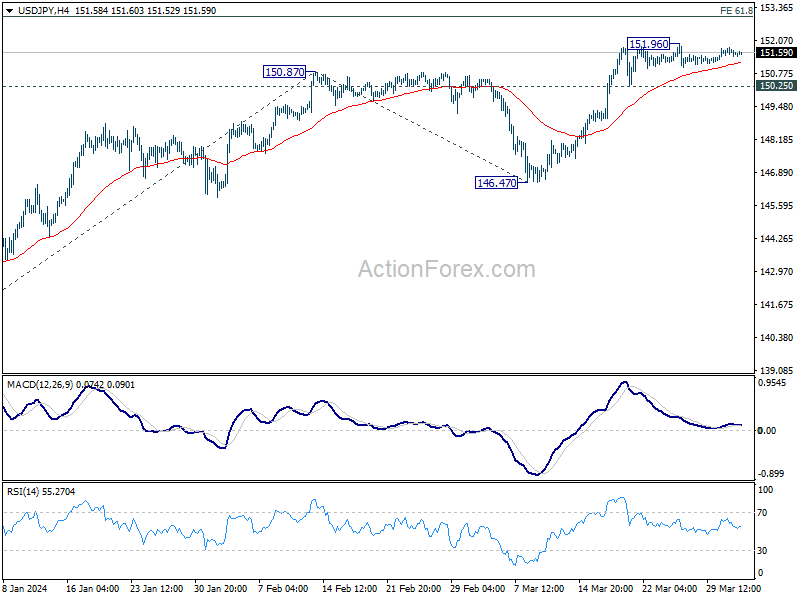
Intraday bias in USD/JPY remains neutral as sideway trading continues below 151.96. On the downside, break of 150.25 support should confirm short term topping, and turn bias back to the downside for 55 D EMA (now at 149.43). Nevertheless, sustained break of 151.93 key resistance will confirm long term up trend resumption. Next near term target will be 61.8% projection of 140.25 to 150.87 from 146.47 at 153.03.
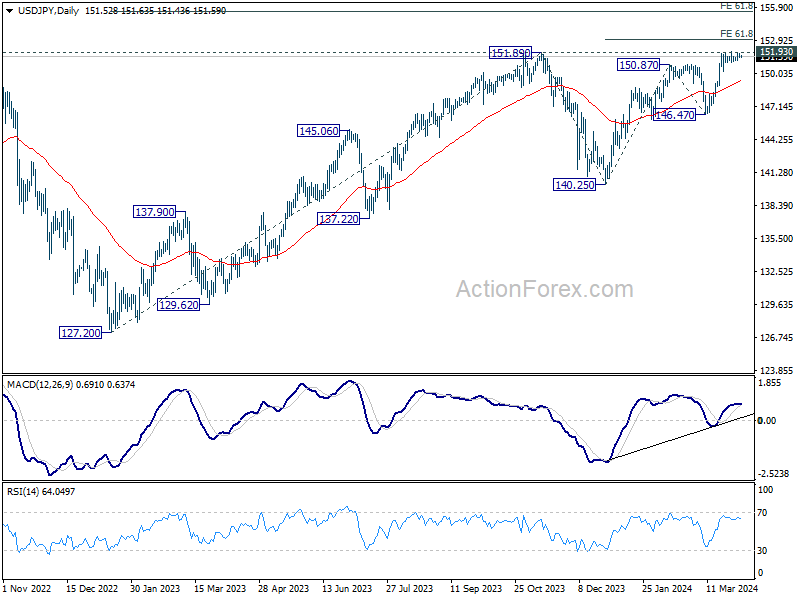
In the bigger picture, correction from 151.87 (2023) high could have completed at 140.25 already. Rise from 127.20 (2023 low), as part of the long term up trend, is probably ready to resume. Decisive break of 151.93 resistance (2022 high) will confirm this bullish case. Next medium term target will be 61.8% projection of 127.20 to 151.89 from 140.25 at 155.20. This will remain the favored case as long as 146.47 support holds, in case of another pullback.
USD/CHF Daily Outlook
Daily Pivots: (S1) 0.9050; (P) 0.9071; (R1) 0.9100; More....
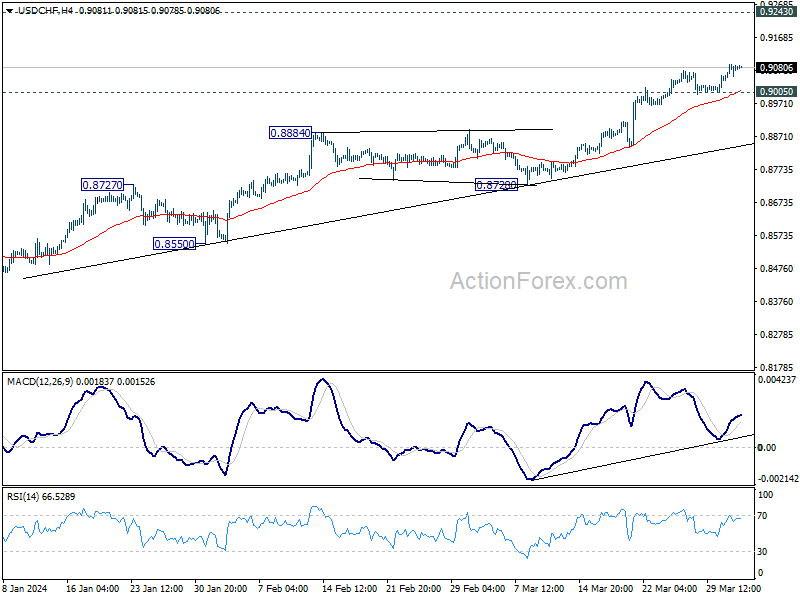
Intraday bias in USD/CHF stays on the upside at this point. Current rally is in progress for 0.9243 key resistance next. On the downside, break of 0.9005 support is needed to indicate short term topping. Otherwise, outlook will stay bullish in case of retreat.
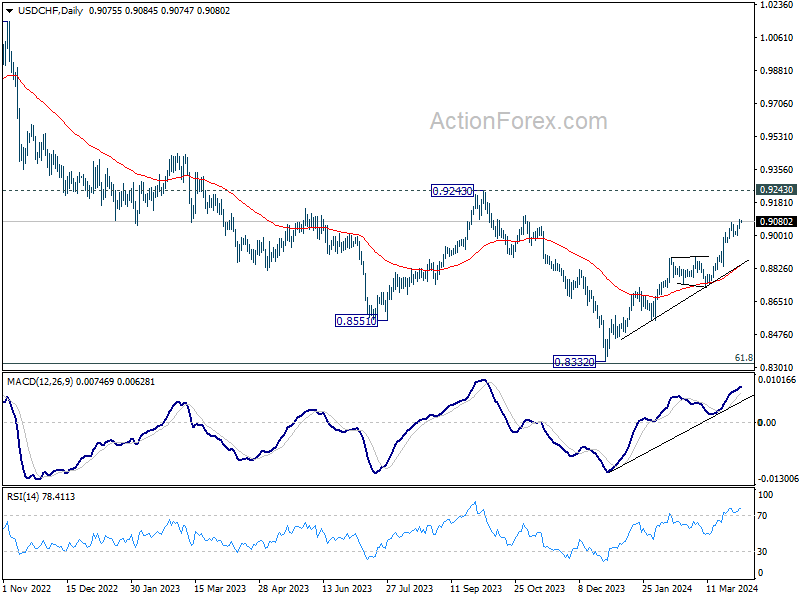
In the bigger picture, price actions from 0.8332 medium term bottom as tentatively seen as developing into a corrective pattern to the down trend from 1.0146 (2022 high). Further rise would be seen as long as 0.8728 support holds. But upside should be limited by 0.9243 resistance, at least on first attempt.
GBP/USD Daily Outlook
Daily Pivots: (S1) 1.2552; (P) 1.2565; (R1) 1.2592; More...
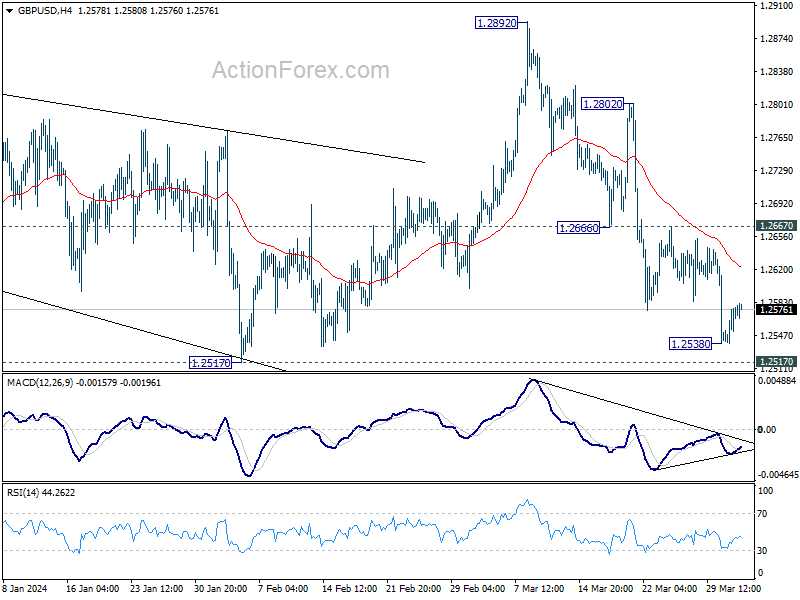
Intraday bias in GBP/USD is turned neutral with current recovery and some consolidations could be seen first. But risk will stay on the downside as long as 1.2667 resistance holds, in case of recovery. Below 1.2538 will target 1.2517 structural support. Decisive break there will suggest that rise from 1.2036 has completed at 1.2892 already, and turn near term outlook bearish.
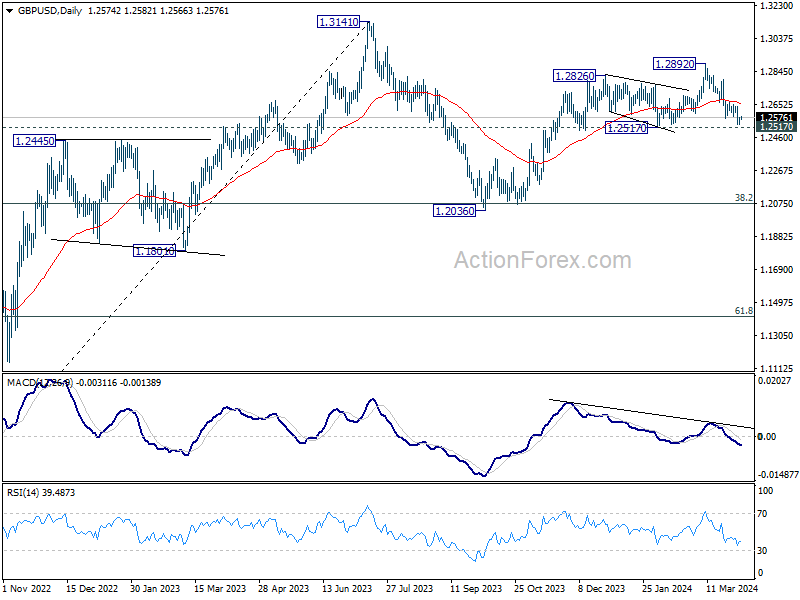
In the bigger picture, price actions from 1.3141 medium term top are seen as a corrective pattern to up trend from 1.0351 (2022 low). Rise from 1.2036 is seen as the second leg, which might still be in progress. But upside should be limited by 1.3141 to bring the third leg of the pattern. Meanwhile, break of 1.2517 support will argue that the third leg has already started for 38.2% retracement of 1.0351 (2022 low) to 1.3141 at 1.2075 again.
EUR/USD Daily Outlook
Daily Pivots: (S1) 1.0736; (P) 1.0758; (R1) 1.0790; More...
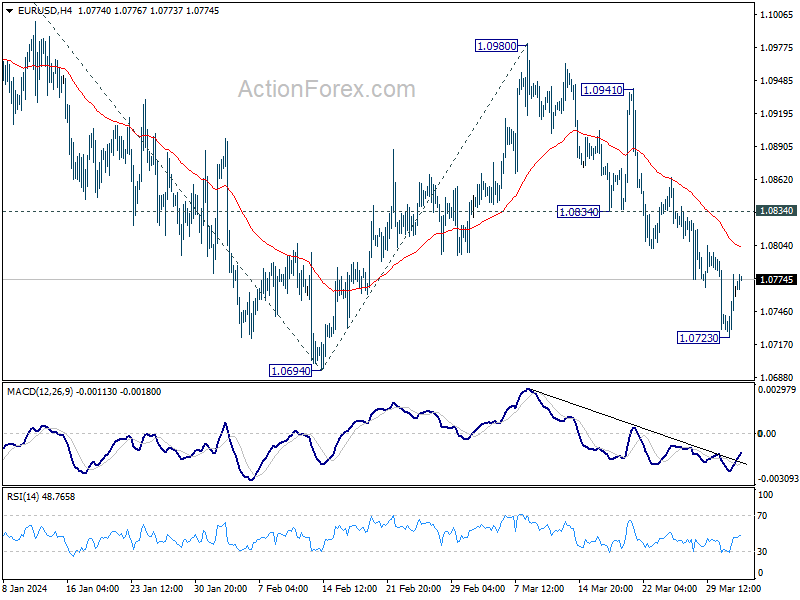
Intraday bias in EUR/USD is turned neutral with current recovery and some consolidation would be seen first. But risk will stay on the downside as long as 1.0834 support turned resistance holds, in case of recovery. Below 1.0723 will bring retest of 1.0694 support first. Decisive break there will resume the whole decline from 1.1138 and target 100% projection of 1.1138 to 1.0694 from 1.0980 at 1.0536.
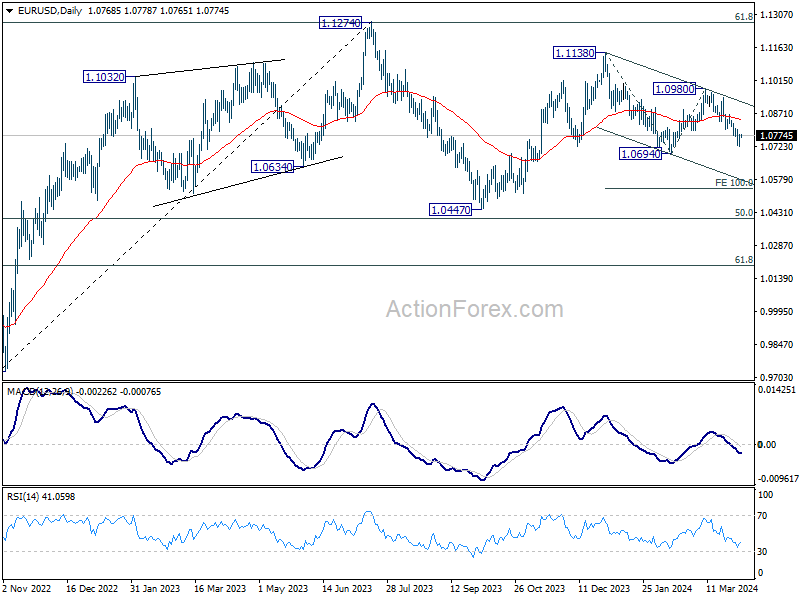
In the bigger picture, price actions from 1.1274 are viewed as a corrective pattern to rise from 0.9534 (2022 low). Rise from 1.0447 is seen as the second leg. While further rally could cannot be ruled out, upside should be limited by 1.1274 to bring the third leg of the pattern. Meanwhile, sustained break of 1.0694 support will argue that the third leg has already started for 1.0447 and possibly below.
Dollar Sees Mild Retreat Ahead of ISM Services, Gold Extends Record Run
Dollar retreated mildly following comments from two FOMC members, including a known hawkish figure, reiterating expectations for three interest rate cuts within the year. Despite this, the retreat remains subdued as there is no guarantee yet for a June cut. Fed's approach continues to be heavily influenced by incoming data. The greenback's next move will hinge on today's ISM Services data, as well as Friday's Non-Farm Payrolls.
Euro is trading as the day's stronger currency, with anticipation building ahead of Eurozone CPI flash release. Market expectations suggest a slight moderation in both headline and core CPI to 2.5% and 3.0%, respectively, for March. Unless faced with significant downside surprises,ECB is poised to begin its interest rate cuts in June rather than April.
In terms of weekly performance, Australian Dollar leads as the strongest currency, followed by Dollar and New Zealand Dollar. Swiss Franc finds itself as the weakest, with Sterling and Canadian Dollar also underperforming. Euro and Yen are situated mid-pack.
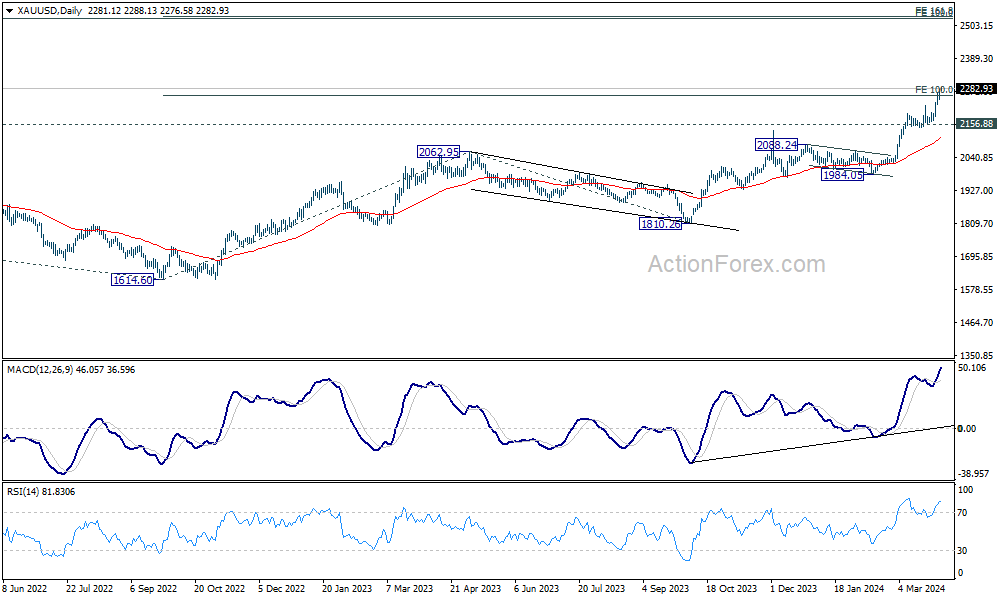
Technically, Gold's record run continues today overbought conditions. 100% projection of 1614.60 to 2062.95 from 1810.26 at 2258.61 is considered clear. Gold should now be on march towards 161.8% projection at 2535.69, or simply put 2500 handle. In any case, near term outlook will stay bullish as long as 2156.88 support holds.
In Asia, at the time of writing, Nikkei is down -0.66%. Hong Kong HSI is down -0.90%. China Shanghai SSE is down -0.20%. Singapore Strait Times is down -0.66%. Japan 10-year JGB yield is up 0.0153 at 0.768. Overnight, DOW fell -1.00%. S&P 500 fell -0.72%. NASDAQ fell -0.95%. 10-year yield rose 0.036 to 4.365.
Fed's Mester views three rate cuts as appropriate, yet decision tightly contested
Cleveland Fed President Loretta Mester said overnight that three rate cuts might be appropriate this year, though she mentioned, "it's a close call" on the possibility of fewer reductions being needed.
Addressing the upcoming meeting scheduled for April 30-May 1, Mester expressed that it is unlikely there will be sufficient information available to make a decision on reducing rates by then. However, she left the door open for a rate cut in June, stating, "We have to be data dependent so I don't want to rule that out."
Mester highlighted the importance of upcoming data to gauge whether the disinflation process is merely experiencing a "temporary detour" or if there are signs that efforts to bring inflation back down to the 2% target are faltering.
She cautioned against premature or overly rapid rate reductions, warning that such actions could jeopardize the progress made on inflation control. "Moving rates down too soon or too quickly without sufficient evidence to give us confidence that inflation is on a sustainable and timely path back to 2% would risk undoing the progress we have made on inflation," Mester remarked.
Fed's Daly: Three rate cuts very reasonable, but not guaranteed
San Francisco Fed President Mary Daly offered described three rate cuts this year as a "very reasonable baseline." However, she was careful to clarify that such a projection should not be interpreted as a commitment, stating, "not a promise."
Daly highlighted the current state of economic growth as a factor tempering the immediacy for policy adjustments, noting, "Growth is going strong, so there's really no urgency to adjust the rate."
Furthermore, Daly voiced concerns over the risks associated with prematurely lowering interest rates. She warned of the "real risk" that too early a cut could entrench the "toxic tax" of persistently high inflation.
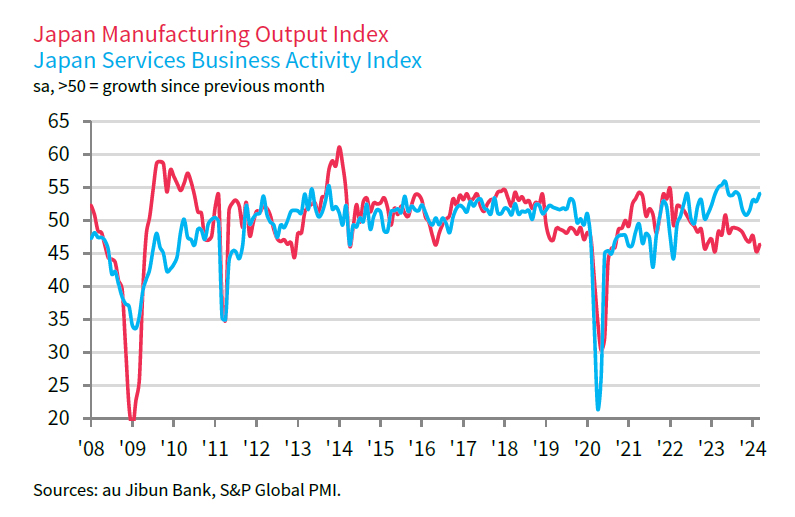
Japan's PMI services finalized at 54.1, marked increase in cost burdens
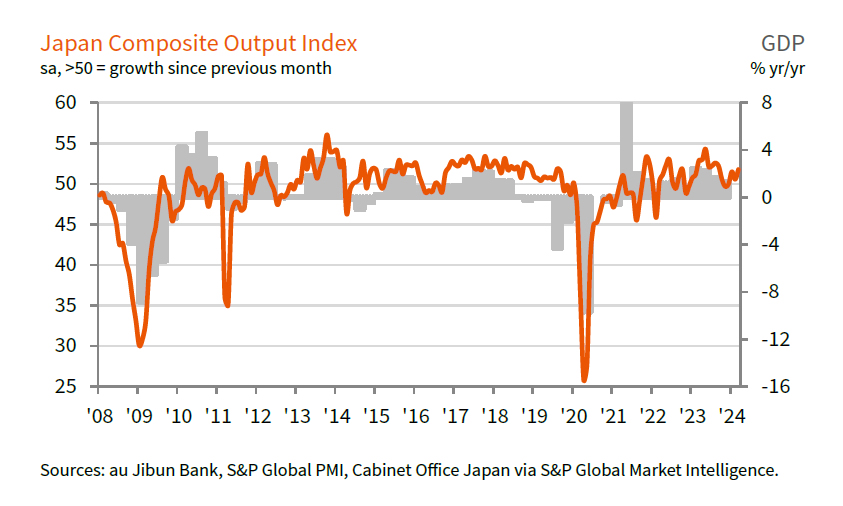
Japan's PMI Services was finalized at 54.1 in March, a notable improvement from February's 52.9 and marking the most significant growth for the past seven months. PMI Composite also rose to 51.7 from the previous month's 50.6.
Usamah Bhatti, economist at S&P Global Market Intelligence, noted that near-term outlook for the service sector appears "robust", as outstanding business, a key indicator of future work, continues to rise at "near-record rates". Confidence regarding the 12-month future also remains strong among service providers.
However, the sector is not without its challenges, particularly on the price front. Businesses signaled "another marked increase in cost burdens," underlining ongoing inflationary pressures. These pressures are mirrored in the broader Japanese private sector, where cost inflation has hit a "five-month high".
Bhatti added that inflationary pressures, alongside BoJ's recent shift away from negative interest rates, "will likely remain a downside risk to the Japanese private sector economy in the coming months."
China's Caixin PMI services edges up to 52.7, matches expectations
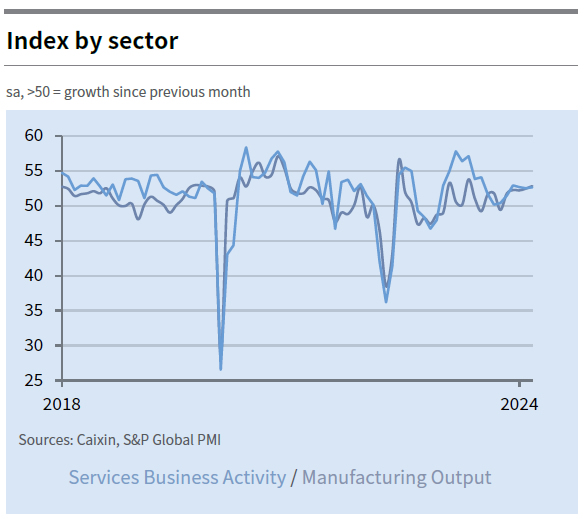
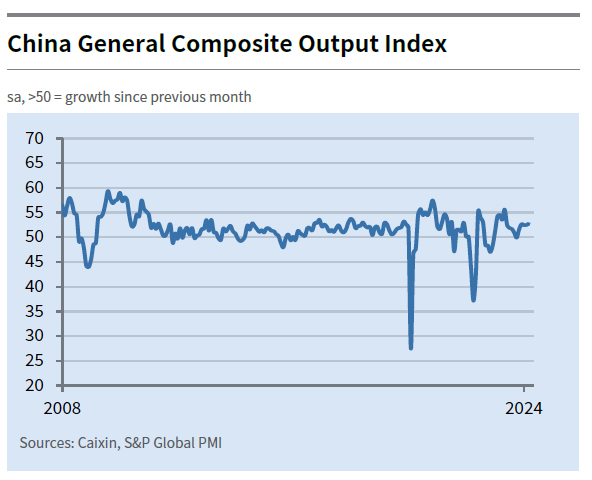
China's Caixin PMI Services edged up slightly from 52.5 to 52.7 in March, matched expectations. PMI Composite, which tracks both manufacturing and service sectors, also increased from 52.5 to 52.7, indicating the most pronounced expansion of overall business activity since May 2023.
Wang Zhe, Senior Economist at Caixin Insight Group, highlighted the favorable economic performance in the early months of the year and the manufacturing sector's five-month run in expansionary territory. He stated, "This indicates a generally stable and positive economic recovery".
Despite these optimistic signs, the economist pointed out several challenges facing the Chinese economy. Wang Zhe identified persistent downward economic pressures, subdued employment levels, low prices, and insufficient effective demand as critical issues that have yet to be fully addressed.
Looking ahead
Eurozone CPI flash is the main feature in European session. US ADP employment and ISM services will take center stage in US session.
EUR/USD Daily Outlook
Daily Pivots: (S1) 1.0736; (P) 1.0758; (R1) 1.0790; More...
Intraday bias in EUR/USD is turned neutral with current recovery and some consolidation would be seen first. But risk will stay on the downside as long as 1.0834 support turned resistance holds, in case of recovery. Below 1.0723 will bring retest of 1.0694 support first. Decisive break there will resume the whole decline from 1.1138 and target 100% projection of 1.1138 to 1.0694 from 1.0980 at 1.0536.
In the bigger picture, price actions from 1.1274 are viewed as a corrective pattern to rise from 0.9534 (2022 low). Rise from 1.0447 is seen as the second leg. While further rally could cannot be ruled out, upside should be limited by 1.1274 to bring the third leg of the pattern. Meanwhile, sustained break of 1.0694 support will argue that the third leg has already started for 1.0447 and possibly below.
Economic Indicators Update
| GMT | Ccy | Events | Actual | Forecast | Previous | Revised |
|---|---|---|---|---|---|---|
| 00:30 | JPY | Services PMI Mar F | 54.1 | 54.9 | 54.9 | |
| 01:45 | CNY | Caixin Services PMI Mar | 52.7 | 52.7 | 52.5 | |
| 08:00 | EUR | Italy Unemployment Feb | 7.20% | 7.20% | ||
| 09:00 | EUR | Eurozone CPI Y/Y Mar P | 2.50% | 2.60% | ||
| 09:00 | EUR | Eurozone CPI Core Y/Y Mar P | 3.00% | 3.10% | ||
| 12:15 | USD | ADP Employment Change Mar | 150K | 140K | ||
| 13:45 | USD | Services PMI Mar F | 51.7 | 51.7 | ||
| 14:00 | USD | ISM Services PMI Mar | 52.8 | 52.6 | ||
| 14:30 | USD | Crude Oil Inventories | -0.3M | 3.2M |
GBP/USD Slides Further and Bears Are Not Done Yet
Key Highlights
- GBP/USD gained bearish momentum below the 1.2640 support zone.
- A major bearish trend line is forming with resistance at 1.2670 on the 4-hour chart.
- Gold prices rallied further above the $2,260 resistance.
- The US ISM Services Index could increase from 52.6 to 52.7 in March 2024.
GBP/USD Technical Analysis
The British Pound started another decline below the 1.2740 zone against the US Dollar. GBP/USD traded below the 1.2650 and 1.2620 levels to move into a bearish zone.
Looking at the 4-hour chart, the pair even settled below the 1.2600 level, the 100 simple moving average (red, 4-hour), and the 200 simple moving average (green, 4-hour). Finally, the pair traded below the 1.2550 support.
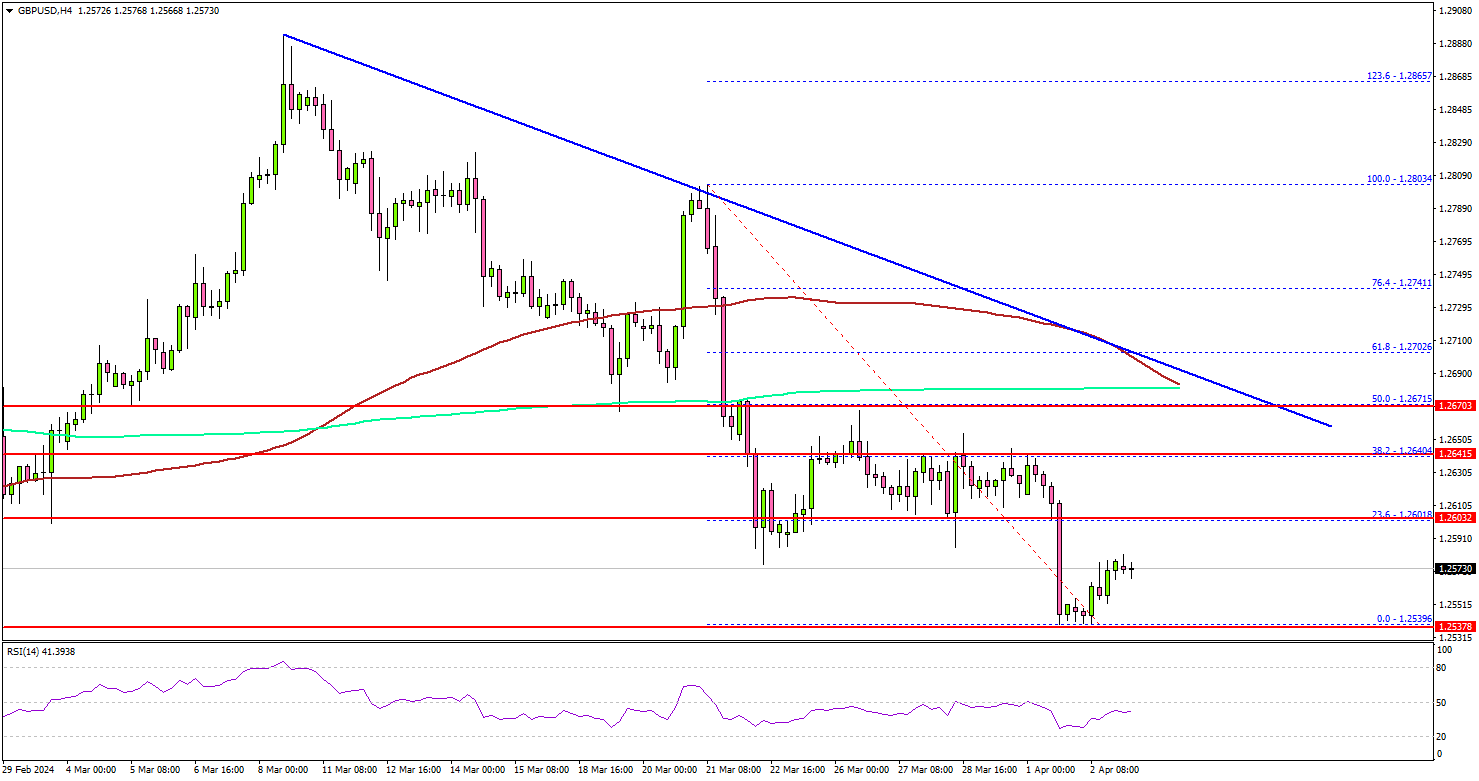
A low was formed near 1.2539 and the pair is now consolidating losses. On the upside, the pair could face resistance near the 1.2580 level. The first major resistance is now forming near 1.2600 or the 23.6% Fib retracement level of the downward move from the 1.2803 swing high to the 1.2539 low.
The first major resistance is forming near the 1.2640 level. The main resistance is now forming near 1.2670. There is also a major bearish trend line forming with resistance at 1.2670 on the same chart.
A close above the 1.2670 zone could open the doors for more upsides. The next stop for the bulls might be 1.2800. If not, the pair might continue to decline. Immediate support is near the 1.2530 level.
The next major support is at 1.2500. If there is a downside break below the 1.2500 support, the pair could decline toward the 1.2440 support. Any more losses might send the pair toward the 1.2350 level in the near term.
Looking at Gold, the bulls remain in control as they were able to push prices above the $2,260 level and there could be a move toward $2,300.
Economic Releases
- US ISM Services Index for March 2024 – Forecast 52.7, versus 52.6 previous.
- Federal Reserve Chair Jerome Powell’s speech.
China’s Caixin PMI services edges up to 52.7, matches expectations
China's Caixin PMI Services edged up slightly from 52.5 to 52.7 in March, matched expectations. PMI Composite, which tracks both manufacturing and service sectors, also increased from 52.5 to 52.7, indicating the most pronounced expansion of overall business activity since May 2023.
Wang Zhe, Senior Economist at Caixin Insight Group, highlighted the favorable economic performance in the early months of the year and the manufacturing sector's five-month run in expansionary territory. He stated, "This indicates a generally stable and positive economic recovery".
Despite these optimistic signs, the economist pointed out several challenges facing the Chinese economy. Wang Zhe identified persistent downward economic pressures, subdued employment levels, low prices, and insufficient effective demand as critical issues that have yet to be fully addressed.
Japan’s PMI services finalized at 54.1, marked increase in cost burdens
Japan's PMI Services was finalized at 54.1 in March, a notable improvement from February's 52.9 and marking the most significant growth for the past seven months. PMI Composite also rose to 51.7 from the previous month's 50.6.
Usamah Bhatti, economist at S&P Global Market Intelligence, noted that near-term outlook for the service sector appears "robust", as outstanding business, a key indicator of future work, continues to rise at "near-record rates". Confidence regarding the 12-month future also remains strong among service providers.
However, the sector is not without its challenges, particularly on the price front. Businesses signaled "another marked increase in cost burdens," underlining ongoing inflationary pressures. These pressures are mirrored in the broader Japanese private sector, where cost inflation has hit a "five-month high".
Bhatti added that inflationary pressures, alongside BoJ's recent shift away from negative interest rates, "will likely remain a downside risk to the Japanese private sector economy in the coming months."
Fed’s Daly: Three rate cuts very reasonable, but not guaranteed
San Francisco Fed President Mary Daly offered described three rate cuts this year as a "very reasonable baseline." However, she was careful to clarify that such a projection should not be interpreted as a commitment, stating, "not a promise."
Daly highlighted the current state of economic growth as a factor tempering the immediacy for policy adjustments, noting, "Growth is going strong, so there's really no urgency to adjust the rate."
Furthermore, Daly voiced concerns over the risks associated with prematurely lowering interest rates. She warned of the "real risk" that too early a cut could entrench the "toxic tax" of persistently high inflation.
Fed’s Mester views three rate cuts as appropriate, yet decision tightly contested
Cleveland Fed President Loretta Mester said overnight that three rate cuts might be appropriate this year, though she mentioned, "it's a close call" on the possibility of fewer reductions being needed.
Addressing the upcoming meeting scheduled for April 30-May 1, Mester expressed that it is unlikely there will be sufficient information available to make a decision on reducing rates by then. However, she left the door open for a rate cut in June, stating, "We have to be data dependent so I don't want to rule that out."
Mester highlighted the importance of upcoming data to gauge whether the disinflation process is merely experiencing a "temporary detour" or if there are signs that efforts to bring inflation back down to the 2% target are faltering.
She cautioned against premature or overly rapid rate reductions, warning that such actions could jeopardize the progress made on inflation control. "Moving rates down too soon or too quickly without sufficient evidence to give us confidence that inflation is on a sustainable and timely path back to 2% would risk undoing the progress we have made on inflation," Mester remarked.