

Sample Category Title
Fed Powell’s testimony eyed, 10-year yield takes a preemptive drop
Fed Chairman Jerome Powell is set to begin his two-day semiannual Congressional testimony today, drawing significant attention from the markets as participants seek clarity on the Fed's monetary policy direction for the year. Key questions include the timing of the first rate cut and the total number expected throughout the year.
Powell is anticipated to reiterate the cautious stance echoed by his colleagues, indicating that Fed is not in a hurry to lower interest rates. The central bank seeks further assurance that inflation is on a consistent downward path to target before considering rate reductions. Regarding the number of rate cuts, Powell may reference the median projection of three cuts this year, emphasizing that any adjustments will be contingent on incoming economic data.
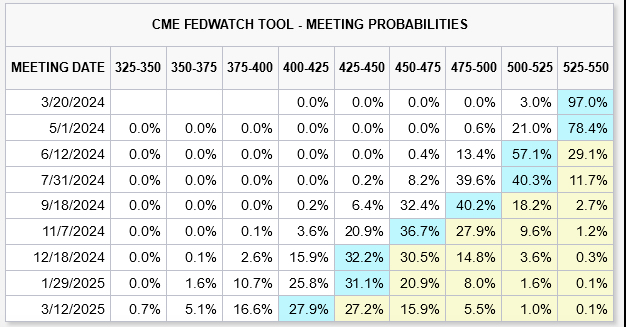
Currently fed fund futures suggest a slightly less than 70% probability of the initial rate cut occurring in June. By year-end, the likelihood exceeds 80% that federal funds rate will adjust to a range of 4.50-4.75%, marking three 25bps reductions from the present 5.25-5.50% level.
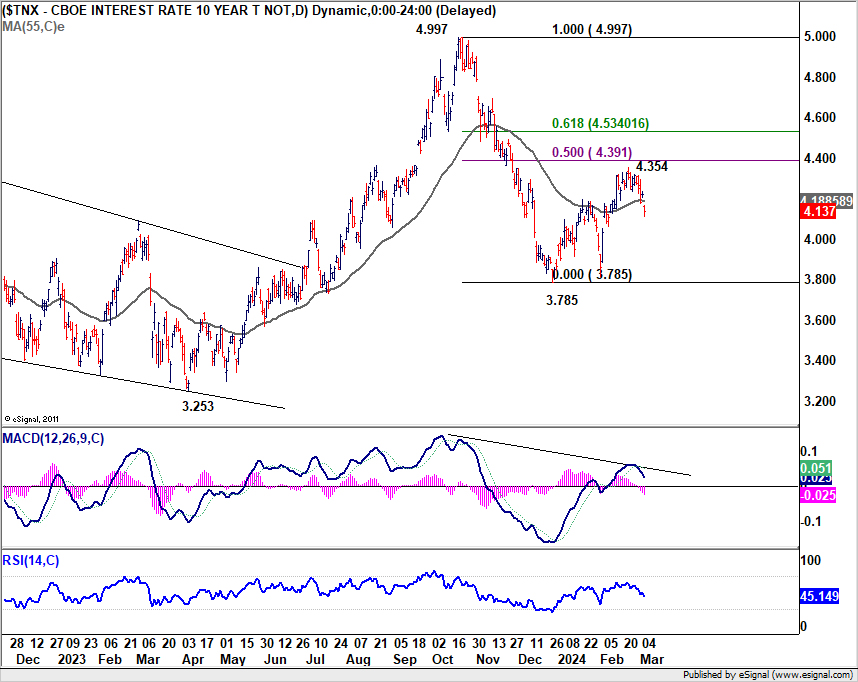
A key to watch is the reactions in 10-year yields the break of 55 D EMA (now at 4.188) affirms the case that corrective recovery from 3.785 has completed at 4.354 already. Risk will now stay on the downside as long as this EMA holds. Deeper fall is in favor towards 3.785 low. This development would keep Dollar under some pressure, or at least cap its rally momentum. A daily close above 55 EMA would delay the bearish case. But upside potential for rebound should be limited below 4.354.
DAX Bullish Impulse Looks Incomplete
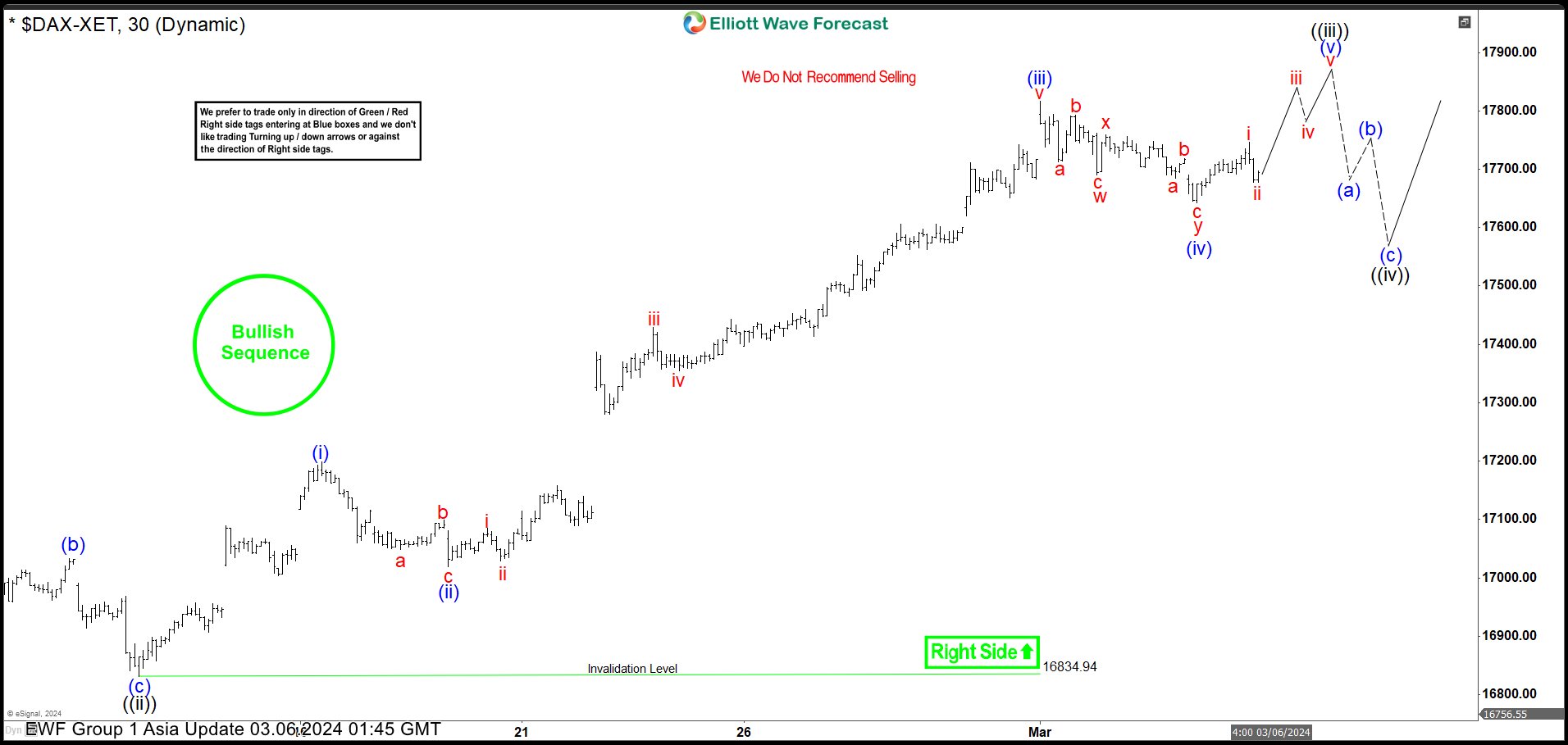
Short Term Elliott Wave View in DAX suggests that rally from 1.17.2024 low is in progress as a 5 waves impulse. Up from 1.17.2024 low, wave ((i)) ended at 17049.52 and dips in wave ((ii)) ended at 16834.94. Up from there, wave ((iii)) is in progress as a 5 waves impulse. Wave (i) ended at 17198.45 and pullback in wave (ii) ended at 17019.15. The Index extends higher again in wave (iii). Up from wave (ii), wave i ended at 17084.87 and wave ii dips ended at 17029.59. Wave iii higher ended at 17429.66 and wave iv ended at 17354.76. Final leg wave v ended at 17816.52 which completed wave (iii).
Pullback in wave (iv) ended at 17643.11 with internal subdivision as a double three. Down from wave (iii), wave w ended at 17690.89 and wave x ended at 17759.02. Final leg wave y ended at 17643.11 which completed wave (iv) in higher degree. The Index then resumes higher in wave (v). Up from wave (iv), wave i ended at 17746.57 and wave ii ended at 17677.03. Near term, as far as pivot at 16834.94 stays intact, expect Index to extend higher.
DAX 60 Minutes Elliott Wave Chart
DAX Elliott Wave Video
https://www.youtube.com/watch?v=2HPF2xx3Qto
BoC to hold rates steady, EUR/CAD and GBP/CAD extending gains
BoC is widely anticipated to maintain benchmark overnight rate at 5.00% today, marking the fifth consecutive meeting without change. While dropping its tightening bias in January, it is deemed premature for BoC to adopt a loosening stance at this point. The central bank might reiterate the ongoing process to bring inflation back to target, indicating that the desired state has not been fully achieved yet. The critical aspect to observe will be how Governor Tiff Macklem articulates the current inflation outlook.
A recent Bloomberg survey highlighted consensus among economists predicting the first rate cut to occur in June. Overnight swaps markets attributing a mere 30% chance for a cut in April and anticipating the initial full 25 basis points reduction in July. Nonetheless, these projections remain flexible, hinging on forthcoming data and economic developments.
Canadian Dollar is trading as the month's weakest performer so far, particularly struggling against Euro and Sterling. More downside is in favor for the Loonie in the near term as traders continue to reverse their bets on earlier ECB and BoE cut. The persistence of this selling momentum, however, ultimately depends on which central bank initiates rate cuts first and the subsequent rate of policy easing.
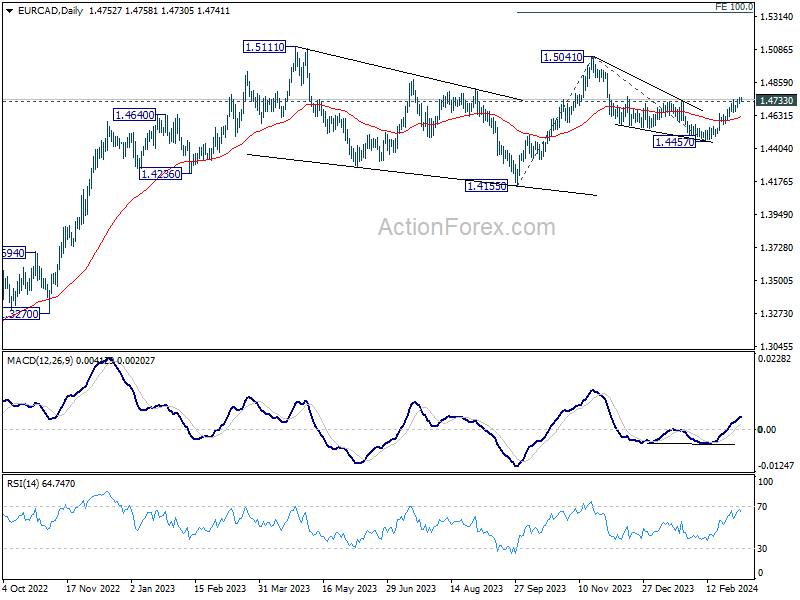
Technically, EUR/CAD's breach of 1.4733 resistance suggests that correction from 1.5041 has already completed with three waves down to 1.4457. Further rally is now in favor as long as 55 D EMA (now at 1.4625) holds. Further rally would be seen to retest 1.5041 resistance first. Firm break there will resume the larger up trend to 61.8% projection of 1.4155 to 1.5041 from 1.4457 at 1.5343 next.
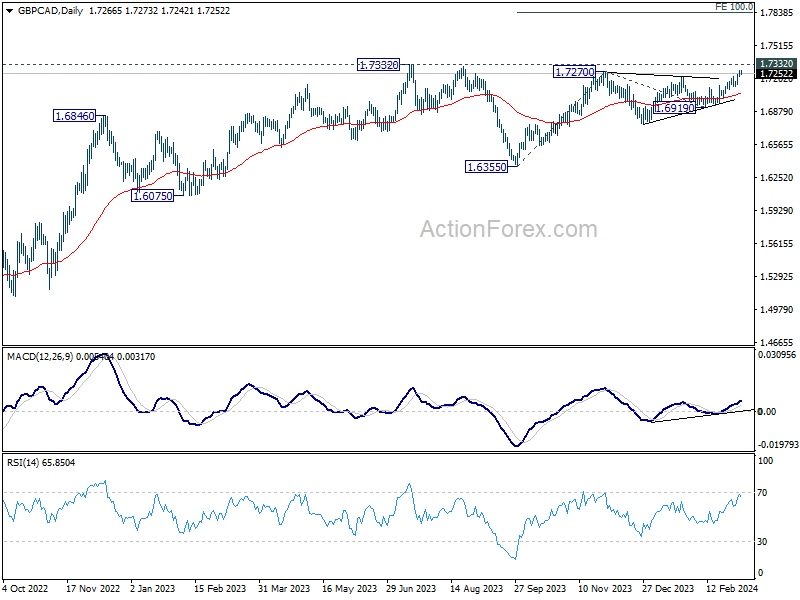
GBP/CAD's breach of 1.7270 resistance this week suggests that consolidation from there has completed at 1.6919 already. Further rise is in favor as long as 55 D EMA (now at 1.7060) holds. Decisive break of 1.7332 high will resume the larger up trend from 1.4069 and target 100% projection of 1.6355 to 1.7270 from 1.6919 at 1.7834.
Australia’s GDP up 0.2% qoq in Q4, continuing consistent slowdown
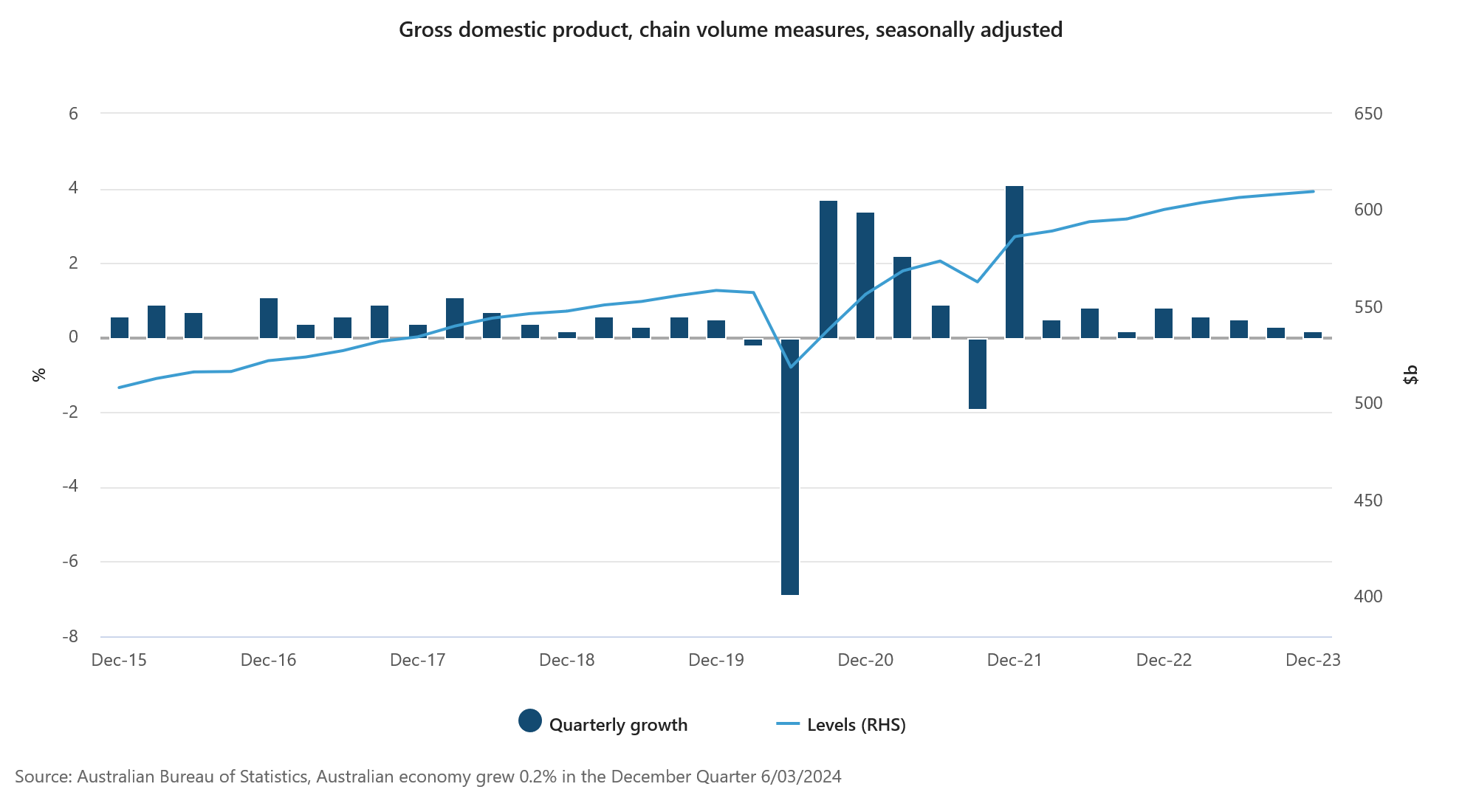
Australia GDP grew 0.2% qoq in Q4, slightly below expectation of 0.3% qoq. On an annual basis, the economy expanded by 1.5% yoy.
The data indicates deceleration in economic momentum as the year progressed, with Katherine Keenan, the head of national accounts at ABS, noting a consistent slowdown across each quarter of 2023.
The main pillars supporting GDP growth were identified as government spending and private business investment. Government final consumption expenditure saw 0.6% qoq increase , while private business investment grew 0.7% qoq.
The significant contribution of net trade, which added 0.6 percentage points to the overall GDP growth, was largely attributed to a -3.4% qoq decrease in import.
Gold Price Surges Above $2,100, Bitcoin Sets New ATH
Key Highlights
- Gold rallied above the $2,080 and $2,100 resistance levels.
- A connecting bullish trend line is forming with support at $2,045 on the 4-hour chart.
- Bitcoin extended gains above the $68,800 resistance.
- Ethereum bulls seem to be aiming for a move toward $4,000.
Gold Price Technical Analysis
Gold prices started a fresh increase from the $2,020 support against the US Dollar. The bulls cleared the $2,065 resistance to start a strong rally.
The 4-hour chart of XAU/USD indicates that the price settled above the $2,080 level, the 100 Simple Moving Average (red, 4 hours), and the 200 Simple Moving Average (green, 4 hours).
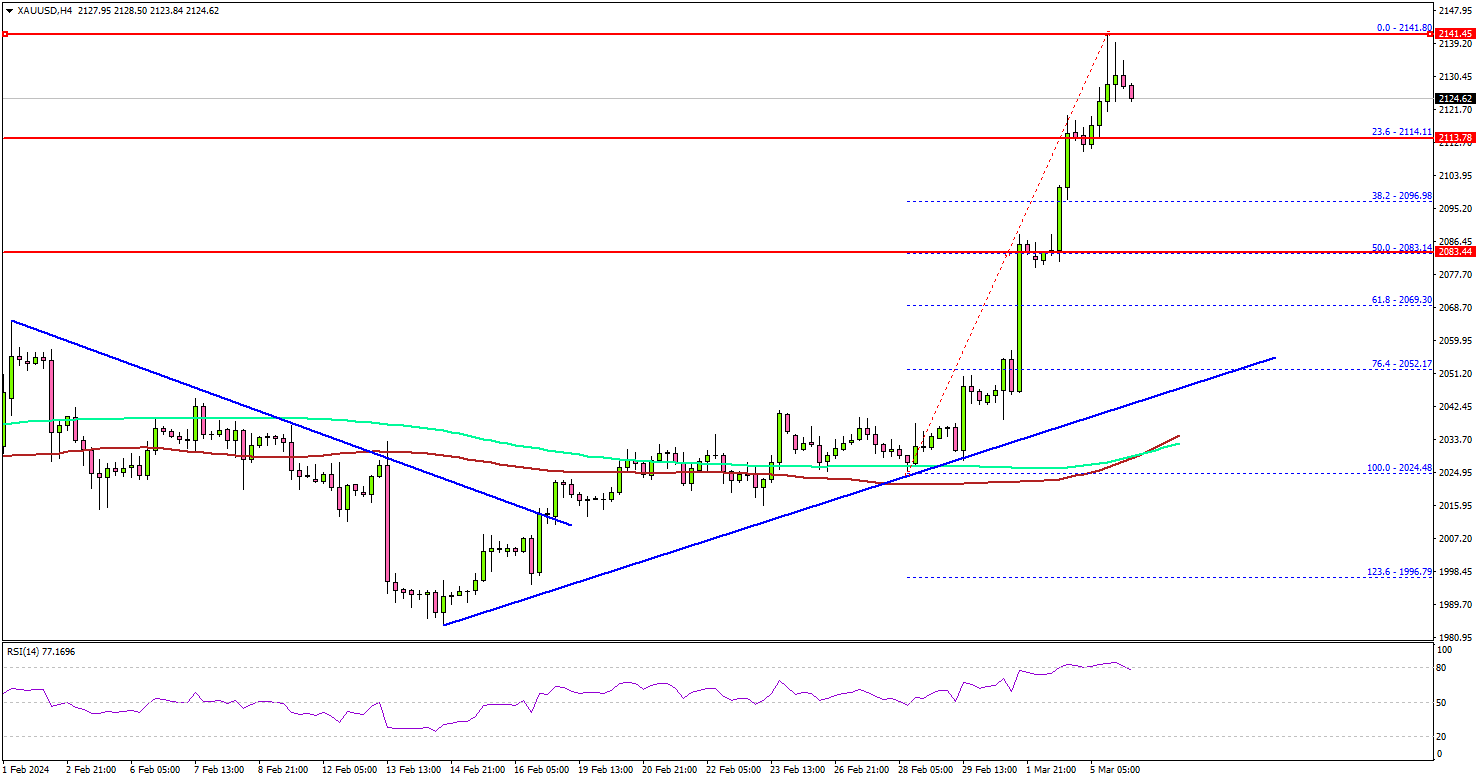
The bulls were able to pump the price above the $2,100 and $2,120 levels. If they remain in action, there could be a move toward the $2,150 level. Any more gains might open the doors for a test of $2,180.
Initial support is near the $2,110 level. The first major support sits at $2,080. Any more losses might call for a move toward the $2,050 level in the coming days.
There is also a connecting bullish trend line forming with support at $2,045 on the same chart, below which Gold might decline and test the 100 Simple Moving Average (red, 4 hours) at $2,030.
Looking at Bitcoin, there was a strong upward move above the $66,000 and $68,000 levels. The next key resistance sits at $70,000.
Economic Releases to Watch Today
- Euro Zone Retail Sales for Jan 2024 (YoY) - Forecast -1.3%, versus -0.8% previous.
- BoC Interest Rate Decision – Forecast 5.0%, versus 5.0% previous.
RBNZ’s Conway: OCR to stay restrictive for some time into the future
RBNZ Chief Economist Paul Conway, speaking at a webinar today, noted that emphasizing the contractionary nature of current interest rates is effectively "tapping the brakes" on the economy to moderate its pace of growth and address inflationary pressures.
Conway expressed optimism about the recent declines in core inflation and business inflation expectations. However, he also highlighted ongoing concerns regarding elevated household inflation expectations, which pose a potential risk to the inflation outlook.
Looking forward, Conway underscored the necessity for OCR to maintain a restrictive level "for some time into the future" to get headline inflation, currently at 4.7%, back into the 1-3% target band.
An interesting consideration Conway raised was the impact of Fed's policy moves on New Zealand's monetary policy trajectory. He suggested that if Fed were to initiate rate cuts towards the end of the year, and RBNZ did not follow suit, the resulting appreciation in NZD could alleviate inflationary pressures in New Zealand. This scenario might prompt RBNZ to reassess its rate cut timeline, leading to earlier-than-anticipated adjustments depending on the broader economic implications.
Dissecting ECB Monetary Policy Decisions Communiqué
- The monetary policy decisions statement is released at 13:15 GMT
- President Lagarde et al could signal a policy shift in this communiqué
- The ECB staff projections could also hold the key to a rate cut soon
- The scheduled press conference takes place 30 minutes later
Complementing the detailed ECB preview, this report focuses on the first communication made by the European Central Bank after the completion of each rate setting meeting. A press statement called “Monetary policy decisions” is released at 13:15 GMT and it is the first point of reference for traders. This communiqué has grown in both length and importance since President Lagarde took over on November 1, 2019.
The communiqué layout is mostly predetermined
There is a preset layout for this communiqué with the necessary flexibility to shift the segments around in order to convey the intended message. The initial section contains a comment on the current economic conditions, mostly on inflation, with the first paragraph presenting any likely rate changes decided in the respective gathering. Barring a major upset, Thursday’s communiqué should report that the ECB decided to keep the three ECB rates unchanged.
ECB Staff projections are again the key
This first section of this communication release becomes even more important when the ECB staff projections are published in March, June, September and December of each year. Therefore, on Thursday this section will be closely scrutinized as the updated ECB staff projections could offer the ECB with sufficient justification for a rate cut soon, even in April. This has occurred in the past as on June 9, 2022 the staff projections were used to pre-announce the first rate hike after almost 11 years of stable rates, while the September 2023 projections essentially confirmed the end of the 14-month long rate hiking cycle.
The next paragraph usually signals the ECB's rate intentions regarding its future gatherings. For example, the "Governing Council (GC) will take whatever action is needed" comment at the April 14, 2022 communiqué morphed into the "the GC decided to take further steps in normalising its monetary policy" sentence in the June 9, 2022 release, essentially signalling that a rate hike was coming up next.
Since hiking rates in September 2023, the communiqué includes the following key paragraph: “Based on its current assessment, the GC considers that the key ECB interest rates are at levels that, maintained for a sufficiently long duration, will make a substantial contribution to this goal. The GC’s future decisions will ensure that its policy rates will be set at sufficiently restrictive levels for as long as necessary.” Should President Lagarde et al decide to send an initial dovish signal to the market, this paragraph could be amended, especially the latter part about the time needed to maintain the current level of ECB rates.
The "Key ECB interest rates" segment is usually next
Provided that there are no changes at the various ECB asset purchases programmes, the details of the meeting’s rate decision follow. Should the ECB want to clearly state its strategy for the next meeting, comments like "the GC expects to raise the key ECB interest rates again in September" appearing after the June 9, 2022 gathering could feature at Thursday's communiqué. This looks somewhat far-fetched considering President Lagarde’s inclination to avoid any precommitment, but the ECB has utilized this approach in the past and could possibly employ it again, if deemed necessary.
A comment on the various ECB purchase programmes usually follows
Βarring a surprise, no change at both the Asset purchase programme (APP) and pandemic emergency purchase programme (PEPP) is expected. The PEPP was amended at the December 2023 meeting with the ECB announcing its intention to reduce the PEPP portfolio by €7.5bn per month on average over the second half of 2024. It also maintained its original promise of discontinuing reinvestments under the PEPP at the end of 2024. Another amendment to the PEPP announced on Thursday could mean that a rate cut could be closer than currently foreseen by the market.
The "Refinancing operations" section is usually last
The refinancing section of this press communication is usually not market moving. However, the final four operations of the third TLTRO programme mature during 2024 with the first, and biggest one with €215.5bn outstanding amount, scheduled for a March 27 maturity. Considering the €3.5trn deposited at the overnight ECB facility, the full repayment of this amount is unlikely to change the current liquidity profile of most banking institutions. Nevertheless, President Lagarde et al could have a comment on the provision of liquidity by the ECB.
Putting everything together, when the monetary policy decisions communiqué is published on Thursday at 13:15 GMT the focus should be on (1) the first section detailing the new staff projections, offering the ECB’s view on recent inflation prints and possibly including a comment from President Lagarde et al on upcoming ECB gatherings and (2) on the "Key ECB interest rates" segment potentially signalling a rate cut in April or June.
ECB to Ask for More Patience Before Rate Cuts
- ECB announces rate decision on Thursday at 13:15 GMT
- Policymakers to avoid rate cut signals as inflation risks linger in the background
- New economic projections might reflect potential changes in the ECB’s thinking
Don’t expect rate cut signals
Hawkish views by central bankers and positive economic data have led investors to reconsider their expectations of aggressive rate cuts. Although no actions are anticipated during the European Central Bank's policy review this week, the board's updated economic projections may shed light on the feasibility of a rate cut in June.
The recent euphoria in European stock markets is more of a reflection of the AI frenzy than a true picture of the region’s economy. Real GDP growth in the eurozone declined to 0.1% y/y in the second half of 2023. This is below the ECB’s sluggish forecast of 0.6% y/y expansion but is not considered a technical recession thanks to Spain’s and Portugal’s positive tourism performance which prevented the bloc from falling off the cliff despite Europe’s diminishing powerhouse Germany weighing on the output.
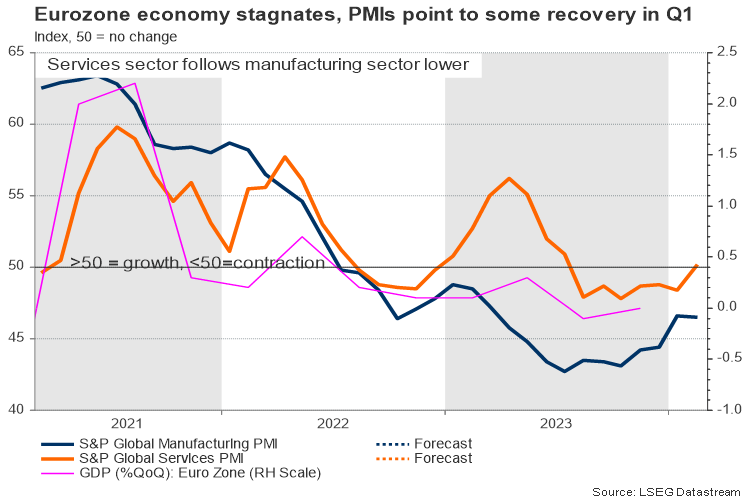
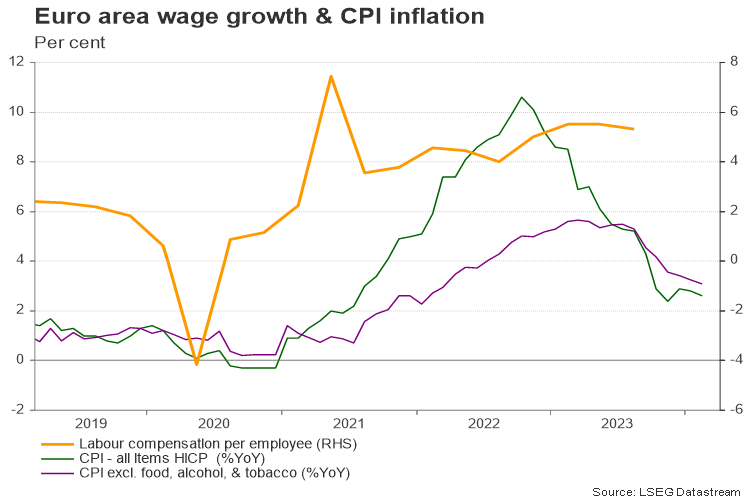
Despite the stagnant economy, policymakers are cautious about rate reductions to avoid fueling inflation amidst low unemployment and increasing wages. Moreover, the EU's surrounding areas are experiencing instability, with no clear indication of when a ceasefire will occur in the Middle East and if Russia-NATO relations will improve in the near future. Therefore, another round of spikes in energy and food prices cannot be ruled out in the foreseeable future.
The ECB prefers to witness a stable decline in inflation towards its 2.0% goal before engaging in talks about rate cuts. Apparently, this is difficult to ensure this week. So, the central bank may not risk losing its credibility by disclosing its rate cut plans prematurely, especially when core CPI inflation is still above 3.0% and oil prices are rising again. There is another meeting in April and a couple of data releases, which might provide more clarity on the inflation path before June’s gathering, while May’s negotiated wage data for Q1 might be worth waiting too.
But new economic projections might move the euro
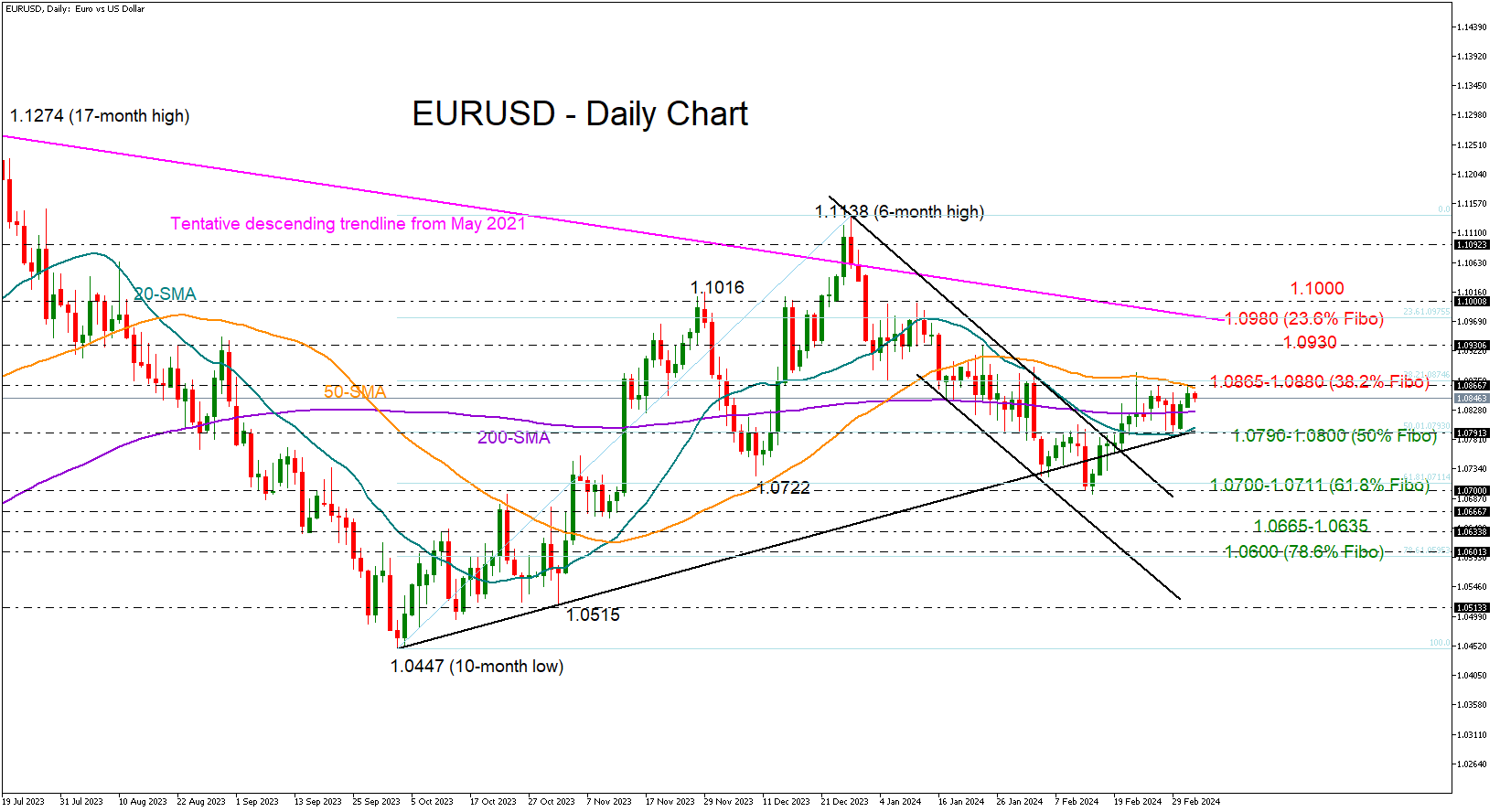
Hence, the central bank may not open up on Lagarde’s summer rate cut rhetoric, but its updated economic forecasts might give some indirect insight into its thinking. Previous projections showed headline inflation averaging around 2.1% y/y at the end of 2025. If policymakers bring the timing forward, investors might feel more confident that a June rate cut is on the way. In this case, EURUSD could reverse lower to test its 1.0790-1.0800 support zone, a break of which could prompt a sharper decline towards 1.0700.
Otherwise, if the central bank disappoints those who expect rate cut signals, sticking to its existing guidance and inflation forecasts, the euro could gear up. Specifically, the bulls will look for a close above the important 1.0880 bar and the 50-day simple moving average to lift the price aggressively into the 1.0930-1.0980 region. A negative surprise in the US nonfarm payrolls or unexpected dovish tweaks in Powell’s testimony later this week might have a similar impact on the pair.
That said, the eurozone economy may not have the comfort to wait for too long either. The elevated interest rates keep weighing on loans, with bank lending to households rising incrementally in February year-on-year and at the softest pace since June 2015. Mortgage lending faced a slight contraction for the first time in nine years, and corporate lending diminished too. Therefore, if not at this meeting, the next ECB gatherings might be more eventful for markets, potentially providing more details about when and how interest rates will drop.
USDJPY: Will the Bullish Trend Persist?
- Bullish Scenario: Intraday buys above 149.80 with TP: 150.50, TP2: 150.80, and TP3: 151.00 and 151.90 medium-term, with S.L. below 149.60 or at least 1% of account capital*. Apply trailing stop.
- Bearish Scenario: Sales below 150.50 with TP1: 149.80, TP2: 149.17, and 147.62 medium-term with S.L. above 150.80 or at least 1% of account capital*.
Fundamental Environment
The Bank of Japan has been postponing its plans to abandon its moderate policy stance as wage growth is still not strong enough to sustainably keep inflation above the 2% target.
This week, the key trigger for the pair will be the testimony of Federal Reserve Chairman Jerome Powell before Congress on Wednesday, who may reiterate that there is no urgency to cut rates. The Federal Reserve is less likely to cut interest rates before gaining confidence that inflation will sustainably return to the 2% target.
Analysis from a daily chart. Volume Profile and Structure.
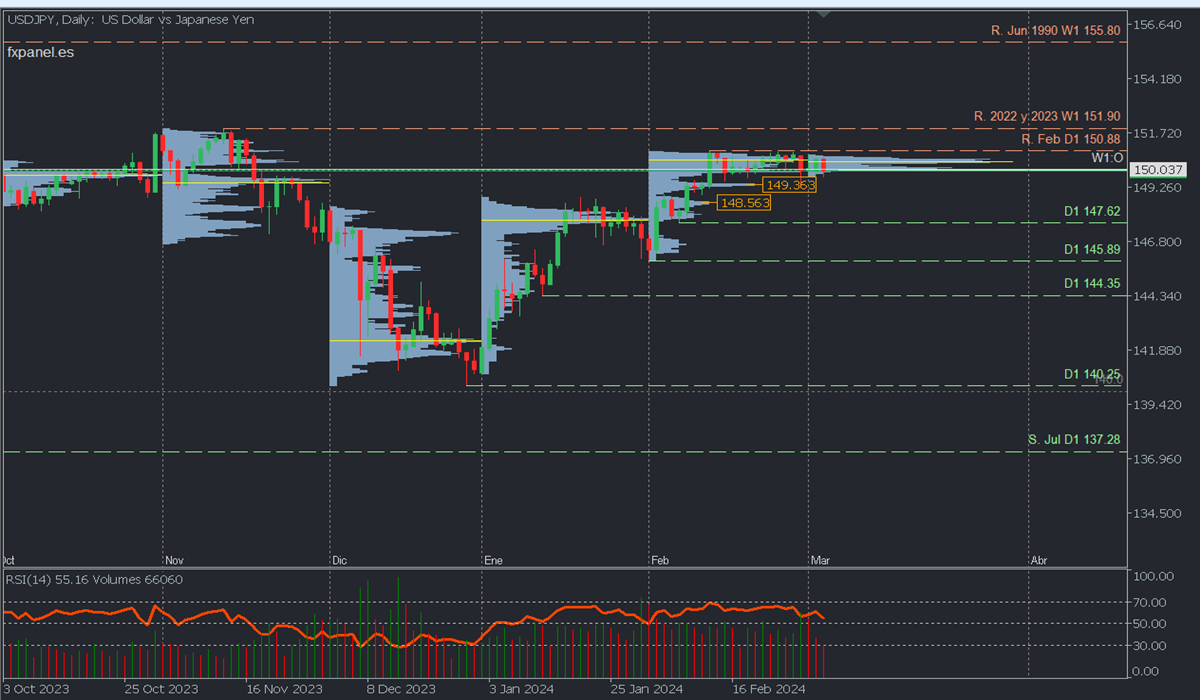
The pair has maintained a bullish technical structure since January, aiming to break the 2022 and 2023 resistance at 151.96 to extend the multi-month bullish trend, although it remained consolidated in February below its resistance at 150.88, leaving a volume concentration around 150.48, after a brief rebound from a high-volume node of the month around 149.36.
All of the above leaves the scenario open to continue bullish if prices decisively break above the high volume zone and February resistance at 150.88, aiming to reach the 2022 and 2023 resistance at 151.90.
However, as long as prices remain below 150.00, a new correction towards 149.00 and 148.56 can be expected, with attention to the last relevant support of the bullish trend at 147.62, whose confirmed breakout with a second minimum will reverse the bullish trend.
Scenario from H4 chart:
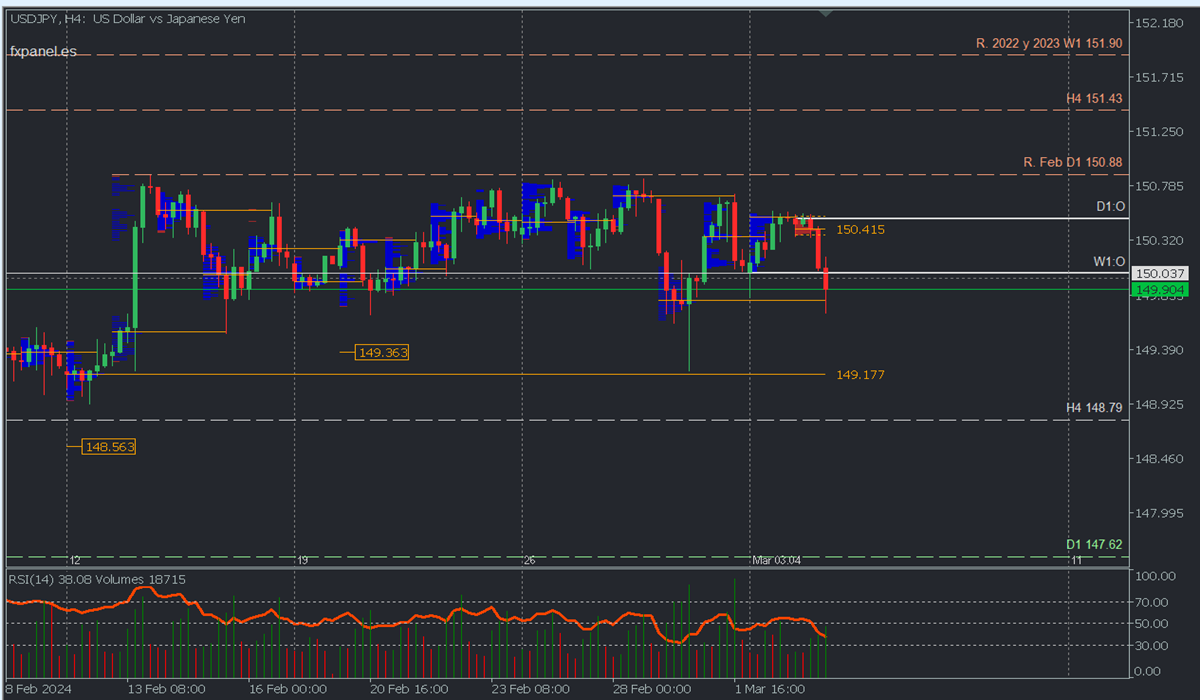
Consolidation could continue in the short term given the proximity of supply and demand zones, so sales can only be considered while prices remain below 150.40, considering the latest supply zones at 150.50 and 150.70, which will test the buy zone at 149.80 and 149.17. The breakout of the buy zones will extend the decline towards 148.79 with a possible challenge to the 147.62 support.
On the other hand, the strong bullish reaction from the buy zones that trigger a breakout of the sell zones between 150.50 and 150.80, with the consequent decisive breakout of the February resistance at 150.88, will be the signal that yen weakness will drive prices towards the 151.43 resistance and the highest in the last two years.
*Uncovered POC: POC = Point of Control: It is the level or zone where the highest volume concentration occurred. If there was a bearish movement from it previously, it is considered a sell zone and forms a resistance zone. Conversely, if there was a bullish impulse previously, it is considered a buy zone, usually located at lows, thus forming support zones.
**Consider this risk management suggestion
**It is very important that risk management be based on capital and traded volume. Therefore, a maximum risk of 1% of the capital is recommended. It is suggested to use risk management indicators like Easy Order.
Renminbi (USDCNH) Bullish Corrective Sequence Still Incomplete
In the last years, the renminbi made a pause in his attempt to get stronger against USD dollar. In February 2014, renminbi found support at 6.0153 as wave ((III)) and from there it made a perfect zig – zag correction structure to equal legs at 7.1964 in June 2020. After these 3 swings, USDCNH should have continued with the downtrend. However, the pair turning up again breaking 7.1964 high suggesting that market is developing a double correction structure.
USDCNH November 2023 Weekly Chart
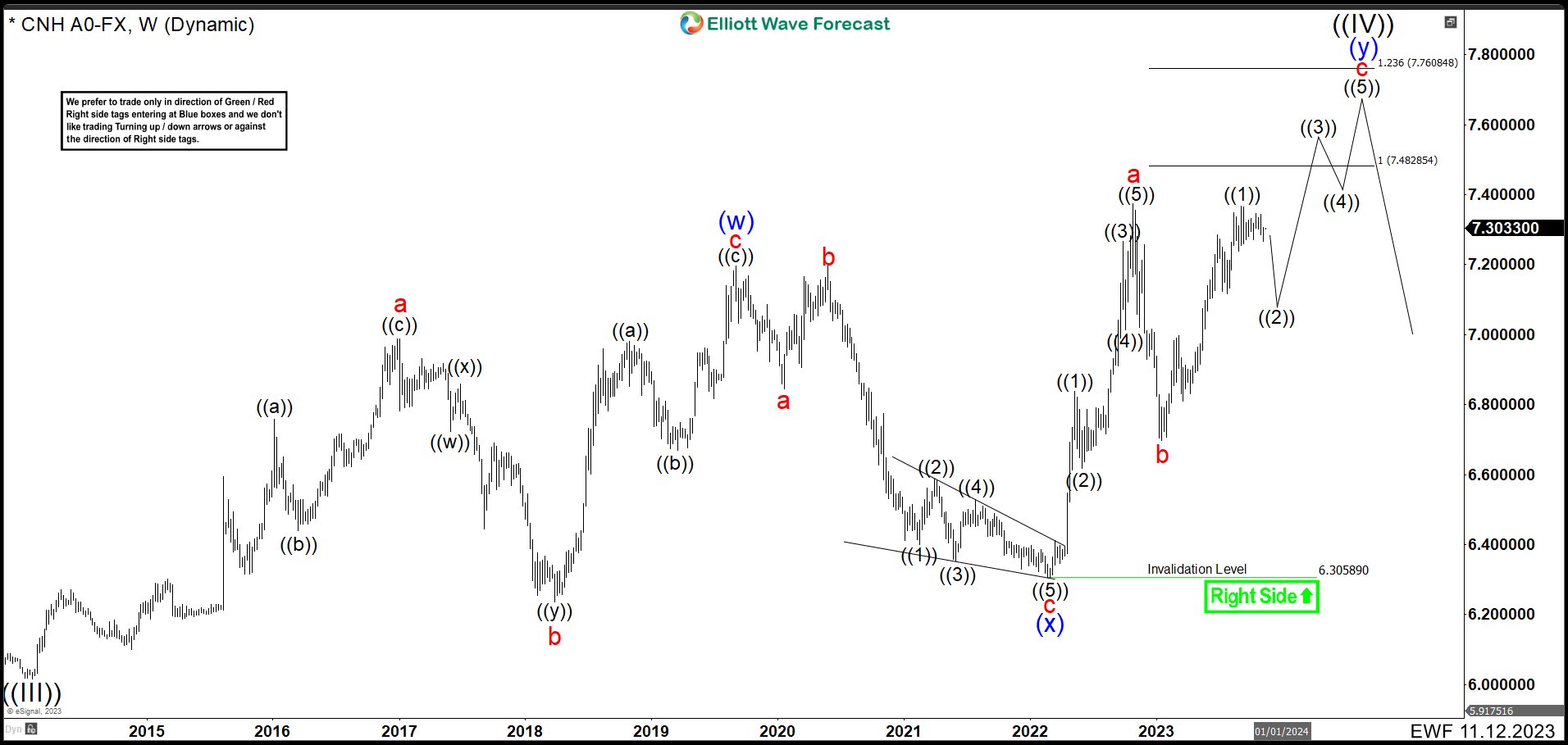
In the chart above, looks like the first leg of the wave “c” ended as wave ((1)). Up from 6.6883 wave “b” low, we can see 5 swings higher creating an impulse. First wave ended at 6.9967. Wave (2) pullback at 6.8107 low. Then USDCNH rally finishing wave (3) at 7.2855. Wave (4) correction completed at 7.1162 low. Last push to 7.3679 ended wave (5) and wave ((1)). Currently, we are expecting a correction as wave ((2)) of “c”. This movement should drop to 7.12 – 6.95 area correlating with USDX weakness that we are looking for. After finishing wave ((2)), pair should rally in 3 swings to build an impulse as wave “c” to 7.4866 – 7.7646 area. This also will finish the double correction wave (y), and the wave ((IV)) before renminbi continues with the downtrend.
USDCNH March 2024 Weekly Chart
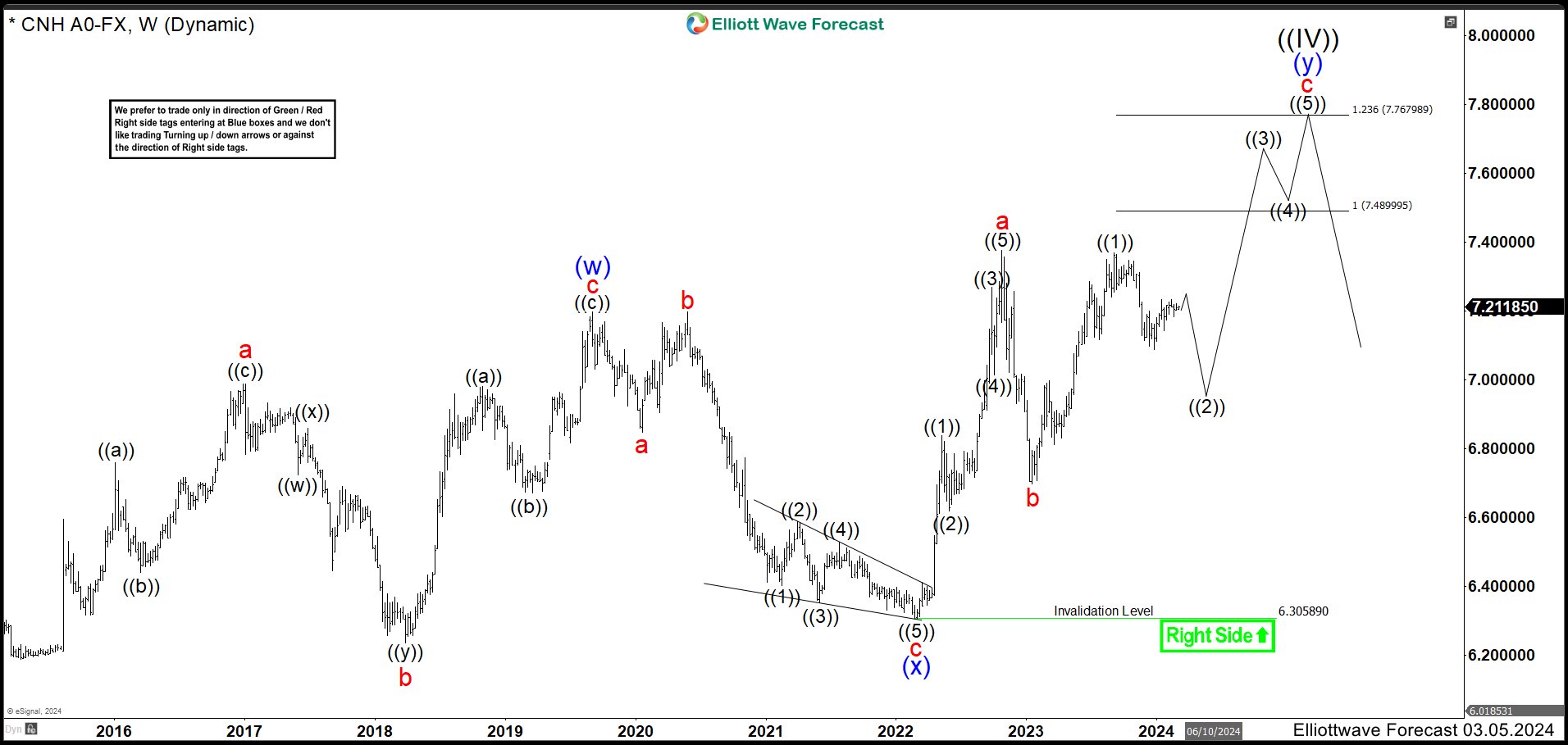
After 4 months, We can see a pullback as we expected. The drop in wave ((2)) ended at 7.08 in the 7.12 – 6.95 area and it has bounced higher. The reaction is not what we expected and pair looks like is lagging. Therefore, we are calling the possibility that structure ended at 7.08 could be wave (A) of ((2)), the bounce the wave (B) of ((2)) and we should see one more low to end wave ((2)) before resuming the rally to 7.4866 – 7.7646 area to complete wave ((IV)) correction.
USDCNH March 2024 Alternative Weekly Chart
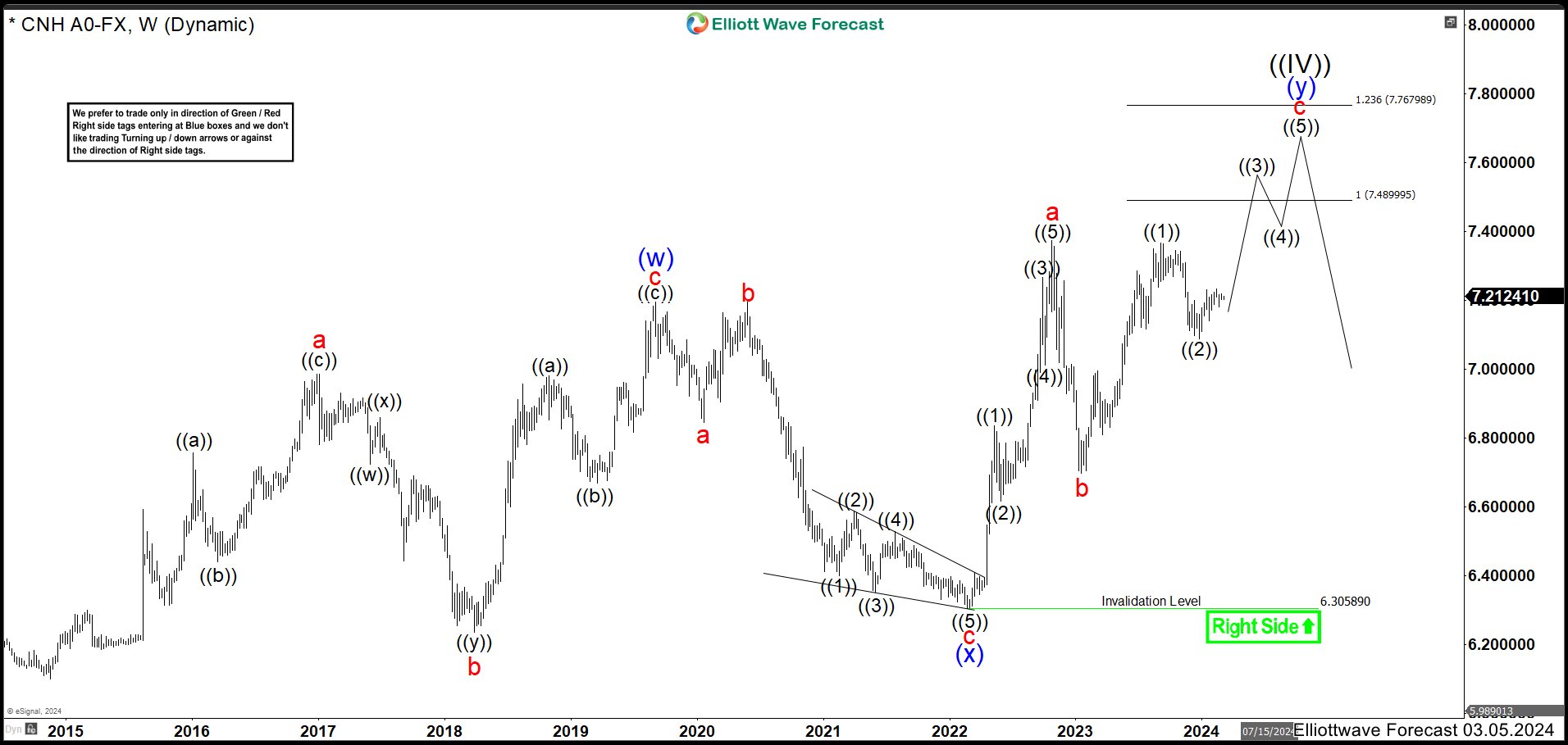
As alternative view, we cannot rule out that wave ((2)) is completed at 7.08 and the pair should continue to the upside to end the double correction as wave ((IV)).