Sample Category Title
USD/JPY Mid-Day Outlook
Daily Pivots: (S1) 150.43; (P) 150.64; (R1) 150.91; More...
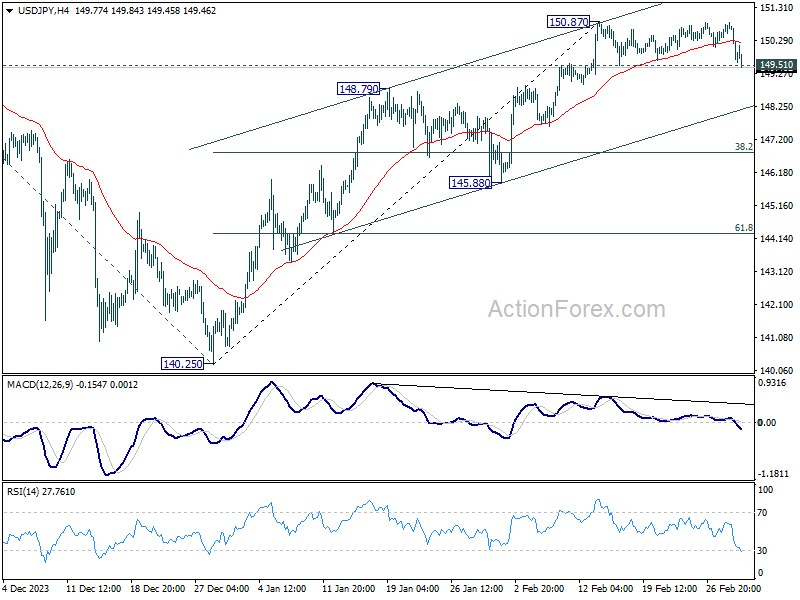
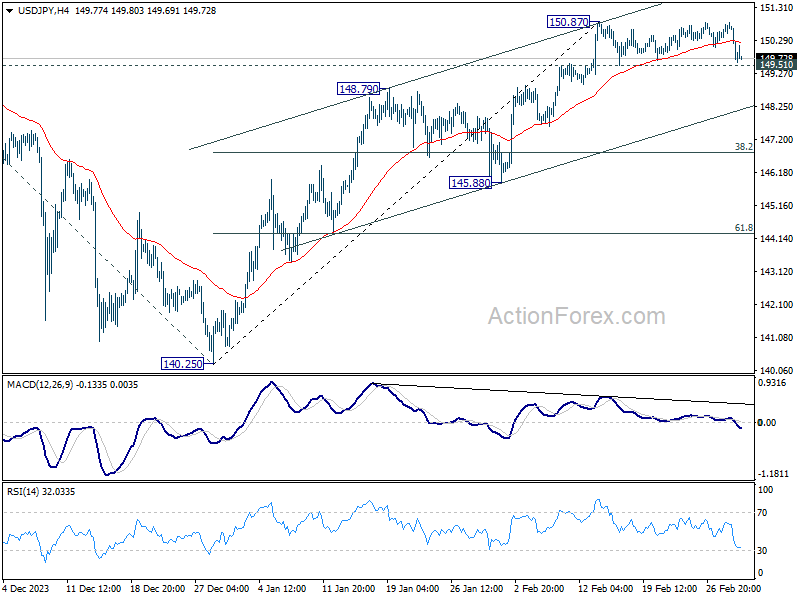
Immediate focus is now on 149.51 minor support in USD/JPY. Considering bearish divergence condition in 4H MACD, firm break of 149.51 should confirm short term topping at 150.87. Intraday bias will then be back on the downside for channel support (now at 148.20), even as a corrective move. On the upside, though, break of 150.87 will resume the rally from 140.25 to retest 151.89/93 key resistance zone.
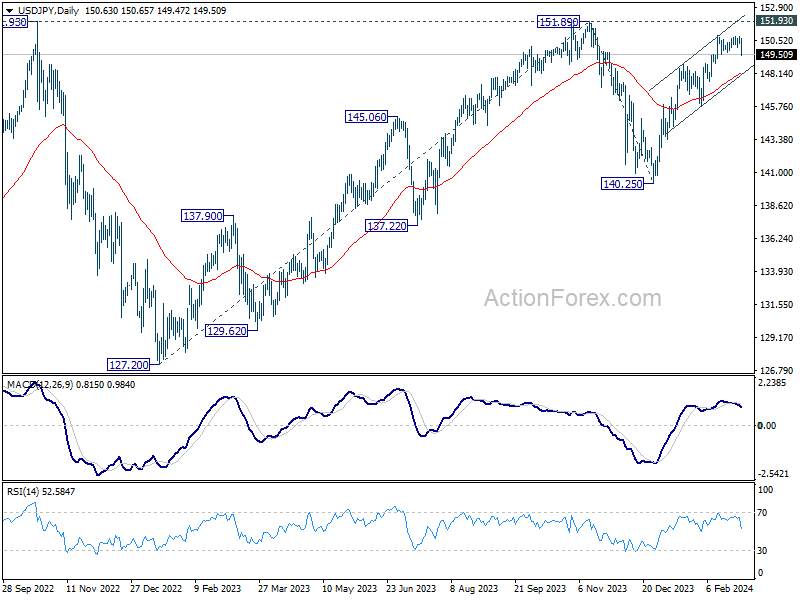
In the bigger picture, rise from 140.25 is seen as resuming the trend from 127.20 (2023 low). Decisive break of 151.89/.93 resistance zone will confirm this bullish case and target 61.8% projection of 127.20 to 151.89 from 140.25 at 155.50. However, break of 148.79 resistance turned support will delay this bullish case, and extend the corrective pattern from 151.89 with another falling leg.
USD/CHF Mid-Day Outlook
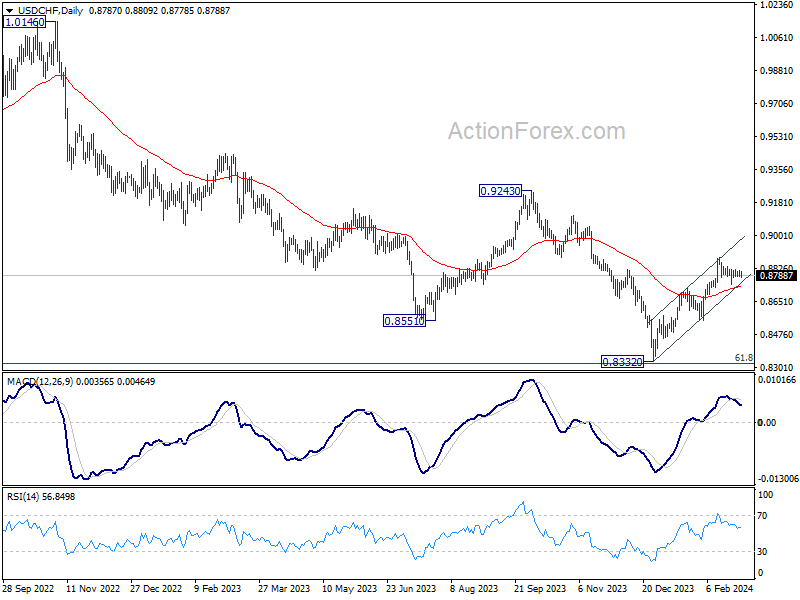
Daily Pivots: (S1) 0.8776; (P) 0.8794; (R1) 0.8803; More....
USD/CHF is still bounded in consolidation from 0.8884 and intraday bias remains neutral. With 0.8727 resistance turned support intact, further rally is expected. On the upside, above 0.8884 will resume the rise from 0.8332 towards 0.9243 resistance. However, sustained break of 0.8727 will dampen this bullish view, and turn bias back to the downside for 0.8550 support instead.
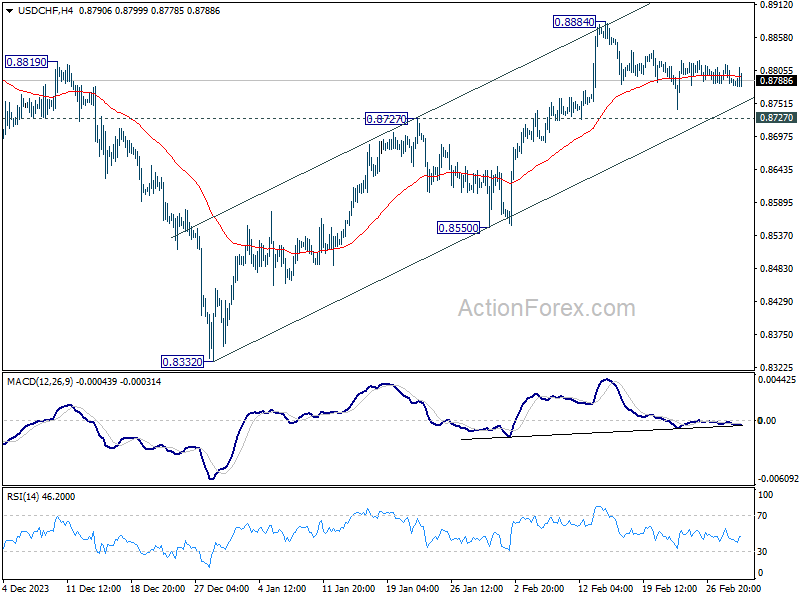
In the bigger picture, a medium term bottom should be formed at 0.8332, on bullish convergence condition in W MACD, just ahead of 0.8317 long term fibonacci support. It's still early to decide if the larger down trend from 1.0146 (2022 high) is reversing. But further rise should be seen to 0.9243 resistance even as a correction.
GBP/USD Mid-Day Outlook
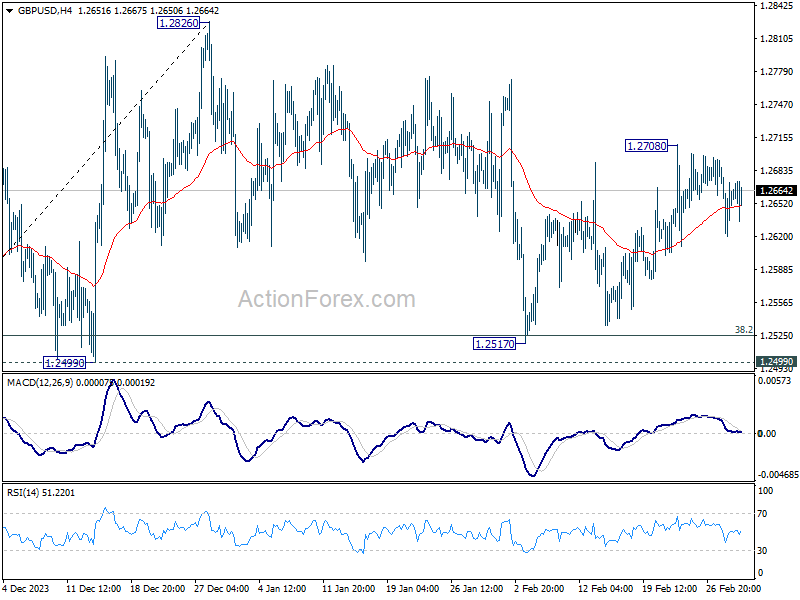
Daily Pivots: (S1) 1.2626; (P) 1.2657; (R1) 1.2693; More...
Intraday bias in GBP/USD remains neutral as sideway trading continues. On the upside, break of 1.2708 resistance will indicate that correction from 1.2826 has completed. Intraday bias will be back on the upside for retesting 1.2826. Nevertheless, decisive break of 1.2499 will argue that whole rise from 1.2036 has completed and turn near term outlook bearish.
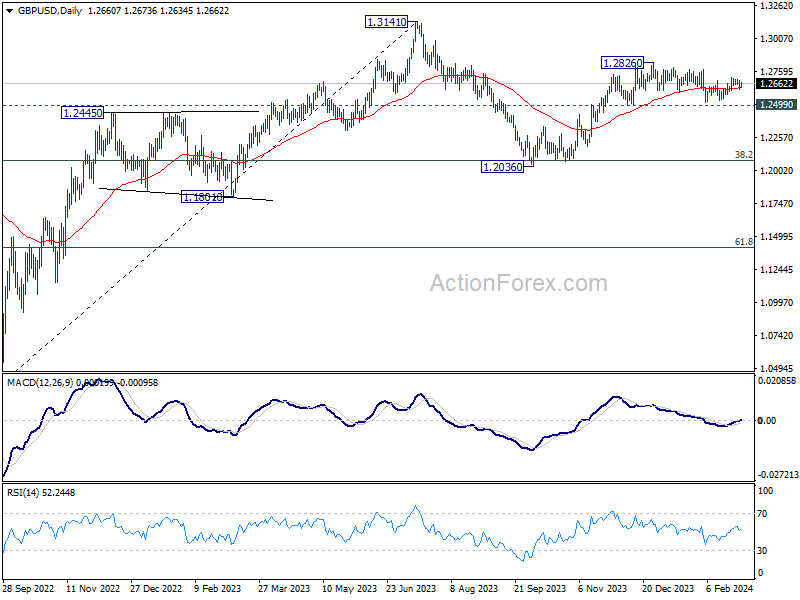
In the bigger picture, price actions from 1.3141 medium term top are seen as a corrective pattern to up trend from 1.0351 (2022 low). Rise from 1.2036 is seen as the second leg, which could be still in progress. But upside should be limited by 1.3141 to bring the third leg of the pattern. Meanwhile, break of 1.2499 support will argue that the third leg has already started for 38.2% retracement of 1.0351 (2022 low) to 1.3141 at 1.2075 again.
Canada’s GDP Sees Another Below Trend Performance in the Fourth Quarter of 2023
The Canadian economy grew by 0.99% quarter/quarter annualized (q/q) in 2023 Q4, while Q3 was revised higher (-0.5% q/q from -1.1%). Furthermore, the flash estimate for January showed a +0.4% monthly increase. Stripping out external factors, final domestic demand came in at a very weak -0.7% q/q.
International trade supported growth, with exports of goods and services rising 5.6% q/q. This was driven by "crude oil and crude bitumen exports (+6.2%), which coincided with sustained production of crude oil in Alberta, as well as that of travel services and other transportation equipment and parts." Imports were down (-1.7% q/q), driven by "intermediate metal products, tires, motor vehicle engines and parts, and passenger cars and light trucks."
Consumer spending rose by +1.0% q/q. The growth was largely seen in durable goods (+7.0% q/q), such as "new trucks, vans and utility vehicles". Easing supply chain snarls and rapid population growth were cited as drivers. Growth in services was more tepid at 0.4% q/q.
Business investment was a big drag on the quarter, with non-residential structures and machinery/equipment down 9.5% q/q. This was led by "lower spending on aircraft and other transportation equipment." Residential investment also fell on the quarter (-1.7% q/q), which "despite increased activity in new construction (+2.2%) and renovations (+0.2%), the resale market weakened across Canada, which offset increased housing investment, as ownership transfer costs fell 7.7% in the fourth quarter."
Key Implications
The Canadian economy showed some life in the final quarter of 2024. Consumers, who have been paring back spending for much of the year, were busy driving around in their new cars and filling shopping malls during the holiday season. We also saw strong demand for exports, as the benefits of a surging U.S. economy spilled over into Canada. At the same time, business investment and government spending were a drag on growth, with the latter reflecting some mean reversion following the big spending outlays to fight wildfires over the summer.
A return to growth in the fourth quarter was widely expected, following two quarters of effectively no growth in the country. While today's report came in better than consensus (+0.8% q/q) and much better than what the BoC was thinking (0% q/q), the narrative on the Canadian economy remains the same: High interest rates are weighing on economic growth. Stripping out international drivers, the economy contracted, while GDP per capita has now declined in five of the last six quarters. The BoC has recognized this weakness in recent commentaries, but it is patiently waiting for inflation to follow suit. We think the wheels are in motion for this to come through the data in the coming months and have penciled in the first BoC rate cut for June.
U.S. Consumer Spending Opens 2024 on a Modest Note
Personal income grew 1.0% month-on-month (m/m) in January, a sizeable increase from December's 0.3% gain, and above market expectations for a 0.4% increase.
Accounting for inflation and taxes, real personal disposable income was flat on the month relative to 0.2% growth in December.
Personal consumption expenditures rose 0.2% m/m, a notable deceleration from 0.7% growth in December, but in line with market expectations. Spending in real terms however fell by a -0.1%, led by weakness in goods spending (-1.1% m/m) even as services spending rose (+0.4% m/m).
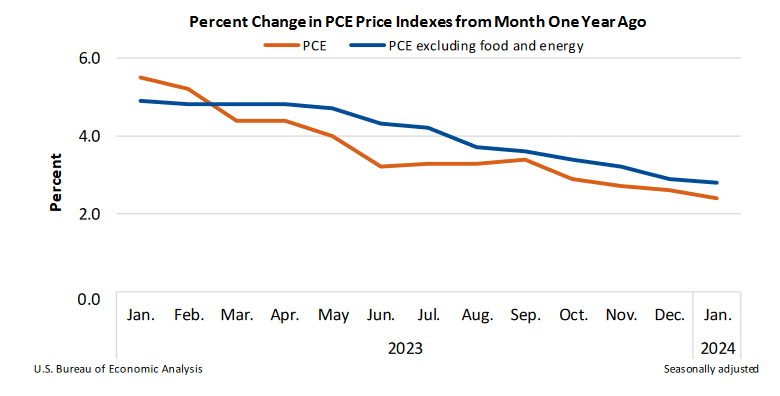
On inflation, the Fed's preferred inflation metric, the core PCE price deflator, rose from 0.1% to 0.4% on a monthly basis, but decelerated from 2.9% in December to 2.8% in January on an annual basis.
The personal savings rate rose in January to 3.8% from December's 3.7% reading.
Key Implications
Given recent prints showing a notable pullback in spending and stalled inflation progress, today's report was highly anticipated. Looking at spending, the deceleration in January was largely as expected, and in line with signals from the previously released retail spending report. After enjoying the holiday season, it appears consumers are now taking a breather. Reduced savings and a cooling labor market are likely to keep consumer spending at a modest pace for the remainder of the year.
The Fed' s preferred measure of inflation continued its downward trek in January with the core PCE price deflator posting its 16th consecutive month of lower year-on-year growth. That said, at 2.6% the three month annualized rate of change on core PCE inflation rose above the Fed's 2% target, (after falling below it last month to 1.6%) – a dynamic which could suggest some near term concerns. With the disinflation process progressing at an uneven pace while facing elevated upside risks and consumer spending starting to show some moderation, the central bank may be more inclined to continue exercising patience in its decision about when to cut rates.
EUR/USD Mid-Day Outlook
Daily Pivots: (S1) 1.0807; (P) 1.0829; (R1) 1.0860; More...
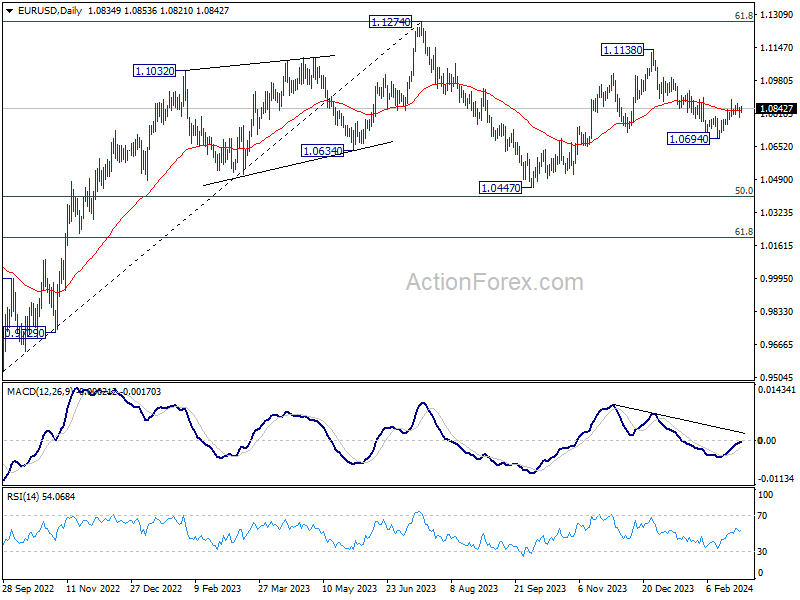
EUR/USD recovers mildly in early US session but stays in range below 1.0887. Intraday bias stays neutral at this point. On the upside, break of 1.0887 and sustained trading above 55 D EMA (now at 1.0832) will affirm the case that fall from 1.1138 has completed. Stronger rally would then be seen back to 1.1138. However, break of 1.0761 will turn bias back to the downside for retesting 1.0694 support.
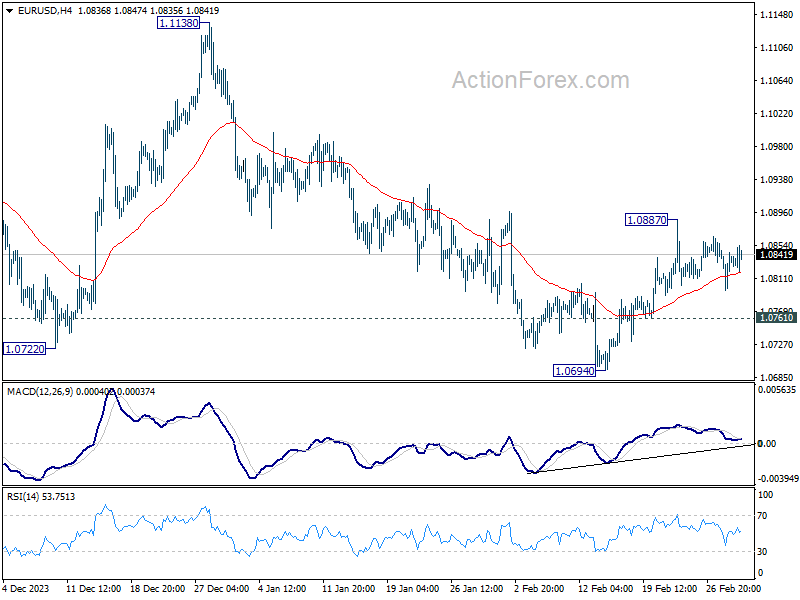
In the bigger picture, price actions from 1.1274 are viewed as a corrective pattern to rise from 0.9534 (2022 low). Rise from 1.0447 is seen as the second leg. While further rally could cannot be ruled out, upside should be limited by 1.1274 to bring the third leg of the pattern. Meanwhile, sustained break of 1.0694 support will argue that the third leg has already started for 1.0447 and possibly below.
Dollar Softens Mildly as Inflation Matches Forecasts, Yen Rally Loses Steam
US stock futures bounce while treasury yields weaken following release of January's PCE inflation data, which showed slowdown in both headline and core inflation rates as anticipated. This development provided some relief to investors, who were concerned that disinflation progress might have come to a halt. Fed should remain more likely start interest rate cuts in the first half of the year, rather than waiting until later. The development also led to mild weakening of Dollar.
As for the day Yen is maintaining its position as the strongest currency, fueled by hawkish comments from a BoJ official. Yet, there is no clear follow through momentum for now. Traders are probably awaiting more definitive guidance from BoJ Governor Kazuo Ueda on the anticipated rate hike before making significant bets.
Elsewhere, Australian Dollar and the Canadian Dollar are trailing Yen as the second and third strongest currencies, respectively. On the other end of the spectrum, Sterling and Swiss Franc are underperforming, with New Zealand Dollar not far behind. Euro and the Dollar are mixed in the middle.
Technically, 149.51 support in USD/JPY remains a major focus for the rest of the session. Firm break there would open up deeper decline to channel support (now at 148.14), even as a corrective move. However, strong bounce from the current level would likely resume the rise from 140.25 through 150.87 instead.
In Europe, at the time of writing, FTSE is up 0.55%. DAX is up 0.57%. CAC is down -0.02%. UK 10-year yield is up 0.155 at 4.272. Germany 10-year yield is down -0.001 at 2.456. Earlier in Asia, Nikkei fell -0.11%. Hong Kong HSI fell -0.15%. China Shanghai SSE rose 1.94%. Singapore Strait Times rose 0.09%. Japan 10-year JGB yield rose 0.0160 to 0.714.
US PCE prices slows to 2.4% yoy in Jan, core PCE down to 2.8% yoy
US personal income rose USD 233.7B or 1.0% mom in January, well above expectation of 0.5% mom. Personal spending rose USD 43.9B or 0.2% mom, matched expectations.
Headline PCE price index rose 0.3% mom, matched expectations. Core PCE price index (excluding food and energy) rose 0.4% mom, matched expectations. Services prices rose 0.6% mom while goods prices decreased -0.2% mom. Food prices rose 0.5% mom and energy prices fell -1.4% mom.
From the same month a year ago, headline PCE price index slowed from 2.6% yoy to 2.4% yoy. Core PCE price index slowed from 2.9% yoy to 2.8% yoy. Both matched expectations. Services prices were up 3.9% yoy while goods prices fell -0.5% yoy. Food prices rose 1.4% yoy and energy prices fell -4.9% yoy.
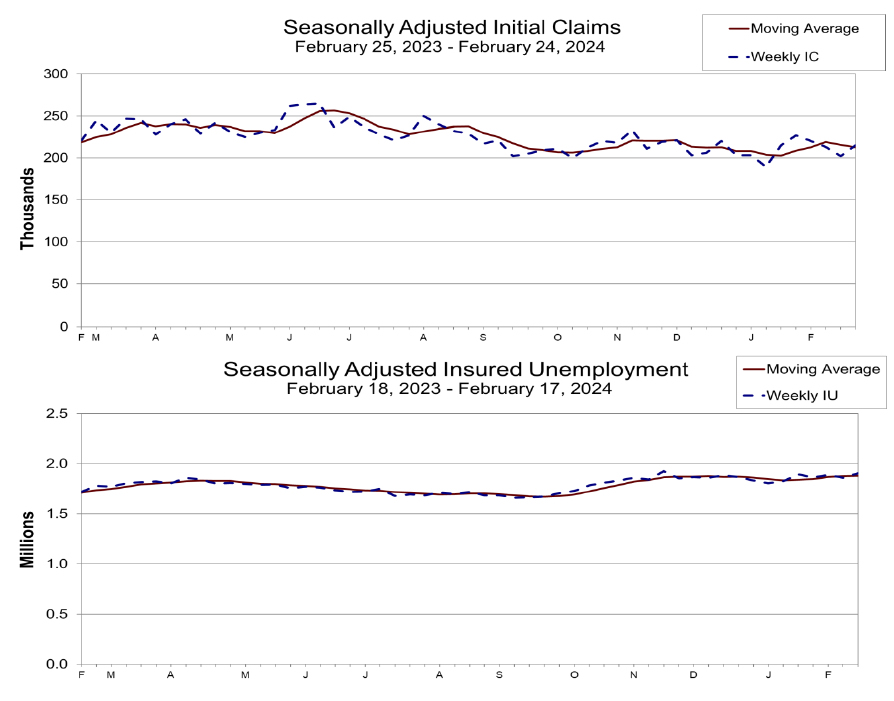
US initial jobless claims rises to 215k, above expectation 210k
US initial jobless claims rose 13k to 215k in the week ending February 24, above expectation of 210k. Four-week moving average of initial claims fell -3k to 212.5.
Continuing claims rose 45k to 1905k in the week ending February 17. Four-week moving average of continuing claims rose 3k to 2880, highest since December 11 2021.
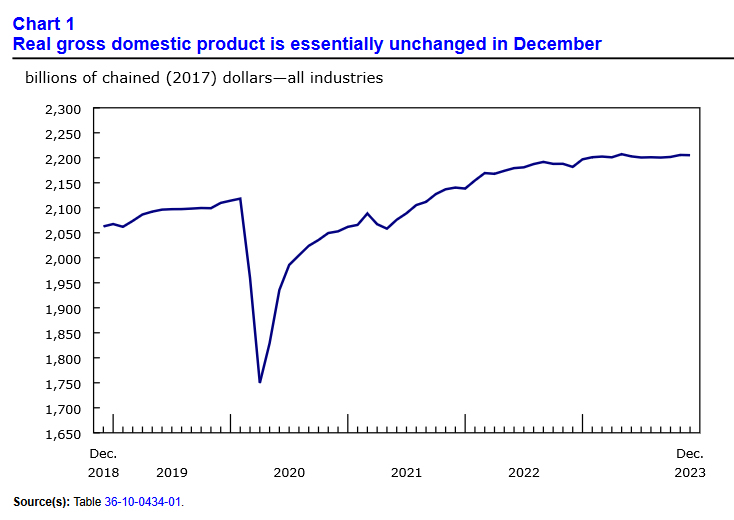
Canada's GDP flat in Dec, up 0.2% qoq in Q4
Canada's GDP rose 0.2% qoq in Q4, recovering from Q3's -0.1% decline. Statistics Canada noted that higher exports (up 1.4%) and reduced imports (down -0.4%) fuelled GDP growth, but this was moderated by a decline in business investment.
In December, GDP was flat for the month, below expectation of 0.2% mom. Goods-producing industries contracted -0.2% mom. Services-producing industries were largely unchanged. Advance information indicates that real GDP rose 0.4% mom in January.
Swiss GDP grows 0.3% qoq in Q4, abv exp 0.1% qoq
Switzerland's GDP grew by 0.3% qoq in Q4, slightly surpassing expectation of 0.1% qoq growth.
Despite this modest uptick, the nation faced slight decline in domestic final demand, which fell by -0.3%. This downturn was primarily driven by a significant, broad-based decrease in investments in equipment, plummeting by -2.5%. Construction investment also fell by by -0.3%, which in turn, led to -0.2% decrease in the construction industry.
Meanwhile, private consumption saw a marginal increase of 0.3%, buoyed by spending in housing, health, mobility, and foreign travel sectors. However, spending on food and other retail goods witnessed a decline. The retail and trade sectors also reported contraction, with retail dropping by -0.3% and trade by -1.0% . Additionally, imports of goods and services showed weak performance, registering 0.7% increase after adjusting for sporting events.
Swiss KOF falls to 101.6 in Feb, rather positive economic signals intact
Swiss KOF Economic Barometer fell from 102.5 to 101.6 in February, below expectation of 102.0. Despite this marginal cooling, KOF maintains an optimistic stance regarding the Swiss economy, asserting that "the rather positive economic signals in Switzerland remain intact."
This assertion is particularly relevant to manufacturing and construction sectors, which have seen an improvement in their outlooks. Contrastingly, projections for financial and insurance services, hospitality, other services, and foreign demand have experienced a downturn. Meanwhile, forecast for private consumption within Switzerland remains stable.
BoJ's Takata urges policy shift, time to exit ultra-accommodative stance
In a significant speech today, BoJ board member Hajime Takata emphasized the need for a "nimble and flexible response" to the nation's monetary policy strategy, and called for the moves away from the current "extremely accommodative monetary policy".
He outlined several measures for consideration, including exiting yield curve control, moving away from negative interest rates, and revising the BoJ's commitment to expanding its monetary base until inflation consistently exceeds the 2% target.
Takata's remarks come at a time when Japan appears to be on the cusp of meeting its long-sought-after inflation target of 2%. He noted, "While there are some economic uncertainties, I feel that we're finally seeing prospects for achieving our 2% inflation target."
Furthermore, Takata highlighted the positive momentum in spring wage negotiations, with many companies proposing wage hikes surpassing those of 2023. This trend towards higher wages, coupled with the corporate sector's growing resilience to yield increases upon the exit of current monetary policies, underscores a strengthening economic foundation.
Japan faces steepest industrial decline in nearly four years, -7.5% mom drop in Jan
Japan's industrial production faced a significant downturn in January, recording a -7.5% mom decline in production, marking the sharpest drop since May 2020. This downturn was slightly more severe than the anticipated -7.3% mom, with a widespread decrease across 14 of the 15 surveyed industries. Motor vehicles sector experienced the most substantial fall, plummeting by -17.8% mom, driven by declines in regular passenger cars and electrical drive systems.
Manufacturers remain somewhat optimistic, anticipating a rebound with of 4.8% in output for February and a further 2.0% rise in March, as surveyed by the Ministry of Economy, Trade and Industry. However, these forecasted gains are deemed insufficient by METI officials to fully counterbalance the steep January decline.
In contrast to the industrial sector's struggles, Japan's retail sales presented a brighter picture, rising 2.3% yoy in January, surpassing the expected 2.0% increase.
RBNZ's Orr confident on bringing down inflation, highlights global risks
RBNZ to said in a conversation with Radio New Zealand that the central bank RBNZ's very confident on returning inflation to target band of 1%-3% by the second half of 2024, with a goal to hit near 2% midpoint in 2025.
Highlighting the broader context, Orr pointed out that key risks to this positive outlook are mostly global. Domestic economy aligns with RBNZ's expectations. Orr noted the current "subdued spending" and "declined" inflation levels as outcomes of the existing monetary policy settings and trade conditions.
Later in the day, Orr told a parliamentary committee the importance of "retaining a restrictive stance with the official cash rate," as a pivotal factor for ensuring the forecasted return to target inflation levels.
NZ ANZ business confidence falls to 34.7, patchy economy
New Zealand ANZ Business Confidence fell from 36.6 to 34.7 in February. Own activity outlook rose from 25.6 to 29.5. Inflation expectations fell from 4.28% to 4.03%. Pricing intentions eased from 50% to 48%, continuing their sideways trend of recent months. Cost expectations fell from 75.6 to 73.5. Wages expectation fell from 81.4 to 78.9.
ANZ's describes the economy as "patchy," with visible "green shoots" in some sectors, yet acknowledges the "ongoing challenges" facing other segments. The survey does not imply the "economy is rolling over" or that "inflation has been beaten".
Australia's retail sales rises 1.1% mom in Jan, stagnates in trend terms
Australia's retail sales rose 1.1% mom in January, below expectation of 1.7% mom. This increase marks a recovery from December's significant -2.1% mom decline, where consumer spending retracted following the Black Friday sales rush in November.
According to Ben Dorber, ABS head of retail statistics, retail turnover has effectively returned to the levels observed in September 2023. Additionally, "retail turnover was unchanged in trend terms in January," indicating that, despite the month's positive performance, the broader trend reflects a period of stagnation in retail sales when considering the volatility of the past few months.
EUR/USD Mid-Day Outlook
Daily Pivots: (S1) 1.0807; (P) 1.0829; (R1) 1.0860; More...
EUR/USD recovers mildly in early US session but stays in range below 1.0887. Intraday bias stays neutral at this point. On the upside, break of 1.0887 and sustained trading above 55 D EMA (now at 1.0832) will affirm the case that fall from 1.1138 has completed. Stronger rally would then be seen back to 1.1138. However, break of 1.0761 will turn bias back to the downside for retesting 1.0694 support.
In the bigger picture, price actions from 1.1274 are viewed as a corrective pattern to rise from 0.9534 (2022 low). Rise from 1.0447 is seen as the second leg. While further rally could cannot be ruled out, upside should be limited by 1.1274 to bring the third leg of the pattern. Meanwhile, sustained break of 1.0694 support will argue that the third leg has already started for 1.0447 and possibly below.
Economic Indicators Update
| GMT | Ccy | Events | Actual | Forecast | Previous | Revised |
|---|---|---|---|---|---|---|
| 23:50 | JPY | Industrial Production M/M Jan P | -7.50% | -7.30% | 1.40% | |
| 23:50 | JPY | Retail Trade Y/Y Jan | 2.30% | 2.00% | 2.30% | |
| 00:00 | NZD | ANZ Business Confidence Feb | 34.7 | 36.6 | ||
| 00:30 | AUD | Retail Sales M/M Jan | 1.10% | 1.70% | -2.70% | -2.10% |
| 00:30 | AUD | Private Sector Credit M/M Jan | 0.40% | 0.40% | 0.40% | |
| 00:30 | AUD | Private Capital Expenditure Q4 | 0.80% | 0.40% | 0.60% | 0.30% |
| 05:00 | JPY | Housing Starts Y/Y Jan | -7.50% | -7.50% | -4.00% | |
| 07:00 | EUR | Germany Retail Sales M/M Jan | -0.40% | 0.50% | -1.60% | |
| 07:45 | EUR | France GDP Q/Q Q4 | 0.10% | 0.00% | 0.00% | |
| 08:00 | CHF | KOF Economic Barometer Feb | 101.6 | 102 | 101.5 | 102.5 |
| 08:00 | CHF | GDP Q/Q Q4 | 0.30% | 0.20% | 0.30% | |
| 08:55 | EUR | Germany Unemployment Change Feb | 11K | 10K | -2K | |
| 08:55 | EUR | Germany Unemployment Rate Feb | 5.90% | 5.80% | 5.80% | |
| 09:30 | GBP | M4 Money Supply M/M Jan | -0.10% | 0.30% | 0.50% | |
| 13:00 | EUR | Germany CPI M/M Feb P | 0.40% | 0.50% | 0.20% | |
| 13:00 | EUR | Germany CPI Y/Y Feb P | 2.50% | 2.60% | 2.90% | |
| 13:30 | CAD | GDP M/M Dec | 0.00% | 0.20% | 0.20% | |
| 13:30 | USD | Personal Income M/M Jan | 1.00% | 0.50% | 0.30% | |
| 13:30 | USD | Personal Spending Jan | 0.20% | 0.20% | 0.70% | |
| 13:30 | USD | PCE Price Index M/M Jan | 0.30% | 0.30% | 0.20% | |
| 13:30 | USD | PCE Price Index Y/Y Jan | 2.40% | 2.40% | 2.60% | |
| 13:30 | USD | Core PCE Price Index M/M Jan | 0.40% | 0.40% | 0.20% | |
| 13:30 | USD | Core PCE Price Index Y/Y Jan | 2.80% | 2.80% | 2.90% | |
| 13:30 | USD | Initial Jobless Claims (Feb 23) | 215K | 210K | 201K | 202K |
| 14:45 | USD | Chicago PMI Feb | 47.9 | 46 | ||
| 15:00 | USD | Pending Home Sales M/M Jan | 1.00% | 8.30% | ||
| 15:30 | USD | Natural Gas Storage | -86B | -60B |
Canada’s GDP flat in Dec, up 0.2% qoq in Q4
Canada's GDP rose 0.2% qoq in Q4, recovering from Q3's -0.1% decline. Statistics Canada noted that higher exports (up 1.4%) and reduced imports (down -0.4%) fuelled GDP growth, but this was moderated by a decline in business investment.
In December, GDP was flat for the month, below expectation of 0.2% mom. Goods-producing industries contracted -0.2% mom. Services-producing industries were largely unchanged. Advance information indicates that real GDP rose 0.4% mom in January.
US initial jobless claims rises to 215k, above expectation 210k
US initial jobless claims rose 13k to 215k in the week ending February 24, above expectation of 210k. Four-week moving average of initial claims fell -3k to 212.5.
Continuing claims rose 45k to 1905k in the week ending February 17. Four-week moving average of continuing claims rose 3k to 2880, highest since December 11 2021.
US PCE prices slows to 2.4% yoy in Jan, core PCE down to 2.8% yoy
US personal income rose USD 233.7B or 1.0% mom in January, well above expectation of 0.5% mom. Personal spending rose USD 43.9B or 0.2% mom, matched expectations.
Headline PCE price index rose 0.3% mom, matched expectations. Core PCE price index (excluding food and energy) rose 0.4% mom, matched expectations. Services prices rose 0.6% mom while goods prices decreased -0.2% mom. Food prices rose 0.5% mom and energy prices fell -1.4% mom.
From the same month a year ago, headline PCE price index slowed from 2.6% yoy to 2.4% yoy. Core PCE price index slowed from 2.9% yoy to 2.8% yoy. Both matched expectations. Services prices were up 3.9% yoy while goods prices fell -0.5% yoy. Food prices rose 1.4% yoy and energy prices fell -4.9% yoy.