Sample Category Title
Eurozone PMI composite rises to 48.9, a step towards recovery amid German drag
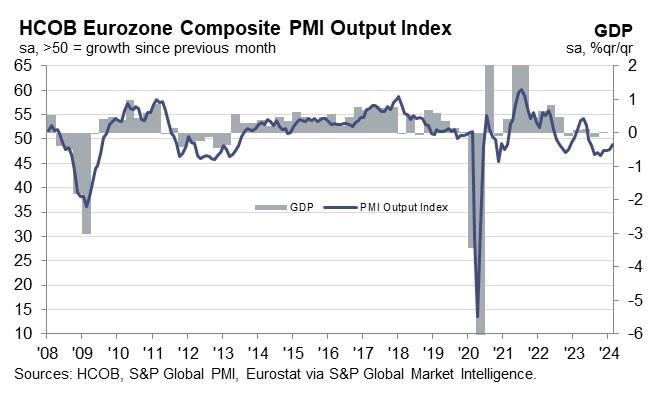
Eurozone PMI Manufacturing dipped further from 46.6 to 46.1 in February, undershooting expectations of a 47.1 reading and signaling continued contraction. Conversely, PMI Services climbed from 48.4 to neutral mark of 50.0, surpassing the forecast of 48.7 and reaching a 7-month high. This uplift in services contributed to PMI Composite's rise from 47.9 to 48.9, marking an 8-month peak yet still indicating slight overall economic contraction.
Norman Liebke, Economist at Hamburg Commercial Bank, cited a "glimmer of hope" as Eurozone edges closer to recovery, particularly within the services sector. Despite the manufacturing downturn, Liebke reaffirms an annual growth forecast of 0.8% for 2024.
ECB is likely to find the latest PMI figures concerning, especially with output prices increasing for the fourth consecutive month, largely driven by labor-intensive services sector grappling with rising wages. ECB is anticipated to make its first interest rate cut in June according to Liebke's forecast.
The disparity in economic performance between Germany and France is striking. Germany, Europe's largest economy, appears to be a significant "drag" on the broader Eurozone growth, with its manufacturing sector facing pronounced challenges. In contrast, France is experiencing a more robust recovery across both services and manufacturing.
Germany's PMI readings for February further underscore its economic difficulties, with PMI Manufacturing plummeting to a 4-month low of 42.3, PMI Services rising from 48.2 and Composite PMI also hitting a 4-month low at 46.1.
On the other hand, France's economic indicators offer more positive news, with PMI Manufacturing surging to an 11-month high of 46.8, Services PMI rising to an 8-month high at 48.0, and PMI Composite reaching a 9-month high at 47.7.
No Surprises in FOMC Minutes
In focus today
The key events today will be the February flash PMIs from the euro area, US, and UK. Lately, we have seen the manufacturing PMIs improve while the service PMIs have stabilised around the 48 level in the euro area. Leading indicators from Asia suggest that the global manufacturing cycle is about to turn, which we expect to lift manufacturing PMIs higher together with the increasing order-inventory balance. We will also pay close attention to the service price index that has risen lately and still suggest a significant service price pressure due to recent wage increases.
In the euro area, we also get the final January HICP figures. It will be interesting to investigate to what extent one-offs affected the January print where especially the monthly increase in service inflation was to the high side.
This morning the Swedish National Debt Office presents an updated Central Government Borrowing Report (9.30). Since the last report in October, the government budget outcome has been SEK13bn worse than expected, but we do not anticipate any adjustments to the full year 2024 budget balance due to less grim economic developments than expected. For 2025 we believe the negative budget balance will be adjusted to -30bn amid uncertainties in defense spending and unfunded reforms. The recapitalization of the Riksbank will likely still not be included in the forecast due to uncertainties around timing and amount. Expectations are for roughly SEK4bn in recapitalization.
In Norway, the Q1 Expectations survey from Norges Bank, due for release today, will be important in a situation when core inflation is well above the 2 %-target and the NOK remains weak, but medium-term inflation drivers have turned significantly. In the previous round, there were lower inflation expectations across the board. Lower inflation and a stronger NOK have probably dampened inflation expectations, especially on the 12-month and 2-year horizons. Also, keep an eye on the wage expectations, especially from the labour unions.
The Central Bank of Turkey is set to make their rate decision today. We expect them to hold the rate at 45.0%, in line with consensus.
Chinese home prices for January are due overnight. The price declines have increased in recent months highlighting that there is still no end in sight for China's housing crisis. Home prices are one of the key indicators to watch for signs of any turning point in the crisis.
Economic and market news
What happened overnight
Overnight, the Japanese Nikkei index (finally) breached its previous record level set in 1989 during the height of the asset price bubble. Japanese companies have benefitted from a weak yen which has boosted exports. In other equity news, Nvidia, the leading maker of high-end AI-computing chips, beat market expectations (which were already stratospheric) in their quarterly report, posting a 265% increase in quarterly earnings. This led to a surge in AI- and semiconductor related stock prices. Nvidia has become the third most valuable listed US company, beating Alphabet in recent weeks.
Also in Japan, February PMIs weakened a bit with Manufacturing extending losses from 48.0 to 47.2 and service PMI declining from 53.1 to 52.5.
What happened yesterday
Japan: The yen took a(nother) tumble against major currencies, with the EUR/JPY at a 3-month high of 162.70 as of yesterday's session. This came after US 10-year yields traded above 4.3%. Markets also assessed a government report that lowered growth prospects, especially on consumer spending. Domestic demand has been weak in Japan, with data last week showing the country slipped into a technical recession in Q4. Weak demand could prove a challenge for the BoJ's hopes of exiting the negative-rate environment. Their stated focus is sustained, demand-driven wage growth, for which we will have more information after the major labour union wage negotiations conclude in March.
US: The FOMC minutes of the January meeting were in line with other recent commentary, with the bulk of the committee noting the "risks of moving too quickly to ease the stance of policy", emphasizing the risk of more persistent inflation. The initial market reaction was muted, as recent upside surprises in macro data have already prompted markets to reduce the pricing of rate cuts.
China: China took another step to stabilize the domestic equity market as it introduced new rules for short selling, Bloomberg reports. Specifically, the rules prevent affected firms from selling more shares than they buy during the first and last 30 minutes of the trading day. It is not clear how wide across the financial industry it is hitting, but it seems mainly aimed at big hedge funds.
Geopolitics: Finally, on geopolitics, the EU member states agreed on a new package of sanctions on Russia, which for the first time also included sanctions on Chinese and Indian companies deemed to support the Russian war effort. For now, this includes three Chinese companies and one Indian company.
Equities: Global equities ended marginally higher yesterday as US stocks rallied the last half hour of trading. There was unusually high focus on just one company, Nvidia, reporting after the bell. Some investors lowered their allocation to tech stocks ahead of the long-awaited earnings. That changed after the earnings where Nvidia once again delivered eye-popping result and guidance. In US yesterday Dow +0.1%, S&P 500 +0.1%, Nasdaq -0.3% and Russell 2000 -0.5%. This is a very special morning in Asia. Nikkei 225 continues the strong run and has this morning reached a new all-time high for the first time since 1989! Futures in Europe and US are higher this morning with tech futures leading the advances.
FI: Global yields drifted higher in yesterday's session, extending the rising tendency seen over the past week. The market reaction to FOMC minutes released in the evening was subdued, as the somewhat cautious stance on rate cuts was well-known. The German curve ended up by 7-8bp in line with the rest of the Eurozone, with the rise not attributable to a single factor. However, the substantial bond supplies these days obviously put upward pressure on yields. The bid-to-cover ratio at yesterday's USD16bn 20Y UST auction fell to 2.4, the lowest since September, while the EUR3.7bn 10Y German auction was better received in a historic context with a bid-to-cover at 2.1. The pricing of rate cuts in 2024 fell by 8bp for the ECB and Fed, now trading at 102bp and 82bp, respectively.
FX: On another quiet day in the FX market CHF recovered a bit, while SEK, GBP and JPY lost a bit of ground. FOMC minutes failed to move the market including EUR/USD, which held steady just above the 1.08 level.
Nvidia Surpassed Sales Expectations Once Again
Bingo! Nvidia surpassed the sales expectations once again and announced total sales of $22bn for the Q4 of last year – that’s a 22% growth compared to the quarter before and an eye popping 265% growth compared to the same period last year. Their data center unit revenue alone hit $18bn – that’s more than what they made during the entirety of the previous quarter. That number is up from $3.6bn generated for the data center unit during the same period last year. ‘Accelerated computing and generative AI have hit their tipping point’, said the company CEO, ‘demand is surging worldwide across companies, industries and nations’. Cherry on top: for the current quarter, Nvidia said that they will deliver $24bn sales. And given the track record of the past year, we must admit that there is a stronger case for the company to deliver on its promise than otherwise.
Nvidia jumped 10% in the afterhours trading as predicted by options positioning and will hit a fresh ATH at the open. This time, the idea that speculation is partly responsible for Nvidia’s shine will be on the back of investors’ mind, but investors must admit that a part of the rise is well funded and well deserved. So, there you go, ladies and gentlemen, a potential misstep from Nvidia that would hammer the AI rally has simply not come. What now? The rally will probably continue. Until when? Until a misstep.
Of course, Nvidia will see challenges on its way up. First the revenue growth will likely stabilize, and the euphoria regarding growth and growth perceptions will level out. Competition will come in, regulation will come in and China will be a drag regarding the stateside sales. China stood for 20% of the revenues last year, and their part of Nvidia’s sales will fall below 10%. But on the other hand, Nvidia is unlikely to be constrained by drying demand anytime soon. They will more likely be constrained by their own capacity to respond to the fast-surging demand, and that will make the future revenues finite. This being said, the company managed to decrease its lead times for GPU orders from 8-11 months to just 3-4 months, indicating room for further growth peak.
And it’s worth noting that, yes the AI rally is compared to the dot.com bubble – which ended in tears for many internet companies, but during the dot.com bubble that preceded a massive internet crash, valuations were getting ahead of earnings. What’s different with AI is, earnings are getting ahead of valuations. Some company valuations are extremely high, but overall, there is a huge amount of investment concretely flowing in. And that’s something beyond speculation.
As such, Nasdaq futures are up by 1.50% at the time of writing. It will be a good day.
Now in a rare occurrence, Nvidia stole the light from the Federal Reserve (Fed) minutes released yesterday. The news were not enchanting from the doves’ point of view. Minutes showed that most Fed members are concerned more about moving quickly to cut rates than concerned about keeping the rates high for long. Interestingly, activity on Fed funds futures gives more than 70% chance for a rate cut to happen in June, anyway, but any further evidence that inflation is picking up momentum could easily hammer that expectation, and make the Fed’s job harder for what they call the ‘last mile’.
On a side note, Biden announced that 150’000 student loan borrowers will have their debt forgiven, for a total amount of $1.2 trillion. And that’s just one area where government spends big to keep the US economy strong as it is, at least until November elections. Plus, oil prices are upbeat. Crude oil is trying to drill above the $78pb level, a major Fibonacci resistance that distinguishes between the actual negative trend and a medium-term bullish reversal, while US gasoline bulls are coughing back to life after more than 6-month silence. The rising gasoline prices should also show up in the next few inflation readings. Therefore, the Fed policy easing may not go according to the plan.
Consequently, I am NOT surprised that the Fed members won’t rush toward the exit, but I am surprised that the USD bulls are hard to bring on board. The US dollar index slipped below the 100-DMA, and below its ytd bullish channel base, the EURUSD cleared its 200-DMA and is now trading above the ytd descending channel. Cable looks upbeat above its 200-DMA, whereas the Japanese yen – which was supposed to be the rising star of the year, is pretty much the only major currency that doesn’t see demand. The USDJPY is above 150 despite a broad-based weakness in the US dollar.
Today, the Eurozone PMI numbers will give an idea on the fragile health of the euro area economies, while inflation is expected to have fallen 0.4% on a monthly basis, and core inflation is seen 0.9% lower on a monthly basis too for January. Softer-than-expected inflation and gloomy PMI numbers could stall the euro bull’s endeavor to beat the dollar bulls. Fundamentals back a softer euro against the greenback than the contrary.
January FOMC Minutes Confirmed Most Participants Noting Risk of Moving Too Quickly to Ease
Markets
Weakness in core bonds was the sole exemption to another wise dull trading day yesterday. It’s hard to point an exact reason. The move already started ahead of ECB Wunsch and Fed Bowman comments, the release of January FOMC Minutes or a weak 20-yr Bond auction. ECB Wunsch recently moderated his hawkish tone, but yesterday showed his true colors again. He calls it too early to get hopes up on (lower) rates with high wage pressure and a tight labour market suggesting that policy might stay tight for longer. Fed Bowman, usually scarce with comments, said that the time for lower rates is certainly not now. January FOMC Minutes confirmed that view with most participants noting the risk of moving too quickly to ease the stance of policy. Only two of them highlighted the risks of keeping rates too high for too long. On the balance sheet, many participants suggested that it would be appropriate to begin in-depth discussions at the March meeting to guide an eventual decision to slow the pace of its runoff (at some point later in time). Finally, the US Treasury’s 20-yr bond auction tailed significantly with below average demand (2.39 bid cover). Daily changes on the US yield curve varied between +2.9 bps (30-yr) and +5.4 bps (2-yr) in the close. Yields tested last week’s post-CPI and YTD highs, but technical breaks didn’t occur. Several tenors are bumping into 100d moving averages as well (eg 4.67% at 2-yr and 4.32% at 10-yr). German yields added 5.6 bps (30-yr) to 8 bps (5-yr) in a daily perspective. German yields managed new YTD highs across the curve.
Strong Nvidia earnings after WS close lifts risk sentiment in Asia this morning. The Japanese Nikkei 225 finally sets a new record high after 34 years! EUR/USD profits from general sentiment, leaving the 1.08-zone slowly behind. Global PMI’s, ECB Minutes of the January meeting and an avalanche of Fed speakers feature on today’s agenda. With both US and EMU money markets now finally convinced that central bankers will conduct a first rate cut at the earliest in June, we fear that the scope for a big market reaction on the data is limited. If any, market moves could be strongest in case of positive European surprises. This could cause some more underperformance of German Bunds against US Treasuries and together with positive risk sentiment extend EUR/USD’s recent rebound.
News & Views
News agency Bloomberg suggests that the EU is poised to approve the release of €6.3bn in post-pandemic aid to Poland as early as next week. People familiar with the discussion indicate that the EC will accept a package of recent political commitments as sufficient to trigger the first payment from almost € 60bn in grants and loans that have been blocked over rule-of law concerns as the previous government failed to meet a series of milestones on reversing changes in the judiciary. However, the final decision hasn’t been taken yet as some details still have to be ironed out. Any decision of the EC also needs to be rubberstamped by EU member states. Approval of post-pandemic aid would ultimately pave the way for unlocking an additional €76bn in cohesion funds. The zloty reversed intraday losses after the Bloomberg report to close at EUR/PLN 4.3175.
The Indian HSBC composite PMI suggests that activity will continue growing at a strong pace. The PMI rose from 61.2 to 61.5, the highest level in 7 months. The move was supported by a gain both in the manufacturing measure (56.7 from 56.5) and the services index (62 from 61.8). New orders across India's private sector rose for the 31st successive month. International markets again made a positive contribution to companies' order books, as seen by the fastest expansion in new export work since last September, mainly driven by orders for goods.. Despite the solid growth performance, the rate of charged inflation for Indian goods and services receded to the weakest in a year as companies were said to have generally observed a lack of cost pressures. Input prices increased at the slowest pace in three-and-a-half years. Overall business confidence eased from January, but remained solid. The Indian Rupee is captured in a very slow strengthening trend against the dollar since end last year trading near USD/INR 82.93, compared to 83.40 mid-December.
EUR/USD Daily Outlook
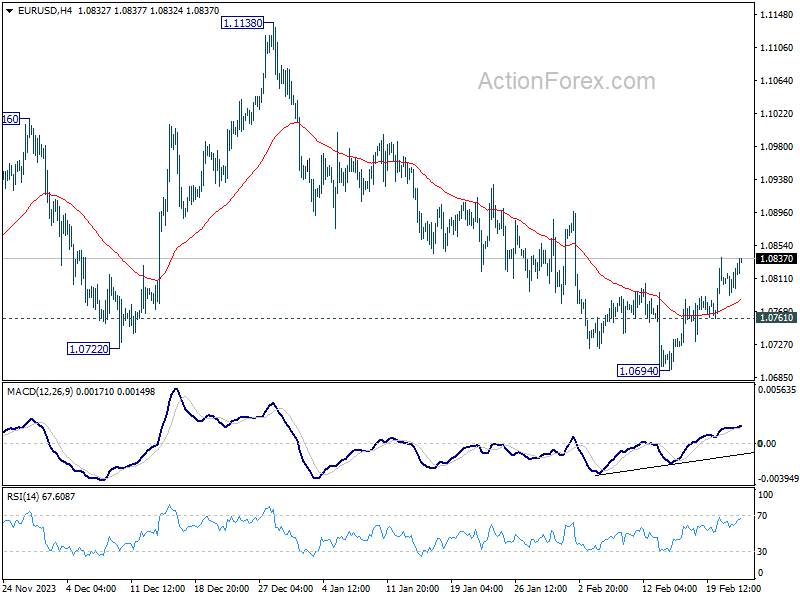
Daily Pivots: (S1) 1.0799; (P) 1.0811; (R1) 1.0833; More...
Intraday bias in EUR/USD stays on the upside for the moment. Sustained trading above above 55 D EMA (now at 1.0832) will argue that fall from 1.1138 has completed and target this resistance. Meanwhile, rejection by 55 D EMA, followed by break of 1.0761 minor support will retain near term bearishness, and bring retest of 1.0694 first.
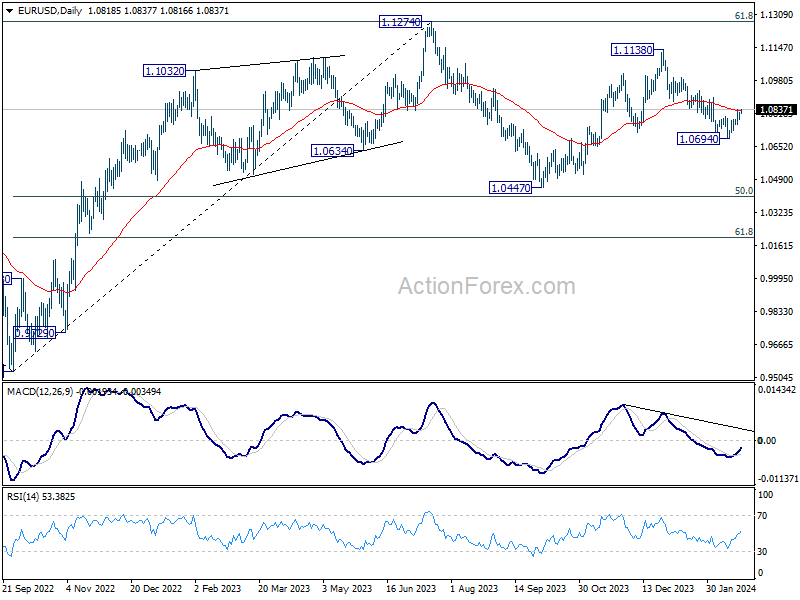
In the bigger picture, price actions from 1.1274 are viewed as a corrective pattern to rise from 0.9534 (2022 low). Rise from 1.0447 is seen as the second leg. While further rally could cannot be ruled out, upside should be limited by 1.1274 to bring the third leg of the pattern. Meanwhile, sustained break of 1.0722 support will argue that the third leg has already started for 1.0447 and possibly below.
USD/JPY Daily Outlook
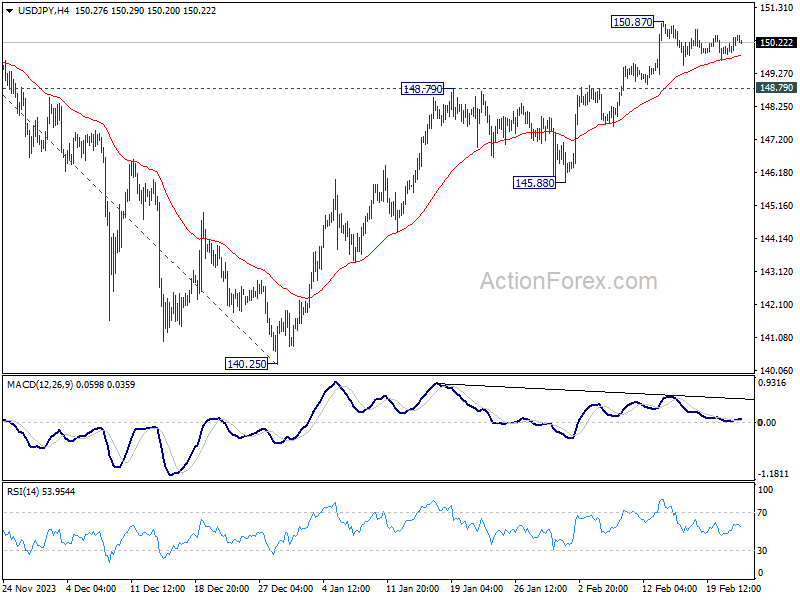
Daily Pivots: (S1) 149.96; (P) 150.18; (R1) 150.50; More...
Intraday bias in USD/JPY remains neutral as consolidation from 150.87 is extending. In case of another retreat, downside should be contained by 148.79 resistance turned support to bring another rally. Above 150.87 will resume the rise from 140.25 to 151.89/93 key resistance zone. Decisive break there will confirm larger up trend resumption of 155.50 projection level next. However, firm break of 148.79 will turn bias to the downside for 145.88 support.
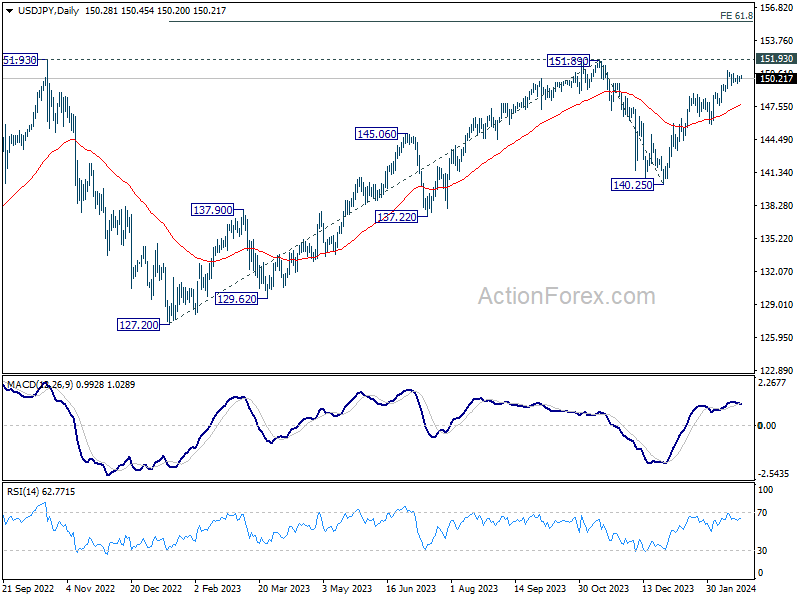
In the bigger picture, fall from 151.89 is seen as a correction to the rally from 127.20, which might have completed at 140.25 already. Firm break of 151.89/93 resistance zone will confirm up trend resumption, and next target will be 61.8% projection of 127.20 to 151.89 from 140.25 at 155.50. This will now remain the favored case as long as 140.25 support holds.
GBP/USD Daily Outlook
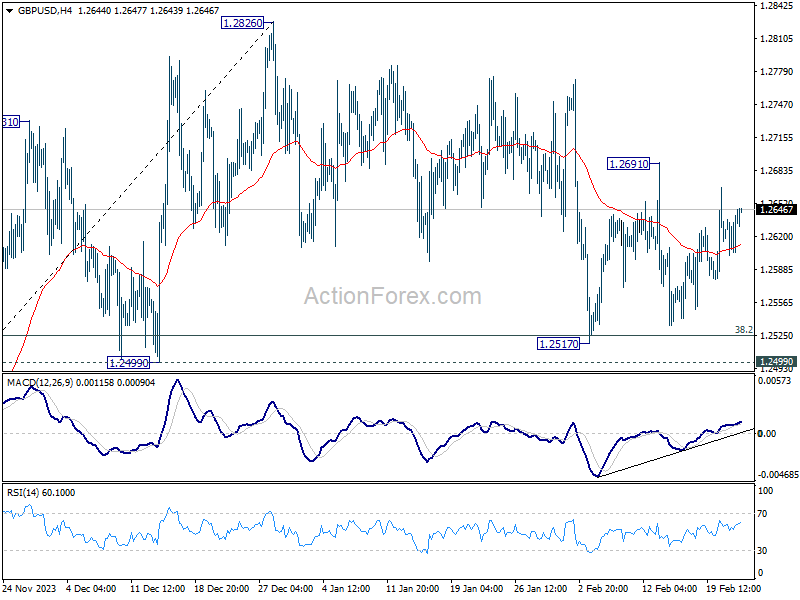
Daily Pivots: (S1) 1.2613; (P) 1.2628; (R1) 1.2652; More...
Intraday bias in GBP/USD remains neutral for the moment, as range trading continues. On the upside, break of 1.2691 resistance will indicate that correction from 1.2826 has completed. Intraday bias will be back on the upside for retesting 1.2826. Nevertheless, decisive break of 1.2499 will argue that whole rise from 1.2036 has completed and turn near term outlook bearish.
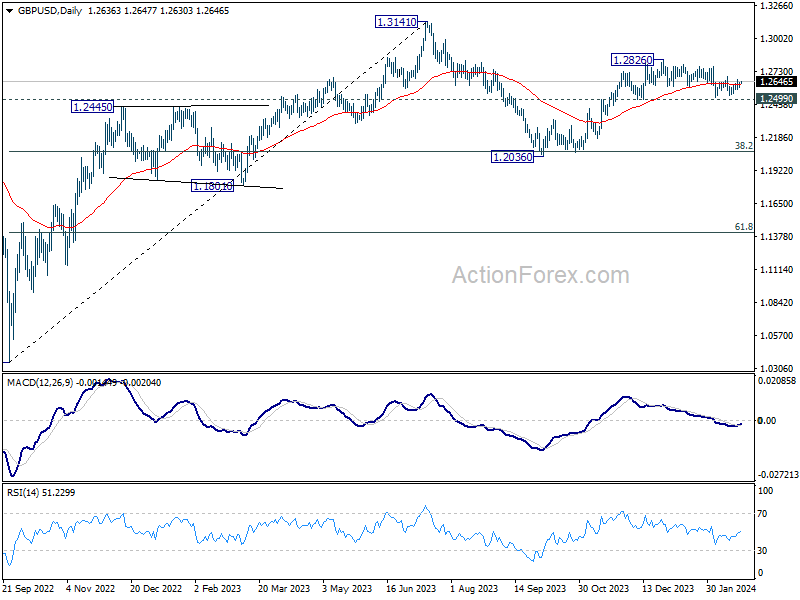
In the bigger picture, price actions from 1.3141 medium term top are seen as a corrective pattern to up trend from 1.0351 (2022 low). Rise from 1.2036 is seen as the second leg, which could be still in progress. But upside should be limited by 1.3141 to bring the third leg of the pattern. Meanwhile, break of 1.2499 support will argue that the third leg has already started for 38.2% retracement of 1.0351 (2022 low) to 1.3141 at 1.2075 again.
USD/CHF Daily Outlook
Daily Pivots: (S1) 0.8783; (P) 0.8802; (R1) 0.8816; More....
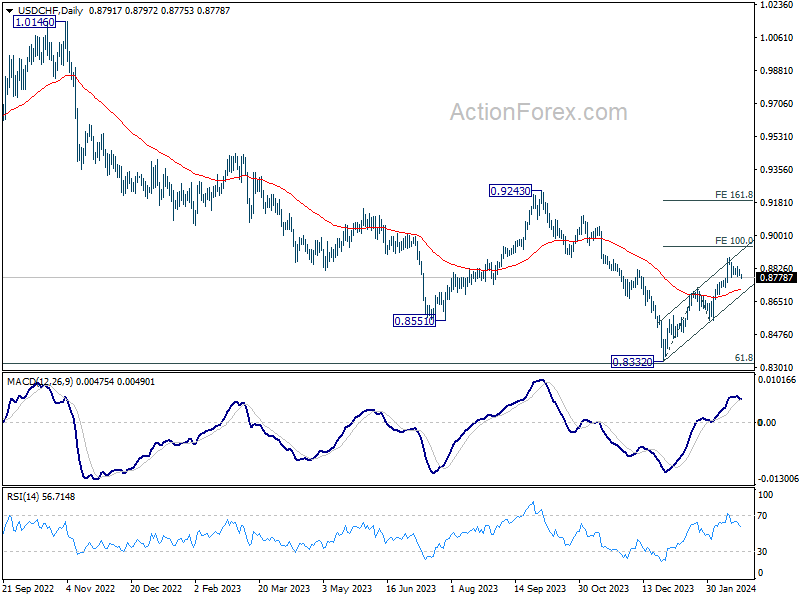
USD/CHF is extending the consolidation from 0.8884 and intraday bias stays neutral. With 0.8727 resistance turned support intact, further rally is still expected. On the upside, break of 0.8885 will resume the rise from 0.8332 and target and 100% projection of 0.8332 to 0.8727 from 0.8550 at 0.8954. However, sustained break of 0.8727 will dampen this bullish view, and turn bias back to the downside for 0.8550 support instead.
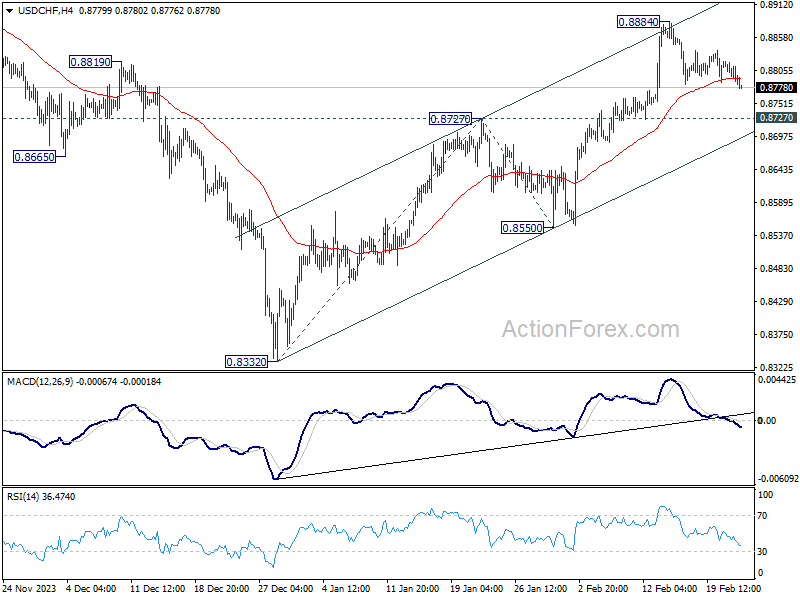
In the bigger picture, a medium term bottom should be formed at 0.8332, on bullish convergence condition in W MACD, just ahead of 0.8317 long term fibonacci support. It's still early to decide if the larger down trend from 1.0146 (2022 high) is reversing. But further rise should be seen to 0.9243 resistance even as a correction.
AUD/USD Daily Report
Daily Pivots: (S1) 0.6532; (P) 0.6553; (R1) 0.6572; More...
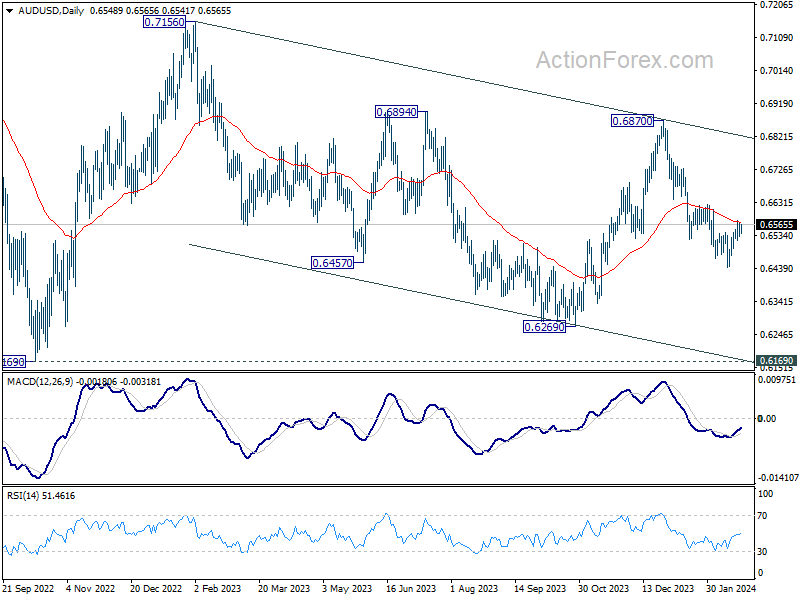
Intraday bias in AUD/USD remains neutral for the moment, and further decline is in favor with 0.6621 resistance intact. On the downside, below 0.6520 minor support will turn bias to the downside for retesting 0.6442 first. Firm break there will resume the the decline from 0.6870 towards 0.6269 low. Nevertheless, considering bullish convergence condition in 4H MACD, decisive break of 0.6621 will turn near term outlook bullish for 0.6870 resistance instead.
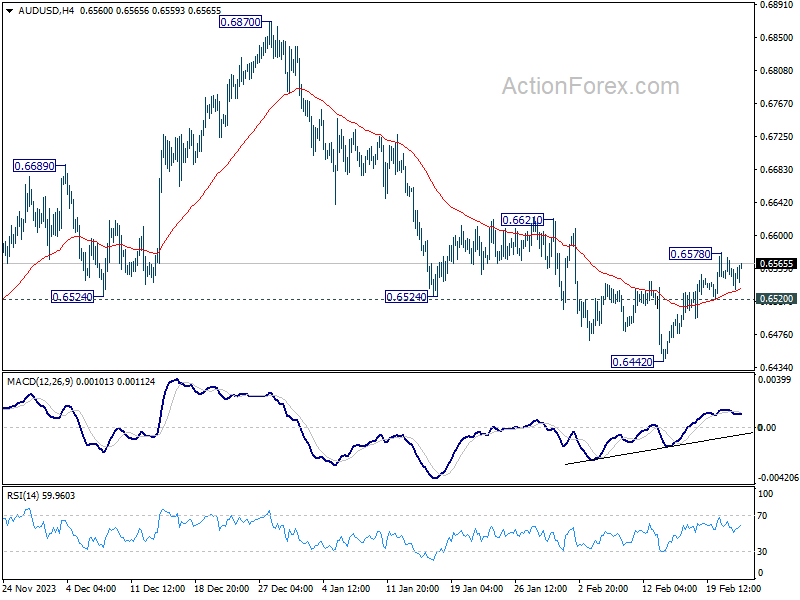
In the bigger picture, price actions from 0.6169 (2022 low) are seen as a medium term corrective pattern to the down trend from 0.8006 (2021 high). Fall from 0.7156 (2023 high) is seen as the second leg, which might still be in progress. Overall, sideway trading could continue in range of 0.6169/7156 for some more time. But as long as 0.7156 holds, an eventual downside breakout would be mildly in favor.
USD/CAD Daily Outlook
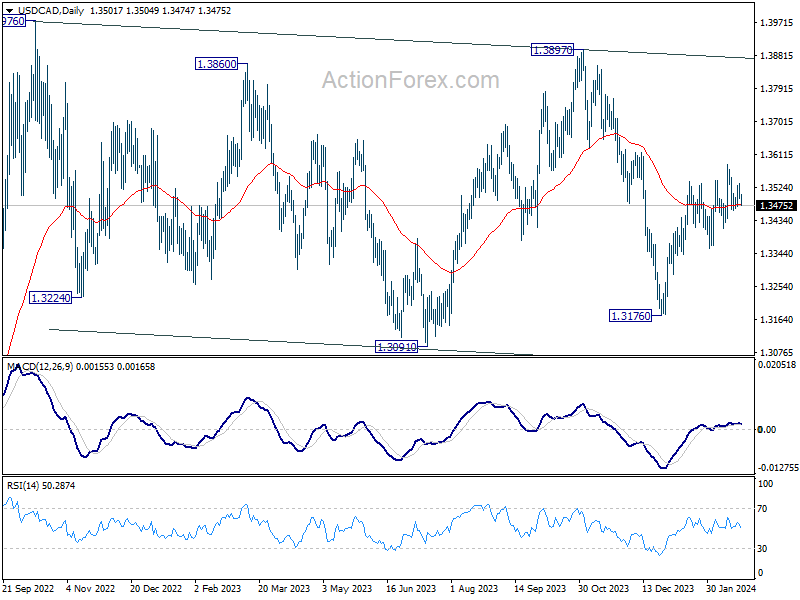
Daily Pivots: (S1) 1.3487; (P) 1.3512; (R1) 1.3529; More...
Range trading continues in USD/CAD and intraday bias stays neutral. More consolidations could be seen, but further rally is expected as long as 1.3357 support holds. On the upside, firm break of 1.3585 will resume the rebound from 1.3176 for 1.3897 resistance.
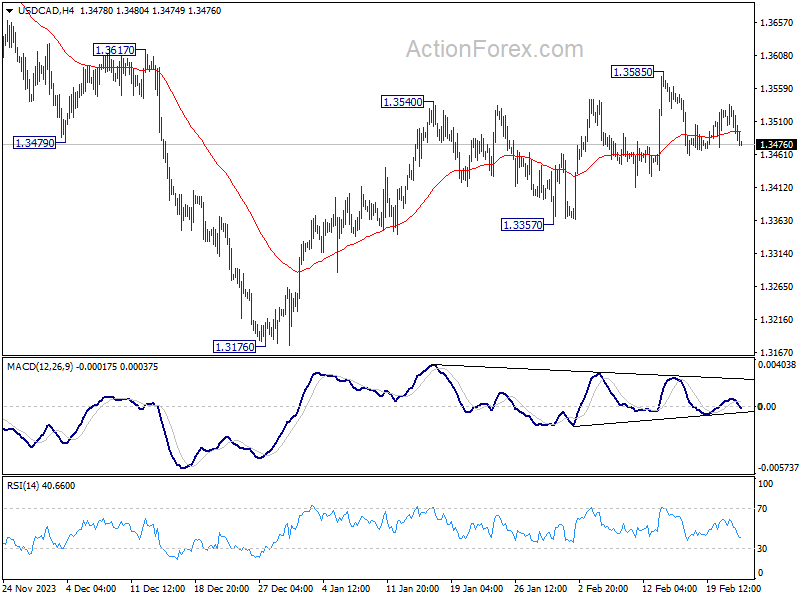
In the bigger picture, price actions from 1.3976 (2022 high) are viewed as a corrective pattern only. In case of another fall, strong support should emerge above 1.2947 resistance turned support to bring rebound. Overall, larger up trend from 1.2005 (2021 low) is still expected to resume through 1.3976 at a later stage.