

Sample Category Title
All’s Well That Ends Well
The market has been very quick in swallowing and digesting this Tuesday’s less than ideal inflation data from the US – which showed that inflation in the US didn’t ease as much as expected in January, remember that data? It was just two days ago, it was supposed to be important, and potentially trend changing. Interestingly, the kneejerk market reaction remained short lived. The fact that inflation in other places, like in the UK, didn’t pick up certainly helped cementing the idea that, this is certainly just a blip in the disinflation trend, and if it’s not, the Chicago Federal Reserve’s (Fed) Goolsbee said that slightly higher inflation data for a few months will still be consistent with a further easing toward the Fed’s 2% target. Staff at the European Central Bank (ECB) sounded more poetic, posting the world’s cheesiest central bank message ‘roses are red, violets are blue, we’re nearing our target, and we will reach too’. So, it’s in this atmosphere of love and hope that investors got their thoughts together and put on their dip-buyer heads, went out there and chased good deals – if you can call them good at the current levels.
And know that even The Big Short’s Michael Burry – who is famous for shorting stocks and who was short the chip stocks last year, short the S&P500 and short the Nasdaq – has no more short positions in his portfolio according to the latest 13F filings. The most famous short trader of the history threw in the towel. He is now long health and tech stocks.
The S&P500 rebounded almost 1%, technology stocks led rally. Uber, for example, jumped nearly 15% after announcing its first-ever buyback of $7bn to celebrate its first-ever annual net profit since it became public. Its Asian competitor Lyft jumped more than 60% but that was a mistake – the company was confused between 50 and 500bp. It’s more than just one zero on a press release.
Now, back to serious stuff, the US 2 and 10-yer yields retraced the post-CPI jump on market’s ignorance of the inflation risks that should delay the first rate cut from the Fed. The US dollar gave back field. But note that, despite the bulls keeping their faces on, the expectation of Fed rate cuts is not what it used to be at the start of the year. Investors will focus on retail sales, and some manufacturing indices today to continue guessing when the Fed will move. Stronger retail sales should weaken the Fed doves, while soft manufacturing should support them. The market pricing suggests 3 fully priced rate cuts, and a fourth cut priced at around 70%. That’s less than the 4 rate cuts priced for the ECB.
As such, the euro’s depreciation against the US dollar remains well supported by fundamentals. There is one thing, though. The dovish ECB expectations are fueled by soft growth and falling inflation in the euro area. But a broadly stronger US dollar is inflationary for the rest of the world because everything from commodities to oil are negotiated in USD terms. Therefore, the hawkish shift from the Fed and a stronger US dollar could lead to an undesired U-turn in European inflation, soften the ECB doves’ hand and throw a floor under the EURUSD selloff.
Happily, energy prices are not yet threatening enough. In this context, the barrel of US crude fell sharply, after trading above the 200-DMA, as the latest EIA data printed an 8.5-mio barrel increase in oil inventories last week. Nat gas futures continue to dive as well, driven by soft demand due to record high production, ample supplies, and mild winter both in Europe and the US.
Elsewhere, data released this morning in Japan showed that the country unexpectedly entered recession in Q4. The economy shrank 0.1%, while analysts were expecting a 0.3% expansion. The private consumption declined for the 3rd straight quarter. If the latter didn’t trigger a fresh selloff in the Japanese yen due to the heavy threat of direct intervention.
All Eyes on US Retail Sales
In focus today
In the US, January retail sales and industrial production data is due for release. Consensus expects some moderation in retail sales growth, even though early credit card data suggests that consumption has remained brisk at the start of the year as well. The NAHB housing market index and initial claims data will also be released today.
In the euro area, the European Commission releases its economic forecasts, including GDP and inflation estimates. As the Commission and the ECB use similar models, the projections could give hints of what to expect from the ECB's staff projections at the March meeting. Additionally, ECB President Lagarde will make public remarks today.
An empty Swedish Macro calendar awaits today. However, two Riksbank speakers Erik Thedéen and Anna Breman are set to speak on two different events. Thedéen will kick things off as his event starts 08.30 CET, followed by Breman at 16.20 CET. Both speeches are themed as "The economic situation and current monetary policy".
Economic and market news
What happened overnight?
In Japan, national accounts for Q4 unexpectedly came in at -0.1% after -0.7% in Q3. The decline stems primarily from weak consumption and capital expenditure. With two consecutive GDP contractions, Japan is now in a technical recession, while Germany has surpassed Japan to become the world's third-largest economy. The print complicates the monetary policy outlook for Bank of Japan, although the policy outlook much depends on the spring wage negotiations.
What happened yesterday?
In Norway, mainland-GDP printed 0.2% q/q in Q4 (Danske: 0.2%, cons: 0.1%). While the print signals some recovery in Q4, we find the details weaker as strong growth in private consumption was partly due to higher electricity consumption. Additionally, mainland exports contributed to the upside, whereas investments acted as a solid drag. Growth seems a bit stronger than Norges Bank (NB) expected in the December MPR (0.0%), but we still believe that capacity utilisation is moving downwards and will allow Norges Bank to cut rates once other central banks start cutting.
In the UK, inflation came in lower than expected in January at 4.0% y/y (cons: 4.1%) and core at 5.1% (cons: 5.2%). Looking at the seasonally adjusted monthly developments CPI was 0.24% m/m and core inflation was just 0.16% m/m s.a. Importantly, service inflation was just 0.03% m/m s.a., which is highlighted as an important component by the BoE.
In the euro area, industrial production surprised to the upside in December, printing 2.6% m/m compared to consensus of -0.2% m/m. However, the uptick is attributed to a large increase in capital goods of 20.5% m/m, driven by a large patent in Ireland (Irish industrial production rose 44.5% y/y). Non-durable goods production saw only a muted increase of 0.2% m/m. The total euro area Q4 industrial production figure was 0.0% q/q in line with GDP. Hence, the industry ended the year on a weak footing but still better than in Q3 in a sign that the worst of the manufacturing slump is behind us.
Equities: Global equities were higher yesterday as inflation and central bank fear abated. Most visible in the small caps with Russell 2000 rising 2.4% after the massive sell-off following CPI data Tuesday. Add to that most indices ended close to day-high and futures are higher again. Hence, our conclusion yesterday that CPI should not lead to a change in the current dominating narrative seems to also be the conclusion global investors reached yesterday. In US Dow +0.4%, S&P 500 +0.96%, Nasdaq +1.3% and Russell 2000 +2.4%. Asian markets mostly higher this morning led by Japan as dollar-yen crosses 150. European futures are up almost half a percent today while US futures are in marginal gains.
FI: European yields declined after the lower-than-expected UK inflation data, and the 10Y German government bonds did not cross the 2.4% level. There was also a rebound in the US Treasury market with a decent decline in bond yields across the curve.
FX: Yesterday's price action was characterised as a (part) reversal of the post US CPI price action from Tuesday: cyclically sensitive currencies gained while the USD was among the underperformers. Alongside the SEK the NOK was the biggest outperformer with the Norwegian currency showing remarkable resilience amid Brent Crude falling 2 USD/bbl. Despite the rise in equities the GBP traded on the weak side while USD/JPY remains north of the psychologically important 150-level despite verbal intervention from the Japanese authorities.
USD/CAD Daily Outlook
Daily Pivots: (S1) 1.3524; (P) 1.3551; (R1) 1.3572; More...
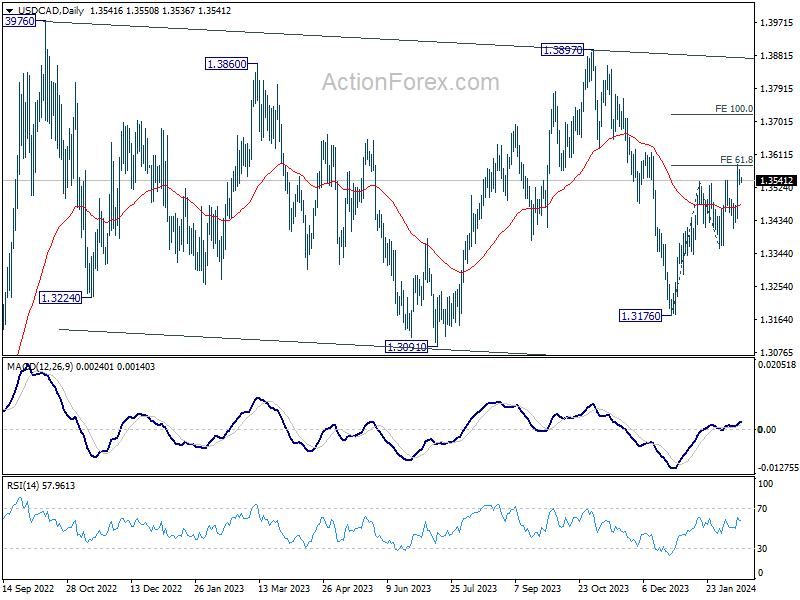
Intraday bias in USD/CAD stays on the upside at this point. Firm break of 61.8% projection of 1.3176 to 1.3540 from 1.3357 at 1.3582 will pave the way to 100% projection at 1.3721. On the downside, break of 1.3438 support is needed to indicate short term topping. Otherwise, outlook will stay bullish in case of retreat.
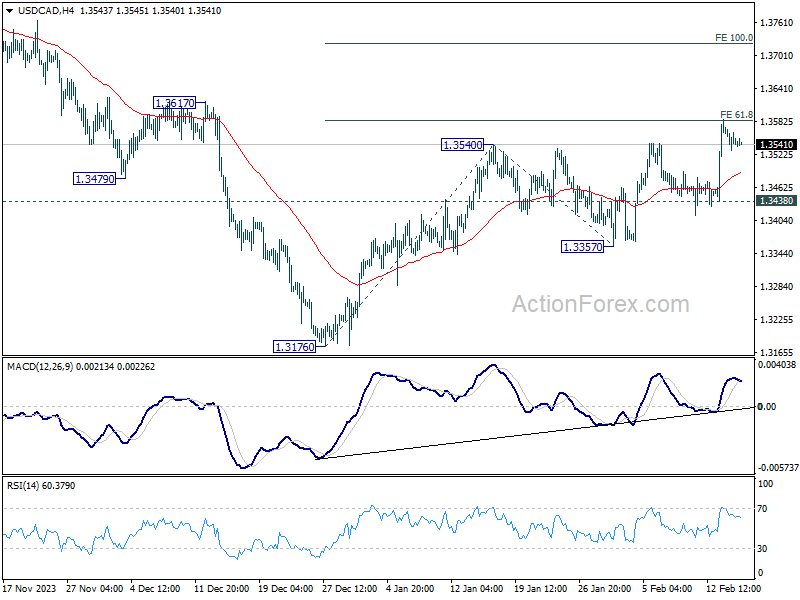
In the bigger picture, price actions from 1.3976 (2022 high) are viewed as a corrective pattern only. In case of another fall, strong support should emerge above 1.2947 resistance turned support to bring rebound. Overall, larger up trend from 1.2005 (2021 low) is still expected to resume through 1.3976 at a later stage.
AUD/USD Daily Report
Daily Pivots: (S1) 0.6460; (P) 0.6478; (R1) 0.6510; More...
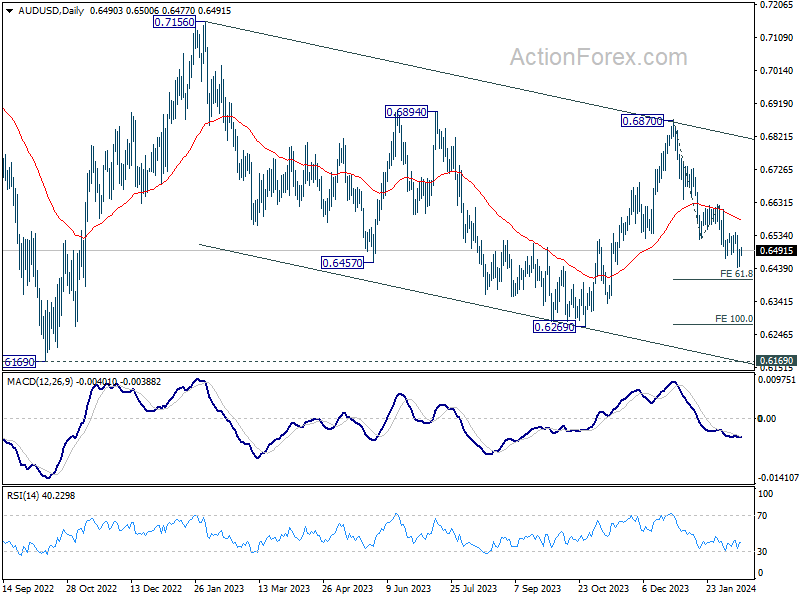
Intraday bias in AUD/USD is turned neutral with current recovery, and some consolidations would be seen first. But outlook will remain bearish as long as 0.6621 resistance holds. Below 0.6442 will resume the fall from 0.6870 to 61.8% projection of 0.6870 to 0.6524 from 0.6621 at 0.6407. Firm break there will target 100% projection at 0.6275, which is close to 0.6269 support.
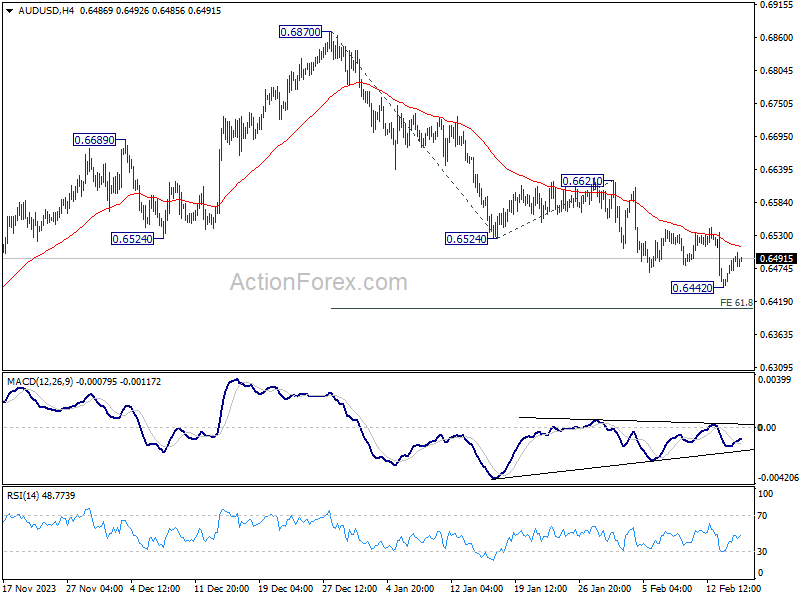
In the bigger picture, price actions from 0.6169 (2022 low) are seen as a medium term corrective pattern to the down trend from 0.8006 (2021 high). Fall from 0.7156 (2023 high) is seen as the second leg, which might still be in progress. Overall, sideway trading could continue in range of 0.6169/7156 for some more time. But as long as 0.7156 holds, an eventual downside breakout would be mildly in favor.
EUR/USD Daily Outlook
Daily Pivots: (S1) 1.0704; (P) 1.0719; (R1) 1.0744; More...
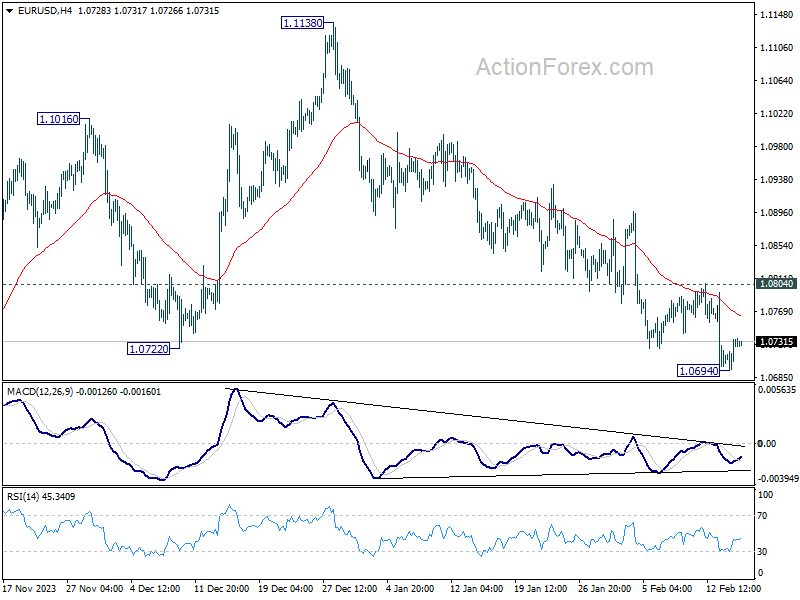
Intraday bias in EUR/USD is turned neutral with current recovery, and some consolidations could be seen first. Outlook will remain bearish as long as 1.0804 resistance holds. Below 1.0694 will resume the fall from 1.1138 to retest 1.0447 support. Nevertheless, considering bullish convergence condition in 4H MACD, above 1.0804 will turn bias to the upside for stronger rebound.
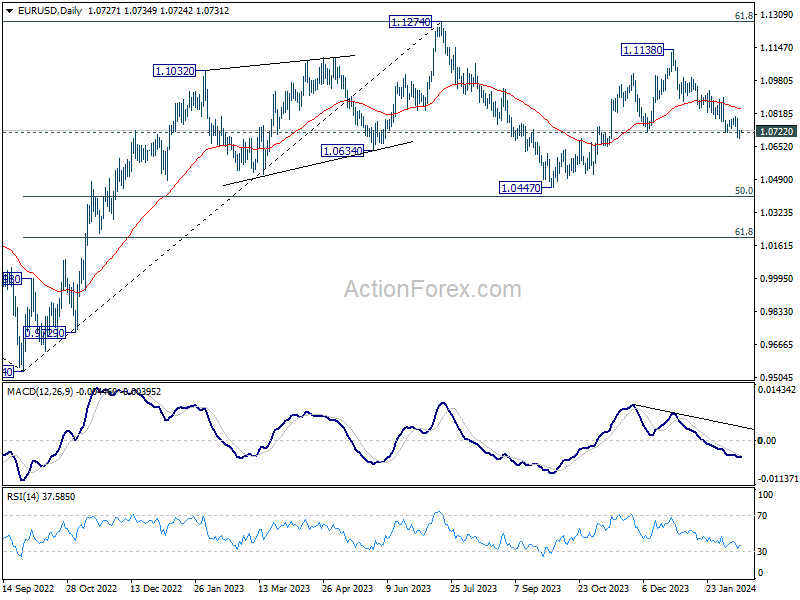
In the bigger picture, price actions from 1.1274 are viewed as a corrective pattern to rise from 0.9534 (2022 low). Rise from 1.0447 is seen as the second leg. While further rally could cannot be ruled out, upside should be limited by 1.1274 to bring the third leg of the pattern. Meanwhile, sustained break of 1.0722 support will argue that the third leg has already started for 1.0447 and possibly below.
GBP/USD Daily Outlook
Daily Pivots: (S1) 1.2531; (P) 1.2571; (R1) 1.2606; More...
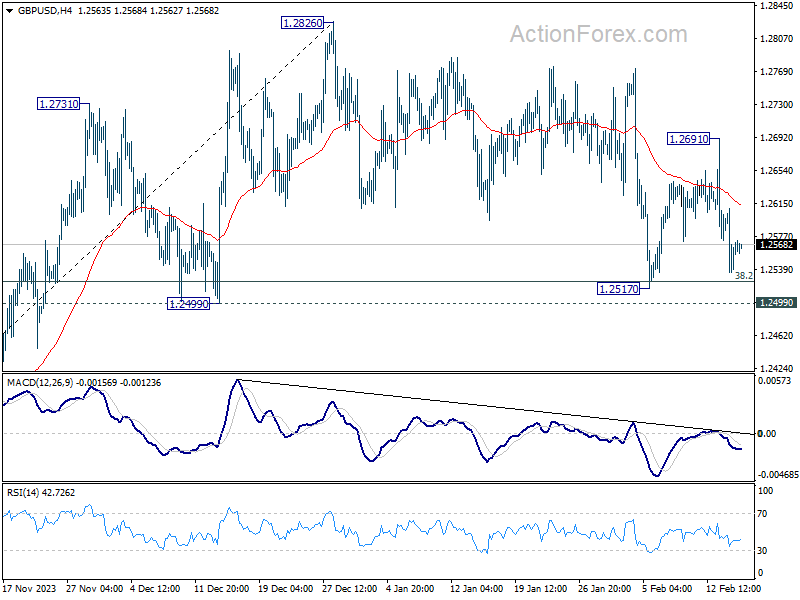
Intraday bias in GBP/USD remains neutral at this point. On the upside, break of 1.2691 resistance will indicate that correction from 1.2826 has completed. Intraday bias will be back on the upside for retesting 1.2826. Nevertheless, decisive break of 1.2499 will argue that whole rise from 1.2036 has completed and turn near term outlook bearish.
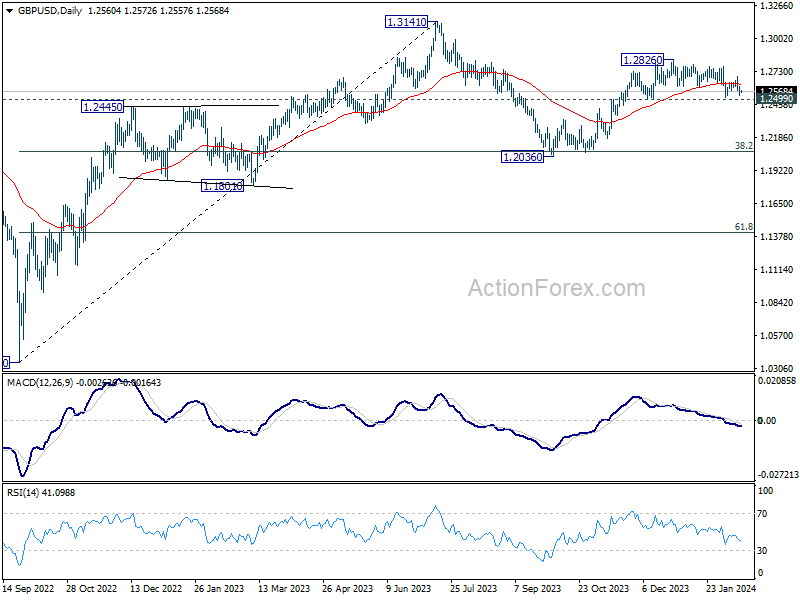
In the bigger picture, price actions from 1.3141 medium term top are seen as a corrective pattern to up trend from 1.0351 (2022 low). Rise from 1.2036 is seen as the second leg, which could be still in progress. But upside should be limited by 1.3141 to bring the third leg of the pattern. Meanwhile, break of 1.2499 support will argue that the third leg has already started for 38.2% retracement of 1.0351 (2022 low) to 1.3141 at 1.2075 again.
USD/CHF Daily Outlook
Daily Pivots: (S1) 0.8842; (P) 0.8864; (R1) 0.8880; More....
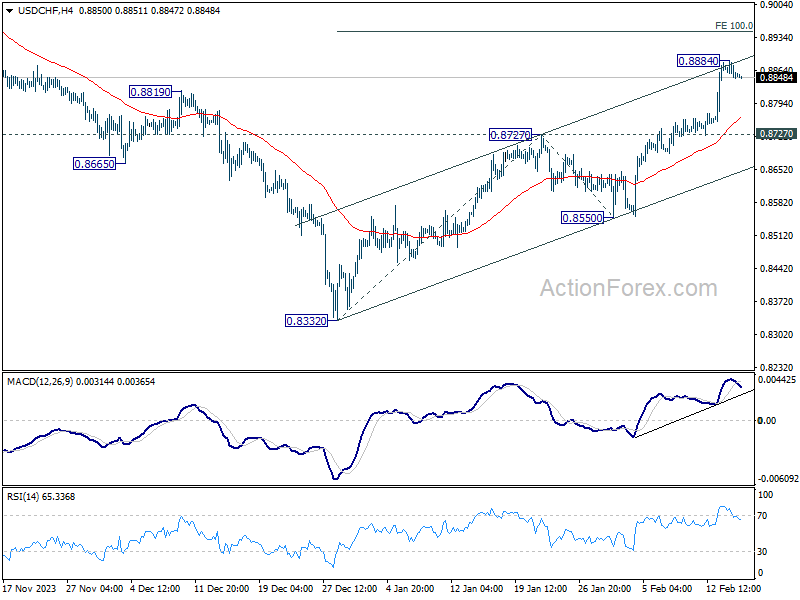
Intraday bias in USD/CHF is turned neutral with current retreat, and some consolidations would be seen first. Downside should be contained by 0.8727 resistance turned support to bring another rally. On the upside, above 0.8884 will resume the rise from 0.8332 to 100% projection of 0.8332 to 0.8727 from 0.8550 at 0.8954. Firm break there will pave the way to 161.8% projection at 0.9189.
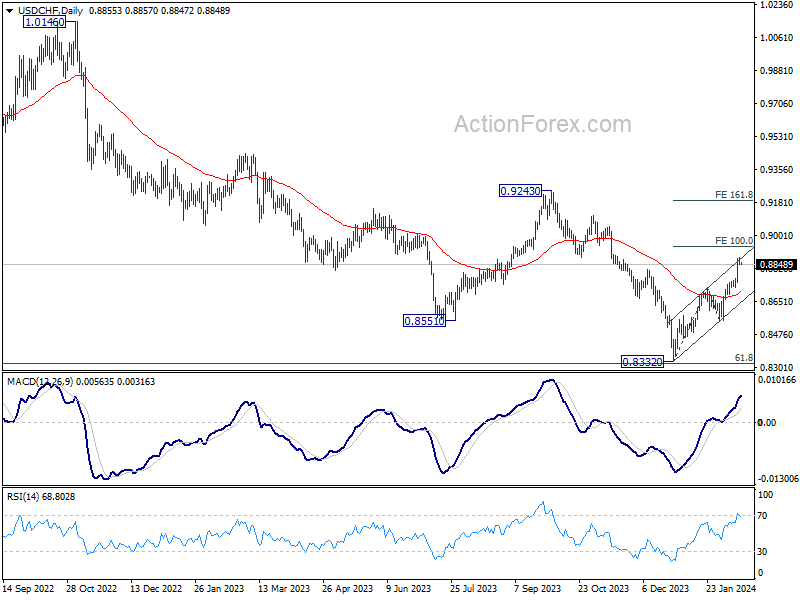
In the bigger picture, a medium term bottom should be formed at 0.8332, on bullish convergence condition in W MACD, just ahead of 0.8317 long term fibonacci support, on bullish convergence condition in W MACD. It's still early to decide if the larger down trend from 1.0146 (2022 high) is reversing. But further rise should be seen to 0.9243 resistance even as a correction.
USD/JPY Daily Outlook
Daily Pivots: (S1) 150.33; (P) 150.61; (R1) 150.86; More...
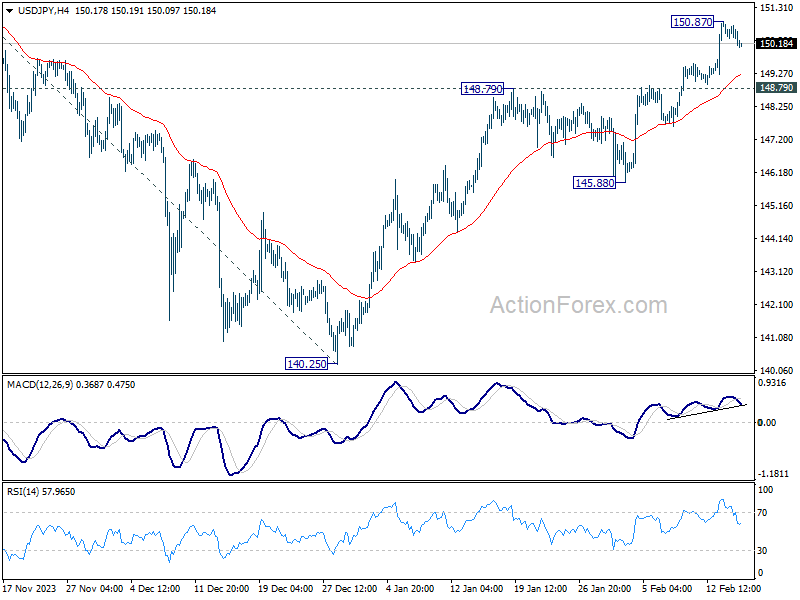
Intraday bias in USD/JPY is turned neutral with current retreat and some consolidations could be seen first. Downside of consolidation should be contained by 148.79 resistance turned support to bring another rally. Above 150.87 will resume the rise from 140.25 to 151.89/93 key resistance zone. Decisive break there will confirm larger up trend resumption of 155.50 projection level next.
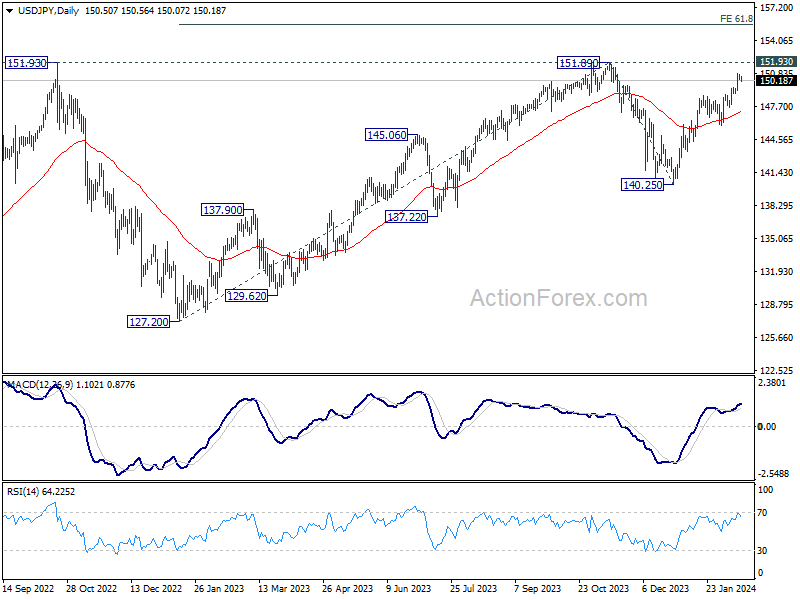
In the bigger picture, fall from 151.89 is seen as a correction to the rally from 127.20, which might have completed at 140.25 already. Firm break of 151.89/93 resistance zone will confirm up trend resumption, and next target will be 61.8% projection of 127.20 to 151.89 from 140.25 at 155.50. This will now remain the favored case as long as 140.25 support holds.
Japan’s Recession Can’t Hold Back Yen’s Recovery and Nikkei’s Surge
Japanese Yen recovers broadly in Asian session today, while Nikkei also soared to a new 34-year high, surpassing the 38k mark. The move came as a rather complex reactions to economic data showing that Japan unexpectedly slipping into recession. The surprised downturn also led to the country's demotion to the world's fourth-largest economy in 2023, with Germany ascending to third place.
This economic setback has not deterred speculations BoJ is still on track to exit its long-standing negative interest rate policy within the current year. This optimism is grounded in the resilience of Japan's labor market and the robust investment intentions of its corporations. Yen's current recovery is largely reflective of market sentiment that aligns with these expectations. However, the equity market's robust performance suggests that investors may be anticipating a delayed policy adjustment by BoJ, at a time later than April.
On a global scale, Dollar continues to dominate as the week's strongest currency, with investors keenly awaiting the forthcoming US retail sales figures. British Pound maintains its position as the second strongest currency, with significant interest focused on the upcoming UK GDP data. Eurozone holds the third spot in this week's currency strength ranking. Conversely, Swiss Franc is languishing as the week's weakest currency, with New Zealand Dollar, Australian Dollar, and Canadian Dollar trailing close behind. Australia's recent lackluster employment report has notably dampened Aussie's recovery momentum.
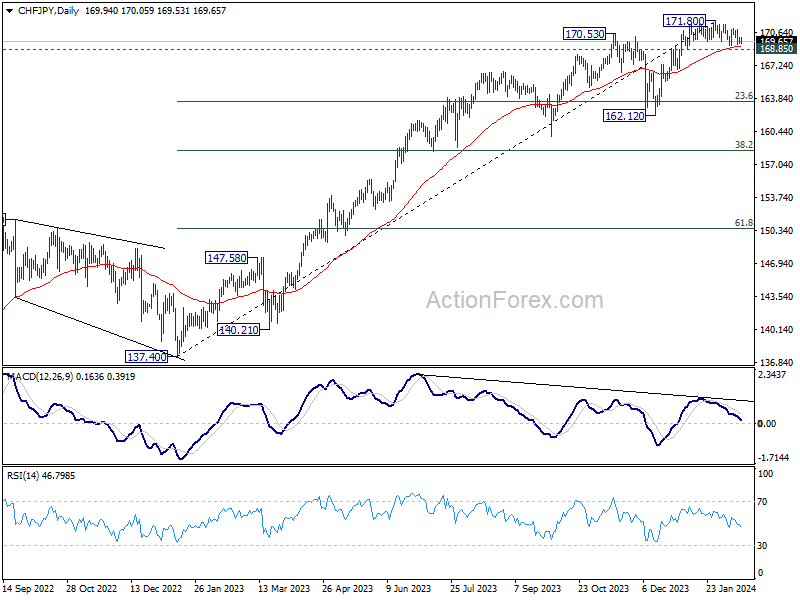
Technically, CHF/JPY is looking vulnerable to a deeper correction. Upside momentum has been clearly diminishing for a while, as seen in D MACD. Break of 168.85 support will argue that a medium term top was also formed, and bring deeper fall to 23.6% retracement of 137.40 to 171.80 at 163.68, as a correction to the uptrend from 137.40. Any extended selloff in Swiss Franc or rebound in Yen could catalyze this anticipated movement.
In Asia, Nikkei rose 1.25%. Hong Kong HSI is up 0.31%. Singapore Strait Times is up 0.56%. Japan 10-year JGB yield is down -0.0285 at 0.732. Overnight, DOW rose 0.40%. S&P 500 rose 0.96%. NASDAQ rose 1.30%. 10-year yield fell -0.049 to 4.267.
Japan Enters Technical Recession Amid Falling Consumption and Investment
Japan's economy has entered a technical recession as GDP unexpectedly contracted by -0.1% qoq in Q4, much worse than expectation of 0.3% qoq growth. That also marked a continuation from -0.8% contraction seen in Q3. On annualized basis, the downturn was -0.4%, a stark contrast to the anticipated 1.4% growth and following -3.3% contraction in the previous quarter.
The contraction is attributed primarily to decline in private consumption, which accounts for over half of the Japanese economy, falling by -0.2% qoq. Capital expenditure, another significant driver of private-sector growth, also decreased by -0.1% qoq. However, external demand, as indicated by the net exports, provided a slight buffer, contributing 0.2 percentage points to GDP, with exports growing by 2.6% qoq.
Economy Minister Yoshitaka Shindo emphasized the importance of solid wage growth to support consumer spending, which he noted is currently "lacking momentum" amidst rising prices. He also pointed out that BoJ considers a broad range of data, including consumption patterns and risks to the economy, when formulating monetary policy.
RBA's Bullock highlights inflation persistence and demand-supply imbalance
In today's Senate Estimates appearance, RBA Governor Michele Bullock underscored the "persistent" nature of inflationary pressures within the Australian economy.
She pointed out the crucial distinction between demand growth rates and overall demand levels, emphasizing "growth rates are slowing, but aggregate demand is still above aggregate supply, and that's what's generating inflationary pressures."
Bullock remained optimistic about RBA's ability to manage inflation effectively without jeopardizing employment growth. "We think we're in a good position to get inflation down in a reasonable amount of time while still keeping employment growing," she noted.
Australia's employment grows 0.5k in Jan, unemployment rate rises to 4.1%
Australia's job market showed further signs of cooling in January, as the latest employment data reveals a modest increase of just 0.5k jobs, significantly below expectation of 20.7k growth. Looking at the details, full-time employment saw an uptick of 11.1k, counterbalanced by reduction in part-time job by -10.6k.
Unemployment rate unexpectedly rose from 3.9% to 4.1%, above expectation of 4.0%. That also marked the first occasion in two years since January 2022 that the rate has breached the 4% threshold. Participation rate held steady at 66.8%, but a notable decrease in monthly hours worked by -2.5% mom paints a picture of a slackening labor market.
BoE's Bailey highlights persistent concerns over services inflation and wage trends
During an appearance the House of Lords Economics Affairs Committee, BoE Governor Andrew Bailey highlighted that UK's inflation rates have fluctuated, slightly overshooting last month and slightly undershooting this month. The development balanced out to "pretty much leaves us where we were".
He noted the inflation trend were "obviously encouraging" potential worse outcomes. However, he emphasized that services inflation is at levels that are "not compatible with a 2% sustained inflation target". Meanwhile, pay growth reduction was "just not quite as far as we thought."
Bailey's observations come after the latest CPI data remained steady at 4% in January, with core CPI also unchanged at 5.1%. Bailey's comment suggested that this week's data s unlikely to prompt immediate policy shifts.
Fed's Barr: Rate cut decisions hinge on continued good data
In a speech overnight, Fed Vice Chair Michael Barr noted that the FOMC is "confident" that US is "on a path to 2% inflation". However, Barr underscored the importance of seeing "continued good data" before initiating reduction in federal funds rate.
Reflecting on the latest consumer product index inflation report, he acknowledged the potential for a "bumpy" journey back to the target inflation rate, emphasizing the need for a "careful approach" in the current economic climate.
Looking ahead
UK GDP data is the main focus in European session while production and trade balance will be featured. Swiss will release PPI and SECO consumer climate. Eurozone will release trade balance.
Later in the day, US retail sales will take center stage, and jobless claims, Empire state manufacturing, Philly Fed manufacturing, industrial production, business inventories, and NAHB housing index will be released. Canada will release manufacturing sales and housing starts.
USD/JPY Daily Outlook
Daily Pivots: (S1) 150.33; (P) 150.61; (R1) 150.86; More...
Intraday bias in USD/JPY is turned neutral with current retreat and some consolidations could be seen first. Downside of consolidation should be contained by 148.79 resistance turned support to bring another rally. Above 150.87 will resume the rise from 140.25 to 151.89/93 key resistance zone. Decisive break there will confirm larger up trend resumption of 155.50 projection level next.
In the bigger picture, fall from 151.89 is seen as a correction to the rally from 127.20, which might have completed at 140.25 already. Firm break of 151.89/93 resistance zone will confirm up trend resumption, and next target will be 61.8% projection of 127.20 to 151.89 from 140.25 at 155.50. This will now remain the favored case as long as 140.25 support holds.
Economic Indicators Update
| GMT | Ccy | Events | Actual | Forecast | Previous | Revised |
|---|---|---|---|---|---|---|
| 23:50 | JPY | GDP Q4 Q/Q P | -0.10% | 0.30% | -0.70% | -0.80% |
| 23:50 | JPY | GDP Deflator Y/Y Q4 P | 3.80% | 4.00% | 5.30% | |
| 00:00 | AUD | Consumer Inflation Expectations Feb | 4.50% | 4.50% | ||
| 00:30 | AUD | Employment Change Jan | 0.5K | 20.7K | -65.1K | -62.7K |
| 00:30 | AUD | Unemployment Rate Jan | 4.10% | 4.00% | 3.90% | |
| 04:30 | JPY | Industrial Production M/M Dec F | 1.40% | 1.80% | 1.80% | |
| 07:00 | GBP | GDP M/M Dec | -0.20% | 0.30% | ||
| 07:00 | GBP | GDP Q/Q Q4 P | -0.10% | -0.10% | ||
| 07:00 | GBP | Industrial Production M/M Dec | -0.10% | 0.30% | ||
| 07:00 | GBP | Industrial Production Y/Y Dec | -0.10% | |||
| 07:00 | GBP | Manufacturing Production M/M Dec | 0.00% | 0.40% | ||
| 07:00 | GBP | Manufacturing Production Y/Y Dec | 1.30% | |||
| 07:00 | GBP | Goods Trade Balance (GBP) Dec | -14.1B | -14.2B | ||
| 07:30 | CHF | PPI M/M Jan | -0.20% | -0.60% | ||
| 07:30 | CHF | PPI Y/Y Jan | -1.10% | |||
| 08:00 | CHF | SECO Consumer Climate Q1 | -34 | -40 | ||
| 10:00 | EUR | Eurozone Trade Balance (EUR) Dec | 15.7B | 14.8B | ||
| 13:00 | GBP | NIESR GDP Estimate Jan | 0.00% | |||
| 13:15 | CAD | Housing Starts Jan | 225K | 249K | ||
| 13:30 | CAD | Manufacturing Sales M/M Dec | -0.50% | 1.20% | ||
| 13:30 | USD | Initial Jobless Claims (Feb 9) | 217K | 218K | ||
| 13:30 | USD | Retail Sales M/M Jan | -0.20% | 0.60% | ||
| 13:30 | USD | Retail Sales ex Autos M/M Jan | 0.10% | 0.40% | ||
| 13:30 | USD | Import Price Index M/M Jan | -0.10% | 0.00% | ||
| 13:30 | USD | Empire State Manufacturing Index Feb | -12.5 | -43.7 | ||
| 13:30 | USD | Philadelphia Fed Manufacturing Survey Feb | -8.9 | -10.6 | ||
| 14:15 | USD | Industrial Production M/M Jan | 0.30% | 0.10% | ||
| 14:15 | USD | Capacity Utilization Jan | 78.80% | 78.60% | ||
| 15:00 | USD | Business Inventories Dec | 0.30% | -0.10% | ||
| 15:00 | USD | NAHB Housing Market Index Feb | 46 | 44 | ||
| 15:30 | USD | Natural Gas Storage | -67B | -75B |
Gold (XAUUSD) May See Larger Degree Correction
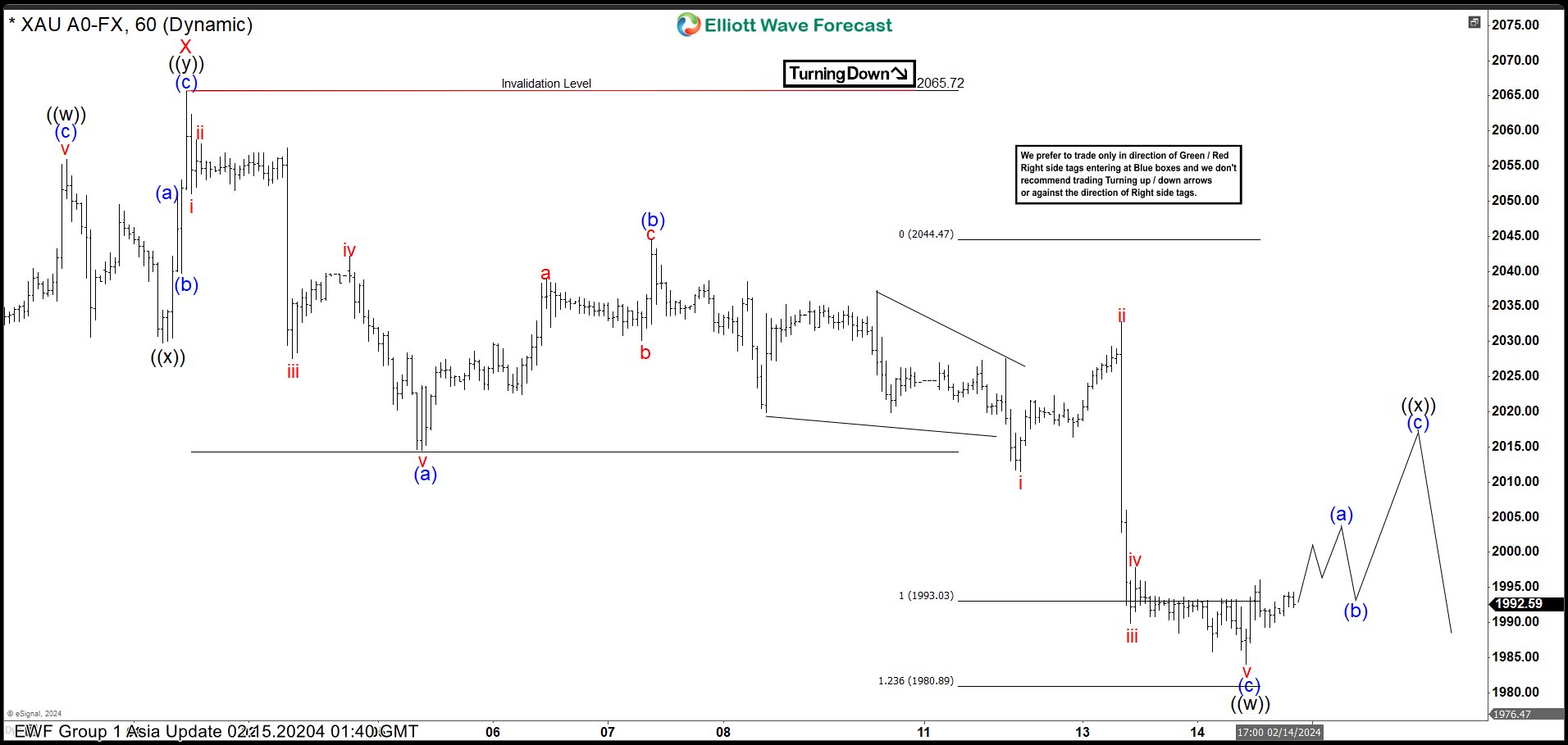
Gold (XAUUSD) cyclc from 12.28.2023 high is in progress as a double three Elliott Wave structure. Down from 12.28.2023 high, wave W ended at 2001.6 and rally in wave X ended at 2065.6. The metal then turns lower again in wave Y. Wave Y subdivides into another double three in lesser degree. Down from wave X, wave i ended at 2051 and wave ii ended at 2058.70. Wave iii lower ended at 2027.6, wave iv ended at 2042.22, and wave v lower ended at 2014.50. This completed wave (a) in higher degree. Rally in wave (b) ended at 2044.55 as a zigzag. Up from wave (a), wave a ended at 2038.8 and wave b ended at 2030.2.
Wave c higher ended at 2044.55 which completed wave (b). Down from there, wave i ended at 2011.5 and wave ii ended at 2032.85. Wave iii lower ended at 1989.9 and wave iv ended at 1997.81. Last leg lower wave v ended at 1984.09 which completed wave (c) of ((w)). Wave ((x)) rally is now in progress to correct cycle from 2.1.2024 high in 3, 7, or 11 swing before it resumes lower. Near term, as far as pivot at 2065.7 high stays intact, expect rally to fail for further downside.
Gold (XAUUSD) 60 Minutes Elliott Wave Chart
XAUUSD Elliott Wave Video
https://www.youtube.com/watch?v=edr2O8fcSkk