

Sample Category Title
RBA’s Bullock: Another hike neither ruled out nor ruled in
In an appearance before a parliamentary economics committee in Canberra today, RBA Governor Michele Bullock acknowledged the presence of "some encouraging signs" in Australia's economic landscape, yet cautioned that the nation's battle against inflation is "not over".
RBA's stance remains deliberately balanced, with Bullock stating, "At this stage, the Board hasn't ruled out a further increase in interest rates but neither has it ruled it in." Interest rate path will "depend upon the data and the evolving assessment of risks".
Bullock further elaborated on the dynamics of demand and supply within the Australian economy, indicating that demand levels continue to outstrip the economy's supply capacity. This imbalance, coupled with persistently tight labor market conditions, suggests that while the observed slowdown in demand is contributing to a moderation of inflationary pressures, the desired equilibrium has yet to be reached.
Goods price inflation has shown a softer trend than anticipated, mirroring patterns observed in international markets, Bullock noted. However, services price inflation remains elevated, driven by significant increases in both labor and non-labor input costs.
"Indeed, while inflation was lower than we were expecting in November, this is largely attributable to softer-than-expected goods inflation – services inflation was pretty much where we had forecast it to be."
BoE’s Mann skeptical of continuing decline in UK inflation
BoE MPC member Catherine Mann expressed skepticism about the continuation of the recent deceleration in headline inflation, challenging the prevailing market sentiment anticipating imminent rate cuts by the central bank. "I am not convinced that the near-term deceleration in headline inflation will continue," Mann stated.
As financial markets are expecting rate reductions from the current 5.25%, her concern is that financial conditions have "eased too much already," complicating BoE's efforts to anchor inflation expectations and stabilize price growth.
Mann also highlighted "upside risks" to inflation stemming from geopolitical tensions in the Red Sea, noting that increased shipping and insurance costs could exacerbate the UK's inflation challenges. "
Against a backdrop of sluggish supply growth and possible upside shocks, I see risks of continued inflation momentum and embedded persistence," she remarked.
Comparing UK's inflation dynamics with its international peers, Mann expressed reservations about the optimistic view that the UK is merely trailing slightly behind in its efforts to return inflation to target. "A look at the data suggests to me that the 'bit later' might be quite a while later," she cautioned.
In the latest MPC meeting, Mann, alongside fellow external member Jonathan Haskel, stood out for advocating an additional interest rate hike. Mann described her decision as "finely balanced," attributing her stance to UK's slower progress in reducing inflation compared to US and Eurozone.
ECB’s Lane anticipates March projections for comprehensive update
ECB Chief Economist Philip Lane highlighted in a speech that recent data suggest the disinflation process "may run faster than previously expected" in the near term. However, he was quick to note that the implications for medium-term inflation remain "less clear".
The economic recovery's strength, fiscal policy paths, wage developments, firms' capacity to absorb higher input costs, and ongoing geopolitical tensions are all pivotal factors that Lane identified as having an "important bearing" on the inflation trajectory.
Lane also emphasized the significance of March 2024 ECB staff macroeconomic projections as a critical juncture for providing a "comprehensive update" of medium-term inflation outlook.
In terms of policy approach, Lane reaffirmed ECB's commitment to a "firmly data-dependent approach," stressing the importance of striking a delicate balance between the risks of overtightening and prematurely easing monetary policy.
"Monetary policy needs to carefully balance the risk of overtightening by keeping rates too high for too long against the risk of prematurely moving away from the hold-steady position," he stated.
Furthermore, Lane stressed the importance being "further along in the disinflation process" before gaining confidence that inflation will consistently meet ECB's target in a timely and sustainable manner.
Fed’s Collins anticipates 75bps in rate cuts this year as baseline
In an interview overnight, Boston Fed President Susan Collins described her "baseline" expectation for rate path as being "similar" to Fed's latest projection, which anticipates a total of 75 basis points cut in interest rates within the year.
She highlighted the importance of additional data to support the decision for the timing of the first rate cut. "I will need more, additional evidence" to confirm that inflation is consistently trending towards Fed's 2% goal, she stated.
Nevertheless, Collins noted that waiting for inflation to reach the target before acting "would be waiting too long," suggesting a proactive yet measured stance in adjusting policy.
USD/JPY Accelerates Higher, 150 Presents Resistance
Key Highlights
- USD/JPY started a fresh increase from the 146.00 support zone.
- It broke a key bullish flag with resistance at 147.80 on the 4-hour chart.
- EUR/USD is consolidating losses below the 1.0800 resistance zone.
- Bitcoin price climbed above the $43,500 and $44,000 resistance levels.
USD/JPY Technical Analysis
The US Dollar formed a base above the 146.00 level against the Japanese Yen. USD/JPY started another increase and broke many hurdles near 147.50.
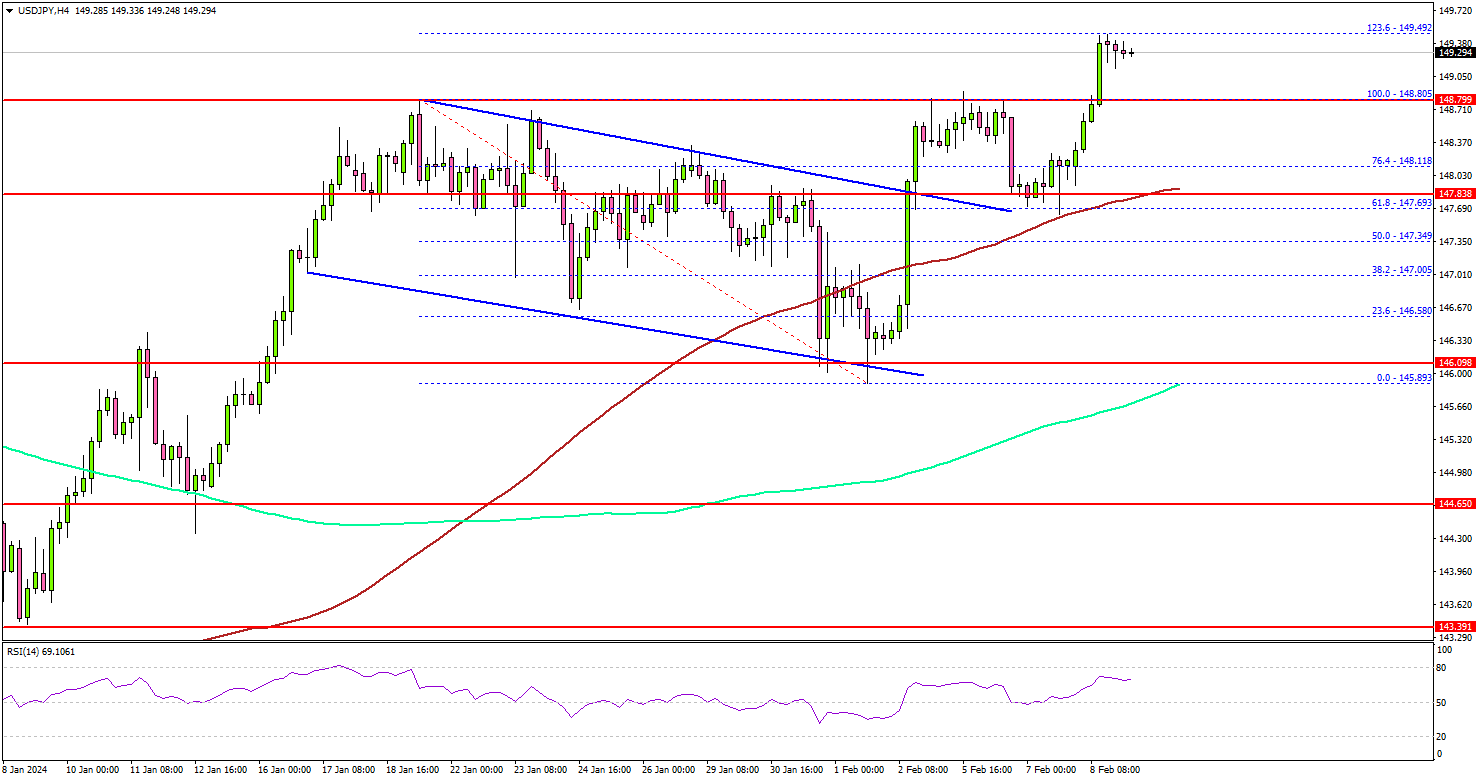
Looking at the 4-hour chart, the pair broke a key bullish flag with resistance at 147.80 to start another surge. There was a close above the 148.00 level, the 100 simple moving average (red, 4 hours), and the 200 simple moving average (green, 4 hours).
The bulls even pumped the pair above the 148.80 and 149.20 levels. It tested the 1.236 Fib extension level of the downside correction from the 148.80 swing high to the 145.89 low.
On the upside, the bulls are facing hurdles near the 149.80 level. The next key resistance is near the 150.00 level. A close above the 150.00 zone could open the doors for more upsides. The next stop for the bulls might be 151.20. Any more gains might send USD/JPY toward the 152.50 level.
Immediate support is near the 149.00 level. The first major support sits near the 148.80 level. The next major support sits at 148.00, below which the pair might gain bearish momentum. In the stated case, the pair could even revisit the 146.00 support level.
Looking at Bitcoin, there was a strong increase above the $43,500 resistance zone and there could be more upsides in the coming sessions.
Economic Releases
- Canada’s employment Change for Jan 2023 – Forecast 15K, versus 0.1K previous.
- Canada’s Unemployment Rate for Jan 2023 - Forecast 5.9%, versus 5.8% previous.
EURGBP Wave Analysis
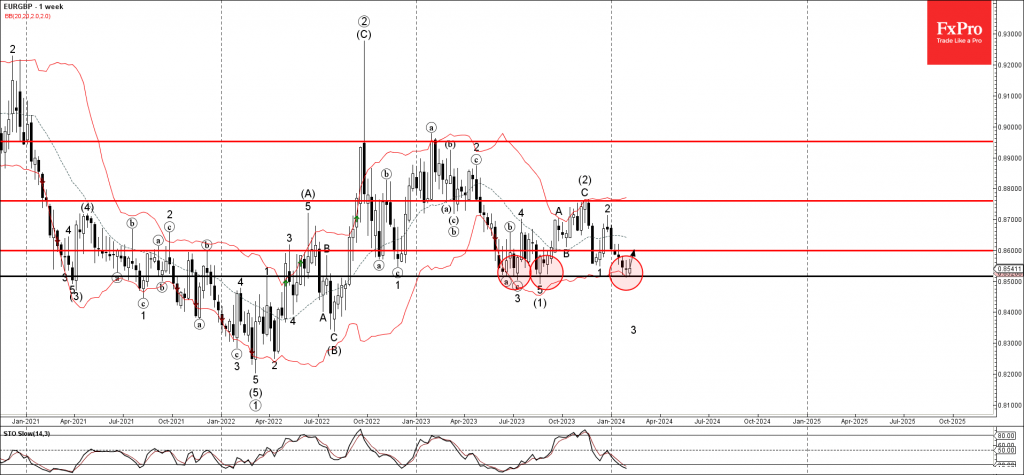
- EURGBP reversed from support level 0.8515
- Likely to rise to resistance level 0.8600
EURGBP currency pair recently reversed up from the support level 0.8515, which has been reversing the price from the middle of 2023.
The support level 0.8515 was strengthened by the lower weekly Bollinger Band and by the lower daily Bollinger Band.
Given the oversold weekly Stochastic and the strength of the nearby support level 0.8515, EURGBP currency pair can be expected to rise further to the next resistance level 0.8600.
Pound Traders Lock Gaze on UK Inflation and GDP Data
- Investors price in rate cuts despite BoE’s ‘higher for longer’ mantra
- Will the UK CPI and GDP data confirm that view?
- CPI inflation on Wednesday (07:00 GMT), GDP on Thursday (07:00 GMT)
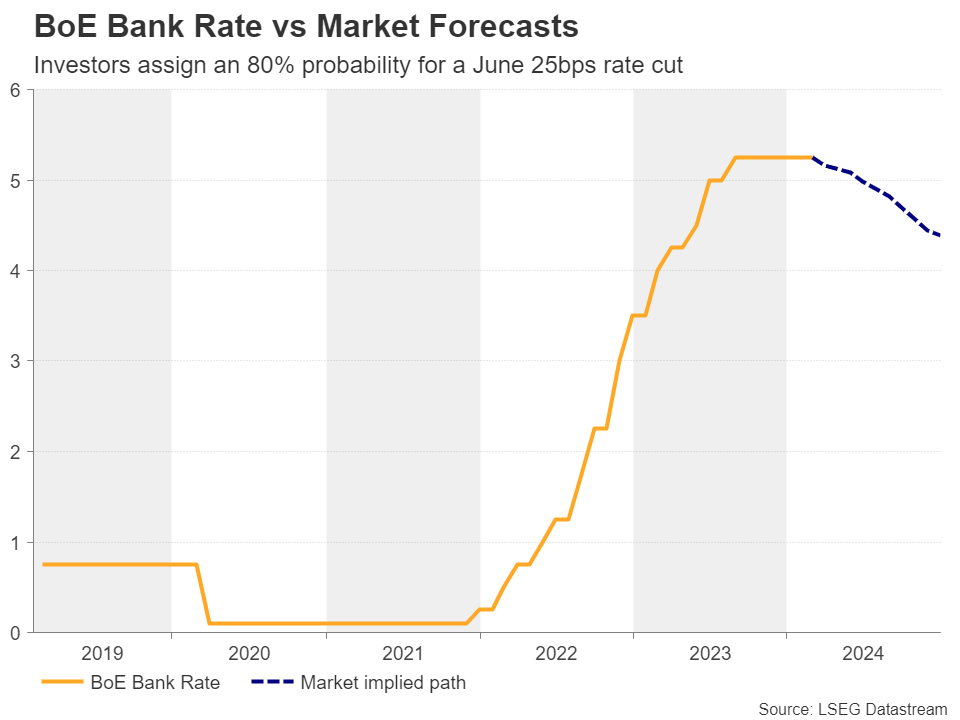
Traders assign an 80% chance of a June BoE rate cut
When they last met, Bank of England (BoE) policymakers decided to keep interest rates unchanged at 5.25%. However, the decision was not unanimous. Two members voted for raising interest rates by another 25bps and one favored a same-sized rate cut.
Although officials removed from the statement the part saying that further tightening may be required if inflationary pressures persist, at the press conference following the decision, Governor Bailey pushed back against rate cut expectations, saying that they are not yet at a point where they can lower borrowing costs, adding that policy needs to stay sufficiently restrictive for sufficiently long.
That said, remarks by chief economist Huw Pill this week had a somewhat more dovish flavor, with the senior BoE official noting that key gauges of price pressures were not yet at a level that would permit easing policy, but also that there is no need for inflation to hit 2% before they begin to do so. “Lowering interest rates is a reward to the economy for better inflation performance,” he also said, allowing market participants to continue penciling in a high 80% chance for a first quarter-point reduction in June.
Inflation could further slow, recession may have been avoided
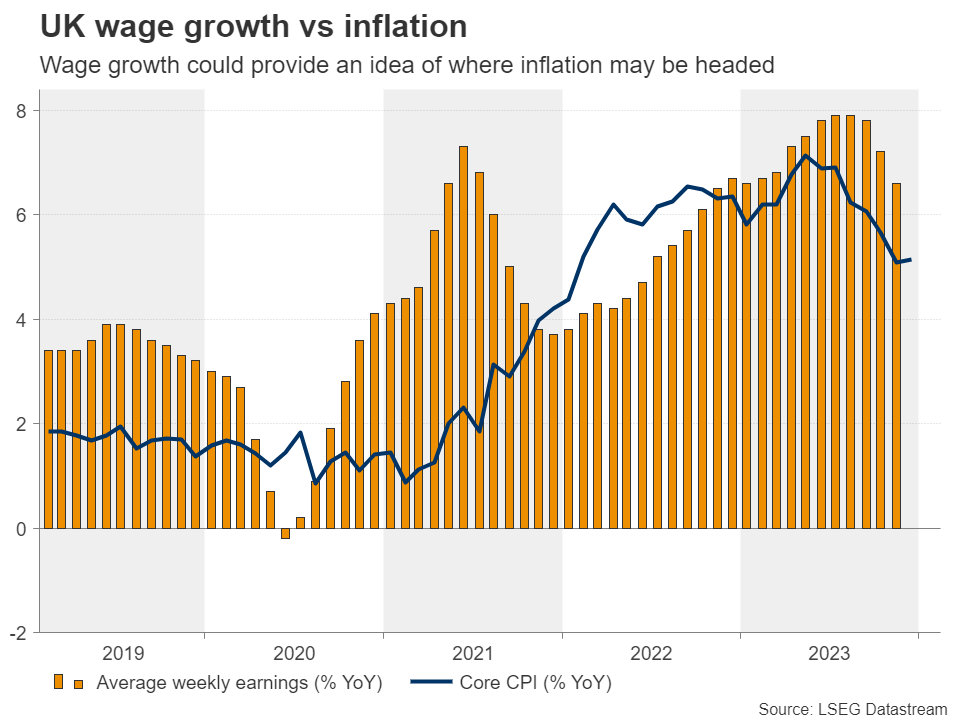
With all that in mind, pound traders will stay locked in front of their screens next week, as the calendar is packed with UK economic releases. On Tuesday, the jobs report for December is due to be released, with the focus likely to fall on average weekly earnings as investors try to figure out where inflation may be headed next.
Yet, the centerpiece may be Wednesday’s CPI numbers for January. According to the UK PMIs for the month, although rising ocean freight rates resulted in cost burdens across the manufacturing sector and despite service providers signaling another steep rise in input prices, overall, prices charged by private sector firms increased at the weakest pace since last October. This likely shifts the risks surrounding the CPI numbers to the downside.
Though, with the y/y change in oil prices remaining close to zero, the gap between the headline and core inflation rates may continue to narrow, which means that the headline rate may not decline as much as the core one.
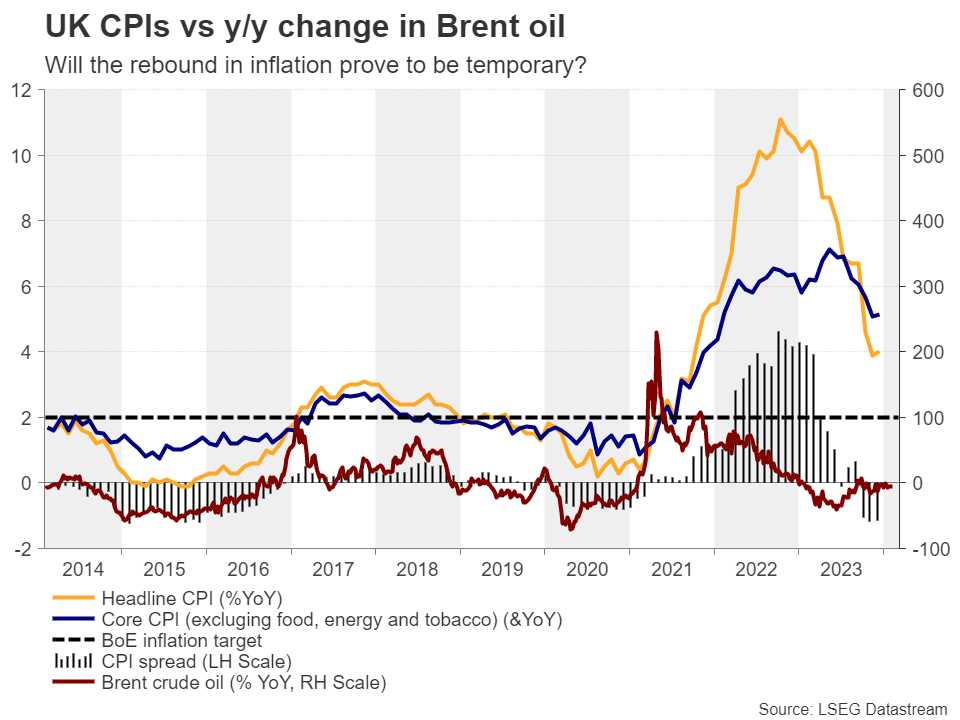
Be that as it may, slowing inflation may corroborate the market’s view that the BoE will start lowering borrowing costs in the summer, but the expectations about the pace of subsequent reductions may also depend on growth related data. On Thursday, the preliminary GDP data for Q4 and the month of December are due to be released, alongside the industrial and manufacturing production stats for the same month.
The downside revision of the Q3 GDP print revealed that the economy shrank 0.1%, and the 0.3% monthly contraction for October sparked recession fears, but those fears receded after the November monthly rate clocked at at 0.3%. Ergo, Thursday’s data may attract extra attention as it may confirm whether the UK economy has dodged a bullet.
According to the NIESR GDP estimate, the UK economy flatlined in the last three months of 2023, and should this be the case, the release may be cheered by pound traders. However, it is unlikely to tempt them to raise their BoE implied rate path. Any GDP related gains may remain limited and short-lived, especially if inflation further slows the day before. For the pound to end up gaining and sustaining those gains, an upside surprise may be needed. Retail sales are also due to be released on Friday.
Pound/dollar could turn south again
From a technical standpoint, on February 5, pound/dollar fell below the lower end of the sideways range that was in place since December 14. However, just the following day, it rebounded after hitting support slightly above the 1.2500 zone and the 200-day exponential moving average (EMA). The recovery allowed the pair to test the 50-day EMA before turning south again.
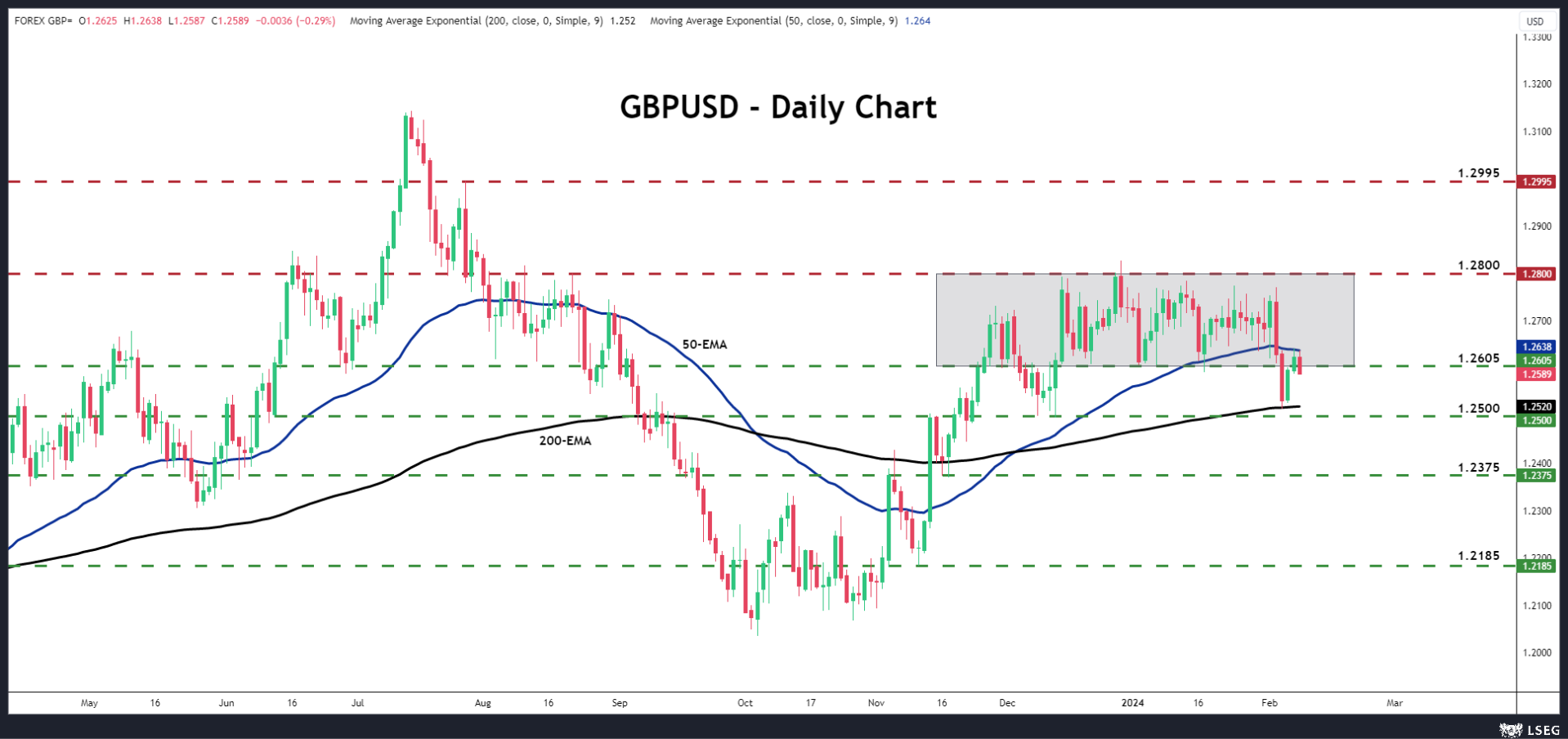 A slowdown in UK inflation on Tuesday could result in more selling, with the bears aiming for another test near the psychological barrier of 1.2500. However, growth data confirming the no-recession case may be a reason for a pause around there. For the outlook to be considered bullish, the pair may need to climb all the way above the upper bound of the range at around 1.2800.
USD/JPY: Rallies on Diverging BoJ/Fed Rate Outlook
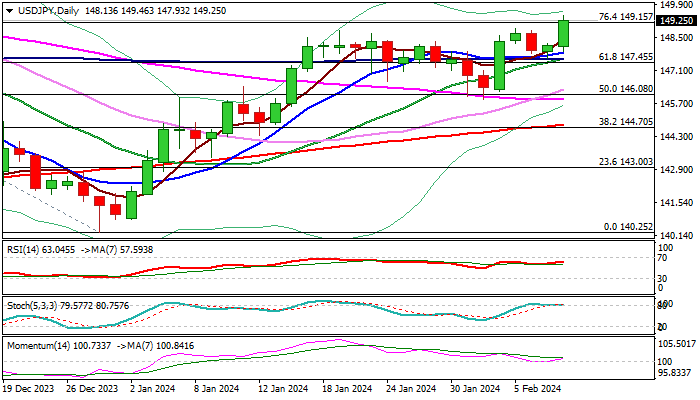
USDJPY rallied on Thursday (up 0.80% until early hours of the US session) as BoJ kept dovish stance in rate talks which deflated yen, while dollar appreciated from growing signs that the Fed would slow the action towards rate cuts in 2024.
The pair rose to the highest in more than two months, as fresh strength broke above former top at 148.80 (Jan 19), signaling an end of 148.80/145.89 corrective phase and bullish continuation.
Break of Fibo barrier at 149.15 (76.4% of 151.90/140.25) generated fresh bullish signal (which will require verification on close above this level) for attack at psychological 150 resistance.
Rising positive momentum and moving averages in full bullish configuration on daily chart, underpin the action, though overbought stochastic warns that bulls may face headwinds on approach to 150 barrier.
Rising 10DMA (147.90) should contain dips to keep bulls intact for 150+ acceleration.
Res: 149.70; 150.00; 150.77; 151.43.
Sup: 149.15; 148.80; 147.90; 147.45.
Sunset Market Commentary
Markets
Japanese stock markets and JPY still account for today’s biggest market move in a telling sign about current market momentum. The Nikkei closed slightly over 2% higher. USD/JPY sets a new YTD high at 149.40 with both the psychologic 150 mark and the 2022 (151.95) and 2023 (151.91) tops coming dangerously close. EUR/JPY escapes a narrow downward trend channel, rising to 160.50. It’s unlikely that this is what BoJ deputy governor Uchida had in mind when he spoke to local business leaders this morning. He advocated ending the negative interest rate policy, putting QE asset buying programmes (barely used of late) to bed and officially leaving the yield curve control policy (currently flexible cap of 1% at 10yr yield). While this trio of measures would be a big turn in BoJ monetary policy, Uchida also stressed that it is hard to imagine a path in which the BoJ would then keep raising interest rates rapidly. Financial conditions are set to remain easy. This “nuance” is what markets triggered into using their favoured JPY pressure tool: a weaker currency. Especially as USD and EUR profit (relatively) from a retreat in aggressive easing speculation. At the current weakening pace, it won’t take long before the Japanese Ministry of Finance turns to verbal (and effective?) FX interventions.
US weekly jobless claims were today’s sole data point of interest up until now (US 30-yr bond auction still to come). Unfortunately they printed almost bang in line with consensus at 218k. Central bank speeches didn’t deliver fireworks either. ECB Wunsch warns that wage rises are holding up rate cuts and that there’s value in waiting for more numbers. Richmond Fed Barkin joined the recent chorus to be patient on cutting rates as well. US yields currently add 1.5 bps (2-yr) to 3.9 bps (30-yr). German yields increase by 1.5 bps to 3 bps across the curve. General risk sentiment isn’t influenced yet by the spreading uncertainty over US (& European) bank exposure to US commercial real estate. The EuroStoxx50 rallies 0.8% to a new YTD/cycle high. Major US benchmarks open flattish. EUR/USD is trapped between 1.0750 and 1.08. In central Europe, the Czech National Bank accelerated from a 25 bps rate cut in December, to a 50 bps move today (to 6.25%). The Board voted 6-1 with one arguing for a 75 bps rate cut. The Czech currency is under new selling pressure with EUR/CZK rising above 25 for the first time since May last year.
News & Views
Riksbank Deputy Governor Jansson indicated that especially Swedish core inflation has recently fallen a little faster than expected. At the same time the economy continues to cool, reducing the risk of inflation becoming entrenched. This makes it possible to cut the policy rate earlier than indicated late last year. Still, monetary policy need to be characterized by caution. He doesn’t rule out a March cut, but sees it as not very likely. For now, it is more realistic to start cutting rates in May or June. Jansson doesn’t mention the currency as a risk for early rate cuts, unlike other MPC members including governor Thedeen in the minutes of the January meeting published yesterday. Despite the U-turn in the RB assessment, the krone recently held relatively stable (EUR/SEK .11.28).
The National Bank of Poland kept its policy rate unchanged at 5.75% yesterday. NBP governor Glapinski at the post meeting press conference (today) had a chance to give some insight on the NBP’s intentions going forward. Except for some small changes related to incoming data since the January meeting, the policy statement/assessment was almost identical to last meeting. The NBP sees inflation cooling. Especially headline inflation (6.2% Y/Y) might decline substantially in Q1 (2.5% in March) with slower progress seen for core inflation. However, the NBP still sees uncertainties related to regulatory and fiscal policy of the new government, with higher VAT, higher energy prices and (public) wage increases posing material upside risks for inflation in H2 (projection range of 3-8% by year end). Glapinski said that the NBP is committed to work with the government. The NBP statement sees the zloty now consistent with fundamentals and supporting the decrease in inflation. March projections should bring some more clarity. For now Glapinski still doesn’t see further rates cuts this year. EUR/PLN (4.33) declines modestly today.