

Sample Category Title
Sunset Market Commentary
Markets
Japanese stock markets and JPY still account for today’s biggest market move in a telling sign about current market momentum. The Nikkei closed slightly over 2% higher. USD/JPY sets a new YTD high at 149.40 with both the psychologic 150 mark and the 2022 (151.95) and 2023 (151.91) tops coming dangerously close. EUR/JPY escapes a narrow downward trend channel, rising to 160.50. It’s unlikely that this is what BoJ deputy governor Uchida had in mind when he spoke to local business leaders this morning. He advocated ending the negative interest rate policy, putting QE asset buying programmes (barely used of late) to bed and officially leaving the yield curve control policy (currently flexible cap of 1% at 10yr yield). While this trio of measures would be a big turn in BoJ monetary policy, Uchida also stressed that it is hard to imagine a path in which the BoJ would then keep raising interest rates rapidly. Financial conditions are set to remain easy. This “nuance” is what markets triggered into using their favoured JPY pressure tool: a weaker currency. Especially as USD and EUR profit (relatively) from a retreat in aggressive easing speculation. At the current weakening pace, it won’t take long before the Japanese Ministry of Finance turns to verbal (and effective?) FX interventions.
US weekly jobless claims were today’s sole data point of interest up until now (US 30-yr bond auction still to come). Unfortunately they printed almost bang in line with consensus at 218k. Central bank speeches didn’t deliver fireworks either. ECB Wunsch warns that wage rises are holding up rate cuts and that there’s value in waiting for more numbers. Richmond Fed Barkin joined the recent chorus to be patient on cutting rates as well. US yields currently add 1.5 bps (2-yr) to 3.9 bps (30-yr). German yields increase by 1.5 bps to 3 bps across the curve. General risk sentiment isn’t influenced yet by the spreading uncertainty over US (& European) bank exposure to US commercial real estate. The EuroStoxx50 rallies 0.8% to a new YTD/cycle high. Major US benchmarks open flattish. EUR/USD is trapped between 1.0750 and 1.08. In central Europe, the Czech National Bank accelerated from a 25 bps rate cut in December, to a 50 bps move today (to 6.25%). The Board voted 6-1 with one arguing for a 75 bps rate cut. The Czech currency is under new selling pressure with EUR/CZK rising above 25 for the first time since May last year.
News & Views
Riksbank Deputy Governor Jansson indicated that especially Swedish core inflation has recently fallen a little faster than expected. At the same time the economy continues to cool, reducing the risk of inflation becoming entrenched. This makes it possible to cut the policy rate earlier than indicated late last year. Still, monetary policy need to be characterized by caution. He doesn’t rule out a March cut, but sees it as not very likely. For now, it is more realistic to start cutting rates in May or June. Jansson doesn’t mention the currency as a risk for early rate cuts, unlike other MPC members including governor Thedeen in the minutes of the January meeting published yesterday. Despite the U-turn in the RB assessment, the krone recently held relatively stable (EUR/SEK .11.28).
The National Bank of Poland kept its policy rate unchanged at 5.75% yesterday. NBP governor Glapinski at the post meeting press conference (today) had a chance to give some insight on the NBP’s intentions going forward. Except for some small changes related to incoming data since the January meeting, the policy statement/assessment was almost identical to last meeting. The NBP sees inflation cooling. Especially headline inflation (6.2% Y/Y) might decline substantially in Q1 (2.5% in March) with slower progress seen for core inflation. However, the NBP still sees uncertainties related to regulatory and fiscal policy of the new government, with higher VAT, higher energy prices and (public) wage increases posing material upside risks for inflation in H2 (projection range of 3-8% by year end). Glapinski said that the NBP is committed to work with the government. The NBP statement sees the zloty now consistent with fundamentals and supporting the decrease in inflation. March projections should bring some more clarity. For now Glapinski still doesn’t see further rates cuts this year. EUR/PLN (4.33) declines modestly today.
Fed’s Barkin: We’ve got some time to be patient
Richmond Fed President Thomas Barkin highlighted the strength of the labor market and the encouraging trend of decreasing inflation in a Bloomberg TV interview. The cautious yet optimistic outlook grants Fed a period of watchful waiting before starting interest rate cuts.
"It's a very strong labor market still, and so gratified to see inflation coming down, hoping it continues to come down," Barkin remarked.
Barkin further indicated willingness to adopt a patient approach in the coming months. "I think we've got some time to be patient," he stated. Fed will get "a few more months" of inflation data and he desires "to see that trend continue and broaden".
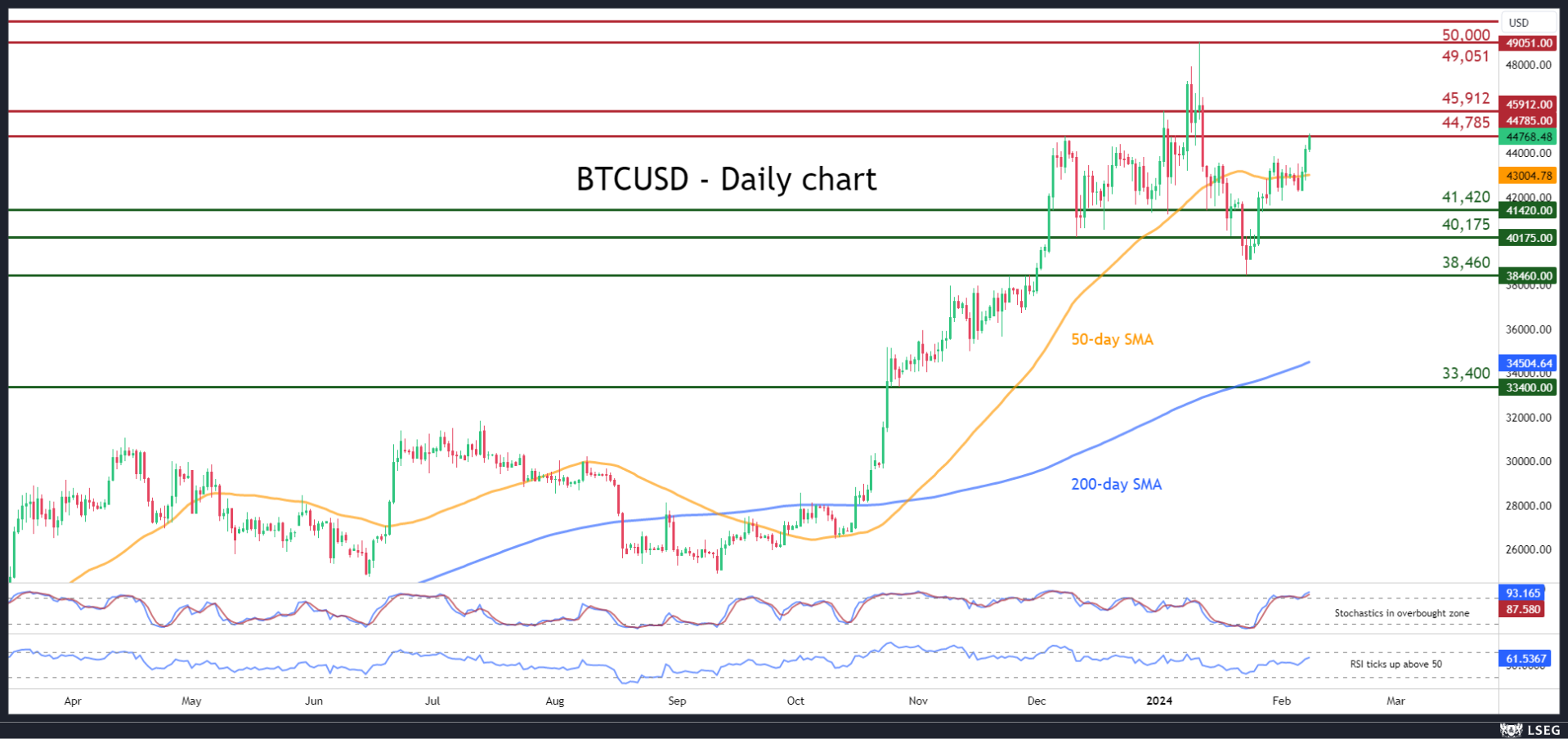
BTCUSD Advances Towards Crucial Resistance
- BTCUSD ascends sharply after claiming 50-day SMA
- Currently challenges the December peak of 44,785
- Momentum indicators are starting to look overbought
BTCUSD (Bitcoin) experienced a strong decline from its recent two-year peak of 49,051, dropping to as low as 38,460. However, the price has managed to storm back and recoup a significant part of its losses, testing the crucial 44,785 resistance zone on Thursday.
If the price conquers the December peak of 44,785, the bulls could then aim for the January resistance of 45,912. A jump above the latter could shift the spotlight to the two-year high of 49,051. Surpassing that region, Bitcoin could surge to fresh multi year highs, where the 50,00 psychological mark could serve as the next resistance territory.
On the flipside, should the advance falter, the inside swing low of 41,420 could act as the first line of defence. In case of a downside violation, the price may face the December support of 40,175. Further declines might encounter strong support at the 2024 bottom of 38,460.
In brief, BTCUSD’s advance has accelerated after the profound break above the 50-day simple moving average (SMA). Therefore, the focus now shifts on the December peak of 44,785, where a failure to conquer that region could trigger a pullback.
EUR/USD Eyes German Inflation
EUR/USD is slightly lower on Wednesday. In the North American session, the euro is trading at 1.0751, down 0.20%.
German inflation expected at 0.2%
Germany’s CPI is expected at 0.2% m/m on Friday, which would confirm the initial estimate from two weeks earlier. On an annualized basis, the initial estimate for CPI came in at 2.9% in January, down sharply from 3.7% in December. A deceleration in energy and food costs was the driver of the downturn in January, which was the lowest inflation rate since June 2021. Core inflation has also been falling, with the initial estimate showing a drop to 3.4%, its lowest rate since June 2022.
The drop in German inflation is not all that surprising, as the eurozone’s largest economy has been struggling. Germany’s manufacturing sector has been in prolonged decline and the services sector is sputtering, with five declines in the past six months. The economy declined in the fourth quarter and another contraction in Q1 would mean that Germany will have entered a technical recession. The eurozone is also grappling with a weak economy, with the latest evidence earlier this week as retail sales declined 1.1% m/m in December.
Despite weak economic conditions in the eurozone and Germany, the European Central Bank has been hesitant to cut interest rates. ECB members have expressed concern that inflation could make a comeback if the ECB were to cut rates too early. That could force the ECB to raise rates again and the optics of such a zig-zag would be disastrous. For now, the ECB remains hawkish on rate policy and is content to continue holding rates until inflation falls closer to the 2% target.
Since last week’s Fed meeting, a host of Fed members have delivered the message that inflation is heading in the right direction but the Fed plans to be patient and is in no rush to lower rates. The markets have taken note of the Fed’s pushback and have pared expectations of a rate cut in March to 18%, down from over 70% in January, according to the CME’s Fed Watch tool.
EUR/USD Technical
- EUR/USD tested support at 1.0746 earlier. Below, there is support at 1.0704
- There is resistance at 1.0822 and 1.0864
USD/JPY Slides After BOJ Uchida’s Hawkish Comments
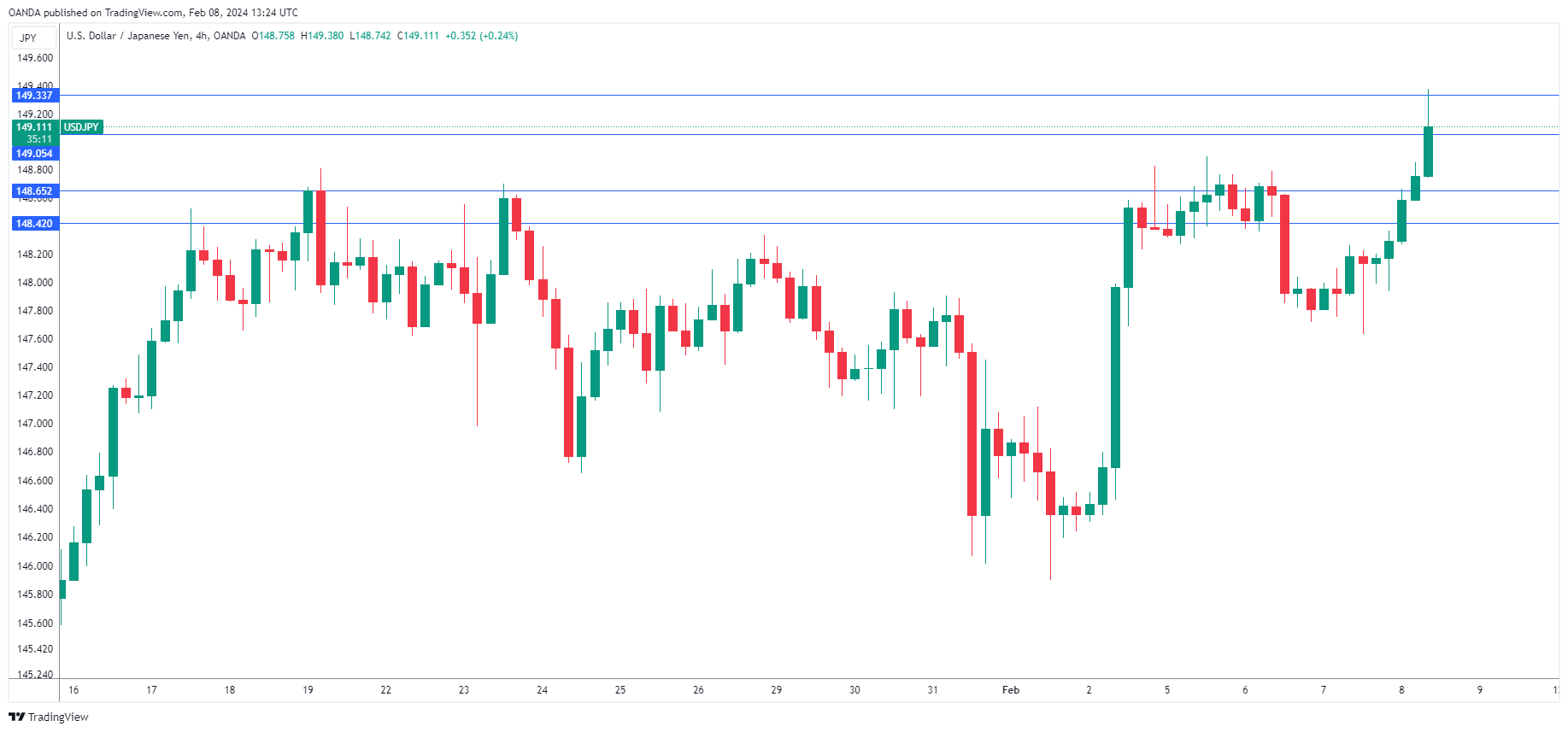
The Japanese yen is down sharply on Thursday. In the European session, USD/JPY is trading at 149.12, up 0.64%. This is the yen’s lowest level against the US dollar since November 27.
BoJ’s Uchida hints at policy shift
The Bank of Japan dropped its latest hint of a shift in monetary policy earlier today. BoJ Deputy Governor Shinichi Uchida said that even if the BoJ were to end negative rates, it was unlikely to “keep raising the interest rate rapidly”. Uchida added that the central bank would likely terminate its massive stimulus once the goal of a sustainable and stable inflation rate of 2% was within reach.
The BoJ has been carefully laying the groundwork for normalising policy, which would be a sea-change in policy and would likely send the Japanese yen sharply higher. An exit from negative rates, which is equivalent to a hike in rates, appears to be a question of timing. The markets are expecting the central bank to make a move in March or April, although the June meeting is also a possibility.
The Federal Reserve continues to push back against rate cut expectations. Four Fed officials signalled on Wednesday that the Fed is not on the cusp of a historic interest rate cut after its steep rate-tightening cycle which has tamed inflation.
Since last week’s policy meeting, a string of Fed members have come out with the message that inflation is heading in the right direction but the Fed plans to be patient and is in no rush to lower rates. The markets have taken note of the Fed’s reluctance and have pared expectations of a rate cut in March to 18%, down from over 70% in January, according to the CME’s Fed Watch tool.
USD/JPY Technical
- USD/JPY is testing resistance at 149.05. Above, there is resistance in 149.33
- There is support at 148.42 and 148.02
EUR/USD Mid-Day Outlook
Daily Pivots: (S1) 1.0755; (P) 1.0770; (R1) 1.0787; More...
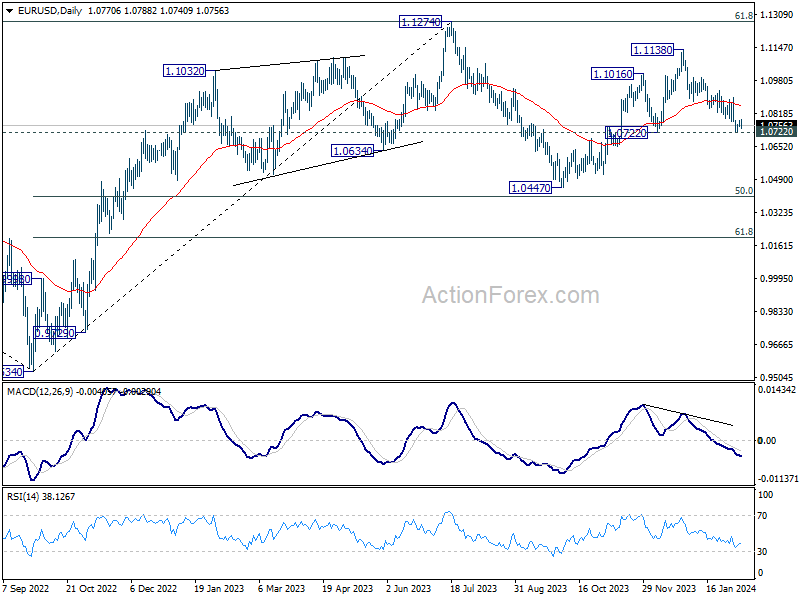
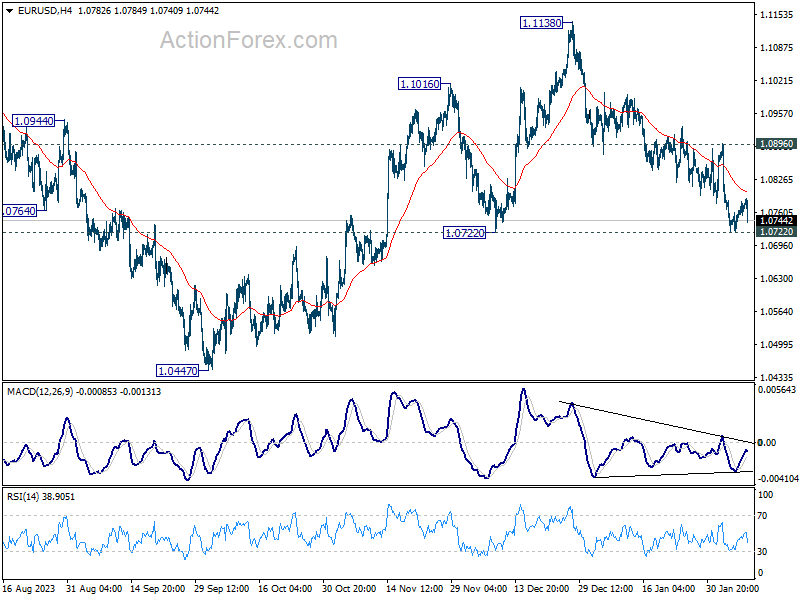
EUR/USD is still holding above 1.0722 support and intraday bias stays neutral. On the downside, decisive break of 1.0722 will argue that whole rise from 1.0447 has completed. Deeper fall would then be seen to target this low. On the upside, break of 1.0896 resistance is needed to indicate short term bottoming. Otherwise, risk will stay on the downside in case of recovery.
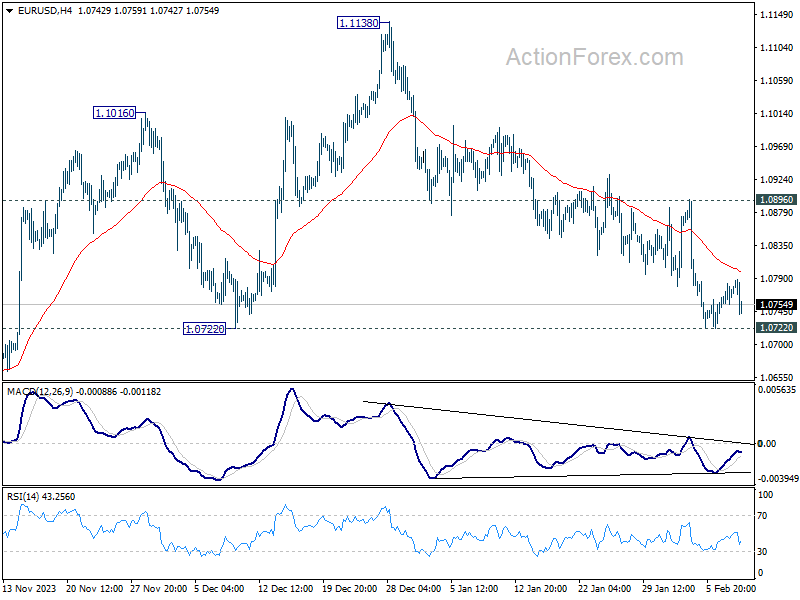
In the bigger picture, price actions from 1.1274 are viewed as a corrective pattern to rise from 0.9534 (2022 low). Rise from 1.0447 is seen as the second leg. While further rally could cannot be ruled out, upside should be limited by 1.1274 to bring the third leg of the pattern. Meanwhile, sustained break of 1.0722 support will argue that the third leg has already started for 1.0447 and possibly below.
GBP/USD Mid-Day Outlook
Daily Pivots: (S1) 1.2599; (P) 1.2620; (R1) 1.2650; More...
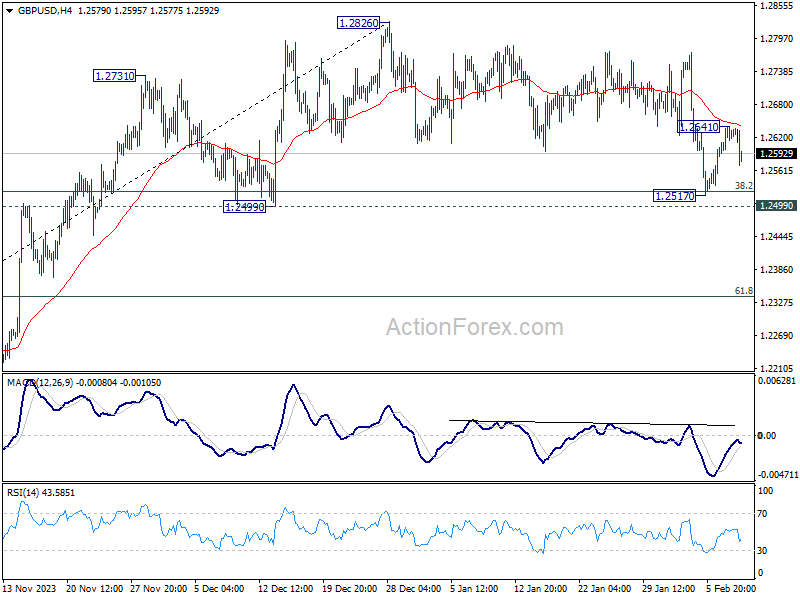
GBP/USD retreated ahead of 55 4H EMA (now at 1.2642) and intraday bias is turned neutral first. Above 1.2641 will resume the rebound from 1.2517 to retest 1.2826 high. On the downside, however, decisive break of 1.2499 will argue that whole rise from 1.2036 has completed and turn near term outlook bearish.
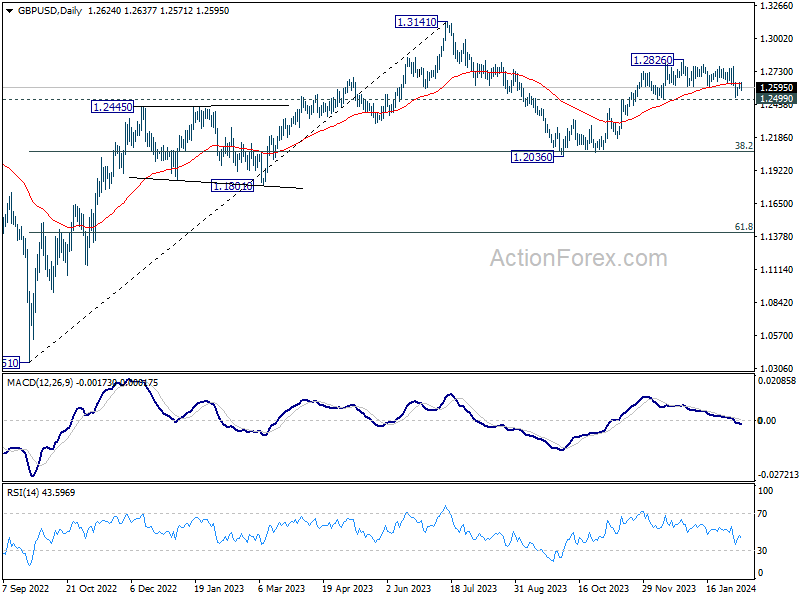
In the bigger picture, price actions from 1.3141 medium term top are seen as a corrective pattern to up trend from 1.0351 (2022 low). Rise from 1.2036 is seen as the second leg that's still in progress. Upside should be limited by 1.3141 to bring the third leg of the pattern. Meanwhile, break of 1.2499 support will argue that the third leg has already started for 38.2% retracement of 1.0351 (2022 low) to 1.3141 at 1.2075 again.
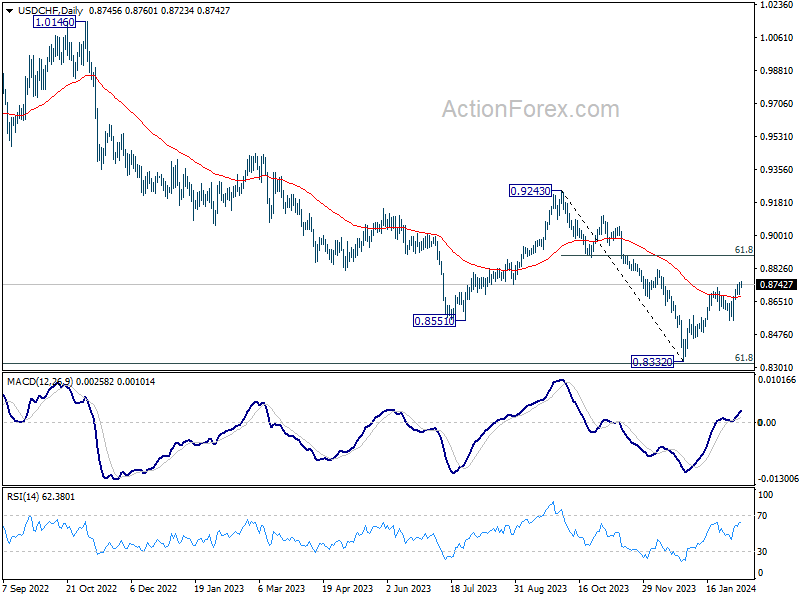
USD/CHF Mid-Day Outlook
Daily Pivots: (S1) 0.8706; (P) 0.8730; (R1) 0.8770; More....
Intraday bias in USD/CHF remains on the upside as rise from 0.8332 is in progress. Further seen to 61.8% retracement of 0.9243 to 0.8332 at 0.8995 next. On the downside, below 0.8687 minor support will turn intraday bias neutral first. But near term outlook will stay cautiously bullish as long as 0.8550 support holds.
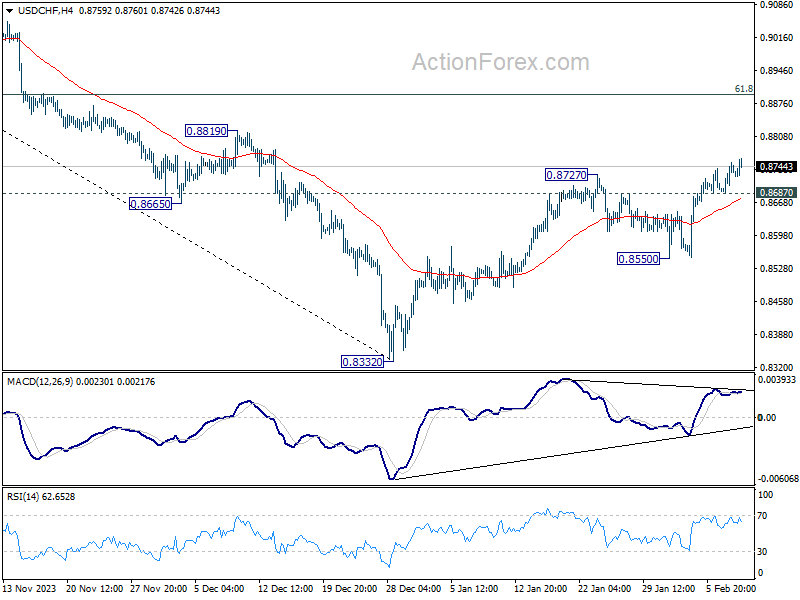
In the bigger picture, there is prospect of medium term bottoming at 0.8332 considering possible bullish convergence condition in W MACD, and the support from 0.8317 long term fibonacci support. Sustained trading above 55 D EMA (now at 0.8677) will affirm this case, and bring stronger rise back towards 0.9243 resistance, even as a corrective move.
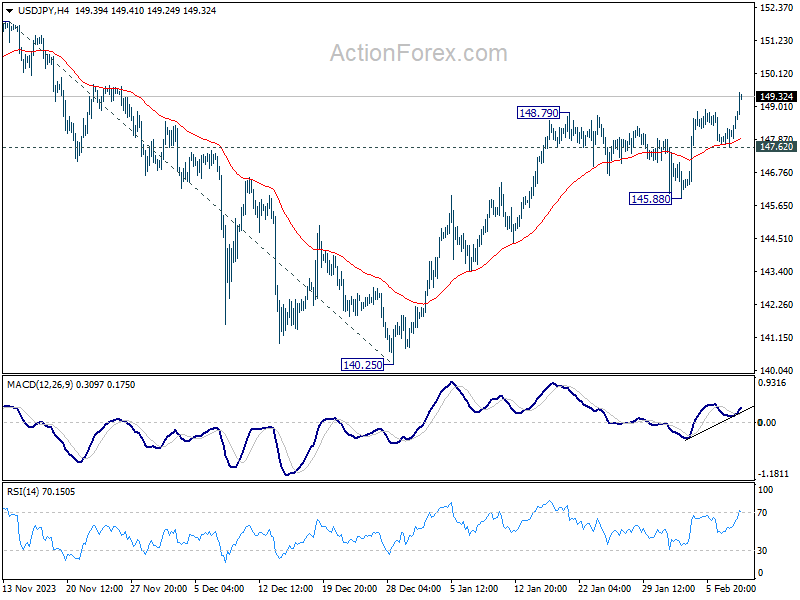
USD/JPY Mid-Day Outlook
Daily Pivots: (S1) 147.79; (P) 148.02; (R1) 148.42; More...
USD/JPY's rally from 140.25 is in progress and intraday bias remains on the upside. Further rally is expected to retest 151.89/93 key resistance zone. Decisive break there will confirm resumption of larger up trend. On the downside, below 147.62 minor support will turn intraday bias neutral first. But near term outlook will remain cautiously bullish as long as 145.88 support holds.
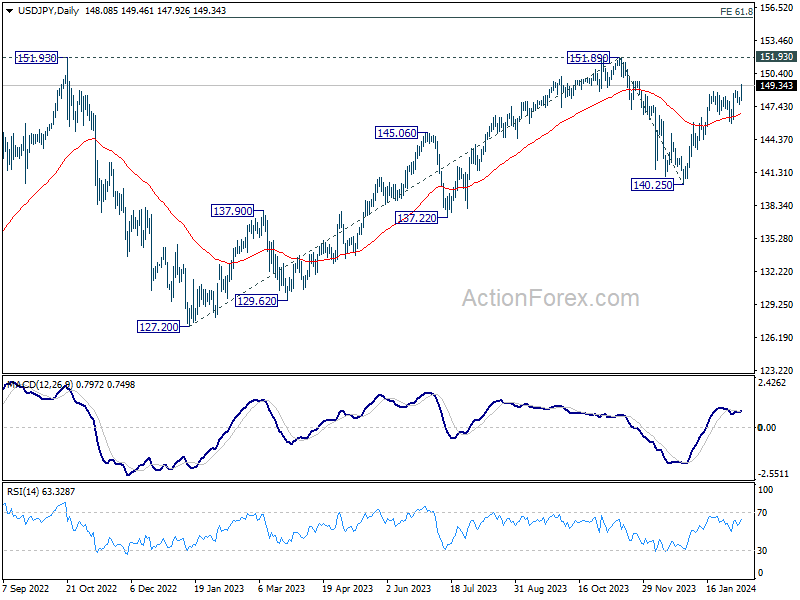
In the bigger picture, fall from 151.89 is seen as a correction to the rally from 127.20, which might have completed at 140.25 already. Firm break of 151.89/93 resistance zone will confirm up trend resumption next target will be 61.8% projection of 127.20 to 151.89 from 140.25 at 155.50. This will now remain the favored case as long as 140.25 support holds.
Dollar Rises on Relative Yield Strength and Economic Optimism
Dollar rises broadly in early US session, standing out in a day characterized by relatively slow news flow. The move in the greenback can be primarily attributed to the rise in US benchmark yields, which outpaced those of other regions, thereby bolstering the greenback's appeal.
Sentiment surrounding the US market remains positive, with traders showing confidence in resilience of the US economy. This optimism persists despite expectations that Fed's cycle of interest rate cuts may commence later than previously anticipated.
The development is fostering a relatively unusual scenario where Dollar, yields, and stocks may ascend in tandem, a convergence that could persist until the correlation dynamics shift.
Meanwhile, Japanese Yen finds itself at the bottom of today's performance chart, initially dragged down by dovish remarks from a senior BoJ official and further pressured by the strength in US and European benchmark yields.
Following closely behind in terms of underperformance were Australian and New Zealand Dollars, which succumbed to the gravitational pull of concerning economic data from China indicating deepening of deflationary pressures as the new year commenced.
In contrast, the Swiss Franc and Canadian Dollar showcased resilience, managing to secure firmer ground amidst the currency tumult, while the Euro and Sterling exhibit mixed performance.
Technically, it's possible that EUR/USD's recovery since Monday has already completed, after failing to even tough 55 4H EMA. 1.0722 support is back as the focus for the rest of the week. Decisive break there will indicate that whole rebound from 1.0447 has completed at 1.1138, and solidify near term bearishness for retesting 1.0447 low later in the month.
In Europe, at the time of writing, FTSE is down -0.09%. DAX is up 0.51%. CAC is up 0.81%. UK 10-year yield is up 0.0030 at 4.021. Germany 10-year yield is up 0.019 at 2.337. Earlier in Asia, Nikkei rose 2.06%. Hong Kong HSI fell -1.27%. China Shanghai SSE rose 1.28%. Singapore Strait Times fell -0.42%. Japan 10-year JGB yield fell -0.0108 to 0.699.
US initial jobless claims falls to 218k, vs exp 220k
US initial jobless claims fell -9k to 218k in the week ending February 3, slightly better than expectation of 220k. Four-week moving average of continuing claims rose 4k to 212k.
Continuing claims fell -23k to 1871k in the week ending January 27. Four-week moving average of continuing claims rose 9.5k to 1850k.
ECB's Wunsch sees some value to waiting
ECB Governing Council member Pierre Wunsch said today, "I'm on the side of those that believe there's some value to waiting" before cutting interest rates.
Nevertheless, Wunsch also acknowledged the inherent uncertainties in economic forecasting and the eventual need to make decisions based on the best available data. "But again, we won't get full comfort. So at some point, we'll have to look at all the information we have and take a bet," he said.
A critical factor in Wunsch's cautious stance is the current state of wage growth within Eurozone. He pointed out that wage increases are occurring at a pace that may undermine ECB's efforts to bring inflation down to 2% inflation target. Were it not for the uptick in salaries, ECB might already be in a position to initiate monetary easing.
BoJ's Uchida signals no swift hikes after negative rate ends
In a speech today, BoJ Deputy Governor Shinichi Uchida articulated a scenario where, despite an end to the negative interest rate policy, rapid interest rate hikes remain unlikely.
"Even if the Bank were to terminate the negative interest rate policy, it is hard to imagine a path in which it would then keep raising the interest rate rapidly," he stated, suggesting a gradual adjustment process, while financial conditions wild remain "accommodative.
Uchida projected gradual increase in underlying inflation toward 2 percent target through fiscal 2025. This forecast anticipates core CPI (all items less fresh food) at 2.8% for fiscal 2023, with a subsequent moderation to 2.4% in fiscal 2024 and 1.8% in fiscal 2025.
Theses projections are based on the outlook that "while the pass-through of cost increases will continue to wane, prices such as of services will rise, accompanied by wage increases."
To achieve this economic outlook, Uchida emphasized, the virtuous cycle needs to intensify in both directions, from prices to wages and from wages to prices."
China's deepening deflation: CPI hits 14-year low in Jan
China's CPI took a notable dip in January, registering decrease of -0.8% yoy, marking a significant deepening of deflationary pressures from the previous month's -0.3% and falling short of expectation -0.5% yoy. This downturn represents the fourth consecutive negative reading and the most substantial fall observed since 2009, over fourteen years ago.
The decline was particularly pronounced in food prices, which was down -5.9% yoy. Meanwhile, core CPI, which excludes volatile energy and food prices, rose by a modest 0.4% yoy, slowing from December's 0.6% yoy increase. Despite the annual downturn, CPI saw a slight month-on-month increase of 0.3%, albeit below the anticipated 0.4% growth.
The NBS attributed January's inflation figures to the high base effect associated with the Spring Festival, or Lunar New Year, which occurred in January the previous year. This annual holiday, which shifts between January and February depending on the lunar calendar, significantly impacts consumption patterns and inflation metrics due to its influence on consumer spending and business operations.
In parallel, PPI fell by -2.5% yoy in January, showing a modest improvement from the -2.7% yoy observed in the previous month and slightly better than -2.6% forecast. This marks the 16th consecutive month of annual declines for PPI, with factory-gate prices decreasing by -0.2% mom, following -0.3% mom drop in December.
USD/JPY Mid-Day Outlook
Daily Pivots: (S1) 147.79; (P) 148.02; (R1) 148.42; More...
USD/JPY's rally from 140.25 is in progress and intraday bias remains on the upside. Further rally is expected to retest 151.89/93 key resistance zone. Decisive break there will confirm resumption of larger up trend. On the downside, below 147.62 minor support will turn intraday bias neutral first. But near term outlook will remain cautiously bullish as long as 145.88 support holds.
In the bigger picture, fall from 151.89 is seen as a correction to the rally from 127.20, which might have completed at 140.25 already. Firm break of 151.89/93 resistance zone will confirm up trend resumption next target will be 61.8% projection of 127.20 to 151.89 from 140.25 at 155.50. This will now remain the favored case as long as 140.25 support holds.
Economic Indicators Update
| GMT | Ccy | Events | Actual | Forecast | Previous | Revised |
|---|---|---|---|---|---|---|
| 23:50 | JPY | Bank Lending Y/Y Jan | 3.10% | 3.20% | 3.10% | 3.00% |
| 00:01 | GBP | RICS Housing Price Balance Jan | -18% | -28% | -30% | |
| 01:30 | CNY | CPI Y/Y Jan | -0.80% | -0.50% | -0.30% | |
| 01:30 | CNY | PPI Y/Y Jan | -2.50% | -2.60% | -2.70% | |
| 05:00 | JPY | Eco Watchers Survey: Current Jan | 50.2 | 50.3 | 50.7 | |
| 09:00 | EUR | ECB Economic Bulletin | ||||
| 13:30 | USD | Initial Jobless Claims (Feb 2) | 218K | 220K | 224K | 227K |
| 15:00 | USD | Wholesale Inventories Dec F | 0.40% | 0.40% | ||
| 15:30 | USD | Natural Gas Storage | -73B | -197B |