

Sample Category Title
EUR/GBP Daily Outlook
Daily Pivots: (S1) 0.8517; (P) 0.8530; (R1) 0.8543; More...
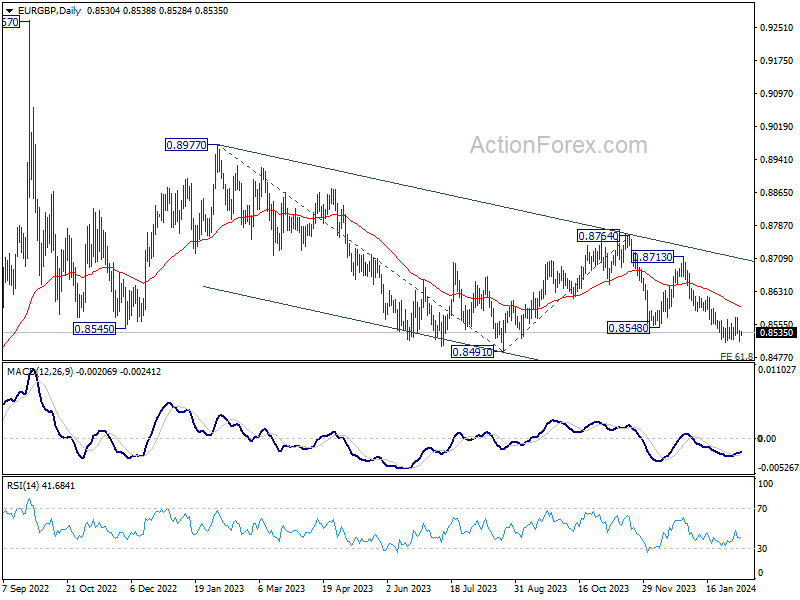
EUR/GBP recovered ahead of 0.8512 support, and intraday bias remains neutral. Further decline is expected with 0.8591 resistance intact. On the downside, below 0.8512 will resume the fall from 0.8713 to 0.8491, and then 0.8464 projection level. However, firm break of 0.8591 will turn bias back to the upside for stronger rebound.
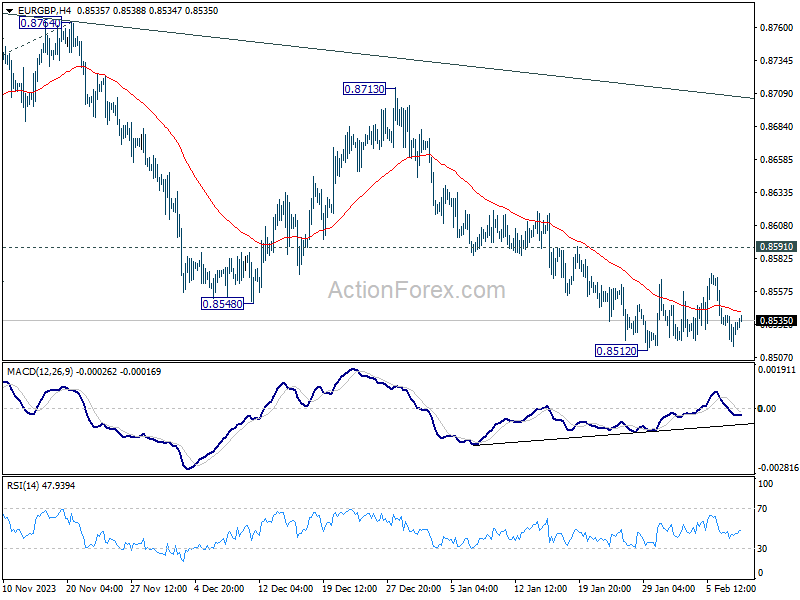
In the bigger picture, fall from 0.8764 is seen as another leg in the whole down trend from 0.9267 (2022 high). Outlook will stay bearish as long as 0.8713 resistance holds. Break of 0.8491 will target 61.8% projection of 0.8977 to 0.8491 from 0.8764 at 0.8464.
EUR/AUD Daily Outlook
Daily Pivots: (S1) 1.6476; (P) 1.6504; (R1) 1.6551; More...
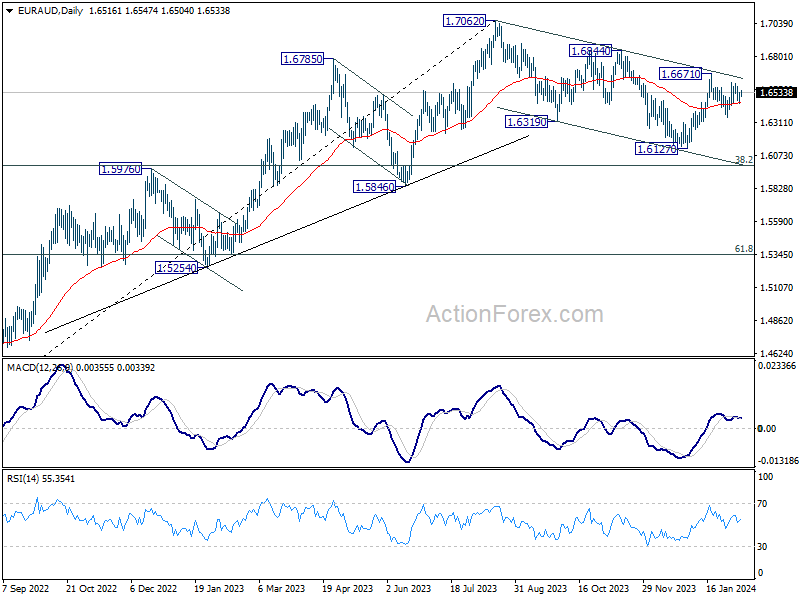
EUR/AUD is still bounded in range trading and intraday bias stays neutral. On the upside, decisive break of 1.6671 will revive the case that whole correction from 1.7062 has completed with three waves down to 1.6127. Further rally should then be seen to 1.6844 resistance for confirmation. Nevertheless, break of 1.6438 will bring deeper fall back to 1.6127 support instead.
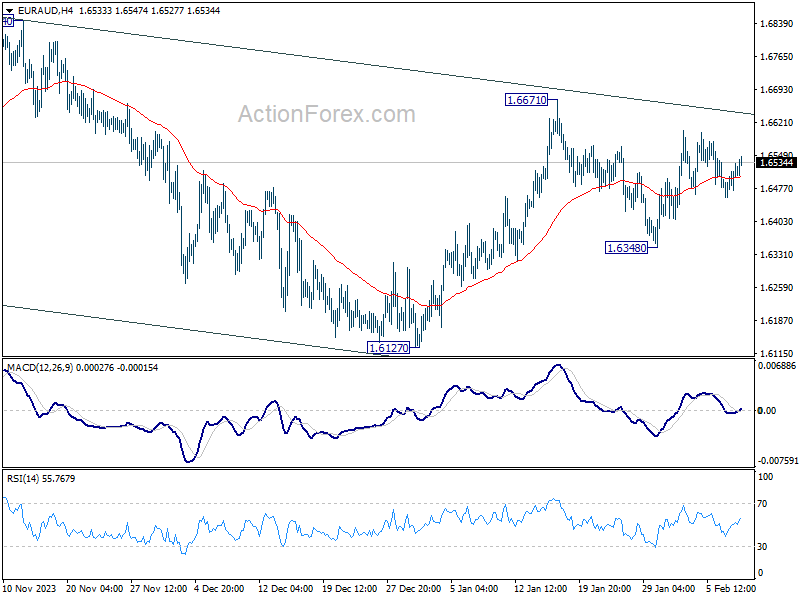
In the bigger picture, fall from 1.7062 medium term top is seen as correction to the up trend from 1.4281 (2022 low). Break of 1.6844 resistance will argue that this up trend is ready to resume through 1.7062 high. In case of another fall, strong support should be seen around 1.5846 and 38.2% retracement of 1.4281 to 1.7062 at 1.6000 to bring rebound.
EUR/CHF Daily Outlook
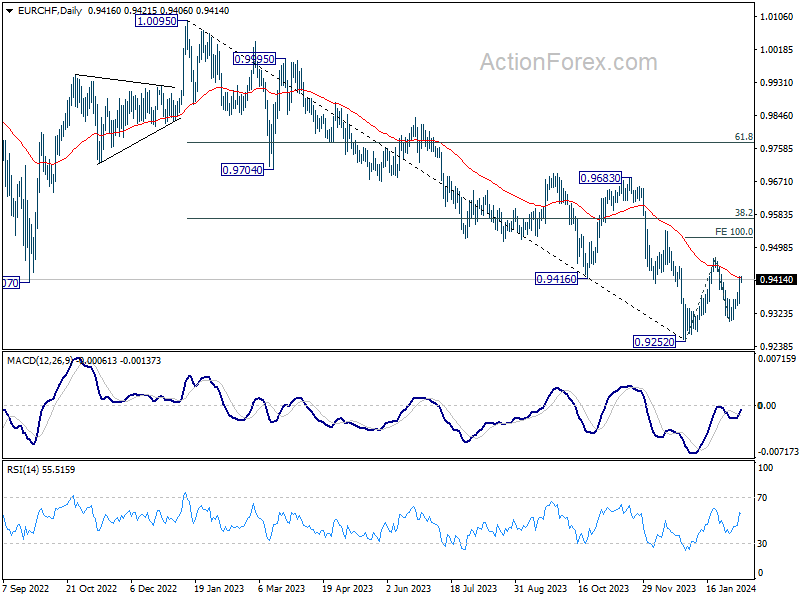
Daily Pivots: (S1) 0.9375; (P) 0.9399; (R1) 0.9448; More...
Intraday bias in EUR/CHF stays on the upside for 0.9471 resistance. Firm break there will resume whole rebound from 0.9252. Next target is 100% projection of 0.9252 to 0.9471 from 0.9304 at 0.9523. On the downside, below 0.9376 minor support will turn intraday bias neutral first.
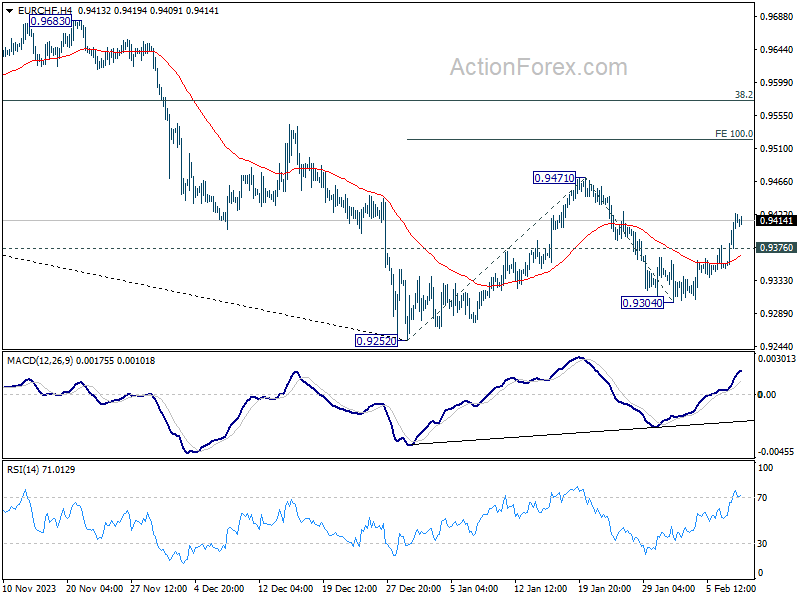
In the bigger picture, price actions from 0.9252 are tentatively seen as a correction to the five-wave down trend from 1.0095 (2023 high). Further rise would be seen to 38.2% retracement of 1.0095 to 0.9252 at 0.9574. But overall medium term outlook will remain bearish as long as 0.9683 resistance holds.
EUR/JPY Daily Outlook
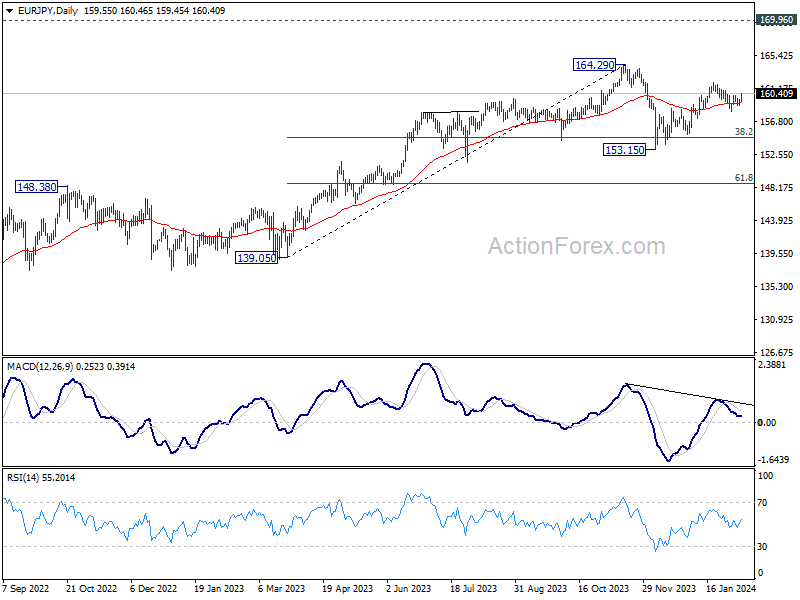
Daily Pivots: (S1) 159.12; (P) 159.43; (R1) 159.94; More...
Intraday bias in EUR/JPY is back on the upside with break of 160.25 minor resistance. Further rise should be seen to 161.84 resistance first. Firm break there will target 164.29 high. For now, further rally is expected as long as 158.06 support holds, in case of recovery.
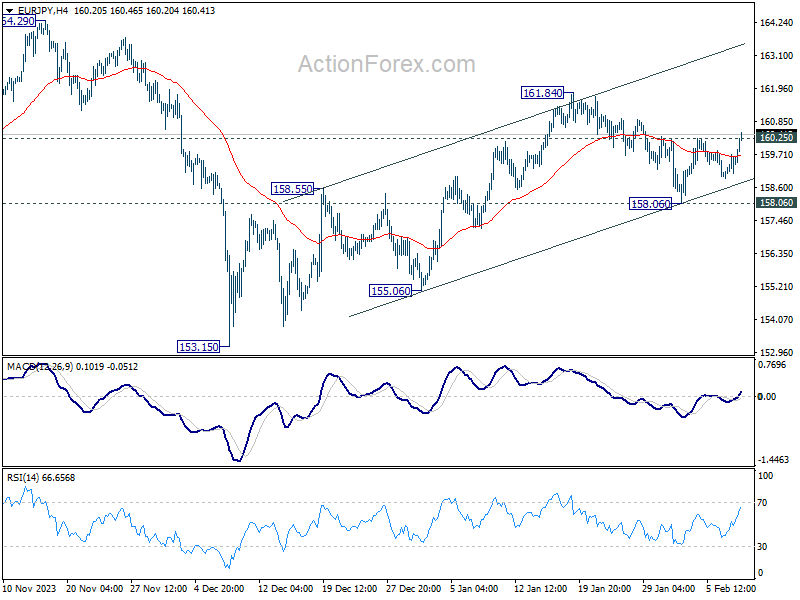
In the bigger picture, price actions from 164.29 medium term top are seen as a correction to rise from 139.05 only. As long as 148.38 resistance turned support holds (2022 high), larger up trend from 114.42 (2020 low) is expected to resume through 164.29 at a later stage.
Euro Doesn’t Give the Impression to be Able to Really Profit from (Temporary) USD Softness
Markets
US and European bond yields both ‘rebounded’ 2-3 bps yesterday after Tuesday correction. YTD peak which came within reach after Monday’s strong US services ISM for now prove to be a too high hurdle. Fed Speakers (Kugler, Collins, Barkin, Kashkari) gave small nuances on the mantra that inflation is cooling, but that more evidence is needed to start lowering rates somewhere later this year. For now, tensions at some regional US Banks are not a major topic in the official Fed communication. Still it remains a risk for the Fed to step in earlier than what is guided for now. This maybe also be why markets don’t rule out the option of a May rate cut that easily. The issue is also reaching some banks in Europe and Japan, but for now remains a secondary theme for markets. The S&P 500 yesterday even touched a new all-time record close (+0.85% and almost touching the psychological barrier of 5000). After a poor open, the US regional bank index (KWB) also regained some ground after a negative open. Still the issue deserves to keep an eye on. The record $42bn sale of 10y US Treasury notes met with solid investor demand. Investors apparently see recent price concessions as an opportunity to step in. On FX markets, the dollar ceded slightly further ground, but with no major technical impact. DXY closed just below 104 (103.94). EUR/USD extended its rebound off the 1.0724 support (close 1.077), but the euro doesn’t give the impression to be able to really profit from (temporary) USD softness. USD/JPY was the exception as it is again nearing the 148.84/89 YTD peak levels. Sterling remained in good shape (close 0.8531), but the key 0.8493 support stays out of reach.
Asian equities show a mixed picture this morning, with Japan and Korea outperforming. Chinese markets (CSI 300) basically are hovering sideways going into the Lunar New Year Holidays starting tomorrow. BOJ Deputy Governor Shinichi Uchida in a speech indicated that even if the BoJ were to end its negative policy rate policy, it is very unlikely that it will raise interest rates rapidly. Markets drew some comfort from the Uchida comments (Nikkei +2%, USD/JPY rising). Even so, the comments implicitly suggest that a first rate hike is coming (very?) close. Later today, the calendar is again thin with the US jobless claims and the sale of $25bn 30y US Treasury bonds the exception. Central bank speakers include ECB’s Wunch, BoE’s Catherine Mann, ECB’s Lane and Fed Barkin. We also keep an eye at the policy decision of the Czech national bank.
News & Views
Chinese consumer prices dropped for a fourth month straight in January. The accelerated pace of -0.8% y/y is the fastest since September 2009 and more than the -0.5% expected. Food was still weighed heavily (-5.9%) on the headline number. Excluding for this as well as energy, core inflation rose 0.4% but that as well was a further deceleration from the 0.6% the month before. Persistent deflationary pressures are also seen in factory gate inflation, which has remained in sub-zero territory since October 2022. The numbers once again raise pressure on authorities to step up policies and revive aggregate demand that’s buckled under weak consumer confidence and private debt. Several measures have been announced in recent months but none of them have the shock-and-awe effect that’s probably needed to kickstart the economy. USD/CNY this morning opened weaker but pared the minor gains quickly after. The pair is currently trading around recent highs just south of 7.20.
The US Congressional Budget Office yesterday projected the country’s deficit to soar by about two-thirds in the next 10 years, bringing it from $1.6tn this year to $2.6tn. In terms of GDP, this means going from 5.6% to 6.1%. The director of the non-partisan organization said interest payments would account for about 75% of the deficit’s rise with the average rate seen advancing to 3.4% over that period. Net interest payments will climb to 3.1% of GDP next year, that’s the highest since recording began in 1940, and will hit 3.9% in 2034. The CBO sees US debt piling up to more than 100% of GDP in 2025 and then further to 116% in 2034..
A Modest Sliver Lining for China and Hong Kong Stock Markets
- China’s CPI continued to deflate in January to -0.8% y/y from -0.3% y/y in December 2023 while the pace of contraction has slowed slightly in PPI (factory gate prices) to -2.5% y/y from -2.7% y/y in December.
- The spread of PPI over CPI has widened which in turn may see a turnaround in the current negative profitability growth rate of China’s industrial enterprises.
- Technical analysis suggests the minor countertrend rally in the Hang Seng Index may extend.
Since the start of this week, the China and Hong Kong stock markets have rallied after one of the benchmark China stock indices sank to a 5-year low due to more forceful measures that clamped down on short-selling activities and President Xi’s in-person meeting with the China Securities Regulatory Commission that led to the intermediate replacement of the regulator party chief yesterday, 7 February.
The involvement of President Xi, the pinnacle of China’s top policymakers in an attempt to stop the rout that has wiped out close to US$7 trillion in market capitalization of the China and Hong Kong stock markets since the highs in 2021; has sent a potential signal to the markets that a stock market stabilization fund is likely to be announced soon after an idea of it backed by a fund size of US$278 billion from offshore accounts of Chinese state-owned enterprises was floated two week ago.
The benchmark CSI 300 Index has gained by +4.6% week-to-date as of 8 February at this time of the writing, similar positive movements are seen in the Hong Kong benchmark stock indices as well over the same period; Hang Seng Index (+2.6%), Hang Seng TECH Index (4.5%), and Hang Seng China Enterprises Index (+3.1%).
Previous attempts to shore up investors’ confidence over the past 12 months via piecemeal stimulus and policies have failed to enact sustainable bullish movements in the China and Hong Kong stock benchmark indices other than several bouts of “dead cat bounces”.
A silver lining within the deflationary forces
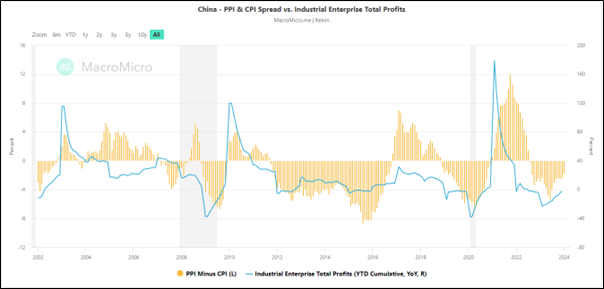
Fig 1: China PPI/CPI spread with Industrial Enterprise Total Profits as of Jan 2024 (Source: MacroMicro, click to enlarge chart)
Can this time round be different? The answer lies with the crux of the problem, the heightened deflationary risk spiral via the wealth effect destruction from a persistently weak property market in China.
No doubt, the latest data has indicated further weakness in consumer prices where the monthly CPI inflation rate for January has further decelerated in the negative territory to -0.8% y/y from -0.3% y/y in December 2023, its longest stretch of contraction since October 2009, and below consensus of -0.5% y/y.
On a slightly positive note, China’s producer prices have continued to fall for the 16th consecutive month but at a slower pace where PPI for January came in at -2.5% y/y, above -2.7% y/y in December, and consensus of -2.6% y/y, notching its softest drop in four months.
Given the slower pace of contraction in PPI, the spread between PPI and CPI has widened significantly in the past six months to -1.70 in January from -3.10 printed in August 2023.
This spread can be used as a proxy to measure the profitability of China’s industrial enterprises. A widening of the spread below zero is likely to indicate some form of recovery or turnaround in the current negative profitability growth of industrial enterprises. The cumulative Industrial Enterprise Total Profits y/y trend has indeed shown modest signs of recovery in the past six months; improving from -15.50% y/y recorded in July 2023 to -2.30% y/y in December 2023 (see Fig 1).
If the spread of PPI and CPI continues to widen, it may reduce the current bout of deflationary forces which in turn ignite more confidence in the stock market that potentially led to more pronounced countertrend rallies.
That said, consumer and business sentiment in China also needs to improve significantly to inspire major multi-month bullish trends to kickstart in the China and Hong Kong stock markets where the required catalysts are direct fiscal stimulus measures to boost spending which are lacking at this juncture.
Minor countertrend rally may extend in Hang Seng Index
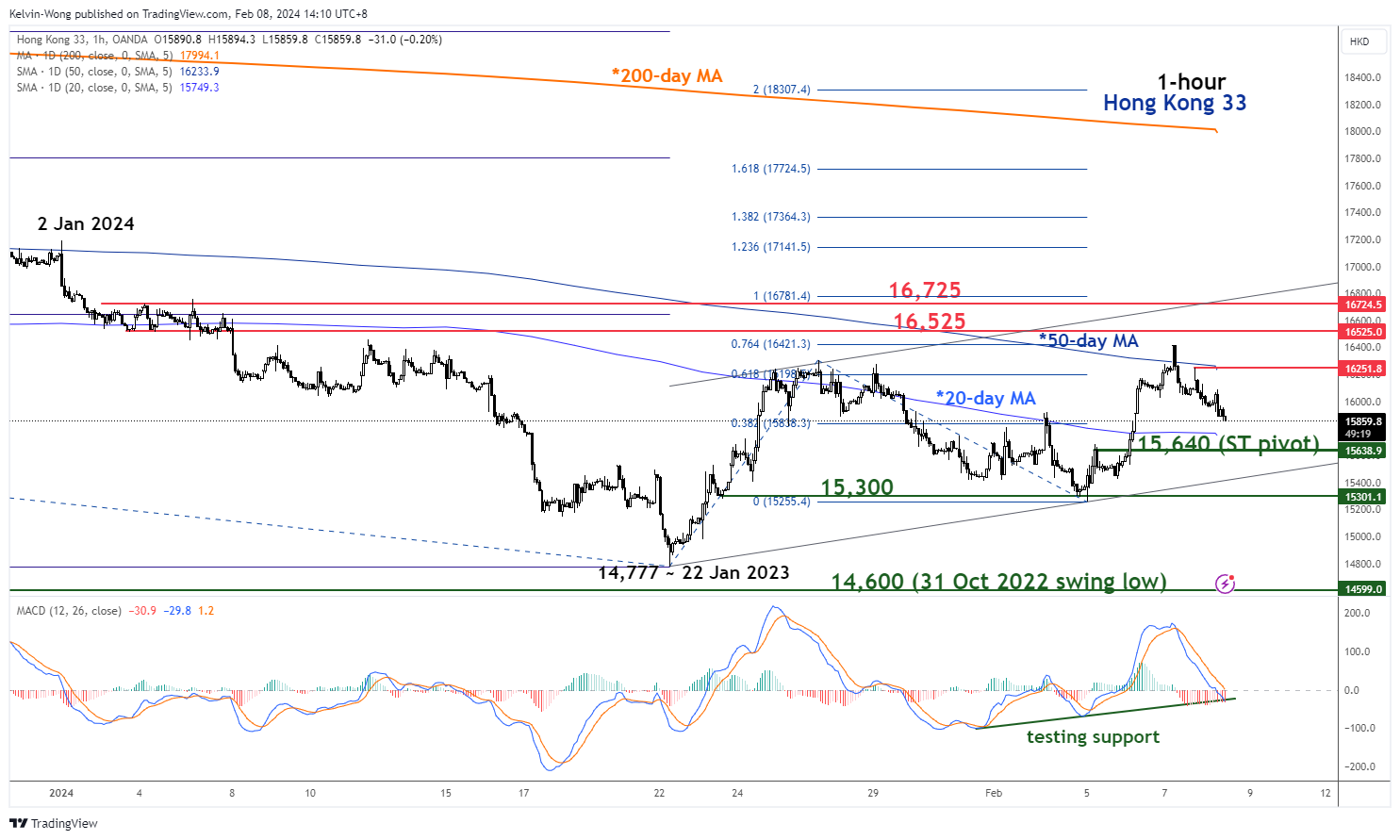
Fig 2: Hong Kong 33 short-term trend as of 8 Feb 2024 (Source: TradingView, click to enlarge chart)
The price actions of the Hong Kong 33 Index (a proxy of the Hang Seng Index futures) have shed -3.5% in the past session from an intraday high of 16,420 printed yesterday, 7 February.
There are still several positive short-term technical elements to note; the current price action of the Index is still oscillating above its 20-day moving average, and the hourly MACD trend indicator has dipped down to retest its ascending support which in turn may translate into a bullish inflection for price actions.
Watch the 15,640 key short-term pivotal support (close to the 20-day moving average & 61.8% Fibonacci retracement of the prior minor rally from the 5 February low to 7 February high) and clearance above the near-term resistance of 16,250 (also the 50-day moving average) may see the next intermediate resistance coming in at 16,525/16,725 (upper boundary of the minor ascending channel from 22 January low & 4/5 January minor swing highs area).
However, failure to hold at 15,640 invalidates the bullish tone for a further slide to expose the next intermediate support at 15,300. Failure to hold at 15,300 increases the risk of a retest on the major support of 14,600.
SP 500 Hits Record, Chinese Deflation Deepens
Hawkish comments from the Federal Reserve members continued to make the headlines in the US, yesterday, with Susan Collins, Thomas Barkin and a new Fed Governor Adriana Kugler, all saying the same exact thing: that there is no hurry for the US to cut the interest rates when the economic data points at such a surprising and historical resilience to the modern times’ most aggressive rate hikes.
But knowing that the Fed is done hiking its rates and the expectation that the next move from the Fed will be a rate cut is enough to keep the market in a sweet spot. A delay in the timing of the first rate cut is even perceived as a good thing: the US economy is doing so well that there is no urge to cut the rates right away. And that’s tant mieux for your corporate earnings.
This is how the US economy shrugs off the latest commercial real estate worries that cost the New York Community Bancorp more than half of its value. And even though the worries jumped to Germany’s Deutsche Pfandbriefbank, the stress is nowhere to be felt on the sovereign bond or index level. On the contrary, the US had a record-breaking auction for its 10-year bonds yesterday, where it sold $42bn worth of notes at a lower than anticipated yield. The strong demand for the US 10-year papers hints that investors continue to binge buy the US 10-year papers while sitting patiently in the waiting room and watching the major US indices’ record-breaking race to occupy themselves. You could think that the regional bank stress could bring the Fed to cut the rates earlier than otherwise, but that’s not necessarily what we sense in the market today, so I am sticking to my rate-cut expectation gun to explain why the US 10-year papers saw such a strong demand yesterday.
In Germany, the 10-year bund yield didn’t blink to Pfandbriefbank jitters, the DAX and the Stoxx 600 were down on Wednesday but the declines remained too soft to hint at panic, while the S&P500 renewed record and traded at a spitting distance from the 5000 psychological mark. That’s a powerful psychological milestone mind you, and it could trigger some profit taking due to the overbought market conditions and bubbling valuations. But the S&P500’s rally is backed by the anticipation of upcoming rate cuts and robust earnings. And sentiment in both yields and earnings remains supportive. In this respect, Disney followed in the footsteps of its happy tech peers yesterday and rose almost 7% in the afterhours trading after reporting better than expected earnings and issuing an upbeat profit outlook.
All’s well that ends well.
In the FX
The slowdown in the US sovereign selloff is weighing on the US dollar. The dollar index returned below its 100-DMA. The fact that central bankers around the world, like the ones in Europe and Australia, are also pushing back on early rate cut expectations certainly play a role in dollar’s limited gains. In this context, the Reserve Bank of Australia (RBA) warned earlier this week that the bank could even think of tightening the financial conditions if inflation didn’t ease to levels that they consider being acceptable. The hawkish accompanying statement from the RBA helped the AUDUSD limit losses near the 65 cents level earlier this week. But the pair remains offered into the 100-DMA, and the morose inflation figures from China don’t help cheer up the bulls.
Oh, China
China announced this morning that deflation accelerated in January to -0.8% y-o-y, faster than a 0.5% deflation penciled in by analysts and the fastest price drop in over 14 years. In plain English, it means that the Chinese efforts to boost growth and bring inflation back are not working according to the plan. Money poured into the Chinese system doesn’t circulate in a way to stimulate economy – blame people who lost confidence – and the radical measures that the government has put in place to prop up equity valuations hardly help China’s battered stock markets to get back on their feet. Today, sentiment in the CPI 300 index is mixed. I was writing yesterday that a deeper than expected deflation number will certainly encourage Chinese authorities to announce more stimulus measures. But measures alone won’t help getting the Chinese markets’ heads above water if investors don’t play along.
Another worry about the Chinese recovery is that because the Chinese dream has been dashed by a $7 trillion selloff in the equity markets, many could be tempted to take their loss and walk away in the slightest recovery. In summary, the road to a sustainable recovery seems far away.
Zooming in, Alibaba missed the opportunity to break above its down-trending channel that has been building since last August as its shares dived 6% after its sales missed expectations in the latest Q4 report. The latter offset a $25bn buyback program that the company has just announced. Alibaba’s price chart over the past 5 years is the best summary of how things went down for Chinese equities as Xi-led government was busy beating their tech gems with baseball bats, imposing absurd covid zero rules, and getting both the Chinese consumers and foreign investors on their back. Here we are today, waiting for more measures to cheer us up.
Chinese Inflation Still Negative
In focus today
- We have a light schedule on for today.
- In the US we receive initial jobless claims.
- The central bank of the Czech Republic announces its policy decision. A Reuters poll expects a 25bp cut in the repo rate to 6.50% from 6.75%.
- In Sweden, Governor Thedéen from the Riksbank will be speaking at a closed event. Deputy Governor Per Jansson will visit London and give a lecture on the economic situation and current monetary policy.
- Fed's Barkin will be speaking twice, at 14.30 CET and 18.05 CET.
Economic and market news
What happened overnight
In China, we received both CPI and PPI data for January. The numbers showed Chinese consumer prices fell by 0.8% y/y (expectations: -0.6% y/y). That marks the fourth month in a row with a negative print y/y. The negative Chinese inflation is however to a large degree driven by lower food prices (food prices were down 5.9% y/y in January). We thus see that core CPI (CPI ex food and energy) remains in positive territory at 0.4% y/y. Hence, we do not see any broad-based deflation in China. The lower food prices are also helpful in terms of stimulating Chinese private consumption, as they ease living costs and improve purchasing power for Chinese consumers. Producer prices fell 2.5% y/y in January (prior: 2.7% y/y).
In Japan, the deputy governor of the Bank of Japan Shinchi Uchida said the BoJ would likely end its risky assets purchases, as part of unwinding its monetary support scheme. He stressed however that beyond putting an end to its negative interest rate (which currently stand at -0.1%), he did not see the BoJ raising rates rapidly if its inflation target of 2% was otherwise met. JPY weakened a bit on the back of this. We still view the spring wage negotiations as key for the development in Japanese inflation, and as such Japanese monetary policy.
What happened yesterday
In Germany, industrial production declined 1.6% m/m compared to consensus expectations of -0.5% m/m. Given the already released German GDP numbers showing the economy contracted 0.3% q/q in Q4 2023 the contraction in industrial production is not surprising. The data however shows German industry was a growth drag in the economy towards the end of 2023.
Israeli premier Benjamin Netanyahu declined a proposed ceasefire deal which US secretary of state Anthony Blinken who arrived in Israel Wednesday had tried to secure. Netanyahu was cited for calling Hamas' demands "delusional" as well as saying "total victory" was achievable within months.
In Sweden, we got the Riksbank's minutes which mostly confirmed what was said at the monetary update last week. Several board members were open to a cut in H1 2024 depending on the development of inflation and the real economy. However, the minutes highlighted somewhat more any risks than in the official statement; namely worries about inflation risks that a new weakening of the SEK could pose, and the currently too alleviated price plans were mentioned as well. There were also some indications of caution to cut before big central banks given risks to the exchange rate. They highlighted the importance of cutting cautiously which matches well with our forecast.
The Polish central bank kept its base rate unchanged at 5.75% in line with expectations.
Equities: Global equities were higher yesterday primarily lifted by US large cap stocks. There was no major top-down news to move the market and we were not surprised to see the market drifting higher and VIX sliding in yesterday's session since the sum of macro, monetary policy and earnings news has been rather positive for stocks lately. One obstacle for equities is the reemerged fear of CRE-related losses for banks in the US and not least regional banks. That was also the case yesterday with a 3% intraday swing in the KBW index (US regional banks). In US yesterday: Dow +0.4%, S&P 500 +0.8%, Nasdaq +1.0%, Russell 2000 -0.2%. Asian equities mostly higher this morning with Japan up more than 2% and hence continuing the strong run back by a weak currency. Futures marginally higher in Europe while mixed in the US.
FI: Wednesday was yet another quiet session without any major news out. Long-end UST yields drifted higher through most of the session but ended unchanged as the refunding auction in the 10Y tenor (USD42bn) saw very decent demand (bid-to-cover: 2.56). Today, focus will turn to the USD25bn offered at the 30Y auction. The German curve bear steepened slightly as Schnabel's FT interview, where she explicitly warns against the still present upside risks to Eurozone inflation, led to renewed moderation of rate cut expectations in markets. In just one week, the pricing of ECB rate cuts for 2024 has declined from 150bp to 125bp. Our base case is still 75bp.
FX: Risk-on as S&P500 closes in on its 5,000 milestone, with EUR/USD gradually edging higher throughout the session. Scandies sideways, with a slight tilt lower for NOK/SEK which now sits below 0.99 once again. USD/JPY remains above 148 as JPY continues to struggle.
GBP/JPY Daily Outlook
Daily Pivots: (S1) 186.45; (P) 186.86; (R1) 187.53; More...
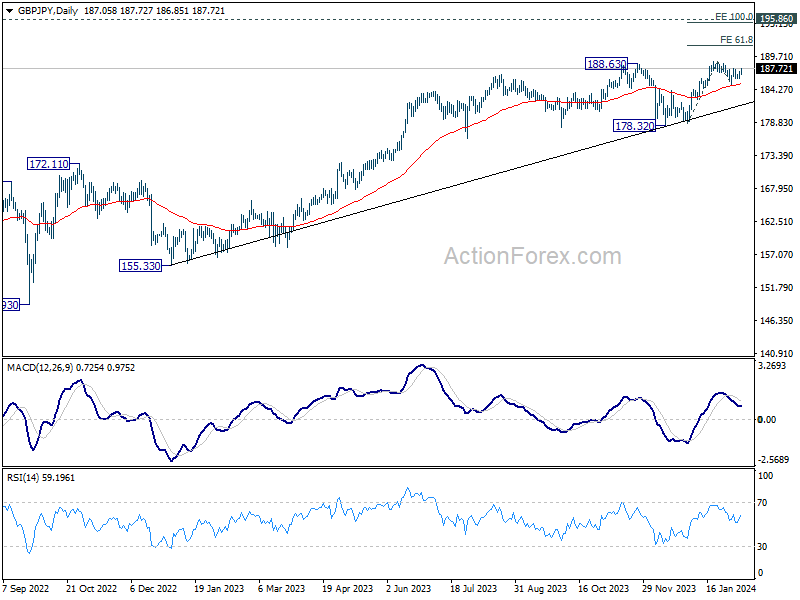
Intraday bias in GBP/JPY is back on the upside as rebound from 185.21 resumes. Further rise is expected to retest 188.90 resistance first. Firm break there will resume larger up trend. Next near term target will be 61.8% projection of 178.71 to 188.90 from 185.21 at 191.50. For now, near term outlook will stay bullish as long as 185.21 support holds, in case of retreat.
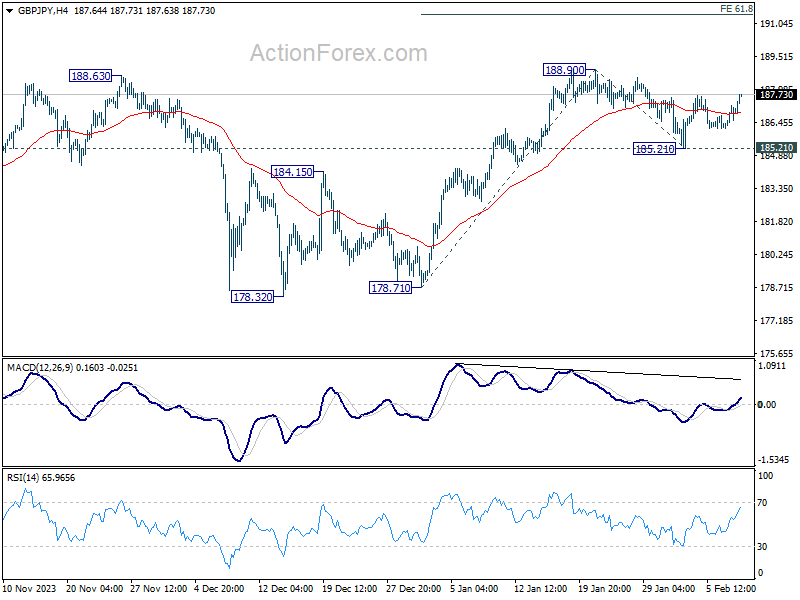
In the bigger picture, up trend from 123.94 (2020 low) is in progress. Medium term outlook will stay bullish as long as 178.32 support holds. Next target is 195.86 long term resistance (2015 high).
Yen Weakens Amid BoJ’s Dovish Signals, S&P 500 Poised to Break Through 5000 Milestone
Japanese Yen declines broadly in today's Asian session, reacting to dovish remarks made by BoJ Deputy Governor. The official's commentary emphasized a cautious approach to monetary tightening, highlighting that even with exit from negative interest rate policy, the pace of interest rate hikes would remain measured.
This outlook, especially the suggestion that inflation could stabilize around the 2% target without prompting rapid policy adjustments, has contributed to Yen's downward trajectory, setting the stage for further depreciation against major currencies in the coming days.
Nevertheless, Yen's performance will still hinge on the movements of benchmark treasury yields in US and Europe.
At the same time, Australian and New Zealand Dollars weakened. This regional currency softness comes at a time when Chinese stock market is set to close for Lunar New Year holidays, pausing trading activities until February 18.
Instead of introducing concrete market supporting measures as rumored, China announced a notable change in leadership at the Securities Regulatory Commission. Yi Huiman, the outgoing chair, will be succeeded by Wu Qing, vice mayor of Shanghai during the stringent 2022 lockdown. Wu is also know for his strict regulation of traders that have earned him the moniker "Broker Butcher."
Elsewhere in the market, Swiss Franc is making a modest recovery after yesterday's selloff, while Euro and Sterling maintain their strength, as near term rebound continued. Canadian Dollar is also showing firmness, contrasting with the mixed performance of Dollar.
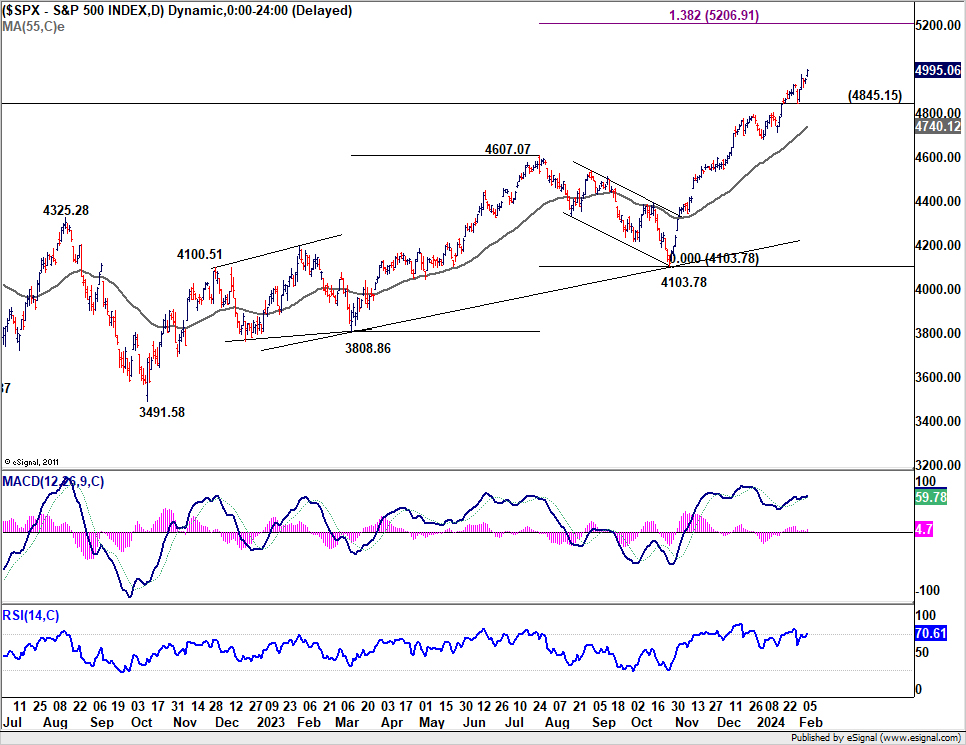
S&P 500 hit another record high overnight despite persistent comments from Fed officials advocating patience regarding rate cuts. Immediate focus will be on 5000 psychological level now. Sustained break there will pave the way to 138.2% projection of 3808.86 to 4607.07 from 4103.78 at 5206.91. In any case, near term outlook will stay bullish as long as 4845.15 support holds.
In Asia, Nikkei rose 2.15. Hong Kong HSI is down -1.16%. China Shanghai SSE is up 1.05%. Singapore Strait Times is down-0.21%. Japan 10-year JGB yield is down -0.0077 at 0.702. Overnight, DOW rose 0.40%. S&P 500 rose 0.82%. NASDAQ rose 0.95%. 10-year yield rose 0.020 to 0.411.
BoJ's Uchida signals no swift hikes after negative rate ends
In a speech today, BoJ Deputy Governor Shinichi Uchida articulated a scenario where, despite an end to the negative interest rate policy, rapid interest rate hikes remain unlikely.
"Even if the Bank were to terminate the negative interest rate policy, it is hard to imagine a path in which it would then keep raising the interest rate rapidly," he stated, suggesting a gradual adjustment process, while financial conditions wild remain "accommodative.
Uchida projected gradual increase in underlying inflation toward 2 percent target through fiscal 2025. This forecast anticipates core CPI (all items less fresh food) at 2.8% for fiscal 2023, with a subsequent moderation to 2.4% in fiscal 2024 and 1.8% in fiscal 2025.
Theses projections are based on the outlook that "while the pass-through of cost increases will continue to wane, prices such as of services will rise, accompanied by wage increases."
To achieve this economic outlook, Uchida emphasized, the virtuous cycle needs to intensify in both directions, from prices to wages and from wages to prices."
China's deepening deflation: CPI hits 14-year low in Jan
China's CPI took a notable dip in January, registering decrease of -0.8% yoy, marking a significant deepening of deflationary pressures from the previous month's -0.3% and falling short of expectation -0.5% yoy. This downturn represents the fourth consecutive negative reading and the most substantial fall observed since 2009, over fourteen years ago.
The decline was particularly pronounced in food prices, which was down -5.9% yoy. Meanwhile, core CPI, which excludes volatile energy and food prices, rose by a modest 0.4% yoy, slowing from December's 0.6% yoy increase. Despite the annual downturn, CPI saw a slight month-on-month increase of 0.3%, albeit below the anticipated 0.4% growth.
The NBS attributed January's inflation figures to the high base effect associated with the Spring Festival, or Lunar New Year, which occurred in January the previous year. This annual holiday, which shifts between January and February depending on the lunar calendar, significantly impacts consumption patterns and inflation metrics due to its influence on consumer spending and business operations.
In parallel, PPI fell by -2.5% yoy in January, showing a modest improvement from the -2.7% yoy observed in the previous month and slightly better than -2.6% forecast. This marks the 16th consecutive month of annual declines for PPI, with factory-gate prices decreasing by -0.2% mom, following -0.3% mom drop in December.
Fed's Kugler highlights inflation risks stemming from consumer behavior, job market, and global tensions
In a speech overnight, Fed Governor Adriana Kugler said she's satisfied with the disinflationary progress, and expects it to "continue". However, she was quick to temper this optimism with a note of caution, emphasizing that Fed's work in combating inflation is far from over. The unpredictability of consumer behavior stands as a reminder of unforeseen developments to "slow progress on inflation."
Kugler also pointed to the recent employment report, which showed unexpected strength. While a strong labor market is generally a positive sign, in the context of Fed's efforts to cool inflation, such robustness could complicate the path to achieving a balanced demand-supply equation in both product and labor markets.
Fed Governor underscored the importance of monitoring geopolitical risks, particularly highlighting how the ongoing conflict in Ukraine and tensions in the Middle East could exacerbate inflationary pressures through "higher commodity prices" and global trade "disruptions", "in turn pushing up goods inflation in the US".
"At some point, the continued cooling of inflation and labor markets may make it appropriate to reduce the target range for the federal funds rate," she noted. Conversely, "if progress on disinflation stalls, it may be appropriate to hold the target range steady at its current level for longer to ensure continued progress on our dual mandate."
Fed's Collins: Sustained, broadening inflation progress needed before methodical policy relaxation
Boston Fed President Susan Collins emphasized the need for "sustained, broadening signs of progress" in inflation reduction before contemplating any "methodical" adjustments to interest rate policy.
"As we gain more confidence in the economy achieving the Committee's goals... I believe it will likely become appropriate to begin easing policy restraint later this year," she stated in a speech overnight.
She advocates for a gradual approach to interest rate adjustments, allowing for "flexibility to manage risks, while promoting stable prices and maximum employment."
Collins also highlighted the resilience of the US economy, as evidenced by recent GDP and labor market data, suggesting that the anticipated slowdown in economic activity "may take some time".
"The path the economy takes toward the Fed's mandated goals may continue to be bumpy and uneven, and we should not overreact to individual data points," she advised.
A critical factor in Collins's assessment is wage dynamics, with a specific interest in wage trends that align with long-term price stability. While acknowledging that not all economic indicators might perfectly converge, "seeing sustained, broadening signs of progress should provide the necessary confidence I would need to begin a methodical adjustment to our policy stance."
Fed's Barkin endorses patience regarding rate cuts
Richmond Fed President Thomas Barkin has voiced a call for patience concerning interest rate cuts, in the face of prevailing economic uncertainties.
"I am very supportive of being patient to get to where we need to get," Barkin articulated during an event overnight.
Barkin highlighted the ongoing efforts to combat inflation, acknowledging that while progress has been made towards balancing the trade-offs between economic growth and inflation control, "a reasonable amount of uncertainty" remains.
He pointed out that the inflationary challenges are not confined to goods alone but extend to services and rental sectors.
"Declaring victory is very enticing, but you're never going to hear me do that," Barkin asserted.
BoC cites difficulty in predicting appropriate timing of rate cuts
BoC's deliberations from the January meeting saw the governing council expressing that it was "difficult to foresee when it would be appropriate to begin cutting interest rates."
The possibility of additional rate hikes was not dismissed, with members indicating that such measures could be warranted should new inflationary surprises emerge. However, the focus of future policy discussions would likely "shift to how much longer to maintain the policy rate at 5% to sustain the disinflationary process."
Inflation's persistent high levels and broad impact have prompted the council to emphasize their ongoing concerns regarding "persistence of underlying inflation" in their communications.
The members collectively agreed on the necessity for "further evidence of progress toward price stability," seeking definitive signs of a downturn in core inflation rates.
To gauge the effectiveness of their monetary policy and the evolving economic landscape, the Governing Council plans to closely monitor core inflation alongside several critical indicators. These include the equilibrium between supply and demand within the economy, corporate pricing strategies, inflation expectations, and the ratio of wage growth to productivity.
Looking ahead
ECB monthly bulletin is the only feature in the European economic calendar. Later today, US will release jobless claims.
GBP/JPY Daily Outlook
Daily Pivots: (S1) 186.45; (P) 186.86; (R1) 187.53; More...
Intraday bias in GBP/JPY is back on the upside as rebound from 185.21 resumes. Further rise is expected to retest 188.90 resistance first. Firm break there will resume larger up trend. Next near term target will be 61.8% projection of 178.71 to 188.90 from 185.21 at 191.50. For now, near term outlook will stay bullish as long as 185.21 support holds, in case of retreat.
In the bigger picture, up trend from 123.94 (2020 low) is in progress. Medium term outlook will stay bullish as long as 178.32 support holds. Next target is 195.86 long term resistance (2015 high).
Economic Indicators Update
| GMT | Ccy | Events | Actual | Forecast | Previous | Revised |
|---|---|---|---|---|---|---|
| 23:50 | JPY | Bank Lending Y/Y Jan | 3.10% | 3.20% | 3.10% | 3.00% |
| 00:01 | GBP | RICS Housing Price Balance Jan | -18% | -28% | -30% | |
| 01:30 | CNY | CPI Y/Y Jan | -0.80% | -0.50% | -0.30% | |
| 01:30 | CNY | PPI Y/Y Jan | -2.50% | -2.60% | -2.70% | |
| 05:00 | JPY | Eco Watchers Survey: Current Jan | 50.2 | 50.3 | 50.7 | |
| 09:00 | EUR | ECB Economic Bulletin | ||||
| 13:30 | USD | Initial Jobless Claims (Feb 2) | 220K | 224K | ||
| 15:00 | USD | Wholesale Inventories Dec F | 0.40% | 0.40% | ||
| 15:30 | USD | Natural Gas Storage | -73B | -197B |