Sample Category Title
China’s deepening deflation: CPI hits 14-year low in Jan
China's CPI took a notable dip in January, registering decrease of -0.8% yoy, marking a significant deepening of deflationary pressures from the previous month's -0.3% and falling short of expectation -0.5% yoy. This downturn represents the fourth consecutive negative reading and the most substantial fall observed since 2009, over fourteen years ago.
The decline was particularly pronounced in food prices, which was down -5.9% yoy. Meanwhile, core CPI, which excludes volatile energy and food prices, rose by a modest 0.4% yoy, slowing from December's 0.6% yoy increase. Despite the annual downturn, CPI saw a slight month-on-month increase of 0.3%, albeit below the anticipated 0.4% growth.
The NBS attributed January's inflation figures to the high base effect associated with the Spring Festival, or Lunar New Year, which occurred in January the previous year. This annual holiday, which shifts between January and February depending on the lunar calendar, significantly impacts consumption patterns and inflation metrics due to its influence on consumer spending and business operations.
In parallel, PPI fell by -2.5% yoy in January, showing a modest improvement from the -2.7% yoy observed in the previous month and slightly better than -2.6% forecast. This marks the 16th consecutive month of annual declines for PPI, with factory-gate prices decreasing by -0.2% mom, following -0.3% mom drop in December.
BoC cites difficulty in predicting appropriate timing of rate cuts
BoC's deliberations from the January meeting saw the governing council expressing that it was "difficult to foresee when it would be appropriate to begin cutting interest rates."
The possibility of additional rate hikes was not dismissed, with members indicating that such measures could be warranted should new inflationary surprises emerge. However, the focus of future policy discussions would likely "shift to how much longer to maintain the policy rate at 5% to sustain the disinflationary process."
Inflation's persistent high levels and broad impact have prompted the council to emphasize their ongoing concerns regarding "persistence of underlying inflation" in their communications.
The members collectively agreed on the necessity for "further evidence of progress toward price stability," seeking definitive signs of a downturn in core inflation rates.
To gauge the effectiveness of their monetary policy and the evolving economic landscape, the Governing Council plans to closely monitor core inflation alongside several critical indicators. These include the equilibrium between supply and demand within the economy, corporate pricing strategies, inflation expectations, and the ratio of wage growth to productivity.
Fed’s Barkin endorses patience regarding rate cuts
Richmond Fed President Thomas Barkin has voiced a call for patience concerning interest rate cuts, in the face of prevailing economic uncertainties.
"I am very supportive of being patient to get to where we need to get," Barkin articulated during an event overnight.
Barkin highlighted the ongoing efforts to combat inflation, acknowledging that while progress has been made towards balancing the trade-offs between economic growth and inflation control, "a reasonable amount of uncertainty" remains.
He pointed out that the inflationary challenges are not confined to goods alone but extend to services and rental sectors.
"Declaring victory is very enticing, but you're never going to hear me do that," Barkin asserted.
Fed’s Collins: Sustained, broadening inflation progress needed before methodical policy relaxation
Boston Fed President Susan Collins emphasized the need for "sustained, broadening signs of progress" in inflation reduction before contemplating any "methodical" adjustments to interest rate policy.
"As we gain more confidence in the economy achieving the Committee's goals... I believe it will likely become appropriate to begin easing policy restraint later this year," she stated in a speech overnight.
She advocates for a gradual approach to interest rate adjustments, allowing for "flexibility to manage risks, while promoting stable prices and maximum employment."
Collins also highlighted the resilience of the US economy, as evidenced by recent GDP and labor market data, suggesting that the anticipated slowdown in economic activity "may take some time".
"The path the economy takes toward the Fed's mandated goals may continue to be bumpy and uneven, and we should not overreact to individual data points," she advised.
A critical factor in Collins's assessment is wage dynamics, with a specific interest in wage trends that align with long-term price stability. While acknowledging that not all economic indicators might perfectly converge, "seeing sustained, broadening signs of progress should provide the necessary confidence I would need to begin a methodical adjustment to our policy stance."
Fed’s Kugler highlights inflation risks stemming from consumer behavior, job market, and global tensions
In a speech overnight, Fed Governor Adriana Kugler said she's satisfied with the disinflationary progress, and expects it to "continue". However, she was quick to temper this optimism with a note of caution, emphasizing that Fed's work in combating inflation is far from over. The unpredictability of consumer behavior stands as a reminder of unforeseen developments to "slow progress on inflation."
Kugler also pointed to the recent employment report, which showed unexpected strength. While a strong labor market is generally a positive sign, in the context of Fed's efforts to cool inflation, such robustness could complicate the path to achieving a balanced demand-supply equation in both product and labor markets.
Fed Governor underscored the importance of monitoring geopolitical risks, particularly highlighting how the ongoing conflict in Ukraine and tensions in the Middle East could exacerbate inflationary pressures through "higher commodity prices" and global trade "disruptions", "in turn pushing up goods inflation in the US".
"At some point, the continued cooling of inflation and labor markets may make it appropriate to reduce the target range for the federal funds rate," she noted. Conversely, "if progress on disinflation stalls, it may be appropriate to hold the target range steady at its current level for longer to ensure continued progress on our dual mandate."
GBP/USD – A Bearish Reversal at a Key Fib Level?
- Fed policymakers sticking to the script
- US data continues to point to a strong economy
- Fib rebound may suggest we’ve seen a correction in GBPUSD
It isn’t the busiest week as far as UK and US economic data is concerned but there are still a few pieces worth keeping an eye on. As well as, of course, the scattering of central bank speak.
So far, policymakers appear to remain consistent with the message from the last meeting despite Friday’s surprisingly strong jobs report.
The services PMI on Monday was also far better than expected, further supporting the view that the economy is far from suffering under the weight of high interest rates.
Have we just seen a correction in GBPUSD?
But perhaps it’s the technicals that could prove to be more interesting this week.
GBPUSD Daily
Source – OANDA
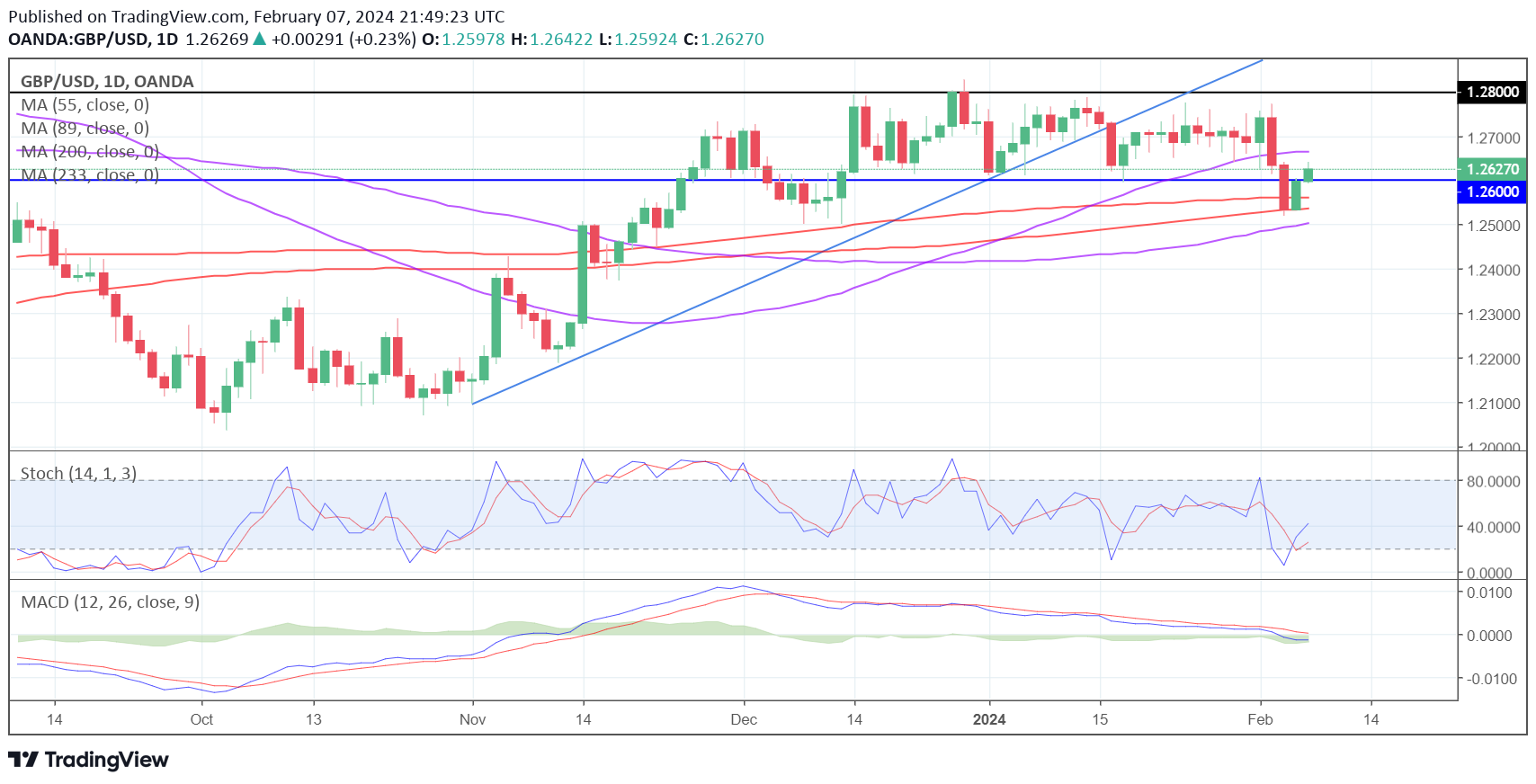
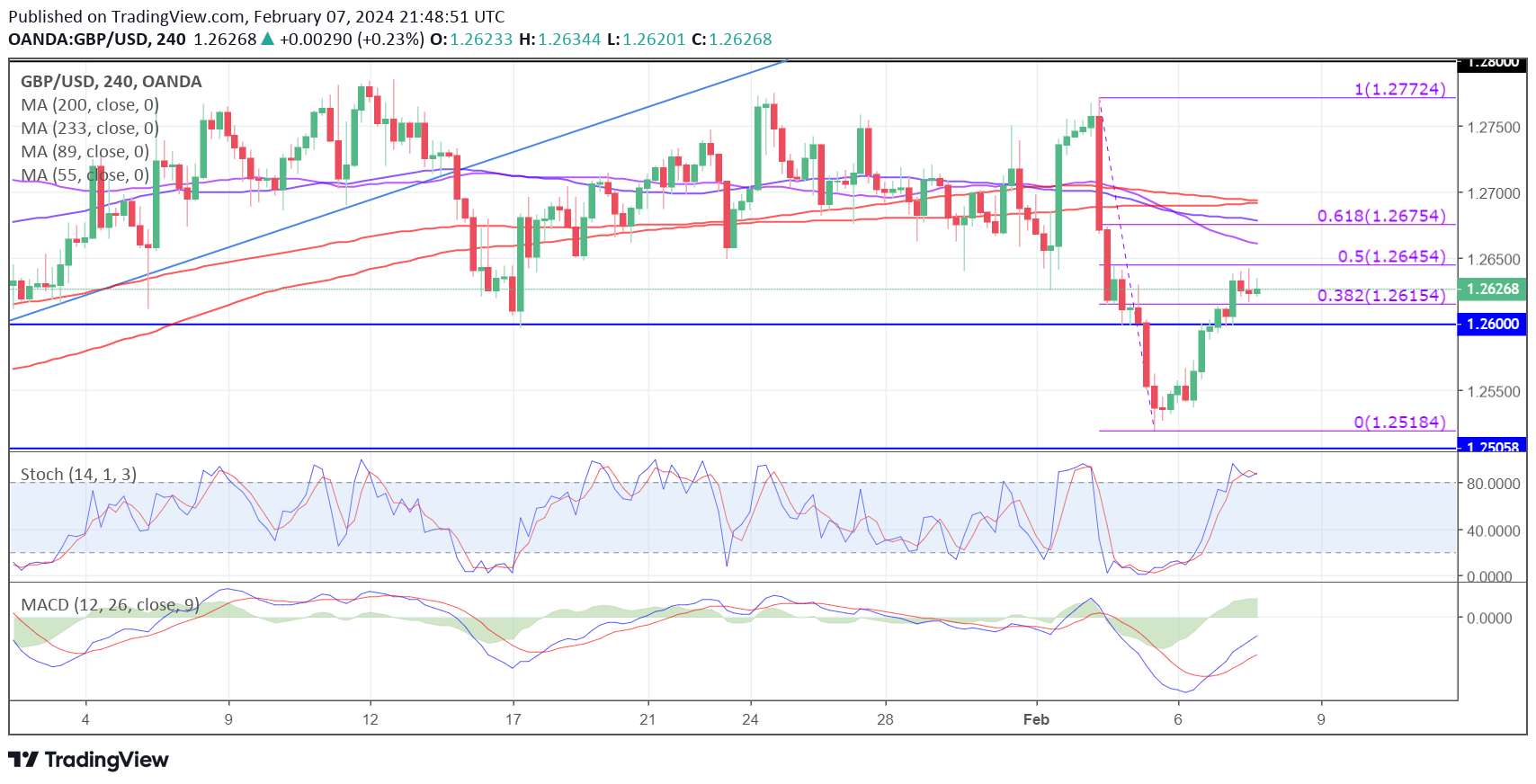
On Monday the pair broke below the neckline of a quadruple top formation around 1.26. While it has since pulled back, it could just be a corrective move and the rotation off the 50% Fibonacci retracement level today may support that view.
GBPUSD 4-Hour
Nasdaq-100 Wave Analysis
- Nasdaq-100 rising inside impulse wave 5
- Likely to rise to resistance level 18000.00
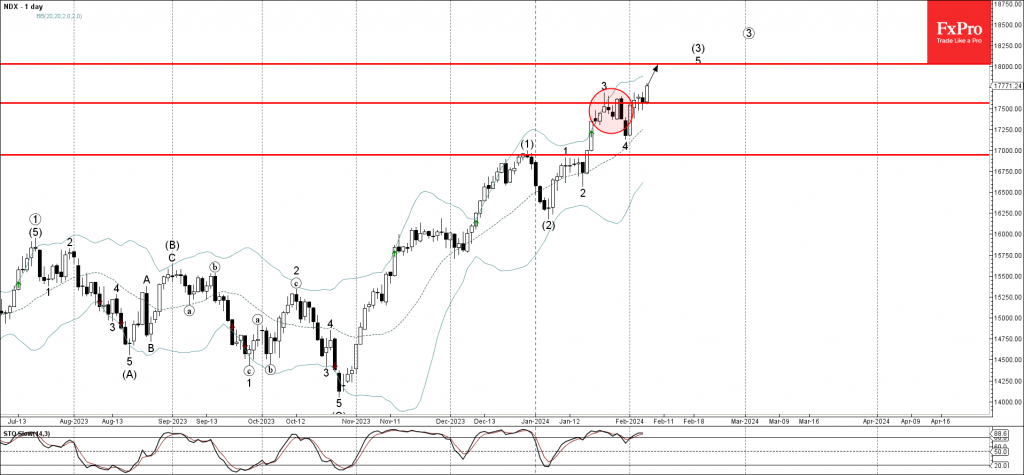
Nasdaq-100 index rising steadily after the price reversed up from the support level 17565.00, former resistance which stopped wave 3 in January.
The upward reversal from the support level 17565.00 continues the active impulse wave 5 of the intermediate impulse sequence (3) from the start of the year.
Given the clear daily uptrend, Nasdaq-100 index can be expected to rise further to the next resistance level 18000.00, target for the completion of the active impulse wave 5.
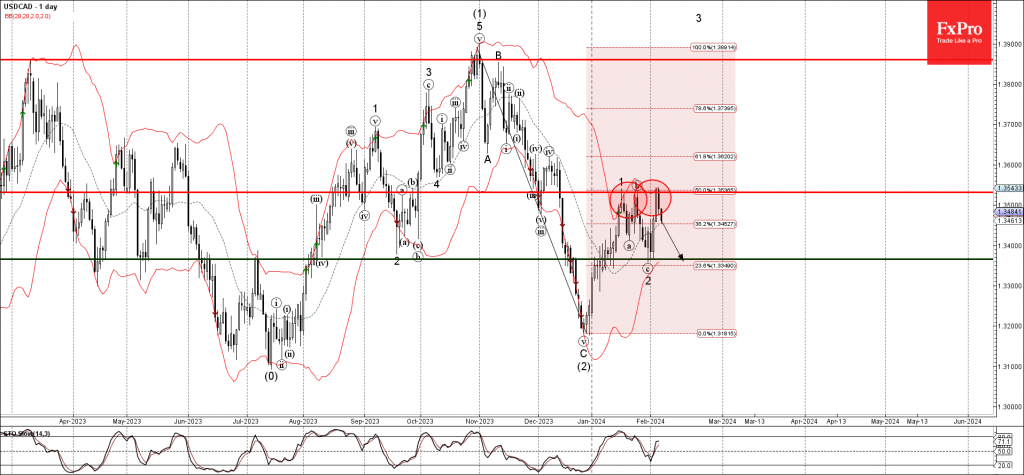
USDCAD Wave Analysis
- USDCAD reversed from resistance level 1.3530
- Likely to fall to support level 1.3365
USDCAD currency pair recently reversed down from the resistance level 1.3530, which stopped waves 1 and (b) in the middle of January.
The resistance level 1.3530 was strengthened by the upper daily Bollinger Band and by the 50% Fibonacci correction of downward ABC correction (2) from October.
Given the strength of the resistance level 1.3530, USDCAD can be expected to fall further to the next support level 1.3365, low of the previous correction 2.
XAU/USD: Gold Remains in Prolonged Consolidation Before Larger Bulls Resume
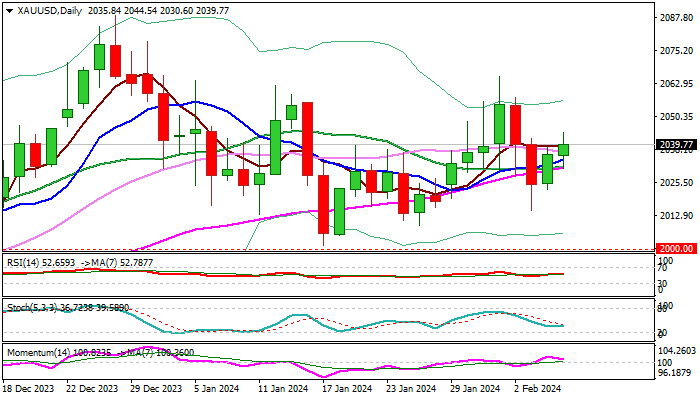
Short-term action remains in a sideways mode after the metal’s price spiked to new record high ($2141) in early December, holding within $1973/$2088 range, but mainly above psychological $2000 level, which adds to positive bias.
Gold is consolidating after Oct-Dec 2023 18% advance, a part of larger uptrend from $1616 (Nov 2022 higher low) with strong prospects for further gains, as growing global geopolitical tensions, economic uncertainty and signals that the Fed considers interest rates cuts later this year, continue to keep demand for safe-haven bullion steady.
The price is likely to continue to fluctuate within current range, awaiting fresh signals from fundamental side as technical studies on all larger timeframes remain bullishly aligned and contribute to positive outlook.
Gold can rise towards Fibonacci projections at $2206/26, on firm break of $2141 peak, with extension towards $2300 zone expected on stronger acceleration.
Res: 2056; 2065; 2088; 2100
Sup: 2014; 2009; 2000; 1985