

Sample Category Title
UK Wage Growth Cools Which Could Enable Earlier BoE Rate Cuts
Labour market figures this morning have kicked off a big week of economic data for the UK in a promising way, with wage growth a particular highlight from the report.
For a long time now, central banks have indicated that a significant amount of pressure from higher interest rates will need to be applied to cool the labour market - in turn, lifting unemployment and slowing wage growth - to return inflation sustainably to target. But recent evidence suggests that may not necessarily be the case.
Instead, inflation has been falling faster than anticipated, and now so is wage growth which has slowed significantly since the last peak four months ago. Average earnings growth including bonuses in the three months to November was 6.5% compared with 7.2% a month earlier and 8.5% four months ago.
Don't get me wrong, that's still far too high but it's a lot of progress in a very short period, and with inflation now running much lower, there's every chance we see much more over the coming months that enables the Bank of England to pivot towards cutting interest rates.
The pound did fall in the aftermath of the release but perhaps not quite as much as you'd expect from such an undershoot. That said, market positioning on rate cuts from the BoE was already far more aggressive than what many, especially at the central bank, have indicated is likely. Markets still see 125 basis points of cuts this year but there's a growing chance of 150 which is more in line with the US and euro area.
We'll hear from BoE Governor Andrew Bailey later in the day who may offer his views on the recent data and perhaps hint at a change in tone when the central bank meets in a couple of weeks. It's probably a little early to expect too big a pivot but it could lay the groundwork for a May cut as long as the data continues to comply.
Oil prices remain very choppy
Oil prices remain very choppy amid the uncertainty in the Middle East following the US and UK attacks on Houthi targets. We haven't seen a significant increase in the price of oil on the back of the attacks but the brief spikes we've seen have highlighted the sensitivity in the market to events around the Red Sea.
Gold struggling near previous record high
Gold is trading a little lower this morning after bouncing higher once again in recent sessions. The yellow metal remains buoyed by very aggressive rate-cutting expectations, particularly in the US, but at the same time, it is struggling to generate fresh momentum around the prior record highs, near $2,070. We obviously saw a spike in early December well above this but the timing of the move and the speed with which it reversed it suggests the market was never fully behind it, so the prior highs continue to look like a significant psychological threshold.
Could Bitcoin dip below $40,000 after ETF announcement?
Bitcoin is trading quite flat today but has come well off its highs since last Thursday. It's down around 13% in that time with some heat potentially coming out of the market in the aftermath of the spot bitcoin ETF announcement. We may be seeing another example of "buy the rumour, sell the fact" considering how highly anticipated the announcement was, it's just not clear whether that's now played out. A dip below $40,000 would be a big test.
‘First Five Days’ Rule Points to a Challenging Year
US equity indices declined in the first five trading sessions of January. This dynamic promises a challenging year for the stock market, according to the old “first five days” rule.
Identifying a defining trend would have been an easy task if not for stabilisation on the day of the NFP release on January 5 and a strong rally on January 8.
The “first five days” rule was popularised by Jim O’Neil during his time working for investment banks. Don’t limit yourself to this rule for the entire year, but consider it as a sentiment for the year.
The last time this method misfired was in 2018, but after that, it correctly determined five times whether the S&P500 would end the year up or down. The indicator also predicted a decline in 2016, but that was a year of growth after the prolonged stagnation of 2015 and an 11% plunge in January.
We now tend to agree with the “first five days” sentiment. The S&P500 index broke the highs of late last week and was only 0.8% away from an all-time high.
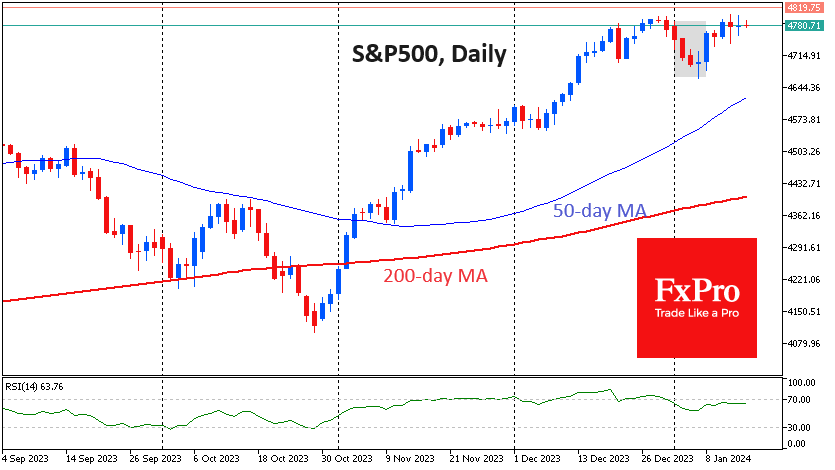
The US stock market was near highs last week as markets strengthened on expectations of more aggressive rate cuts from the Fed. Currently, rate futures see a cut at every meeting since March as the main scenario. The driver has been weaker ISM services and producer price indices, but the usually weightier, stronger employment and consumer inflation data is ignored.
In addition, we are dismayed to see that the level of greed in the markets has bordered on extreme greed over the past month. Declines out of extreme greed often precede corrections and sometimes give rise to bear markets.
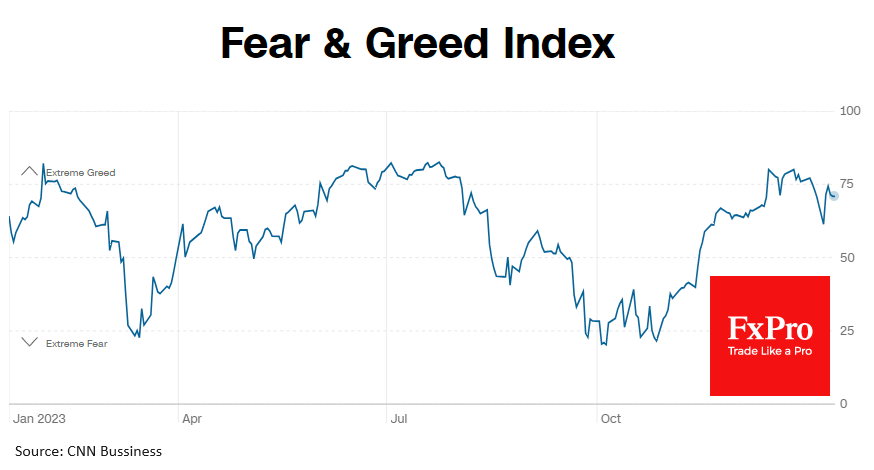
It may well be that the bulls squeezed everything they could out of the last rally, including abundant short-squeezes from recession-expecting bears and extremely dovish expectations from the Fed for this year.
The coming year may prove to be as challenging and clear-cut as the first five trading sessions have been, but still more indicators point to a correction than a continued rally, at least in the coming weeks.
Dollar Shows Broad Gains
Markets
With US markets closed for Martin Luther King Day, Europe was obliged to find its own intraday dynamics. After a sharp US driven (softer PPI’s) yield decline on Friday, German rates gapped higher at the open (+/-4 bps). Initially, there was little news to support a clear directional move. A preliminary estimate of the German Statistical office of the country’s 2023 GDP growth was set at -0.3% Y/Y, in line with expectations. The estimates/details in the report didn’t provide much of a reason for yields to rally further. Later in the session, the focus turned the ECB members speaking on the sidelines of the World Economic Forum in Davos. Buba’s Nagel repeated his assessment that it’s too early to talk about rate cuts as inflation still remains too high. He labelled markets’ pricing as too optimistic. Later, ECB’s Holzmann, admittedly a well-known hawk within the ECB MPC, even indicated that one should not bank on rate cuts in 2024 as geopolitical tensions still risk disrupting supply chains and energy markets, potentially keeping price increases at levels the ECB can’t ignore. Hawkish comments from Nagel and Holzmann shouldn’t come as a big surprise. Even so, German yields gained some further traction close higher between 8.1 bps (2-y) and 4.0 bps (30-y). Higher yields added to a risk-off sentiment with the EuroStoxx 50 ceding 0.57%. Despite ongoing tensions on Middle East supply, Brent oil held stable below the $80 p/b mark (close $78.15). Higher EMU yields and at the same time a risk-off sentiment kept the euro and the dollar in balance (EUR/USD close 1.095). Sterling lost modest ground against the euro as UK yields rose less than EMU/German ones (EUR/GBP close 0.8603).
This morning, US yields are joining yesterday’s rebound in Europe and gain about 5-6 bps across the curve. Asian markets are captured by a broad risk-off sentiment often ceding 1% (+). India outperforms. The dollar shows broad gains (DXY 102.87, EUR/USD 1.092, USD/JPY 146.1). The eco calendar today is again rather thin. ECB inflation expectations and the ZEW economic confidence might influence intraday trends but are no game changers. ECB’s Villeroy will speak in Davos. The US calendar only contains the Empire manufacturing survey. Fed’s Waller will speak on the economy. Even as US yields are gaining a few bps this morning, last week’s price action keeps the downtrend in place, especially at the short end of the curve. The US 2-y yield needs to regain the 4.40% area to call off the downside alert. On FX markets, first USD resistance/euro support is coming in at 1.0877.
UK labour market data this morning came in on the soft side of expectations. The number of payrolled employees declined a bigger than expected 24k. At the same time average weekly earnings growth (ex-bonus) slowed more than expected from 7.2% to 6.6%. In a first reaction, sterling is losing some further ground (EUR/GBP 0.8615).
News & Views
Former BoJ executive director as well as ex-chief economist Maeda said that he expects annual wage negotiations to result in a 4% rise, exceeding the 3.58% of last year and paving the way for the central bank to ditch its negative policy rate. According to Maeda, the “virtuous cycle between wages and inflation” that the Bank of Japan is seeking is already in place. Until now, current governor Ueda has defended the ultra-easy policy stance because policymakers aren’t so sure that is indeed the case. Maeda, who left the BoJ in 2020 after playing a major role in the central bank’s initial response to the pandemic, believes rate action could come in the spring (April) without ruling out an earlier move.
Hungary’s Finance Ministry State Secretary in an op-ed on a Hungarian financial news website called for a bigger consolidation effort. While the government does plan to reduce the deficit from 5.9% in 2023 to 2.9% of GDP this year, Péter Beno Banai warned for the probability of revenues missing estimates and expenditures exceeding plans due to base effects. With the current forecast being only just below the EU’s 3% threshold, risks are for Hungary to enter the bloc’s excessive-deficit procedure. That could ultimately end up in the suspension of EU funds at a time when many billions (including from the Resilience and Recovery Facility) are already held back over graft and rule-of-law concerns.
GBP/JPY Daily Outlook
Daily Pivots: (S1) 184.82; (P) 185.29; (R1) 185.98; More...
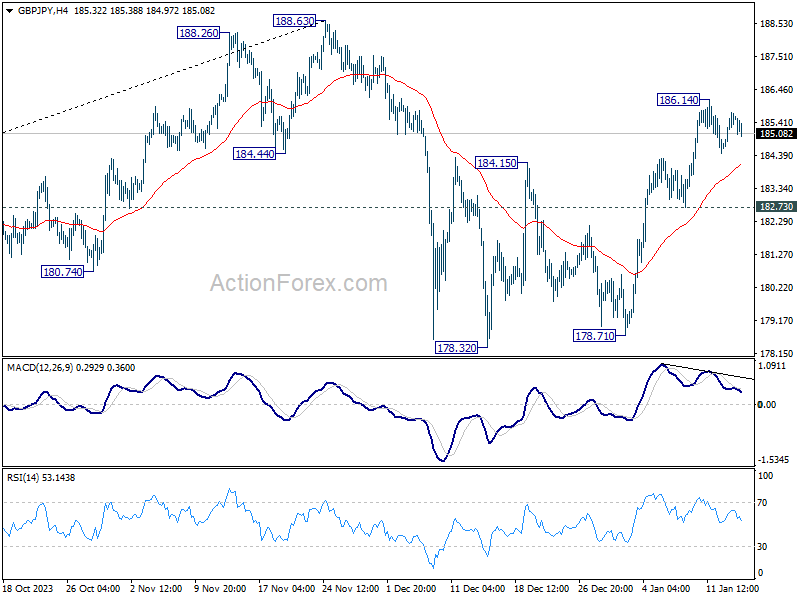
GBP/JPY is staying in tight range despite today's dip and intraday bias remains neutral. Further rally is in favor as long as 182.73 minor support holds. Corrective pull back from 188.63 should have completed. Above 186.14 will resume the rebound from 178.32 to retest 188.63.
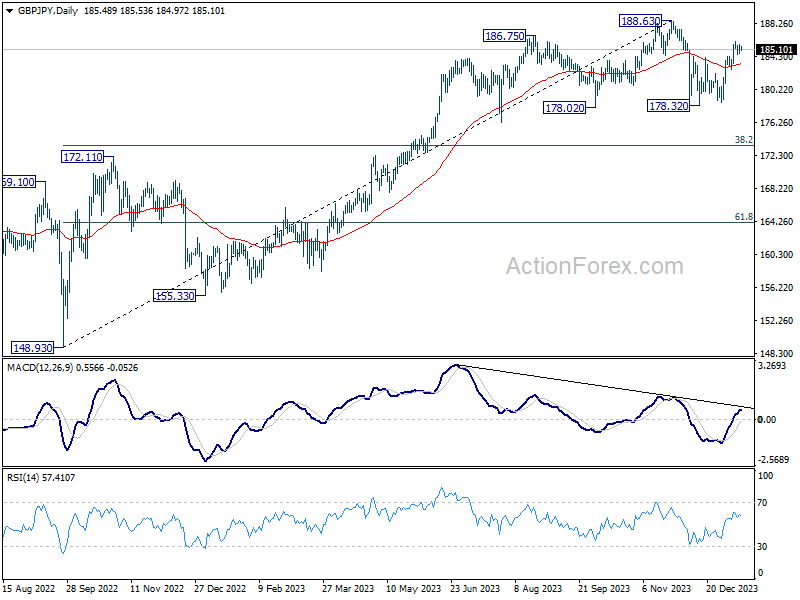
In the bigger picture, price actions from 188.63 medium term top are seen as a correction to the up trend from 148.93 (2022 low) only. As long as 172.11 resistance turned support holds, larger up trend from 123.94 (2020 low) is still in favor to resume through 188.63 at a later stage.
EUR/GBP Daily Outlook
Daily Pivots: (S1) 0.8591; (P) 0.8601; (R1) 0.8616; More...
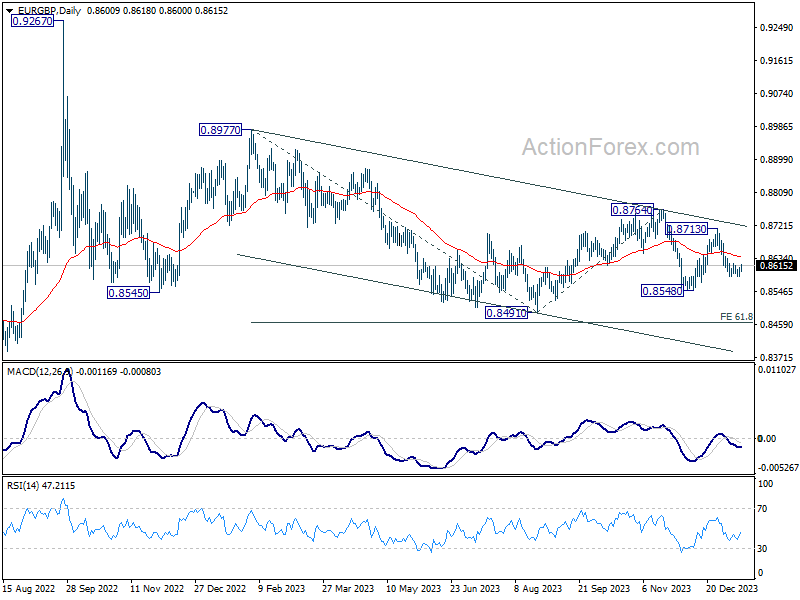
EUR/GBP is staying in tight range above 0.8585 and intraday bias remains neutral. Further decline is expected as long as 0.8638 minor resistance holds. On the downside, below 0.8585 will resume the fall from 0.8713 to 0.8548 support. Firm break there will target 0.8491 low next. Nevertheless, decisive break of 0.8638 will turn bias back to the upside for stronger rebound to 0.8713 instead.
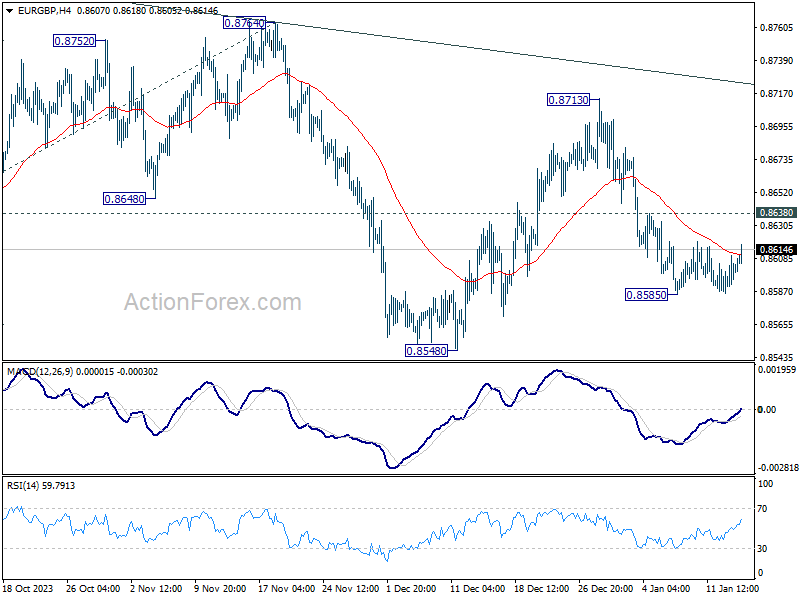
In the bigger picture, fall from 0.8764 is seen as another leg in the whole down trend from 0.9267 (2022 high). Outlook will stay bearish as long as 0.8764 resistance holds. Break of 0.8491 will target 61.8% projection of 0.8977 to 0.8491 from 0.8764 at 0.8464.
GBP/USD Daily Outlook
Daily Pivots: (S1) 1.2705; (P) 1.2735; (R1) 1.2758; More...
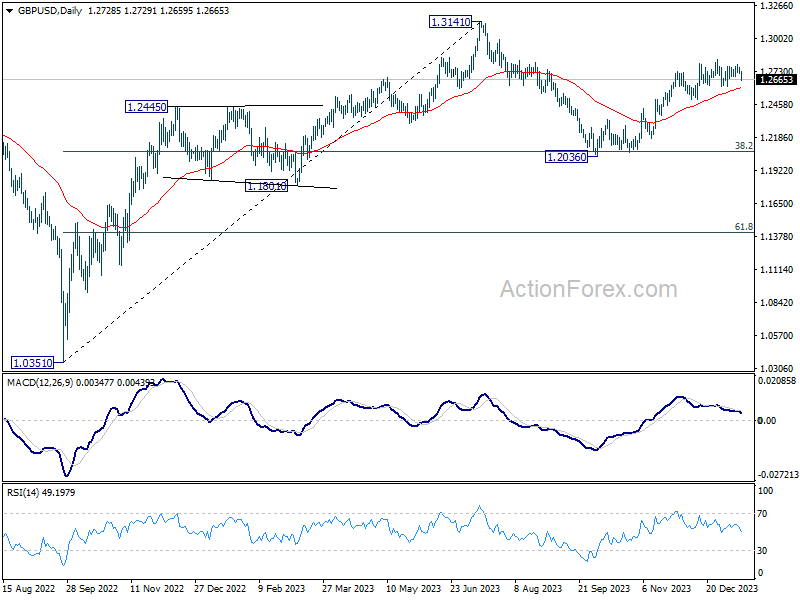
GBP/USD is staying in range of 1.2611/2826 despite today's decline. Intraday bias remains neutral first. On the upside, decisive break of 1.2826 will resume whole rally from 1.2036. Nevertheless, break of 1.2611 will bring deeper decline to 1.2499 support instead.
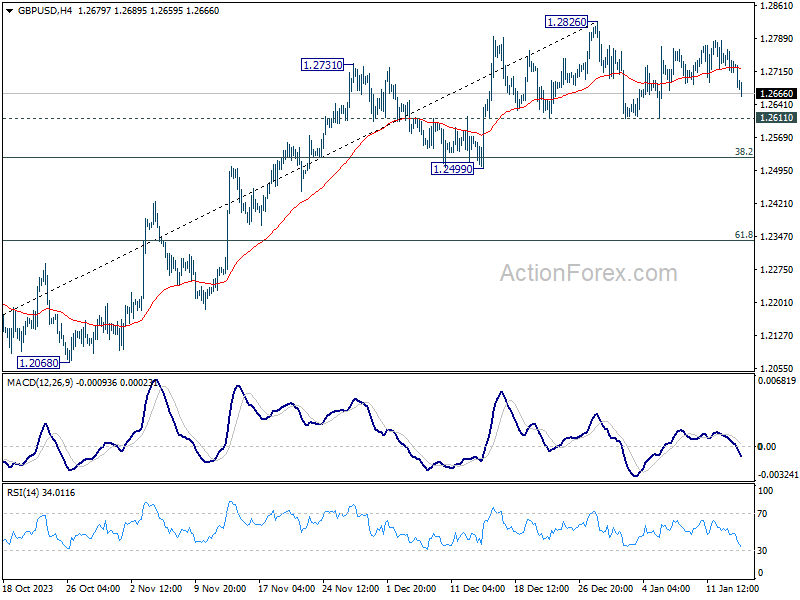
In the bigger picture, price actions from 1.3141 medium term top are seen as a corrective pattern to up trend from 1.0351 (2022 low). Rise from 1.2036 is seen as the second leg that's in progress. Upside should be limited by 1.3141 to bring the third leg of the pattern. Meanwhile, break of 1.2499 support will argue that the third leg has already started for 38.2% retracement of 1.0351 (2022 low) to 1.3141 at 1.2075 again.
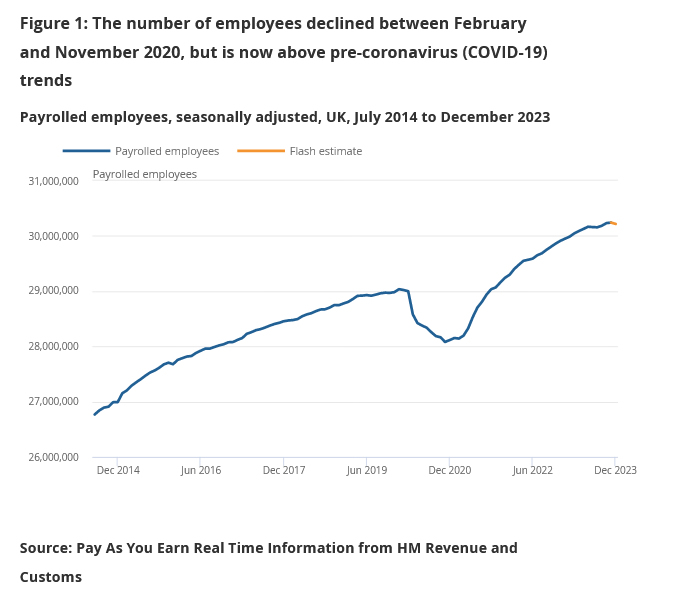
UK payrolled employment falls -24k in Dec, unemployment rate at 4.2% in Nov
UK payrolled employment fell -0.1% mom, or -24k in December. Annual growth in employees fell from 1.3% yoy to 1.0% yoy. Median monthly pay increased by 6.6% yoy, up from prior month's 6.5% yoy. Claimant count rose 11.7k, below expectation of 18.1k.
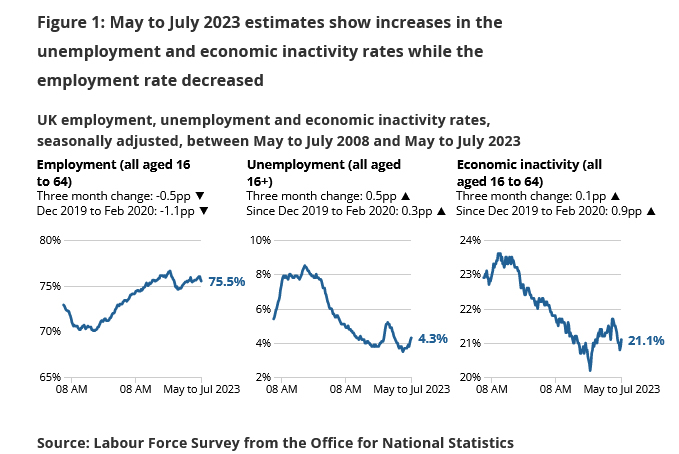
In three months to November, unemployment rate rose to 4.2%, up 0.5% from the previous three month period. Employment rate fell to 75.5%, down -0.5%. Total weekly hours also fell -18.5 to 1040. Average earnings excluding bonus slowed from 7.3% 3moy to 6.6%, matched expectations. Average earnings including bonus fell from 7.2% 3moy to 6.5%, below expectation of 6.8%.
WTI Oil Technical: Sideways Within a Potential Minor Bottoming Configuration
- Ongoing hostilities in the Middle East region and the Red Sea shipping route have put a potential “floor” in oil prices due to the increasing risk of supply disruptions.
- The demand side has remained weak as China’s top policymakers have signalled a less forceful approach in enacting stimulus measures after PBoC left its 1-year MLF rate unchanged at 2.50%.
- Sideways for now between US$76.05/78.40 and US$69.20 for WTI crude oil.
Since our last report, the price actions of West Texas Oil (a proxy of WTI crude oil futures) have managed to trade above its 13 December 2023 low of US$67.82/barrel and whipsawed around the 20-day moving average in the past two weeks.
Conflicting fundamental factors
There are no clear catalysts to determine whether the bulls or bears are leading the oil market as conflicting factors are at play, thus causing a flux situation at this juncture.
On the positive side that is supporting oil prices is the rising geopolitical risk premium in the Middle East region that could potentially disrupt the oil supplies. The odds are high for an increase in hostilities in the Red Sea shipping route where Yemen’s Houthi militants are showing no signs of backing down in attacking registered ships from Israel and its allies, primarily the US in the Red Sea despite the recent joint counter strikes from US and UK to neutralize these threats.
In addition, Iran, a key stakeholder in the Middle East has started to play a bigger military role in terms of showing its displeasure in the ongoing war between Israel and Hamas by mounting an attack yesterday on Israel’s spy HQ in Iraq as reported by various media outlets.
On the flipside, the demand side narrative for oil remains weak as China’s central bank, PBoC has disappointed market participants by keeping one of its key benchmark interest rates unchanged; the 1-year medium-term lending (MLF) rate was held at 2.5% since August 2023.
This latest monetary policy move from PBoC has signalled that Chinese top policymakers are in no rush to enact more “pronounced” stimulus measures to negate the deflationary risk spiral in China, thus dampening the mood of short-term bullish animal spirits in the oil market.
Potential minor bottoming for WTI crude
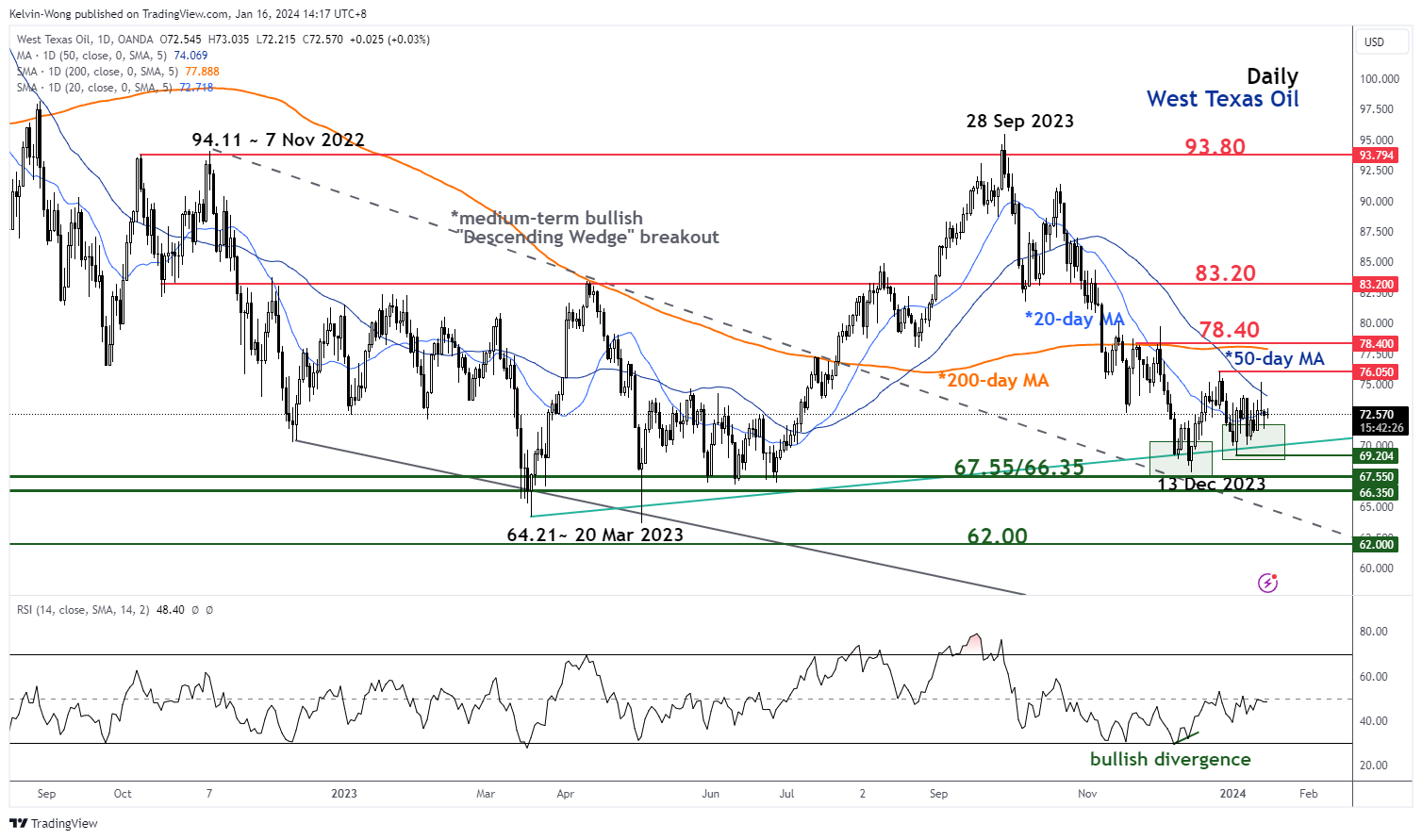
Fig 1: West Texas Oil medium-term trend as of 16 Jan 2024 (Source: TradingView, click to enlarge chart)
In the lens of technical analysis, the recent steep drop of -15% of WTI crude from 30 November 2023 to 13 December 2023 has managed to stall at the medium-term ascending trendline support in place since the 20 March 2023 swing low of US$64.21. In addition, it has formed a “higher low” in the past four weeks.
The key resistance of this potential minor bottoming formation stands at US$76.05/78.40 which confluences with 50-day and 200-day moving averages that are acting as price caps as well.
Therefore, in the short to medium term, WTI crude is likely to trade sideways between US$78.40 and US$69.20 (the ascending trendline from the 20 March 2023 low) due to conflicting fundamental factors. Only a clearance above US$78.40 may ignite a more impulsive upmove sequence to see the next medium-term resistances coming in at US$83.20 and US$93.80.
On the other hand, failure to hold at US$69.20 sees a slide to retest the first major support zone at US$67.55/66.35.
Calling a Spade, a Spade
I sense that the first quarter of this year will be marked by the realization that it’s too early for the central banks to cut the interest rates unless something really bad – like another bank crisis, or a real estate crisis, or another debt crisis hits the fan. Because March – where market prices reflect the first rate cuts from both the Federal Reserve (Fed) and the European Central Bank (ECB) - is about two months away, and things don’t look *that* bad.
In Europe, growth is slowing, Germany is struggling to reverse slow down, the slump in the Eurozone’s industrial production accelerated, and production fell 6.8% in November from a year earlier. Over the last 9 readings, only one came in positive, and it was a small 0.2% growth back in June. But economic slowdown is what the ECB needs to pull inflation lower. And unless there is a sharp slowdown in economic activity, the ECB won’t hurry up to cut rates. On the contrary, the bank is now focused on waning the pandemic era aid programs. And according to a recent Bloomberg survey, the ECB will make four 25bp cuts this year starting in June instead of six rate cuts starting from April – as priced in by the markets.
In the US, the resilient growth, healthy jobs market and sustained fiscal spending into the presidential election suggest no urge for a Fed cut in March.
The divergence between the reason and market pricing suggests that the rate cut expectations will be gently delayed and pricing will be revisited.
If that’s the case, stock and bond markets should correct to the downside, and the US dollar should recover.
Calling a spade, a spade
The US dollar kicked off this week on a positive note, as the EURUSD made a swift move to the downside following ECB Holzmann’s words in Davos yesterday. Holzmann warned that the threats from looming inflation will likely prevent the ECB from lowering the rates this year, even as a recession can no longer be ruled out. He pointed at the conflict in the Middle East as a risk for further disruption to supply chains and energy markets and cautioned that the latter developments will likely keep ECB alert regarding the price risks. The euro fell and the Stoxx 600 retreated.
One thing that prevents inflation worries from darkening the mood is the subdued reaction from oil markets. The escalation of the conflict in the Red Sea region no longer fuels oil prices. Despite news of further attacks and retaliation, US crude saw limited upside yesterday and closed the session slightly lower. Resistance remains intact into $75pb level.
But if inflation worries resurface, weak economic data will no longer fuel the central bank doves and act as good news.
The EURUSD has potential to fall further. The next natural target for the euro bears stands at 1.0875, the major 38.2% Fibonacci retracement on the latest rebound that started in October. Below this level, the EURUSD will step into the medium-term bearish consolidation zone. Cable could return below 1.25, and the USDJPY could make an attempt on the 100-DMA – near 147.40. But the consensus for the USDJPY remains bearish as the Bank of Japan (BoJ) should exit the negative rate policy. Japanese policymakers could be further encouraged to act in case of strong annual wage-negotiation results.
Trump Wins Iowa Caucus
In focus today
Today, focus is on German ZEW data for January and final inflation figures for December. The final HICP figures include details on inflation components that will provide important information about the underlying inflationary pressure in the largest euro area economy.
While the official labour force statistics continue to be postponed, today we get the experimental estimates for November/December at 8:00 CET. Key will be developments in wage growth, which is highly determining of service inflation. Other surveys point to a further easing in wage growth although the loosening of the labour market appears to lose steam.
In Norway November GDP numbers for the mainland is released at 08:00 CET. We expect the number to come in at -0.2% m/m.
Fed's Waller speaks at 17:00 CET.
In the US, markets will resume trading after being closed for Martin Luther King Day on Monday.
Early Wednesday morning (03:00 CET) China releases GDP on top of the monthly batch of data. GDP growth is expected to be 1.0% q/q down from 1.3% q/q in Q4 which would result in a rise in the annual growth rate from 4.9% to 5.2%. It would imply an average growth rate for the year at 5.2% and thus above the government's 5% target. More interesting will be Chinese data on home sales and retail sales. Home sales are still very depressed leaving no sign of a bottom in the housing crisis. Retail sales have been solid in November growing 10.1% y/y but expected by consensus to drop to around 8%. It is crucial that consumption growth stays afloat for China to continue a growth path around 5% in 2024.
Economic and market news
What happened overnight
In the US, former president Donald Trump expectedly won the Iowa caucus, thus bringing him one step closer to getting on the Republican ticket for the presidential election this November. The Trump victory was highly anticipated in prediction markets. Ron DeSantis came second narrowly ahead of Nikki Haley. Third runner-up Vivek Ramaswamy chose to withdraw from the primaries and endorse Trump, thus giving the former president even more support in his endeavours to secure the Republican nomination.
In Asia, Japanese wholesale inflation for December came out higher than expected at 0.3% m/m and 0.0% y/y. Consensus was expecting it to land at 0.0% m/m and -0.3% y/y. The surprise in the corporate goods inflation comes ahead of Friday's nationwide Japanese December CPI release.
Swedish unemployment increased from 6.5% in November to 6.7% in December according to new data released by the Swedish Public Employment Service (SPES) this morning. This number can be compared to an unemployment rate of 6.6% back in December 2022 and shows that the unemployment is remaining at stable and relatively low levels. Danske Bank expects a modest increase in Swedish unemployment during 2024.
What happened yesterday
In Sweden, inflation surprised to the upside with the nominal CPIF coming in at 2.3% and CPIF ex energy coming in at 5.3%, both y/y. Clothing and furniture appeared to be the primary causes behind the upside surprise, both rising much more than expected. Despite the higher than expected December print, inflation remains below the most recent Riksbank forecast.
German GDP numbers showed the economy shrank by 0.3% in 2023. The preliminary GDP numbers (official quarterly data are released in two weeks) for the Q4 came in at -0.3% q/q, whereas Q3 was revised up from -0.1% q/q to 0.0% q/q. The manufacturing sector has weighed increasingly heavy on the economy in Q4 according to IFO data and the construction sector has continued its increasingly steeper slide into recession.
Manufacturing recession: In the euro area, weak soft data also translates into weak hard data with industrial production down 0.3% m/m in November as expected. This compares to a decline in October of 0.7% m/m.
ECB: At the World Economic Forum in Davos, Robert Holzmann, hawkish member of the ECB Governing Council, made it clear he deemed it prematurely to speak of rate cuts, saying he "may even foresee no cut at all this year".
In energy markets the Dutch natural gas benchmark the TTF, widely recognised as the most prominent natural gas benchmark in Europe, dropped below €30/MWh due to EU natural gas storages sitting at around 80%. This storage level is close to a record-high for this time of year, albeit slightly lower than the corresponding level in 2023, hence market sentiment has begun leaning towards Europe making it rather comfortably through the winter despite cold weather. By session end the TTF stood at €30.5/MWh.
Red Sea: The on-going conflict between the Iran-backed Houthis and the US led naval contingent in the Red Sea is still at the centre of attention in crude markets. A US owned dry bulk carrier ship was hit by a missile off Yemen. The Houthi movement responsible for the attack followed up with a statement saying they would now target all American ships. Several oil tankers diverted routes to avoid the Red Sea. QatarEnergy announced they would also seize passing through the Red Sea. Despite the continued tension in the Red Sea oil retracted slightly in yesterday's trading session, with Brent settling at USD78.15/barrel.
Equities: Global equities were mostly lower yesterday with US closed for Martin Luther King Day. Sentiment kept sliding throughout the day and the appetite for risk continues to drop this morning in Asian and western futures. No big sector or style rotation but rather a broad-based sell-off with energy sector doing marginally better than the rest. Japan stood out yesterday as well and is 5% ahead of other markets year-to-date as yen has weakened on the back of a dovish turn in central bank expectations.
FI: Yields rose across the board on the first trading session of the week, reversing some of the decline last Friday. 10Y UST yields ended 6bp higher, while 10Y Bund yields rose 5bp. The pricing of rate cuts from the ECB in 2024 fell from 156bp to 150bp during the session. The Bund ASW-spread continued to tighten, while peripheral spreads were slightly wider. Overnight, oil prices have gained some tailwinds on the back of yesterday's Houthi attack on a US-owned commercial vessel in the Red Sea.
FX: The week has started relatively quietly in the G10 FX space with the US market closed yesterday. EUR/USD remains in the mid 1.09-1.10 range, while the JPY traded weak, driving USD/JPY above 145 and EUR/JPY closer to 160. EUR/GBP hovers around 0.86. In the Scandies space, both EUR/NOK and EUR/SEK drifted above 11.30.