Sample Category Title
EUR/GBP: Steep Fall Extends Below Thick Daily Ichimoku Cloud
EURGBP continues to trend south and hit new 3 ½ month low on Friday, in extension of steep and uninterrupted downtrend from 0.8765 (Nov 16 peak).
The pair is on track to complete the second week of heavy losses, after November’s close in red marked the biggest monthly loss since May.
Fresh signals that the ECB will start cutting interest rates before BoE, after the latest comments from Bank of England’s hawks that rates may stay elevated for longer, additionally weighed on the pair.
Friday’s break below the base of thick daily cloud (0.8616) generated fresh bearish signal, which requires confirmation on weekly close below the cloud.
Daily studies are in full bearish setup but overextended and warning about possible corrective action in coming sessions.
Cloud base and 100DMA (0.8616/38 respectively) reverted to resistances which should ideally cap upticks and guard 0.8650/61 (Nov 16 former higher low / broken Fibo 38.2%).
Res: 0.8616; 0.8638; 0.8661; 0.8674.
Sup: 0.8596; 0.8567; 0.8556; 0.8523.
USD/CAD Eyes Canadian Job Data, US PMI
- Canada’s job growth expected to expand by 15,000
- US ISM Manufacturing PMI projected to accelerate to 47.6
The Canadian dollar continues to gain ground against a slumping US dollar. In the European session, USD/CAD is trading at 1.3529, down 0.23%.
The Canadian currency is poised to post a third straight winning week against the greenback and soared 2.25% in November. It is a busy Friday, with Canada releasing the employment report, the US publishing the ISM Manufacturing PMI and Fed Chair Powell speaking at an event in Atlanta.
Canada’s labour market has softened but remains in good shape and has shown expansion for three straight months. The economy is expected to have added 15,000 jobs in November, slightly lower than the 17,500 reading in October. The market consensus for the unemployment rate stands at 5.8%, compared to 5.7% in October.
Canada’s GDP posts negative growth
This week’s GDP report was another reminder that the economy remains weak. Third-quarter GDP declined by 0.3% q/q, below the revised o.3% gain in Q2 and the first decline since the second quarter of 2021. High interest rates have cooled the economy and exports were down in the third quarter as global demand remains weak. On an annualized basis, GDP slid 1.1% in the third quarter, compared to a revised 1.4% gain in Q2 and shy of the market consensus of 0.2%.
The US wraps up the week with the ISM Manufacturing PMI. The manufacturing sector has been in a prolonged slump and the PMI has indicated contraction for twelve consecutive months. The PMI is expected to improve to 47.6 in November, compared to 46.7 in October. A reading below 50 indicates contraction.
Investors will be listening closely to Jerome Powell’s remarks today, looking for hints about upcoming rate decisions. Powell has stuck to his script of a ‘higher for longer’ rate policy, but the markets have priced in a rate cut in May at 84%.
USD/CAD Technical
- USD/CAD tested resistance at 1.3564 in the Asian session. Above, there is resistance at 1.3665
- 1.3494 and 1.3434 are providing support
Vibrant Crypto Market
Market picture
The crypto market has added 1.5% in the last 24 hours, bringing the capitalisation back to the 1.44 trillion level, which has been acting as resistance for the last three weeks. The upward movement has intensified since the beginning of December.
Bitcoin rose 9.4% to $37.7K in November, strengthening for the third consecutive month. In terms of seasonality, December is considered a relatively neutral month of the year, adding half the time over the past 12 years. The average gain is 30.8%, while the average decline is 12.8%.
December started on the upside, returning BTCUSD to another test of highs near $38.4K. The price went up with the start of a new day and month before touching the lower boundary of the trading channel. Such dynamics look like an attempt to accelerate the growth trend.
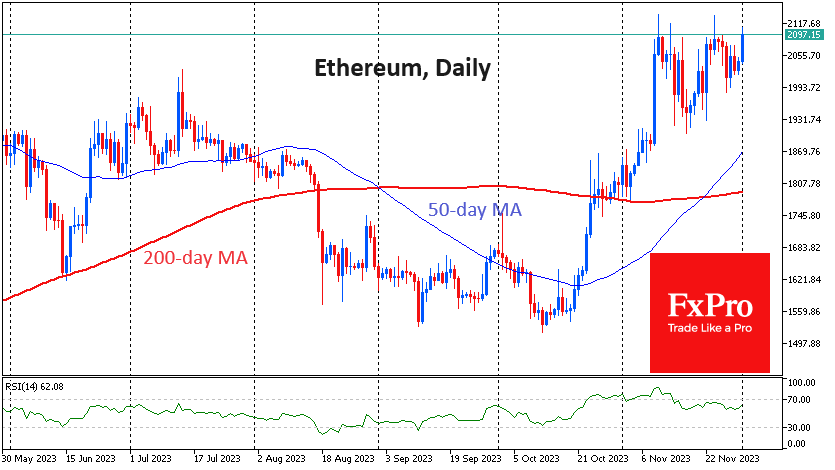
Ethereum is adding 3.8% over the day, having returned to test $2100 – a horizontal resistance which withstood the bulls’ onslaught several times in November and was a turning point in April. A move above opens up a wide untraded range, giving ETH freedom of movement all the way to $3500.
News background
SEC chief Gary Gensler said the agency is working closely on numerous applications for spot Bitcoin ETFs. Still, it is not helpful to comment on timing or anticipate future decisions on them. He reiterated the Commission’s position that bitcoin is a commodity.
Coinbase’s team has met with the SEC 30 times in a year and a half but has not received an answer to the question of whether certain assets belong to securities, said Brian Armstrong, the exchange’s CEO.
MicroStrategy bought 16,130 BTC in November at an average price of $36,785. The company’s total reserves reached 174,530 BTC. In total, the company has about 174.5K BTC on its balance sheet, with an average purchase price of $30.2K.
The U.S. Treasury Department has asked lawmakers to give the agency expanded powers to fight illegal financing through cryptocurrencies. Cryptocurrency services and mixers could be used for this purpose.
Bankrupt cryptocurrency exchange FTX received bankruptcy court approval and began selling $744 million worth of crypto assets to Grayscale Investments.
Mining pool AntPool, which received a record $3.1 million Bitcoin transaction fee, said it was willing to reimburse it.
Swiss Franc Hits 4-month High, GDP Beats Forecast
- Swiss franc climbs to 4-month high
- Swiss GDP rises 0.3%
- US ISM Manufacturing PMI expected to rise slightly
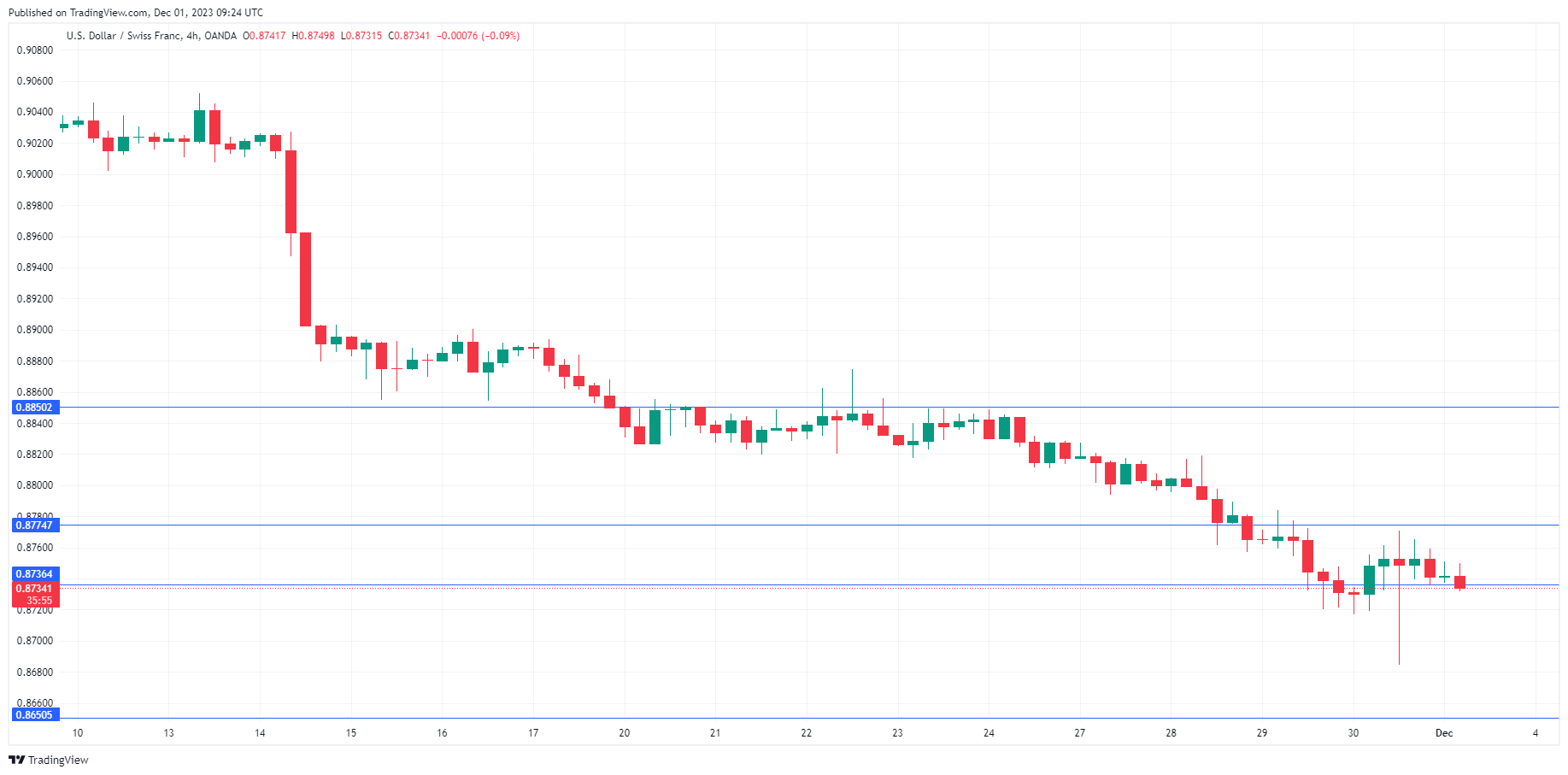
The Swiss franc is lower on Friday. In the European session, USD/CHF is trading at 0.8723, down 0.22%.
Swiss franc continues to climb
The Swiss franc continues to power higher against a slumping US dollar. USD/CHF has fallen 1% this week and plunged 3.8% in November. On Thursday, USD/CHF touched a low of 0.8684, its lowest level since July 31.
The Swissie’s rapid appreciation is likely causing sleepless nights at the Swiss National Bank. Policy makers at the central bank follow the exchange rate carefully and have not hesitated to intervene in the currency markets as a monetary policy tool. The stronger Swiss franc has helped dampen inflation but the SNB doesn’t want the currency to be too strong since that hurts the crucial export sector. If the Swiss franc continues to lose ground, the SNB could respond with some verbal intervention and express concern about the Swiss franc’s high value.
Swiss inflation is in a good place, within the 0%-2% target, but the economy remains weak. Swiss GDP rose by just 0.3% q/q in the third quarter, up from a revised -0.1% in Q2 and above the consensus estimate of 0.1%. The services sector was the main driver of growth as manufacturing was flat and consumer spending posted modest growth. The GDP report noted that the “international environment remains challenging”. Global demand remains weak, and the EU, which is Switzerland’s largest export market, posted 0% growth in the third quarter.
The US wraps up the week with the ISM Manufacturing PMI. The manufacturing sector has been in a deep slump and the PMI has indicated contraction for twelve consecutive months. The PMI is expected to improve to 47.6 in November, compared to 47.6 in October. A reading below 50 indicates contraction.
We will also hear from Federal Reserve Chair Powell later today. Investors will be looking for hints about upcoming rate decisions. Powell has stuck to his script of a ‘higher for longer’ rate policy, but the markets have fully priced in a rate cut by May, up from 65% a week ago.
USD/CHF Technical
- USD/CHF is testing resistance at 0.8736. Below, there is support at 0.8650
- 0.8736 and 0.8774 are the next resistance lines
UK PMI manufacturing finalized at 47.2, recovery remains elusive
UK PMI Manufacturing was finalized at 47.2 in November, up notably from October's 44.8. This marks the third consecutive month of rising PMI figures and the highest level since May.
Despite these gains, it is important to note that the PMI has remained below the neutral 50 mark for 16 consecutive months, indicating a prolonged period of contraction in the manufacturing sector.
Rob Dobson, Director at S&P Global Market Intelligence, commented, "Although the downturn in production eased sharply in November, the latest PMI report brings little festive cheer when the finer details are considered."
Dobson pointed out that despite improvement in production, the sector faces ongoing challenges. These include sharp declines in new order inflows and exports, along with clients destocking, which collectively suggest that a robust and sustained revival in meaningful growth is not yet on the horizon.
Dobson also noted, "Manufacturers are preparing for tough times ahead, with their continued caution leading to cutbacks in staffing, inventories, and purchasing."

USDCHF Bullish Odds Increase After 4-month Lows
- USDCHF bounces from 4-month lows
- Oversold signals create hopes for a rebound
- An advance above 0.9100 is required
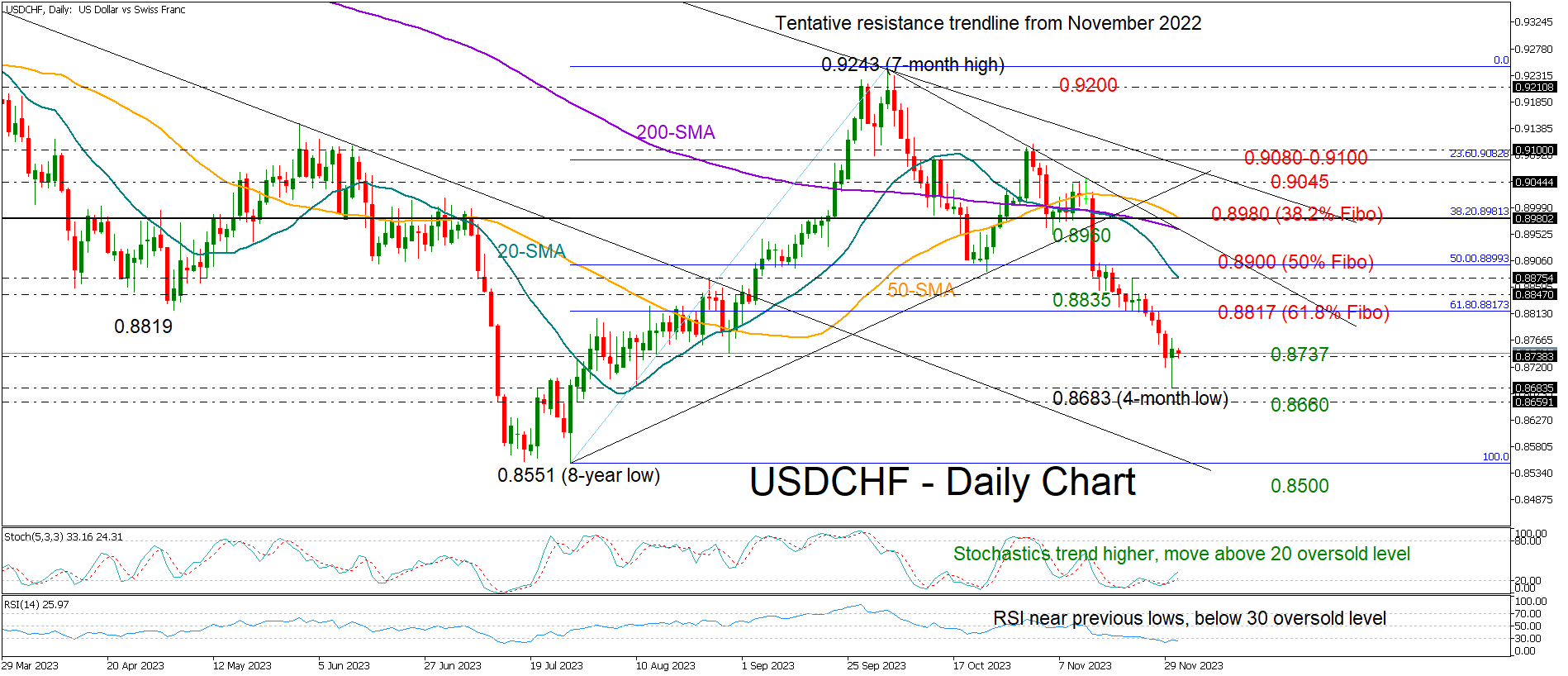
USDCHF extended its three-week bearish wave, dipping as low as 0.8683 on Thursday before closing the day with mild gains above the 0.8700 round level.
Although Friday’s session started with weak momentum ahead of the ISM business PMI figures, traders might attempt to push the pair higher according to the technical indicators. The RSI is near its previous lows in the oversold zone, while the stochastic oscillator has started to make higher highs and higher lows to exit the oversold zone below 20, both making an upside reversal or some stability likely. Moreover, Thursday’s candlestick seems to have taken the form of a bullish hammer, but more gains are required to confirm it.
On the upside, the area between 0.8815 and 0.8900 formed by the 61.8% and 50% Fibonacci retracement levels of the previous upleg could be a hurdle given the constraints within the region. A decisive close above it could underpin buying appetite, lifting the price forcefully up to the 200- and 50-day simple moving averages (SMAs), where the 38.2% Fibonacci mark is also located at 0.8980. Additional gains from there might take a breather around 0.9045 before the attention turns to the 23.6% Fibonacci level of 0.9080 and the 0.9100 psychological mark.
In the bearish case, where the price slips below 0.8737, support could commence within the 0.8660-0.8683 territory. If that base proves fragile, the pair might fall directly to July’s eight-year low of 0.8551. A continuation below 0.8500 could see a test around the January 2015 barrier of 0.8370.
All in all, USDCHF could switch into recovery mode in the short-term, though only a bounce above 0.8900 would add credence to a potential rebound.
Eurozone PMI manufacturing finalized at 44.2, continuing contraction, but slower
Eurozone's PMI Manufacturing was finalized at 44.2 in November, up from October's 43.1, reaching a six-month high. The report highlights reduction in the rate of decline for new orders, stocks, and purchasing activity, yet underscores a concerning trend of increasing employment cuts.
Breaking down the performance across Eurozone member states, Greece emerged as the only country in expansion, with PMI of 50.9. Ireland remained stable at 50.0. In contrast, other major economies like Spain (46.3), the Netherlands (44.9), Italy (44.4), France (42.9), Germany (42.6), and Austria (42.2) all registered figures indicative of ongoing contraction in their manufacturing sectors.
Cyrus de la Rubia, Chief Economist at Hamburg Commercial Bank, said, "November has not been the prettiest." He noted the continuous decline in output and the trend of workforce reductions extending for six months. While acknowledging slight improvements in various sub-indices, de la Rubia pointed out that these are insufficient to signal a robust upward trend, describing them as "timid" and lacking the necessary dynamism.
De la Rubia also highlighted the divergent conditions within the top four Eurozone economies, with Germany uniquely showing a softening in output decline. In contrast, the situation appears to be worsening in other major economies.
He emphasized, "A crucial barometer for the recovery's onset will likely be a more synchronized upward movement in the economies PMI indexes, leading to a self-reinforcing reciprocal push among countries."
USDCAD Extends Decline Towards the 200-day SMA
- USDCAD posts a fresh 2-month low in today’s session
- Decline shows no signs of easing, bears eye the 200-day SMA
- Momentum indicators endorse the resumption of the retreat
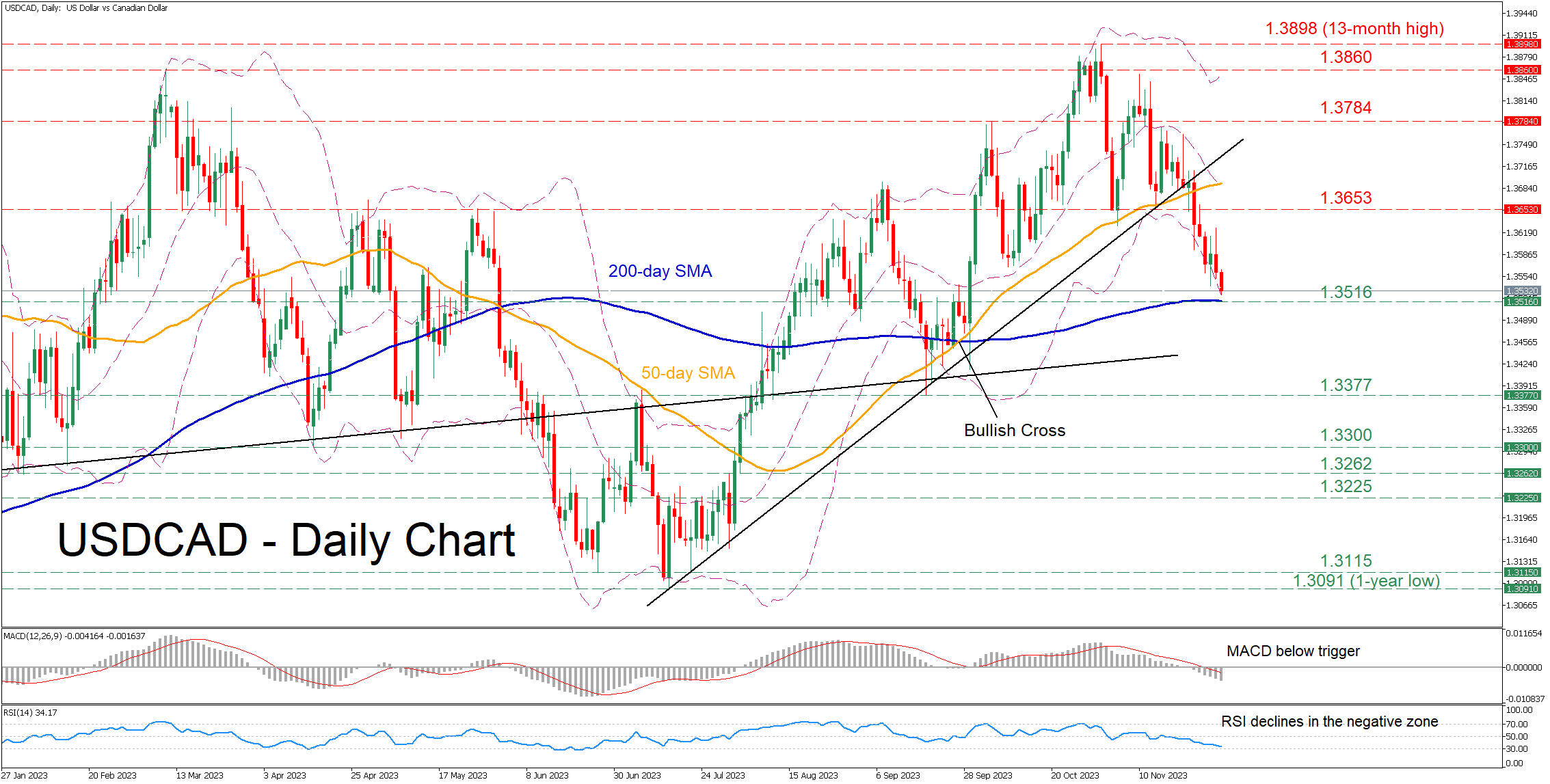
USDCAD has been constantly losing ground following its 13-month high of 1.3898 on November 11. Moreover, the pair dropped to its lowest levels in two months on Friday, with the bears setting the stage for a test of the 200-day simple moving average (SMA).
Given that the momentum indicators are heavily tilted to the downside, the pair could soon face the 200-day SMA at around 1.3516. Should that barricade fail, there is no prominent support until the September low of 1.3377. A violation of that territory could open the door for the April bottom of 1.3300.
On the flipside, if the price reverses higher, the bulls might attack the April-May resistance of 1.3653. Surpassing that zone, the pair could face the October resistance of 1.3784. Further advances may then cease at the March peak of 1.3860.
In brief, USDCAD has been under increasing downside pressures lately, generating a structure of lower lows. Moving forward, a test of the 200-day SMA could decide whether the decline has been overstretched.
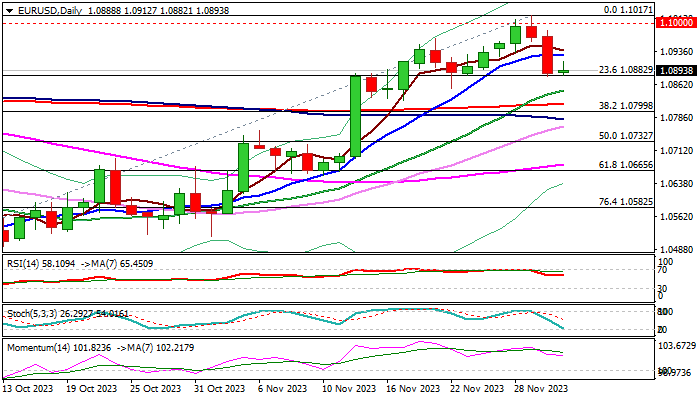
EUR/USD Stands at the Back Foot Ahead of Fed Powell’s Speeches
EURUSD was a tad higher on Friday morning following nearly 0.8% drop on Thursday, when the Euro was deflated by soft EU inflation numbers which may add to ECB’s dovish stance in the near future.
Additional pressure came from stronger dollar on speculations that Fed Chair Powell may surprise on hawkish shift in his speeches due later today.
Two-day pullback after a double failure at psychological 1.10 barrier, found temporary footstep on Fibo support at 1.0882 (23.6% retracement of 1.0448/1.1017 rally).
The pair is holding within a narrow consolidation above one-week low, as traders await fresh direction signals from Powell’s speeches.
Overall picture is still bullish on daily chart, but near-term structure is weak, with bearish bias to remain in play while the action stays below broken 10DMA (1.0926) and risk test of next pivotal supports at 1.0818/00 (200DMA / weekly cloud top / Fibo 38.2% of 1.0448/1.1017), violation of which would open way for deeper drop.
Friday’s close below cracked Fibo resistance at 1.0559 (61.8% of 1.1275/1.0448) would confirm bull-trap on weekly chart and add pressure on Euro.
Res: 1.0926; 1.0965; 1.1000; 1.1017.
Sup: 1.0882; 1.0847; 1.0818; 1.0800.
Swiss GDP rises 0.3% qoq in Q3, services provides support
Swiss GDP grew 0.3% qoq in Q3, above expectation of 0.1% qoq. SECO said: "The international environment remains challenging, with value added in industry stagnating accordingly. However, the service sector was once again able to provide a support."