

Sample Category Title
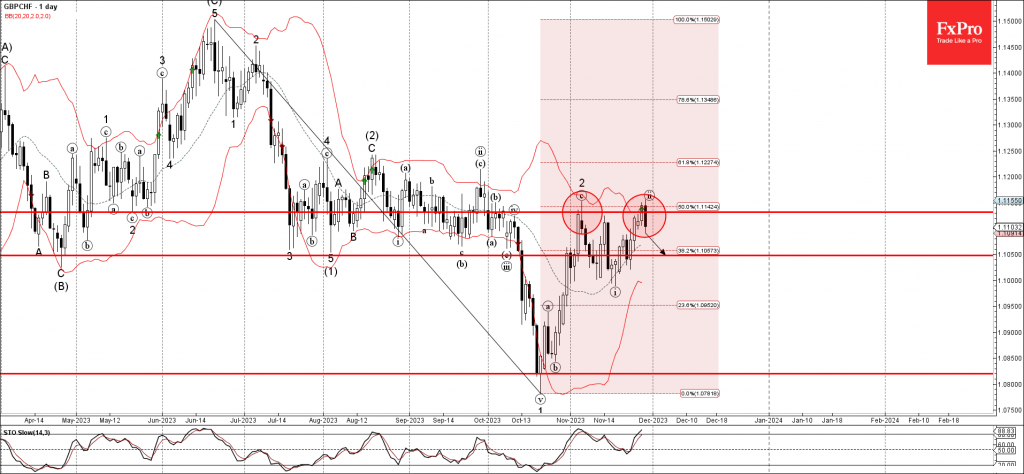
GBPCHF Wave Analysis
- GBPCHF reversed from resistance level 1.1130
- Likely to fall to support level 1.1050
GBPCHF currency pair recently reversed down from the pivotal resistance level 1.1130, which stopped the previous minor correction 2 at the start of this month, as can be seen below.
The resistance level 1.1130 was strengthened by the upper daily Bollinger Band and by the 50% Fibonacci correction of the previous downtrend from June.
Given the overbought daily Stochastic, strong downtrend and the widespread Swiss franc inflows, GBPCHF currency pair can be expected to fall further to the next support level 1.1050.
AUDJPY Wave Analysis
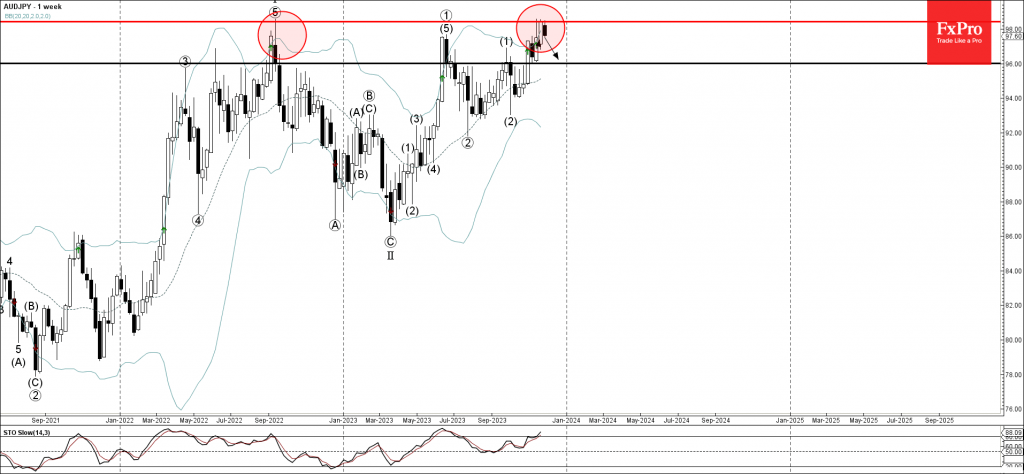
- AUDJPY reversed from resistance level 98.40
- Likely to fall to support level 96.00
AUDJPY currency pair recently reversed down from the long-term resistance level 98.40, which stopped the sharp weekly uptrend in the middle of 2022, as can be seen below.
The resistance level 98.40 was further strengthened by the upper weekly Bollinger Band.
Given the strength of the resistance level 98.40 and the overbought weekly Stochastic, AUDJPY currency pair can be expected to fall further to the next support level 96.00.
Sunset Market Commentary
Markets:
The chase is sometimes better than the catch. Lemmy knew. Scooter knew. And now we know. Since the start of the week, investors have been chasing down bond yields. In Europe, anticipation on lower inflation numbers offer part of the explanation. ECB Lagarde switching focus from policy rates to halting PEPP reinvestments ahead of the current shelf date (end 2024 at the earliest) strengthened the markets’ early rate cut bias as well. Today’s Spanish and German EU harmonized November CPI numbers showed steep monthly drops of respectively -0.6% and -0.7%. A retreat in energy prices and tourism (Spain) & holiday packages (Germany) are the main culprit. The Y/Y-figures slowed from 3.5% to 3.2% in Spain and from 3% to 2.3% in Germany. National data for France and Italy and the EMU aggregate number are due tomorrow. After “catching” the data releases, investors held back from pushing EMU bond yields even lower. Negative daily European changes are solely due to a lower opening, catching up with WS action yesterday. German yields trade 4.1 bps (30-yr) to 6.6 bps (2-yr) below Tuesday’s close. Apart from the anticipation effect, we can’t stress enough that statistical base effects will from next month onwards push headline inflation back higher to more sticky levels around 3%-4%. The OECD in its latest economic outlook also said that it expects the ECB and the BoE to hold policy rates at their current peak until 2025 because of persistent inflationary pressures. That’s in stark contrast of current market pricing (start cutting cycle in Q2 2024).
US Treasuries initially extended their rally on yesterday’s “strategic” comments by influential Fed governor Waller. In one of the final interviews ahead the silence period, he showed readiness to start cutting policy rates if the US disinflationary process runs for “another 3, 4, 5, months…”. US Treasuries couldn’t ask for more in the current climate where investors react in an asymmetric matter. Magnifying every argument in favour of a fast central bank pivot and turning a blind eye to everything that argues in favour of higher for longer. Whether you like it our not, it’s the market current going into December Fed & ECB meetings which could serve as eye openers. Recall that the Fed as recently as September put forward a >5% policy rate for end 2024. Growth outperformed expectations while the US disinflation process ran according to prognosis. Financial conditions are back at square one after tightening significantly in October. US Q3 GDP was upwardly revised (5.2% Q/Qa from 4.9%) because of stronger business investment and government spending but didn’t alter intraday dynamics. US yield lose 5.5 bps (30-yr) to 10.2 bps (2-yr). In FX space, declining EMU inflation prevented a clear break through EUR/USD 1.10 for now (1.0980).
News & Views:
Q3 Swedish GDP growth was negative for the second consecutive quarter. Activity declined by -0.3% after a -0.8% contraction in the Q2 and is 1.4% below the level of the same quarter last year. The contraction was mainly the result of a decrease in inventories and reduced household consumption (-0.3% Q/Q). Household consumption was negative for the fifth consecutive quarter. The downturn partly offset by a positive contribution of net exports (1.5% ppt) as imports declined 1.5% while at the same time exports rose 1.5%. General government consumption was unchanged. Gross fixed capital formation dropped by 0.6 percent. Last week, the Swedish Riksbank (RB) left its policy rate unchanged at 4% even as inflation (CPIF 4.1% % and CPIF excluding energy 6.1%) remains well above the 2%. Target. The RB expects negative growth for both this year (-0.7%) and next (-0.2%). Despite a soft RB policy approach, the Swedish krone strengthened beyond EUR/SEK 11.40 support due to lower core yields globally.
Belgian inflation increased by 0.17% M/M, raising the Y/Y figure from 0.36% to 0.72%. Core inflation still stands at 5.95% Y/Y in November even as it declined from 6.55% Y/Y in October. Energy prices are the major driver behind the low headline inflation, declining 32.9% Y/Y in November. Food price inflation remains high at 8.22% Y/Y. In a monthly perspective, the most significant price increases in November concerned alcoholic beverages (9.8%), natural gas (10.8%), non-alcoholic beverages (3.2%), travels abroad and city trips (2.8), vegetables (2.3%), electricity (1.7%) and fruit (2.2%). Motor fuels (-4.5%), hotel rooms (-7.3%), the purchase of vehicles (-0.7%) , domestic heating oil (-2.8) and dairy products (-1.5%) had a downward effect. The first inflation estimate according to the European harmonized index of consumer prices (HICP flash estimate) for Belgium was -0.7% Y/Y in November 2023.
EUR/USD Dips as German Inflation Declines
- German inflation falls to 3.2%, eurozone inflation next
- US second-estimate GDP improves to 5.2%
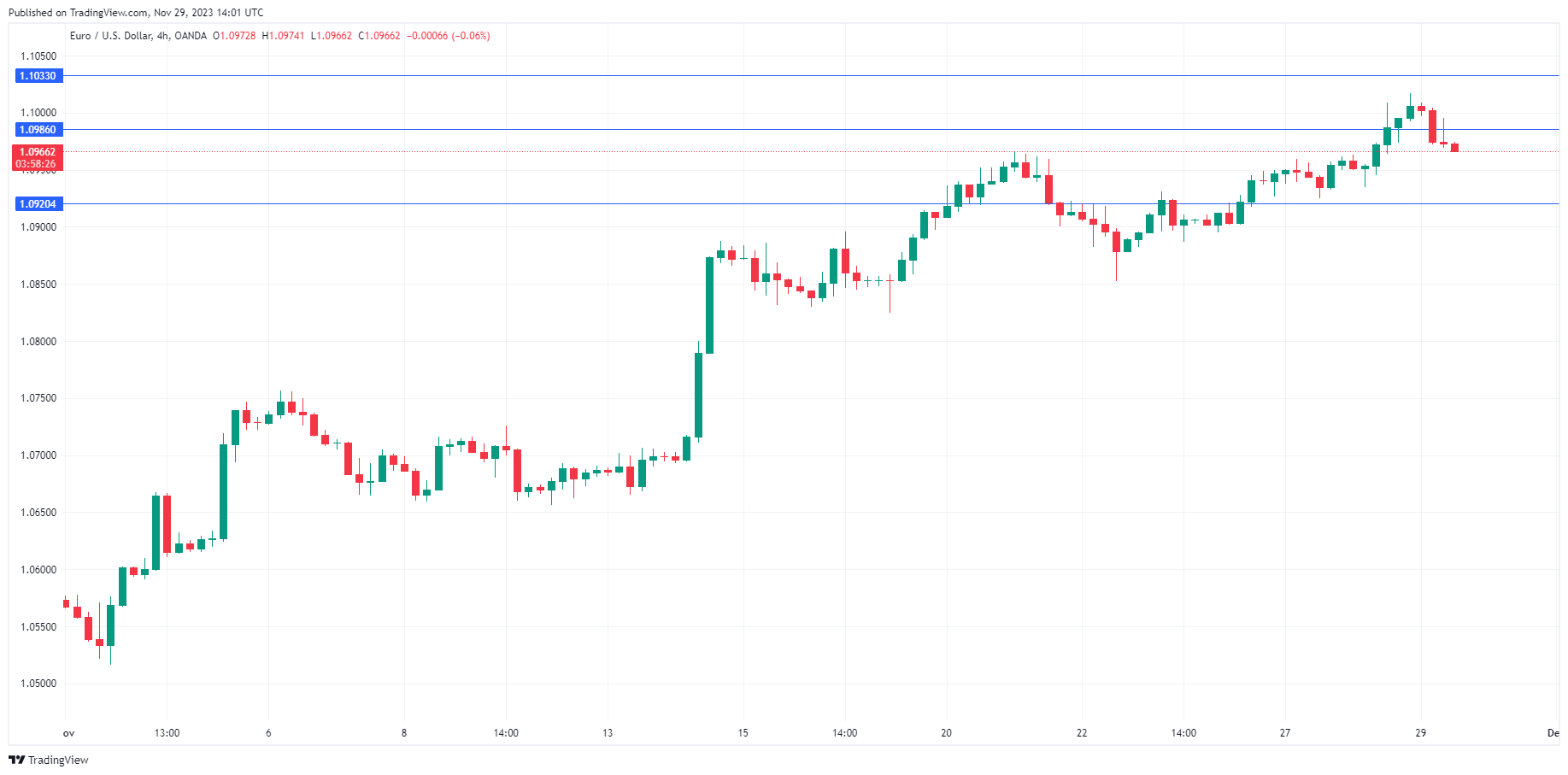
The euro is showing limited movement on Wednesday. In the North American session, EUR/USD is trading at 1.0984, down 0.11%.
German inflation falls to 3.2%
Gerrmany’s inflation rate dropped more than expected, coming in at 3.2% y/y in November. This was down considerably from 3.8% in October and below the market consensus of 3.5%. This was the lowest inflation rate since June 2021 and was driven by lower food and energy inflation. Services inflation eased to 3.4%, down from 3.9%. Core inflation dropped to 3.8%, down from 4.3% in October.
There’s a lot to like in this inflation print and ECB policy makers will no doubt be pleased as German inflation continues to fall. The next text is on Thursday, with the release of eurozone inflation for November. Headline inflation is expected to fall to 2.7%, down from 2.9%, and the core is expected to ease to 3.9%, down from 4.2%.
The ECB has signalled a ‘higher for longer policy’, as have the Federal Reserve and other major central banks. Even though inflation has been dropping, it remains higher than the ECB’s 2% target, and the central bank hasn’t given any indications of a rate cut. The markets are more dovish and have priced in a rate cut as early as May. If eurozone CPI follows the German release and declines more than expected, we could see the odds of a rate cut brought forward ahead of May.
The US economy provided another reminder today that the economy is in strong shape. US GDP (second estimate) climbed an impressive 5.2% y/y in the third quarter, the strongest quarter since Q4 2021. The release beat the market consensus of 5.0% and was higher than the preliminary estimate of 4.9%. The economy showed marked improvement compared to the second quarter, which had growth of just 2.1%.
EUR/USD Technical
- EUR/USD is testing support at 1.0986. Below, there is support at 1.0920
- 1.1033 and 1.1099 are providing support
Australian Dollar Falls as Inflation Cools
- Australian CPI falls more than expected
- AUD/USD down after four-day winning streak
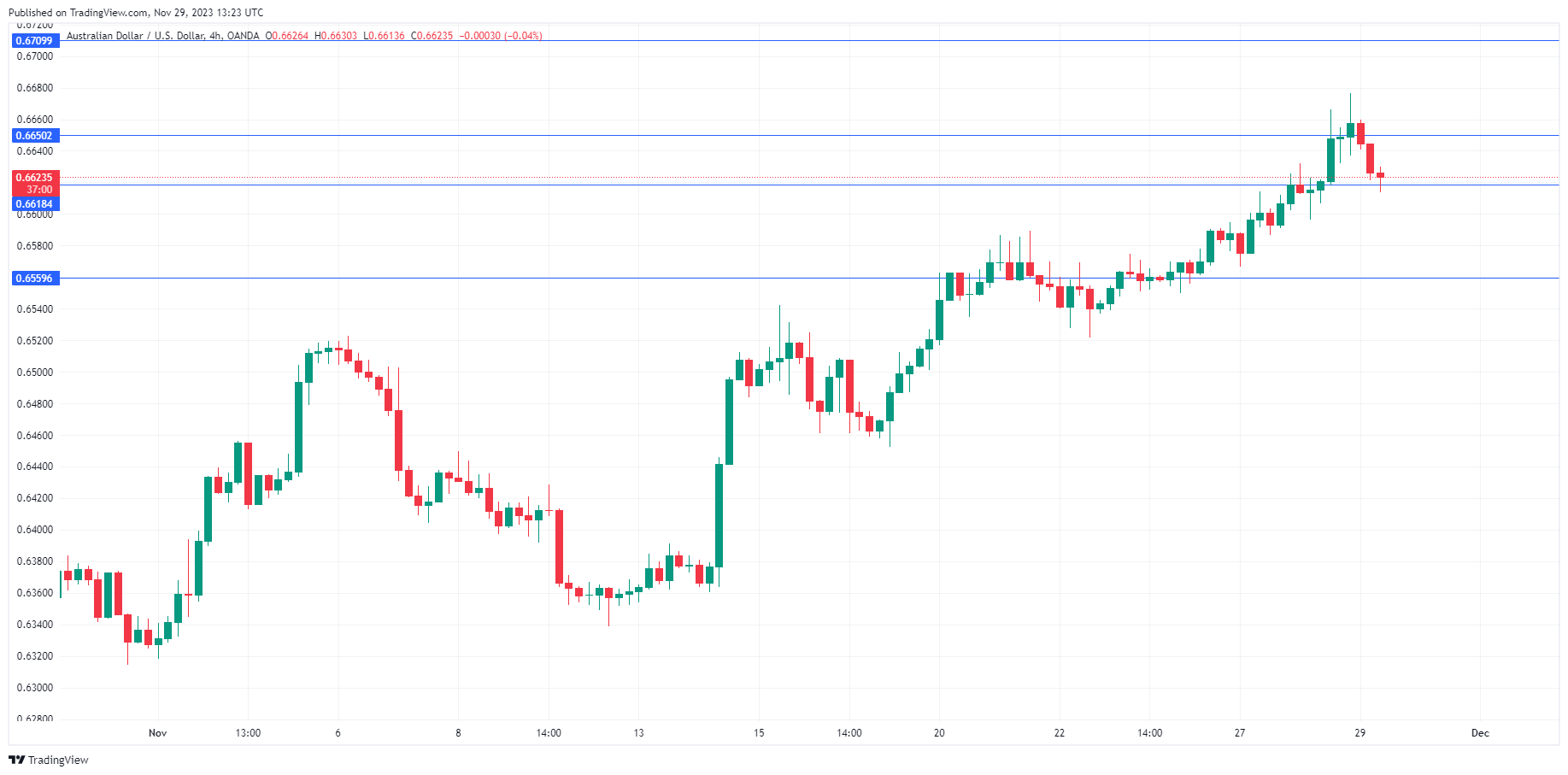
The Australian dollar is in negative territory on Wednesday, after four straight winning sessions. In the North American session, AUD/USD is trading at 0.6623, down 0.39%.
Australia’s inflation rate surprises on the downside
Australia’s inflation rate rose 4.9% y/y in October, down from September’s 5.6%, which was a five-month high. This beat the consensus estimate of 5.2% and marked the first decline in inflation since July. Trimmed mean inflation, a key core inflation gauge, ticked lower to 5.4%, down from 5.3% in September.
The drop in inflation is an encouraging sign for the Reserve Bank of Australia, which has tightened rates in order to curb inflation and bring it back down to the target range of 2%-3%. The RBA has said that inflation has peaked, but that doesn’t necessarily mean that interest rates have peaked as well. Future rate policy will largely depend on the data, and inflation will be a key factor. If inflation continues to fall at a relatively fast pace in the coming months, it’s likely that the tightening cycle is over. If that is not the case, then one final quarter-point hike remains a possibility, perhaps as early as February.
Today’s inflation print led to a repricing of the rate odds for the December meeting. The probability of a quarter-point hike has fallen from 10% on Tuesday to 2% today, according to the ASX RBA rate tracker. It’s a virtual lock that the RBA won’t raise rates next month and the inflation print has raised expectations of rate cuts in 2024.
Australia’s retail sales surprised on the downside with a 0.2% decline in October. This was another sign that elevated rates are filtering through the economy and dampening economic growth.
Fed members presented a mixed picture on Tuesday. Fed Governor Christopher Waller said that he was “increasingly confident” that rates had peaked and that the Fed could trim rates in the coming months if inflation continued on its downswing. Fed Governor Michelle Bowman expressed the opposite position, saying that further hikes will likely be needed in order to bring inflation back down to the 2% target.
AUD/USD Technical
- AUD/USD tested support at 0.6618 earlier. Below, there is support at 0.6559
- 0.6650 and 0.6709 are the next resistance line
US Q3 GDP Revised Higher, While Corporate Profits Sharply Accelerate
The Bureau of Economic Analysis' second estimate of Q3-2023 real GDP was revised 0.3 percentage points (pp) higher to 5.2% quarter-over-quarter (q/q, annualized).
Consumer spending advanced by 3.6% – a modest downward revision from the 4.0% gain reported in the advance estimate. Healthy gains in spending were seen across both goods (+4.7%) and services (+3.0%).
Business fixed investment expanded by 1.3% – an upgrade from the near flat reading previously reported – with the revision largely concentrated in non-residential structures (+6.9% from 1.6%). Meanwhile, equipment spending fell by 3.5%, while intellectual property products expanded by 2.8%.
Residential investment rose by 6.2%, snapping what had been nine consecutive quarters of declines.
Government spending expanded by a robust 5.5% (up from the previously reported 4.6% gain) and added nearly a full percentage point to third quarter growth. Gains were seen across both federal (+7.0%) and state & local (+4.6%) spending.
Inventory investment added a meaningful 1.4 pp to GDP, while net trade had no overall impact as a strong gain in exports (+6.0%) was completely offset by a slightly smaller rise in imports (+5.2%).
Real Gross Domestic Income rose by 1.5% in the third quarter, an acceleration from the downwardly revised gain of 0.5% (previously 0.7%) in Q2. Corporate profits were meaningfully higher, rising by 14.0% (annualized) or $105.6 billion after accounting for inventory valuation and capital consumption adjustments. Personal income rose by a healthy 3.9%, largely unchanged from Q2's gain.
- Measured as a share of nominal GDP, corporate profits inched higher by 0.2 pp to 11.9% and remain slightly above the 2018-2019 average of 11.5%.
Key Implications
At the beginning of 2023, most forecasters expected the U.S. economy to be contracting or at least slowing through the second half of this year. Instead, Q3 growth expanded at a pace that was more than double the previous quarters' rate of growth, and well above what most believe to be the economy's underlying potential growth rate of 1.8%.
While we expect growth to downshift in the fourth quarter, our current tracking still has the U.S. economy expanding by 1.8% to round out the year. The Atlanta Fed's GDPNow tracking is even stronger at 2.1%. These numbers are inconsistent with returning price stability and could require a further tightening in the policy rate unless we see a more decisive slowing in economic activity through early-2024.
Dollar Finds Its Footing, Euro Faces Headwinds, Aussie at a Critical Point
Dollar is stabilizing after earlier selloff but remains the weakest performer for the week. Its modest recovery can be partly attributed to a bounce back against Euro, which is currently under pressure due to Germany's lower-than-expected CPI readings. Meanwhile, Australian Dollar is experiencing a delayed reaction to Australia's lower-than-expected monthly CPI readings too. As a result, both Aussie and Euro are the worst performers for the day.
On the other hand, the New Zealand Dollar continues to soar, bolstered by RBNZ's (RBNZ) hawkish holds. Swiss Franc is also showing strength, particularly in its recovery against Euro. Sterling and Canadian Dollar, meanwhile, display mixed performances amidst these currency movements.
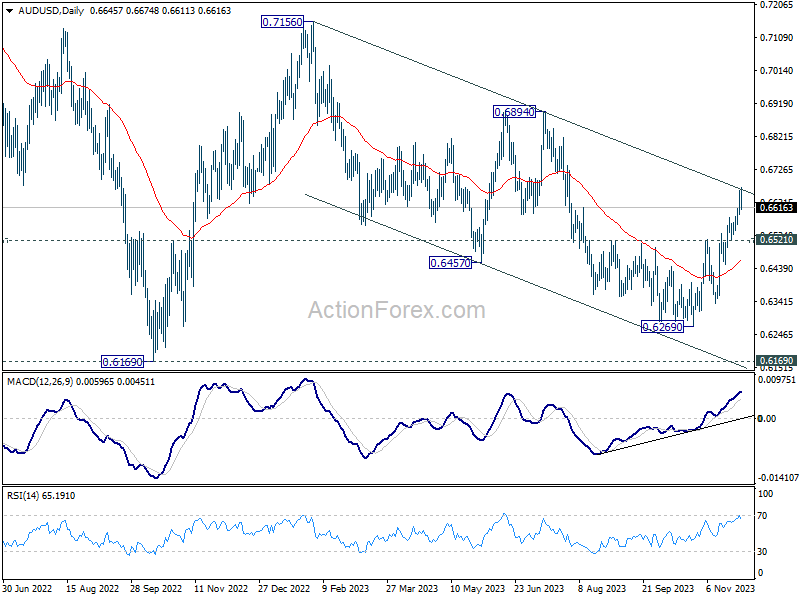
From a technical analysis perspective, AUD/USD is now at a critical juncture, pressing medium term falling channel resistance. Decisive break there will solidify the case that whole fall from 0.7156 has completed with waves down to 0.6269. Further rally should then be seen to 0.6894 resistance.
On the other hand, rejection by the channel resistance at this stage will bring consolidations first. However, break of 0.6521 support will revive medium term bearishness for deeper fall. The upcoming China PMI data, expected tomorrow, could be a significant catalyst for the next move in this currency pair.
In Europe, at the time of writing, FTSE is up 0.02%. DAX is up 1.14%. CAC is up 0.55%. Germany 10-year yield is down -0.040 at 2.456. Earlier in Asia, Nikkei fell -0.26%. Hong Kong HSI fell -2.08%. China Shanghai SSE fell -0.56%. Singapore Strait Times rose 0.61%. Japan 10-year JGB yield fell -0.074 to 0.681.
US goods trade deficit widens to USD -89.8B in Oct
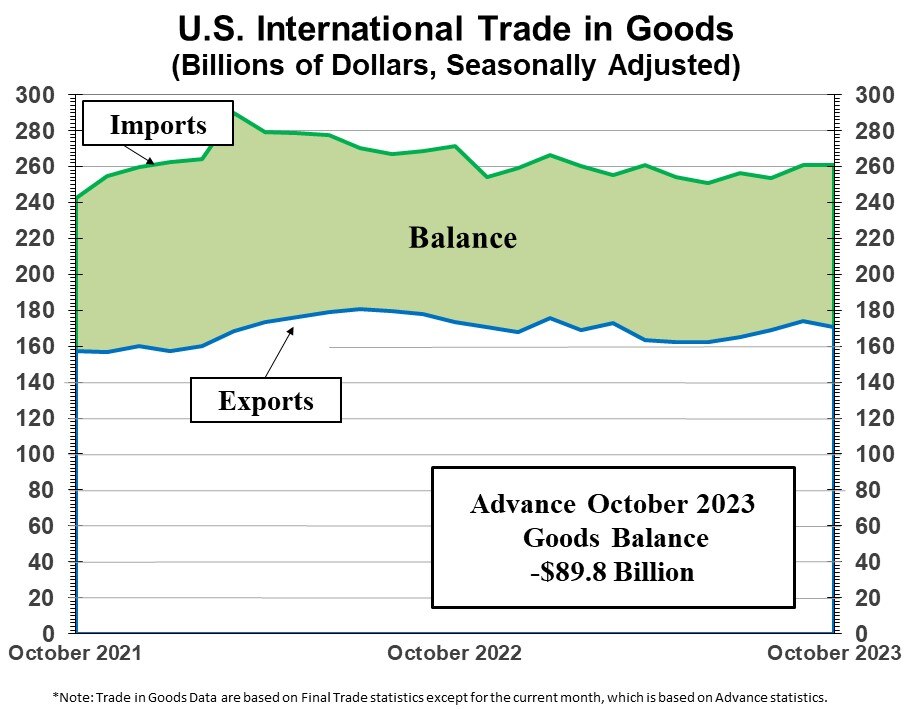
US goods exports fell -1.7% mom to USD 170.8B in October. Goods imports was flat 0.0% mom at 260.7B. Goods trade deficit widened from USD -86.8B to USD -89.8B, larger than expectation of USD -86.7B.
Wholesale inventories fell -0.2% mom to USD 899.4B. Retail inventories was virtually unchanged at USD 796.6B.
Eurozone economic sentiment rose to 93.8, EU rose to 93.7
Eurozone Economic Sentiment Indicator ticked up from 93.5 to 93.8 in November. Employment Expectations Indication fell from 102.8 to 102.1 Economic Uncertainty Indicator fell from 22.7 to 22.4.
Eurozone industry confidence fell from -9.2 to -9.5. Services confidence rose from 4.6 to 4.9. Consumer confidence rose from -17.8 to -16.9. Retail trade confidence rose from -7.4 to -7.0. Construction confidence rose from -5.5 to -4.8.
EU Economic Sentiment Indicator rose from 93.2 to 93.7. Employment Expectations Indicator fell from 102.3 to 101.8. Economic Uncertainty Indicator fell from 22.2 to 21.8.
Amongst the largest EU economies, the ESI improved in the Netherlands (+2.9), France (+2.0) and Poland (+1.7), while it eased in Spain (-1.5) and, to a lesser extent, in Germany (-0.5) and Italy (-0.3).
BoE's Bailey dismisses rate cut speculations again
BoE Governor Andrew Bailey, in an interview, emphasized, "Two percent is our (inflation) target and we will do what it takes to get there."
Bailey also addressed the speculation around interest rate cuts, categorically stating, "We are not in a place now where we can discuss cutting interest rates – that is not happening."
He noted, "We need to see how the final part of the journey down to 2% inflation plays out; we have not seen enough of that journey yet to be confident."
He acknowledged the ongoing economic challenges, including some weakening in economic activity. However, he described this observation as a "realist view" rather than an "ultra-pessimist" outlook, as some critics have suggested.
RBNZ raises rate track, signaling additional rate hike
RBNZ decided to keep the Official Cash Rate steady at 5.50%, aligning with market expectations. However, a significant aspect of their announcement is the upward revision of their "rate track."
According to the bank's forecasts in the Monetary Policy Statement, OCR is expected to peak at 5.70% in Q2 of 2024 and maintain this level throughout the year. Looking ahead, RBNZ anticipates a rate cut in Q2 of 2025, bringing it down to 5.4%.
In the accompanying statement, RBNZ noted, "ongoing excess demand and inflationary pressures are of concern, given the elevated level of core inflation."
RBNZ also emphasized its readiness to hike again. "If inflationary pressures were to be stronger than anticipated, the OCR would likely need to increase further."
Moreover, RBNZ underlined the necessity of maintaining interest rates at a restrictive level for a sustained period, aiming at ensuring consumer price inflation returns to target level and to support maximum sustainable employment.
Australia's monthly CPI slowed to 4.9% in Oct, below exp 5.2%
Australia monthly CPI slowed from 5.6% you to 4.9% yoy in October, below expectation of 5.20%. Excluding volatile items and holiday travel, CPI slowed from 5.5% yoy to 5.1% yoy. Annual trimmed mean CPI also slowed from 5.4% yoy to 5.3% yoy.
The most significant contributors to the October annual increase were Housing (+6.1%), Food and non-alcoholic beverages (+5.3 per cent) and Transport (+5.9%).
BoJ's Adachi: Not at a stage to discuss exit from ultra-loose policy
BoJ board member Seiji Adachi acknowledged that while there are early indications of a positive wage-inflation cycle emerging, these are not yet sufficient to consider exiting ultra-loose monetary policy.
He emphasized the importance of continuing with monetary easing approach, stating today, "For now, it's appropriate to patiently continue with our monetary easing."
Adachi specifically pointed out the challenges posed by China's slowing growth and the potential impacts of aggressive US interest rate hikes, noting that these factors make it difficult to predict whether Japanese firms will substantially increase wages next year.
He also addressed the disparity in wage increase capabilities between large and small companies. While some big companies seem prepared to continue raising wages, many smaller firms, particularly in regional areas, are struggling to do so due to challenging business conditions.
He emphasized, "We're not at a stage yet where we can discuss an exit" from ultra-loose policy.
EUR/USD Mid-Day Outlook
Daily Pivots: (S1) 1.0950; (P) 1.0980; (R1) 1.1024; More...
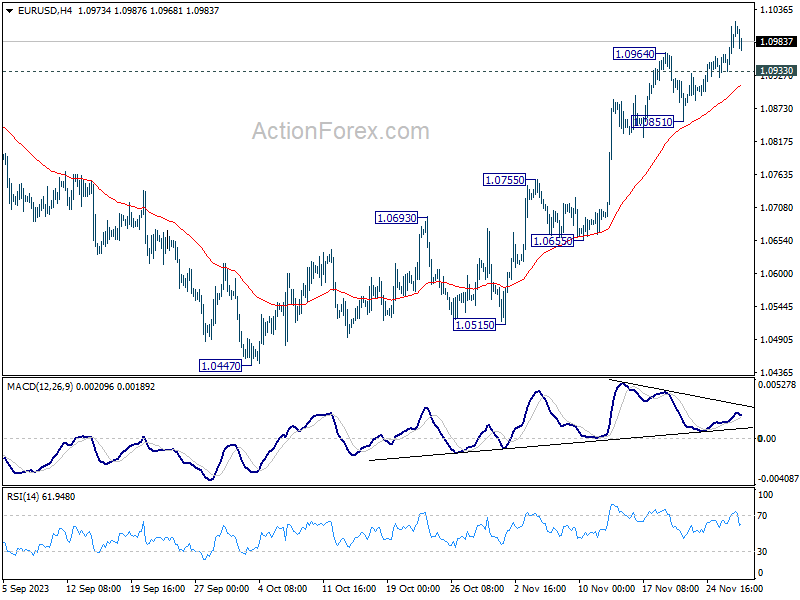
Intraday bias in EUR/USD stays on the upside with 1.0933 minor support intact. Current rise from 1.0447 should target 1.1274 resistance next. But strong resistance should be seen there to limit upside. On the downside, below 1.0933 minor support will turn intraday bias neutral and bring consolidations. But further rally will remain in favor as long as 1.0851 support holds.
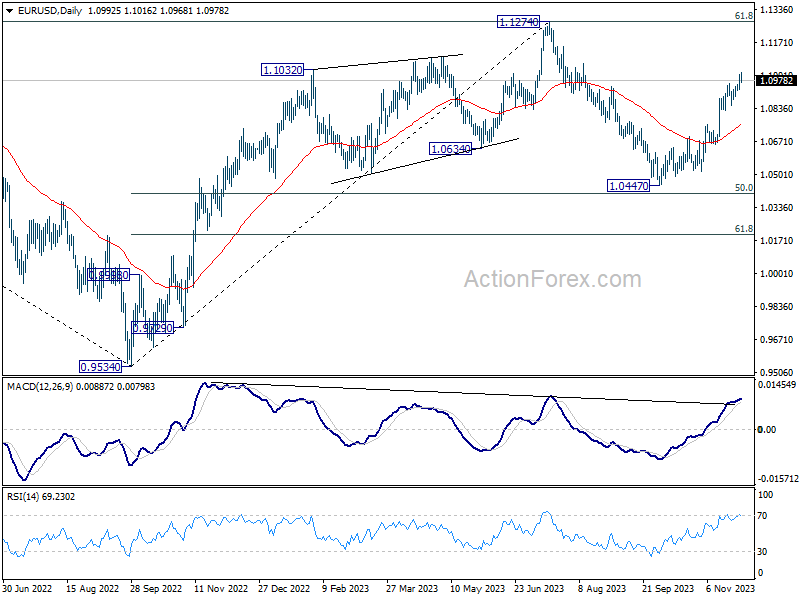
In the bigger picture, price actions from 1.1274 are viewed as a corrective pattern to rise from 0.9534 (2022 low). Rise from 1.0447 is tentatively seen as the second leg. Hence while further rally could be seen, upside should be limited by 1.1274 to bring the third leg of the pattern.
Economic Indicators Update
| GMT | Ccy | Events | Actual | Forecast | Previous | Revised |
|---|---|---|---|---|---|---|
| 00:30 | AUD | Monthly CPI Y/Y Oct | 4.90% | 5.20% | 5.60% | |
| 01:00 | NZD | RBNZ Rate Decision | 5.50% | 5.50% | 5.50% | |
| 07:00 | EUR | Germany Import Price M/M Oct | 0.30% | 0.10% | 1.60% | |
| 09:00 | CHF | Credit Suisse Economic Expectations Nov | -29.6 | -37.8 | ||
| 09:30 | GBP | M4 Money Supply M/M Oct | 0.30% | -0.20% | -1.10% | |
| 09:30 | GBP | Mortgage Approvals Oct | 47K | 44K | 43K | 44K |
| 10:00 | EUR | Eurozone Economic Sentiment Indicator Nov | 93.8 | 93.7 | 93.3 | 93.5 |
| 10:00 | EUR | Eurozone Industrial Confidence Nov | -9.5 | -8.9 | -9.3 | -9.2 |
| 10:00 | EUR | Eurozone Services Sentiment Nov | 4.9 | 4.3 | 4.5 | 4.6 |
| 10:00 | EUR | Consumer Confidence Nov F | -16.9 | -16.9 | -16.9 | |
| 13:00 | EUR | Germany CPI M/M Nov P | -0.40% | -0.10% | 0% | |
| 13:00 | EUR | Germany CPI Y/Y Nov P | 3.20% | 3.50% | 3.80% | |
| 13:30 | CAD | Current Account (CAD) Q3 | -3.2B | 0.7B | -6.6B | |
| 13:30 | USD | GDP Annualized Q3 P | 5.20% | 5.00% | 4.90% | |
| 13:30 | USD | GDP Price Index Q3 P | 3.60% | 3.50% | 3.50% | |
| 13:30 | USD | Goods Trade Balance (USD) Oct P | -89.8B | -86.7B | -86.8B | |
| 13:30 | USD | Wholesale Inventories Oct P | -0.20% | 0.10% | 0.20% | |
| 15:30 | USD | Crude Oil Inventories | -0.1M | 8.7M | ||
| 19:00 | USD | Fed's Beige Book |
US goods trade deficit widens to USD -89.8B in Oct
US goods exports fell -1.7% mom to USD 170.8B in October. Goods imports was flat 0.0% mom at 260.7B. Goods trade deficit widened from USD -86.8B to USD -89.8B, larger than expectation of USD -86.7B.
Wholesale inventories fell -0.2% mom to USD 899.4B. Retail inventories was virtually unchanged at USD 796.6B.
EUR/USD Mid-Day Outlook
Daily Pivots: (S1) 1.0950; (P) 1.0980; (R1) 1.1024; More...
Intraday bias in EUR/USD stays on the upside with 1.0933 minor support intact. Current rise from 1.0447 should target 1.1274 resistance next. But strong resistance should be seen there to limit upside. On the downside, below 1.0933 minor support will turn intraday bias neutral and bring consolidations. But further rally will remain in favor as long as 1.0851 support holds.
In the bigger picture, price actions from 1.1274 are viewed as a corrective pattern to rise from 0.9534 (2022 low). Rise from 1.0447 is tentatively seen as the second leg. Hence while further rally could be seen, upside should be limited by 1.1274 to bring the third leg of the pattern.