

Sample Category Title
GBP/USD Daily Outlook
Daily Pivots: (S1) 1.2631; (P) 1.2673; (R1) 1.2739; More...
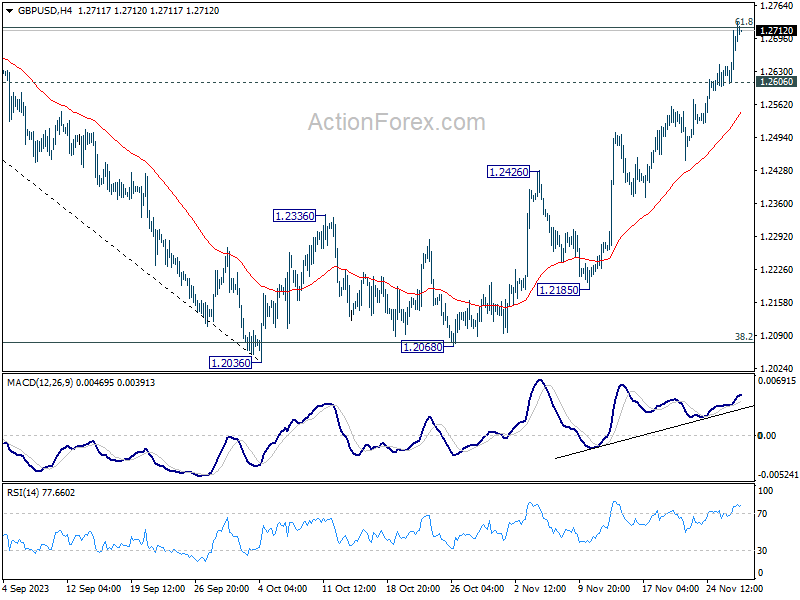
GBP/USD's rally is still in progress and intraday bias stays on the upside. 4H MACD indicates that it's picking up momentum again. Sustained trading above 61.8% retracement of 1.3141 to 1.2036 at 1.2716 will pave the way to retest 1.3141 high. On the downside, below 1.2606 minor support will turn bias neutral and bring consolidations first. But further rally will remain in favor as long as 1.2426 resistance turned support holds.
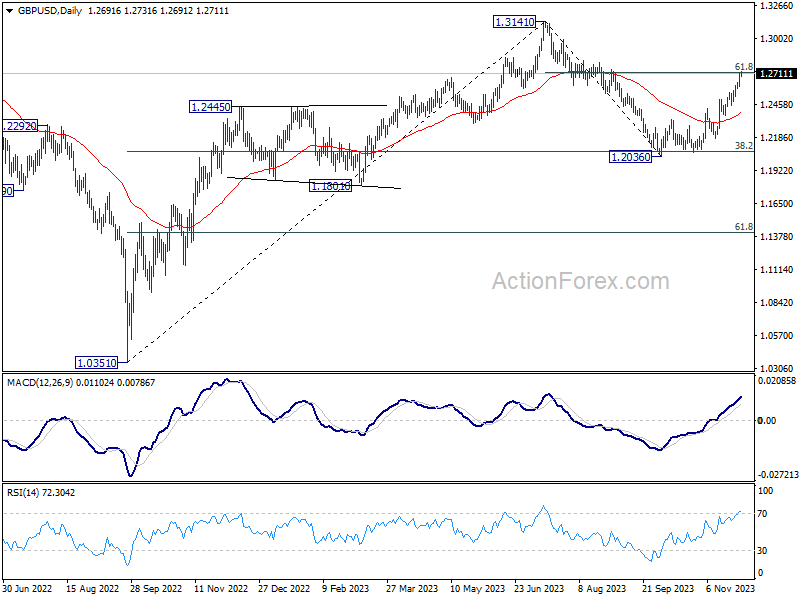
In the bigger picture, price actions from 1.3141 are seen as a corrective pattern to rise from 1.0351 (2022 low). Strong rebound from 38.2% retracement of 1.0351 (2022 low) to 1.3141 at 1.2075 suggests that current rise from 1.2036 is already the second leg. However, while further rally could be seen, upside should be limited by 1.3141 to bring the third leg of the pattern.
USD/CHF Daily Outlook
Daily Pivots: (S1) 0.8756; (P) 0.8787; (R1) 0.8813; More....
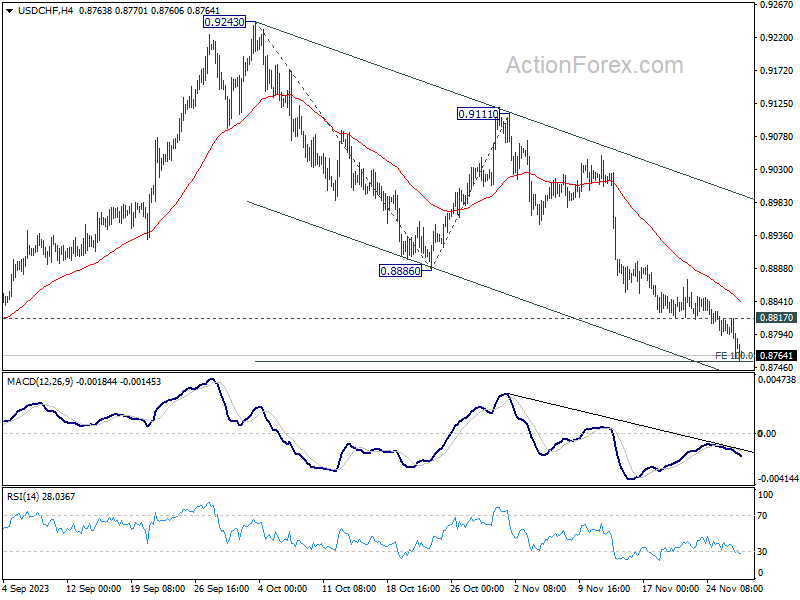
USD/CHF's fall is still in progress and intraday bias remains on the downside. Firm break of 100% projection of 0.9243 to 0.8886 from 0.9111 at 0.8754 will target 161.8% projection at 0.8533, which is close to 0.8551 low. On the upside, above 0.8817 minor resistance will turn intraday bias neutral first. But risk will stay on the downside as long as 0.8886 support turned resistance holds.
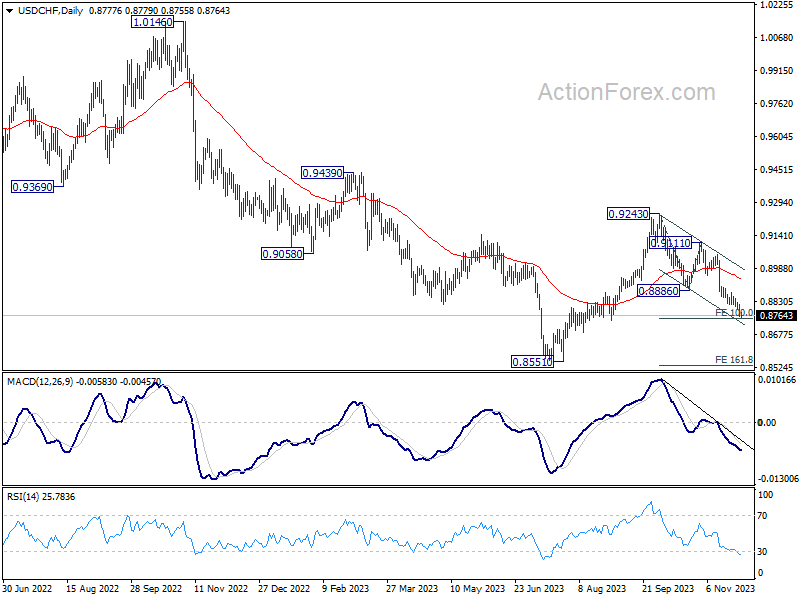
In the bigger picture, price actions from 0.8551 are currently seen as part of a corrective pattern to the decline from 1.0146 (2022 high). Fall from 0.9243 is seen as the second leg for now. Deeper decline could be seen to 0.8551 low but strong support should be seen there to bring rebound. For now, this will remain the favored case as long as 0.8886 resistance holds.
Technical Outlook and Review
DXY:
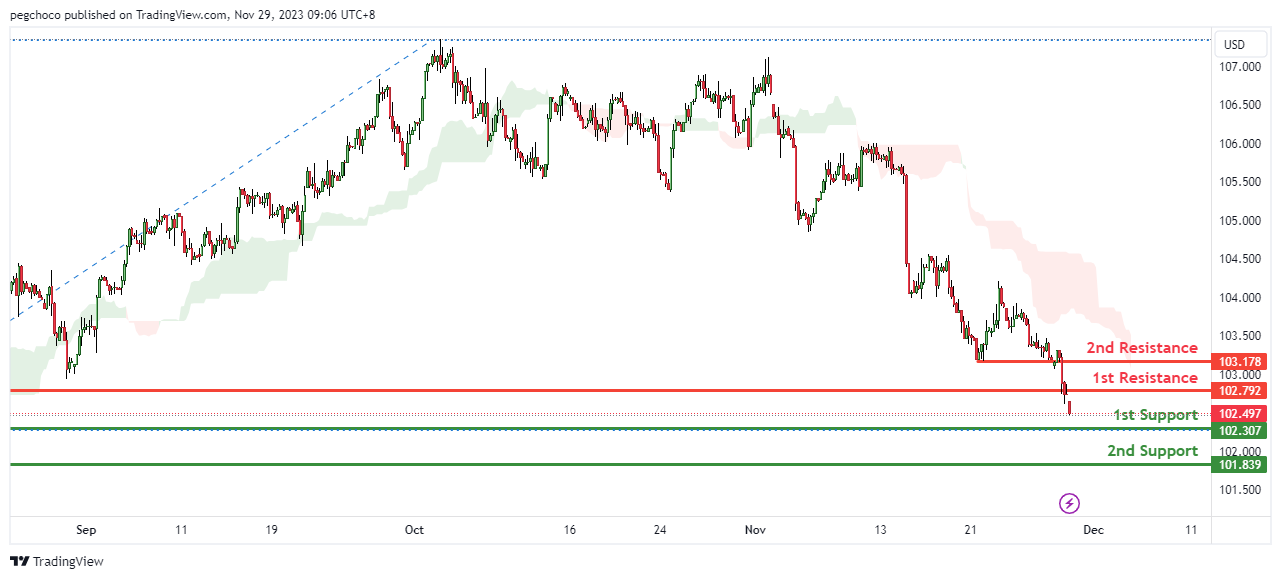
The DXY (US Dollar Index) could potentially make a Bearish continuation towards the 1st support.
The 1st support at 102.30 is identified as a pullback support. This suggests that it’s a significant level where buying interest may emerge, providing support for the DXY.
The 2nd support at 101.83 is another overlap support level. This adds further significance to this support level, indicating it as a potential area where buyers might become active.
On the resistance side, The 1st resistance at 102.79 is categorized as a pullback resistance, implying that it’s a level where selling pressure may increase, acting as a potential barrier to further upward price movement.
The 2nd resistance at 103.17 is also noted as a pullback resistance, adding to the potential resistance factors for the DXY.
EUR/USD:
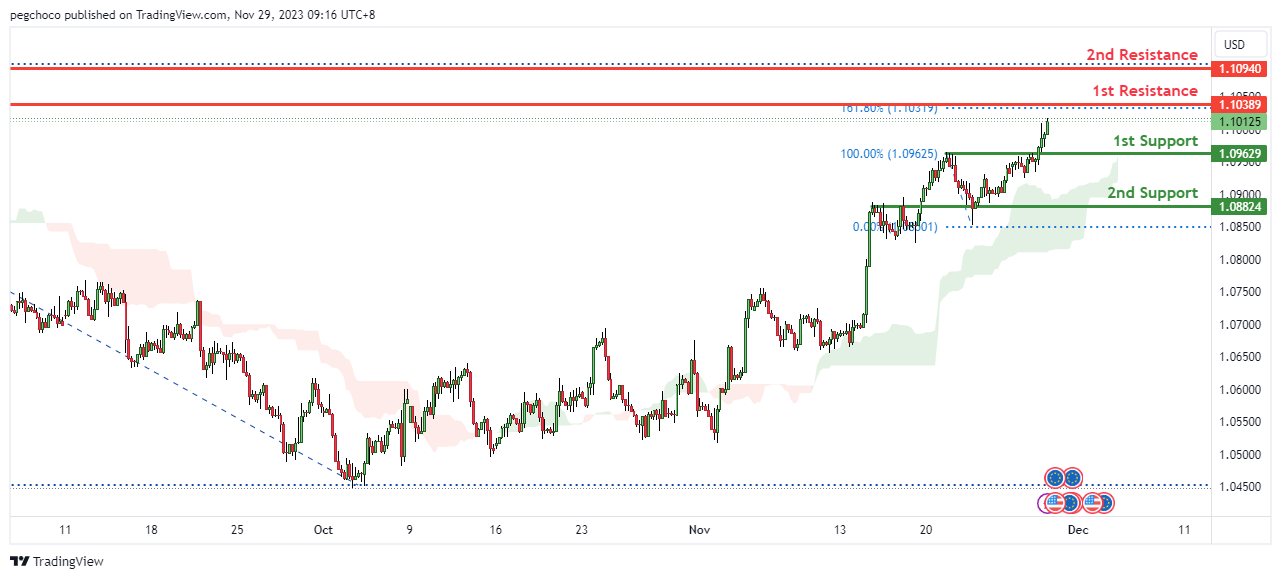
The EUR/USD could potentially make a Bullish continuation towards the 1st resistance.
The 1st support at 1.0962 is identified as a pullback support. This suggests that it’s a significant level where buying interest may emerge, providing support for the EUR/USD currency pair.
The 2nd support at 1.08824 is another overlap support level. This adds further significance to this support level, indicating it as a potential area where buyers might become active.
On the resistance side,
The 1st resistance at 1.1038 is categorized as an overlap resistance and is also associated with the 161.80% Fibonacci Extension level. This dual significance suggests that it’s a significant barrier where selling interest could intensify, potentially halting further upward movement for the EUR/USD.
The 2nd resistance at 1.1094 is noted as a pullback resistance, indicating that it’s a level where selling pressure may increase, acting as another potential obstacle to the currency pair’s upward price movement.
EUR/JPY:
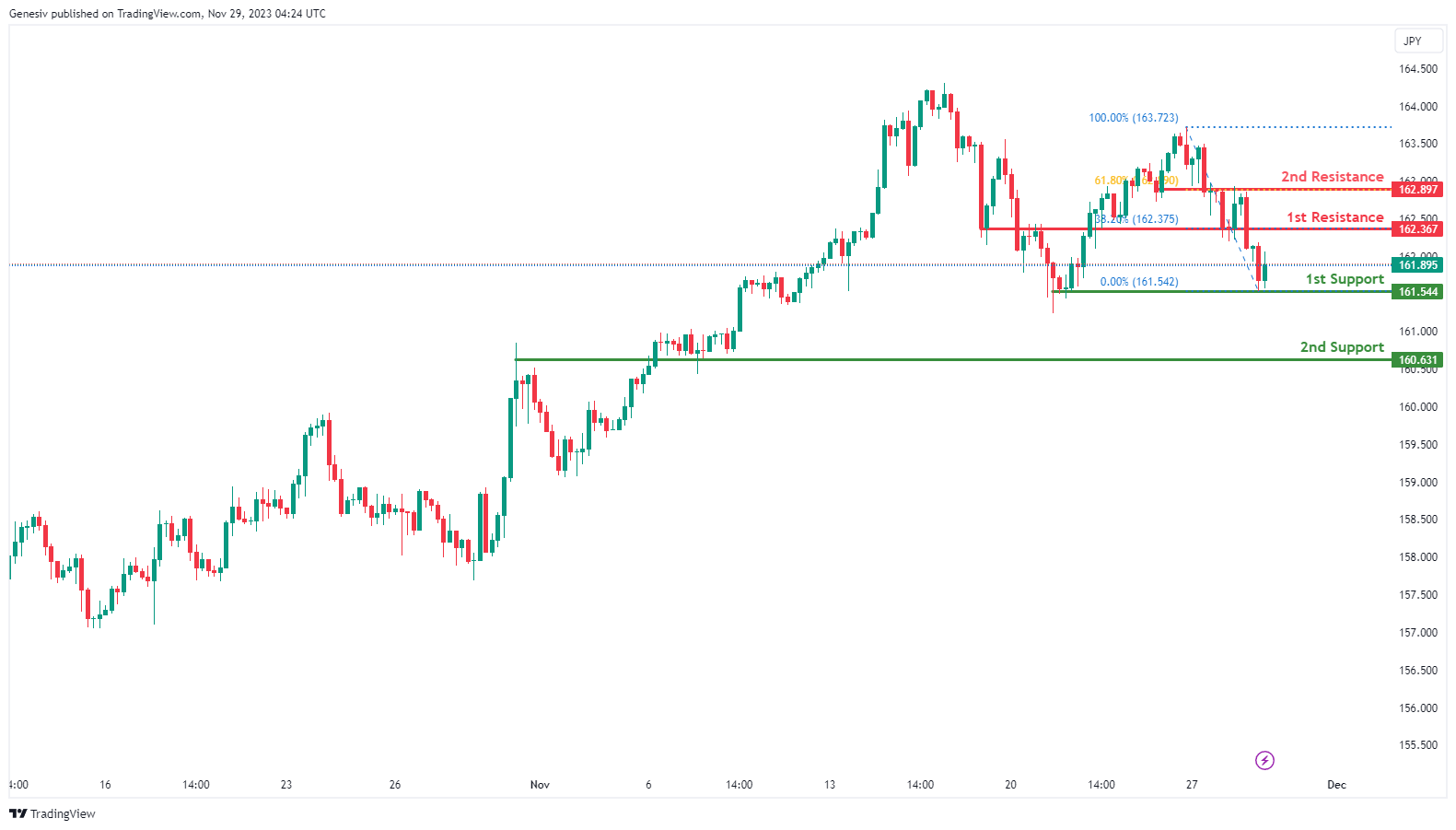
The analyzed instrument is EUR/JPY, and the overall momentum of the chart is currently bullish.
There is a potential for the price to make a bullish continuation towards the 1st resistance.
The 1st support level is identified at 161.54, and its favorable characteristic is attributed to being a multi-swing low support.
The 2nd support level is situated at 160.63, and its favorable aspect is derived from being an overlap support.
On the resistance side, the 1st resistance is positioned at 162.36, and it is considered significant due to being a pullback resistance and coinciding with the 38.20% Fibonacci Retracement.
The 2nd resistance is located at 162.89, and its significance is derived from being an overlap resistance, aligning with the 61.80% Fibonacci Retracement.
EUR/GBP:
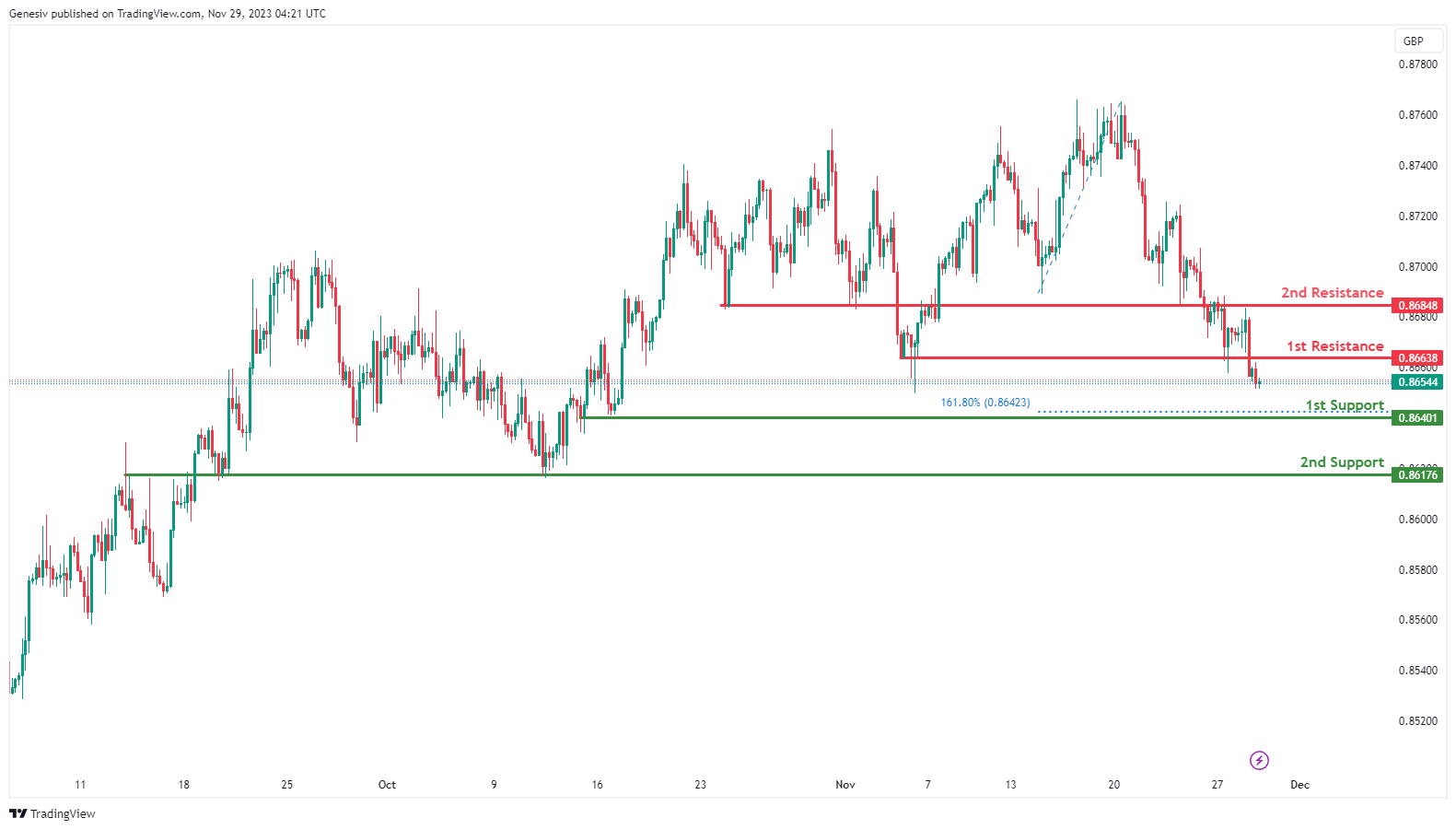
The analyzed instrument is EUR/GBP, and the overall momentum of the chart is currently bearish.
There is a potential for the price to make a bearish continuation towards the 1st support.
The 1st support level is identified at 0.8640, and its favorable characteristics include being a multi-swing low support and coinciding with the 161.80% Fibonacci Extension.
The 2nd support level is situated at 0.8617, and its favorable aspect is derived from being an overlap support.
On the resistance side, the 1st resistance is positioned at 0.8663, and it is considered significant due to being a pullback resistance.
The 2nd resistance is located at 0.8684, and its significance is derived from being an overlap resistance.
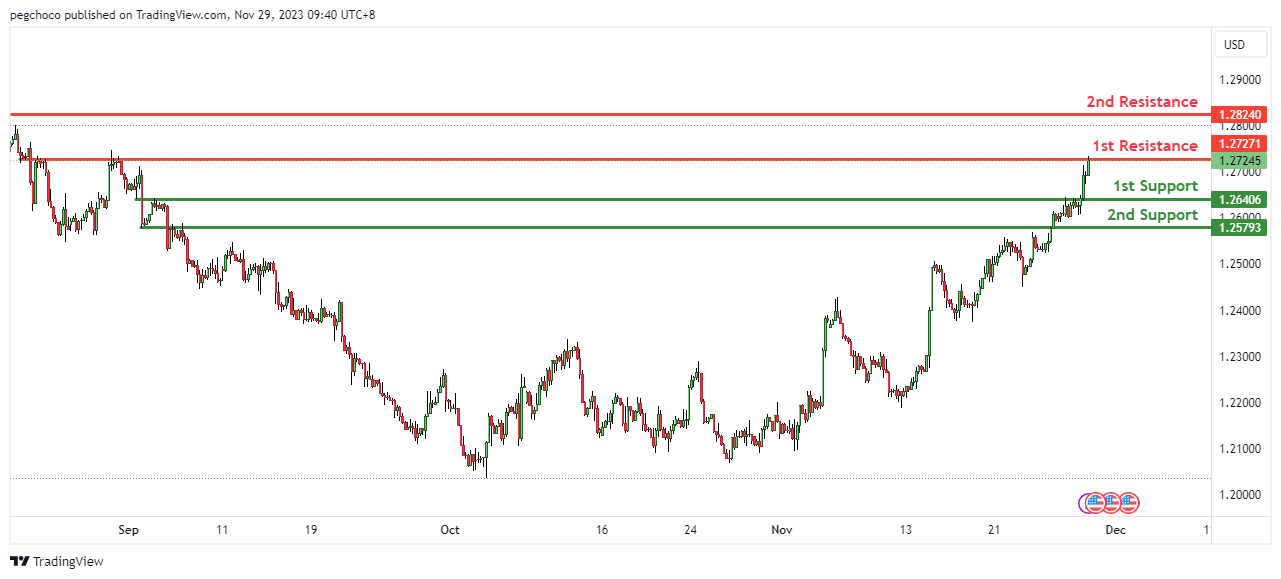
GBP/USD:
The GBP/USD, the overall momentum of the chart is bullish, suggesting a potential upward movement in price. In this scenario, there is a possibility that the price could potentially make a drop further to the 1st support in the short term before bouncing from there and rising to the 1st resistance.
The 1st support at 1.264 is identified as a pullback support. This suggests that it’s a significant level where buying interest may emerge, providing support for the GBP/USD currency pair.
The 2nd support at 1.2579 is another overlap support level. This adds further significance to this support level, indicating it as a potential area where buyers might become active.
On the resistance side,
The 1st resistance at 1.2727 is categorized as an overlap resistance. This suggests that it’s a significant barrier where selling interest could intensify, potentially slowing down the GBP/USD’s upward price movement.
The 2nd resistance at 1.2824 is also noted as an overlap resistance, adding to the potential resistance factors for the currency pair.
GBP/JPY:
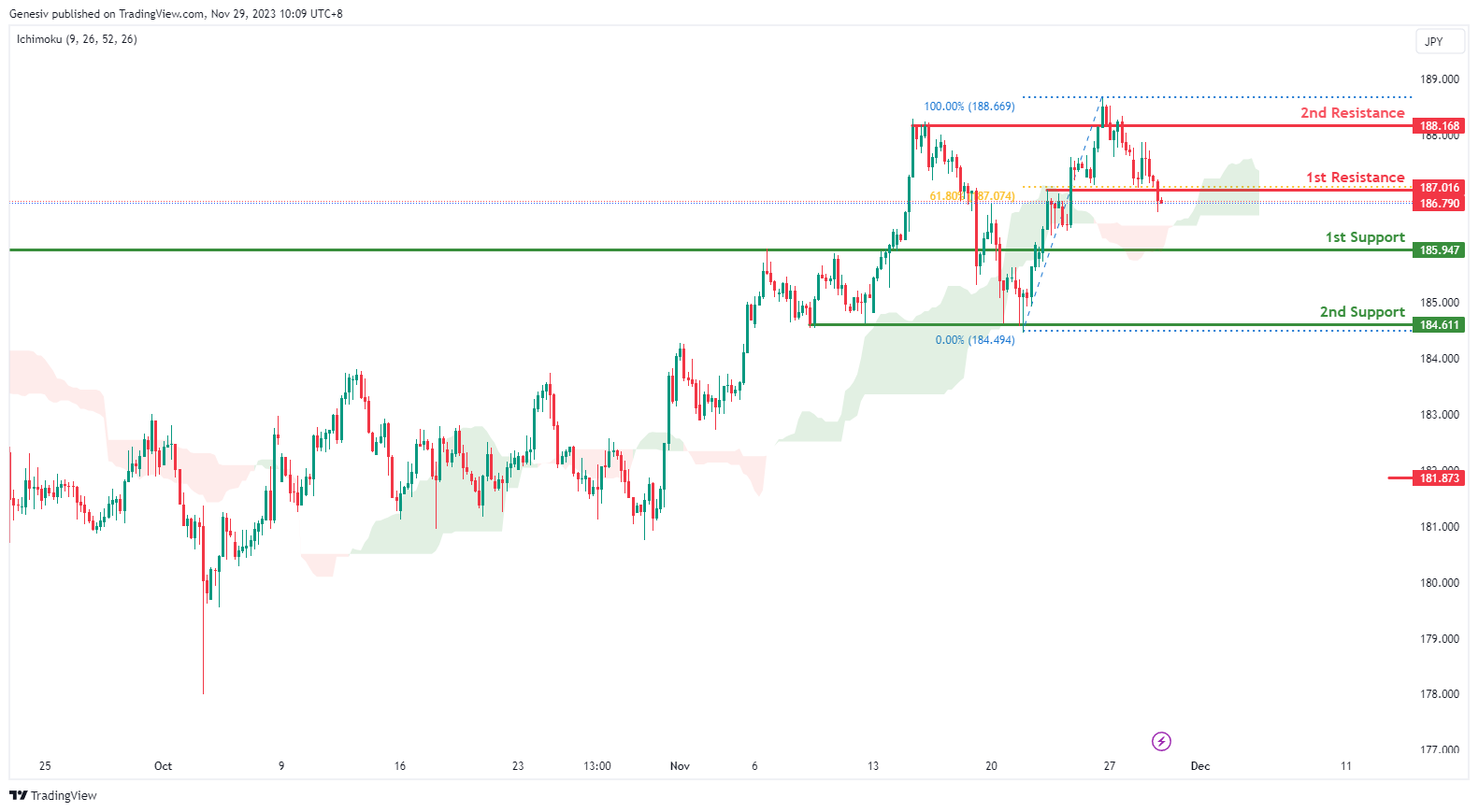
The overall momentum of GBP/JPY is.bearish, indicating a potential continuation of the downward movement in price. There is a possibility that the price could continue its bearish trend towards the 1st support level.
1st support at 185.95: This level is identified as a pullback support, indicating it has the potential to provide a temporary halt to the downward movement as traders may see it as a value area to buy. It’s a level to watch for potential bullish reactions.
2nd support at 184.61: The 2nd support level is another critical area, marked as a multi-swing low support. This suggests that it has previously acted as a significant price level where buyers have shown interest. It’s a stronger support level.
1st resistance at 187.02: The 1st resistance is characterized as a pullback resistance, indicating a point where selling pressure may increase, potentially leading to a reversal or a pause in the downward movement. Additionally, it coincides with the 61.80% Fibonacci retracement level, adding to its significance.
2nd resistance at 188.17: The 2nd resistance is also noted as a pullback resistance, suggesting a level where sellers might be more active in defending their positions.
USD/CHF:
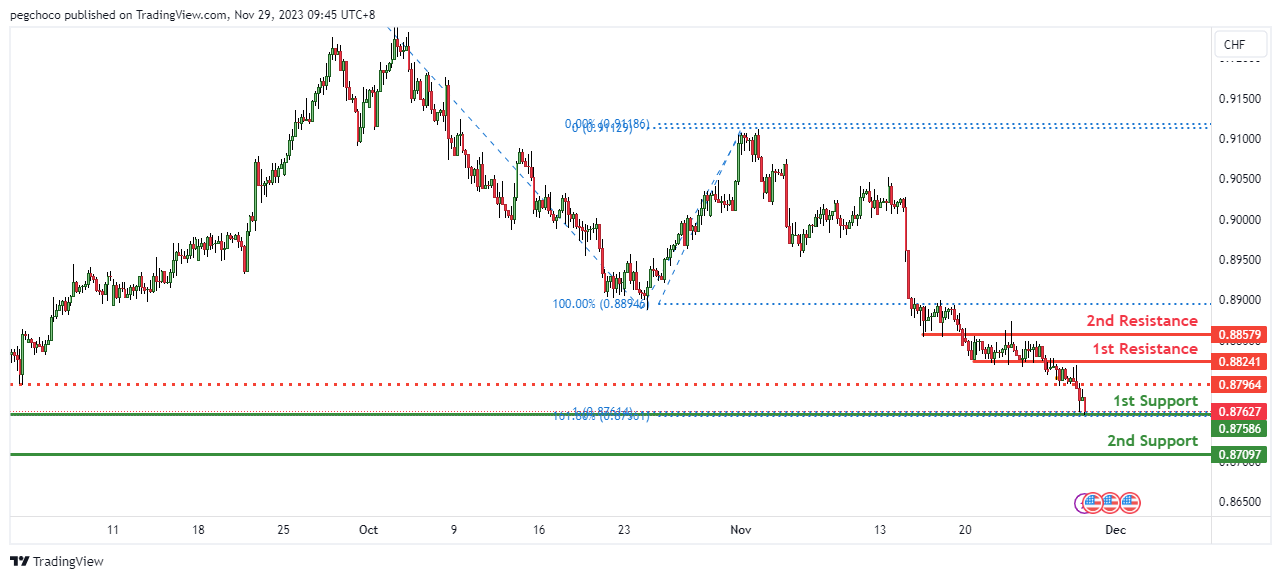
USD/CHF, the overall momentum of the chart is bearish, indicating a downward tren, suggesting a potential downward movement in price. In this scenario, there is a possibility that Price could potentially make a rise towards the 1st resistance in the short term before reversing off it and dropping towards the 1st support.
The 1st support at 0.8758 is identified as a multi-swing low support. This suggests that it’s a significant level where buying interest may emerge, supported by the presence of the 161.80% Fibonacci Extension and 100% Fibonacci Projection, indicating Fibonacci confluence.
The 2nd support at 0.8709 is another multi-swing low support level. This adds further significance to this support level, indicating it as a potential area where buyers might become active.
On the resistance side, The 1st resistance at 0.8824 is categorized as an overlap resistance. This suggests that it’s a significant barrier where selling interest could intensify, potentially causing a reversal in the USD/CHF’s upward price movement.
The 2nd resistance at 0.8857 is also noted as an overlap resistance, adding to the potential resistance factors for the currency pair.
USD/JPY:
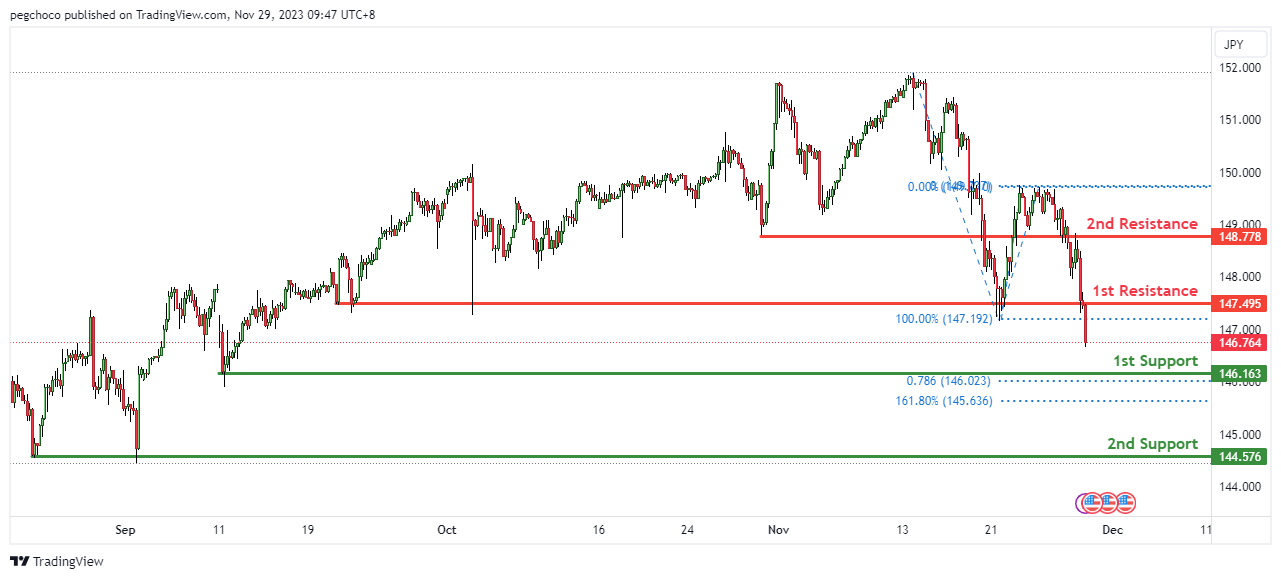
The USD/JPY, the overall momentum of the chart is bearish, indicating a downward trend, suggesting a potential downward movement in price. In this scenario, there is a possibility that the price could potentially make a bearish continuation towards the 1st support.
The 1st support at 146.16 is identified as a swing low support, indicating that it’s a significant level where buying interest may emerge. Additionally, the presence of the 78.60% Fibonacci Projection adds further significance to this support level.
The 2nd support at 144.57 is another swing low support level. This adds to the significance of this support, indicating it as a potential area where buyers might become active.
On the resistance side,
The 1st resistance at 147.49 is categorized as a pullback resistance. This implies that it’s a level where selling pressure may increase, potentially acting as a barrier to further upward price movement for USD/JPY.
The 2nd resistance at 148.77 is noted as an overlap resistance. This suggests that it’s another significant level where selling interest could intensify.
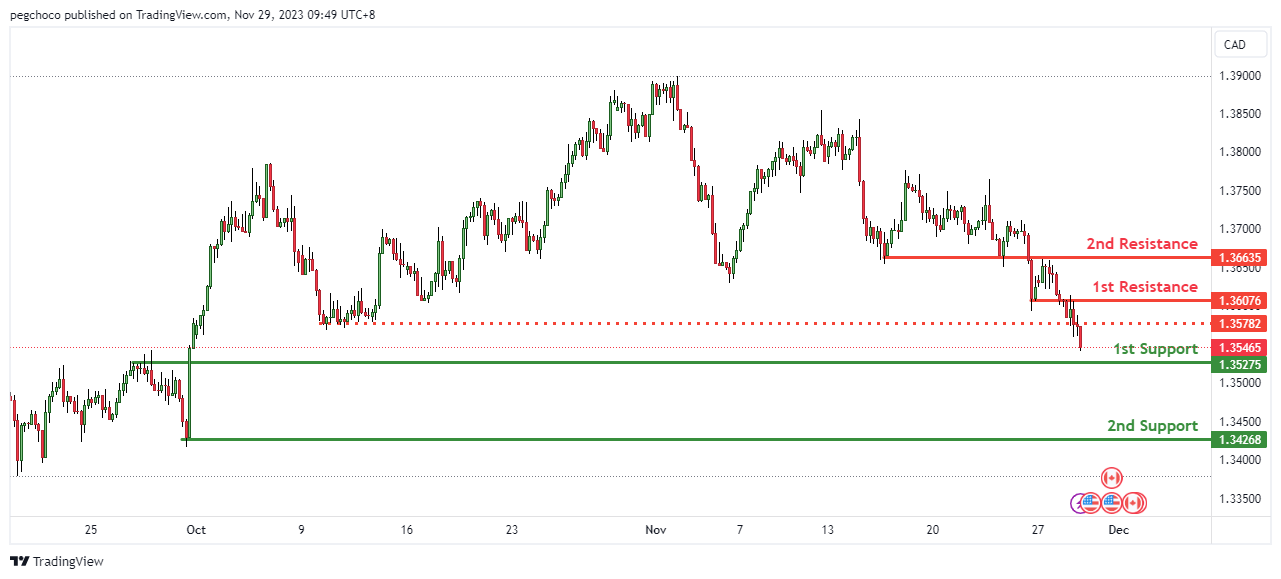
USD/CAD:
The USD/CAD, the overall momentum of the chart is currently bearish, suggesting a potential downward movement in price. In this scenario, there is a possibility that the price could potentially make a rise towards the 1st resistance in the short term before reversing off it and dropping towards the 1st support.
The 1st support at 1.3527 is identified as a pullback support. This suggests that it’s a significant level where buying interest may emerge, providing support for the USD/CAD currency pair.
The 2nd support at 1.3426 is another swing low support level. This adds further significance to this support level, indicating it as a potential area where buyers might become active.
On the resistance side, The 1st resistance at 1.3607 is categorized as a pullback resistance. This implies that it’s a level where selling pressure may increase, acting as a potential barrier to further upward price movement for USD/CAD.
The 2nd resistance at 1.3663 is noted as an overlap resistance, suggesting it’s another significant level where selling interest could intensify.
Additionally, there is an intermediate resistance at 1.3536, which is also identified as a pullback resistance, reinforcing the potential resistance factors for the currency pair.
AUD/USD:
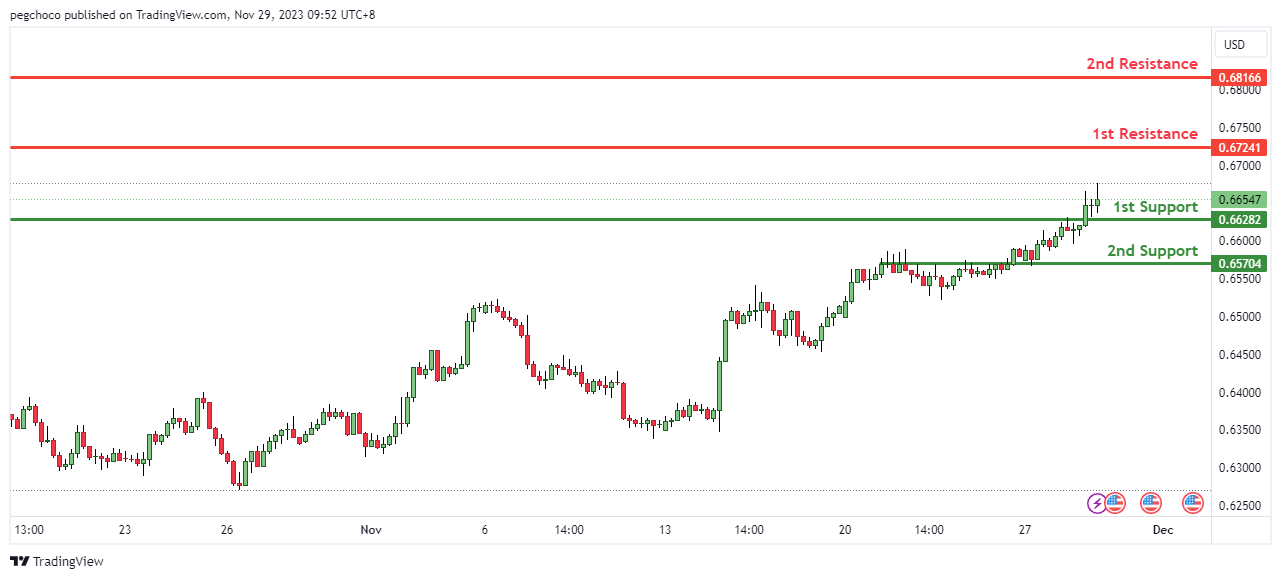
AUD/USD, the overall momentum of the chart is currently bullish, suggesting a potential upward movement in price. In this scenario, there is a possibility that the price could potentially make a bullish continuation towards the 1st resistance.
The 1st support at 0.6628 is identified as an overlap support. This suggests that it’s a significant level where buying interest may emerge, providing support for the AUD/USD currency pair.
The 2nd support at 0.6570 is another overlap support level. This adds further significance to this support level, indicating it as a potential area where buyers might become active.
On the resistance side, The 1st resistance at 0.6724 is categorized as an overlap resistance. This suggests that it’s a significant barrier where selling interest could intensify, potentially limiting the upward movement for AUD/USD.
The 2nd resistance at 0.6816 is noted as a swing high resistance. This adds to the potential resistance factors for the currency pair.
NZD/USD
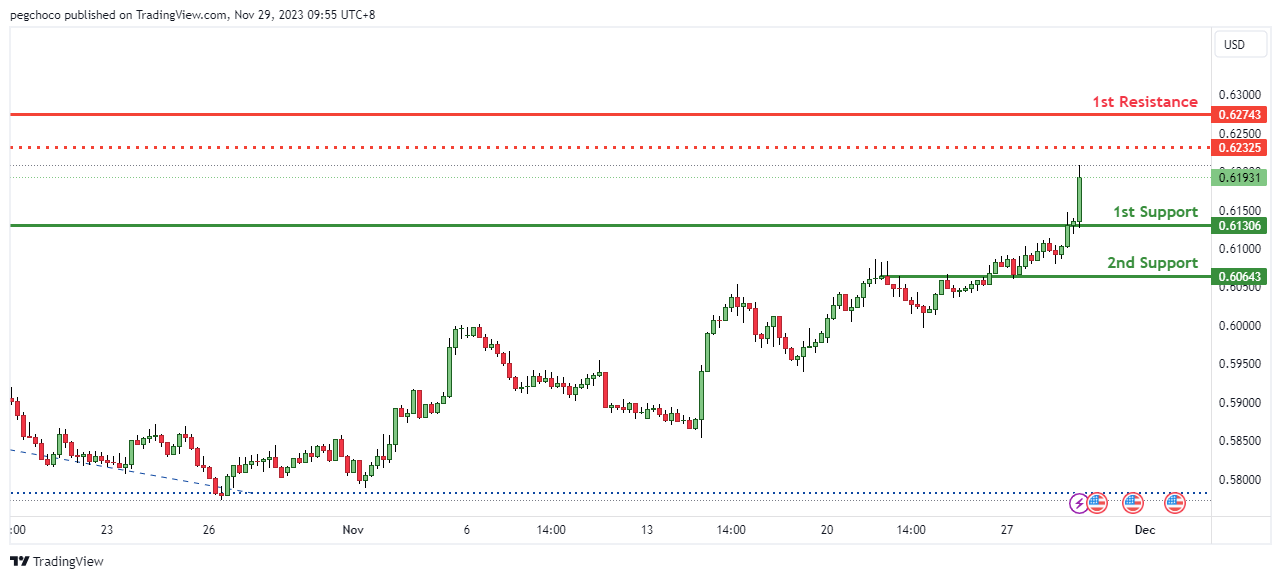
The NZD/USD, the overall momentum of the chart is currently bullish, indicating a potential upward movement in the price. In this scenario, there is a possibility that price could potentially make a bullish continuation towards the 1st resistance.
The 1st support at 0.6130 is identified as a pullback support. This suggests that it’s a significant level where buying interest may emerge, providing support for the NZD/USD currency pair.
The 2nd support at 0.6064 is another overlap support level. This adds further significance to this support level, indicating it as a potential area where buyers might become active.
On the resistance side, The 1st resistance at 0.6274 is categorized as a swing high resistance, and it also coincides with the 78.60% Fibonacci Retracement level. This dual significance suggests that it’s a significant barrier where selling interest could intensify, potentially limiting the upward movement for NZD/USD.
Additionally, there is an intermediate resistance at 0.6232, which is an overlap resistance, further reinforcing the potential resistance factors for the currency pair.
DJ30:
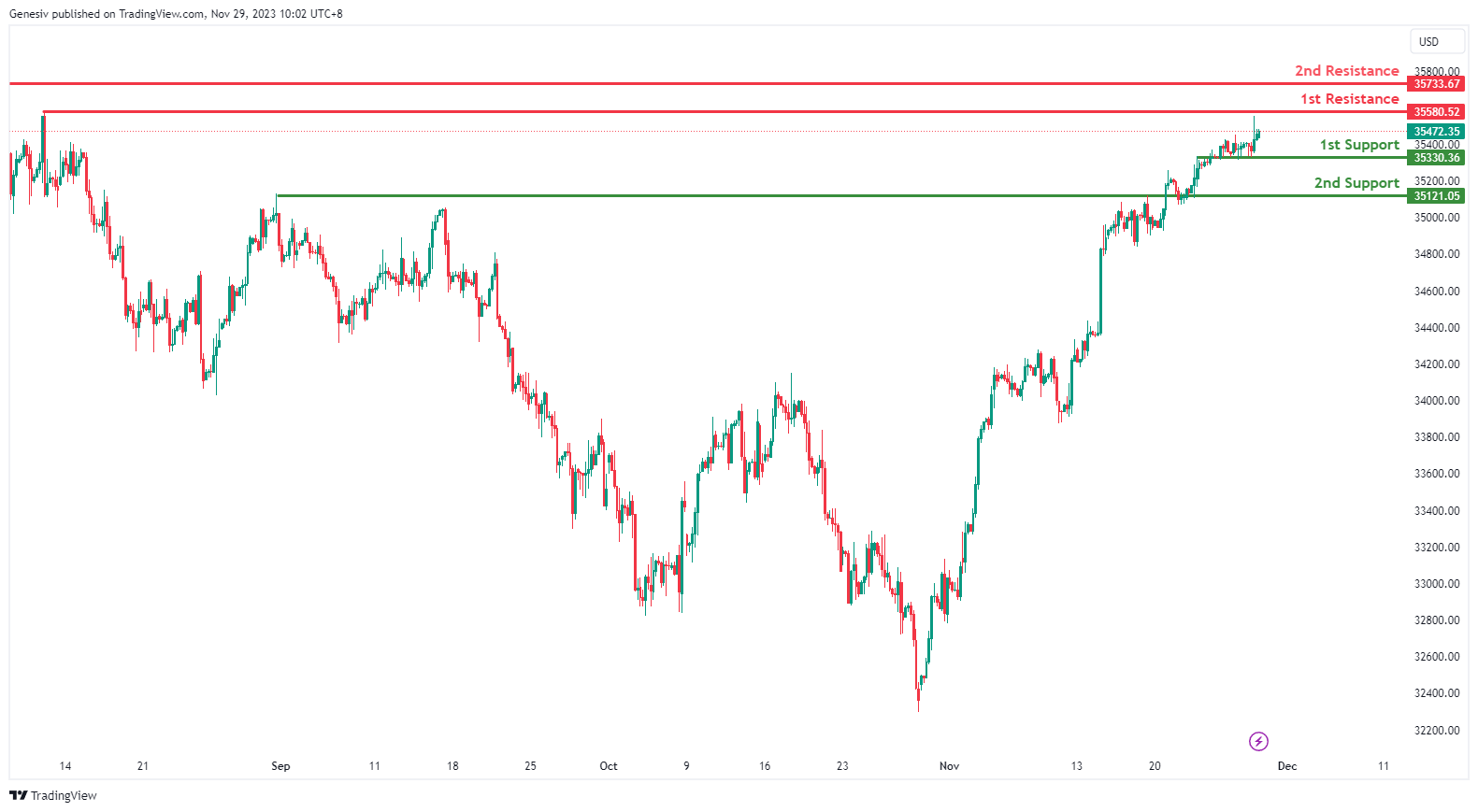
The DJ30, the momentum of the chart is bullish, indicating a potential continuation of the upward movement in price. In this scenario, there is a possibility that the price could experience a bullish bounce off the 1st support level and head towards the 1st resistance.
1st support at 35330.36: This level is identified as an overlap support, suggesting that it has previously acted as a significant price level where buyers have shown interest. It’s a level to watch for potential bullish reactions and a potential bounce.
2nd support at 35121.05: The 2nd support level is marked as pullback support, indicating that it may provide support during retracements. It’s another level where buyers might be interested.
Intermediate resistance at 35580.52: This level is characterized as pullback resistance, suggesting that it could be a point where selling pressure may increase, potentially leading to a temporary halt or retracement in the upward movement.
2nd resistance at 35733.67: The 2nd resistance is also noted as pullback resistance, indicating that it’s a level where sellers might be more active in defending their positions.
GER40:
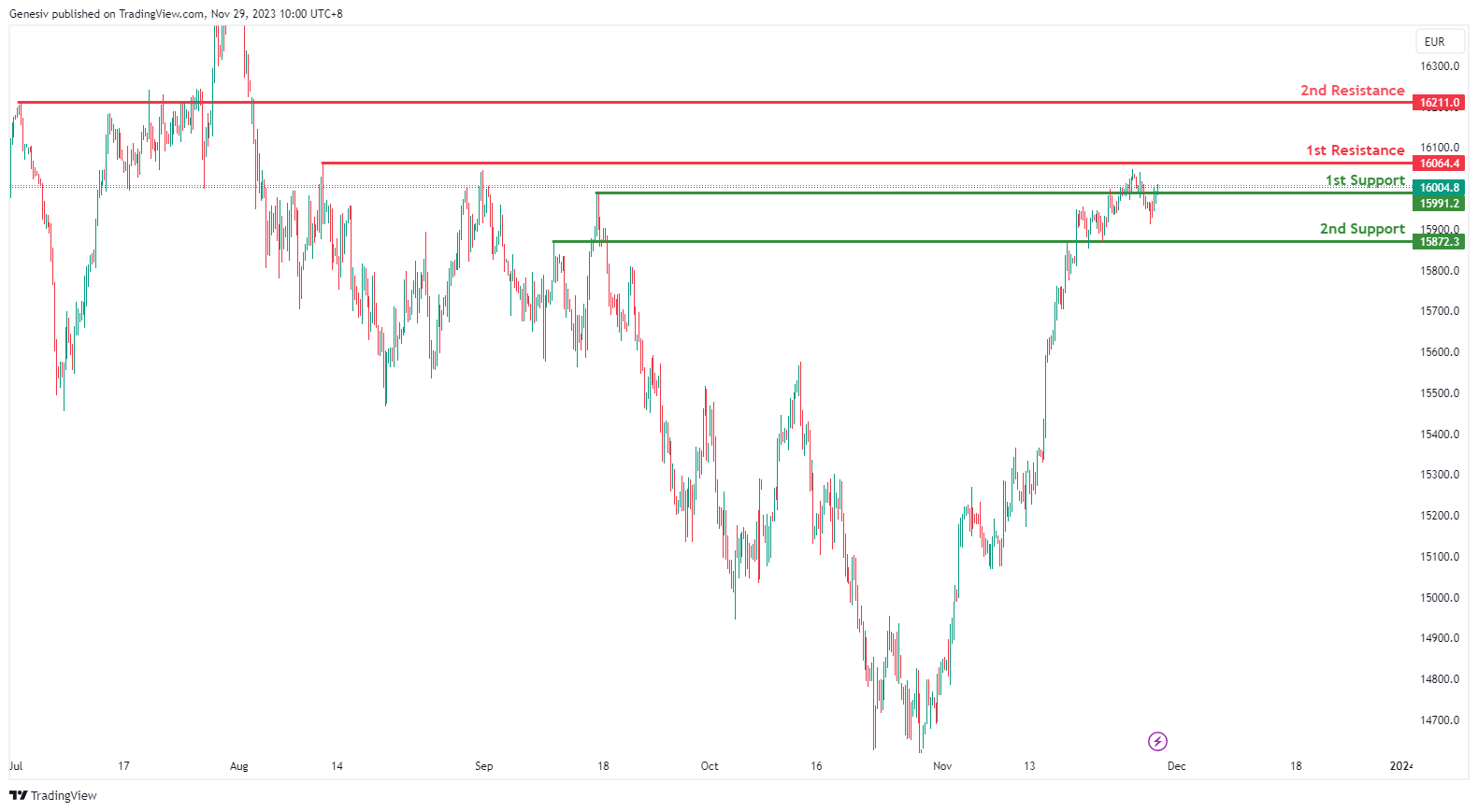
The GER40 overall momentum is overall bearish, indicating a potential continuation of the downward movement in price. There is a possibility that the price could experience a bearish continuation towards the 1st support.
1st support at 15991.2: This level is identified as an overlap support, suggesting that it has previously acted as a significant price level where buyers have shown interest. It’s a level to watch for potential bearish reactions and a potential continuation of the downtrend.
2nd support at 15872.3: The 2nd support level is marked as an overlap support as well, indicating its importance as a potential area of buying interest. Traders may anticipate potential support around this level.
1st resistance at 16064.4: This level is characterized as pullback resistance, suggesting that it could be a point where selling pressure may increase, potentially leading to a halt or retracement in the downward movement.
2nd resistance at 16211.0: The 2nd resistance is also noted as pullback resistance, indicating that it’s a level where sellers might be more active in defending their positions.
US500:
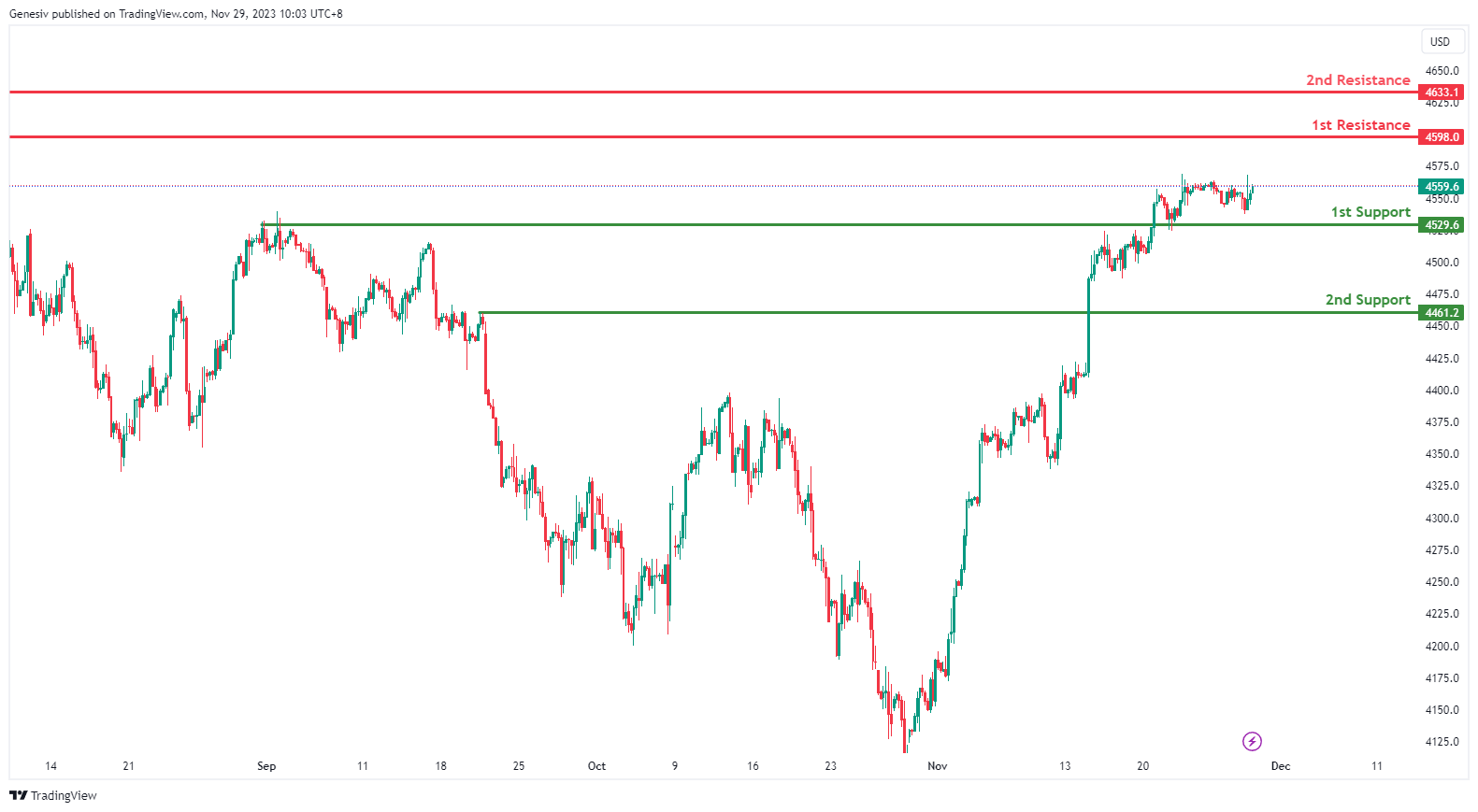
The overall momentum of US500 is bullish. The price could potentially continue its bullish movement towards the 1st resistance level.
1st support at 4529.6: This level is identified as an overlap support, suggesting that it has previously acted as a significant price level where buyers have shown interest. It’s a level to watch for potential bullish reactions and a potential continuation of the uptrend.
2nd support at 4461.2: The 2nd support level is marked as a pullback support, indicating its importance as a potential area of buying interest. Traders may anticipate potential support around this level.
1st resistance at 4598.0: This level is characterized as pullback resistance, suggesting that it could be a point where selling pressure may increase, potentially leading to a pause or retracement in the upward movement.
2nd resistance at 4633.1: The 2nd resistance is also noted as pullback resistance, indicating that it’s a level where sellers might be more active in defending their positions.
BTC/USD:
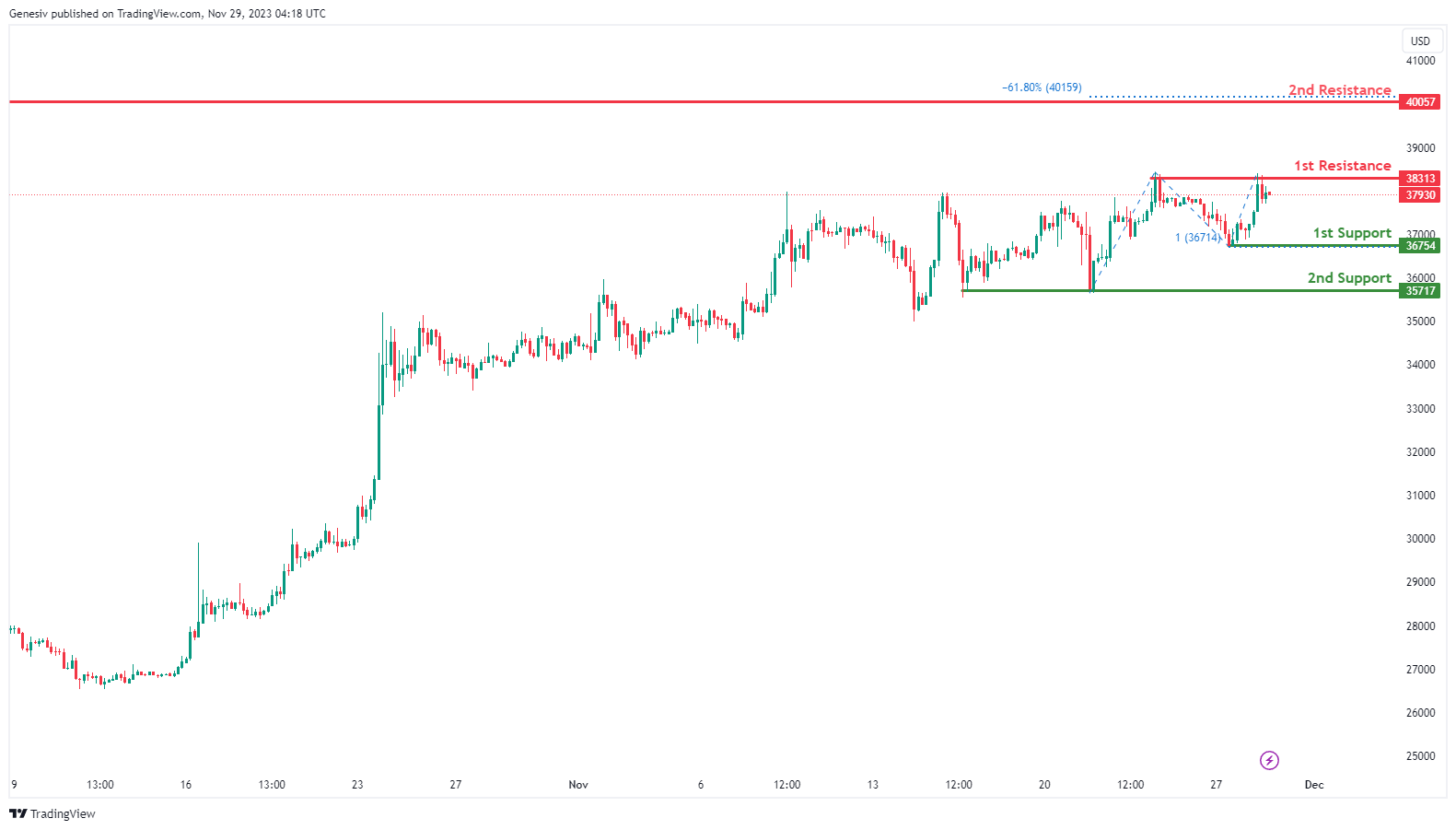
The analyzed instrument is BTC/USD, and the overall momentum of the chart is currently bearish.
There is a potential for the price to make a bearish reaction off the 1st resistance and drop to the 1st support.
The 1st support level is identified at 36754, and its favorable characteristic is attributed to being a swing low support, coinciding with the 100% Fibonacci Projection.
The 2nd support level is situated at 35717, and its favorable aspect is derived from being a multi-swing low support.
On the resistance side, the 1st resistance is positioned at 38313, and it is considered significant due to being a multi-swing high resistance.
The 2nd resistance is located at 39878, and its significance is derived from being a swing high resistance, aligning with the -61.8% Fibonacci Expansion.
ETH/USD:
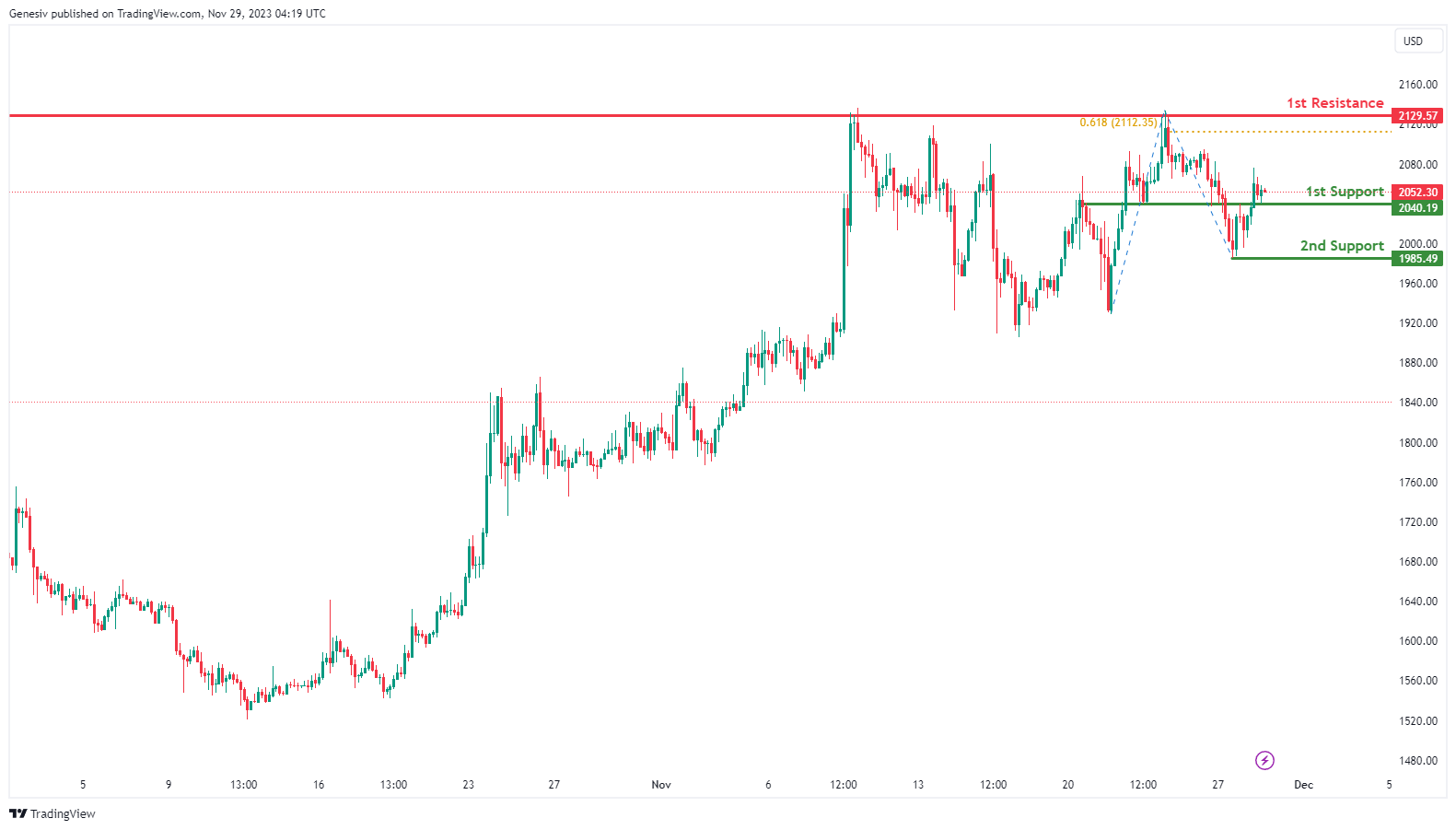
The analyzed instrument is ETH/USD, and the overall momentum of the chart is currently bullish.
There is a potential for the price to make a bullish bounce off the 1st support and head towards the 1st resistance.
The 1st support level is identified at 2040.19, and its favorable characteristic is attributed to being an overlap support.
The 2nd support level is situated at 1985.49, and its favorable aspect is derived from being a swing low support.
On the resistance side, the 1st resistance is positioned at 2129.57, and it is considered significant due to being a multi-swing high resistance, coinciding with the 61.80% Fibonacci Projection.
WTI/USD:
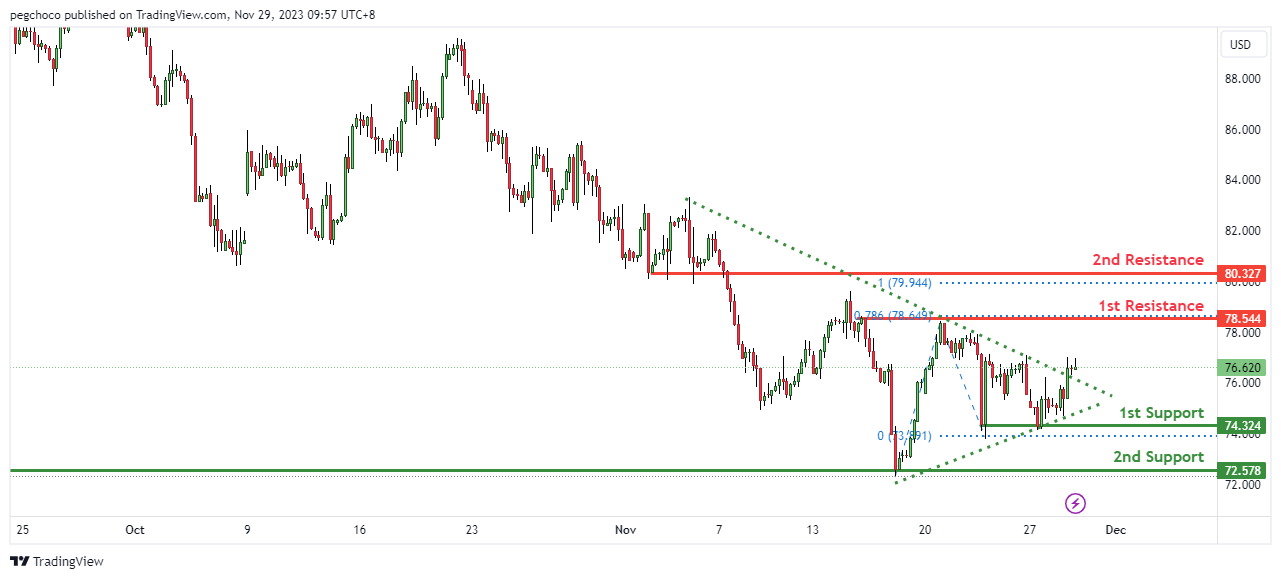
The WTI (West Texas Intermediate) crude oil, the overall momentum of the chart is bullishl, price broke above a descending resistance line, triggering a potential bullish move. Price could potentially make a bullish continuation towards the 1st resistance.
The 1st support at 74.32 is identified as a multi-swing low support. This suggests that it’s a significant level where buying interest may emerge, providing support for WTI crude oil.
The 2nd support at 72.57 is another overlap support level. This adds further significance to this support level, indicating it as a potential area where buyers might become active.
On the resistance side, The 1st resistance at 78.54 is categorized as a swing high resistance, and it also coincides with the 78.60% Fibonacci Projection. This dual significance suggests that it’s a significant barrier where selling interest could intensify, potentially limiting the upward movement for WTI crude oil.
The 2nd resistance at 80.32 is noted as a pullback resistance, and it is associated with the 100% Fibonacci Projection. This adds to the potential resistance factors for the commodity.
XAU/USD (GOLD):
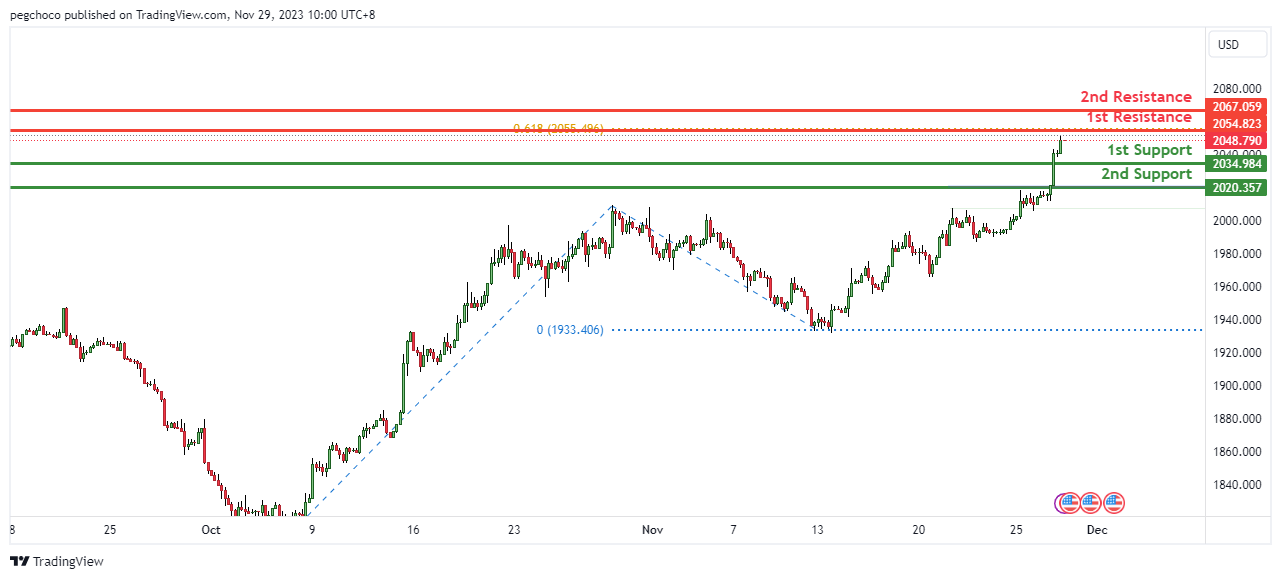
The XAU/USD, the overall momentum of the chart is bullish, Price could potentially make a bullish bounce off the 1st support and head towards the 1st resistance.
The 1st support at 2034.98 is identified as a pullback support. This suggests that it’s a significant level where buying interest may emerge, potentially leading to a bullish bounce for XAUUSD.
The 2nd support at 2020.35 is another pullback support level. This adds further significance to this support level, indicating it as another potential area where buyers might become active.
On the resistance side, The 1st resistance at 2054.82 is categorized as a swing high resistance, and it also coincides with the 61.80% Fibonacci Projection. This dual significance suggests that it’s a significant barrier where selling interest could intensify, potentially limiting the upward movement for XAUUSD.
The 2nd resistance at 2067.05 is noted as a multi-swing high resistance, indicating another potential obstacle for the precious metal’s upward price movement.
USD/JPY Daily Outlook
Daily Pivots: (S1) 146.92; (P) 147.87; (R1) 148.43; More...
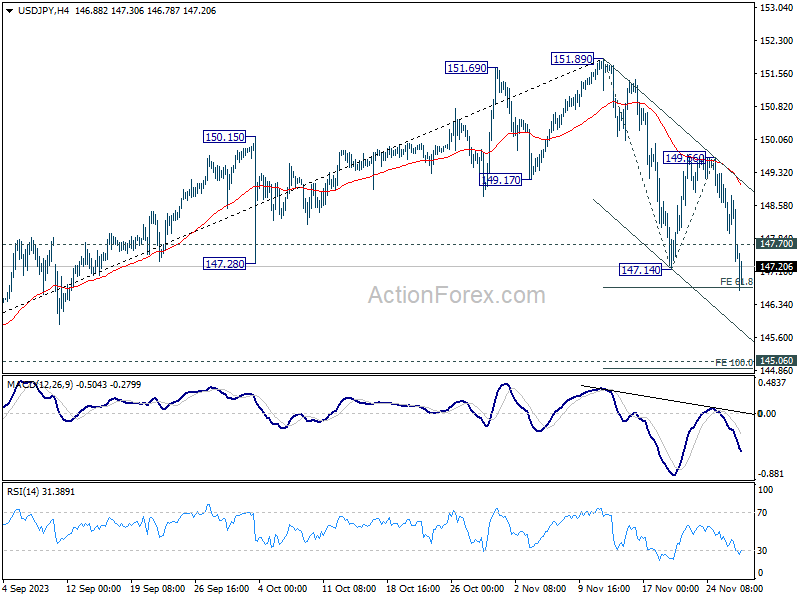
USD/JPY's decline continues today and break of 147.14 support confirms resumption of whole fall from 151.89. Intraday bias stays on the downside at this point. Sustained break of 61.8% projection of 151.89 to 147.14 from 149.66 at 146.72 will pave the way to 100% projection at 149.91, which is close to 145.06 key resistance turned support. On the upside, above 147.70 minor resistance will turn intraday bias neutral first. But risk will stay on the downside as long as 149.66 resistance holds.
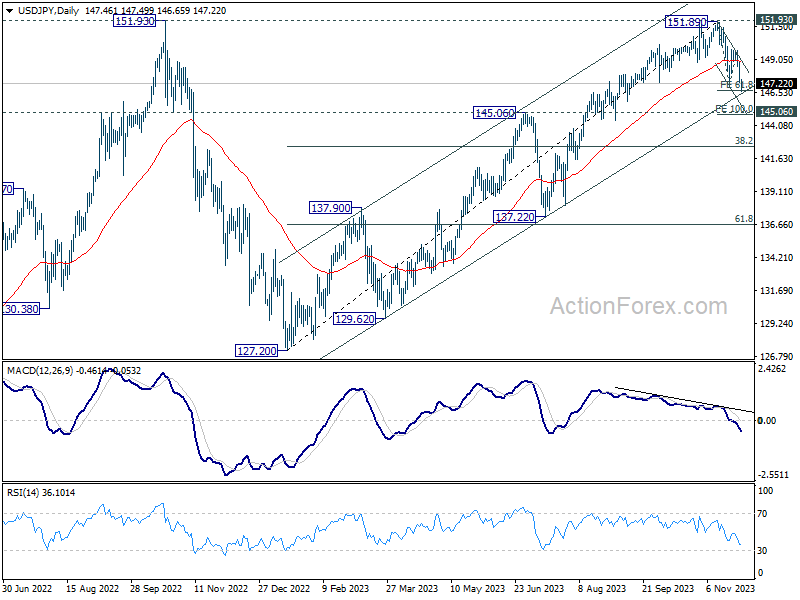
In the bigger picture, rise from 127.20 (2023 low) is seen as the second leg of the pattern from 151.93 (2022 high). Decisive break of 145.06 resistance turned support will confirm that this second leg has completed, after rejection by 151.93. Deeper fall would be seen through 38.2% retracement of 127.20 to 151.89 at 142.45 to 61.8% retracement at 136.63. Nevertheless strong bounce from 145.06 will retain medium term bullishness for another test on 151.93 at a later stage.
Fed’s Dovish Tone Pressures Dollar and Yields, RBNZ’s Hawkishness Lifts Kiwi
Dollar's decline finally takes off again overnight, following dovish comments from some Fed officials. In particular, Fed Governor Christopher Waller, typically known for his hawkish views, softened his stance and expressed a level of satisfaction with the current interest rate policy. Chicago Fed President Austan Goolsbee's even raised concerns about the risks of maintaining overly restrictive monetary policy for an extended period. Fed Governor Michelle Bowman, maintaining a hawkish stance, was the only one expecting another rate hike.
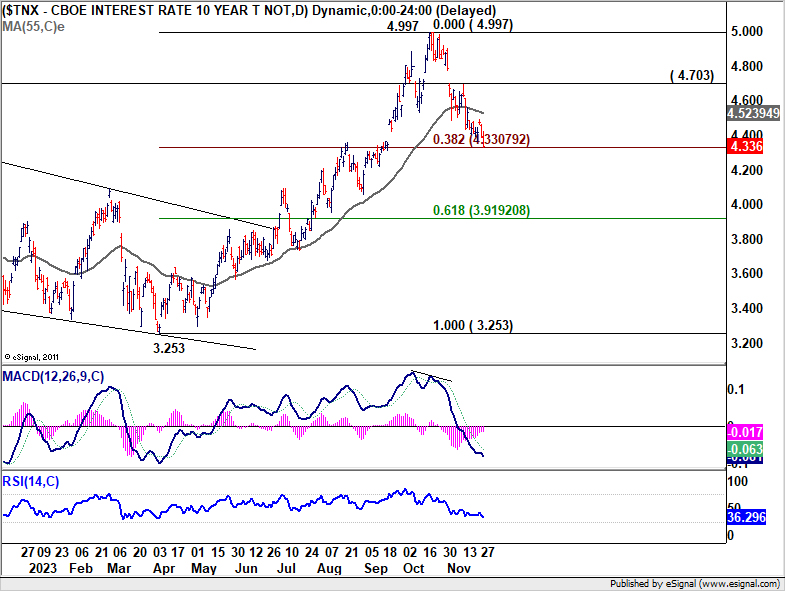
One significant technical development to note is that 10-year yield is now pressing an important fibonacci level of 38.2% retracement of 3.253 to 4.997 at 4.330. Sustained break of this level would open up deeper decline through 4% handle to 61.8% retracement at 3.919. This development, if realized, would exert additional broad based pressure on the greenback.
As for the week, Dollar remains the weakest performer, followed by Euro and Swiss Franc by a distance.
On the other hand, New Zealand Dollar emerged as the strongest performer, rallying significantly after RBNZ's (RBNZ) hawkish hold. The central bank's new economic projections suggest another rate hike in the first half of the next year.
Japanese Yen also gained strength, benefiting from the lower Treasury yields in the US and Europe and the ongoing expectations of a policy shift by BoJ away from negative interest rates.
Australian Dollar has shown resilience too, maintaining strength despite lower-than-expected CPI data. Sterling and Canadian Dollar exhibit mixed performance, however.
In Asia, at the time of writing, Nikkei is up 0.30%. Hong Kong HSI is down -1.84%. China Shanghai SSE is down -0.27%. Singapore Strait Times is up 0.46%. Japan 10-year JGB yield is down -0.052 at 0.703. Overnight, DOW rose 0.24%. S&P 500 rose 0.10%. NASDAQ rose 0.29%. 10-year yield fell -0.053 to 4.336.
RBNZ raises rate track, signaling additional rate hike
RBNZ decided to keep the Official Cash Rate steady at 5.50%, aligning with market expectations. However, a significant aspect of their announcement is the upward revision of their "rate track."
According to the bank's forecasts in the Monetary Policy Statement, OCR is expected to peak at 5.70% in Q2 of 2024 and maintain this level throughout the year. Looking ahead, RBNZ anticipates a rate cut in Q2 of 2025, bringing it down to 5.4%.
In the accompanying statement, RBNZ noted, "ongoing excess demand and inflationary pressures are of concern, given the elevated level of core inflation."
RBNZ also emphasized its readiness to hike again. "If inflationary pressures were to be stronger than anticipated, the OCR would likely need to increase further."
Moreover, RBNZ underlined the necessity of maintaining interest rates at a restrictive level for a sustained period, aiming at ensuring consumer price inflation returns to target level and to support maximum sustainable employment.
NZD/USD soars, AUD/NZD dives after RBNZ hawkish hold
New Zealand Dollar surges sharply after hawkish RBNZ holds, which hints at another rate hike in Q2 next year.
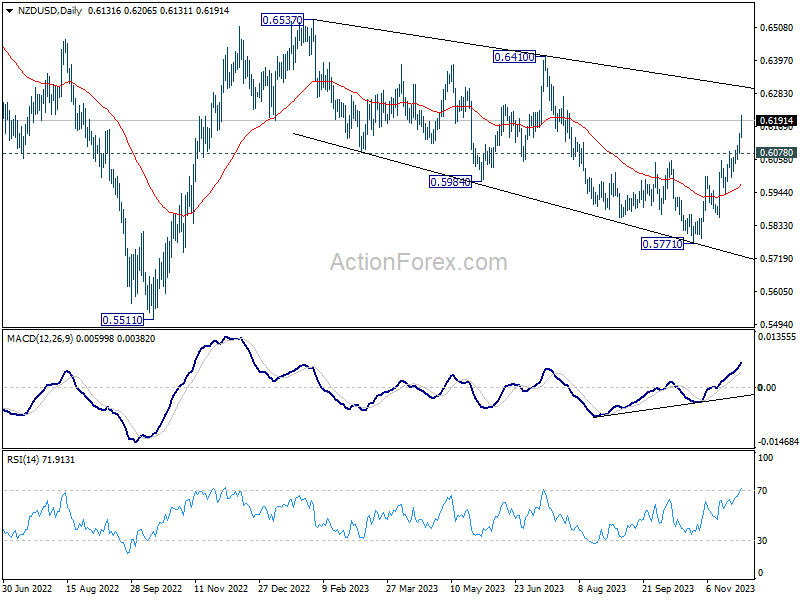
From a technical standpoint, NZD/USD's rally from 0.5771 accelerates to as high as 0.6206 so far today. The development strengthen the case that whole corrective fall from 0.6537 (Feb high), has completed with three waves down to 0.5771 (Oct low).
Near term outlook will stay bullish as long as 0.6078 support holds. Next target is trend line resistance at around 0.6300. Sustained break there would pave the way through 0.6537 to resume the rise from 0.5511 (2022 low).
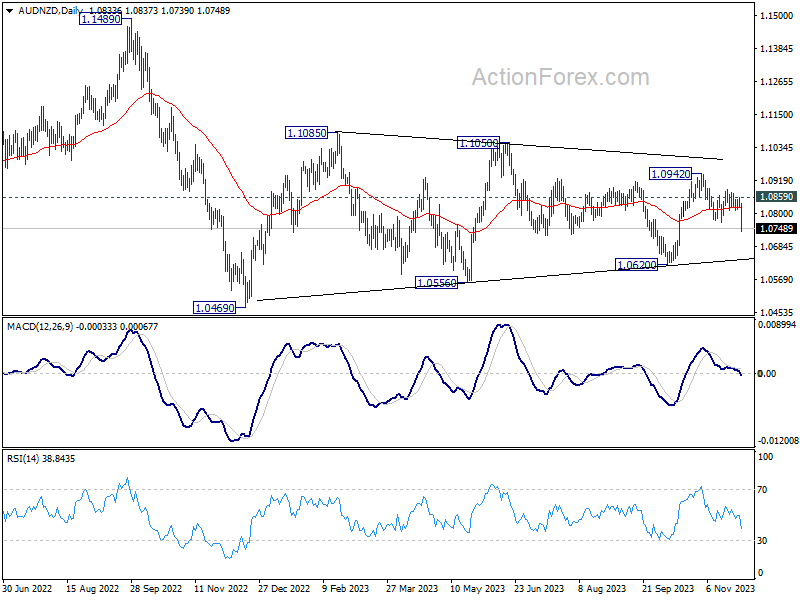
In gauging Kiwi's strength, AUD/NZD is always a reference. Today's sharp decline suggests that fall from 1.0942 is in progress. Near term outlook remains bearish as long as 1.0859 resistance holds, next target is 1.0620 support.
More importantly, it's possible that the triangle consolidation pattern from 1.0469 (2022 low) has completed at 1.0942. Firm break of 1.0620 will argue that whole fall from 1.1489 (2022 high) is ready to resume through 1.0469 in the medium term.
Australia's monthly CPI slowed to 4.9% in Oct, below exp 5.2%
Australia monthly CPI slowed from 5.6% you to 4.9% yoy in October, below expectation of 5.20%. Excluding volatile items and holiday travel, CPI slowed from 5.5% yoy to 5.1% yoy. Annual trimmed mean CPI also slowed from 5.4% yoy to 5.3% yoy.
The most significant contributors to the October annual increase were Housing (+6.1%), Food and non-alcoholic beverages (+5.3 per cent) and Transport (+5.9%).
BoJ's Adachi: Not at a stage to discuss exit from ultra-loose policy
BoJ board member Seiji Adachi acknowledged that while there are early indications of a positive wage-inflation cycle emerging, these are not yet sufficient to consider exiting ultra-loose monetary policy.
He emphasized the importance of continuing with monetary easing approach, stating today, "For now, it's appropriate to patiently continue with our monetary easing."
Adachi specifically pointed out the challenges posed by China's slowing growth and the potential impacts of aggressive US interest rate hikes, noting that these factors make it difficult to predict whether Japanese firms will substantially increase wages next year.
He also addressed the disparity in wage increase capabilities between large and small companies. While some big companies seem prepared to continue raising wages, many smaller firms, particularly in regional areas, are struggling to do so due to challenging business conditions.
He emphasized, "We're not at a stage yet where we can discuss an exit" from ultra-loose policy.
Fed's Waller increasingly confident that policy is well positioned
Fed Governor Christopher Waller, in his speech at the American Enterprise Institute think tank overnight, stated that inflation rates "moving along pretty much like" he expected and expressed increasing confidence in Fed's policy's effectiveness in slowing the economy and steering inflation back towards 2% target.
Waller's confidence also extends to managing this economic slowdown without significantly impacting the unemployment rate, which currently stands at 3.9%.
Furthermore, Waller discussed the possibility of lowering the policy rate in the future, conditional on the continued decline of inflation.
He suggested that if the downward trend in inflation persists for several months – "three months, four months, five months" – Fed could consider "lowering the policy rate just because inflation is lower."
This approach, he clarified, is not aimed at "trying to save the economy" but is consistent with established "policy rules". Waller emphasized that there is no rationale for maintaining excessively high rates if inflation consistently decreases.
Fed's Bowman still prepared for another rate hike
Fed Governor Michelle Bowman, in a speech overnight, noted that her baseline economic outlook anticipates the "need to increase the federal funds rate further", to bring inflation down to 2% target in a "timely way".
Bowman also mentioned her willingness to support a rate hike at a future meeting if data suggests that progress on inflation has stalled or is not sufficient.
Yet she added that "monetary policy is not on a preset course," and she will continue to closely watch the incoming data.
Importantly, Bowman cautioned against "prematurely declaring victory in the fight against inflation". She stressed the historical lessons and risks associated with such premature actions.
Fed's Goolsbee on monetary policy: Pull out the turkey early for residual heat
Chicago Fed President Austan Goolsbee, in an interview with Marketplace overnight, expressed concerns about the risks of maintaining high interest rates for an extended period. Goolsbee emphasized the importance of adjusting the level of restrictiveness in monetary policy as the economy moves closer to inflation target.
He likened this to cooking a turkey, suggesting that just as a turkey should be removed from the oven before it's fully done to account for "residual heat", similarly, monetary policy should be eased before inflation hits the target to prevent overshooting.
Goolsbee noted that "once you believe that you are on the path to get inflation to target, then the amount of restrictiveness that you need to apply needs to be less."
Additionally, Goolsbee highlighted the progress made in controlling inflation, particularly outside the food sector. He pointed out that inflation has been coming down, and although it hasn't reached the target level yet, 2023 is on track to see the largest drop in the inflation rate in 71 years.
USD/JPY Daily Outlook
Daily Pivots: (S1) 146.92; (P) 147.87; (R1) 148.43; More...
USD/JPY's decline continues today and break of 147.14 support confirms resumption of whole fall from 151.89. Intraday bias stays on the downside at this point. Sustained break of 61.8% projection of 151.89 to 147.14 from 149.66 at 146.72 will pave the way to 100% projection at 149.91, which is close to 145.06 key resistance turned support. On the upside, above 147.70 minor resistance will turn intraday bias neutral first. But risk will stay on the downside as long as 149.66 resistance holds.
In the bigger picture, rise from 127.20 (2023 low) is seen as the second leg of the pattern from 151.93 (2022 high). Decisive break of 145.06 resistance turned support will confirm that this second leg has completed, after rejection by 151.93. Deeper fall would be seen through 38.2% retracement of 127.20 to 151.89 at 142.45 to 61.8% retracement at 136.63. Nevertheless strong bounce from 145.06 will retain medium term bullishness for another test on 151.93 at a later stage.
Economic Indicators Update
| GMT | Ccy | Events | Actual | Forecast | Previous | Revised |
|---|---|---|---|---|---|---|
| 00:30 | AUD | Monthly CPI Y/Y Oct | 4.90% | 5.20% | 5.60% | |
| 01:00 | NZD | RBNZ Rate Decision | 5.50% | 5.50% | 5.50% | |
| 07:00 | EUR | Germany Import Price M/M Oct | 0.10% | 1.60% | ||
| 09:00 | CHF | Credit Suisse Economic Expectations Nov | -37.8 | |||
| 09:30 | GBP | M4 Money Supply M/M Oct | -0.20% | -1.10% | ||
| 09:30 | GBP | Mortgage Approvals Oct | 44K | 43K | ||
| 10:00 | EUR | Eurozone Economic Sentiment Indicator Nov | 93.7 | 93.3 | ||
| 10:00 | EUR | Eurozone Industrial Confidence Nov | -9.3 | |||
| 10:00 | EUR | Eurozone Services Sentiment Nov | 4.5 | |||
| 10:00 | EUR | Consumer Confidence Nov F | -16.9 | -16.9 | ||
| 13:00 | EUR | Germany CPI M/M Nov P | -0.10% | 0% | ||
| 13:00 | EUR | Germany CPI Y/Y Nov P | 3.50% | 3.80% | ||
| 13:30 | CAD | Current Account (CAD) Q3 | 0.7B | -6.6B | ||
| 13:30 | USD | GDP Annualized Q3 P | 5.00% | 4.90% | ||
| 13:30 | USD | GDP Price Index Q3 P | 3.50% | 3.50% | ||
| 13:30 | USD | Goods Trade Balance (USD) Oct P | -86.7B | -86.8B | ||
| 13:30 | USD | Wholesale Inventories Oct P | 0.10% | 0.20% | ||
| 15:30 | USD | Crude Oil Inventories | -0.1M | 8.7M | ||
| 19:00 | USD | Fed's Beige Book |
BoJ’s Adachi: Not at a stage to discuss exit from ultra-loose policy
BoJ board member Seiji Adachi acknowledged that while there are early indications of a positive wage-inflation cycle emerging, these are not yet sufficient to consider exiting ultra-loose monetary policy.
He emphasized the importance of continuing with monetary easing approach, stating today, "For now, it's appropriate to patiently continue with our monetary easing."
Adachi specifically pointed out the challenges posed by China's slowing growth and the potential impacts of aggressive US interest rate hikes, noting that these factors make it difficult to predict whether Japanese firms will substantially increase wages next year.
He also addressed the disparity in wage increase capabilities between large and small companies. While some big companies seem prepared to continue raising wages, many smaller firms, particularly in regional areas, are struggling to do so due to challenging business conditions.
He emphasized, "We're not at a stage yet where we can discuss an exit" from ultra-loose policy.
Australia October Monthly CPI Indicator
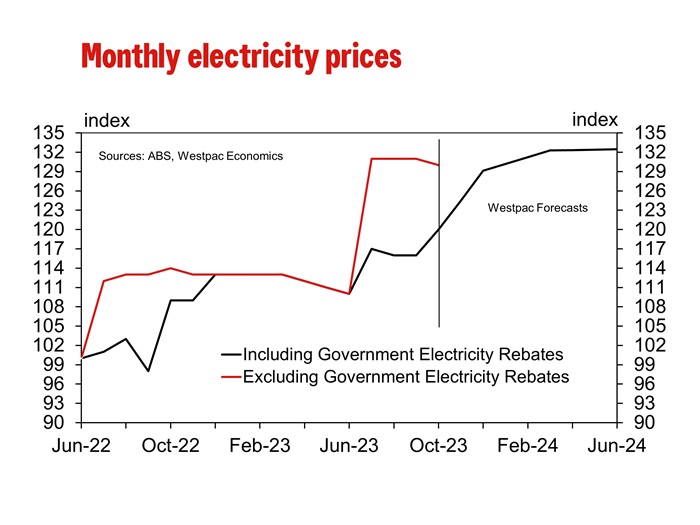
Government policies are holding down inflation but electricity prices are starting to rise as rebates come to an end.
The Monthly CPI Indicator rose 4.9% in the year to October, down from 5.6%yr in September and the recent peak of 8.4%yr at December 2022. This was meaningfully less than Westpac’s forecast of 5.3%yr, and the market median forecast of 5.2%yr.
As we noted in the preview, the first month of the quarter is heavy with the quarterly surveys of many household durable goods and given the global deflation in durable goods, we had been expecting a softer monthly print.
In the month, the CPI was down –0.3% compared to our forecast of 0.2%. Household contents were softer than expected (–1.6% vs flat forecast) but garments were stronger (+3.4% vs –0.2% forecast). The real surprise was the fall in rents (–0.4% vs +0.8% forecast), softer dwelling purchase prices (+0.2% vs +0.5% forecast) and a larger than expected fall in gas prices (–2.5% vs –0.5% forecast). Electricity prices rose as expected. Also of note was a large fall in holiday travel (–7.0% vs +3.7% forecast).
On the stronger side was food (0.1% vs –0.2% forecast), alcohol & tobacco (+1.3% vs +0.2% forecast) and as noted above clothing and footwear. It would be tempting to blame the softer-than-expected headline result on greater goods deflation, but goods were only down –0.1% in the month while services fell –0.7%. Note that the services that are surveyed monthly includes rents (–0.4%) and holiday travel (–7.0%).
The fall in rents was due to the impact of changes to Commonwealth Rent Assistance. From 20 September, the maximum rate available for rent assistance increased by 15% and as it was applied in late September, only part of the assistance was used in September and the remainder was used in October. The ABS noted that excluding the changes to rent assistance, rents would have risen 0.7% in October for an annual pace of 8.3%yr. Taking the difference between 8.3%yr and the 6.6%yr CPI estimate, and subtracting the non-assistance rent increase from the published increase in October (+0.7% vs. –0.4%) we estimate that non-assisted rents rose 0.9% in September, matching the 0.9% increase in June which was the largest monthly increase in monthly rental series.
Without the increase in the assistance from June to October, the monthly increases would have been 0.9%, 0.7%, 0.7%, 0.9% and 0.7% – no sign of a moderation from a monthly average increase of around 0.8%.
This increase in rental assistance shaved 0.07ppt off the Monthly CPI in October and 0.10ppt through September and October.
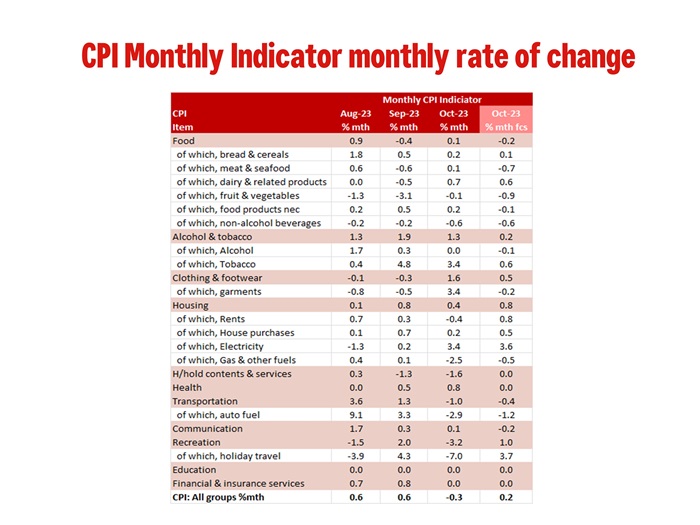
We are now starting to see the unwinding of the effect of the energy rebates. Energy Bill Relief Fund rebates introduced from July 2023 reduced electricity bills for concession households in Sydney, Melbourne, Adelaide, Hobart, Darwin and Canberra and for all households in Brisbane and Perth. From October 2023, newly eligible households received Energy Bill Relief Fund rebates in Sydney, Adelaide, Hobart, Darwin and Canberra. For Melbourne, rebates for newly eligible households will be reflected from November 2023. But the ABS data makes it clear the overall impact of the rebates is fading. In October, electricity prices rose 3.4% in the Monthly CPI but the ABS reports that electricity prices before the rebates fell –0.8%. As you can see in the chart below, as the effect of rebates fades, the level of electricity prices reported in the CPI rise to match the price without rebates.
It is also worth noting that the Monthly Indicator Trimmed Mean printed 5.3%yr, down from 5.4%yr in September and well down from the recent peak of 7.2% in December 2022. The quarterly Trimmed Mean printed 5.2%yr in September and our current forecast for the December quarter is 4.4%yr.
We are updating the full data set to see what any implications there are for our December quarter forecast.
Fed’s Goolsbee on monetary policy: Pull out the turkey early for residual heat
Chicago Fed President Austan Goolsbee, in an interview with Marketplace overnight, expressed concerns about the risks of maintaining high interest rates for an extended period. Goolsbee emphasized the importance of adjusting the level of restrictiveness in monetary policy as the economy moves closer to inflation target.
He likened this to cooking a turkey, suggesting that just as a turkey should be removed from the oven before it's fully done to account for "residual heat", similarly, monetary policy should be eased before inflation hits the target to prevent overshooting.
Goolsbee noted that "once you believe that you are on the path to get inflation to target, then the amount of restrictiveness that you need to apply needs to be less."
Additionally, Goolsbee highlighted the progress made in controlling inflation, particularly outside the food sector. He pointed out that inflation has been coming down, and although it hasn't reached the target level yet, 2023 is on track to see the largest drop in the inflation rate in 71 years.
Fed’s Bowman still prepared for another rate hike
Fed Governor Michelle Bowman, in a speech overnight, noted that her baseline economic outlook anticipates the "need to increase the federal funds rate further", to bring inflation down to 2% target in a "timely way".
Bowman also mentioned her willingness to support a rate hike at a future meeting if data suggests that progress on inflation has stalled or is not sufficient.
Yet she added that "monetary policy is not on a preset course," and she will continue to closely watch the incoming data.
Importantly, Bowman cautioned against "prematurely declaring victory in the fight against inflation". She stressed the historical lessons and risks associated with such premature actions.
Fed’s Waller increasingly confident that policy is well positioned
Fed Governor Christopher Waller, in his speech at the American Enterprise Institute think tank overnight, stated that inflation rates "moving along pretty much like" he expected and expressed increasing confidence in Fed's policy's effectiveness in slowing the economy and steering inflation back towards 2% target.
Waller's confidence also extends to managing this economic slowdown without significantly impacting the unemployment rate, which currently stands at 3.9%.
Furthermore, Waller discussed the possibility of lowering the policy rate in the future, conditional on the continued decline of inflation.
He suggested that if the downward trend in inflation persists for several months – "three months, four months, five months" – Fed could consider "lowering the policy rate just because inflation is lower."
This approach, he clarified, is not aimed at "trying to save the economy" but is consistent with established "policy rules". Waller emphasized that there is no rationale for maintaining excessively high rates if inflation consistently decreases.