Sample Category Title
USD/CHF Nosedives While Gold Price Extends Rally
Key Highlights
- USD/CHF declined heavily below the 0.8720 support.
- A short-term bearish trend line is forming with resistance near 0.8605 on the 4-hour chart.
- EUR/USD climbed toward 1.1280 before the bears appeared.
- Gold price accelerated gains above the $1,965 resistance.
USD/CHF Technical Analysis
The US Dollar started a major decline from well above 0.8950 against the Swiss Franc. USD/CHF declined below the 0.8820 support to move into a bearish zone.
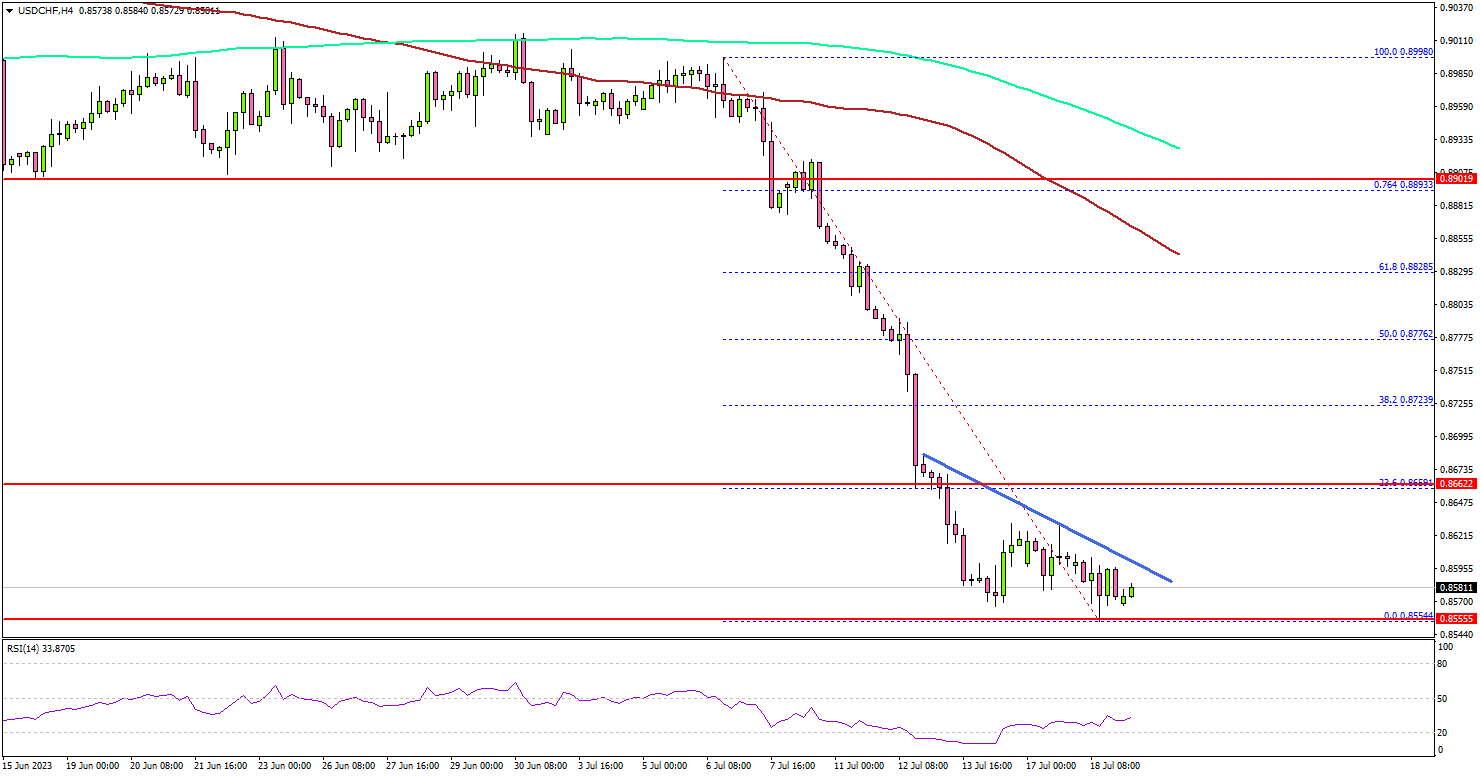
Looking at the 4-hour chart, the pair accelerated lower below the 0.8720 support, the 200 simple moving average (green, 4 hours), and the 100 simple moving average (red, 4 hours).
The pair even declined below 0.8600 and tested 0.8550. The pair is now showing a lot of bearish signs, with immediate resistance at 0.8600. There is also a short-term bearish trend line forming with resistance near 0.8605 on the same chart.
The next major resistance is near 0.8660. If there is a move above the 0.8660 resistance, the pair could rise toward 0.8720. Any more gains might send the pair toward the 0.8800 resistance zone in the near term.
Immediate support is near the 0.8550 level. The next major support is seen near the 0.8520 level, below which there could be a drop to 0.8450. Any more losses might send the pair toward the 0.8320 support zone.
Looking at Gold price, the bulls seem to be in control and they could aim a fresh move toward the $2,000 resistance zone.
Economic Releases
- UK Consumer Price Index for June 2023 (YoY) – Forecast +8.2%, versus +8.7% previous.
- UK Core Consumer Price Index for June 2023 (YoY) – Forecast +7.1%, versus +7.1% previous.
- Euro Zone CPI for June 2023 (YoY) - Forecast +5.5%, versus +5.5% previous.
- Euro Zone CPI for June 2023 (MoM) - Forecast +0.3%, versus +0.3% previous.
New Zealand’s Q2 CPI beats expectations despite slowdown
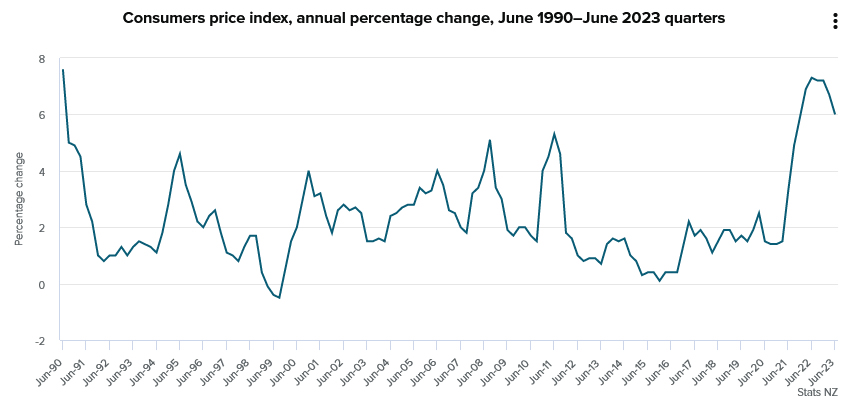
New Zealand's CPI experienced a slightly slowed but stronger-than-expected rise in Q2, registering 1.1% qoq increase compared to Q1's 1.2% qoq. This exceeded the anticipated 0.9% qoq rise for the quarter. Year-on-year inflation also surpassed expectations, with 6.0% yoy rise as opposed to expected 5.9% yoy, despite slowdown from 6.7% yoy in the previous quarter.
StatsNZ, New Zealand's pointed out that food prices, which rose 2.2% qoq and 12.3% yoy, were the primary drivers of Q2 annual inflation rate. Rising prices for vegetables, ready-to-eat food, and dairy products like milk, cheese, and eggs played a significant role. Housing and household utilities, another crucial sector, experienced quarterly increase of 1.2% qoq and 6.0% yoy increase annually.
On analyzing the CPI data further, it was found that excluding food, inflation increased by 4.6% yoy. Excluding housing and household utilities, it increased by 6.1% yoy. When excluding alcoholic beverages and tobacco, the annual increase stood at 5.9% yoy. CPI increased by 6.1% yoy when food, household energy, and vehicle fuels were excluded.
S&P 500 Wave Analysis
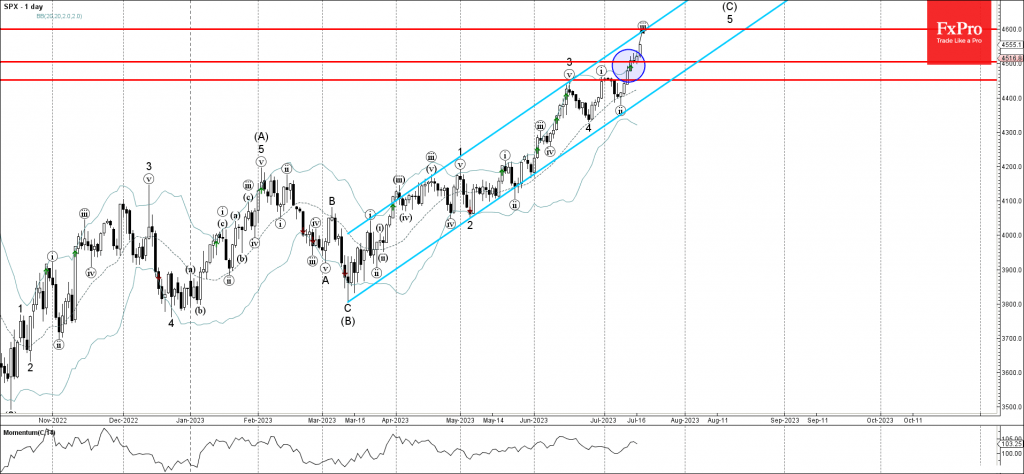
- S&P 500 broke resistance level 4500.00
- Likely to rise to resistance level 4600.00
S&P 500 index under the bullish pressure after the price broke above the key resistance level 4500.00.
The breakout of the resistance level 4500.00 accelerated the active impulse wave iii of the impulse wave 5 of the intermediate impulse sequence C from the start of March.
Given the prevailing uptrend, S&P 500 index can be expected to rise further toward the next resistance level 4600.00 (target price for the completion of the active impulse wave iii).
EURCHF Wave Analysis
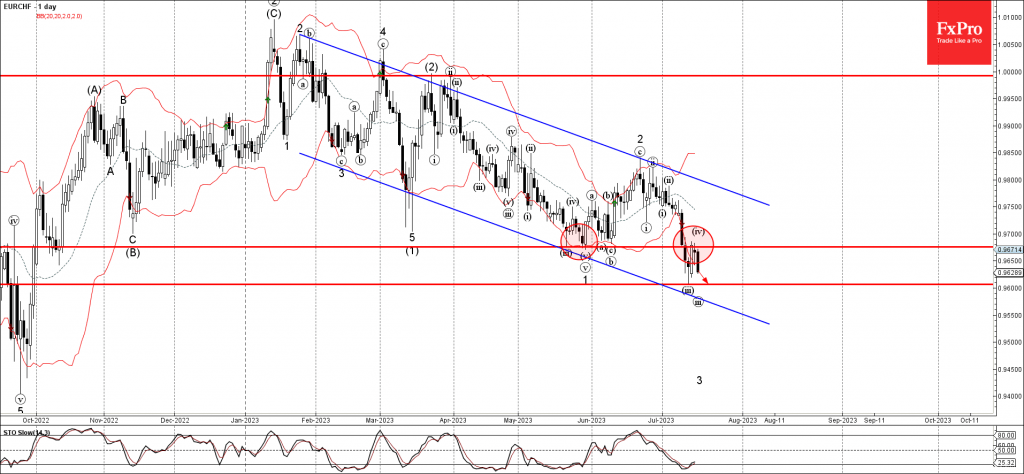
- EURCHF reversed from resistance level 0.9675
- Likely to fall to support level 0.9600
EURCHF currency pair recently reversed down from the key resistance level 0.9675 (former multi-month support May and June).
The downward reversal from the resistance level 0.9675 stopped the previous minor correction (ii) forming the daily Evening Star.
Given the prevailing downtrend, EURCHF can be expected to fall further toward the next support level 0.9600 (low of the previous minor impulse wave iii).
JPY Starts the Week With Decline
According to Japanese Finance Minister Shunichi Suzuki, there was "no discussion" about exchange rates during the recent meeting of Group of Seven (G7) finance ministers and central bank chiefs in India. This news comes as the yen weakened to around ¥145 per dollar last month, prompting concerns that the Japanese government may intervene in the currency market to support the yen. However, the yen has rebounded strongly this month to approximately ¥138 per dollar. A weak yen can benefit Japanese exporters and raise import costs for businesses and consumers. On another note, Suzuki reiterated Japan's strong support for Ukraine. Bank of Japan Governor Kazuo Ueda highlighted the uncertainty in the global economy, which is influencing the central bank's decision to maintain ultra-easy monetary policy despite inflation exceeding the target. The BOJ's loose monetary policy has been a key factor contributing to the yen's weakness compared to other major currencies. Keep an eye on these developments for potential impact on forex markets!
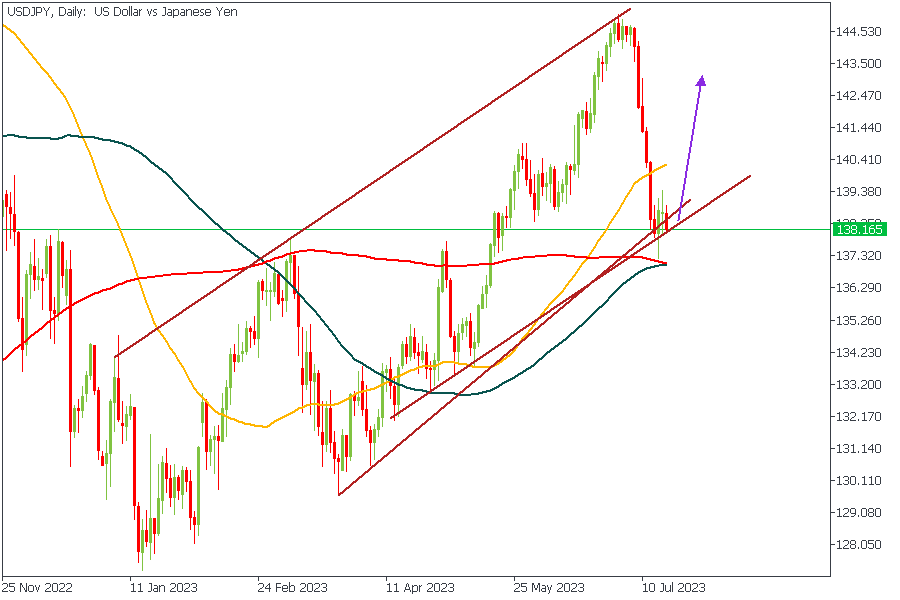
USDJPY - D1 Timeframe
USDJPY is currently resting on top of a double trendline situation within a strong pivot range. Looking also at how the moving averages are poised, there is a high likelihood that the price rebounds off the trendline in continuation of the original bullish movement.
Analyst’s Expectations:
- Direction: Bullish
- Target: 141.986
- Invalidation: 136.867
GBPJPY - D1 Timeframe
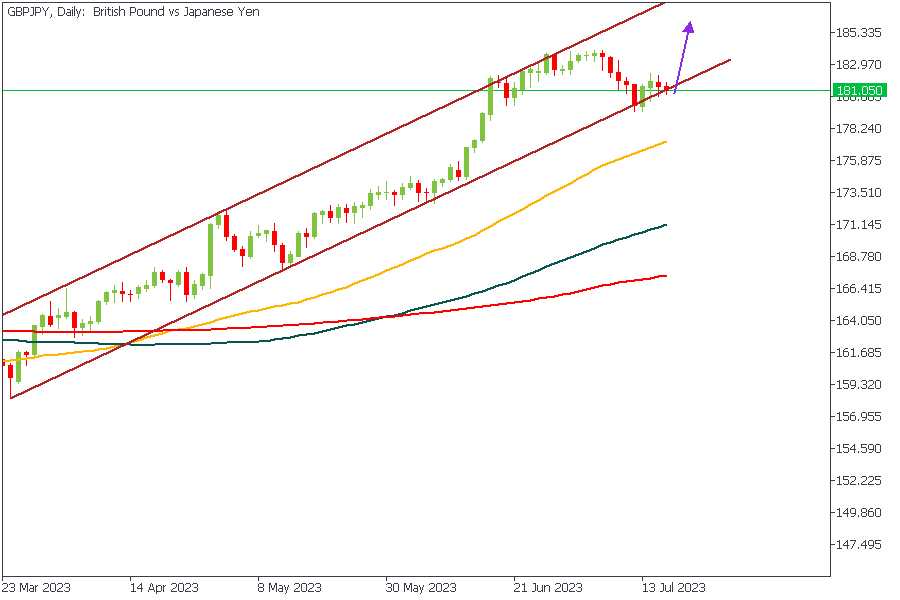
GBPJPY, as shown in the chart, is currently trading inside a rising channel pattern. The moving averages are also currently in a bullish array, which lends credibility to the likelihood of a bullish reaction from the support trendline.
Analyst’s Expectations:
- Direction: Bullish
- Target: 183.245
- Invalidation: 179.360
CADJPY - D1 Timeframe
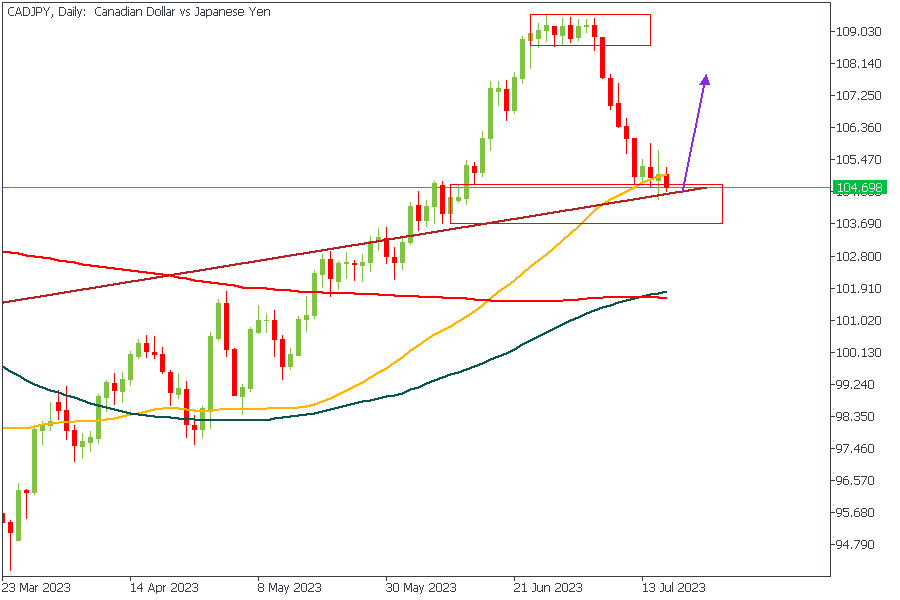
CADJPY has, at this time, reached a strong demand zone. The demand zone has confluences from the trendline support, the 50-day moving average, and the bullish array of the moving averages. Based on the observed confluences, I will be watching for a continuation of the bullish trend.
Analyst’s Expectations:
- Direction: Bullish
- Target: 107.035
- Invalidation: 103.670
CONCLUSION
The trading of CFDs comes at a risk. Thus, to succeed, you have to manage risks properly. To avoid costly mistakes while you look to trade these opportunities, be sure to do your due diligence and manage your risk appropriately.
XAU/USD: Gold Breaks Key Barriers on 1.2% Advance on Tuesday
Gold price jumped to 1 ½ month high on Wednesday, mainly driven by weaker dollar on changing US rate outlook.
Although US retail sales missed expectations in June (data released on Tuesday) spending remains resilient despite strong rise in borrowing cost, adding to positive signals from easing inflation, which is likely to prompt Fed to end its tightening cycle in the near future.
Recent economic data showed that the US economy is in better shape than anticipated and analysts are optimistic in their expectations that the US will avoid recession.
Brightening rate outlook keeps the dollar under pressure and boosts demand for the yellow metal, but gains might be limited as the start of cutting rates is unlikely in the near future.
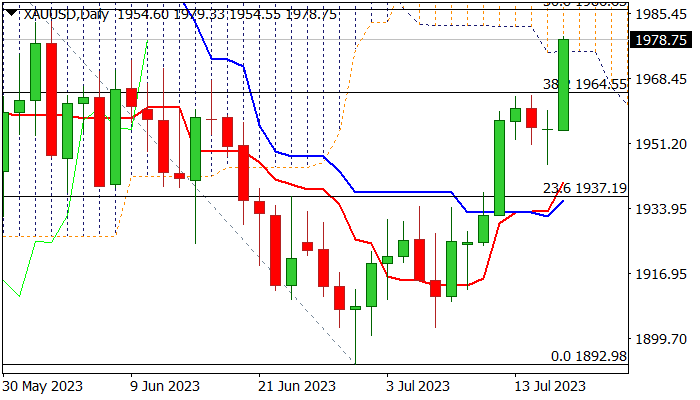
Fresh strength signals continuation of an uptrend from $1892 (June 29 low) after brief consolidation in past three days.
Bulls broke through important Fibo barrier at $1964 (38.2% retracement of $2080/$1892) and penetrated into falling daily cloud (cloud base lays at $1975) with close within the cloud needed to confirm fresh bullish signal.
Daily studies are in full bullish setup, but overbought conditions warn that bulls may start to lose traction.
Dip-buying for rally towards $1986 (Fibo 50%) and $2000 (psychological) in extension, to remain favored while the price stays above broken Fibo 38.2% barrier at $1964.
Res: 1986; 2000; 2006; 2008
Sup: 1975; 1964; 1956; 1945
BoJ Ueda: Sustainably achieving 2% inflation remains distant
BoJ Governor Kazuo Ueda, following a G20 finance leaders' meeting in India, has restated the central bank's stance on maintaining their ultra-loose monetary policy under yield curve control as sustainably and stably achieving 2% inflation target remains a distant objective.
He stated, "Based on this understanding, we have patiently continued our ultra-loose monetary policy under yield curve control."
Ueda highlighted BOJ's intent to thoroughly assess the pace of Japan's progress towards sustainably achieving its 2% target during every policy meeting.
He added, "If our assumption (that sustained achievement of 2% inflation remains distant) is unchanged, our overall narrative on monetary policy remains unchanged," indicating that any alteration to YCC policy will depend on the evidence of significant progress towards the central bank's inflation target.
Sunset Market Commentary
Markets
German Bunds vastly outperform US Treasuries today. Yields in the country drop 6.5-14.8 bps with the front end of the curve particularly in market’s focus. Comments from ECB’s Knot were responsible. The Dutch central bank governor is known as an outspoken hawk but in an interview with news agency Bloomberg today he struck an unusual neutral-to-dovish tone. Knot said that core inflation looks like it has plateaued. While labeling a July 27 rate hike as a given, he called any increases after that “at most a possibility”. It all comes down to the data between next week and September. Knot did call into question Italian governor Visco’s view of inflation hitting 2% sooner than the ECB’s official forecast of 2025. That suggests he still favours a high-for-longer strategy. European money markets stepped further away from a peak policy rate at 4%. Such a scenario gets attributed a 40% chance vs 60% yesterday. US rates eased 4-7 bps going into the publication of the June retail sales. Last month’s volumes sold were revised up by 0.1-0.2 ppts, downplaying the miss for the headline number which came in at 0.2% m/m vs 0.5% consensus. More importantly, a core gauge used to calculate GDP and which excludes food services, auto dealers, building materials and gasoline stations rose a firm 0.6%. At the very least it points at consumer resilience. Yields whipsawed in the immediate aftermath but eventually returned to levels seen prior to the release. UK gilts hold a road somewhere between Bunds and UST’s. British yields fall 6.5-8 bps as investors await tomorrow’s inflation data. Stocks fluctuated throughout the day, flipflopping between minor gains and losses. The EuroStoxx50 sheds 0.2% at the time of writing.
General volatility on FI markets is much higher compared to FX. EUR/USD went for a test of the 1.1274 resistance level but first Knot and later US data killed off the attack pretty soon. The pair is currently trading near intraday lows around 1.123. DXY sticks around below 100. EUR/GBP surpassed 0.86 for the first time since the beginning of this month but Knot’s comments killed off that adventure quickly. The combo is now changing hands in the 0.856 area. The Japanese yen is better bid following the drop in core bond yields. USD/JPY moves south to 138.21. EUR/JPY joins that downleg to 155.27. The Canadian dollar faces conflicting signals from the June CPI numbers (see below). News & Views
According to the UK government agency insolvency services, the number of registered company insolvencies in June 2023 was 27% higher than in the same month in 2022. The agency also specified that this is higher than the levels seen when the government support measures were in place in response to the coronavirus (COVID-19) pandemic and also higher than pre-pandemic numbers. The data suggest that the combination of lower demand due to the cost of living crisis, higher interest rates and rising wage coast are taking their toll at least on part of UK enterprises. On a completely different topic, a YouGov poll published today showed that 57% of Britons indicated that the decision to leave the European in 2016 was wrong. 32% still consider it a correct decision. 55% of the respondents now indicated they would vote to stay in the European union while 31% said they still would opt to stay out in case a referendum was to be held now.
Economic data released in Canada today showed a mixed picture. Headline CPI in June decelerated faster than expected to 0.1% M/M bringing the Y/Y measure down from 4.0% to 2.8%. A decline to 3% was expected. So, at least headline inflation returned within the 1-3% Bank of Canada target band for the first time since March 2021. However, the decline in the core median (unchanged at 3.9% Y/Y) and core trim (3.7% from 3.8%) which are closely monitored by the Bank of Canada was slightly less than expected. Goods inflation slowed to 1.4% Y/Y. Services inflation printed at 4.2% down from 4.6% Y/Y. At the same time, housing starts unexpectedly jumped to an annualized rate of 281.4k from 200k in May. Last week, the BoC for the second consecutive meeting again rose its policy rate by 25 bps to 5.0%. The Bank paused its hiking cycle in March and April. In last week’s communiqué the BoC assessed that ‘with three-month rates of core inflation running around 3½-4% since last September, underlying price pressures appear to be more persistent than anticipated’. The Canadian 2-y yield eases 4.5 bps, but this is probably mainly due to overall market trends. The loonie is losing modest ground against the dollar with USD/CAD trading near 1.3220 from a close near 1.32 yesterday evening.
USD/JPY Mid-Day Outlook
Daily Pivots: (S1) 138.01; (P) 138.71; (R1) 139.41; More...
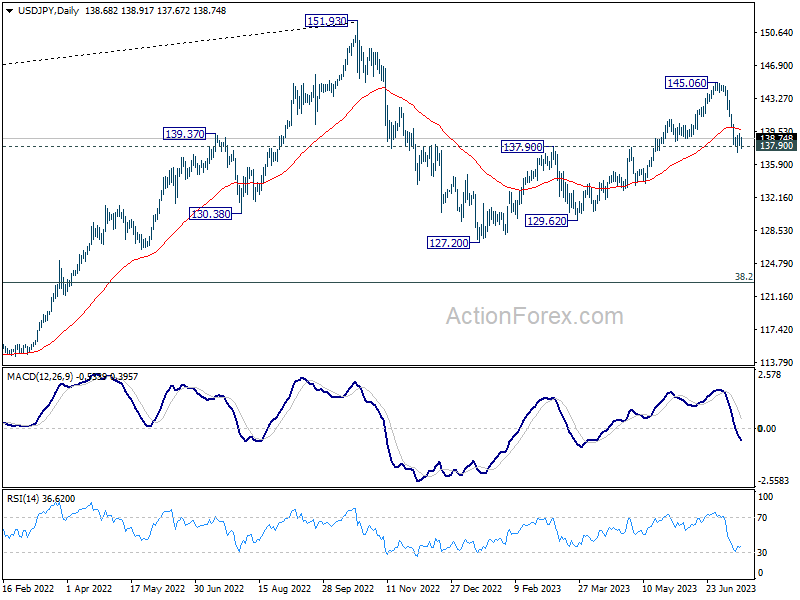
USD/JPY is extending the consolidation from 137.22 and intraday bias stays neutral. Upside of recovery should be limited by 55 4H EMA (now at 140.06) and bring another decline. Break of 137.22 and sustained trading below 137.90 resistance turned support will confirm the larger bearish case, and target 127.20 and below.
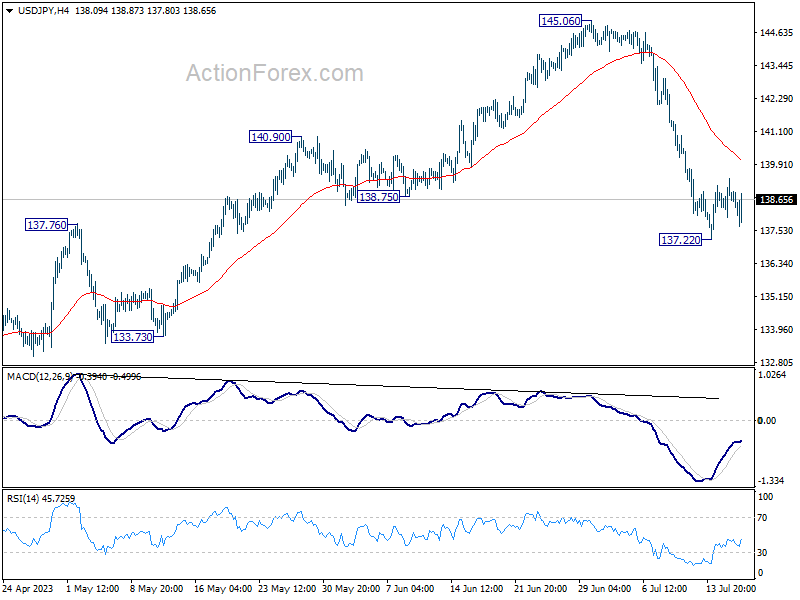
In the bigger picture, fall from 145.06 is seen as the third leg of the corrective pattern from 151.93 (2022 high). Sustained break of 137.90 resistance turned support should confirm this case and target 127.20 (2023 low) and below. For now, this will remain the favored case as long as 145.06 resistance holds, even in case of strong rebound.