

Sample Category Title
Sunset Market Commentary
Markets
The German IFO business climate index brought a message similar to last Friday’s EMU PMI’s. Sentiment in Europe’s biggest economy has clouded over considerably, Ifo reported. The overall index dropped from 91.5 to 88.5. In particular, companies turned markedly more pessimistic on expectations (83.6 from 88.3) but current assessment was also softer than last month (93.7 from 94.8). Ifo explicitly mentions that ‘weakness in the manufacturing sector is steering the German economy into turbulent waters’. Many companies in the sector rate their order backlogs as being too low. However, subindices for services, trade and construction also printed at a lower level compared to last month. The Ifo release, together with a fragile risk sentiment, helped bonds to extend Friday’s, even as the move slowed after USD traders joined. German yields currently are ceding between 1.5 bps and 3.5 bps with the belly of the curve (5 &10’s) again outperforming. US yields on Friday were less affected as US PMI’s showed more resilient compared to Europe. Today, US and European interest rate markets again trade more or less in line with US yields declining from 1 bp (2-y) to 3.0 bps (5-y). Markets apparently fear that central bankers’ determination to eradicate (core) inflation will make it more difficult to engineer the hoped for soft landing, both in the US and in Europe. This evening, ECB’s Lagarde opens the ECB Forum on monetary policy in Sintra. The US Treasury later today also will sell $42 bln of 2-year notes.European equity indices initially declined 0.5%/0.75%, but selling pressure gradually eased. The Eurostoxx 50 currently even reversed initial losses (+0.3%). The S&P 500 opens little changed. Investors are still pondering the consequences of the turmoil in Russia this weekend, but apparently didn’t draw any firm conclusions yet. The Dutch reference gas contract this morning temporarily jumped about 10 % higher but currently again trades little changed near €33/MWh. Oil also shows no clear directional trend (Brent $74.4 p/b). Golds gains modestly trading at $1930 p/oz.
FX markets show a mixed, slightly inconclusive picture. The dollar again doesn’t profit from geopolitical and/or economic uncertainty. DXY dropped back to the 102,65 area. EUR/USD, despite fragile EMU data regains the 1.09 barrier (1.0915). The yen (USD/JPY 143,45, EUR/JPY 156.55) is holding within reach of the lows registered end last week. EUR/GBP again follows the broader EUR/USD move, rebounding to the 0.8590 area, compared to a pre-BoE correction low at 0.8518 touched last week. Despite uncertainty on Russia, CE currencies continue to perform well with especially the Czech koruna (EUR/CZK 23.65) and the forint (EUR/HUF 369) showing decent buying interest.
News & Views
The Financial Times reported that the German audit office, the Bundesrechnungshof, said that possible Bundesbank losses are substantial and could necessitate a recapitalization of the German central bank with budgetary funds. “Depending on the extent and probability, the risks arising from monetary policy could, in the worst case, endanger the budgetary autonomy of the German Bundestag”. In its annual report earlier this, the Bundesbank announced a €1bn hit from its bond holdings, warning that future losses will likely exceed its remaining €19.2bn of provisions and €2.5bn capital. The rising interest rate environment causes losses on bond portfolios accumulated over the past decade via asset purchase programmes (monetary policy). The Bundesbank already stopped paying dividends to government. Other European national banks, including the NBB, are facing similar problems.
The Turkish lira reached another all-time low today (EUR/TRY > 28) after the central bank (CBRT) this weekend announced another step to a more conventional monetary policy. It reduced the security maintenance ratio for banks from 10% to 5%. These forced banks to hold TRY-denominated bonds on top of required reserves for FX deposits. The CBRT also lowered the threshold from 60% to 57% above which banks were required to pay a higher maintenance. The measures are part of undoing the previous lira-isation strategy. Since Erdogan’s presidential re-election, the ministry of Finance also ended costly FX-interventions to artificially slow the decline in TRY while the CBRT raised its policy rate in first instance from 8.5% to 15%.
EUR/USD Mid-Day Outlook
Daily Pivots: (S1) 1.0835; (P) 1.0903; (R1) 1.0960; More...
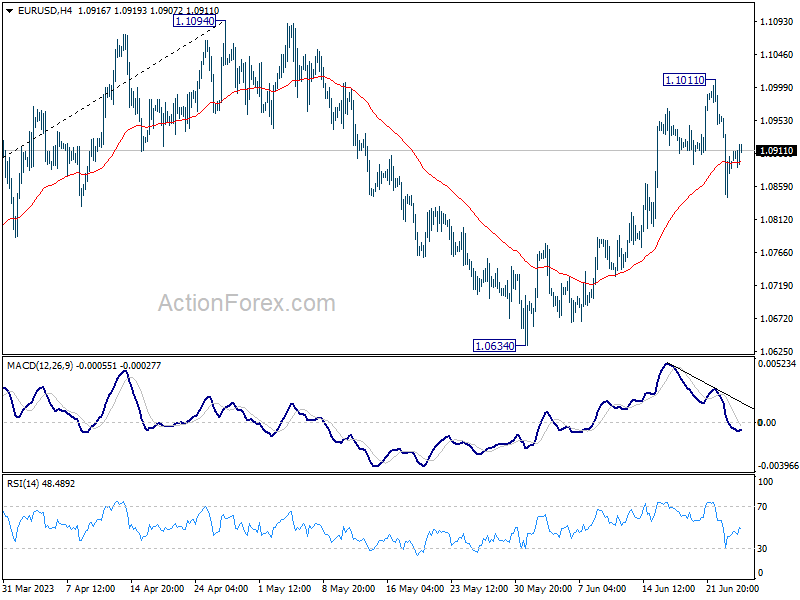
Outlook in EUR/USD remains unchanged. Fall from 1.1101 is seen as the third leg of the corrective pattern from 1.1094. Sustained break of 55 D EMA (now at 1.0838) will target 1.0634 support and below. Nevertheless, rebound from current level, followed by break of 1.1011 will target a test on 1.1094 high instead.
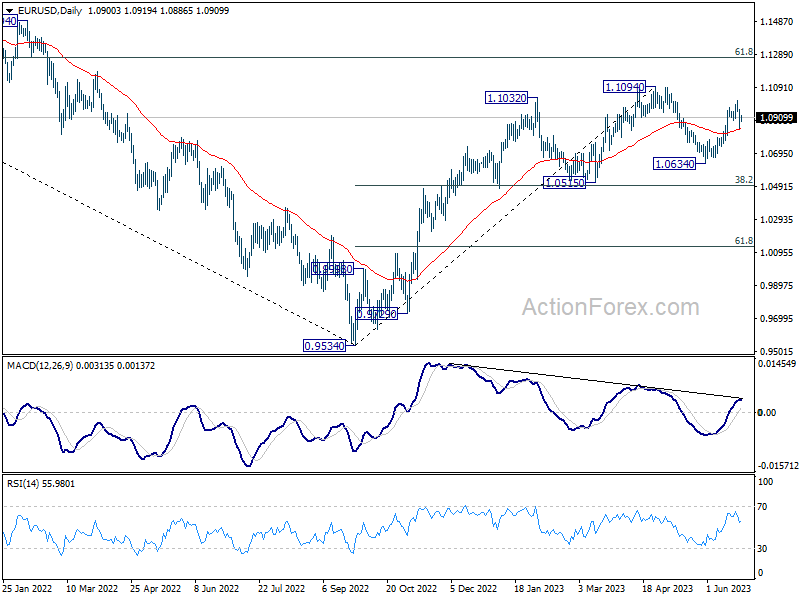
In the bigger picture, as long as 1.0515 support holds, rise from 0.9534 (2022 low) would still extend higher. Sustained break of 61.8% retracement of 1.2348 (2021 high) to 0.9534 at 1.1273 will solidify the case of bullish trend reversal and target 1.2348 resistance next (2021 high).
GBP/USD Mid-Day Outlook
Daily Pivots: (S1) 1.2683; (P) 1.2719; (R1) 1.2753; More...
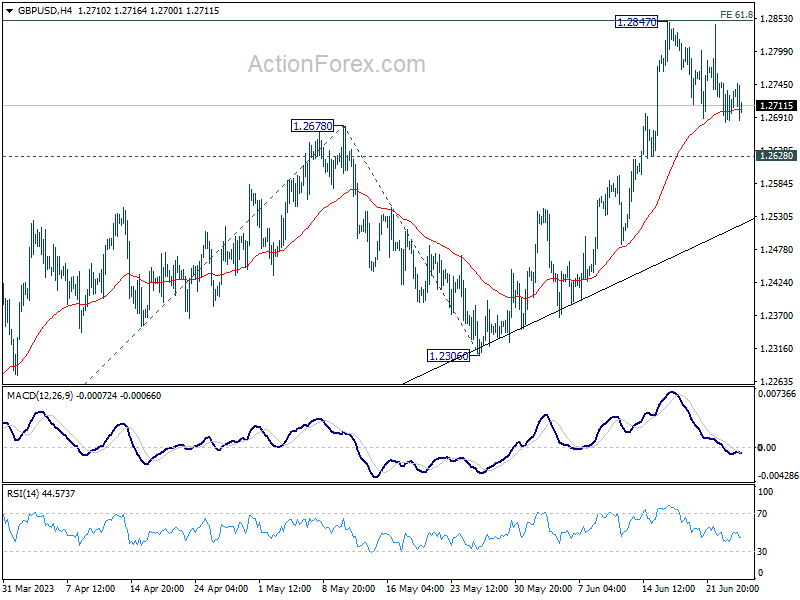
Intraday bias in GBP/USD remains neutral as consolidation from 1.2847 is still in progress. Further rally is expected as long as 1.2628 support holds. On the upside, firm break of 1.2847 will resume larger up trend and target 100% projection of 1.1801 to 1.2678 from 1.2306 at 1.3183 next. However, firm break of 1.2628 will turn bias to the downside, for deeper fall to 1.2306 support instead.
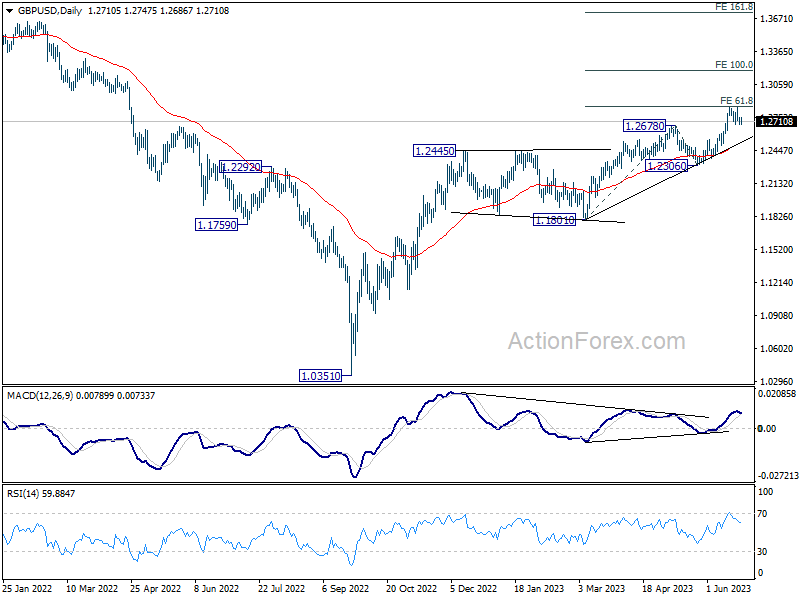
In the bigger picture, the strong support from 55 W EMA (now at 1.2341) is a medium term bullish sign. Outlook will stay bullish as long as 1.2306 support holds. Rise from 1.0351 medium term bottom (2022 low) is expected to extend further to retest 1.4248 key resistance (2021 high).
USD/JPY Mid-Day Outlook
Daily Pivots: (S1) 143.03; (P) 143.45; (R1) 144.14; More...
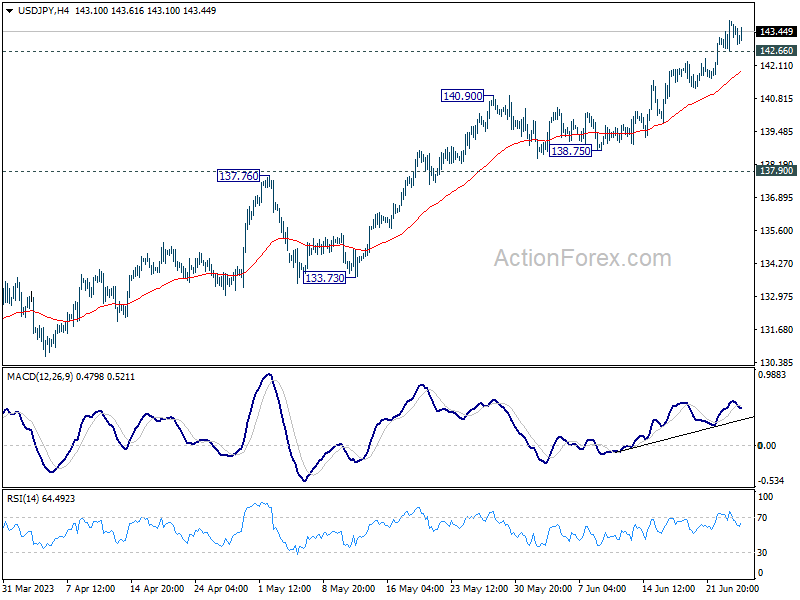
Intraday bias in USD/JPY stays mildly on the upside with 142.66 minor support intact. Current rally from 127.20 should target 161.8% projection of 127.20 to 137.90 from 129.62 at 146.93. On the downside, below 142.66 minor support will turn intraday bias neutral first. But further rally will now remain in favor as long as 137.90 resistance turned support holds.
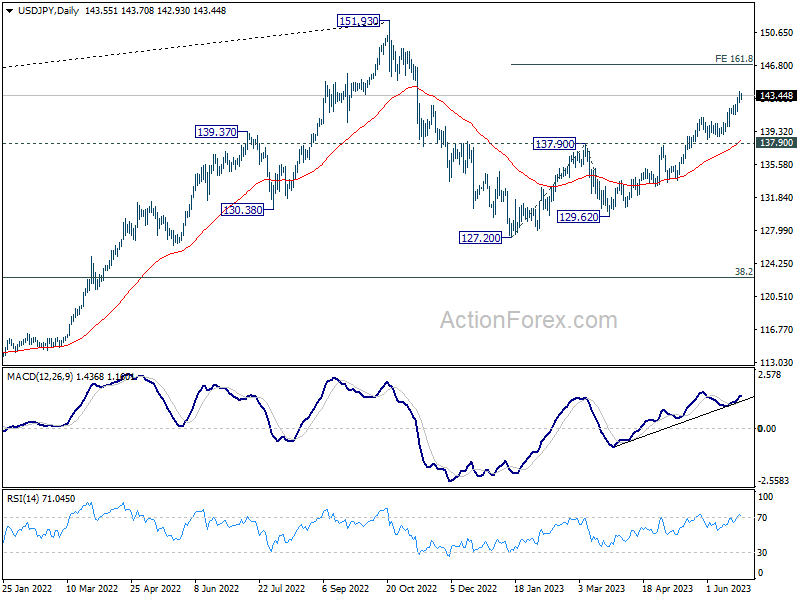
In the bigger picture, rise from 127.20 is currently seen as the second leg of the corrective pattern from 151.93 high. Further rally is expected as long as 137.90 resistance turned support holds, to retest 151.93. But strong resistance could be seen there to limit upside. Break of 137.90 will indicate the the third leg has started back towards 127.20.
USD/CHF Mid-Day Outlook
Daily Pivots: (S1) 0.8934; (P) 0.8973; (R1) 0.9010; More...
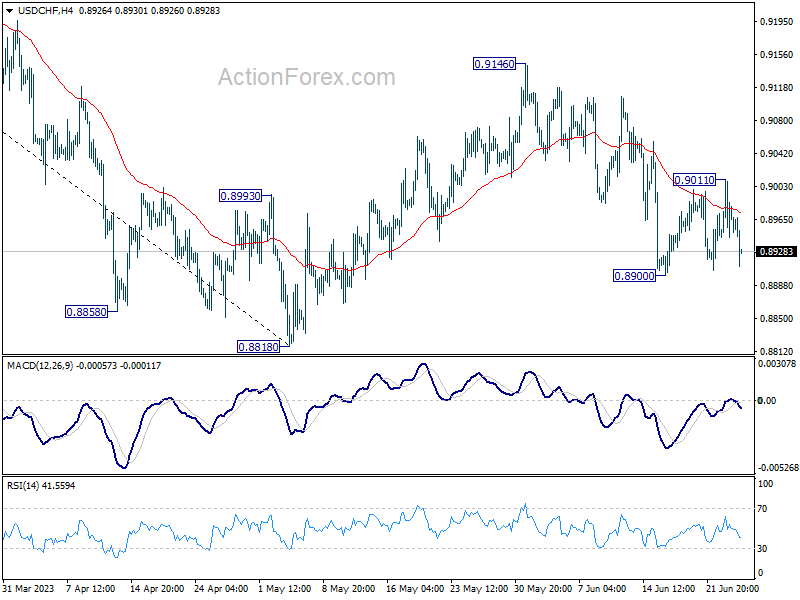
USD/CHF dips notably today but stays above 0.8900 temporary low. Intraday bias remains neutral first. Break of 0.8900 will resume the fall from 0.9146 to 0.8818 low or below. But for now, strong support is still expected from 0.8756 long term support to bring rebound. . On the upside, above 0.9011 will bring stronger rise towards 0.9146 resistance.
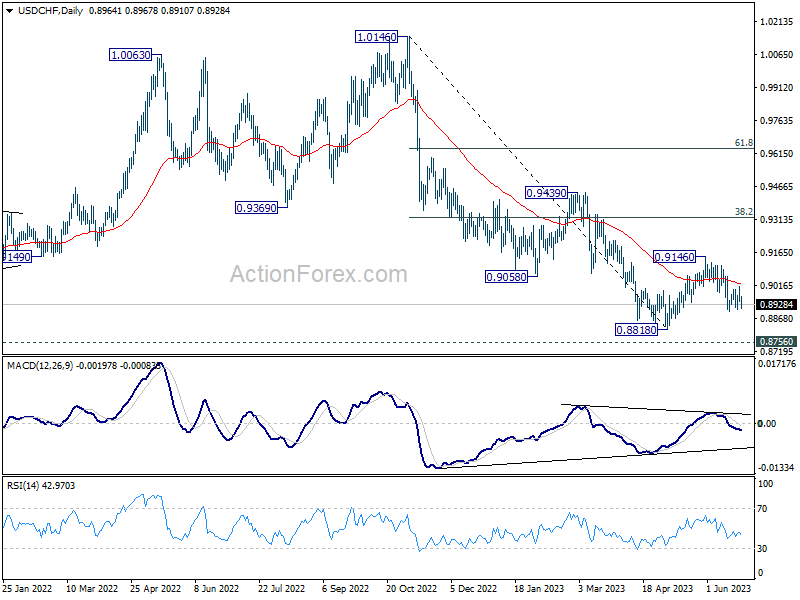
In the bigger picture, fall from 1.1046 (2022 high) is seen as a leg in the long term range pattern from 1.0342 (2016 high), which might have completed at 0.8818 already, just ahead of 0.8756 long term support. Sustained trading above 0.9058 support turned resistance should confirm medium term bottoming.
Swiss Franc Capitalizes on Disappointing German Data and Geopolitical Uncertainty
Today sees Swiss Franc making notable gains due to an array of risk-averse factors at play. Disheartening data on German business sentiment fuels concerns about a protracted recession in the country and by extension, the broader Eurozone. While the weekend's events surrounding Wagner mutiny may not have triggered a seismic response in the markets, the ensuing rise in geopolitical uncertainty is hard to overlook. This has prompted an inflow into safe-haven assets like government bonds, consequently driving down major European and US yields. Swiss Franc stands to gain from these dynamics, both as a direct beneficiary of its safe-haven status and from buying pressure against Euro.
In other currency market developments, New Zealand Dollar is also on the rise, ranking as the second strongest currency for the day, largely due a rally against Aussie Dollar. Conversely, Sterling is faring poorly as today's weakest performer, with Dollar and Aussie trailing closely. Meanwhile, Yen's performance is mixed, with verbal interventions from Japanese officials cushioning its recent decline.
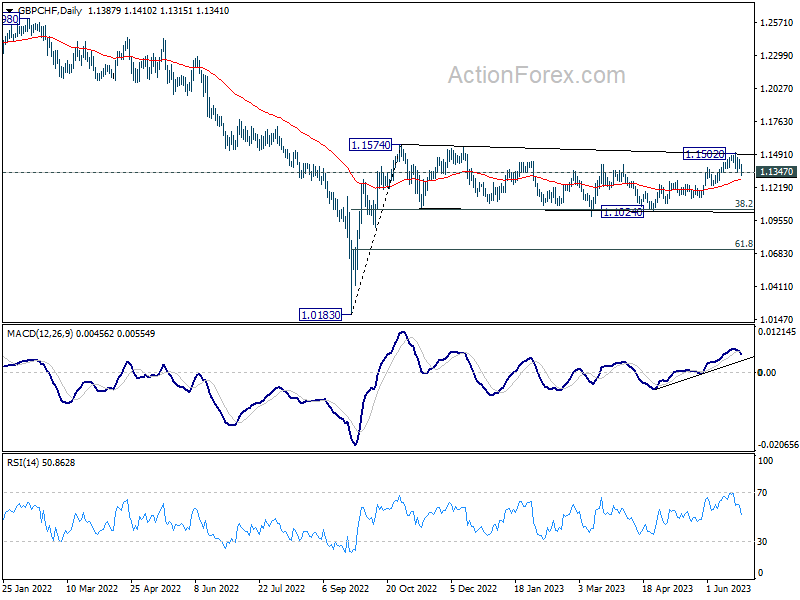
Technically, GBP/CHF's break of 1.1347 support today argues that the rebound from 1.1024 has completed at 1.1502, after rejection by 1.1574 resistance. The development also indicates that corrective pattern from 1.1574 is extending with another falling leg. Immediate focus is now on 55 D EMA (now at 1.1284). Firm break there will bring deeper fall towards 1.1024 cluster support (38.2% retracement of 1.0183 to 1.1574 at 1.1043).
In Europe, at the time of writing, FTSE is down -0.01%. DAX is down -0.12%. CAC is up 0.21%. Germany 10-year yield is down -0.0578 at 2.301. Earlier in Asia, Nikkei dropped -0.25%. Hong Kong HSI dropped -0.51%. China Shanghai SSE dropped -1.48%. Singapore Strait Times dropped -0.06%. Japan 10-year JGB yield is dropped -0.0183 to 0.353.
Bundesbank foresees difficult recovery for Germany, despite ended recession in Spring
In its latest monthly report, Bundesbank projected a somewhat gloomy economic outlook for Germany. The central bank expects the country's GDP to shrink by a calendar-adjusted -0.3% for 2023, with subsequent growth projected at 1.2% in 2024 and 1.3% in 2025.
Characterizing the economic recovery as a laborious process, the Bundesbank pointed to the lingering impacts of the crises Germany has endured over the past three years. The nation's recession, however, is anticipated to conclude in the spring quarter, with a slight increase in GDP predicted for April to June period.
Bundesbank anticipates that private consumption, a crucial component of economic health, will hit its lowest point and then begin to rebound. It highlighted that "Thanks to strongly rising wages, the real disposable incomes of private households are stabilizing despite inflation remaining very high."
Germany Ifo down to 88.5, manufacturing weakness steering economy into turbulent waters
Germany Ifo Business Climate fell from 91.5 to 88.5 in June, below expectation of 91.2. Current Assessment Index dropped from 94.8 to 93.7, slightly above expectation of 93.5. Expectations Index tumbled further from 88.3 to 83.6, below expectation of 88.0.
By sector, manufacturing fell sharply from -0.1 to -6.6, lowest since November. Services dropped from 6.8 to 2.7. Trade edged down from -19.1 to -20.2. Construction decreased from -18.5 to -20.1.
Ifo said: "Sentiment in the German economy has clouded over considerably...Above all, the weakness in the manufacturing sector is steering the German economy into turbulent waters."
SNB to pilot wholesale CBDC on SIX digital exchange
Switzerland's central bank is making a foray into the realm of digital currencies. Thomas Jordan, Chairman of SNB, revealed plans to launch a wholesale central bank digital currency on the country's SIX digital exchange, as part of a pilot.
In a conference in Zurich, Jordan clarified that the CBDC is not a mere experiment, but a step towards digitizing money. He asserted, "This is not just an experiment, it will be real money equivalent to bank reserves and the objective is to test real transactions with market participants."
Despite the innovative move, Jordan voiced concerns regarding potential risks posed by retail CBDCs on the financial system. Moreover, he flagged the difficulty in controlling the use of such currencies. While not ruling out future introduction of retail CBDCs, he expressed a measure of caution, stating, "We do not exclude that we will never introduce retail [CBDCs] but nevertheless we are a little bit prudent at the moment."
Japan's top officials voice concern over 'rapid and one-sided' yen moves
In the face of Yen's swift depreciation, top Japanese currency diplomat Masato Kanda expressed concern on Monday, describing the recent changes as "rapid and one-sided. He added that "We have all options available and we are not ruling out any options."
Kanda, Vice Finance Minister for International Affairs, however, refrained from using the phrase "decisive action," a term he used before Japan intervened in the currency market last year. This careful choice of words suggests that while officials are monitoring the situation, they may not be ready to step in just yet.
Adding to this sentiment, Finance Minister Shunichi Suzuki highlighted the ongoing vigilance of the government, stating that "we will continue to watch the forex market with a sense of urgency."
In keeping with this sense of readiness, Suzuki assured that authorities would respond "appropriately" to any excessive currency swings, indicating that the government is primed to intervene if necessary.
BoJ opinions: Persistent monetary easing stance upheld, first call YCC Debate
Summary of opinions from BoJ Monetary Policy Meeting on June 15-16 shed light on the prevailing sentiment among policymakers regarding the nation's current monetary easing stance.
Among the opinions expressed, there was an evident call for maintaining the current monetary easing policy to support rising wage growth, which was described as "the highest in around 30 years."
Board members noted, "In order to achieve the price stability target of 2 percent in a sustainable and stable manner, price rises accompanied by wage increases, rather than those caused by cost-push factors, are necessary."
The Bank was thus urged to "keep supporting such momentum for wage hikes through continuation of the current monetary easing."
Significantly, there was a focus on the potential risks associated with premature policy revisions. It was stated, "It would be premature to revise monetary policy if it would hinder such developments," referring to increasing wage and investment willingness among small and medium-sized firms.
Policymakers also warned against a "hasty policy change" that could miss the chance to achieve the price stability target.
However, one board member signaled a notable dissent, explicitly calling for an early discussion about tweaking the BoJ's yield curve control (YCC) - a tool for monetary easing.
This marked the first time a BOJ summary displayed a member's open expression for an early debate on modifying the YCC, hinting at possible future shifts in the Bank's policy discussions.
USD/CHF Mid-Day Outlook
Daily Pivots: (S1) 0.8934; (P) 0.8973; (R1) 0.9010; More...
USD/CHF dips notably today but stays above 0.8900 temporary low. Intraday bias remains neutral first. Break of 0.8900 will resume the fall from 0.9146 to 0.8818 low or below. But for now, strong support is still expected from 0.8756 long term support to bring rebound. . On the upside, above 0.9011 will bring stronger rise towards 0.9146 resistance.
In the bigger picture, fall from 1.1046 (2022 high) is seen as a leg in the long term range pattern from 1.0342 (2016 high), which might have completed at 0.8818 already, just ahead of 0.8756 long term support. Sustained trading above 0.9058 support turned resistance should confirm medium term bottoming.
Economic Indicators Update
| GMT | Ccy | Events | Actual | Forecast | Previous | Revised |
|---|---|---|---|---|---|---|
| 23:50 | JPY | Corporate Service Price Index Y/Y May | 1.60% | 1.80% | 1.60% | |
| 23:50 | JPY | BoJ Summary of Opinions | ||||
| 08:00 | EUR | Germany IFO Business Climate Jun | 88.5 | 91.2 | 91.7 | 91.5 |
| 08:00 | EUR | Germany IFO Current Assessment Jun | 93.7 | 93.5 | 94.8 | |
| 08:00 | EUR | Germany IFO Expectations Jun | 83.6 | 88 | 88.6 | 88.3 |
SNB to pilot wholesale CBDC on SIX digital exchange
Switzerland's central bank is making a foray into the realm of digital currencies. Thomas Jordan, Chairman of SNB, revealed plans to launch a wholesale central bank digital currency on the country's SIX digital exchange, as part of a pilot.
In a conference in Zurich, Jordan clarified that the CBDC is not a mere experiment, but a step towards digitizing money. He asserted, "This is not just an experiment, it will be real money equivalent to bank reserves and the objective is to test real transactions with market participants."
Despite the innovative move, Jordan voiced concerns regarding potential risks posed by retail CBDCs on the financial system. Moreover, he flagged the difficulty in controlling the use of such currencies. While not ruling out future introduction of retail CBDCs, he expressed a measure of caution, stating, "We do not exclude that we will never introduce retail [CBDCs] but nevertheless we are a little bit prudent at the moment."
Navigating EUR/USD Stability, Speculation, and Technical Analysis
EUR/USD remains steady near 1.0910 as it enters the new week of June, shrugging off some of the tension it previously faced.
In the recent past, the market was consumed with speculation and conjecture about the next moves of the US Federal Reserve System regarding interest rates. According to the CME FedWatch monitor, there is a high likelihood of a credit cost increase at the July meeting.
Monetary policymakers at the Fed have been hinting at similar possibilities. Fed Chair Jerome Powell, while addressing politicians last week, expressed that the idea of raising rates again seemed reasonable.
The primary objective for the Fed remains the same—to bring inflation back to 2%. Presently, inflation figures are considerably higher, necessitating an ongoing battle.
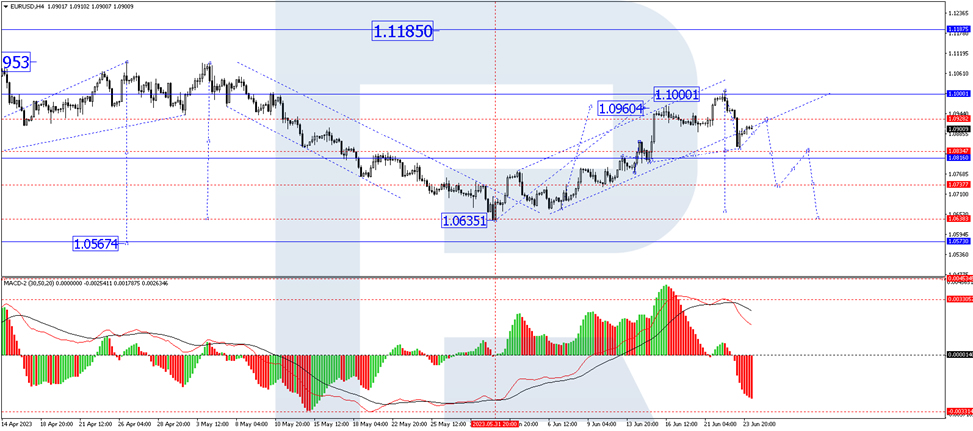
From a technical analysis perspective, EUR/USD has followed the projected upward wave to 1.1000 on the H4 timeframe. Subsequently, the market experienced a downward impulse, reaching 1.0844. A correction to 1.0930 could develop today, and after its completion, a new downward wave to 1.0740, possibly extending to 1.0660, may ensue. This scenario gains support from the MACD indicator, with its signal line currently at highs and descending sharply towards zero.
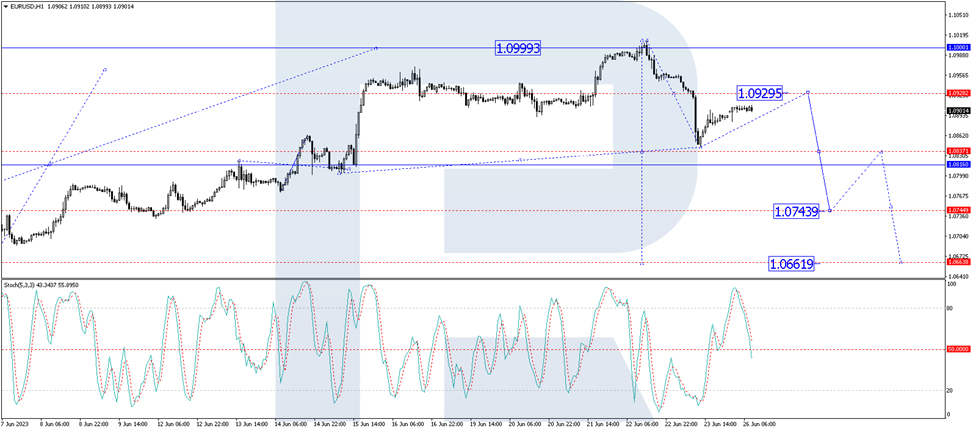
On the H1 timeframe, a consolidation range has formed around 1.0940. Upon breaking out upwards, the market exhibited an extended structure, reaching 1.1000. It then underwent a downward impulse to 1.0840. A correction to 1.0940 has already occurred today, testing from below. Following its completion, a fresh downward wave to 1.0840 could commence. This technical scenario finds confirmation from the Stochastic oscillator, as its signal line is above 50 and could potentially rise to 80 today.
Overall, EUR/USD has remained resilient near the 1.0910 level, exhibiting stability despite previous uncertainties. The upcoming actions of the US Federal Reserve System regarding interest rates continue to be a focal point for market participants, with analysts closely monitoring the potential impact on the currency pair. From a technical standpoint, various indicators and patterns suggest the possibility of both corrective rallies and downward movements, indicating the importance of monitoring key levels and trend developments.
Bundesbank foresees difficult recovery for Germany, despite ended recession in Spring
In its latest monthly report, Bundesbank projected a somewhat gloomy economic outlook for Germany. The central bank expects the country's GDP to shrink by a calendar-adjusted -0.3% for 2023, with subsequent growth projected at 1.2% in 2024 and 1.3% in 2025.
Characterizing the economic recovery as a laborious process, the Bundesbank pointed to the lingering impacts of the crises Germany has endured over the past three years. The nation's recession, however, is anticipated to conclude in the spring quarter, with a slight increase in GDP predicted for April to June period.
Bundesbank anticipates that private consumption, a crucial component of economic health, will hit its lowest point and then begin to rebound. It highlighted that "Thanks to strongly rising wages, the real disposable incomes of private households are stabilizing despite inflation remaining very high."
Bitcoin Needs to Cool Off for Now after Proving its Ability to Grow
Market picture
The total capitalisation of the crypto market rose 10.8% over the week to $1.184 trillion, according to CoinMarketCap. Bitcoin rose 15% over the week to close at $30.4K. Ethereum gained 9.5% to $1890. Other leading altcoins in the top 10 showed mixed dynamics, ranging from a 2.8% decline (BNB) to an 11.1% gain (Cardano).
Bitcoin renewed its early June highs near $31.4K on Friday, but the rally was not sustained, and over the weekend, the recent momentum was dissipated, bringing the price back down to $30.3K in early Monday trading. The BTC rally is often attributed to hopes of launching spot bitcoin ETFs, which ease access of institutional capital to the flagship cryptocurrency.
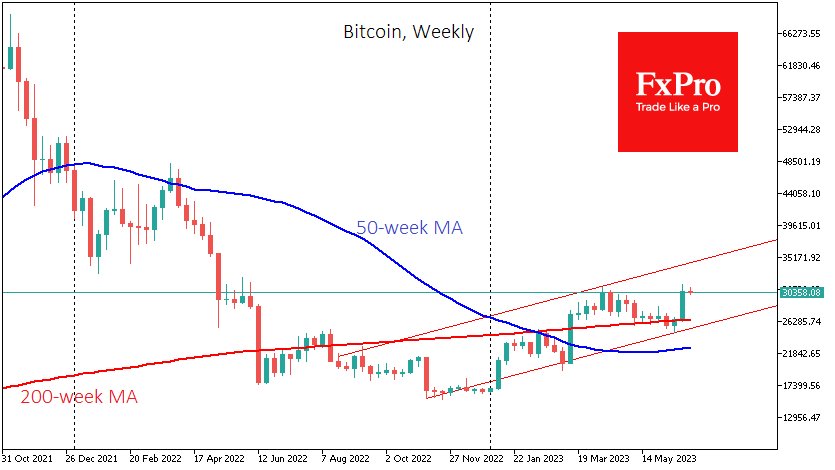
Besides, the technical factors have also supported the crypto’s recent march to the North. BTCUSD broke through the 50-day moving average resistance and consolidated above the upper boundary of the descending channel. A bounce off the 200-week MA was an even more critical bullish signal.
Strictly speaking, we saw a bounce and a rapid rise from the lower boundary of the longer-term bullish corridor formed by the November 2022 and March 2023 lows. In the short term, bitcoin will need to cool off after the march, but overall, it has a much better chance of touching the upper boundary at $34.5K within a month than the lower boundary at $26.1K. Despite the bullish outlook, the market needs to cool down in the coming days.
News background
Mark Yusko, a founder of Morgan Creek Capital, believes the recent rise in Bitcoin and other cryptocurrencies is a sign of the start of a new bullish cycle that will last until next spring’s halving. In his view, BTC will eventually replace gold as a store of value.
Bitwise CEO Matt Haugan said the crypto market is beginning a multi-year bull cycle as institutional investors start to invest in digital assets.
Hugh Hendry, a founder of hedge fund Eclectica Asset Management, said that rising interest rates in major economies would lead to a deterioration in macroeconomic conditions, which is good for Bitcoin. He believes the BTC exchange rate could triple against such a backdrop.
Major German software developer SAP has launched a pilot project for international payments using the Circle USDC and EUROC stablecoins on the Ethereum blockchain.
One of the oldest altcoins, Bitcoin Cash, rose 80% last week as crypto exchange EDX Markets backed BCH.