

Sample Category Title
GBP/USD Eyes Fresh Increase, USD/CAD Could Extend Losses
GBP/USD faced resistance near 1.2845 and started a downside correction. USD/CAD is struggling below 1.3210 and might decline further.
Important Takeaways for GBP/USD and USD/CAD
- The British Pound started a downside correction below the 1.2845 zone.
- There is a key bearish trend line forming with resistance near 1.2740 on the hourly chart of GBP/USD at FXOpen.
- USD/CAD declined below the 1.3210 and 1.3185 support levels.
- A connecting bearish trend line is forming with resistance near 1.3185 on the hourly chart at FXOpen.
GBP/USD Technical Analysis
On the hourly chart of GBP/USD at FXOpen, the pair was able to climb above the 1.2800 resistance zone. However, the bears were active near the 1.2845 zone.
As a result, the pair started a downside correction below the 1.2780 and 1.2740 support levels. The pair even spiked below 1.2700 before the bulls appeared near 1.2690. A low is formed near 1.2684 and the pair is now consolidating losses.
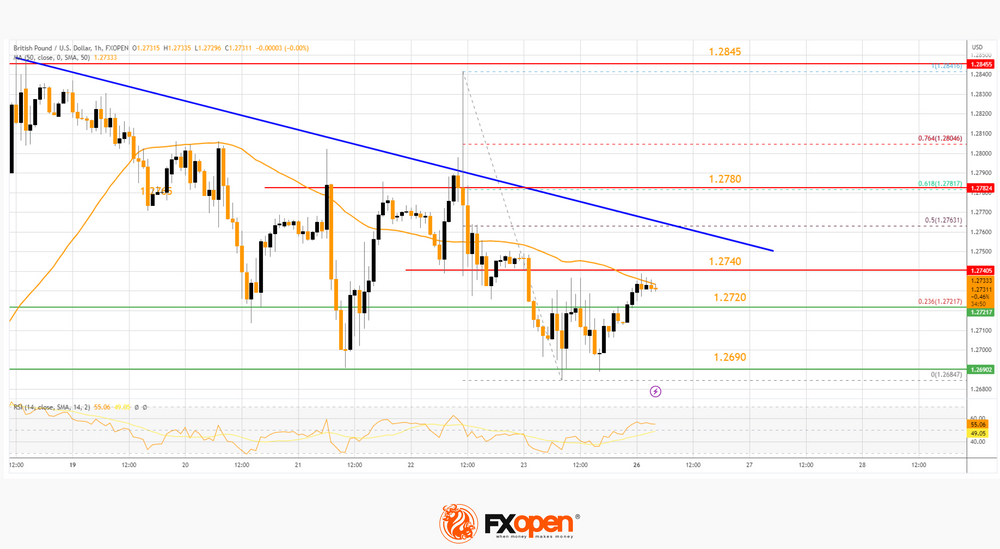
There was a move above the 23.6% Fib retracement level of the downward move from the 1.2841 swing high to the 1.2684 low. Immediate resistance on the GBP/USD chart is forming near the 50-hour simple moving average at 1.2732.
The next resistance is near a key bearish trend line at 1.2740. An upside break above the 1.2740 zone, the pair could rise toward 1.2780. It coincides with the 61.8% Fib retracement level of the downward move from the 1.2841 swing high to the 1.2684 low.
Any more gains might open the doors for a test of 1.2845. On the downside, initial support is near the 1.2720 area. The next major support is near the 1.2690 level. If there is a break below 1.2690, the pair could extend its decline. The next key support is near the 1.2640 level. Any more losses might call for a test of the 1.2580 support.
USD/CAD Technical Analysis
On the hourly chart of USD/CAD at FXOpen, the pair started a fresh decline from the 1.3240 resistance zone. The US Dollar gained bearish momentum below the 1.3210 support against the Canadian Dollar.
The bears were able to push the pair below the 50% Fib retracement level of the upward move from the 1.3138 swing low to the 1.3225 high. It is now trading below the 50-hour simple moving average.
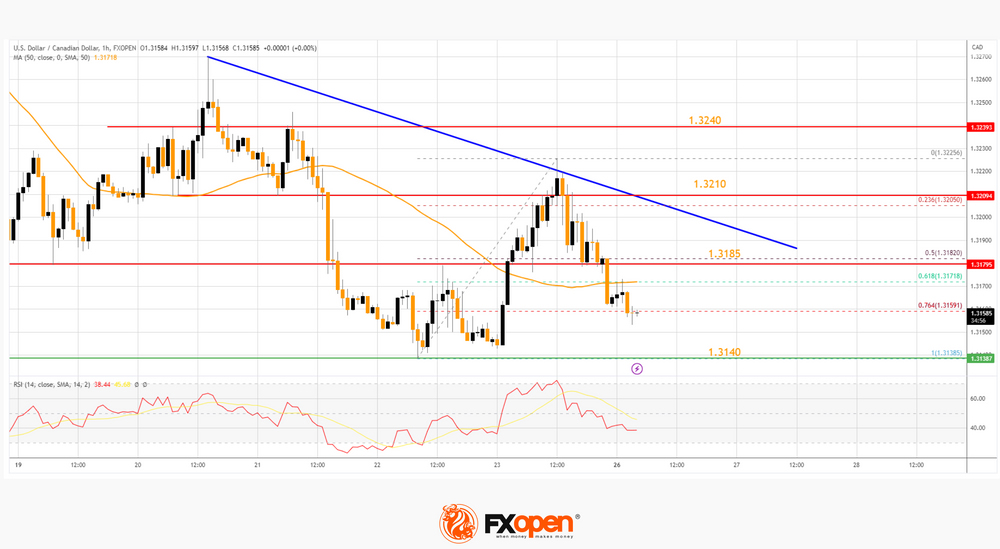
It is also showing bearish signs below the 76.4% Fib retracement level of the upward move from the 1.3138 swing low to the 1.3225 high. Immediate support is near the 1.3140 level. A close below the 1.3140 level might trigger a strong decline.
In the stated case, USD/CAD might test 1.3100. Any more losses may possibly open the doors for a drop toward the 1.3040 support.
On the upside, the pair is facing resistance near a connecting bearish trend line at 1.3185. If there is an upside break above the trend line, the pair could rise toward the 1.3210 resistance.
If the bulls pump USD/CAD above the 1.3210 resistance, there might be a decent increase toward the 1.3240 level. The next major resistance is near the 1.3280 level, above which it could rise steadily toward the 1.3335 resistance zone.
Price of Bitcoin Updates Maximum of the Year, What’s Next?
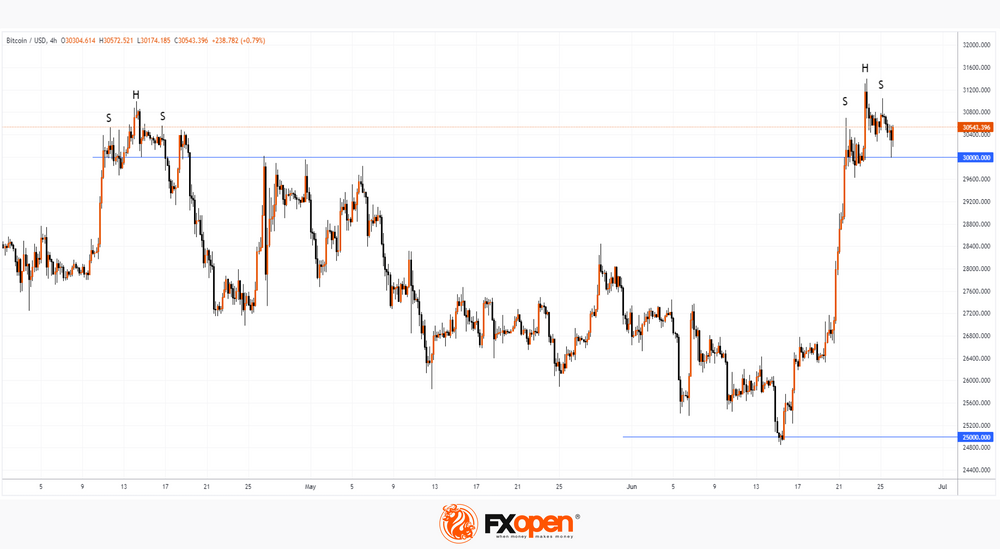
After skyrocketing last week for the 3 reasons we wrote about earlier, the price of bitcoin hit a 2023 high on Friday, surpassing USD 31,400 per bitcoin. This was facilitated by the news that the SEC approved the first exchange-traded fund (ETF) of bitcoin futures with leverage.
In April, the bulls were already above the psychological level of USD 30k per bitcoin, but after that a pullback followed, culminating in the price dropping below the psychological level of USD 25k per bitcoin. The BTC/USD market once again emphasized the emotionality of its participants — this is how you can interpret the tendency of the bitcoin exchange rate to the US dollar to make reversals after the breakdown of psychological levels.
What will happen next? Will the price of bitcoin follow the June breakdown according to the rollback scenario that was realized after the April breakdown? The probability of this is indicated by the bearish SHS patterns (head-and-shoulders), which formed when the price of bitcoin exceeded the level of 30k. You may also have deja vu, as the 2 peaks above 30k in 2023 resemble the 2 peaks (in April and November) above 60k in 2021.
The ability of the price of bitcoin to recover from declines under the 30k level (if any) will give more evidence that the bull market is indeed sustainable.
Gold Price Takes a Breather But Bearish Pressure Persists
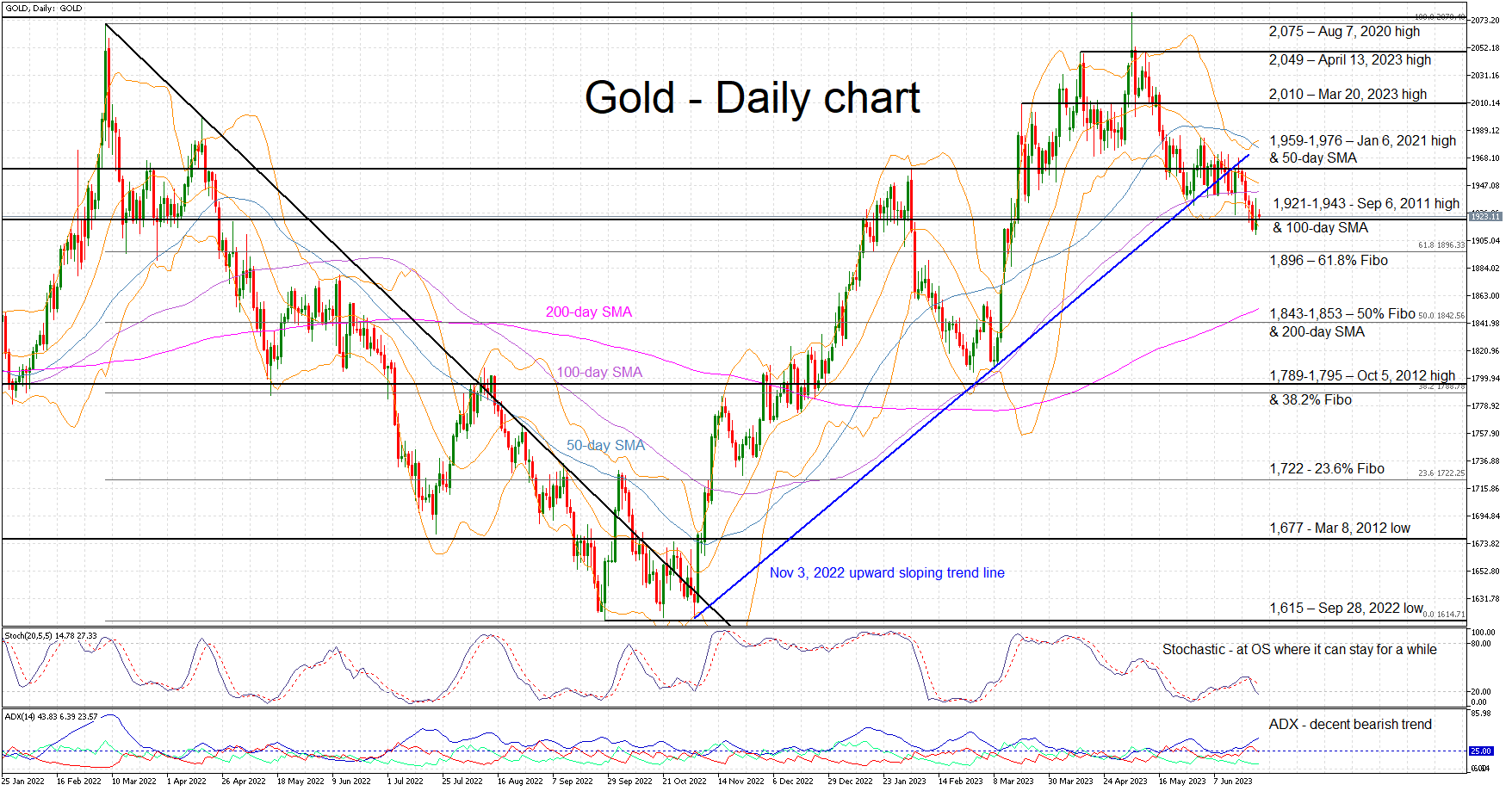
Gold is hovering inside the 1,921-1,943 area, a tad above its 3-month low and around 7.5% lower than the May 5, 2023 high of 2,079. The bulls are anxiously trying to put a temporary stop to the current short-term bearish trend and the bearish series of lower highs and lower lows.
The momentum indicators are still mostly on the bears’ side. The Average Directional Movement Index (ADX) is pointing to a bearish trend, the strongest one since the February-March 2023 correction, and the stochastic oscillator has just moved to its oversold (OS) territory. Although it can stay inside its OS area for a while, allowing gold to record lower lows, this drop is also an early sell-off exhaustion sign.
Should the bears decide to push the gold price even lower, they would quickly try to break the 1,921-1,943 area defined by the September 6, 2011 high and the 100-day simple moving average (SMA). Lower, the 61.8% Fibonacci retracement of March 8, 2022 – September 28, 2022 downtrend at 1,896 is unlikely to trouble the bulls as they would then set their eyes on the key 1,843-1,853 area.
On the other hand, the bulls would love to keep gold above 1,943 and gradually target the busier 1,959-1,976 area that is populated by January 6, 2021 high and the 50-day SMA. If successful, they would then have the chance to record a higher high, breaking the recent bearish pattern of lower highs, and open the door to a move above the 2,000 threshold.
To sum up, the bulls are trying to put a temporary stop to gold’s freefall by defending the 1,921-1,943 level, but there is still some gas left in the bearish tank.
Geopolitical Chaos, FX Intervention, and US Banks’ Stress Test Results
- Russia’s weekend mutiny cast doubts on Putin’s grip on power.
- No major impact on markets but keep a lookout on Gold, which bounced off the key support zone of US$1,913/1,896 per ounce.
- Stern FX verbal intervention from Japan’s top currency official. Watch USD/JPY key near-term support at 142.50/25.
- US banking stocks tumbled ahead of annual key Fed’s banks’ stress test results
Before the start of this new trading week, market participants were being jolted from their weekend leisure activities to shift their focus to the internal coup in Russia that may put President Putin’s power grip in jeopardy.
Yevgeny Prigozhin, leader of the Wagner Group, a Russian key independent military contractor that has played a significant role in the ongoing Russia-Ukraine territorial conflict voiced displeasure with Russia’s top leadership in handling the Russia-Ukraine situation, took over two Russian cities and order his mercenaries to march towards Moscow on Saturday.
Russia’s weekend mutiny started fast and ended fast
Upon reaching 200 km within Moscow, Prigozhin’s troops halted and made a U-turn back to their field camps. In addition, Putin dropped earlier treason charges on the Wagner Group and allowed Prigozhin to head to Belarus, Russia’s western neighbour for exile.
In less than 48 hours, the mutiny in Russia is over without any clear details on what has transpired that led to Prigozhin’s retreat as Putin has not made any official speech or press conference yet. US Secretary of State Blinken commented that the weekend’s uprising by Prigozhin, a former Putin royalist has posed a direct challenge to Putin’s grip on power in Russia and provided a battlefield advantage to Ukraine.
On the other hand, several geopolitical commenters have analyzed the situation to be in favour of Putin in which Wagner Group’s mutiny may be used as a cover for Putin to remove the top brass in Russia’s Ministry of Defence; Shoigu, the defence minister and Gerasimov, chief of the general staff as they posed a threat to Putin’s rule. Thus, the change of Russia’s military leadership may be part of the “deal” package that the Kremlin and Prigozhin agreed on.
No significant movements in markets but watch gold
In today’s Asian session, both the S&P 500 and Nasdaq 100 e-mini futures were up slightly by around +0.20% after posting their worst weekly losses last week in three months. Major Asian stock indices were mixed at this time of the writing, Nikkei 225 (-0.24%), Kospi 200 (+0.60%), Hang Seng Index (-0.14%), Hang Seng China Enterprises Index (+0.13%), and CSI 300 (-0.70%).
The US dollar is almost unchanged on average with the US Dollar Index inching down by a meagre -0.1%. Gold, a traditional safe haven asset that tends to benefit in light of major geopolitical risks upheaval in the past has exhibited some interesting price actions movement from a technical analysis perspective.
Gold’s decline has managed to bounce off from a key support zone of US$1,913/1,896 per ounce
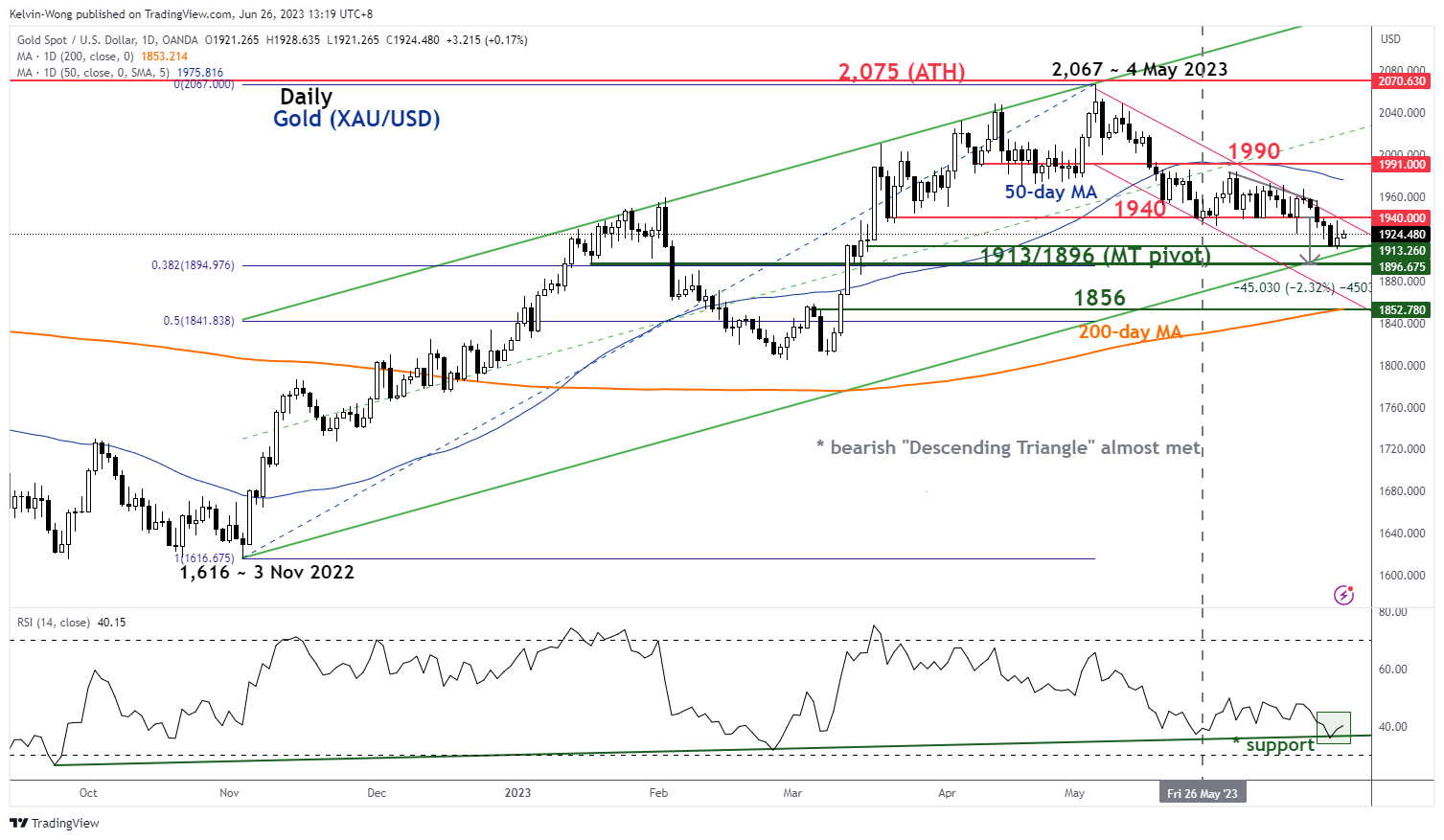
Fig 1: Gold (XAU/USD) medium-term trend as of 26 Jun 2023 (Source: TradingView, click to enlarge chart)
Last week’s decline seen in Gold (XAU/USD) has led its price actions to hit a crucial medium-term pivotal support zone of US$1,913/US$ 1,896 per ounce (printed an intraday low of US$1,910 last Friday, 23 June) which is being defined by a confluence of elements; the lower boundary of the medium-term ascending channel in place since 3 November 2022 low, 38.2% Fibonacci retracement of the prior medium-term up move from 3 November 2022 low to 4 May 2023 high, and approximately the downside price objective of recent “Descending Triangle” bearish breakdown.
Momentum has also improved as the daily RSI oscillator has managed to stage a bounce off the key corresponding support at the 36 level. Watch the US$1,896 key medium-term pivotal support and a clearance above US1,940 intermediate resistance sees the next resistance coming in at US$1,990 (also the 50-day moving average).
FX verbal intervention from Japan
After a strong upside movement seen in the USD/JPY that recorded a weekly gain of +1.3% last week which outperformed other major USD crosses, the US Dollar Index only rose by +0.56% over the same period, Japan’s Vice Finance Minister Masato Kanda, a top currency official that has oversight over foreign exchange market matters has sounded the alarm in today’s morning Asian session.
Based on a Reuters report, Kanda said that the authorities will respond to any excessive moves in the foreign exchange market, warned that the recent yen moves were rapid and will not rule out any chance of an FX intervention.
He said, “Regardless of the direction, it’s generally not good for the economy if exchange rates move excessively in a way that deviates from economic fundamentals.” Today’s verbal intervention was the most pronounced made by any of Japan’s finance ministry officials in the past month when USD/JPY sailed past the prior 141.00 and 142.00 psychological levels “effortlessly”.
USD/JPY has shed -0.2% intraday and broke key near-term support at 143.45 at this time of the writing, the next support to watch will be at 142.50/25 (former swing highs of 11/21/22 November 2022).
Fed’s annual banks stress test results out on Wednesday
The US Federal Reserve will unveil the results of its annual stress tests on the 23 biggest US banks on Wednesday, 28 June. The key focus will be on a section of the test, labelled as “exploratory market shock”, this is the first time such a test is being conducted on the trading books of the largest US banks.
The urgency and significance of the “exploratory market shock” stress test come after the US regional banks’ turmoil. Hence, monitoring of fixed income duration risk is paramount now given that the latest Fed’s hawkish monetary policy guidance is to keep interest rates higher for a longer period.
Last week, the US banking stocks shed by -6.80% as indicated by the SPDR S&P Bank exchange-traded fund, its worse weekly performance in seven weeks and underperformed the S&P 500.
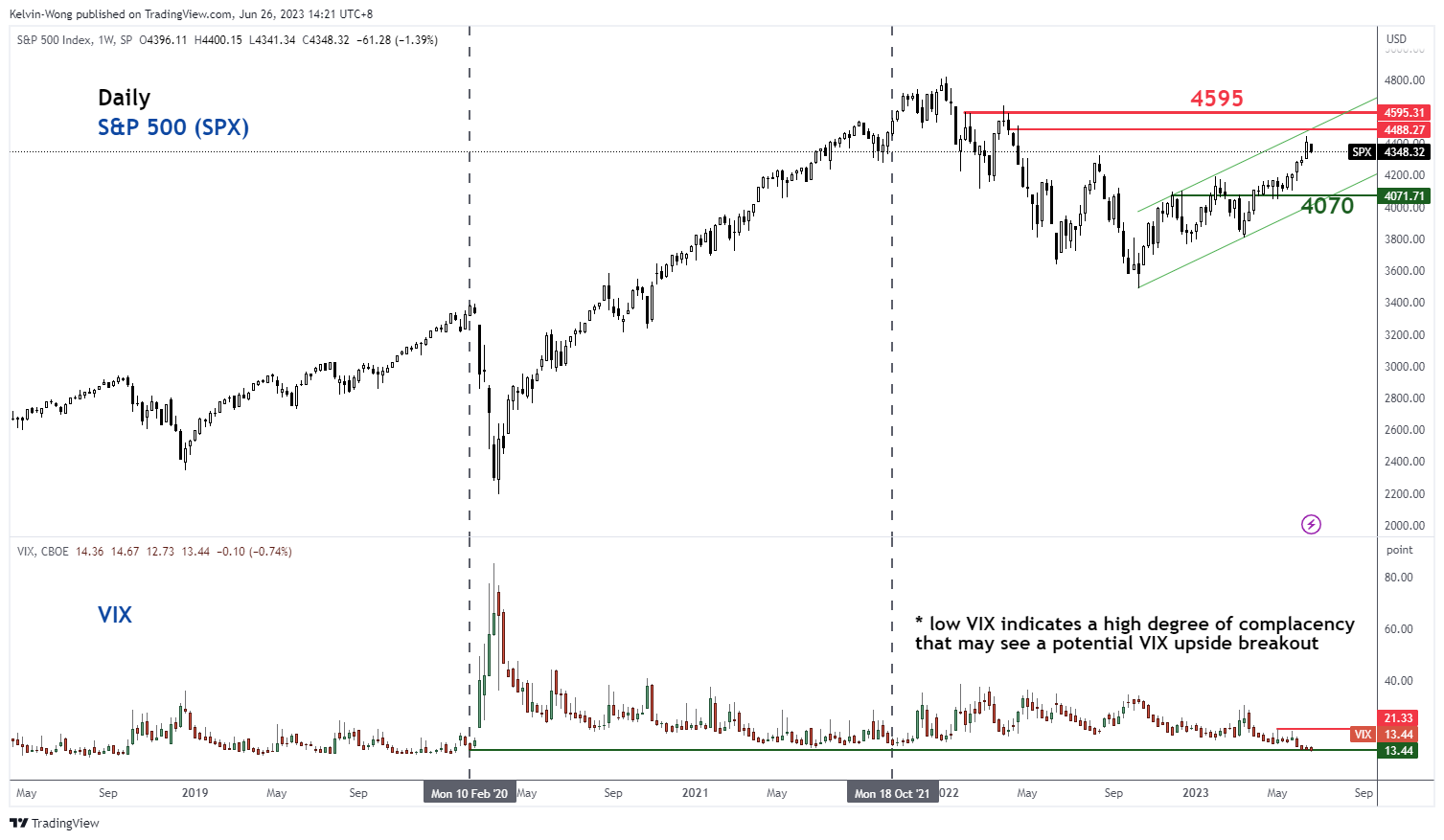
Fig 2: S&P 500 major trend with VIX as of 26 Jun 2023 (Source: TradingView, click to enlarge chart)
If the “exploratory market shock” stress test results come in unfavourable, it may put more downside pressure on US banking stocks which in turn may trigger a volatility upside breakout in the VIX, a measurement of implied volatility on the S&P 500 as it has compressed to a low level of 13.44 not seen since early February 2020 before the pandemic. A sudden spike in VIX may dampen the current bullish mood for US stock indices.
EUR Pulls Back
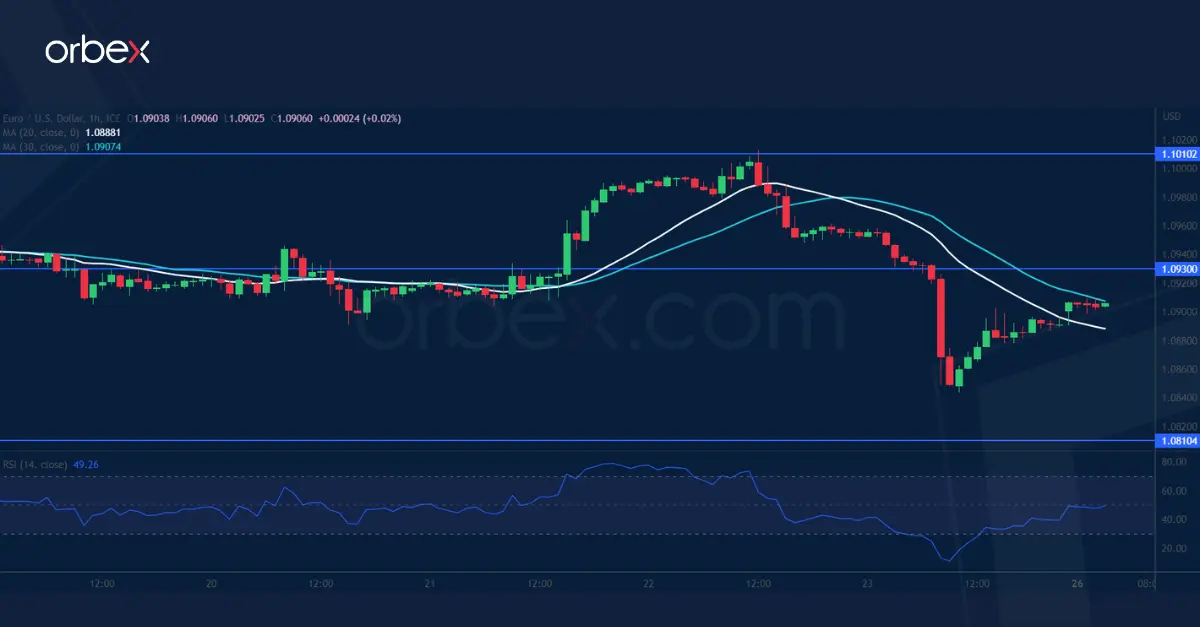
EUR/USD probes support
The euro fell after lacklustre PMI showed a manufacturing recession. The rally first came to a halt in the supply zone around 1.1010 from the early May sell-off and a subsequent tumble below 1.0900 indicates a lack of follow-through bids, prompting more buyers to close their positions. 1.0810 on the bullish MA cross on the daily chart is a major level to gauge the bulls’ commitment. A close above the fresh resistance of 1.0930 is necessary to ease the selling pressure. Otherwise, a correction might send the euro to 1.0700.
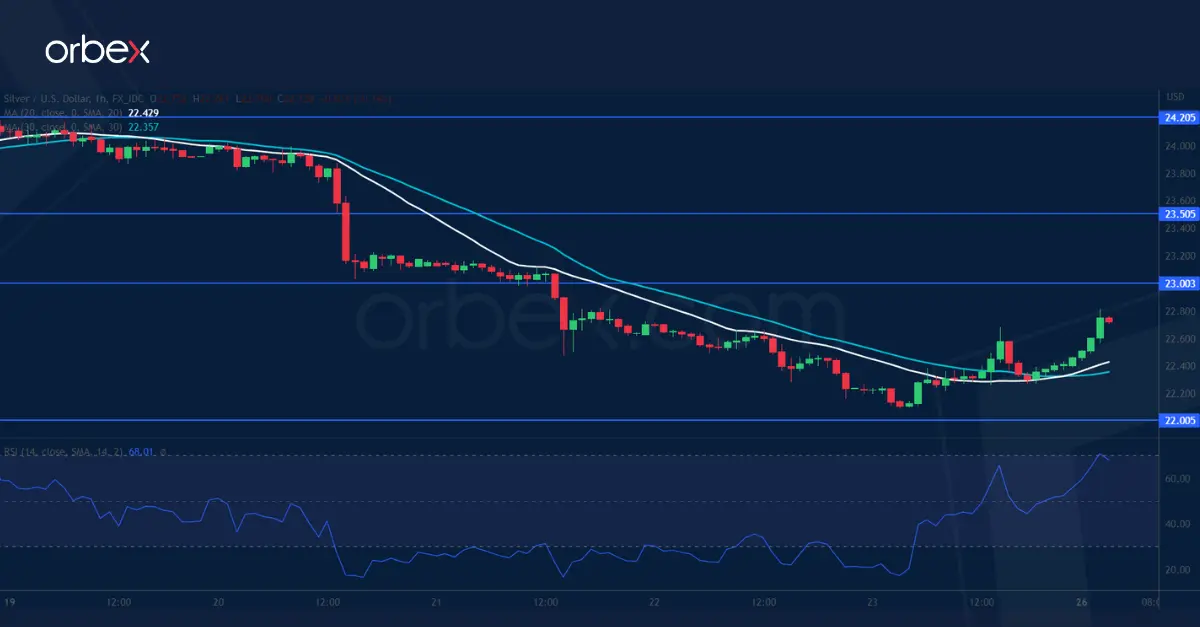
XAG/USD struggles to recover
Silver slips in the wake of hawkish comments by Fed officials. The precious metal continues lower after it invalidated this month’s rebound by breaking below the daily support of 22.70. The round number of 22.00 is a key level where buying interests have shown up again as the RSI rises back from the oversold area. 23.00 from the previous demand zone is a key resistance where the bears could be eager to fade a rebound after sentiment turned downbeat. 23.45 would be a second layer of resistance in case of a breakout.
DAX 40 grinds key support
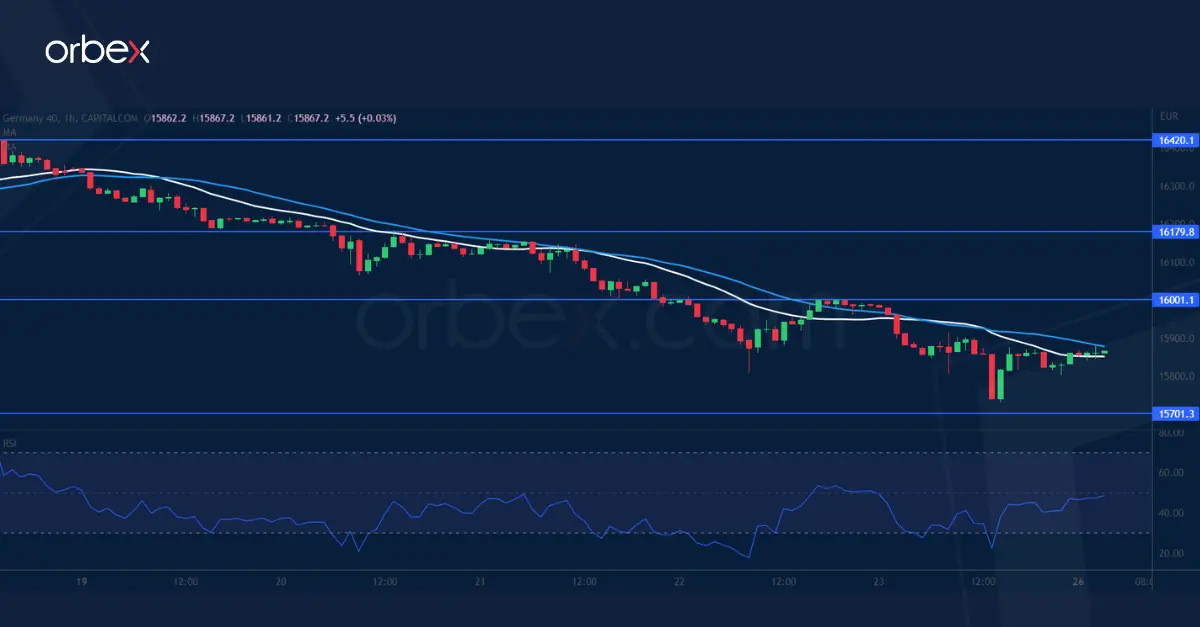
The Dax 40 weakens over concerns of protracted tightening cycles by major central banks. A break below the lower band (15900) of a previous consolidation range has dented the market mood. Then a brief bounce came under pressure at the psychological level of 16000, which is a sign of a strong bearish cap. The daily support of 15700 at the base of the June rally is a critical floor to keep the index afloat as its breach could trigger a correction towards 15200. 16000 is the first hurdle to lift to help the bulls regain confidence.
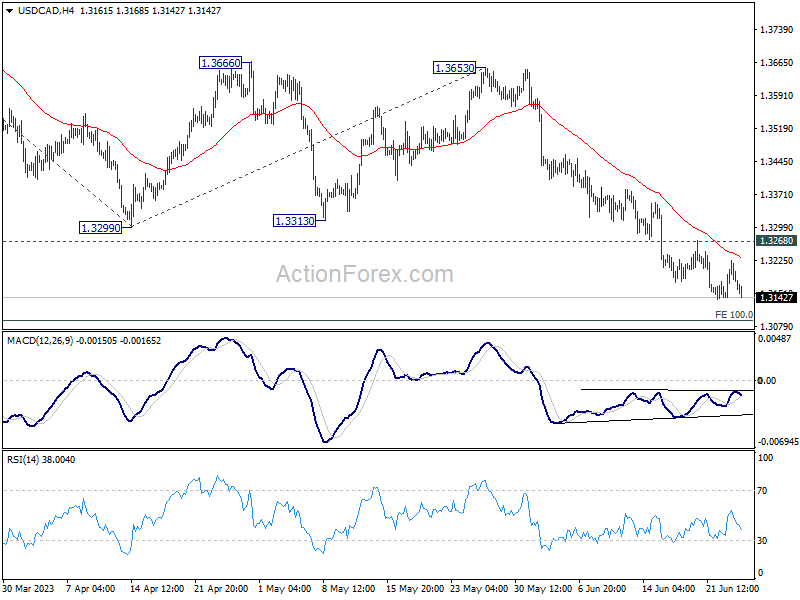
USD/CAD Daily Outlook
Daily Pivots: (S1) 1.3141; (P) 1.3183; (R1) 1.3224; More....
Further decline is expected in USD/CAD with 1.3268 resistance intact. Current fall from 1.3653 should target 100% projection of 1.3860 to 1.3299 from 1.3653 at 1.3092. Decisive break there will target 161.8% projection at 1.2745. On the upside, however, break of 1.3268 resistance should now indicate short term bottoming, and turn bias back to the upside for rebound.
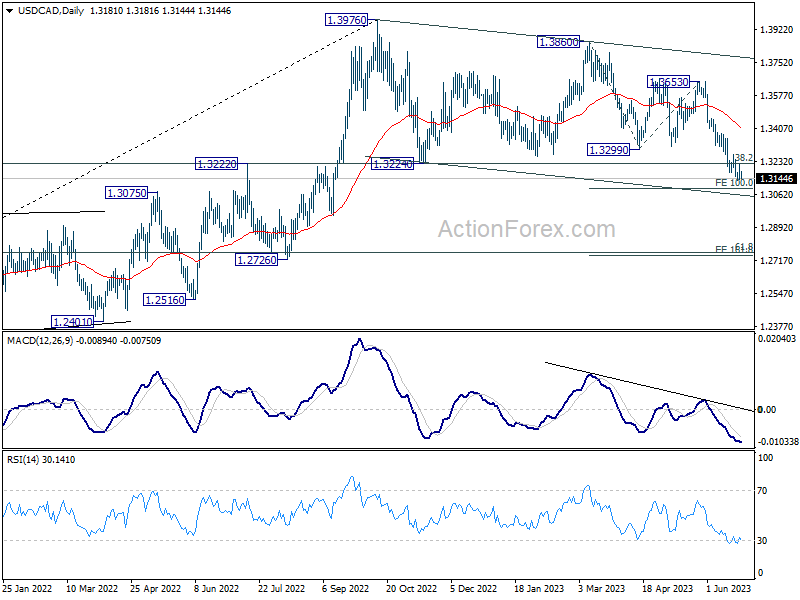
In the bigger picture, price actions from 1.3976 are still viewed as a correction to up trend from 1.2005 (2021 low), but chance of trend reversal is increasing with current decline. In either case, sustained trading below 38.2% retracement of 1.2005 to 1.3976 at 1.3233 will pave the way to 61.8% retracement at 1.2758. Risk will stay on the downside as long as 1.3299 support turned resistance holds, even in case of strong rebound.
Markets Staying in Tight Range, Inflation and Sentiment Data to Highlight the Week
The financial markets are rather steady in Asian session today, showing little reaction to the brief "uprising" in Russia. Major indexes generally traded in tight range, with the exception of China which is just catching up the holidays on Thursday and Friday. In the currency markets, Aussie is the worst performer for now, followed by Kiwi by a distant. Yen is the stronger one, followed by Canadian. But overall, other than a few Aussie pairs, major pairs and crosses are bounded inside Friday's range.
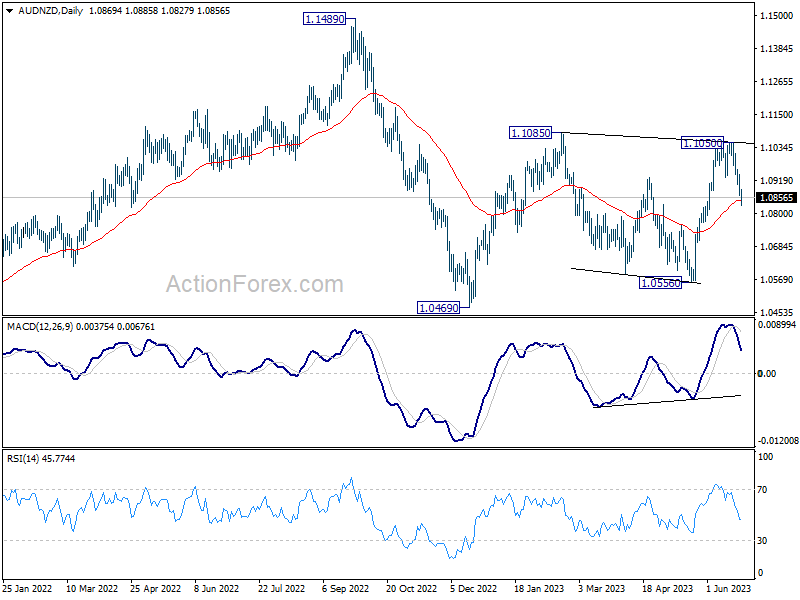
Technically, AUD/NZD's decline from 1.1050 extended lower today and it's now pressing 55 D EMA (now at 1.0846). Sustained trading below the EMA would pave the way down towards 1.0556 support. For now, break of 1.0469 is not envisaged unless further downside acceleration is seen. However, if this scenario does come to fruition, a deeper fall in AUD/NZD could potentially hinder the recovery of Aussie elsewhere.
In Asia, Nikkei closed down -0.25%. Hong Kong HSI is down -0.40%. China Shanghai SSE is down -1.51%. Singapore Strait Times is up 0.02%. Japan 10-year JGB yield is down further by -0.126 at 0.359.
Japan's top officials voice concern over 'rapid and one-sided' yen moves
In the face of Yen's swift depreciation, top Japanese currency diplomat Masato Kanda expressed concern on Monday, describing the recent changes as "rapid and one-sided. He added that "We have all options available and we are not ruling out any options."
Kanda, Vice Finance Minister for International Affairs, however, refrained from using the phrase "decisive action," a term he used before Japan intervened in the currency market last year. This careful choice of words suggests that while officials are monitoring the situation, they may not be ready to step in just yet.
Adding to this sentiment, Finance Minister Shunichi Suzuki highlighted the ongoing vigilance of the government, stating that "we will continue to watch the forex market with a sense of urgency."
In keeping with this sense of readiness, Suzuki assured that authorities would respond "appropriately" to any excessive currency swings, indicating that the government is primed to intervene if necessary.
BoJ opinions: Persistent monetary easing stance upheld, first call YCC Debate
Summary of opinions from BoJ Monetary Policy Meeting on June 15-16 shed light on the prevailing sentiment among policymakers regarding the nation's current monetary easing stance.
Among the opinions expressed, there was an evident call for maintaining the current monetary easing policy to support rising wage growth, which was described as "the highest in around 30 years."
Board members noted, "In order to achieve the price stability target of 2 percent in a sustainable and stable manner, price rises accompanied by wage increases, rather than those caused by cost-push factors, are necessary."
The Bank was thus urged to "keep supporting such momentum for wage hikes through continuation of the current monetary easing."
Significantly, there was a focus on the potential risks associated with premature policy revisions. It was stated, "It would be premature to revise monetary policy if it would hinder such developments," referring to increasing wage and investment willingness among small and medium-sized firms.
Policymakers also warned against a "hasty policy change" that could miss the chance to achieve the price stability target.
However, one board member signaled a notable dissent, explicitly calling for an early discussion about tweaking the BoJ's yield curve control (YCC) - a tool for monetary easing.
This marked the first time a BOJ summary displayed a member's open expression for an early debate on modifying the YCC, hinting at possible future shifts in the Bank's policy discussions.
SNB: Monetary policy isn't tight enough to anchor price stability
In a radio interview with public broadcaster SRF, SNB President Thomas Jordan subtly hinted at the potential need for a tighter monetary policy. This comes on the heels of the Swiss central bank's recent interest rate hike, which saw an increase of 25 basis points to 1.75% last Thursday.
Interpreting SNB's inflation forecasts, Jordan said, "If you look at our inflation forecasts and interpret them correctly, then you'll see that from today's perspective monetary policy possibly isn't tight enough to anchor price stability."
Acknowledging the inevitable, Jordan added, "We can't completely prevent second-round effects — that would be an illusion — but we have to fight them." These second-round effects typically refer to changes in wages and prices in response to initial inflationary shocks, underlining the broader impact of inflation on the economy.
Inflation figures and sentiment data: Main attractions for final week of H1
As we approach the final week of the first half of the year, markets will be keenly watching a deluge of consumer inflation data that will likely dictate future monetary tightening policies. Core PCE figures from US, Eurozone's CPI flash estimate, and CPI from both Canada and Australia stand out as key barometers that their respective central banks will use to gauge the needed extent of further monetary tightening.
Additionally, the pulse of consumer and business sentiment will also come under scrutiny, with US consumer confidence, Germany's Ifo business climate index, and New Zealand's ANZ business confidence all on the docket. Moreover, PMI figures from China are set to offer insights into the country's recovery trajectory and could provoke volatility in Asian and commodity markets.
Here are some highlights for the week:
- Monday: BoJ summary of opinions, Japan corporate services prices; Germany Ifo business climate.
- Tuesday: Canada CPI; US durable goods orders, house price index, consumer confidence, new home sales.
- Wednesday: Australia monthly CPI; Germany Gfk consumer sentiment; Eurozone M3 money supply; Swiss Credit Suisse economic expectations; US goods trade balance.
- Thursday: Japan retail sales, consumer confidence; New Zealand ANZ business confidence; Australia retail sales; Germany CPI flash; Eurozone monthly bulletin; UK M4 money supply, mortgage approvals; US GDP final, jobless claims, pending home sales.
- Friday: Japan Tokyo CPI, unemployment rate, industrial production, housing starts; Australia private sector credit; China PMIs; Germany import prices, retail sales; UK current account, GDP final; Swiss retail sales, KOF economic barometer; France consumer spending; Germany unemployment; Eurozone CPI flash, unemployment rate; Canada GDP, US personal income and spending and PCE price index, Chicago PMI.
USD/CAD Daily Outlook
Daily Pivots: (S1) 1.3141; (P) 1.3183; (R1) 1.3224; More....
Further decline is expected in USD/CAD with 1.3268 resistance intact. Current fall from 1.3653 should target 100% projection of 1.3860 to 1.3299 from 1.3653 at 1.3092. Decisive break there will target 161.8% projection at 1.2745. On the upside, however, break of 1.3268 resistance should now indicate short term bottoming, and turn bias back to the upside for rebound.
In the bigger picture, price actions from 1.3976 are still viewed as a correction to up trend from 1.2005 (2021 low), but chance of trend reversal is increasing with current decline. In either case, sustained trading below 38.2% retracement of 1.2005 to 1.3976 at 1.3233 will pave the way to 61.8% retracement at 1.2758. Risk will stay on the downside as long as 1.3299 support turned resistance holds, even in case of strong rebound.
Economic Indicators Update
| GMT | Ccy | Events | Actual | Forecast | Previous | Revised |
|---|---|---|---|---|---|---|
| 23:50 | JPY | Corporate Service Price Index Y/Y May | 1.60% | 1.80% | 1.60% | |
| 23:50 | JPY | BoJ Summary of Opinions | ||||
| 08:00 | EUR | Germany IFO Business Climate Jun | 91.2 | 91.7 | ||
| 08:00 | EUR | Germany IFO Current Assessment Jun | 93.5 | 94.8 | ||
| 08:00 | EUR | Germany IFO Expectations Jun | 88 | 88.6 |
Asian Trading Shows Little Impact of Insurrection
Markets
Core bonds ended last week on a solid footing. German Bunds outperformed US Treasuries in more of a one-off reset after very weak French PMI’s. German yields fell by 10 bps to 15 bps with the belly of the curve outperforming the wings. US Treasuries lost 5 to 6 bps across the curve. Risk sentiment took a hit with main European and US equity indices losing 0.5% to 1%. The dollar profited in this environment, with the trade-weighted (DXY) index closing at 103.16 from a start at 102.38. EUR/USD set an intraday low at 1.0845, but the single currency turned more resilient in the end, managing a close at 1.0894 (from 1.0956). EUR/GBP followed the intraday trading pattern of EUR/USD with an intraday low at 0.8536 and a close at 0.8567.
The Russian uprising dominated headlines this weekend. The mutiny of the Wagner Group already ended following a deal with Moscow, but the episode highlights Russian instability and suggests signs of weakness. Asian trading shows little impact of insurrection though. Today’s eco calendar is rather light, giving little guidance for trading. Friday’s market direction is the likely way, if any, to follow. June German Ifo Business Climate is the sole data point, but is normally a reflection of the earlier published PMI. The German composite PMI unexpectedly declined from 53.9 to 50.8 with the manufacturing recession deepening (41 from 43.2) and with the services sector losing momentum (54.1 from 57.2). The US Treasury starts its end-of-month refinancing operation with a $42bn 2-yr Note auction. We expect it to go well given the yield increase of the past month even as the US Treasury is in full replenishing mode following the debt ceiling deal. The ECB’s annual forum starts in Sintra, which will result in an avalanche of central bank speakers. A panel discussion with ECB Lagarde, Fed Powell, BoE Bailey and BoJ Ueda on Wednesday is the key event. European and Japanese inflation numbers on Thursday and on Friday are this week’s other key events.
News Headlines
Rating agency Fitch on Friday affirmed Hungary’s BBB rating with a negative outlook. The country’s ratings are supported by strong structural indicators relative to BBB peers, economic growth fueled by investments and solid net FDI inflows. These positives are balanced against a high public debt, unorthodox fiscal and monetary policy moves and worsening governance indicators. The negative outlook reflects risks around the credibility of macroeconomic policy. Fitch mentions, amongst others, the cost of energy support measures, the regulatory burden of windfall taxes and high inflation despite (ineffective) price caps. The external position improved substantially due to lower cost of energy imports, but energy dependence on Russia is still seen an important risk. Fitch expects Hungary to reach an agreement European Union on EU funds the but timing and size remain uncertain. The agency sees Hungarian growth stagnating in 2023 as domestic demand will contract. Growth in 2024/25 is expected to average 3% again. Inflation is expected to ease to 8-10% by the end of this year and to average 5.1% next year and 3.1% in 2025. The budget deficit is expected to narrow to 4.1% this year and 2.9% in 2024.
Minutes of the June Bank of Japan meeting showed one policy member calling for an early revision of Yield Curve Control (YCC). According to the member, the BOJ should maintain its overall framework of monetary easing, but a revision to the treatment of YCC should be discussed at an early stage as the cost of YCC is high taking into account factors as preventing sharp fluctuations in interest rates in the future phase of an exit from the current policy, in terms of improvement in market functioning, and enabling smoother dialogue with market participants. While representing a minority within the MPC, markets will look out for more signals/comments on a potential tweak in the YCC in the run-up to the next BoJ meeting on July 28. In the meantime, persistent yen weakness again caused Japan’s vice finance minister for international affairs, Masato Kanda, to warn on rapid and one-sided moves in the yen. With regard to potential interventions, Kanda said that all options are available and the government isn’t ruling out any option. Finance Minister Suzuki said authorities will respond appropriate to excessive FX moves.
Slow Start Following an Eventful Weekend
The weekend was eventful with the unexpected rebellion of the Wagner Group against the Kremlin. Yevgeny Prigozhin’s men, who fight for Putin in the deadliest battles in Ukraine walked towards Moscow this weekend as Prigozhin accused the Kremlin of not providing enough arms to his troops. But suddenly, Prigozhin called off the attack following an agreement brokered by Belarus and agreed to go into exile. The Kremlin took back control of the situation, but we haven’t seen Vladimit Putin, or Prigozhin talk since then. The Wagner incident may have exposed Putin’s weakness, and was the most serious threat to his rule in two decades. It could be a turning point in the war in Ukraine. But nothing is more unsure. According to Volodymyr Zelensky, there are no indications that Wagner fighters are retreating from the battlefield.
The first reaction of the financial markets to Wagner’s mini coup was relatively calm. Gold for example, which is a good indication of market stress at this kind of moment, remained flat, and even sold into the $1930 level. The dollar-swissy moved little near the 90 cents level. Crude oil was offered into the $70pb level, as nat gas futures jumped more than 2% at the weekly open, and specific stocks like United Co. Rusal International, a Russian aluminum producer that trades in Hong Kong, gapped lower at the open but recovered losses.
Equities in Asia were mostly under pressure from last week’s selloff in the US, while US futures ticked higher and are slightly positive at the time of writing.
The Wagner incident will likely remain broadly ignored by investors, unless there are fresh developments that could change the course of the war in Ukraine. Until then, markets will be back to business as usual. There is nothing much on today’s economic calendar, but the rest of the week will be busy with a series of inflation reports from Canada, Australia, Europe, the US, and Japan.
Except for Japan, where the Bank of Japan (BoJ) doesn’t seem urged to hike the rates, higher-than-expected inflation figures could further fuel the hawkish central bank expectations and add to the weakening appetite in risk assets.
The Federal Reserve (Fed) will carry its annual bank stress test this week, to see how many more rate hikes the baking sector could take in and the potential for changes in capital requirements down the road. The big banks are likely not very vulnerable to higher capital requirements, yet the profitability of the US regional banks could be at jeopardy and that could cause investors to remain skeptical regarding the US banking stocks altogether. Invesco’s KBW bank ETF slipped below its 50-DMA, following recovery in May on the back of decidedly aggressive Fed to continue hiking rates, and stricter requirements could further weigh on appetite.
Zooming out, the S&P500 is down by more than 2% since this month’s peak, Nasdaq 100 lost more than 3% while Europe’s Stoxx 600 dipped 3.70% between mid-June and now on the back of growing signs that the aggressive central bank rate hikes are finally slowing economic activity around the world. A series of PMI data released last Friday showed that activity in euro area’s biggest economies fell to a 5-month low as manufacturing contracted faster and services grew slower than expected. The EURUSD tipped a toe below its 50-DMA last Friday but found buyers below this level. Weak data weakens the European Central Bank (ECB) expectations, but that could easily reverse with a strong inflation read given that the ECB is ready to induce more pain on the Eurozone economy to fight inflation.
Across the Channel, the picture isn’t necessarily better. Both services and manufacturing came in softer than expected. And despite the positive surprise on the retail sales front, retail sales in Britain slumped more than 2% in May, due to the rising cost of living that led the Brits back from loosening their purse string. One thing though. UK’s largest lenders agreed to give borrowers a 12-month grace period if they missed their mortgage payments as a result of whopping costs of keeping their mortgages due to the aggressively rising interest rates. Unless an accident – in real estate for example, the Bank of England (BoE) will continue hiking the rates and reach a peak rate of 6.25% by December. The only way to slow down the pace of hikes is to find a solution to the sticky inflation problem. And because the BoE has limited influence on prices, Jeremy Hunt will meet industry regulatory this week to discuss how they could prevent companies from taking advantage of inflation and raising prices more than needed, which adds to inflationary pressures through what we call ‘greeflation’. But until he finds a solution, the BoE has no choice but to keep hiking and the UK’s 2-year gilt yield has further to run higher, whereas the widening gap between the 2 and 10-year yield hints at growing odds of recession in the UK, which should also prevent the pound from gaining strength on the back of hawkish BoE. Cable will more likely end up going back to 1.25, than extending gains to 1.30.
Geopolitics is Back on the Agenda
Market movers today
Today IFO figures will give further perspective on the German slowdown in June indicated by PMIs on Friday. It will be interesting to see if they are as weak.
We will also be listening in to ECB president Lagarde's speech on the ECB Forum on Central Banking in Sintra tonight.
Through the remainder of the week, the Riksbank meeting and euro area inflation data will be in markets' focus.
We will also keep an eye on the situation in Russia, following the dramatic events over the weekend.
The 60 second overview
Russia: Over the weekend, all eyes were on Russia where an armed mutiny against the country's military leadership instigated by Wagner group leader, Yevgeny Prigozhin, took place. Prigozhin and his troops started a 'march of justice' towards Moscow after easily seizing control of a southern city Rostov-on-Don early Saturday morning. President Putin threatened Wagner with a criminal charge for treason and announced tightening of legislation against those breaking martial law. As Prigozhin and his troops quickly advanced towards Moscow, the city was preparing to fence itself from the attack. However, eventually, the revolt was over in less than 24 hours when Prigozhin announced he had accepted conditions of a deal brokered by Belarusian President Lukashenko. As part of the deal, he would move to Belarus and all charges against him would be dropped. Overall, many open questions remain regarding Prigozhin's motivations and objectives. It is unclear what has been agreed exactly and what will happen to Wagner group going forward. It is clear geopolitical risk has again raised its head and that Russia has become very unstable. We stress that the situation remains fluid. Yet, here is our best effort to understand what is going on: Geopolitical radar - Making sense of what is happening in Russia, 26 June.
Market sentiment: Asian markets mostly shrugged off geopolitical concerns and risk sentiment remains resilient ahead of the European markets opening. Euro is slightly stronger against the dollar and stock market futures are mixed, while gold and oil prices are only marginally higher. It is possible markets largely ignore the events in Russia at this point as it is still so unclear what really happened and at least the most chaotic scenario of Russia spiralling into a civil war has been avoided for now. However, we think geopolitical risks are now very much back on the agenda, and we highlight that rising instability in Russia could have very severe implications for Europe.
PMIs: Euro area June PMIs came in much weaker than expected on Friday as particularly service sector activity took a hit. Also, sub-indices showed both input and output prices declined despite the still persistent wage pressures in the service industry, which is good news for the ECB. The weak PMI prints are a surprise considering the otherwise solid macro data during the first half of the year. They could signal that higher interest rates are starting to pass through to consumption, particularly as savings buffers are gradually eroded. In the US, manufacturing PMI also surprised to the downside, but overall, the composite indicator held up above the 50 level, indicating economic growth.
Equities: Global equities ended lower on Friday across countries and regions. Defensives were outperforming but considering past period with strong cyclical outperformance, we find it surprising that defensives were not able to make a more solid outperformance. Banks and financials performing in line with market and hence investors were not increasing the recession fear but rather readjusting for higher for longer or a soft version of stagflation. We would have expected that markets had paid more attention to the very weak PMI prints. In the US, Dow -0.6%, S&P 500 -0.8%, Nasdaq -1.0% and Russell 2000 -1.4%. Asian markets are mixed this morning while European and US futures slightly stronger.
FI: On Friday, the weak European PMI set the stage for a significant rally with the 2y Germany declining 10bp to 3.1% and slightly more in the 5 to 10y area. The German curves continue to hover around the lows since 1992. Markets also repriced the front end ECB peak 5bp lower just below 4%. Through June, markets have added a full 25bp rate hike to the peak policy rate. Furthermore the 'higher-for-longer' narrative has pushed the point of policy rate cut further out, see also our discussion here: COTW: EUR liquidity tightening, kicking the can and higher for longer, 23 June.
FX: EUR/USD fell well below 1.09 on Friday following weak Eurozone PMIs. EUR/NOK recovery on Friday after the brief drop induced by Norges Bank's big rate hike on Thursday. USD/JPY ignored a drop in 10Y US yield and oil prices and rose close to 144.
Credit: Soft PMI data sent credit markets into risk-off mode on Friday, despite a rally in underlying rates. Itrax main widened 1.5bp to close at 78.9bp and Itrax Xover widened 9.6bp to close at 417.6bp. The Xover close was the widest level in around three weeks. Primary markets were relatively quiet on Friday.