Mon, Apr 13, 2026 06:57 GMT
More

    Sample Category Title

    Eyes on Final Q3 Euro Area GDP Data

    In focus today

    In the euro area, focus turns to wage growth and the final estimate of Q3 GDP. The data will give us the first full picture of wage developments in the third quarter, which are very important for the ECB outlook since services inflation, which is mainly determined by wages, is what currently keeps inflation from falling below target. The data on negotiated wages showed a very sharp decline in Q3 signaling that the compensation per employee, which in addition to negotiated wages includes wage drift, is also going to fall in Q3. The ECB staff projections estimated that compensation per employee would decline from 3.8% y/y in Q2 to 3.2% y/y in Q3. The final GDP data for Q3 is expected to confirm the two previous estimates of 0.2% q/q, so focus will instead be on the details, particularly private consumption and the savings ratio.

    In the US, the September PCE data on both real private consumption and inflation is finally due for release after a lengthy shutdown-driven delay. December's flash consumer confidence index from the University of Michigan will also be released. Note that the November Jobs Report originally scheduled for today has been delayed until 16 December

    In Sweden, Budget numbers for November are due at 08:00 CET. The Debt Office has pencilled in a SEK 12.1bn surplus (revised down from 18.1bn in the previous report).

    Over the weekend, Japan publishes October wage data. Wages struggle to compensate for price increases with real wage growth still in negative territory. Real wage growth is the key remaining piece of the puzzle for Bank of Japan to confidently raise rates further. Largely all other factors are in place, though, and a December hike is also close to priced- in, in alignment with our expectations. Further hikes will largely hinge on improvement in wage data and the outlook for solid wage growth in 2026. We will also look for the revised national accounts for Q3.

    Economic and market news

    What happened overnight

    In the US, senators introduced the SAFE CHIPS Act to block the Trump administration from relaxing restrictions on sales of advanced Nvidia and AMD AI chips to China, Russia, Iran, and North Korea for 2.5 years. The bipartisan bill, aimed at protecting national security, seeks to limit Beijing's access to cutting-edge AI technology and requires a congressional briefing before any changes to export controls can take effect.
    What happened yesterday

    In the US, the November Challenger report showed a sharp decline in layoff announcements to 71k (prev: 153k), with AI-related cuts accounting for 6.2k. Despite growing attention on AI, it has explained less than 5% of layoffs this year, with most linked to traditional factors. Hiring announcements dropped significantly to 9k (prev: 283k), partly due to seasonal effects, though the figure remains low even for November. Meanwhile, initial jobless claims fell to 191k, and continuing claims dropped to 1.94 million, which is very close to the average level seen since June, suggesting that actual layoffs remain low despite slowing headline job growth.

    Meta plans to cut up to 30% of its metaverse budget as part of 2026 planning, which could involve layoffs starting next month. The decision follows over USD 60bn in costs since 2020 and reflects Meta's focus on artificial intelligence after recent setbacks in its AI initiatives.

    In Sweden, November inflation surprised to the downside, with underlying inflation at 2.4% y/y and CPIF at 2.3% y/y. The decline was likely driven by larger-than-expected Black Friday price reductions, as the monthly drop was unusually large compared to the past decade. Details on inflation components, expected next week, will be key for assessing whether the decline is seasonal and temporary or more persistent.

    In China, French President Emmanuel Macron met Xi Jinping to discuss trade, geopolitics, and the environment, while urging Beijing to help end the war in Ukraine. Despite signing cooperation agreements in areas like nuclear energy and population ageing, no major deals were sealed, including the expected Airbus order. Macron also raised concerns over rare-earth export restrictions and China's subsidised goods impacting European industry.

    In India, Russian President Vladimir Putin began his first visit in four years, aiming to boost and diversify trade with Indian Prime Minister Narendra Modi. Both countries seek to raise bilateral trade to USD 100bn by 2030, with Russia looking to increase imports of Indian goods and India expanding exports of industrial goods, shrimp, tropical fruits, and machinery. The visit comes amidst US pressure on India to distance itself from Moscow due to the ongoing war in Ukraine.

    Furthermore, the Reserve Bank of India cut its repo rate by 25 basis points to 5.25% and announced measures to boost liquidity by USD 16bn to support growth during a "goldilocks economy". The central bank raised its GDP forecast to 7.3% for 2025 while lowering its inflation projection to 2%, citing strong growth and rapid disinflation.

    Equities: Equities extended gains yesterday in what can only be described as a classic, old-fashioned cyclical risk-on rotation. Defensives, min-vol, quality and large-cap all underperformed, with healthcare, consumer staples and utilities closing lower. On the other side of the ledger, industrials led the advance, yields moved higher across the curve, and value outperformed growth. While none of these correlations are unusual, in fact, they are textbook, but it has been a while since we have seen such a clean cross-asset rotation into cyclical risk. In the US yesterday, Dow -0.1%, S&P 500 +0.1%, Nasdaq +0.2% and Russell 2000 +0.8%. Asian trading is a mixed bag this morning: South Korea trades more than 1% higher, while Japan is down by more than 1%. Futures in both the US and Europe are higher this morning.

    FI and FX: Global yields moved higher during yesterday's session with US yields rising 3-4bp in Treasury and swap space across the curve. European yields mirrored the move, but it was of less magnitude. EUR/USD took a breather during yesterday's session and edged closer to the 1.16 mark. Lower than expected inflation in Sweden provided support for EUR/SEK, which moved up towards the 11.00 mark.

    EUR/CHF Daily Outlook

    Daily Pivots: (S1) 0.9332; (P) 0.9347; (R1) 0.9373; More....

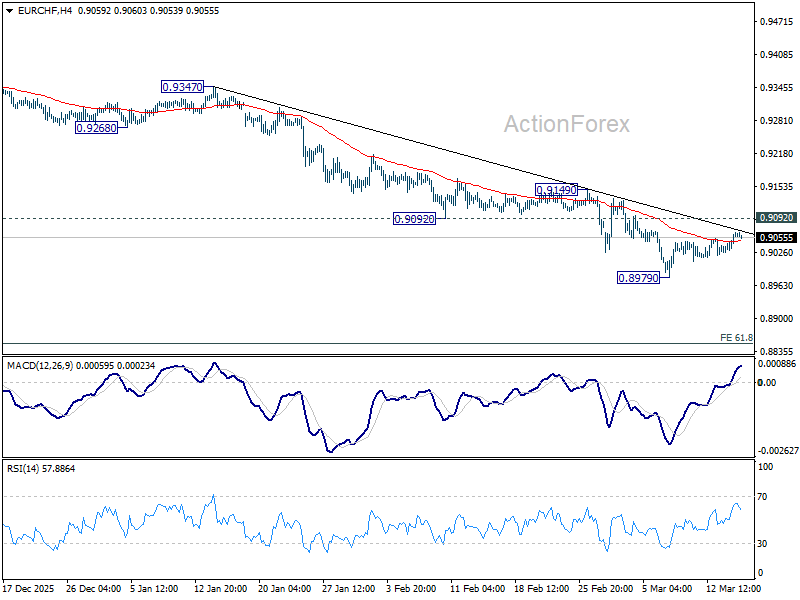
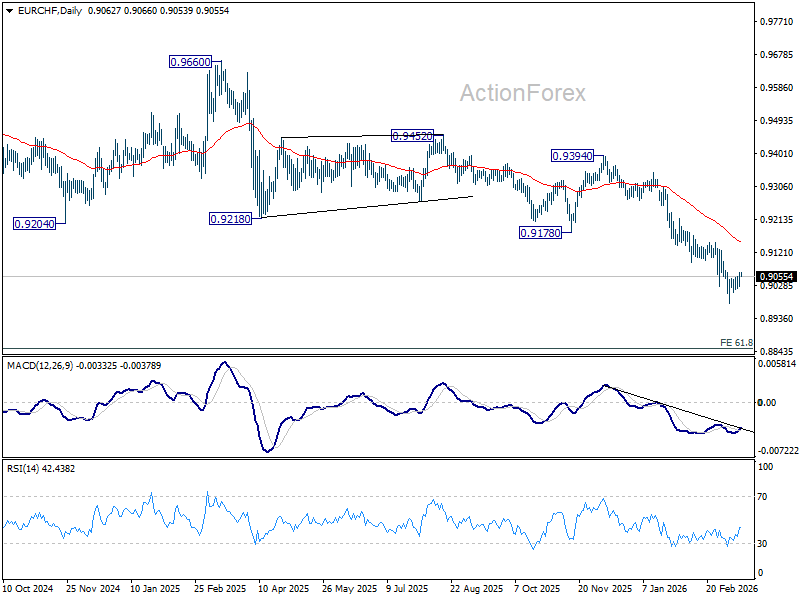
    EUR/CHF's rise from 0.9178 resumed by breaking through 0.9349, and intraday bias is back on the upside. As noted before, fall from 0.9660 could have completed at 0.9178, on bullish convergence condition in D MACD. Further rise should be seen to 0.9452 resistance next. On the downside, below 0.9325 support will turn intraday bias neutral again first.

    In the bigger picture, outlook remains bearish with EUR/CHF staying well inside long term falling channel after multiple rejection by 55 W EMA (now at 0.9371). Next target is 61.8% projection of 1.1149 to 0.9407 from 0.9928 at 0.8851. Break of 0.9452 resistance is needed to be the first sign of medium term bottoming. Otherwise, outlook will stay bearish in case of strong rebound.

    EUR/GBP Daily Outlook

    Daily Pivots: (S1) 0.8721; (P) 0.8738; (R1) 0.8753; More…

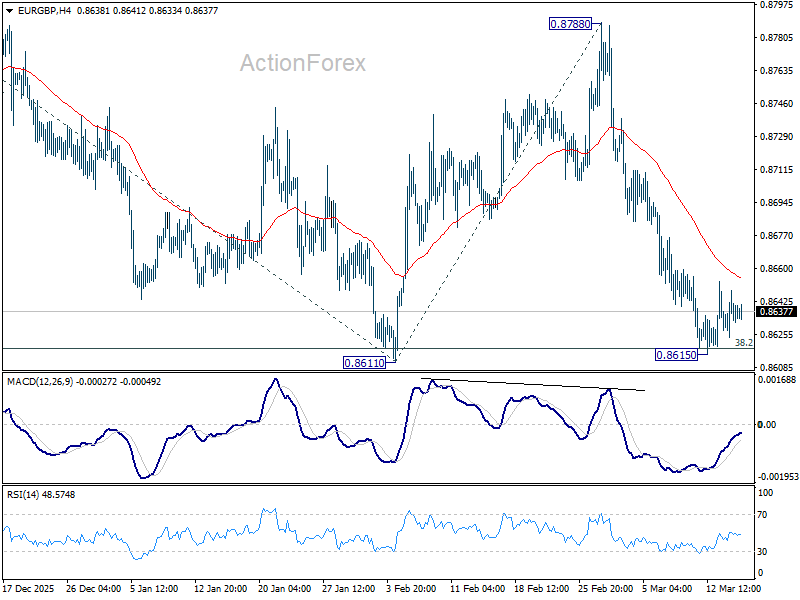
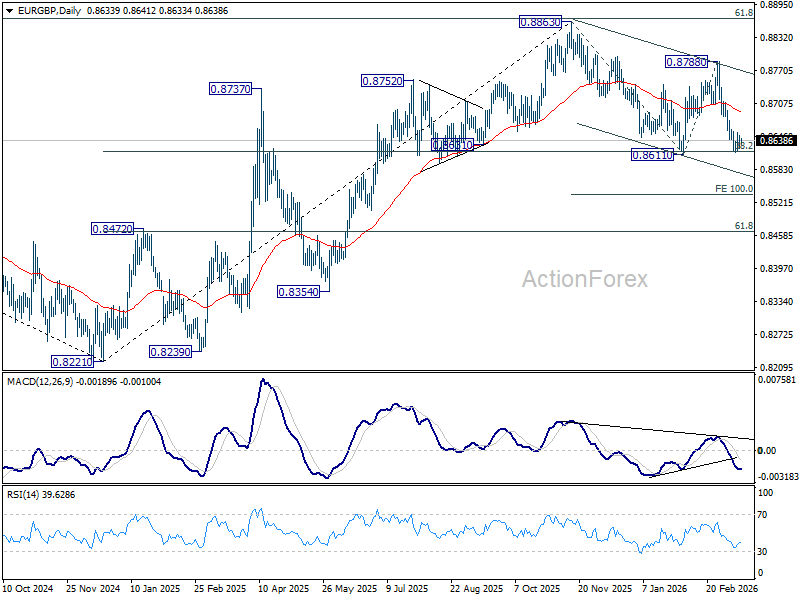
    Intraday bias in EUR/GBP remains on the downside at this point. Break of 55 D EMA (now at 0.8745) indicates rejection by 0.8867 fibonacci level. Further fall should be seen to 0.8631 cluster (38.2% retracement of 0.8221 to 0.8663 at 0.8618). For now, risk will stay on the downside as long as 0.8800 resistance holds, in case of recovery.

    In the bigger picture, rise from 0.8221 medium term bottom is still seen as a corrective move. Upside should be limited by 61.8% retracement of 0.9267 to 0.8221 at 0.8867. Sustained trading below 55 W EMA (now at 0.8600) should confirm that this corrective bounce has completed. However, decisive break of 0.8867 will suggest that EUR/GBP is already reversing whole decline from 0.9267 (2022 high). That should pave the way back to 0.9267.

    EUR/AUD Daily Outlook

    Daily Pivots: (S1) 1.7577; (P) 1.7643; (R1) 1.7681; More...

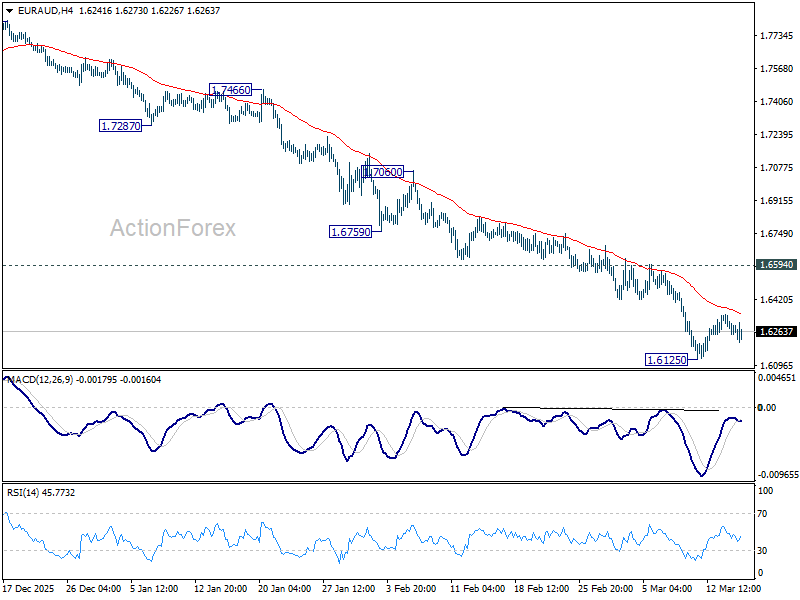
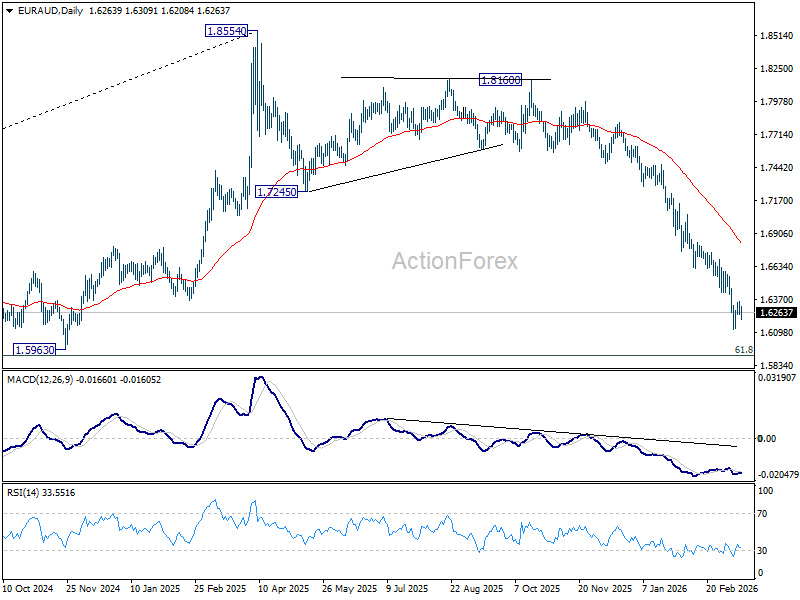
    Intraday bias in EUR/AUD remains on the downside for 1.7561 support. Firm break there should confirm that larger corrective pattern from 1.8554 is already in the third leg. Deeper decline should then be seen to 1.7245 support next. For now, risk will stay on the downside as long as 1.7761 resistance holds, in case of recovery.

    In the bigger picture, price actions from 1.8554 medium term top are seen as a corrective pattern. Sustained break of 55 W EMA (now at 1.7426) will suggest that it's correcting the whole rally from 1.4281 (2022 low). In this case, deeper decline would be seen to 38.2% retracement of 1.4281 to 1.8554 at 1.6922. Nevertheless, strong rebound from 55 W EMA will likely bring resumption of the up trend sooner.

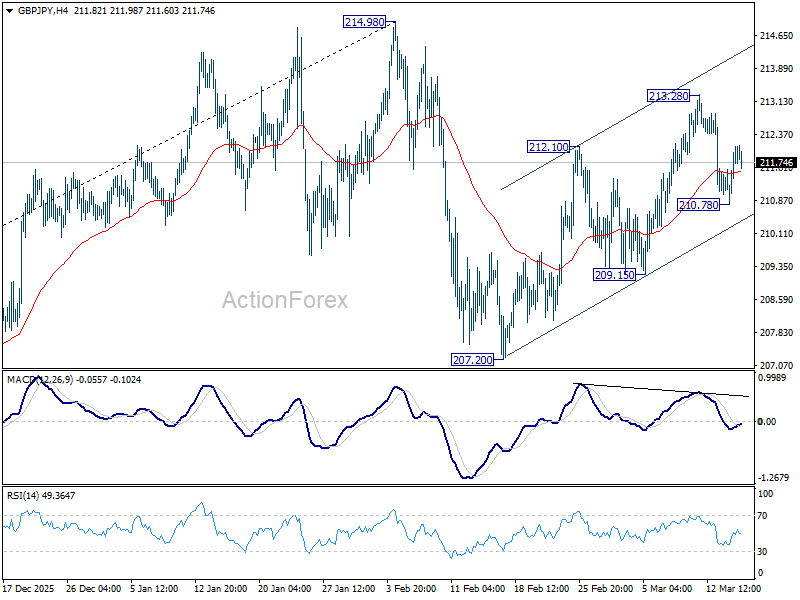
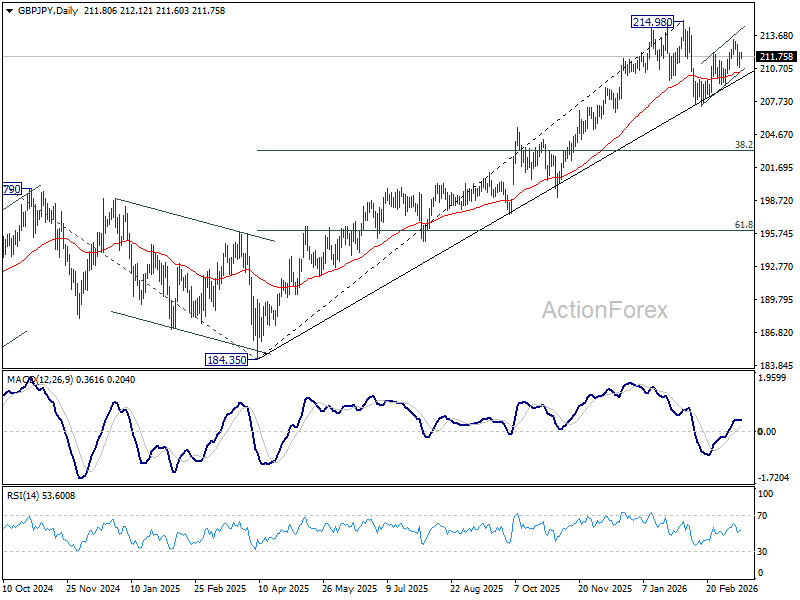
    GBP/JPY Daily Outlook

    Daily Pivots: (S1) 206.26; (P) 206.81; (R1) 207.27; More...

    GBP/JPY retreated after edging higher to 207.34 briefly, and intraday bias is turned neutral gain. Further rise is expected as long as 205.17 support holds. Above 207.34 will resume the rise from 184.35 to retest 208.09 high. However, break of 205.17 support will turn bias to the downside for deeper pullback, possibly to 55 D EMA (now at 203.22).

    In the bigger picture, price actions from 208.09 (2024 high) are seen as a corrective pattern which might have completed at 184.35. Firm break of 208.09 high will resume the up trend from 123.94 (2020 low). Next target is 61.8% projection of 148.93 to 208.09 from 184.35 at 220.90. However, decisive break of 199.04 support will dampen this view and extend the corrective pattern with another fall.

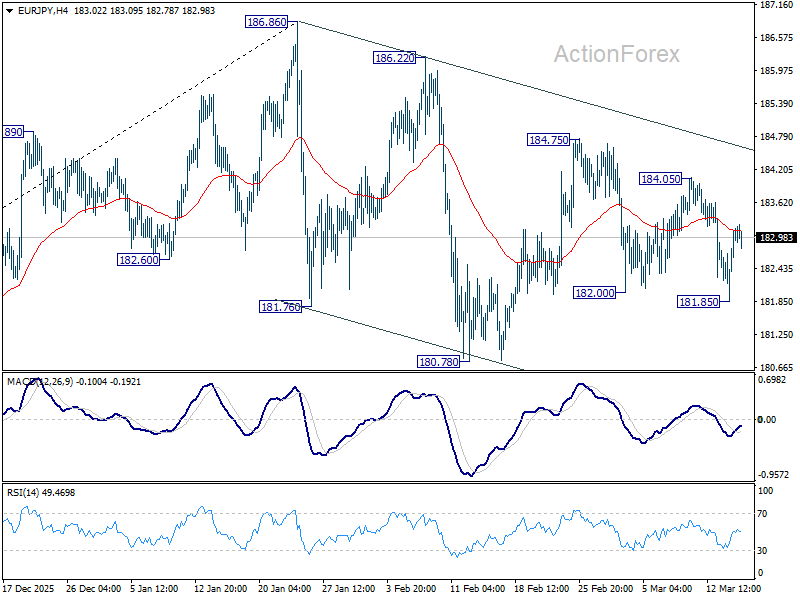
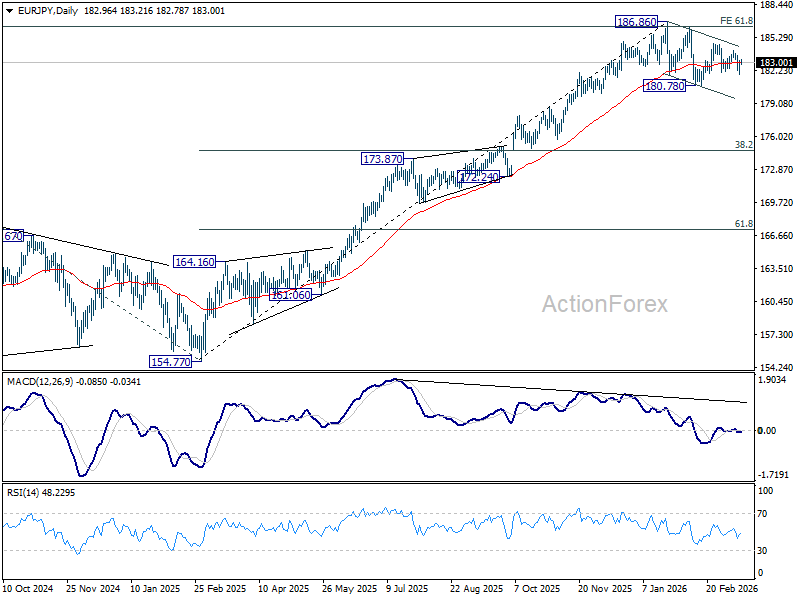
    EUR/JPY Daily Outlook

    Daily Pivots: (S1) 180.24; (P) 180.77; (R1) 181.14; More...

    EUR/JPY dips again today but stays above 179.74 support. Intraday bias remains neutral and another rally is still in favor. On the upside, break of 181.98 will target 100% projection of 161.06 to 173.87 from 171.09 at 183.90 next. However, firm break of 178.80 will argue that deeper correction is already underway towards 55 D EMA (now at 177.81).

    In the bigger picture, up trend from 114.42 (2020 low) is in progress and should target 61.8% projection of 124.37 to 175.41 from 154.77 at 186.31. However, considering bearish divergence condition in D MACD, upside should be capped by 186.31 on first attempt. Outlook will continue to stay bullish as long as 55 W EMA (now at 169.87) holds, even in case of deep pullback.

    JGB Yields Climb, BoJ Hike Bets Rise, and Yen Risks Triggering Carry Unwind

    Japan remains the center of attention in an otherwise quiet Asian session, with traders focused on the relentless climb in JGB yields. The 10-year benchmark surged to a fresh 18-year high today and appears poised to challenge the psychological 2% handle soon, an escalation that is increasingly difficult for global markets to ignore.

    Much of the pressure stems from Prime Minister Sanae Takaichi’s JPY 18.3 trillion stimulus package, which has put the government on a collision course with investors concerned about fiscal sustainability. The scale of the planned spending, combined with a softening stance on fiscal consolidation, has amplified expectations for higher long-term borrowing costs.

    Earlier this week, Japan’s Fiscal System Council retreated from its previous call for a rapid return to surplus, instead advising only an annual review of the primary balance. Markets interpreted the shift as clearing the runway for Takaichi to pursue more aggressive stimulus—reinforcing fears that Japan’s debt could steepen further.

    Finance Minister Satsuki Katayama pushed back today, stressing that the supplementary budget was crafted with sustainability in mind and that fiscal responsibility will guide the FY2026 budget. But these assurances have done little to ease investor unease.

    In parallel, markets have intensified bets on a December 19 BoJ rate hike to 0.75%, fuelled by recent comments from Governor Kazuo Ueda and signs of improved communication between the new cabinet and the central bank. Katayama noted positive engagement with Ueda since taking office, while emphasizing the BoJ’s operational independence—remarks seen as a subtle green light for further tightening.

    The key question for traders now is whether soaring JGB yields and rising BoJ expectations will translate into a durable rebound in Yen. A meaningful JPY rally raises the risk of triggering the kind of carry-trade unwind seen last year, an unwind that briefly shook global risk assets and exposed vulnerabilities in leveraged positioning.

    In the currency markets, Dollar remains pinned at the bottom of the weekly performance chart, with today’s US personal income, spending, PCE inflation, and consumer sentiment data unlikely to spark a sustained recovery. Swiss Franc and Loonie follow as the next weakest performers.

    At the strong end, Aussie continues to lead as markets doubt whether the RBA has room to cut rates again next year. Yen follows in second place, while Sterling also benefits from improved domestic sentiment. Kiwi and Euro sit in the middle of the pack.

    In Asia, Nikkei fell -1.22%. Hong Kong HSI is up 0.31% at the time of writing. China Shanghai SSE is up 0.71%. Singapore Strait Times is down -0.24%. Japan 10-year JGB yield rose 0.01 to 1.951. Overnight, DOW fell -0.07%. S&P 500 rose 0.11%. NASDAQ rose 0.22%. 10-year yield rose 0.051 to 4.108.

    Japan household spending slumps -3.0% yoy in October, casting doubt over strength of recovery

    Japan’s household spending fell sharply by -3.0% yoy in October, far below expectations for 1.1% yoy increase, and marking the steepest decline since January 2024. It was also the first annual drop in six months.

    On a monthly, seasonally adjusted basis, spending plunged -3.5% mom, defying forecasts of a 0.7% mom growth. Lower outlays on food, leisure and automobile-related expenses drove the weakness, though officials said it remains unclear whether the decline represents a one-off setback, noting consumption is still perceived to be in a recovery phase.

    The data arrive at a delicate moment for the BoJ. Markets have ramped up bets on a rate hike this month following recent comments from Governor Kazuo Ueda that the Bank would weigh the “pros and cons” of further tightening. The slump in spending, however, introduces fresh uncertainty around the durability of domestic demand—one of the BoJ’s key criteria for normalizing policy continuously.

    EUR/JPY Daily Outlook

    Daily Pivots: (S1) 180.24; (P) 180.77; (R1) 181.14; More...

    EUR/JPY dips again today but stays above 179.74 support. Intraday bias remains neutral and another rally is still in favor. On the upside, break of 181.98 will target 100% projection of 161.06 to 173.87 from 171.09 at 183.90 next. However, firm break of 178.80 will argue that deeper correction is already underway towards 55 D EMA (now at 177.81).

    In the bigger picture, up trend from 114.42 (2020 low) is in progress and should target 61.8% projection of 124.37 to 175.41 from 154.77 at 186.31. However, considering bearish divergence condition in D MACD, upside should be capped by 186.31 on first attempt. Outlook will continue to stay bullish as long as 55 W EMA (now at 169.87) holds, even in case of deep pullback.


    Economic Indicators Update

    GMT CCY EVENTS ACT F/C PP REV
    23:30 JPY Household Spending Y/Y Oct -3.00% 1.10% 1.80%
    05:00 JPY Leading Economic Index Oct P 110 109.3 108.6
    07:00 EUR Germany Factory Orders M/M Oct 0.30% 1.10%
    07:45 EUR France Industrial Output M/M Oct -0.10% 0.80%
    08:00 CHF Foreign Currency Reserves (CHF) Nov 725B
    10:00 EUR Eurozone GDP Q/Q Q3 F 0.20% 0.20%
    10:00 EUR Eurozone Employment Change Q/Q Q3 F 0.10% 0.10%
    13:30 USD Personal Income M/M Sep 0.40% 0.40%
    13:30 USD Personal Spending Sep 0.40% 0.60%
    13:30 USD PCE Price Index M/M Sep 0.30% 0.30%
    13:30 USD PCE Price Index Y/Y Sep 2.80% 2.70%
    13:30 USD Core PCE Price Index M/M Sep 0.20% 0.20%
    13:30 USD Core PCE Price Index Y/Y Sep 2.90% 2.90%
    13:30 CAD Net Change in Employment Nov -1.5K 66.6K
    13:30 CAD Unemployment Rate Nov 7.00% 6.90%
    15:00 USD UoM Consumer Sentiment Dec P 52 51
    15:00 USD UoM 1-Yr Inflation Expectations Dec P 4.50%


    Japan household spending slumps -3.0% yoy in October, casting doubt over strength of recovery

    Japan’s household spending fell sharply by -3.0% yoy in October, far below expectations for 1.1% yoy increase, and marking the steepest decline since January 2024. It was also the first annual drop in six months.

    On a monthly, seasonally adjusted basis, spending plunged -3.5% mom, defying forecasts of a 0.7% mom growth. Lower outlays on food, leisure and automobile-related expenses drove the weakness, though officials said it remains unclear whether the decline represents a one-off setback, noting consumption is still perceived to be in a recovery phase.

    The data arrive at a delicate moment for the BoJ. Markets have ramped up bets on a rate hike this month following recent comments from Governor Kazuo Ueda that the Bank would weigh the “pros and cons” of further tightening. The slump in spending, however, introduces fresh uncertainty around the durability of domestic demand—one of the BoJ’s key criteria for normalizing policy continuously.

    Swing Up, You Won’t Hit a Wall

    A genuine cyclical upswing in private sector spending is underway. This is needed, not necessarily a reason to worry about inflation. There is too much pessimism about supply capacity.

    • The September quarter national accounts confirmed what we had already flagged in our forecasts and ‘Westpac-Now’ nowcast of activity: that growth in private sector demand is picking up, finally. Rising household incomes have eased cost-of-living pressures somewhat and supported spending. Business investment also picked up in the latest quarter, which is a positive for future capacity.
    • Contrary to some views, we do not regard activity growth at this rate as being necessarily inflationary. Estimates of growth in the capacity of Australia’s economy around 2% look too low. Such assumptions are vulnerable to small surprises in population, participation or productivity. The risks on these are all on the upside.
    • There are, however, reasons to be cautious about the current inflation environment. As with all inflation releases, there are some categories running well above the overall inflation rate, and some well below. However, the high outcomes recently are dominated by categories where policies of government at various levels determine prices. For many of these categories, high inflation rates are locked in for the next few years. The RBA’s mandate to hit its 2½% inflation target would mean keeping the rest of the economy weak and market-sector inflation low, to offset this policy-driven inflation. Surely there is a better way.

    The September quarter national accounts confirmed that an upswing in private sector demand is underway. This was previously flagged by our ‘Westpac-Now’ nowcast estimate, in turn driven by the upswing in our Westpac–DataX Card Tracker and, for business investment, the ABS Capex survey.

    For some observers, though, what is good is bad. Stronger growth in activity is seen in these quarters as outstripping the growth rate of Australia’s supply capacity – so-called ‘potential output’. With the economy also seen as having little to no spare capacity in absolute terms, the conclusion is then that demand pressures imply faster inflation. According to this view, the upswing will soon hit a wall of higher inflation and interest rates.

    We simply have a different view about supply capacity. As highlighted in the lead-up to the national accounts, we think trend growth is more like 2¼%yr than the RBA’s assumption of 2%. Even higher numbers are achievable if the productivity benefits of AI become evident in coming years.

    There are a number of ways to estimate trend growth in supply capacity but most of them boil down to adding trend growth in labour productivity to trend growth in labour supply. We have discussed the RBA’s 0.7%yr near-term estimate of trend productivity growth elsewhere, but for the sake of argument, let’s take that as a base-case minimum. To get 2% for potential output growth, that means trend labour supply growth of 1.3%. Is this realistic? Consider that even if the RBA’s assumption about overall population growth of 1.2%yr over 2027 is correct, working-age population will grow faster; new migrants to Australia are disproportionately young adults without children. The gap between working-age and total population varies over time and on current data is unusually high. Over recent decades it has averaged at least 0.1–0.2 percentage points. So, suppose trend working-age population growth is 1.3–1.4%yr.

    How this translates into trend growth in labour supply depends on trends in labour force participation and average hours. Back in September, Westpac Economics colleague Ryan Wells and I highlighted that there is an upward trend in labour force participation in Australia and many other advanced economies. The RBA has since acknowledged this in its November Statement on Monetary Policy. Average hours per working person are trending downwards as part-time work becomes more common. The net of the two trends looks to be a wash, or at worst a gentle downtrend around 0.1%pt per year.

    You can then see how the RBA gets its 2%yr estimate of potential output growth. Assume 0.7%yr productivity plus 1.3–1.4%yr growth in working-age population, minus up to 0.1%pt for the net of participation and average hours, implying 1.3%yr trend growth in labour supply.

    You can also see how vulnerable the RBA’s conclusion is to small misses, and that all these risks are in the one direction. Population growth of 1.2%yr is 0.4%pt lower than the latest official data and would be lower than at any time in the past two decades. Our own forecast for 2027 is 1.35%. Working-age population is currently estimated to be growing at a 2% pace, though we expect the ABS will revise this down as the estimated resident population figures come in. Even allowing for some narrowing in the current gap between the growth rates of total and working-age population, labour supply growth in the 1.5–1.6%yr range is entirely plausible. Add in the more positive view of productivity growth implied by this week’s national accounts, and it is easy to get a trend growth estimate more in the 2¼–2½%yr range than the 2% advocated by the productivity pessimists.

    The September quarter and new October monthly inflation data did nothing to counteract the more pessimistic view of supply capacity, to be fair. While the October headline result, at 3.8%, was not a surprise to Westpac Economics (
    we had nowcast 3.9% (PDF 842KB)), it was a surprise to market consensus.

    One should avoid the temptation of dismissing an uncomfortable result with words to the effect of “if you exclude all the things that are increasing a lot, inflation is actually ok”. That said, there are reasons to believe that recent inflation outcomes are not suggesting that strong demand is pushing up inflation at present. Rather, much of the strength has been driven by government policy.

    One way to look at this question is to consider the categories of the CPI that recorded the highest inflation – say, 5%yr or more. Some of these – beef & veal (10.4%yr), lamb & goat (14.3%yr) and coffee, tea & cocoa (16.5%yr) – are obviously supply shocks that will not continue at that pace forever. They could even fall, as the price of eggs has been for the past six months now that the flock numbers have recovered after a wave of bird flu over 2023–24. Other categories are known volatiles that tell us little about underlying trends (domestic travel, clothing & footwear).

    More worrisome, though, is the preponderance of policy-driven categories. From the well-known unwind of electricity rebates (electricity up 37.4%yr) to the NSW pricing decision for Sydney Water discussed last week, to local government property rates & charges (6.2%yr), policy-controlled prices dominated the top of the distribution. Tobacco, child care, school education, postal and medical & hospital charges all exceeded 5%yr as well. About the only non-policy ongoing inflation at these rates was Audio, Visual & Computing Media & Services (9.8%yr). And I just don’t think Foxtel and Xbox (the only announced price increases we could find where the timing matches the 5.4% spike in the month of August) are going to increase their charges every year on that scale.

    So we have a bit of an issue in that most of the high inflation is in sectors that are insulated from monetary policy. The RBA can still achieve its inflation target in this environment, but only by squeezing the market sector of the economy with tight policy to offset high administered price inflation with sub-target inflation elsewhere. Given that Australian households’ real incomes per person have been static for half a decade, this is an unsatisfactory way to run an economy. There must be a better way to keep inflation under control than to keep the boot continuously on the neck of the Australian consumer. And there is, but it requires governments at all levels to take charge of their own contribution to inflation.

    Nothing about this situation will change this month, of course. The RBA is aware that some of the recent pick-up in inflation is temporary but will be cautious given their view of potential output growth. It will therefore remain emphatically on hold this month and for much of next year.

    If we are right about supply capacity, inflation will moderate – at least in the market sector – over the course of 2026, leaving room for the two cuts we still have pencilled in (May and August as the base case). Given the RBA’s beliefs about potential output, this will not be its expectation. It might therefore seek to further dampen expectations of future cuts. The risk to our base case is quite obviously that the RBA stays on hold for longer. If we are right about supply capacity, though, the Australian economy will not hit the wall of capacity constraints. And that means the RBA risks keeping interest rates too high for too long.

    Cliff Notes: The State of the Nation

    Key insights from the week that was.

    In Australia, Q3 GDP fell short of expectations, rising just 0.4% (2.1%yr). However, much of the disappointment was tied to a run-down of inventories, masking a much stronger showing for domestic demand, up 1.2% (2.6%yr). The public sector added to growth via consumption and investment, although the scale of support offered through both channels is easing as cost-of-living relief measures wind up and existing infrastructure projects progress.

    New business investment was in the spotlight in the private sector, surging 3.4% (3.8%yr). Data centres and aircraft were key drivers, but there are some early hints of a broadening in the investment pulse across both consumer and business-facing sub-sectors. This trend has positive implications for supply capacity and productivity which are explored in more detail by Chief Economist Luci Ellis in this week’s essay.

    Consumer spending was also a key contributor, lifting 0.5% (2.5%yr), spot on our expectation. This was mostly driven by spending on essentials, including electricity and superannuation fees – the latter owing to Q3’s superannuation guarantee increase. Although discretionary spending was a touch softer, both our internal data and recent ABS data point to a pick-up in this category into year end. Going forward, one of the key risks is the fading of the tailwinds associated with easing inflation, interest rate reductions and tax cuts for disposable incomes and spending.

    The boost to wealth from rising house prices is also important to keep in mind, the Cotality index surging another 1.0% (7.1%yr) in November. Recent gains have been driven by lower cost tiers of the market, suggesting affordability remains a constraint but that households continue to adjust expectations to transact. Dwelling approvals have largely moved sideways this year, but the pipeline remains robust and should go some way to alleviating tight supply in coming years. For our in-depth view of the housing market, see the latest Housing Pulse.

    Before moving offshore, a final note on trade. Partial data released earlier this week showed the current account balance widened slightly in Q3, from –$16.2bn to –$16.6bn, chiefly driven by a larger trade surplus, a trend that looks to have persisted in the goods balance into October. In real terms, the external sector subtracted 0.1ppts from GDP in Q3. This speaks to the longer-run structural headwinds for ‘traditional’ commodity export channels; however, that does not preclude burgeoning areas of opportunity gaining scale – services exports of software licensing being an example.

    In the US, the ISM Services PMI rose 0.2pts to 52.6pts in November, although that still leaves all sub-components excluding prices well below their ten-year pre-COVID average. There were notable increases in the backlog of orders (+8.3pts), imports (+5.2pts), inventories (+3.9pts) and supplier deliveries (+3.3pts), while new orders (-3.3pts) and prices (-4.6pts) both exhibited falls. The sizeable fall in the prices component primarily reflected declines in gasoline prices. The manufacturing PMI meanwhile declined 0.5pts to 48.2pts, reflecting falls in new orders (-2pts), employment (-2pts), supplier deliveries (-4.9pts) and the order backlog (-3.9pts). The prices component increased by 0.5pts to 58.5pts but remains well off its highs. All told, both surveys point to sub-par momentum, but not aggregate contraction.

    In Europe meanwhile, the flash estimate for November indicated prices fell 0.3% in the month, reflecting falling energy costs. In annual terms, inflation accelerated to 2.2%, backed by a 3.5% gain in services prices. Looking ahead, there are some downside risks to the headline component following a decline in wholesale gas prices. In a speech this week, ECB President Lagarde noted that underlying inflation pressures are consistent with achieving the inflation target, but that risks to the outlook remain two-sided.