Sample Category Title
DXY Testing the 100.82 YtD Low
Markets
Yesterday’s second tier US data (weekly jobless claims, PPI) undershot consensus again. It strengthened market conviction of the Fed’s tightening cycle not only coming to a close but that it is about to go in reverse soon to support a slowing economy. Short-term US yields initially dropped 6-7 bps shortly after the release before recovering again. Yields at longer maturities ended the day even 5.4-6.3 bps higher (10-y/30-y segment), reflecting hopes of the expected cutting cycle to boost the economic recovery going forward. The spread between the 10-y and 2-y over the past month halved, from -108 bps early March – the most since the early eighties – to -52 bps yesterday. German yields joined the US trend lower after the data but partly missed out on the late-session recovery at the other side of the Atlantic. Speeches from ECB members Kazaks and Holzmann came after European closing hours too. Both favoured another 50 bps May rate hike. The US dollar stayed in the defensive on currency markets amid a bright equity mood (Nasdaq finished 2% higher). DXY (trade-weighted) slipped from 101.5 to 101.01. EUR/USD shot op from below 1.10 to 1.1046, the highest close since end March 2022. We fear there is little that can save the dollar short-term, neither fundamentally nor technically. The economic calendar contains US retail sales and U. of Michigan consumer confidence. But given the market’s current reaction function, all the greenback can hope for is that is does not surprise to the downside. DXY is testing the 100.82 YtD low during the Asian session this morning. A break lower paves the way towards a support zone around 99.4. EUR/USD extends gains to 1.107 with from a technical point of view little in the way for a return to 1.1185. The picture for rates turned a bit more neutral in our view. It’s all tentative, but yesterday’s intraday price action at the front end of the curve suggests markets currently think enough cuts are priced in for the time being. For longer maturities, the bad economic news yesterday was eventually good news for yields. This combines with rates across all maturities consistently finding solid support from the lows set at the height of the financial turmoil mid-March. There are two risks to this hypothesis today: a huge miss in the data and/or the earnings season kickoff by the financial sector. Especially the latter’s effect on equity markets is critical. Another series of Fed and ECB speakers serve as a wildcard for trading. It took a while, but we’re finally seeing some movement in sterling as well, even as it is a non-autonomous, USD-inspired one. EUR/GBP rose for a third day straight to 0.8821 with the pound unable to profit from BoE Pill’s warning for a positive demand shock emerging (see headline below).
News Headlines
Bloomberg reports that Republican House Speaker McCarthy is preparing to unveil a proposal next week which would suspend the US debt ceiling for a year in return for spending concessions. The plan calls for a House vote in late May according to people familiar with talks. In return for the vote, non-defense discretionary spending would have to stay at roughly the same level as fiscal year 2022 and grow 1% per year over 10 years. The GOP plan will include other spending cut proposals and regulations changes which could form the basis of separate budget talks towards late May 2024. US President Biden and Democrats have long called for an unconditional increase of the US debt limit. US Treasury Secretary Yellen warned that the US debt ceiling could be hit as soon as early June. Without a deal to raise it, the country is at risk of default. CDS prices to insure against the risk and short term US money market rates stretching beyond June are starting to show signs of rising unease over the issue in the investor community.
UK chief economist Pill said that the less pessimistic outlook on UK unemployment is supportive for consumption given the relatively strong relationship between unemployment and precautionary saving. That gives space for a positive demand shock which may cloud the picture a return of double digit inflation towards the central bank’s 2% inflation target. Pill is worried about inflation (10.4% Y/Y) but the Bank of England needs to recognize there is scope to do too much as well as too little. He wasn’t lured into giving guidance for the May policy meeting (including new Monetary Policy Report) and added that the string of 11 interest rate hikes (to 4.25%) was weighing on inflation. UK money markets discount a 4.5-4.75% policy rate peak. The MPC is divided on whether the economy needs higher unemployment to return inflation to target.
USD/CAD Daily Outlook
Daily Pivots: (S1) 1.3299; (P) 1.3373; (R1) 1.3414; More....
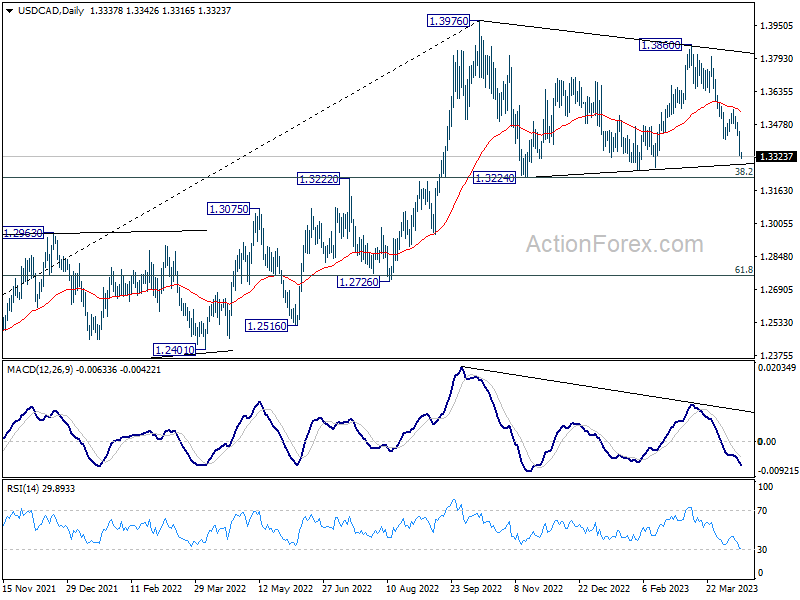
Intraday bias in USD/CAD stays on the downside fall the momentum. Fall from 1.3860, which is seen as the third leg of the corrective pattern from 1.3976, is in progress for 1.3224/61 support zone. Strong support is expected there to complete the corrective pattern and bring rebound. On the upside, above 1.3405 support turned resistance will turn intraday bias neutral first. Further break of 1.3552 will indicate near term reversal.
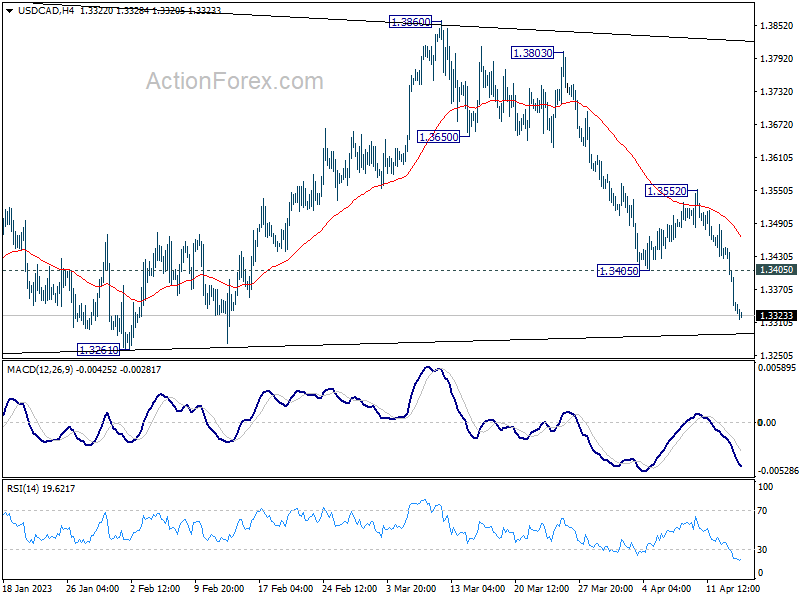
In the bigger picture, the up trend from 1.2005 (2021 low) is still in progress. Break of 1.3976 will confirm resumption and target 61.8% projection of 1.2401 to 1.3976 from 1.3261 at 1.4234. Firm break there will pave the way to long term resistance zone at 1.4667/89 (2016, 2020 highs). On the downside, sustained break of 55 week EMA (now at 1.3282) is needed to confirm medium term topping. Otherwise, outlook will remain bullish even in case of deep pull back.
Dollar Dives as Disinflation Solidifies Fed’s Tightening Cycle End; Stocks Rise
As disinflation process in the US picks up steam, Dollar continues its relentless descent, fueling the belief that Fed's tightening cycle is close to its curtain call. This evolving sentiment has not only lifted US stocks overnight but also spilled over into Asian session, painting a positive picture for the markets. Despite its recent woes, the greenback is not this week's weakest performer; that dubious honor goes to Yen, bogged down by unwavering dovish stance of the new BoJ Governor. Meanwhile, Swiss Franc basks in the limelight as the strongest contender, trailed by Aussie, Euro, and Sterling. Amid BoC's pause earlier in the week, Canadian Dollar remains a mixed bag.
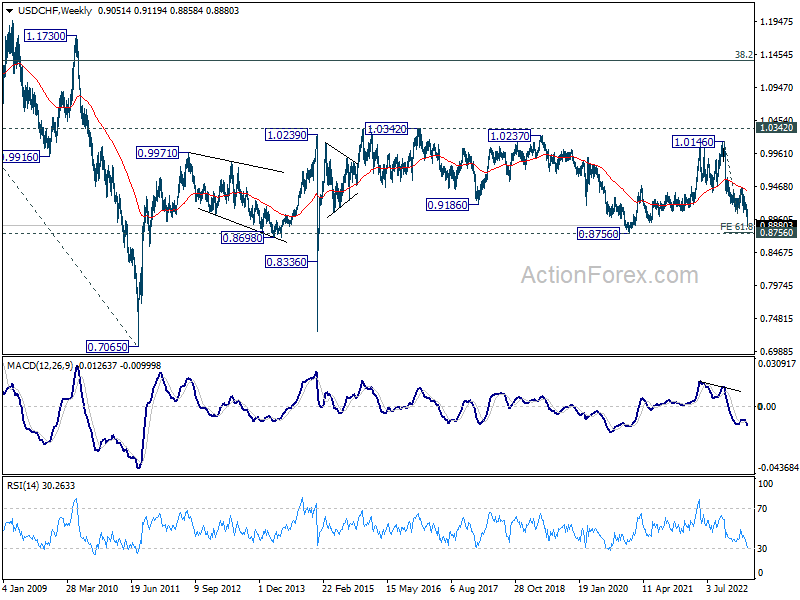
On the technical front, USD/CHF is quickly approaching an important support level at 0.8756 (2021 low). A test on the level could happen in weeks, or even days depending on the intensity of the current selloff in the greenback. Robust support is expected there to bring sustainable rebound back to 0.9058/9439 resistance zone, at least on the first attempt. However, decisive break of the support will break USD/CHF out of a long term range that started back in early 2010s. That would be a significant development if realized.
In Asia, at the time of writing, Nikkei is up 1.14%. Hong Kong HSI is up 0.09%. China Shanghai SSE is up 0.43%. Singapore Strait Times is up 0.34%. Japan 10-year JGB yield is down-0.0048 at 0.461. Overnight, DOW rose 1.14%. S&P 500 rose 1.33%. NASDAQ rose 1.99%. 10-year yield rose 0.11 to 3.452.
DOW surges as disinflation gains momentum and fed's tightening cycle nears end
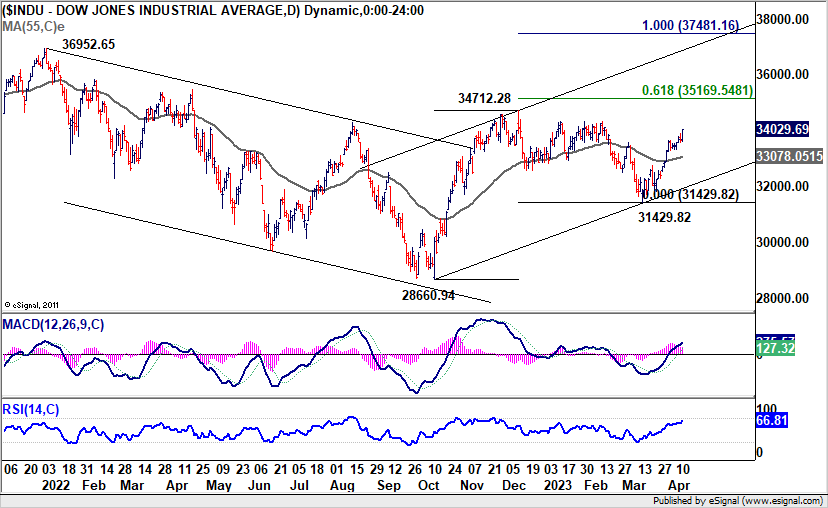
US stocks closed significantly higher overnight, with DOW and S&P 500 extending their near-term rallies. This week's data supported the view that disinflation is gaining momentum in the US, as evidenced by the notable downside surprise in US PPI and the below-expectation headline CPI readings for March. Additionally, jobless claims data indicated that job market remains stable rather than overheated. The overall picture suggests that while inflation is slowing, the economy isn't crashing. These factors also contribute to the case that Fed's tightening cycle is nearing its end, although it remains uncertain when Fed will reverse course.
Technically, DOW's corrective pattern from 34712.28 should have completed with three waves down to 31429.82. Further rise is now expected as long as 55 D EMA (now at 33078.05) holds. Break of 34712.28 resistance is envisaged as the rally continues. The test for the near term lies in 61.8% projection of 28660.94 to 34712.28 from 31429.82 at 35169.54. Decisive break there could add more fuel to the rally and prompt upside acceleration through. 36952.65 high later in the year.
BoJ Ueda foresees core inflation slowing, reiterates commitment to ultra-loose monetary policy
BoJ Governor Kazuo Ueda, who recently attended the G20 finance leaders' meeting in Washington, expects core consumer inflation in Japan, currently around 3%, to slow below 2% by the latter half of this fiscal year. Ueda emphasized the central bank's commitment to maintaining ultra-loose monetary policy in order to achieve its 2% inflation target in a stable and sustainable manner.
Ueda believes that "as our base scenario is for global growth to pick up after a period of slowdown, Japan's wages will likely keep rising." He added that the BoJ's forecasts already factor in the possibility of a global economic slowdown, but a severe global recession is not considered in the baseline projection.
As for the upcoming April policy meeting, Ueda said, "It's been just a week since I took office and now I am on a business trip. I'll think about it closely once I'm back." Market participants are closely watching the BoJ's first policy meeting under Ueda's leadership on April 27-28, where the board will release fresh quarterly growth and inflation forecasts extending through fiscal 2025.
NZ BNZ manufacturing dropped to 48.1, sector faces headwinds
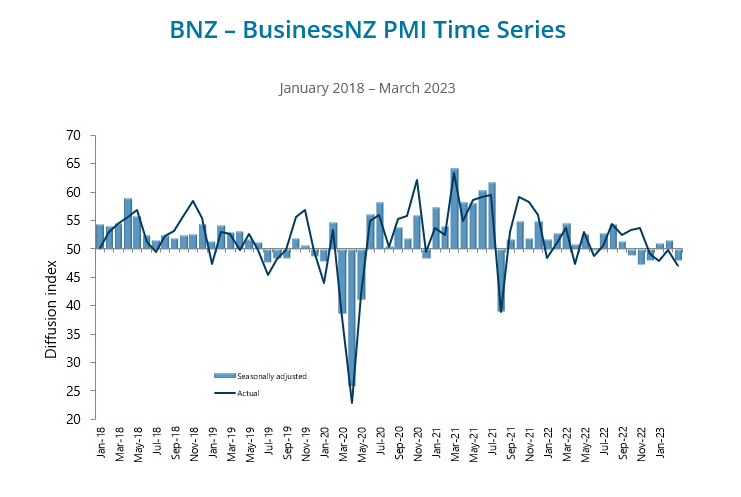
New Zealand's BusinessNZ Performance of Manufacturing Index fell from 51.7 in February to 48.1 in March, slipping back into negative territory after briefly reaching positive levels in January and February. The decline in the index signals challenges for the manufacturing sector.
A closer look at the data reveals that production dropped from 48.7 to 43.3, its lowest level since August 2021. Employment shrank from 55.2 to 47.1, while new orders dipped from 51.5 to 46.7, matching November 2022 levels. Finished stocks decreased from 55.1 to 48.4, and deliveries rose slightly from 52.2 to 53.8.
Catherine Beard, BusinessNZ's Director of Advocacy, pointed out that the numbers behind the main March result indicate the manufacturing sector is facing significant headwinds. BNZ Senior Economist Craig Ebert added that although New Zealand's March PMI was disappointing, it was "not especially negative in the longer-term context" and was in line with global manufacturing readings.
Looking ahead
Swiss PPI is the only feature in the European session. Later in the day, main focus in US retail sales, and import prices, industrial production and U of Michigan consumer sentiment will be released. Canada will also release manufacturing sales.
USD/CAD Daily Outlook
Daily Pivots: (S1) 1.3299; (P) 1.3373; (R1) 1.3414; More....
Intraday bias in USD/CAD stays on the downside fall the momentum. Fall from 1.3860, which is seen as the third leg of the corrective pattern from 1.3976, is in progress for 1.3224/61 support zone. Strong support is expected there to complete the corrective pattern and bring rebound. On the upside, above 1.3405 support turned resistance will turn intraday bias neutral first. Further break of 1.3552 will indicate near term reversal.
In the bigger picture, the up trend from 1.2005 (2021 low) is still in progress. Break of 1.3976 will confirm resumption and target 61.8% projection of 1.2401 to 1.3976 from 1.3261 at 1.4234. Firm break there will pave the way to long term resistance zone at 1.4667/89 (2016, 2020 highs). On the downside, sustained break of 55 week EMA (now at 1.3282) is needed to confirm medium term topping. Otherwise, outlook will remain bullish even in case of deep pull back.
Economic Indicators Update
| GMT | Ccy | Events | Actual | Forecast | Previous | Revised |
|---|---|---|---|---|---|---|
| 22:30 | NZD | Business NZ PMI Mar | 48.1 | 51 | 52 | |
| 06:30 | CHF | Producer and Import Prices M/M Mar | -0.20% | -0.20% | ||
| 06:30 | CHF | Producer and Import Prices Y/Y Mar | 2.70% | 2.70% | ||
| 12:30 | CAD | Manufacturing Sales M/M Feb | -2.50% | 4.10% | ||
| 12:30 | USD | Retail Sales M/M Mar | -0.50% | -0.40% | ||
| 12:30 | USD | Retail Sales ex Autos M/M Mar | -0.40% | -0.10% | ||
| 12:30 | USD | Import Price Index M/M Mar | -0.20% | -0.10% | ||
| 13:15 | USD | Industrial Production M/M Mar | 0.20% | 0.00% | ||
| 14:00 | USD | Michigan Consumer Sentiment Index Apr P | 62.7 | 62 | ||
| 14:00 | USD | Business Inventories Feb | 0.20% | -0.10% |
DOW surges as disinflation gains momentum and fed’s tightening cycle nears end
US stocks closed significantly higher overnight, with DOW and S&P 500 extending their near-term rallies. This week's data supported the view that disinflation is gaining momentum in the US, as evidenced by the notable downside surprise in US PPI and the below-expectation headline CPI readings for March. Additionally, jobless claims data indicated that job market remains stable rather than overheated. The overall picture suggests that while inflation is slowing, the economy isn't crashing. These factors also contribute to the case that Fed's tightening cycle is nearing its end, although it remains uncertain when Fed will reverse course.
Technically, DOW's corrective pattern from 34712.28 should have completed with three waves down to 31429.82. Further rise is now expected as long as 55 D EMA (now at 33078.05) holds. Break of 34712.28 resistance is envisaged as the rally continues. The test for the near term lies in 61.8% projection of 28660.94 to 34712.28 from 31429.82 at 35169.54. Decisive break there could add more fuel to the rally and prompt upside acceleration through. 36952.65 high later in the year.
NZ BNZ manufacturing dropped to 48.1, sector faces headwinds
New Zealand's BusinessNZ Performance of Manufacturing Index fell from 51.7 in February to 48.1 in March, slipping back into negative territory after briefly reaching positive levels in January and February. The decline in the index signals challenges for the manufacturing sector.
A closer look at the data reveals that production dropped from 48.7 to 43.3, its lowest level since August 2021. Employment shrank from 55.2 to 47.1, while new orders dipped from 51.5 to 46.7, matching November 2022 levels. Finished stocks decreased from 55.1 to 48.4, and deliveries rose slightly from 52.2 to 53.8.
Catherine Beard, BusinessNZ's Director of Advocacy, pointed out that the numbers behind the main March result indicate the manufacturing sector is facing significant headwinds. BNZ Senior Economist Craig Ebert added that although New Zealand's March PMI was disappointing, it was "not especially negative in the longer-term context" and was in line with global manufacturing readings.
BoJ Ueda foresees core inflation slowing, reiterates commitment to ultra-loose monetary policy
BoJ Governor Kazuo Ueda, who recently attended the G20 finance leaders' meeting in Washington, expects core consumer inflation in Japan, currently around 3%, to slow below 2% by the latter half of this fiscal year. Ueda emphasized the central bank's commitment to maintaining ultra-loose monetary policy in order to achieve its 2% inflation target in a stable and sustainable manner.
Ueda believes that "as our base scenario is for global growth to pick up after a period of slowdown, Japan's wages will likely keep rising." He added that the BoJ's forecasts already factor in the possibility of a global economic slowdown, but a severe global recession is not considered in the baseline projection.
As for the upcoming April policy meeting, Ueda said, "It's been just a week since I took office and now I am on a business trip. I'll think about it closely once I'm back." Market participants are closely watching the BoJ's first policy meeting under Ueda's leadership on April 27-28, where the board will release fresh quarterly growth and inflation forecasts extending through fiscal 2025.
USD/JPY At Risk of Fresh Decline If It Breaks 132.00
Key Highlights
- USD/JPY reacted to the downside from the 133.75 resistance zone.
- It traded below a major bullish trend line with support near 132.90 on the 4-hour chart.
- EUR/USD rallied further above the 1.1000 resistance zone.
- Gold price started a fresh increase above the $2,020 resistance.
USD/JPY Technical Analysis
The US Dollar started a fresh decline after it failed to surpass 133.75 against the Swiss Franc. USD/JPY traded below the 133.20 support to start a bearish wave.
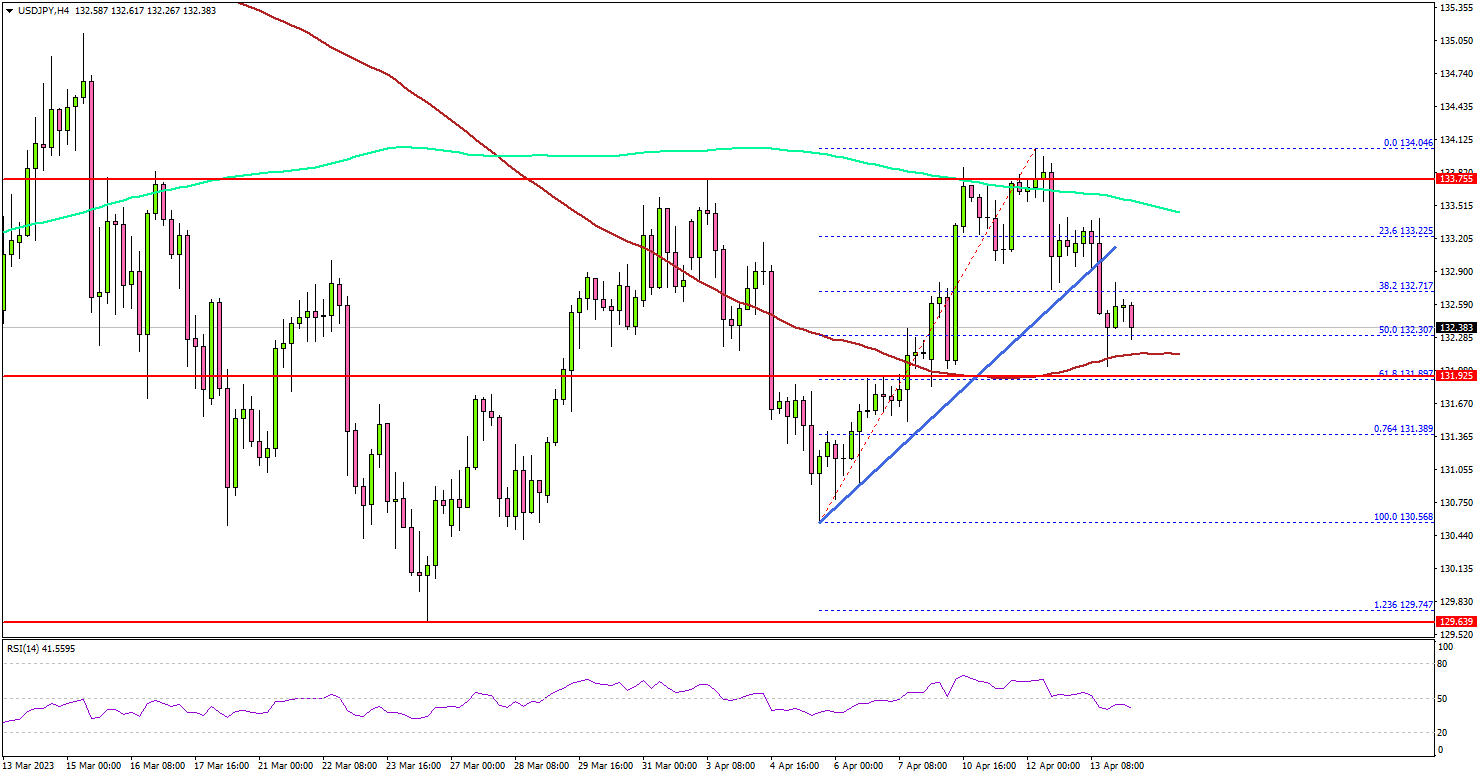
Looking at the 4-hour chart, the pair gained bearish momentum below the 133.00 support zone and settled below the 200 simple moving average (green, 4 hours).
There was also a break below a major bullish trend line with support near 132.90 on the same chart. The pair tested the 132.20 support and the 100 simple moving average (red, 4 hours). The next major support is near the 131.80 level, below which the pair might accelerate lower.
In the stated case, the pair may perhaps decline toward the 130.50 level. Any more losses might call for a test of the 129.80 support zone.
On the upside, the pair is facing resistance near the 133.00 level. The next key resistance is near the 133.75 zone. A clear move above the 133.75 resistance might send the pair toward the 134.50 zone. Any more gains might send the pair toward 135.00.
Looking at EUR/USD, there was a major upside break above 1.1000, and the pair traded to a new multi-week high above 1.1050.
Economic Releases
- US Retail Sales for March 2023 (MoM) – Forecast -0.4%, versus -0.4% previous.
- US Industrial Production for March 2023 (MoM) – Forecast 0.2%, versus 0% previous.
Elliott Wave Sequence Suggests GBPUSD Favors Higher & Remain Supported
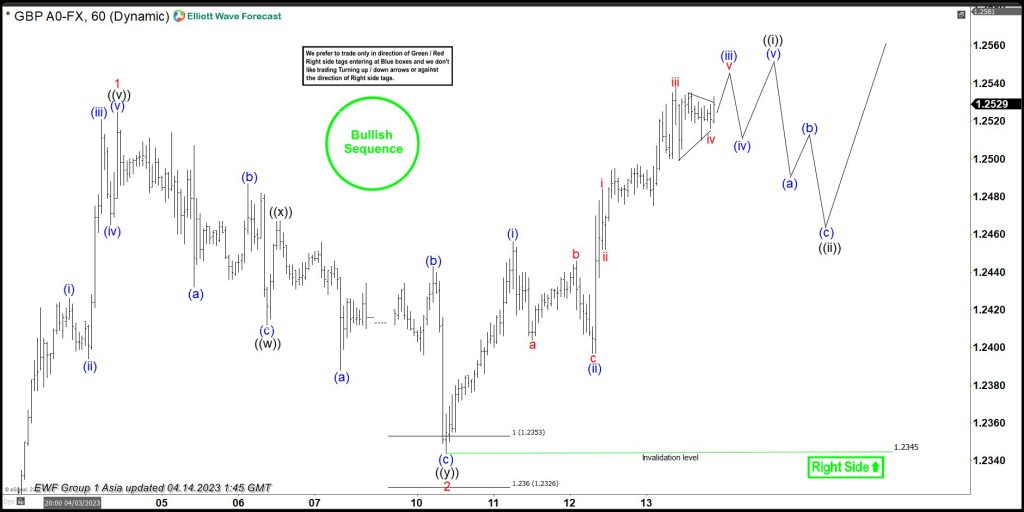
GBPUSD ended 5 wave impulse Elliott Wave sequence as wave 1 of (C) at 1.2525 high on 4/04/2023 started from 3/08/2023 low. It already confirmed higher high sequence against September-2022 low, calling for further upside to continue in wave (C). It placed ((i)) of 1 at 1.2204 high & ((ii)) at 1.2009 low. ((ii)) was 0.5 Fibonacci retracement of ((i)). It ended ((iii)) at 1.2423 high & ((iv)) at 1.2273 low. ((iv)) was typical 0.382 Fibonacci retracement of ((iii)). Finally, it ended ((v)) at 1.2525 high as wave 1. Below there, it ended wave 2 at 1.2345 low in 7 swings correction. Currently, it favors higher in 3 of (C).
Above wave 2 low, it placed (i) at 1.2456 high & (ii) at 1.2397 low as 0.5 Fibonacci retracement in 3 swing sequence. Currently, it favors higher in (iii) of ((i)) of 3. It placed i at 1.2484 high, ii at 1.2452 low, iii at 1.2538 high & iv as triangle at 1.2516 low. Above there, it favors higher in v of (iii) & expects small upside before starts correcting in (iv) in ((i)) soon. It expects short term upside in ((i)) of 3 before starts correcting in ((ii)) later in 3, 7 or 11 swings against 4/10/2023 low. The pair should remain supported in correction at extreme areas to resume higher in bullish sequence.
GBPUSD 60 Minute Elliott Wave Chart
GBPUSD Elliott Wave Video
https://www.youtube.com/watch?v=DrQ2iaoW6KI
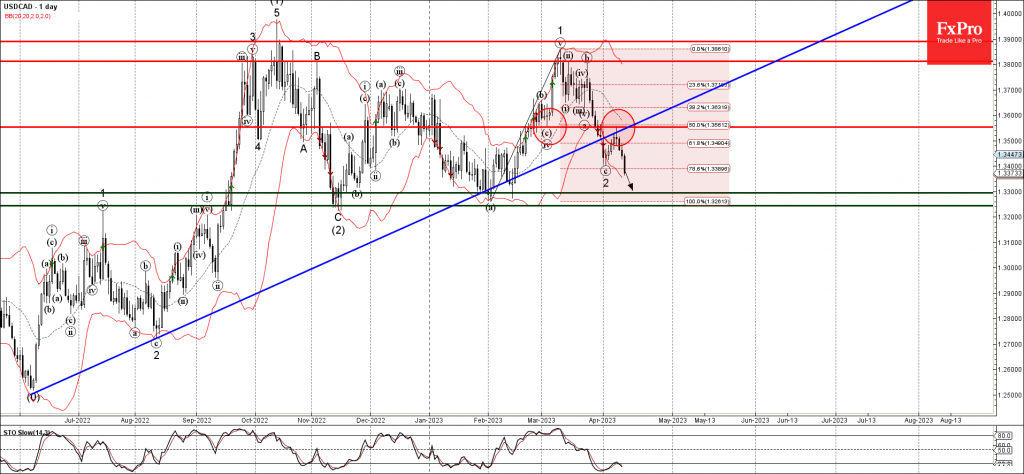
USDCAD Wave Analysis
- USDCAD reversed from key resistance level
- Likely to fall to support level 1.3295
USDCAD currency pair continues to fall after the earlier downward reversal from the key resistance level 1.3555 (former support from the start of March).
The resistance level 1.3555 was further strengthened by the recently broken trendline from 2022, acting as the resistance after it was broken.
Given the strongly bearish USD sentiment seen today, USDCAD can then be expected to fall further toward the next support level 1.3295 (which stopped wave (a) in February).