

Sample Category Title
EUR/USD Mid-Day Outlook
Daily Pivots: (S1) 1.0552; (P) 1.0598; (R1) 1.0623; More...
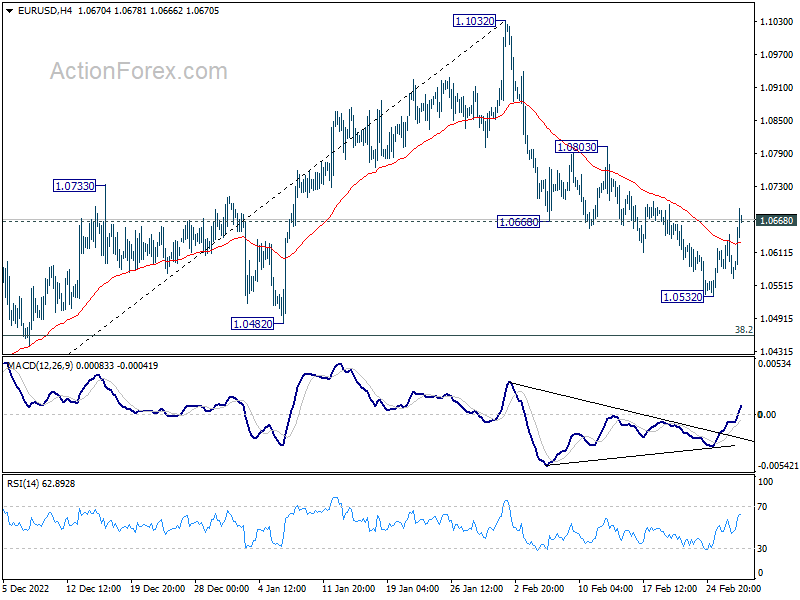
EUR/USD's break of 1.0668 support turned resistance argues that corrective decline from 1.1032 has completed with three waves down to 1.0532 already. Intraday bias is back on the upside for 1.0803 resistance first. Firm break there will pave the way to retest 1.1032 high. For now, risk will stay mildly on the upside as long as 1.0532 support holds, in case of retreat.
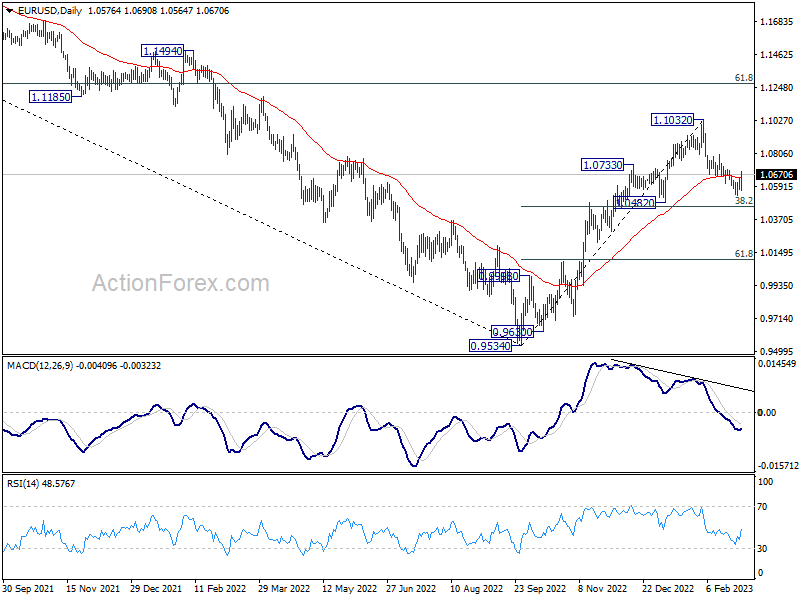
In the bigger picture, as long as 1.0482 support holds, rise from 0.9534 (2022 low) should continue to 61.8% retracement of 1.2348 (2021 high) to 0.9534 at 1.1273. However, sustained break of 1.0482 will bring deeper fall to 61.8% retracement of 0.9534 to 1.1032 at 1.0106, even as a corrective pull back.
GBP/USD Mid-Day Outlook
Daily Pivots: (S1) 1.1980; (P) 1.2061; (R1) 1.2106; More...
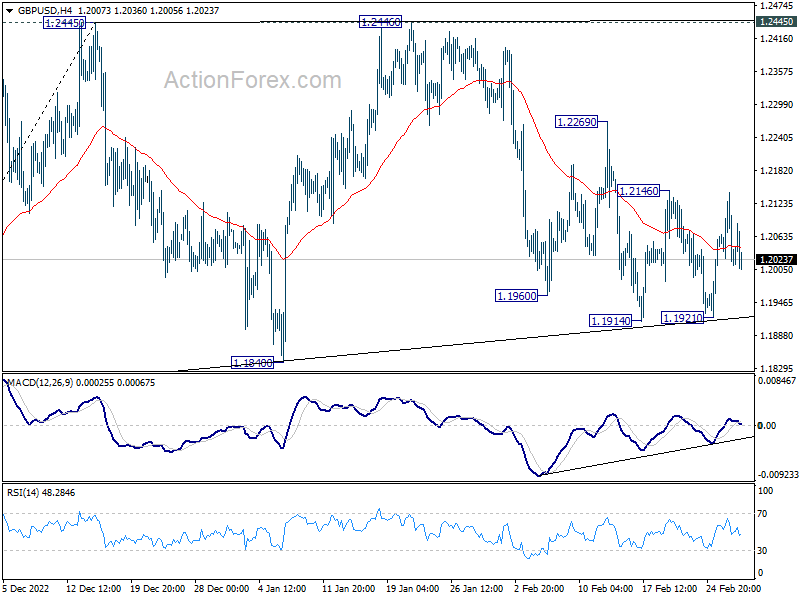
GBP/USD is still bounded in range of 1.1913/2146 despite this week's volatility. Intraday bias remains neutral for the moment. On the downside, break of 1.1914 will resume the decline from 1.2446 for 1.1840 support and possibly below. On the upside, break of 1.2146 resistance will turn bias back to the upside for further rebound to 1.2269 and above.
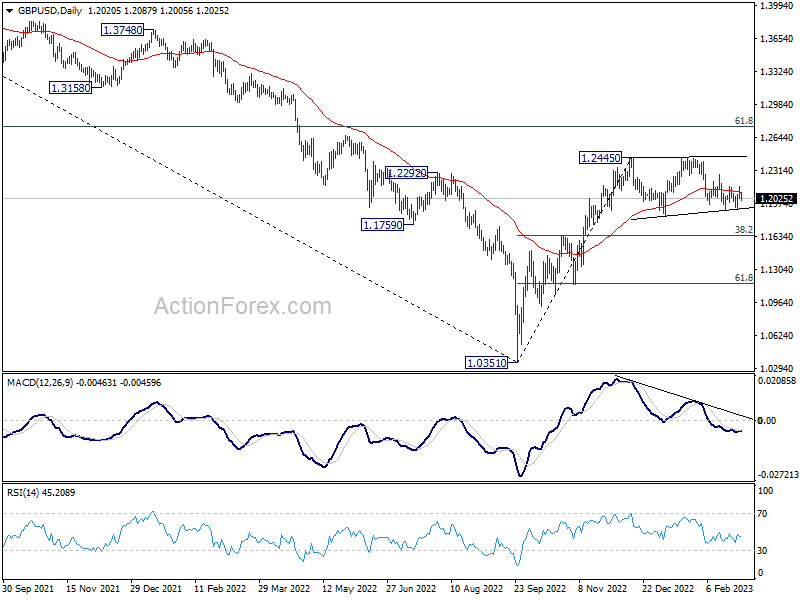
In the bigger picture,as long as 1.1840 support holds, rise from 1.0351 medium term bottom (2022 low) should still continue to 61.8% retracement of 1.4248 (2021 high) to 1.0351 at 1.2759. However, decisive break of 1.1840 will complete a double top pattern (1.2445, 1.2446) after rejection by 55 week EMA (now at 1.2251). Deeper decline should be seen back to 38.2% retracement of 1.0351 to 1.2445 at 1.1645.
USD/CHF Mid-Day Outlook
Daily Pivots: (S1) 0.9368; (P) 0.9396; (R1) 0.9449; More...
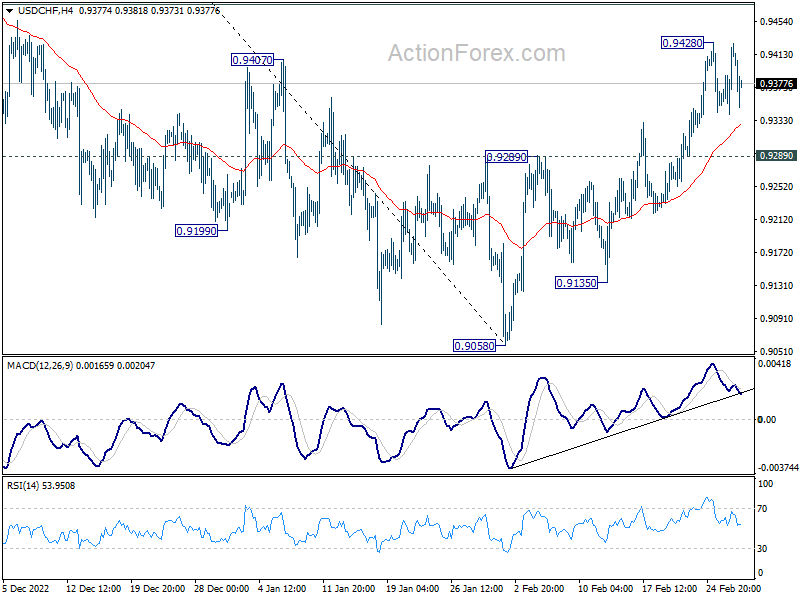
USD/CHF is staying in consolidation below 0.9428 temporary top and intraday bias remains neutral. Break of 0.9428 will resume the rebound from 0.9058. But strong resistance could be seen at 38.2% retracement of 1.0146 to 0.9058 at 0.9474 to limit upside. Break of 0.9289 resistance turned support will indicate completion of the rebound and turn bias back to the downside. However, decisive break of 0.9474 will carry larger bullish implications and target 61.8% retracement at 0.9730.
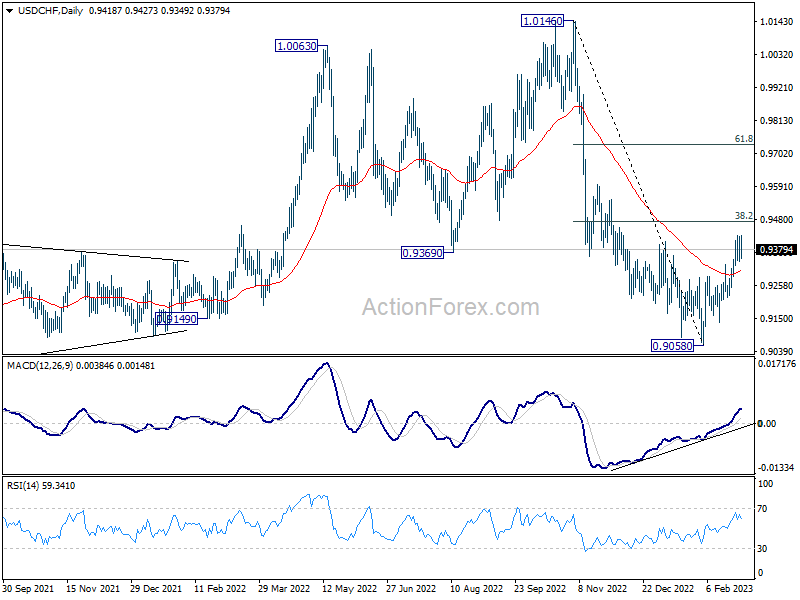
In the bigger picture, decline from 1.0146 is seen as part of a long term sideway pattern. As long as 38.2% retracement of 1.0146 to 0.9058 at 0.9474 holds, another fall is in favor through 0.9058. However, sustained trading above 0.9474 will indicate that the medium term trend has reversed, and open up further rally to 61.8% retracement at 0.9730 and above.
USD/JPY Mid-Day Outlook
Daily Pivots: (S1) 135.68; (P) 136.30; (R1) 136.86; More...
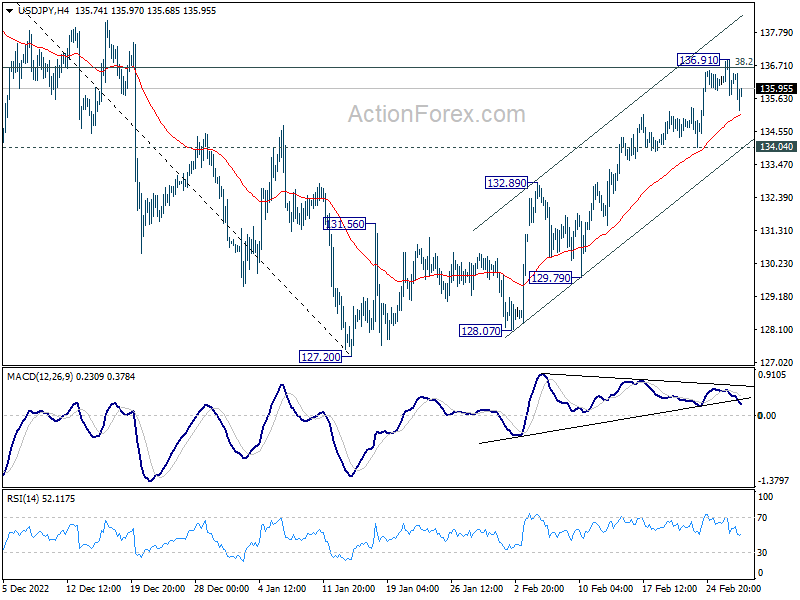
USD/JPY is staying in consolidation below 136.91 temporary top and intraday bias remains neutral first. Focus is staying on 38.2% retracement of 151.93 to 127.20 at 136.64. Rejection by this fibonacci level, followed by break of 134.04 support, will argue that rebound from 127.20 has completed, and turn bias back to the downside. However, sustained trading above 136.64 will indicate that fall from 151.93 has completed, and bring further rally to 61.8% retracement at 142.48.
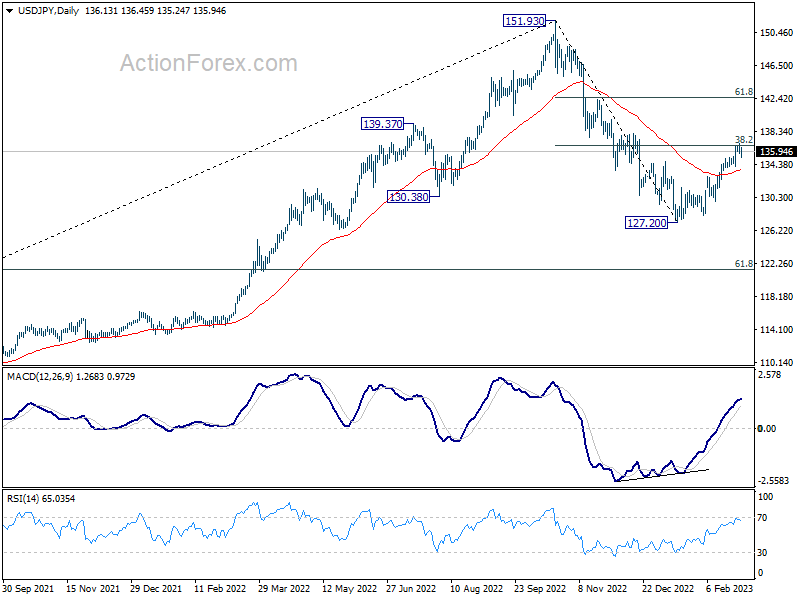
In the bigger picture, focus is now on 38.2% retracement of 151.93 to 127.20 at 136.64. Sustained break there will indicate that price actions from 151.93 medium term are merely a corrective pattern. Such development will maintain long term bullishness. Rejection by 136.64 will, on the downside, extend the fall from 151.93 to 61.8% retracement of 102.58 to 151.93 at 121.43 at a later stage.
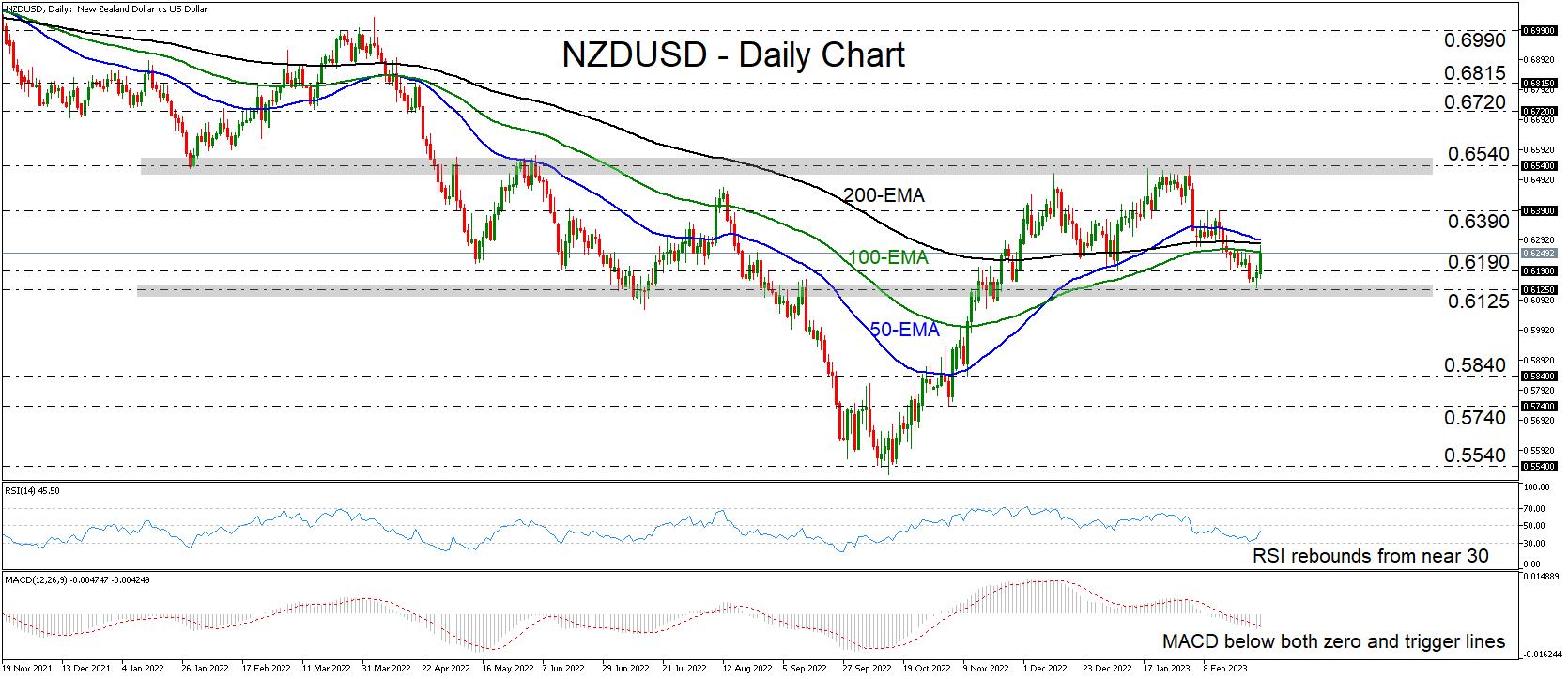
NZDUSD Rebounds Strongly from Near 0.6125
NZDUSD has been in a recovery mode since Monday when the pair triggered some buy orders near the 0.6125 territory, an area around which the pair changed hands several times since the summer. Today, the recovery accelerated, adding around 1.5% worth of gains to the pair, but given that it is still trading below the plotted exponential moving averages, the outlook could still be neutral.
The RSI rebounded from near the 30 line, while the MACD, although below both its zero and trigger lines, is showing signs of bottoming as well. Both indicators detect slowing negative momentum and suggest that the rebound may continue for a while longer.
However, for the near-term picture to turn overly positive, a break above the strong resistance zone of 0.6540 may be needed. That territory has been acting as a ceiling since May 2022, while it offered support on January 20, 2022. If the bulls are strong enough to climb above that zone, they could then decide to shoot for the 0.6720 or 0.6815 zones, marked by the inside swing low of April 18 and the high of April 20, respectively.
The bears could take the driver’s seat if the NZDUSD slips below 0.6125. Such a dip will confirm a lower low on the daily chart and may see scope for declines all the way down to the low of November 10 at 0.5840, or the low of November 3 at 0.5740.
To sum up, NZDUSD has seen a strong recovery this week from near the key support territory of 0.6125. However, as long as it remains below the 0.6540 resistance zone, it is hard to envision an overly bullish outlook.
EUR/GBP Mid-Day Outlook
Daily Pivots: (S1) 0.8763; (P) 0.8788; (R1) 0.8820; More...
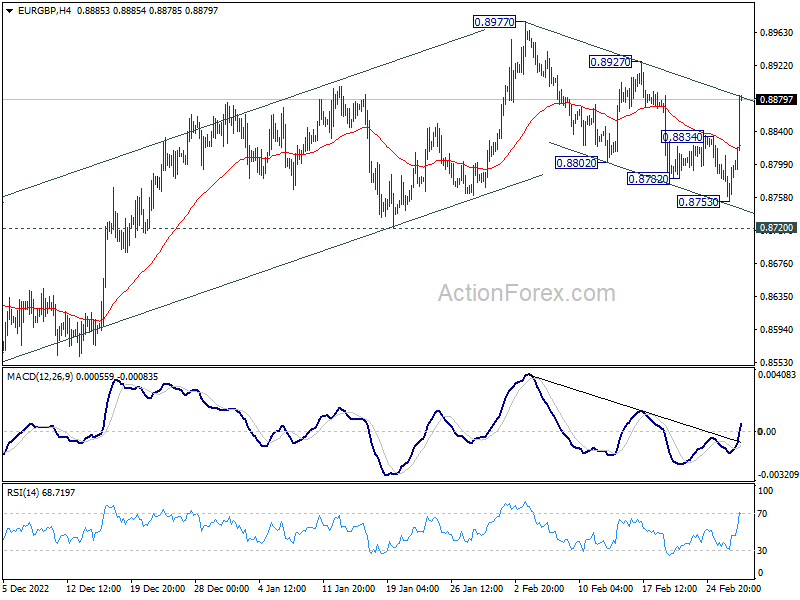
EUR/GBP's rebound from 0.8753 accelerated higher today. The strong break of 0.8834 resistance argues that fall from 0.8977 has completed with three waves down to 0.8753, ahead of 0.8720 support. The development in turn suggests that rise from 0.8545 is not over. Intraday bias is back on the upside for 0.8927 first. Decisive break there will bring retest of 0.8977 next.
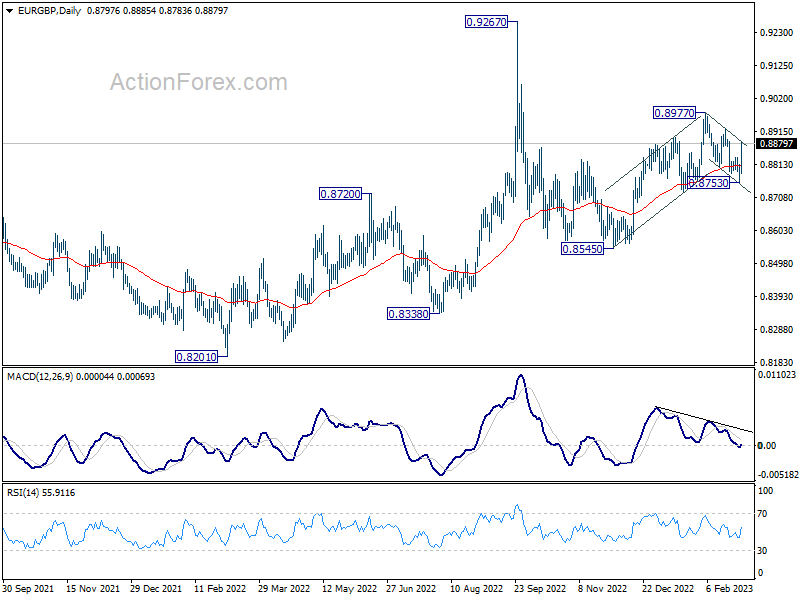
In the bigger picture, outlook is rather mixed for now, except that price actions from 0.9267 (2022 high) are part of the long term range pattern from 0.9499 (2020 high). With 0.8720 support intact, rise from 0.8545 is in favor to continue through 0.8977. However, firm break of 0.8720 will argue that such rebound has completed, and open up deeper fall through this support level.
Contrasting ECB/BoE Comments Drive Euro Higher While Aussie Lags Behind on Weak Data
Two major themes are vying for attention today. Euro has seen broad gains following hawkish comments from Bundesbank President Joachim Nagel. In contrast, the remarks of BoE Governor Andrew Bailey have left Sterling struggling to keep pace. As these European majors trade blows, the Swiss Franc has been pushed higher too.
Meanwhile, both Australian and New Zealand Dollars have received a boost from China's recent economic data. However, the Kiwi has outshone the Aussie, as the latter currency has been weighed down by weaker than expected GDP and CPI figures.
Overall, Dollar is the worst performer for the day so far. However, it is worth keeping an eye on risk sentiment in the upcoming US session, which could provide a potential opportunity for the greenback to recover some lost ground, is investors' mood turn around.
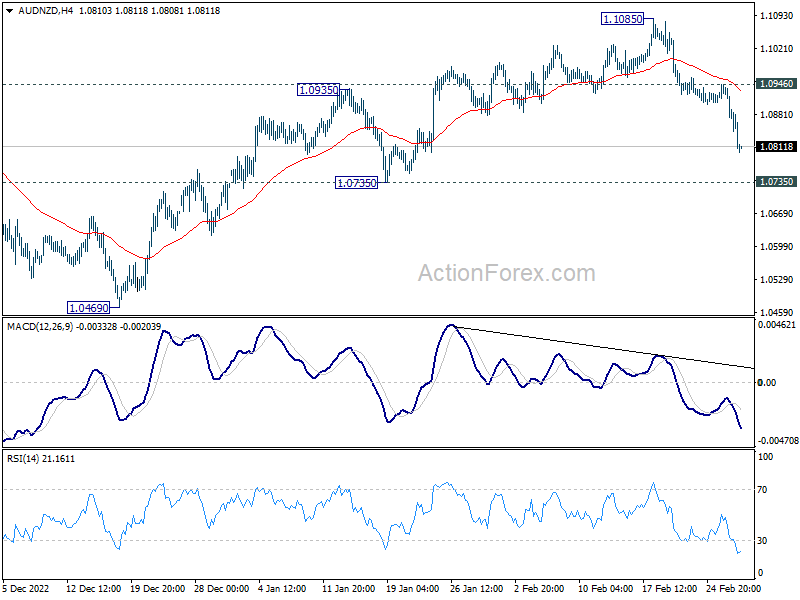
Technically, AUD/NZD's extended decline from 1.1085 argues that whole rebound from 1.0469 has completed with three waves up to 1.1085. Deeper fall is now in favor as long as 1.0946 resistance holds, towards 1.0735 support first. Firm break there would set the stage to retest 1.0469 low.
In Europe, at the time of writing, FTSE is up 0.49%. DAX is up 0.02%. CAC is up 0.05%. Germany 10-year yield is up 0.071 at 2.720. Earlier in Asia, Nikkei rose 0.26%. Hong Kong HSI rose 4.21%. China Shanghai SSE rose 1.00%. Singapore Strait Times dropped -0.23%. Japan 10-year JGB yield rose 0.005 to 0.508.
Bundesbank Nagel: Further significant rate steps after Mar, steeper balance sheet reduction in Jul
Bundesbank President Joachim Nagel said in a speech today, "the interest rate step announced (by ECB) for March will not be the last."
"Further significant interest rate steps might even be necessary afterwards, too," he added.
Regarding the timing of a rate cut, Nagel said, the impact of tightening has to be reflected in underlying inflation. Until that is the case, interest rate cuts are a non-starter."
Nagel also said with the current pace of balance sheet reduction at EUR 15B a month, it will take too long to make a significant reduction. "I am therefore in favour of taking a steeper path of reduction starting in July in light of experience gained up to that point," he said.
Regarding the economy, "although there could be a gradual pick-up in the second quarter, there is still no sign of any major improvement for now," Nagel said. "Our experts are not expecting there to be a visible economic recovery until the second half of the year."
Eurozone PMI manufacturing finalized at 48.5, output at 50.1
Eurozone PMI Manufacturing was finalized at 48.5 in February, down from January's 48.8. Manufacturing output was finalized at 50.1, up from 48.9, a 9-month high.
Looking a some member states, readings for Italy (52.0, 10-mont high), Greece (51.7, 9-month high), Ireland (51.3, 4-month high), and Spain (50.7, 8-month high) improved. The Netherlands (48.7, 2-month low), France (47.4, 4-month low), Austria (47.1, 3-month low), and Germany (46.3, 3-month low) deteriorated.
Chris Williamson, Chief Business Economist at S&P Global Market Intelligence said:
"A marginal expansion of output reported by Eurozone manufacturers in February is welcome news in representing the first increase since last May... Unfortunately, inflows of new orders continued to fall at a marked rate, reflecting persistent weak demand... In the meantime, the combination of improved supply and sustained weak demand – as well as lower energy prices – is helping bring inflationary pressures down sharply".
BoE Bailey: Some further hike may be appropriate, but nothing is decided
BoE Governor Andrew Bailey said in a speech, "I would caution against suggesting either that we are done with increasing Bank Rate, or that we will inevitably need to do more".
"Some further increase in Bank Rate may turn out to be appropriate, but nothing is decided. The incoming data will add to the overall picture of the economy and the outlook for inflation, and that will inform our policy decisions.," he added.
Regarding the economy, he said that data since February meeting, is that the economy is "evolving much as we expected it to".
"Inflation has been slightly weaker, and activity and wages slightly stronger, though I would emphasise 'slightly' in both cases," he said. "A further set of data will be coming in before our next monetary policy decision later this month."
UK PMI manufacturing finalized at 49.3 in Feb, showed encouraging signs of resilience
UK PMI Manufacturing was finalized at 49.3 in February, up from January's 47.0. That's the highest level in 7 months even though it's stuck in contraction territory. New orders fell but showed signs of stabilizing. Input cost and output price inflation eased.
Rob Dobson, Director at S&P Global Market Intelligence, said:
"UK manufacturing showed encouraging signs of resilience in February. Output rose for the first time in eight months, boosted by weaker cost inflation and reduced supply chain disruptions. Input prices increased at the slowest pace since July 2020 and supplier performance improved for the first time in three-and-a-half years. This offset some of the ongoing negative impacts from strikes, the cost of living crisis and lower order intakes.
"Manufacturers' confidence also strengthened, with 60% of companies forecasting production will expand during the coming year. Part of the reason for renewed optimism was a near-stabilisation of new order inflows in February, with total new orders and new export business both falling only slightly and to much lesser extents than in recent months. Manufacturers benefited from growing signs of a global economic recovery and the easing of COVID restrictions by China. This process of economic revival, alongside signs of inflation peaking and reduced recession fears, should hopefully help UK manufacturers eke out further growth in the coming months."
China PMI manufacturing rose to 52.6, highest since 2012
China official PMI Manufacturing rose from 50.1 to 52.6, above expectation of 50.7. That's also the highest reading since April 2012. PMI Non-Manufacturing rose from 54.4 to 56.3, highest since March 2021. PMI Composite rose from 52.9 to 56.4.
"In February, the economic stabilisation policy measures further took effect, coupled with the epidemic's impact receding and other favourable factors, the speed of enterprises to resume production accelerated, meaning China's economic prosperity level continued to rebound," said senior NBS statistician Zhao Qinghe.
Also released, Caixin PMI Manufacturing rose from 49.2 to 51.6 in February, slightly above expectation of 51.3. That the first expansion reading in 7 months, and the second-highest since May 2021. Caixin added there were renewed increases in output, new orders and employment. Suppliers' delivery times improved at the quickest rate for eight years. Business confidence also strengthened to near two-year high.
Japan PMI manufacturing finalized at 47.7 in Feb, continually deteriorating activity
Japan PMI Manufacturing was finalized at 47.7 in February, down from January's 48.9. That's also the worst reading since September 2020. S&P Global also noted that backlogs of work decreased at quickest pace for 29 months. Input prices had the slowest rise for a year-and-a-half.
Usamah Bhatti, Economist at S&P Global Market Intelligence, said: "Latest data pointed to continually deteriorating activity in the Japanese manufacturing sector midway through the first quarter of 2023. Both new orders and production levels, which make up 55% of the headline PMI figure, fell at the fastest pace since July 2020 as weak domestic demand and a global economic slowdown hindered sales and output volumes.
"Moreover, the dip is likely to be sustained in the near-term as the absence of new orders amid dampened client confidence lifted capacity pressure on manufacturers further and led to the sharpest reduction in outstanding business in nearly two-and- a-half years."
Australia CPI slowed to 7.4% yoy in Jan, ex-volatile items down to 7.2% yoy
Australia monthly CPI indicator slowed from 8.4% yoy to 7.4% yoy in January, below expectation of 8.1% yoy. CPI excluding volatile items (i.e. excludes Fruit and vegetables and Automotive fuel) slowed from 8.1% yoy to 7.2% yoy.
The most significant contributors to the annual increase in the January monthly CPI indicator were Housing (9.8%), Food and non-alcoholic beverages (8.2%) and recreation and culture (10.2%).
Australia GDP grew 0.5% qoq in Q4, domestic prices grew fastest since 1990
Australia GDP grew 0.5% qoq in Q4, below expectation of 0.8% qoq. Through the year, GDP grew 2.7% yoy. GDP Implicit price deflator (IPD) rose 1.6% qoq and 9.1% yoy. Domestic prices grew 1.4% qoq and 6.6 yoy, highest annual growth since 1990.
Katherine Keenan, ABS head of National Accounts, said, "the 0.4 per cent rise in total consumption and 1.1 per cent rise in exports were the primary contributors to GDP growth in the December quarter...
"Continued growth in household and government spending drove the rise in consumption, while increased exports of travel services and continued overseas demand for coal and mineral ores drove exports."
EUR/GBP Mid-Day Outlook
Daily Pivots: (S1) 0.8763; (P) 0.8788; (R1) 0.8820; More...
EUR/GBP's rebound from 0.8753 accelerated higher today. The strong break of 0.8834 resistance argues that fall from 0.8977 has completed with three waves down to 0.8753, ahead of 0.8720 support. The development in turn suggests that rise from 0.8545 is not over. Intraday bias is back on the upside for 0.8927 first. Decisive break there will bring retest of 0.8977 next.
In the bigger picture, outlook is rather mixed for now, except that price actions from 0.9267 (2022 high) are part of the long term range pattern from 0.9499 (2020 high). With 0.8720 support intact, rise from 0.8545 is in favor to continue through 0.8977. However, firm break of 0.8720 will argue that such rebound has completed, and open up deeper fall through this support level.
Economic Indicators Update
| GMT | Ccy | Events | Actual | Forecast | Previous | Revised |
|---|---|---|---|---|---|---|
| 21:45 | NZD | Building Permits M/M Jan | -1.50% | -7.20% | ||
| 00:30 | AUD | GDP Q/Q Q4 | 0.50% | 0.80% | 0.60% | 0.70% |
| 00:30 | AUD | Monthly CPI Y/Y Jan | 7.40% | 8.10% | 8.40% | |
| 00:30 | JPY | Manufacturing PMI Feb F | 47.7 | 47.4 | 47.4 | |
| 01:00 | CNY | NBS Manufacturing PMI Jan | 52.6 | 50.7 | 50.1 | |
| 01:00 | CNY | Non-Manufacturing PMI Jan | 56.3 | 55 | 54.4 | |
| 01:45 | CNY | Caixin Manufacturing PMI Feb | 51.6 | 51.3 | 49.2 | |
| 07:30 | CHF | Real Retail Sales Y/Y Jan | -2.20% | -2.20% | -2.80% | -3.00% |
| 08:30 | CHF | Manufacturing PMI Feb | 48.9 | 50.4 | 49.3 | |
| 08:45 | EUR | Italy Manufacturing PMI Feb | 52 | 50.9 | 50.4 | |
| 08:50 | EUR | France Manufacturing PMI Feb F | 47.4 | 47.9 | 47.9 | |
| 08:55 | EUR | Germany Manufacturing PMI Feb F | 46.3 | 46.5 | 46.5 | |
| 08:55 | EUR | Germany Unemployment Change Jan | 2K | 9K | -22K | |
| 08:55 | EUR | Germany Unemployment Rate Jan | 5.50% | 5.50% | 5.50% | |
| 09:00 | EUR | Eurozone Manufacturing PMI Feb F | 48.5 | 48.5 | 48.5 | |
| 09:30 | GBP | Mortgage Approvals Jan | 40K | 36K | 36K | |
| 09:30 | GBP | M4 Money Supply M/M Jan | 1.30% | -0.90% | -0.80% | |
| 09:30 | GBP | Manufacturing PMI Feb F | 49.3 | 49.2 | 49.2 | |
| 13:00 | EUR | Germany CPI M/M Feb P | 0.80% | 0.80% | 1.00% | |
| 13:00 | EUR | Germany CPI Y/Y Feb P | 8.70% | 8.70% | 8.70% | |
| 14:30 | CAD | Manufacturing PMI Feb | 51 | |||
| 14:45 | USD | Manufacturing PMI Feb F | 47.8 | 47.8 | ||
| 15:00 | USD | ISM Manufacturing PMI Feb | 47.9 | 47.4 | ||
| 15:00 | USD | ISM Manufacturing Prices Paid Feb | 45.2 | 44.5 | ||
| 15:00 | USD | ISM Manufacturing Employment Index Feb | 50.6 | |||
| 15:00 | USD | Construction Spending M/M Jan | 0.20% | -0.40% | ||
| 15:30 | USD | Crude Oil Inventories | 1.7M | 7.6M |
US 100 Cash Index Remains Above Key Area
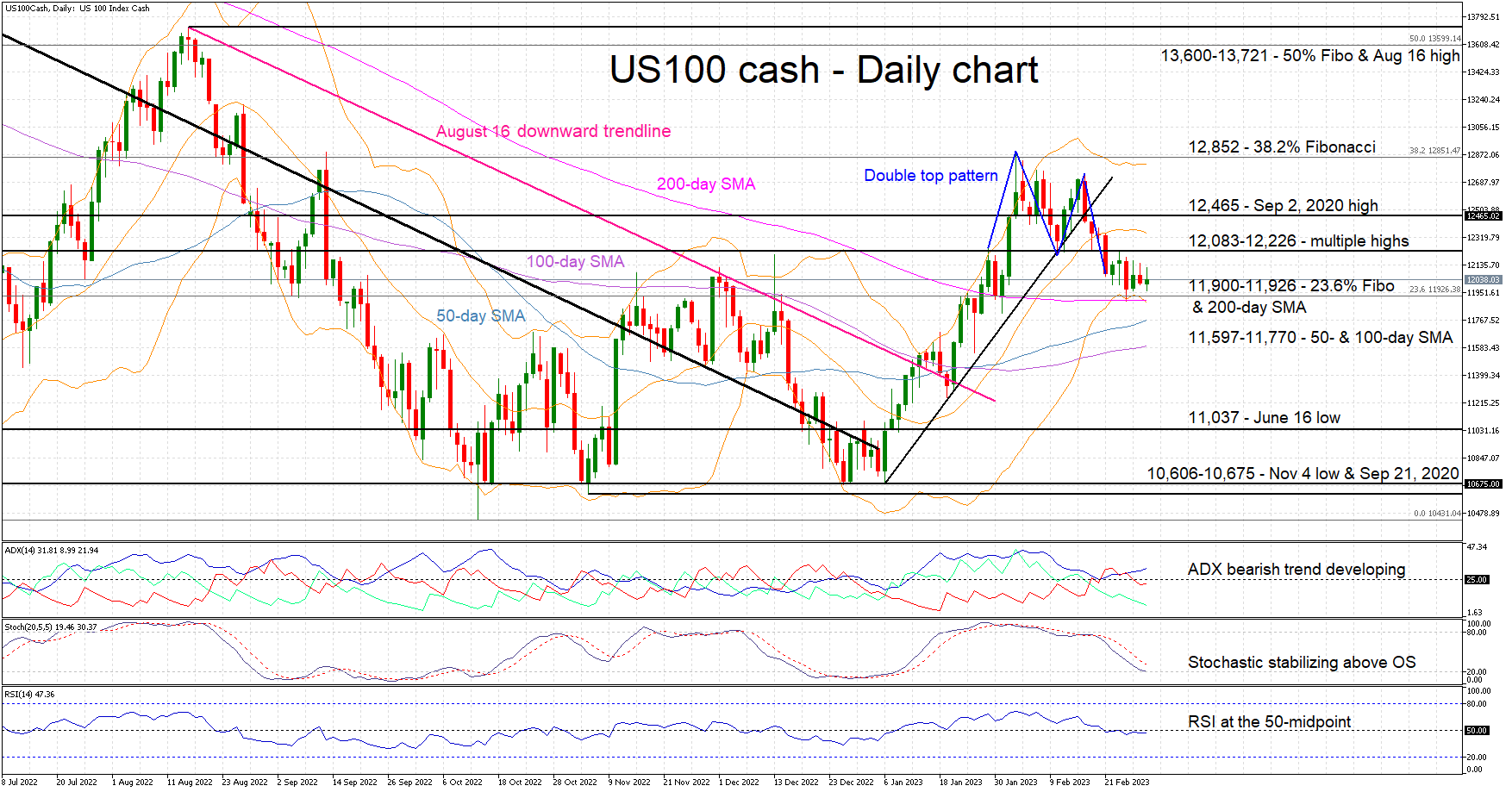
The US 100 cash index continues to trade sideways, just above the busy 11,900-11,926 area populated by the 23.6% Fibonacci retracement level of the November 22, 2021 – October 13 downtrend and the 200-day simple moving average (SMA) respectively. This is the first decent correction following the 21% rally that was recorded during the January 6 – February 2 period, as the market is trying to find its next direction.
The Average Directional Movement Index (ADX) is pointing to a developing bearish trend while the RSI appears to be undecided at this juncture. The burden once again falls on the stochastic oscillator, which is showing early signs of stabilization above its oversold territory. Interestingly, a double top pattern has formed with the neckline at the 12,202 level and the primary target set at 11,500 area. The US 100 has broken through the neckline, confirming this pattern, but has moved modestly below it.
Should the bulls take the market reins, the first target would be at the 12,083-12,226 range set by multiple highs during 2020. Higher, the September 2, 2020 high of 12,465 could trouble the bulls before they potentially set their eyes on the 38.2% Fibonacci retracement of 12,852.
On the other hand, the primary goal for the bears remains the 11,900-11,926 area populated by the 23.6% Fibonacci retracement and the 200-day SMA. If successful in breaking this area, they could have a look at the 11,597-11,770 range where the 50- and 100-day SMAs reside.
To sum up, the US 100 cash index is moving sideways as the bears are testing the support set by the 11,900-11,926 range. A break below could potentially morph into a significant bearish move.
EUR/GBP jumps on constrasting comments of ECB Nagel and BoE Bailey
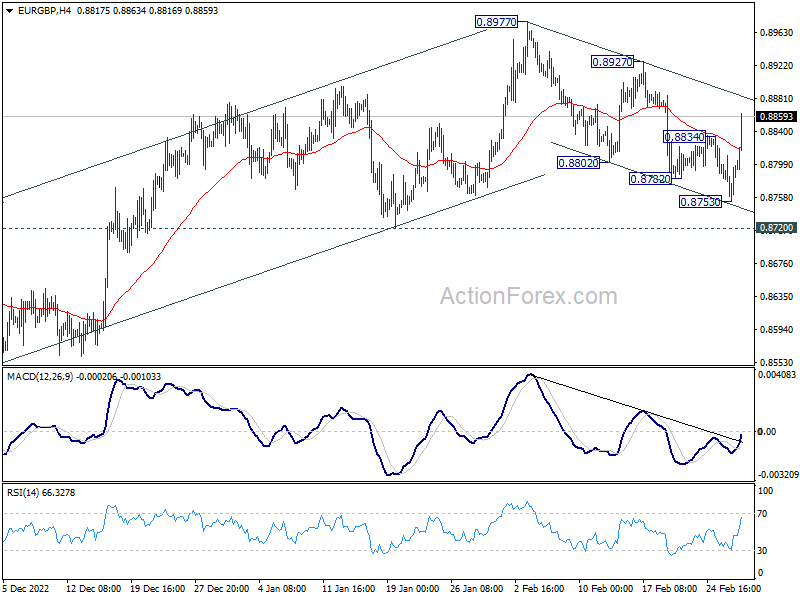
EUR/GBP rebounds strongly on a contrasting comments from Bundesbank President Joachim Nagel and BoE Governor Andrew Bailey.
In short, Nagel said "further significant interest rate steps" might be necessary for ECB after March, and a "steeper path of reduction" of balance sheet is favored in July.
On the other hand, Bailey said more interest rate hike is not inevitable and "nothing is decided" for March.
EUR/GBP's strong rebound and break of 0.8834 resistance argues that fall from 0.8977 has completed with three waves down to 0.8753, ahead of 0.8720 structural support. The development in turn suggests that rise from 0.8545 is not over. Near term focus is back on 0.8927 resistance and firm break there will solidify the revived near term bullishness.
BoE Bailey: Some further hike may be appropriate, but nothing is decided
BoE Governor Andrew Bailey said in a speech, "I would caution against suggesting either that we are done with increasing Bank Rate, or that we will inevitably need to do more".
"Some further increase in Bank Rate may turn out to be appropriate, but nothing is decided. The incoming data will add to the overall picture of the economy and the outlook for inflation, and that will inform our policy decisions.," he added.
Regarding the economy, he said that data since February meeting, is that the economy is "evolving much as we expected it to".
"Inflation has been slightly weaker, and activity and wages slightly stronger, though I would emphasise 'slightly' in both cases," he said. "A further set of data will be coming in before our next monetary policy decision later this month."