

Sample Category Title
Bundesbank Nagel: Further significant rate steps after Mar, steeper balance sheet reduction in Jul
Bundesbank President Joachim Nagel said in a speech today, "the interest rate step announced (by ECB) for March will not be the last."
"Further significant interest rate steps might even be necessary afterwards, too," he added.
Regarding the timing of a rate cut, Nagel said, the impact of tightening has to be reflected in underlying inflation. Until that is the case, interest rate cuts are a non-starter."
Nagel also said with the current pace of balance sheet reduction at EUR 15B a month, it will take too long to make a significant reduction. "I am therefore in favour of taking a steeper path of reduction starting in July in light of experience gained up to that point," he said.
Regarding the economy, "although there could be a gradual pick-up in the second quarter, there is still no sign of any major improvement for now," Nagel said. "Our experts are not expecting there to be a visible economic recovery until the second half of the year."
Euro Traders Lock Gaze on Eurozone Inflation Data
With economic data suggesting that the Euro area may have dodged a severe recession and underlying inflation not showing any signs of slowing yet, investors have dramatically raised their ECB hike bets. Ergo, this week, they may be sitting on the edge of their seats in anticipation of Thursday’s preliminary CPI data as they try to figure out whether the ECB will proceed with the telegraphed 50bps hike or a bigger increment at the upcoming meeting. The data comes out at 10:00 GMT and the enigma is how will the numbers affect the euro.
Outlook warrants more sizable hikes
At its last meeting, the ECB raised interest rates by 50bps as was widely expected, with President Lagarde explicitly saying that they intend to raise them by another 50bps in March and then evaluate the future path on a meeting-by-meeting basis based on the data. She also added that supply bottlenecks are gradually easing, but the delayed effects are still pushing up goods price inflation.
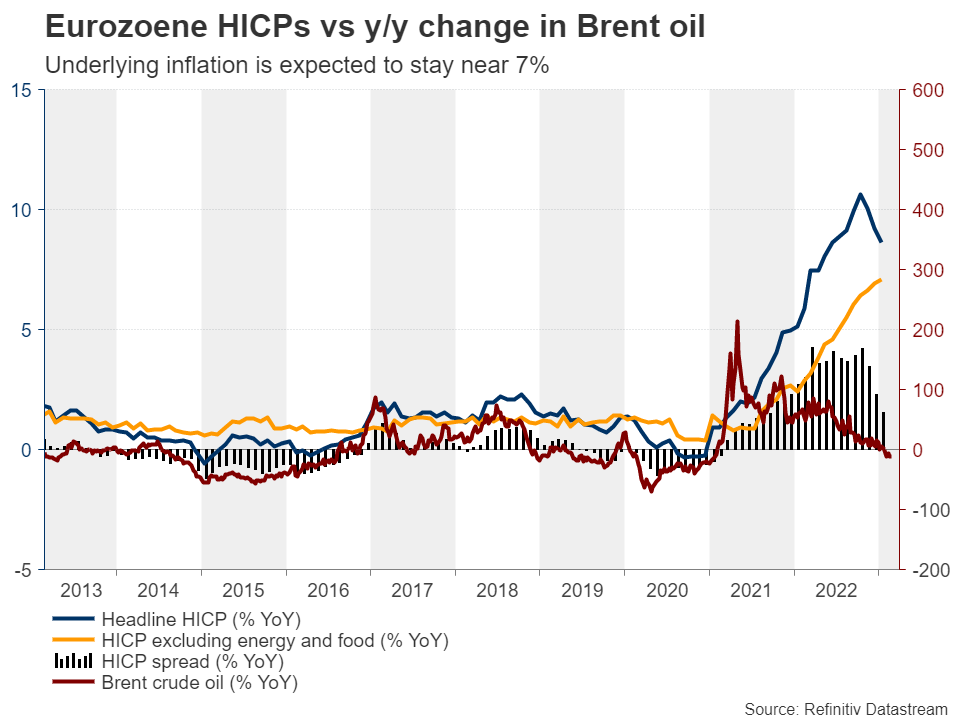
Indeed, headline inflation has slowed notably after peaking at 10.6% in October and could slow even further in the months to come as the war-related rally in energy prices drops out of the year-over-year calculation. However, underlying inflation is proving stubborn, not showing signs of a slowdown yet. On top of that, just last week, Eurozone’s preliminary PMIs for February were largely better than expected, with the composite PMI rising to 52.3 from 50.3 and adding to hopes that a previously feared recession may be sidestepped.
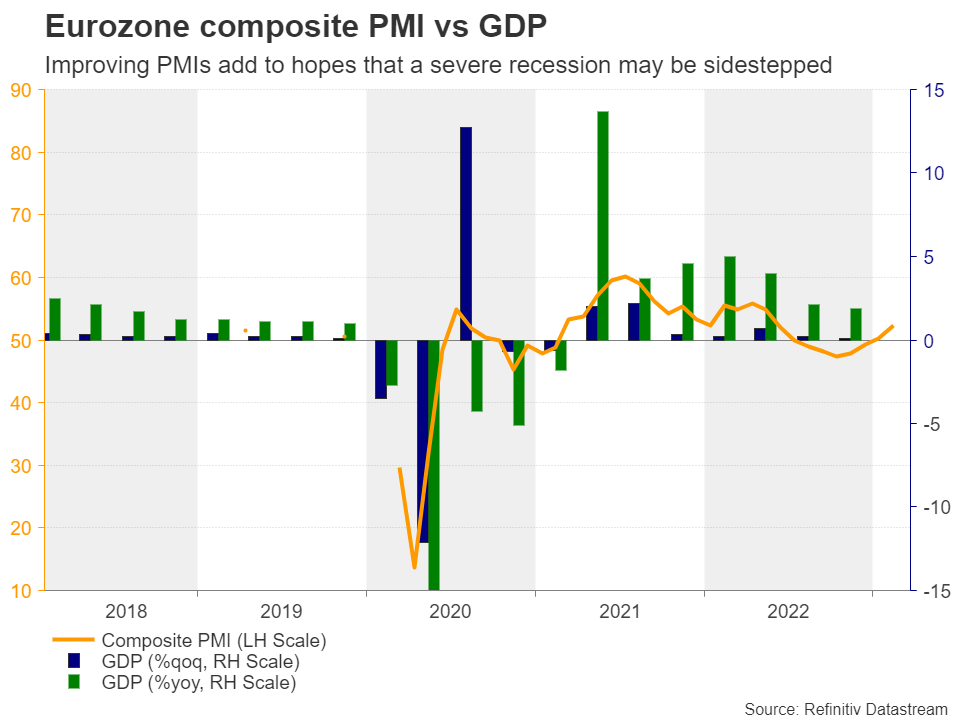
The blend of such economic figures allowed ECB policymakers to become more vocal about the need for more double hikes. The only policymaker sounding a bit cautious lately was Chief Economist Philip Lane, who noted that the Governing Council may not need to proceed as forcefully as previously planned.
Investors see decent chance for a triple hike in March
With all that information in hand, market participants are now assigning a nearly 40% probability for a 75bps hike at the upcoming gathering, with the remaining 60% pointing to the telegraphed 50bps increment. Moreover, they are projecting a total of 155bps worth of additional hikes until the end of the year, while just a couple of weeks ago, they were seeing only 100bps.
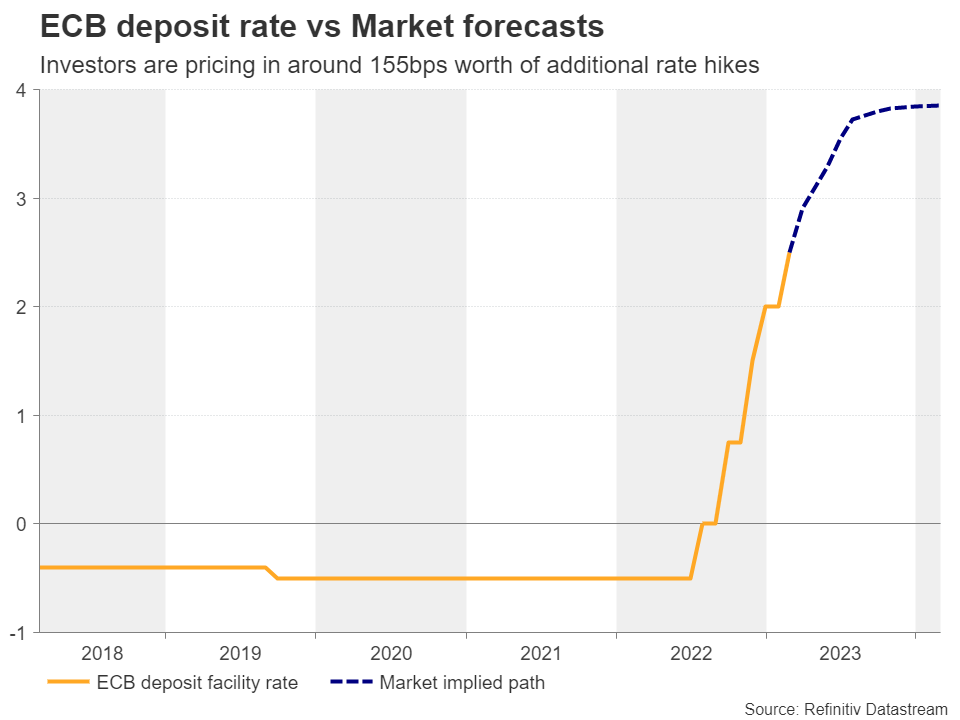
And yet the euro has been on the back foot against its US counterpart, and that’s because investors have been lifting their Fed implied rate path as well. So, will this week’s inflation data wake up the euro bulls? The headline rate is forecast to slide further to 8.2% y/y from 8.6%, while the core rate is anticipated to just pull back to 6.9% y/y from 7.1%. The euro could retreat somewhat on cooling inflation rates, but with the core one staying near 7%, ECB hike bets are unlikely to be altered much.
Euro may perform better against the loonie
This could keep some euro bulls in the game and thereby complicate things for euro/dollar sellers. Nonetheless, it could also increase the downside risk in the case of an upcoming economic data point disappointing. The same goes for the dollar. Therefore, the outlook for euro/dollar seems somewhat blurry for now. Maybe both currencies will perform better against the risk-linked ones as increasing hike expectations have been weighing on risk sentiment lately. With the slowdown in Canada’s inflation for January and the nation’s disappointing GDP data for Q4 congealing expectations that the BoC may refrain from hiking rates further, the loonie may be the best choice.
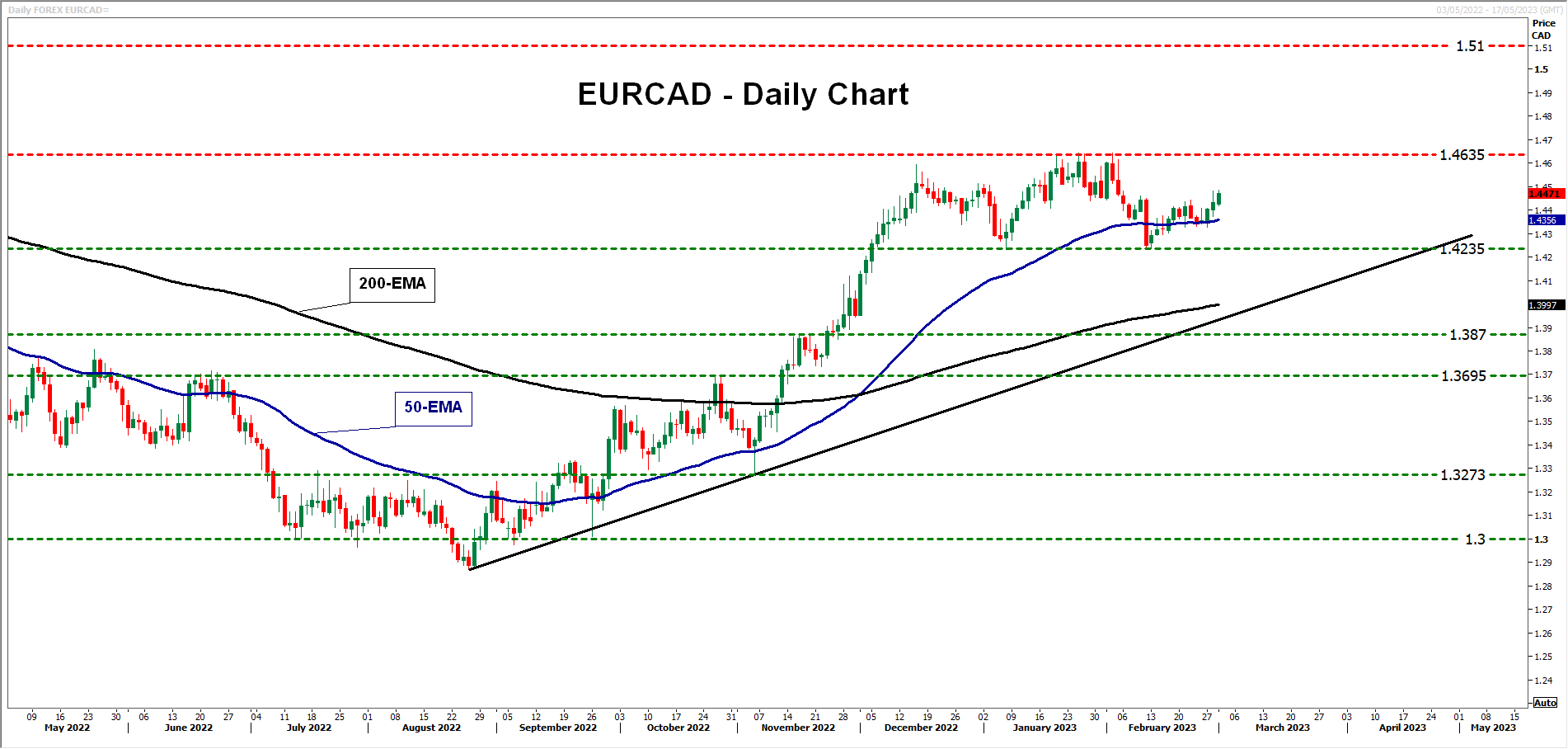
Euro/loonie has been trading higher recently, but still within the sideways range between the 1.4235 support and the strong resistance of 1.4535, which acted as a ceiling, not only recently, but also back in December 2021 and January 2022. In the bigger picture, the pair is still lying above both the 50- and 200-day EMAs, as well as above the uptrend line drawn from the low of August 25. This keeps the door for further advances wide open.
If underlying inflation in the Euro area remains at elevated levels, the bulls may be tempted to challenge the 14635 zone in the foreseeable future, the break of which would confirm a higher high and may set the stage for a gradual advance towards the 1.51 territory, which acted as a solid wall against the bulls between July and September 2021.
Alternatively, if Thursday’s inflation rates miss their forecasts, the euro is likely to lose ground, with euro/loonie perhaps coming back down to the 1.4235 barrier. That said, even if that zone gets broken, the pair would still be trading above the aforementioned uptrend line, something that might keep the bigger outlook cautiously positive.
Gold Strengthens the Rebound Around 1,800
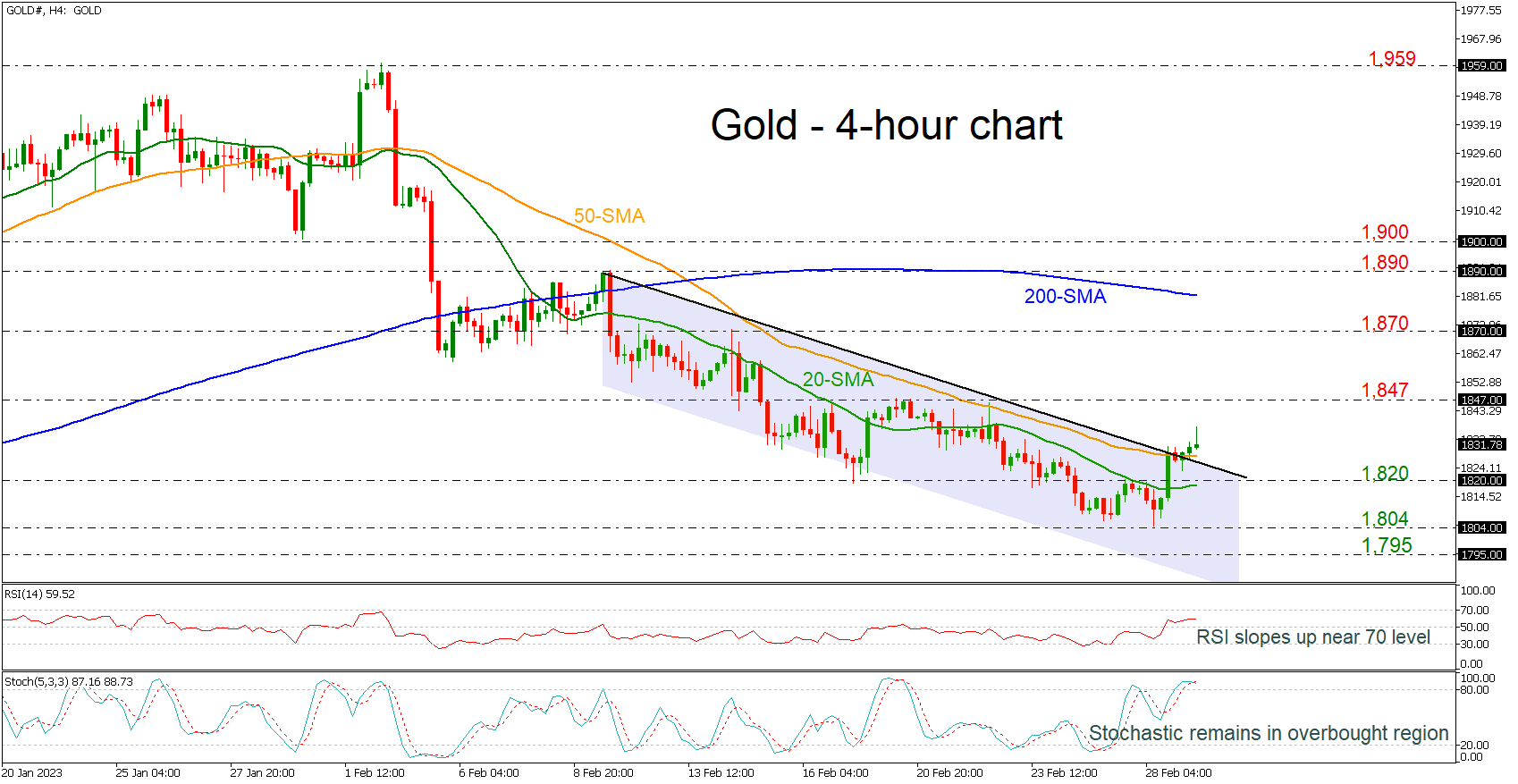
Gold is overperforming the last couple of sessions on the 4-hour chart, advancing above the short-term downward sloping channel and the 20- and the 50-period simple moving averages (SMAs). The RSI is moving higher above the 50 level, while the stochastic remains in the overbought territory, indicating a possible overstretched market.
Should the metal manage to gather more upside momentum, the next resistance could come around 1,847. A break above this level would shift the bias to a more bullish one and open the way towards the 1,870 barrier and the 200-period SMA at 1,882.
However, if the price is unable to remain above the descending channel, the risk would shift back to the downside, with the next support coming from the 1,820 barrier, which coincides with the 20-period SMA. A drop lower would signal a resumption of the downtrend, meeting 1,804 and 1,795.
In a nutshell, the yellow metal is showing some strength after the bounce off 1,804 and any moves above the 200-period SMA could confirm the bullish correction.
AUD/USD Jumps on Inflation, China PMIs
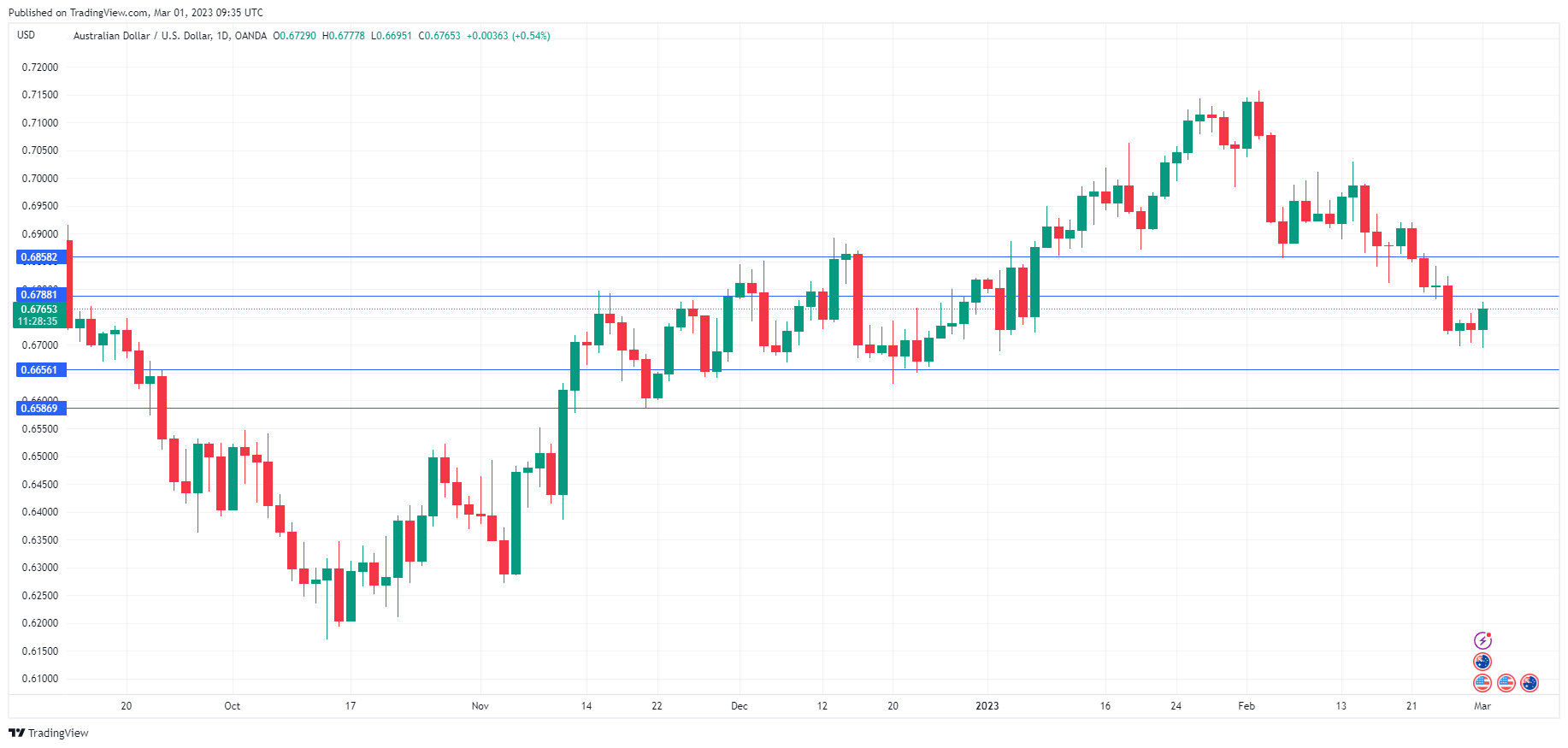
The Australian dollar is showing strong gains for the first time in a week. AUD/USD is trading at 0.6764 in Europe, up 0.53%.
Australia’s inflation eases
Australia’s inflation fell to 7.4% in January, down from 8.4% in December and below the estimate of 8.0%. Australian Treasurer Jim Chalmers said that he was “cautiously hopeful” that inflation has peaked, but inflation still remained the economy’s biggest challenge. The GDP report was not as positive, with a gain of 0.5% q/q in Q4, below the Q3 gain of 0.7% and the forecast of 0.8%. On an annualized basis, GDP slowed to 2.7% in Q4, down sharply from 5.9% in the third quarter.
The RBA’s rate-hike cycle has slowed economic activity and is responsible for the drop in inflation as well as the soft GDP. The central bank will have to consider how aggressive it should be with regard to future rate increases. Inflation needs to come down much further, but further rate hikes raise the risk of the economy tipping into a recession. The RBA is expected to raise rates by 25 basis points next week but may pause at the April meeting if the data, particularly inflation, allows the Bank to take to a breather.
The Aussie received a boost today from strong Chinese PMIs. Manufacturing and Non-manufacturing PMIs improved in February and beat expectations, with readings of 52.6 and 56.3, respectively. A reading above 50.0 indicates expansion. China is Australia’s largest trading partner and a stronger Chinese economy means greater demand for Australian exports, which is bullish for the Australian dollar. China’s transition from zero-Covid to reopening the economy has gone well so far and a rebound in China is important not just for China and the region but for the global economy as well.
AUD/USD Technical
- AUD/USD has support at 0.6656 and 0.6586
- There is resistance at 0.6788 and 0.6858
EUR/USD: Euro Rebounds after Daily Cloud Base Repeatedly Contained Dips
The Euro accelerated higher on Wednesday, lifted by stronger than expected growth in China’s manufacturing sector, which pressured dollar, while German regional inflation data added to price growth worries and boost expectations of ECB’s further rate hikes.
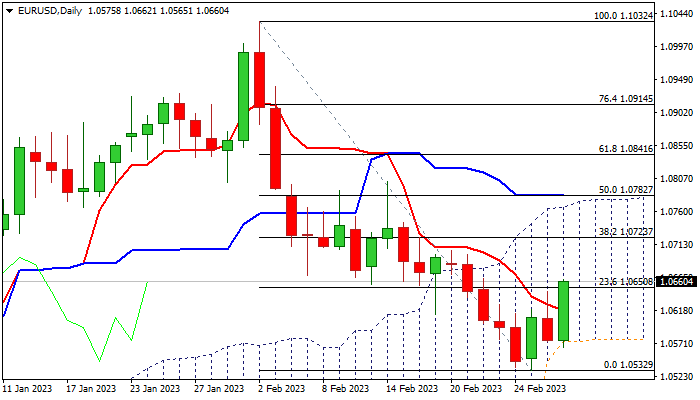
Fresh advance emerges after larger bear-leg faced strong headwinds from the base of rising daily Ichimoku cloud, which repeatedly limited attacks and proved to be solid support.
Improving conditions on daily chart (14-d momentum is heading north and approaching the border line of positive territory, stochastic / RSI are in steep ascend and price action broke above initial Fibo barrier at 1.0650 – 23.6% of 1.1032/1.0532)) generate initial positive signal, which looks for verification on extension above falling 20DMA (1.0685) and will be confirmed on break and close above pivotal Fibo barrier at 1.0723 (Fibo 38.2%).
Broken daily Tenkan-sen (1.0627) now offers initial support, guarding more significand cloud base (1.0574).
Res: 1.0704; 1.0723; 1.0782; 1.0803.
Sup: 1.0627; 1.0574; 1.0520; 1.0483.
GBP/USD Pair Moved into a Short-Term Positive Zone Above 1.2080
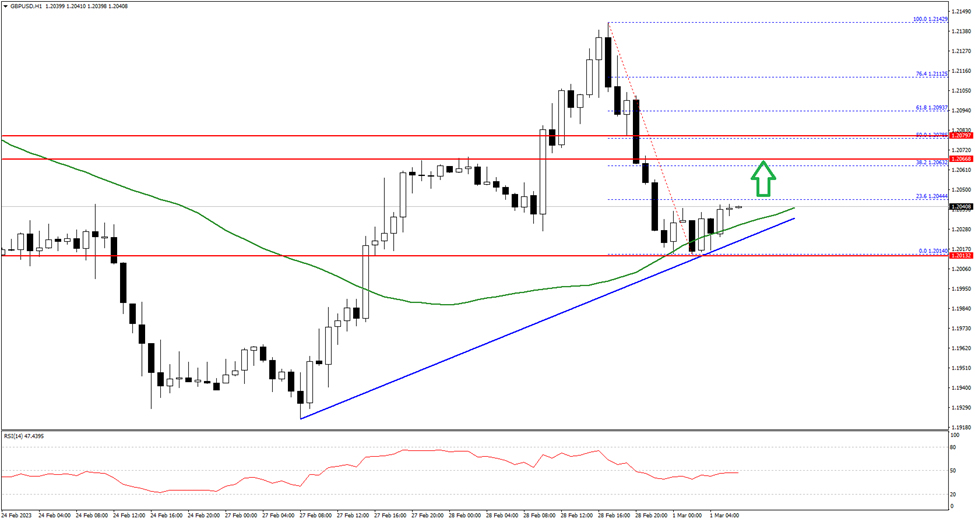
The British Pound started a decent increase above the 1.2000 resistance zone against the US Dollar. The GBP/USD pair climbed above the 1.2080 level and moved into a short-term positive zone.
The pair traded as high as 1.2142 before it corrected lower. It is now trading above the 1.2000 level and the 50 hourly simple moving average. An immediate resistance is near the 1.2060 level.
The first major resistance is near the 1.2075 level. If there is a clear upside break above the 1.2075 resistance, the pair could rise steadily towards the 1.2120 level in the near term. The next major resistance sits near 1.2150 on FXOpen.
On the downside, the first major support is near the 1.2020 level and a connecting bullish trend line on the hourly chart. The main support is forming near the 1.2000 level. A break below the 1.2000 support could push the pair towards the 1.1940 support.
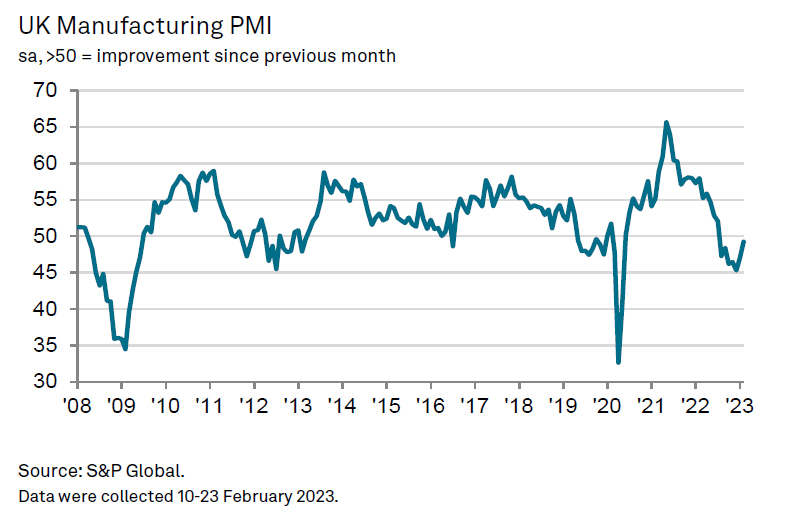
UK PMI manufacturing finalized at 49.3 in Feb, showed encouraging signs of resilience
UK PMI Manufacturing was finalized at 49.3 in February, up from January's 47.0. That's the highest level in 7 months even though it's stuck in contraction territory. New orders fell but showed signs of stabilizing. Input cost and output price inflation eased.
Rob Dobson, Director at S&P Global Market Intelligence, said:
"UK manufacturing showed encouraging signs of resilience in February. Output rose for the first time in eight months, boosted by weaker cost inflation and reduced supply chain disruptions. Input prices increased at the slowest pace since July 2020 and supplier performance improved for the first time in three-and-a-half years. This offset some of the ongoing negative impacts from strikes, the cost of living crisis and lower order intakes.
"Manufacturers' confidence also strengthened, with 60% of companies forecasting production will expand during the coming year. Part of the reason for renewed optimism was a near-stabilisation of new order inflows in February, with total new orders and new export business both falling only slightly and to much lesser extents than in recent months. Manufacturers benefited from growing signs of a global economic recovery and the easing of COVID restrictions by China. This process of economic revival, alongside signs of inflation peaking and reduced recession fears, should hopefully help UK manufacturers eke out further growth in the coming months."
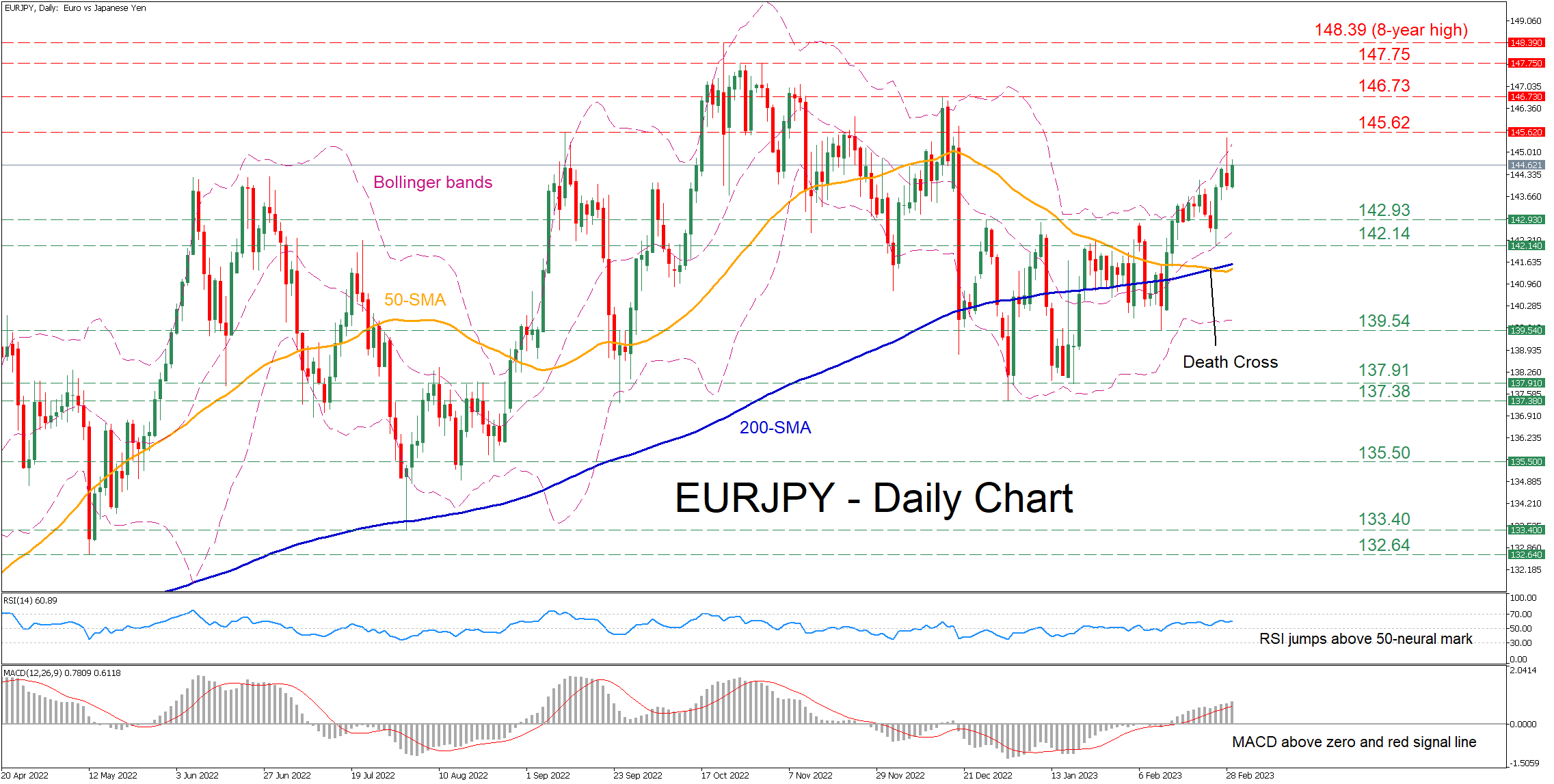
EURJPY Hits Fresh 2-Month High as Rebound Strengthens
EURJPY has been in a downtrend since mid-October when the price peaked at the eight-year high of 148.39. In the short-term, however, the pair has staged a moderate rebound despite the completion of a death cross between its 50- and 200-day simple moving averages (SMAs).
The momentum indicators currently suggest that bullish forces are intensifying. Specifically, the RSI is ticking upwards in the positive zone, while the MACD histogram is strengthening above both zero and its red signal line.
If buying pressures persist, the price could extend its advance towards the September peak of 145.62. Jumping above that barrier, the bulls could aim for the December high of 146.73 before the spotlight turns to 147.75. A break above the latter may set the stage for the eight-year high of 148.39.
On the flipside, if the price reverses lower, initial support could be found at the 142.93 hurdle, which has acted both as support and resistance multiple times in the past four months. Should that floor collapse, further declines could come to a halt at the 142.14 support region. Even lower, the February bottom of 139.54 could provide downside protection.
In brief, EURJPY seems ready to extend its pattern of higher highs as near-term risks remain predominantly to the upside. However, the pair is trading near its upper Bollinger band, hinting that this latest advance could be overstretched.
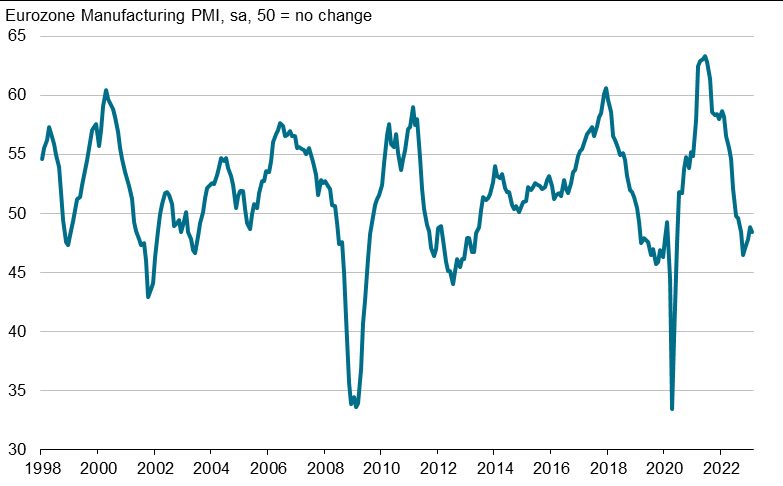
Eurozone PMI manufacturing finalized at 48.5, output at 50.1
Eurozone PMI Manufacturing was finalized at 48.5 in February, down from January's 48.8. Manufacturing output was finalized at 50.1, up from 48.9, a 9-month high.
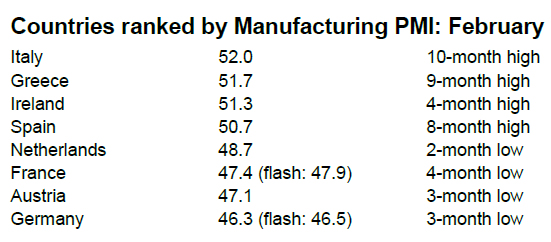
Looking a some member states, readings for Italy (52.0, 10-mont high), Greece (51.7, 9-month high), Ireland (51.3, 4-month high), and Spain (50.7, 8-month high) improved. The Netherlands (48.7, 2-month low), France (47.4, 4-month low), Austria (47.1, 3-month low), and Germany (46.3, 3-month low) deteriorated.
Chris Williamson, Chief Business Economist at S&P Global Market Intelligence said:
"A marginal expansion of output reported by Eurozone manufacturers in February is welcome news in representing the first increase since last May... Unfortunately, inflows of new orders continued to fall at a marked rate, reflecting persistent weak demand... In the meantime, the combination of improved supply and sustained weak demand – as well as lower energy prices – is helping bring inflationary pressures down sharply".
Challenging March for Bitcoin
Market picture
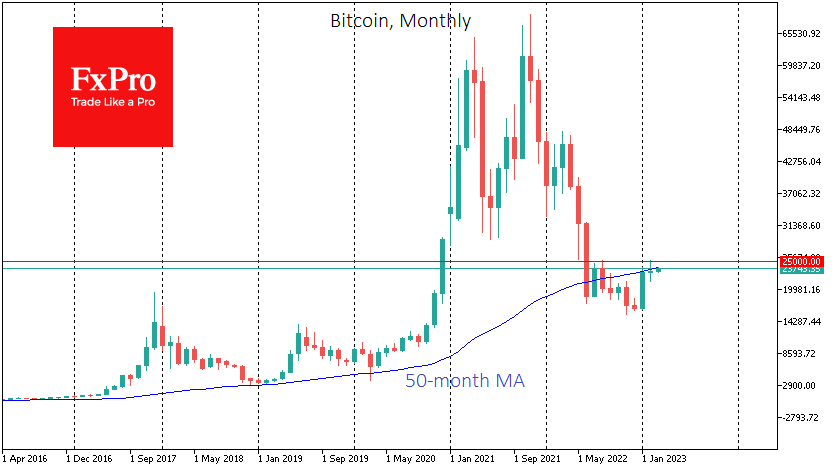
Bitcoin ended February slightly higher (+0.9%, to $23,200). March is off to a buying start, pushing the price up to $23.7K at the time of writing.
March is considered an unpromising month of the year for the top cryptocurrency, having fallen in eight of the last 12 years with an average decline of about 15%, an average gain of 16%.
The strong growth momentum in January and the renewal of local highs in February suggest that the bulls prevail. At the same time, the technical picture on the weekly timeframe suggests that only a consolidation above $25K will strengthen the bullish view of the market.
Bernstein noted that cryptocurrencies’ correlation with the US stock market and macroeconomic events is weakening amid BTC’s current flat move, which is a bullish signal.
News background
Ethereum developers have completed the Shanghai-Capella (Shapella) hard fork on the Sepolia test network. An update to the second cryptocurrency’s main network should occur as early as March. The main change after the update will be the ability to withdraw ETH from stakes.
Reuters reported that payment giants Visa and MasterCard had put plans for cryptocurrency integration on hold after a series of bankruptcies rocked the industry in 2022. The payment companies want to wait for market conditions and the regulatory environment to improve.
Coinbase, the largest US cryptocurrency exchange by trading volume, issued a notice of impending delisting of the Binance USD stablecoin. Investors began withdrawing funds from BUSD in early February after Paxos announced it would stop issuing the stablecoin under pressure from US authorities.
The Tel Aviv Stock Exchange is set to launch cryptocurrency trading. One of the largest local banks, Leumi Bank, has also agreed to start trading digital assets.