Sample Category Title
GBP/USD Could Recover If Bulls Clear This Hurdle
Key Highlights
- GBP/USD retested the key 1.1920 support zone.
- A major bearish trend line is forming with resistance near 1.2060 on the 4-hours chart.
- EUR/USD is attempting a recovery wave above the 1.0600 resistance zone.
- Gold price is struggling to stay above the $1,800 support.
GBP/USD Technical Analysis
The British Pound started a fresh decline from well above 1.2100 against the US Dollar. GBP/USD traded below the 1.2000 support to enter a bearish zone.
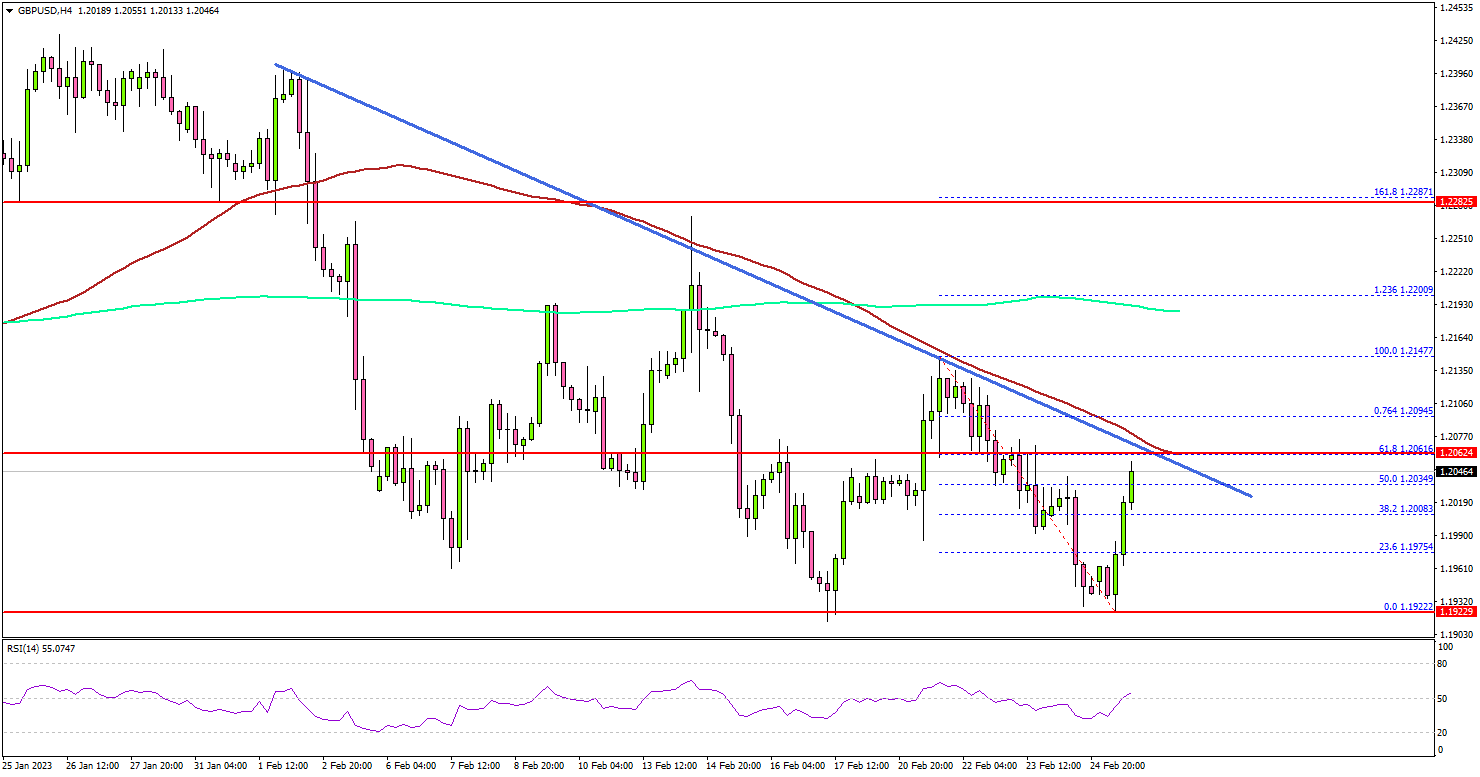
Looking at the 4-hours chart, the pair settled below the 1.2050 support level, the 100 simple moving average (red, 4-hours), and the 200 simple moving average (green, 4-hours).
Finally, it retested the key 1.1920 support zone. A low was formed near 1.1922 and the pair recently started an upside correction. There was a wave above the 1.1950 and 1.2000 resistance levels.
GBP/USD spiked above the 50% Fib retracement level of the downward move from the 1.2147 swing high to 1.1922 low. On the upside, an immediate resistance is near the 1.2060 level.
There is also a major bearish trend line forming with resistance near 1.2060 on the same chart. The next major resistance is near the 1.2100 level. A clear move above the 1.2100 resistance might start a steady increase.
The next target could be near the 1.2200 level and the 200 simple moving average (green, 4-hours). Any more gains could open the doors for a move towards the 1.2280 level.
On the downside, an immediate support is near the 1.1950 level. The next major support is near the 1.1920 level, below which there is a risk of a move towards the 1.1850. Any more losses could open the doors for a drop towards 1.1720.
Looking at EUR/USD, the pair tested the 1.0535 zone and recently corrected higher. It is now facing hurdles near the 1.0640 and 1.0650 levels.
Economic Releases
- US Housing Price Index for Dec 2023 (MoM) - Forecast -0.6%, versus -0.1% previous.
- Canadian Gross Domestic Product for Q4 2022 – Forecast -0.2%, versus +0.7% previous.
GBPAUD Wave Analysis
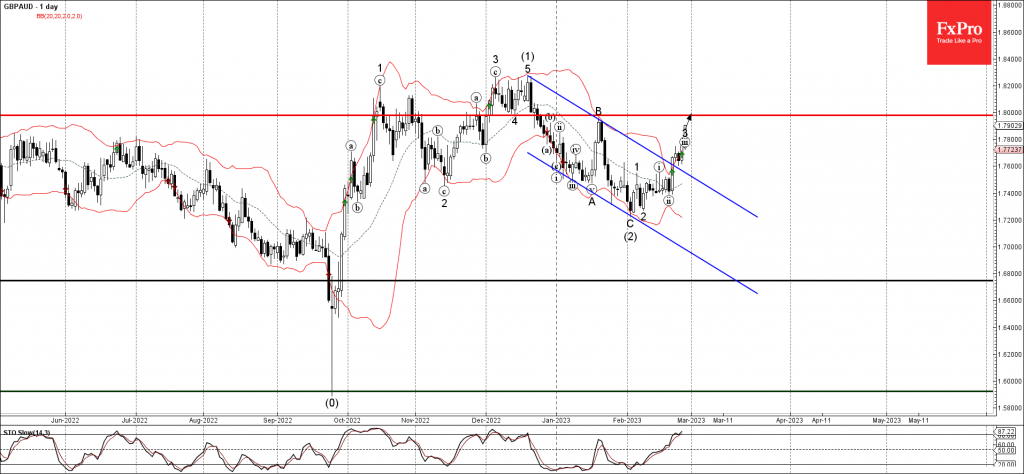
- GBPAUD broke daily down channel
- Likely to rise to resistance level 1.8000
GBPAUD previously broke the resistance trendline of the daily down channel from December (which enclosed the previous ABC correction (2)).
The breakout of this daily down channel accelerated the active impulse wave 3 of the intermediate impulse wave (3) from the start of February.
GBPAUD can be expected to rise further toward the next round resistance level 1.8000 (top of the B wave from last month).
GBPUSD Wave Analysis
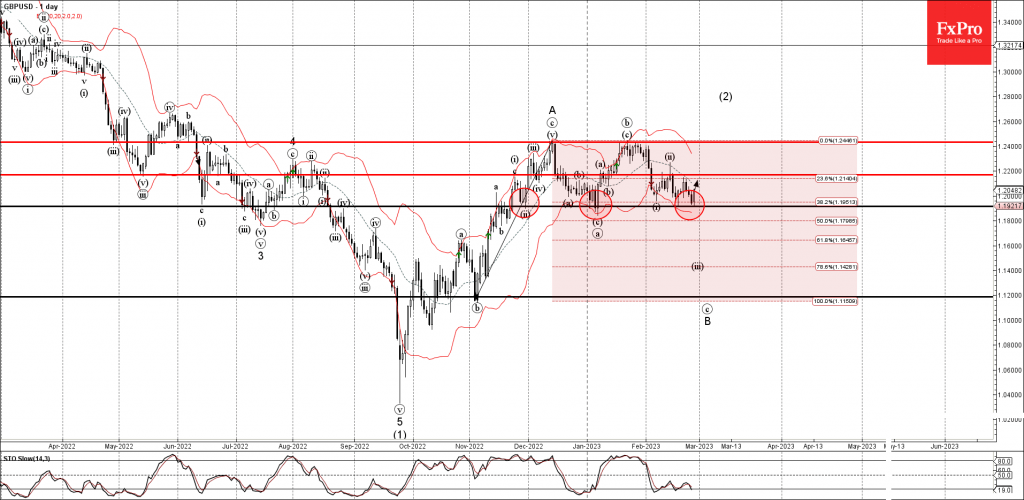
- GBPUSD reversed from key support level 1.1915
- Likely to rise to resistance level 1.2200
GBPUSD recently reversed up from the key support level 1.1915 (which has been reversing the pair from the end of November) intersecting with the lower daily Bollinger Band and the 38.2% Fibonacci correction of the previous upward impulse from November .
The upward reversal from the support level 1.1915 is likely to form the daily candlesticks reversal pattern Bullish Engulfing.
GBPUSD can be expected to rise further toward the next resistance level 1.2200 (which stopped the pervious wave (ii)).
Eurozone Credit Slowdown
Money supply and lending in the eurozone are slowing faster than expected, indicating an imminent economic contraction.
Data released on Monday morning pointed to a slowdown in new lending, coinciding with the start of the euro zone’s interest rate hike cycle. Loans rose by 3.6% year-on-year, compared with 3.8% in the previous month and an expected acceleration to 3.9%.
The annualised growth rate of M3 slowed to 3.5% yoy from 4.1% at the end of last year. The deceleration was stronger than the expected 3.9%. The money supply in Europe is not keeping pace with inflation, which was 8.6% in January and is expected to slow to 8.2% in February.
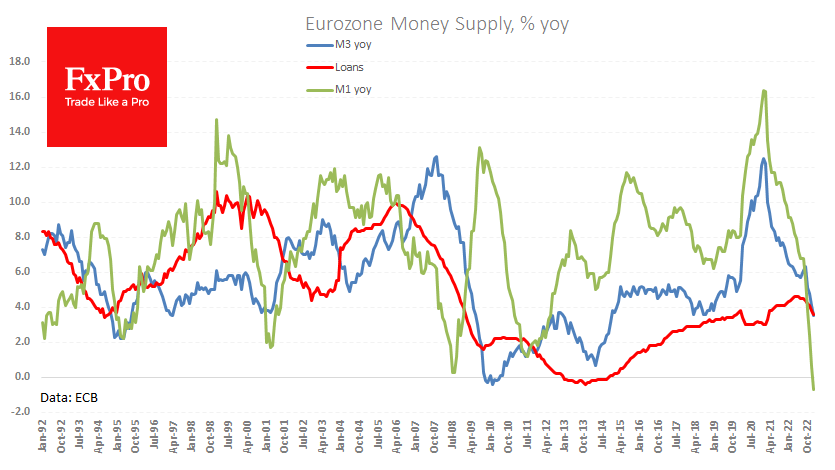
For the first time since 1981, the monetary aggregate M1 declined year-on-year. Such a development is often seen as an anti-inflationary indicator.
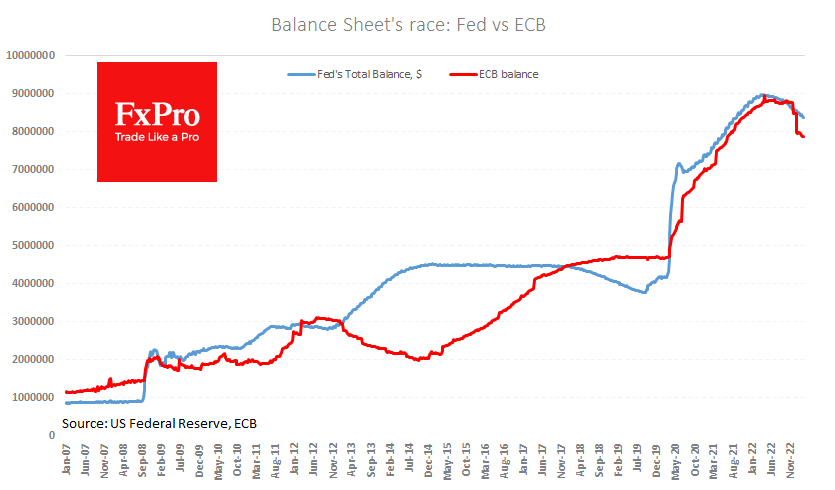
At the same time, the ECB continues to reduce its balance sheet by 962 billion or 11% since its peak in June. The most significant contributor to the decline in central bank assets has been the completion of regular liquidity programmes. The Fed’s balance sheet was 6.3% below its peak.
For the economy, falling credit and a slowdown in lending are essential signals of an economic downturn.
From a fundamental point of view, this is negative data for the euro as it could lead the ECB to start easing policy sooner. However, this data has little impact on the currency as most traders await the release of February inflation estimates later in the week.
Bouncing Back
Equity markets ended last week on a negative note but they're bouncing back once more in trade on Monday.
Interest rate fears are front and centre, following a terrible month of data from the US in January, as far as the Fed is concerned at least. That was further compounded on Friday by the PCE, income, and spending data which didn't come as a major surprise given what preceded it but it didn't offer any relief either.
Thankfully, January is likely to be an anomaly month driven by unseasonably warm weather and the data over the next few weeks prior to the next Fed meeting will confirm to what extent that is the case. For now, bond investors are fearing the worst, something that is much less evident in equities.
Another hot jobs report next week could put seriously test the enthusiasm we've seen so far this year in equity markets as it would cast major doubt over the extent to which January was a blip and cement expectations for more rate hikes for longer, perhaps even reverting back to 50 basis point moves.
In the interim, while this week offers an abundance of economic data and events, the vast majority is tier two or worse and so will not likely be hard-hitting. But as we've seen today, investors clearly don't need much of a catalyst to get things moving.
Choppy and directionless
Oil prices are drifting lower again as we continue to see choppy trading conditions. We've seen consolidation in oil prices for many weeks now but it is happening at a glacial pace and there's little reason to expect that's going to change in the immediate future. One upside risk could be an improvement in the economic data that points to cooling in all the right places, while any indication that China's adjustment is experiencing difficulties could be a downside risk. That aside, choppy with ultimately sideways trade could be on the cards a little longer.
Losing momentum
Gold is a little higher today, buoyed by a slightly softer dollar and small declines in US yields. We are seeing less momentum in the sell-off recently as it drifts ever closer to $1,800. That remains the big test for the yellow metal now, between $1,780-$1,800, and it may take another nasty turn in the economic data to seriously test that support.
On the rise again
Bitcoin is rallying another 3% today after briefly dipping below $23,000 over the weekend. Once more we're seeing some resilience in the space and it seems as long as equity market optimism remains in place, crypto bulls are going nowhere. The key test to above remains the $24,500-$25,500 region, a break above which could generate a lot more excitement.
USD/JPY: Bulls Taking a Breather after Strong Rally on Friday
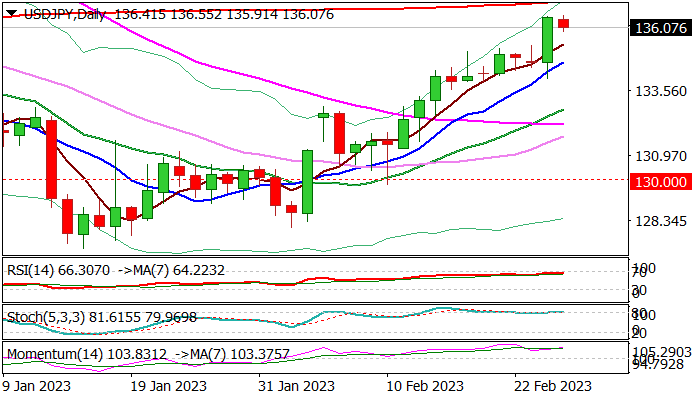
The USDJPY eases from new nine-week high on Monday, as bulls faced strong headwinds at 136.44 (Fibo 38.2% retracement of 151.94/127.22) and ahead of converged 100/200DMA’s which are forming a bear-cross, prompting traders to collect some profits after last Friday’s 1.3% advance (the biggest daily gains since Feb 3).
Larger bulls started to lose traction, though dips are likely to be shallow as 14-period momentum on daily chart is rising while RSI turned south after touching the border of overbought zone.
Dollar keeps firm bullish stance on fresh hawkish rhetoric from Fed and higher than expected US inflation and consumer spending data, which contribute to scenario of extended policy tightening cycle and possible renewed increase of pace of rate hikes, in Fed’s key task – bringing high inflation under control.
Adding to bullish scenario is formation of reversal pattern on monthly chart, as well as bear-trap under psychological 130.00 support.
Rising 10DMA (134.66) and Friday’s low (134.05) offer initial supports ahead of 133.00 zone (Fibo 38.2% of 127.22/136.55, reinforced by rising 20DMA), which should contain deeper pullback to keep bulls intact.
Res: 134.66; 137.12; 138.17; 138.58.
Sup: 135.41; 134.66; 133.50; 132.80.
Sunset Market Commentary
Markets
There is no stopping the repositioning on core (EMU and US) interest rate markets, even not in session with only second tier data. Economic confidence from the European Commission, contrary to most other data evidence of late, surprisingly deteriorated slightly (99.7 from 99.8 vs 101 expected). However, it was no reason to trigger a correction on the established yield rally. German yields today set new cycle peak levels for all maturities up to 10-y. At 2.58% the German 10-y yield touched the highest level since July 2011. The German 2-y yield (3.07%) even trades at levels not seen since October 2008. Markets now fully accept that the ECB won’t cut interest rates this year and even ponder scenario’s that see the hiking cycle lasting well into summer. German yields are rising 3-4 bps across the curve. The 30-y underperforms (+7.5 bp). Despite markets pricing a scenario of a prolonged Fed and ECB hiking cycle with a higher peak level, this recently didn’t translate into lower inflation expectations as measures by EMU and US inflation swaps. Inflation swaps across almost all maturities (both in the US and EMU) trade off the January lows. This ‘rebound’ also occurs despite a sharp decline in gas prices and oil holding at relatively low levels. One should be cautious too read too much in short-term swings in inflation swaps. Even so, it might suggest that also this market is having second thoughts that it won’t be that easy to bring down the kind of inflation caused by higher labour costs/a tight labour market which structurally adds to (services) inflation. US yields initially also tried a further upside test, but finally fell prey to a modest countermove easing between 4 bps (5-y) and 1.5 bps (30-y). US durable goods orders at least weren’t to blame. Headline orders declined 4.5% M/M after a 5.1% gain in January, but underlying non-defense ex aircraft printed strong both for orders (0.8% M/M) and shipments (0.7%). Equities today showed some resilience. For now, equity investors apparently aren’t overly worried that higher yields will immediately translate into an aggressive decline in global demand. The Eurostoxx 50 regains about 2.0% . US indices open 0.5%-1.0% in green.
FX markets aare mainly inspired by the daily swings in risk sentiment. The dollar rally takes a breather. DXY drops back below the 105 mark (104.85). After filling bids in the 1.0535 area, EUR/USD currently trades in the 1.0585 area. A constructive risk sentiment supports sterling. EUR/GBP returned to the 0.88 area as investors await the details of the new EU-UK brexit deal. CE currencies also took a strong start to the new week. EUR/CZK touched a new multi-year low near 23.60. The forint (EUR/HUF 379) is near the mid-month recovery top against the euro. Equally, the zloty extends its rebound (EUR/PLN 4.7125).
News Headlines
Commenting when the Bank of International Settlements published its quarterly review, head of economic research Borio said monetary authorities must “get the job done” when it comes to getting inflation back under control. Declaring victory too soon would invoke spirits of the ’70, when inflation rekindled after central banks lowered policy rates too soon and as a result had to hike them to painfully high levels afterwards. The BIS in this respect warned investors for overestimating the chances of rate cuts next year, saying that current pricing of policy rates declining materially in 2024 was in “sharp contrast” to what central banks were communicating. Interestingly, Borio also said there is nothing wrong with central banks slowing the tightening pace only to accelerate it again if needed.
Belgian inflation eased from 8.05% in January to 6.62% this month on a 0.70% M/M price drop, Statbel reported. Energy was a big contributor to the deceleration. Base effects resulted in energy inflation of -7.93% y/y with gas prices and electricity respectively 30.8% and 16% lower compared to February 2022. This caused the “housing, water and energy” component to drag the headline number 0.47 ppts lower. Core inflation (ex. energy and unprocessed food) rose further from 8.05% to 8.28% on increases in processed food products and services (up from 6.56% to 6.96%). This breakdown is critical in the ECB’s assessment. We expect other national numbers (tomorrow and Wednesday) and the EMU-wide inflation print (Thursday) to show similar dynamics.
Fed Jefferson: Core goods inflation has started to come down
In a speech, Fed Governor Philip Jefferson said, "core goods inflation has started to come down. Several indicators suggest that housing services inflation is likely to come down in the coming months. There is more uncertainty surrounding inflation in core services excluding housing. Over time, we'll learn more about inflation dynamics in this sector."
"The inflation outlook for this nonhousing category of core services partly depends on whether growth in nominal labor costs comes back down, and recent data suggest that labor compensation has indeed started to decelerate somewhat over the past year," he also noted.
Jefferson also rejected the idea of changing Fed's longer-run inflation objective of 2%. He said that would "introduce an additional risk by calling into question the FOMC's commitment to stabilizing inflation at any level because it might lead people to suspect that the target could be changed opportunistically in the future".
Pound Jumps on N. Ireland Hopes
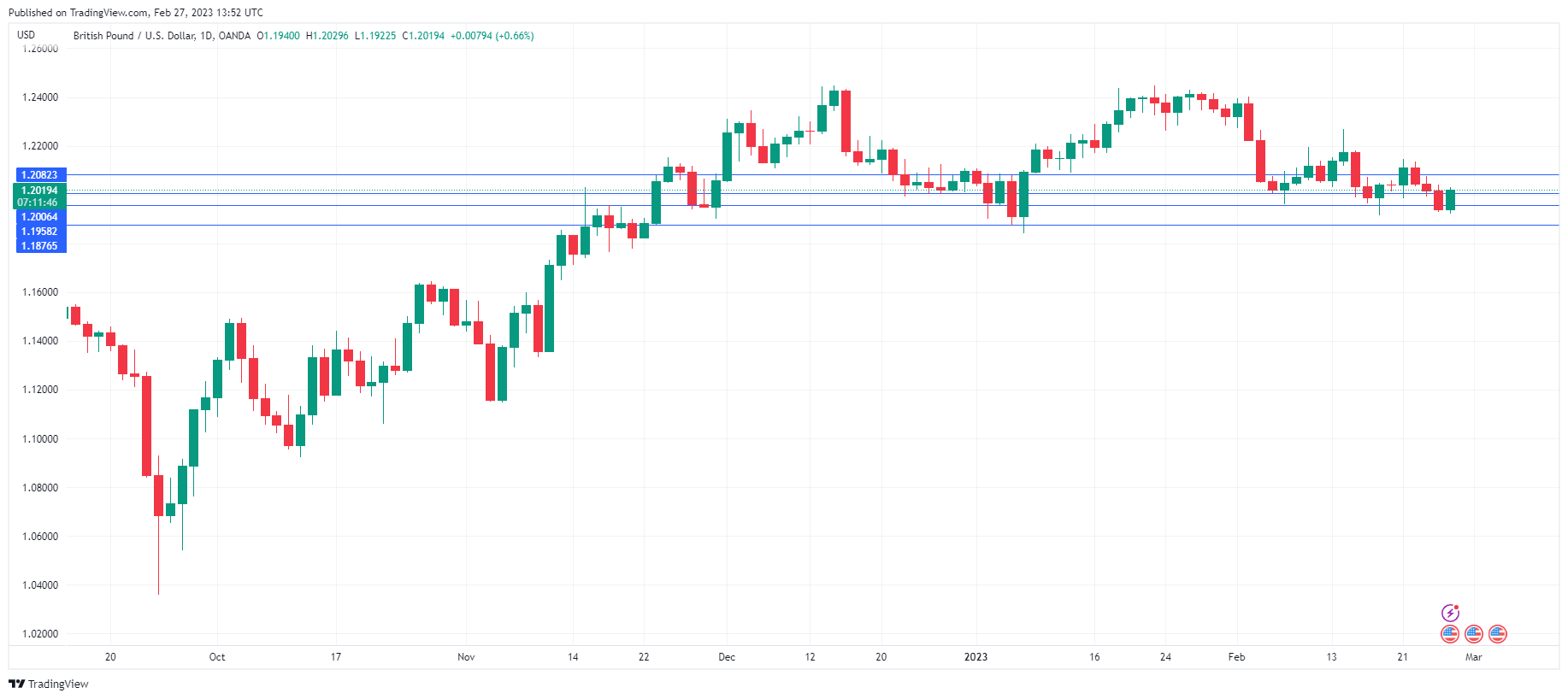
The British pound has posted sharp gains on Monday, after falling below the symbolic 1.20 level on Friday. In the European session, GBP/USD is trading at 1.2026, up 0.72%.
In the UK, the economic calendar is unusually quiet this week, with no tier-1 releases. There will be a host of BoE members speaking, including BoE member Broadbent today and Governor Bailey and Chief Economist Pill later in the week. The BoE is widely expected to raise rates by 0.25% at the March 23 meeting, which would bring the cash rate to 4.25%. The UK economy appeared to be well on its way toward a recession, and the BoE signalled at the February meeting that it was considering easing up on the pace of rate hikes due to the slowing economy.
The central bank may have to reconsider its policy after strong economic data was released last week. Services PMI climbed back into expansion territory in January, rising from 48.7 to 53.3. As well, GfK consumer confidence for February improved to -38, up from -43 a year prior. Although consumer confidence remains deep in negative territory, this was the strongest release since April 2022. The improvement in economic activity has caused the markets to fully price in 0.25% hikes in March and May, with a 33% likelihood of the cash rate rising to 5% in August.
The UK left the EU in January 2020, but the vexing problem of the Northern Ireland border has continued to create friction between London and Brussels. There are hopes that the sides will announce as early as today that progress has been made, with speculation that a deal is very close to being reached. An agreement would be a massive victory for UK Prime Minister Sunak, who has been dealing with a lackluster economy and public worker strikes.
GBP/USD Technical
- GBP/USD is testing resistance at 1.2006. The next resistance line is 1.2082
- 1.1958 and 1.1864 are providing support