

Sample Category Title
EUR/JPY Daily Outlook
Daily Pivots: (S1) 143.88; (P) 144.22; (R1) 144.86; More....
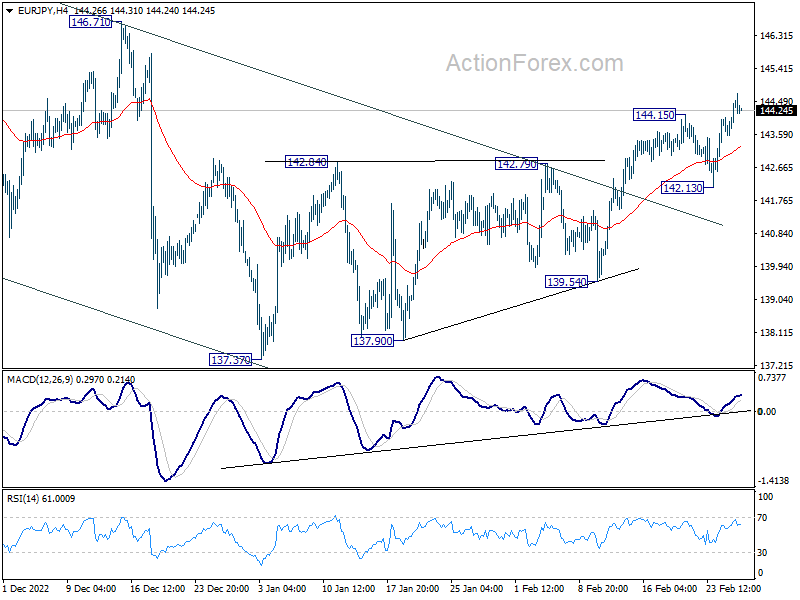
EUR/JPY's rebound from 137.37 resumed by breaking through 144.15 resistance. Intraday bias is back on the upside. As noted before, corrective fall from 148.38 has completed at 137.37 already. Further rise should be seen to 146.71 resistance and then 148.38 high. For now, outlook will stay cautiously bullish as long as 142.13 support holds, in case of retreat.
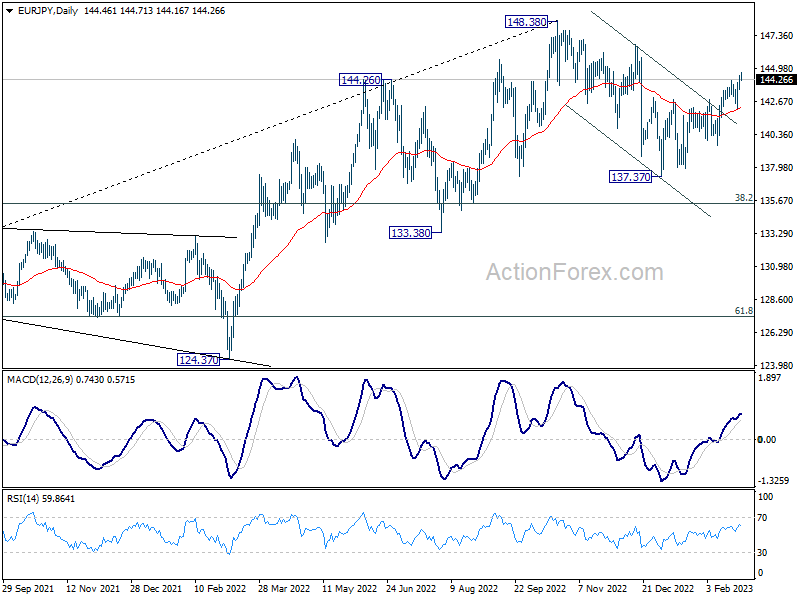
In the bigger picture, as long as 55 week EMA (now at 139.21) holds, larger up trend from 114.42 (2020 low) is still in progress for 149.76 long term resistance. However, firm break of 55 week EMA will bring deeper fall to 38.2% retracement of 114.42 to 148.38 at 135.40. Sustained break there will raise the chance of trend reversal, and target 61.8% retracement at 127.39.
Yen Down Against Euro and Sterling, Pressing Support Against Dollar
Markets are generally quite in Asian session today, in consolidation mode. Australian and New Zealand Dollar remain the worst performed. While Dollar is recovering slightly, it's trading below last week's high, except versus Aussie and Kiwi. Sterling is supported by hope of a Northern Ireland deal with EU but lacks follow through buying. Yen is also mixed together with Swiss Franc and Euro.
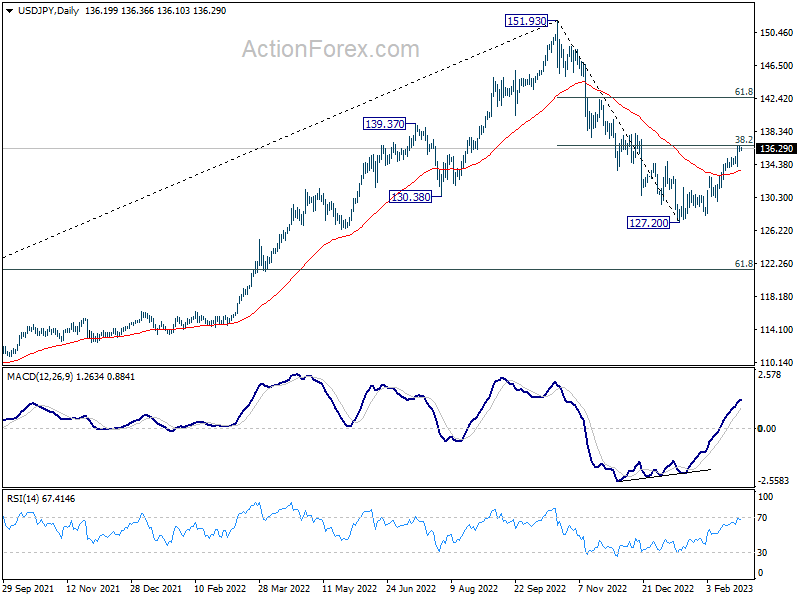
Technically, both EUR/JPY and GBP/JPY resuming near term rallies by taking out 144.15 and 163.73 temporary tops. Further rise is expected to 146.71 resistance and 169.26 resistance respectively. A key to decide Yen's near term fortune lies on whether USD/JPY could break through 38.2% retracement of 151.93 to 127.20 at 136.64 to secure bullish reversal. Let's see.
In Asia, Nikkei closed up 0.08%. Hong Kong HSI is down -0.30%. China Shanghai SSE is down -0.06%. Singapore Strait Times is up 0.34%. Japan 10-year JGB yield is down -0.0029 at 0.502. Overnight, DOW rose 0.22%. S&P 500 rose 0.31%. NASDAQ rose 0.63%. 10-year yield dropped -0.027 to 3.922.
ECB Vujcic: We should persevere if core inflation persists
ECB Governing Council member Boris Vujcic told Bloomberg TV yesterday, "as long as core (inflation) persists at the levels we're talking about and this is significantly higher than our rates are and significantly higher than where are target is, we should persevere."
The markets have been raising their bets on higher interest rates and are betting tightening extending into 2024. Vujcic said, "I think this repricing in a way is what we did during our last projections, where we projected basically higher inflation for longer, core inflation which turns out to be stickier than most people probably expected."
"Probably markets are now repricing and saying 'OK, we might see higher rates for maybe longer,'" he said.
BoJ Wakatabe: Dangers of secular stagnation and Japanification not yet passed
Deputy Governor Masazumi Wakatabe said, "the mild-inflation regime has not come to an end, and we should say that the potential dangers of secular stagnation and Japanification have not yet passed."
"When an exogenous shock occurs, there is an adjustment from the old to a new price system. After adjustment, the rising inflation rate is likely to return to the steady-state inflation rate," he said.
"So the important point is how this rate is affected. Of course, it is possible that cost-push factors will remain, but whether they will push up the steady-state inflation rate is uncertain," Wakatabe said, adding that it was "well known that cost-push inflation does not last long.".
BoJ Uchida: Shouldn't modify easy policy just because there are side-effects
Incoming BoJ Deputy Governor Shinichi Uchida told an upper house confirmation hearing, "BOJ must maintain monetary easing. It shouldn't modify easy policy just because there are side-effects. Rather, it must come up with ideas" to mitigate the costs and help sustain stimulus.
He also noted it's premature to discuss an exit from the ultra-loose monetary policy. Any exit would involve adjustments in the interest targets and the balance sheet. "In what order and at what timing the BOJ will make these adjustments will depend on economic and financial developments at the time," Uchida said.
Japan industrial production down -4.6% mom in Jan, expected to rebound in Feb
Japan industrial production declined -4.6% mom in January, much worse than expectation of -2.6% mom.
Upon the release of the data, the METI downgraded its assessment of industrial production, saying that it has weakened. Never the less, the ministry forecast industrial production to bounce back by 8.0% in February, and then a further 0.7% in March.
Retail sales rose 6.3% yoy, above expectation of 4.0% yoy.
Australia retail sales rose 1.9% mom in Jan, flat on average over the past few months
Australia retail sales turnover rose 1.9% mom to AUD 35.09B in January, above expectation of 1.6% mom. Compared with January 2022, sales turnover was up 7.5% yoy.
Ben Dorber, ABS head of retail statistics, said: "The rebound in retail turnover in January followed a substantial fall of 4.0 per cent in December and a large rise of 1.7 per cent in November.
"Looking through this volatility shows that turnover is at a similar level to September 2022, and on average, growth has been flat over the past few months."
NZ ANZ business confidence rose to -43.3, firms wary but getting on with the job
New Zealand ANZ Business Confidence improved form -52.0 to -43.3 in February. Own Activity Outlook rose from -15.8 to -9.2.
Looking at some details, export intentions ticked up from -5.4 to -5.2. Investment intentions rose from -13.7 to -4.9. Employment intentions jumped from -11.1 to -3.4. Pricing intentions dropped from 62.4 to 58.8. Cost expectations dropped from 91.3 to 88.3. Inflation expectations ticked down from 5.99 to 5.94.
ANZ said: "The shock value of the November Monetary Policy Statement appears to have faded into the rear-vision mirror as firms focus on the risks and opportunities that are front and centre.... Opportunity is clearly still knocking. That said, the level of most indicators remain subdued – firms are still very wary, and understandably so. But they are getting on with the job."
Looking ahead
Germany import price, France GDP, Swiss KOF and GDP will be featured in European session. Later in the day, Canada will release GDP. US will release goods trade balance, house price index, Chicago PMI and consumer confidence.
EUR/JPY Daily Outlook
Daily Pivots: (S1) 143.88; (P) 144.22; (R1) 144.86; More....
EUR/JPY's rebound from 137.37 resumed by breaking through 144.15 resistance. Intraday bias is back on the upside. As noted before, corrective fall from 148.38 has completed at 137.37 already. Further rise should be seen to 146.71 resistance and then 148.38 high. For now, outlook will stay cautiously bullish as long as 142.13 support holds, in case of retreat.
In the bigger picture, as long as 55 week EMA (now at 139.21) holds, larger up trend from 114.42 (2020 low) is still in progress for 149.76 long term resistance. However, firm break of 55 week EMA will bring deeper fall to 38.2% retracement of 114.42 to 148.38 at 135.40. Sustained break there will raise the chance of trend reversal, and target 61.8% retracement at 127.39.
Economic Indicators Update
| GMT | Ccy | Events | Actual | Forecast | Previous | Revised |
|---|---|---|---|---|---|---|
| 23:50 | JPY | Industrial Production M/M Jan P | -4.60% | -2.60% | 0.30% | |
| 23:50 | JPY | Retail Trade Y/Y Jan | 6.30% | 4.00% | 3.80% | |
| 00:00 | NZD | ANZ Business Confidence Feb | -43.3 | -52 | ||
| 00:30 | AUD | Current Account Balance (AUD) Q4 | 14.1B | 6.8B | -2.3B | 0.8B |
| 00:30 | AUD | Private Sector Credit M/M Jan | 0.40% | 0.40% | 0.30% | |
| 00:30 | AUD | Retail Sales M/M Jan | 1.90% | 1.60% | -3.90% | -4.00% |
| 05:00 | JPY | Housing Starts Y/Y Jan | 6.60% | -1.20% | -1.70% | |
| 07:00 | EUR | Germany Import Price Index M/M Jan | 0.40% | -1.60% | ||
| 07:45 | EUR | France GDP Q/Q Q4 | 0.10% | 0.10% | ||
| 08:00 | CHF | KOF Economic Barometer Feb | 98 | 97.2 | ||
| 08:00 | CHF | GDP Q/Q Q4 | 0.30% | 0.20% | ||
| 13:30 | CAD | GDP M/M Dec | 0.20% | 0.10% | ||
| 13:30 | USD | Goods Trade Balance (USD) Jan P | -91.0B | -90.3B | ||
| 13:30 | USD | Wholesale Inventories Jan P | 0.10% | 0.10% | ||
| 14:00 | USD | Housing Price Index M/M Dec | -0.20% | -0.10% | ||
| 14:00 | USD | S&P/CS Composite-20 HPI Y/Y Dec | 6.80% | 6.80% | ||
| 14:45 | USD | Chicago PMI Feb | 45 | 44.3 | ||
| 15:00 | USD | Consumer Confidence Feb | 108.5 | 107.1 |
United Kingdom Economy Still Likely to Underwhelm in 2023
Summary
- While there have been some mildly encouraging developments in the recent U.K. data flow, the outlook for the British economy remains distinctly subpar. A flat Q4 GDP outcome has been followed by improving confidence surveys early this year. However, with prior price increases likely to pose lingering challenges to household purchasing power, we still forecast U.K. GDP to contract 0.6% in 2023.
- There has also been some improving news on the inflation front, which decelerated more quickly than expected in January at both the headline and the core levels. We view this as a noteworthy development, given the backdrop of the rapid slowing of inflation forecast by the Bank of England (BoE) over the medium-term and some dovish comments from important central bank policymakers.
- Should inflation continue to show a pronounced declaration, and activity and survey data show renewed softening, we expect the Bank of England to deliver a final 25 basis point rate to 4.25% in March and to begin cutting interest rates as early as Q4 of this year.
- Our forecast policy rate peak is well below the level implied by current market pricing. The less aggressive approach we envisage from the BoE is an important reason we expect that, over the medium-term, the pound will be an underperformer against a broadly soft U.S. dollar, targeting a GBP/USD exchange rate of just $1.2200 by the end of this year. The BoE's less aggressive approach should also contribute to some decline in two and ten year U.K. government bond yields from current levels over time.
U.K. Economic Outlook Still (Somewhat) Underwhelming
Although there have been some mildly encouraging developments in the recent U.K. data flow, the outlook for the British economy remains distinctly subpar. The U.K. has narrowly avoided recession, for now, with the release of its fourth quarter GDP figures. Q4 GDP was flat for the quarter, with the details showing consumer spending edging up 0.1% and business investment jumping 4.8%. While the economy held steady for quarter as a whole, the economy did finish 2022 on a soft note as U.K. December GDP dropped 0.5% month-over-month, driven by a 0.8% decline in services activity as industrial output rose 0.3%. The Q4 GDP report also suggested that high inflation could pose some lingering challenges to household purchasing power in the months ahead. After adjusting for higher prices, we estimate that U.K. real employee compensation fell 0.5% quarter-over-quarter in Q4, and was down 2.8% year-over-year. The previous increase in U.K. prices could remain a headwind for the U.K. consumer for the time being and, by extension, act as a restraint on the broader economy.
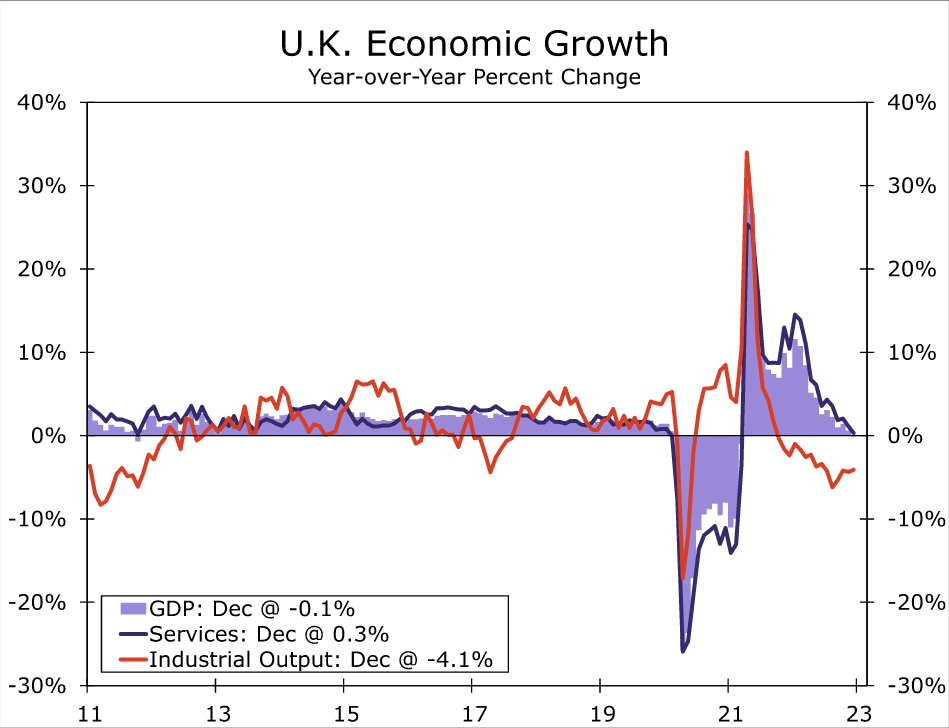
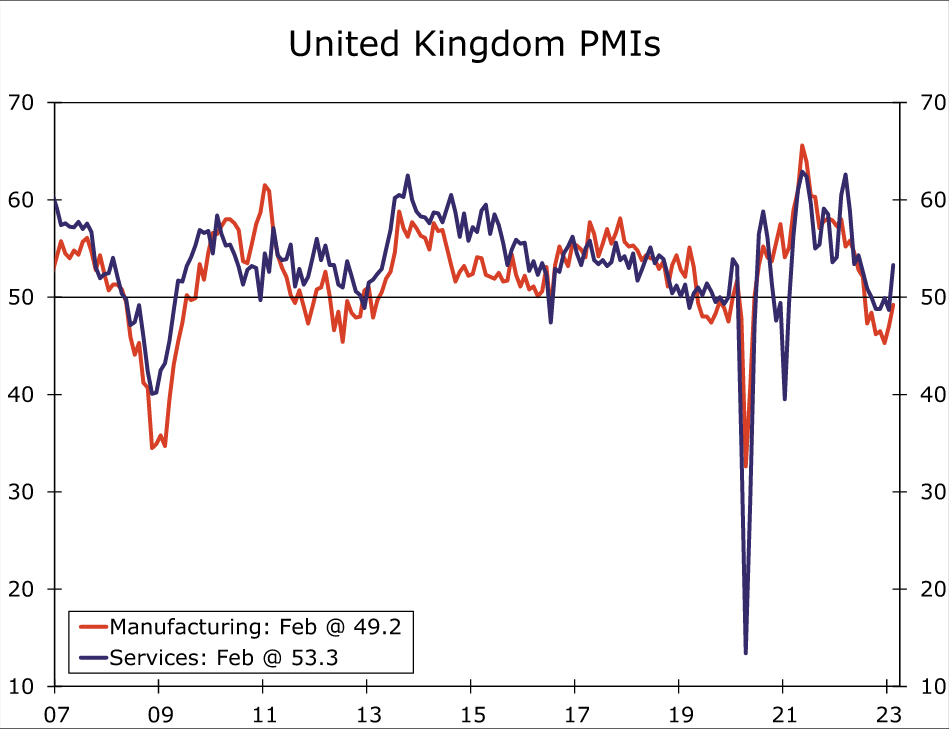
Most recently as energy prices have fallen back, there have been somewhat more encouraging developments for the U.K. outlook. Turning the page into 2023, retail sales rose in January, although that comes after a large December decline. Perhaps more noteworthy was the improvement in the U.K. February PMI surveys, as the manufacturing PMI rose to 49.2 and the services PMI rose above the breakeven 50 level to 53.3. The labor market backdrop is also reasonably solid, as Q4 employment rose by 74,000 and January payroll employees gained 102,000—both stronger than expected outcomes. Overall, this combination of U.K. data makes us less downbeat on the economy than previously. While we believe elevated inflation will remain something of a drag on the economy, we also believe that slowing inflation could result in less of a drag than we previously forecast. As a result, we have turned less negative on growth prospects in recent months. For full-year 2023 we now forecast U.K. GDP to contract by 0.6%, compared to a forecast 1.5% contraction as recently as December.
The Path Ahead for Bank of England Policy
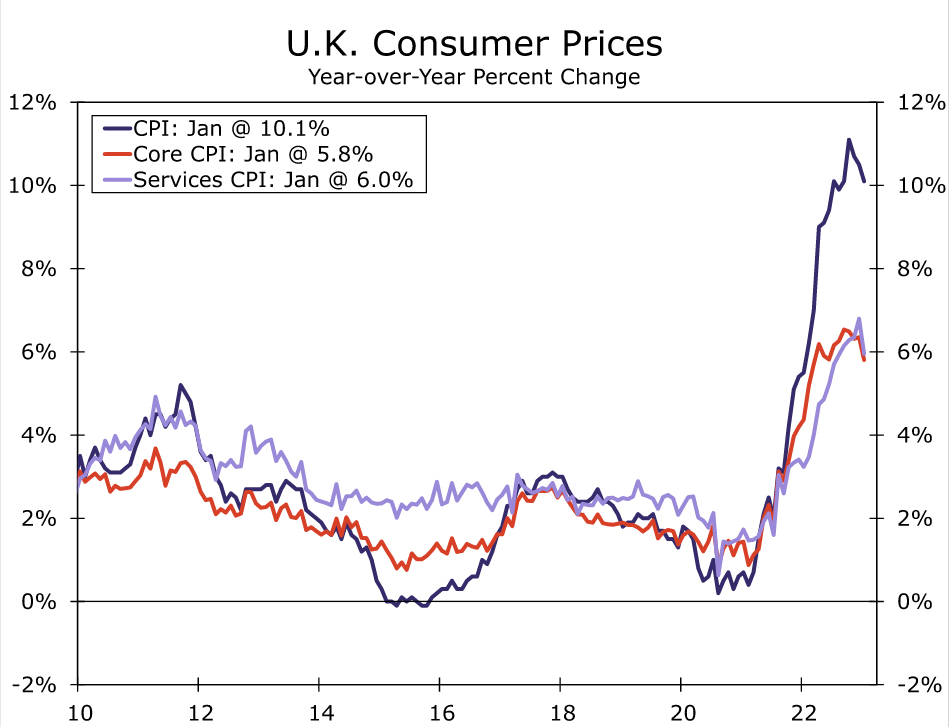
In addition to some better news on the activity front, there has also been improving news on the inflation front. Headline CPI inflation slowed more than expected to 10.1% year-over-year in January while, just as importantly, core CPI inflation also slowed more than forecast to 5.8% and services inflation slowed to 6.0%. It is true that those inflation readings remain elevated and well above the Bank of England's (BoE) 2% inflation target, meaning some further policy tightening will almost certainly be forthcoming. The more pressing question is, given slowing inflation and underwhelming growth, what could the extent of that policy tightening be?
At its most recent policy announcement in early February, the BoE's updated economic projections forecast CPI inflation falling below 2% over the medium term. Specifically, based on market implied interest rates at the time, which envisaged a peak policy rate near 4.50% around mid-2023, the central bank forecast CPI inflation to fall to 1.9% by Q1-2025 and to just 0.8% by Q4-2025. At the same time, in referring to the inflation outlook, Bank of England policymakers said there "are considerable uncertainties around this medium-term outlook, and the Committee continues to judge that the risks to inflation are skewed significantly to the upside."
This was further elaborated in the minutes from the meeting, which qualitatively said that, "an inflation forecast that took into account these upside risks was judged to be much closer to the 2% target at the policy horizon than the modal central projection." These considerations were reflected in the Bank of England's policy guidance, in which the central bank said it will "continue to monitor closely indications of persistent inflationary pressures, including the tightness of labor market conditions and the behavior of wage growth and services inflation. If there were to be evidence of more persistent pressures, then further tightening in monetary policy would be required.”
Recent comments from the BoE have been mixed, although comments from some key policymakers have leaned towards the dovish side. In mid-February, BoE Chief Economist Pill said continuing to raise interest rates at the pace of the past year would eventually, and perhaps soon, imply that monetary policy had tightened too much. In early February, BoE Governor Bailey said "I do think we’ve turned the corner in terms of headline inflation … It has not only fallen, it’s now under what we thought it would be in November. But we need to see more evidence that this process will take effect."
Considering the Bank of England's projections and policymaker comments, how quickly inflation decelerates, and to a lesser extent whether the economy shows renewed softness, will be key to how much further the BoE hikes rates. Should inflation continue slowing similarly to the pronounced pace seen in January, and should activity and survey data show renewed softening (which would be consistent with our forecast for U.K. Q1 GDP to fall by 0.2% quarter-over-quarter), we expect the Bank of England will be comfortable shifting to a slower pace of rate hikes and, indeed, we forecast a 25 basis point rate hike to 4.25% at the March monetary policy meeting. In fact, the longer inflation continues decelerating while U.K. growth remains subpar—which again is broadly consistent with our outlook—the more convinced policymakers could become that the upside risks to their below-target medium-term inflation forecast are dissipating. Thus, at the current juncture, should U.K. activity and inflation data soften as we anticipate, we expect the BoE's March rate hike will mark the end of its tightening cycle and that rate cuts could begin by Q4 of this year.
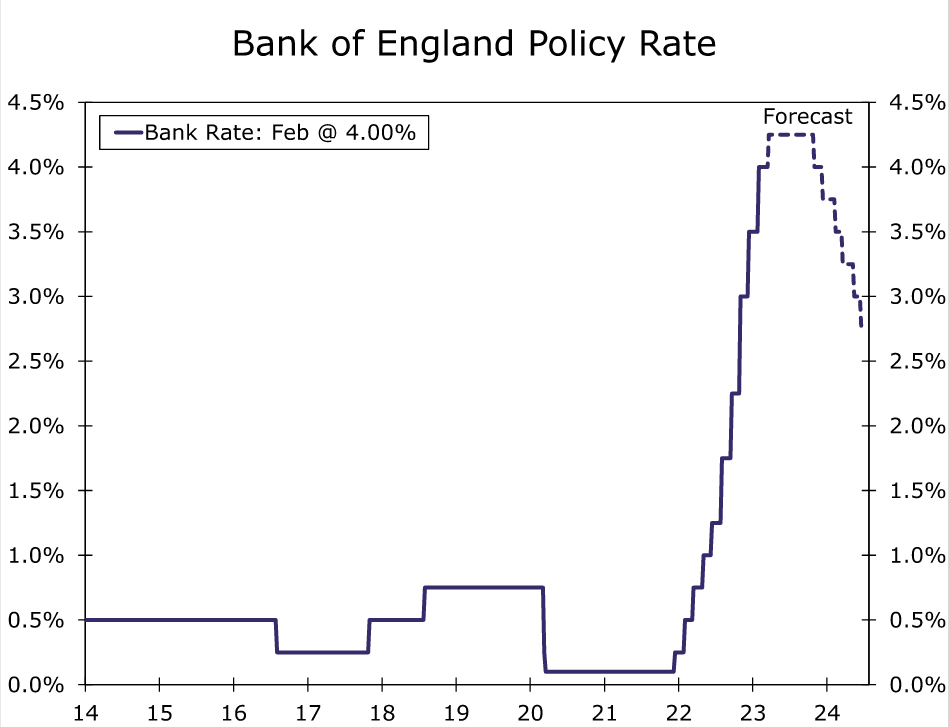
While there is admittedly some upside risk to our policy rate outlook, our forecast peak of 4.25% is still well below market implied interest rates, which currently envisage a peak near 4.75% by September this year. The less aggressive approach we envisage from the BoE is also an important reason we expect that, over the medium-term, the pound will be an underperformer against a broadly soft U.S. dollar. Even as the greenback is weighed down by eventual U.S. recession and aggressive Fed rate cuts beginning from early 2024, we forecast only modest gains in the GBP/USD exchange rate, targeting around $1.2200 by the end of 2023 and $1.2400 by mid-2024. We also anticipate some decline in U.K. government bond yields from current levels over time, and forecast the U.K. two and ten year yields at 2.75% and 2.90% respectively by the end of this year.
Technical Outlook and Review
USD/JPY:
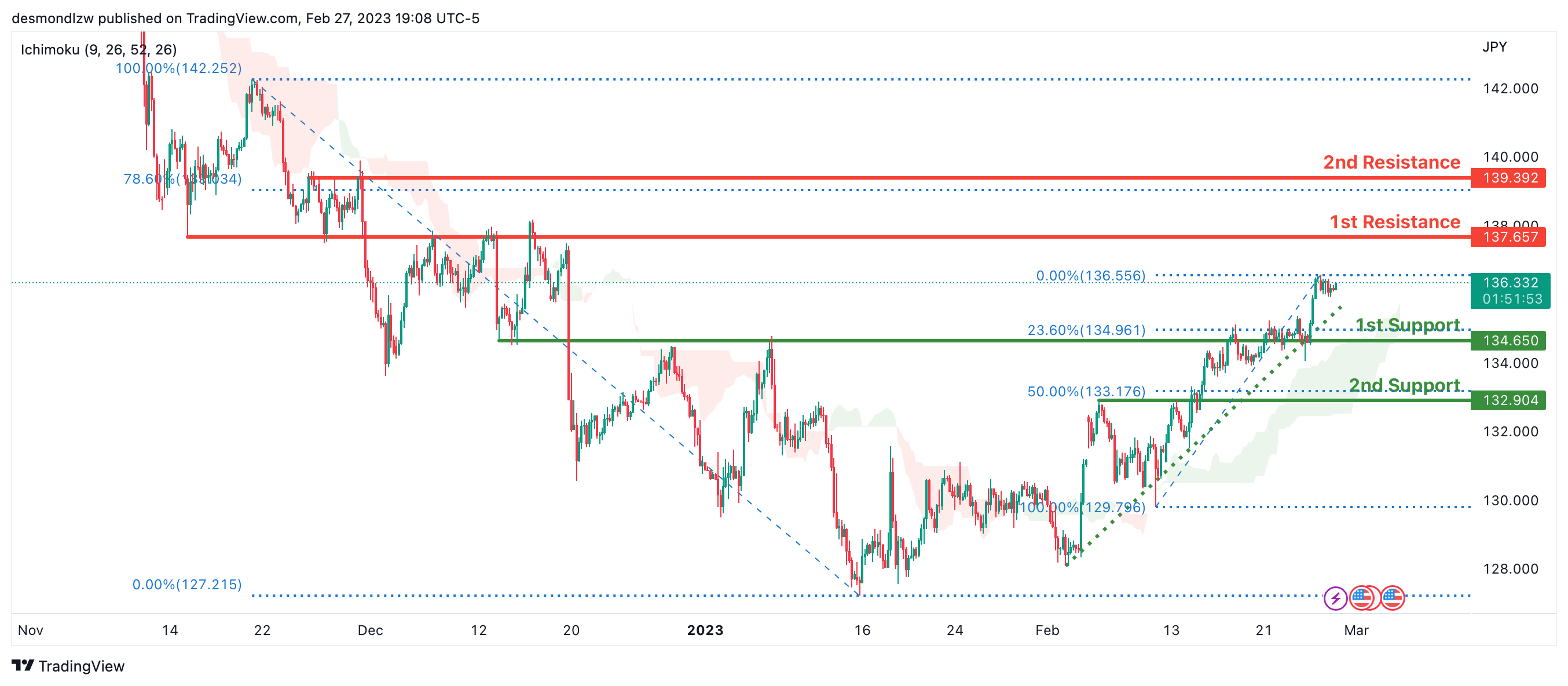
Looking at the H4 chart, my overall bias for USDJPY is bullish due to the current price being above the Ichimoku cloud, indicating a bullish market. To add confluence to this bias, price is also along an ascending trendline.If this bullish momentum continues, expect the price to continue heading towards the 1st resistance at 137.657, where the overlap resistance is.
In an alternate scenario, price could possibly head back down to retest the 1st support at 134.650, where the overlap support intersects with the 23.6% Fibonacci line.
Areas of consideration:
- H4 time frame, 1st resistance at 137.657
- H4 time frame, 1st support at 134.650
DXY:
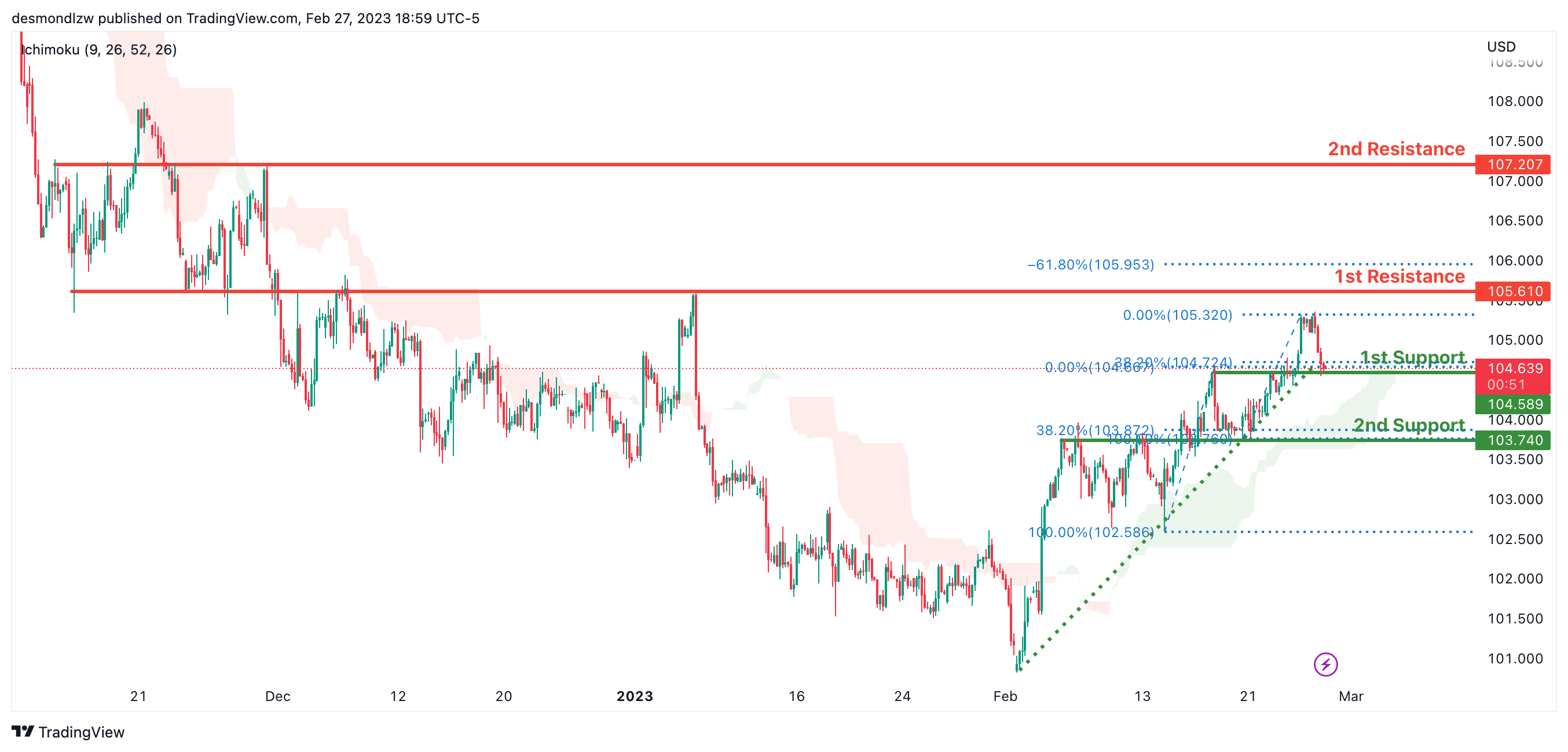
Looking at the H4 chart, my overall bias for DXY is bullish due to the current price crossing above the Ichimoku cloud, indicating a bullish market. To add confluence to this bias, price is also along an ascending trendline.If this bullish momentum continues, expect the price to possibly break the 1st resistance at 105.610, where the overlap resistance and 78.6% Fibonacci line is before heading towards the 2nd resistance at 107.207 which is the overlap resistance.
In an alternative scenario, price could head back down to break the 1st support at 104.667, where the overlap support and 38.2% Fibonacci line is before heading towards the 2nd support at 103.740, where the overlap support and 38.2% Fibonacci line is.
Areas of consideration:
- H4 time frame, 1st resistance at 105.610
- H4 time frame, 2nd resistance at 107.207
- H4 time frame, 1st support at 104.667
- H4 time frame, 2nd support at 103.740
EUR/USD:
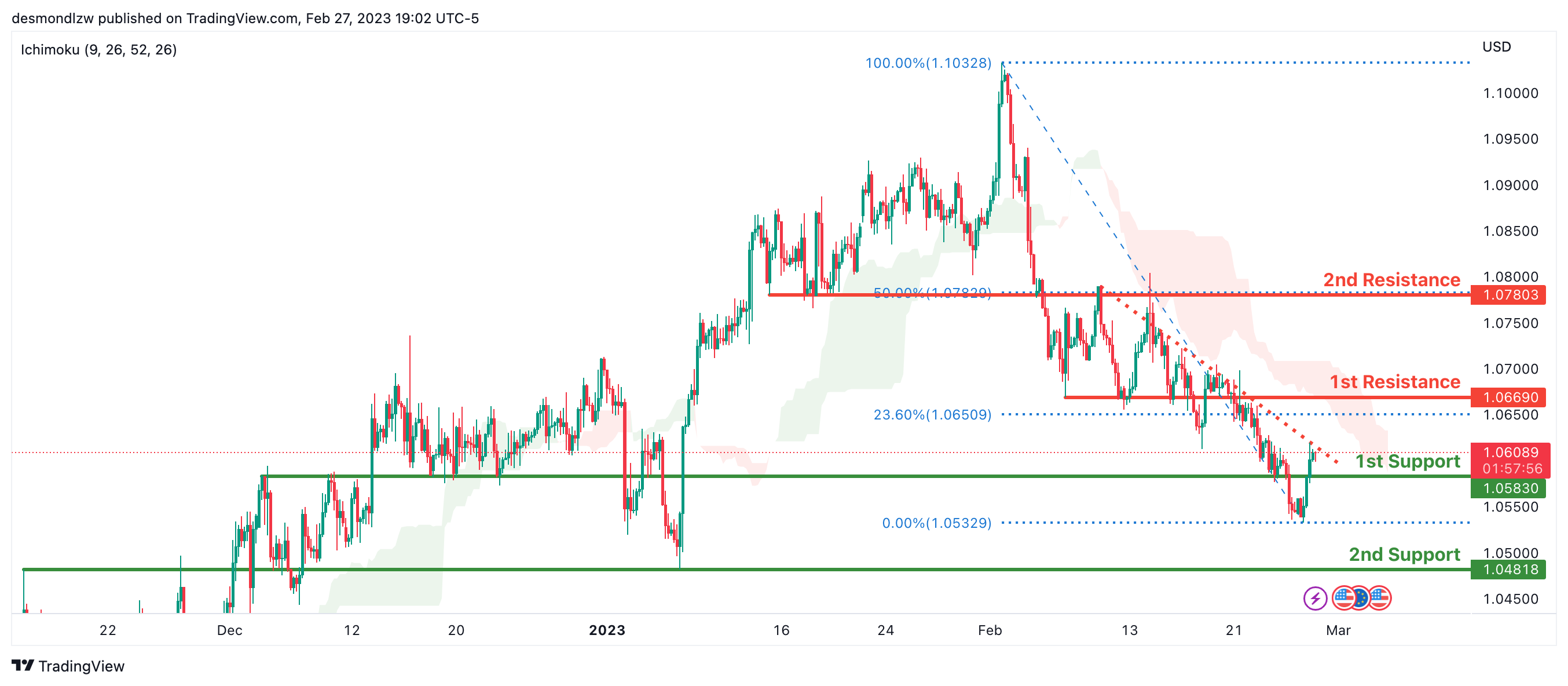
Looking at the H4 chart, my overall bias for EURUSD is bearish due to the current price crossing below the Ichimoku cloud, indicating a bearish market structure. To add confluence to this bias, price is also along a descending trendline.If this bearish momentum continues, expect the price to head towards the 1st support at 1.05830, where the overlap resistance is.
at 1.04818 which is the overlap support is.
In an alternate scenario, price could possibly head back up to retest the 1st resistance at 1.06690, where the overlap resistance and 23.6% Fibonacci line is.
Areas of consideration :
- H4 1st resistance at 1.05830
- H4 1st support at 1.04818
GBP/USD:
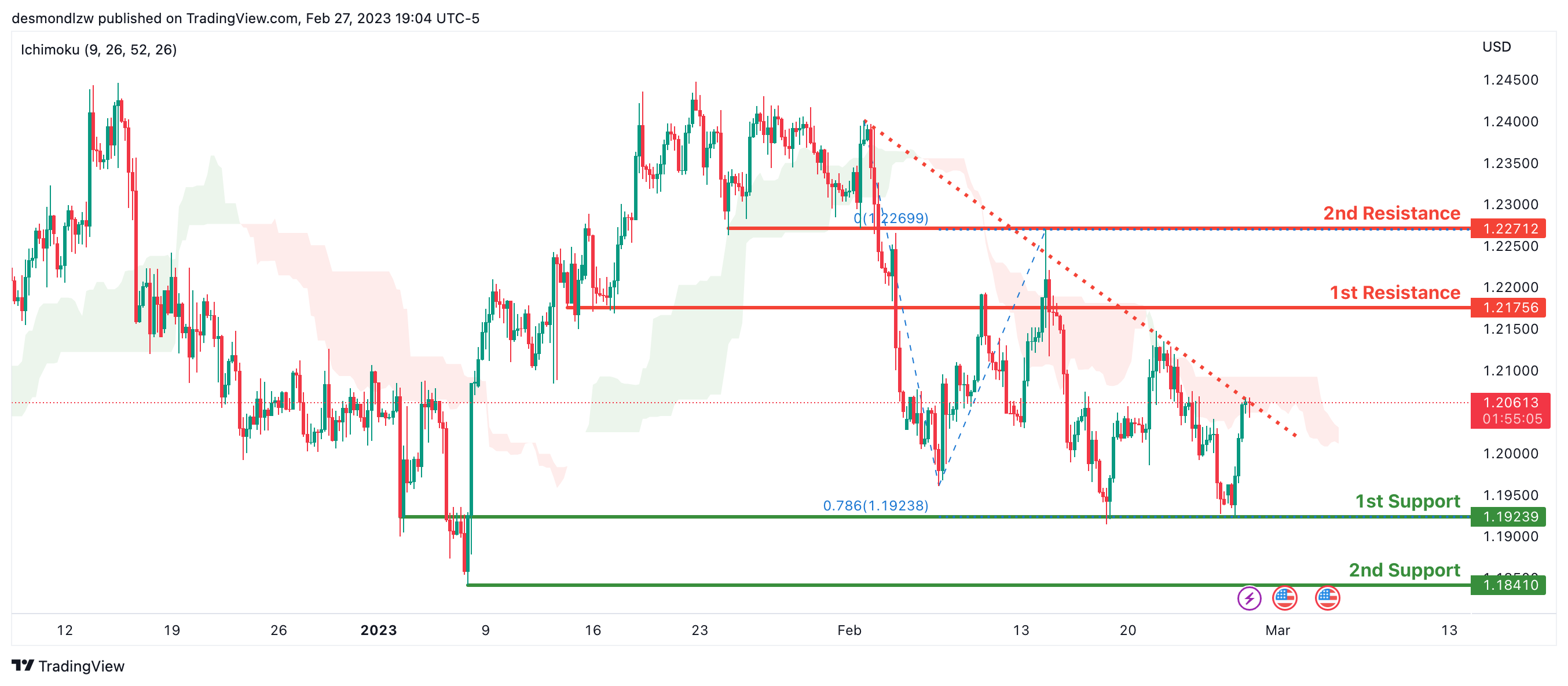
Looking at the H4 chart, my overall bias for GBPUSD is bearish due to the current price crossing below the Ichimoku cloud, indicating a bearish market. To add confluence to this bias, price is also along a descending trendline.If this bearish momentum continues, expect the price to head towards the 1st support at 1.19239, where the overlap support is.
In an alternate scenario, price could head back up to retest the 1st resistance line at 1.21756 where the overlap resistance is.
Areas of consideration:
- H4 1st resistance at 1.21756
- H4 1st support at 1.19239
USD/CHF:
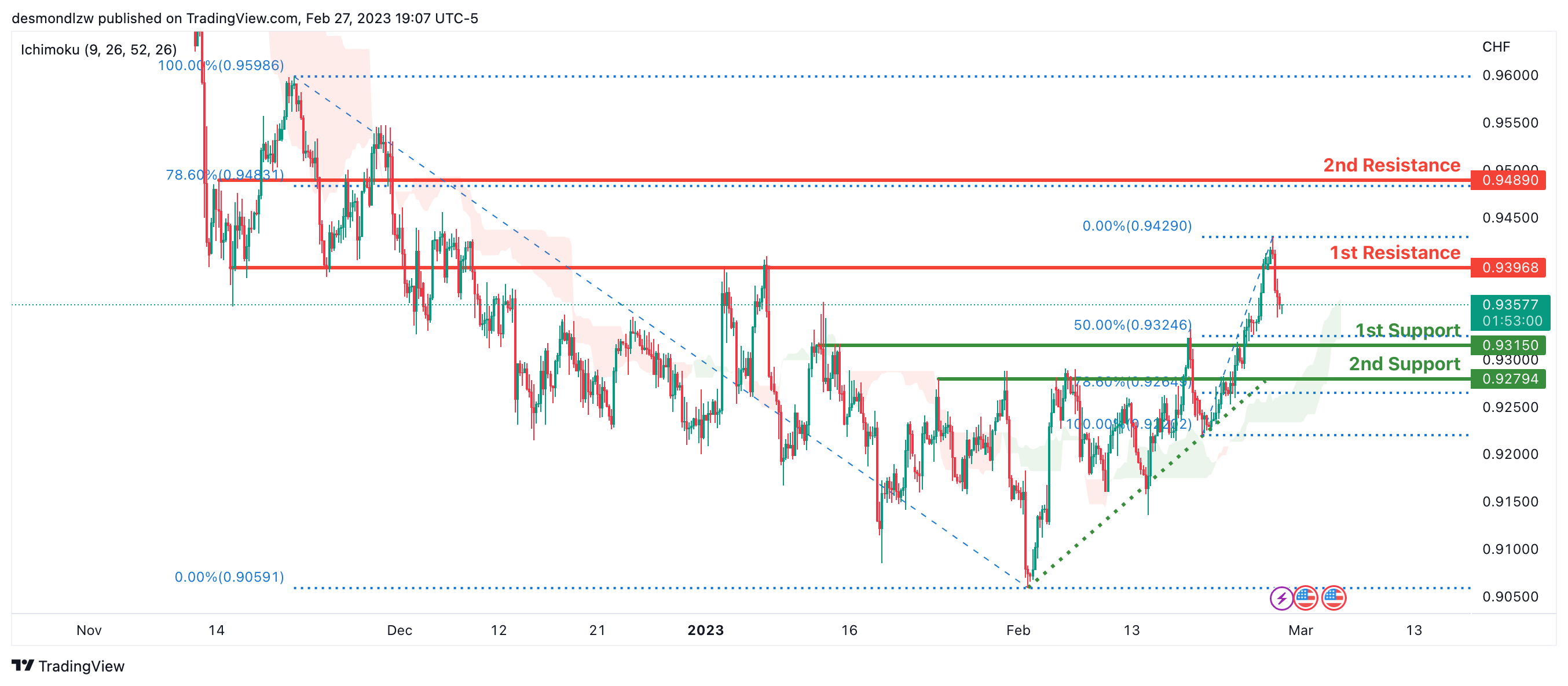
Looking at the H4 chart, my overall bias for USDCHF is bullish due to the current price being above the Ichimoku cloud, indicating a bullish market. To add confluence to this bias, price is also along an ascending trendline.If the current bullish trend continues, expect the price to possibly continue heading towards the 1st resistance at 0.93968 where the overlap resistance is.In an alternative scenario, price could possibly head back down to retest the 1st support at 0.93150, where the overlap support and 50% Fibonacci line is
Areas of consideration
- H4 1st support at 0.93150
- H4 1st resistance at 0.93968
XAU/USD (GOLD):
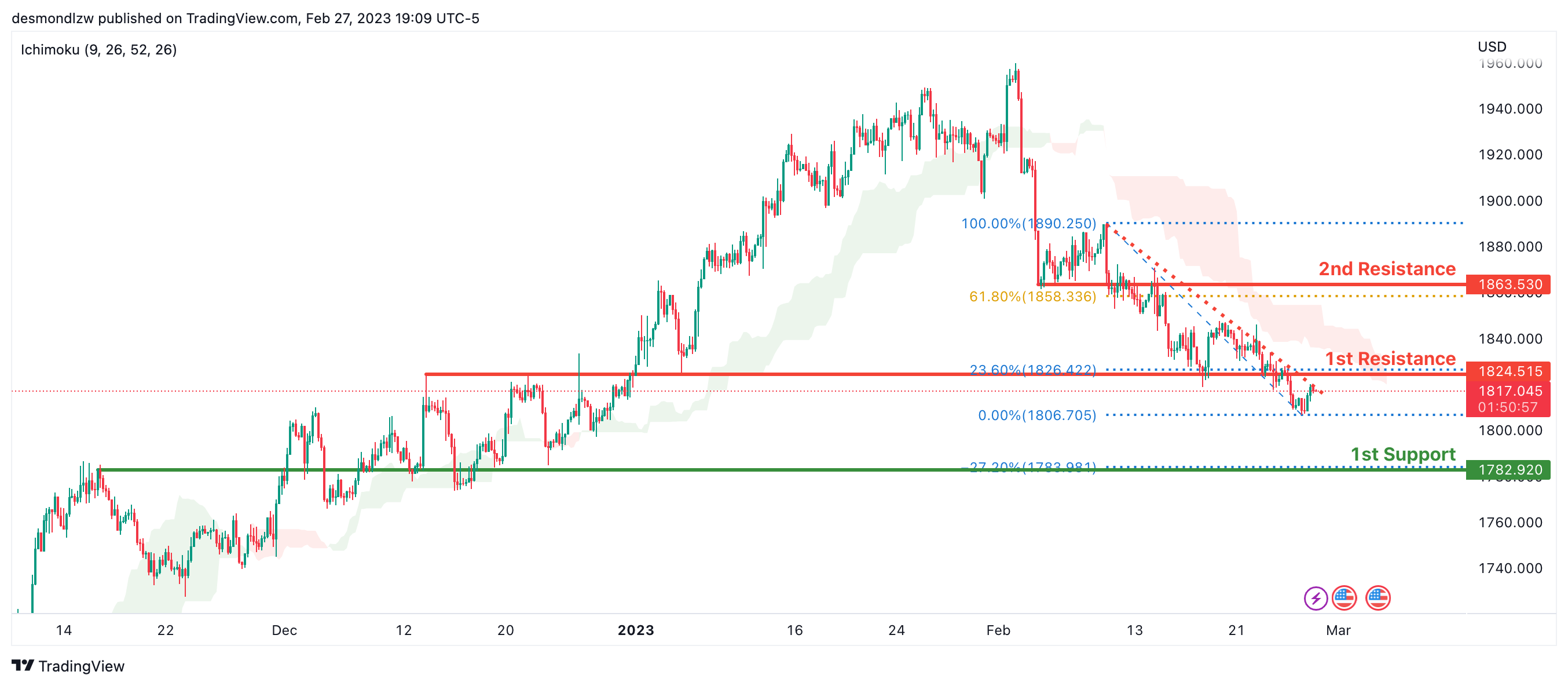
Looking at the H4 chart, my overall bias for XAUUSD is bearish due to the current price being below the Ichimoku cloud, indicating a bearish market. To add confluence to this bias, price is also along a descending trendline.If this bearish momentum continues, expect the price to possibly continue heading towards the 1st support at 1782.920 where the overlap support intersects with the -27.2% Fibonacci expansion line.
In an alternative scenario, price could possibly head back up to retest the 1st resistance at 1824.515 where the overlap resistance and 23.6% Fibonacci line is
Areas of consideration:
- H4 time frame, 1st resistance at 1824.515
- H4 time frame, 1st support at 1782.920
AUD/USD:
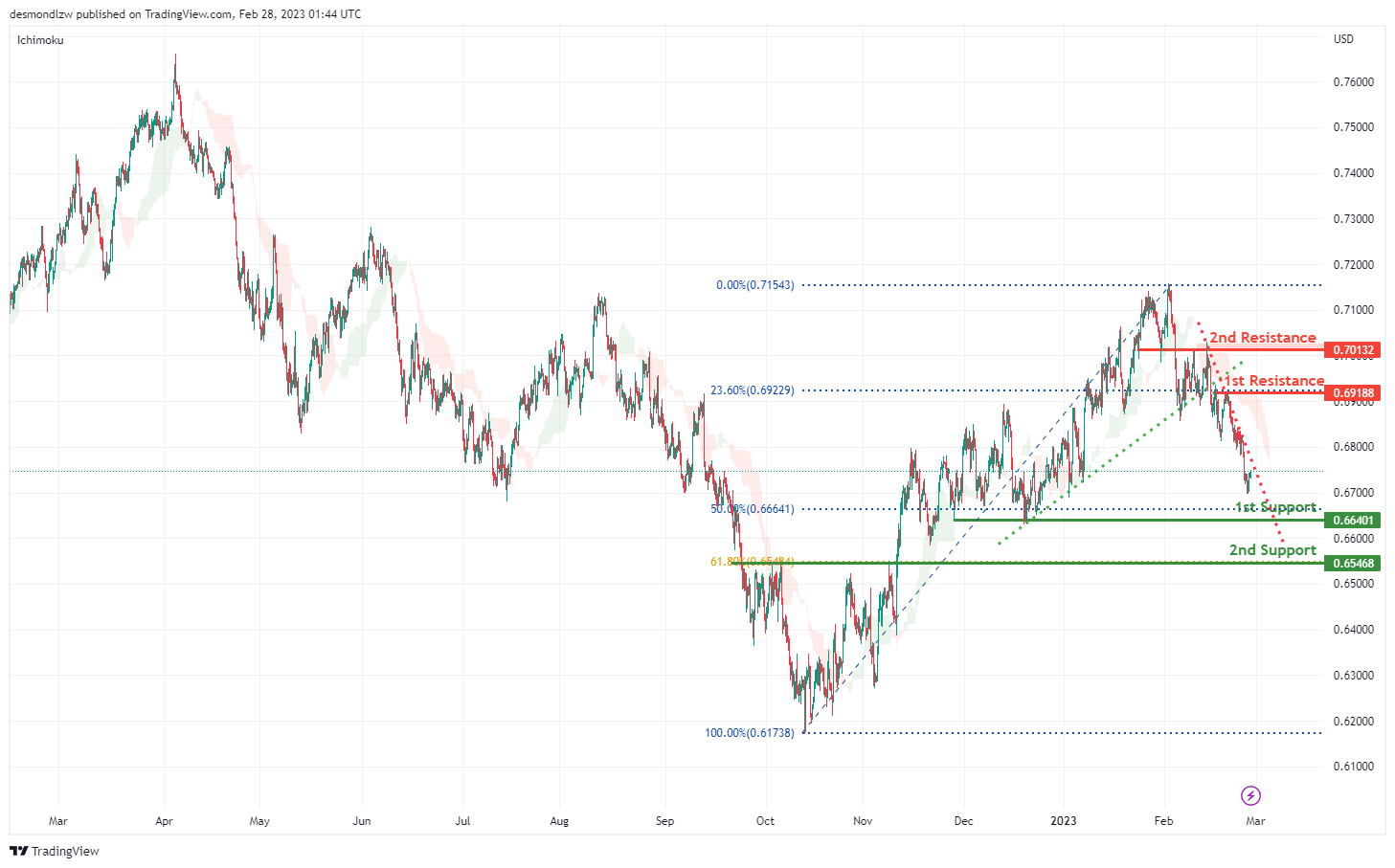
Looking at the H4 chart, my overall bias for AUDUSD is bearish due to the current price being below the Ichimoku cloud, and the price has broken the ascending trend line,a downward trend line has been created, indicating a bearish market.
The price could possibly godown towards the 1st support level at 0.66401 which is the recent overlap swing low. There is 2nd support at 0.65468 where the 61.8 % Fibonacci line are.
In an alternate scenario, The price could possibly go up towards the 1st resistance level at 0.69188 which is the recent overlap swing high, There is 2nd resistance at 0.70132 which is in line with the 23.6% Fibonacci retracement.
Areas of consideration
- H4. 2nd resistance at 0.70132
- H4. 1st resistance at 0.69188
- H4, 1st support at 0.66401
- H4, 2nd support at 0.65468
NZD/USD:
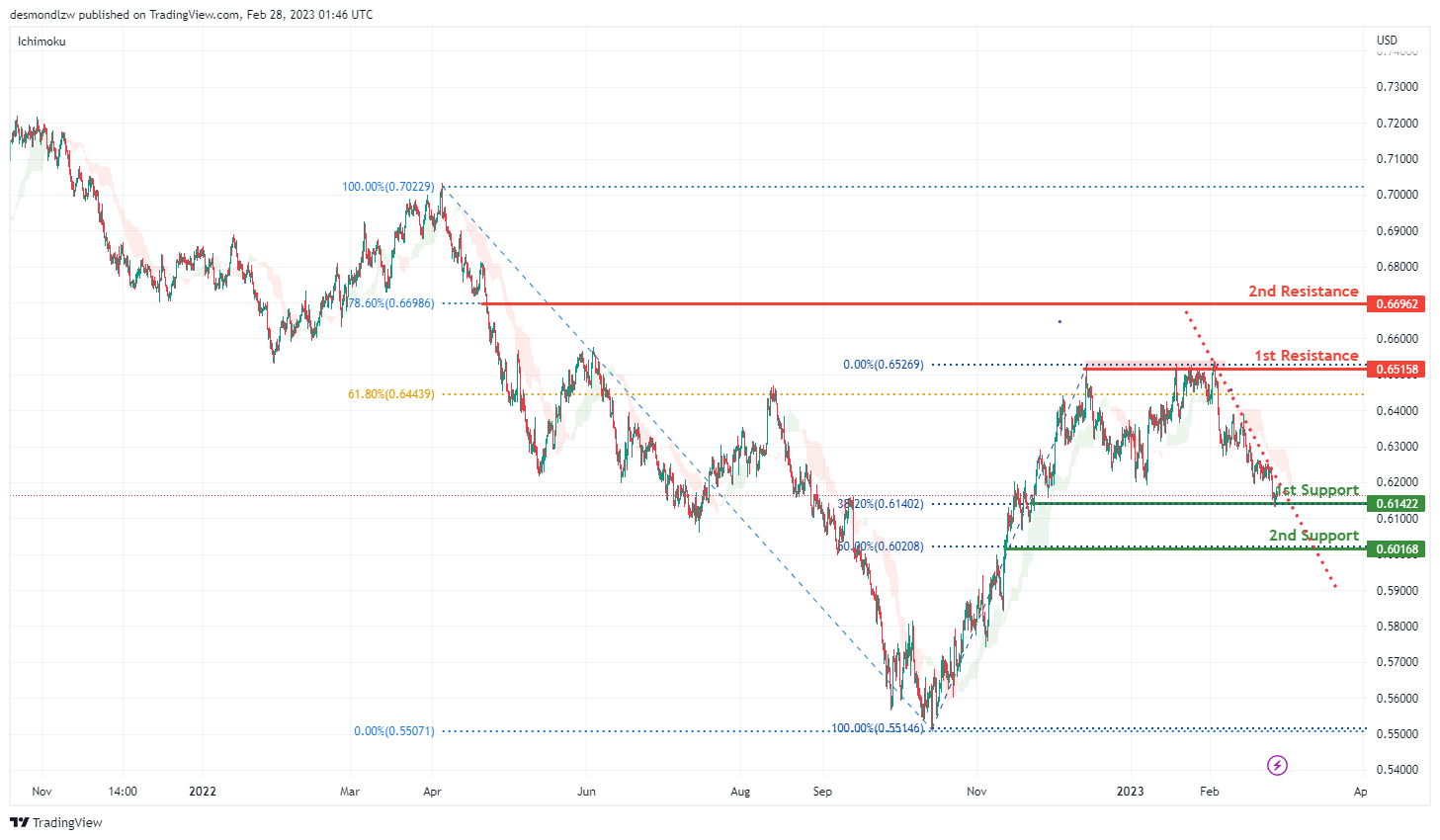
Looking at the H4 chart, my overall bias for NZDUSD is bearish, as the current price is below the Ichimoku Cloud. A descending trend line has been created, indicating a bearish market. Expecting the price go down towards the 1st support at 0.61422 where the overlap swing low and 38.2% Fibonacci line are. The 2nd support is at 0.60168 where the 50% Fibonacci line is.
In an alternate scenario, price could possibly go up towards the 1st resistance level at 0.65158 which is the recent overlap swing high. There is a 2nd resistance at 0.66962 where the 78.6% Fibonacci line is.
Areas of consideration:
- H4 time frame, 2nd resistance at 0.66962
- H4 time frame, 1st resistance at 0.65158
- H4 time frame, 1st support at 0.61422
- H4 time frame, 2nd support at 0.60168
USD/CAD:
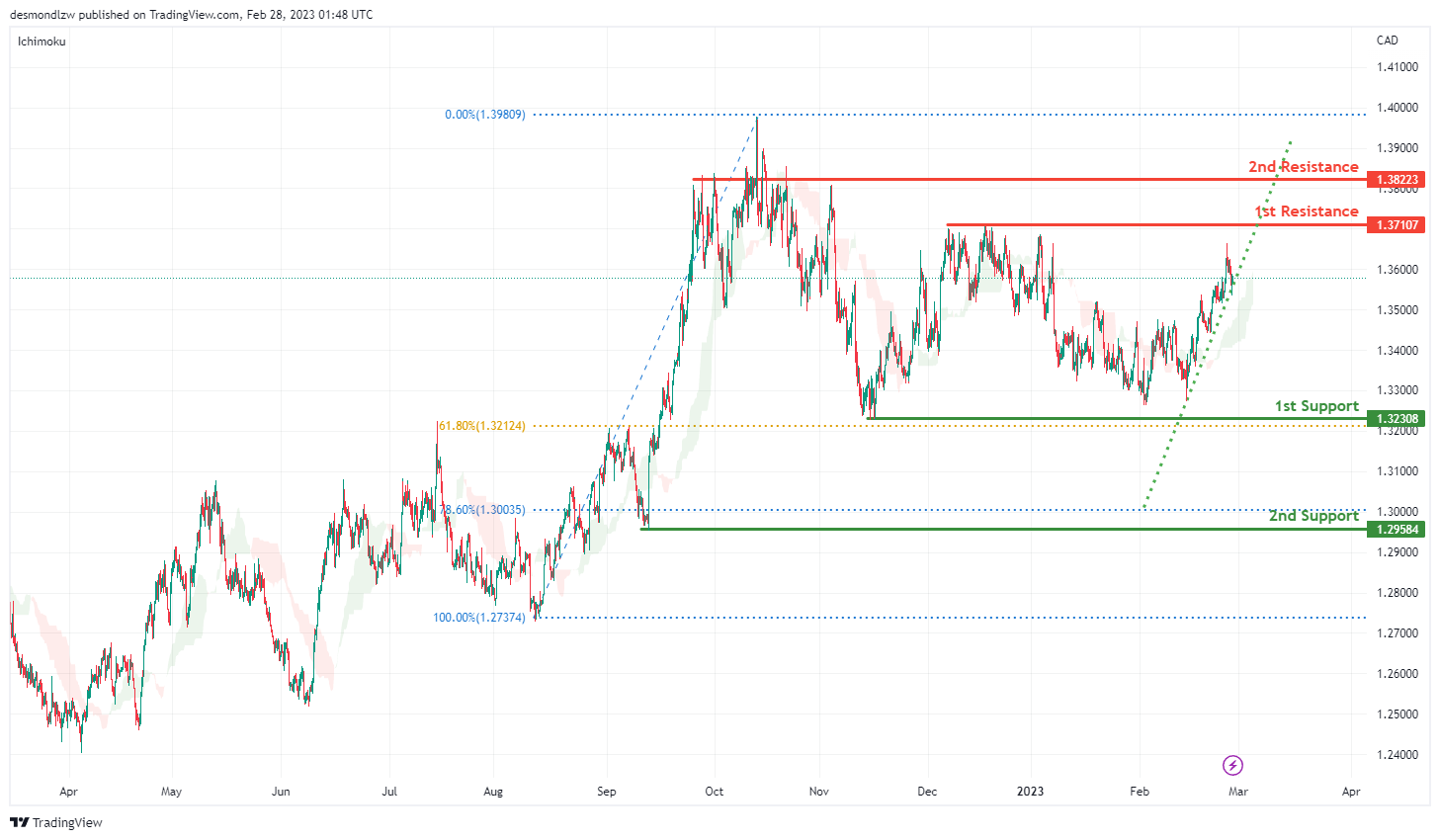
Looking at the H4 chart, my overall bias for USDCAD is bullish , as the current price is above the Ichimoku cloud. An ascending trend line has been created, indicating a bullish market. Expecting the current price to possibly break the 1st resistance at 1.37107 which is the overlap of the recent swing high, before it heads to the 2nd resistance at 1.38223 which is the previous swing high.
In an alternative scenario, the price could possibly drop to the 1st support at 1.32308 which is the previous swing low and also in line with the 61.8% Fibonacci retracement. The 2nd support is at 1.29584 where the 78.6% Fibonacci line is .
Areas of consideration:
- H4 time frame, 2nd resistance at 1.38223
- H4 time frame, 1st resistance at 1.37107
- H4 time frame, 1st support at 1.32308
- H4 time frame, 2nd support at 1.29584
OIL:
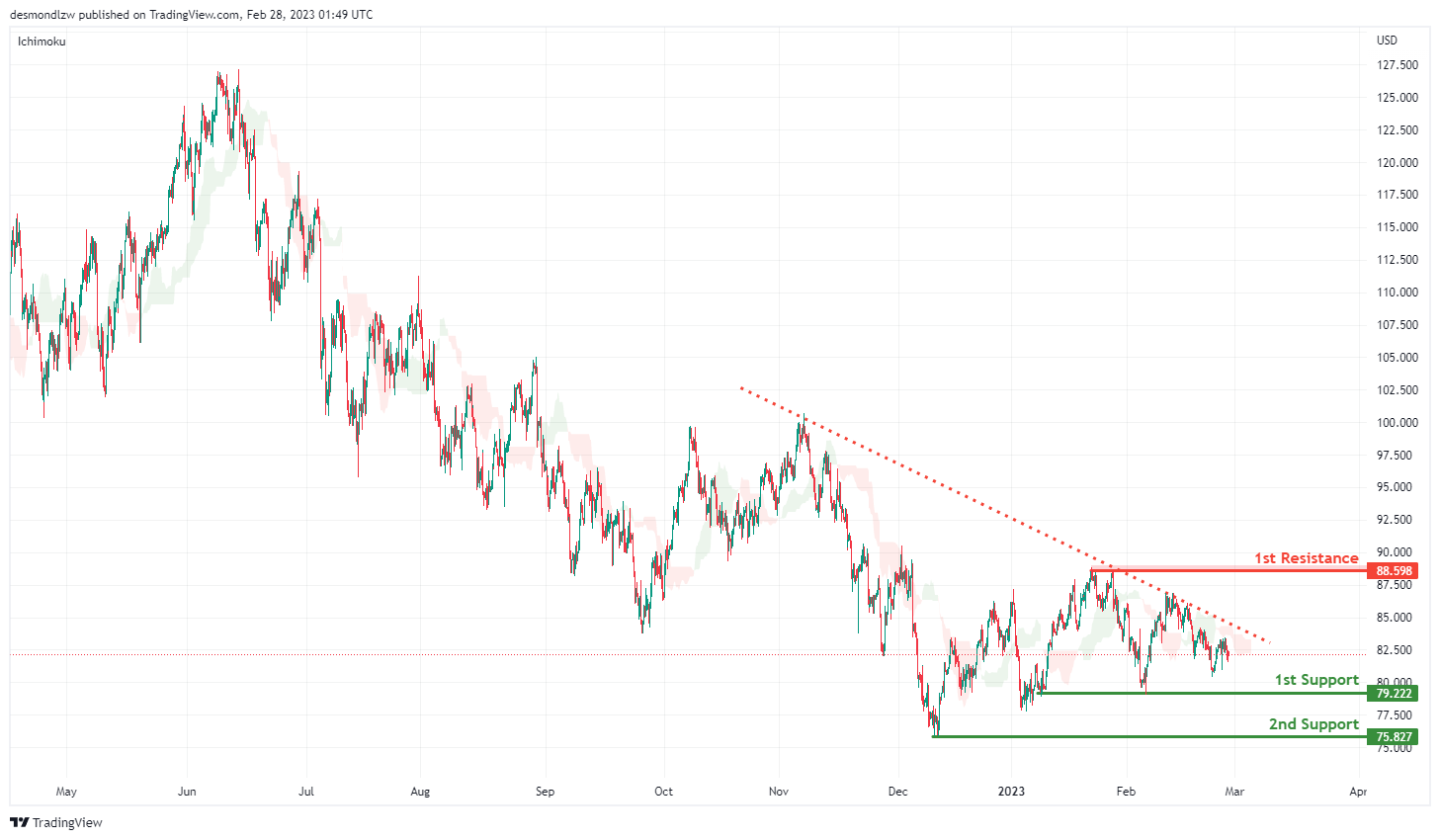
Looking at the H4 chart, my overall bias for BOC is bearish as the current price is below the Ichimoku cloud, and there is an descending trend line. Expecting the price to head down towards the 1st support level at 79.222 which is the recent overlap swing low, before the price drops to the 2nd support at 75.827.
In an alternate scenario, the price could possibly head up towards the 1st resistance level at 88.598 which is the recent swing high.
Areas of consideration:
- H4 time frame, 1st resistance at 88.598
- H4 time frame,1st support at 79.222
- H4 time frame, 2nd support at 75.827
Dow Jones Industrial Average:
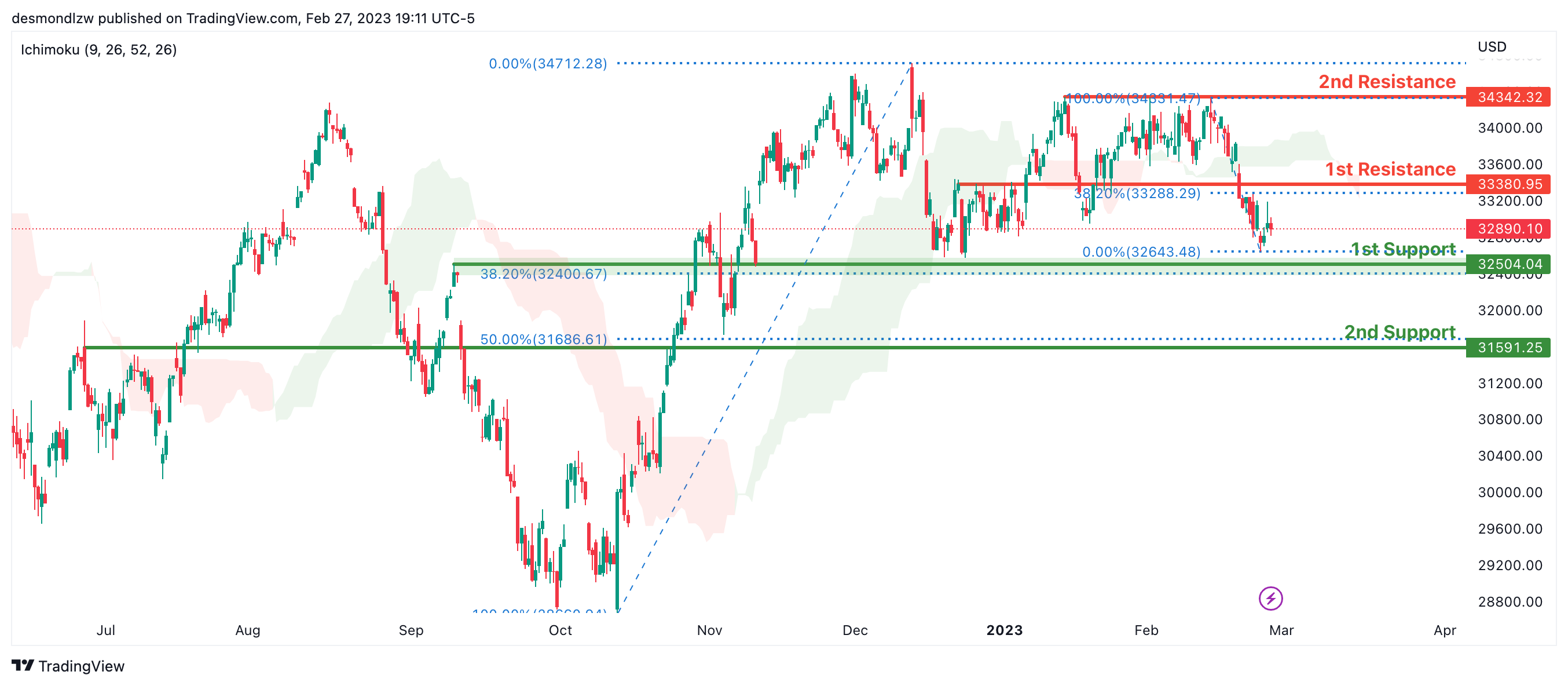
On the H4 chart, the overall bias for DJI is bearish. To add confluence to this, the price is crossing below the Ichimoku cloud which indicates a bearish market.If this bearish momentum continues, expect the price to possibly continue heading towards the 1st support at 32504.04, where the 38.2% Fibonacci line and overlap support is.In an alternative scenario, price could possibly head back up towards the 1st resistance at 33380.95, where the 23.6% Fibonacci line is.
Areas of consideration:
- H4 time frame, 1st support at 32504.04
- H4 time frame, 1st Resistance at 33380.95
DAX:
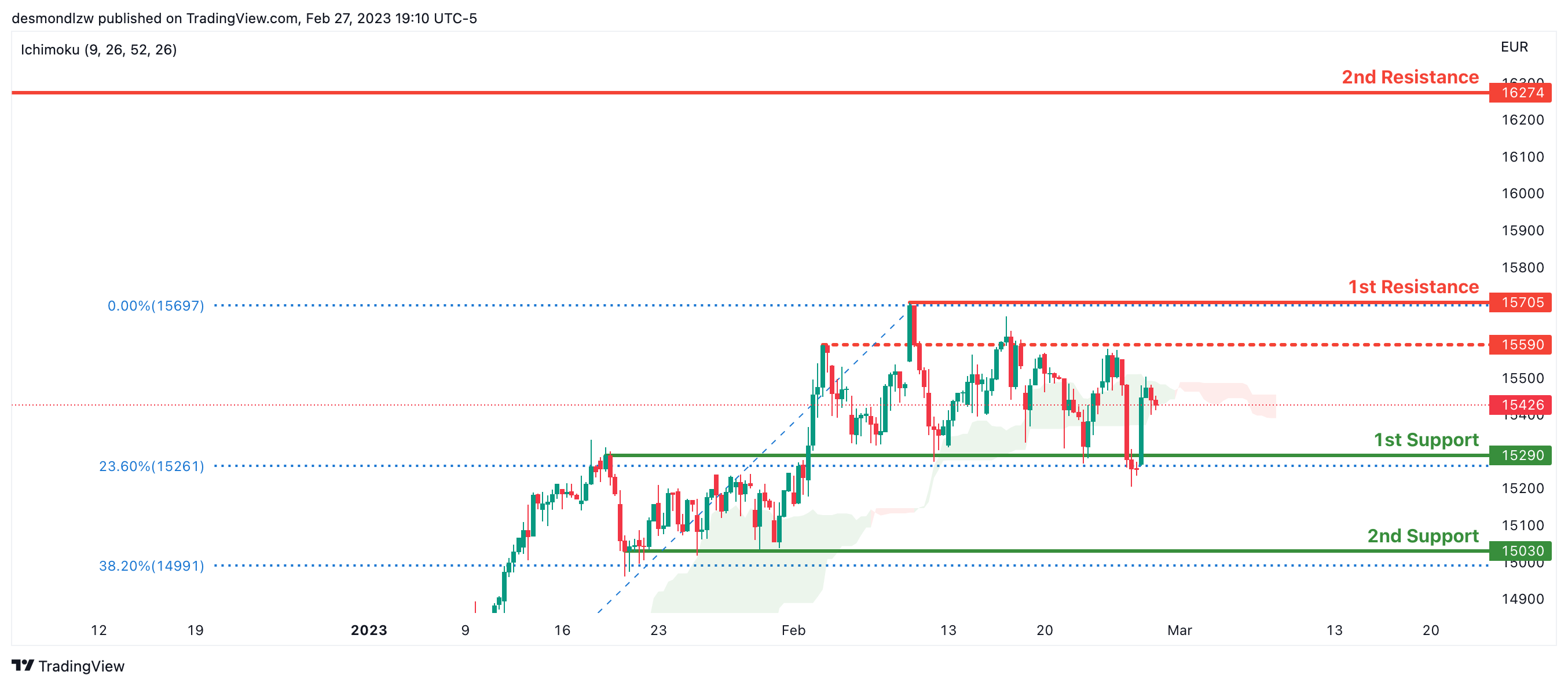
Looking at the H4 chart, my overall bias for DAX is bullish. However price has crossed below the Ichimoku cloud which indicates a possible shift to bearish market structure.If this bearish momentum continues, expect the price to possibly head towards the 1st support line at 15290, where the overlap support intersects with the 23.6% Fibonacci line.In an alternative scenario, price could possibly head up to retest the 1st resistance at 15705 where the recent high is.
Areas of consideration:
- H4 time frame, 1st resistance is at 15705
- H4 time frame, 1st support is at 15290
ETHUSD:
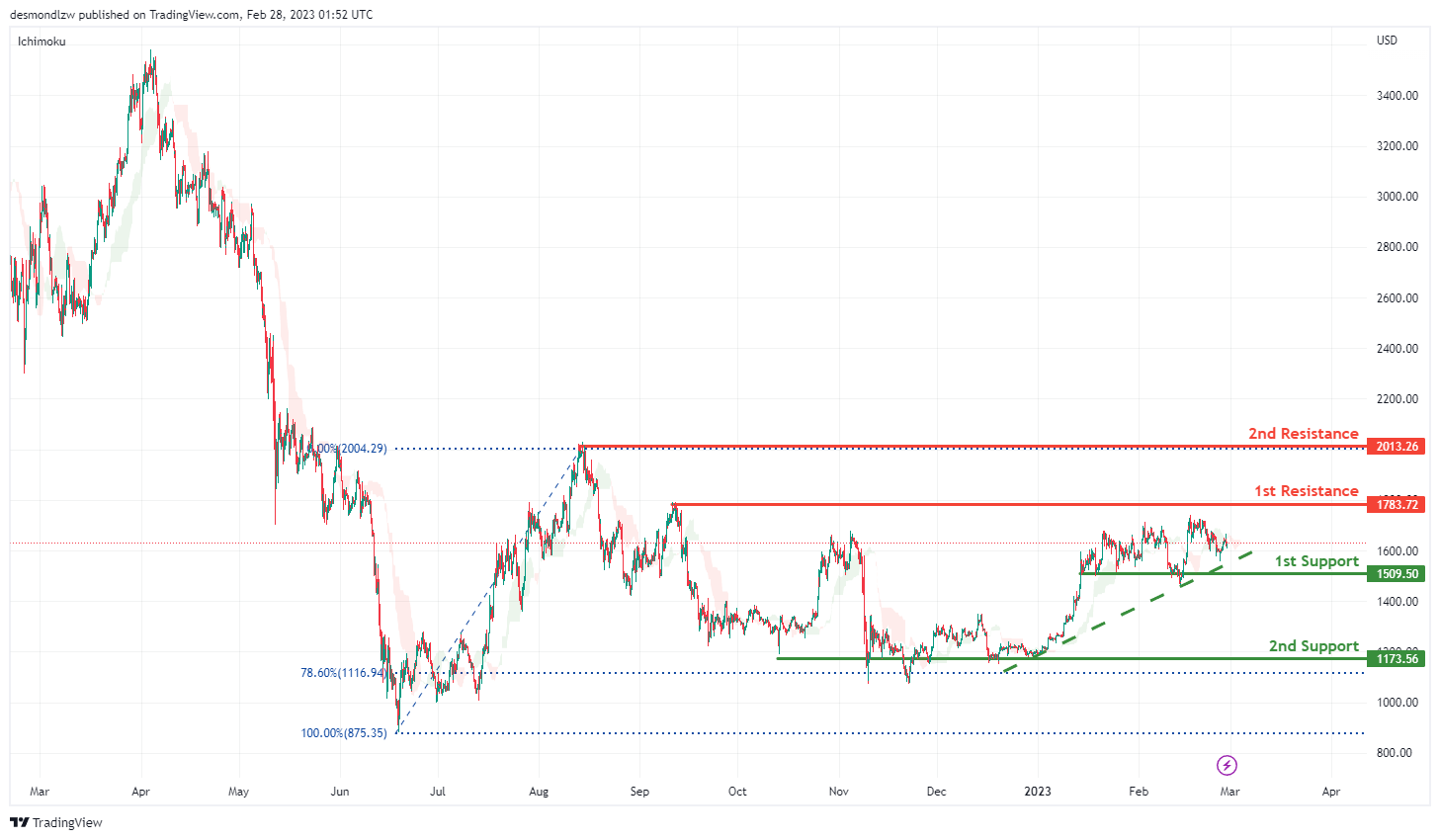
Looking at the H4 chart, my overall bias for ETHUSD is slightly bearish, even though there is a strong ascending trend line, the price may head back to retest the 1st support that intersects with the ascending trend line, before it goes up and break the 1st resistance line at 1783.72 before breaking the 2nd resistance line at 2013.26 which is the previous swing high.
In an alternate scenario, the price may retrace back to the 1st support line at 1509.50 which is the recent overlap support before it heads towards the 2nd support at 1173.56 which is in line with 78.6% Fibonacci retracement.
Areas of consideration:
- H4 time frame, 2nd resistance of 2013.26
- H4 time frame, 1st resistance of 1783.72
- H4 time frame, 1st support at 1509.50
- H4 time frame, 2nd support at 1173.56
BTCUSD:
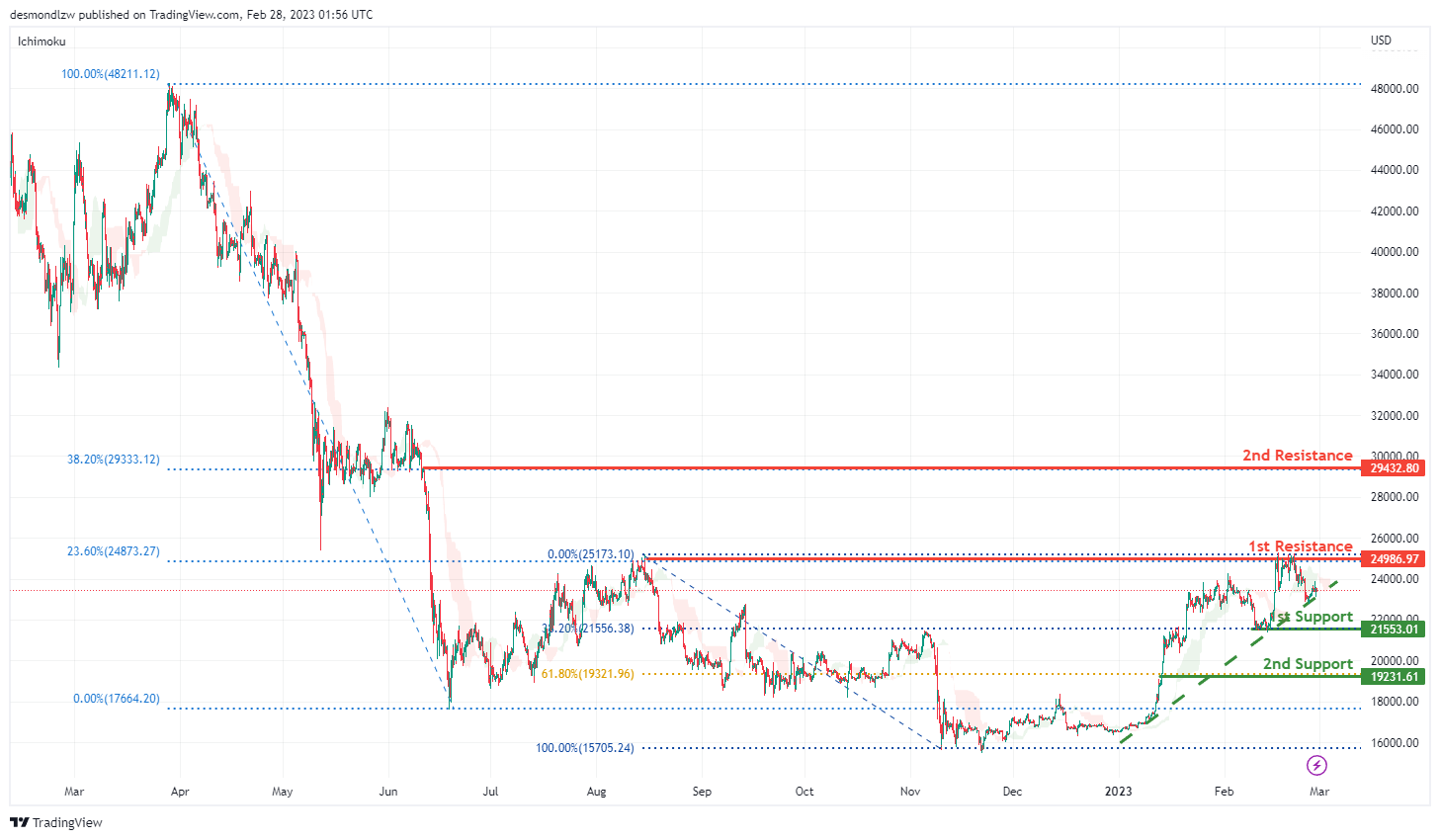
Looking at the H4 chart, my overall bias for BTCUSD is bullish. As there is an ascending trend line, expect the price may head back to retest an the ascending trend line, before it goes up and break the 1st resistance at 24986.97 which is the overlap recent swing high, before it head up to the 2nd resistance 29432.80 where the 38.2% Fibonacci retracement is.
In an alternate scenario, The price may go down towards the 1st support line at 21553.01 which is in line with 38.2% Fibonacci retracement, before heading down towards the 2nd support at 19231.61 which is in line with 61.8% Fibonacci retracement.
Areas of consideration:
- H4 time frame, 2nd resistance 29432.80
- H4 time frame, 1st resistance 24986.97
- H4 time frame, 1st support at 21553.01
- H4 time frame, 2nd support at 19231.61
S&P 500:
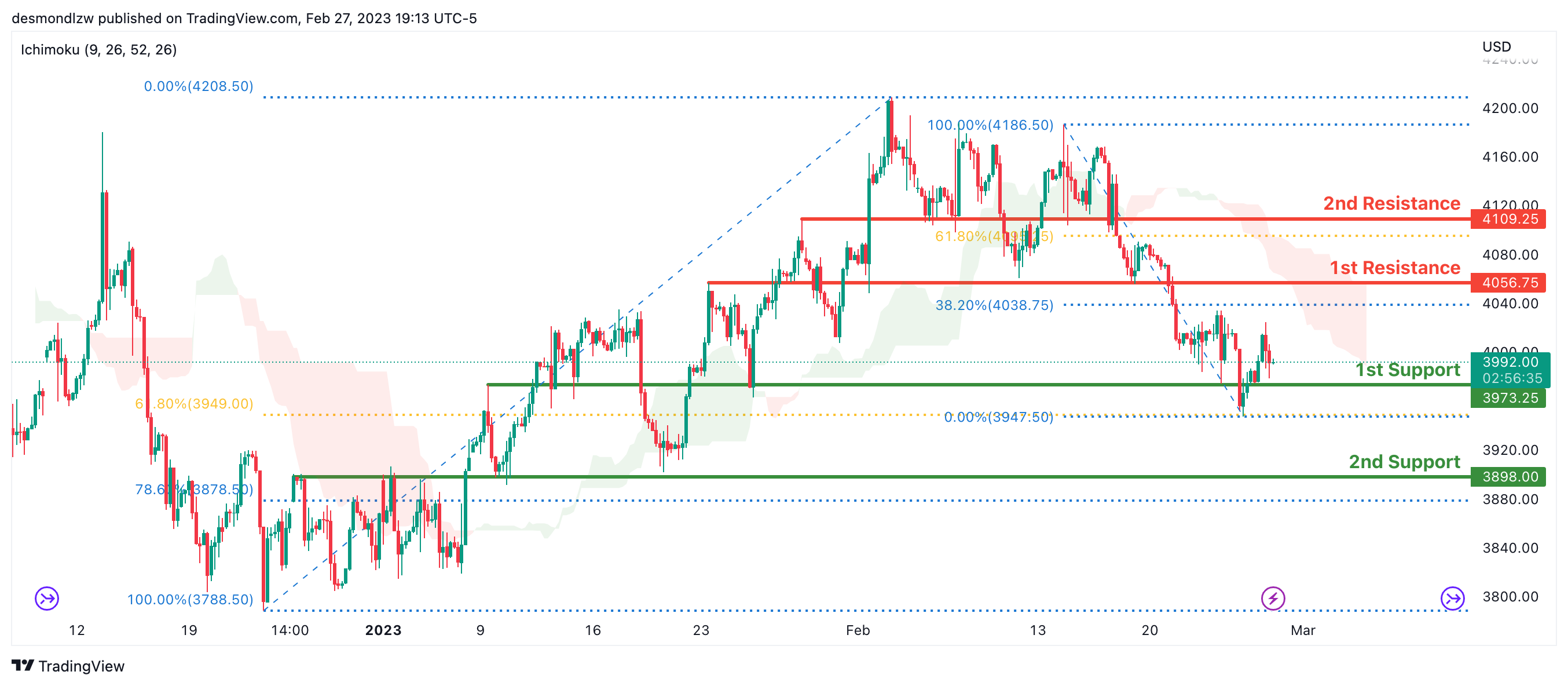
Looking at the H4 chart, my overall bias for S&P500 is bearish due to the current price being below the Ichimoku cloud, indicating a bearish market.If this bearish momentum continues, expect the price to continue heading towards the 1st support at 3973.25 where the overlap support intersects with the 61.8% Fibonacci line.
In an alternative scenario, price could possibly head back up to retest the 1st resistance at 4056.75 which is the overlap resistance and 38.2% Fibonacci line is.
Areas of consideration:
- H4 time frame, 1st support at 3973.25
- H4 time frame, 1st resistance at 4056.75
Australia retail sales rose 1.9% mom in Jan, flat on average over the past few months
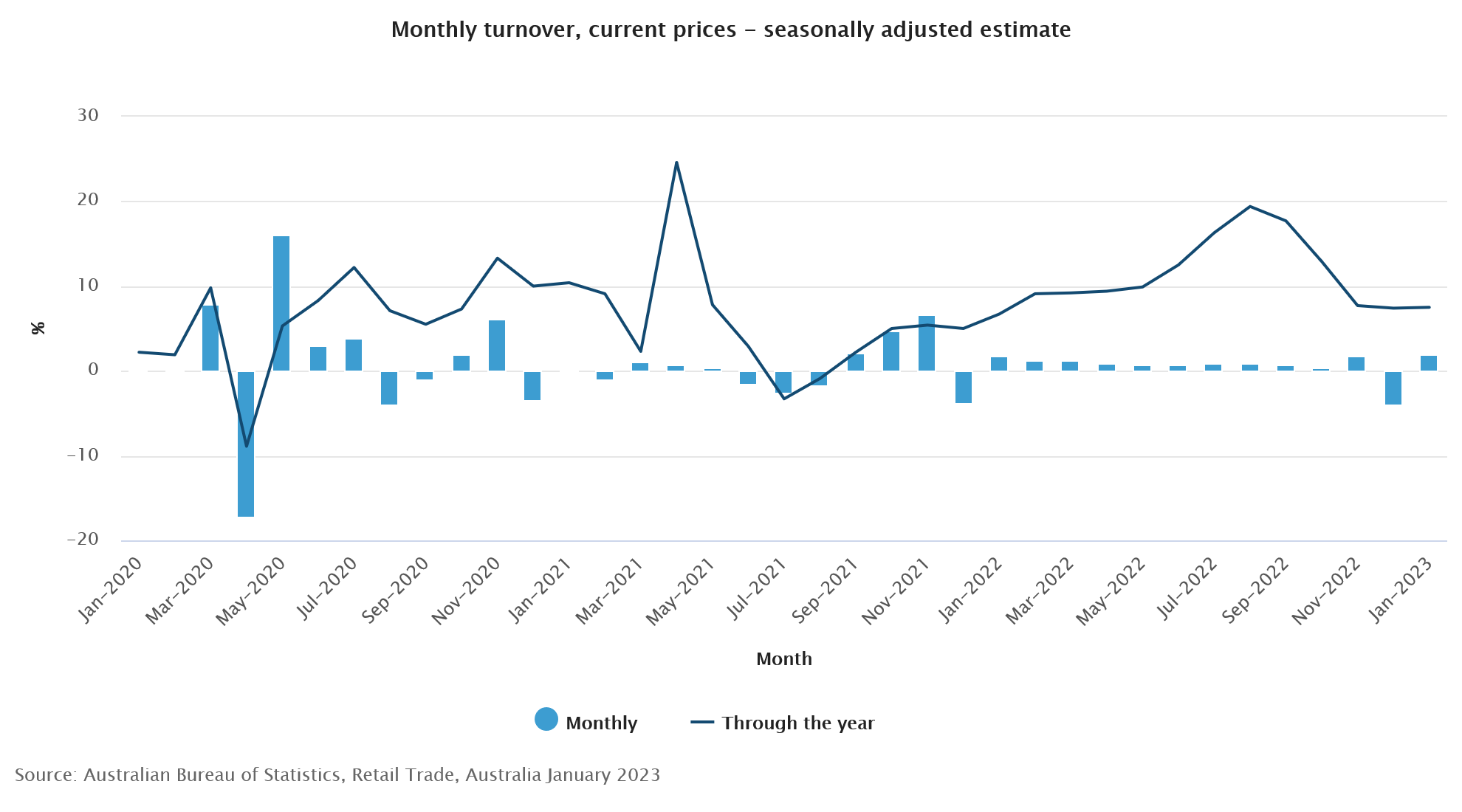
Australia retail sales turnover rose 1.9% mom to AUD 35.09B in January, above expectation of 1.6% mom. Compared with January 2022, sales turnover was up 7.5% yoy.
Ben Dorber, ABS head of retail statistics, said: "The rebound in retail turnover in January followed a substantial fall of 4.0 per cent in December and a large rise of 1.7 per cent in November.
"Looking through this volatility shows that turnover is at a similar level to September 2022, and on average, growth has been flat over the past few months."
NZ ANZ business confidence rose to -43.3, firms wary but getting on with the job
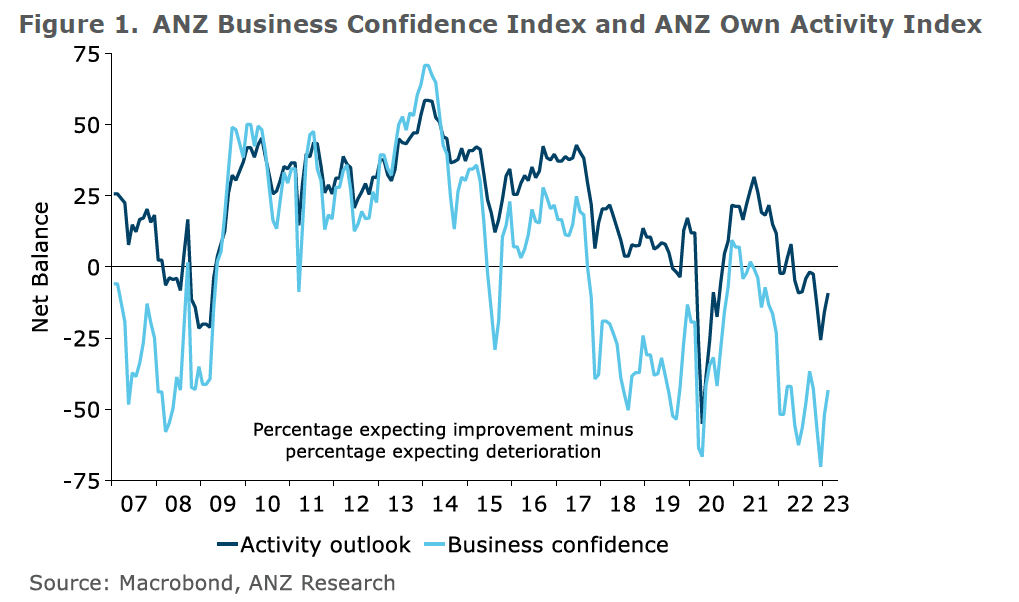
New Zealand ANZ Business Confidence improved form -52.0 to -43.3 in February. Own Activity Outlook rose from -15.8 to -9.2.
Looking at some details, export intentions ticked up from -5.4 to -5.2. Investment intentions rose from -13.7 to -4.9. Employment intentions jumped from -11.1 to -3.4. Pricing intentions dropped from 62.4 to 58.8. Cost expectations dropped from 91.3 to 88.3. Inflation expectations ticked down from 5.99 to 5.94.
ANZ said: "The shock value of the November Monetary Policy Statement appears to have faded into the rear-vision mirror as firms focus on the risks and opportunities that are front and centre.... Opportunity is clearly still knocking. That said, the level of most indicators remain subdued – firms are still very wary, and understandably so. But they are getting on with the job."
Japan industrial production down -4.6% mom in Jan, expected to rebound in Feb
Japan industrial production declined -4.6% mom in January, much worse than expectation of -2.6% mom.
Upon the release of the data, the METI downgraded its assessment of industrial production, saying that it has weakened. Never the less, the ministry forecast industrial production to bounce back by 8.0% in February, and then a further 0.7% in March.
Retail sales rose 6.3% yoy, above expectation of 4.0% yoy.
BoJ Uchida: Shouldn’t modify easy policy just because there are side-effects
Incoming BoJ Deputy Governor Shinichi Uchida told an upper house confirmation hearing, "BOJ must maintain monetary easing. It shouldn't modify easy policy just because there are side-effects. Rather, it must come up with ideas" to mitigate the costs and help sustain stimulus.
He also noted it's premature to discuss an exit from the ultra-loose monetary policy. Any exit would involve adjustments in the interest targets and the balance sheet. "In what order and at what timing the BOJ will make these adjustments will depend on economic and financial developments at the time," Uchida said.
BoJ Wakatabe: Dangers of secular stagnation and Japanification not yet passed
BoJ Deputy Governor Masazumi Wakatabe said, "the mild-inflation regime has not come to an end, and we should say that the potential dangers of secular stagnation and Japanification have not yet passed."
"When an exogenous shock occurs, there is an adjustment from the old to a new price system. After adjustment, the rising inflation rate is likely to return to the steady-state inflation rate," he said.
"So the important point is how this rate is affected. Of course, it is possible that cost-push factors will remain, but whether they will push up the steady-state inflation rate is uncertain," Wakatabe said, adding that it was "well known that cost-push inflation does not last long."
ECB Vujcic: We should persevere if core inflation persists
ECB Governing Council member Boris Vujcic told Bloomberg TV yesterday, "as long as core (inflation) persists at the levels we're talking about and this is significantly higher than our rates are and significantly higher than where are target is, we should persevere."
The markets have been raising their bets on higher interest rates and are betting tightening extending into 2024. Vujcic said, "I think this repricing in a way is what we did during our last projections, where we projected basically higher inflation for longer, core inflation which turns out to be stickier than most people probably expected."
"Probably markets are now repricing and saying 'OK, we might see higher rates for maybe longer,'" he said.