Sample Category Title
USD/JPY Mid-Day Outlook
Daily Pivots: (S1) 134.87; (P) 135.69; (R1) 137.33; More...
Intraday bias in USD/JPY remains on the upside with focus on 38.2% retracement of 151.93 to 127.20 at 136.64. Rejection by this fibonacci level, followed by break of 134.04 support, will argue that such rebound from 127.20 has completed, and turn bias back to the downside. However, sustained trading above 136.64 will indicate that fall from 151.93 has completed, and bring further rally to 61.8% retracement at 142.48.
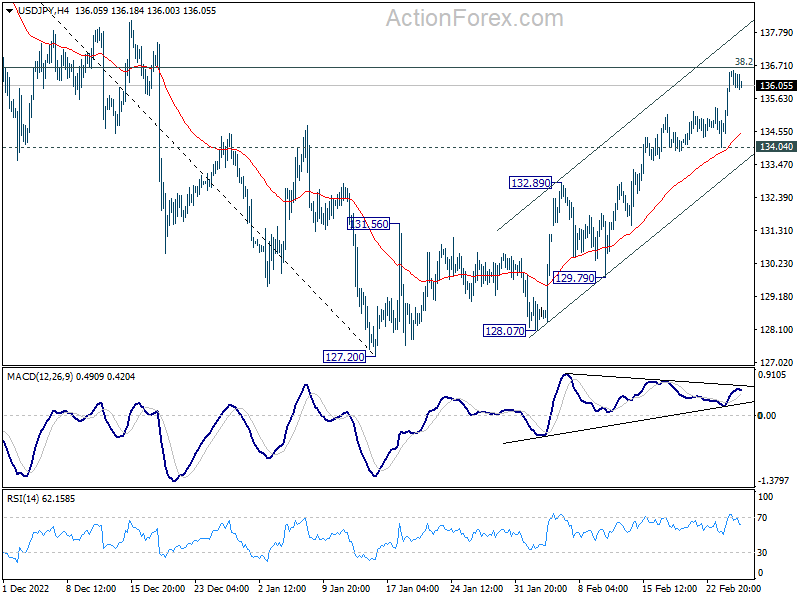
In the bigger picture, focus is now on 38.2% retracement of 151.93 to 127.20 at 136.64. Sustained break there will indicate that price actions from 151.93 medium term are merely a corrective pattern. Such development will maintain long term bullishness. Rejection by 136.64 will, on the downside, extend the fall from 151.93 to 61.8% retracement of 102.58 to 151.93 at 121.43 at a later stage.
USD/CHF Mid-Day Outlook
Daily Pivots: (S1) 0.9354; (P) 0.9383; (R1) 0.9441; More...
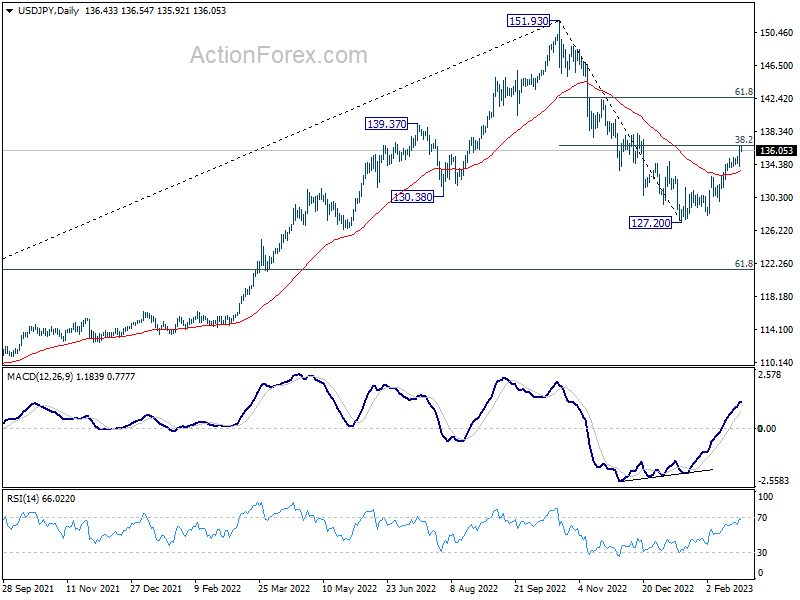
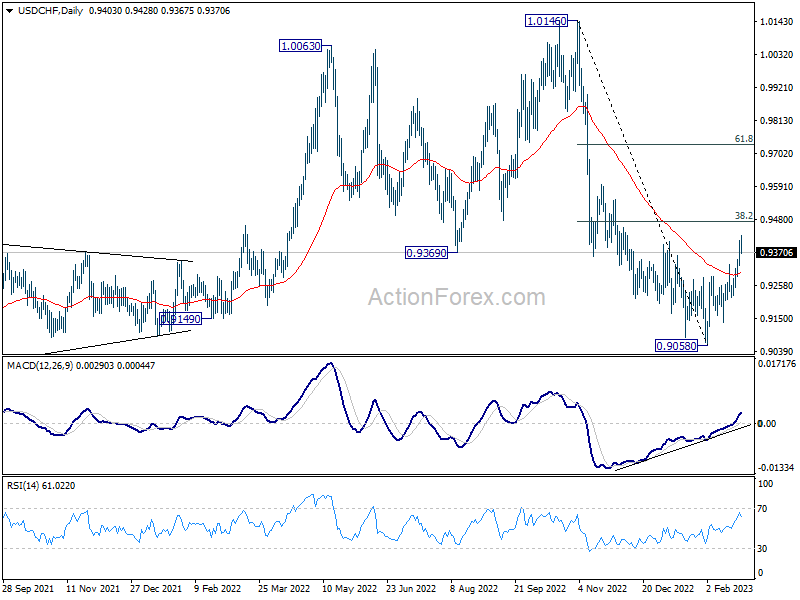
A temporary top is formed at 0.9428 with current retreat. Intraday bias in USD/CHF is turned neutral first. Break of 0.9428 will resume the rebound form 0.9058. But strong resistance could be seen at 38.2% retracement of 1.0146 to 0.9058 at 0.9474 to limit upside. Break of 0.9289 resistance turned support will indicate completion of the rebound and turn bias back to the downside. however, decisive break of 0.9474 will carry larger bullish implications and target 61.8% retracement at 0.9730.
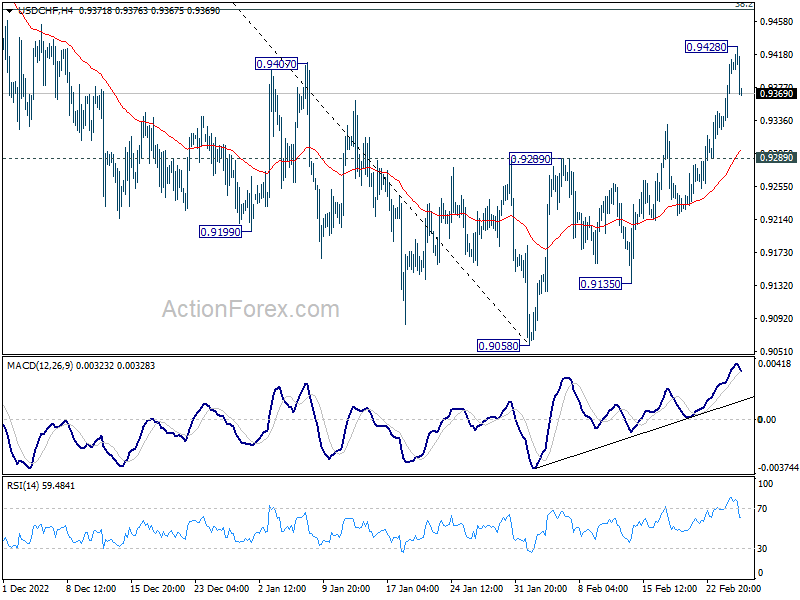
In the bigger picture, decline from 1.0146 is seen as part of a long term sideway pattern. As long as 38.2% retracement of 1.0146 to 0.9058 at 0.9474 holds, another fall is in favor through 0.9058. However, sustained trading above 0.9474 will indicate that the medium term trend has reversed, and open up further rally to 61.8% retracement at 0.9730 and above.
EUR/USD Mid-Day Outlook
Daily Pivots: (S1) 1.0516; (P) 1.0566; (R1) 1.0595; More...
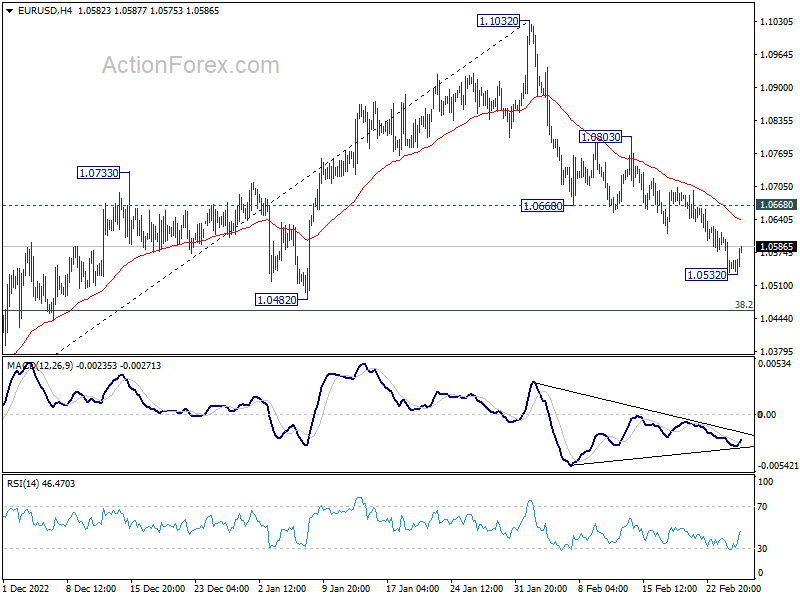
A temporary low is formed at 1.0532 with 4 hour MACD crossed above signal line. Intraday bias in EUR/USD is turned neutral first. While fall from 1.1032 might extend, strong support could be seen around 38.2% retracement of 0.9534 to 1.1032 at 1.0463 to bring rebound, at least on first attempt. Break of 1.0668 support turned resistance will turn bias back to the upside for 1.0803 resistance and above. However, sustained break of 1.0463 will carry larger bearish implications.
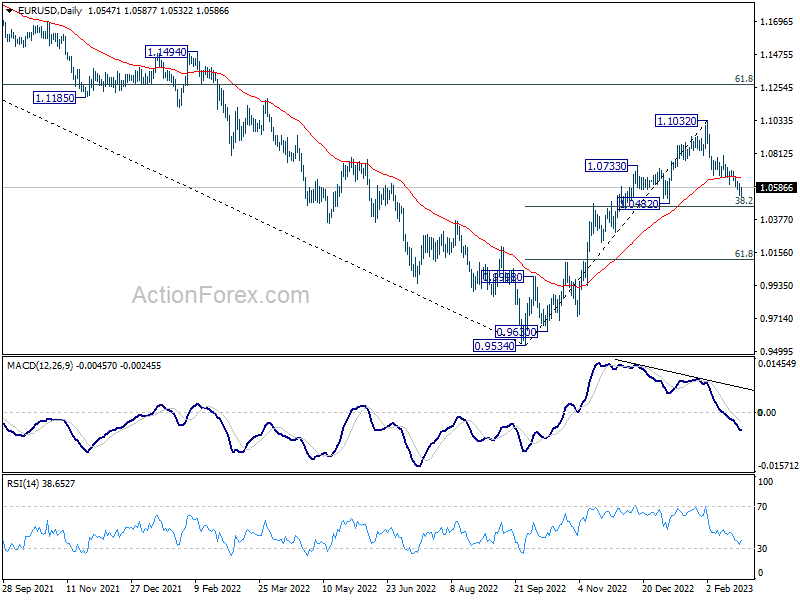
In the bigger picture, as long as 1.0482 support holds, rise from 0.9534 (2022 low) should continue to 61.8% retracement of 1.2348 (2021 high) to 0.9534 at 1.1273. However, sustained break of 1.0482 will bring deeper fall to 61.8% retracement of 0.9534 to 1.1032 at 1.0106, even as a corrective pull back.
GBP/USD Mid-Day Outlook
Daily Pivots: (S1) 1.1899; (P) 1.1971; (R1) 1.2012; More...
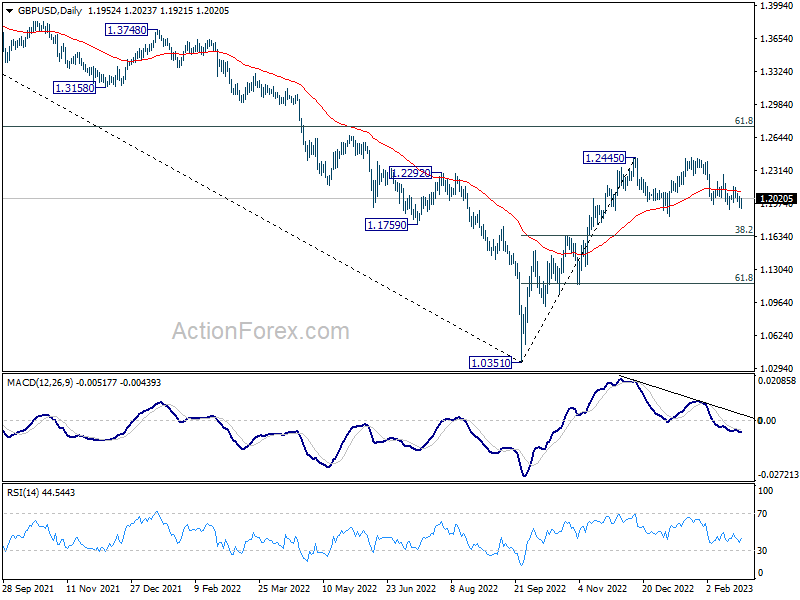
GBP/SUD recovered ahead of 1.1914 and intraday bias is turned neutral first. Another fall is in favor with 1.2146 resistance intact. Break of 1.1914 will resume the decline from 1.2446 for 1.1840 support and possibly below. On the upside, break of 1.2146 resistance will turn bias back to the upside for further rebound to 1.2269 and above.
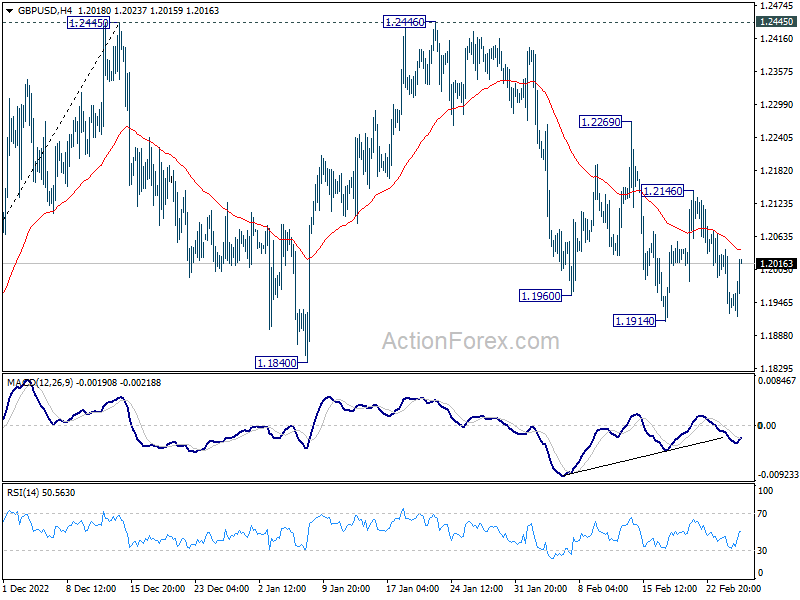
In the bigger picture,as long as 1.1840 support holds, rise from 1.0351 medium term bottom (2022 low) should still continue to 61.8% retracement of 1.4248 (2021 high) to 1.0351 at 1.2759. However, decisive break of 1.1840 will complete a double top pattern (1.2445, 1.2446) after rejection by 55 week EMA (now at 1.2251). Deeper decline should be seen back to 38.2% retracement of 1.0351 to 1.2445 at 1.1645.
Futures Up, Dollar Down after Mixed Durable Goods Data, Sterling Flexing Muscles
US futures climbed following the release of mixed durable goods orders data, leading to a decline in Dollar, which reverses some of last week's gains. However, the positive sentiment is not bolstering the commodity currencies, with New Zealand and Australian Dollars performing the worst for the day. Meanwhile, Sterling is showing strength, followed by Yen and then Swiss Franc. Euro is mixed, albeit slightly weaker.
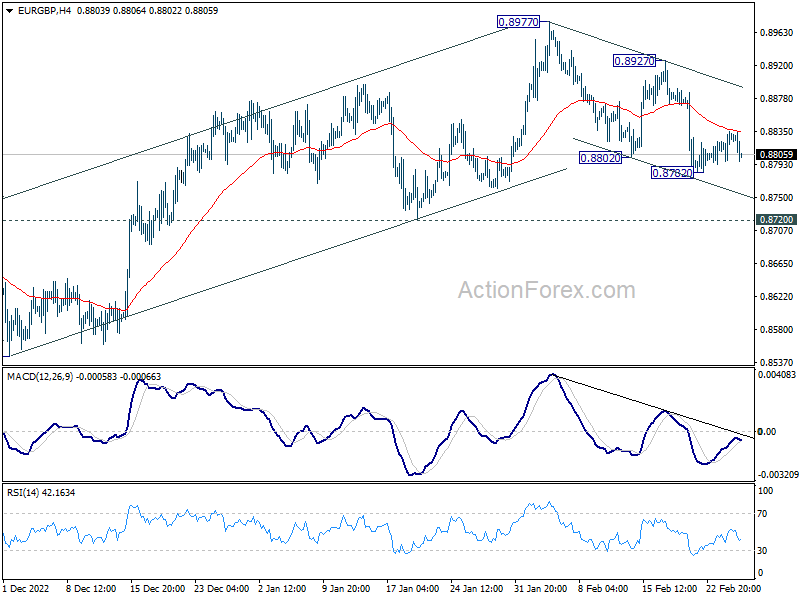
Technically, EUR/GBP declined after being previously rejected by 55 day EMA. This suggests that the drop from 0.8977 may be ready to continue. If the temporary low of 0.8782 is broken, it will confirm the resumption of the decline, with the next target being the 0.8270 support level. If this occurs, it could coincide with a rise in the value of Sterling against other currencies. In particular, GBP/JPY may break through its temporary top at 163.73.
In Europe, at the time of writing, FTSE is up 0.79%. DAX is up 1.75%. CAC is up 1.85%. Germany 10-year yield is up 0.0239 at 2.573. Earlier in Asia, Nikkei dropped -0.11%. Hong Kong HSI dropped -0.33%. China Shanghai SSE dropped -0.28%. Singapore Strait Times dropped -0.58%. Japan 10-year JGB yield dropped -0.0008 to 0.505.
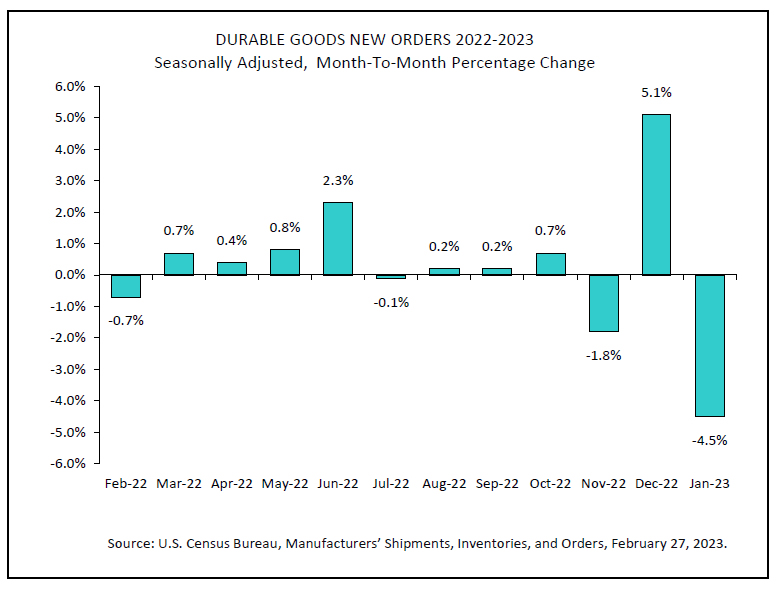
US durable goods orders down -4.5% mom in Jan, but ex-transport rose 0.7% mom
US durable goods orders dropped -4.5% mom to USD 272.3B in January, worse than expectation of -4.0% mom. But ex-transport orders rose 0.7% mom to 179.4B. above expectation of 0.0% mom. Ex-defense orders dropped -5.1% mom to USD 253.9B. Transportation equipment dropped -13.3% mom to USD 92.8B.
Eurozone economic sentiment ticked down to 99.7 in Feb
Eurozone Economic Sentiment Indicator ticked down from 99.8 to 99.7 in February. Employment Expectation Indicator dropped from 109.7 to 109.4. Economic Uncertainty Indicator dropped from 26.2 to 23.3. Industry confidence dropped from 1.2 to 0.5. Services confidence dropped form 10.4 to 9.5. Consumer confidence improved from -20.7 to -19.0. Retail trade confidence rose from -0.7 to -0.1.
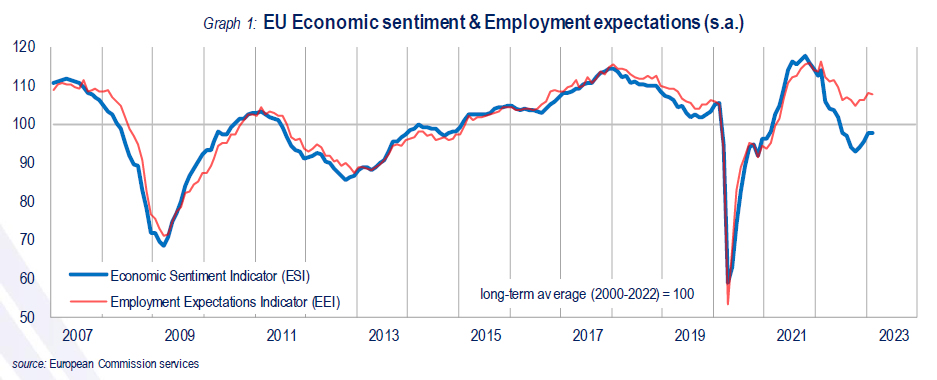
EU Economic Sentiment Indicator was unchanged at 97.8. Employment Expectation Indicator dropped from 108.1 to 107.7. Economic Uncertainty Indicator dropped from 25.8 to 23.3. Amongst the largest EU economies, the ESI decreased in Spain (-2.0) and France (-1.5), while it increased in the Netherlands (+2.9) and stayed broadly flat in Germany (+0.1), Italy (±0.0) and Poland (-0.2).
ECB Lagarde: After March, we will see. We are data dependent
ECB President Christine Lagarde said in an interview, "Interest rates are the most efficient tool in the present circumstances. There is every reason to believe that we will do another 50 basis points in March. After that, we will see. We are data dependent."
"We will do more hikes if necessary to return inflation to our target of 2% in a timely manner. It will take what it will take," She added.
"I don't have a timeline. I have an objective, which is our target. We need to raise interest rates to a level that is sufficiently restrictive to return inflation to 2%, and to keep rates there for as long as necessary to be confident that inflation returns to 2% in a timely manner. That's the mantra." She said.
"Hiking rates inevitably dampens demand. And what we're trying to do is to adjust demand. That's the mechanical impact that we expect from what we are doing."
BoJ Ueda: Benefits of current policy exceed the costs
Incoming BoJ Governor Kazuo Ueda told the upper house of parliament today, "there's still some distance for Japan to see inflation sustainably and stably meet the BoJ's 2% target."
"Big improvements must be made in Japan's trend inflation for the BoJ to shift towards monetary tightening," he said."It's not that I have no ideas on how to tweak the BoJ's current policy. But the desirable tweak will vary depending on economic changes at the time."
"In guiding monetary policy, central banks must weigh the benefits and costs of each step," Ueda said. "At present, the benefits of the BoJ's current policy exceed the costs."
"There are various side-effects emerging, but the BoJ's current policy is necessary and appropriate" to achieve its 2% inflation target, he said.
NZ retail sales volume dropped -0.6% qoq in Q4, value up 1.7% qoq
New Zealand retail sales volume dropped -0.6% qoq in Q4, below expectation of 0.2% qoq rise. Retail sales value rose 1.7% qoq.
By industry, the largest movements in sales volume were: electrical and electronic goods retailing (down -9.7%), motor vehicle and parts retailing (up 2.3%), food and beverage services (up 2.4%), fuel retailing (up 2.6%), furniture, floor coverings, houseware, and textile goods (down -5.2%).
GBP/USD Mid-Day Outlook
Daily Pivots: (S1) 1.1899; (P) 1.1971; (R1) 1.2012; More...
GBP/SUD recovered ahead of 1.1914 and intraday bias is turned neutral first. Another fall is in favor with 1.2146 resistance intact. Break of 1.1914 will resume the decline from 1.2446 for 1.1840 support and possibly below. On the upside, break of 1.2146 resistance will turn bias back to the upside for further rebound to 1.2269 and above.
In the bigger picture,as long as 1.1840 support holds, rise from 1.0351 medium term bottom (2022 low) should still continue to 61.8% retracement of 1.4248 (2021 high) to 1.0351 at 1.2759. However, decisive break of 1.1840 will complete a double top pattern (1.2445, 1.2446) after rejection by 55 week EMA (now at 1.2251). Deeper decline should be seen back to 38.2% retracement of 1.0351 to 1.2445 at 1.1645.
Economic Indicators Update
| GMT | Ccy | Events | Actual | Forecast | Previous | Revised |
|---|---|---|---|---|---|---|
| 21:45 | NZD | Retail Sales Q/Q Q4 | -0.60% | 0.20% | 0.40% | 0.60% |
| 21:45 | NZD | Retail Sales ex Autos Q/Q Q4 | -1.30% | 0.30% | 0.40% | 0.50% |
| 00:30 | AUD | Company Gross Operating Profits Q/Q Q4 | 10.60% | 1.50% | -12.40% | -11.50% |
| 09:00 | EUR | Eurozone M3 Money Supply Y/Y Jan | 3.50% | 3.90% | 4.10% | |
| 10:00 | EUR | Eurozone Economic Sentiment Indicator Feb | 99.7 | 101 | 99.9 | 99.8 |
| 10:00 | EUR | Eurozone Industrial Confidence Feb | 0.5 | 2 | 1.3 | 1.2 |
| 10:00 | EUR | Eurozone Services Sentiment Feb | 9.5 | 12.4 | 10.7 | 1.4 |
| 10:00 | EUR | Eurozone Consumer Confidence Feb F | -19 | -19 | -19 | |
| 13:30 | CAD | Current Account (CAD) Q4 | -10.6B | -11.0B | -11.1B | -8.4B |
| 13:30 | USD | Durable Goods Orders Jan | -4.50% | -4.00% | 5.60% | |
| 13:30 | USD | Durable Goods Orders ex Transportation Jan | 0.70% | 0.00% | -0.20% | |
| 15:00 | USD | Pending Home Sales M/M Jan | 0.90% | 2.50% |
US durable goods orders down -4.5% mom in Jan, but ex-transport rose 0.7% mom
US durable goods orders dropped -4.5% mom to USD 272.3B in January, worse than expectation of -4.0% mom. But ex-transport orders rose 0.7% mom to 179.4B. above expectation of 0.0% mom. Ex-defense orders dropped -5.1% mom to USD 253.9B. Transportation equipment dropped -13.3% mom to USD 92.8B.
New Zealand Dollar Falls to 3-mth Low
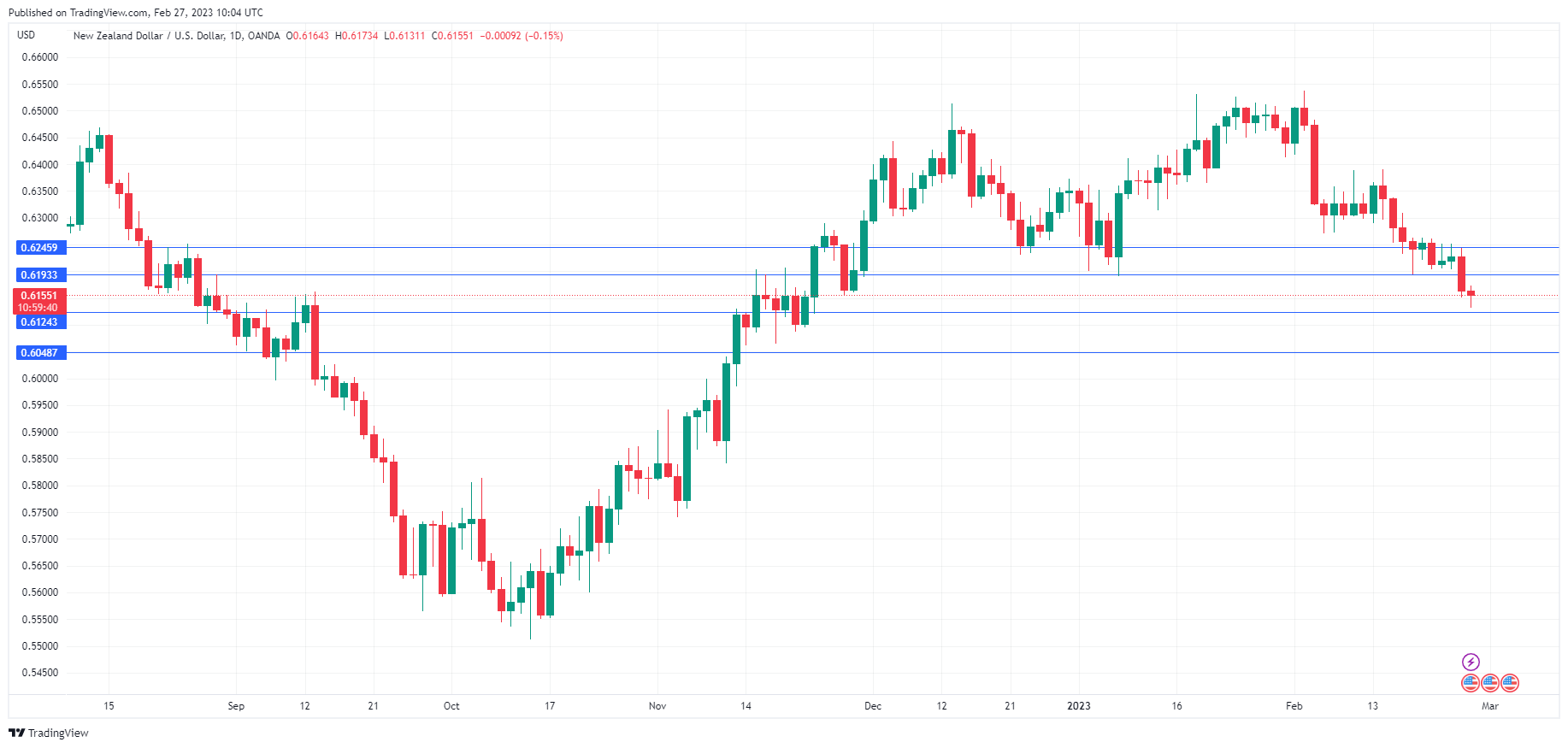
The New Zealand dollar has extended its losses on Monday, after a dismal end to the week. In the European session, NZD/USD is trading at 0.6151, down 0.20%. Earlier, NZD/USD touched a low of 0.6131, its lowest level since Nov. 23.
The US dollar flexed its muscles against the majors on Friday, courtesy of a sharp rise in the US personal consumption expenditures price index (PCE), the Fed’s preferred inflation indicator. Headline PCE inflation climbed 0.6% m/m in January, up from 0.2% in December and above the estimate of 0.5%. Core PCE inflation also rose 0.6% m/m, above the December reading of 0.4%, which was also the forecast. As well, Personal Spending in January surged 1.8%, compared to -0.1% in December and an estimate of 1.3%.
The uptake from the better-than-expected inflation and consumer data is that the economy remains resilient and the Fed may have to raise rates even higher, perhaps closer to 6%. The markets have quickly shifted from expecting a hold in rate cuts to pricing three more rate increases this year, and the US dollar is showing gains on expectations that more rate hikes are coming. Following the PCE release, Fed member Mester said she wasn’t surprised by the strong numbers and said that the Fed needed to do more to put inflation on a “sustainable downward path to 2%”.
New Zealand retail sales decline
In New Zealand, retail sales for Q4 disappointed at -0.6% q/q, down from an upwardly revised 0.6% reading in Q3 and shy of the estimate of 1.5%. This marks the third decline in four quarters. The core rate fell by 1.3%, compared to an upwardly revised 0.6% in Q3 and an estimate of 1.5%. The central bank remains in aggressive mode and raised rates by 0.50% last week, bringing the cash rate to 4.75%. The decline in retail sales signals that the extensive tightening is taking a bite out of economic activity, which is necessary in order for inflation to decline.
NZD/USD Technical
- 0.6124 is under pressure in support. Below, there is support at 0.6049
- 0.6193 and 0.6245 are the next resistance lines
Eurozone economic sentiment ticked down to 99.7 in Feb
Eurozone Economic Sentiment Indicator ticked down from 99.8 to 99.7 in February. Employment Expectation Indicator dropped from 109.7 to 109.4. Economic Uncertainty Indicator dropped from 26.2 to 23.3. Industry confidence dropped from 1.2 to 0.5. Services confidence dropped form 10.4 to 9.5. Consumer confidence improved from -20.7 to -19.0. Retail trade confidence rose from -0.7 to -0.1.
EU Economic Sentiment Indicator was unchanged at 97.8. Employment Expectation Indicator dropped from 108.1 to 107.7. Economic Uncertainty Indicator dropped from 25.8 to 23.3. Amongst the largest EU economies, the ESI decreased in Spain (-2.0) and France (-1.5), while it increased in the Netherlands (+2.9) and stayed broadly flat in Germany (+0.1), Italy (±0.0) and Poland (-0.2).
Bitcoin Retreats But Not Yet Broken
Market picture
Bitcoin closed last week down 6.8%, ending the week at around $23K. Ethereum lost 6.7% to $1570. According to CoinMarketCap, the total capitalisation of the crypto market is $1.07 trillion at the time of writing, down from $1.13 trillion the week before.
Bitcoin fell during the week amid falling stock indices and a rising USD on expectations that the Fed will have to raise interest rates further to cool inflation. Higher interest rates hamper the availability of money and risk appetite.
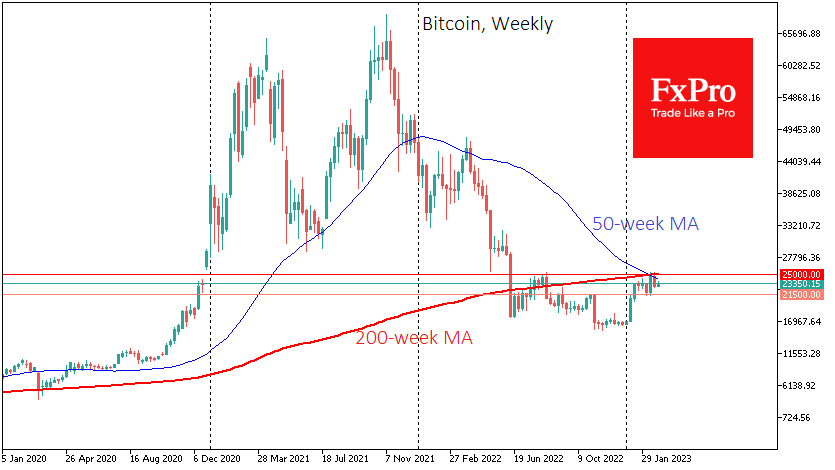
Technically, bitcoin is selling off after touching its 200-week moving average. And due to the negative momentum at the end of the week, it has also fallen below the 50-week moving average. This dynamic may be a prologue to further declines, a predictable tug-of-war near trend levels.
A pullback in bitcoin to $21.5K would remain a correction within a bull market, but a sharp drop below that level could force a reassessment of whether we are out of a bear market.
Another recalculation has resulted in a 9.95% increase in the BTC mining difficulty. The figure hit an all-time high of 43.05 T. According to Glassnode, the network’s smoothed 7-day moving average hash rate is close to 303 EH/s.
News background
The International Monetary Fund (IMF) has called for a “coordinated response” to cryptocurrencies. The growing acceptance of digital assets requires harmonisation of supervisory efforts across countries to regulate them, the IMF said in a statement. The fund said that cryptocurrencies should not be recognised as a means of payment.
The Fed, FDIC and OCC issued a joint statement reminding the US banks about the potential risks of crypto-services-oriented companies. The regulators cited the “unpredictable size and timing of deposit inflows and outflows” from such companies.
Treasury Secretary Janet Yellen said that while the US was not considering an outright ban on cryptocurrency activity, it was important to establish a regulatory framework for the sector. In contrast, IMF chief Kristalina Georgieva believes a cryptocurrency ban is possible.
Solana’s verifiers restarted the network twice due to an unknown error, causing a complete shutdown of economic activity on the blockchain. The malfunction occurred during a node software upgrade to a newer version.
US Oil: Waiting for Continuation of Bullish Trend to 90.64
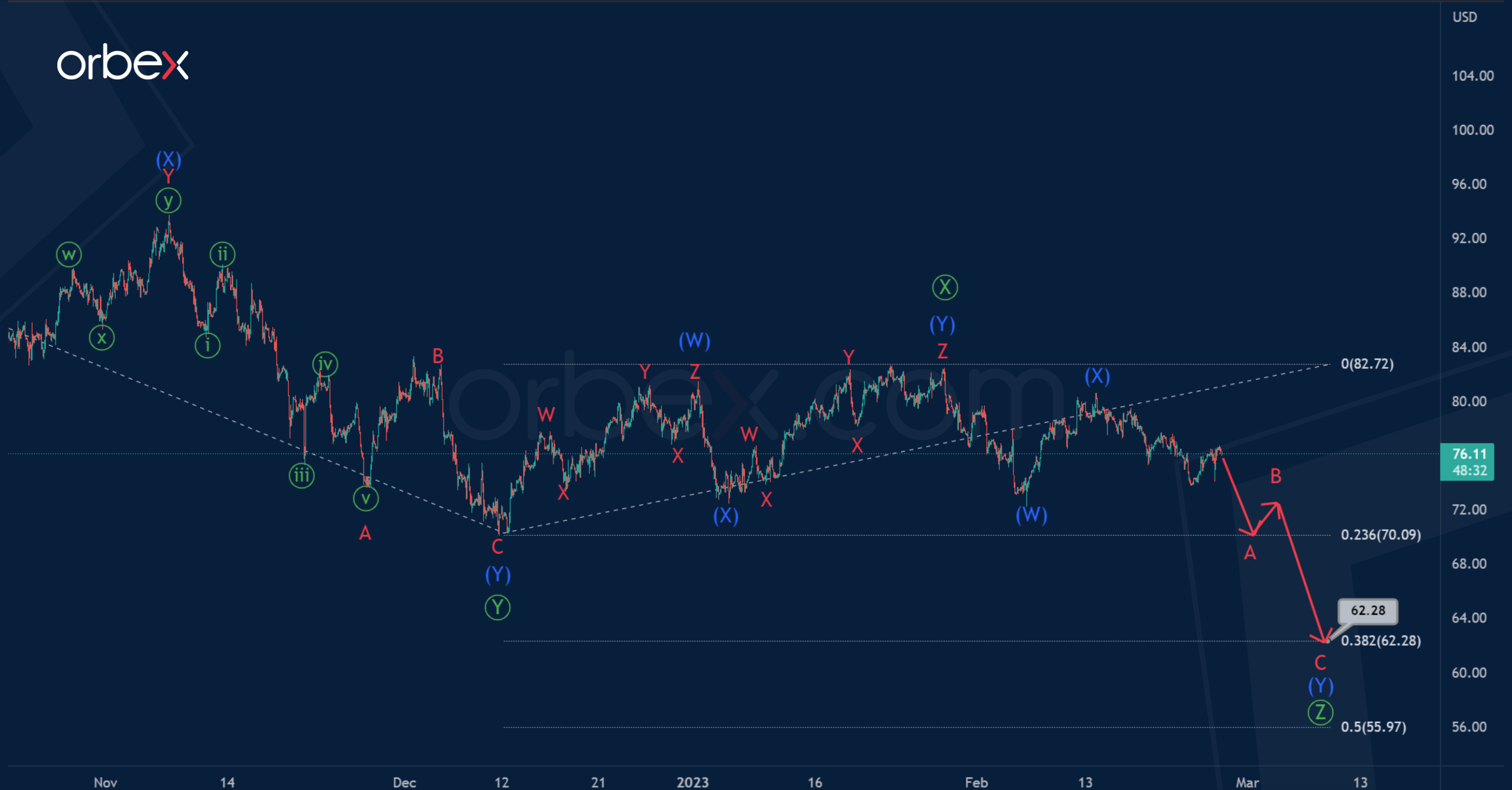
It is assumed that USOIL can form a triple zigzag pattern Ⓦ-Ⓧ-Ⓨ-Ⓧ-Ⓩ, where the primary waves Ⓦ-Ⓧ-Ⓨ seem to be fully completed.
In the last section of the chart, we see growth within the ascending primary intervening wave Ⓧ. Perhaps it takes the form of an intermediate double zigzag (W)-(X)-(Y), and now the price is going up in the last actionary wave (Y).
It is likely that the wave (Y) will end near 90.64, taking the form of a zigzag A-B-C. At the specified level, wave Ⓧ will be at 38.2% of wave Ⓨ.
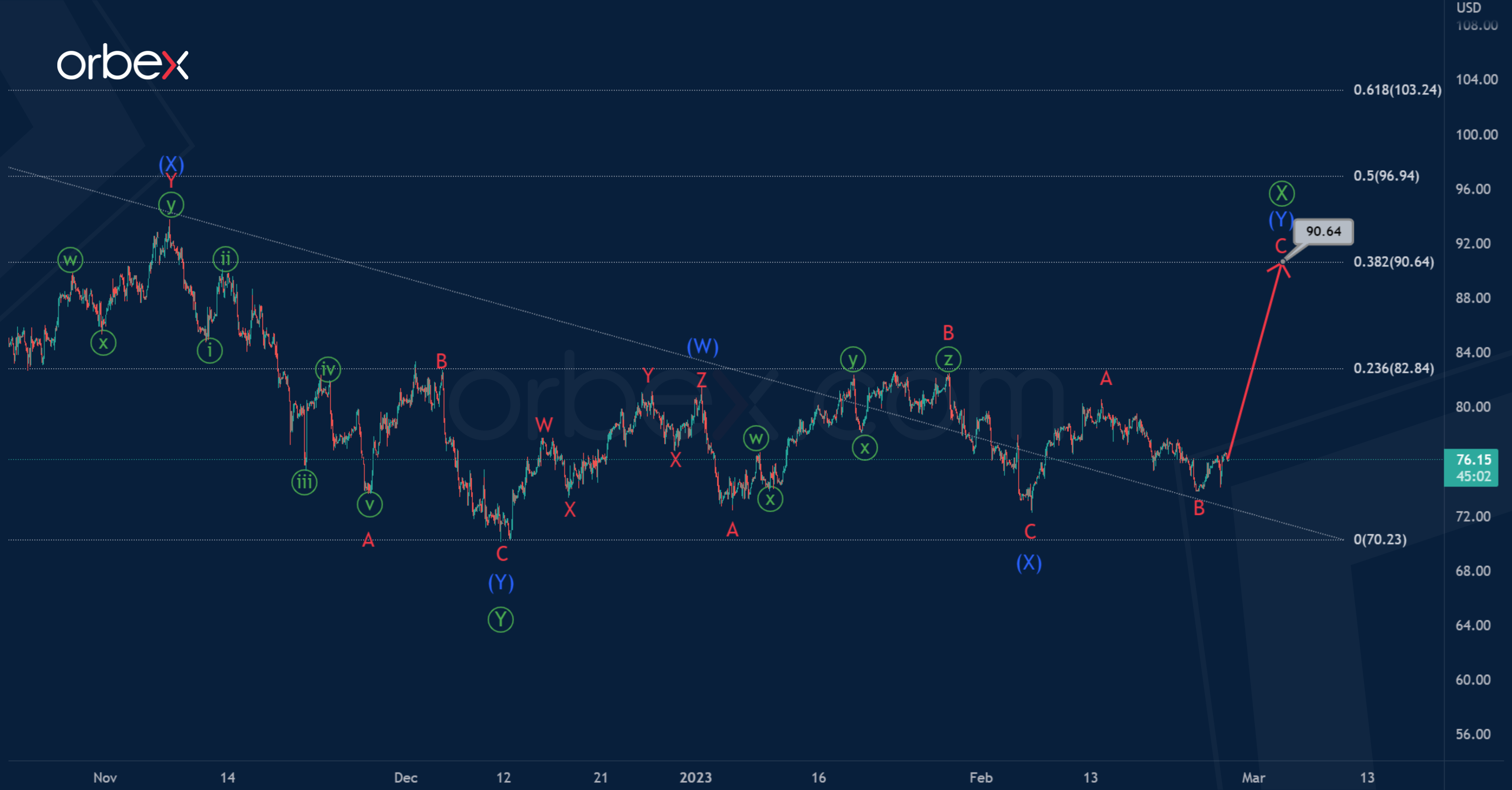
In the second variant, the intervening wave Ⓧ is already finished, at 82.72.
In the near future, we will observe the fall and development of the primary actionary wave Ⓩ in the form of an intermediate double zigzag (W)-(X)-(Y), which at the moment can be built in half.
It is assumed that the bearish trend will continue to 62.28. At that level, primary wave Ⓩ will be at 38.2% of wave Ⓨ.