

Sample Category Title
January Jobs Report Scrambles the Signals on U.S. Inflation
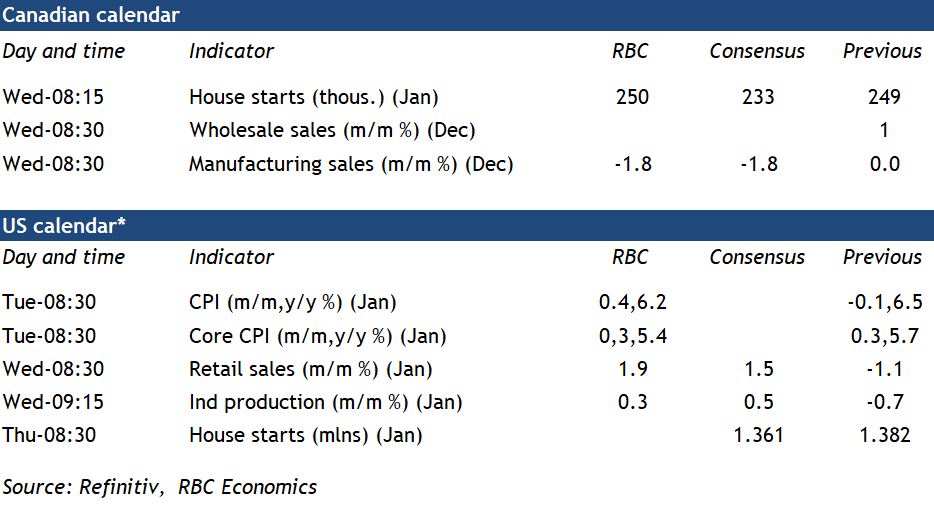
U.S inflation will be the focus next week after a surge in January employment raised eyebrows. The surprise jump in the measure has raised concerns that the economy isn’t cooling quickly enough to ease price pressures. Still, we expect CPI growth edged down to 6.2% in January from 6.5% in December (year-over-year). Food price growth likely also continued to slow, albeit from very high levels. By contrast, we expect energy price growth ticked up for the first time in 7 months—though to an 8% rate that is still well below a June peak of 42%.
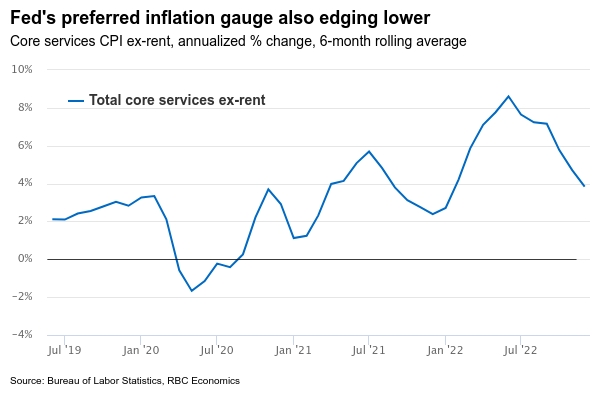
Both food and energy prices are heavily influenced by global cost pressures—which have been easing. But U.S. Federal Reserve officials will be more focused on ‘domestically-driven’ price growth. We look for core inflation to slow further in January, coming in at 5.4% year-over-year, down from 5.7% in December. And prices for purchased goods are also expected to have softened. Home rents will continue to fuel core inflation as earlier price increases ripple through to leases, but those pressures are likely to slow in the months ahead. Core services ex-rents, a measure Federal Reserve officials have highlighted as a key indicator of where U.S. inflation is heading, will be watched more closely. But all told, recent inflation reports have pointed to relatively broadly-based easing in price pressures.
The labour market remains strong, with last week’s employment report showing payrolls up by 517,000 and the unemployment rate down to 3.4%. Wage growth has been decelerating–a measure Federal Reserve policymakers are also closely monitoring for further signs of disinflation. For now, we continue to look for another 25 basis point hike to the Fed funds rate in March—though any robust (and sustained) labour market data could alter this outlook.
Week ahead data watch
January U.S. retail sales likely rose 1.9% from a 1.2% decline in December, thanks to an 18% surge in unit vehicle sales. U.S. industrial production likely edged up 0.3% during that month, with higher manufacturing outputs offsetting a weather-related decline in utility output.
StatCan’s flash estimate of Canadian manufacturing sales showed a 1.8% decline in December, and flagged a drop in petroleum and coal products. The decline in petroleum and coal sales was likely price-related but isn’t significant enough to explain in the overall decline total sales. This suggests weaker sales in other sectors as well.
Canadian housing starts are expected to stay at 250,000 units in January. Residential building permit issuances have been slowing, with a 3-month rolling average of 242,000 units in December.
GBP Might Strenghten as GDP Posts Positive
On Friday 10th February 2023, the Office for National Statistics published the figures for the Gross Domestic Product (GDP) as 0.1% which turned out greater than the initial forecast of -0.2%. As a result of the positive outlook of this report, we need to examine the short-term impact on GBP pairs from a technical point of view.
GBPUSD
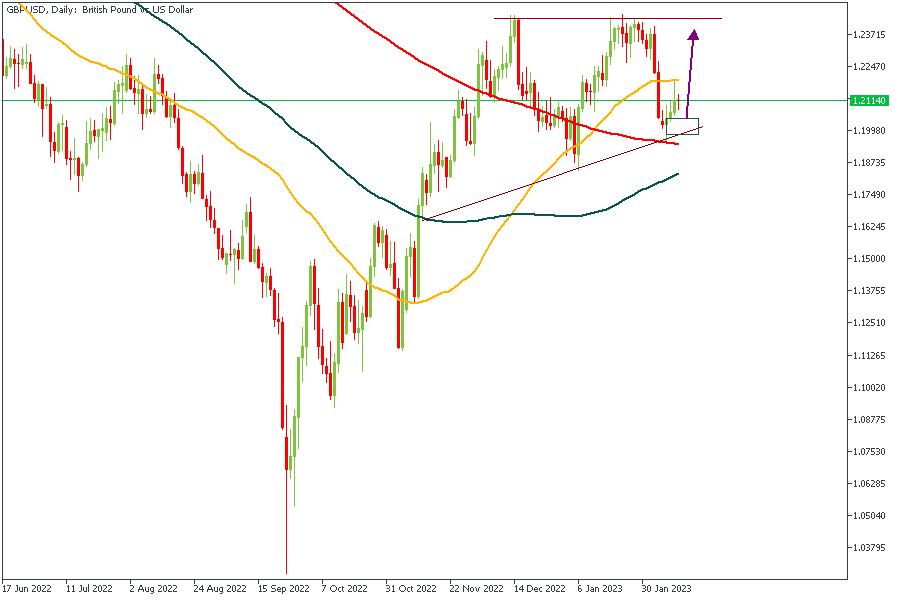
GBPUSD is currently reacting from the confluence of the trendline support, the 200-Day moving average, and the 88% Fibonacci level. Also, since the 50-Day moving average already crossed above the 100 and 200-period averages, there's a huge chance we get to experience some bullish price action all the way to 1.24854 or higher.
Analysts’ Expectations:
- Direction: Bullish
- Target: 1.24854
- Invalidation: 1.19492
GBPCAD
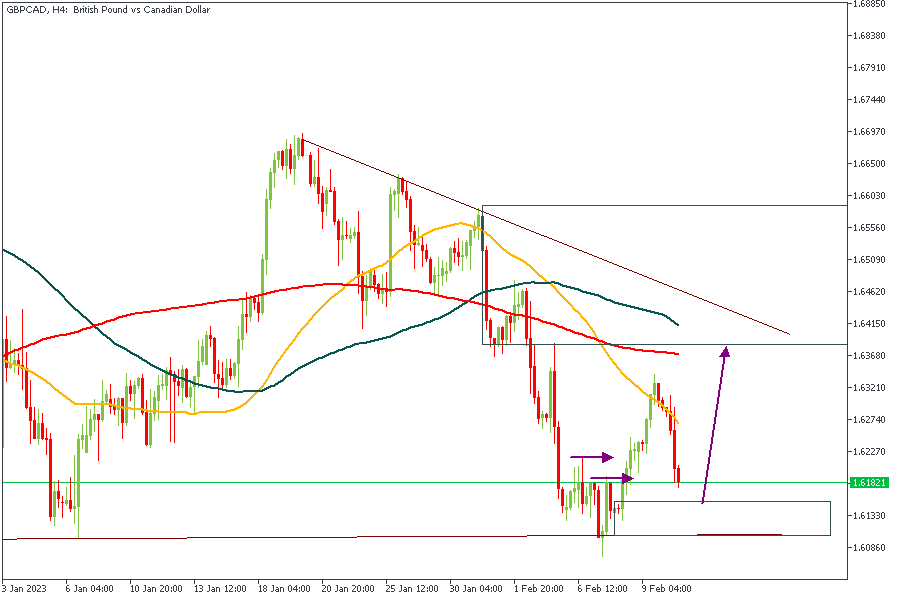
Despite being in a downtrend, GBPCAD can be seen to have broken above two previous highs. This indicates the possibility of a bullish reaction from the highlighted drop-base-rally demand zone. I personally expect a typical case of a buy-to-sell movement to come into play in this scenario.
Analysts’ Expectations:
- Direction: Bullish
- Target: 1.63470
- Invalidation: 1.60654
GBPJPY
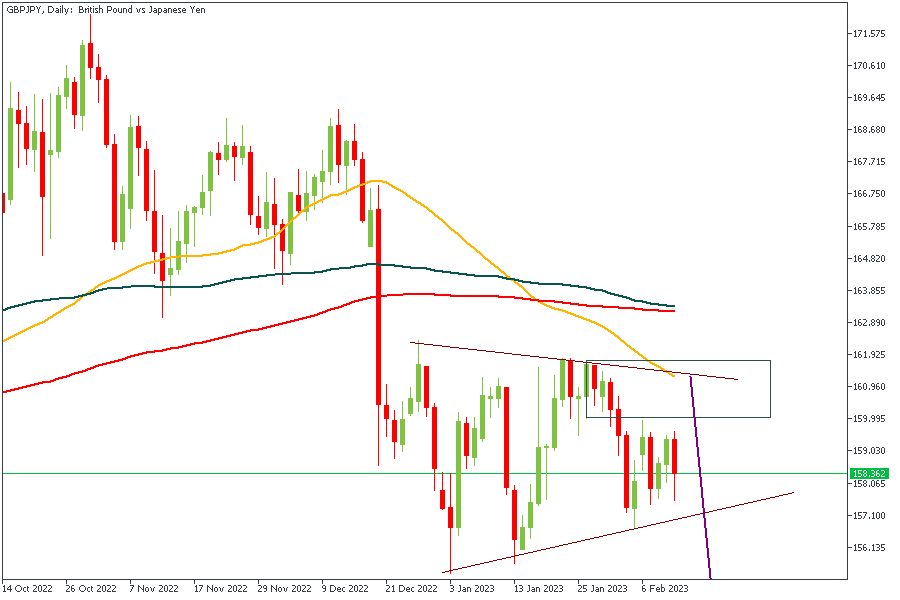
GBPJPY has recently created a wedge pattern, and within this wedge the most recent price action has been a bullish reaction from the trendline support, leaving us with the option of a bearish rejection from the rally-base-drop supply zone. The 50-Day moving average acts as an additional confluence to validate our prediction.
Analysts’ Expectations:
- Direction: Bearish
- Target: 156.21
- Invalidation: 161.908
GBPAUD
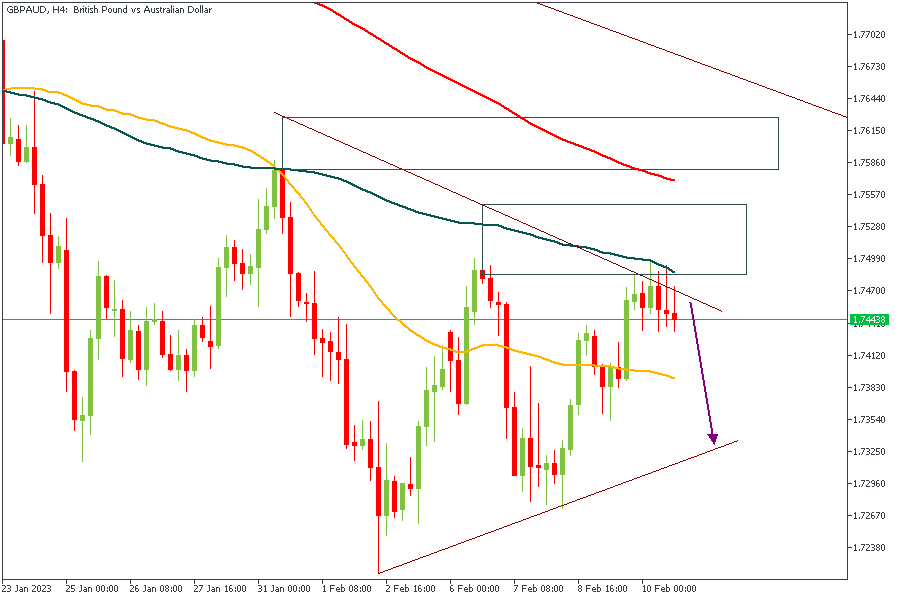
GBPAUD is currently reacting from an area of supply. The 100-period moving average and the trendline resistance are an added confluence for the bearish price action since price is currently constricted within a wedge pattern.
Analysts’ Expectations:
- Direction: Bearish
- Target: 1.73278
- Invalidation: 1.75482
CONCLUSION
The trading of CFDs comes at a risk. Thus, to succeed, you have to manage risks properly. To avoid costly mistakes while you look to trade these opportunities, be sure to do your due diligence and manage your risk appropriately.
Week Ahead – A Valentine’s Day Treat
US
The Valentine’s Day inflation report is the main event of this week. Disinflation trends will get tested here and we could potentially have a major turning point with Wall Street’s expectations on how high the Fed will have to take interest rates. The January inflation report is expected to show headline CPI from a month ago rose 0.5%, up from the -0.1% reading in the prior month. Inflation from a year ago is expected to improve from 6.5% to 6.2%. The core readings on a monthly basis are expected to keep the 0.3% pace, while on an annual basis is expected to improve from 5.7% to 5.4%. If pricing pressures come in hotter-than-expected, this could be an inflation reckoning report that might drive Fed rate hike expectations above 5.25%.
Investors will pay close attention to Fed speak after the January inflation report. Fed’s Logan, Harker, and Williams will speak shortly after the Tuesday inflation data. On Thursday, we will hear from Mester, Bullard, and Cook. Friday contains appearances by Barkin and Bowman.
Earnings seasons continues with key updates from AIG, Analog Devices, Applied Materials, AutoNation, Barclays, Barrick Gold, Biogen, Coca-Cola, Deere, Devon Energy, DraftKings, Fidelity, Heineken, Hermes International, Hyatt Hotels, Kraft Heinz, Nestle, Orange, Pernod Ricard, Restaurant Brands International, Shake Shack, and Shopify
Eurozone
Not the most thrilling week but there is a scattering of data points, many of which the ECB won’t ignore even if they aren’t as impactful as the headline inflation numbers. GDP and employment on Tuesday fall into that category as we see how the bloc coped with the early winter period. That aside, central bank speak as ever remains key with President Lagarde on Wednesday the standout.
UK
The situation in the UK is very intriguing. The economy is basically drifting at the moment, fluctuating around zero growth, unable to recoup pandemic losses, and expected to remain near the bottom of the growth table. At the same time, its inflation problem has been among the worst and even now it’s only a little shy of 10% (and its peak). And yet, markets are pricing in only one more 25 basis point hike, the MPC is confident inflation will be below 4% by the end of the year and two policymakers even voted to hold at the February meeting.
GDP figures Friday confirmed the UK avoided recession by the finest of margins, a fact that could be easily revised out in the coming months. Next week we’ll get retail sales, labour market, and most importantly, inflation data. Last month it fell faster than the BoE expected; could we be in for another positive surprise or will Wednesday bring us back down to earth with a bang?
Russia
No major economic events next week. Focus remains on the war in Ukraine.
South Africa
Inflation is edging ever closer to the SARB’s target range of 3-6%, with CPI data next week expected to show it falling from 7.2% to 6.9%. That may allow the central bank to take its foot off the break and ease the pressure on the economy.
Turkey
No major economic announcements or events next week.
Switzerland
With the SNB determined to get inflation back to target below 2%, attention will be on the CPI release on Monday. Chair Jordan has been adamant that getting a grip on inflation is their absolute priority and markets are convinced, pricing in a 56% chance of 50 basis points next month, and a 44% chance of 25.
China
Amid rising optimism about China’s reopening, economic momentum is growing. Strong capital inflows into China may continue, especially as the country resumes work after the Chinese New Year holiday.
The recent strengthening of the Fed’s hawkish stance and a slight tightening of overall risk sentiment, combined with heightened US-China tensions has also led to a wave of declines in regional equities.
Next week, there will be no critical data. Investors are awaiting the work report of Premier Li Qiang in March, among other key policy events, which may include measures to boost consumption and stimulate economic growth. The People’s Bank of China may also cut its benchmark interest rate to boost credit demand for the private sector amid the grand economic resurgence.
India
Inflation is within the RBI 2-6% range and yet the central bank raised rates again last week by 25 basis points to 6.5%. It’s clearly concerned about the stubbornness of core inflation and fears under-tightening in the longer term over the alternative. The inflation data next week will help determine whether those are well-founded or not. Either way, further hikes look unlikely with two of the six RBI policymakers voting against the last hike.
Australia & New Zealand
Recent CPI data indicate that the RBA may have underestimated the stubbornness of Australian inflation. Policymakers may have little option but to reconsider the possibility of more significant interest rate increases.
Changes in the external environment, such as the weakening of the US dollar, the reopening of China, and improved China-Australia relations are supportive for the economies of Australia and New Zealand.
New Zealand’s inflation rate rose less than the RBNZ forecast in the fourth quarter. This has led to a slight reduction in expectations for the February meeting, although the market is still pricing in a 50 basis point hike.
Australia’s labour market figures are released on Thursday, while appearances by Philip Lowe, Governor of the RBA, will be eyed.
Japan
There is growing speculation in the market that the BoJ is about to shift its policy after widening its yield target range last December. Some market participants believe that a new BoJ leadership would be the ideal catalyst for a policy shift. The Japanese government is expected to present its nominee for the next Governor of the Bank of Japan next week, with Kazuo Ueda the reported choice.
Japan’s preliminary fourth-quarter GDP eyed on Tuesday.
Singapore
GDP data is the only notable release on Monday.
Economic Calendar
Saturday, Feb. 11
Economic Data/Events
- China FDI
- ECB’s Visco addresses the Warwick Economics Summit in Coventry, UK
- Labor protests expected in France of proposed pension reforms
Sunday, Feb. 12
Economic Data/Events
- The Kansas City Chiefs and the Philadelphia Eagles play in Super Bowl LVII
- Regional elections in Lombardy and Lazio, Italy
- Berlin holds repeat vote for regional parliament and district councils
Monday, Feb. 13
Economic Data/Events
- India CPI
- New Zealand performance services index
- Singapore GDP
- Turkey current account
- Euro-area finance ministers meet in Brussels to discuss energy markets and other topics
- Fed’s Bowman speaks at the American Bankers Association National Conference for Community in Orlando, Florida
- ECB’s Centeno speaks at a London School of Economics event on “Challenges and new approaches to European monetary policy”
- The United Arab Emirates hosts the World Government Summit
- Norwegian PM Gahr Store meets Lithuanian President Nausėda in Oslo
Tuesday, Feb. 14
Economic Data/Events
- US CPI
- Eurozone GDP
- Hungary GDP
- Norway GDP
- Japan GDP
- Australia consumer confidence
- France unemployment
- India wholesale prices
- Japan industrial production
- Mexico international reserves, inflation expectation
- New Zealand food prices, house sales
- UK jobless claims, unemployment
- Fed’s Logan takes part in a moderated discussion hosted by Texas A&M University in Prairie View, Texas
- Fed’s Williams gives the keynote speech at an event hosted by the New York Bankers Association
- Fed’s Barkin discusses inflation in an interview with Bloomberg Television
- EU finance ministers meet to discuss the impact of Russia’s war
- Singapore releases 2023 budget
Wednesday, Feb. 15
Economic Data/Events
- US business inventories, industrial production, retail sales, empire manufacturing
- India trade
- Poland CPI
- UK CPI
- China medium-term lending
- Canada housing starts, existing home sales
- Eurozone industrial production
- Japan tertiary index
- South Africa retail sales, CPI
- RBA Governor Lowe appears before the Senate Economics Legislation Committee
Thursday, Feb. 16
Economic Data/Events
- US housing starts, PPI, initial jobless claims
- Australia unemployment, household spending, consumer inflation expectations
- China property prices, Swift global payments
- Italy trade
- Japan machinery orders, trade, department store sales
- New Zealand net migration
- Spain trade
- New Zealand government releases financial statements for six months to Dec. 31
- ECB’s Panetta speaks at a Center for European Reform conference focused on “Monetary policy after the energy shock” in London
- ECB’s Nagel lectures on “Reforms for greater stability and prosperity” at the German Institute for Economic Research
- ECB’s Lane delivers the NIESR Dow lecture on “The Euro area hiking cycle”
- Norges Bank Q1 expectations survey. Governor Wolden Bache gives annual address to the Supervisory Council of Norway’s central bank
- BOE chief economist Pill has a “fireside chat” on the UK economy at the Warwick Think Tank
- Fed’s Mester speaks at an event hosted by the Global Interdependence Center in Florida. Mester later discusses the economic outlook at a meeting of Financial Executives International of Northeast Ohio and ACG Cleveland
- Fed’s Bullard discusses the US economy and monetary policy at an event hosted by the Greater Jackson County Chamber in Jackson, Tennessee
Friday, Feb. 17
Economic Data/Events
- France CPI
- Russia, Thailand GDP
- Singapore trade
- Thailand foreign reserves, forward contracts, car sales
- RBA Gov Lowe appears before House Economics Committee
- Fed’s Barkin speaks on labor market at an event hosted by the Rosslyn Business Improvement District in Arlington, Virginia
Sovereign Rating Updates
- Poland (S&P)
- Switzerland (Moody’s)
Traders on the Edge of Their Seats in Anticipation of the US CPIs
With market participants revising up their implied path for the Fed funds target rate after the astounding US employment report for January, the dollar is set to eke out gains for the second straight week. That said, the next test for the currency may come in the form of the January CPI data, due to be released on Tuesday at 13:30 GMT. How may the greenback react to another notable slowdown?
Dollar stages a comeback after NFPs and ISM PMI
Last Friday, the US employment report showed that nonfarm payrolls surged by 517k in January, with the unemployment rate hitting a more than a 53 1/2-year low of 3.4%. Soon thereafter, the ISM non-manufacturing PMI rebounded strongly back into expansionary territory, adding to hopes that the US economy may eventually avert a recession.
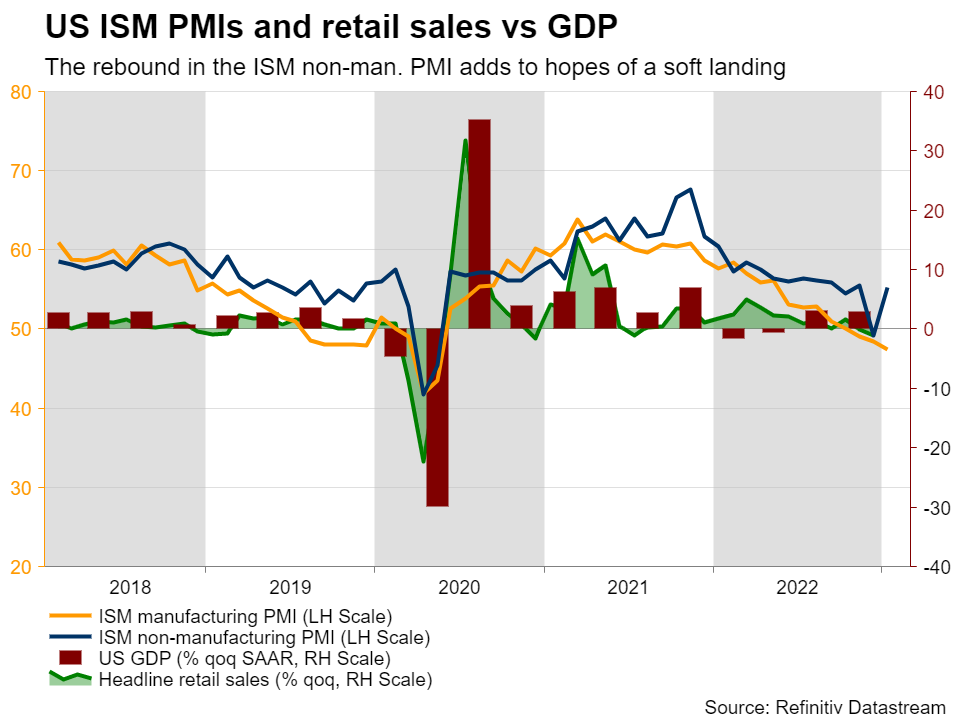
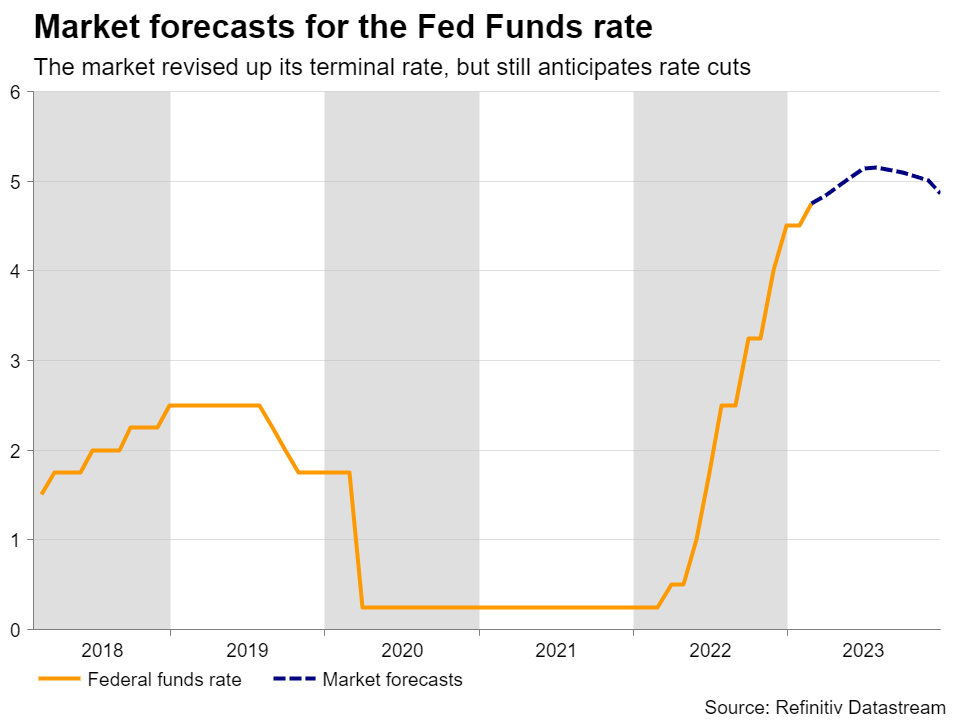
The result was a massive wave of dollar buying and a strong rebound in Treasury yields as investors revised up the level of where they expect interest rates to peak and priced out one of the two quarter-point rate reductions they were seeing towards the end of the year. Although Fed Chair Powell reiterated his disinflation remarks on Wednesday, market pricing was not altered much. Currently, investors are pricing in a terminal rate of 5.15%, in line with the Fed’s own projections, while they see interest rates being 30bps lower by the end of the year.
But CPIs could bring the dollar recovery to an end
Having said all that though, investors bets and thereby the greenback will be put to the test on Tuesday, when we get the US CPIs for January. This data set has proven to be the dollar’s biggest nightmare in the past as consistent downside surprises in previous months were the fuel behind speculation for a Fed pivot and two quarter point cuts until December. Both the headline and core rate are expected to have continued to decline, to 6.2% y/y and 5.5% y/y from 6.5% and 5.7% respectively. Nonetheless, with the y/y chance of oil prices dipping further in the negative territory, the risks surrounding the headline rate may be tilted to the downside.
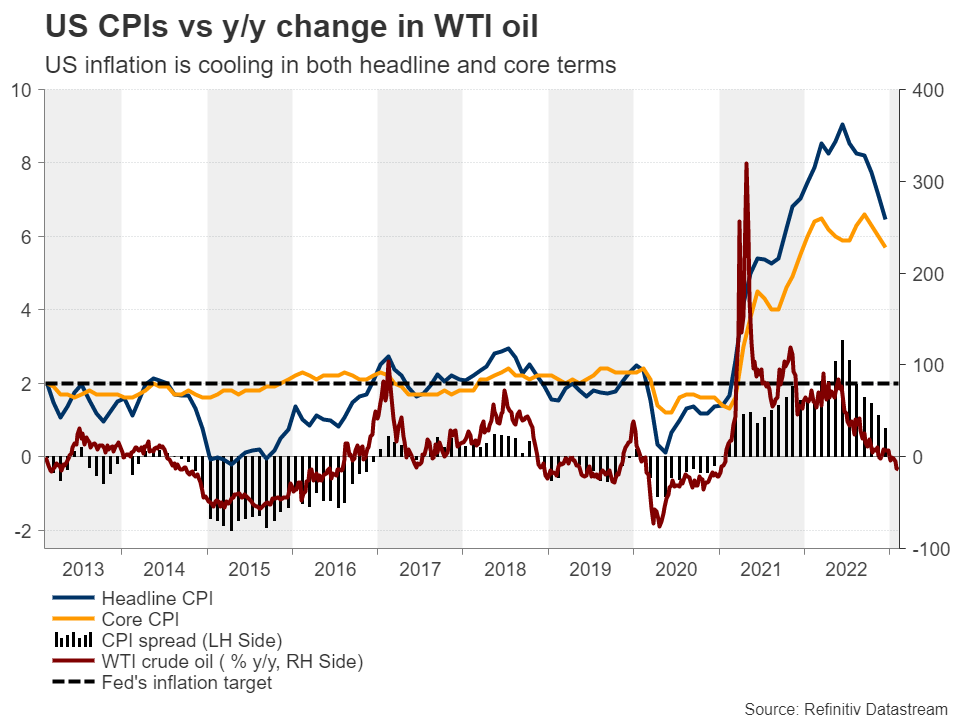
Another downside surprise could revive speculation about a lower peak in US interest rates as well as more rate cuts for later this year. US Treasury yields may come under renewed pressure and thereby the dollar could be sold again. With the ECB still expected to continue raising interest rates more aggressively than the Fed, especially following hawkish remarks by German policymakers Joachim Nagel and Isabel Schnabel, euro/dollar may rebound and continue its prevailing uptrend.
Door for a rebound in euro/dollar remains open
From a technical standpoint, euro/dollar is now testing the 1.0670 zone, which coincides with the 50-day exponential moving average. In the bigger picture, despite the steep slide following the NFPs, the pair is still trading well above the uptrend line drawn from the low of September 28, which keeps the door for a rebound in the foreseeable future open. Should the price rebound back above 1.0800, traders may be encouraged to put the key resistance of 1.1175 back on their radar.
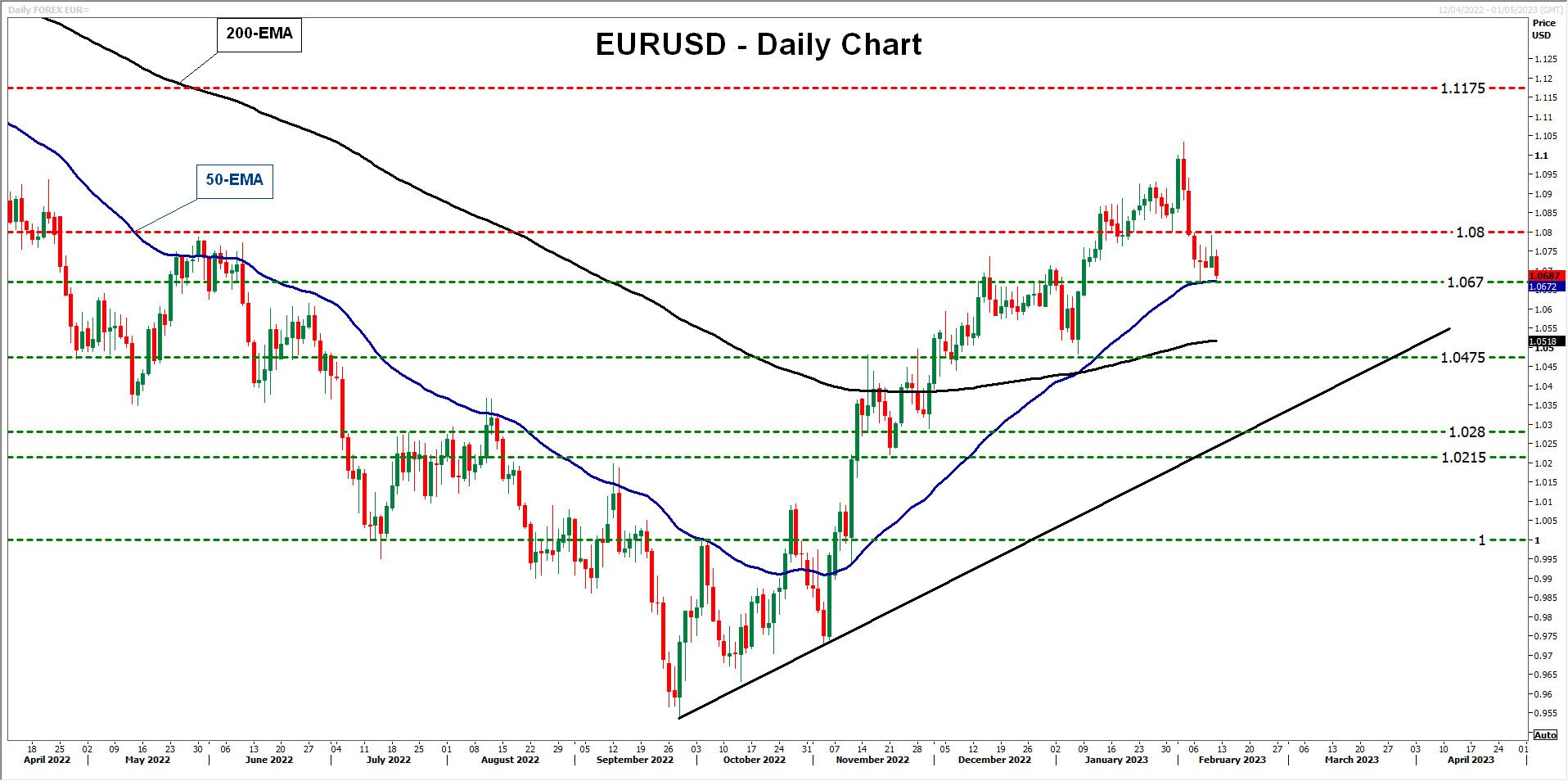
On the downside, a dip below 1.0715 and the 50-day EMA could allow declines towards the 1.0475 zone. Such a dip could occur if the CPI data surprises to the upside. Having said all that though, even in the case of such a slide, the pair would still be trading above the aforementioned uptrend line. For the outlook to turn overly bearish, a clear dip below 1.0215 may be needed.
Week Ahead – US Inflation and BoJ Governor Nomination in Focus
An action-packed week lies ahead for FX traders. The dollar staged a recovery lately as markets priced in a higher peak for Fed rates, but whether this comeback has scope to continue will depend on the upcoming US inflation report. Over in Japan, the nation will enter a new chapter with the nomination of its next central bank chief, putting the spotlight on the yen.
Yen jumps on BoJ bets
The moment of truth for the yen is finally here. Media reports suggest the new Bank of Japan Governor will be nominated on Tuesday, with the latest articles tipping Kazuo Ueda as the most likely choice.
Previous reports suggested Masayoshi Amamiya was the frontrunner - one of the architects of the central bank’s unorthodox tactics - but it seems he refused the position. The yen strengthened on the leaks that it will be Ueda instead, in what seemed like a relief move.
Even though Ueda’s policy views are not clear yet, traders are betting he is unlikely to be as cautious as Amamiya on tightening policy. He is not a current member of the Bank of Japan and was not involved in the extreme stimulus policies of the last decade, so the thinking is that he could be more open to raising interest rates.
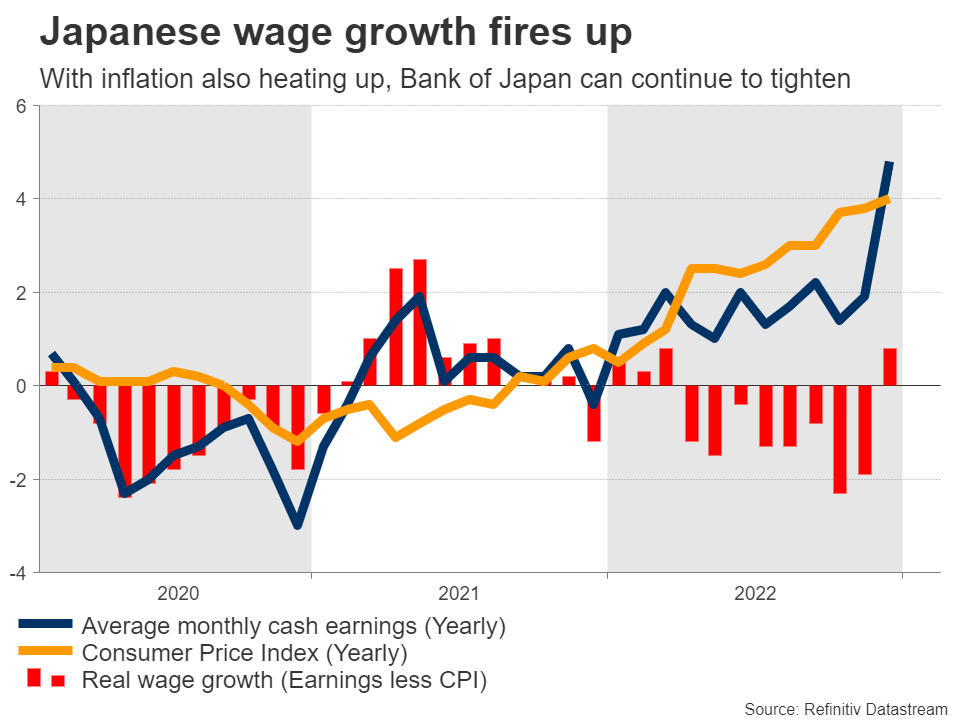
In the big picture, what matters most for the yen’s trajectory is the economic landscape, which has improved substantially lately with both inflation and wage growth firing up. These developments pave the way for more tightening by the Bank of Japan, turning the focus to the March meeting for the next adjustment in the yield curve control strategy.
Outside of Japan, foreign central banks are about to conclude their own hiking cycles and global economic momentum is losing steam. This is a favorable investment regime for the yen, as yield differentials might continue to compress to its benefit.
On the data front, the nation’s GDP report for Q4 is out on Tuesday and forecasts point to a rebound in economic growth, adding credence to speculation for another BoJ move.
US inflation for Valentine’s day
In the United States, a string of strong data releases has led markets to reprice where they expect Fed rates to peak. Following the stunning nonfarm payrolls report and ISM services survey last week, investors concluded that the US economy remains resilient, pricing in a ‘higher for longer’ scenario for interest rates.
Market pricing now implies that rates will hit 5.15% this cycle, while speculation for rate cuts later this year has started to recede. Traders are still betting that rates will be cut by December, but only slightly so. The ‘serious’ cuts are seen as a story for 2024 instead.
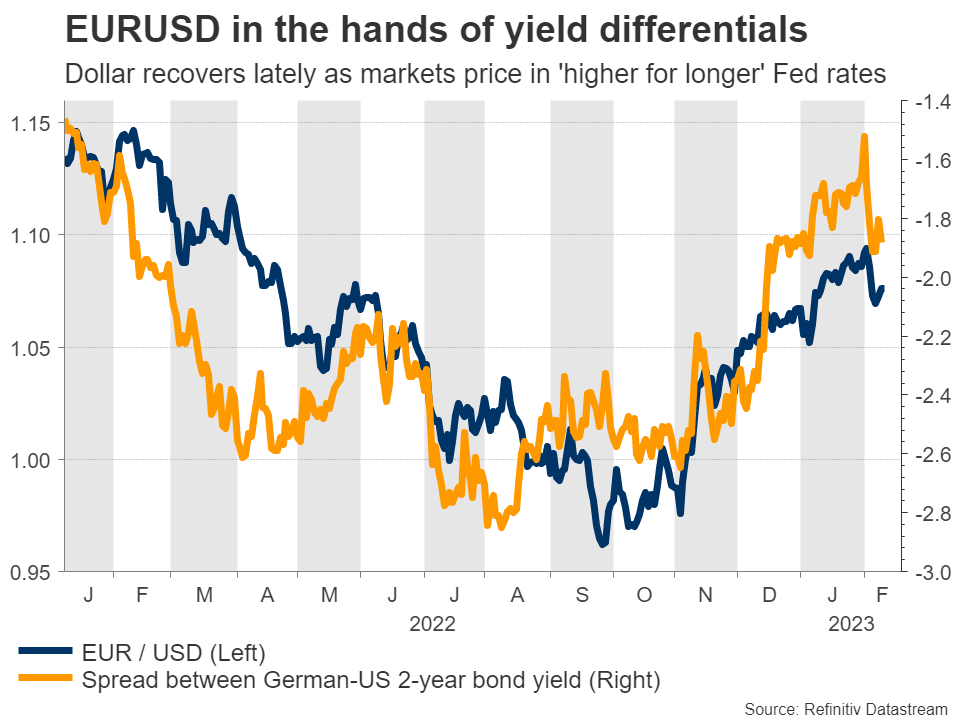
With the labor market still exceptionally tight, the worry is that inflation could return for a second round, forcing the Fed to stay tight for a longer period. This repricing helped breathe some life back into the US dollar recently, but whether the recovery can persist will ultimately depend on whether incoming data validates this narrative.
The ball will get rolling with the latest CPI inflation stats on Tuesday, where expectations are for another cooldown in inflationary pressures. On a yearly basis, the headline CPI rate is expected to have declined two ticks to reach 6.3% in January, from 6.5% previously. It’s a similar picture for the core print.
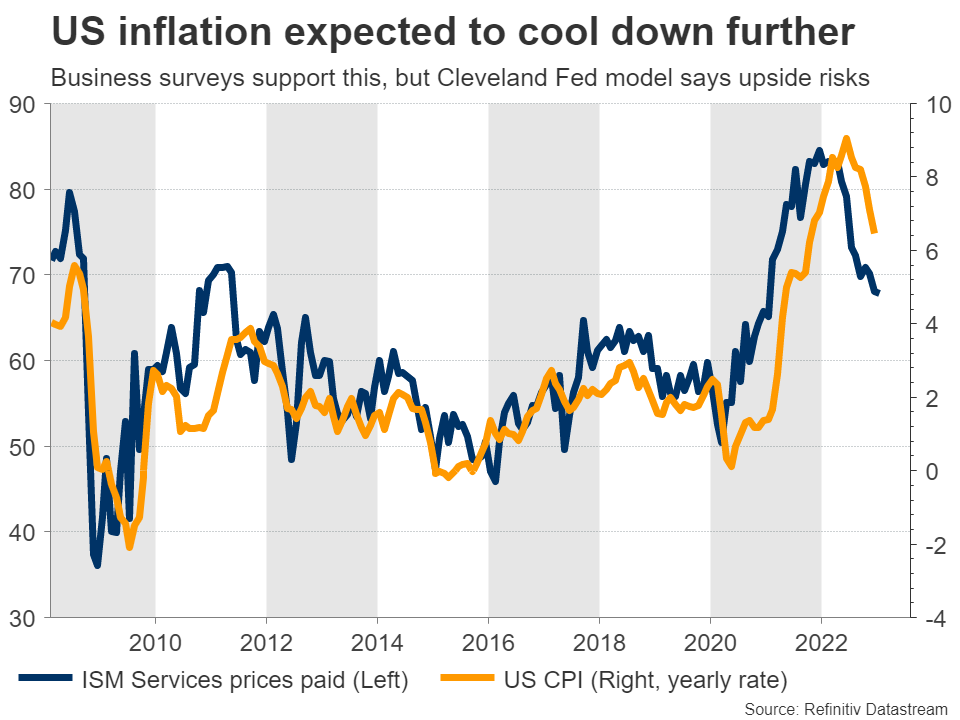
Supporting the notion of another slowdown in inflation are the latest business surveys from S&P Global, which signaled that service-sector companies raised their selling prices at the slowest pace in more than two years in January. However, the Cleveland Fed Nowcast model points to an upside surprise, forecasting this CPI print at 6.44% instead.
For the dollar to continue its recovery, the markets would probably need to see such a hotter-than-expected print. Retail sales will be the next item to digest on Wednesday, with forecasts pointing to a solid rebound after a worrisome drop back in December. The latest batch of producer prices will follow on Thursday.
British and Australian data eyed
Over in the United Kingdom, there’s a flurry of data releases on the agenda starting with the jobs report for December, which is out on Tuesday. Inflation stats for January will follow on Wednesday, ahead of retail sales on Friday.
Following the Bank of England’s latest ‘cautious’ rate increase, markets think that the central bank could hit the pause button soon, pricing in about even chances for a rate increase or nothing at all next month. Hence, this dataset could be the deciding factor.
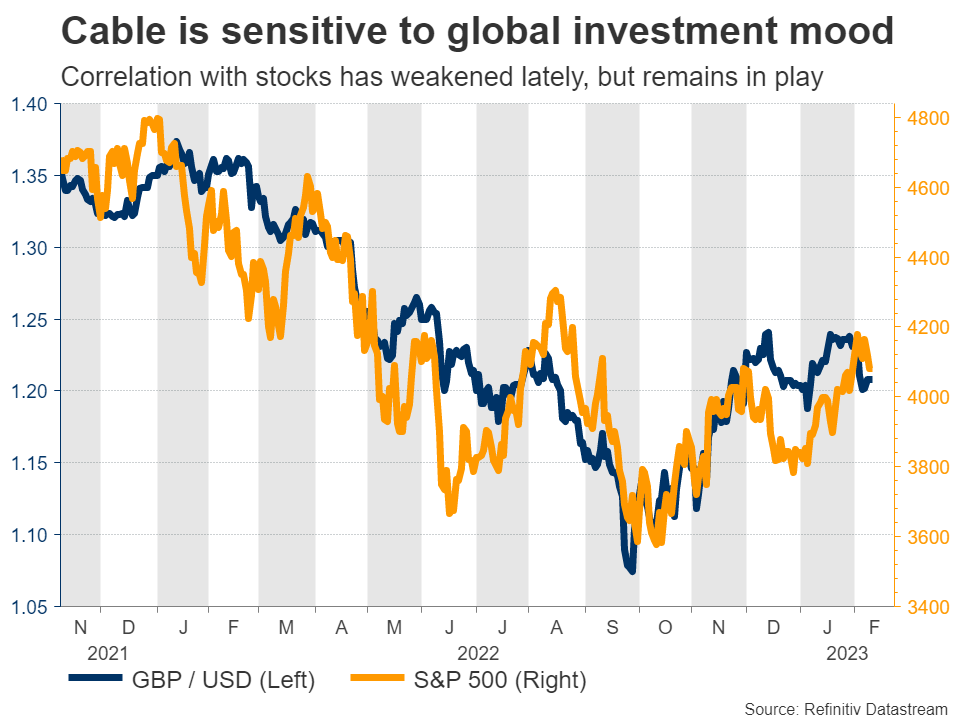
As for the pound, the outlook seems cloudy. The UK economy faces serious recession risks according to business surveys, while the Bank of England is sending mixed signals about rates. Meanwhile, US stock markets might be gearing up for another selloff as valuations have become unrealistic and earnings are contracting, leaving sterling vulnerable given its classic correlation with risky assets.
Finally in Australia, the employment report for January will be released Thursday. The Australian dollar is still the best performing major currency so far this year, riding the hype of China’s reopening. However, it is difficult to trust this rebound. Similar to sterling, the aussie is highly correlated with global risk sentiment, leaving it exposed in case the market mood deteriorates.
Who’s the New BOJ Governor?
Overnight, there was considerable movement in the USDJPY with rampant press speculation over who would be nominated as the next governor of the BOJ. There has been a lot of anticipation about the announcement, since the new governor is expected to provide a new direction for the bank. Remember that the current governor, Haruhiko Kuroda, is expected to step down in April at the end of his term (implying just one more meeting under his leadership).
Kuroda, of course, has been a perpetual dove, keeping rates in the negative for his entire tenure, with extraordinary easing in an effort to get organic inflation to rise. Recently, global conditions have caused higher inflation, and the BOJ has had to make some adjustments to its years-long stance.
The potential contenders
For a couple of months now, there has been speculation that the new BOJ governor would be more hawkish. Just as a matter of probability, simply because Kuroda is probably the most dovish central bank official around. The expectation was that he would maintain policy as is until the end of his term, but could tweak things in order to prepare the ground for his replacement. That included, studying the impact of eliminating YCC, and widening the band to allow some further appreciation in government bond yields.
One of the more cited replacements was Deputy BOJ Governor Masayoshi Amamiya, who is perhaps the only contender to equal if not beat Kuroda for dovishness. He had most recently said that he saw no need to tweak YCC policy, for example.
What caused the fire works
Last Monday, Nikkei reported that the Government was looking to nominate Amamiya for the top post at the BOJ. This would assure continuity of policy, and the markets took on a more dovish outlook for the yen. Then, on Thursday it emerged that the ruling LDP party was divided on whom to nominate for the BOJ. Mostly as there was a clear split between those who wanted to keep easing, and those who wanted the bank to tackle rising inflation. Who is confirmed as the governor would determine which of those two routes was chosen.
The big news was early this morning (for Europe and US; late afternoon for Asian traders) that Amamiya had rejected the offer to take the top spot in the BOJ. This was only reported in the press; the Finance Minister earlier in the day refused to comment on speculation, saying that he was unaware of the nomination schedule.
The state of play
Then Nikkei reported that the government was planning to nominate Kazuo Uedia, a former BOJ official who is now a professor at the University of Tokyo. Crucially, he hasn't made any public comments on central bank policy since 2011. He might be seen as a compromise candidate, not having a public stance on the current situation. Though his last public comment was to criticize easing.
The market reacted as the BOJ tooking on hawkish turn, basically because anyone besides Amamiya was seen as relatively hawkish. At the moment, it's still press speculation. The formal nomination hasn't been made yet, but the expectation is that it could happen most likely on Tuesday.
Weekly Focus – Recession or Re-acceleration?
Following a period where the discussion was not about if we would have a recession but how long and how deep it would get, focus has now turned to whether we will avoid recession and in fact could be seeing a mild re-acceleration of global growth. The main reason is 1) economic data has not been quite as bad as feared, 2) China has reopened earlier and faster than expected and 3) mild winter weather has pushed down gas and electricity prices. The change in sentiment has underpinned a rally in equity and credit market since October with emerging markets and euro risk assets taking the lead.
A strong US labour market report on Friday last week added to the sense that the global economy may actually be bottoming out going into the new year, see Research US - From soft landing to no landing?, 9 February. It is supported by an increase in global PMI for January, a decent rise in some of the most leading surveys in the euro area (Euro Sentix, ifo expectations) and a broad improvement of what we call the "growth tax", which is a summary of the change in financial conditions and energy prices. Order-inventory balances have also turned higher in for example US, the euro area and China. Hence, after a year with heavy clouds over the global economy, we start to see some rays of light, see also Research Global - Global manufacturing PMI heading higher in H1, 29 January.
The flip side is, though, that central banks will have to err on the hawkish side for longer. We did indeed see more signals over the past week from both the ECB and the Fed that more rate hikes will be needed to get inflation down - and keep it down. It led to a rebound in bond yields and in the middle of the week caused some headwinds to risk assets and metal prices.
US-China tensions flared up again after the US shot down an alleged Chinese 'spy balloon', which China claims is a civilian balloon for research of weather. It caused a short-term exchange of harsh rhetoric but things have already calmed down a bit. What will be more important is a likely visit to Taiwan by the new Speaker of the US House, Kevin McCarthy. It could happen during spring and would most likely trigger a similar strong response from China as was seen when Nancy Pelosi travelled to Taiwan in August.
Next week all eyes will be on the US CPI for January. Core inflation has surprised to the downside in recent months paving the way for the Fed to reduce the pace of hiking to 25bp steps. We look for core inflation to rise to 0.4% m/m, an increase from 0.3% m/m in December. It is still a too high run rate for the Fed to be comfortable with inflation moving back to the 2% target and we look for another two 25bp hikes in March and May with the risk of more hikes needed after that. Following the rise in rates this week, the market is now in line with our baseline scenario of two hikes but is still too optimistic in our view when it comes to the pricing of rate cuts in the second half of the year. We also get US retail sales, which will give more information on the state of the US consumer. Sales have been softer in recent months but consensus looks for a rebound in January based on high-frequency transaction data. In Europe we have no big data releases but the European Commission will publish new forecasts, where focus is on their stance on recession and how fast inflation comes down.
Sunset Market Commentary
Markets
In a session deprived of major eco data releases on both sides of the Atlantic, US and European bonds suffered further fall-through losses after yesterday’s late session U-turn on US markets. Over there, a poor 30-y Treasury auction highlighted that an easy investor pick-up of massive bond supply wasn’t as evident as markets were inclined to take for granted of late. In mainly technical trade, US yields are adding between 1 bps (2-y) and 5 bps (30-y). Headlines on Russia cutting its oil output by 500 000 barrels a day from next month maybe added to inflationary fears, further supporting core bond yields. Brent oil in a first reaction jumped from $ 84 p/b to almost $87 b/p, but the move is already partially reversed ($85.5). Even so, in a bear flattening move, German yields also gain between 5.5 bps (2-y) and 4.0 bps (30-y). Fore now, the rise in global core yields still only has a limited impact on intra-EMU government bond spreads (10-y spread Italy-Germany +2 bps). The combination of higher yields and some additional uncertainty on the oil market this time was a good enough reason for equity investors to reduce some exposure. Losses are substantial (EuroStoxx 50 -1.2%, Nasdaq -0.75%). For now, no key technical references have been broken, but the remarkable rally since the start of the year this week shows signs of fatigue. After finishing this report, in the US, consumer confidence of the U. of Michigan (including closely watched measures of consumer inflation expectations) still might affect trading going into the weekend.
On FX markets, risk-off sentiment reinstalled a better bid for the US dollar. Still the gains remain modest. DXY trades at 103.35. EUR/USD is at risk of slipping below the 1.07 big figure. The 1.0669 correction low is coming within reach. USD/JPY showed some wild intraday swings. The yen jumped from USD/JPY 131.50 to below 130 on headlines that the Japanese government will appoint Kazuo Ueda as successor of governor Kuroda as the next BOJ head. He is seen being less of a dove compared to deputy Governor Masayoshi Amamiya, who was seen in pole position for the job. However, Ueda in a first reaction indicated that current easy BOJ policy is appropriate and needs to be continued, for now. The yen reversed part of its early gain but at USD/JPY 130.75, the yen still outperforms the other majors, despite higher core (EMU & US) yields. Sterling again showed remarkable strength today. UK data this morning showed that the UK just avoided a technical recession with ‘growth’ at 0.0% after a 0.3% contraction in Q3. Whether this is something to be very happy about remains to be seen, especially as the monthly December GDP estimate (-0.5%) was weaker than expected. Still, sterling extended this week’s rebound, with EUR/GBP currently trading near 0.8835 (from 0.886).
News & Views
Hungarian inflation soared from 24.5% in December to 25.7% y/y (2.3% m/m) in January, more than expected. Core inflation sped up as well, to 25.4%. Services inflation was to blame for the upward surprise and with strong wage growth in the pipeline there may be no letup in the short run. Gas and electricity prices moderated thanks to the mild winter. Headline inflation could start to ease from February on thanks to base effects. The government’s decision whether or not to extend the price cap on some food products beyond April is a wildcard for the subsequent decline though. Provided the disinflationary process indeed started from this month on and on the condition that the Hungarian forint stays around current levels (EUR/HUF 390.30 currently, slightly weaker than at the open), we assume the central bank to cut the overnight deposit tender rate from 18% to 17% at the March meeting.
Czech inflation soared 6% m/m to be up 17.5% y/y in January. The sharp increase followed the government’s decision to discontinue the energy savings tariff for households and instead introducing a price cap. Core inflation eased further, to 12.3%, with both goods and services prices moderating. Today’s numbers were more than analysts expected but broadly in line with (even slightly lower than) the Czech National Bank’s winter forecasts. The CNB assumes the January acceleration in early 2023 to be temporary before decreasing rapidly to single digits in 2023H2 and close to the 2% target in the beginning of 2024 with a tight monetary policy stance (7% and to remain there for longer than markets expect, dixit governor Michl) contributing to the decline. The Czech koruna trades unchanged near its 2008 high of EUR/CZK 23.70.
Canada’s Jobs Market Bursts Out of the Gates in 2023
The Canadian labour market added 150k positions in January, with full-time employment up 121k and part-time employment up 28.9k.
The unemployment rate held steady at 5.0%. The participation rate rose to 65.7% (up 0.3 percentage points).
By industry, employment was up in trade (+59k), health care (+40k), and education (+18k). Losses were seen in transportation and warehousing (-17k).
Lastly, total hours worked were up 0.8% month-on-month and wages were up 4.5% year-on-year in January, a slight deceleration from a 4.8% y/y pace in December.
Key Implications
It was a blowout report for the Canadian labour market. The 150k jobs gain is one thing, but the fact that gains were concentrated in full-time jobs in the private sector, alongside people working more hours, makes this an even more impressive report. Although the seasonal adjustment should be called into question, the sheer size of this print points to a further boost to consumer spending and overall GDP to start the year.
Today's report is sure to raise eyebrows at the Bank of Canada. Their conditional pause on further rate hikes is predicated on a slowing of economic growth and an easing in the labour market. The Bank won't adjust course after one report, but it will be closely watching to see if this trend of massive job gains continues.
ECB Schnabel: Rates must reach a sufficiently restrictive level
ECB Executive Board member Isabel Schnabel said in Twitter Q&A, "further rate hikes will help bring inflation back to our target, which – given nominal wages – will increase real wages."
"Rates must reach a sufficiently restrictive level ... (and) we'll keep rates high until we see robust evidence that underlying inflation returns to our target," she added.