

Sample Category Title
USD/CAD Weekly Outlook
USD/CAD struggled to sustain above 55 day EMA (now at 1.3441) last week and retreated. Initial bias stays neutral this week first. The choppy decline from 1.3704 might still extend lower, but strong support is expected to 1.3224 key support to bring rebound. On the upside, above 1.3519 resistance will confirm short term bottoming, and turn intraday bias back to the upside for retesting 1.3704 resistance. However, decisive break of 1.3224 would carry larger bearish implication.
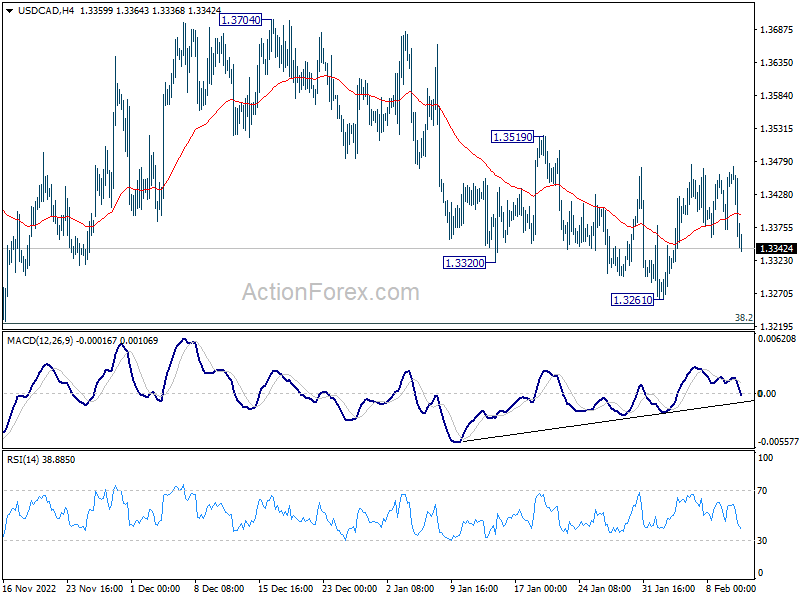
In the bigger picture, as long as 1.3222 cluster support (38.2% retracement of 1.2005 to 1.3976 at 1.3223) holds, larger up trend from 1.2005 (2021 low) is still expected to resume through 1.3976 high at a later stage. However, firm break of 1.3222/3 will indicate that the trend might have reversed. Deeper fall would be seen to next cluster support at 1.2726 (61.8% retracement at 1.2758).
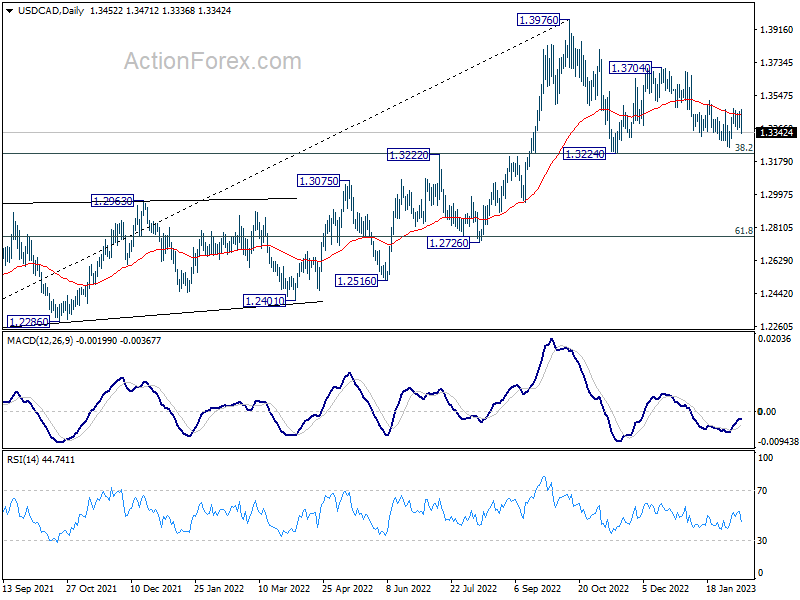
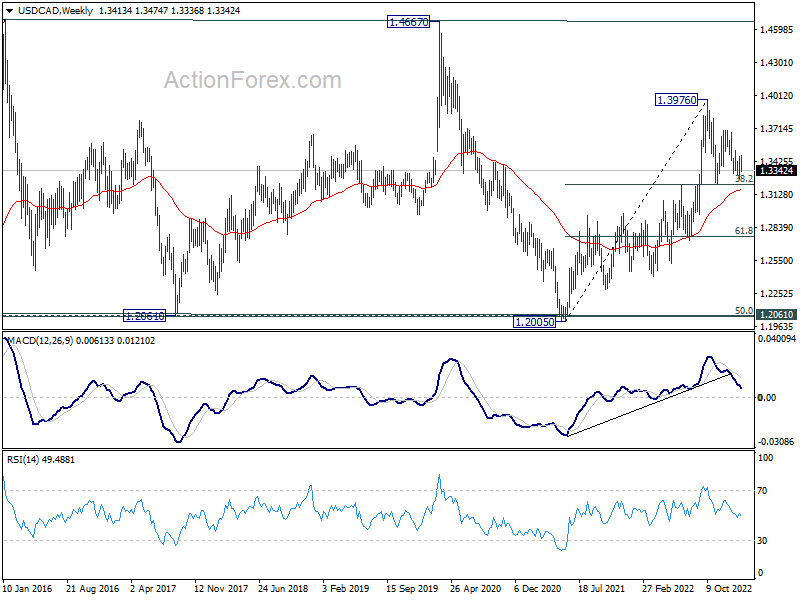
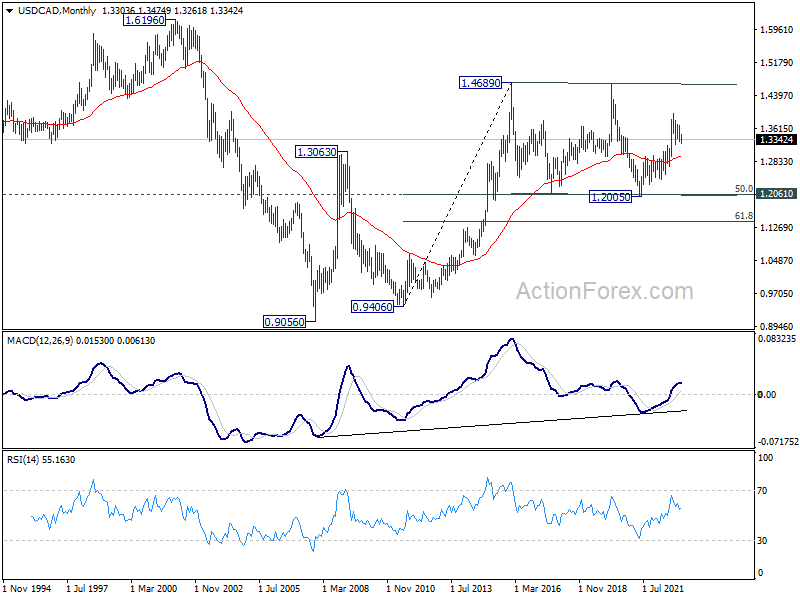
In the longer term picture, price actions from 1.4689 (2016 high) are seen as a consolidation pattern only, which might have completed at 1.2005. That is, up trend from 0.9506 (2007 low) is expected to resume at a later stage. This will remain the favored case as 55 month EMA (now at 1.2962) holds.
GBP/JPY Weekly Outlook
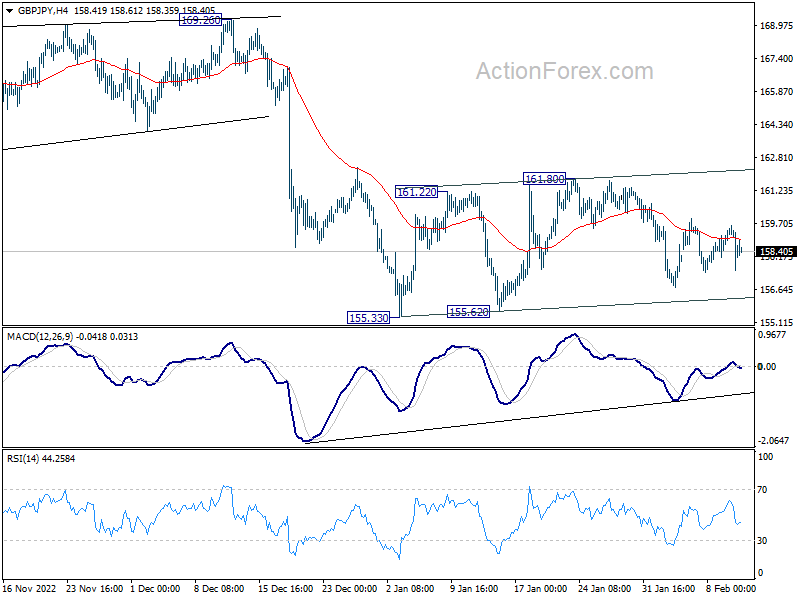
GBP/JPY stayed in range above 155.33 last week and outlook is unchanged. Initial bias stays neutral this week and further decline is in favor. On the downside, break of 155.33 low will resume the fall from 172.11 to 153.70 fibonacci level next. On the upside, sustained trading above 55 day EMA (now at 161.04) will turn bias to the upside, for stronger rise back to 169.26/172.11 resistance zone.
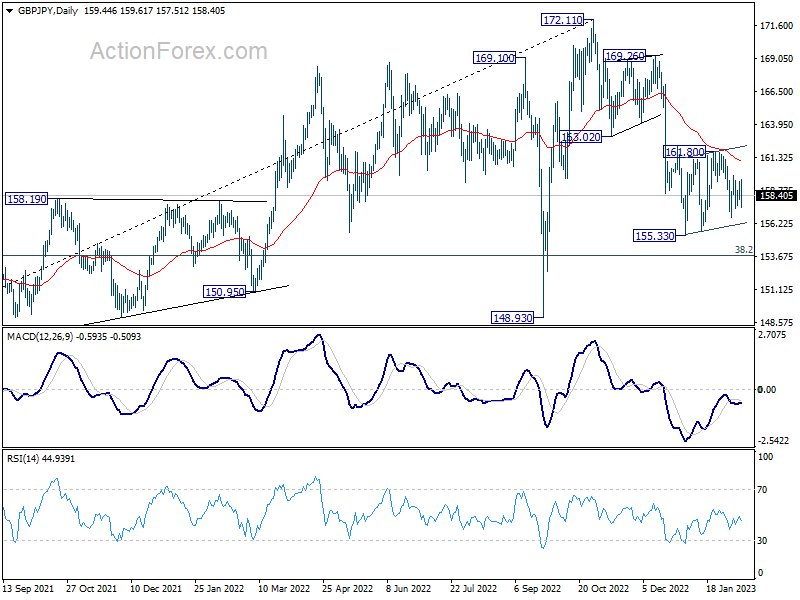
In the bigger picture, as long as 163.02 support turned resistance holds, decline from 172.11 medium term top is expected to continue to 38.2% retracement of 123.94 to 172.11 at 153.70. Sustained break there will raise the change of trend reversal and target 61.8% retracement at 142.34. Nevertheless, break of 163.02 support turned resistance will argue that the decline has completed, and retain medium term bullishness.
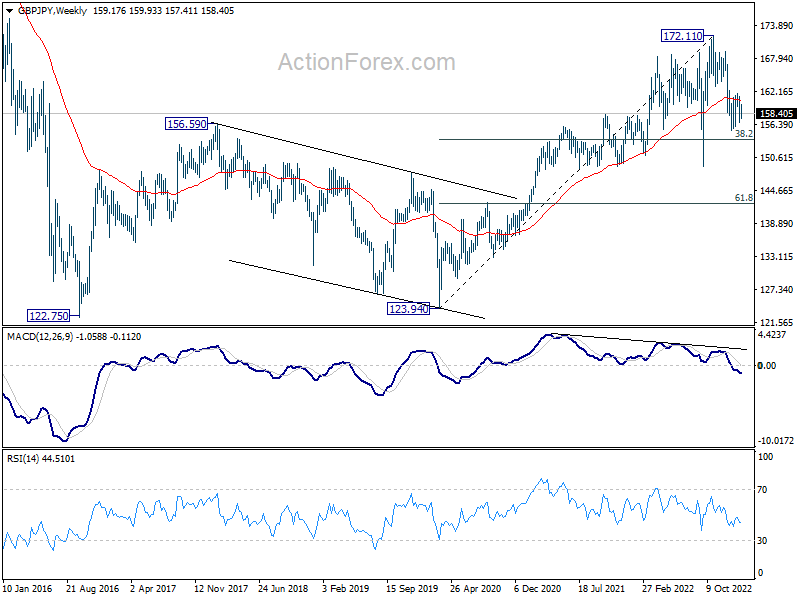
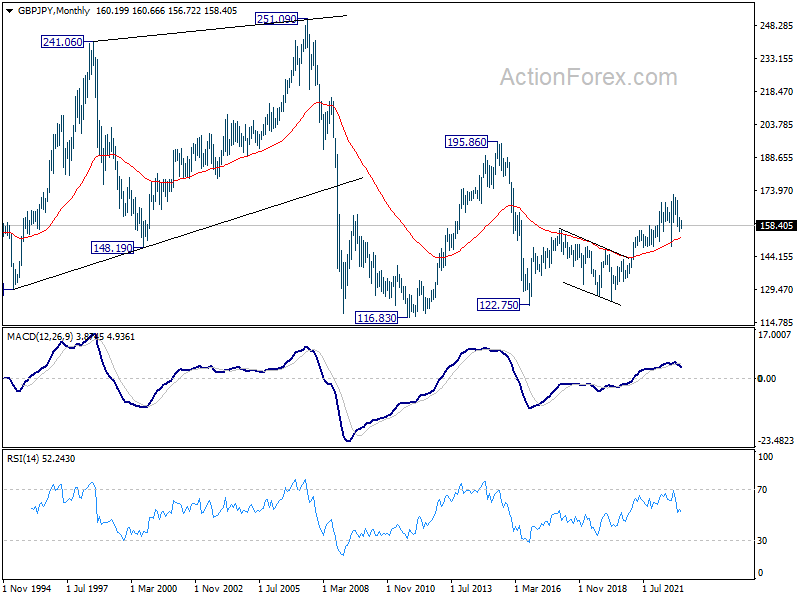
In the longer term picture, as long as 55 month EMA (now at 152.38) holds, rise from 122.75 could still extend higher at a later stage.
EUR/JPY Weekly Outlook
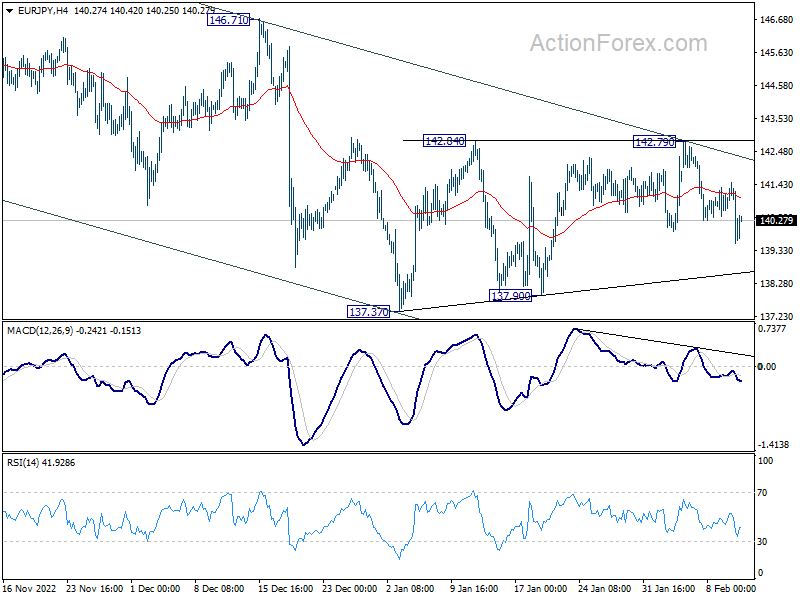
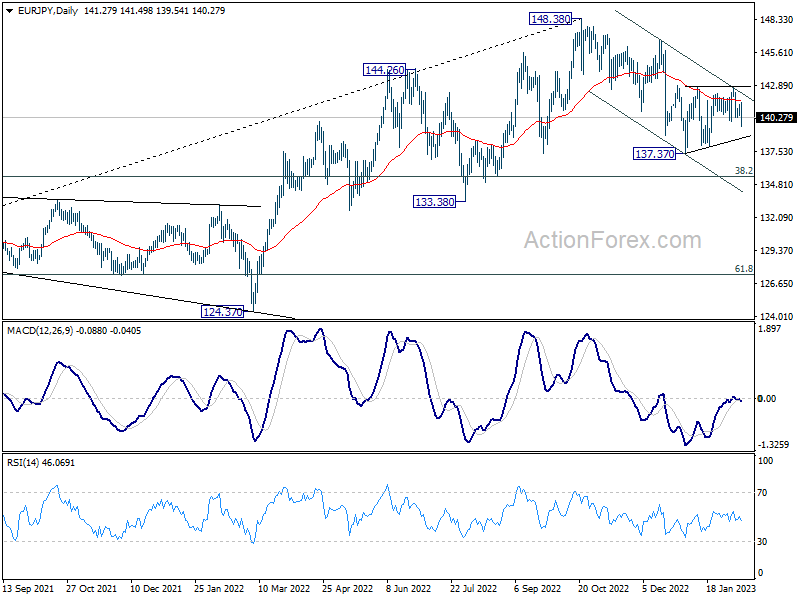
EUR/JPY stayed in range of 137.37/142.84 last week and outlook is unchanged. Further decline is mildly in favor. Break of 137.37 will resume the whole fall from 148.38 to 135.40 fibonacci level. On the upside, however, break of 142.84 will argue that the correction from 148.38 has completed at 137.37 already. Further rise would be seen to 146.71 resistance next.
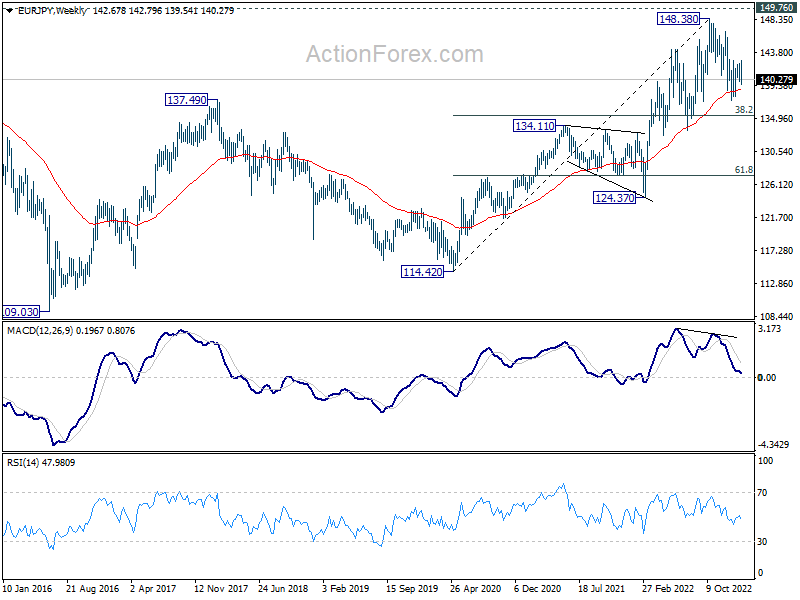
In the bigger picture, as long as 55 week EMA (now at 138.87) holds, larger up trend from 114.42 (2020 low) is still in progress for 149.76 long term resistance. However, firm break of 55 week EMA will bring deeper fall to 38.2% retracement of 114.42 to 148.38 at 135.40. Sustained break there will raise the chance of trend reversal, and target 61.8% retracement at 127.39.
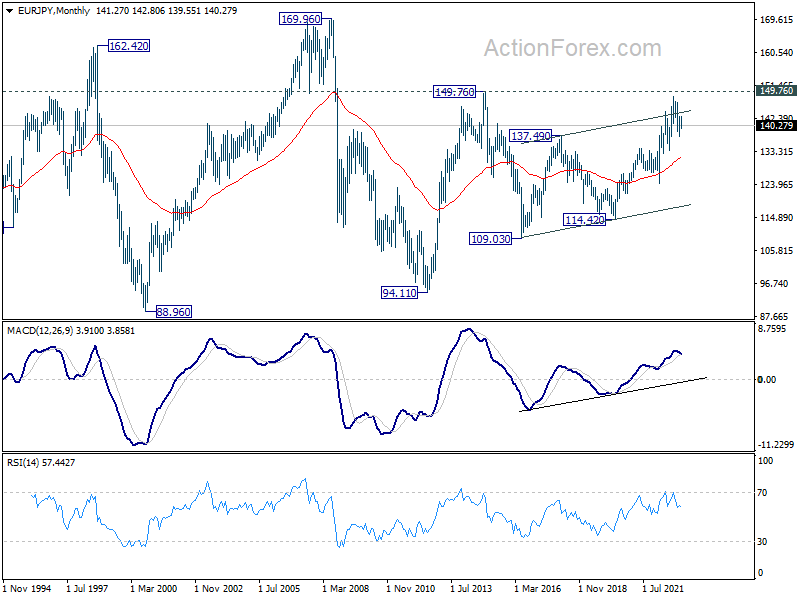
In the long term picture, outlook will stay bullish as long as 134.11 resistance turned support holds (2021 high). Sustained break of 149.76 (2014 high) will open up further rally, as resumption of the rise from 94.11 (2012 low), towards 169.96 (2008 high).
EUR/GBP Weekly Outlook
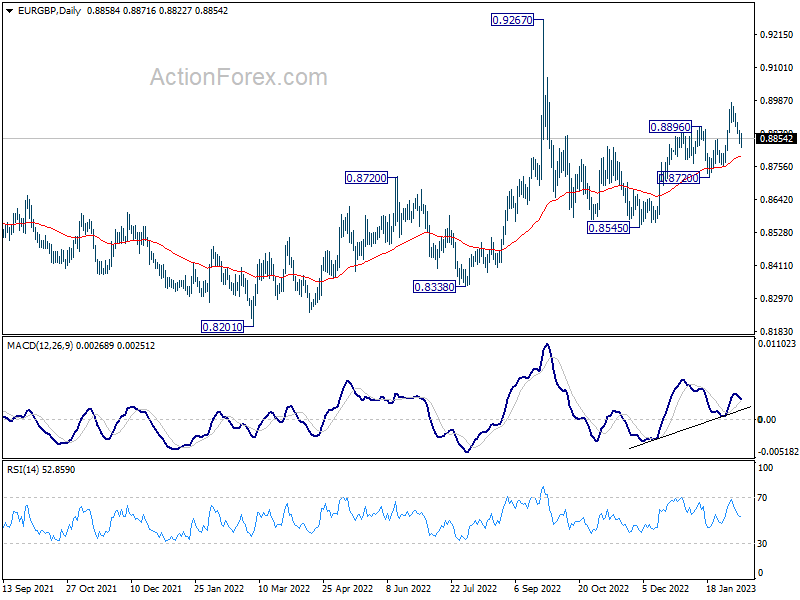
EUR/GBP's retreat from 0.8977 extended lower last week but stays well above 0.8720 support. Initial bias remains neutral this week first. On the upside, break of 0.8977 will resume whole rebound from 0.8545 towards 0.9267 high. On the downside, however, break of 0.8270 will turn near term outlook bearish again.
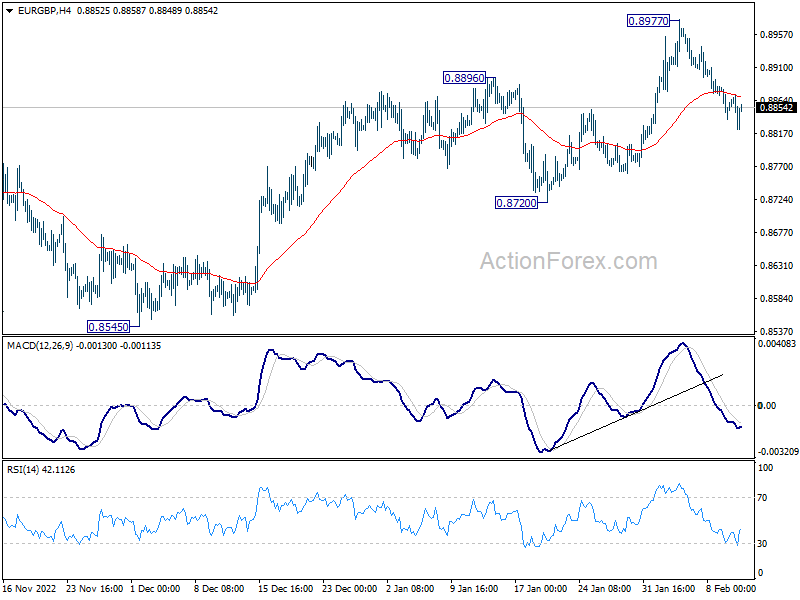
In the bigger picture, the notable support from 55 day EMA (now at 0.8780) retains near term bullishness. Break of 0.8896 should target 0.9267 (2022 high) and possibly above, to resume whole up trend from 0.8201 (2022 low). However, break of 0.8270 support and sustained trading below 55 day EMA will set the stage for 0.8545 and below.
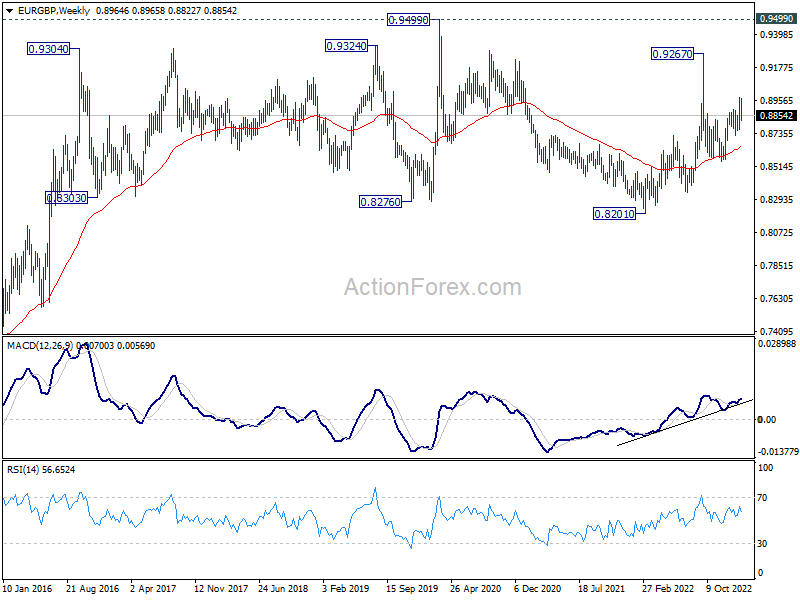
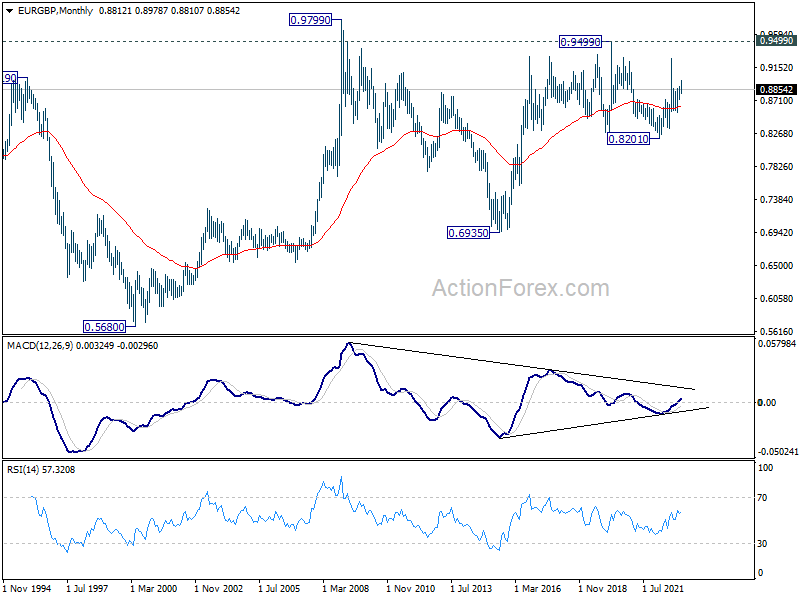
In the long term picture, long term range pattern is extending. But rise from 0.6935 (2015 low) is expected to extend at a later stage, to 0.9799 (2009 high).
EUR/AUD Weekly Outlook
While EUR/AUD dropped notably last week, downside is contained well above 1.5254/71 support zone. Initial bias stays neutral first. On the downside, firm break of 1.5254/71 will carry larger bearish implication and resume the fall from 1.5976. On the upside, above 1.5650 will resume the rebound to 1.5749 resistance.
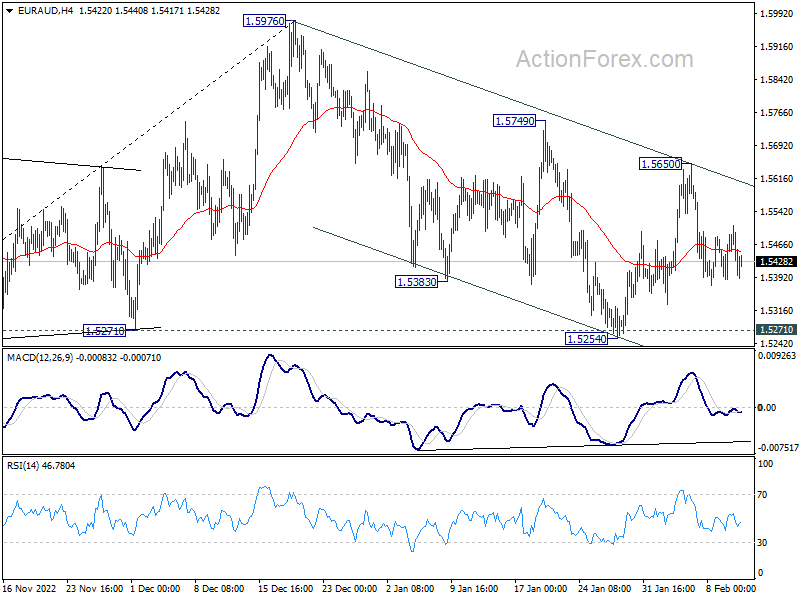
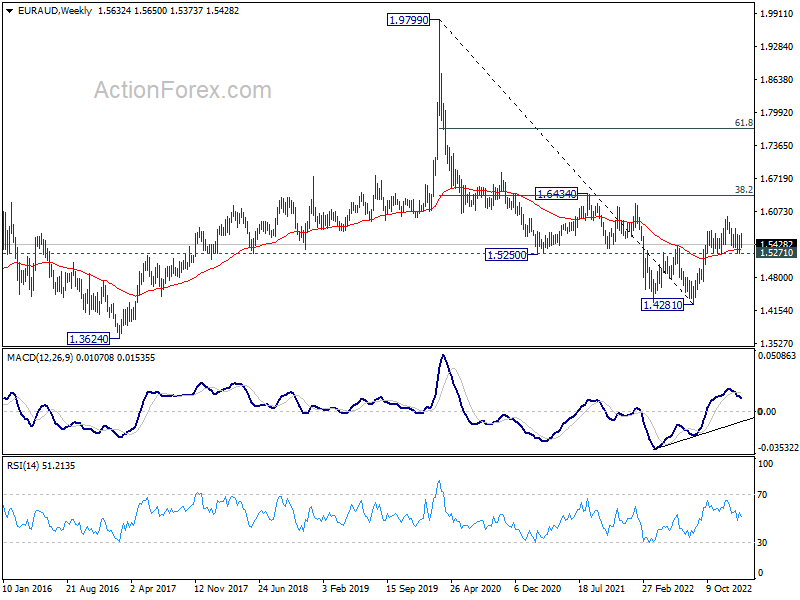
In the bigger picture, it's still early to confirm if rise from 1.4281 represents bullish trend reversal. But as long as 1.5271 support holds, such rally is in favor to continue. Break of 1.5976 will target 1.6434 key resistance next. On the other hand, firm break of 1.5271 will retain medium term bearishness instead.
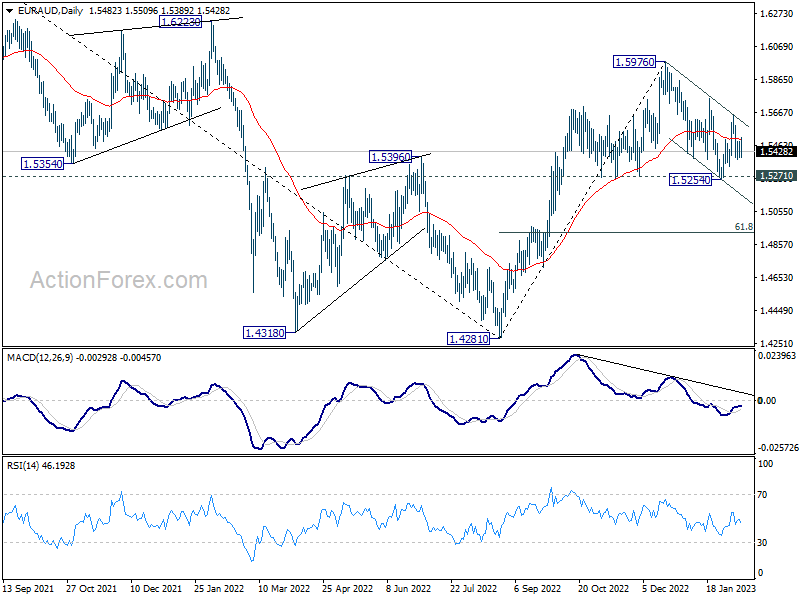
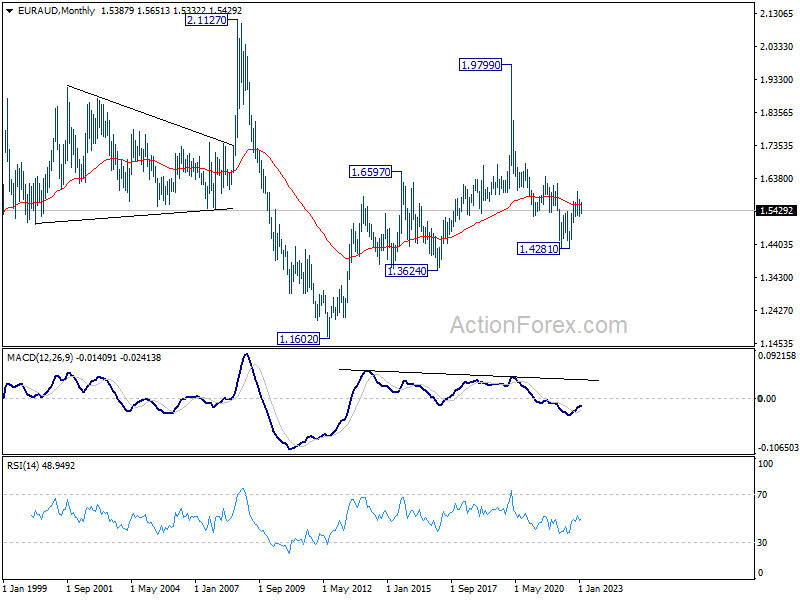
In the longer term picture, focus stays on 55 month EMA (now at 1.5595). Sustained trading above there will raise the chance of bullish trend reversal, and at least bring further rally to 1.6434 cluster resistance, 38.2% retracement of 1.9799 (2020 high) to 1.4281 at 1.6389. However, rejection by 55 month EMA will suggest that down trend from 1.9799 is still in progress for another low below 1.4281.
EUR/CHF Weekly Outlook
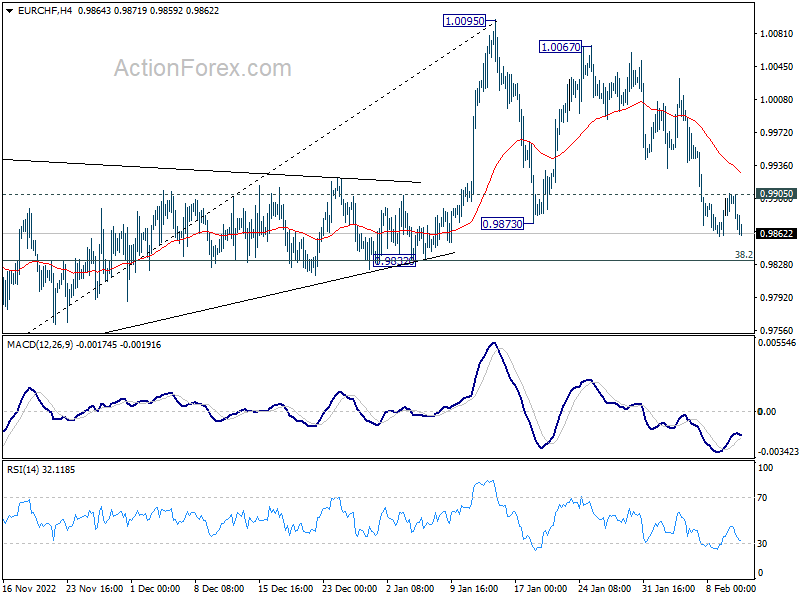
EUR/CHF's corrective pattern from 1.0095 continued last week and dropped to 0.9858. Further decline could still be seen this week. But downside be contained by 38.2% retracement of 0.9407 to 1.0095 at 0.9832 to bring rebound. On the upside, break of 0.9905 minor resistance will turn bias back to the upside for 4 hour 55 EMA (now at 0.9927) and above.
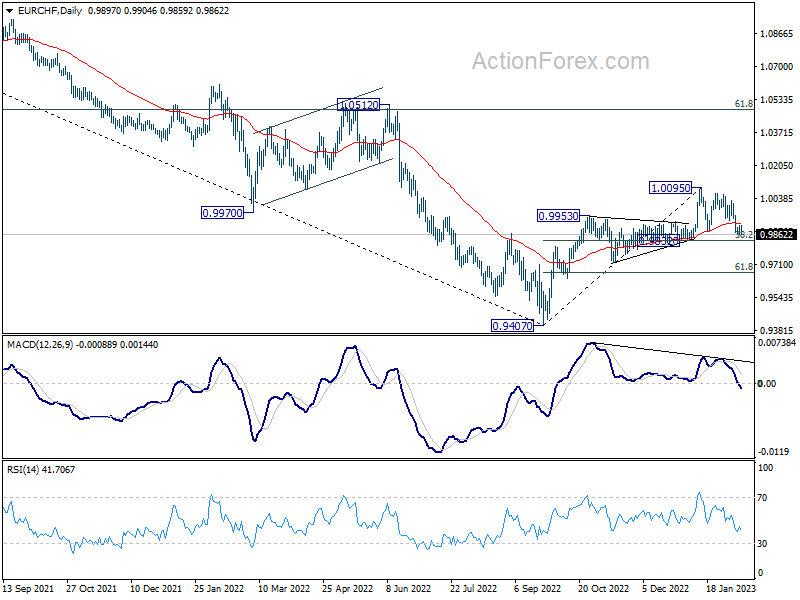
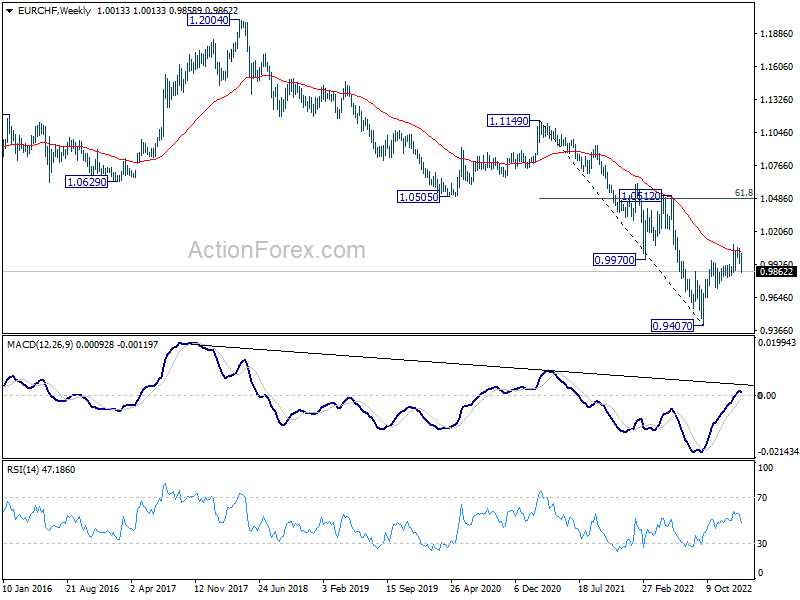
In the bigger picture, the rejection by 55 week EMA (now at 1.0039) mixed up the outlook. On the upside, sustained trading above 55 week EMA will raise the chance of bullish trend reversal. Rise from 0.9407 should then target 1.0505 cluster resistance (2020 low at 1.0505, 61.8% retracement of 1.1149 to 0.9407 at 1.1484). However, firm break of 0.9832 support will revive medium term bearishness and bring retest of 0.9407 low instead.
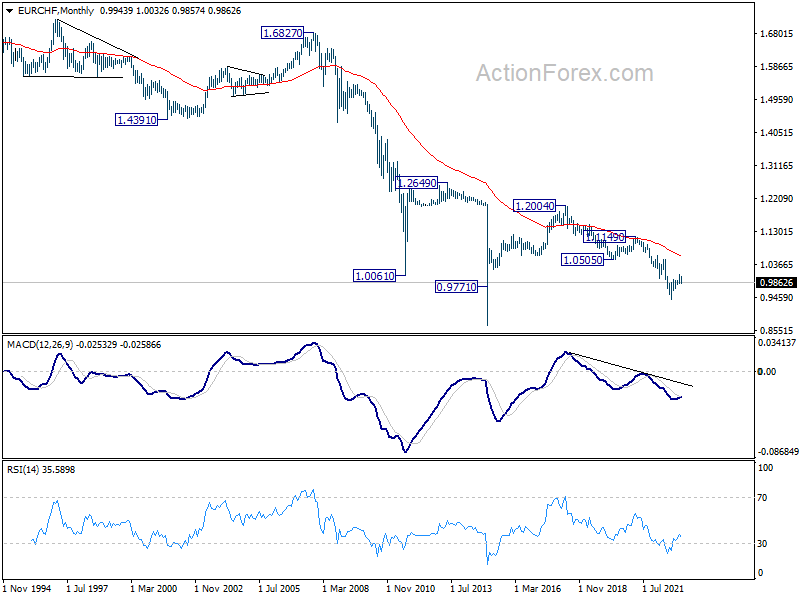
In the long term picture, it's still way to early too call for bullish trend reversal with upside capped well below 55 month EMA and 1.0505 support turned resistance (2020 low).
Dollar Mixed Despite Bet on Fed Peaking at 6%
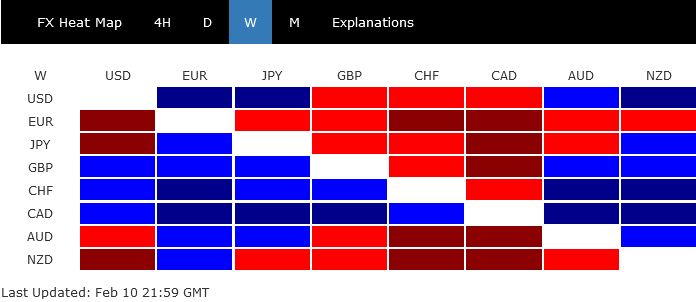
While the economic calendar was relatively light, the week was full of surprise. The biggest one was the big wagers that put on Fed interest rate peaking at 6%. Rumors and speculations about the next BoJ Governor triggered some volatility. Meanwhile, the blockbuster Canadian job data came in and blew everyone away.
Canadian Dollar eventually ended as the best performer, followed by Sterling and Swiss Franc. The latter two were clearly helped by selloff in Euro, which ended as the worst performer. Kiwi were the second worst, followed by Yen. Aussie was just mixed after hawkish RBA hike. Dollar was also mixed, and need some inspirations from the upcoming CPI report.
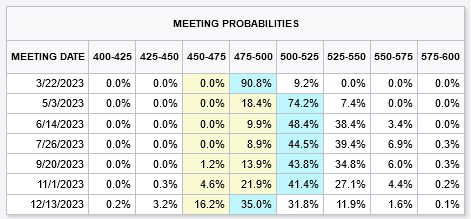
Market expecting Fed to peak at 5.00-5.25%, despite big wagers on 6%
The juiciest news last week was probably the big wagers in the US on betting Fed interest rate hitting 6% this year, comparing to Fed's own projection of 5.10%. The move came after prior week's stellar non-farm payroll data, as well as hawkish comments from Fed officials, including Chair Jerome Powell.
In short, for one of the traders, they would make as much as USD 135m if Fed continues tightening until September. That is, there will by five more 25 bps hike in March, May, June, July, and September, to bring interest rate target from current 4.50-4.75% to 4.75-6.0%. The trade will break even at if Fed hikes to 5.6%, and USD 60m at 5.8%.
But after all, speculations of some traders are not the whole of the markets. Fed funds futures are now pricing in a pause after two more 25bps hikes in March and May, to 5.00-5.25%. The majority seemed finally giving a nod to Fed officials' views. Nevertheless, they're still seeing more than 50% of a cut in December. Let's see when the markets will change their mind.
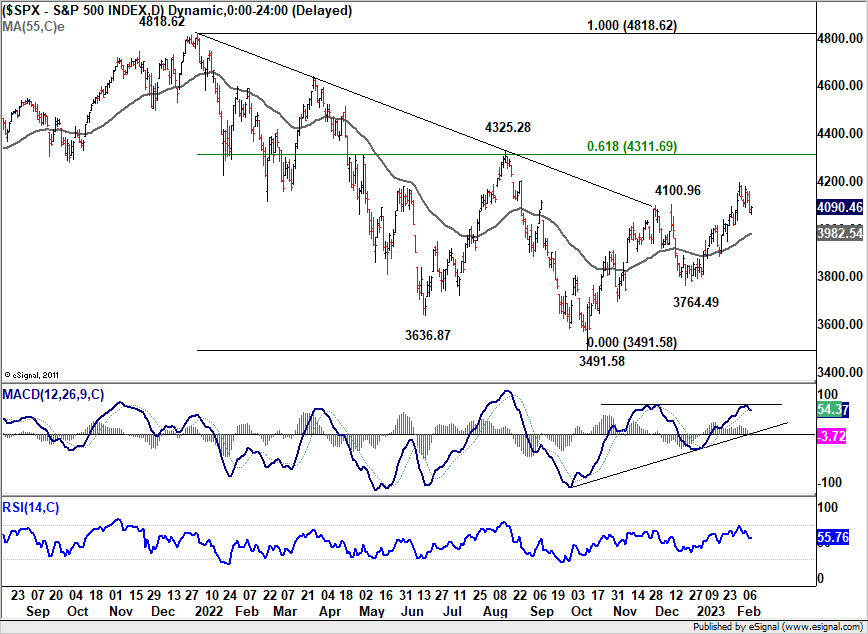
More upside in 10-year yield after completing correction
In the US stock markets, sentiment was a little bit "off" but the pullback was so far shallow. Further rally is expected in S&P 500 as long as 55 day EMA (now at 3982.54) holds. Current rise form 3491.58 should still extend higher, even as a corrective move, to 4325.28 cluster resistance (61.8% retracement of 4818.62 to 3491.58 at 4311.69).
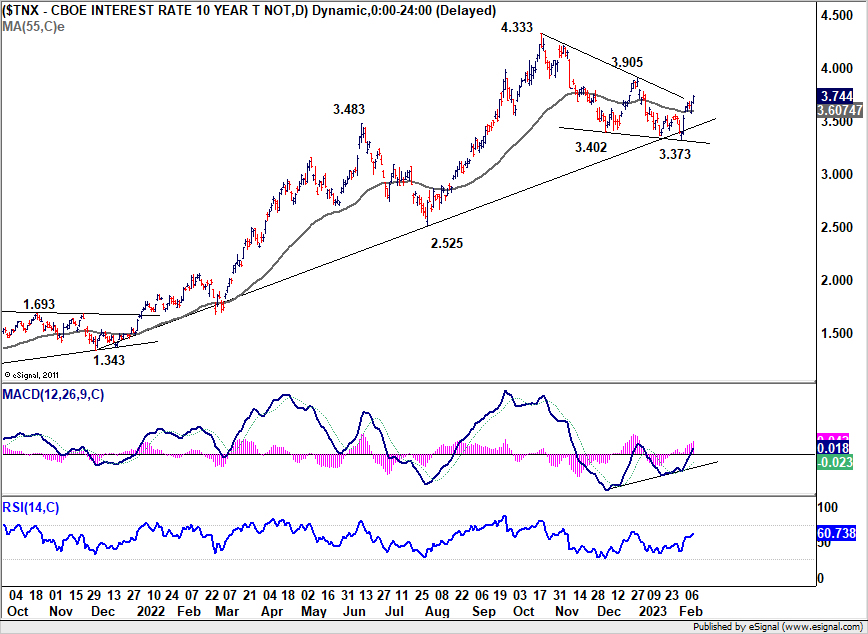
The development in 10-year yield is worth much attention in the coming weeks. Strong support from 55 day EMA (now at 3.607) is certainly a bullish sign. Correction from 4.333 has likely completed with three waves down to 3.373, after hitting medium term channel support. Further rise should be seen to 3.905 resistance first. Decisive break there could set the stage to 4.333 and possibly long term up trend resumption, in the latter half of the year. That, if happens, would be an indication of prolonged above target inflation and Fed tightening.
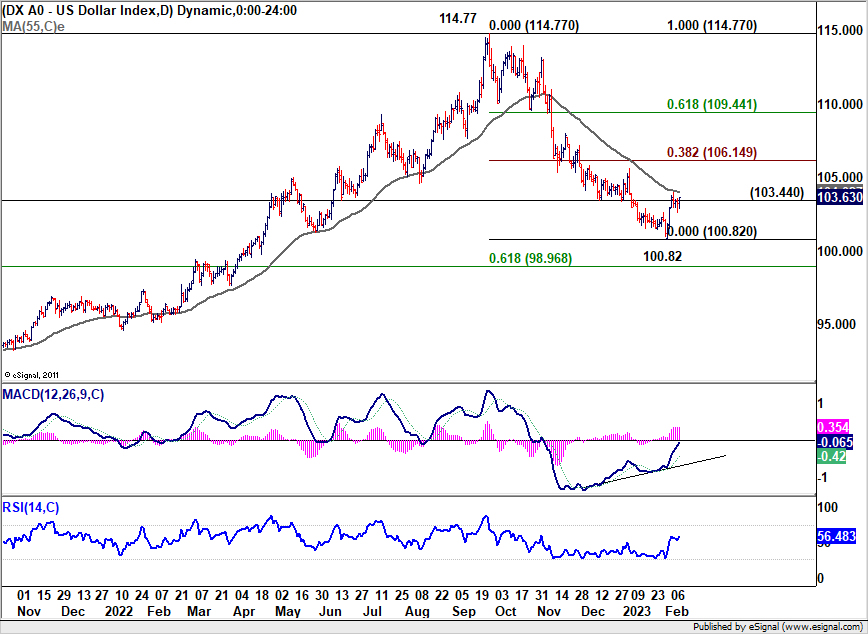
As for the Dollar Index, the break of 103.44 resistance last week should confirm short term bottoming at 100.82, on bullish convergence condition in daily MACD. Immediate focus is now on 55 day EMA (now at 104.02). Sustained break there will bring stronger rebound back to 38.2% retracement of 114.77 to 100.82 at 106.14, even as a corrective move. If that happens, it would likely mean that Fed is likely to continue the tightening cycle longer, even longer than the ECB which may pause after May.
CAD surges after job data, EUR/CAD in correction
The blockbuster Canadian job report was another surprise in the week. While the 150k headline growth blew all expectations away, the details were also exceptional strong, with gains concentrated in full-time jobs in the private sector, and more working hours. Probably, the only goods news to BoC is the slowdown in wage growth.
Talking about BoC, it made itself clear in the minutes that the pause in tightening is "conditional" while "the bar for additional rate increases was now higher". One set of data is definitely not enough to alter BoC's course. But it should have definitely made the board nervous and raise the chance of going back to rate hikes at a later stage.
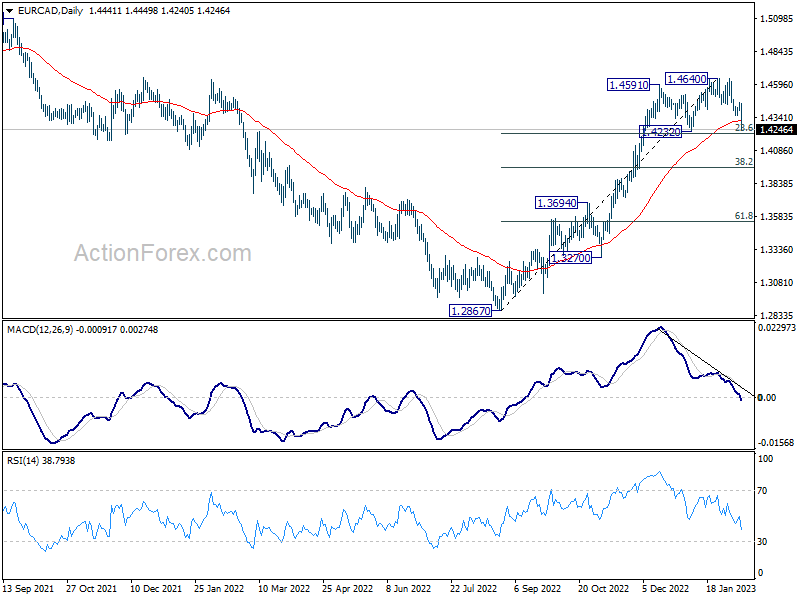
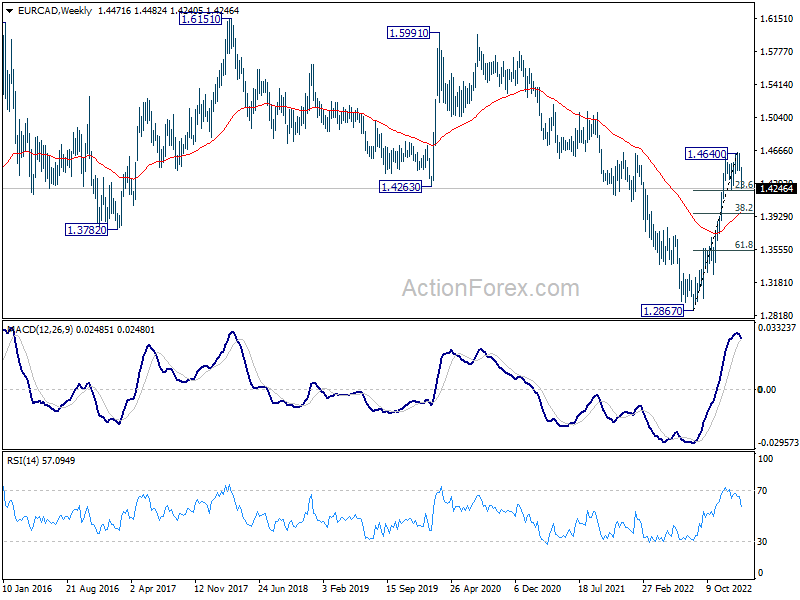
EUR/CAD was the top mover last week, losing -1.51%. The development now suggests that a short term top was at least formed at 1.4640. Indeed, fall from there should be correcting whole up trend from 1.2867. Firm break below 1.4232 support will set the stage for 38.2% retracement of 1.2867 to 1.4640 at 1.3963.
Considering that 55 week EMA is now sitting at 1.3955, downside on pullback should be contained by 1.3963, at least on first attempt, to bring rebound.
Risk on Yen tilted to the downside on BoJ nomination
Lots of jitters were seen in Japanese Yen last week, on news regarding the new BoJ Governor, after Haruhiko Kuroda's term ends in April. Initially, there was talks that current deputy Masayoshi Amamiya would be nominated by the government. Yen gapped down the week as Amamiya was seen as continuation of Kuroda's ultra loose policy.
Then, Yen was shot up later in the week on reports that academic, and former BoJ board member, Kazuo Ueda would be nominated instead. That's seen a an intention of the government to direct away from the current path. Yet, Ueda sounded composed in telling NTV that "The Bank of Japan's current policy is appropriate and monetary easing needs to be continued at this point." Then Yen came down.
The question on who the next BoJ is should be answered rather soon, as the government would table nomination on February 14.
Risks to Yen could now be a bit skewed to the downside. While Ueda is not the "dove" as Kuroda as perceived by some, he's not likely the "hawk" that some would hope for.
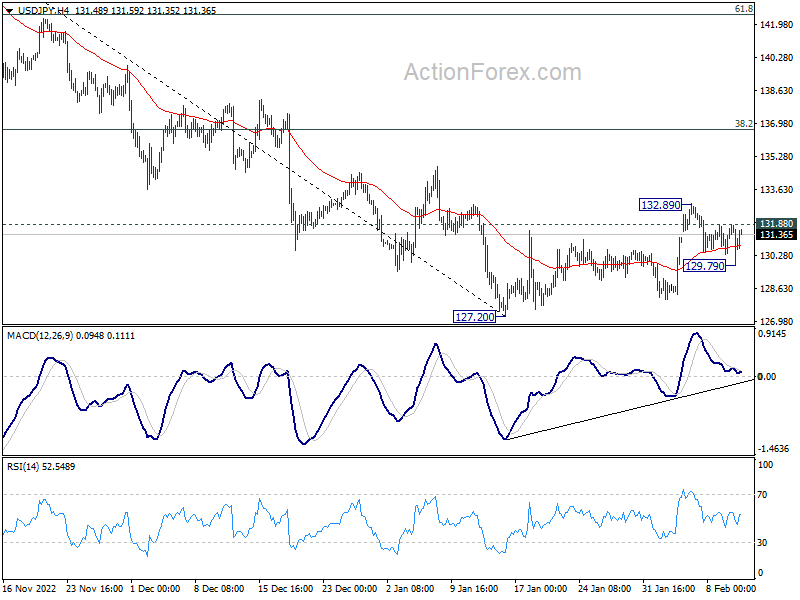
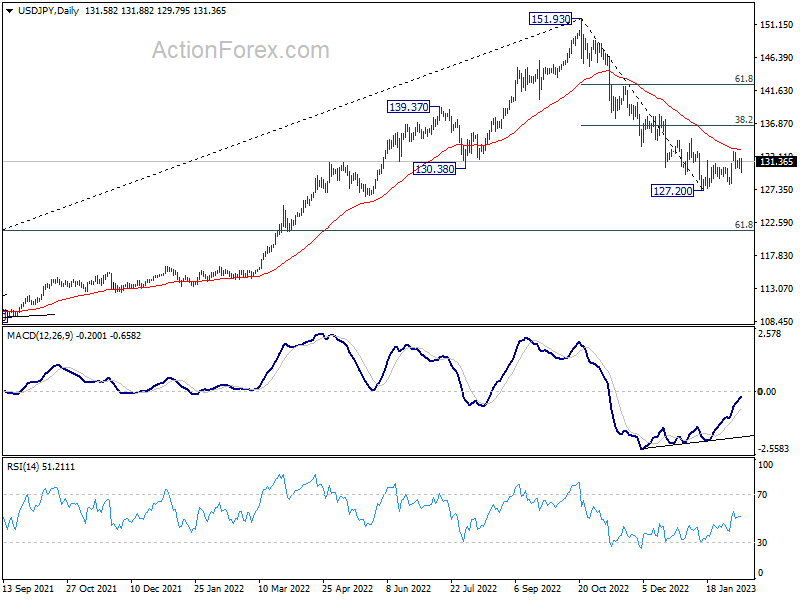
While USD/JPY's pull back from 132.89 was deeper than expected, it's looking more like a corrective move than not. That is, rebound from 127.20 is likely not over yet. Break of 131.88 minor resistance will bring retest of 132.89 first. Decisive break there will resume the rebound to 38.2% retracement of 151.93 to 127.20 at 136.64.
EUR/USD Weekly Outlook
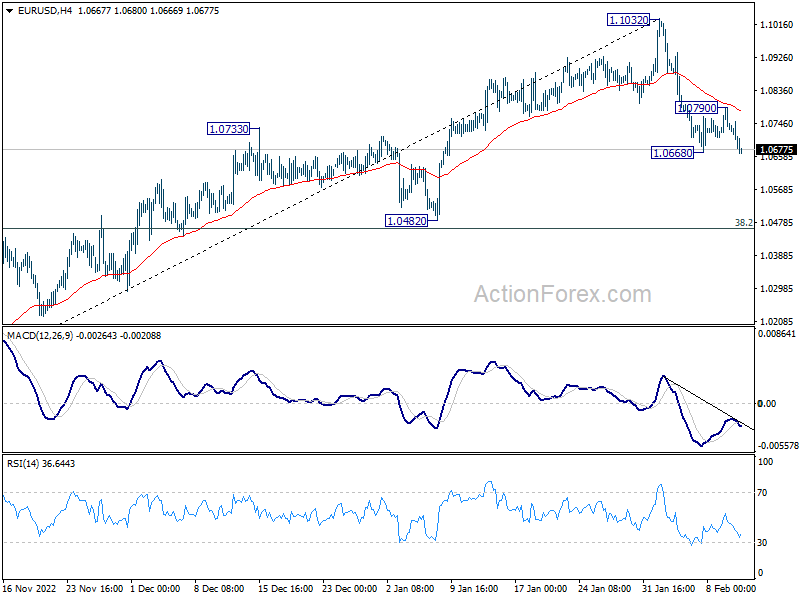
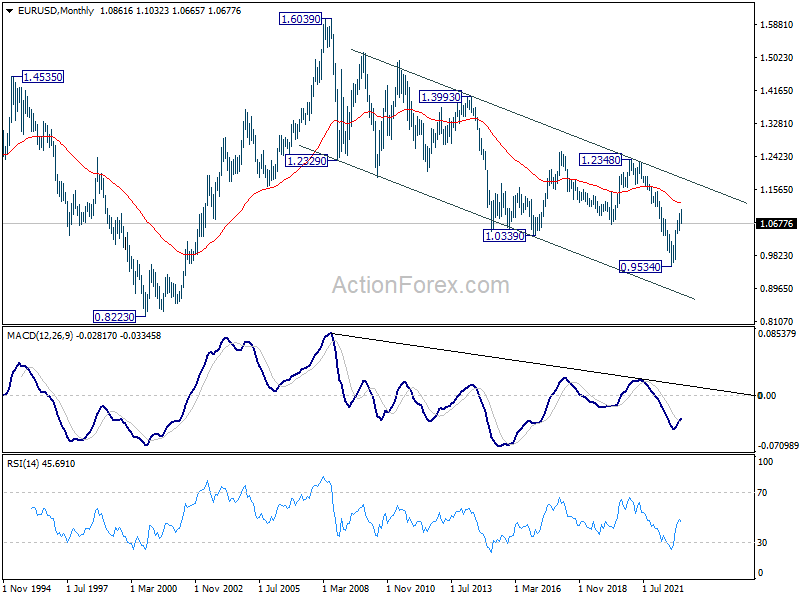
EUR/USD's decline last week indicates that it's already in correction to whole up trend from 0.9534. Rejection by 4 hour 55 EMA maintains near term bearishness and favors more downside. Break of 1.0668 temporary low this week will bring deeper fall to 38.2% retracement of 0.9534 to 1.1032 at 1.0463. Nevertheless, on the upside, break of 1.0790 minor resistance will turn bias back to the upside for retesting 1.1032 high instead.
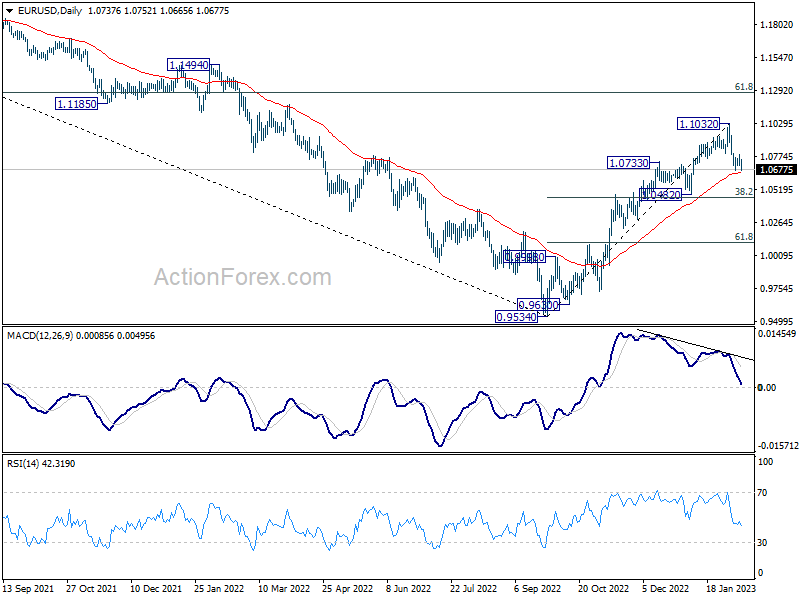
In the bigger picture, the rally from 0.9534 low (2022 low) is a medium term up trend rather than a correction. Further rise is in favor to 61.8% retracement of 1.2348 (2021 high) to 0.9534 at 1.1273 next. This will remain the favored case as long as 1.0482 support holds.
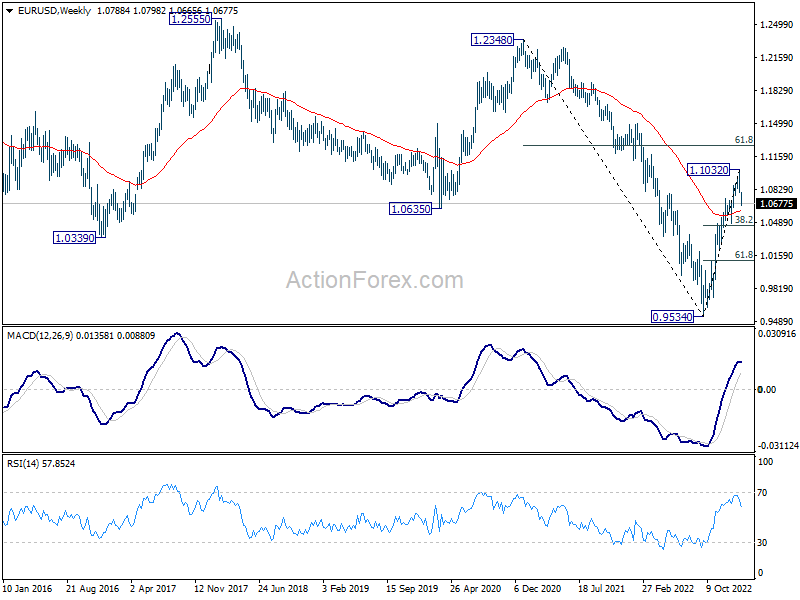
In the long term picture, while it's too early to call for long term trend reversal at this point, the strong break of 1.0635 support turned resistance (2020 low) should at least turn outlook neutral. Focus will turn to 55 month EMA (now at 1.1189). Rejection by this EMA will revive long term bearishness.
Summary 2/13 – 2/17
Monday, Feb 13, 2023
| GMT | Ccy | Events | Consensus | Previous |
|---|---|---|---|---|
| 07:30 | CHF | CPI M/M Jan | 0.50% | -0.20% |
| 07:30 | CHF | CPI Y/Y Jan | 2.70% | 2.80% |
| 23:30 | AUD | Westpac Consumer Confidence Feb | 5.00% | |
| 23:50 | JPY | GDP Q/Q Q4 P | 0.50% | -0.20% |
| 23:50 | JPY | GDP Deflator Y/Y Q4 P | 1.10% | -0.30% |
| GMT | Ccy | Events | |
|---|---|---|---|
| 07:30 | CHF | CPI M/M Jan | |
| Forecast: 0.50% | Previous: -0.20% | ||
| 07:30 | CHF | CPI Y/Y Jan | |
| Forecast: 2.70% | Previous: 2.80% | ||
| 23:30 | AUD | Westpac Consumer Confidence Feb | |
| Forecast: | Previous: 5.00% | ||
| 23:50 | JPY | GDP Q/Q Q4 P | |
| Forecast: 0.50% | Previous: -0.20% | ||
| 23:50 | JPY | GDP Deflator Y/Y Q4 P | |
| Forecast: 1.10% | Previous: -0.30% | ||
Tuesday, Feb 14, 2023
| GMT | Ccy | Events | Consensus | Previous |
|---|---|---|---|---|
| 00:30 | AUD | NAB Business Conditions Jan | 12 | |
| 00:30 | AUD | NAB Business Confidence Jan | -1 | |
| 02:00 | NZD | RBNZ Inflation Expectations Q/Q Q1 | 3.62% | |
| 04:30 | JPY | Industrial Production M/M Dec F | -0.10% | -0.10% |
| 07:00 | GBP | Claimant Count Change Jan | 9K | 19.7K |
| 07:00 | GBP | ILO Unemployment Rate (3M) Dec | 3.70% | 3.70% |
| 07:00 | GBP | Average Earnings Excluding Bonus 3M/Y Dec | 6.50% | 6.40% |
| 07:00 | GBP | Average Earnings Including Bonus 3M/Y Dec | 6.20% | 6.40% |
| 07:30 | CHF | Producer and Import Prices M/M Jan | 0.20% | -0.70% |
| 07:30 | CHF | Producer and Import Prices Y/Y Jan | 2.20% | 3.20% |
| 10:00 | EUR | Eurozone GDP Q/Q Q4 P | 0.10% | 0.10% |
| 10:00 | EUR | Eurozone Employment Change Q/Q Q4 P | 0.10% | 0.30% |
| 11:00 | USD | NFIB Business Optimism Index Jan | 89.8 | |
| 13:30 | USD | CPI M/M Jan | 0.50% | 0.10% |
| 13:30 | USD | CPI Y/Y Jan | 6.20% | 6.50% |
| 13:30 | USD | CPI Core M/M Jan | 0.40% | 0.40% |
| 13:30 | USD | CPI Core Y/Y Jan | 5.30% | 5.70% |
| GMT | Ccy | Events | |
|---|---|---|---|
| 00:30 | AUD | NAB Business Conditions Jan | |
| Forecast: | Previous: 12 | ||
| 00:30 | AUD | NAB Business Confidence Jan | |
| Forecast: | Previous: -1 | ||
| 02:00 | NZD | RBNZ Inflation Expectations Q/Q Q1 | |
| Forecast: | Previous: 3.62% | ||
| 04:30 | JPY | Industrial Production M/M Dec F | |
| Forecast: -0.10% | Previous: -0.10% | ||
| 07:00 | GBP | Claimant Count Change Jan | |
| Forecast: 9K | Previous: 19.7K | ||
| 07:00 | GBP | ILO Unemployment Rate (3M) Dec | |
| Forecast: 3.70% | Previous: 3.70% | ||
| 07:00 | GBP | Average Earnings Excluding Bonus 3M/Y Dec | |
| Forecast: 6.50% | Previous: 6.40% | ||
| 07:00 | GBP | Average Earnings Including Bonus 3M/Y Dec | |
| Forecast: 6.20% | Previous: 6.40% | ||
| 07:30 | CHF | Producer and Import Prices M/M Jan | |
| Forecast: 0.20% | Previous: -0.70% | ||
| 07:30 | CHF | Producer and Import Prices Y/Y Jan | |
| Forecast: 2.20% | Previous: 3.20% | ||
| 10:00 | EUR | Eurozone GDP Q/Q Q4 P | |
| Forecast: 0.10% | Previous: 0.10% | ||
| 10:00 | EUR | Eurozone Employment Change Q/Q Q4 P | |
| Forecast: 0.10% | Previous: 0.30% | ||
| 11:00 | USD | NFIB Business Optimism Index Jan | |
| Forecast: | Previous: 89.8 | ||
| 13:30 | USD | CPI M/M Jan | |
| Forecast: 0.50% | Previous: 0.10% | ||
| 13:30 | USD | CPI Y/Y Jan | |
| Forecast: 6.20% | Previous: 6.50% | ||
| 13:30 | USD | CPI Core M/M Jan | |
| Forecast: 0.40% | Previous: 0.40% | ||
| 13:30 | USD | CPI Core Y/Y Jan | |
| Forecast: 5.30% | Previous: 5.70% | ||
Wednesday, Feb 15, 2023
| GMT | Ccy | Events | Consensus | Previous |
|---|---|---|---|---|
| 04:30 | JPY | Tertiary Industry Index M/M Dec | 0.00% | -0.20% |
| 07:00 | GBP | CPI M/M Jan | -0.40% | 0.40% |
| 07:00 | GBP | CPI Y/Y Jan | 10.30% | 10.50% |
| 07:00 | GBP | Core CPI Y/Y Jan | 6.20% | 6.30% |
| 07:00 | GBP | RPI M/M Jan | 0.10% | 0.60% |
| 07:00 | GBP | RPI Y/Y Jan | 13.20% | 13.40% |
| 07:00 | GBP | PPI Input M/M Jan | 0.80% | -1.10% |
| 07:00 | GBP | PPI Input Y/Y Jan | 15.40% | 16.50% |
| 07:00 | GBP | PPI Output M/M Jan | -0.20% | -0.80% |
| 07:00 | GBP | PPI Output Y/Y Jan | 14.40% | 14.70% |
| 07:00 | GBP | PPI Core Output M/M Jan | 0.70% | 0.10% |
| 07:00 | GBP | PPI Core Output Y/Y Jan | 11.90% | 12.40% |
| 10:00 | EUR | Eurozone Trade Balance (EUR) Dec | -16.0B | -15.2B |
| 10:00 | EUR | Eurozone Industrial Production M/M Dec | -0.80% | 1.00% |
| 13:15 | CAD | Housing Starts Jan | 252K | 249K |
| 13:30 | CAD | Manufacturing Sales M/M Dec | 0% | |
| 13:30 | CAD | Wholesale Sales M/M Dec | 0.50% | |
| 13:30 | USD | Empire State Manufacturing Index Feb | -15.6 | -32.9 |
| 13:30 | USD | Retail Sales M/M Jan | 1.70% | -1.10% |
| 13:30 | USD | Retail Sales ex Autos M/M Jan | 0.90% | -1.10% |
| 14:15 | USD | Industrial Production M/M Jan | 0.40% | -0.70% |
| 14:15 | USD | Capacity Utilization Jan | 79.00% | 78.80% |
| 15:00 | USD | NAHB Housing Market Index Feb | 37 | 35 |
| 15:00 | USD | Business Inventories Dec | 0.40% | 0.40% |
| 15:30 | USD | Crude Oil Inventories | 2.4M | |
| 23:50 | JPY | Trade Balance (JPY) Jan | -2.47T | -1.72T |
| 23:50 | JPY | Machinery Orders M/M Dec | 2.70% | -8.30% |
| GMT | Ccy | Events | |
|---|---|---|---|
| 04:30 | JPY | Tertiary Industry Index M/M Dec | |
| Forecast: 0.00% | Previous: -0.20% | ||
| 07:00 | GBP | CPI M/M Jan | |
| Forecast: -0.40% | Previous: 0.40% | ||
| 07:00 | GBP | CPI Y/Y Jan | |
| Forecast: 10.30% | Previous: 10.50% | ||
| 07:00 | GBP | Core CPI Y/Y Jan | |
| Forecast: 6.20% | Previous: 6.30% | ||
| 07:00 | GBP | RPI M/M Jan | |
| Forecast: 0.10% | Previous: 0.60% | ||
| 07:00 | GBP | RPI Y/Y Jan | |
| Forecast: 13.20% | Previous: 13.40% | ||
| 07:00 | GBP | PPI Input M/M Jan | |
| Forecast: 0.80% | Previous: -1.10% | ||
| 07:00 | GBP | PPI Input Y/Y Jan | |
| Forecast: 15.40% | Previous: 16.50% | ||
| 07:00 | GBP | PPI Output M/M Jan | |
| Forecast: -0.20% | Previous: -0.80% | ||
| 07:00 | GBP | PPI Output Y/Y Jan | |
| Forecast: 14.40% | Previous: 14.70% | ||
| 07:00 | GBP | PPI Core Output M/M Jan | |
| Forecast: 0.70% | Previous: 0.10% | ||
| 07:00 | GBP | PPI Core Output Y/Y Jan | |
| Forecast: 11.90% | Previous: 12.40% | ||
| 10:00 | EUR | Eurozone Trade Balance (EUR) Dec | |
| Forecast: -16.0B | Previous: -15.2B | ||
| 10:00 | EUR | Eurozone Industrial Production M/M Dec | |
| Forecast: -0.80% | Previous: 1.00% | ||
| 13:15 | CAD | Housing Starts Jan | |
| Forecast: 252K | Previous: 249K | ||
| 13:30 | CAD | Manufacturing Sales M/M Dec | |
| Forecast: | Previous: 0% | ||
| 13:30 | CAD | Wholesale Sales M/M Dec | |
| Forecast: | Previous: 0.50% | ||
| 13:30 | USD | Empire State Manufacturing Index Feb | |
| Forecast: -15.6 | Previous: -32.9 | ||
| 13:30 | USD | Retail Sales M/M Jan | |
| Forecast: 1.70% | Previous: -1.10% | ||
| 13:30 | USD | Retail Sales ex Autos M/M Jan | |
| Forecast: 0.90% | Previous: -1.10% | ||
| 14:15 | USD | Industrial Production M/M Jan | |
| Forecast: 0.40% | Previous: -0.70% | ||
| 14:15 | USD | Capacity Utilization Jan | |
| Forecast: 79.00% | Previous: 78.80% | ||
| 15:00 | USD | NAHB Housing Market Index Feb | |
| Forecast: 37 | Previous: 35 | ||
| 15:00 | USD | Business Inventories Dec | |
| Forecast: 0.40% | Previous: 0.40% | ||
| 15:30 | USD | Crude Oil Inventories | |
| Forecast: | Previous: 2.4M | ||
| 23:50 | JPY | Trade Balance (JPY) Jan | |
| Forecast: -2.47T | Previous: -1.72T | ||
| 23:50 | JPY | Machinery Orders M/M Dec | |
| Forecast: 2.70% | Previous: -8.30% | ||
Thursday, Feb 16, 2023
| GMT | Ccy | Events | Consensus | Previous |
|---|---|---|---|---|
| 00:00 | AUD | Consumer Inflation Expectations Feb | 5.60% | |
| 00:30 | AUD | Employment Change Jan | 20.0K | -14.6K |
| 00:30 | AUD | Unemployment Rate Jan | 3.50% | 3.50% |
| 09:00 | EUR | ECB Economic Bulletin | ||
| 13:30 | USD | Housing Starts Jan | 1.36M | 1.38M |
| 13:30 | USD | Building Permits Jan | 1.35M | 1.34M |
| 13:30 | USD | PPI M/M Jan | 0.40% | -0.50% |
| 13:30 | USD | PPI Y/Y Jan | 5.10% | 6.20% |
| 13:30 | USD | PPI Core M/M Jan | 0.30% | 0.10% |
| 13:30 | USD | PPI Core Y/Y Jan | 4.90% | 5.50% |
| 13:30 | USD | Initial Jobless Claims (Feb 10) | 200K | 196K |
| 13:30 | USD | Philadelphia Fed Manufacturing Survey Feb | -7.7 | -8.9 |
| 15:30 | USD | Natural Gas Storage | -217B |
| GMT | Ccy | Events | |
|---|---|---|---|
| 00:00 | AUD | Consumer Inflation Expectations Feb | |
| Forecast: | Previous: 5.60% | ||
| 00:30 | AUD | Employment Change Jan | |
| Forecast: 20.0K | Previous: -14.6K | ||
| 00:30 | AUD | Unemployment Rate Jan | |
| Forecast: 3.50% | Previous: 3.50% | ||
| 09:00 | EUR | ECB Economic Bulletin | |
| Forecast: | Previous: | ||
| 13:30 | USD | Housing Starts Jan | |
| Forecast: 1.36M | Previous: 1.38M | ||
| 13:30 | USD | Building Permits Jan | |
| Forecast: 1.35M | Previous: 1.34M | ||
| 13:30 | USD | PPI M/M Jan | |
| Forecast: 0.40% | Previous: -0.50% | ||
| 13:30 | USD | PPI Y/Y Jan | |
| Forecast: 5.10% | Previous: 6.20% | ||
| 13:30 | USD | PPI Core M/M Jan | |
| Forecast: 0.30% | Previous: 0.10% | ||
| 13:30 | USD | PPI Core Y/Y Jan | |
| Forecast: 4.90% | Previous: 5.50% | ||
| 13:30 | USD | Initial Jobless Claims (Feb 10) | |
| Forecast: 200K | Previous: 196K | ||
| 13:30 | USD | Philadelphia Fed Manufacturing Survey Feb | |
| Forecast: -7.7 | Previous: -8.9 | ||
| 15:30 | USD | Natural Gas Storage | |
| Forecast: | Previous: -217B | ||
Friday, Feb 17, 2023
| GMT | Ccy | Events | Consensus | Previous |
|---|---|---|---|---|
| 07:00 | GBP | Retail Sales M/M Jan | -0.20% | -1.00% |
| 07:00 | GBP | Retail Sales Y/Y Jan | 1.80% | -5.80% |
| 07:00 | GBP | Retail Sales ex-Fuel M/M Jan | 0.00% | -1.10% |
| 07:00 | GBP | Retail Sales ex-Fuel Y/Y Jan | -4.40% | -6.10% |
| 09:00 | EUR | Eurozone Current Account (EUR) Dec | 13.6B | |
| 13:30 | CAD | Industrial Product Price M/M Jan | -1.10% | |
| 13:30 | CAD | Raw Material Price Index Jan | -3.10% | |
| 13:30 | USD | Import Price Index M/M Jan | 0.40% | 0.40% |
| GMT | Ccy | Events | |
|---|---|---|---|
| 07:00 | GBP | Retail Sales M/M Jan | |
| Forecast: -0.20% | Previous: -1.00% | ||
| 07:00 | GBP | Retail Sales Y/Y Jan | |
| Forecast: 1.80% | Previous: -5.80% | ||
| 07:00 | GBP | Retail Sales ex-Fuel M/M Jan | |
| Forecast: 0.00% | Previous: -1.10% | ||
| 07:00 | GBP | Retail Sales ex-Fuel Y/Y Jan | |
| Forecast: -4.40% | Previous: -6.10% | ||
| 09:00 | EUR | Eurozone Current Account (EUR) Dec | |
| Forecast: | Previous: 13.6B | ||
| 13:30 | CAD | Industrial Product Price M/M Jan | |
| Forecast: | Previous: -1.10% | ||
| 13:30 | CAD | Raw Material Price Index Jan | |
| Forecast: | Previous: -3.10% | ||
| 13:30 | USD | Import Price Index M/M Jan | |
| Forecast: 0.40% | Previous: 0.40% | ||
The Weekly Bottom Line: Holding the Line… For Now
U.S. Highlights
- Since last Friday’s blockbuster employment report, market pricing on the peak fed funds rate has firmed to 5.25%. This aligns to the FOMC’s December projections, though markets still foresee the Fed cutting rates later this year.
- At an event on Tuesday, Fed Chair Powell did not pushback against investors’ diverging view, nor was his tone any more hawkish, despite last week’s strong reading on employment.
- With the FOMC now in the “fine turning” stage of the tightening cycle, policymakers have become increasingly data dependent. This means next week’s inflation report will be under the microscope..
Canadian Highlights
- This week was dominated by Canada’s own blockbuster jobs report. The economy added a hefty 150,000 jobs in January, and the unemployment rate held steady at 5% - near a record low.
- The Bank of Canada released its first-ever minutes from the Governing Council’s interest rate deliberations back in January. In them the Bank noted that inflation was heading in the right direction, but that growth and labour market continued to surprise to the upside.
- If the improvement in labour market and other indicators continues beyond a January bounce, the Bank of Canada indicated it will be ready to pick up the bat once again.
U.S. - Holding the Line… For Now
It was a very quiet week on the economic data calendar, giving investors a bit more time to digest last week’s blockbuster employment numbers. Since the jobs report, market pricing on the future path of the fed funds rate has firmed, with investors now anticipating two more 25 basis-point hikes by May, bringing the terminal rate to 5.25%. This aligns to FOMC’s last forecast outlined in the December Summary of Economic Projections. In contrast, markets differ from the Fed on the timing of rate cuts, with interest rate cuts priced in by financial markets for later this year, whereas the Fed doesn’t foresee that happening until 2024.
At an event on Tuesday, Fed Chair Powell did not pushback against the markets’ diverging view. Instead, he reiterated many of the same themes that he had emphasized in the press conference following last week’s interest rate announcement. The key message being that while the disinflationary process has begun, it remains very much in the early stages, and it will take “considerable time” before inflation returns to 2%. While financial markets initially rallied on the remarks, they later sold-off through the back-half of the week. At the time of writing, the S&P 500 is down 2%, while the 10-year Treasury edged higher by 15bps to 3.7% for the week.
When asked specifically about last week’s employment numbers, Powell said that it, “simply reaffirmed that the central bank has some way to go on raising rates” and that the strong numbers highlight that the adjustment process is unlikely to be linear. While there’s certainly validity to that argument, there’s also reason to believe that the January payrolls may be overstating the degree of strength in the labor market.
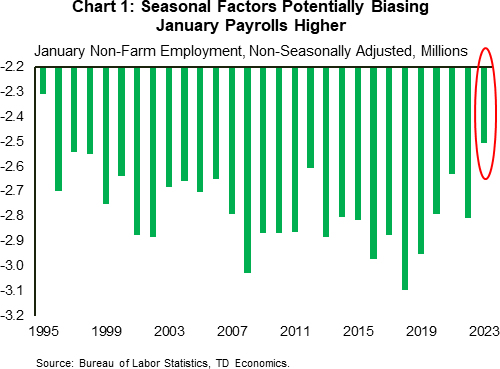
For starters, January was unseasonably warm across most of the U.S., which likely means there was a pull forward of economic activity. From that perspective, some of January’s gains may have been robbed from subsequent months – suggesting much weaker employment growth in the months ahead. Second, seasonal adjustment factors may have also played some role in biasing last month’s numbers higher. January is historically a month where non-seasonally adjusted payrolls record a massive decline in absolute terms (Chart 1). While this remained true last month, it did so by the smallest amount since 1995. This likely translated to an outsized gain in the seasonally adjusted figures.
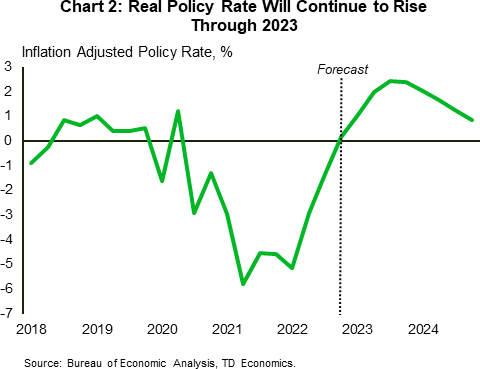
So, where does that leave us? It’s up for debate how much the January numbers are overstating the degree of underlying strength. But, at the end of the day, there is little doubt that the labor market remains incredibly tight. For now, Chair Powell seems content to not rattle expectations and watch how the data evolves. You can’t argue the logic. Monetary policy acts with considerable lag, and the cumulative effect of all the tightening done over the past 11 months is not yet being felt. Even once rate hikes are finished, the real effective policy rate will continue to rise through this year as inflation continues to decline (Chart 2). With the FOMC now in the “fine tuning” stage of the tightening cycle, data dependence will be the name of the game. With that, the focus now shifts to next week’s inflation report. Stay tuned!
Canada – Labour Market Slowdown Remains Elusive
This week was dominated by Canada's impressive jobs report, which overshadowed the first-ever minutes from the Bank of Canada's Governing Council's interest rate deliberations. In its aim to increase transparency and following in the Federal Reserve's footsteps, the Bank of Canada released an account detailing January monetary policy decision. In it the Bank noted that inflation was heading in the right direction. Globally as well as in Canada inflation has turned the corner as energy prices have declined from their peak and supply chain bottlenecks continued to ease.
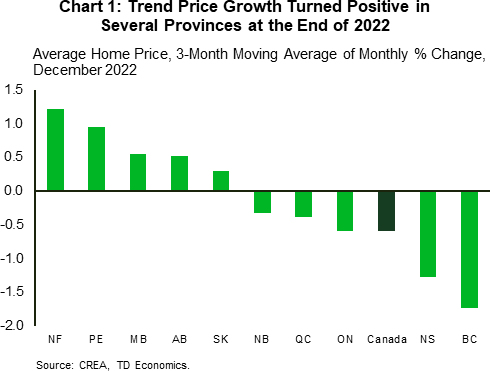
Growth-wise, however, things were not evolving entirely as expected. The Council noted that while economic growth has been slowing, both the economy and the labour market are putting up a fight, showing more resilience than anticipated. Third quarter GDP growth surprised to the upside, and outturn in the fourth quarter is also likely to come in above the Bank's expectations. Indeed, indicators such as job growth and credit and debit spending fared better at the end of last year relative to the slowdown during summer months. Even the battered housing market appears to be finding its footing again. As we noted in this week's report, on a three-month moving average basis house price growth was positive in half of all provinces in December (Chart 1).
The ongoing tightness in the labour market could complicate the Bank of Canada's job of taming inflation. Coming on the heels of already strong gain in December, today's release showed that the economy added a blockbuster 150,000 jobs in January, most of them in full-time positions in the private sector (Chart 2). The unemployment rate held steady at 5% - near a record low, and hours worked also rose by 0.8% on the month.
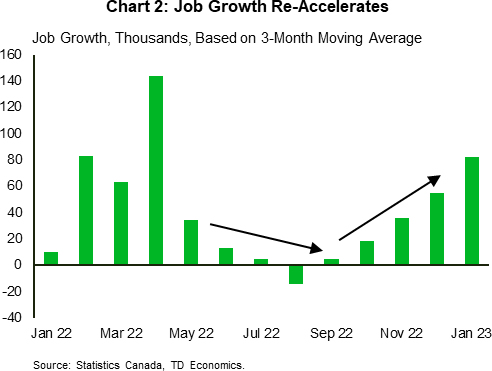
Perhaps some slight consolation for the Bank could be found in the fact that wage growth continued to decelerate for the second consecutive month, slowing to 4.5% year-over-year (down from 4.8% December and 5.8% in November). Still at this level, it remains too strong. In the minutes of its January's meeting, the Council noted that persistent wage growth in the 4%-5% range "was not viewed as consistent with achieving the 2% inflation target unless productivity increases to well above its historical trend."
The Bank of Canada's conditional pause on rate hikes is based on slowing economic growth and a cooler labour market, and the data recently has not been cooperating. The Labour Force Survey is notoriously volatile, and the Bank is not going to change course following one report. But, it has thrown a curve ball to the BoC, suggesting that upside risks to inflation remain. If the improvement in other indicators continues beyond a January bounce, the Bank of Canada indicated it will be ready to pick up the bat once again.
Weekly Economic & Financial Commentary: International Central Banks Deliver Another Round of Rate Hikes
Summary
United States: Light Data Week, Soft Landing?
- Beyond Chair Powell's interview on Tuesday, it was a light week for economic news. The U.S. trade deficit widened to $67.4 billion at the end of last year, revolving consumer credit increased at its slowest pace since 2021 in December and year-ahead consumer inflation expectations jumped to 4.2% in February.
- Next week: NFIB (Tue), CPI (Wed), Retail Sales (Wed)
International: International Central Banks Deliver Another Round of Rate Hikes
- This week saw another round of rate hikes from global central banks. The Reserve Bank of Australia (RBA) got the ball rolling with a 25 bps policy rate hike, to 3.35%. Given hawkish comments, we expect the RBA to follow up with 25 bps hikes in both March and April. Sweden's central bank hiked rates 50 bps and signaled a further increase in the spring, while adding it would also start selling bonds to shrink its balance sheet at a faster pace. Mexico's central bank surprised with a larger-than-forecast 50 bps policy rate hike to 11.00%, while the Reserve Bank of India also raised interest rates this week.
- Next week: Japan GDP (Tue), U.K. CPI (Wed), Australia Employment (Thu)
Credit Market Insights: Worsening Credit Conditions: Good News for the Fed?
- The latest Senior Loan Officer Opinion Survey (SLOOS) revealed widespread demand deterioration and tighter credit standards across all loan types in the last three months of 2022. The decline in credit conditions is emblematic of the broader effects of restrictive monetary policy starting to take hold.
Topic of the Week: Heading South: Sun Belt on the Rise
- Recent blockbuster NBA trades are emblematic of broader migration trends occurring in the United States. Between 2021 and 2022, Census Bureau estimates indicate that nine of the top 10 states receiving the highest number of domestic migrants were within the Sun Belt.