Sample Category Title
NZ BusinessNZ services rose to 54.5, but negative comments trend higher
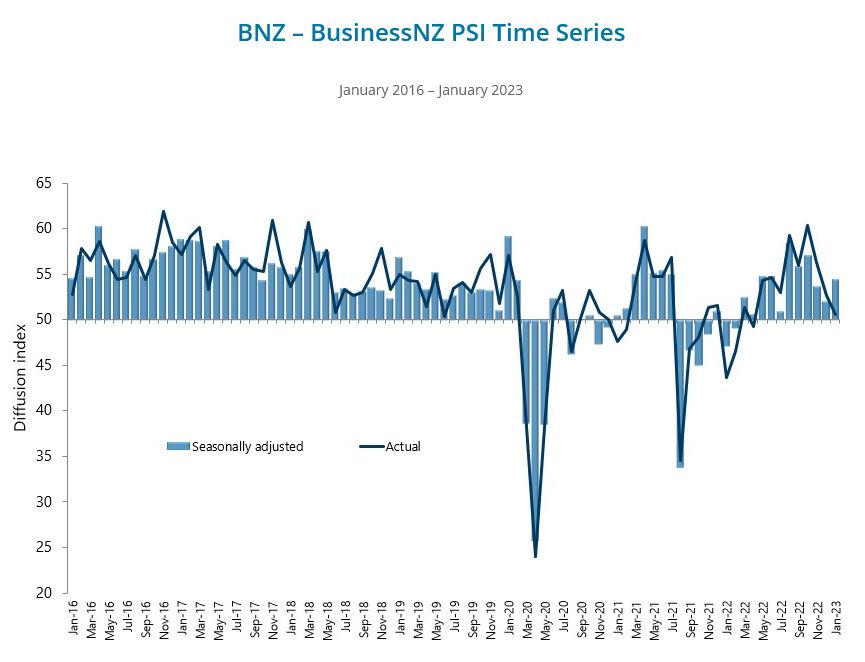
New Zealand BusinessNZ Performance of Services Index rose from 52.0 to 54.5 in January. Looking at some details, activity/sales rose form 51.9 to 52.1. Employment rebounded strongly from 46.9 to 51.9. New orders/business dropped from 57.7 to 54.5. Stocks/inventories rose from 51.6 to 54.3. Supplier deliveries dropped from 53.9 to 52.0.
BusinessNZ chief executive Kirk Hope said: "Despite the halt in lower expansionary levels, the trend of a higher proportion of negative comments continued in January (61.7%), compared with 58.2% in December and 47.3% in November. The holiday season was a common theme, along with the shortage of labour and general market uncertainty that has been evident for some months now".
BNZ Senior Economist Doug Steel said that "as encouraging as January's PSI result might look, we are reluctant to read too much into one month's result – especially around the holiday period".
ECB Visco: Tightening should continue in a progressive but measured way
ECB Governing Council member Ignazio Visco said on Saturday, interest rates must continue to rise "in a progressive but measured way, on the basis of the incoming data and their use in the assessment of the inflation outlook". But when asked how far interest rates could rise, he replied "we don't know".
Visco also said, "today, disinflation is obviously needed, but given the levels of private and public debts that prevail in the euro area, we must be careful to avoid engineering an unnecessary and excessive rise in real interest rates."
"Indeed, I am convinced that the credibility of our actions is preserved not by flexing our muscles in the face of inflation, but by continually showing wisdom and balance."
EUR/USD Turns Red Below 1.0750, Dollar Gains
Key Highlights
- EUR/USD extended its decline below the 1.0750 support.
- It is facing many hurdles near 1.0750 and 1.0800 on the 4-hours chart.
- GBP/USD is declining and might revisit the 1.2000 support.
- Bitcoin price declined further below the $22,350 support zone.
EUR/USD Technical Analysis
The Euro started a major decline from well above the 1.0950 level against the US Dollar. EUR/USD declined below the 1.0850 support to move into a bearish zone.
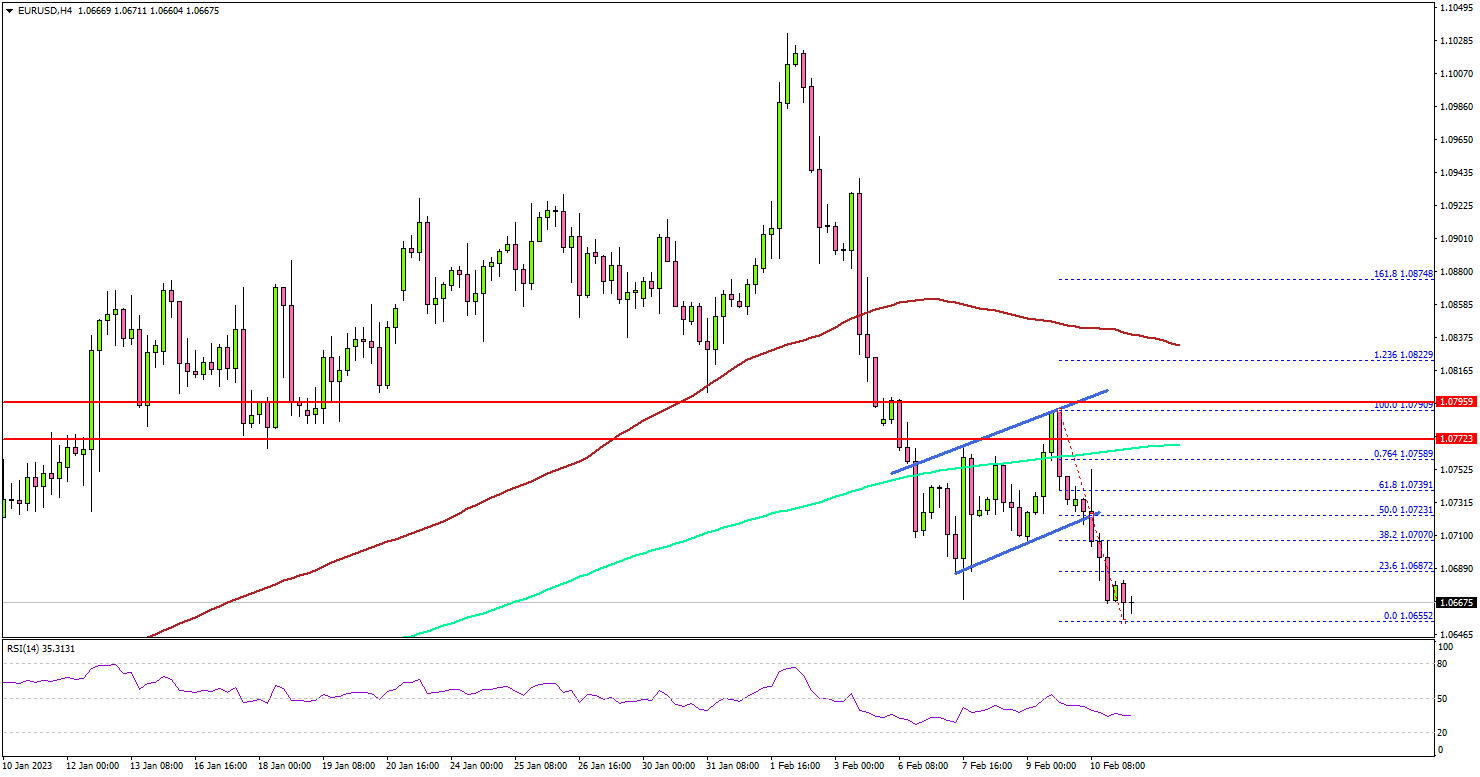
Looking at the 4-hours chart, the pair declined below the 1.0800 support zone, the 100 simple moving average (red, 4-hours), and the 200 simple moving average (green, 4-hours).
There was also a close below the 1.0750 support zone. Finally, it tested the 1.0660 support zone. The current price action suggests more chances of a drop below the 1.0620 and 1.0600 support levels.
The next major support is near the 1.0550 level. If there is a downside break, the pair could decline towards the 1.0500 level. Any more losses might call for a test of 1.0420.
On the upside, the pair is facing resistance near the 1.0720 level. The next major resistance is near the 1.0750 level. A clear move above the 1.0750 resistance might start a steady increase towards the 1.0800 resistance zone.
Any more gains could open the doors for a move towards the 1.0850 level, above which the bulls may perhaps aim a retest of the 1.1000 resistance.
Looking at bitcoin price, there was a clear move below the $22,350 support zone and it seems like the bulls are slowly losing control.
Economic Releases
Japan’s Gross Domestic Product Q4 2022 (QoQ) (Prelim) - Forecast 0.5%, versus -0.2% previous.
Forex and Cryptocurrency Forecast
EUR/USD: The Fed's Doves Have Turned into Hawks Again
After the US Federal Reserve and ECB meetings, the DXY Dollar Index fell to a new 9-month low of 100.80 on February 02. This happened after the dovish hints of the head of the Fed, Jerome Powell, who, during a press conference following the meeting, admitted for the first time that "the deflationary process has begun." The market has decided that this is the beginning of the end, and that the end of the bullish wave is near.
But hints aren't specific promises. Especially from the heads of the US Central Bank. And now, speaking at the Washington Economic Club, Jerome Powell is saying that interest rates must continue to rise in order to control inflation. And he makes a hawkish hint that the peak rates may be higher than the markets expect. And even higher than the Fed's own forecasts, announced in December.
Powell's hawkish attitude was supported by New York Federal Reserve Bank (FRB) President John Williams, Fed Board of Governors Christopher Waller, and Minneapolis Fed Chairman Neil Kashkari. The latter said that the Fed still has a lot of work to do to curb inflation. This could mean that the interest rate could be raised from the current 4.75% all the way up to 5.40% or higher and stay at that high for quite some time.
This time, the market decided that it was not worth waiting for an early easing of monetary policy, and the dollar began to gain strength. The DXY index reached a five-week high at 103.96 points on Tuesday, February 07. However, it could not rise higher, as it met several fairly strong resistance levels at once: 1) the 50-day SMA, 2) the former trend line from 2021, 3) the upper limit of the descending channel, which began in November 2022, as well as horizontal resistance in the 104.00 zone.
The past five days were stingy with macro statistics, but rich in statements by both American and European officials (the EU leaders summit took place on February 09-10). The next week promises to be richer in economic data. January data on US consumer inflation (CPI) will be published on Tuesday, February 14. The forecast assumes that prices rose by 0.4-0.5% in January (0.1% in December). At the same time, annual data may turn out to be lower than the previous value (6.2% vs. 6.5%). If the CPI shows that inflation is stable, this will confirm the latest hawkish statements by Fed officials and support the dollar. (Scotiabank economists believe that EUR/USD may fall to 1.0500-1.0600). If there is a steady decline in inflation, the US currency will be under serious pressure.
Having reached a high of 1.1032 on February 02 (the highest since April 2022), EUR/USD reversed and ended the week at 1.0679. 35% of analysts expect a further strengthening of the dollar at the time of writing the review (on the evening of February 10), 20% expect the euro to strengthen, and the remaining 45% have taken a neutral position. The picture is different among the indicators on D1. 85% of the oscillators are colored red (a third are in the oversold zone), while the remaining 15% are green. Among trend indicators, 40% recommend buying, 60% - selling. The nearest support for the pair is in the zone 1.0670, then there are levels and zones 1.0620, 1.0560, 1.0500, 1.0440 and 1.0370-1.0400. The bulls will meet resistance in the area of 1.0700-1.0710, 1.0745-1.0760, 1.0800, 1.0865, 1.0895-1.0925, 1.0985-1.1030, 1.1110, after which they will try to gain a foothold in the 1.1260-1.1360 echelon.
Among the events of the upcoming week, in addition to the release of the inflation data mentioned above, we can note the publication of preliminary data on Eurozone GDP on Tuesday, February 14. (And of course, we must not forget that February 14 is St. Valentine's Day, the most romantic holiday celebrated in most countries of the world. People confess their love to each other on this day, for more than one and a half thousand years). Retail sales in the US will become known on Wednesday, February 15, and data on US unemployment will come on Thursday, February 16. The January US Producer Price Index (PPI) will also be released on February 16.
GBP/USD: Coming Week: Volatility Guaranteed
The pound tried to win back part of its losses last week. GBP/USD, having rebounded on February 07 from the level of 1.1961 (the lowest level since January 06), reached a weekly high of 1.2193 on February 09. Then, the pound began to gradually retreat against the dollar along with other currencies included in the DXY Index. As a result, GBP/USD ended the week at 1.2055, that is, almost where it started (1.2050).
The news background still looks vague and uncertain. Economic problems continue to put pressure on the British currency. Recall that in the fight against inflation, the Bank of England (BoE) raised the key rate by 50 bp on February 2 to 4.00%, but at the same time softened its message noticeably. This pushed the British currency down from its highest values since mid-June 2022 (1.2450) by more than 250 points.
Market participants believe that the BoE may be afraid of further sharp rate hikes. It is another question how its growth will affect inflation. But it may well provoke a crisis in the economy and, above all, in the construction sector. January data on the index of business activity in the construction sector of the country were published on Monday, January 06, having shown a drop in this indicator from 48.8 to 48.4 points. The Office for National Statistics of the United Kingdom reported on Friday, February 10 that the entire economy of the country in December, with a forecast of minus -0.3%, actually shrank by -0.5% (there was an increase of +0.1% in November). GDP stagnated at 0% in Q4, after falling by -0.2% a quarter earlier. GDP fell from +1.9% to +0.4% in annual terms.
Against this background, the triumphant reports and optimistic forecasts from the UK Treasury Secretary Jeremy Hunt sounded somewhat strange. The high official said that "the UK was the fastest growing economy in the G7 last year and avoided a recession as well". This shows that "the economy has proven to be more resilient than many feared." And "if we stick to our plan to cut inflation by half this year," continued Jeremy Hunt, "we can be sure that we will have some of the best growth prospects of any country in Europe."
Unlike Mr. Hunt, Commerzbank strategists believe that uncertainty about future inflation in the UK remains high. The dynamics and values of the Consumer Price Index, which will be published on Wednesday, February 15, can bring some clarity. It is the CPI that is the key indicator that determines the future monetary policy of the Bank of England. Of course, data on the state of the labor market, which will be released the day before, on Tuesday, February 14, and on retail sales in the UK, which will become known on February 17, will also be important.
All these macroeconomic statistics are sure to cause increased volatility in GBP/USD. In the meantime, 40% of analysts expect further weakening of the pound, the same number prefer to refrain from forecasts and wait for the release of specific indicators. Only 20% of experts vote for the strengthening of the pound and the growth of the pair. Among the trend indicators on D1, the balance of power is 75% to 25% in favor of the reds. Among the oscillators, the red ones have a 100% advantage, however, 10% of them give signals that the pair is oversold. Support levels and zones for the pair are 1.2025, 1.1960, 1.1900, 1.1800-1.1840. When the pair moves north, it will face resistance at the levels 1.2085, 1.2145, 1.2185-1.2210, 1.2270, 1.2335, 1.2390-1.2400, 1.2430-1.2450, 1.2510, 1.2575-1.2610, 1.2700, 1.2750 and 1.2940.
USD/JPY: The Head of BOJ Is New, the Policy Is Old.
The Japanese yen, like its DXY counterparts, reacted both to the hawkish statements of the US Federal Reserve and to fluctuations in US Treasury yields last week. However, the biggest surge in volatility was the news that the Cabinet of Ministers intends to nominate 71-year-old Kazuo Ueda as the new governor of the Bank of Japan (BOJ).
This former professor at the University of Tokyo is a well-known monetary policy expert. He joined the Board of Governors of BOJ a quarter of a century ago, in April 1998 and remained there until April 2005. Ueda spoke out against the Central Bank's abandonment of the policy of zero rates in 2000, and the choice of his candidacy was probably due to the desire of the authorities to see a person at the head of the Bank of Japan who would not rush to curtail the ultra-soft monetary policy. This is confirmed by Ueda himself, who stated on February 10 that the current policy of the regulator is adequate, and that it is necessary to continue to adhere to it.
USD/JPY ended last week at 131.39, where it has been many times since December 20, 2022. According to the majority of analysts (55%), the yen may strengthen somewhat in the three-month period, but the range of targets here is quite large. Some believe that the Fed will finally return to the doves' camp, and then USD/JPY will be able to reach the 120.00 zone, while others consider the range of 127.00-128.00 to be the limit of the fall.
As for the short term, only 20% of experts vote for the pair to go down, 30% vote for its growth, and 50% have decided not to make any predictions at all. Among the oscillators on D1, 80% point north, 10% look south, and 10% point east. For trend indicators, 40% look north, and 60% look in the opposite direction. The nearest support level is located at 131.25 zone, followed by levels and zones 130.50, 129.70-130.00, 128.90-129.00, 128.50, 127.75-128.10, 127.00-127.25 and 125.00. Levels and resistance zones are 131.85-132.00, 132.80-133.00, 133.60, 134.40 and then 137.50.
Japan's preliminary GDP data will be released next week, on Tuesday, February 14. It is expected that the country's economy will grow +0.5% in Q4 2022 (down -+0.2% a quarter earlier). The data already published also look positive. Bank lending in January was higher than expected (+2.6%) and actually increased by +3.1% (+2.7% in December). The Eco Watchers Current Situation Index also increased, rising from 47.9 to 48.5 points by the end of January.
CRYPTOCURRENCIES: Should Bitcoin "Take a Break"?
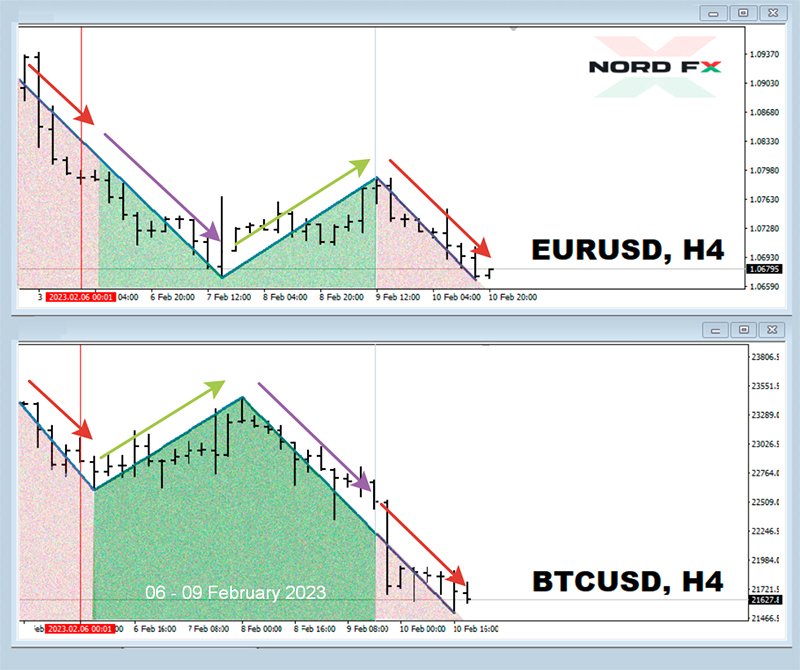
Bitcoin's correlation with the stock market (S&P500, Dow Jones, Nasdaq) and other risky assets is nothing new. But digital gold unexpectedly showed not an inverse, but a direct correlation with the US currency last week. This is clearly seen if we compare the BTC/USD and EUR/USD charts. Both assets were getting heavier or lighter, at the same time. Drawing an analogy with a balance scale, we observed a physical paradox where both bowls go up and fall down at the same time. It was only at the end of the working week that the laws of physics began to work again: the dollar strengthened a little, bitcoin weakened.
The upward momentum that raised the main cryptocurrency from a low of $16,272 in November 2022 to $24,244 in the first days of February 2023 has gradually faded away. BTC/USD has returned to where it was in the second half of January, and the result of the last three and a half weeks can be considered close to zero.
As noted by well-known trader and investor Tone Vays, bitcoin has "grown very fast and very high" and is now facing serious resistance as it approaches the $25,000 level. The specialist believes that the asset will eventually break through this resistance zone, but it probably "should take a break now." Vays clarified that he expects either the consolidation of the rate in a narrow range, or a small pullback.
This expert is not alone in his assessment. According to statistics, the media forecast of crypto community members accurately predicted the value of bitcoin by the end of each month, over the past six months with a probability of up to 75%. Finbold experts released the results of the latest survey of more than 15 thousand traders and predictions of machine learning algorithms. Real people expect BTC quotes to fall to $20,250 by February 28, 2023, artificial intelligence points to $24,342.
Such a small (by bitcoin standards) range of fluctuations corresponds quite accurately to Vays' prediction of a "breather". The market situation is quite uncertain at the moment, and while short-term holders have returned to the profitable zone, long-term holders (holding for six months) still remain in the red zone. It took 291 days for all the metrics to turn green in the last bearish phase, only 268 have passed now.
Most investors went into the red at the end of last year. Thus, MicroStrategy recorded a balance sheet (unrealized) loss of $1.3 billion for 2022, due to its long-term investments in bitcoin. (As of December 31, 2022, MicroStrategy held a total of 132,500 BTC worth $1.84 billion). At the same time, the company's management does not plan to stop operations with a digital asset. Commenting on last year's turmoil, MicroStrategy co-founder Michael Saylor said he sees this as a kind of Darwinian theory: weak and bad players have left the market, and this should push the industry forward in the long run. At the same time, according to Saylor, cryptocurrencies need a clear regulatory framework for companies to comply with certain standards and protect customers. "What is really needed is supervision. Clear guidance from Congress is needed for the industry to have its own Goldman Sachs, Morgan Stanley and BlackRock. We need clear rules of conduct from the SEC (Securities and Exchange Commission) of the United States."
However, David Marcus, former Meta blockchain executive and former PayPal president, for example, doubts that legislatures will be able to develop such rules anytime soon. Based on this, he believes that crypto companies will continue to operate in a "vacuum" in 2023, at their own peril and risk, and the crypto winter will end only by 2025, when the market recovers from last year's shocks.
Surprisingly, not only supporters of cryptocurrencies, but also their fierce opponents advocate increased regulatory pressure. Thus, Charlie Munger, an associate of Warren Buffett, vice president of the Berkshire Hathaway holding company, called on the US authorities to destroy bitcoin, which the billionaire compares investing in to gambling. He said in an interview with the Wall Street Journal that the cryptocurrency industry is undermining the stability of the global financial sector. And that BTC cannot be considered an asset class as it has no value.
Munger has been expressing this point of view over the past few years. And now he calls on the US authorities to deal a devastating blow to the crypto market. In his opinion, it is necessary to drive it into such a strict framework of regulation that will finally strangle this industry.
Note that Charlie Munger is 99 years old, which, perhaps, explains his radical conservatism. The younger generation of businessmen is more loyal to digital innovations. Suffice it to recall the results of a survey conducted by the financial consulting company deVere Group. They showed that despite the challenges of 2022, 82% of millionaires were considering investing in digital assets. According to Nigel Green, CEO of the deVere Group, the momentum for such interest will increase as conditions in the traditional financial system change.
Morgan Creek investment company CEO Mark W. Yusko believes that favorable macroeconomic conditions will lead to the fact that the next bull market could begin as early as Q2 2023. According to the top manager, the US Federal Reserve is unlikely to cut the key rate in the near future. However, even a slowdown or pause in this process will be perceived as a positive signal for risky assets, which include cryptocurrencies. The CEO of Morgan Creek pointed to the expectations of the next bitcoin halving, which will tentatively take place on April 19-21, 2024, as an additional reason for the growth of the crypto market. According to Yusko's calculations, the recovery of the digital asset market usually begins nine months before this event, which means that the rally will start at the end of the summer of 2023 this time.
Cathie Wood, the head of ARK Invest, is even more optimistic about the future, she still considers the first cryptocurrency to be the best form of protection against financial losses. In her opinion, all segments of the population, both the poor and the wealthy, will benefit from the use of digital gold. In confirmation of the words of their manager, Ark Invest analysts make just a cosmic forecast. Their pessimistic scenario assumes that the BTC price will rise to $259,000, and the optimistic one - up to $1.5 million per coin. (we wonder what Charlie Munger would say about this?)
At the time of writing this review (Friday evening, February 10), BTC/USD is trading in the $21,600 zone. The total capitalization of the crypto market is $1.010 trillion ($1.082 trillion a week ago). The Crypto Fear & Greed Index fell from 60 to 48 points over the week, and ended up in the Neutral zone, almost in the very center of the scale. The situation is uncertain, and perhaps traders, like bitcoin, "should take a break"?
EUR/USD Weekly Outlook
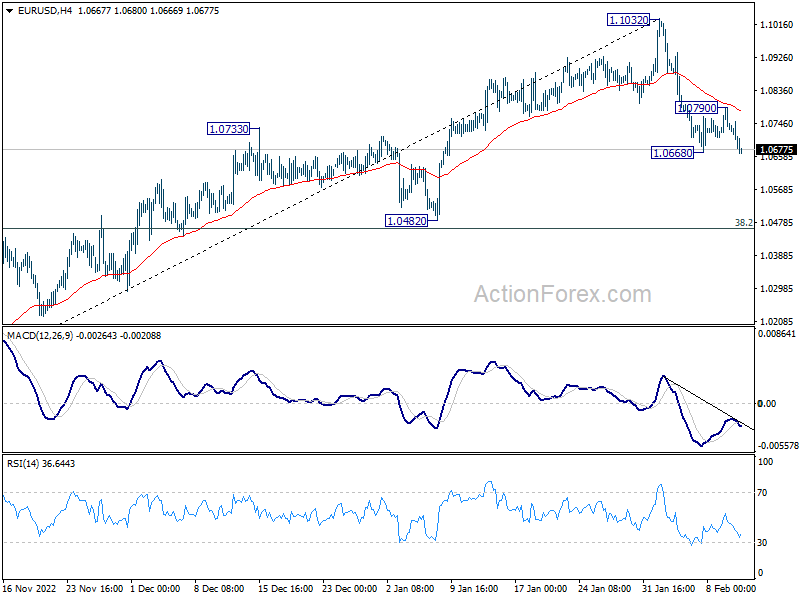
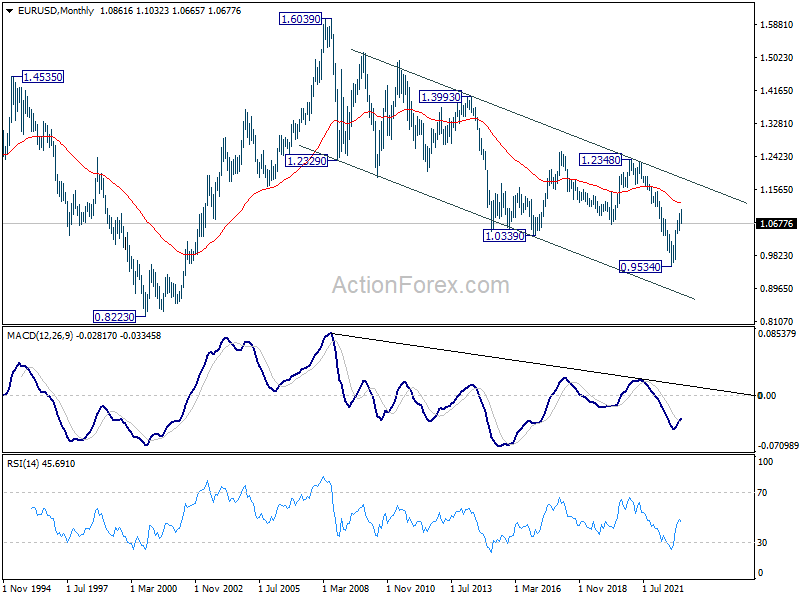
EUR/USD's decline last week indicates that it's already in correction to whole up trend from 0.9534. Rejection by 4 hour 55 EMA maintains near term bearishness and favors more downside. Break of 1.0668 temporary low this week will bring deeper fall to 38.2% retracement of 0.9534 to 1.1032 at 1.0463. Nevertheless, on the upside, break of 1.0790 minor resistance will turn bias back to the upside for retesting 1.1032 high instead.
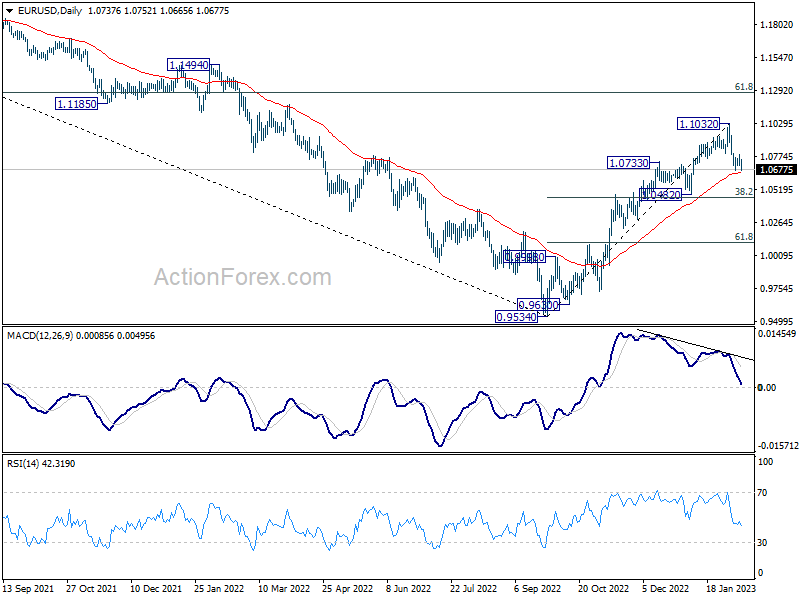
In the bigger picture, the rally from 0.9534 low (2022 low) is a medium term up trend rather than a correction. Further rise is in favor to 61.8% retracement of 1.2348 (2021 high) to 0.9534 at 1.1273 next. This will remain the favored case as long as 1.0482 support holds.
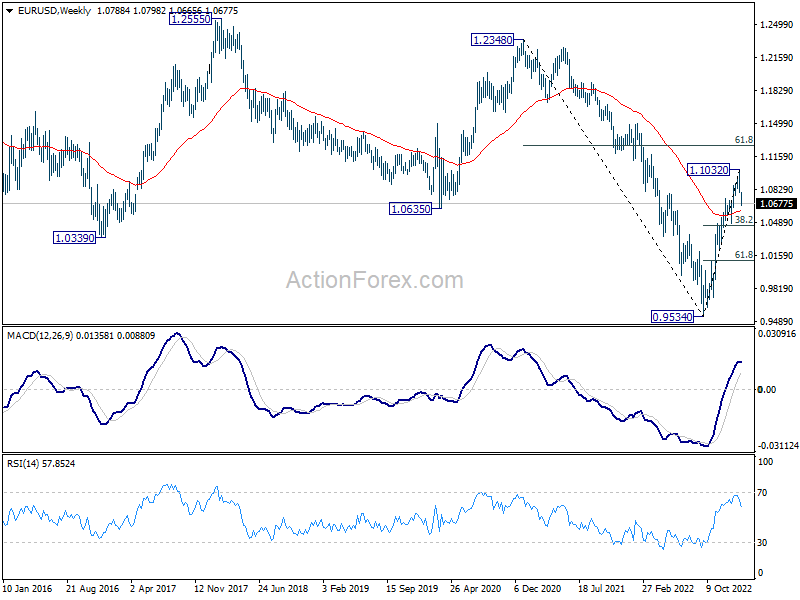
In the long term picture, while it's too early to call for long term trend reversal at this point, the strong break of 1.0635 support turned resistance (2020 low) should at least turn outlook neutral. Focus will turn to 55 month EMA (now at 1.1189). Rejection by this EMA will revive long term bearishness.
USD/JPY Weekly Outlook
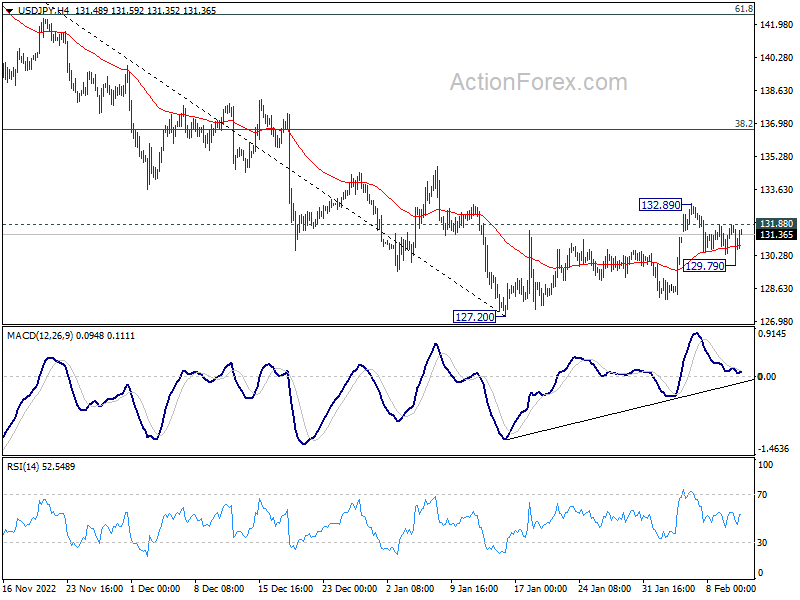
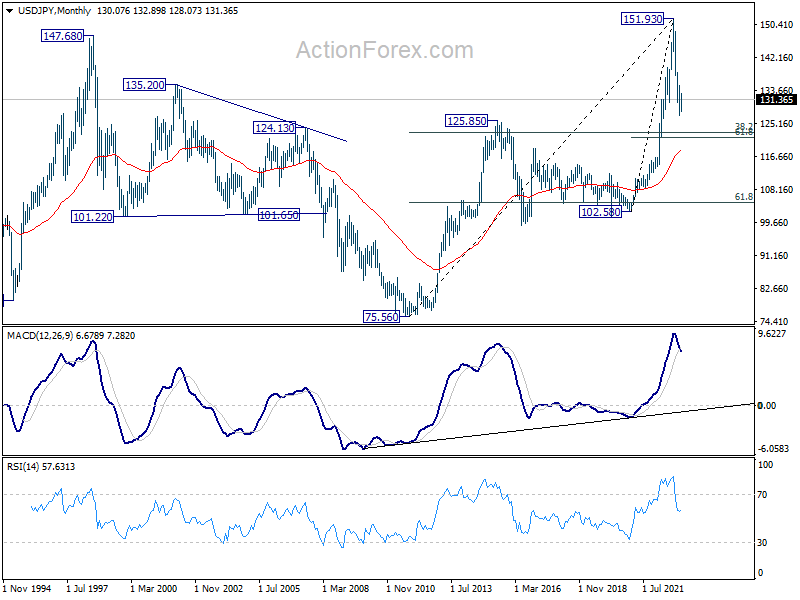
Looking through the volatility in USD/JPY last week, a short term bottom should be in place at 127.20. Break of 131.88 minor resistance will target 132.89 first. Break there will resume the rebound to 38.2% retracement of 151.93 to 127.20 at 136.64, even as a correction to the decline from 151.39. On the downside, through, below 129.79 will target 127.20 low again.
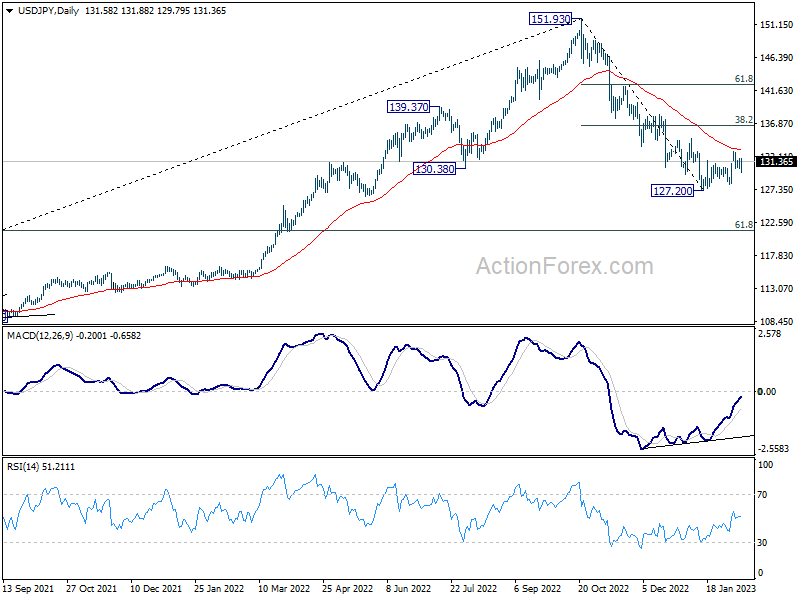
In the bigger picture, prior of 55 week EMA (now at 131.39) raises the chance of medium term bearish reversal, but that's not confirmed yet. Strong rebound from current level, followed by sustained break of 38.2% retracement of 151.93 to 127.20 at 136.64 will argue that price actions from 151.93 is merely a corrective pattern. However, rejection by 136.64 will solidify medium term bearishness for 61.8% retracement of 102.58 to 151.93 at 121.43 and 38.2% retracement of 75.56 to 151.93 at 122.75.
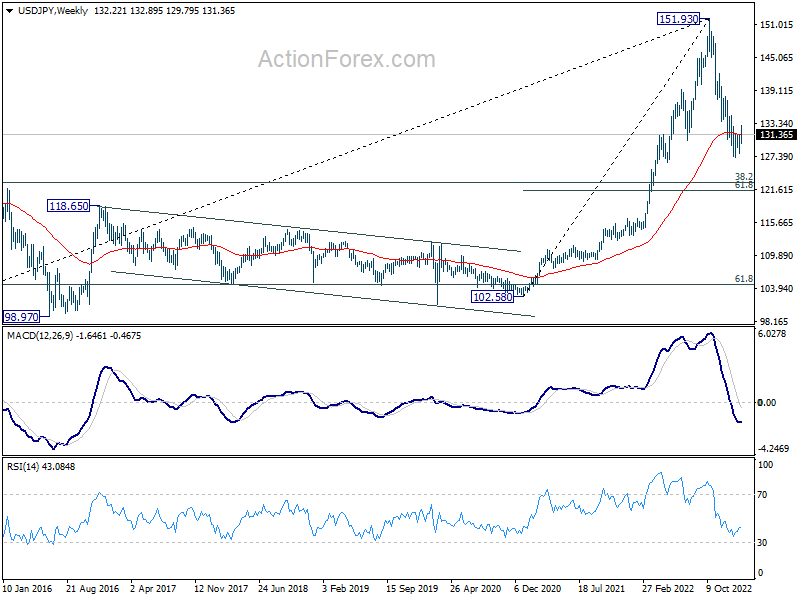
In the long term picture, 151.93 looks increasingly likely a major top. But it's too early to call for long term bearish reversal at this point. Rebound from around 38.2% retracement of 75.56 to 151.93 at 122.75 will keep the case open for price action from 151.93 to be just a corrective pattern.
GBP/USD Weekly Outlook
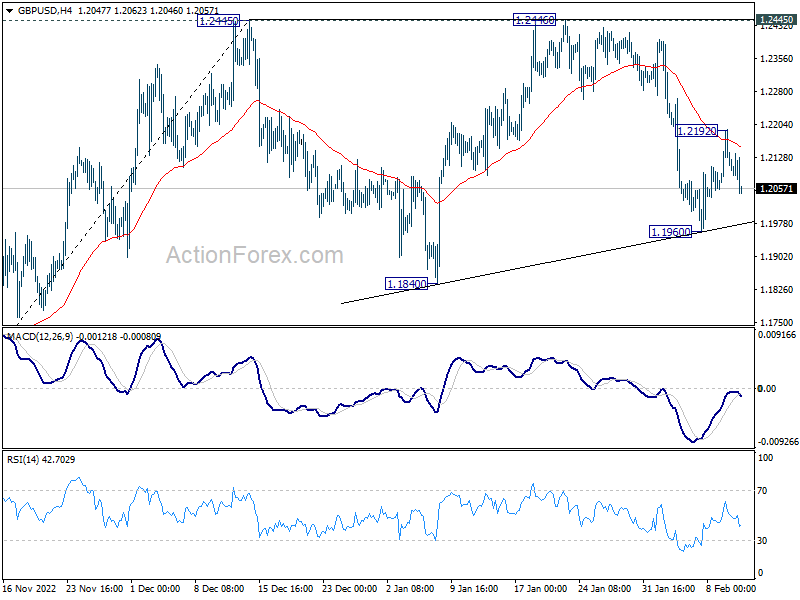
GBP/USD edged lower to 1.1960 last week but recovered since then. Initial bias stays neutral this week first, but further decline is in favor after rejection by 4 hour 55 EMA. Break of 1.1960 will resume the fall from 1.2446, as the third leg of the corrective pattern from 1.2445, to 1.1840 support, and possibly below. on the upside, though, break of 1.2192 will resume the rise from 1.1960 to retest 1.2445/6.
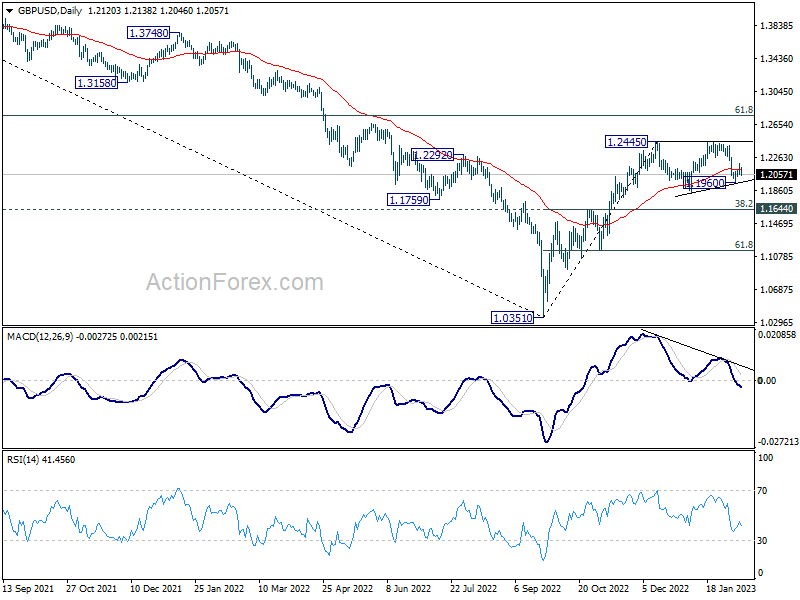
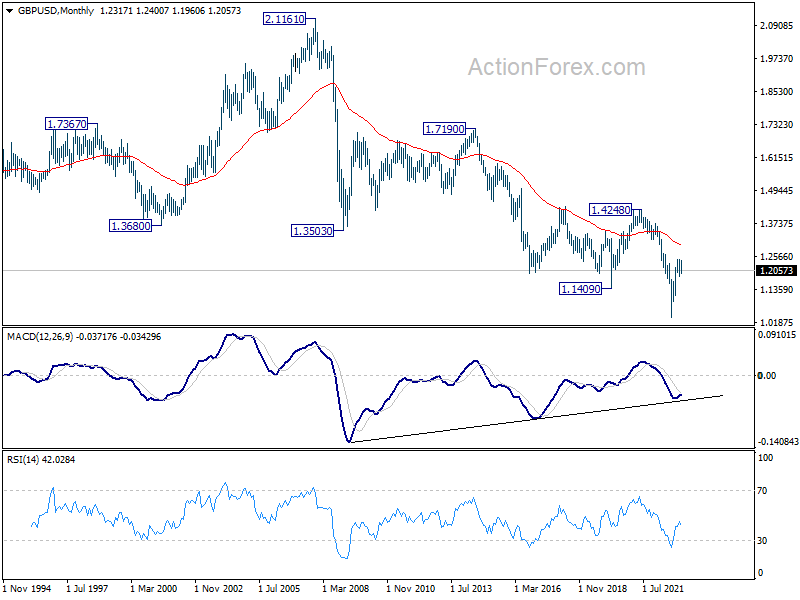
In the bigger picture, rise from 1.0351 medium term bottom is at least correcting whole down trend from 1.4248 (2021 high). Further rise is expected as long as 1.1644 resistance turned support holds. Next target is 61.8% retracement of 1.4248 to 1.0351 at 1.2759. Sustained break there will pave the way back to 1.4248.
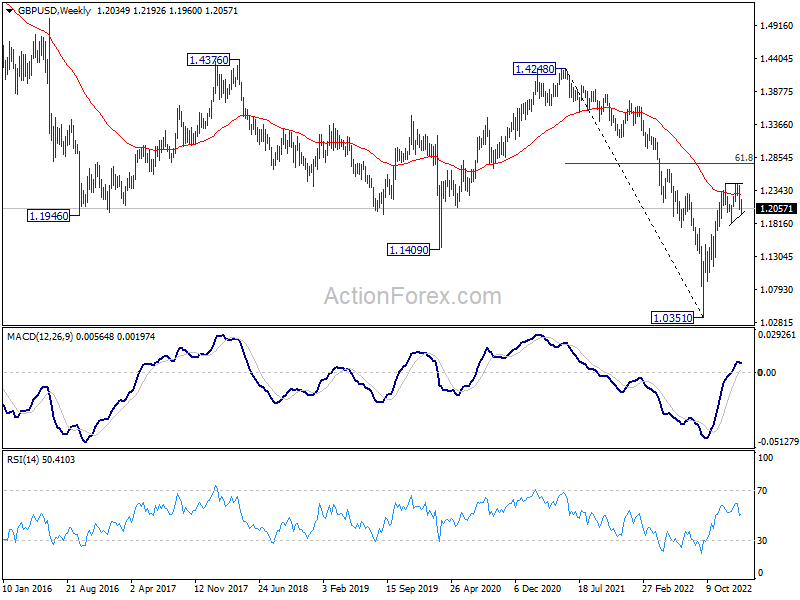
In the longer term picture, as long as 1.4248 resistance holds (2021 high), long term outlook will remain neutral at best. Down trend from 2.1161 (2007) could still resume for another low through 1.0351 at a later stage.
USD/CHF Weekly Outlook
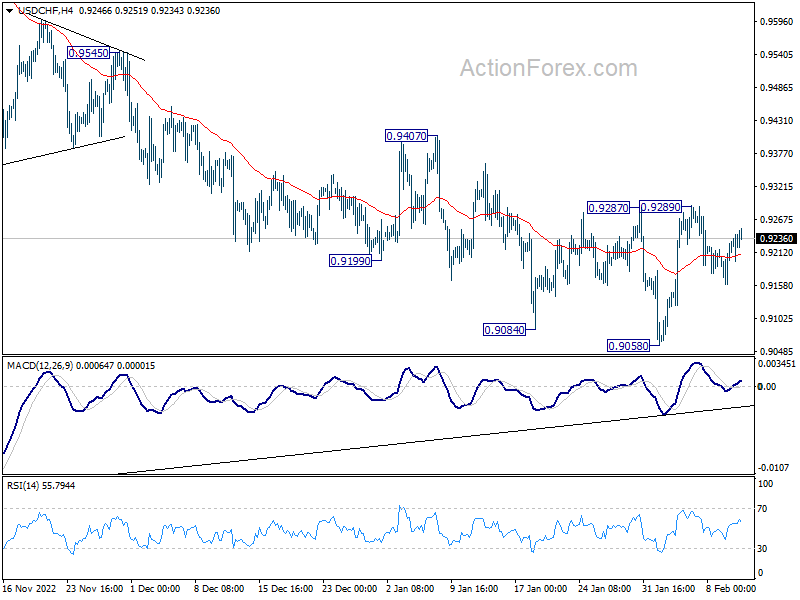
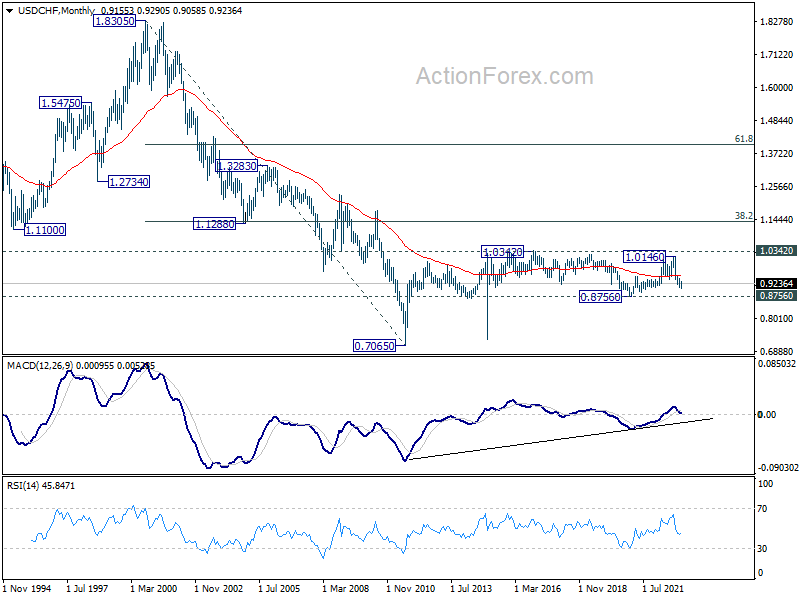
USD/CHF stayed in range above 0.9058 last week and outlook is unchanged. Initial bias remains neutral this week first. On the upside, firm break of 0.92879 resistance will confirm short term bottoming at 0.9058, and bring stronger rise to 0.9407 resistance. On the downside, however, sustained break of 0.9058 will resume larger decline from 1.0146 instead.
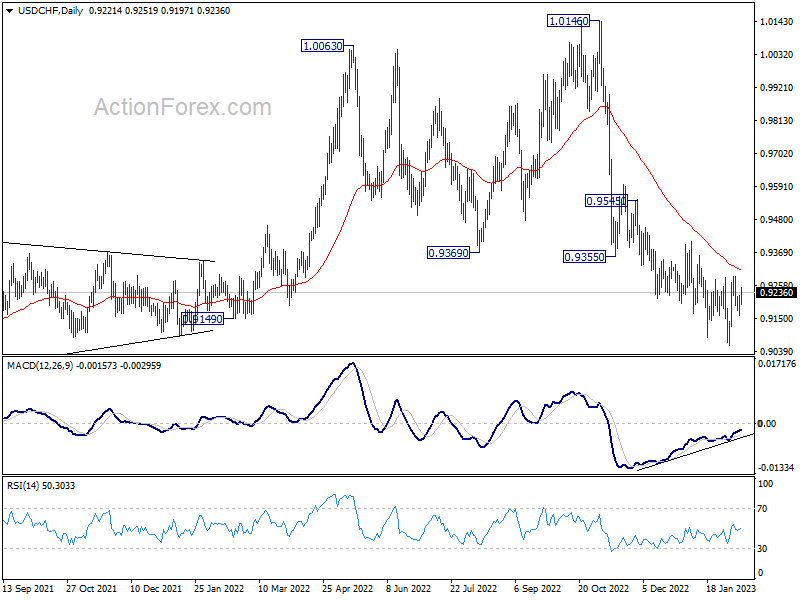
In the bigger picture, rise from 0.8756 (2021 low) has completed at 1.0146, well ahead of 1.0342 long term resistance (2016 high). Based on current downside momentum, fall from 1.0146 should be a medium term down trend itself. Next target is a test on 0.8756 low. Strong support should be seen there to bring rebound. Still, further decline will now be expected as long as 0.9407 resistance holds, in any case.
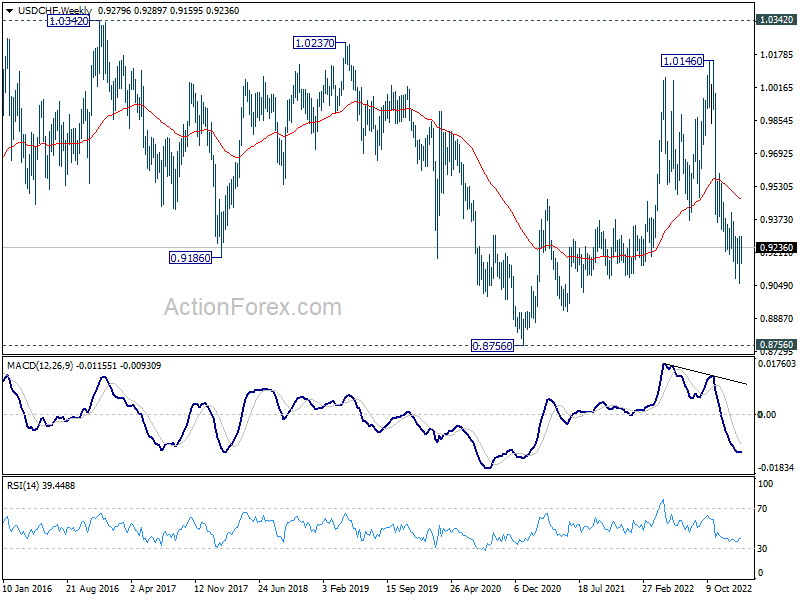
In the long term picture, long term sideway pattern from 1.0342 (2016 high) is extending and it's probably in another medium term down leg. Downside will likely be contained by 0.8756 support in case of deeper fall. Overall, range trading should continue until further development.
AUD/USD Weekly Report
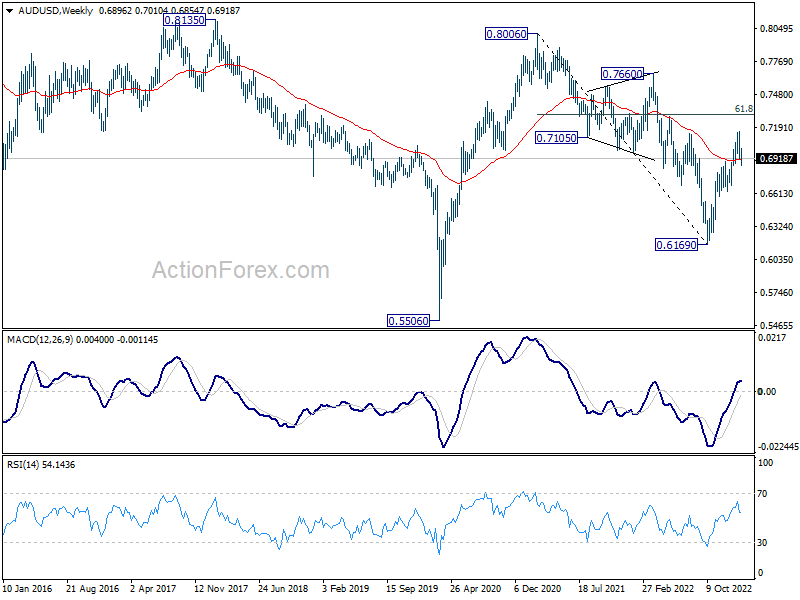
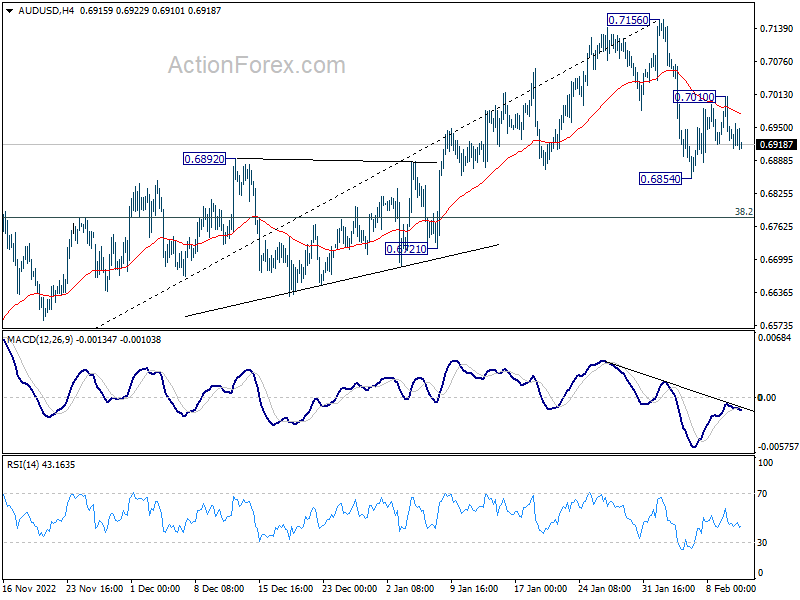
AUD/USD's corrective fall from 0.7156 extended to 0.6854 last week but recovered since then. Initial bias remains neutral this week first and another fall is mildly in favor. Break of 0.6854 will target 38.2% retracement of 0.6169 to 0.7156 at 0.6779. On the upside, break of 0.7010 will turn bias back to the upside for retesting 0.7156 high instead.
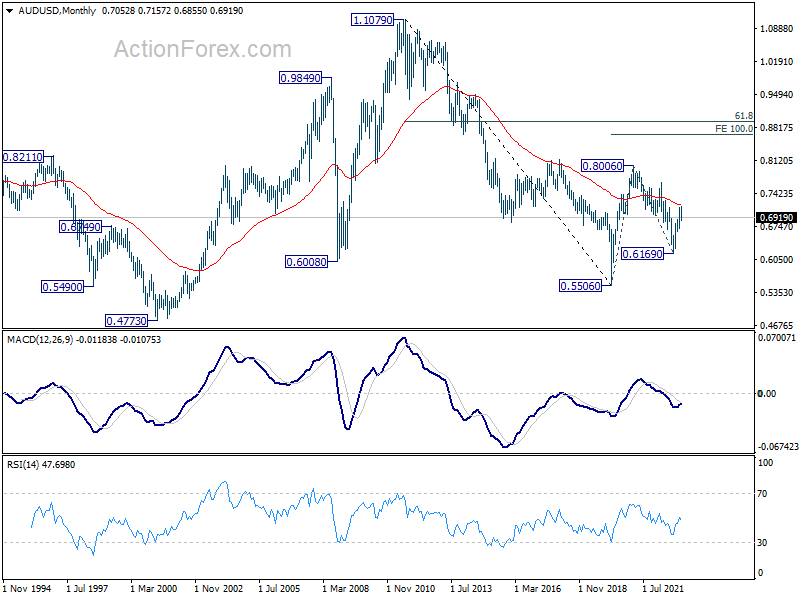
In the bigger picture, corrective decline from 0.8006 (2021 high) should have completed with three waves down to 0.6169 (2022 low). Further rally should be seen to 61.8% retracement of 0.8006 to 0.6169 at 0.7304. Sustained break there will pave the way to retest 0.8006. This will now remain the favored case as long as 0.6721 support holds.
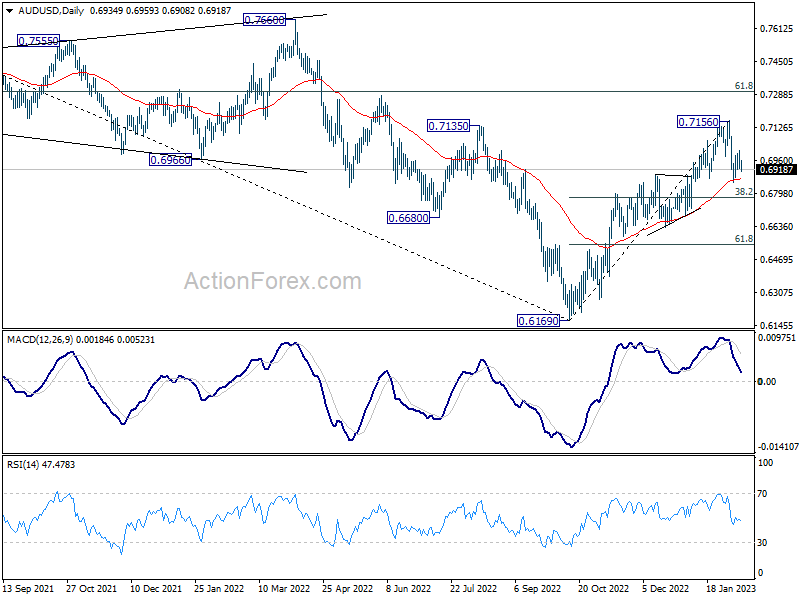
In the long term picture, current development suggests that fall from 0.8006 was merely a correction to the rise from 0.5506 (2020 low). Sustained trading above 55 month EMA (now at 0.7186) will raise the chance of up trend resumption through 0.8006 at a later stage.