

Sample Category Title
EUR/CHF Daily Outlook
Daily Pivots: (S1) 0.9875; (P) 0.9891; (R1) 0.9920; More....
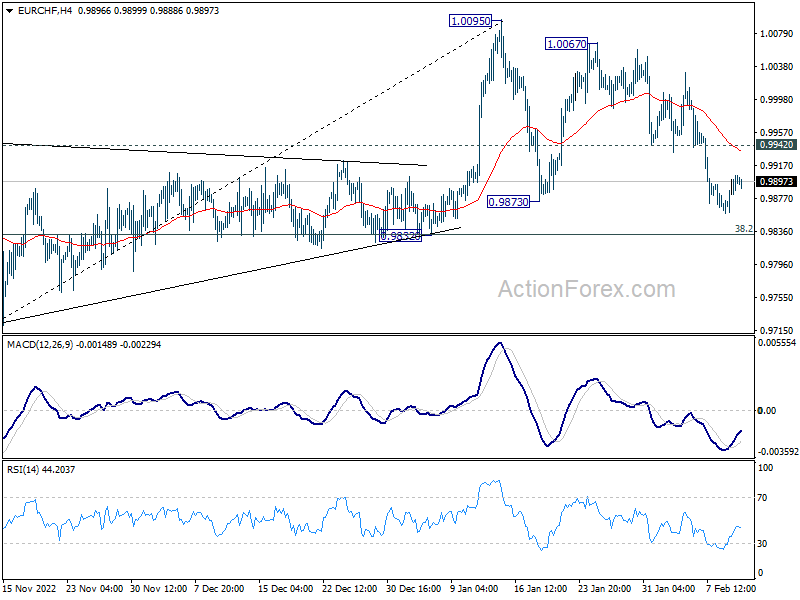
No change in EUR/CHF's outlook as consolidation from 1.0095 is still in progress. Deeper fall cannot be ruled out but downside should be contained by 38.2% retracement of 0.9407 to 1.0095 at 0.9832 to bring rebound. On the upside, break of 0.9942 minor resistance will turn bias back to the upside for retesting 1.0067.95 resistance zone.
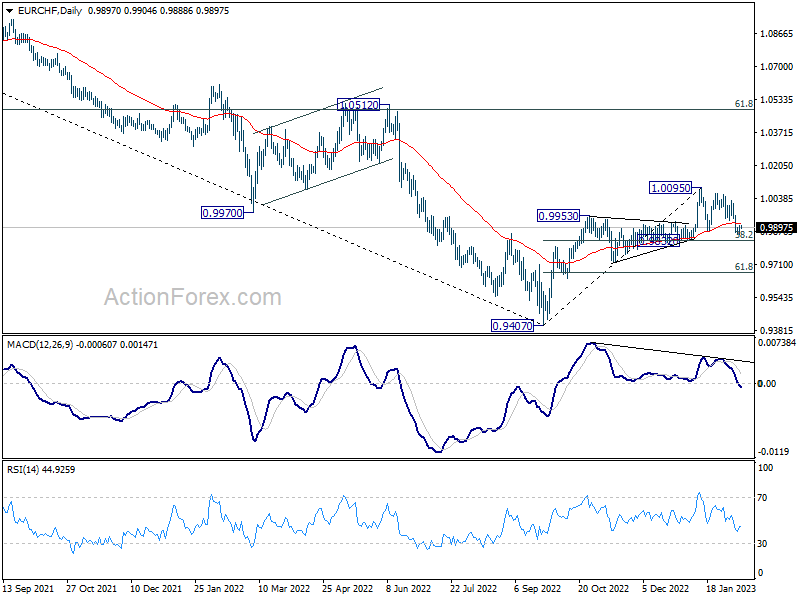
In the bigger picture, the initial rejection by 55 week EMA (now at 1.0039) mixed up the outlook. On the upside, sustained trading above 55 week EMA will raise the chance of bullish trend reversal. Rise from 0.9407 should then target 1.0505 cluster resistance (2020 low at 1.0505, 61.8% retracement of 1.1149 to 0.9407 at 1.1484). However, firm break of 0.9832 support will revive medium term bearishness and bring retest of 0.9407 low instead.
Barring a Large Surprise, We Don’t Expect Much of a Market Reaction
Markets
The unexpected slowing in German inflation, however difficult the numbers are to interpret, determined much of the trading session yesterday. European rates fell with German bund yields printing losses between 2.5 bps (2y) to 6.2 bps (30y) still. US bond yields dropped in the slipstream. The long end outperformed, causing the 10y2y spread at some point to hit a new multidecade extreme. Enter the 30y $21bn auction. After a strong 3y and outright stellar 10y bond sale the days before, few expected difficulties for the one yesterday. Yet, the auction tailed by about 3 bps, primary dealer award was the highest in nearly a year and the bid-cover ratio was lower than the average for the past six auctions. It triggered a sudden and sharp sell-off in US Treasuries, especially at longer maturities (intraday moves of >10 bps). The US yield curve eventually added 5.6 bps (30y) to 7.1 bps (5y). Equity markets in Europe finished about 1% higher (Euro Stoxx 50). Wall Street’s green opening was followed immediately by a protracted decline, leading to losses of 1% in the likes of the Nasdaq. That offered relief to the greenback. EUR/USD pared much of its earlier gains to close only marginally higher at 1.074 (from 1.071). The trade-weighted DXY clawed back above 102.99 (pandemic 2020 support) to finish at 103.22. Sterling traders were stoic about BoE governor Bailey’s (and Pill’s, Haskel’s and others) appearance before parliament yesterday. Risk-on pushed EUR/GBP temporarily below 0.885. This technical support area survived but remains at risk.
Chinese CPI accelerated from 1.8% to 2.1% in January. Services inflation rose 1%, increasing from 0.6% in December. The pick-up was expected given the demand rebound around Lunar New Year. Factory gate inflation (PPI) is still negative though, at -0.8% y/y (from -0.7%). The yuan doesn’t profit against a generally stronger USD. USD/CNY tests 6.80 resistance. EUR/USD loses a few ticks and DXY holds near yesterday’s closing levels. Core bonds trade sideways and we fear that that may not change a lot today. The eco calendar only contains the U. of Michigan consumer confidence which also publishes inflation expectations for the short and medium term. Barring a large surprise, we don’t expect much of a market reaction with investors likely to refrain from taking major positions ahead next week’s US inflation numbers. Dollar performance just as in the previous days is likely to be determined by equity sentiment. Stock futures point to a marginally lower opening in Europe and the US. UK GDP Q4 GDP this morning as expected printed at no change (vs -0.3% in Q3). Sterling is losing a few ticks post the release (EUR/GBP 0.887).
News Headlines
The Central Bank of Mexico (Banxico) yesterday delivered a surprise 50 bps rate hike, bringing the policy rate to 11.00%. Analysts expected the Bank of slow the pace to 25 bps. The Bank saw the economy growing in Q4 2022, but it lost momentum. January headline inflation increased to 7.91% Y/Y, but especially core inflation which the bank sees as more accurately reflecting the inflation trend, surprised on the upside (8.45%), a.o. due to a rebound in services prices. Inflation expectations for 2023 and 2024 were upwardly revised. Inflation is now only expected to converge to the 3.0% target in the final quarter of 2024 (3.1%), with upside risks to the outlook. Especially higher than expected core inflation caused the Bank to opt for an additional step of 50 bps. Depending on incoming data, for its next policy meeting, the upward adjustment to the reference rate could be of lower magnitude. The Mexican peso after the decision strengthened from USD/MXN 18,95 to close near 18.77.
In the quarterly monetary policy report released this morning, the Reserve Bank of Australia raised its forecasts for inflation. Inflation in Q4 of 2022 remained high and broad-based (headline 7.8%, trimmed mean at 6.9%). Even as inflation is expected to have peak, it remains too high. The RBA now forecasts the trimmed mean inflation to be at 6.25% in June (from 5.5%), 4.25% in December 2023 (from 3.25%) and only to return to 3.0% and still to stay at the 3.0% upper bound of the 2-3% band end 2024 and 2025. Wage growth is expected to climb to 4.25% this year. Amongst others, the risk remains of a tight labour market fueling wage costs and prices rises in the services sector. The RBA sees 1.5% GDP growth in 2023 and 2024 after 2.75% growth in 2022. The path of the expected unemployment rate was kept unchanged (3.5% and Dec 2022, 3.75% end 2023 and 4.25% end 2024). The RBA raised its policy rate by 25 bps earlier this week and changed its guidance to more tightening to come. The Aussie dollar today trades little changed at AUD/USD 0.6925.
The 6% Bet
The DAX index advanced to a fresh year high on Thursday as a 7% rally in Siemens after strong results, and a slowdown in German inflation fueled appetite in the German big caps.
The Frech CAC40 gained almost 1%.
But futures hint at a bearish open as US stocks failed to keep up with the European optimism on the back of rising option bets that the Federal Reserve (Fed) could hike the rates to 6%.
The 6% bet
US stocks kicked off Thursday session on a positive note, but sentiment rapidly soured as the Fed hawks didn’t let the bulls enjoy gains. The inversion between the US 2 and 10-year yields hit the highest levels since 1980s, as the Fed members’ calls for higher rates finally started kicking in.
Option traders are piling into bets that the US rates could peak at 6%.
Plus, the surprise 50bp hike from Mexico’s Banxico, on the back of unexpected – and unwelcomed inflation jump since the end of last year, also raised worries that the US could experience a similar uptick in inflation, and, may have to raise rates higher.
And the strong US jobs market, the latest recovery in energy and commodity prices on the Chinese reopening optimism, and the sudden jump in second-hand car prices are red flags.
Now if we make a quick detour to China, data released this morning showed that the Chinese consumer price inflation advanced to a 3-month high, but the headline figure came in a bit short of the expectations, while the factory gate prices fell for the 4th straight month.
But the Chinese New Year is always a depressed period in China, so what will happen from now will matter for global inflation and the base-case scenario is that the Chinese reopening will boost inflation in China, and beyond borders.
What now?
The S&P500 fell 0.88% yesterday, and Nasdaq retreated 0.90%. Topsellers will likely remain in charge of the market on the possibility that maybe inflation in the US may have not eased to 6.2% as expected by analysts.
But nothing is clear before next Tuesday’s CPI release, in terms of Fed expectations. For now, there is rising will to believe that the Fed will continue hiking the rates. If inflation numbers don’t show the easing expected, that willpower will get even stronger, and could result in a sharp pullback in the equity rally.
What’s interesting though, is that the hawkish Fed bets don’t translate fully into the US dollar valuation. The US dollar remains under pressure despite the positive pressure on the US yields. And the 50-DMA offers remain particularly solid in the US dollar index. So, the EURUSD remains seated on its own 50-DMA, while the dollar-yen remains offered into its 50-DMA. Traders are seemingly waiting for a signal from inflation data to be sure that sending the dollar back above the 50-DMA is the right decision.
EUR/USD Pair Moved into a Bearish Zone Below 1.0765
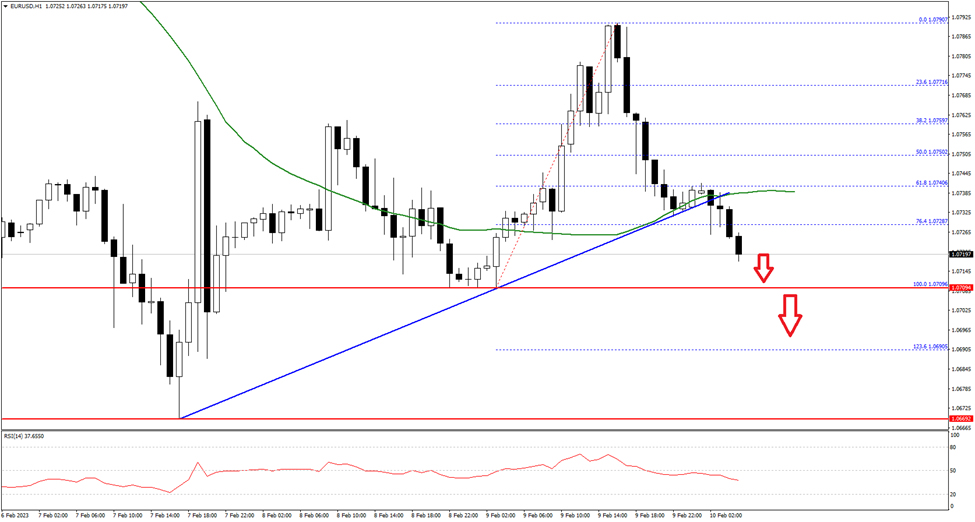
The Euro started a fresh decline from the 1.0800 zone against the US Dollar. The EUR/USD pair traded below the 1.0765 level to move into a bearish zone.
The pair even traded below the 1.0750 level and the 50 hourly simple moving average. The bears pushed the pair below a key bullish trend line with support at 1.0740 on the hourly chart. An immediate resistance is now near the 1.0740 level.
The first major resistance is near 1.0760 on FXOpen. A break above the 1.0760 resistance level could start another increase. In the stated case, it could rise towards the 1.0800 resistance.
Conversely, the pair might continue to move down below 1.0720. The next key support is near 1.0700, below the pair could drop towards the 1.0670 level. Any more losses might send the pair towards the 1.0645 level in the near term.
USD/CAD Daily Outlook
Daily Pivots: (S1) 1.3398; (P) 1.3430; (R1) 1.3488; More....
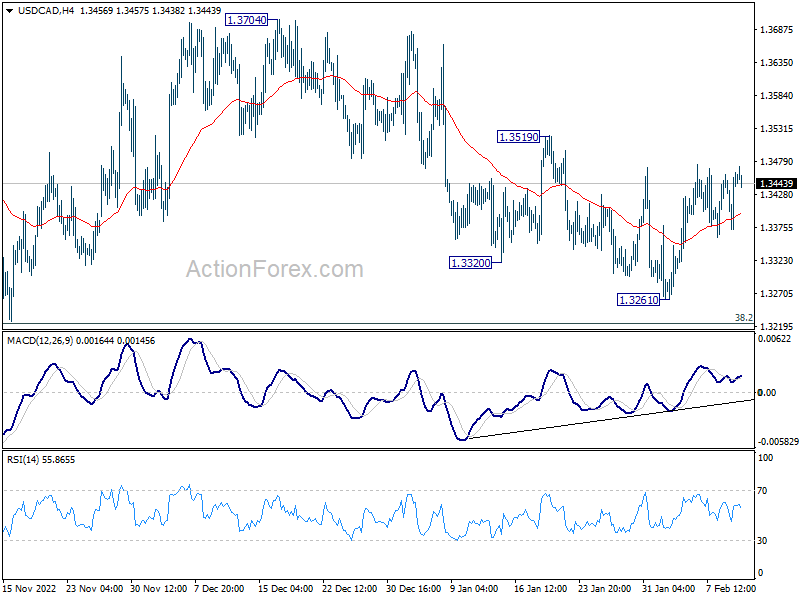
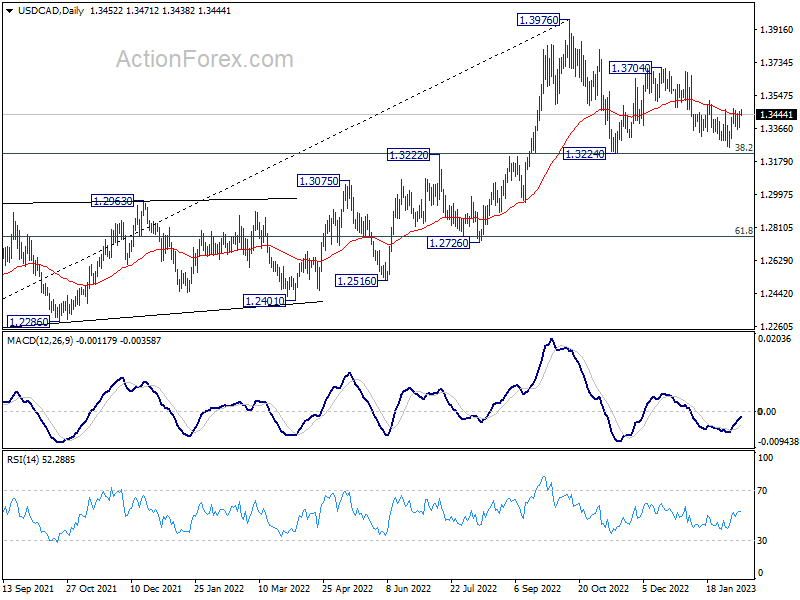
Outlook is USD/CAD is unchanged and intraday bias remains neutral at this point. While the choppy fall from 1.3704 might still extend lower, strong support is expected to 1.3224 key support to bring rebound. On the upside, above 1.3519 minor resistance will confirm short term bottoming, and turn intraday bias back to the upside for retesting 1.3704 resistance. However, decisive break of 1.3224 would carry larger bearish implication.
In the bigger picture, as long as 1.3222 cluster support (38.2% retracement of 1.2005 to 1.3976 at 1.3223) holds, larger up trend from 1.2005 (2021 low) is still expected to resume through 1.3976 high at a later stage. However, firm break of 1.3222/3 will indicate that the trend might have reversed. Deeper fall would be seen to next cluster support at 1.2726 (61.8% retracement at 1.2758).
AUD/USD Daily Report
Daily Pivots: (S1) 0.6900; (P) 0.6955; (R1) 0.6992; More...
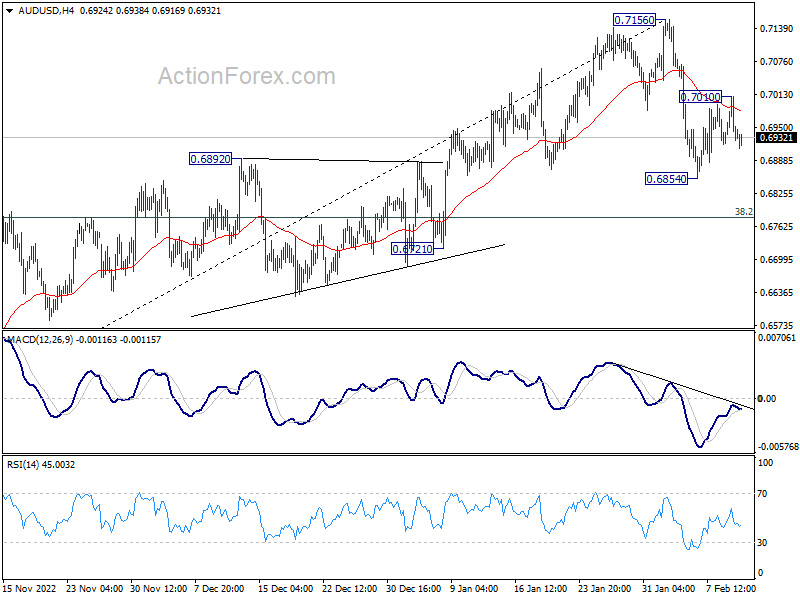
AUD/USD breached 4 hour 55 EMA but quickly retreated. Intraday bias remains neutral first. On the downside, break of 0.6854 will resume the corrective decline from 0.7156 to 38.2% retracement of 0.6169 to 0.7156 at 0.6779. On the upside, break 0.7010 minor resistance should bring retest of 0.7156 high.
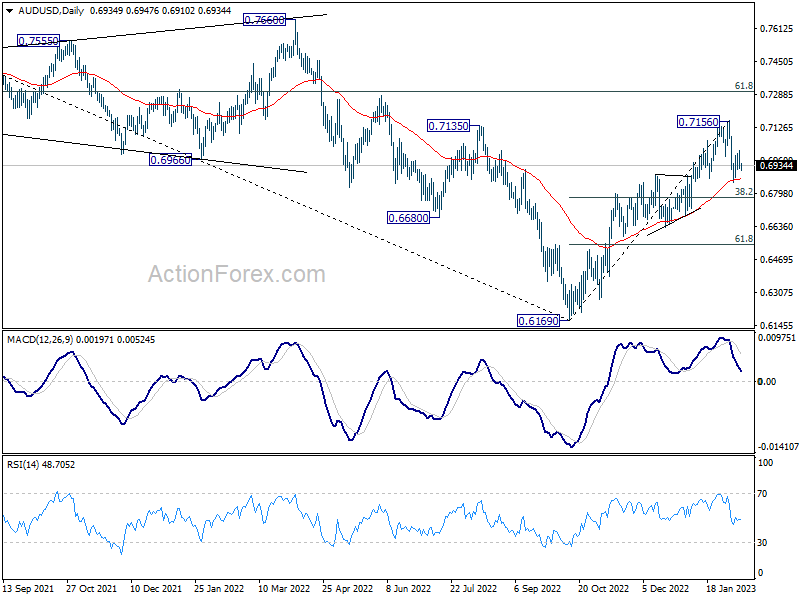
In the bigger picture, corrective decline from 0.8006 (2021 high) should have completed with three waves down to 0.6169 (2022 low). Further rally should be seen to 61.8% retracement of 0.8006 to 0.6169 at 0.7304. Sustained break there will pave the way to retest 0.8006. This will now remain the favored case as long as 0.6721 support holds.
USD/JPY Daily Outlook
Daily Pivots: (S1) 130.63; (P) 131.23; (R1) 132.12; More...
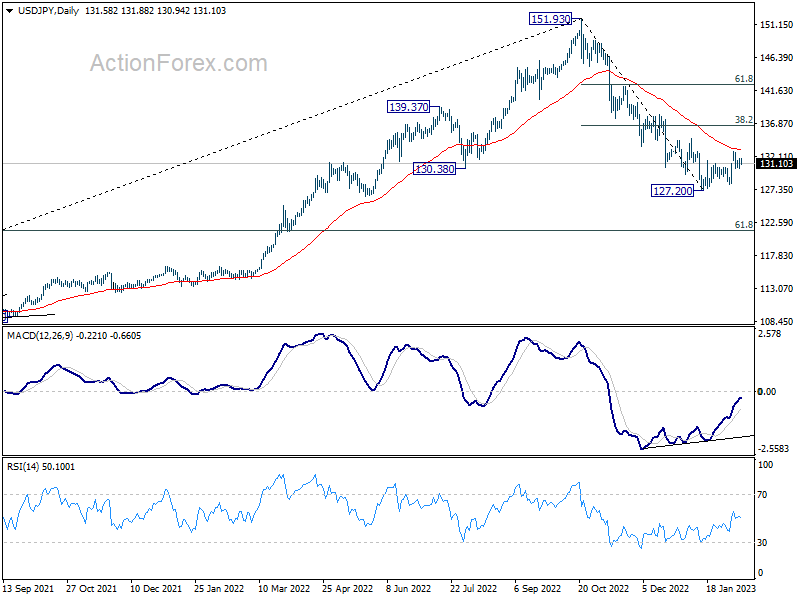
USD/JPY recovered after just brief breach of 4 hour 55 EMA and intraday bias is turned neutral first. On the downside, below 130.33 will bring deeper decline to retest 127.20 low. Decisive break there will resume larger down trend from 151.93. On the upside, above 132.89 will resume the rebound to 38.2% retracement of 151.93 to 127.20 at 136.64.
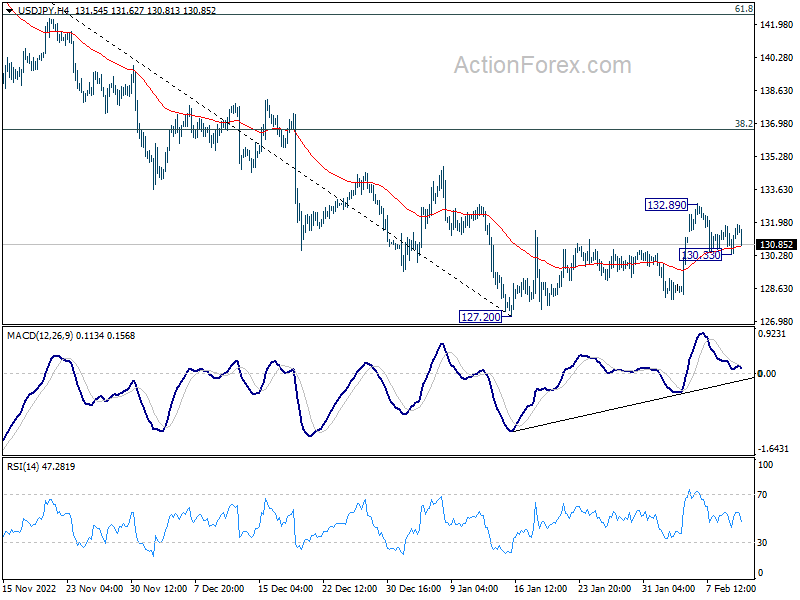
In the bigger picture, prior of 55 week EMA (now at 131.39) raises the chance of medium term bearish reversal, but that's not confirmed yet. Strong rebound from current level, followed by sustained break of 38.2% retracement of 151.93 to 127.20 at 136.64 will argue that price actions from 151.93 is merely a corrective pattern. However, rejection by 136.64 will solidify medium term bearishness for 61.8% retracement of 102.58 to 151.93 at 121.43 and 38.2% retracement of 75.56 to 151.93 at 122.75.
USD/CHF Daily Outlook
Daily Pivots: (S1) 0.9179; (P) 0.9204; (R1) 0.9247; More...
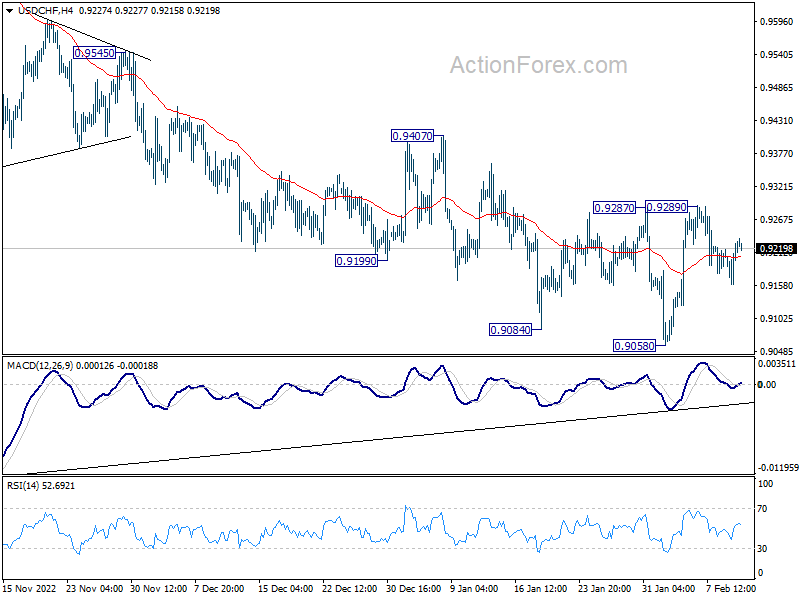
Range trading continues in USD/CHF and intraday bias remains neutral. On the upside, firm break of 0.92879 resistance will confirm short term bottoming at 0.9058, and bring stronger rise to 0.9407 resistance. On the downside, however, sustained break of 0.9058 will resume larger decline from 1.0146 instead.
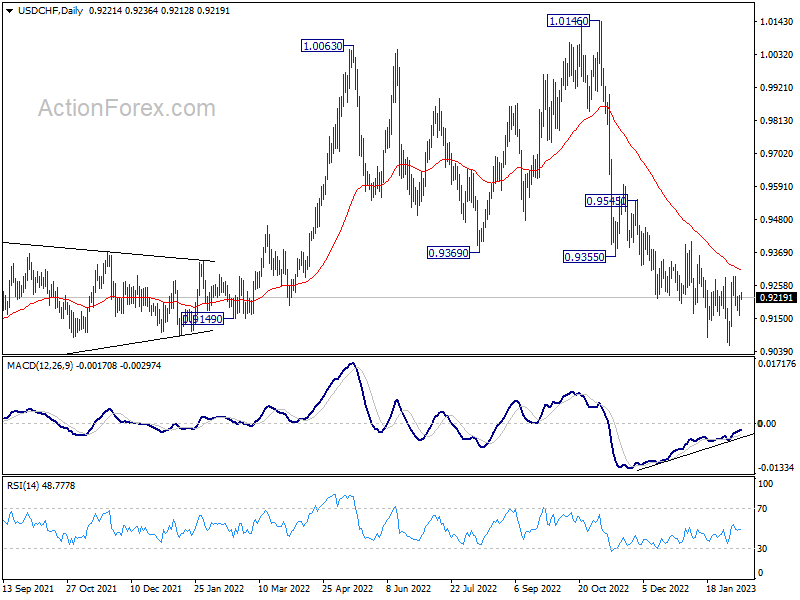
In the bigger picture, rise from 0.8756 (2021 low) has completed at 1.0146, well ahead of 1.0342 long term resistance (2016 high). Based on current downside momentum, fall from 1.0146 should be a medium term down trend itself. Next target is a test on 0.8756 low. Strong support should be seen there to bring rebound. Still, further decline will now be expected as long as 0.9407 resistance holds, in any case.
EUR/USD Daily Outlook
Daily Pivots: (S1) 1.0702; (P) 1.0746; (R1) 1.0783; More...
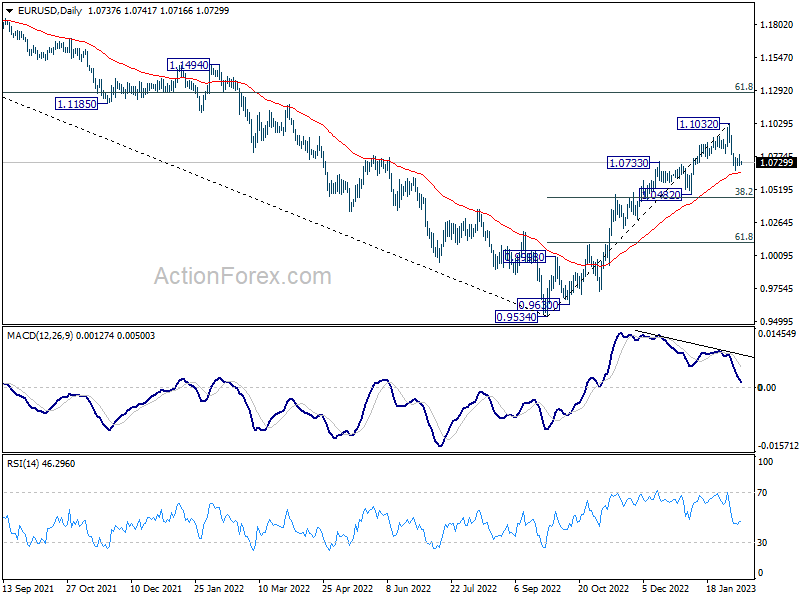
EUR/USD is staying in consolidation above 1.0668 temporary low and intraday bias stays neutral. On the downside, break of 1.0668 will resume the correction from 1.1032 short term top and target 38.2% retracement of 0.9534 to 1.1032 at 1.0463. Nevertheless, firm break of 4 hour 55 EMA (now at 1.0793) will bring retest of 1.1032 high instead.
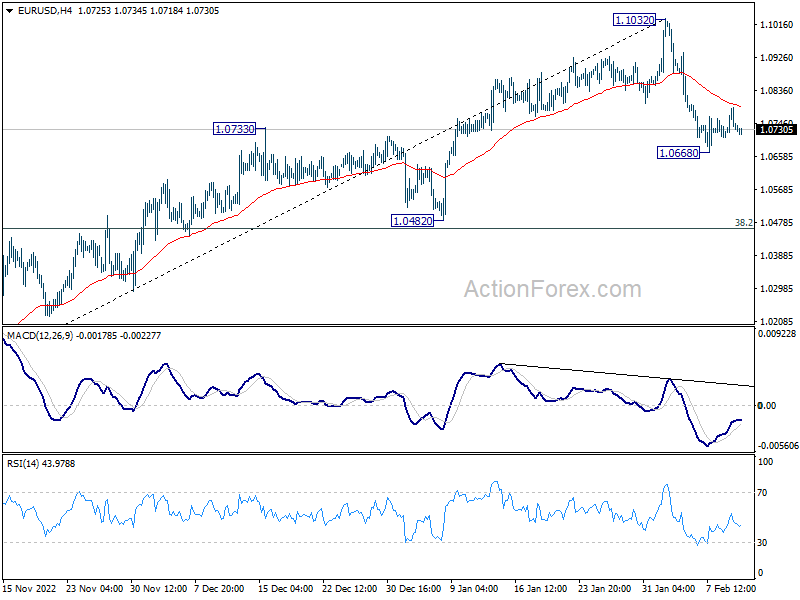
In the bigger picture, current development suggests that the rally from 0.9534 low (2022 low) is a medium term up trend rather than a correction. Further rise is in favor to 61.8% retracement of 1.2348 (2021 high) to 0.9534 at 1.1273 next. This will remain the favored case as long as 1.0482 support holds.
UK GDP contracted -0.5% mom in Dec, flat in Q4
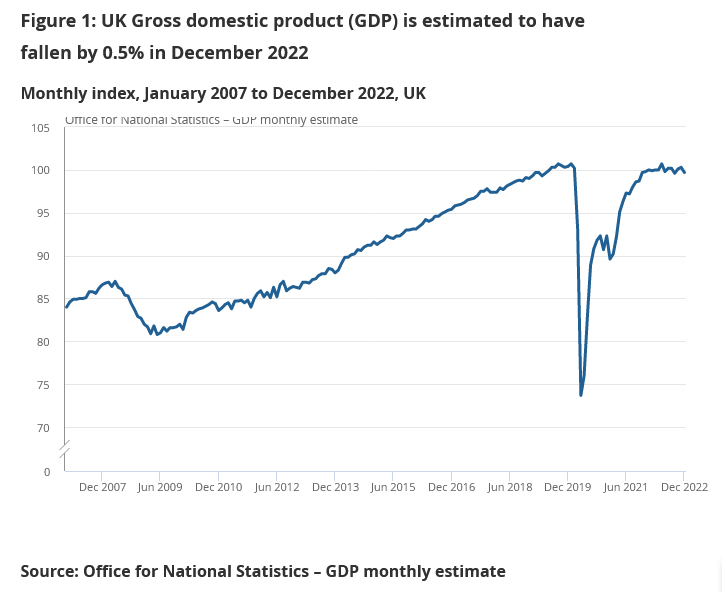
UK GDP contracted notably by -0.5% mom in December, even worse than expectation of -0.3% mom. Services declined by -0.8% mom. Production rose 0.3% mom. Construction was flat for the month.
In Q4, GDP showed 0.0% qoq growth, matched expectations. Services sector was flat on the quarter. Production dropped -0.2% qoq while construction grew 0.3% qoq.
For 2022 as a whole, GDP grew 4.0%, following a 7.6% expansion in 2021.
Also released, industrial production came in at 0.3% mom -4.0% yoy in December, versus expectation of -0.2% mom, -5.3% yoy. Manufacturing was at 0.0% mom, -5.7% yoy, versus expectation of -0.2% mom, -6.1% yoy. Goods trade deficit widened from GBP -14.7B to GBP -19.3B, above expectation of GBP -17.2B.