Sample Category Title
EUR/USD Mid-Day Outlook
Daily Pivots: (S1) 1.0696; (P) 1.0728; (R1) 1.0747; More...
Intraday bias in EUR/USD stays neutral first. On the downside, break of 1.0668 will resume the correction from 1.1032 short term top and target 38.2% retracement of 0.9534 to 1.1032 at 1.0463. Nevertheless, firm break of 4 hour 55 EMA (now at 1.0804) will bring retest of 1.1032 high instead.
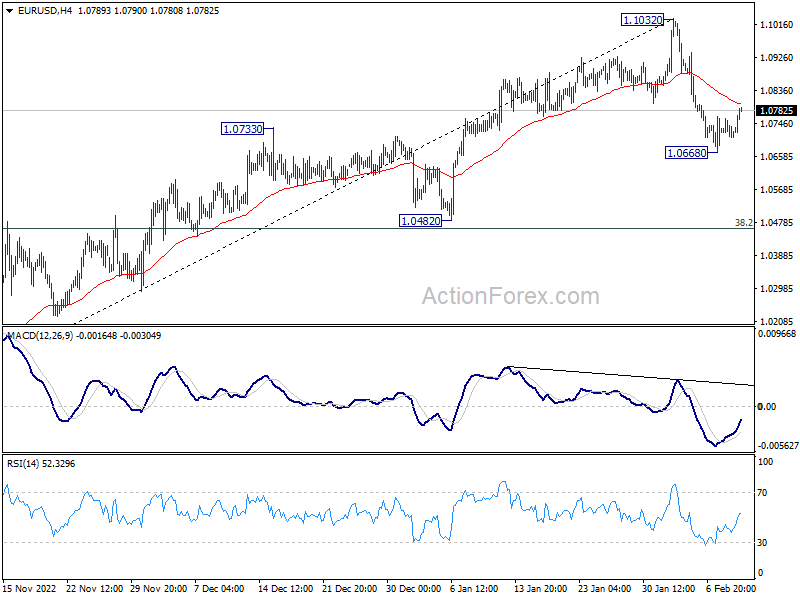
In the bigger picture, current development suggests that the rally from 0.9534 low (2022 low) is a medium term up trend rather than a correction. Further rise is in favor to 61.8% retracement of 1.2348 (2021 high) to 0.9534 at 1.1273 next. This will remain the favored case as long as 1.0482 support holds.
GBP/USD Mid-Day Outlook
Daily Pivots: (S1) 1.2035; (P) 1.2072; (R1) 1.2109; More...
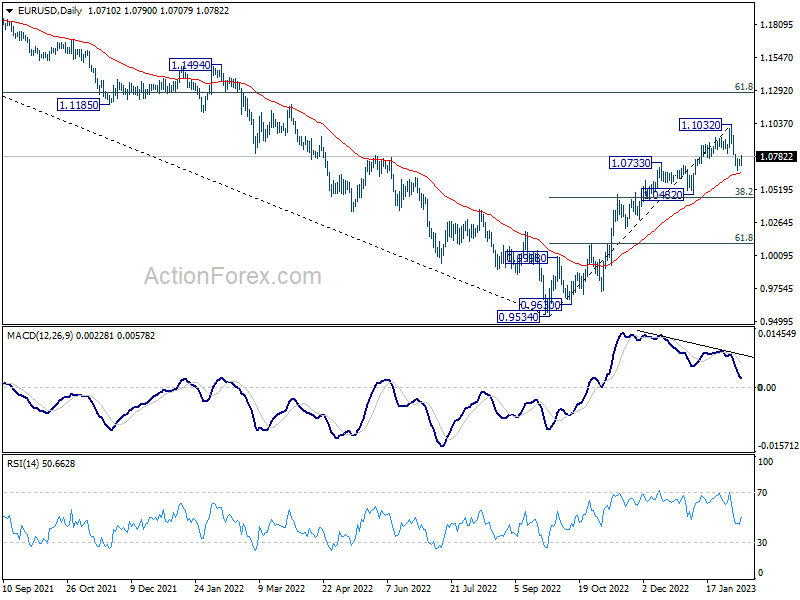
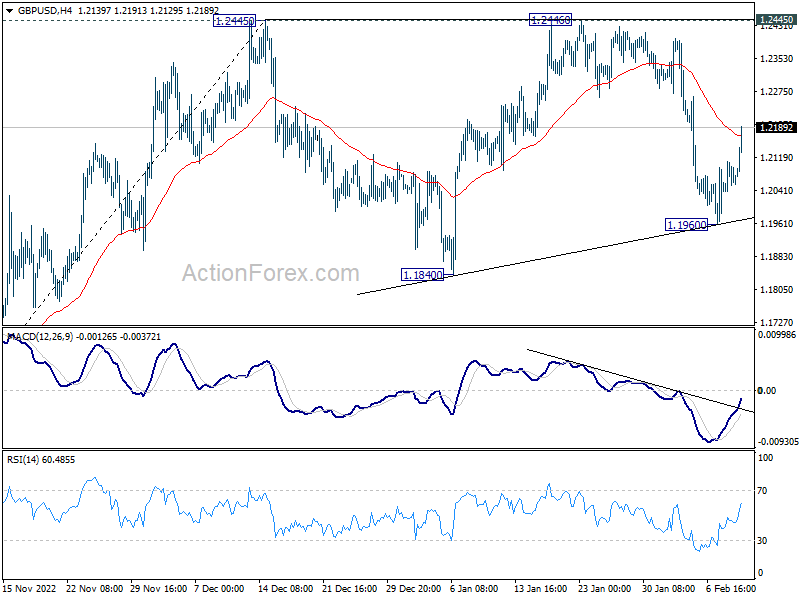
GBP/USD's break of 4 hour 55 EMA suggests that fall from 1.2446 has completed at 1.1960. Corrective pattern from 1.2445 might be finished too. Intraday bias is back on the upside for retesting 1.2445/6. Decisive break there will resume larger rise from 1.0351. On the downside, through break of 1.1960 will extend the corrective pattern with another fall to 1.1840 support and possibly below.
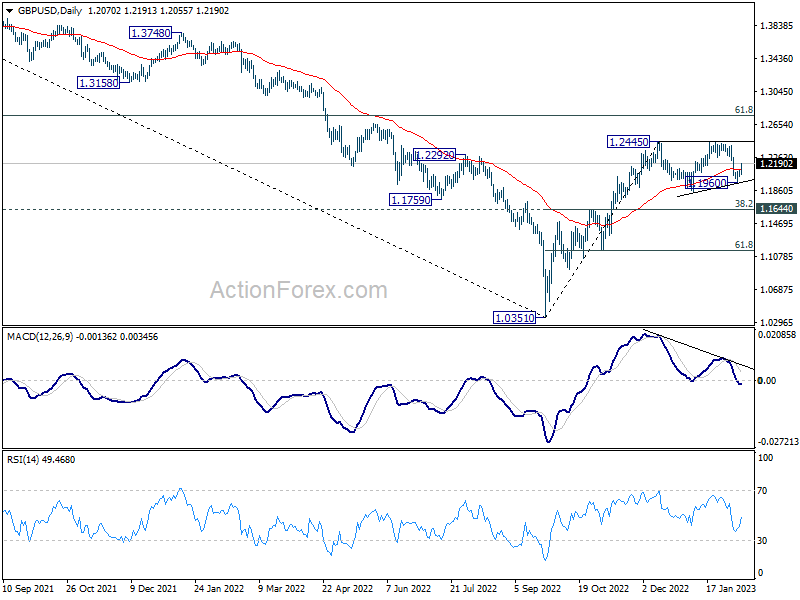
In the bigger picture, rise from 1.0351 medium term bottom is at least correcting whole down trend from 1.4248 (2021 high). Further rise is expected as long as 1.1644 resistance turned support holds. Next target is 61.8% retracement of 1.4248 to 1.0351 at 1.2759. Sustained break there will pave the way back to 1.4248.
USD/CHF Mid-Day Outlook
Daily Pivots: (S1) 0.9182; (P) 0.9206; (R1) 0.9234; More...
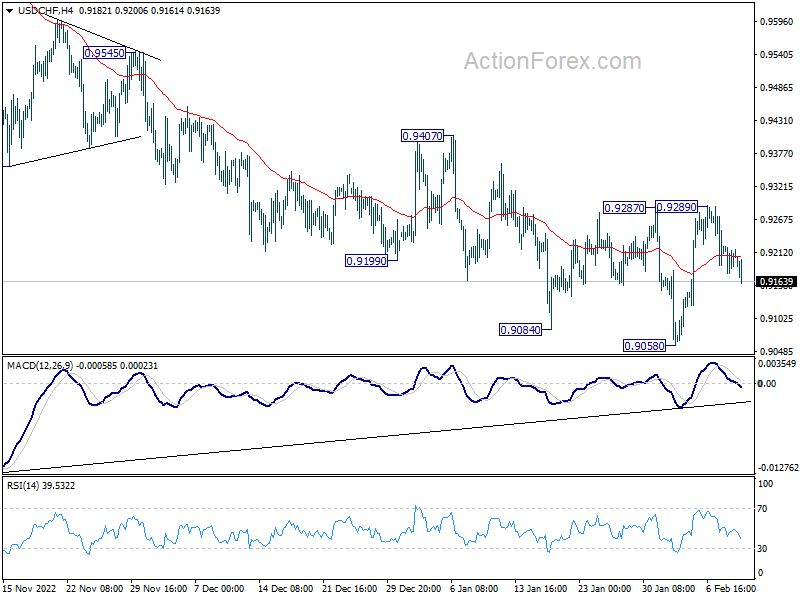
Intraday bias in USD/CHF stays neutral and outlook is unchanged. On the upside, firm break of 0.9287 resistance will confirm short term bottoming at 0.9058, and bring stronger rise to 0.9407 resistance. On the downside, however, sustained break of 0.9058 will resume larger decline from 1.0146 instead.
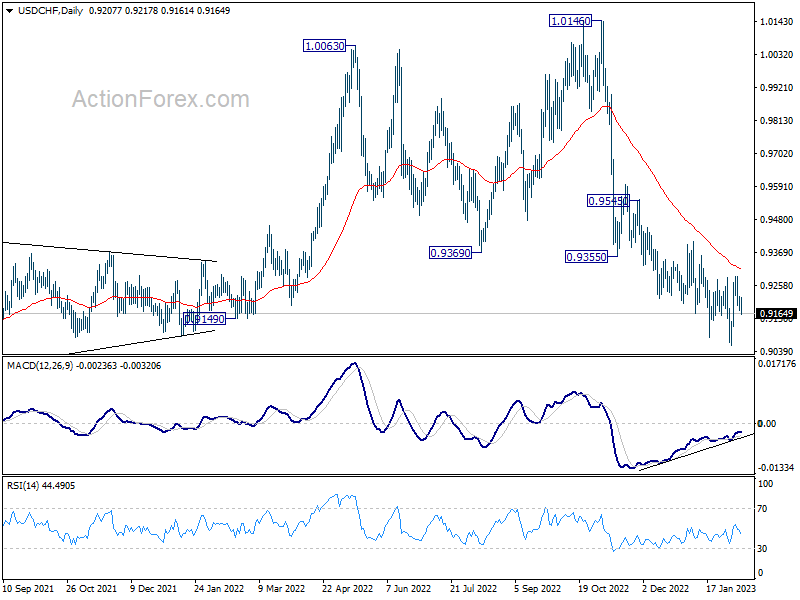
In the bigger picture, rise from 0.8756 (2021 low) has completed at 1.0146, well ahead of 1.0342 long term resistance (2016 high). Based on current downside momentum, fall from 1.0146 should be a medium term down trend itself. Next target is a test on 0.8756 low. Strong support should be seen there to bring rebound. Still, further decline will now be expected as long as 0.9407 resistance holds, in any case.
USD/JPY Mid-Day Outlook
Daily Pivots: (S1) 130.85; (P) 131.19; (R1) 131.79; More...
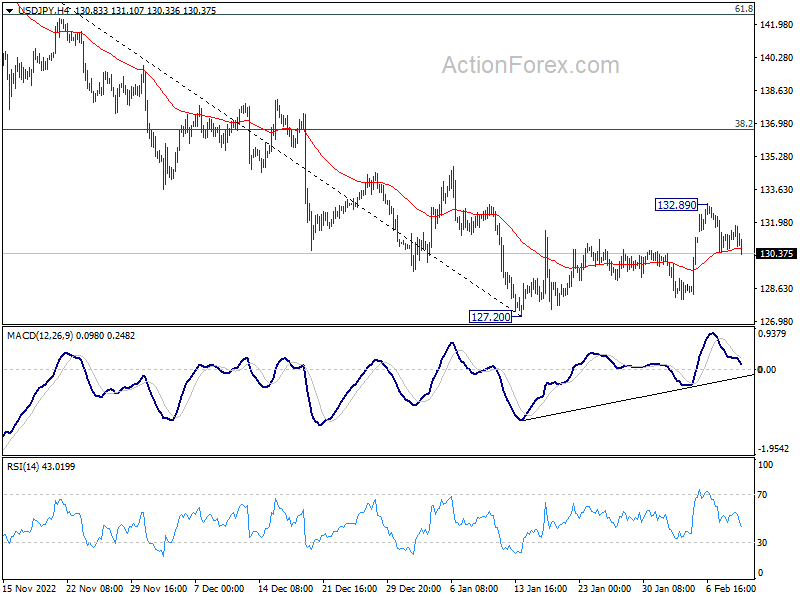
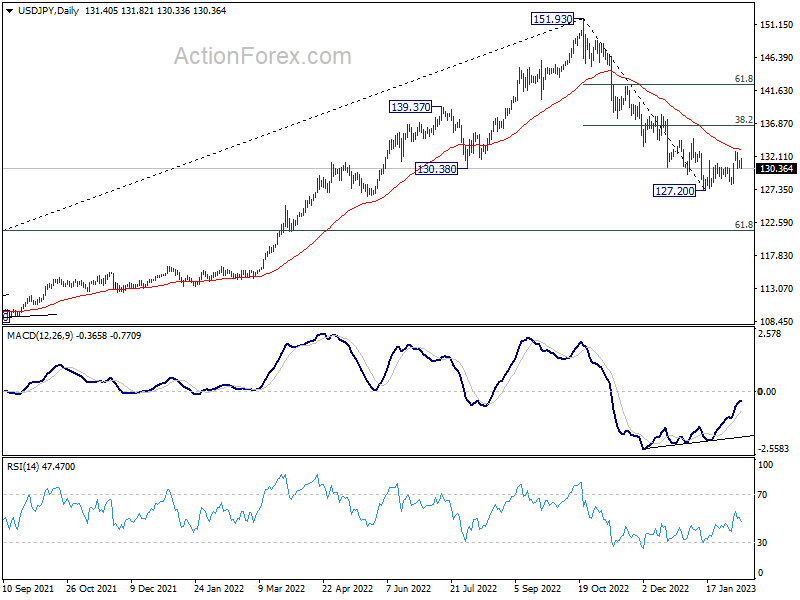
USD/JPY's break of 4 hour 55 EMA argues that rebound from 127.20 has completed at 132.89. Intraday bias is back on the downside for retesting 127.20 low. Decisive break there will resume larger down trend from 151.93. On the upside, above 132.89 will resume the rebound to 38.2% retracement of 151.93 to 127.20 at 136.64.
In the bigger picture, prior of 55 week EMA (now at 131.39) raises the chance of medium term bearish reversal, but that's not confirmed yet. Strong rebound from current level, followed by sustained break of 38.2% retracement of 151.93 to 127.20 at 136.64 will argue that price actions from 151.93 is merely a corrective pattern. However, rejection by 136.64 will solidify medium term bearishness for 61.8% retracement of 102.58 to 151.93 at 121.43 and 38.2% retracement of 75.56 to 151.93 at 122.75.
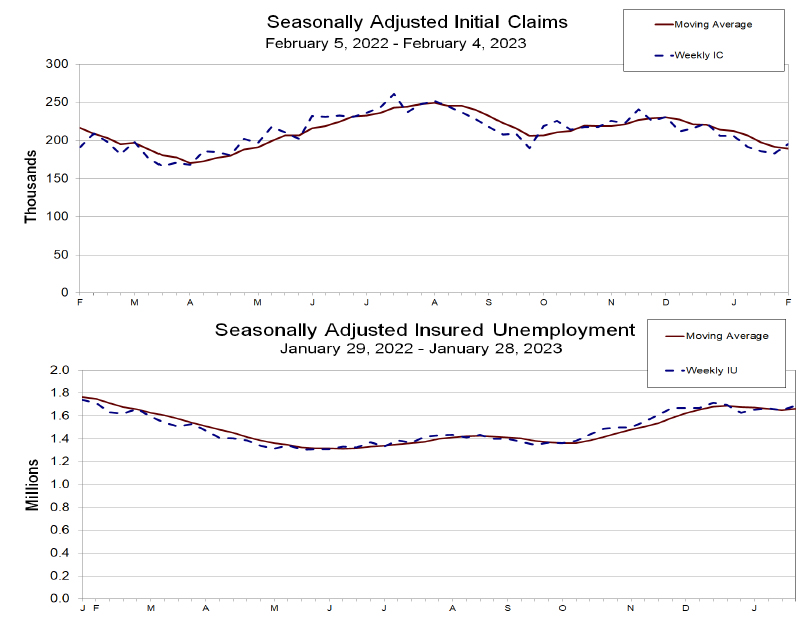
US initial jobless claims rose to 196k
US initial jobless claims rose 13k to 196k in the week ending February 4. Four-week moving average of initial claims dropped -2.5k to 189k.
Continuing claims rose 38k to 1688k in the week ending January 28. Four-week moving average of continuing claims rose 14.5k to 1665k.
BoE Bailey very uncertain particularly about price-setting and wage-setting
BoE Governor Andrew Bailey said in a Treasury Committee hearing, "we are concerned about persistence (of inflation) and that's why, frankly, we raised interest rates this time."
"I am very uncertain particularly about price-setting and wage-setting in this country. We have got the largest upside skew in our forecasts that we have ever had on inflation," Bailey added.
Nevertheless, "what I would urge is that - particularly going forwards because we think inflation is going to fall very rapidly - that is taken into account," Bailey added.
Chief Economist Huw Pill said, "There is no room for complacency. Inflation remains unacceptably high... Returning inflation to target in a sustainable manner requires that the MPC continues to be watchful for signs of greater persistence in inflationary pressures than is embodied in our baseline forecast."
MPC member Jonathan Haskel warned, "Economic theory suggests that uncertainty around the persistence of inflation should be met with more forceful action... I shall remain alert to indications that inflation is more persistent than we expected, and act forcefully if necessary."
On the other hand, Silvana Tenreyro said, "Unless there is another big development that we don't know about - and we have a massive energy shock or something that is not on the cards - then I think they fall in inflation is pretty much guaranteed."
"Where things stand right now, I would see myself considering a cut. I don't want to talk about the particular meeting,: Tenreyo added.
WTI Oil: Strong Rally Starts to Lose Traction on Overbought Conditions/Inflation Concerns
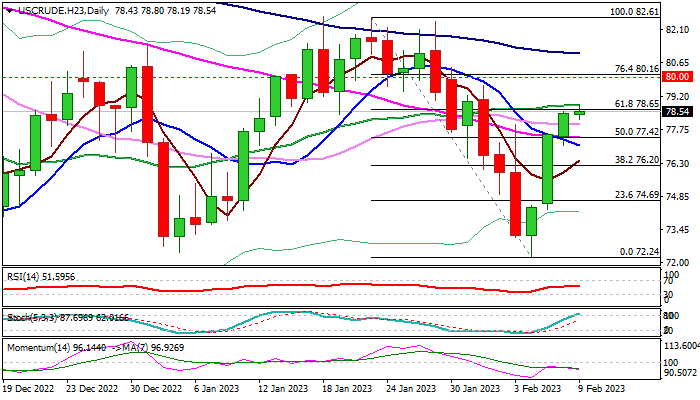
The WTI oil remains at the front foot and extends strong rise from $72.24 (Feb 6 low) for the fourth straight day, underpinned by growing optimism over Chinese demand recovery.
Analysts remain cautiously optimistic as signs that inflation in the US is getting entrenched that would result in further increase in interest rates, may partially offset positive impact and limit gains.
The latest bullish acceleration hit target at $78.65 (Fibo 61.8% of $82.61/$72.24) reinforced by 20DMA, where bulls may face stronger headwinds as daily stochastic entered overbought zone and momentum moves deeper into negative territory.
Failure to break above $78.65 pivot would signal consolidation, with bullish near-term bias to remain intact while dips stay above daily cloud base ($76.83) for attempt at psychological $80.00 barrier.
Conversely, return below the base of thickening daily cloud and extension through daily Tenkan-sen ($76.34) would weaken near-term structure and signal an end of recovery from $72.24.
Res: 78.82; 79.69; 80.00; 81.04
Sup: 77.96; 77.44; 76.83; 76.34
USD/JPY: Dollar Losing Traction But More Signals Needed to Spark Deeper Drop
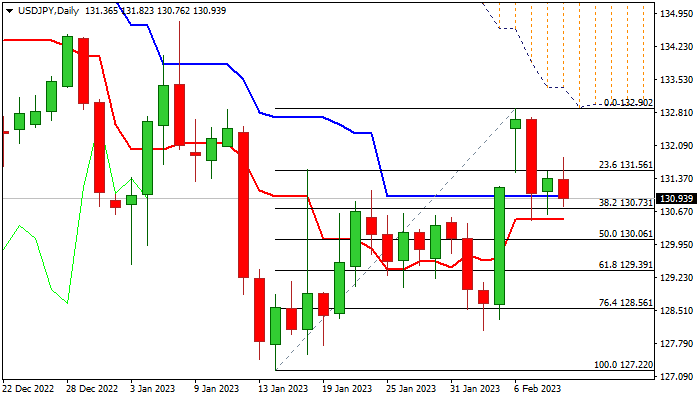
The USDJPY edged lower in early Thursday but remains within 130.50/132.90 range which extends into fourth consecutive day.
Fading bullish momentum and south-heading stochastic / RSI on daily chart, signal that the downside is vulnerable, but need a firm break of daily Kijun-sen (131.00) which contained dips in past two days, with extension below daily Tenkan-sen (130.49) to confirm reversal and open way for further retracement of 127.22/132.90 recovery phase.
Ability to hold above Kijun-sen support would keep an action in extended consolidation, but still weighed by falling thick daily cloud (base of the cloud lays at 132.92).
Investors are focusing on US inflation data for stronger direction signals, after the latest hawkish comments from Fed and speculations that US terminal rate would increase towards 6%, did not provide stronger support to dollar.
Res: 131.56; 131.82; 132.70; 132.92
Sup: 130.49; 130.00; 129.39; 128.56
Euro Gains Ground, German CPI Inches Upwards
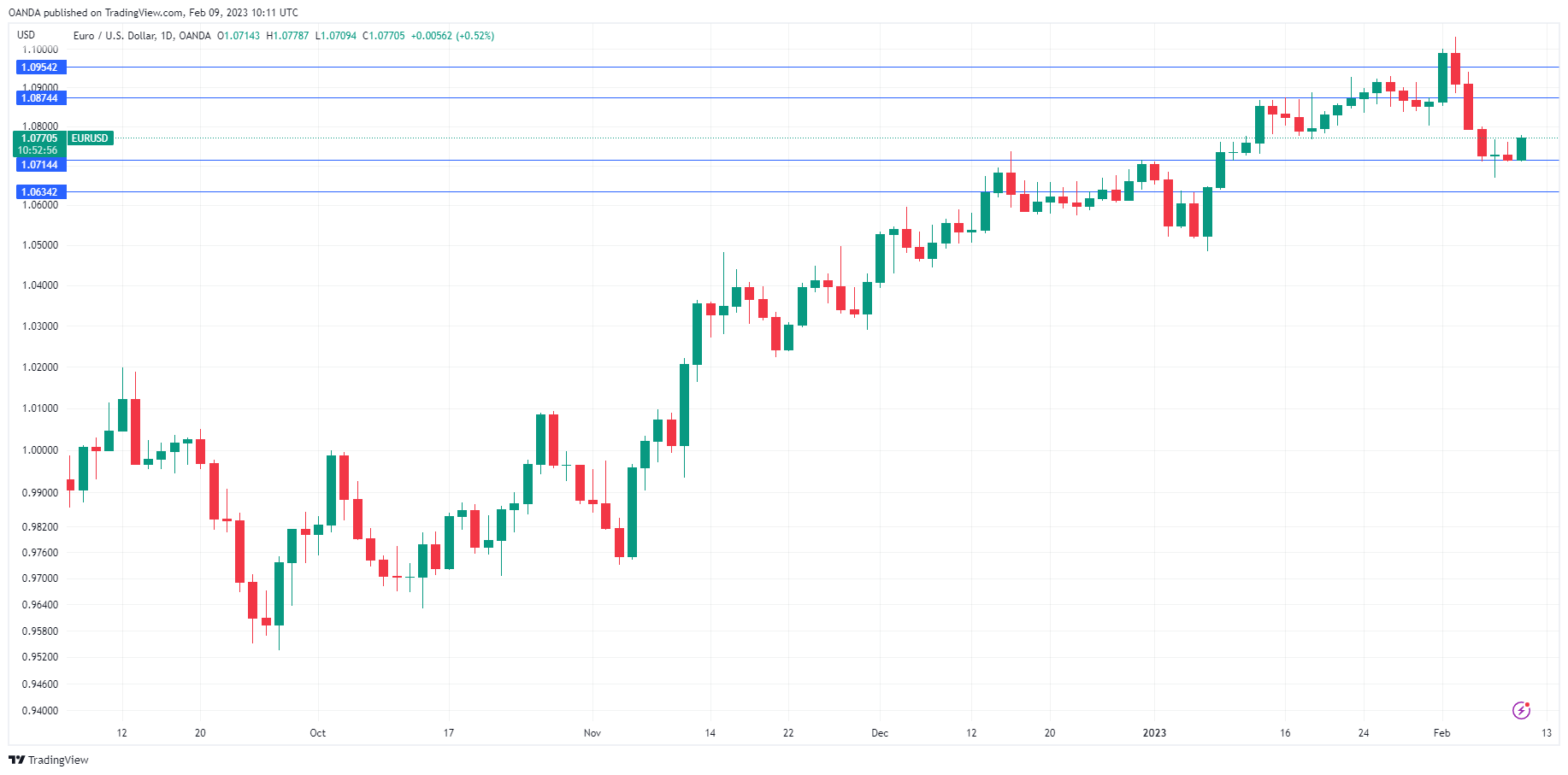
The euro has posted strong gains on Thursday. EUR/USD is trading at 1.0749, up 0.57%.
German CPI ticks higher
German inflation came in at 8.7% y/y in January, up from 8.6% in December. On a monthly basis, CPI rose 1.0%, following a -0.8% reading in December. The report shows that German inflation remains high and it’s still too early to talk of a peak. The good news is that nasty double-digit inflation seems behind us, thanks in large part to lower energy prices due to a warm winter in Europe.
The ECB raised rates by 50 basis points last week, bringing the cash rate to 3.0%. The cash rate remains well below that of all other major central banks – the Fed’s rate, for example, is at 4.75%. ECB policy makers have noted that core inflation, which is a more reliable gauge than headline inflation, remains stickier than expected. The central bank meets next on Mar. 16 and the markets have priced in a 50-bp hike. What happens after March is uncertain. The ECB could take a pause in order to assess the impact of its tightening cycle or it could continue hiking, perhaps in modest increments of 25 bp, until there is a clear indication that core inflation is coming down.
ECB rate policy is primarily focused on taming inflation, but it must also keep an eye on the strength of the German economy, the largest in the eurozone. Recent data has been weak, which will make it harder for the ECB to deliver oversize rate hikes. German Industrial Production came in at -3.2% in December, GDP in Q4 contracted by 0.2%, retail sales for December slumped by 5.3% and Manufacturing PMI remains mired in contraction territory.
The Fed paraded four policy makers on Wednesday, each of whom drummed the message that the fall in inflation was welcome but the fight was not yet over. Fed member Williams said that a restrictive policy stance could last for a few years until inflation dropped to the target of 2%. The markets may be listening more closely to the Fed since the blowout employment report on Friday, but continue to underestimate the Fed’s end game. The markets have priced in a terminal rate of 4.6%, while the Fed has projected a terminal rate of 5.1%.
EUR/USD Technical
- EUR/USD is testing resistance at 1.0758. Above, there is resistance at 1.0873
- 1.0714 and 1.0633 are providing support
AUDUSD Forms Bullish Setup
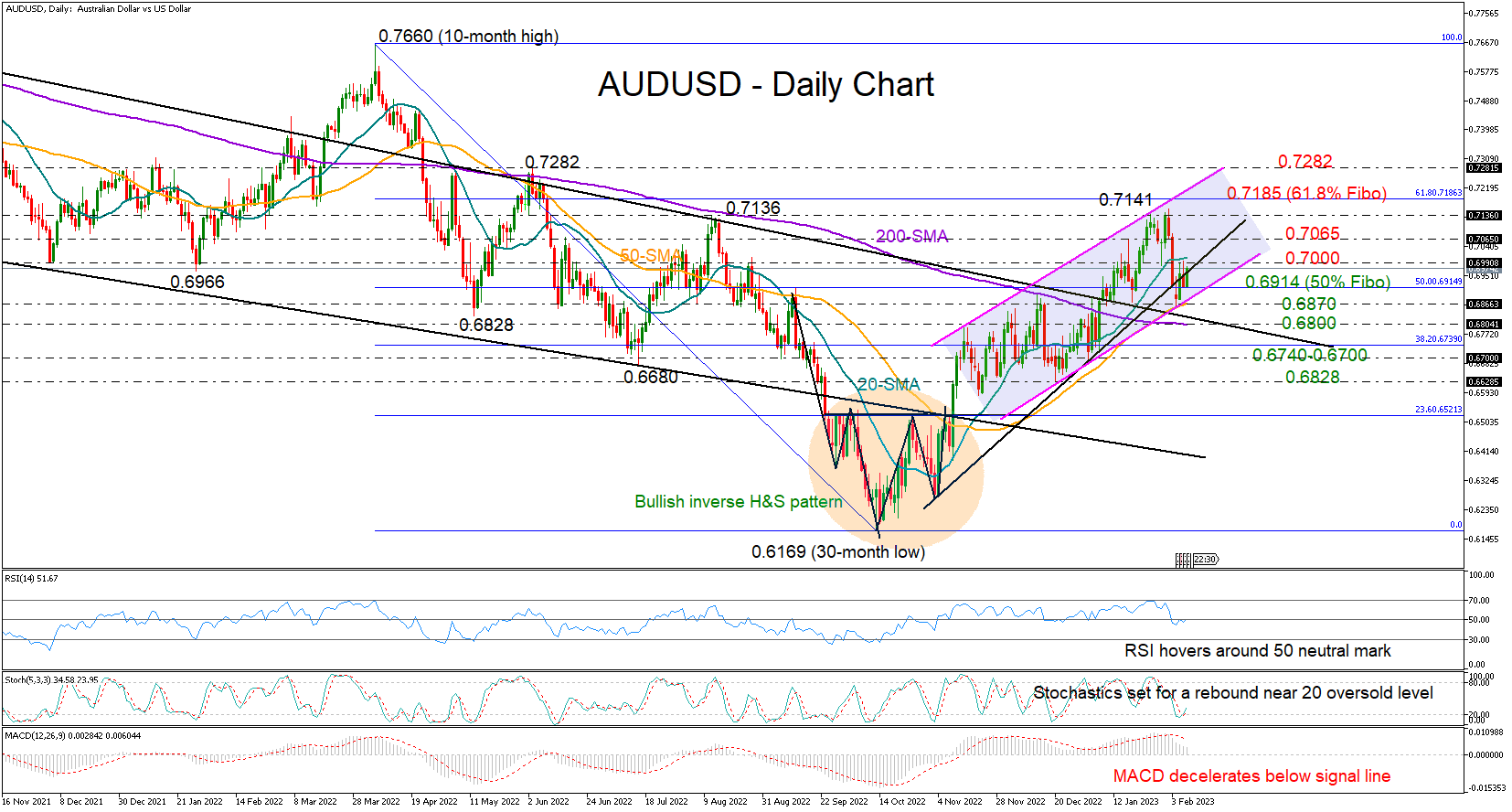
AUDUSD established a bullish setup around its 50-day simple moving average (SMA), aiming to recover last week’s rapid downfall.
Specifically, the pair has completed a large green candlestick following a doji candlestick earlier this week, pointing to fizzling selling tendencies. Interestingly, the rebound in the price took place at the lower boundary of a bullish channel, raising optimism that the recovery has just started.
Yet, with the support-turned-resistance trendline capping upside pressures around 0.6965 over the past few days, the current consolidation phase may continue for a bit longer, given the downward slope in the MACD. The RSI is feeding some skepticism too, as it is struggling to overcome its 50 neutral mark.
Should the bulls eliminate downside risks above the 20-day SMA and the 0.7000 round level, the pair could experience a quick rally towards August’s high of 0.7136, unless the 0.7065 barrier cools upside forces beforehand. Then, a successful penetration higher could mark a new higher high somewhere between the 61.8% Fibonacci retracement of the 0.7660-0.6169 downleg at 0.7185 and the key ascending line drawn from November 15. An extension through June’s peak of 0.7282 would further boost buying confidence.
Alternatively, a flip backward could face limits between the 50- and 200-day SMAs at 0.6870 and 0.6800 respectively. Note that the long-term descending trendline from May 2021 is passing through this zone. Hence, a close lower could squeeze the pair directly to the 38.2% Fibonacci level of 0.6740. The 0.6700 psychological number may come into consideration as well before the sell-off stretches to December’s low of 0.6628.
In brief, AUDUSD seems to be preparing for its next bullish phase. A decisive close above 0.7000 could stimulate buying intentions.