

Sample Category Title
Elliott Wave Count Suggests Further Upside in USDCAD
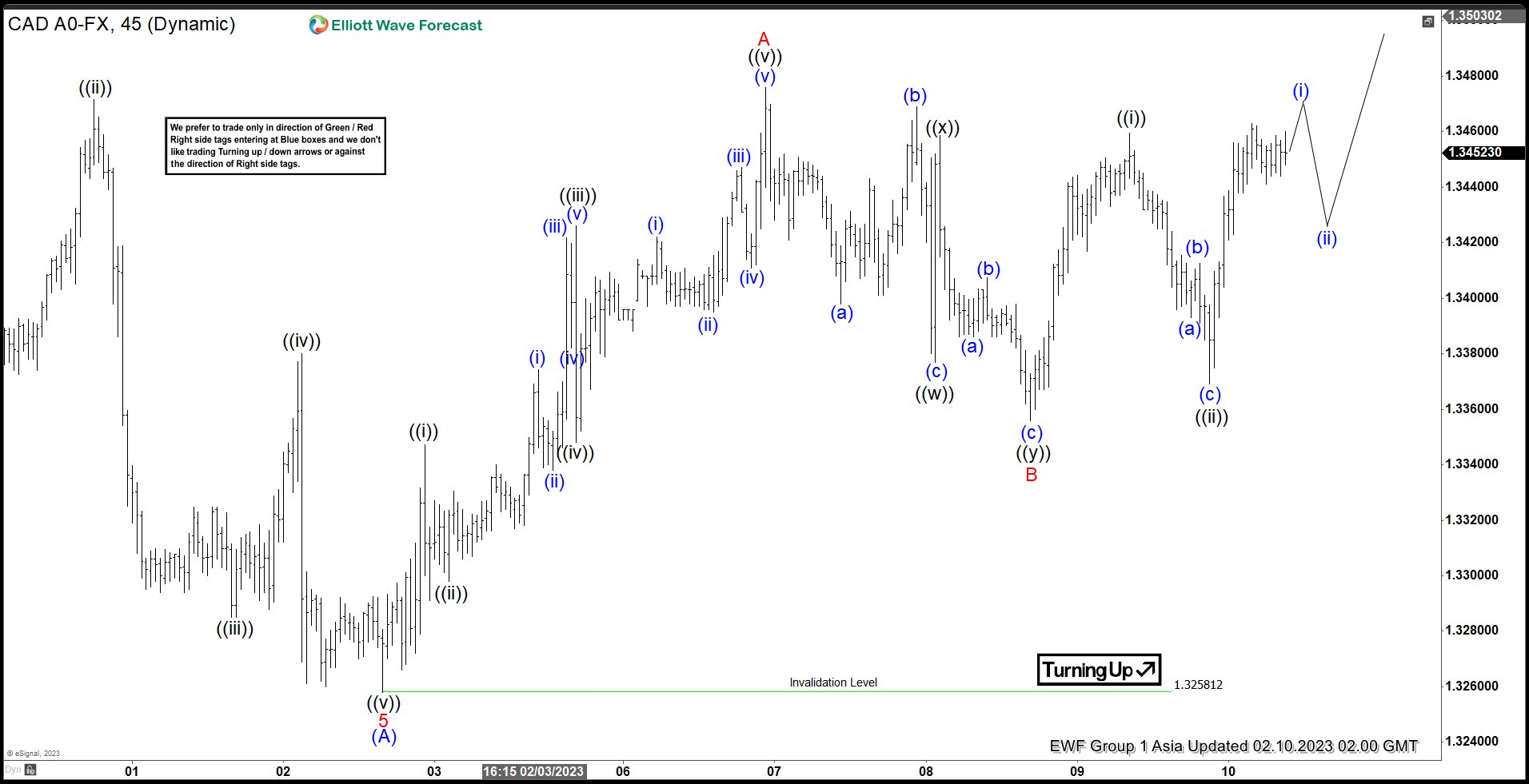
Short term Elliott Wave in USDCAD suggests the decline from 12.17.2022 high ended at 1.3258 as wave (A). Down from 12.17.2022 peak, wave 1 ended at 1.348 and rally in wave 2 ended at 1.3685. Pair extends lower again in wave 3 towards 1.3318 and bounce in wave 4 ended at 1.352. Final leg lower wave 5 ended at 1.3258 which completed wave (A). Wave (B) rally is currently in progress with internal subdivision as a zigzag Elliott Wave structure.
Up from 2.2.2023 low, wave ((i)) ended at 1.3347 and dips in wave ((ii)) ended at 1.3298. Pair extends higher in wave ((iii)) towards 1.3426, and pullback in wave ((iv)) ended at 1.3352. Final leg wave ((v)) ended at 1.3475 which completed wave A in higher degree. Pullback in wave B unfolded as a double three Elliott Wave structure and ended at 1.3356. Down from wave A, wave ((w)) ended at 1.337 and wave ((x)) ended at 1.3458. The third leg wave ((y)) ended at 1.3356 which completed wave B. Pair has turned higher in wave C but still needs to break above wave A at 1.3475 to rule out a double correction. Up from wave B, wave ((i)) ended at 1.3459 and dips in wave ((ii)) ended at 1.3369. Near term, as far as pivot at 1.3258 stays intact, expect pair to extend higher.
USDCAD 45 Minutes Elliott Wave Chart
GBPCHF Wave Analysis
- GBPCHF reversed from support level 1.1100
- Likely to rise to resistance level 1.1315
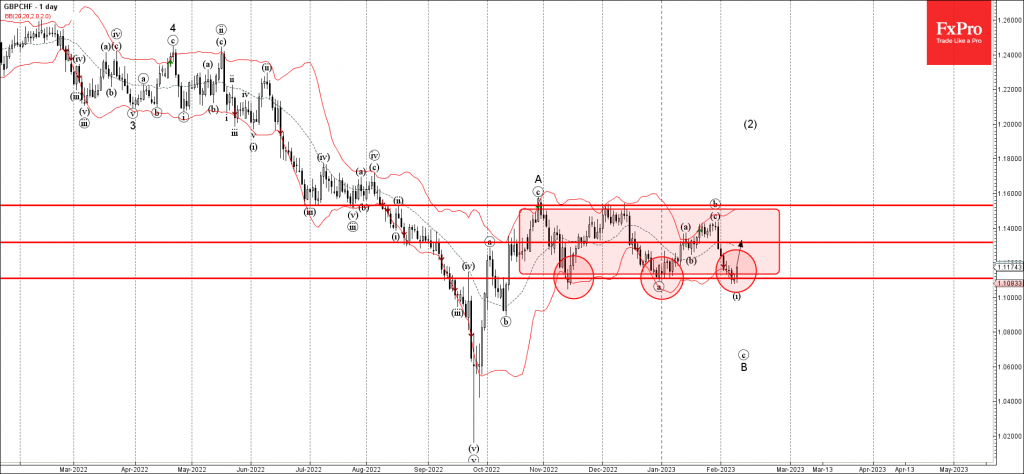
GBPCHF currency pair earlier reversed up from the pivotal support level 1.1100, which is the lower boundary of the sideways price range inside the pair has been moving from the end of October.
The support level 1.1100 was further strengthened by the lower daily Bollinger Band.
Given the continued sterling optimism, GBPCHF can be expected to rise further toward the next resistance level 1.1315.
EURGBP Wave Analysis
- EURGBP moves inside correction (ii)
- Possible test of 0.8800 support level
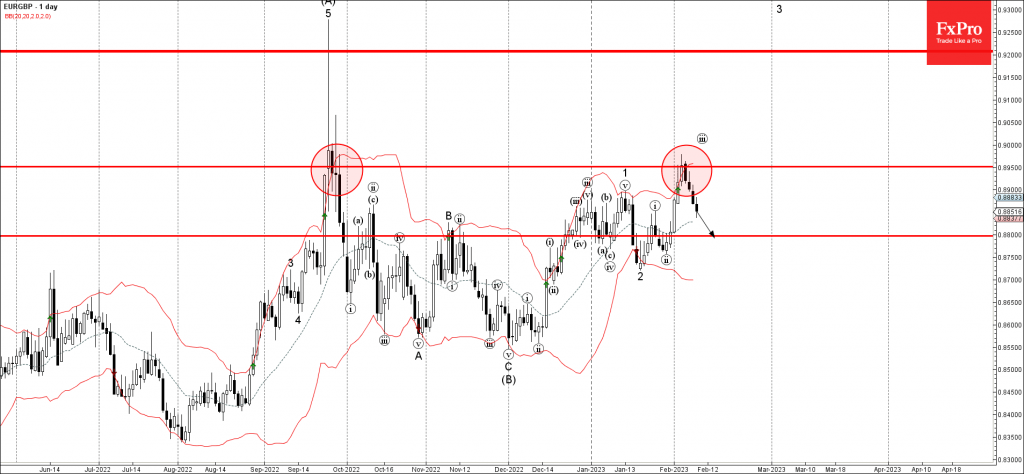
The EURGBP currency pair previously reversed down with the daily bearish engulfing from the strong resistance area surrounding the key resistance level 0.8950 (which also reversed the pair in September).
A downward reversal from the resistance level 0.8950 marked the beginning of an active short-term ABC correction (ii).
Given the increased bullish pressure on the pound sterling, EURGBP can be expected to fall further towards the next support level at 0.8800.
US – Soft Landing to No Landing?
US - Soft landing to no landing?
- From soft landing to no landing? The turnaround in macro momentum could prolong the need for tight monetary policy as labour markets remain too hot.
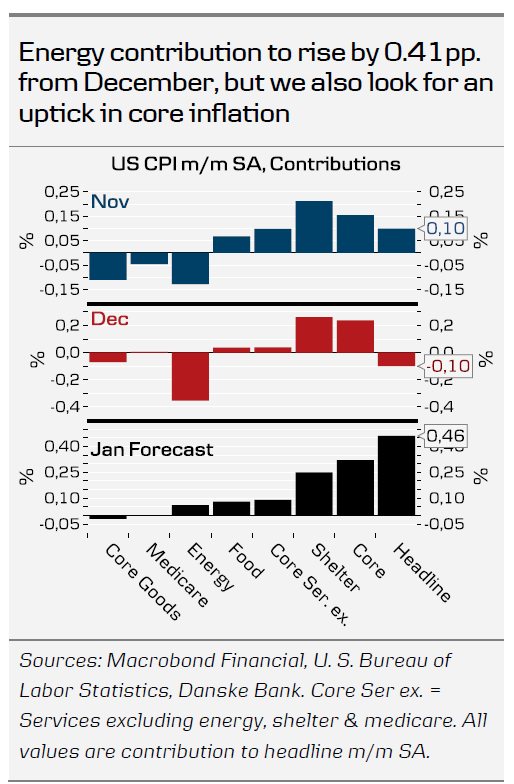
- January core CPI above 0.4% m/m would mark a clear pick-up in underlying inflation pressures and could take EUR/USD another leg lower.
- We think Fed is unlikely to revert back to 50bp hikes, but we remain open for the hiking cycle extending into the summer and/or rates remaining higher for longer.
At the beginning of the year we warned that the pre-emptive easing in financial conditions could lead to a pick-up in economic activity before the labour market has cooled sufficiently (see Research US - Good news is bad news for the Fed, 4 January). In our view, the January global PMIs as well as the US ISM and NFP data support the case.
That said, the 517k employment growth in January could overstate the true strength of the Jobs Report. The January figures are always subject to heavy seasonal adjustments due to the end of the holiday working season. It was the 6th warmest January on record since 1900, which likely supported employment in weather-sensitive sectors like construction. The non-seasonally adjusted employment declined by 2.5M, which is 358k less than during an average January over the past decade. The high SA figure could be partially explained by the adjustment factor failing to fully take into account the warm weather.
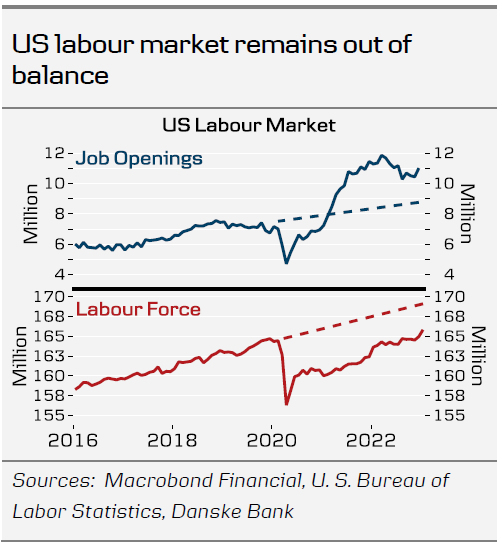
The blurry seasonality does not take away from the fact that labour markets remain extremely tight. Fed has assumed that the gradual slowdown of the economy would also cool the employment situation, but the tide could turn too early. The high number of job openings points towards still elevated labour demand, and the persistent divergence in the establishment survey (counting jobs) and the much weaker household survey (counting workers) suggests that labour supply remains scarce. While growth in both the employment cost index and the Indeed Hiring Lab's wage tracker based on job postings cooled towards the end of 2022, both figures remain too high to be consistent with Fed's inflation target.
As Fed emphasizes data dependency, markets' focus has shifted towards macro data releases, and not least the January CPI. The uptick in ISM services, household savings rate and used car prices suggest that both general activity and firms' pricing power have remained healthy at the beginning of the year. We forecast core CPI at 0.4% m/m, which is on the upper end of consensus forecasts. An upside surprise to 0.5% or above would in our view mark a clear upturn in the broader underlying inflation pressures.
Following the recent data, markets are now aligned with our call of a terminal rate of 5.00-5.25% in May. FOMC members have made it clear that move back to 50bp hikes is unlikely, but further upside surprises in data could push markets towards pricing rate hikes also for June and July. Fed focuses on real rates, and both consumer and market-based inflation expectations will be key to follow. While base effects will ensure that CPI figures come down this year, 1y1y inflation swap forwards have edged higher over the past weeks. Higher inflation expectations would warrant higher nominal rates for longer - for now we stick to our forecast of first cuts only in early 2024.
XAU/USD: Gradual Recovery May Lose Traction and Turn Price to Sideways Mode
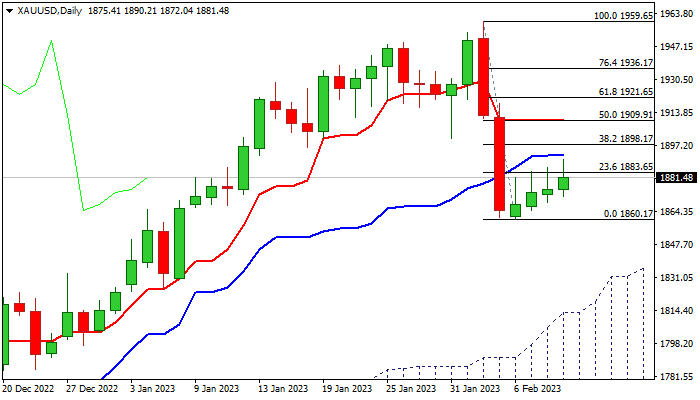
Recovery rally from $1860 (Feb 6 low) extends into fourth straight day and accelerated on Thursday, underpinned by weaker dollar.
Although the recent recovery was steady, gains were rather small and continued to face headwinds, signaled by long upper shadows of daily candles.
This suggests that despite the near-term price action is supported, upticks are likely to be limited, pointing to extended range trading, as traders await firmer signals from next week’s US inflation report, which is expected to put more light on Fed’s near-future steps and determine metal’s direction.
Technical studies show mixed setup of daily moving averages, strong negative momentum and stochastic about to emerge from oversold territory that together contribute with mixed signals to likely near-term range-trading scenario.
Pivotal support lays at $1860 and near-term action is expected to remain biased higher while holding above the latter, while break lower would risk deeper pullback.
At the upside, daily Kijun-sen (1892) marks initial resistance, followed by $1900 zone (psychological / Fibo 38.2% of $1959/$1860 / 10DMA) and upper pivot at $1909 (daily Tenkan-sen / 50% retracement) break of which is needed to bring bulls fully in play.
Res: 1890; 1900; 1909; 1921
Sup: 1872; 1860; 1844; 1827
Could Japanese Government Surprise With Nomination of New BoJ Governor?
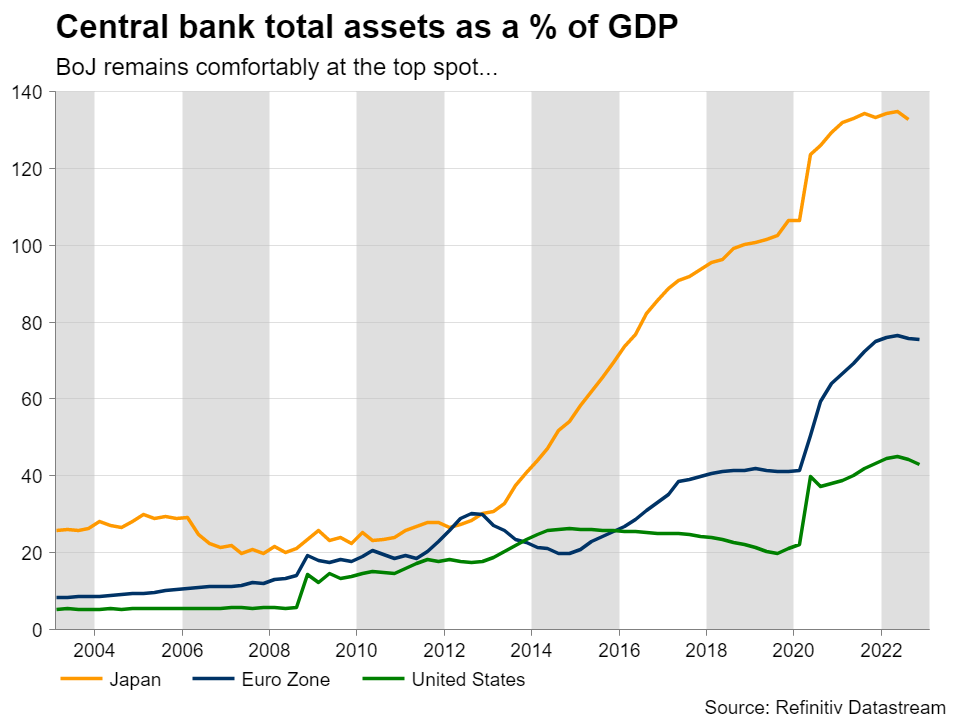
The term of the 31st Governor of the Bank of Japan ends on April 8. For the past 10 years, Governor Kuroda has been spearheading the Japanese efforts to return the country to normal inflation rates and decent growth. The new BoJ Governor will face slightly improved conditions compared to 2013 when Kuroda took over, but the task remains equally daunting. Could the Japanese government hold a surprise in its nomination for the top spot or history will repeat itself and a Deputy Governor will take the job?
Kuroda’s tenure ending
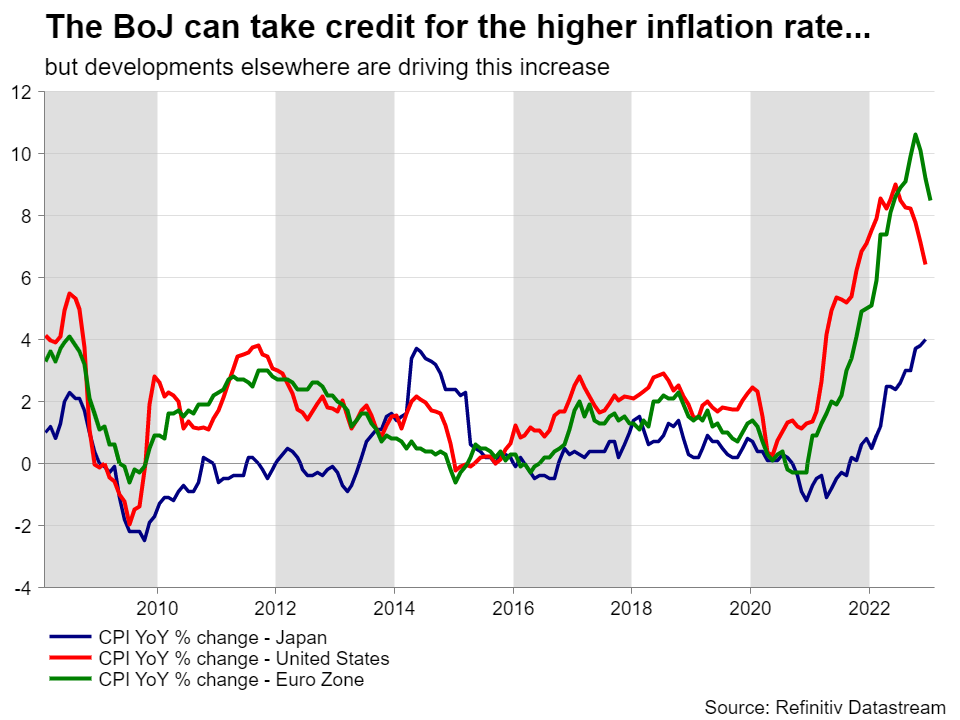
Governor Kuroda took over in March 2013 with the headline CPI year-on-year growth completing almost 4.5 years below the 0.5% rate. In coordination with the then Prime Minister Abe, Kuroda was given carte blanche to lead the Japanese economy into recovery. His immediate reaction was to massively expand the BoJ’s second Quantitative Easing programme that started in October 2010 and never looked back. The CPI performance in 2014 was optimistic, but the increase proved to be purely due to the sales tax increase. The renewed confidence in the BoJ’s efforts gradually dissipated as, despite the continued efforts by Kuroda et al, the results did not match the high expectations. Following the 2014 jump in the CPI, it took the Japanese economy seven years to produce inflation above 2% at a cost of a 488 trillion yen increase at the BoJ’s monetary base. Unfortunately for the Bank, the recent jump in the inflation rate seems to be a product of the recent COVID pandemic and the unfortunate events in Ukraine.
Current situation looks better than 2013
However, the situation on the ground looks more positive compared to 2013. Inflation has reached the highest year-on-year increase since January 1991, and the Japanese economy has been growing at a respectable rate under Kuroda’s leadership. But the main task of the new governor will be the withdrawal of the current massive support programme. Despite the global tightening cycle, the BoJ has only managed to announce a small change in its yield curve framework at the December meeting, resisting calls to more aggressive tightening steps. However, the market seems conservatively optimistic, and it is currently pricing in 14bps of rate hikes by year-end.
Main candidates for the Governor position
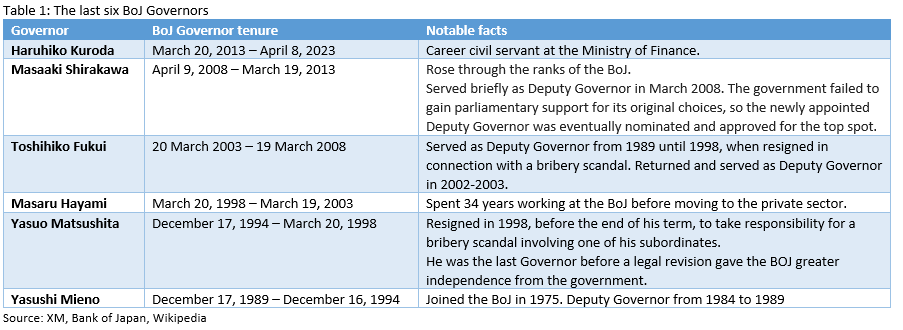
The government will most likely present the nominees for the top three BoJ positions next week. By examining the BoJ Governors since 1989, it is evident that there is a tendency for the government to choose the Governors from the BoJ ranks or the Japanese Finance Ministry. Even Hayami (1998-2003), then considered an outsider, spent 34 years working at the BoJ before moving to the private sector, only to return for BoJ’s top post. Interestingly, three of the last six governors had already served as Deputy Governors, and one held an executive director position before securing the Governor’s role.
Having said that, it makes sense for the government to firstly look at the Deputies’ ranks to find its new top man. Understandably, Masayoshi Amamiya is considered the most likely successor of Kuroda as he has spent his entire professional career at the BoJ, and for the past five years he has been working alongside Kuroda as a Deputy Governor. He is credited with drafting the 2013 expansion plan and supporting Kuroda’s strategy through the years.
From the pool of the remaining Deputy Governors, Hiroshi Nakaso appears to be a close contender. He was a Deputy Governor during Kuroda’s first term between 2013-2018, but he has recently taken another prestigious position. However, if the government decides to nominate him for the BoJ top spot, he is expected to honour the nomination. Nakaso is seen as more hawkish on monetary policy than Amamiya.
On the other hand, one cannot exclude a surprise from the government. The candidacy of the former Deputy Governor Nishimura has been making the rounds at the Japanese parliament. However, most remember in a negative way his tenure under BoJ Shirakawa, who was criticized for easing policy fast enough during this 2008-2013 period.
Yen would like a hawk taking over
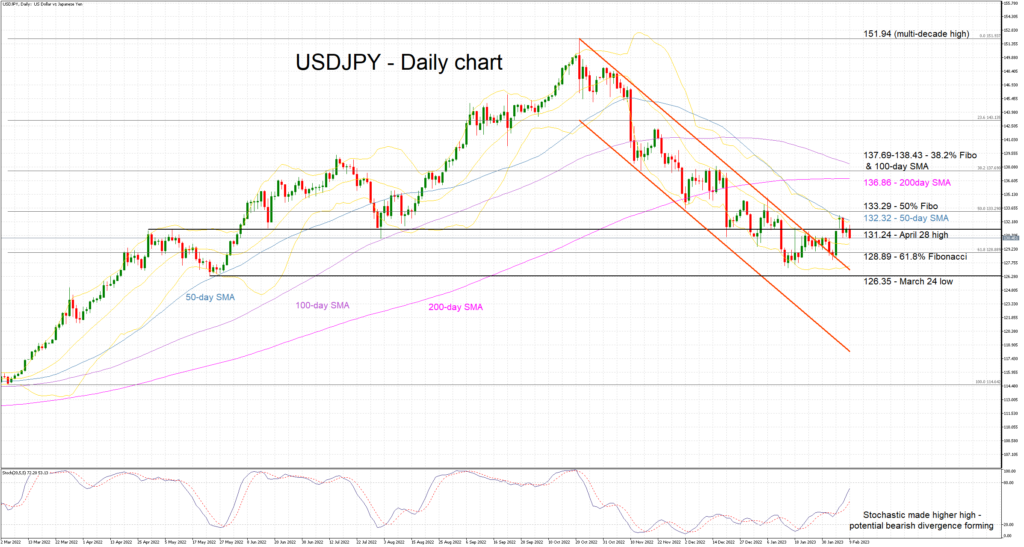
To sum up, the government would prefer to avoid surprising the market and go for the safest option possible. However, it also makes sense for the PM Kishida to decide to distance himself from Abe’s choices and potentially announce a new face from the Ministry of Finance or a candidate that does not sit currently at the BoJ Policy Board. Kishida’s selection would potentially reflect his own view on the economic outlook for the Japanese economy, and hence a dovish selection could have ripple effects across the foreign exchange market, complicating the new governor’s work well before taking over. Yen recorded a 5% rally against the dollar when the amendment of the yield curve framework was announced in December. Part of this move is currently being unwound as the market appears to believe that Kishida might not be as bold as originally hoped in his selection. As a result, the massive support programme could potentially be wound down at a less aggressive pace than the yen bulls would have preferred.
Sunset Market Commentary
Markets
The postponed German inflation figures were key for setting the mood even before the European open. Prices rose 0.5% to be up 9.2% y/y in a further deceleration from December (9.6% y/y). The numbers are extremely difficult to interpret due to basket changes, various government support measures and regular re-pricings of energy contracts. Data crunchers meanwhile figured out that the estimate Eurostat used for calculating the European figure is probably less than the actual German figure, creating upside risks for the final HICP release on February 23. But markets only paid attention to the fact that the outcome undershot analyst expectations (for 1.3% m/m and 10.0% y/y). Even a hawkish Riksbank was disregarded (see below). Equities cheered. The Euro Stoxx 50 advances 1.2% and is less than 4% away from the previous recovery high from 2021. Core bonds gained with Germany outperforming the US – though that balance could even out a bit if tonight’s $21bn 30-year auction even remotely resembles the stellar 10-year sale yesterday. German yields drop 4.1 (2y) to 6.8 bps (10y). US yields rise 1.7 bps at the front and lose less than 3 bps at the long end of the curve (10y-30y). The US 10y-2y curve inversion hit a new multi-decade extreme. The US dollar suffers, with the bullish sentiment to blame. DXY drops below the 2020 pandemic high to 102.66. EUR/USD surpasses 1.0735 to test next resistance at 1.078/08.
Several members of the Bank of England’s MPC appeared before Parliament today. Bailey insisted inflation has turned the corner and that there will be a “very powerful unwinding” of inflation this year, in part thanks to base effects. However, he said that inflation forecasts carry the largest upside skew ever. Risks for more persistent inflation come from the strong and still-imbalanced labour market and public sector pay rises if they are funded through government borrowing. Haskel revived BoE guidance that was omitted from the February statement which stated that if inflation is more persistent, the central bank will act forcefully if necessary. He also downplayed the relevance of medium term inflation forecasts which show price growth slightly below the 2% target. Pill struck a balanced tone. The chief economist sees an extended period of weakness in the UK with first signs of loosening in labour market. While there is no room for complacency, he said, the BoE must also guard against raising interest rates too sharply. UK gilt yields trade flat to -6.5 bps lower today in a move that has more to do with the general trend rather than the BoE testimony. Sterling has a decent run, banking on the risk-on sentiment. EUR/GBP is currently testing 0.885/6 support (38.2% retracement on the 2022 bull run), down from 0.8875 at the open.
News & Views
The Riksbank as expected raised its policy rate by 50 bps to 3.0%. Contrary to the guidance end November, today’s hike won’t be the last. In addition to a prolonged hiking cycle, the RB will accelerate the reduction of its balance sheet by actively selling government bonds starting in April. A more decisive monetary policy approach is needed, as inflation in Sweden at the end of last year remained very high (> 10%), mainly due to energy prices. However, even core inflation is higher and rising. Both activity and inflation are expected to cool this year, but it is uncertain whether (underlying) inflation will fall sufficiently quickly and far, especially as a weak krona complicates the RB’s efforts. The RB sees at least one additional rate hike in spring and expects the policy rate to stay at the peak level throughout the policy horizon (Q1 2026)! After strengthening to a multi-year high at EUR/SEK 11.44 earlier this week (even slightly above the 2020 corona panic level), the prospect of further tightening and the RB advocating the desirability of a strong krone, pushed EUR/SEK back to currently 10.14.
Inflation in Brazil eased marginally in January to 0.53% M/M and 5.77% Y/Y (was 0.62% M/M and 5.79% Y/Y in December). In a monthly perspective, price rises were still broad-based with food and beverages rising 0.59%, transport 0.55% and household goods up 0.7%. While easing, inflation in 2022 stayed above the CB’s annual target of 3.5% +/1.5% tolerance. This year’s target stands at 3.25% +/- 1.5%. The government recently criticized the CB for its high policy rate (13.75%). With inflation still above target and the Central Bank seeing upside risk to inflation due to a supportive fiscal policy, rate cuts are unlikely any time soon. The real trades little changed near USD/BRL 5.18.
Dollar Sellers Back in Control, Risk Rally Resumes
Dollar sellers are back in control today, as markets appear to turn back into risk-on mode. In particular, FTSE is hitting another record high. The greenback is still inversely coupled to risk sentiment. Swiss Franc and Canadian are trailing Dollar as the next weakest. On the other hand, Kiwi and Aussie are the strongest, followed by Sterling, while Yen is mixed.
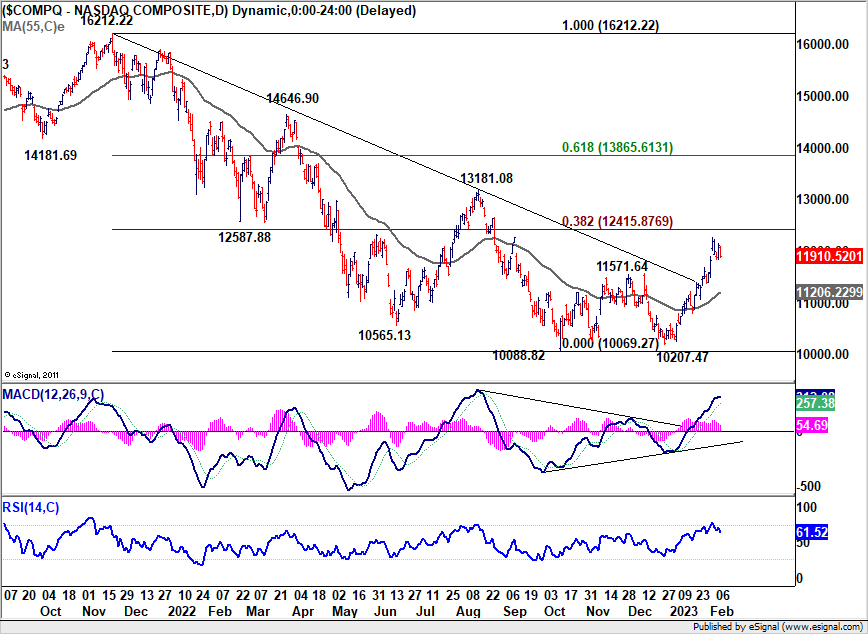
Technically, one focus now is whether NASDAQ could break through last week's high at 12269.55 to resume the rebound from 10088.82, or even further through 38.2% retracement of 16212.22 to 10088.82 at 12415.87. That might give extra pressure to Dollar.
In Europe, at the time of writing, FTSE is up 0.67%. DAX is up 1.05%. CAC is up 1.20%. Germany 10-year yield is down -0.0622 at 2.298. Earlier in Asia, Nikkei dropped -0.08%. Hong Kong HSI rose 1.60%. China Shanghai SSE rose 1.18%. Singapore Strait Times dropped -0.86%. Japan 10-year JGB yield rose 0.0014 to 0.498.
Fed Barkin: Is inflation calming? That's really the core question for this year
Richmond Fed President Thomas Barkin said in a podcast that "while the average (inflation) has dropped, the median has still stayed high".
"That's because the average has been distorted by falling prices for a few goods, like used cars, that escalated unsustainably during the pandemic," he said.
"We have seen three good months on the inflation prints. I'd like to see them continue. Is inflation calming? That's really the core question for this year," he said.
"I think underneath that, I want to understand the labor market. Is it cooling? What's happening to wages? What's happened to employment?" he added. "Underneath that, I want to understand what's happening to the broader demand, particular for companies who may or may not be thinking about increasing prices.
US initial jobless claims rose to 196k
US initial jobless claims rose 13k to 196k in the week ending February 4. Four-week moving average of initial claims dropped -2.5k to 189k.
Continuing claims rose 38k to 1688k in the week ending January 28. Four-week moving average of continuing claims rose 14.5k to 1665k.
BoE Bailey very uncertain particularly about price-setting and wage-setting
BoE Governor Andrew Bailey said in a Treasury Committee hearing, "we are concerned about persistence (of inflation) and that's why, frankly, we raised interest rates this time,"
"I am very uncertain particularly about price-setting and wage-setting in this country. We have got the largest upside skew in our forecasts that we have ever had on inflation," Bailey added.
Nevertheless, "what I would urge is that - particularly going forwards because we think inflation is going to fall very rapidly - that is taken into account," Bailey added.
Chief Economist Huw Pill said, "There is no room for complacency. Inflation remains unacceptably high... Returning inflation to target in a sustainable manner requires that the MPC continues to be watchful for signs of greater persistence in inflationary pressures than is embodied in our baseline forecast."
MPC member Jonathan Haskel warned, "Economic theory suggests that uncertainty around the persistence of inflation should be met with more forceful action... I shall remain alert to indications that inflation is more persistent than we expected, and act forcefully if necessary."
On the other hand, Silvana Tenreyro said, "Unless there is another big development that we don't know about - and we have a massive energy shock or something that is not on the cards - then I think they fall in inflation is pretty much guaranteed."
"Where things stand right now, I would see myself considering a cut. I don't want to talk about the particular meeting,: Tenreyo added.
ECB Villeroy can rule out recession in France
ECB Governing Council member Francois Villeroy de Galhau told France 2TV that he can "rule out" a recession the country. The Bank of France yesterday said its economy was on course to eke out slightly positive growth this quarter after growing 0.1% in the previous quarter.
Villeroy also said he sees "peak in french inflation between now and June, maybe even before June." From this summer onwards, food price inflation could ease off".
GBP/USD Mid-Day Outlook
Daily Pivots: (S1) 1.2035; (P) 1.2072; (R1) 1.2109; More...
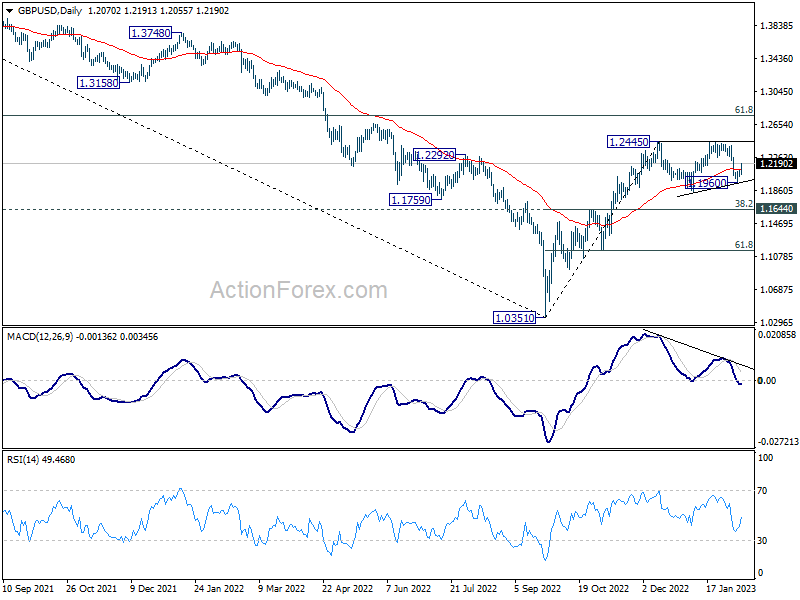
GBP/USD's break of 4 hour 55 EMA suggests that fall from 1.2446 has completed at 1.1960. Corrective pattern from 1.2445 might be finished too. Intraday bias is back on the upside for retesting 1.2445/6. Decisive break there will resume larger rise from 1.0351. On the downside, through break of 1.1960 will extend the corrective pattern with another fall to 1.1840 support and possibly below.
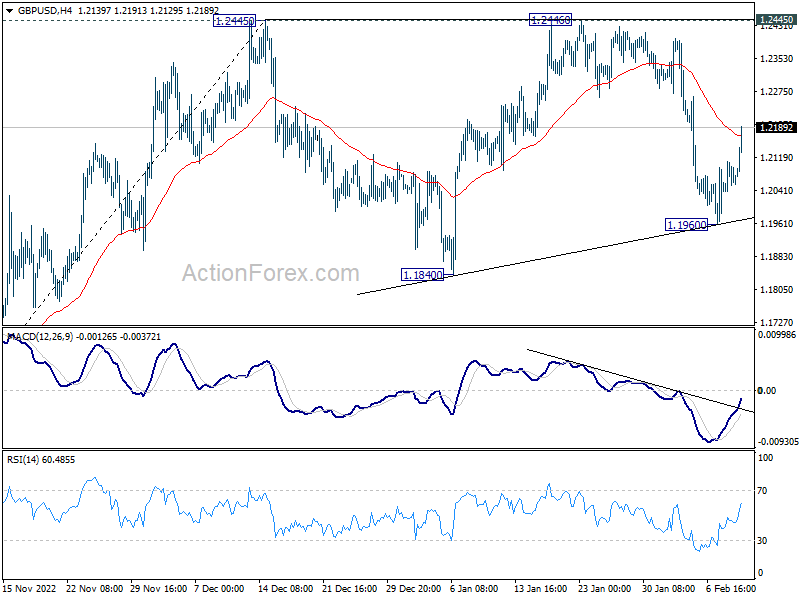
In the bigger picture, rise from 1.0351 medium term bottom is at least correcting whole down trend from 1.4248 (2021 high). Further rise is expected as long as 1.1644 resistance turned support holds. Next target is 61.8% retracement of 1.4248 to 1.0351 at 1.2759. Sustained break there will pave the way back to 1.4248.
Economic Indicators Update
| GMT | Ccy | Events | Actual | Forecast | Previous | Revised |
|---|---|---|---|---|---|---|
| 23:50 | JPY | Money Supply M2+CD Y/Y Jan | 2.70% | 2.80% | 2.90% | |
| 00:01 | GBP | RICS Housing Price Balance Jan | -47% | -45% | -42% | |
| 13:00 | EUR | Germany CPI M/M Jan P | 1.00% | 0.90% | -0.80% | |
| 13:00 | EUR | Germany CPI Y/Y Jan P | 8.70% | 8.90% | 8.60% | |
| 13:30 | USD | Initial Jobless Claims (Feb 3) | 196K | 191K | 183K | |
| 15:30 | USD | Natural Gas Storage | -200B | -151B |
Fed Barkin: Is inflation calming? That’s really the core question for this year
Richmond Fed President Thomas Barkin said in a podcast that "while the average (inflation) has dropped, the median has still stayed high".
"That's because the average has been distorted by falling prices for a few goods, like used cars, that escalated unsustainably during the pandemic," he said.
"We have seen three good months on the inflation prints. I'd like to see them continue. Is inflation calming? That's really the core question for this year," he said.
"I think underneath that, I want to understand the labor market. Is it cooling? What's happening to wages? What's happened to employment?" he added. "Underneath that, I want to understand what's happening to the broader demand, particular for companies who may or may not be thinking about increasing prices.