

Sample Category Title
USD/JPY Mid-Day Outlook
Daily Pivots: (S1) 128.14; (P) 128.64; (R1) 129.18; More…
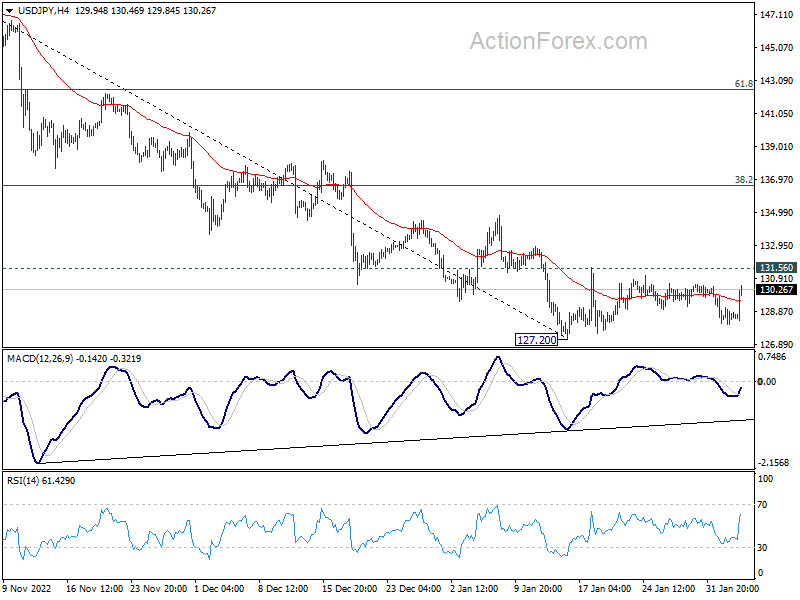
Intraday bias in USD/JPY remains neutral and range trading continues. On the upside, break of 131.56 resistance should confirm short term bottoming, and turn bias back to the upside for stronger rebound to 55 day EMA (now at 133.23) and possibly above. On the downside, break of 127.20 will resume the whole decline from 151.93 and target 121.43 fibonacci level.
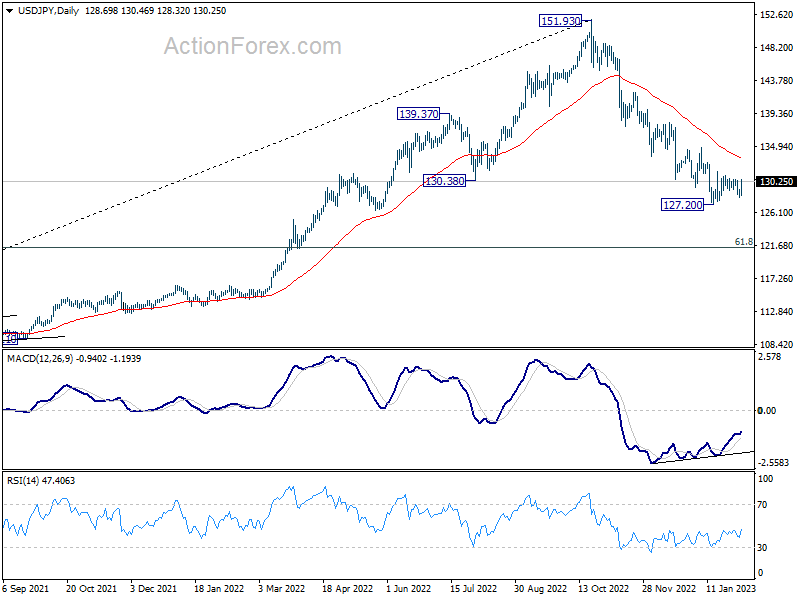
In the bigger picture, the break of 55 week EMA (now at 131.39) raises the chance of medium term bearish reversal, but that’s not confirmed yet. Strong support could be seen around 61.8% retracement of 102.58 to 151.93 at 121.43 and 38.2% retracement of 75.56 to 151.93 at 122.75 to bring rebound. But break of 131.56 resistance is needed to indicate bottoming first. Otherwise further fall will remain in favor.
GBP/USD Mid-Day Outlook
Daily Pivots: (S1) 1.2164; (P) 1.2282; (R1) 1.2342; More…
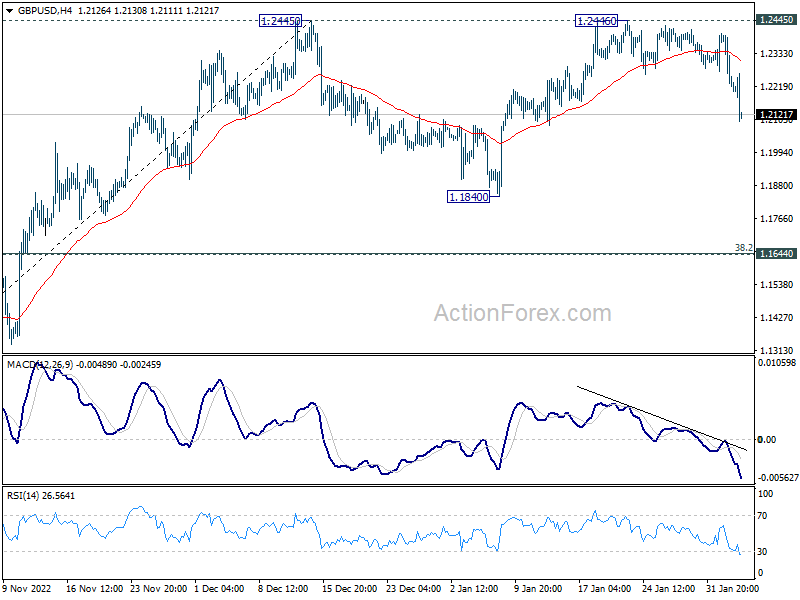
Intraday bias in GBP/USD stays on the downside at this point. Fall from 1.2446 is the third leg of the corrective pattern from 1.2445. Deeper decline could be seen to 1.1840 support. But downside should be contained by 38.2% retracement of 1.0351 to 1.2445 at 1.1645 to bring rebound. For now, risk will stay mildly on the downside as long as 1.2445/6 holds, in case of recovery.
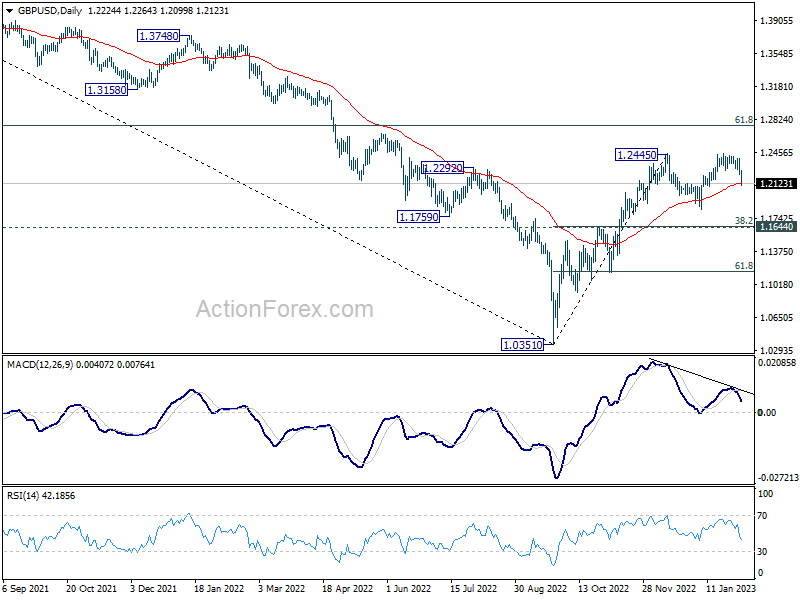
In the bigger picture, rise from 1.0351 medium term bottom is at least correcting whole down trend from 1.4248 (2021 high). Further rise is expected as long as 1.1644 resistance turned support holds. Next target is 61.8% retracement of 1.4248 to 1.0351 at 1.2759. Sustained break there will pave the way back to 1.4248.
EUR/USD Mid-Day Outlook
Daily Pivots: (S1) 1.0854; (P) 1.0943; (R1) 1.1001; More…
Focus is now on 1.0800 minor support in EUR/USD with today's extended pull back. Considering bearish divergence condition in 4 hour MACD, firm break of 1.0800 will confirm short term topping at 1.1032. Intraday bias will then be turned back to the downside for 1.0482 support, which is close to 38.2% retracement of 0.9534 to 1.1032.
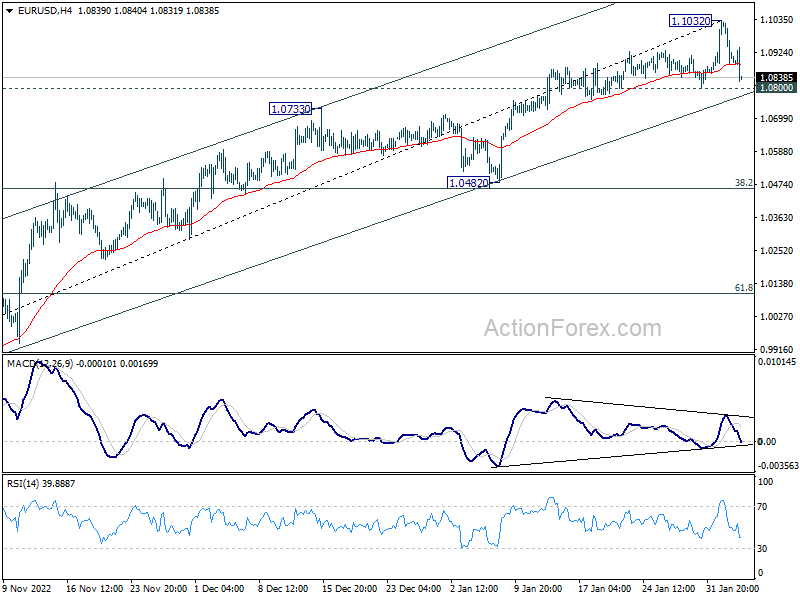
In the bigger picture, current development suggests that the rally from 0.9534 low (2022 low) is a medium term up trend rather than a correction. Further rise is in favor to 61.8% retracement of 1.2348 (2021 high) to 0.9534 at 1.1273 next. This will remain the favored case as long as 1.0482 support holds.
Dollar Strikes Back on Stellar NFP Data
Dollar rebounds strongly and broadly in early US session after a set of stellar job data that blows past expectations. Stock futures dive on renewed concern that interest rate will stay high for lower while benchmark treasury yield rebounds. The question now is whether the greenback could overwhelm Yen and Swiss Franc to end the week as the best performer.
In Europe, at the time of writing, FTSE is up 0.42%. DAX is down -0.84%. CAC is down -0.28%. Germany 10-year yield is up 0.1081 at 2.188. Earlier in Asia, Nikkei rose 0.39%. Hong Kong HSI dropped -1.36%. China Shanghai SSE dropped -0.68%. Singapore Strait Times rose 0.61%. Japan 10-year JGB yield dropped -0.0094 to 0.490.
US NFP surged 517k in Jan, unemployment rate down to 3.4%
US non-farm payroll employment surged 517k in January, blows away expectation of 193k. BLS noted, "job growth was widespread, led by gains in leisure and hospitality, professional and business services, and health care."
Unemployment rate dropped from 3.5% to 3.4%, better than expectation of a rise back to 3.6%. Labor force participation rate ticked up from 62.3% to 62.4%.
Average hourly earnings rose 0.3% mom, matched expectations. Over the past 12 months, average hourly earnings have increased by 4.4% yoy.
ECB Wunsch: If core inflation remains persistent, terminal rate of 3.5% would be a minimum
ECB Governing Council member Pierre Wunsch said, "I don’t think we're going to move from 50 basis points (in March) to zero."
"It might be another 50 basis points or we might be moving to 25. I will certainly not exclude another 50 basis points but that's going to be dependent on the data," he added.
"If core remains persistent, if we keep seeing core momentum being close to 5%, for me a terminal rate of 3.5% would be a minimum," Wunsch said. "But I don't want to give any number that is not conditional on incoming data."
"Rates are clearly above 4% in the UK and the U.S.; that would also be a reference for me," Wunsch said. "Why would we stay at 3% if we have more or less similar core numbers?"
"I'm not saying we need to go to 4%... but if incoming data continue to show very persistent core, we will have to look at what the U.S. and UK seem to consider as a restrictive enough interest rates to bring inflation back to 2%."
ECB Simkus and Kazimir: Mar rate hike is not the last
ECB Governing Council member Gediminas Šimkus said, “I see positive trends for inflation”. Headline inflation might have peaked but core hasn’t. He added that March’s rate hike might not be the last. For May, it could be 25bps or 50bps.
“I think that we are already moving towards that terminal rate,” Šimkus noted. Also, a rate cut in 2023 is unlikely, but possible in 2024 if disinflation trend becomes prominent.
Separately, another Governing Council member Peter Kazimir said in a statement today, “The March increase will not be the last… we will decide how many more will be needed later,” adding that “the battle against inflation is far from won”.
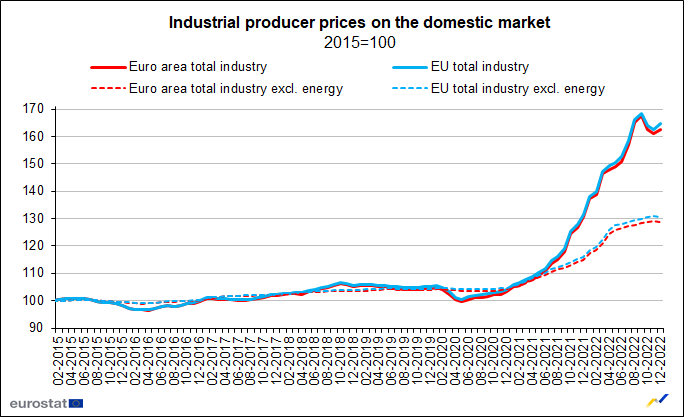
EU PPI up 1.1% mom, 24.6% yoy in Dec, EU up 1.2% mom, 25.2% yoy
Eurozone PPI rose 1.1% mom, 24.6% yoy in December. For the month, industrial producer prices increased by 2.5% in the energy sector, by 0.5% for non-durable consumer goods, by 0.4% for durable consumer goods and by 0.3% for capital goods, while prices decreased by -0.5% for intermediate goods. Prices in total industry excluding energy decreased by -0.1%.
EU PPI rose 1.2% mom, 25.2% yoy. The highest monthly increases in industrial producer prices were observed in Ireland (+43.2%), Bulgaria (+6.0%) and Sweden (+4.4%), while the largest decreases were recorded in Portugal (-3.2%), Croatia (-2.6%) and Slovakia (-2.5%).
Eurozone PMI services finalized at 50.8 in Jan, remains too early to completely disregard recession risks
Eurozone PMI Services was finalized at 50.8 in January, up from December’s 49.8, hitting a 6-month high. PMI Composite was finalized at 50.3, up from prior month’s 49.3, a 7-month high.
Looking at some member states, Ireland PMI Composite rose to 3-month high at 52.0. Spain rose to 6-month high at 51.6. Italy rose to 7-month high at 51.2. Germany rose to 7-month high at 49.9. France was unchanged at 49.1.
Chris Williamson, Chief Business Economist at S&P Global Market Intelligence said:
“A resumption of business output growth, even marginal, is welcome news and suggests that the eurozone could escape a recession…. However, it remains too early to completely disregard recession risks.
“In particular, the impact of higher interest rates on economic growth has yet to be fully felt, and many companies are relying on backlogs of previously placed orders, accumulated during the pandemic, to sustain growth.”
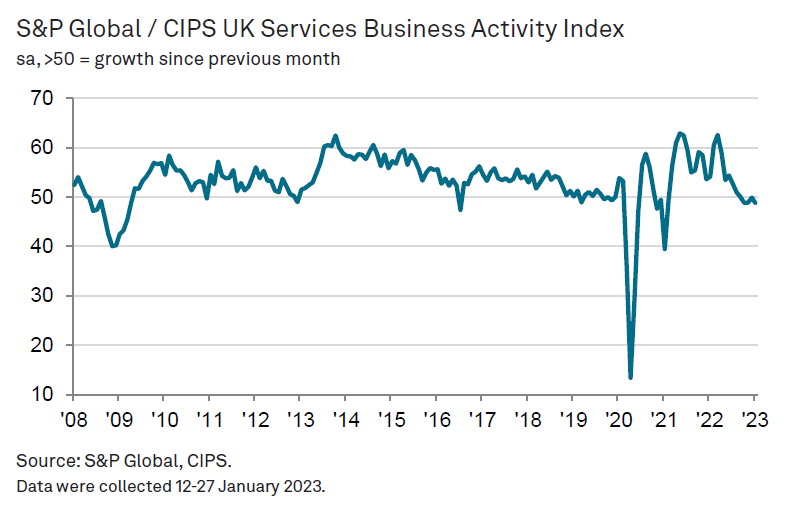
UK PMI services finalized at 48.7 in Jan, downside remained relatively shallow
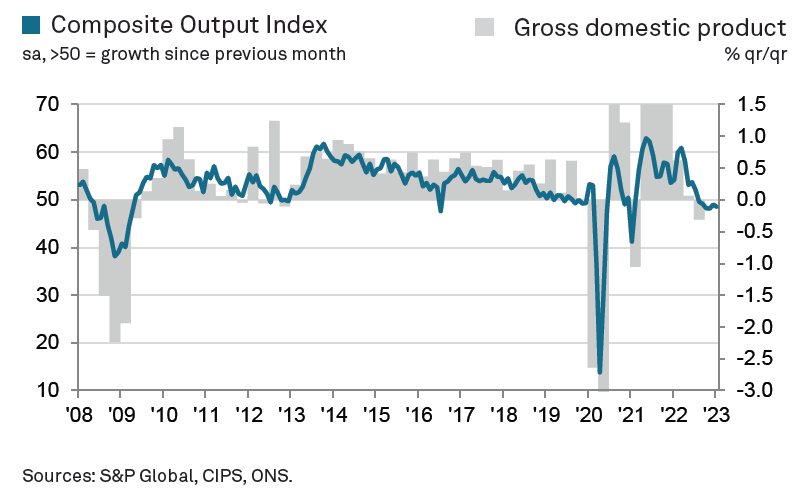
UK PMI Services was finalized at 48.7 in January, down from December’s 49.9, fastest contraction since January 2021. PMI Composite was finalized at 48.5, down from prior month’s 49.0, in contraction for the sixth straight months.
Tim Moore, Economics Director at S&P Global Market Intelligence:
“January data pointed to the weakest service sector performance for two years as cutbacks to business and consumer spending resulted in a fourth consecutively monthly reduction in output levels. The latest survey illustrates that the UK economy risks falling into recession as labour shortages, industrial disputes and higher interest rates take their toll on activity.
“However, the downturn in service sector output remained relatively shallow at the start of 2023. Encouragingly, new order volumes moved closer to stabilisation and export sales picked up in January, which contributed to a marginal upturn in overall employment numbers.”
BoJ Kuroda expects wages to rise quite significantly
BoJ Governor Haruhiko Kuroda told the parliament he expected wages to rise "quite significantly", thanks to improvement in the economy and a tightening job market.
Nevertheless, he reiterated that “BoJ must maintain the ultra-easy policy to support the economy and create an environment for firms to hike wages.”
China PMI composite rose to 51.1, services a boom and manufacturing a drag
China Caixin PMI Services rose from 48.0 to 52.9 in January, first expansionary reading in five months. PMI Composite rose from 48.3 to 51.1, the first upturn in total business activity since August 2022.
Wang Zhe, Senior Economist at Caixin Insight Group said: “Services activity experienced a boom, as both supply and demand expanded, whereas the manufacturing sector became a drag. Employment remained relatively sluggish, with the manufacturing sector logging a larger contraction. Prices stayed stable. Optimism among businesses improved significantly."
EUR/USD Mid-Day Outlook
Daily Pivots: (S1) 1.0854; (P) 1.0943; (R1) 1.1001; More…
Focus is now on 1.0800 minor support in EUR/USD with today's extended pull back. Considering bearish divergence condition in 4 hour MACD, firm break of 1.0800 will confirm short term topping at 1.1032. Intraday bias will then be turned back to the downside for 1.0482 support, which is close to 38.2% retracement of 0.9534 to 1.1032.
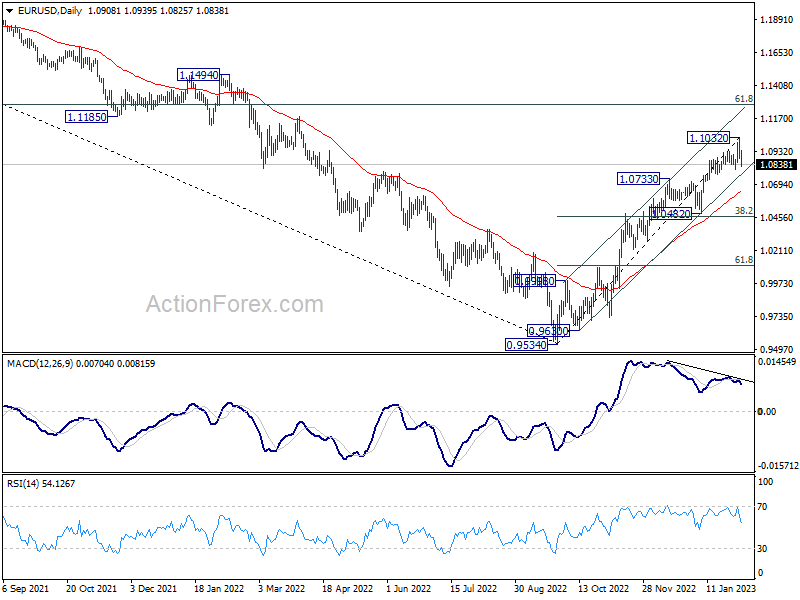
In the bigger picture, current development suggests that the rally from 0.9534 low (2022 low) is a medium term up trend rather than a correction. Further rise is in favor to 61.8% retracement of 1.2348 (2021 high) to 0.9534 at 1.1273 next. This will remain the favored case as long as 1.0482 support holds.
Economic Indicators Update
| GMT | Ccy | Events | Actual | Forecast | Previous | Revised |
|---|---|---|---|---|---|---|
| 01:45 | CNY | Caixin Services PMI Jan | 52.9 | 51.6 | 48 | |
| 07:45 | EUR | France Industrial Output M/M Dec | 1.10% | 0.20% | 2.00% | |
| 08:45 | EUR | Italy Services PMI Jan | 51.2 | 50.9 | 49.9 | |
| 08:50 | EUR | France Services PMI Jan F | 49.4 | 49.2 | 49.2 | |
| 08:55 | EUR | Germany Services PMI Jan F | 50.7 | 50.4 | 50.4 | |
| 09:00 | EUR | Eurozone Services PMI Jan F | 50.8 | 50.7 | 50.7 | |
| 09:30 | GBP | Services PMI Jan F | 48.7 | 48 | 48 | |
| 10:00 | EUR | Eurozone PPI M/M Dec | 1.10% | -0.40% | -1.00% | |
| 10:00 | EUR | Eurozone PPI Y/Y Dec | 24.60% | 22.50% | 27.10% | 27.00% |
| 13:30 | USD | Nonfarm Payrolls Jan | 517K | 193K | 223K | 260K |
| 13:30 | USD | Unemployment Rate Jan | 3.40% | 3.60% | 3.50% | |
| 13:30 | USD | Average Hourly Earnings M/M Jan | 0.30% | 0.30% | 0.30% | 0.40% |
| 14:45 | USD | Services PMI Jan F | 46.6 | 46.6 | ||
| 15:00 | USD | ISM Services PMI Jan | 50.4 | 49.6 |
US NFP surged 517k in Jan, unemployment rate down to 3.4%
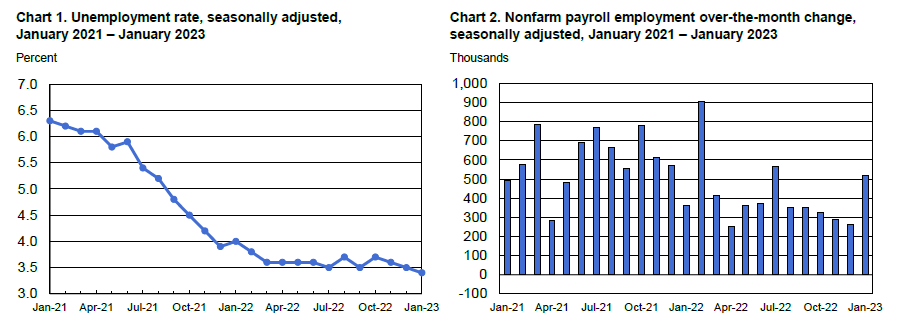
US non-farm payroll employment surged 517k in January, blows away expectation of 193k. BLS noted, "job growth was widespread, led by gains in leisure and hospitality, professional and business services, and health care."
Unemployment rate dropped from 3.5% to 3.4%, better than expectation of a rise back to 3.6%. Labor force participation rate ticked up from 62.3% to 62.4%.
Average hourly earnings rose 0.3% mom, matched expectations. Over the past 12 months, average hourly earnings have increased by 4.4% yoy.
ECB Wunsch: If core inflation remains persistent, terminal rate of 3.5% would be a minimum
ECB Governing Council member Pierre Wunsch said, "I don’t think we're going to move from 50 basis points (in March) to zero."
"It might be another 50 basis points or we might be moving to 25. I will certainly not exclude another 50 basis points but that's going to be dependent on the data," he added.
"If core remains persistent, if we keep seeing core momentum being close to 5%, for me a terminal rate of 3.5% would be a minimum," Wunsch said. "But I don't want to give any number that is not conditional on incoming data."
"Rates are clearly above 4% in the UK and the U.S.; that would also be a reference for me," Wunsch said. "Why would we stay at 3% if we have more or less similar core numbers?"
"I'm not saying we need to go to 4%... but if incoming data continue to show very persistent core, we will have to look at what the U.S. and UK seem to consider as a restrictive enough interest rates to bring inflation back to 2%."
ETHUSD Hovers Around Highs, But Bullish Momentum is Weakening
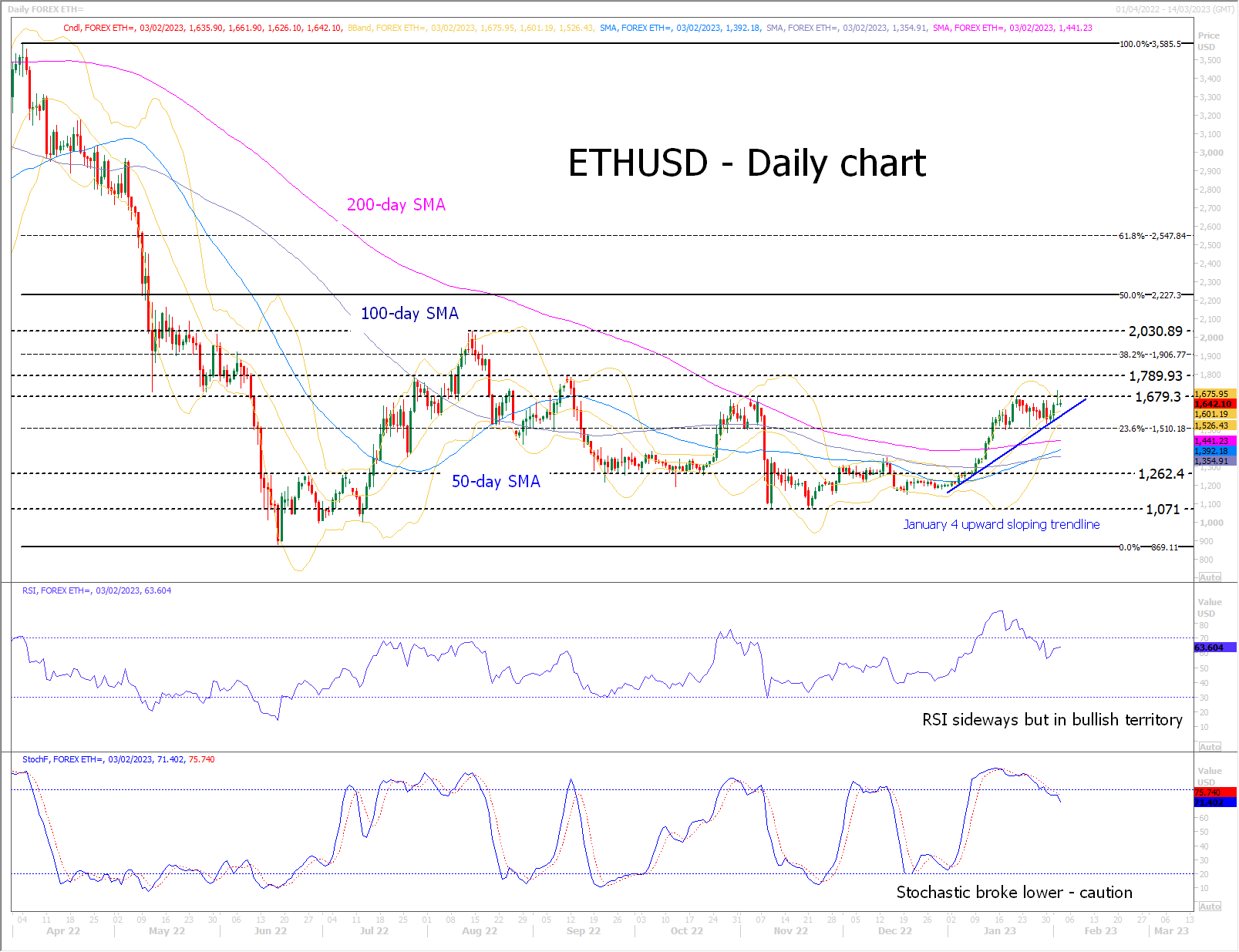
ETHUSD (Ethereum) is moving sideways today, just below the January 21 high of 1,679. Cryptocurrencies started the year on a very positive note and appear to have survived the busy week almost unscathed. However, the recent bullish trend seems to be weakening. While the RSI remains comfortably above 50, supporting, on face value, further bullish episodes, the stochastic is sending a different message. It broke between its overbought area and it is edging aggressively lower, potentially setting up for a bearish divergence if ETHUSD makes another higher high soon. Amidst this dichotomy, the aggressive tightening of the Bollinger bands and the convergence of the various simple moving averages (SMAs) are pointing to a sizeable move soon.
Should ETHUSD break below the January 4 upward sloping trendline, the bears could be encouraged to push it ever lower with the first target at the 23.6% Fibonacci retracement level of the April 4, 2022 –June 18, 2022 downtrend of 1,510, just ahead of the 200-day SMA at 1,441. Even lower, the 1,355-1,392 range populated by the 50- and 100-day SMAs could trouble the bears.
On the other hand, the bulls would be content with another higher high, above 1,679. Higher, the September 11 high of 1,790 and the 38.2% Fibonacci retracement at 1,907 could prove to be stronger resistance points. Upon successfully breaking these levels, the path will be clear for the bulls to test 2,000, a level not seen since August 8, 2022.
To sum up, the rally appears to have lost support from technical indicators. As there is increasing evidence for a sizeable move on the cards, a break below 1,580 could prove a catalyst for further correction towards the 1400s area.
EU PPI up 1.1% mom, 24.6% yoy in Dec, EU up 1.2% mom, 25.2% yoy
Eurozone PPI rose 1.1% mom, 24.6% yoy in December. For the month, industrial producer prices increased by 2.5% in the energy sector, by 0.5% for non-durable consumer goods, by 0.4% for durable consumer goods and by 0.3% for capital goods, while prices decreased by -0.5% for intermediate goods. Prices in total industry excluding energy decreased by -0.1%.
EU PPI rose 1.2% mom, 25.2% yoy. The highest monthly increases in industrial producer prices were observed in Ireland (+43.2%), Bulgaria (+6.0%) and Sweden (+4.4%), while the largest decreases were recorded in Portugal (-3.2%), Croatia (-2.6%) and Slovakia (-2.5%).
UK PMI services finalized at 48.7 in Jan, downside remained relatively shallow
UK PMI Services was finalized at 48.7 in January, down from December's 49.9, fastest contraction since January 2021. PMI Composite was finalized at 48.5, down from prior month's 49.0, in contraction for the sixth straight months.
Tim Moore, Economics Director at S&P Global Market Intelligence:
"January data pointed to the weakest service sector performance for two years as cutbacks to business and consumer spending resulted in a fourth consecutively monthly reduction in output levels. The latest survey illustrates that the UK economy risks falling into recession as labour shortages, industrial disputes and higher interest rates take their toll on activity.
"However, the downturn in service sector output remained relatively shallow at the start of 2023. Encouragingly, new order volumes moved closer to stabilisation and export sales picked up in January, which contributed to a marginal upturn in overall employment numbers."
ECB Simkus and Kazimir: Mar rate hike is not the last
ECB Governing Council member Gediminas Šimkus said, "I see positive trends for inflation". Headline inflation might have peaked but core hasn't. He added that March's rate hike might not be the last. For May, it could be 25bps or 50bps.
"I think that we are already moving towards that terminal rate," Šimkus noted. Also, a rate cut in 2023 is unlikely, but possible in 2024 if disinflation trend becomes prominent.
Separately, another Governing Council member Peter Kazimir said in a statement today, "The March increase will not be the last... we will decide how many more will be needed later," adding that "the battle against inflation is far from won".