Sample Category Title
Will the RBA Start the Year with Another 25bps Hhike?
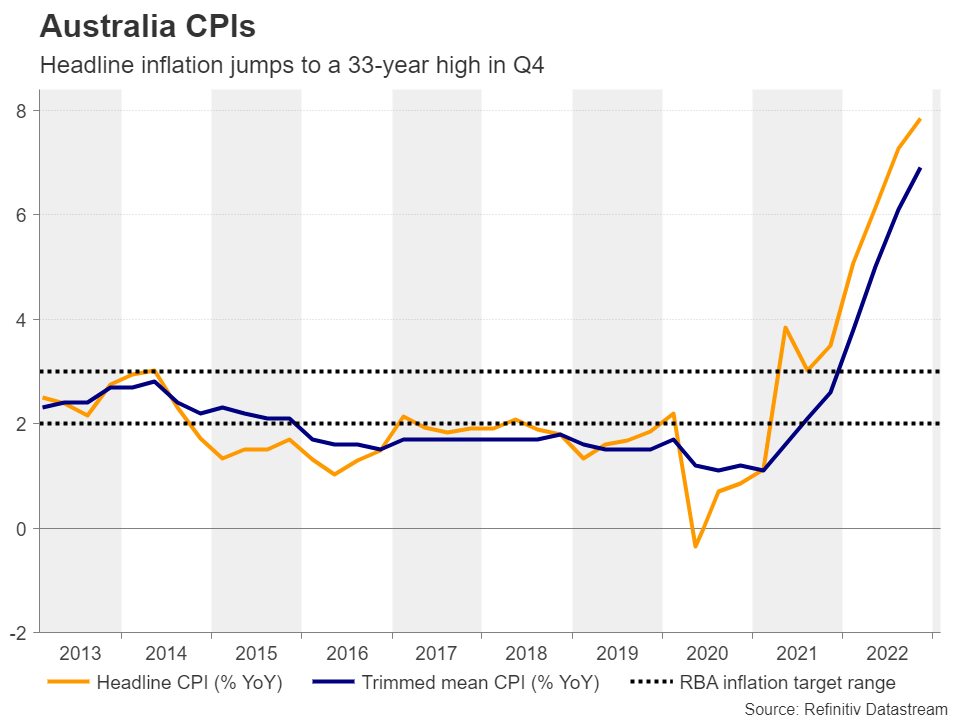
With inflation in Australia shooting to a 33-year high in Q4, most market participants are convinced that the RBA will continue raising interest rates. The Bank meets on Tuesday at 03:30 GMT, with investors eager to see whether another quarter-point hike will be delivered, but also what policymakers are planning thereafter. Will the RBA sound hawkish enough to add extra fuel to the aussie’s tanks?
What happened in December
At its last meeting for 2022, the RBA decided to raise its cash rate target by 25bps to 3.10%. This was the third consecutive quarter-point increment since officials decided to slow down from 50bps hikes.
In the accompanying statement, officials noted that inflation remains high and that the economy continues to grow solidly, although growth is expected to moderate over the year ahead as the global economy slows. They acknowledged that monetary policy operates with a lag and that the full effect of past rate increases is yet to be felt in mortgage payments, but they also signaled that they anticipate more rate raises over the period ahead. However, they added that they are not on a pre-set course, rather that they will assess the outlook and take decisions on a meeting-by-meeting basis.
What is the data saying?
After the gathering there have been some expectations that the RBA might decide to pause this tightening cycle, but incoming data since then has changed investors’ minds. Yes, the employment report revealed that the economy lost 14.6k jobs in December, but this was after seeing gains of 101.3k in October and November together. The unemployment ticked up, but from the lowest rate since 1974. Most importantly, headline inflation jumped to a 33-year high of 7.8% y/y during the last quarter of 2022, with all underlying metrics accelerating more than expected as well.
Now investors are assigning an 88% chance for another 25bps, with the remaining 12% pointing to now action. They also see a further 25bps worth of rate increases before the Bank presses the stop button.
How may the aussie respond?
So, all this suggests that another 25bps hike by itself is unlikely to trigger volatility in the aussie, as it is the market’s base case scenario. Therefore, if indeed this is the size of the delivered hike, market participants may quickly turn their attention to the accompanying statement. February is a month when the Bank releases its quarterly Statement on Monetary Policy the Friday following the policy decision. Therefore, the statement will include a first glimpse on policymakers’ updated economic projections.
Elevated inflationary pressures and a tight labor market may allow policymakers to maintain the view that further hikes may be needed, which may prove supportive for the Australian dollar. Even if the RBA sounds more cautious than expected, especially after it said to a government hearing on Wednesday that inflation has already peaked in Australia, any pullback in the aussie may just prove to be a corrective retreat that provides renewed buying opportunities.
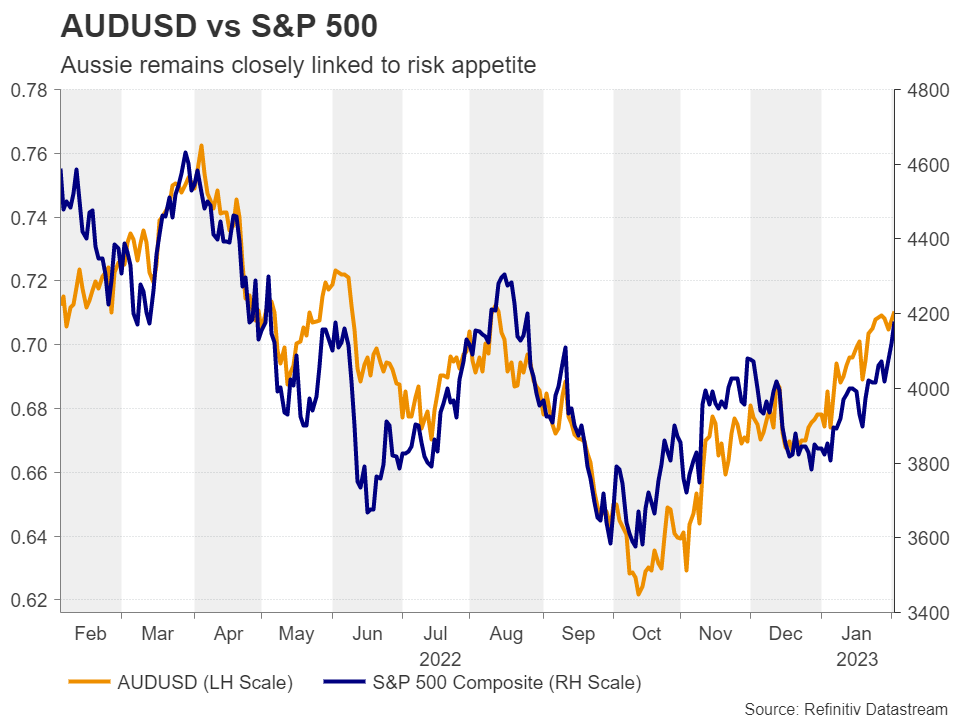
After all, due to its risk-linked characteristics, the Australian currency has been performing very well this year, despite the RBA raising interest rates at a slower pace than most of the other major central banks. The reopening of China, the world’s second largest economy and Australia’s main trading partner, combined with increasing expectations of a pivot by the Fed later this year are a blend of developments that investors continue to cheer.
What about the technical outlook?
From a technical standpoint, aussie/dollar pulled back on Thursday, after it failed to break above the key resistance zone of 0.7135, marked by the high of August 12. Should that happen at some point soon, the pair would confirm a higher high on the daily chart, and signal the continuation of the prevailing uptrend, marked by the uptrend line drawn from the low of October 13. The bulls could then climb to the 0.7285 zone, defined as resistance by the high of June 3, the break of which could carry extensions towards the peak of April 21, at around 0.7460.
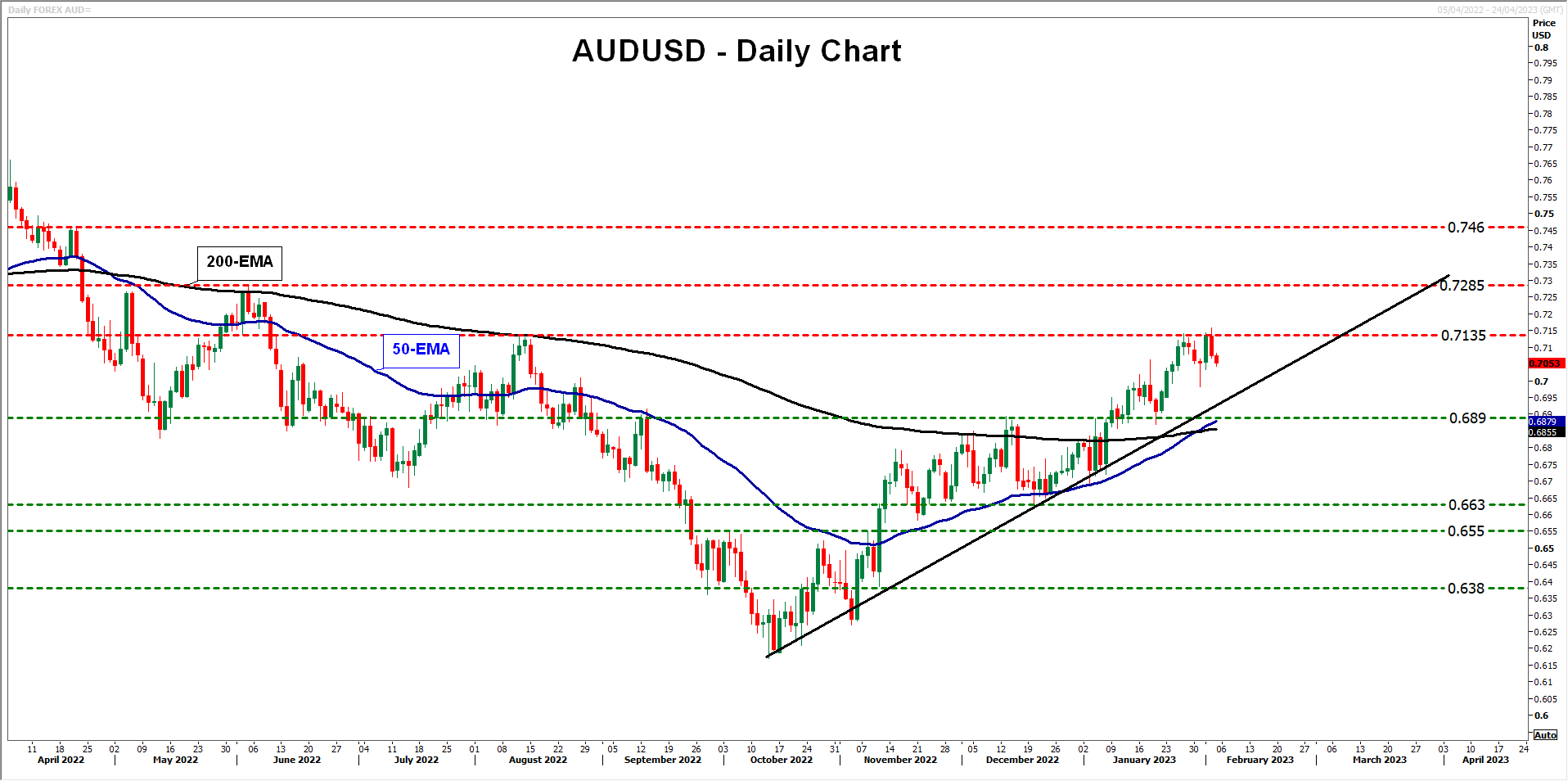
For the outlook to turn bearish, a break below the key support area of 0.6890 may be needed. Such a dip could confirm the violation of the aforementioned uptrend line, and may set the stage for declines towards the key area between 0.6550 and 0.6630. If there are no buyers to be found there either, a break lower may then set the stage for extension towards the low of November 10 at 0.6380.
Week Ahead – RBA Next to Hike, UK Might Avoid a Recession (For Now)
After the past week’s central bank bonanza, things will quieten down in the coming days, although not completely, as the Reserve Bank of Australia will keep the rate hike theme running. On the data front, the highlights will be Canada’s employment report and the first look at UK GDP in the final quarter of 2022. US indicators will be sparse, giving the dollar little to go on as it bounces back from the knock it took from the not-so-hawkish Fed meeting.
CPI jump dents hopes of dovish hike by RBA
Inflation in Australia accelerated towards the end of 2022, hitting 8.3% y/y in December. This was above what the markets were predicting but more or less in line with the RBA’s forecast of around 8%. In contrast, employment unexpectedly fell in December, and the recent PMI readings have been weak too and so the risk of the RBA sounding notably more hawkish on Tuesday is probably not that high.
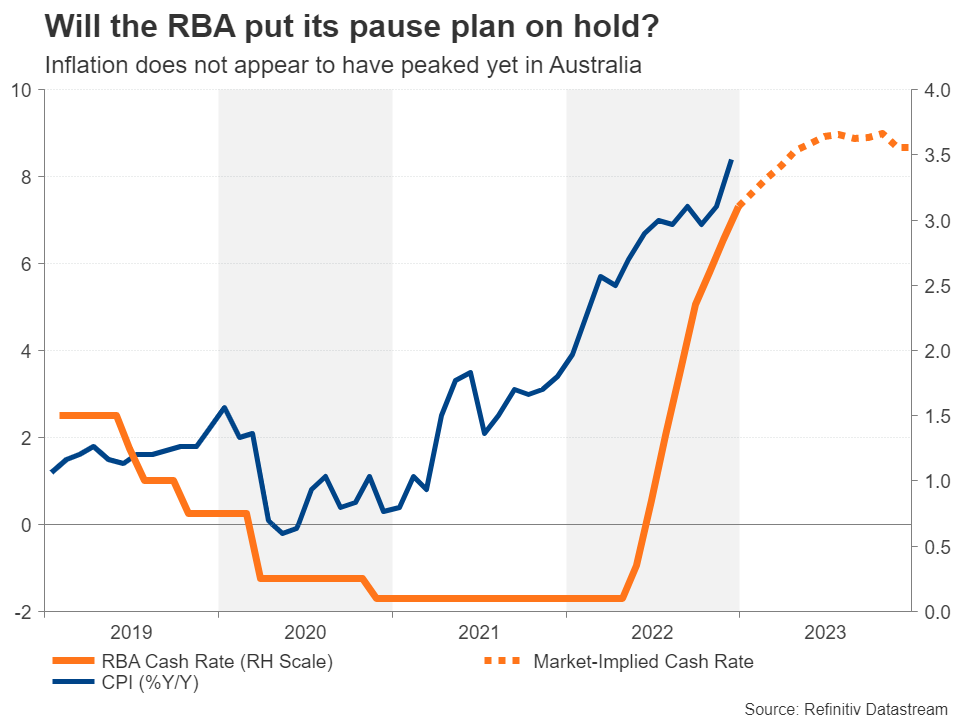
There is additionally China’s reopening to add to the outlook equation – something that could lift demand for Australian exports in the coming months. However, it’s unlikely that policymakers will make big adjustments to their growth forecasts so soon, although investors will certainly be keeping a close eye on the RBA’s updated projections in their quarterly Monetary Policy Statement that will be published on Friday.
At the same time, it’s hard to see the RBA pre-committing to a pause just yet given the upside surprise in inflation and may want to maintain its language that it “expects to increase interest rates further over the period ahead”. Markets have assigned about an 88% probability of a 25-basis-point rate increase in February and the remaining odds are for no change. Thus, a hawkish hike has some potential to boost the Australian dollar. But there is also a risk that Governor Philip Lowe hints that a pause could come as early as the next meeting in March, prompting a selloff.
Can the UK dodge a recession?
Rocketing inflation led by the surge in energy prices has had a devastating effect on the British economy, curtailing spending by both businesses and households. But that’s not been the only drag on growth in recent weeks. Strike action by public sector workers is also costing the economy and so GDP numbers due on Friday are not anticipated to be great.
GDP is expected to have been flat in Q4, which would mean that the UK economy avoided a technical recession. Other data will include the monthly estimates of industrial production and the trade balance.
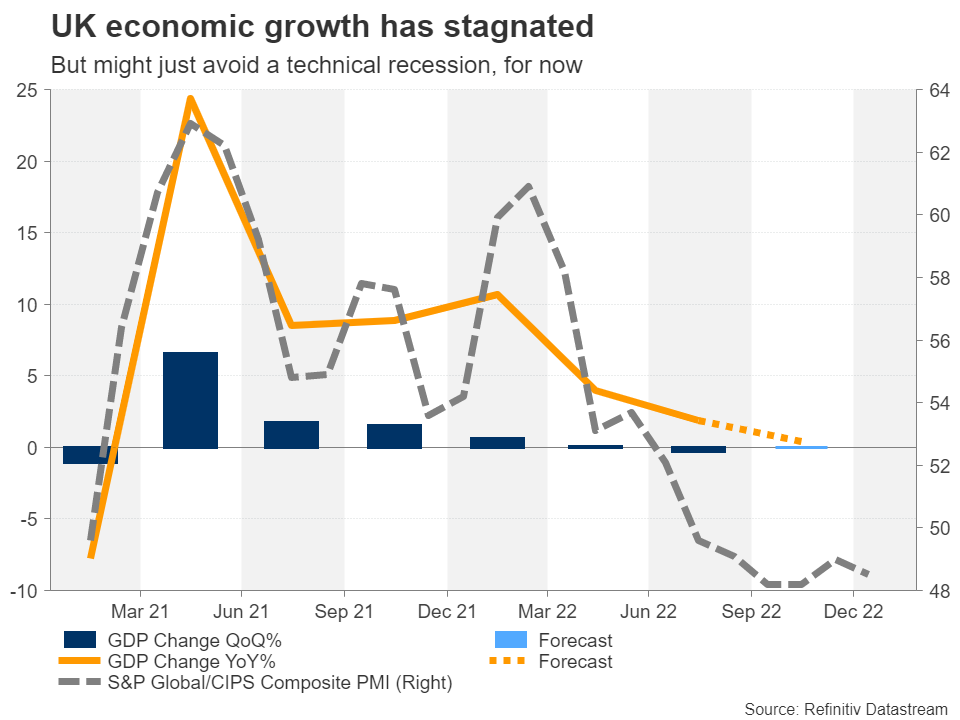
Even if the economy managed to eke out slim growth in the fourth quarter, GDP is on a sure path to contracting in Q1. Hence, the pound is likely to enjoy only a temporary lift from better-than-expected performance towards the end of 2022.
Until recently, there was a strong prospect of sterling being able to extend its rebound against the US dollar despite the UK’s economic headwinds, as the Fed got closer to reaching the end of its tightening cycle. But now that the Bank of England has hinted that it may soon be pausing too, that uptrend is on an increasingly shaky ground.
Canadian jobs on tap
The Canadian dollar has been gaining ground against its US counterpart lately even though the Bank of Canada just signalled that it may have hiked rates for the last time during this tightening cycle, while the Fed has a few more in the pipeline. The improved risk mood on the back of the Fed slowing down its pace of rate hikes and China ditching all its Covid curbs has spurred an impressive rally for commodity-linked currencies like the loonie.
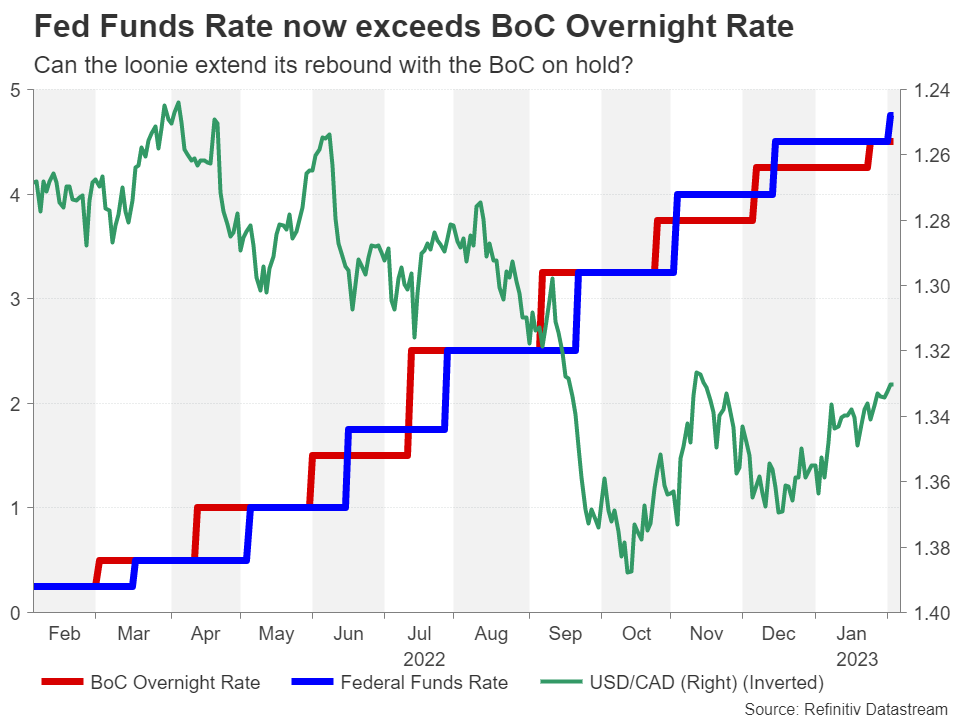
Friday’s employment report may therefore not attract as much attention as usual, although it will still be watched by policymakers as Canada’s tight labour market could yet come back to haunt those betting that the inflation problem has gone away. But unless there are very big surprises in the data, the loonie will likely be unfazed by it.
The BoC has not completely shut the door to further rate hikes so a large beat in the headline employment figure or in wage growth could push the loonie to fresh highs.
Muted dollar to seek direction from Powell
In the United States, there will be some downtime for traders after the Fed meeting and data overload of the past few days, and the only top-tier release on the agenda is the University of Michigan’s preliminary consumer sentiment survey. The closely watched consumer sentiment gauge has been recovering in recent months, while consumer inflation expectations have been levelling off and starting to come down. A continuation of that trend in February would be positive for risk appetite.
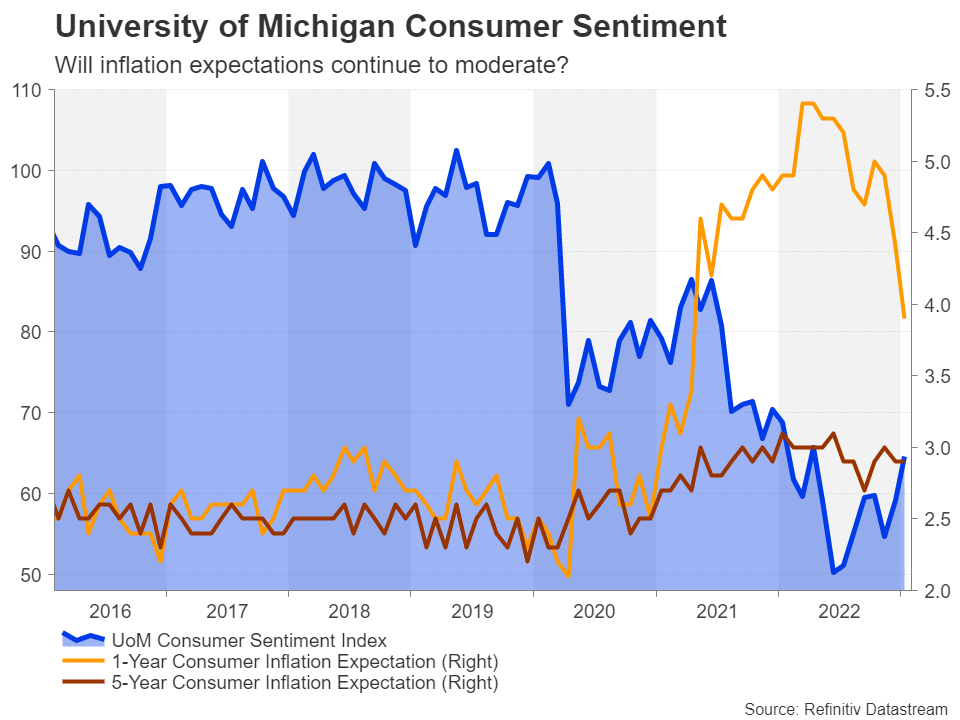
However, the dollar will more likely be taking its cues from Fed Chair Jerome Powell who is scheduled to speak at the Economic Club of Washington on Tuesday. Powell avoided pushing back against market bets of a shallower rate path in his post-FOMC press briefing so any remarks on the inflation and interest rate outlooks will be critical for the greenback.
Lack of major drivers elsewhere
The euro initially benefited from Powel’s somewhat less hawkish stance but later fell back after ECB President Christine Lagarde similarly disappointed the more hawkish expectations. With very little on the European calendar next week apart from a batch of German data on Monday and Tuesday, there will be limited domestic drivers for the euro.
In non-euro member Sweden meanwhile, the Riksbank is anticipated to follow in the footsteps of the ECB on Thursday and hike its policy rate by 50 basis points.
Asian markets will be relatively quiet too, but traders should nevertheless keep an eye on China’s consumer and producer price indices due on Friday and Japanese household spending and wage figures on Tuesday.
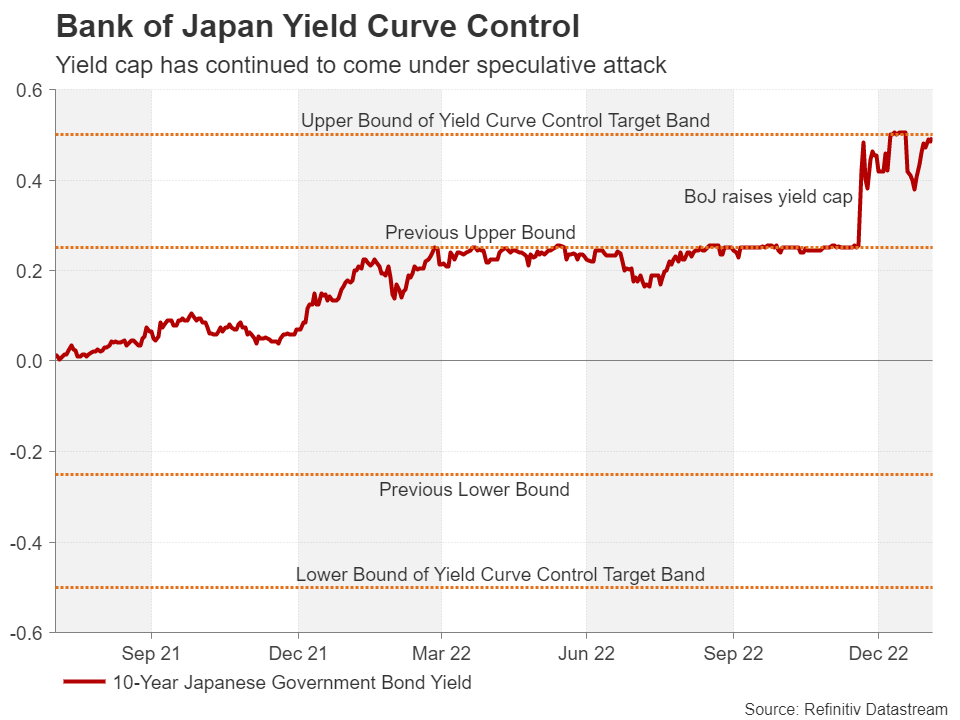
The Bank of Japan seems to be edging closer to an exit from stimulus even though outgoing governor, Haruhiko Kuroda, has set a high bar for doing so. But with the yield curve control policy becoming unsustainable despite the recent tweak, any indication that pay rises are accelerating in Japan would fuel speculation of a major policy shift as soon as a new governor takes over in April.
Weekly Focus – Central Banks Send Softer Signal, Intentionally or Not
The US Federal Reserve, the European Central Bank and the Bank of England all announced rate hikes this week as expected, but they also sent what markets interpreted to be signals of lower levels of rates in the future than previously thought, and there were rallies in equity and especially bond markets. However, the central banks, especially the ECB, did sound very concerned about the inflation outlook still, and actual numbers for core inflation do not seem to point towards lower rates at this point.
The Fed hiked by 25bp as widely signalled before the meeting. Chairman Jay Powell sounded less concerned that a deep recession might be necessary to bring down inflation enough in the US, and also played down the easing in overall financial conditions that has taken place in recent months, despite the Fed rate hikes. The Fed still does not expect that a rate cut will happen this year, but the market is increasingly betting that the central bank will have to change its mind about that, as headline inflation is declining. Speaking against the chance of rate cuts this year, though, is a still tight labour market, signs that business activity might soon start growing again, and the Fed's stated preference for tightening too much rather than too little in the current situation.
The ECB hiked 50bp and seemed to send a hawkish signal in its decision statement by saying that it 'intends' to hike 50bp again in March, pushing back against the media stories that it would only be 25bp. It also stated that, after the March hike, it will 'evaluate' the path of rate hikes depending on how the economy develops. At the press conference, ECB president Christine Lagarde said that the inflation outlook has become 'more balanced', which is a dovish signal. All in all, it seems that the communication was a compromise between the different views on ECB governing council. January inflation declined to 8.5% y/y in the euro area, which was lower than expected but also highly uncertain, as information from Germany was missing, and the data will be revised. Core inflation was unchanged at 5.2% y/y, and seasonally adjusted monthly changes in the core index does not indicate any slowing either. Unemployment in the euro area was unchanged at the record low level of 6.6% in December. Persistently high core inflation and tight labour market are central reasons why the ECB remains in tightening mode, and it seems that there will be less help on those issues from slowing overall economies than previously expected. We and others have upgraded the growth outlook significantly.
In the UK, the central bank also delivered a 50bp hike and revised up its economic outlook. It also still signalled more hikes to come, but in a toned-down language compared to December. Governor Bailey did not push back against market pricing of rate cuts in the second half of 2023, leading markets to price rates even lower towards the end of the year.
The coming week is light in terms of major data releases. The German inflation data that was missing in the January calculation for the euro area should come out on Thursday, and there is an EU summit Thursday-Friday where there will be discussions on trade and industrial policy such as new subsidies, but an agreement seems unlikely at this point.
Gold Wave Analysis
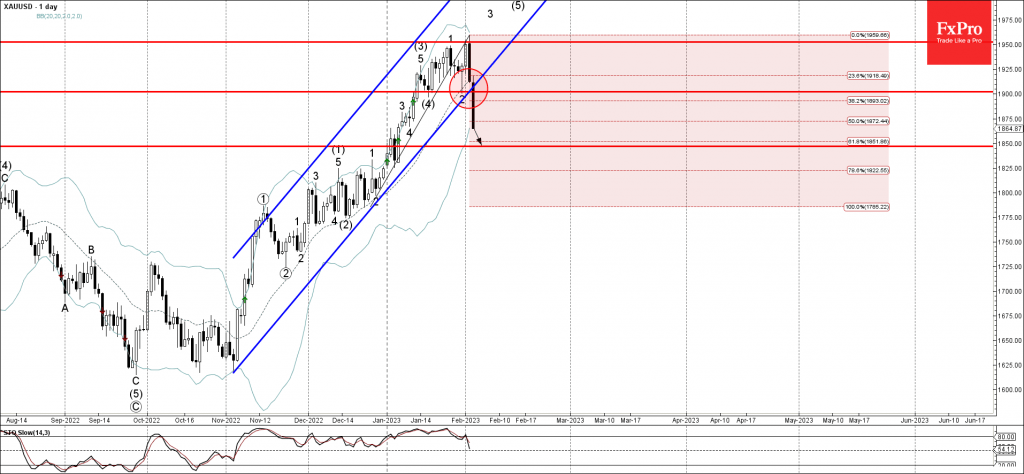
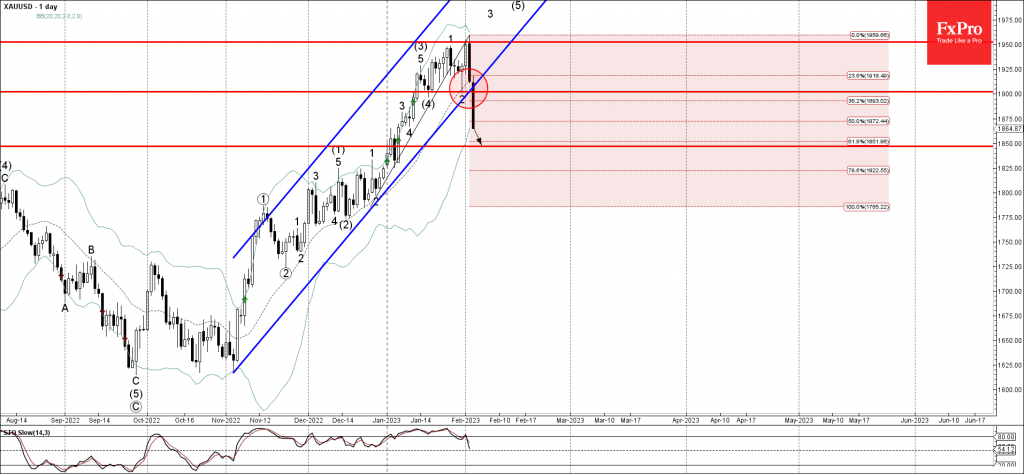
- Gold broke the support level 1900.00
- Likely to fall to support level 1850.00
Gold recently broke the support level 1900.00 (which stopped the previous waves (4) and 2) intersecting with the support trendline of the sharp daily up channel from November.
The breakout of the support level 1900.00 coincided with the breakout of the 38.2% Fibonacci correction of the upward impulse from December – which added to the bearish pressure on the gold.
Gold can be expected to fall further toward the next support level 1850.00 (which reversed the price at the start of January).
EURUSD Wave Analysis
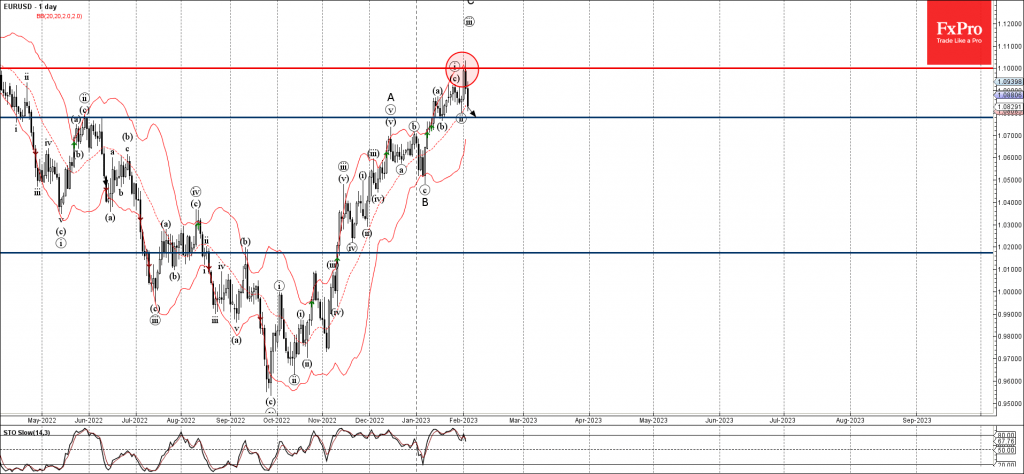
- EURUSD under bearish pressure
- Likely to fall to support level 1.0775
EURUSD under the bearish pressure after the price reversed down from round resistance level 1.1000 , touching the upper daily Bollinger Band.
The downward reversal from the resistance level 1.1000 created the daily Japanese candlesticks reversal pattern Dark Cloud Cover – which stopped the earlier impulse wave (iii).
EURUSD can be expected to fall further toward the next support level 1.0775 (low of the previous short-term correction (ii)).
AUDUSD Wave Analysis
- AUDUSD reversed from resistance level 0.7130
- Likely to fall to support level 0.6875
AUDUSD currency pair recently reversed down from the resistance level 0.7130 (previous monthly high from August), standing near the upper daily Bollinger Band.
The downward reversal from the resistance level 0.7130 created the daily Japanese candlesticks reversal pattern Bearish Engulfing.
Having just broken below the round support level 0.7000, AUDUSD currency pair can be expected to fall further toward the next support level 0.6875.
Sunset Market Commentary
Markets
First ECB governors hit the wires one day after raising policy rates by another 50 bps to 2.5% (deposit rate). ECB Vasle kept close to yesterday’s statement, committing to a 50 bps rate hike in March and vowing to keep policy restrictive. ECB Simkus was somewhat more detailed, warning that core inflation hasn’t peaked yet. Monetary policy is only now becoming mildly restrictive. A rate cut later this year – something markets start believing in – is not very likely. ECB Kazimir warned that a March rate hike won’t be the last and that rates will remain at an eventual peak level for some time to come. He stresses that the fight against inflation is far from won. ECB Muller warned that core inflation is a cause for concern and that the expected economic slowdown may not ease inflation.
US payrolls were… well… Find the adverb yourself: 517k vs 188k expected plus an upward revision of the previous two month’s numbers by 71k. The unemployment rate fell to 3.4%, matching the lowest level since 1968 even as the participation rate rose to 62.4% (matching the highest level since March 2020). Average hourly earnings rose as expected by 0.3% M/M and by 4.4% Y/Y with the previous numbers upgraded to 0.4% M/M and 4.8% Y/Y. Payrolls wrongfooted stubborn markets who doubted central bank inflation commitment. The US yield curve turns less inverse with yields rising by 7.2 bps (30-yr) to 13.6 bps (2-yr). German Bunds yields follow the move (they actually were already rising throughout the day backed by ECB comments) with yields rising by 6.5 bps (2-yr) to 12.2 bps (30-yr). The short term interest rate differential playing in the advantage of the dollar pulls EUR/USD further away from the 1.10-level touched briefly in the aftermath of the FOMC meeting. EUR/USD currently trades around 1.0850. US equities were already bound for a weaker opening following disappointing earnings by three big tech names (Apple, Amazon, Alphabet). Opening losses eventually amount up to 1.3% for the Nasdaq. European stocks cede around 0.7% at the moment. EUR/GBP extends its move beyond 0.89 with dovish comments by chief economist Pill at play as well. He signaled that the end is near for the interest rate tightening spree, stressing the importance of keeping the balance between doing enough to kill inflation but not the economy. Pill added that markets are correctly interpreting the central bank’s guidance. UK money markets currently discount a 4.25% terminal rate and have priced in a first rate cut by Q4. UK Gilt yields are only up to 5 bps higher today in the post-payrolls move.
News & Views
The ECB’s quarterly Survey of Professional Forecasters was released today. Longer-term (> 2025) inflation expectations stand at 2.1%, marginally down from the 2.2% in the previous survey. Respondents revised up their 2023 forecast to 5.9%, reflecting stronger-than-expected indirect effects of energy price developments and wage growth. For 2024 and 2025 price growth is seen at 2.7% (up from 2.4%) and 2.1%. Core inflation over that same horizon could hit 4.4%, 2.8% and 2.3% with 2% penciled in for the longer term. GDP forecasts were broadly unchanged, with a minor upgrade to this year (0.2%, + 0.1ppt) but a slightly lower growth seen for the next (1.4%, - 0.2 ppts). The first estimate for 2025 stands at 1.7%. The unemployment rate is seen ticking higher to 7% this year before easing to 6.9% and 6.7% in the two years thereafter.
The United Nation’s food price index fell for a tenth month straight in January, from 132.24 to 131.16, the lowest level since September 2021. In March 2022, shortly after the Russian invasion, the index shot up to a record high of 159.71. The drop last month was driven by vegetable oils (palm, soy, sunflower seed and rapeseed oils), dairy (butter and milk powders) and sugar. In general, a good harvest & favourable weather (for sugar) and subdued import demand (palm oil and dairy) combined and ample export supplies (rapeseed oil) were at the basis for price declines. The cereal and meat index remained largely stable. A rise in maize and rise prices offset a decline in barley and wheat in the former category . In the meat subindex, lower world prices of poultry and pig meats hung in the balance with rising ovine meat prices.
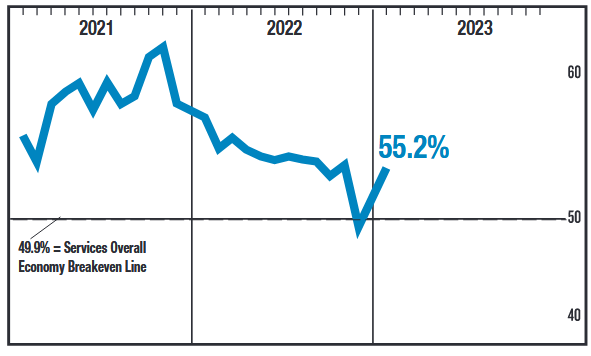
US ISM services jumped to 55.2, corresponds to 1.8% annualized GDP growth
US ISM Services PMI rose from 49.6 to 55.2 in January, well above expectation of 50.4. Looking at some details, business activity/production rose from 53.5 to 60.4. New orders rose sharply from 45.2 to 60.4. Employment ticked up from 49.4 to 50.0. Prices dropped slightly from 68.1 to 67.8.
ISM said: “Ten industries reported growth in January, according to the Services PMI®, which was in expansion territory after a single month of contraction and the prior 30-month period of growth. The composite index has indicated expansion for all but three of the previous 155 months.”
Nieves continues, “Business Survey Committee respondents indicated that capacity and logistics performance continue to improve. Although responses varied by industry and company, the majority of panelists indicated that business is trending in a positive direction. Employment was unchanged for the month. Some companies still find it difficult to fill open positions, while others are facilitating staff reductions.”
“The past relationship between the Services PMI® and the overall economy indicates that the Services PMI® for January (55.2 percent) corresponds to a 1.8-percent increase in real gross domestic product (GDP) on an annualized basis.”
US: January Employment Smashed Expectations, Suggesting More Rate Hikes to Come
The U.S. economy added 517k jobs in January, well above the consensus forecast of 190k. Revisions to the two prior months were substantial, adding 71k to the previously reported figures.
- The Bureau of Labor Statistics also made annual benchmark revisions to last year's establishment survey payroll numbers, which incorporated comprehensive new data through March 2022. Revisions were also made in the months April-December, though these were more due to adjustments in seasonal factors and the NAIS 2022 conversion. Overall, hiring numbers through March were revised higher by 586k on a non-seasonally adjusted basis – slightly above the 462k telegraphed in the preliminary revisions released in August. On a seasonally adjusted basis, overall revisions for the year were also positive – adding an additional 311k jobs to previously reported 4.5M tally.
- We suspect the 2023 preliminary benchmark revisions (won't be released until August) will show a softer pace of employment growth through the second half of 2022.
Employment gains on the service-side (+397k) were broad based, with leisure & hospital (+128k), education & health care (+105k) and professional & business services (+82k) leading the charge. Goods producing industries (+46k) also had a solid month, with gains spread across construction (+25k) and manufacturing (+19k). The public sector chipped in with a very robust 74k jobs.
In the household survey, civilian employment recorded another sizeable gain – rising by 894k. However, this reflects the annual update to the population estimates. If the January gain is corrected for the population adjustment, the number of employed people was up 84k. The updated population estimates also increased the size of the civilian noninstitutional population in December by 954k, the labor force by 871k, and the participation rate by 0.1 percentage points to 62.4% – matching its previous cyclical high. The unemployment rate fell 0.1pp to 3.4% – the lowest level since 1969.
Average hourly earnings rose 0.3% month-on-month (m/m) – a slight deceleration from December's (upwardly revised) 0.4% m/m gain – while the 12-month change slipped to 4.4% (down from last month's reading of 4.8%). After having declined in each of the two prior months, average weekly hours abruptly reversed course in January – rising by 0.9% m/m.
Key Implications
Wow! This is one strong labor market! Not only did payrolls smash expectations, but wage growth over prior months was revised a touch higher, while we also saw a sharp reversal in average hours worked.
Perhaps the only silver lining, from an inflation perspective, was that wage growth continued to show a modest decelerated, which is consistent with what other wage metrics including the Atlanta Fed wage tracker and the Q4 reading on the Employment Cost Index have recently suggested. That said, labor costs are still hovering in the 4.25%-5% range, which is 1-2 percentage points above what's consistent with the Fed's 2% inflation target.
In the press conference following this week's interest rate announcement, Chair Powell noted that while the policy rate has already moved into restrictive territory, more hikes (plural) are required before the policy stance becomes "sufficiently restrictive". While investors had previously discounted the Fed pushing rates above 5%, today's employment numbers definitely tilt the scales in favor of more rates past March, as it is clear the labor market is still running at a pace that is far too hot!
USD/CHF Mid-Day Outlook
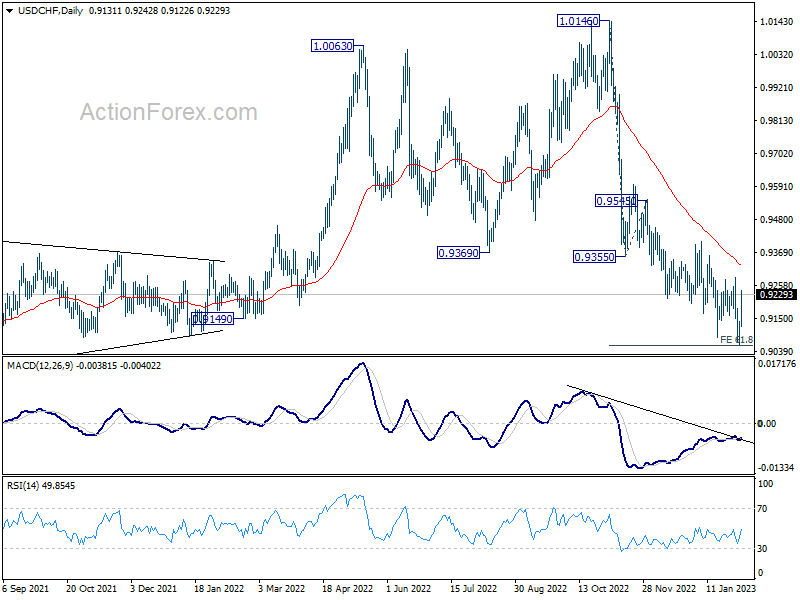
Daily Pivots: (S1) 0.9082; (P) 0.9110; (R1) 0.9161; More…
Intraday bias in USD/CHF stays neutral for the moment. Strong rebound from current level, followed by 0.9287 resistance, should confirm short term bottoming, and turn bias back to the upside. On the downside, sustained break of 61.8% projection of 1.0146 to 0.9355 from 0.9545 at 0.9056 will resume the whole fall from 1.0146 to 100% projection at 0.8754, which is close to 0.8756 long term support.
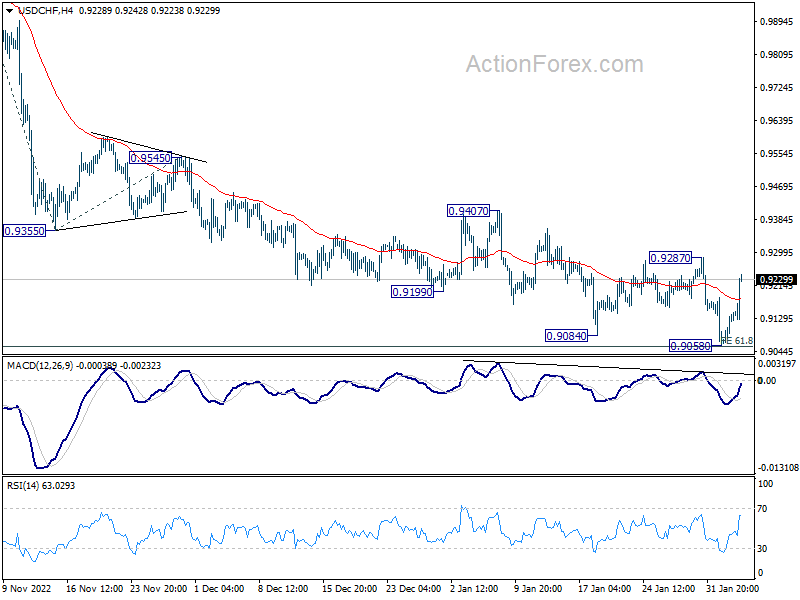
In the bigger picture, rise from 0.8756 (2021 low) has completed at 1.0146, well ahead of 1.0342 long term resistance (2016 high). Based on current downside momentum, fall from 1.0146 should be a medium term down trend itself. Next target is a test on 0.8756 low. Strong support should be seen there to bring rebound. Still, further decline will now be expected as long as 0.9407 resistance holds, in any case.