

Sample Category Title
GBP/USD Weekly Outlook
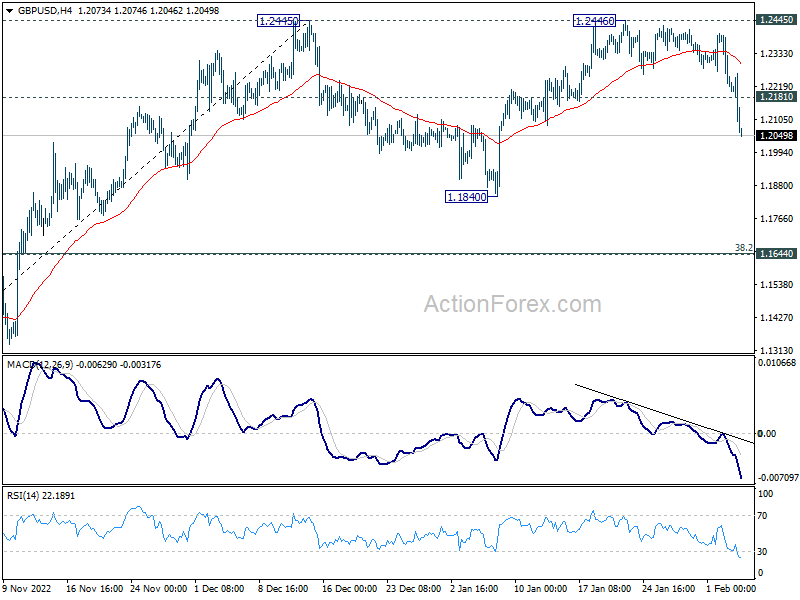
GBP/USD's decline last week confirmed that rebound from 1.1840 has completed at 1.2446, after rejection by 1.2445 resistance. Corrective pattern from 1.2445 should now be in its third leg. Initial bias stays on the downside for 1.1840 support and possibly below. But downside downside should be contained by 38.2% retracement of 1.0351 to 1.2445 at 1.1645 to bring rebound. On the upside, above 1.2181 minor resistance will turn intraday bias neutral first. But risk will stay mildly on the downside as long as 1.2445/6 holds, in case of recovery.
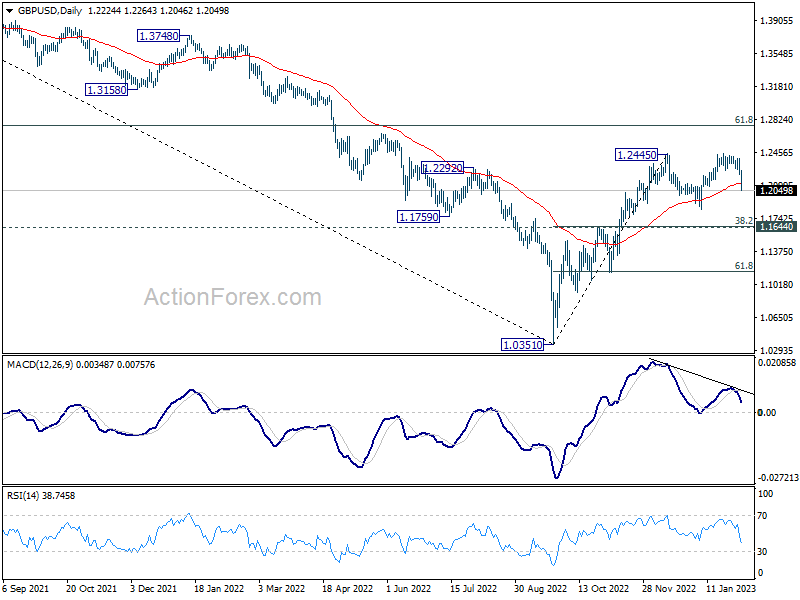
In the bigger picture, rise from 1.0351 medium term bottom is at least correcting whole down trend from 1.4248 (2021 high). Further rise is expected as long as 1.1644 resistance turned support holds. Next target is 61.8% retracement of 1.4248 to 1.0351 at 1.2759. Sustained break there will pave the way back to 1.4248.
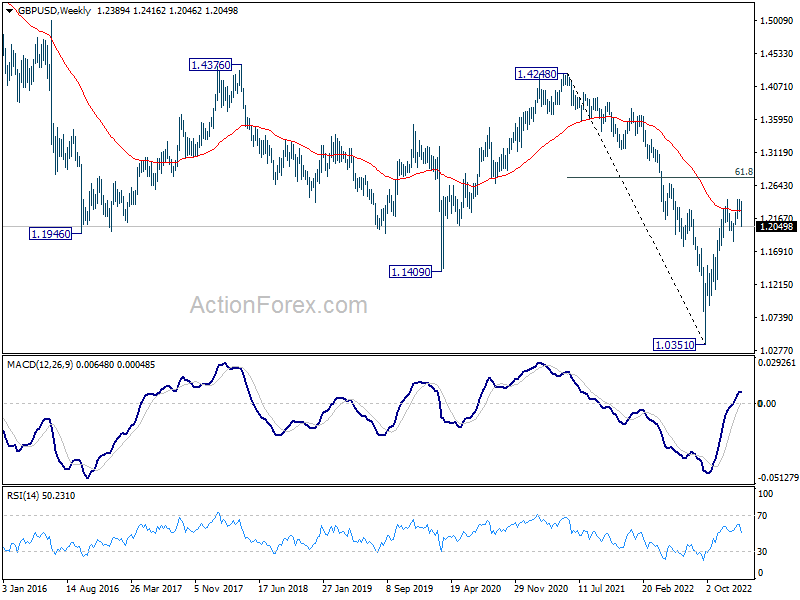
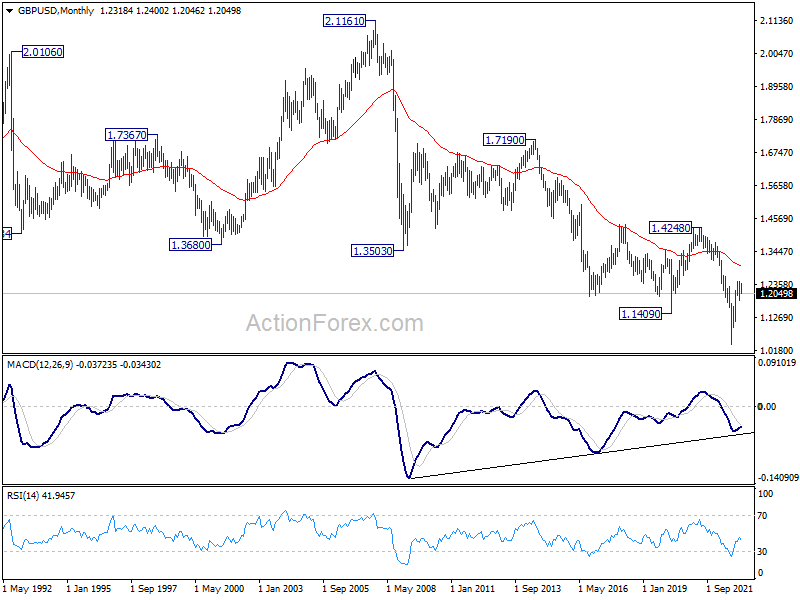
In the longer term picture, as long as 1.4248 resistance holds (2021 high), long term outlook will remain neutral at best. Down trend from 2.1161 (2007) could still resume for another low through 1.0351 at a later stage.
USD/CHF Daily Outlook
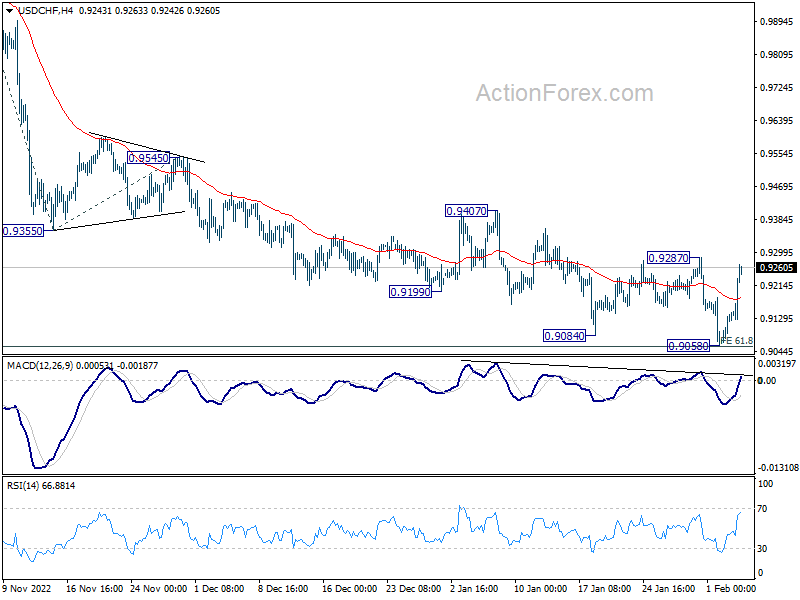
USD/CHF edged lower to 0.9058 last week, but quickly rebounded just ahead of 61.8% projection of 1.0146 to 0.9355 from 0.9545 at 0.9056. Initial bias remains neutral this week first. On the upside, firm break of 0.9287 resistance will confirm short term bottoming. Intraday bias will then be back on the upside for 0.9407 resistance and above. On the downside, however, sustained break of 0.9056 will resume the whole fall from 1.0146 to 100% projection at 0.8754, which is close to 0.8756 long term support.
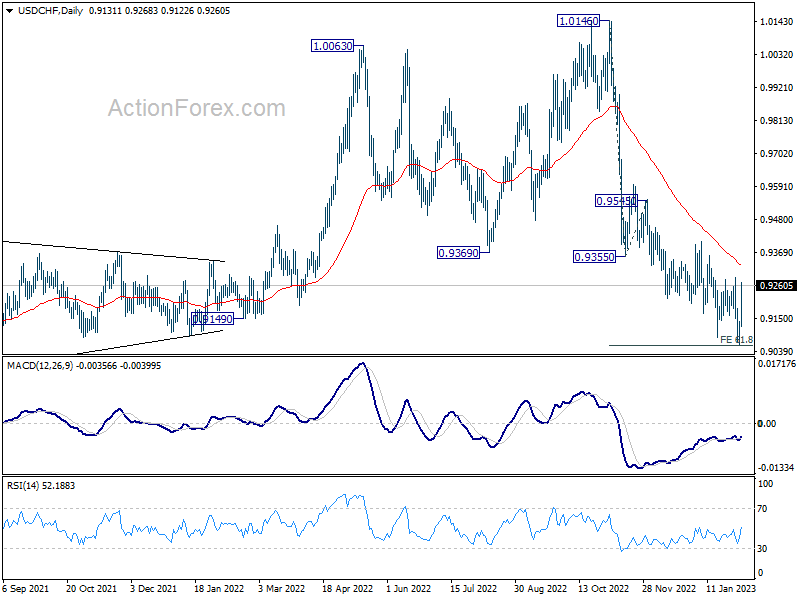
In the bigger picture, rise from 0.8756 (2021 low) has completed at 1.0146, well ahead of 1.0342 long term resistance (2016 high). Based on current downside momentum, fall from 1.0146 should be a medium term down trend itself. Next target is a test on 0.8756 low. Strong support should be seen there to bring rebound. Still, further decline will now be expected as long as 0.9407 resistance holds, in any case.
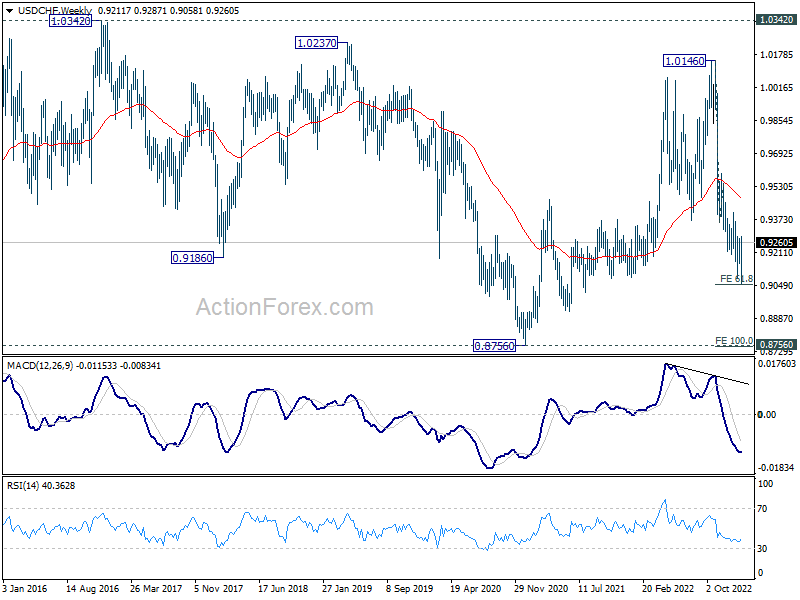
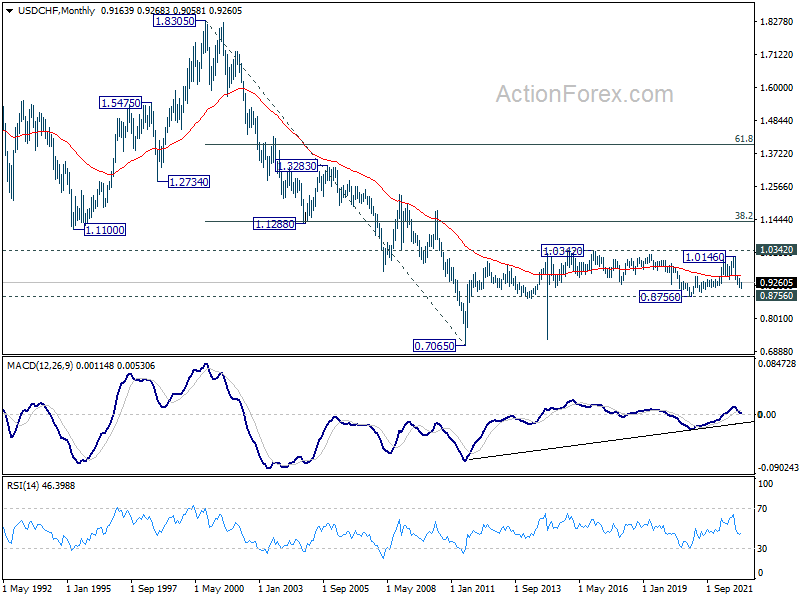
In the long term picture, long term sideway pattern from 1.0342 (2016 high) is extending and it’s probably in another medium term down leg. Downside will likely be contained by 0.8756 support in case of deeper fall. Overall, range trading should continue until further development.
AUD/USD Weekly Outlook
AUD/USD edged higher to 0.7156 last week, but subsequent steep pull back indicates short term topping. Initial bias is now on the downside this week for 55 day EMA (now at 0.6806) and possibly below. But downside should be contained by 38.2% retracement of 0.6169 to 0.7156 at 0.6779 to bring rebound. On the upside, above 0.6994 minor resistance will turn bias neutral first. But overall, corrective pattern from 0.7156 should extend for a while.
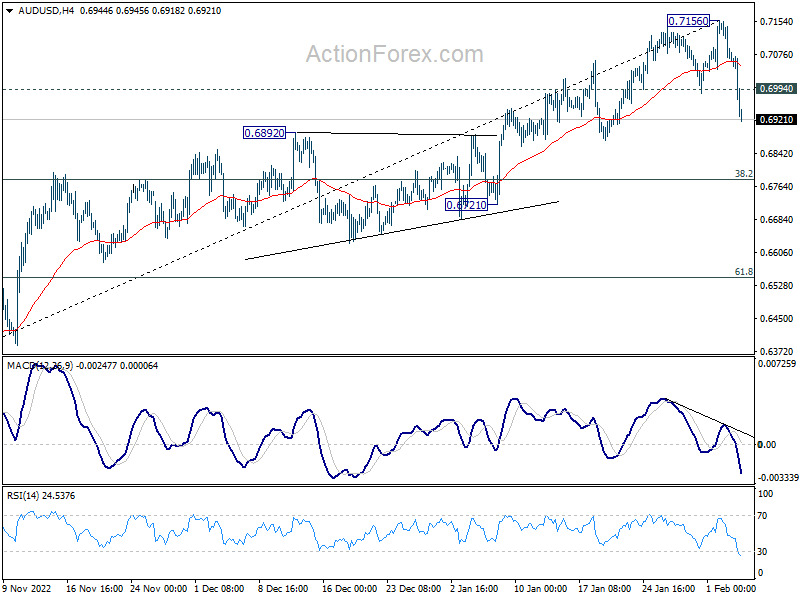
In the bigger picture, corrective decline from 0.8006 (2021 high) should have completed with three waves down to 0.6169 (2022 low). Further rally should be seen to 61.8% retracement of 0.8006 to 0.6169 at 0.7304. Sustained break there will pave the way to retest 0.8006. This will now remain the favored case as long as 0.6721 support holds.
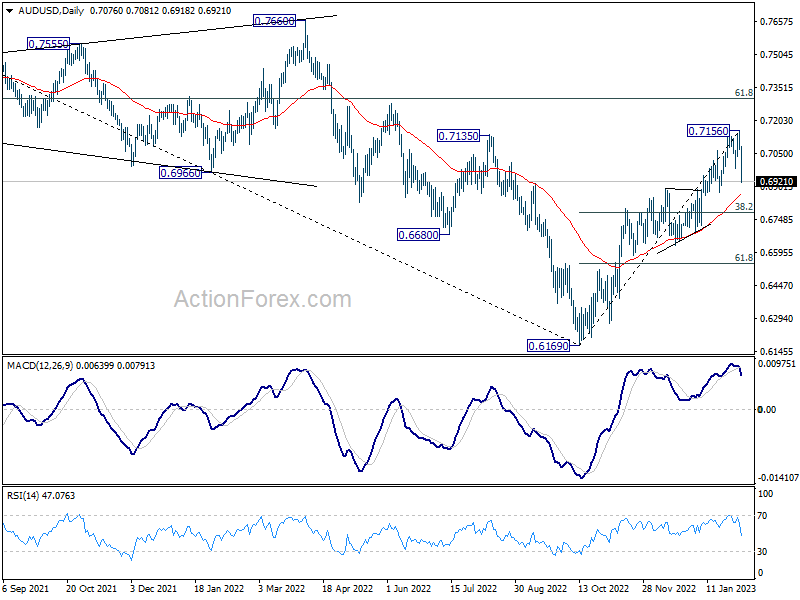
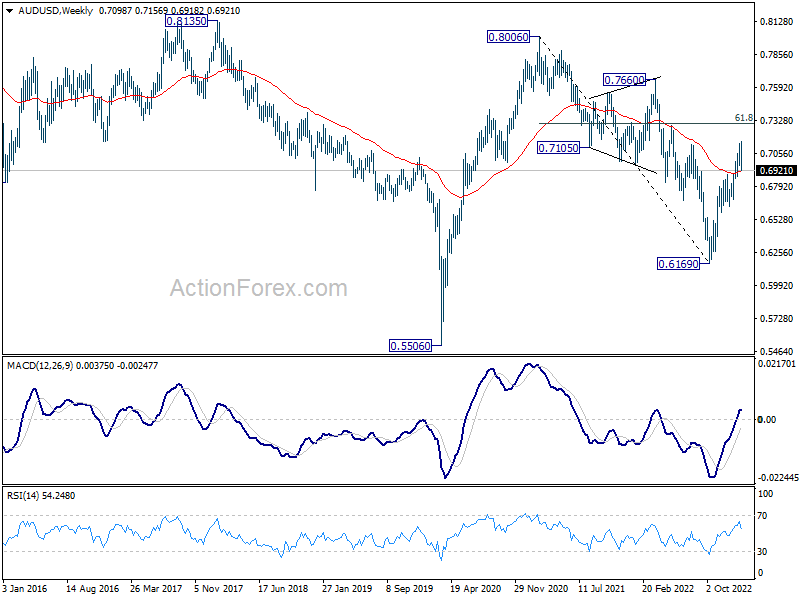
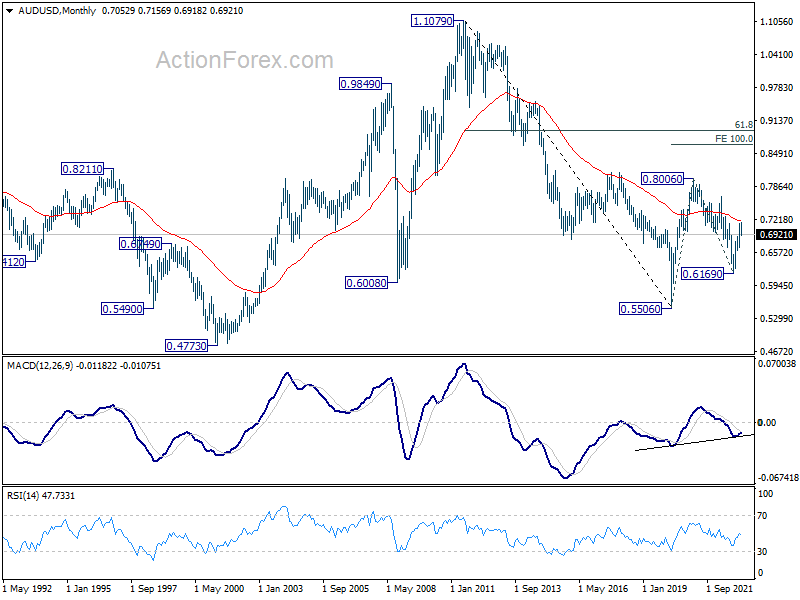
In the long term picture, current development suggests that fall from 0.8006 was merely a correction to the rise from 0.5506 (2020 low). Sustained trading above 55 month EMA (now at 0.7193) will raise the chance of up trend resumption through 0.8006 at a later stage.
USD/CAD Weekly Outlook
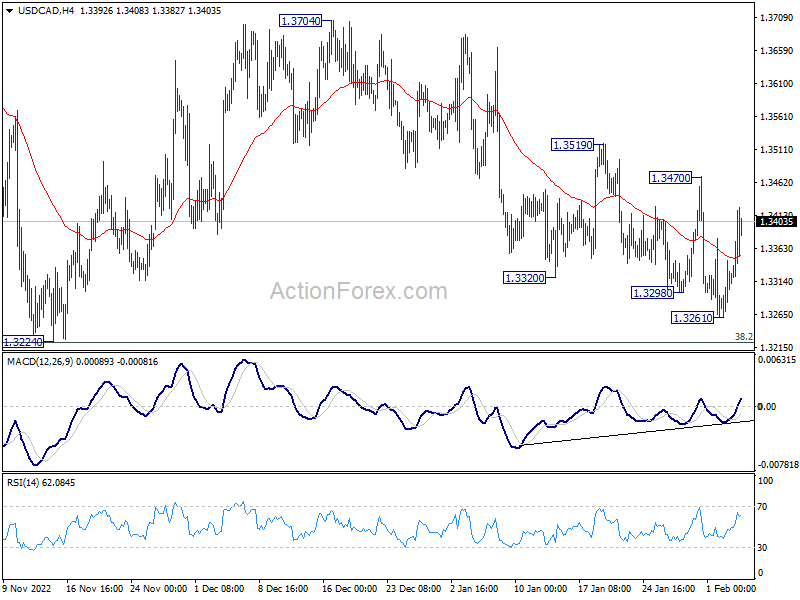
USD/CAD gyrated lower to 1.3261 last week but recovered strongly since then. Initial bias stays neutral this week and outlook is unchanged. While the choppy fall from 1.3704 might still extend lower, strong support is expected to 1.3224 key support to bring rebound. On the upside, above 1.3470 minor resistance will indicate short term bottoming on bullish convergence condition in 4 hour MACD, and turn intraday bias back to the upside for 1.3519 resistance and above. However, decisive break of 1.3224 would carry larger bearish implication.
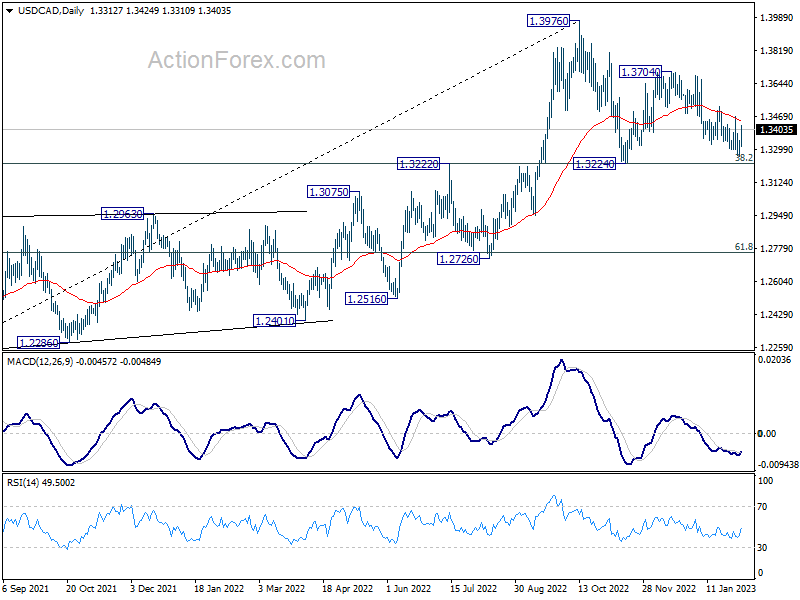
In the bigger picture, as long as 1.3222 cluster support (38.2% retracement of 1.2005 to 1.3976 at 1.3223) holds, larger up trend from 1.2005 (2021 low) is still expected to resume through 1.3976 high at a later stage. However, firm break of 1.3222/3 will indicate that the trend might have reversed. Deeper fall would be seen to next cluster support at 1.2726 (61.8% retracement at 1.2758).
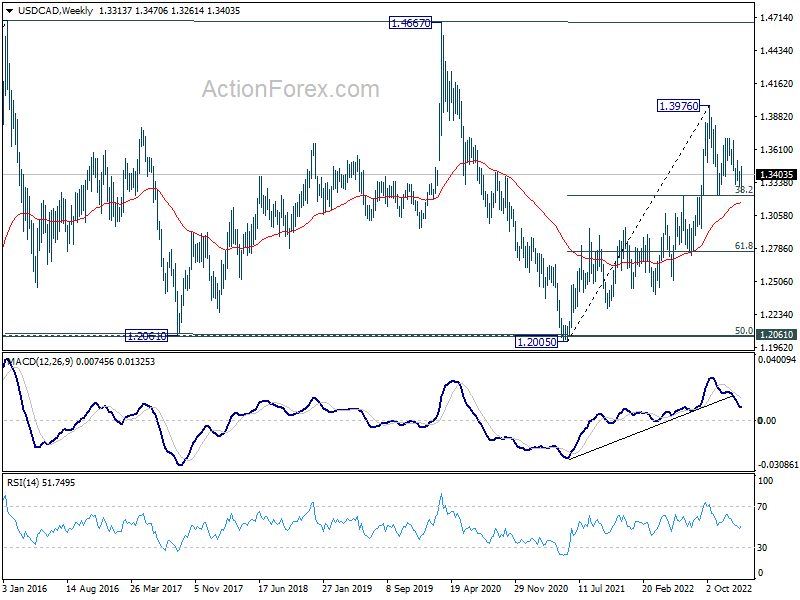
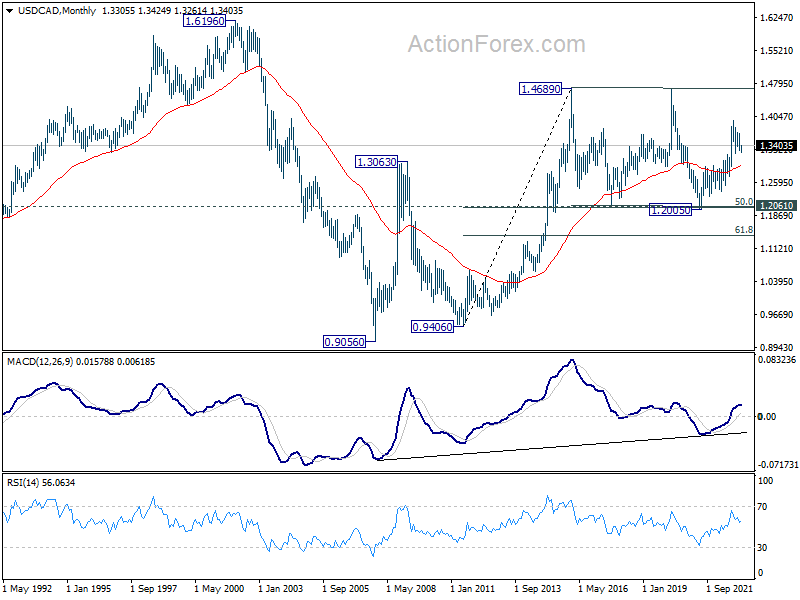
In the longer term picture, price actions from 1.4689 (2016 high) are seen as a consolidation pattern only, which might have completed at 1.2005. That is, up trend from 0.9506 (2007 low) is expected to resume at a later stage. This will remain the favored case as 55 month EMA (now at 1.2953) holds.
Dollar Won on Strong Economic Data, Might Decouple from Risk Sentiment for a While
With the help from strong economic data, Dollar struck back to end as the strongest one, after a week full of heavy weight events. Traders might start to give up on fighting the Fed on the topic of terminal interest rate and the timing of a cut, given the underlying resilience of the economy. At the same time, American and European investors appear to be optimistic that economy is going to withstand extending tightening well. FTSE even made a new record high. The development to monitor now is whether the greenback would have a near term decoupling from risk sentiment.
Elsewhere in the forex markets, Swiss Franc ended the second strongest, followed by Euro and Canadian. Sterling was the worst, thanks to selloff against European majors in particular. Australian Dollar and New Zealand Dollar came as next weakest, without much help from risk-on sentiment. Yen was mixed, facing some pressure from rebound in American and European benchmark yields.
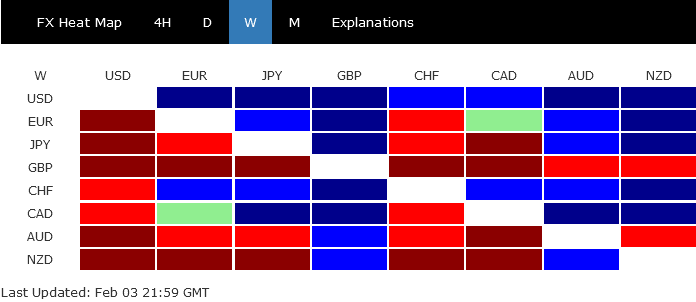
Fed, ECB, and BoE recap
In the US, Fed hike federal funds rate target range by 25bps to 4.50-4.75% as widely expected. While some may disagree, Chair Jerome Powell's post-meeting press conference was not dovish at all. He didn't deviate from the message that rates will peak above 5%. Additional, he deliberately noted that “If the economy performs broadly in line with those expectations, it will not be appropriate to cut rates this year.”
More importantly, economic data published were impressively strong, with more than 500k growth in non-farm payroll employment. ISM services PMI jumped from 49.6 to 55.2 even though ISM manufacturing dropped from 48.4 to 47.4. The markets might be starting to realize that it's really not a good idea to fight the Fed.
Fed fund futures are now pricing in 82.7% chance of another 25bps hike in March,, pretty much the same as 84.3% a week ago. But more importantly, they're pricing in 48.2% change of another 25bps hike in May, comparing to 33.5% a week ago.
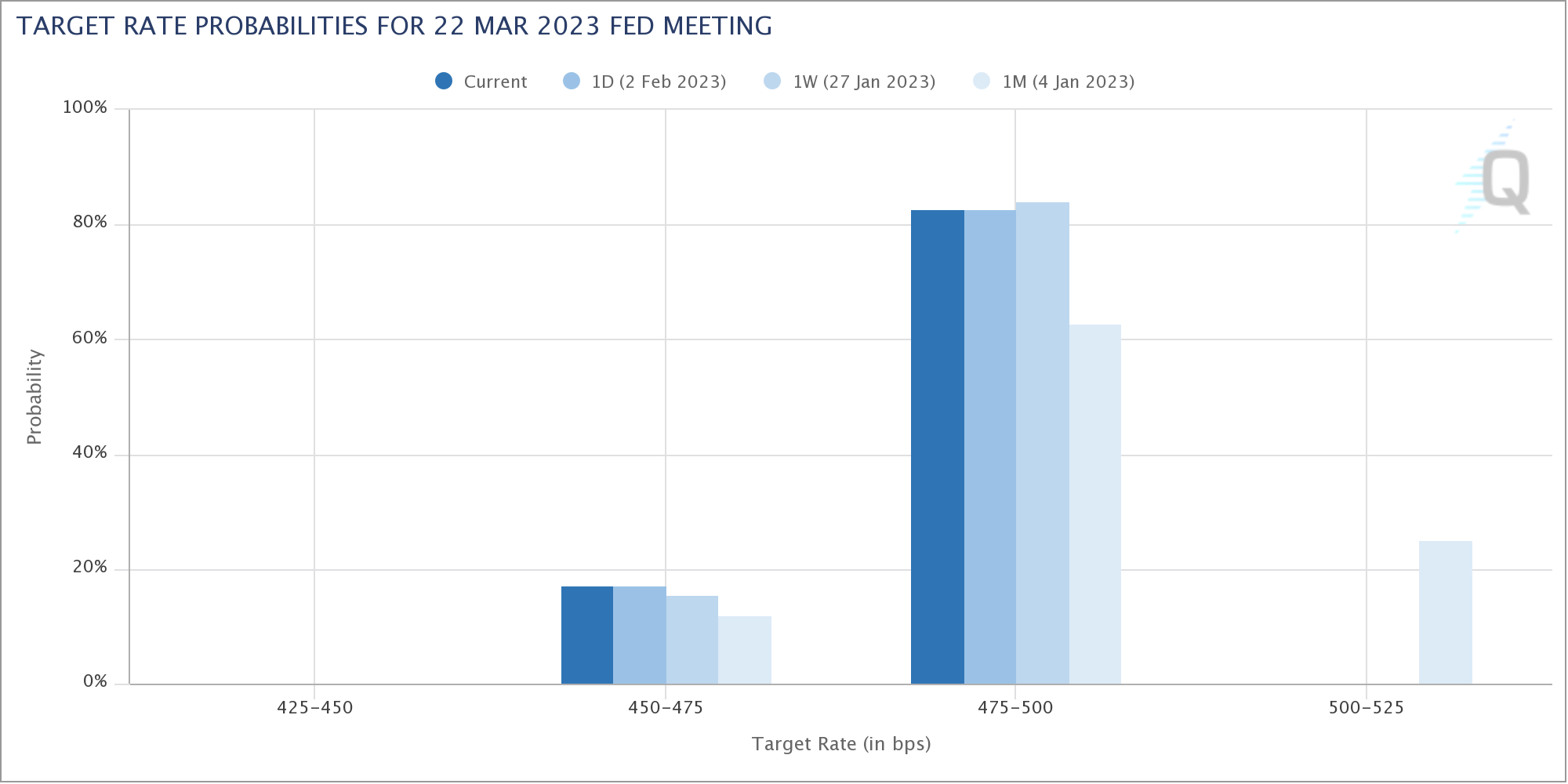
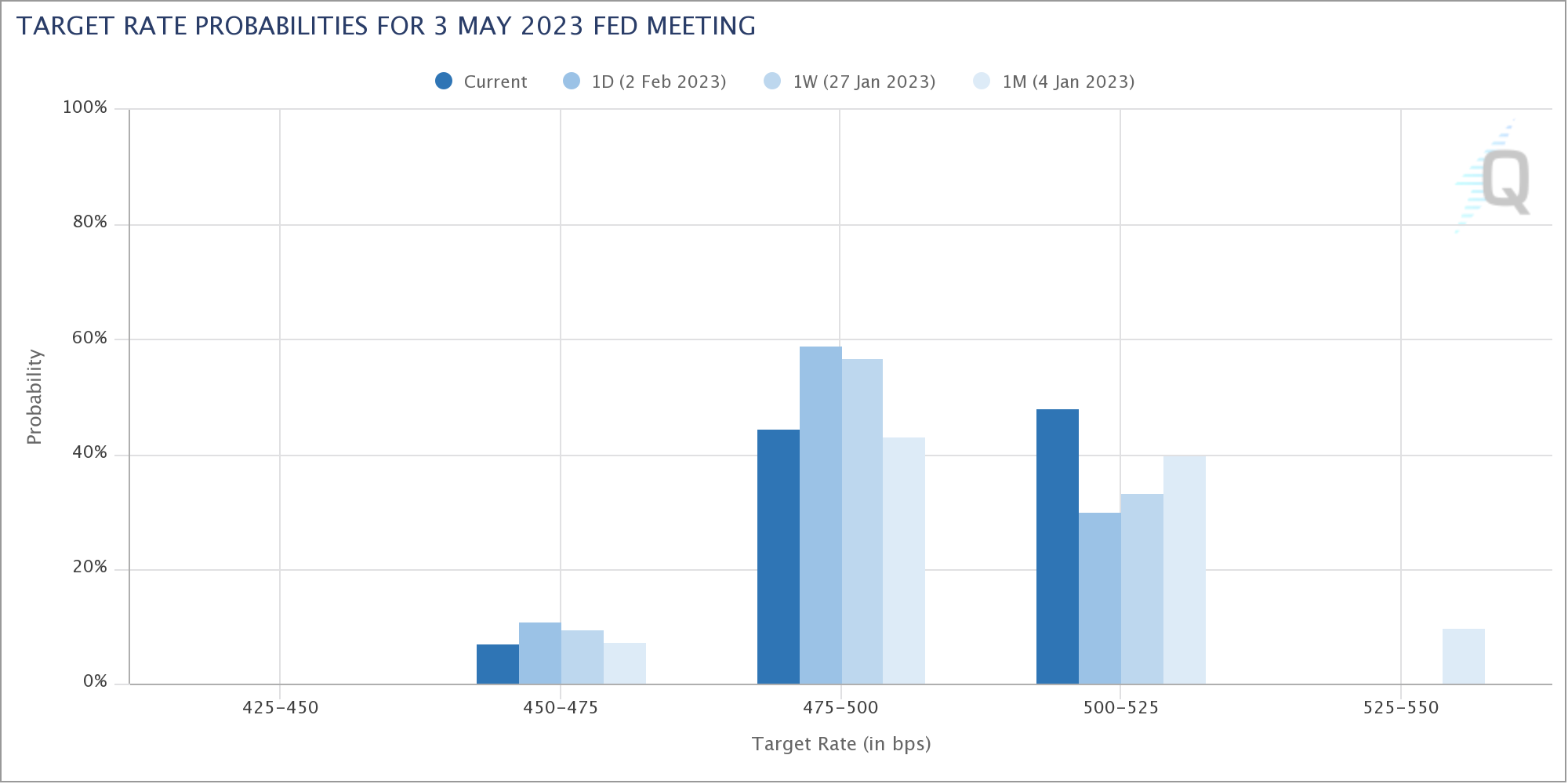
ECB "stayed the course" and hike interest rate by 50bps to 3.00% as expected. It explicitly mentioned in the statement that the “Governing Council intends to raise interest rates by another 50 basis points at its next monetary policy meeting in March.” Comments from ECB official after the meeting indicated that the rate hike in March might not the last one. ECB continue to "outhawk" other major central banks for a while in this phase of the cycle.
BoE also hiked by 50bps to 4.00% as expected, with two doves voted for no change. Governor Andrew Bailey indicated that inflation may have "turned a corner". While other Fed and ECB officials have given similar message on inflation, markets seemed to be giving more weight to Bailey's as recession in the UK could last longer and deeper, even if in slight extent. As indicated in BoE's projections, interest rate might peak at 4.50%, and there're some speculations that it would be below that level.
Risk sentiment stayed positive despite extended tightening
Risk sentiment remained positive after a full week of heavy weight events. Investors appeared to be staying optimistic that the underlying strength of major economies is going to withstand extended monetary tightening well. Also, even if recessions do happen, they'll be relatively shallow ones.
While US stocks pulled back notably on Friday after strong NFP and ISM services, overall risk sentiment was positive. S&P 500 resumed the rise from 3491.58 to close at 4136.48. Near term outlook will stay bullish as long as 4015.55 support holds. Next target is 100% projection of 3491.58 to 4100.51 from 3764.49 at 4373.42, which is close to 4325.28 resistance.
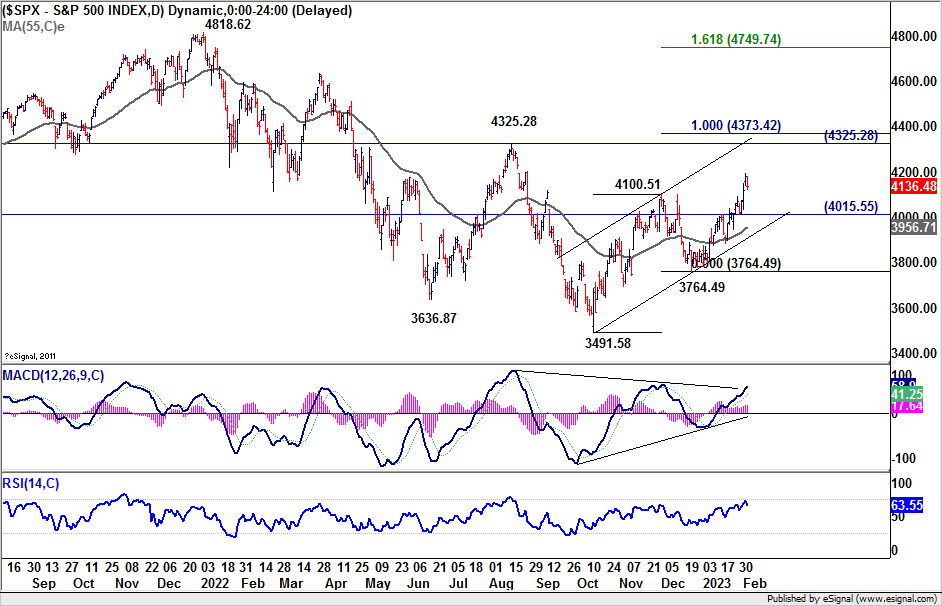
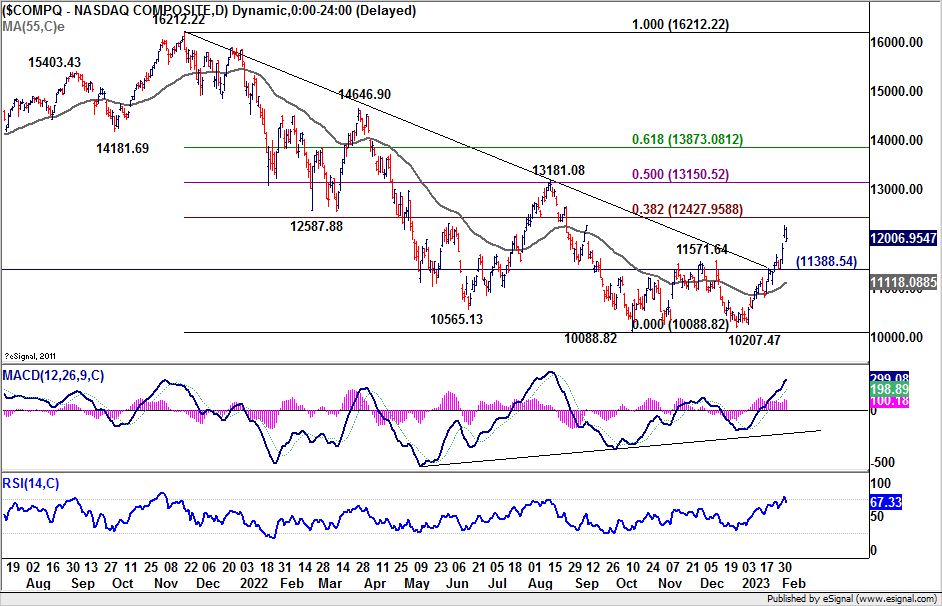
NASDAQ also accelerated up to close at 12006.95. Near term outlook remains bullish as long as 1388.54 support holds. Next target is 38.2% retracement of 16212.22 to 10207.47 at 12427.95. But the real test would be on 13181.08 cluster resistance (50% retracement at 13150.52.
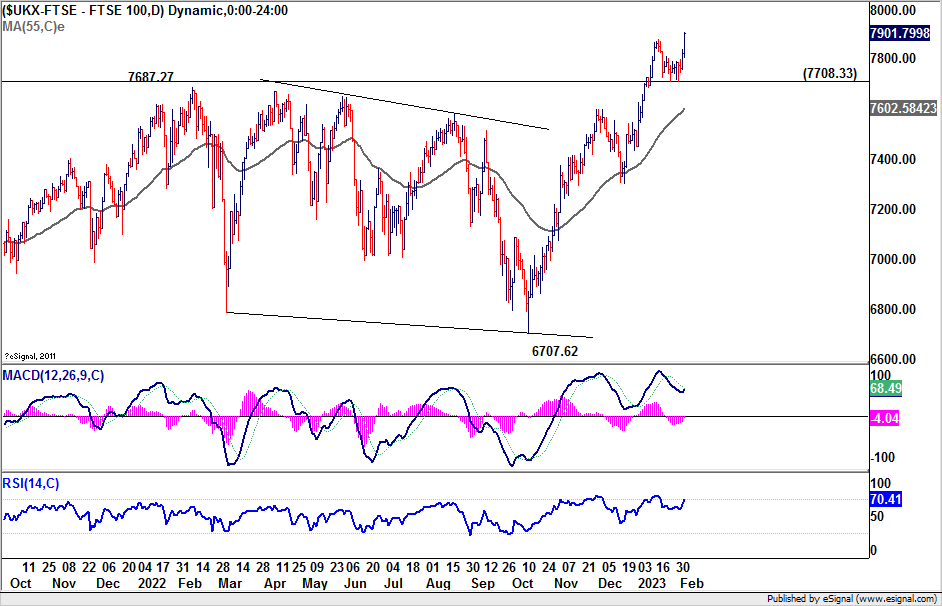
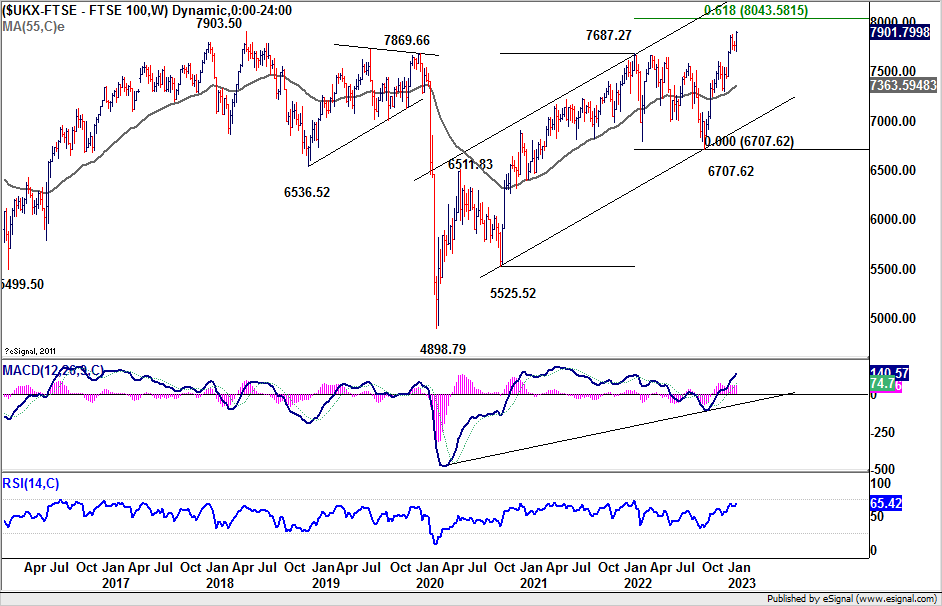
In the UK, FTSE resumed the near term rise from 6707.62 to close 7901.79, after hitting new intraday record high at 7706.58. For the near term, outlook will stay bullish as long as 7708.33 support holds. Next target is 61.8% projection of 5525.52 to 7687.27 from 6707.62 at 8043.58.
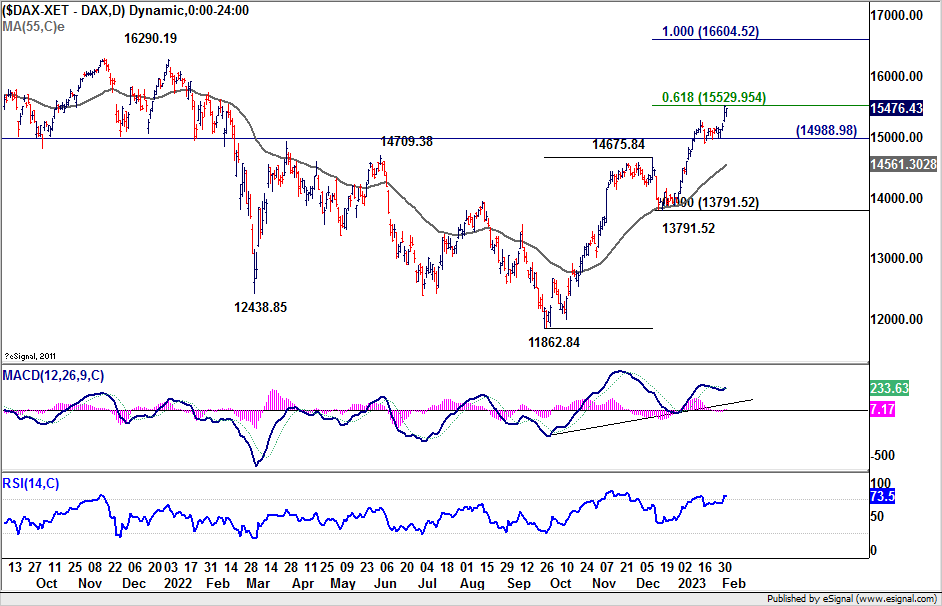
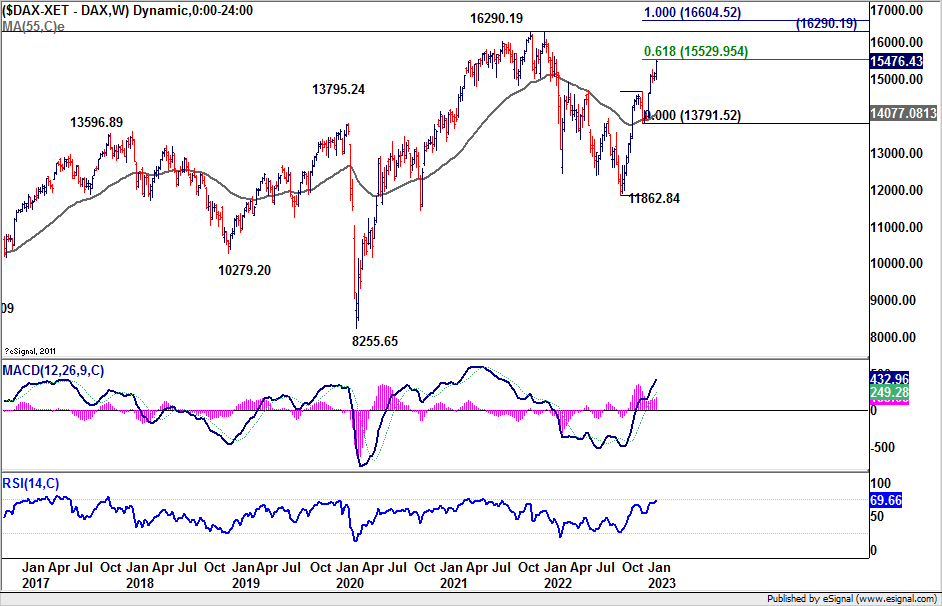
DAX also resumed the rally from 11862.84 and it's now pressing 61.8% projection of 11862.84 to 14675.84 from 13791.52 at 15529.95. Near term outlook stays bullish as long as 14988.98 support holds. Sustained break of 15529.95 could prompt upside acceleration to 100% projection of 16604.52, which is above record high at 16290.19.
US 10-year yield might have completed corrective pattern
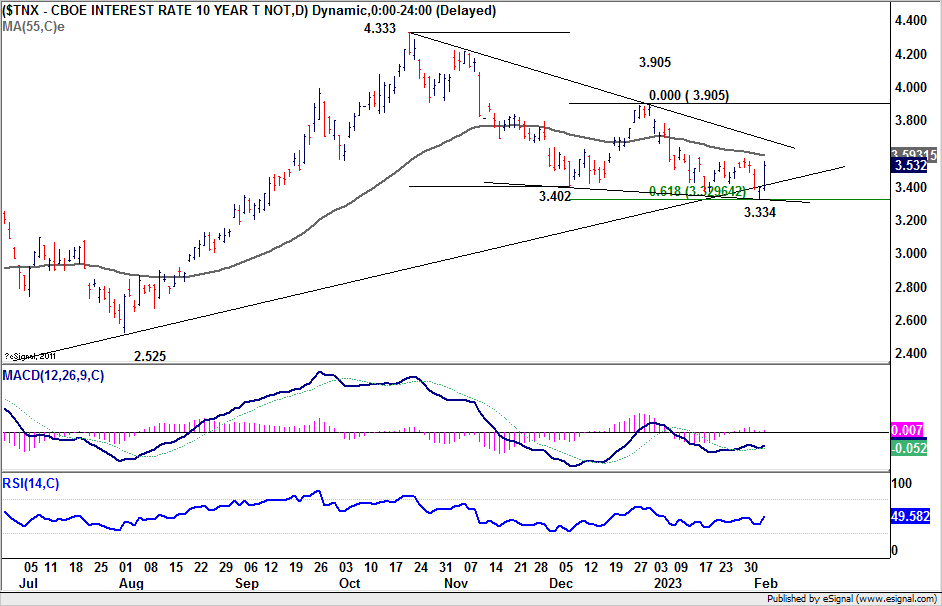
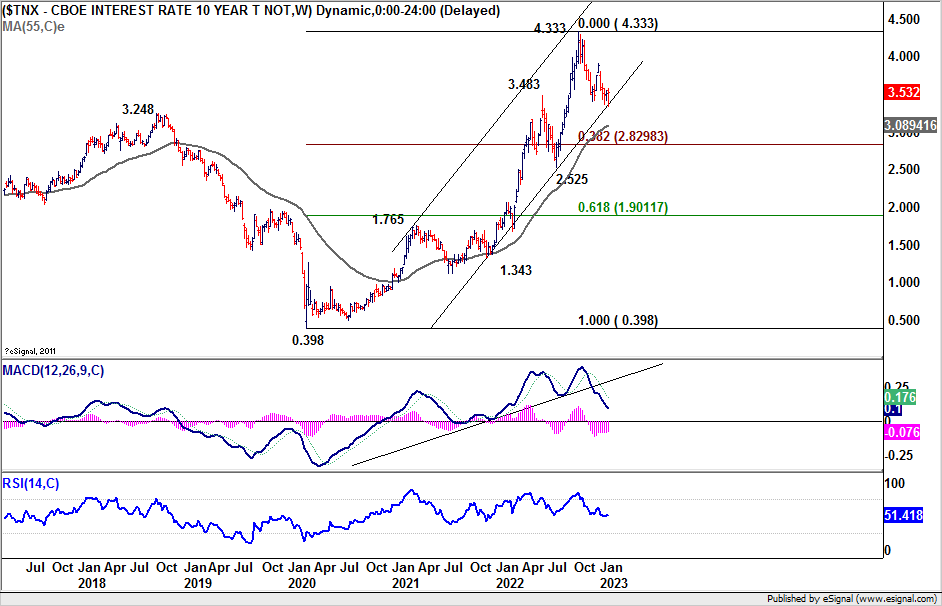
Back in the US, 10-year yield staged a notable rebound on Friday after strong economic data. It appears that corrective pattern from 4.333 might have completed with three waves down to 3.334, after hitting medium term trend line support, and missing 61.8% projection of 4.333 to 3.402 from 3.905 at 3.329 by an inch.
Near term immediate focus is now on 55 day EMA (now at 3.591). Sustained break there will affirm this bullish case and pave the way for stronger rise for at least a test on 3.905 resistance.
Dollar might decouple from risk sentiment for a while
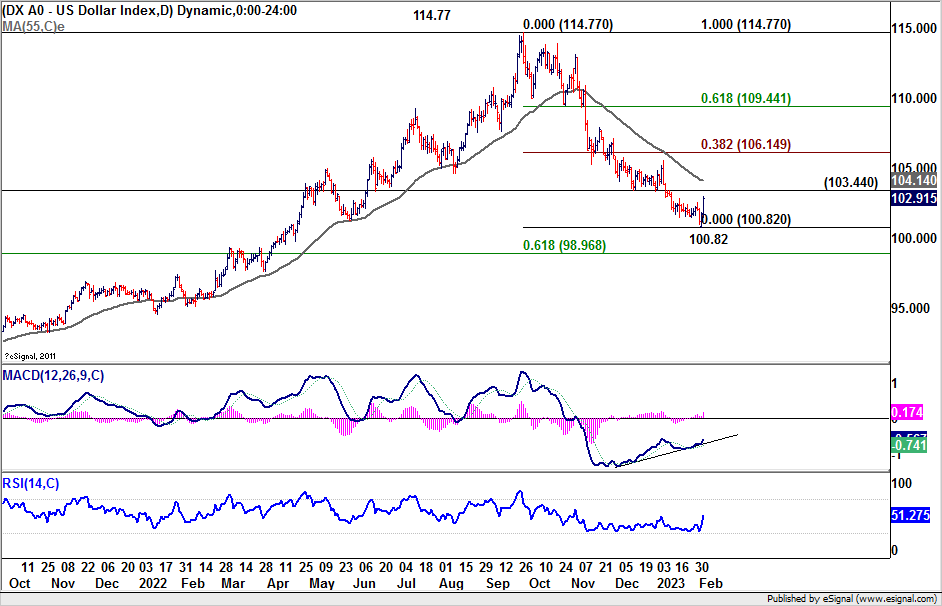
As for the Dollar index, it should be note that firstly, extended rebound in 10-year yield would give the DXY an extra boost. But secondly and more importantly, a near term decoupling of Dollar and risk sentiment might be starting to emerge. The latter development is an important one to monitor and verify in the days ahead.
For now, the conditions for a bounce is there for DXY, considering bullish convergence condition in daily MACD. Break of 103.44 resistance should confirm short term bottoming, and bring further rebound to 55 day EMA (now at 104.14) and above. But the real test would lie in 38.2% retracement of 114.77 to 100.82 at 106.14.
EUR/GBP resumes rally as ECB expected to "outhawk" BoE
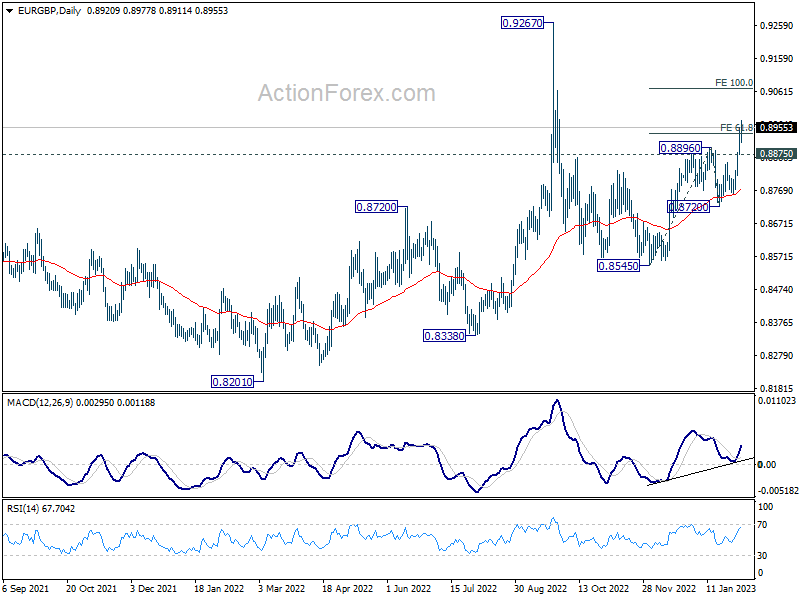
Meanwhile in crosses, EUR/GBP's rally reflected the perception that ECB is going to "outhawk" BoE for a while. Further rise is expected as long as 0.8875 minor support holds. 61.8% projection of 0.8545 to 0.8896 from 0.8720 at 0.8937 was already taken out. Next target is 100% projection at 0.9071.
AUD/USD Weekly Outlook
AUD/USD edged higher to 0.7156 last week, but subsequent steep pull back indicates short term topping. Initial bias is now on the downside this week for 55 day EMA (now at 0.6806) and possibly below. But downside should be contained by 38.2% retracement of 0.6169 to 0.7156 at 0.6779 to bring rebound. On the upside, above 0.6994 minor resistance will turn bias neutral first. But overall, corrective pattern from 0.7156 should extend for a while.
In the bigger picture, corrective decline from 0.8006 (2021 high) should have completed with three waves down to 0.6169 (2022 low). Further rally should be seen to 61.8% retracement of 0.8006 to 0.6169 at 0.7304. Sustained break there will pave the way to retest 0.8006. This will now remain the favored case as long as 0.6721 support holds.
In the long term picture, current development suggests that fall from 0.8006 was merely a correction to the rise from 0.5506 (2020 low). Sustained trading above 55 month EMA (now at 0.7193) will raise the chance of up trend resumption through 0.8006 at a later stage.
Summary 2/6 – 2/10
Monday, Feb 6, 2023
| GMT | Ccy | Events | Consensus | Previous |
|---|---|---|---|---|
| 00:00 | AUD | TD Securities Inflation M/M Jan | 0.20% | |
| 07:00 | EUR | Germany Factory Orders M/M Dec | 2.00% | -5.30% |
| 09:30 | EUR | Eurozone Sentix Investor Confidence Feb | -11.8 | -17.5 |
| 09:30 | GBP | Construction PMI Jan | 49.5 | 48.8 |
| 10:00 | EUR | Eurozone Retail Sales M/M Jan | -2.50% | 0.80% |
| 15:00 | CAD | Ivey PMI Jan | 42.3 | 33.4 |
| 23:30 | JPY | Labor Cash Earnings Y/Y Dec | 2.50% | 0.50% |
| 23:30 | JPY | Household Spending Y/Y Dec | -0.20% | -1.20% |
| GMT | Ccy | Events | |
|---|---|---|---|
| 00:00 | AUD | TD Securities Inflation M/M Jan | |
| Forecast: | Previous: 0.20% | ||
| 07:00 | EUR | Germany Factory Orders M/M Dec | |
| Forecast: 2.00% | Previous: -5.30% | ||
| 09:30 | EUR | Eurozone Sentix Investor Confidence Feb | |
| Forecast: -11.8 | Previous: -17.5 | ||
| 09:30 | GBP | Construction PMI Jan | |
| Forecast: 49.5 | Previous: 48.8 | ||
| 10:00 | EUR | Eurozone Retail Sales M/M Jan | |
| Forecast: -2.50% | Previous: 0.80% | ||
| 15:00 | CAD | Ivey PMI Jan | |
| Forecast: 42.3 | Previous: 33.4 | ||
| 23:30 | JPY | Labor Cash Earnings Y/Y Dec | |
| Forecast: 2.50% | Previous: 0.50% | ||
| 23:30 | JPY | Household Spending Y/Y Dec | |
| Forecast: -0.20% | Previous: -1.20% | ||
Tuesday, Feb 7, 2023
| GMT | Ccy | Events | Consensus | Previous |
|---|---|---|---|---|
| 03:30 | AUD | RBA Rate Decision | 3.35% | 3.10% |
| 00:30 | AUD | Trade Balance (AUD) Dec | 12.2B | 13.20B |
| 05:00 | JPY | Leading Economic Index Dec P | 97.2 | 97.4 |
| 06:45 | CHF | Unemployment Rate Jan | 1.90% | 1.90% |
| 07:00 | EUR | Germany Industrial Production M/M Dec | -0.60% | 0.20% |
| 07:45 | EUR | France Trade Balance (EUR) Dec | -12.2B | -13.8B |
| 08:00 | CHF | Foreign Currency Reserves (CHF) Jan | 784B | |
| 13:30 | CAD | International Merchandise Trade (CAD) Dec | -0.6B | 0.0B |
| 13:30 | USD | Trade Balance (USD) Dec | -68.5B | -61.5B |
| 23:50 | JPY | Bank Lending Y/Y Jan | 2.60% | 2.70% |
| 23:50 | JPY | Current Account (JPY) Dec | 1.25T | 1.92T |
| GMT | Ccy | Events | |
|---|---|---|---|
| 03:30 | AUD | RBA Rate Decision | |
| Forecast: 3.35% | Previous: 3.10% | ||
| 00:30 | AUD | Trade Balance (AUD) Dec | |
| Forecast: 12.2B | Previous: 13.20B | ||
| 05:00 | JPY | Leading Economic Index Dec P | |
| Forecast: 97.2 | Previous: 97.4 | ||
| 06:45 | CHF | Unemployment Rate Jan | |
| Forecast: 1.90% | Previous: 1.90% | ||
| 07:00 | EUR | Germany Industrial Production M/M Dec | |
| Forecast: -0.60% | Previous: 0.20% | ||
| 07:45 | EUR | France Trade Balance (EUR) Dec | |
| Forecast: -12.2B | Previous: -13.8B | ||
| 08:00 | CHF | Foreign Currency Reserves (CHF) Jan | |
| Forecast: | Previous: 784B | ||
| 13:30 | CAD | International Merchandise Trade (CAD) Dec | |
| Forecast: -0.6B | Previous: 0.0B | ||
| 13:30 | USD | Trade Balance (USD) Dec | |
| Forecast: -68.5B | Previous: -61.5B | ||
| 23:50 | JPY | Bank Lending Y/Y Jan | |
| Forecast: 2.60% | Previous: 2.70% | ||
| 23:50 | JPY | Current Account (JPY) Dec | |
| Forecast: 1.25T | Previous: 1.92T | ||
Wednesday, Feb 8, 2023
| GMT | Ccy | Events | Consensus | Previous |
|---|---|---|---|---|
| 05:00 | JPY | Eco Watchers Survey: Current Jan | 48.1 | 47.9 |
| 15:00 | USD | Wholesale Inventories Dec F | 0.10% | 0.10% |
| 15:30 | USD | Crude Oil Inventories | 4.1M | |
| 23:50 | JPY | Money Supply M2+CD Y/Y Jan | 2.80% | 2.90% |
| GMT | Ccy | Events | |
|---|---|---|---|
| 05:00 | JPY | Eco Watchers Survey: Current Jan | |
| Forecast: 48.1 | Previous: 47.9 | ||
| 15:00 | USD | Wholesale Inventories Dec F | |
| Forecast: 0.10% | Previous: 0.10% | ||
| 15:30 | USD | Crude Oil Inventories | |
| Forecast: | Previous: 4.1M | ||
| 23:50 | JPY | Money Supply M2+CD Y/Y Jan | |
| Forecast: 2.80% | Previous: 2.90% | ||
Thursday, Feb 9, 2023
| GMT | Ccy | Events | Consensus | Previous |
|---|---|---|---|---|
| 00:01 | GBP | RICS Housing Price Balance Jan | -45% | -42% |
| 10:00 | EUR | EU Economic Forecasts | ||
| 13:00 | EUR | Germany CPI M/M Jan P | 0.90% | -0.80% |
| 13:00 | EUR | Germany CPI Y/Y Jan P | 8.90% | 8.60% |
| 13:30 | USD | Initial Jobless Claims (Feb 3) | 191K | 183K |
| 15:30 | USD | Natural Gas Storage | -151B | |
| 23:50 | JPY | PPI Y/Y Jan | 11.20% | 10.20% |
| GMT | Ccy | Events | |
|---|---|---|---|
| 00:01 | GBP | RICS Housing Price Balance Jan | |
| Forecast: -45% | Previous: -42% | ||
| 10:00 | EUR | EU Economic Forecasts | |
| Forecast: | Previous: | ||
| 13:00 | EUR | Germany CPI M/M Jan P | |
| Forecast: 0.90% | Previous: -0.80% | ||
| 13:00 | EUR | Germany CPI Y/Y Jan P | |
| Forecast: 8.90% | Previous: 8.60% | ||
| 13:30 | USD | Initial Jobless Claims (Feb 3) | |
| Forecast: 191K | Previous: 183K | ||
| 15:30 | USD | Natural Gas Storage | |
| Forecast: | Previous: -151B | ||
| 23:50 | JPY | PPI Y/Y Jan | |
| Forecast: 11.20% | Previous: 10.20% | ||
Friday, Feb 10, 2023
| GMT | Ccy | Events | Consensus | Previous |
|---|---|---|---|---|
| 00:30 | AUD | RBA Monetary Policy Statement | ||
| 01:30 | CNY | CPI Y/Y Jan | 2.30% | 1.80% |
| 01:30 | CNY | PPI Y/Y Jan | -0.50% | -0.70% |
| 06:00 | JPY | Machine Tool Orders Y/Y Jan P | 1.00% | |
| 07:00 | GBP | GDP M/M Dec | -0.30% | 0.10% |
| 07:00 | GBP | GDP Q/Q Q4 P | 0.00% | -0.30% |
| 07:00 | GBP | Industrial Production M/M Dec | -0.20% | -0.20% |
| 07:00 | GBP | Industrial Production Y/Y Dec | -5.30% | -5.10% |
| 07:00 | GBP | Manufacturing Production M/M Dec | -0.20% | -0.50% |
| 07:00 | GBP | Manufacturing Production Y/Y Dec | -6.10% | -5.90% |
| 07:00 | GBP | Goods Trade Balance (GBP) Dec | -17.2B | -15.6B |
| 09:00 | EUR | Italy Industrial Output M/M Dec | 0.10% | -0.30% |
| 12:00 | GBP | NIESR GDP Estimate (3M) Jan | 0.10% | |
| 13:30 | CAD | Net Change in Employment Jan | 15.0K | 104K |
| 13:30 | CAD | Unemployment Rate Jan | 5.00% | 5.00% |
| 13:30 | CAD | Participation Rate Jan | 64.80% | 65.00% |
| 15:00 | USD | Michigan Consumer Sentiment Index Feb P | 65 | 64.9 |
| GMT | Ccy | Events | |
|---|---|---|---|
| 00:30 | AUD | RBA Monetary Policy Statement | |
| Forecast: | Previous: | ||
| 01:30 | CNY | CPI Y/Y Jan | |
| Forecast: 2.30% | Previous: 1.80% | ||
| 01:30 | CNY | PPI Y/Y Jan | |
| Forecast: -0.50% | Previous: -0.70% | ||
| 06:00 | JPY | Machine Tool Orders Y/Y Jan P | |
| Forecast: | Previous: 1.00% | ||
| 07:00 | GBP | GDP M/M Dec | |
| Forecast: -0.30% | Previous: 0.10% | ||
| 07:00 | GBP | GDP Q/Q Q4 P | |
| Forecast: 0.00% | Previous: -0.30% | ||
| 07:00 | GBP | Industrial Production M/M Dec | |
| Forecast: -0.20% | Previous: -0.20% | ||
| 07:00 | GBP | Industrial Production Y/Y Dec | |
| Forecast: -5.30% | Previous: -5.10% | ||
| 07:00 | GBP | Manufacturing Production M/M Dec | |
| Forecast: -0.20% | Previous: -0.50% | ||
| 07:00 | GBP | Manufacturing Production Y/Y Dec | |
| Forecast: -6.10% | Previous: -5.90% | ||
| 07:00 | GBP | Goods Trade Balance (GBP) Dec | |
| Forecast: -17.2B | Previous: -15.6B | ||
| 09:00 | EUR | Italy Industrial Output M/M Dec | |
| Forecast: 0.10% | Previous: -0.30% | ||
| 12:00 | GBP | NIESR GDP Estimate (3M) Jan | |
| Forecast: | Previous: 0.10% | ||
| 13:30 | CAD | Net Change in Employment Jan | |
| Forecast: 15.0K | Previous: 104K | ||
| 13:30 | CAD | Unemployment Rate Jan | |
| Forecast: 5.00% | Previous: 5.00% | ||
| 13:30 | CAD | Participation Rate Jan | |
| Forecast: 64.80% | Previous: 65.00% | ||
| 15:00 | USD | Michigan Consumer Sentiment Index Feb P | |
| Forecast: 65 | Previous: 64.9 | ||
The Weekly Bottom Line: Until the Job Is Done
U.S. Highlights
- The Federal Reserve hiked the fed funds rate 25 basis-points, a step down from six consecutive hikes of 50 or 75 bps.
- Non-farm payrolls accelerated in January for the first time in five months, adding 517k jobs and nearly tripling market expectations.
- The ISM Manufacturing Index dropped to its lowest level since May 2020, with new orders declining at an accelerating rate, while the ISM Services Index returned to strong growth after contracting in December.
Canadian Highlights
- GDP advanced at a subpar 0.1% m/m pace in November, with output gains somewhat narrowly based across industries. Even worse, Statcan’s flash estimate for December points to no growth that month.
- Growth is clearly slowing in Canada. Still, the industry-based figures are flagging a 1.6% annualized GDP gain in Q4, nearly bang on the Bank of Canada’s latest forecast.
- There is a bit more action for Canada next week, with the January Labour Force Survey and the first release of the Bank of Canada minutes from their latest policy deliberation.
U.S. - Until the Job Is Done
With the first month of 2023 in the books, the start of February was marked by the much anticipated (but widely expected) rate decision delivered by the Federal Reserve on Wednesday. Coupled with a sizeable upside surprise in the January employment data on Friday, markets certainly had a lot to think about this week. The S&P 500 rose 2.6% for the week, while the ten-year Treasury yield was little changed at 3.5% as of the time of writing.
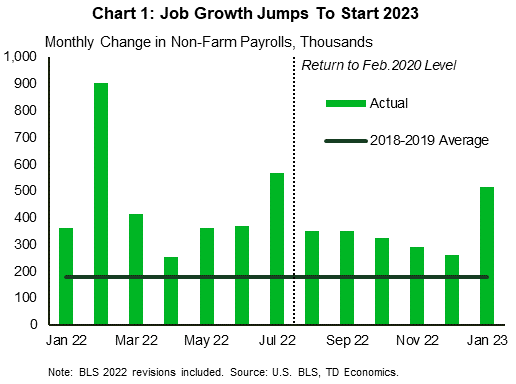
Labor markets began 2023 with a bang, breaking a five-month deceleration trend and adding 517k jobs (Chart 1). This brought the unemployment rate down by 0.1 percentage points (ppts) to a 53-year low of 3.4%. In addition, revisions to 2022 data added 311k jobs to last year’s tally. The labor force participation rate in January ticked up by 0.1 ppts to 62.4%. Average hourly earnings rose by 0.3% month-on-month (m/m) and hours worked increased by 0.9% m/m. On aggregate, this was an exceptionally strong jobs report, which when combined with the sustained downward trend in initial jobless claims and the increase in December job openings, will give the Federal Reserve plenty to contemplate over the coming weeks.
In contrast to the strong labor market data, the ISM Manufacturing Purchasing Managers’ Index (PMI) slipped further into contractionary territory in January, dropping 1 percentage point to 47.4 – its lowest level since May 2020. Economic activity in the sector contracted for the third consecutive month, as new orders continued to decline at an accelerating rate. This contrasts with the ISM Services PMI which showed the industry return to strong growth in January after briefly contracting in December, with new orders jumping up by 15.2 percentage points. While there have been positive developments in the manufacturing sector, such as reduced delivery times and lower price pressures, the robustness of the strength in the services sector will be a concern for the Federal Reserve as it seeks to put a lid on services price growth.
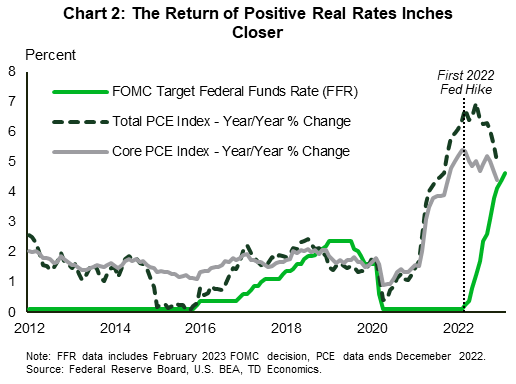
February began with a partial return to conventional monetary policy in the U.S., with the Federal Reserve raising rates by a more usual 25bps for the first time since last March (Chart 2). FOMC Chair Powell noted that it was gratifying to see progress on disinflation, but that further policy tightening would be required to ensure price growth sustainably returns to the Fed’s 2% target. During the press conference, Powell also pushed back against the idea of assuming the Fed could mitigate the risk of a binding debt limit in June, stating that the only way forward was for Congress to raise the debt ceiling.
Markets expect another 25bps hike at the Fed’s next meeting in six weeks, at which time we will also receive an update on the Committee’s Summary of Economic Projections. The January employment report introduced fresh uncertainty to market expectations for the terminal rate, with May meeting expectations now evenly split between no change and a 25bps hike. Powell is in the hot seat in a Q&A next Tuesday, where he is likely to be pressed on his reading of the January jobs blowout. He is likely to confirm the hawkish bias of the press conference, and markets will be listening carefully for any hints of how high the Fed expects to raise rates now.
Canada – Growing Pains
Canadian financial markets took their cue from U.S. events this week, with both an FOMC interest rate decision and Friday's blowout U.S. jobs report. During Chair Powell's presser after the Fed's interest rate decision, Canadian yields fell across the curve while equities popped higher – telltale signs of a dovish take on his comments by markets. However, yields reversed course on Friday in the wake of a super-hot January U.S. jobs report. Elsewhere, oil prices slid lower for the second straight week, greased by government data showing big inventory builds, growth concerns and, importantly, no change in production policy coming out of Wednesday's OPEC+ meeting.
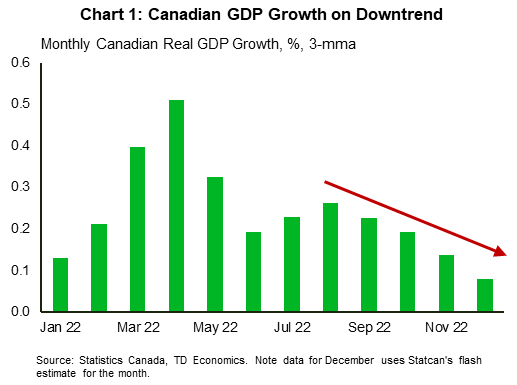
The monthly GDP report was the only main data released in Canada, which had several notable takeaways. Growth was on the softer-side last November, with the economy expanding by 0.1% month-on-month. Meanwhile, the breath of gains was not all that impressive, with output up in 11 of 20 industries and flat in three others. On a trend basis, economic growth is clearly slowing (Chart 1) and going by Statcan's preliminary estimate for December, GDP was flat at the end of last year.
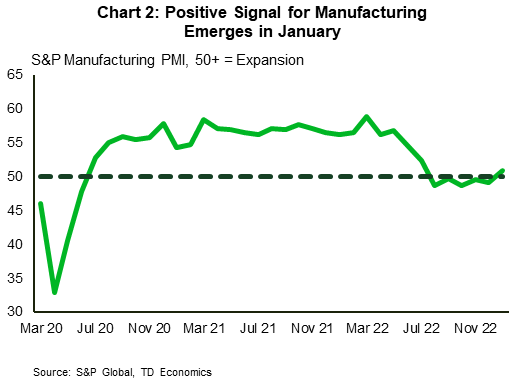
Even with December's estimate, monthly GDP still implies 1.6% annualized economic growth in the fourth quarter. This is nearly bang-on the Bank of Canada's latest forecast and provides precisely zero reason for second thoughts from the Bank around its recent pause. Of course, what industry-based GDP implies for a given quarter can differ from what expenditure-based GDP ultimately shows, and Chart 2 shows the Canadian manufacturing PMI from S&P Global, from March 2020 to January 2023. In January 2023, the PMI increased to 51, indicating expansion in the Canadian manufacturing sector, from 49.2 in December. Over 2022, the index averaged 53.4the latter is what the Bank of Canada uses when forecasting. However, we think the two measures lined up reasonably well in the fourth quarter. Interestingly, while U.S. economic growth may have lagged Canada's in December, January's sizzling jobs U.S. report suggests a stronger footing stateside last month. This, in turn, could spell positive news for Canada's near-term growth prospects and would be consistent with the latest S&P Canadian manufacturing PMI, which moved into expansionary territory for the first time since July (Chart 2).
Next week is shaping up to be an interesting one for financial markets and the central bank. We'll get a fresh reading on job markets with the January Labour Force Survey. Note that with the December report, Statcan published revisions showing employment levels that were higher than originially thought, even as far back as 2002. Meanwhile, hiring in 2022Q4 (while still robust) was lowered by 60k. For the January report, we'll be looking at the full-time/part-time and public/private jobs skew as well as for indications of continued tightness. And, for the first time ever, the Bank of Canada will be releasing the minutes of their latest policy deliberation. We'll be watching to see if the minutes provide any colour to their thinking on rates.
Weekly Economic & Financial Commentary: FOMC’s Job Not Yet Done
Summary
United States: Jobs Day Fireworks to Start 2023
- During January, payrolls jumped by 517K, the unemployment rate fell to 3.4% and average hourly earnings rose by 0.3%. The FOMC raised the fed funds target range by 25 bps to 4.5%-4.75% this week. The ISM services index rebounded to 55.2 in January, while the ISM manufacturing index fell to 47.4. The Employment Cost Index (ECI) rose 1.0% in Q4. In December, job openings (JOLTS) jumped to 11.0 million, while construction outlays fell 0.4%.
- Next week: Trade Balance (Tue), Consumer Credit (Tue)
International: Europe's Central Banks Continue Along Rate Hike Paths
- The European Central Bank (ECB) delivered a 50 bps increase in its Deposit Rate at this week's monetary policy announcement, and offered a relatively determined message to continue along its monetary tightening path. The ECB pre-committed to another 50 bps increase in March, a somewhat unusual move, and said it would keep interest rates at restrictive levels for some time. The Bank of England (BoE) also raised its policy rate 50 bps at its meeting and delivered relatively balanced commentary. We expect a final 25 bps rate increase at the BoE's March meeting, bringing the policy rate to a peak of 4.25%.
- Next week: RBA Rate Decision (Tue), Riksbank Rate Decision (Thu), U.K. GDP (Fri)
Interest Rate Watch: FOMC's Job Not Yet Done
- The FOMC elected to raise the federal funds rate by 25 bps to a range of 4.50%-4.75% at the conclusion of its monetary policy meeting on Wednesday. The clear message was that the job is not yet done in getting inflation back down to 2% and further tightening lies ahead, but just how much remains uncertain.
Topic of the Week: Gaining Economic & Financial Ground in the Black Community Since COVID
- Wednesday marked the first day of Black History Month 2023. To coincide with this celebration, we produced a report that analyzes the economic and financial shifts experienced by the Black and African American Community relative to pre-pandemic times. Has the Black and African American community gained or lost economic and financial ground over the past three years?
Watching for Cracks in Canadian Labour Market Data
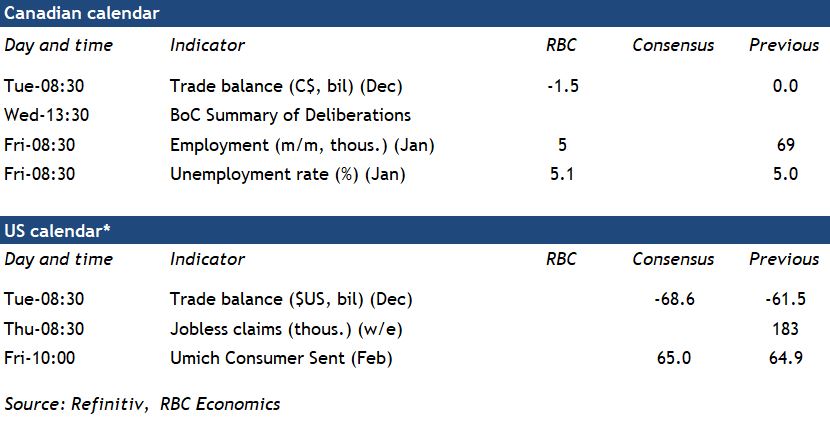
The record squeeze on Canadian labour markets is unlikely to have loosened much in January. We look for a small increase in employment (roughly 5000 workers) to add to the 176,000 surge in positions that played out over the prior four months. We also expect a tick up in the unemployment rate, to 5.1%—still just off multi-decade lows earlier in the summer.
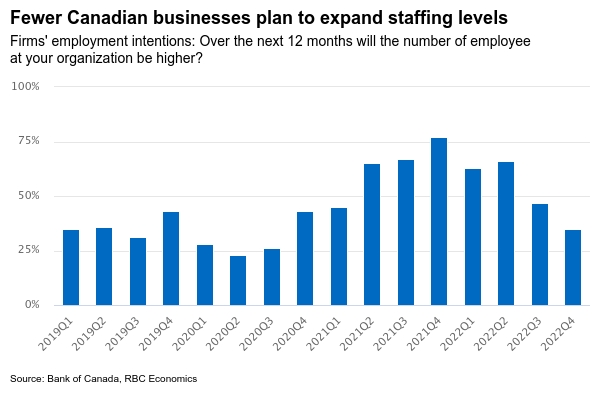
Still, there are early signs that cracks may be forming in the market. The excess of job postings relative to available labour supply has begun to edge lower. Just under 5% of available jobs were vacant as of November, down from a peak of nearly 6% earlier last year. Hours worked actually decreased in December despite strong job growth (and when demand starts to soften, businesses typically cut hours worked first, before moving to layoffs). The closely-watched Bank of Canada Business Outlook Survey showed business plans to add staff have been falling alongside a decline in expected wage growth.
The strongest headwind for labour markets is expected to stem from the 425 basis points of BoC interest rate hikes over the last year. These continue to ripple through the economy, making a particular impact on household borrowing costs. At its January meeting, the BoC said it intends to pause its current hiking cycle, and labour markets have proven substantially more resilient than expected in recent months. But higher borrowing costs—in conjunction with still elevated inflation—will erode consumer spending as debt servicing costs eat up a rising share of household purchasing power. We continue to expect those pressures to weigh on GDP and push unemployment higher this year .
Week ahead data watch
We expect the Canadian trade balance to be in deficit in December. Given that Canada is a large energy exporter, the reduction in oil prices in December (-9.2%) would result in a lower trade balance in the energy sector. A weaker Canadian dollar likely increased the price of both exports and imports.
Minutes from the Bank of Canada deliberations ahead of the January 25th policy decision will be released for the first time. The minutes will be watched for any additional details on what led the BoC to announce an expected pause in interest rate hikes after what may have been the last increase of this cycle at that meeting.
Week Ahead – Nearing the End of Rate Hikes?
Now that Wall Street has had enough time to process the dovish FOMC decision and another robust nonfarm payroll report, the focus shifts predominantly to Fed speak and economic data that should support the disinflation process. Traders will pay close attention to initial jobless claims and the University of Michigan sentiment report. Other notable economic releases include trade data, consumer credit, and the monthly budget statement.
Fed speak will resume on Tuesday as Chair Powell speaks in Washington and Barr discusses financial inclusion. Wednesday contains appearances by Williams, Cook, Barr, and Bostic. On Friday, both Waller and Harker speak at a Crypto Conference.
It will be a busy week for the White House as President Biden will deliver the State of the Union address.
Earnings season remains busy as Wall Street will get results from AbbVie, Activision Blizzard, AstraZeneca, BNP Paribas, BP, British American Tobacco, Brookfield, Brookfield Asset Management, CDW, Centene, Chipotle Mexican Grill, Credit Agricole, CVS Health, Deutsche Boerse, Equinor, Fiserv, Fortinet, Fujifilm, Gartner, Hilton Worldwide, KKR, L’Oreal, Linde, Motorola Solutions, Neste, Nintendo, PayPal Holdings, PepsiCo, Philip Morris International, Prudential Financial, S&P Global, Semiconductor Manufacturing International, Siemens, SoftBank Group, TotalEnergies, Toyota Motor, Walt Disney, Yum China, and Yum! Brands.
EU
We learned a lot this past week about the position the euro area economy is in, the ECBs perception of it, and the market’s trust in the central bank. Inflation is falling and at a decent rate but unfortunately, it’s primarily driven by energy prices reflected by the fact that core inflation remained unchanged at its highs. The ECB thinks there’s further to go on interest rates in order to deal with inflation including more super-sized rate hikes and the market is giving it the Fed treatment. Markets view the next decision on 16 March as a coin toss between 25 and 50 basis points with the peak in rates coming in July, 75-100 bps above where it now lies. Unfortunately for the ECB, central banks don’t have a good record of being right these past 18 months. Next week offers a number of data points but nothing overly significant.
The standout event next week is the monetary policy report hearing on Thursday when policymakers from the BoE will be grilled by the Treasury Select Committee. This event often isn’t overly market moving but it is an opportunity to get a more in-depth insight into how the MPC sees inflation and interest rates moving which always has the potential to do something. That aside, we have a few others BoE appearances throughout the week and GDP data on Friday.
Russia
The CBR is expected to leave the Key Rate unchanged at 7.5% when it meets on Friday, with inflation expected to fall a little further in January to 11.5%. That’s the lowest it will have been since Russia invaded Ukraine, sending markets and the ruble into a tailspin. Unemployment data will also be released on Wednesday.
South Africa
Very little of note on the economic calendar next week, with the business confidence survey on Wednesday and manufacturing production on Thursday.
Turkey
The highlights next week include labour market and industrial production data on Friday. The official inflation data for January fell to 57.7% which may soon incentivize the CBRT to start cutting rates again, a policy that would no doubt have the backing of President Erdogan who pledged to go further in recent days.
Switzerland
A relatively quiet week for Switzerland, with unemployment the only release of note on Tuesday. SNB Chairman Thomas Jordan talked up the potential for further rate hikes this past week, stating that they can’t be ruled out. Markets are currently pricing in a roughly 50/50 chance of 25 or 50 basis points next month.
China is likely to begin a more meaningful recovery after the New Year, with service consumption tending to recover strongly as life returns to normal. The PMI showed an improvement in new orders in the manufacturing, construction and especially service sectors on a year-on-year basis. Business optimism about the future has improved significantly.
The upcoming week contains January inflation data that should show a rise in pricing pressures that was supported by the lifting of the zero covid policy. Credit growth should improve as aggregate financing recovers.
India
Investors will pay close attention to both what evolves with the pressure hitting the Adani Group and the RBI rate decision. The RBI is expected to raise rates by 25bp to 6.50%, which might be the last hike in this tightening cycle.
Australia & New Zealand
China’s COVID reopening has supported both Australian and New Zealand dollars significantly. As long as investors remain convinced that China will post decent economic growth this year, the Aussie dollar and kiwi could have some underlying support.
For Australia, the economic calendar contains the release of December trade data and the RBA rate decision. The RBA is expected to deliver its last rate hike in this cycle, with a 25bp rate rise that will take the cash rate target to 3.35%. The bank might suggest that more hikes could be needed, but disinflation trends should support a hold very soon.
The New Zealand economic calendar contains the January release of ANZ Commodity prices, manufacturing PMI, card spending total, and REINZ house sales.
Japan
In Japan, traders will look to see how high labor cash earnings recovered during the bonus season. Wages might post the strongest increase in over 26 years, but the BOJ might still shrug this report off.
Investors will focus on the January PPI report which should show a gradual slowing. On a monthly basis, PPI is expected to rise 0.3%, down from the 0.5% pace in the prior month.
Singapore
It will be quiet on the data front with one release on foreign reserves.
Economic Calendar
Sunday, Feb. 5
Events
- Presidential election in Cyprus. If no candidate secures 50% of the vote, a runoff will be held a week later
- The EU ban on seaborne imports of refined oil products from Russia comes into effect, two months after the bloc banned most crude oil from Russia
Monday, Feb. 6
Economic Data/Events
- Australia inflation gauge, retail sales ex-inflation
- Eurozone retail sales
- Germany CPI, factory orders
- Indonesia GDP
- Thailand CPI
- RBA Governor Holzmann and BOE’s Mann speak at the “Lamfalussy Lectures” conference in Budapest hosted by Hungarian central bank Governor Matolcsy
- President Biden announces planned US budget for 2024
- Saudi Arabia Oil Minister to speak at India Energy Week conference
Tuesday, Feb. 7
Economic Data/Events
- US trade
- Australia foreign reserves
- China foreign reserves
- Singapore reserves
- Australia trade
- RBA rate decision: Expected to raise cash rate by 25bp to 3.35%
- France trade
- Germany industrial production
- Japan household spending, leading index
- Spain industrial production
- Fed Chair Powell interviewed by David Rubinstein at the Economic Club of Washington
- US President Joe Biden delivers the State of the Union address before Congress
- ECB’s Schnabel participates in webinar on monetary policy at times of pandemic and war
- UK Chancellor Hunt takes questions in the House of Commons
- BOE’s chief economist Pill and deputy governor Ramsden speak at UK Women in Economics Network launch event
Wednesday, Feb. 8
Economic Data/Events
- US wholesale inventories
- India rate decision: Expected to raise repurchase rate by 25bp to 6.50%
- Japan BoP
- Mexico international reserves
- Poland rate decision: Expected to keep rates on hold at 6.75%
- Russia CPI, unemployment
- Fed’s Williams is interviewed at Wall Street Journal live event in New York
- ECB Supervisory Board press conference in Frankfurt
Thursday, Feb. 9
Economic Data/Events
- US initial jobless claims
- Australia heavy traffic index
- China aggregate financing, money supply, new yuan loans
- Japan M2 money stock, machine tool orders
- Mexico rate decision: Expected to deliver one more rate hike
- Mexico CPI
- South Africa manufacturing production
- Sweden rate decision: Expected to raise rates by 50bp to 3.00%
- Thailand consumer confidence
- EU leaders summit in Brussels
- BOE Gov Bailey appears before Treasury Committee
- South African President Ramaphosa delivers the State of the Nation address
Friday, Feb. 10
Economic Data/Events
- US University of Michigan consumer sentiment
- Canada unemployment
- China PPI, CPI, BoP
- India industrial production
- Italy industrial production
- Japan PPI
- Mexico industrial production
- New Zealand PMI, card spending, house sales
- Russia rate decision: Expected to keep rates steady at 7.50%
- Thailand forward contracts, foreign reserves
- Turkey industrial production
- UK industrial production, GDP
- Fed’s Waller speaks on digital assets and Fed’s Harker delivers the keynote address at Global Interdependence Center crypto-focused conference
- RBA releases quarterly updates of economic forecasts and policy outlook
- BOE’s Pill is a panelist at the SUERF/BIS workshop on “gauging disinflation pressures”
Sovereign Rating Updates
- Denmark (S&P)
- Switzerland (S&P)
- Germany (Moody’s)
- Ukraine (Moody’s)
- Spain (DBRS)