Sample Category Title
EUR/USD Daily Outlook
Daily Pivots: (S1) 1.0745; (P) 1.0842; (R1) 1.0892; More...
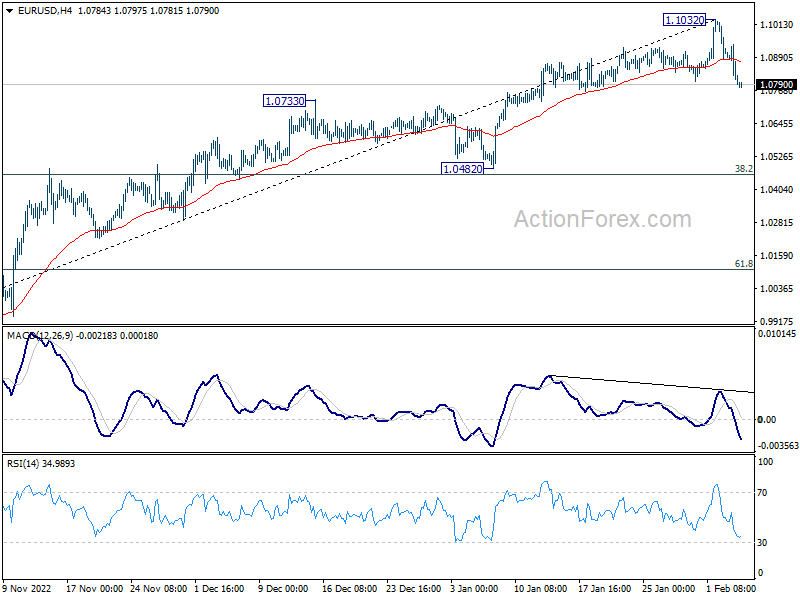
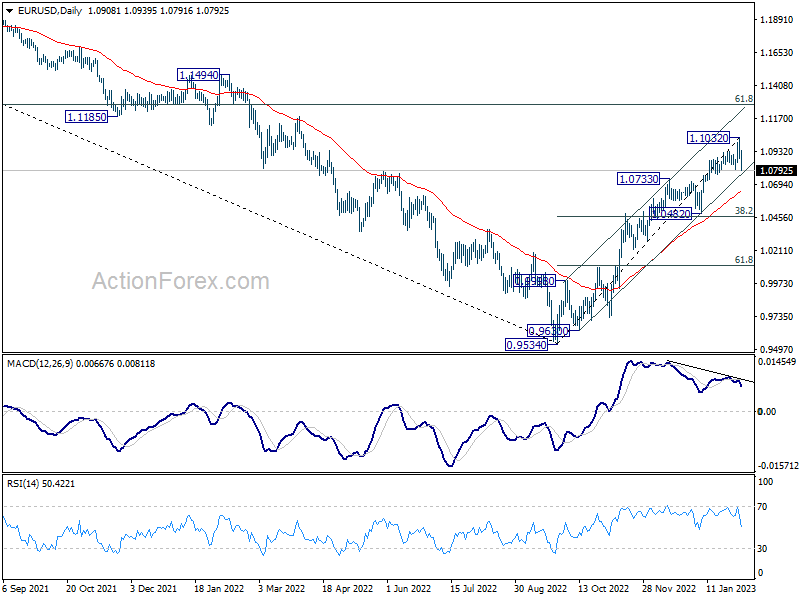
Intraday bias in EUR/USD remains on the downside at this point. Fall form 1.1032 is correcting whole rise from 0.9534, and should target 1.0482 support, which is close to 38.2% retracement of 0.9534 to 1.1032 at 1.0463. For now, risk will stay on the downside as long as 1.1032 resistance holds, in case of recovery.
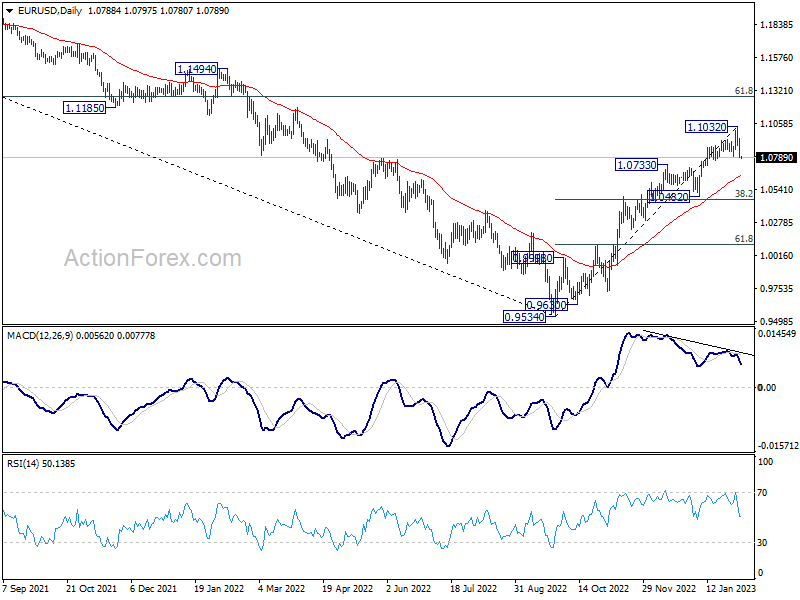
In the bigger picture, current development suggests that the rally from 0.9534 low (2022 low) is a medium term up trend rather than a correction. Further rise is in favor to 61.8% retracement of 1.2348 (2021 high) to 0.9534 at 1.1273 next. This will remain the favored case as long as 1.0482 support holds.
Yen Tumbles Broadly, Dollar Digest Gains
Yen opens the week broadly lower on rumors that current ultra-loose monetary policy would be maintained by the next BoJ governor. Meanwhile, markets are mixed elsewhere. Dollar is paring some gains after initial rally, but stays generally firm. Australian Dollar is trying to recover with other commodity currencies. Swiss Franc is slightly outperforming other European majors. The economic calendar is light today, and focuses will be on any other development surrounding the shoot-down of Chinese surveillance balloon by the US military.
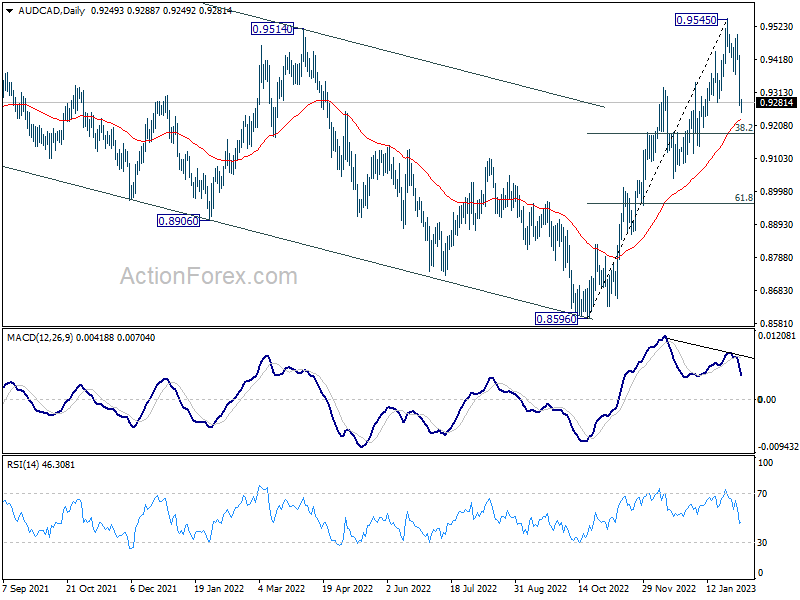
Technically, while AUD/CAD's correction from 0.9545 was deep, there is no change in the near term bullish outlook. Strong support would be seen between 55 day EMA (now at 0.9233) and 38.2% retracement of 0.8596 to 0.9545 at 0.9182 to contain downside to bring rebound, and then resumption of rise from 0.8596. But that would depend on the reactions to this week's RBA rate decision.
In Asia, at the time of writing, Nikkei is up 1.06%. Hong Kong HSI is down -2.34%. China Shanghai SSE is down -1.01%. Singapore Strait Times is up 0.15%. Japan 10-year JGB yield is up 0.0042 at 0.495.
USD/JPY extend rebound on BoJ Amamiya rumor, more upside ahead
Yen tumbles broadly today after Nikkei newspaper reported, quoting unnamed source that current BoJ Deputy Governor Masayoshi Amamiya was approached by the government to take over Governor Haruhiko's job. The news was seen as bearish for the currency, as Amamiya would likely stick with the current ultra-loose monetary policy, comparing to a hawkish alternative.
Nevertheless, Finance Minister Shunichi Suzuki told reports that he had not heard that the government offered Amamiya the job. The prime minister's office and the BOJ were also not immediately available to comment. Amamiya did not comment to reporters himself neither.
Kuroda's term will end on April 8 while his deputies Masayoshi Amamiya and Masazumi Wakatabe will have their terms expire on March 19. The final monetary policy policy meeting the three would hold together would be on March 9-10. The more concrete details of the appointments would probably come in early March by latest.
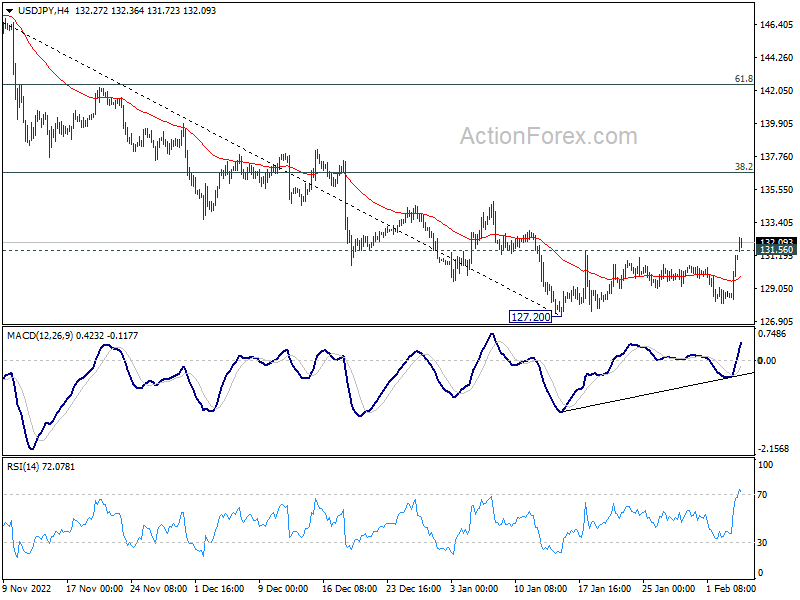
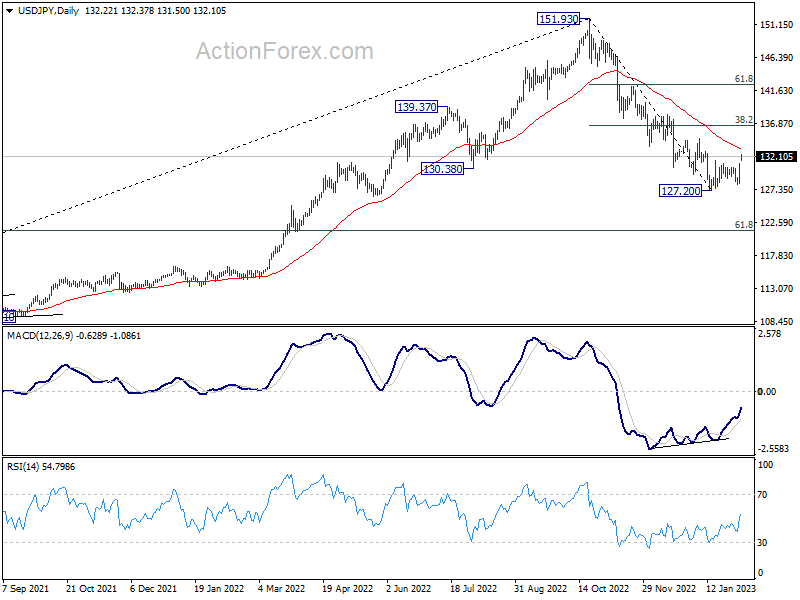
USD/JPY's break of 131.56 resistance should confirm short term bottoming at 127.20, on bullish convergence condition in daily MACD. Further rally should be seen to 55 day EMA (now at 133.28) first. Firm break there will target 38.2% retracement of 151.93 to 127.20 at 136.64, even just as a correction to the decline from 151.93.
BoJ Kuroda: Monetary easing steps a necessary approach shared by others
BoJ Governor Haruhiko Kuroda told the parliament today, "with our monetary easing steps, we sought to stimulate economic activity and tighten the labour market so that prices and wages would rise more."
"This was a necessary approach and one that is shared by other central banks," he said. There was "no better way" to aim at sustainably achieving its 2% inflation target.
Gold in pull back on strong Dollar rebound
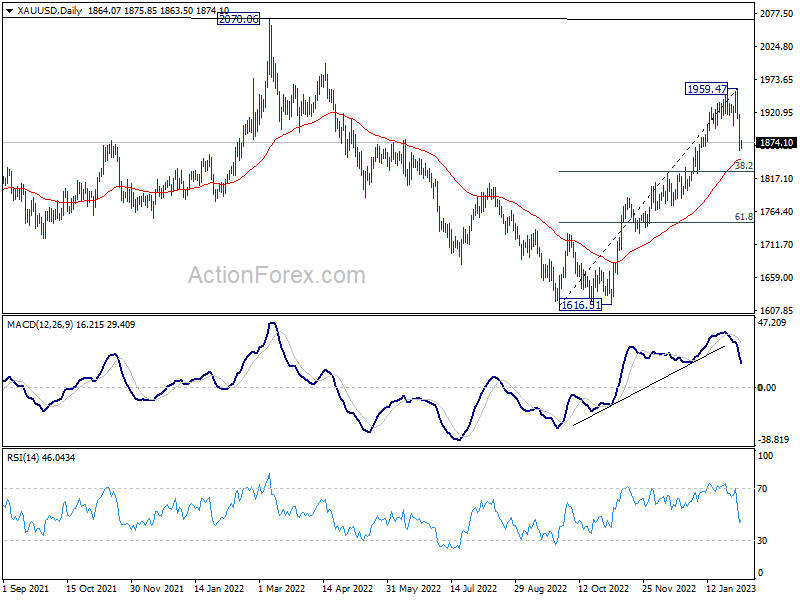
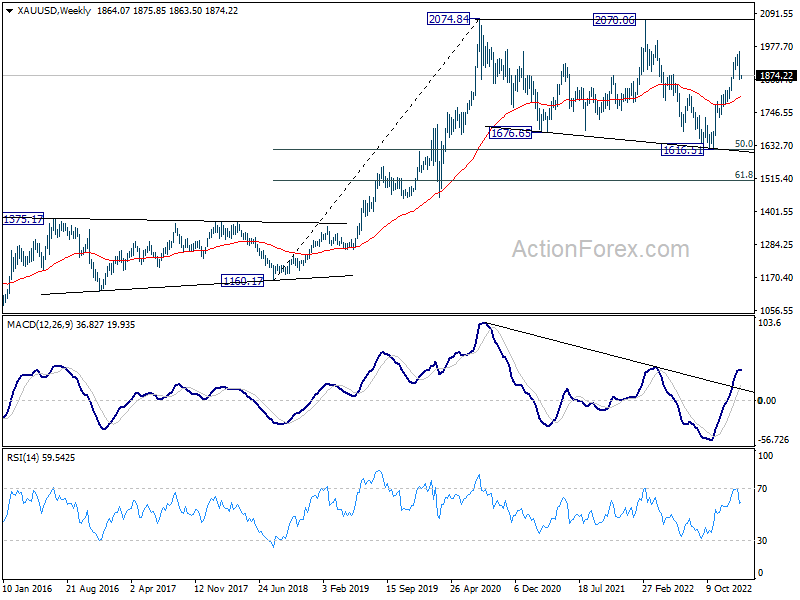
Gold declined sharply last week on the back of strong rebound in Dollar following solid US job and services data. The development indicates short term topping at 1959.47. Deep pull back is now in favor to 55 day EMA (now at 1847.23), or further to 38.2% retracement of 1616.51 to 1959.47 at 1828.45.
Still, as long as 55 week EMA (now at 1798.35) holds, the favored case is still that corrective pattern from 2074.84 has completed with three waves down to 1616.51. That is, rise from there is resuming the larger up trend and should break through 2704.84 "sooner" in medium term.
However, sustained break of the 55 week EMA will argue that corrective pattern from 2074.84 is developing into a five-wave triangle pattern, and delay upside breakout.
RBA to hike 25bps, BoE hearing also watched
RBA is widely expected to continue its tightening pace with 25bps to 3.35% this week. It's likely not the end of the current cycle yet, and thus markets will be looking for affirmation of another hike in March. While there is scope for another hike in April to bring the terminal rate to 3.85%, it's still a bit early to make the call. Instead, focus will be on RBA's assessment on the path of inflation and the risk of recession to see which side the central bank is leaning towards.
BoE monetary policy report hearing is another major central bank activity this week. Sterling was pressured last week after the "perceived" dovish BoE rate hike. There are speculations that the central bank will deliver a final 25 bps hike in March, with interest rate peaking at 4.25%. Governor Andrew Bailey's comments would be crucial in gauging market expectations.
As for the UK, much attention will also be on GDP and production data to be released on Friday. Other data to be watched include Eurozone Sentix investor confidence, Germany GPI flash, Canada employment, as well as US U of Michigan consumer sentiment. Here are some highlights for the week:
- Monday: Germany factory orders; Eurozone Sentix investor confidence, retail sales; UK construction PMI; Canada Ivey PMI.
- Tuesday: Japan average cash earnings, household spending; RBA rate decision, trade balance; Swiss unemployment rate, foreign currency reserves; Germany industrial production; France trade balance; Canada trade balance; US trade balance.
- Wednesday: Japan bank lending, current account; Italy retail sales; US wholesale inventories final.
- Thursday: UK RICS house price balance; Germany CPI flash; US jobless claims.
- Friday: New Zealand BusinessNZ manufacturing index; Japan PPI machine tool orders; China CPI, PPI; UK GDP, production, trade balance; Italy industrial production; Canada employment; US U of Michigan consumer sentiment.
EUR/USD Daily Outlook
Daily Pivots: (S1) 1.0745; (P) 1.0842; (R1) 1.0892; More...
Intraday bias in EUR/USD remains on the downside at this point. Fall form 1.1032 is correcting whole rise from 0.9534, and should target 1.0482 support, which is close to 38.2% retracement of 0.9534 to 1.1032 at 1.0463. For now, risk will stay on the downside as long as 1.1032 resistance holds, in case of recovery.
In the bigger picture, current development suggests that the rally from 0.9534 low (2022 low) is a medium term up trend rather than a correction. Further rise is in favor to 61.8% retracement of 1.2348 (2021 high) to 0.9534 at 1.1273 next. This will remain the favored case as long as 1.0482 support holds.
Economic Indicators Update
| GMT | Ccy | Events | Actual | Forecast | Previous | Revised |
|---|---|---|---|---|---|---|
| 00:00 | AUD | TD Securities Inflation M/M Jan | 0.90% | 0.20% | ||
| 07:00 | EUR | Germany Factory Orders M/M Dec | 2.00% | -5.30% | ||
| 09:30 | EUR | Eurozone Sentix Investor Confidence Feb | -11.8 | -17.5 | ||
| 09:30 | GBP | Construction PMI Jan | 49.5 | 48.8 | ||
| 10:00 | EUR | Eurozone Retail Sales M/M Jan | -2.50% | 0.80% | ||
| 15:00 | CAD | Ivey PMI Jan | 42.3 | 33.4 |
BoJ Kuroda: Monetary easing steps a necessary approach shared by others
BoJ Governor Haruhiko Kuroda told the parliament today, "with our monetary easing steps, we sought to stimulate economic activity and tighten the labour market so that prices and wages would rise more."
"This was a necessary approach and one that is shared by other central banks," he said. There was "no better way" to aim at sustainably achieving its 2% inflation target.
Gold in pull back on strong Dollar rebound
Gold declined sharply last week on the back of strong rebound in Dollar following solid US job and services data. The development indicates short term topping at 1959.47. Deep pull back is now in favor to 55 day EMA (now at 1847.23), or further to 38.2% retracement of 1616.51 to 1959.47 at 1828.45.
Still, as long as 55 week EMA (now at 1798.35) holds, the favored case is still that corrective pattern from 2074.84 has completed with three waves down to 1616.51. That is, rise from there is resuming the larger up trend and should break through 2704.84 "sooner" in medium term.
However, sustained break of the 55 week EMA will argue that corrective pattern from 2074.84 is developing into a five-wave triangle pattern, and delay upside breakout.
EUR/USD Corrects Lower As Dollar Gains Heavily
Key Highlights
- EUR/USD started a downside correction from the 1.1040 zone.
- It traded below a key bullish trend line at 1.0880 on the 4-hours chart.
- Gold price declined heavily below the $1,920 support zone.
- Crude oil price is moving lower towards the $72 support zone.
EUR/USD Technical Analysis
The Euro attempted a decent increase above the 1.1000 resistance against the US Dollar. However, EUR/USD struggled to clear 1.1040 and started a downside correction.
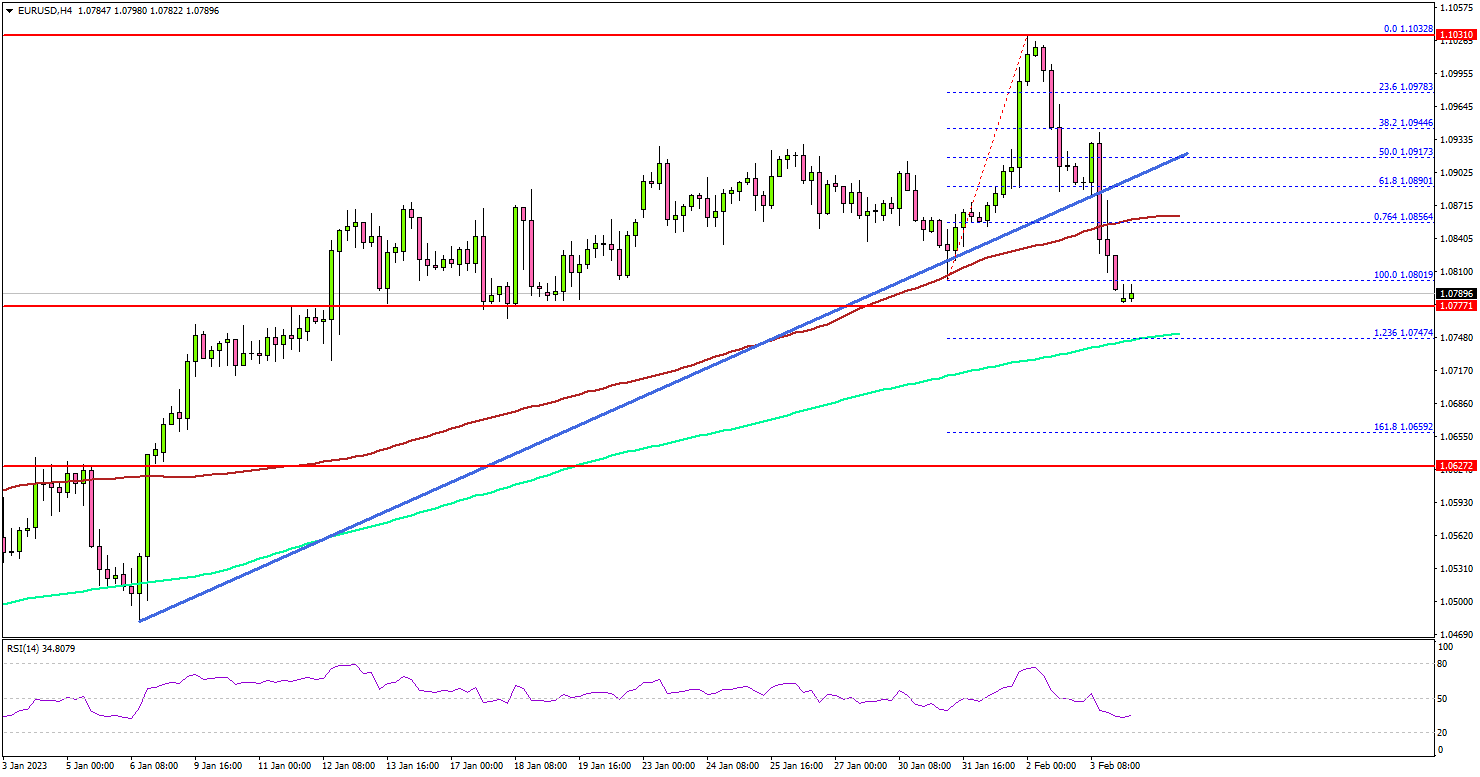
Looking at the 4-hours chart, the pair declined below the 1.1000 and 1.0950 support levels. There was break below a key bullish trend line at 1.0880. The pair even declined below the 61.8% Fib retracement level of the upward move from the 1.0801 swing low to 1.1032 high.
The pair settled below the 1.0850 level and the 100 simple moving average (red, 4-hours). It is now trading near the 1.0780 support zone.
The next major support is near the 1.0750 level and the 200 simple moving average (green, 4-hours). If there is a downside break, the pair could decline towards the 1.0680 level.
On the upside, the pair is facing resistance near 1.0850 and the 100 simple moving average (red, 4-hours). The first major resistance is near the 1.0880 level. A clear move above the 1.0880 resistance might start a steady increase towards the 1.0950 resistance zone.
Any more gains could open the doors for a move towards the 1.1000 level. The next key hurdle is near 1.1040, above which the pair could climb towards the 1.1200 resistance zone.
Looking at gold price, there was a strong bearish reaction after the bears pushed the price below the $1,900 support zone.
Economic Releases
- Euro Zone Retail Sales for Jan 2023 (YoY) - Forecast -2.7%, versus -2.8% previous.
- Euro Zone Retail Sales for Jan 2023 (MoM) - Forecast -2.5%, versus +0.8% previous.
USD/JPY extend rebound on BoJ Amamiya rumor, more upside ahead
Yen tumbles broadly today after Nikkei newspaper reported, quoting unnamed source that current BoJ Deputy Governor Masayoshi Amamiya was approached by the government to take over Governor Haruhiko's job. The news was seen as bearish for the currency, as Amamiya would likely stick with the current ultra-loose monetary policy, comparing to a hawkish alternative.
Nevertheless, Finance Minister Shunichi Suzuki told reports that he had not heard that the government offered Amamiya the job. The prime minister's office and the BOJ were also not immediately available to comment. Amamiya did not comment to reporters himself neither.
Kuroda's term will end on April 8 while his deputies Masayoshi Amamiya and Masazumi Wakatabe will have their terms expire on March 19. The final monetary policy policy meeting the three would hold together would be on March 9-10. The more concrete details of the appointments would probably come in early March by latest.
USD/JPY's break of 131.56 resistance should confirm short term bottoming at 127.20, on bullish convergence condition in daily MACD. Further rally should be seen to 55 day EMA (now at 133.28) first. Firm break there will target 38.2% retracement of 151.93 to 127.20 at 136.64, even just as a correction to the decline from 151.93.
Forex and Cryptocurrency Forecast
EUR/USD: Three Weeks of Uncertainty
The meetings of the Central Banks were held strictly according to plan last week. As expected, the key rate was raised by 25 bps (basis points) at the US Federal Reserve meeting and reached 4.75%, and by 50 bps at the European Central Bank meeting, up to 3.00%. Since the decisions themselves did not bring surprises, market participants focused on the regulators' plans for the future.
The next meeting of the FOMC (Federal Open Market Committee) of the US Federal Reserve will not be held soon: on March 22, that is, in almost two months. Markets are likely to expect that it will announce another rate hike by 25 bps to 5.00%, after which it will hold it at this level.
The DXY Dollar Index fell to a new 9-month low of 100.80 on Thursday, February 02. This happened after the Federal Reserve made it clear that the end of the wave of rate hikes was near. Statistics show that the regulator's efforts to solve economic problems are yielding results: the inflation rate was 9.1% (the highest figure in 40 years) in June, and it fell to 6.5% in December. This makes it possible to put the brake on quantitative tightening (QT). Investors understood the dovish hints of the head of the Fed, Jerome Powell, who, during the press conference following the meeting, admitted for the first time that "the deflationary process has begun." He also assumed that the peak rate would not exceed 5.00% and reiterated that the US Central Bank can achieve a slowdown in inflation without causing significant damage to the economy.
As for the Eurozone, inflation, as shown by data for January, has been falling for the third month in a row. But the basic price increase remains at the same level, despite the fall in energy prices. According to forecasts, inflation in the Eurozone is expected to reach 5.9% in 2023, to fall to 2.7% in 2024, and to fall even lower to 2.1% in 2025. Unemployment growth is also projected to decline further, while GDP growth expectations remain at the same level. According to preliminary data published on Wednesday, February 01, the growth of the European economy will be 1.9% in 2022, which is lower than the previous value (2.3%), but higher than the forecast (1.8%).
Following the last meeting, ECB President Christine Lagarde said that the risks to both economic growth and inflation in the Eurozone have become more balanced. And that the ECB will assess economic development after the next rate hike in March. (It is also expected to be 50 bps). When asked about the possibility of further rate hikes after March 16, Ms Lagarde refrained from making any commitments. This put downward pressure on the euro, and EUR/USD turned around and went down without rising above 1.1031.
The dollar received an additional boost of strength after the publication of impressive data from the US labor market on Friday, February 03. Data released by the Bureau of Labor Statistics (BLS) showed that the country's unemployment rate, instead of the expected increase to 3.6%, fell from 3.5% to 3.4%, and the number of jobs created outside the agricultural sector (NFP) in January increased by 517K, which is 2.8 times higher than the 185K forecast, and almost twice higher than December's 260K growth.
As a result, EUR/USD finished at 1.0794. Recall that it ended the week at 1.0833 on Friday, January 13, at 1.0855 on January 20, and at 1.0875 on January 27. This proximity of all these values (within 100 points) suggests that the market has not received clear signals about where it should aim in the foreseeable future. Although, at the time of writing the review (Friday evening, February 03), the US currency has a certain advantage.
Economists at Singapore's financial UOB Group suggest that the euro is not yet ready to move towards the resistance of 1.1120, and the pair may trade in the range of 1.0820-1.1020 for the next 1-3 weeks. As for the median forecast, 45% of analysts expect further strengthening of the euro, the same number (45%) expect the dollar to strengthen, and the remaining 10% have taken a neutral position. The picture is different among the indicators on D1. 35% of the oscillators are colored red (one third of them are in the oversold zone), 25% are looking up and 40% are colored gray neutral. As for trend indicators, 50% recommend buying, 50% selling. The nearest support for the pair is in the zone 1.0740-1.0775, then there are levels and zones, 1.0700-1.0710, 1.0620-1.0680, 1.0560 and 1.0480-1.0500. The bulls will meet resistance at the levels of 1.0800, 1.0835-1.0850, 1.0895-1.0925, 1.0985-1.1030, 1.1120, after which they will try to gain a foothold in the 1.1260-1.1360 echelon.
Next week's calendar may mark Monday February 06, when preliminary data on consumer prices in Germany and final data on January retail sales in the Eurozone will be published. Fed Chairman Jerome Powell is expected to speak on Tuesday. The final data on inflation (CPI) in Germany and unemployment in the US will arrive on Thursday, February 09. And the value of the Consumer Confidence Index from the University of Michigan USA will be known on Friday, February 10.
GBP/USD: Riddles from BoE
The famous London fog continues to haze the monetary policy of the Bank of England (BoE). Like the ECB, this regulator raised the key rate by 50 bp. to 4.00% on Thursday, February 02, but at the same time it softened its message noticeably. This pushed the British currency back from its highs since mid-June 2022. values (1.2450) down, to the level of 1.2100. At the week's low, after the publication of the US NFP, the GBP/USD pair traded even lower at 1.2046, and ended the five-day period almost there, at 1.2050.
As already mentioned, the future of the UK's finances is vague and uncertain. We have tried to make sense of what the chief economist said BoE Hugh Pill, giving an interview for Times Radio on Friday February 03. Here are just a few quotes. "We must admit that we have already achieved a lot" - "There are many more steps in the pipeline." "A number of news stories have improved recently" - "We must be prepared for shocks." "We have a fairly high degree of confidence that inflation will fall this year" - "The focus is on whether inflation will fall further." And like the icing on the cake, Hugh Pill's remark that it's important for the Bank of England not to do "too much" in monetary policy.
To be honest, we were unable to determine from this statement where the line between "little", "much" and "too much" is drawn. Therefore, here is the opinion of Commerzbank strategists. "It has become clear that the Bank of England is nearing the end of its rate hike cycle," they conclude. And they continue: "While the Bank of England has left the door open for further rate hikes, a more assertive approach would be desirable from a currency market perspective due to high uncertainty. Against this background, it is not surprising that the sterling has weakened, and its further decline seems likely to us."
This point of view of Commerzbank economists has been supported by 55% of analysts, who also "thought probable" a further fall in GBP/USD. The opposite view is held by 45% of experts. Among the trend indicators on D1, the balance of power is 75% to 25% in favor of the reds. Among the oscillators, the reds win as well: their advantage is 85% versus 15%. However, among the reds, 20% signals that the pair is oversold. Support levels and zones for the pair are 1.2025, 1.1960, 1.1900, 1.1800-1.1840. When the pair moves north, it will face resistance at the levels 1.2085, 1.2145, 1.2185-1.2210, 1.2270, 1.2335, 1.2390-1.2400, 1.2430-1.2450, 1.2510, 1.2575-1.2610, 1.2700, 1.2750 and 1.2940.
Among the developments regarding the UK economy in the coming week, Friday 10 February will attract attention with the release of UK GDP data for the past 2022. It is expected that, despite some growth in Q4 (from -0.3% to 0.0%), the annual rate will show a drop from 1.9% to 0.4%.
USD/JPY: Non-Farm Payrolls Knocks the Yen Down
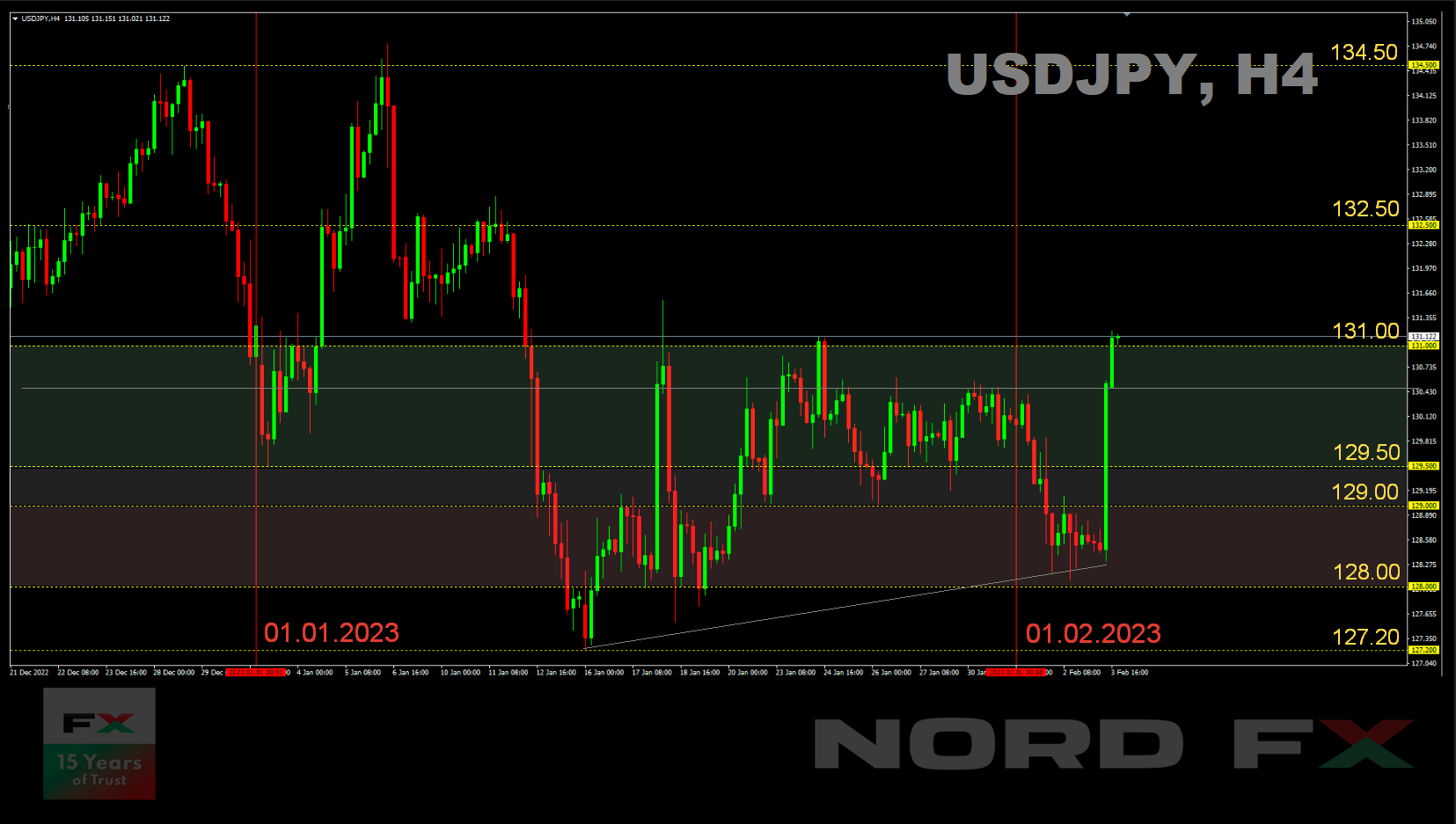
In general, the Japanese yen moved in the same way as its counterparts against the dollar last week, the euro and the British pound. However, its volatility was practically not affected by the decisions of the ECB and the Bank of England. In this case, the determining factor was the difference between interest rates on the dollar (+4.75%) and the yen (-0.1%). As a result, having found a local bottom at 128.08, USD/JPY moved sideways after the Fed meeting, and data from the US labor market (NFP) sent it on a space flight on Friday, with a length of almost 300 points, to the height of 131.18. The flight of investors from the dollar to the safe haven of Japan has stopped, and they have again decided to choose the American currency as a safe haven. USD/JPY set the last chord of the week at the level of 131.12.
Markets will now wait for March 10 for the current Bank of Japan (BoJ) Governor Haruhiko Kuroda to hold his last meeting. His powers will end on April 8, and the meeting of the BoJ on April 28 will be held by the new head of the Central Bank. It is with this event that the markets associate a possible change in the monetary policy of the regulator. Although, until that moment, interventions from the BoJ, similar to those that the regulator undertook in October-November 2022, cannot be ruled out to stop the fall of the national currency.
So far, analysts' forecasts do not provide any clear guidelines: 40% of them side with the bulls, 40% with the bears, and 20% have decided not to make predictions at all.
Among the oscillators on D1, 75% point north (15% are in the oversold zone), 15% look south and 10% look east. For trend indicators, 50% look north, exactly the same number in the opposite direction. The nearest support level is located at -130.85 zone, followed by the levels and zones of 130.50, 129.70-130.00, 128.90-129.00, 128.50, 127.75-128.10, 127.00-127.25 and 125.00. Levels and resistance zones are 131.25, 131.65, 132.00, 132.80, 133.60, 134.40 and then 137.50.
No important events regarding the Japanese economy are expected this week.
CRYPTOCURRENCIES: BTC Has Become a Risk Protective Asset
The past week proved once again that the top cryptocurrencies, and primarily bitcoin, have long ceased to be independent. Their quotes, as well as risky assets in general, are firmly tied to the decisions of the US Federal Reserve: the US dollar is on the opposite side of the scale in BTC/USD. If it weakens, bitcoin gets heavier, and vice versa. Of course, decisions by other regulators, such as the ECB or the People's Bank of China, also influence the price of virtual assets, and internal crises such as the FTX collapse may also shake it up. But the Fed is still the main trend creator of BTC/USD.
Bitcoin is still an amazing asset. It managed, as they say, to sit on two chairs last year. On the one hand, its correlation with the stock market and stock indices S&P500, Dow Jones and Nasdaq allows it to be classified as a risky asset. But on the other hand, analysts at the crypto media site CryptoSlate draw attention to the correlation of cryptocurrency with... gold, which has been considered insurance against inflation and other financial risks since ancient times. The coincidence in movement between the two assets has reached, according to CryptoSlate, an absolute maximum, 83% since February 2022. It turns out that bitcoin is both a risky and protective asset at the same time. As they say, a friend among strangers and a stranger among friends.
According to Goldman Sachs economists, even after adjusting for risk, bitcoin has already significantly outperformed gold, stock markets and the real estate sector in terms of profitability and continues to do so. The main cryptocurrency is now showing its best start to the year since January 2013. Its rate rose by 51% then, the growth was 40% last month. It happened against the backdrop of the weakness of the US dollar. "At the same time, 85% of the contribution to the rally is associated with investors from the United States," says Markus Thielen, head of research at crypto services provider Matrixport. The bullish stance of US companies is also confirmed by the renewed premium in bitcoin futures listed on the Chicago Mercantile Exchange. Open interest in BTC futures on the Chicago Mercantile Exchange (CME) is significantly outperforming the price, with a 77% month-on-month rise to $2.3 billion. "We interpret this as a sign that faster institutional traders and hedge funds are actively buying back the recent fall in the cryptocurrency markets," Thielen said.
Deutsche Digital Assets made a similar observation earlier, on January 20, drawing attention to the increase in Coinbase's premium as evidence of increased buying interest from sophisticated US institutional investors.
A survey by financial advisory firm deVere Group showed that despite the challenges of 2022, 82% of millionaires were considering investing in digital assets. 8 out of 10 surveyed clients of the company, with assets to invest from $1.2 to $6.1 million, turned to financial advisers for cryptocurrency advice.
Nigel Green, CEO and Founder of the deVere Group, believes that while the group surveyed is "generally more conservative," its interest stems from the core values of bitcoin: "digital, global, borderless, decentralized, and secure from unauthorized access". Green also notes a growing interest in crypto services from older financial institutions such as Fidelity, BlackRock and JPMorgan, and considers this a good sign for the industry. He predicts that the momentum of interest will build as the "crypto winter" of 2022 thaws due to changing conditions in the traditional financial system. (For reference, a June 2022 Pricewaterhouse-Coopers report showed that roughly a third of the 89 traditional hedge funds surveyed had already invested in digital assets.)
Similar results were obtained by analysts from Pureprofile. Their study involved 200 institutional investors and asset managers from the US, the EU, Singapore, the UAE and Brazil. The total amount of funds managed by respondents was $2.85 trillion. Nine out of ten investors in the survey were in favor of the growth of the flagship cryptocurrency in 2023, and 23% believe that the value of BTC will exceed $30,000 by the end of the year. In the longer term, 65% of respondents agree that the coin will break the $100,000 mark.
Not only whales, but also smaller investors remain optimistic, despite the dramatic events of the last year. According to statistics, the total number of digital wallets with a balance of $1,000 or more in bitcoin or ethereum increased by 27% in 2022. According to the survey, more than 88% of Binance crypto exchange customers plan to continue investing in cryptocurrencies, and only 3.3% do not consider this possibility. Bitcoin is still the dominant asset, owned by 21.7% of those surveyed.
Over 40% of respondents bought digital assets last year for investment purposes. Other motives were the decline in the value of bitcoin and the general bearish trend. Almost 8% cited the geopolitical situation in the world as a reason for the purchase, and 11.5% expressed distrust of the traditional financial system. 40.8% do not use traditional investment opportunities (buying shares, investing in real estate, mutual funds), while 32.4% do use them. At the same time, 79.7% are sure that cryptocurrencies are necessary for the development of the global economy, and 59.4% of respondents believe that deposits in cryptocurrencies will be able to replace bank deposits over time.
Galaxy Digital Holdings Ltd founder billionaire Mike Novogratz, having weathered a challenging 2022, is now committed to long-term investment in bitcoin mining with a $65 million acquisition of a Helios mining facility in Texas, USA. And according to estimates by a popular analyst aka Plan B, known for his "Stock-to-Flow" model, the price of bitcoin will reach $1 million by 2025, which will more than recoup Mike Novogratz's costs. As for this year, Plan B expects it to rise above $100,000. The analyst also said that the January bitcoin pump confirms that the asset's 4-year cyclical price bottom is over.
According to historical observations by Matrixport experts, while January bitcoin quotes were in the "green" zone on the chart (and they were there), the price rally usually continued in the following months of the year. Based on this, they predict that the flagship cryptocurrency could reach $45,000 by Christmas 2023.
And the well-known cryptocurrency trader Peter Brand considers the bulls' joy a little premature and sticks to the bearish forecast for the near future. As the expert noted, many traders and investors are now waiting for a certain pullback in order to enter the market at better prices. The specialist believes that the flagship of the crypto market may reach the level of $25,000 in the near future, after which there will be a correction closer to $19,000. However, in the medium term, Brand is still optimistic and predicts bitcoin to rise to $65,000 in the middle of this year.
Crypto analyst Benjamin Cowen, who said that bitcoin has a "long year" ahead of time, also warns against premature glee. According to the expert, it may appear that BTC has significant strength, while in fact the asset is likely to be in the process of forming a wide sideways range as a base. Cowen explained that sideways movement is not always an indicator of the growth of the first cryptocurrency and may also signal a fall in quotes.
The analyst reminded traders that a bearish cycle is usually followed by a year of sideways movement. Thus, there were three upward impulses in 2015, and only the last one turned into a real rally. There were also periods of growth in quotes in 2019, then their active fall followed, and a cycle that brought the crypto market to new highs started only after that. Cowen noted that 2023 can be seen as a year of accumulation and that investors can take advantage of this period to increase their holdings of BTC. In addition, he believes that the US Federal Reserve should ease monetary policy for cryptocurrency prices to grow. (The last meeting of the regulator gives hope for this).
At the time of writing this review (Friday evening, February 03), BTC/USD is trading in the $23,400 zone. The total capitalization of the crypto market is $1.082 trillion ($1.060 trillion a week ago). The Crypto Fear & Greed Index, a metric showing the general attitude of the community towards bitcoin, entered the Greed zone for the first time since March 30, 2022, reaching 60 points (55 a week ago). It is clear that this is due to the growth of the coin rate in the first month of the year and the general revival of the market. It is worth noting, however, that the increased confidence among crypto investors should not be directly viewed as a catalyst for the resumption of bullish growth in the bitcoin price. In fact, a Fear or Extreme Fear metric could indicate a good buying opportunity, and too high a Greed reading could mean the market is headed for a downward correction.
And at the end of the review, our half-joking column of crypto life hacks. This time we want to draw the attention of BTC holders to Nigeria. It turns out that this is where you could earn. News releases say that the price of bitcoin on the popular NairaEX exchange in this country, in terms of local currency, jumped to almost $40,000, which is about 70% higher than the global market quotes. As it turned out, the discrepancy is due to the limit imposed by the Central Bank of Nigeria on withdrawing funds from ATMs. So, ladies and gentlemen, do not forget about arbitrage deals, they can also bring good profits. The main thing is to know what, where, when and at what price to buy and then sell.
EUR/USD Weekly Outlook
EUR/USD rose to 1.1032 last week but retreated since then. The breach of 1.0800 minor support argues that a short term top was already formed, on bearish divergence condition in 4 hour MACD. Initial bias is back on the downside for 1.0482 support, which is close to 38.2% retracement of 0.9534 to 1.1032. For now, risk will stay on the downside as long as 1.1032 resistance holds, in case of recovery.
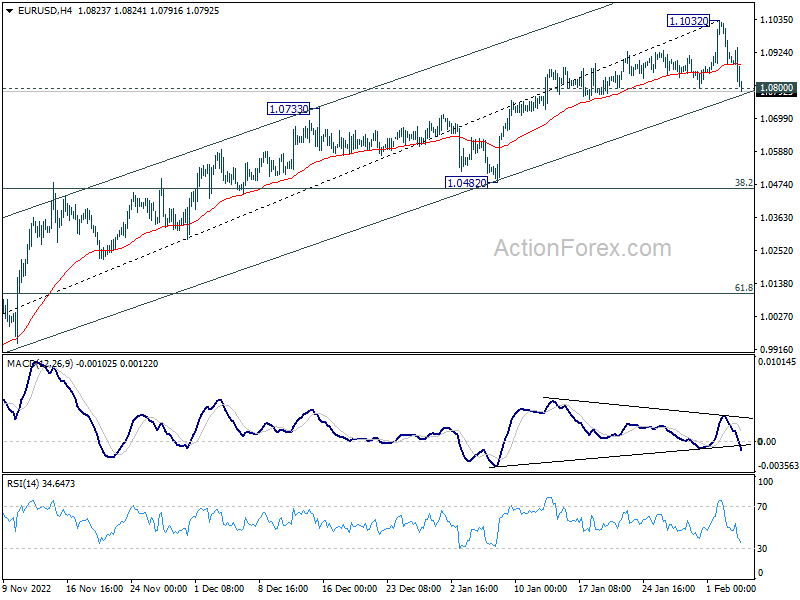
In the bigger picture, current development suggests that the rally from 0.9534 low (2022 low) is a medium term up trend rather than a correction. Further rise is in favor to 61.8% retracement of 1.2348 (2021 high) to 0.9534 at 1.1273 next. This will remain the favored case as long as 1.0482 support holds.
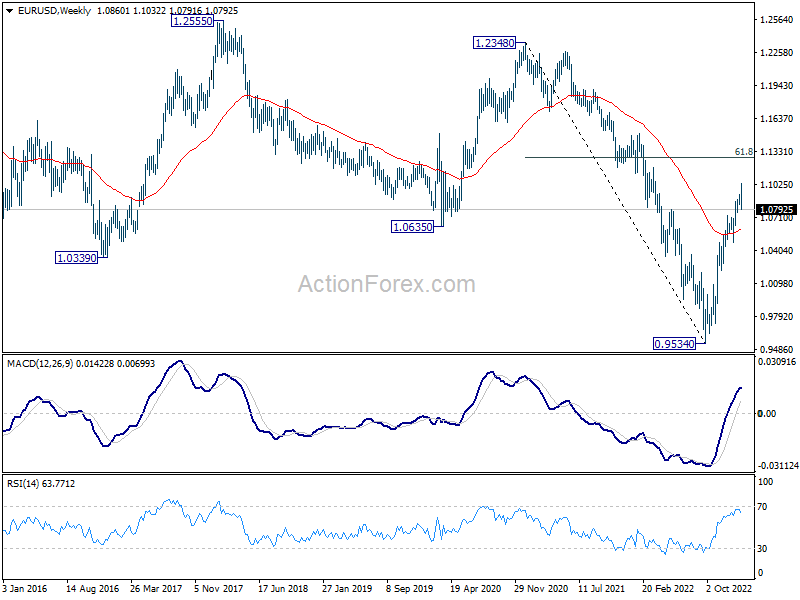
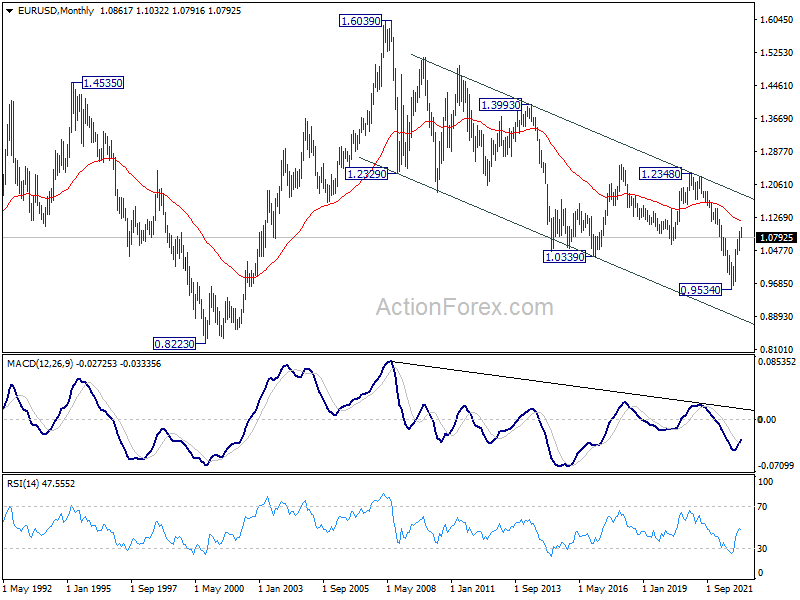
In the long term picture, while it’s too early to call for long term trend reversal at this point, the strong break of 1.0635 support turned resistance (2020 low) should at least turn outlook neutral. Focus will turn to 55 month EMA (now at 1.1207). Rejection by this EMA will revive long term bearishness.
USD/JPY Weekly Outlook
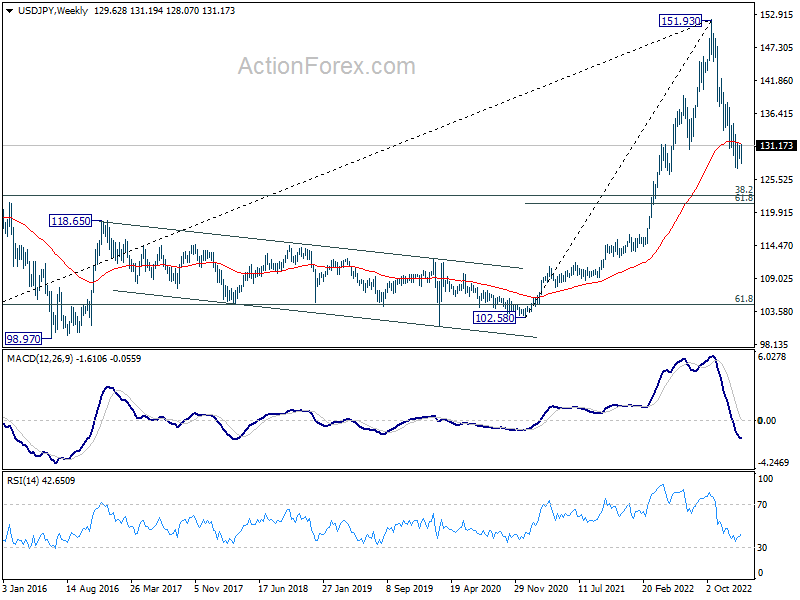
USD/JPY extended the sideway trading from 127.20 last week and outlook is unchanged. Initial bias stays neutral this week first. On the upside, break of 131.56 resistance should confirm short term bottoming, and turn bias back to the upside for stronger rebound to 55 day EMA (now at 133.32) and possibly above. On the downside, break of 127.20 will resume the whole decline from 151.93 and target 121.43 fibonacci level.
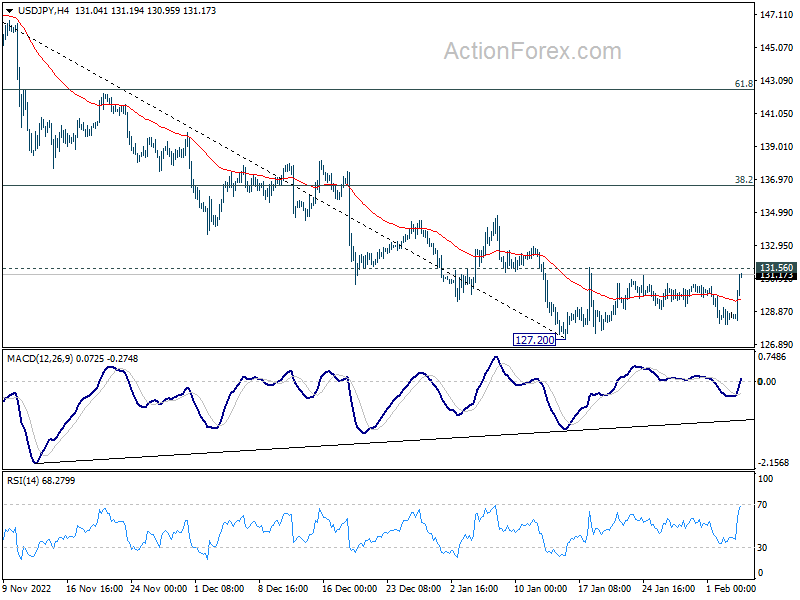
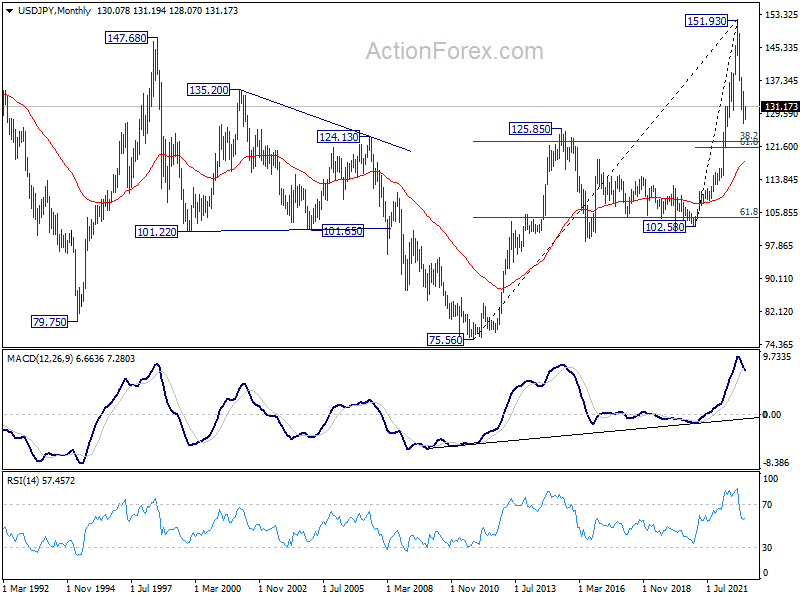
In the bigger picture, the prior of 55 week EMA (now at 131.39) raises the chance of medium term bearish reversal, but that’s not confirmed yet. Strong support could be seen around 61.8% retracement of 102.58 to 151.93 at 121.43 and 38.2% retracement of 75.56 to 151.93 at 122.75 to bring rebound. But break of 131.56 resistance is needed to indicate bottoming first. Otherwise further fall will remain in favor.
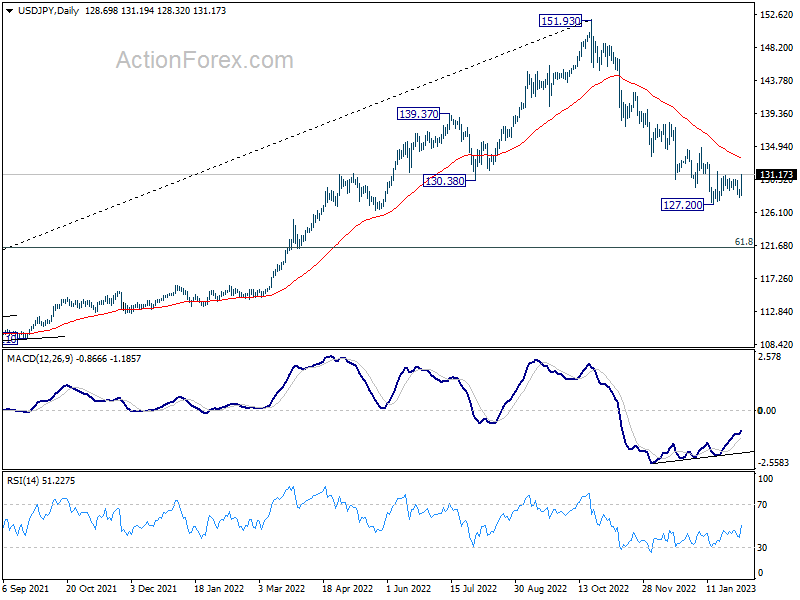
In the long term picture, 151.93 looks increasingly likely a major top. But it’s too early to call for long term bearish reversal at this point. Rebound from around 38.2% retracement of 75.56 to 151.93 at 122.75 will keep the case open for price action from 151.93 to be just a corrective pattern.