Sample Category Title
RBA to Hike after Worrying Signs for Economy
It had seemed that the RBA was almost done with the rate hikes, as several indicators for the economy were looking shaky. Rising unemployment was cited often. Another factor is that a large number of home loans are due for renewal in a few months, which could put increased pressure on Australian homeowners. If higher interest rates persist, or they go up higher, it could substantially increase the mortgage cost for Australians.
Then Q4 CPI figures dropped, showing a surprise increase in prices. This changed the calculus for the central bank, and shifted expectations to be in favor of a rate hike at the next meeting. The RBA didn't have any policy decisions in January, as usual, which means it's a bit behind compared to all the other major central banks which hiked last week.
What are the expectations?
The latest survey shows that the overwhelming majority of economists are forecasting a 25bps hike when the RBA meets on Tuesday (or late Monday, depending where you are in the world). The same economists also expect another quarter point hike at the meeting after, and that the RBA will signal that in the monetary policy statement.
Interestingly, Australian economists aren't as certain as the international ones. A survey of just Australian economists agreed that a 25bps hike is the most likely outcome of the next meeting. But there is considerable disagreement on whether the RBA will signal that another rate hike is coming. The option is that Lowe takes a page out of other central banks' playbook, and emphasizes that the next rate decision will be "data dependent".
Australian schedules are different
That runs the risk of being interpreted as dovish, however. That's because Australia publishes inflation on a quarterly basis, so new inflation data won't become available between the next two meetings. What will become available are further data points that could point to a weakening economy, such as jobs numbers and retails sales. If the RBA goes "data dependent", then scheduling will imply a trove of data pointing to another rate hike not being advisable.
It should also be noted that before the interest rate decision is the release of Australia's trade balance, which is expected to report a significant fall in the trade surplus. Of course this coincides with the period ahead of the lunar new year, in which Chinese firms slow down buying ahead of idling production for a full week. Australia and China have been jointly communicating improved relations, including the potential resumption of coal exports.
Evolution of the AUD/USD
The covid situation in China has naturally affected Australia, and the weakening Aussie from lower exports is seen as having contributed to higher inflation. If Chinese demand ramps up in the coming months, the currency could continue to appreciate. That might help the RBA control inflation, and make further rate hikes not as necessary. That might explain some of the discrepancy between Australian and international economists.
EUR/USD pair moved into a short-term bearish zone below 1.1000
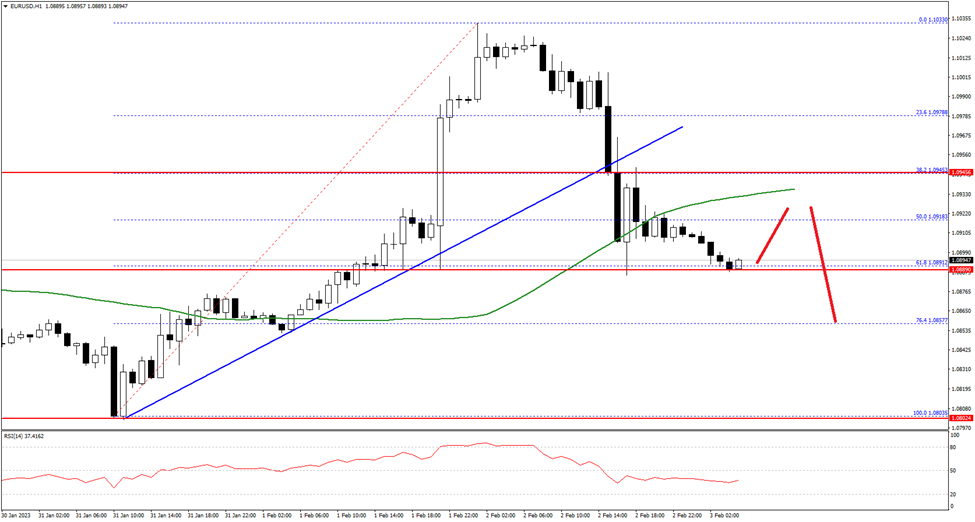
The Euro started a downside correction from the 1.1035 zone against the US Dollar. The EUR/USD pair traded below the 1.1000 level to move into a short-term bearish zone.
The pair even traded below the 1.0980 level and the 50 hourly simple moving average. The bears pushed the pair below a connecting bullish trend line with support at 1.0945 on the hourly chart. An immediate resistance is near the 1.0950 level.
The first major resistance is near 1.0980 on FXOpen. A break above the 1.0980 resistance level could start another increase. In the stated case, it could rise towards the 1.1035 resistance.
Conversely, the pair might continue to move down below 1.0890. The next key support is near 1.0855, below the pair could drop towards the 1.0820 level. Any more losses might send the pair towards the 1.0800 level in the near term.
Eurozone PMI services finalized at 50.8 in Jan, remains too early to completely disregard recession risks
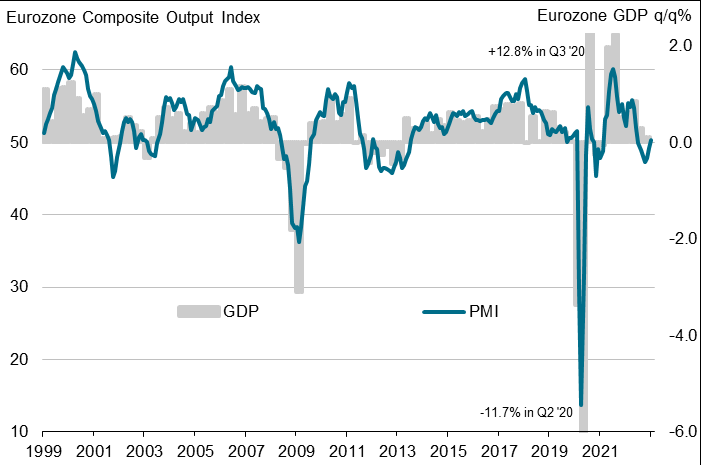
Eurozone PMI Services was finalized at 50.8 in January, up from December's 49.8, hitting a 6-month high. PMI Composite was finalized at 50.3, up from prior month's 49.3, a 7-month high.
Looking at some member states, Ireland PMI Composite rose to 3-month high at 52.0. Spain rose to 6-month high at 51.6. Italy rose to 7-month high at 51.2. Germany rose to 7-month high at 49.9. France was unchanged at 49.1.
Chris Williamson, Chief Business Economist at S&P Global Market Intelligence said:
“A resumption of business output growth, even marginal, is welcome news and suggests that the eurozone could escape a recession.... However, it remains too early to completely disregard recession risks.
"In particular, the impact of higher interest rates on economic growth has yet to be fully felt, and many companies are relying on backlogs of previously placed orders, accumulated during the pandemic, to sustain growth."
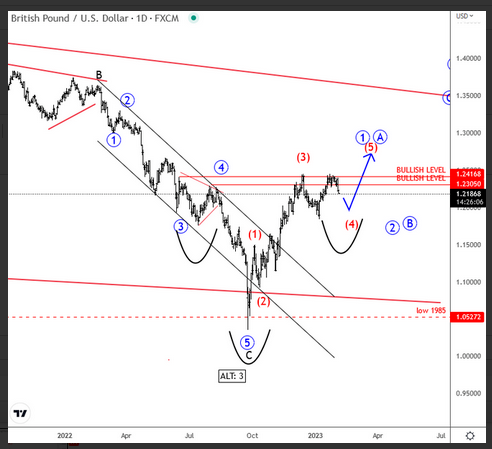
Elliott Waves Suggest More Upside on GBP/USD after a Drop to 1.18-1.2 Area
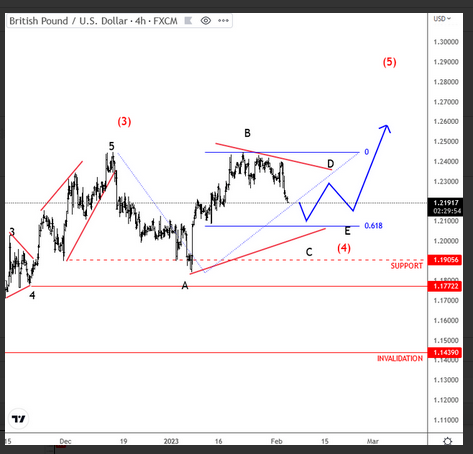
Cable is back in an uptrend after a capitulation back in September 2022. Notice that price is looking impulsive on a daily chart up to 1.23-1.24 resistance where bulls will try to form a breakout, but ideally, after a fourth wave pullback which can be more complex than we firstly thought. We see a potential triangle or even flat, meaning that lower supports can be retested before bulls are back. The ideal zone for a bounce is at 1.2 then 1.8 area.
GBPJPY Declines Sharply on Dovish BoE Remarks
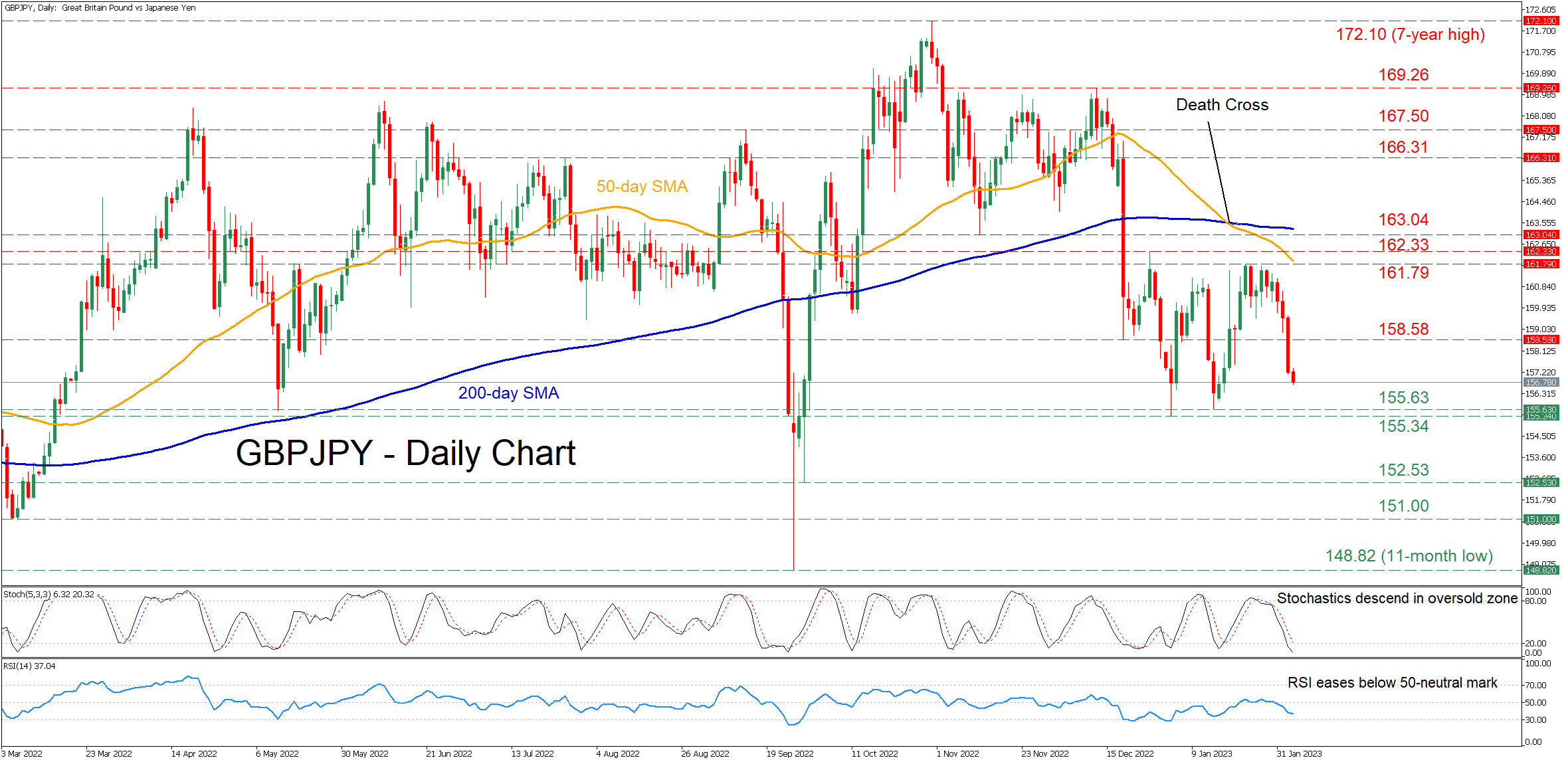
GBPJPY has been losing ground since early November when it posted a fresh seven-year high of 172.10. In the short-term, the pair’s downtrend accelerated after the BoE delivered an anticipated 50 basis points hike, albeit with dovish commentary that disappointed GBPJPY’s bulls.
The momentum indicators currently suggest that bearish forces have taken the upper hand. Specifically, the stochastic oscillator is descending within the oversold zone, while the RSI is flatlining beneath its 50-neutral mark.
Should the negative momentum strengthen, the pair could descend towards its recent support of 155.63. Diving beneath that floor, the price could challenge the 2023 low of 155.34 before the spotlight turns to the 152.53 hurdle. A break below the latter could pave the way for the March low of 151.00.
To the upside, bullish actions might initially propel the price towards the 158.58 zone, which provided support both in December and January but could now act as resistance. Surpassing that zone, the pair could test the January resistance region of 161.79. Conquering this barricade, the bulls may then aim at 162.33.
In brief, GBPJPY experienced a significant retreat after trading without a clear direction during the past month. For that bearish sentiment to reverse, the price needs to cross above the strong ceiling of 161.79, which rejected multiple advances in January.
GBP/JPY Daily Outlook
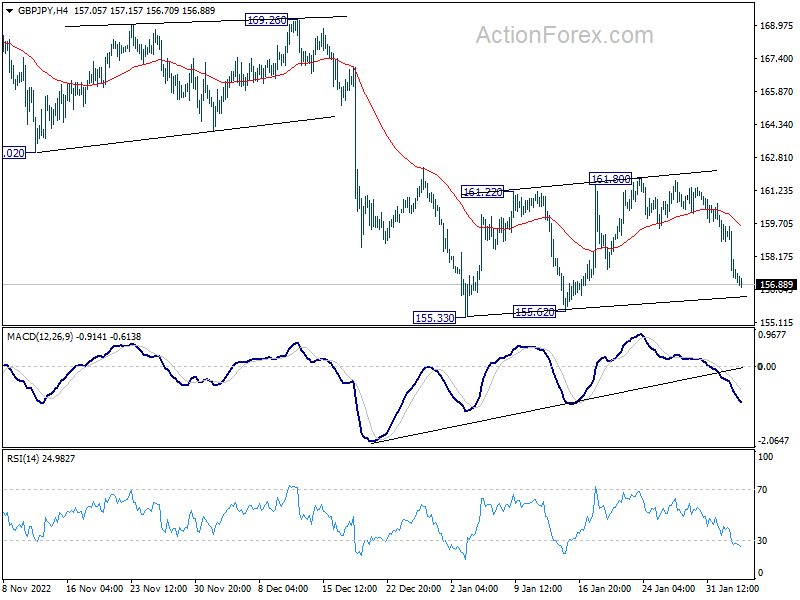
Daily Pivots: (S1) 156.46; (P) 158.04; (R1) 158.90; More…
Outlook in GBP/JPY remains unchanged and intraday bias stays neutral. On the downside, break of 155.33 low will resume the fall form 172.11 to 153.70 fibonacci level next. On the upside, sustained trading above 55 day EMA (now at 161.70) will turn bias to the upside, for stronger rise back to 169.26/172.11 resistance zone.
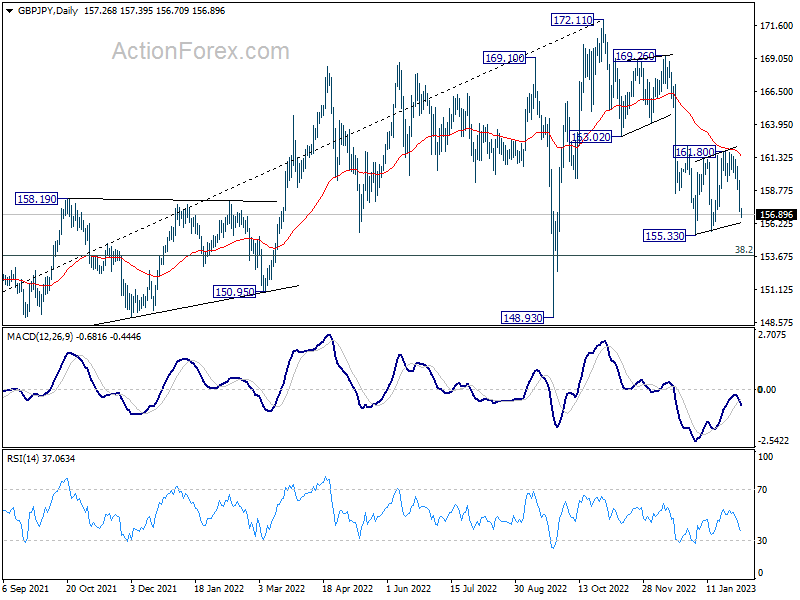
In the bigger picture, as long as 163.02 support turned resistance holds, decline from 172.11 medium term top is expected to continue to 38.2% retracement of 123.94 to 172.11 at 153.70. Sustained break there will raise the change of trend reversal and target 61.8% retracement at 142.34. Nevertheless, break of 163.02 support turned resistance will argue that the decline has completed, and retain medium term bullishness.
EUR/JPY Daily Outlook
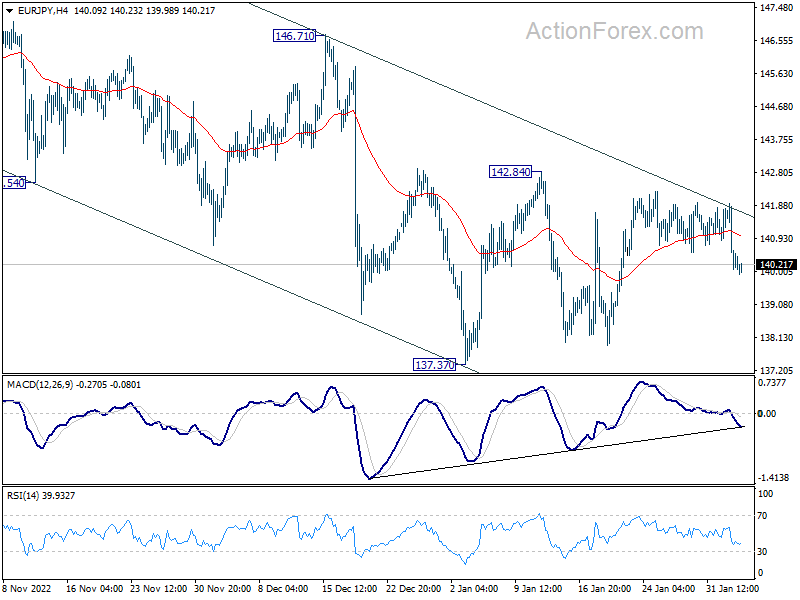
Daily Pivots: (S1) 139.70; (P) 140.82; (R1) 141.55; More….
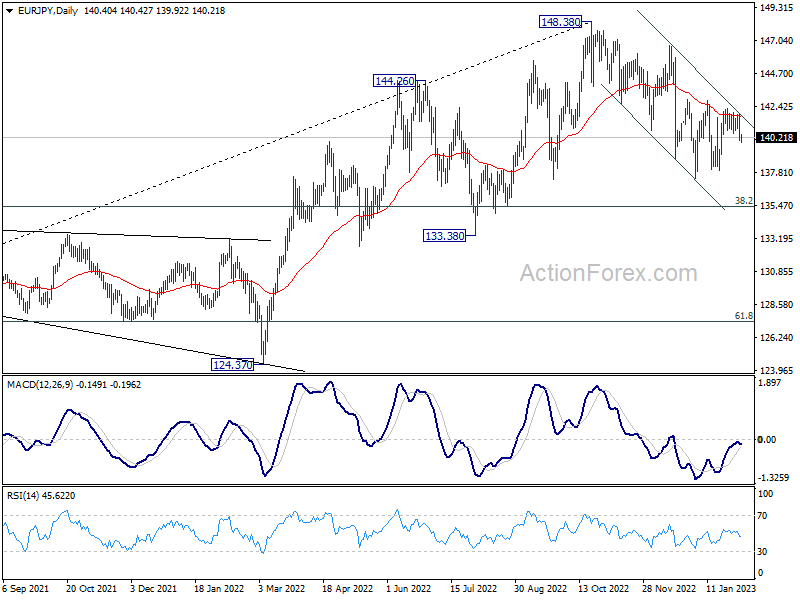
EUR/JPY is still bounded in range of 137.37/142.84 and intraday bias remains neutral. On the downside, firm break of 155.33 will resume the whole decline from 148.38 to 135.40 fibonacci level next. On the upside, decisive break of 142.84 resistance will argue that the correction from 148.38 has completed. Stronger rally should then be seen back to 146.71 resistance.
In the bigger picture, as long as 55 week EMA (now at 138.81) holds, larger up trend from 114.42 (2020 low) is still in progress for 149.76 long term resistance. However, firm break of 55 week EMA will bring deeper fall to 38.2% retracement of 114.42 to 148.38 at 135.40. Sustained break there will raise the chance of trend reversal, and target 61.8% retracement at 127.39.
EUR/GBP Daily Outlook
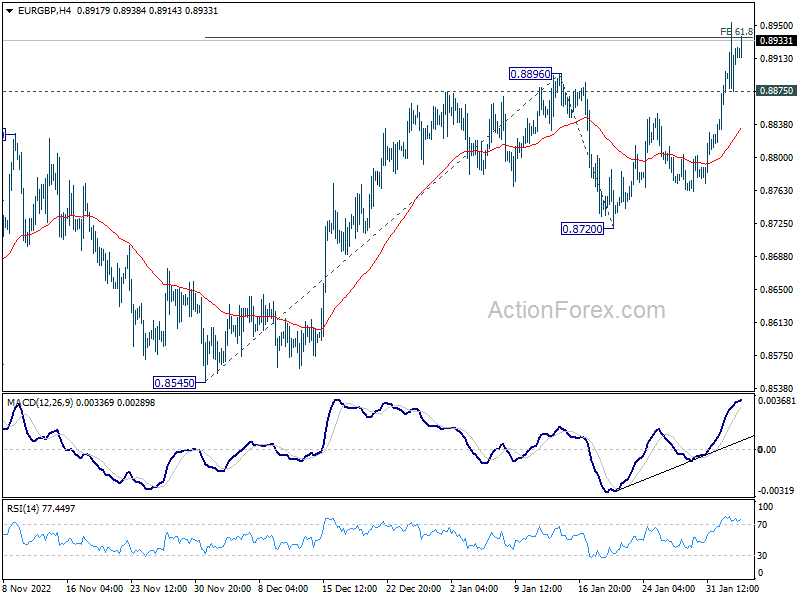
Daily Pivots: (S1) 0.8883; (P) 0.8920; (R1) 0.8962; More…
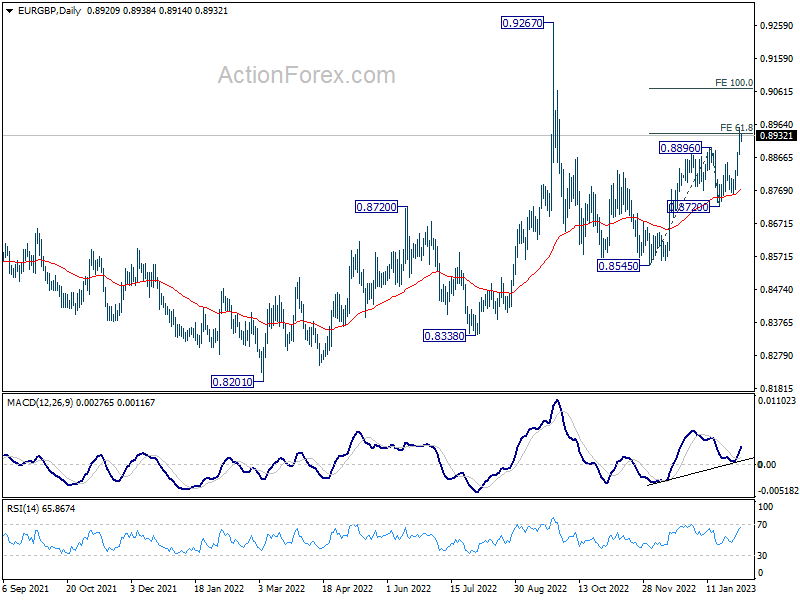
Intraday bias in EUR/GBP remains on the upside for the moment. Firm break of 61.8% projection of 0.8545 to 0.8896 from 0.8720 at 0.8937 will extend the rise from 0.8545 to 100% projection at 0.9071. On the downside, below 0.8875 minor support will turn intraday bias neutral first. But outlook will stay bullish as long as 0.8720 support holds.
In the bigger picture, the notable support from 55 day EMA (now at 0.8752) retains near term bullishness. Break of 0.8896 should target 0.9267 (2022 high) and possibly above, to resume whole up trend from 0.8201 (2022 low). However, break of 0.8270 support and sustained trading below 55 day EMA will set the stage for 0.8545 and below.
EUR/AUD Daily Outlook
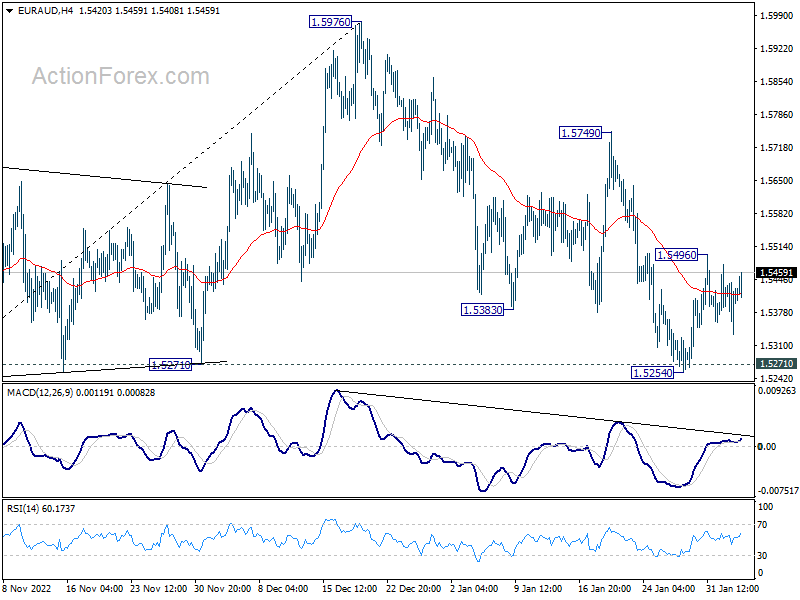
Daily Pivots: (S1) 1.5354; (P) 1.5397; (R1) 1.5461; More…
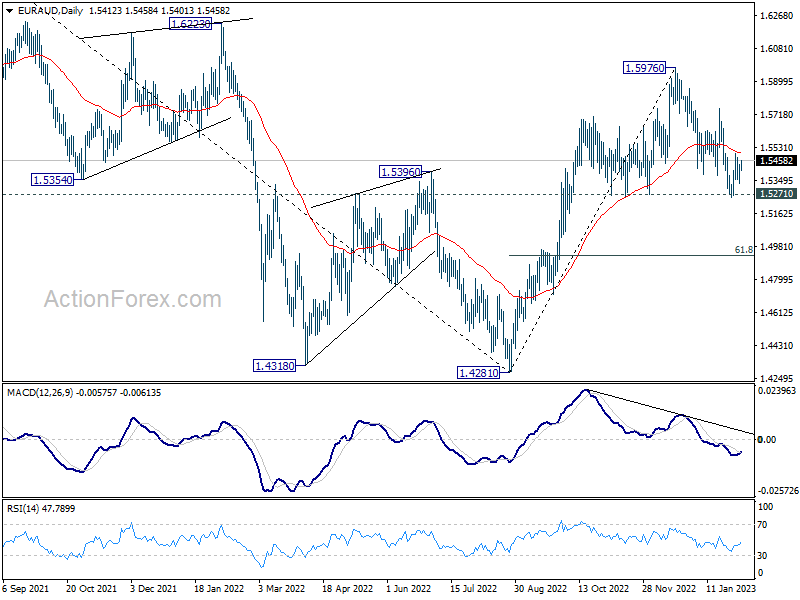
Intraday bias in EUR/AUD stays neutral first. On the upside, above 1.5496 will affirm the case of short term bottoming 1.5254, after defending 1.5271 key support. Intraday bias will then be turned back to the upside for 1.5749 resistance and above. On the downside, decisive break of 1.5271 will carry larger bearish implication and bring deeper fall to 61.8% retracement of 1.4281 to 1.5976 at 1.4928.
In the bigger picture, it's still early to confirm if rise from 1.4281 represents bullish trend reversal. But as long as 1.5271 support holds, such rally is in favor to continue. Break of 1.5976 will target 1.6434 key resistance next. On the other hand, firm break of 1.5271 will retain medium term bearishness instead.
EUR/CHF Daily Outlook
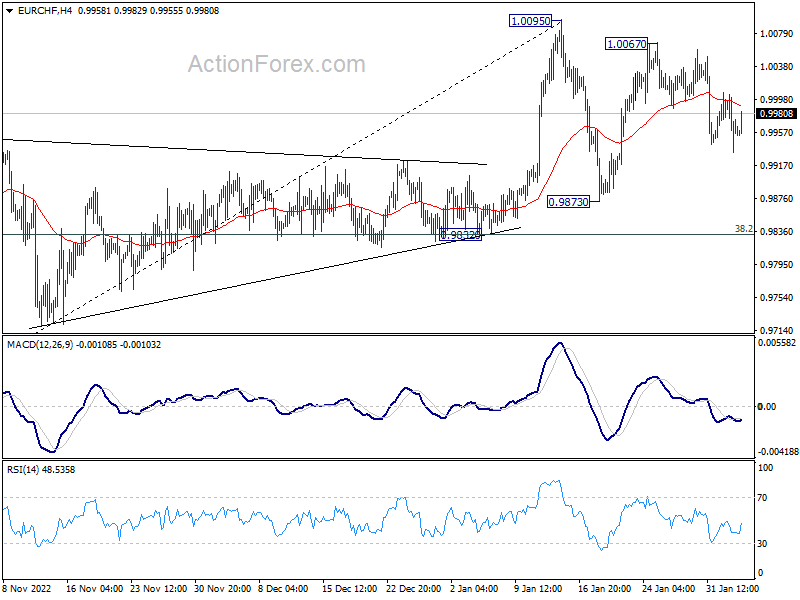
Daily Pivots: (S1) 0.9930; (P) 0.9968; (R1) 1.0001; More….
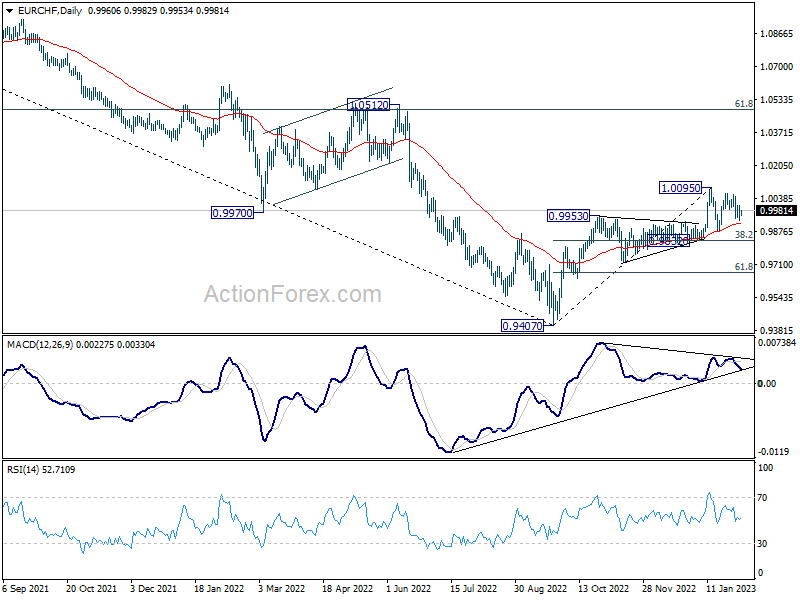
Outlook in EUR/CHF remains unchanged as consolidation from 1.0095 is extending. Deeper fall could be seen and break of 0.9873 support cannot be ruled out. But downside should be contained by 38.2% retracement of 0.9407 to 1.0095 at 0.9832 to bring rebound. For now, risk will stay on the downside as long as 1.0067 resistance holds, in case of recovery.
In the bigger picture, the initial rejection by 55 week EMA (now at 1.0039) mixed up the outlook. On the upside, sustained trading above 55 week EMA will raise the chance of bullish trend reversal. Rise from 0.9407 should then target 1.0505 cluster resistance (2020 low at 1.0505, 61.8% retracement of 1.1149 to 0.9407 at 1.1484). However, firm break of 0.9832 support will revive medium term bearishness and bring retest of 0.9407 low instead.