Sample Category Title
Fed Chair Jerome Powell press conference live stream
https://www.youtube.com/watch?v=CNxtwxLYCxc
Fed hikes 25bps to 4.50-4.75%, ongoing tightening appropriate
Fed raises federal funds rate by 25bps to 4.50-4.75% as widely expected by unanimous vote.
Tightening bias is maintained as "the Committee anticipates that ongoing increases in the target range will be appropriate in order to attain a stance of monetary policy that is sufficiently restrictive to return inflation to 2 percent over time".
Regarding the economy, FOMC said, "Recent indicators point to modest growth in spending and production. Job gains have been robust in recent months, and the unemployment rate has remained low. Inflation has eased somewhat but remains elevated."
(Fed) Federal Reserve issues FOMC statement
Recent indicators point to modest growth in spending and production. Job gains have been robust in recent months, and the unemployment rate has remained low. Inflation has eased somewhat but remains elevated.
Russia's war against Ukraine is causing tremendous human and economic hardship and is contributing to elevated global uncertainty. The Committee is highly attentive to inflation risks.
The Committee seeks to achieve maximum employment and inflation at the rate of 2 percent over the longer run. In support of these goals, the Committee decided to raise the target range for the federal funds rate to 4-1/2 to 4-3/4 percent. The Committee anticipates that ongoing increases in the target range will be appropriate in order to attain a stance of monetary policy that is sufficiently restrictive to return inflation to 2 percent over time. In determining the extent of future increases in the target range, the Committee will take into account the cumulative tightening of monetary policy, the lags with which monetary policy affects economic activity and inflation, and economic and financial developments. In addition, the Committee will continue reducing its holdings of Treasury securities and agency debt and agency mortgage-backed securities, as described in its previously announced plans. The Committee is strongly committed to returning inflation to its 2 percent objective.
In assessing the appropriate stance of monetary policy, the Committee will continue to monitor the implications of incoming information for the economic outlook. The Committee would be prepared to adjust the stance of monetary policy as appropriate if risks emerge that could impede the attainment of the Committee's goals. The Committee's assessments will take into account a wide range of information, including readings on labor market conditions, inflation pressures and inflation expectations, and financial and international developments.
Voting for the monetary policy action were Jerome H. Powell, Chair; John C. Williams, Vice Chair; Michael S. Barr; Michelle W. Bowman; Lael Brainard; Lisa D. Cook; Austan D. Goolsbee; Patrick Harker; Philip N. Jefferson; Neel Kashkari; Lorie K. Logan; and Christopher J. Waller.
ISM Shows U.S. Manufacturing Sector Contracted for a Third Month in a Row
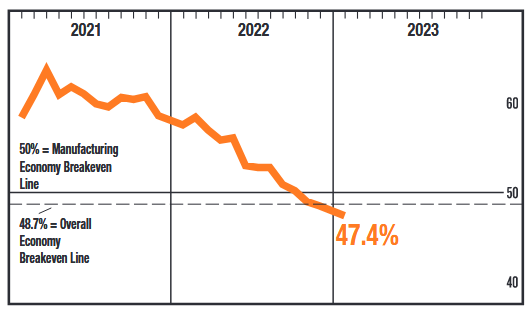
The January ISM manufacturing index registered 47.4, slightly below expectations calling for a 48.0 print. The index fell 1.0 percentage point (pp) from December's reading of 48.4.
New orders fell 2.6 pp to 42.5, while new export orders slowed their decline, rising to 49.4.
The backlog of orders sub-index rose to 43.4, up 2.0 pp from December's 41.4 print.
The production index fell 0.6 pp to 48.0, extending its decline, while the employment index edged down 0.2 pp to 50.6.
The supplier deliveries sub-index rose to 45.6 from 45.1 in December.
Only two (miscellaneous manufacturing & transportation equipment) of 18 manufacturing industries reported growth in January.
Key Implications
Further manufacturing weakness came as no surprise as the momentum from slowing consumer goods demand continues to feed through to producers. The combination of changing preferences and higher financing costs have weighed on new orders as they have now contracted in six of the past seven months.
Looking forward, despite the Fed moving into the final stages of its fight against inflation with another hike today, the full effects of this past year's tightening will continue to be felt for months. December's real consumer expenditure data showed goods demand declined for a second consecutive month – touching its lowest level of the year. This trend looks set to continue as our tracking shows GDP growth slowing to less than 1% in the first quarter of 2023.
How Important Will Friday’s NFP Report Be for the Dollar?
The first US nonfarm payrolls report for 2023 will be published on Friday at 13:30 GMT, a couple of days after the Federal Reserve announces its rate decision. The event may not cause much volatility for the dollar if today's policy update adjusts rate expectations beforehand, though it will still be critical in how it can provide extra input regarding whether monetary policy is moving in the right direction.
US labor market loses steam
December’s jobs data beat analysts’ estimate for a smaller addition of 200k, clocking in slightly higher at 223k instead, with the unemployment rate surprisingly inching down to a record low of 3.5%. While the data instantly lent a helping hand to the US dollar, it was not strong enough to alleviate fears that the US economy is heading towards a cliff edge.
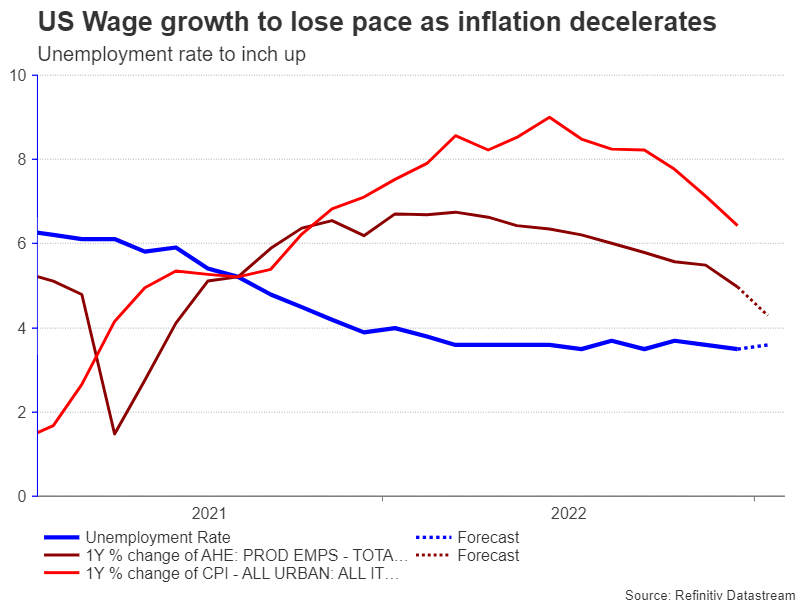
The real picture is that the tight labor market is losing steam and January’s update could provide confirmation of this on Friday. If forecasts are correct, nonfarm payrolls will mark the softest increase of 185k in a year, lifting the unemployment rate slightly higher to 3.6%. Average hourly earnings are forecast to decelerate at a relatively faster pace to 4.3% from 4.6% previously, mirroring slackening economic conditions as well.
Wage concerns far from over
The above earnings stats could be good news for US businesses and a sort of sign that job-matching is becoming more efficient. The figures could also bring some relief to Fed policymakers who are concerned over a potential wage-price spiral.
There is no evidence that wages are fueling inflation so far and if that stays the case, the Fed could follow its plan of softer rate increases. The Employment Cost Index, which is a broad measure of labor costs, posted the smallest advance in a year last quarter. Yet wage concerns are far from over as the increase was relatively firm, and additional solid prints in the first quarter cannot be ruled out given that several companies implement annual changes in salaries at the start of each year.
Rate hike cycle to continue
All in all, it looks like the Fed and other major central banks are currently at a crossroads, and they will need more data before they confidently tweak their forward guidance. Of course, the weakening momentum in inflation and wage growth may allow policymakers to debate whether the tightening phase will pause this spring, though the price stability mandate will remain a top priority. Therefore, the rate hike cycle may continue - probably at a slower pace - even if the economy keeps adding fewer jobs and the unemployment rate starts trending up. Perhaps an economic fallout could help the Fed complete its inflation mission at a lower terminal rate after all.
Analysts believe that wage growth will need to ease to 3.5% y/y in order to press inflation towards the 2.0% target. Hence, the Fed may deliver a smaller 25bps rate hike later today but delay any changes in the statement that says continuous rate increases are likely.
USD/JPY
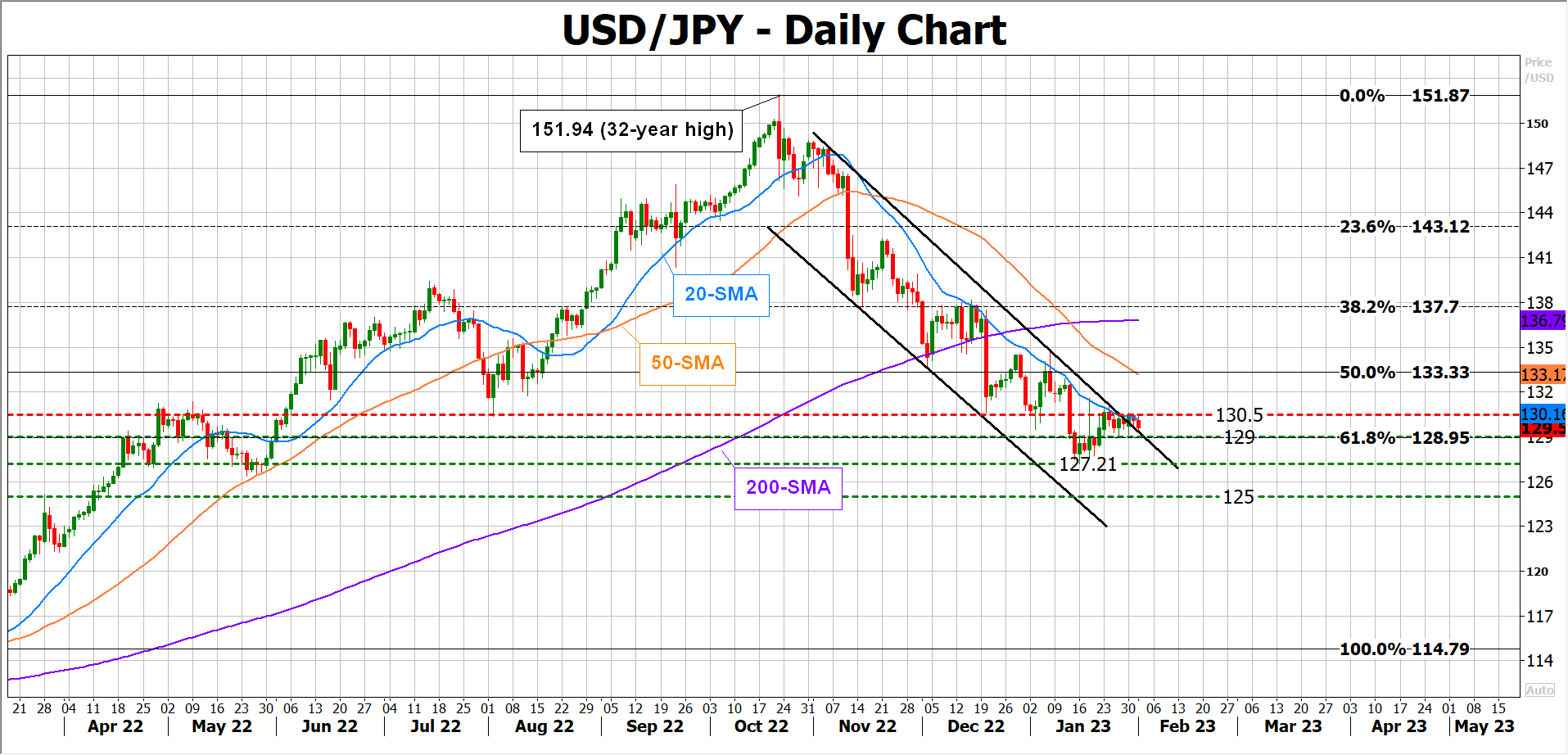
As regards the US dollar, if the Fed chief sounds more hawkish than expected today, it may pierce through its 20-day simple moving average (SMA) at 130.50 against the Japanese yen and rally towards the 132.50-133.30 resistance zone. A stronger-than-expected NFP report, and particularly an upside surprise in average hourly earnings, may bolster the bullish tone but the impact may be muted if the Fed clarifies the next moves in monetary policy today.
Alternatively, if the Fed appears more conservative, backing investors' expectations for a pause in spring, and wage data meet forecasts or come below them, dollar/yen could revisit the 127.50-127.20 support region. The 126.50 former constraining zone will also be in focus before the spotlight shifts to 125.00.
UK Will Not Avoid Recession Says IMF; What Does this Mean for the Pound?
Britain’s economy may be the only one that contracts in 2023 according to the IMF’s latest quarterly assessment, dealing a blow to hopes that a recession can be avoided. The pound was the second worst performing currency after the yen last year amid an energy crisis, political chaos and a botched budget, which all added to the existing post-Brexit and post-pandemic challenges. But how accurate are the IMF’s forecasts when no other major economy is expected to shrink, and can the pound shrug off the gloom to keep its uptrend intact?
Tumbling down the growth league table
It's been a fairly solid start to the year so far for sterling and the economic indicators haven’t been as bad as the negative headlines would suggest. In fact, the United Kingdom likely grew the fastest among the G7 in 2022 as the economy continued to recover from the deep pandemic slump of 2020. But it’s safe to say that the reopening boost has now well and truly faded, and Britain may now have a bigger inflation problem on its hands than other countries.
Brexit has made the price of certain goods costlier after the UK left the single market, however, the bigger impact has been on the labour market. Worker shortages have been evident after freedom of movement with the rest of the EU came to an end following Brexit, adding to wage pressures. The pandemic exacerbated this problem as many people left the workforce, mainly due to early retirement or being unable to work because of long-term health effects from Covid.
Inflation not falling fast enough
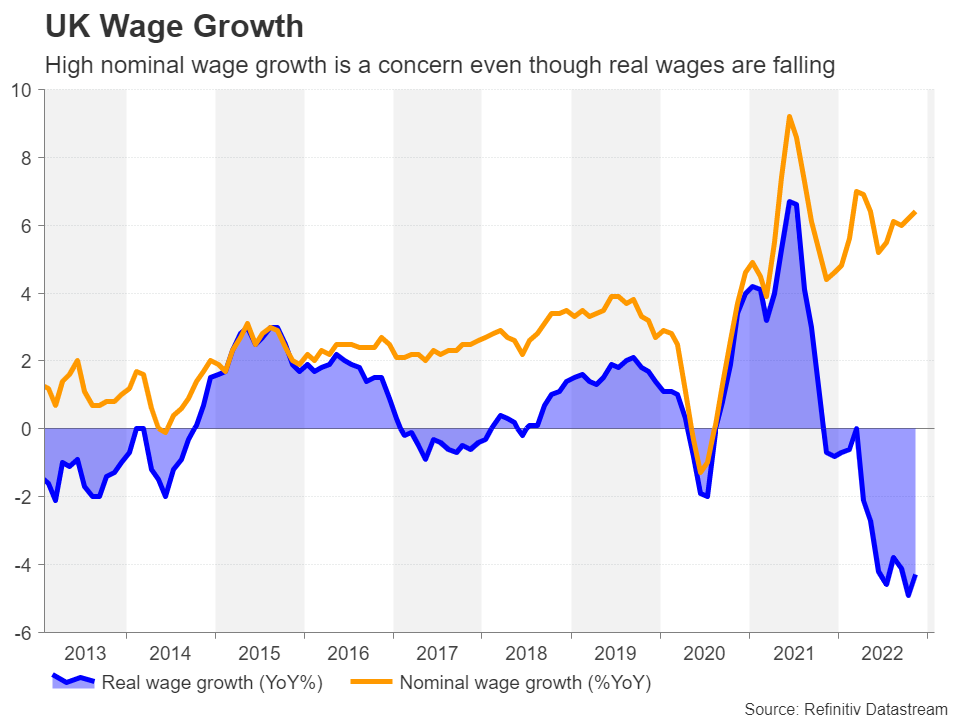
This goes some way in explaining why inflation in the UK peaked higher and has climbed down less than it has in the euro area or in the United States despite the significant decline in energy prices. Wages across the UK are currently rising at an annual pace of more than 6%. Whilst that’s not high enough to turn real wage growth positive, it does add to the cost burden for businesses, who in turn have to put up their prices. In addition, the way the UK energy market is structured compared to Europe has contributed to gas and electricity bills surging far more for British households than on the continent.
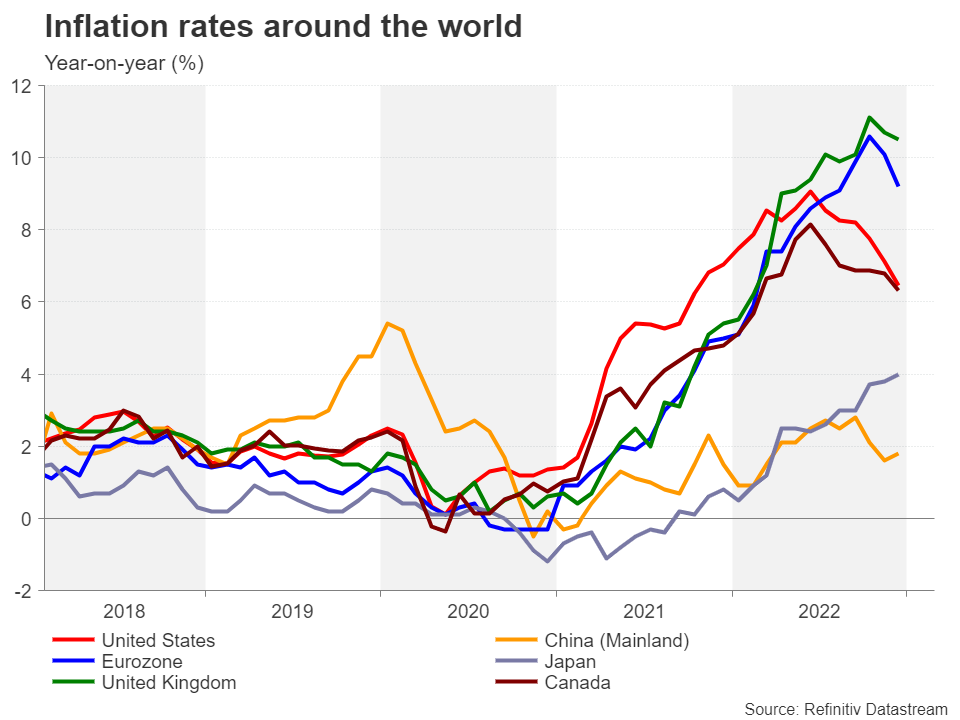
The persistently strong inflationary pressures forced the Bank of England to accelerate its rate hikes in the autumn, increasing the risk of overtightening and thereby choking off growth even more. Although the same can be said for the ECB, the signs on inflation are a little more encouraging in the euro area. Plus, the downside risks are somewhat less pronounced for Eurozone economies.
Post-Brexit blues?
Whatever dangers lie ahead in 2023, for example, should the Ukraine conflict escalate and there is an energy crisis part two, Europe will have China’s reopening to fall back on. The comparative boost to UK exporters will probably be less significant from any rebound in Chinese demand. But there are other pressing issues facing Britain.
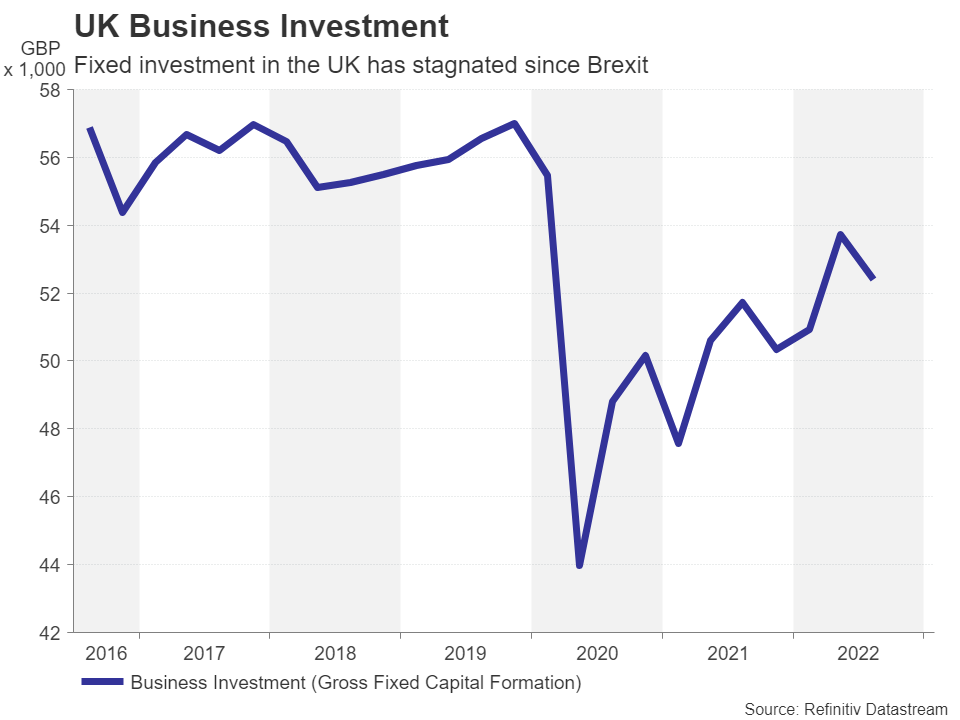
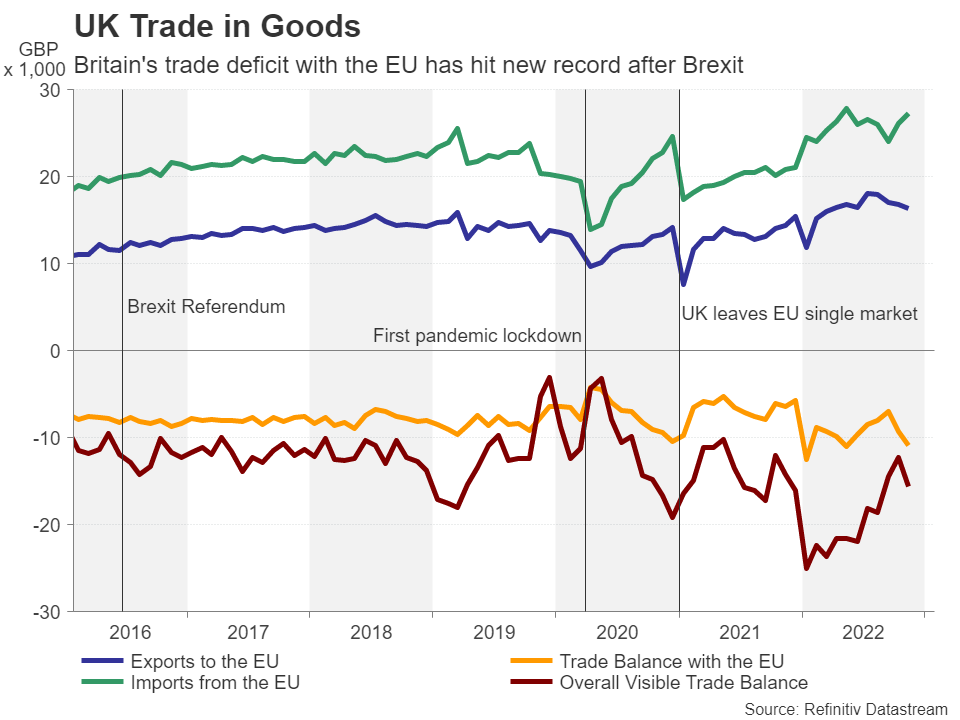
Business investment stopped growing after Brexit and then collapsed after the first Covid lockdown. Not only has investment yet to recover to pre-pandemic levels, but Britain was investing less heading into the virus crisis. Another aftereffect of Brexit has been on trade. After leaving the EU single market in its entirety on January 1, 2021, exports as well as imports briefly plummeted. Although both have now risen above pre-pandemic levels, imports have jumped more than exports, leaving the trade deficit with the EU near all-time highs.
Britain’s total trade deficit has at least now started to improve after hitting a new record at the beginning of 2022 and the current account deficit as a percent of GDP has also been narrowing in the last few years, which bodes well for sterling. Still, it is hard for investors to get too excited about the UK economy following the events of the summer and autumn.
Unprecedented political turmoil
Three prime ministers in two months is not something that’s usually synonymous with the UK, while the budget episode in September may have permanently damaged investor confidence in the economy. Yet, even though Liz Truss’ short time as PM brought havoc to the markets, she was right about one thing: the UK needs a growth plan.
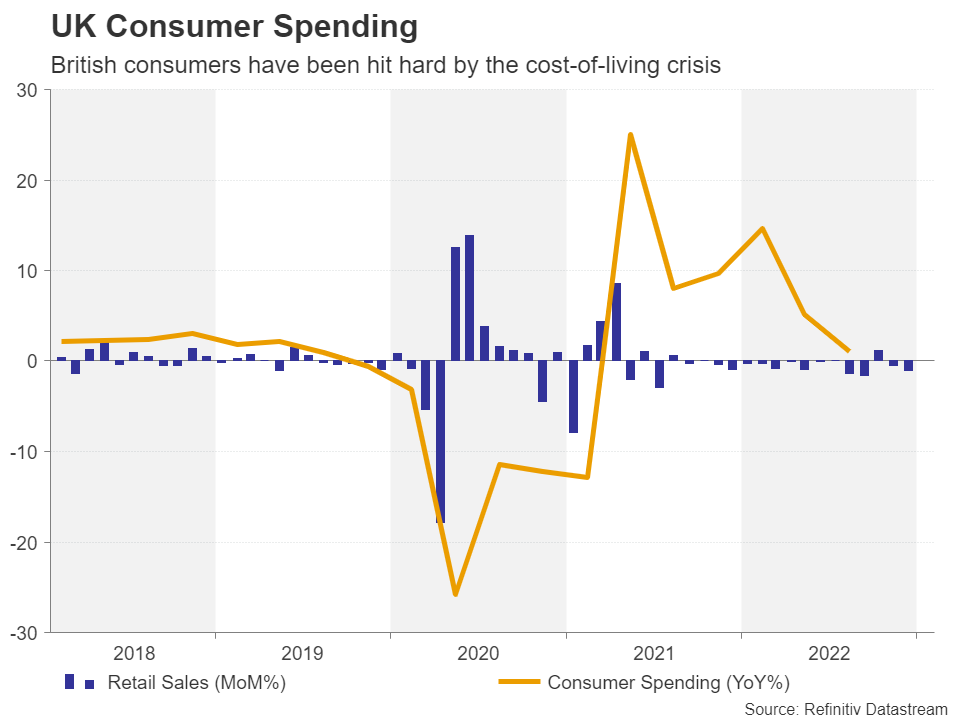
Truss also managed to secure more support to help families through the energy crisis. Without it, households would likely be spending a lot less right now. Consumers are the main growth engine of the UK economy and despite all the government assistance, the outlook remains quite bleak, primarily because borrowing costs are going up, which means higher mortgages for homeowners.
Consumers’ woes set to worsen in 2023
Add to that the possibility that it might take longer for inflation to come down substantially in the UK, 2023 could be an even worse year for UK consumers. The government, meanwhile, is also tightening its purse strings as it needs to reign in spending after borrowing ballooned during the pandemic. This is positive from the inflation perspective as it should help dampen price pressures, but there will be no extra cash to go around for tax cuts or other growth initiatives.
However, a potentially bigger concern for businesses as well as investors is the lack of a long-term economic strategy by the Conservative party. Rishi Sunak replacing Truss may have restored political calm and eased the market panic, but his premiership has so far been marred by endless strikes in the public sector and a series of Tory sleaze allegations.
Can new leadership fix Britain’s problems?
The IMF may therefore have a point in being so much more pessimistic about Britain’s growth prospects as the economy is facing multiple headwinds. Even if the severity of some of these challenges has been overdone and the UK fares better than anticipated this year, investors’ outlook is unlikely to change until there is a new government in Downing Street that has a clear vision for the country.
At this point, the markets’ best bet of that might just be the Labour party. Under the current leader, Keir Starmer, the party has shifted closer towards Tony Blair’s New Labour and away from Jeremy Corbyn’s left-wing influences. Thus, a Labour government does not seem like such a big threat anymore and could provide better stability. However, the next general election is not expected until the end of 2024 and it could be difficult for the pound’s outlook to turn dramatically more bullish until then.
Still some hope for pound bulls
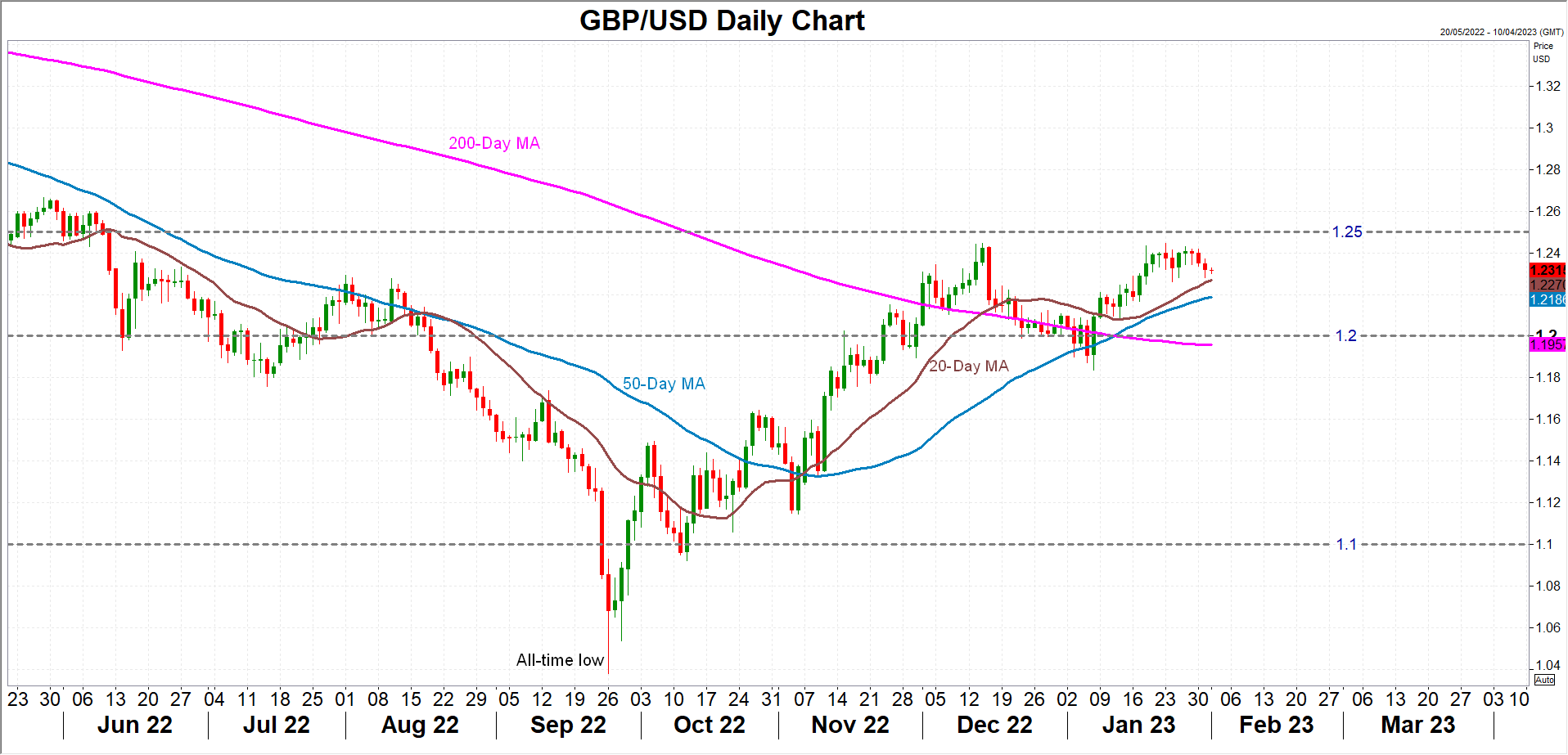
In the meantime, the divergence of monetary policies between the Fed and Bank of England works in sterling’s favour, even if the UK economy underperforms. Nevertheless, a break above $1.25 is critical to sustain the pound’s uptrend.
The big risk, though, is what would happen if the Fed continued to tighten beyond the summer and the Bank of England paused well before that. Sterling could slip back below $1.20 in such a scenario and possibly revisit the $1.10 level as well.
Sunset Market Commentary
Markets
January inflation figures from European sovereigns published earlier this week culminated in the European-wide reading today. Bear in mind that Germany’s official CPI print for technical reasons isn’t due until next week. Eurostat instead resorted to an estimate. Price growth eased more than expected, from 9.2% to 8.5%, thanks to falling energy prices. Core inflation, which strips out energy, food, alcohol and tobacco, stabilized at 5.2%, defying expectations for a minor drop to 5.1%. Services inflation (4.2%) hovered close to the 4.4% record high. With the ECB having labeled core inflation as the needle in the compass, investors reacted accordingly. German yields turned losses of up to 4 bps in minor gains only to come off intraday highs again and trade flat on a net daily basis following the US ADP job report release. Employment grew by 106k in January, undershooting the 180k consensus even taking into account the 18k upward revision to the December figure (253k). Leisure and hospitality together with financial services delivered 125k jobs in the services sector, partially offset by a 41k decline in transportation & trade. In the goods sector, jobs lost in construction (-24k) outweighed those created in manufacturing (+23k). US yields marginally extended a decline with changes currently ranging between -2.3 bps (2y) to -3.8 bps (10y, 30y). A pinch of euro strength with dollar weakness lifts EUR/USD to the 1.09 big figure. DXY (101.76) hovers near recent lows, thus experiencing a make or break moment with key support looming at 101.297 going into the Fed meeting tonight. Currencies in the G10 space outperforming peers today include the Japanese yen (USD/JPY 129.41), the Aussie dollar (AUD/USD 0.709) and the Swedish krone (trying to recover from yesterdays beating at EUR/SEK 11.34).
The Fed is expected to downshift its tightening pace from 50 bps to 25 bps, bringing the policy rate at 4.5%-4.75%. Several governors argued in favour of doing so, though some stuck to the view to get to a peak level (5-5.25% as per December dots) as fast as possible, allowing for a pause afterwards. This would suggest a 50 bps hike tonight followed by a (conditional) last one in March when new forecasts and dot plot are available. It would probably need to show in the policy statement which for months now says that “the Committee anticipates that ongoing increases in the target range will be appropriate in order to attain a stance of monetary policy that is sufficiently restrictive to return inflation to 2% over time”. Only dropping this reference while simultaneously delivering a 25 bps hike could trigger a (bond) rally at the front end of the curve. We don’t believe in that outcome as too many (conflicting) factors remain at play: lower (headline) inflation vs tight labour market & wage pressure, weaker growth dynamics vs looser financial conditions,… . In all other scenarios, we expect the US yield curve to invert further via an underperformance of the front end. This should help the dollar above recent support levels while weighing on risk sentiment as well as the other two scenario’s (50-25-pause) or (25-25-25-pause?) are not discounted in US money markets (peak rate 4.75-5%). Apart from how to get to the peak, we expect Powell to talk markets out of the idea of rate cuts in the second half of the year.
News & Views
The S&P global manufacturing PMI’s for Poland (47.5 from 45.6) and the Czech Republic (44.6 from 42.6) remained firmly in sub 50 contraction territory in January. Output and new orders continue to decline at rather strong rates as both weak domestic and external demand weigh on activity. The employment subseries also indicated further job losses. Output prices continue to rise. At the same time, expectations for activity further out this year improve, supporting a gradual bottoming out in the headline indices that is developing since autumn. The Hungarian PMI as published by the Association of Logistics, Purchasing and Inventory Management shows a different picture, easing from 59.3 in December to 55 in November, with but both production and orders reported to have stayed above 50.
Annual house prices growth in the UK in January slowed further to 1.1% Y/Y down from 2.8% in December, according to the House price index from that Nationwide Building Society. Price declined 0.6% M/M. Nationwide sees ‘some encouraging signs […] but it is too early to tell whether activity in the housing market has started to recover’. The rising cost of servicing mortgages has deteriorated housing affordability over the past year. Nationwide also assumes that ‘It will be hard for the market to regain much momentum in the near term as economic headwinds are set to remain strong’.
US ISM manufacturing dropped to 47.4, corresponds to -0.5% annualized GDP contraction
US ISM Manufacturing PMI dropped further from 48.4 to 47.4 in January, below expectation of 48.7. Looking at some details, new orders dropped from 45.1 to 42.5. Production dropped from 48.6 to 48.0. Employment dropped from 50.8 to 50.6. Prices rose from 5.1 to 39.4.
ISM said: “The U.S. manufacturing sector again contracted, with the Manufacturing PMI® at its lowest level since the coronavirus pandemic recovery began. With Business Survey Committee panelists reporting softening new order rates over the previous nine months, the January composite index reading reflects companies slowing outputs to better match demand in the first half of 2023 and prepare for growth in the second half of the year."
“The past relationship between the Manufacturing PMI® and the overall economy indicates that the Manufacturing PMI® for January (47.4 percent) corresponds to a -0.5-percent change in real gross domestic product (GDP) on an annualized basis.”
USD/CHF Mid-Day Outlook
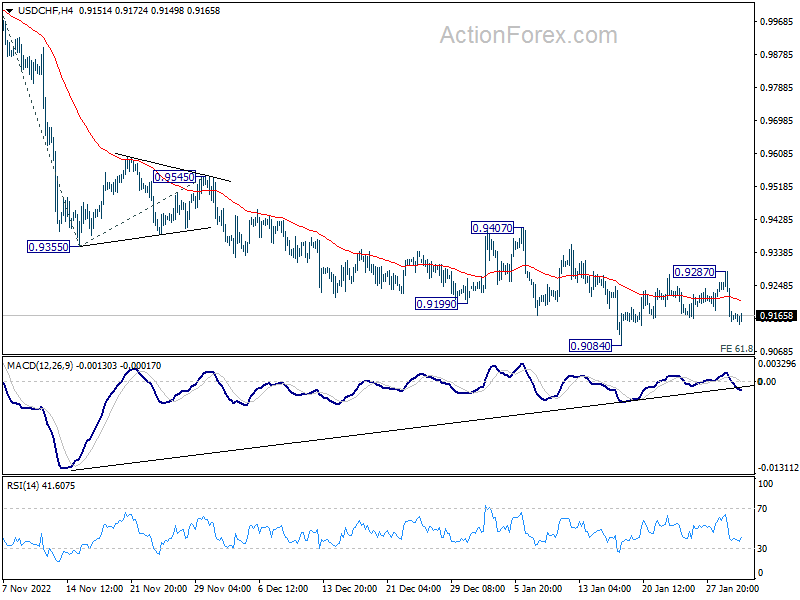
Daily Pivots: (S1) 0.9112; (P) 0.9200; (R1) 0.9249; More…
Intraday bias in USD/CHF remains neutral at this point. Outlook stays mildly bearish despite loss of downside momentum. On the downside, sustained break of 61.8% projection of 1.0146 to 0.9355 from 0.9545 at 0.9056 will pave the way to 100% projection at 0.8754, which is close to 0.8756 long term support. Nevertheless, on the upside, break of 0.9287 should confirm short term bottoming and turn bias back to the upside for 0.9407 resistance.
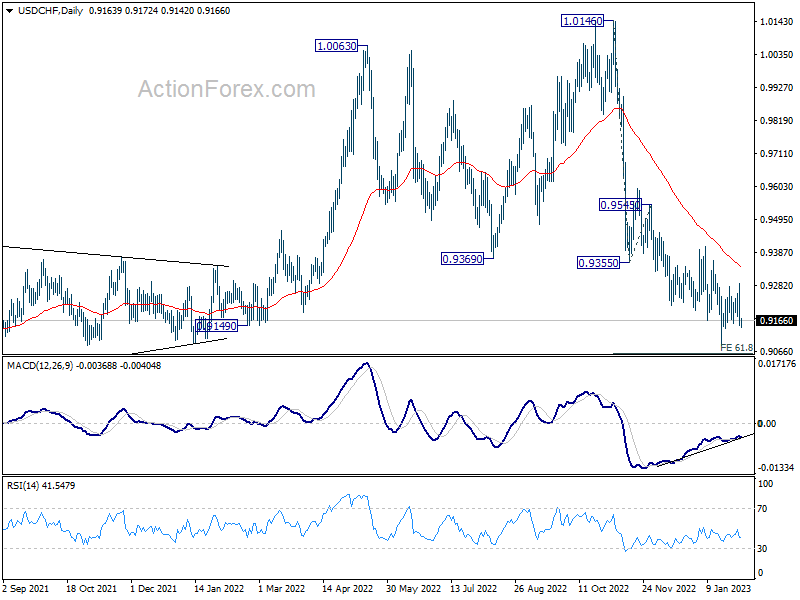
In the bigger picture, rise from 0.8756 (2021 low) has completed at 1.0146, well ahead of 1.0342 long term resistance (2016 high). Based on current downside momentum, fall from 1.0146 should be a medium term down trend itself. Next target is a test on 0.8756 low. Strong support should be seen there to bring rebound. Still, further decline will now be expected as long as 0.9407 resistance holds, in any case.
USD/JPY Mid-Day Outlook
Daily Pivots: (S1) 129.73; (P) 130.13; (R1) 130.51; More…
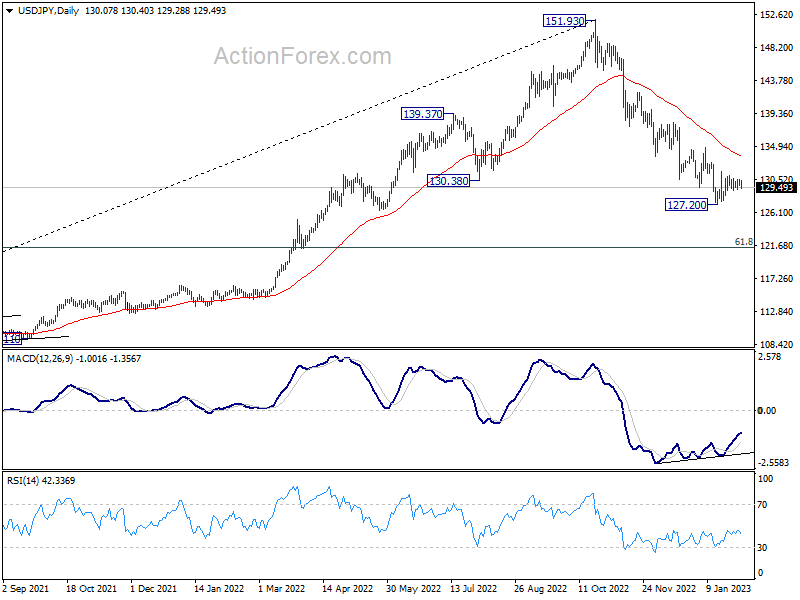
USD/JPY continues to trade sideway and intraday bias remains neutral. On the downside, break of 127.20 will resume the whole decline from 151.93 and target 121.43 fibonacci level. Nevertheless, on the upside, break of 131.56 resistance should confirm short term bottoming, and turn bias back to the upside for stronger rebound to 55 day EMA (now at 133.61) and possibly above.
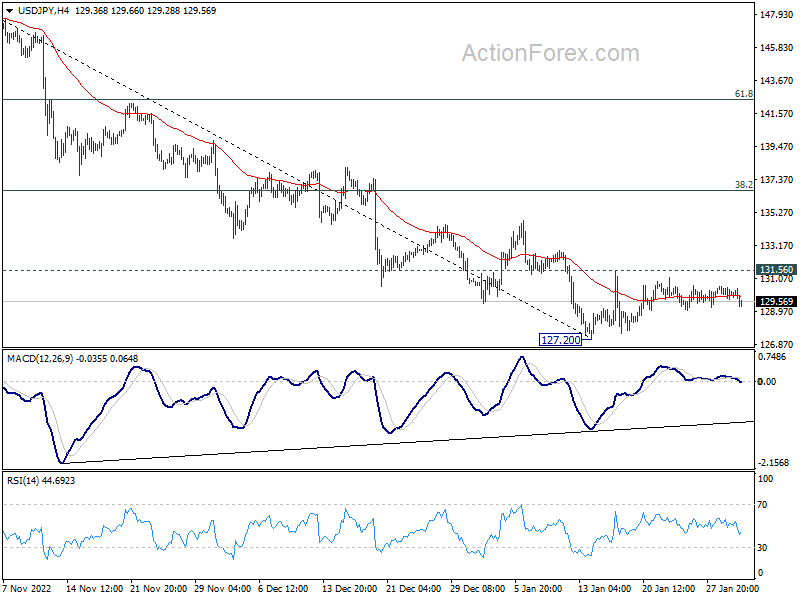
In the bigger picture, the break of 55 week EMA (now at 131.39) raises the chance of medium term bearish reversal, but that’s not confirmed yet. Strong support could be seen around 61.8% retracement of 102.58 to 151.93 at 121.43 and 38.2% retracement of 75.56 to 151.93 at 122.75 to bring rebound. But break of 131.56 resistance is needed to indicate bottoming first. Otherwise further fall will remain in favor.