

Sample Category Title
Dollar Down on Risk-On Sentiment after FOMC, BoE and ECB Take Center Stage
Dollar weakened broadly overnight, more on risk-on sentiment than FOMC rate decision. Yet, selloff was not particularly fierce except versus Euro and Swiss Franc. In particular, Sterling is clearly lagging behind. Judging from the upside breakout in EUR/GBP, traders are probably guarding against the possibility of a dovish twist in BoE today. As for the greenback and overall risk sentiment, there is another mega event of non-farm payrolls ahead. So, fasten your seat-belt.
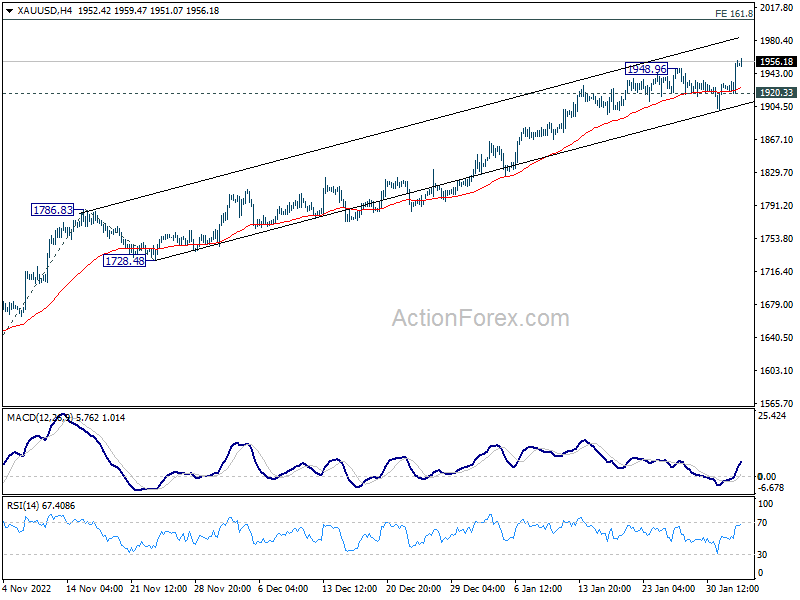
Technically, Gold resumed recent rally by breaking through 1948.96. Outlook will stay bullish as long as 1920.33 support holds. Next target is 161.8% projection of 1616.51 to 1786.83 from 1728.48 at 2004.05, which is also close to 2000 psychological level. Strong resistance might bee seen there to bring a correction. Let's see.
In Asia, Nikkei rose 0.20%. Hong Kong HSI is down -0.12%. China Shanghai SSE is up 0.02%. Singapore Strait Times dropped -0.62%. Japan 10-year JGB yield rose 0.0094 to 0.492. Overnight, DOW rose 0.02%. S&P 500 rose 1.05%. NASDAQ rose 2.00%. 10-year yield rose dropped -0.132 to 3.397.
NASDAQ completed double bottom, investors responded well to Fed
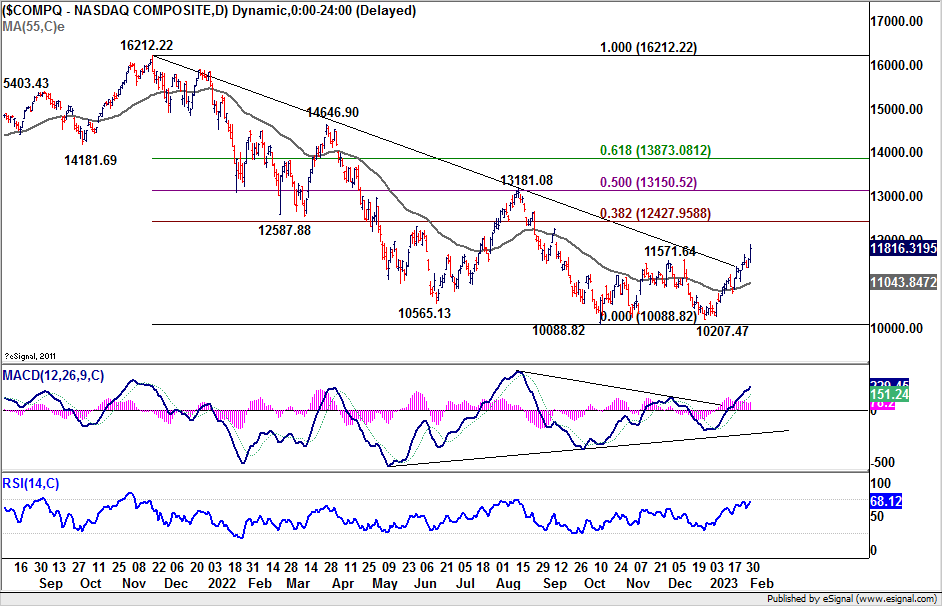
NASDAQ closed strongly up by 2.00% overnight to close at 11816.31. Fed's 25bps rate hike was well received by investors, with Chair Jerome Powell admitting that “we can now say for the first time that the disinflationary process has started.”
Suggested readings on FOMC:
- An End to the Tightening Cycle is on the FOMC’s Horizon
- FOMC Hikes Rates and Signals Yet More to Come
- FOMC Meeting Recap: Powell Not Hawkish Enough, Traders Price in 50bps of Cuts by EOY
- EUR/USD upside breakout as Fed Powell said disinflationary process has started
- FOMC Hikes Policy Rate by 25 Basis Points, Signals More to Come
NASDAQ's break of 11571.64 resistance completes a double bottom pattern (10088.82, 10207.47). Near term outlook will stay bullish as long as 55 day EMA (now at 11043.84) holds. Next target is 38.2% retracement of 16212.22 to 10088.82 at 12427.95.
It's still a bit early to tell if NASDAQ is in correction to the down trend from 16212.22, or in bullish reversal. Key level lies in 13181.08 cluster resistance, 50% retracement at 13150.52. Reactions from there will reveal which case it is.
EUR/GBP upside breakout ahead of BoE and ECB, some previews
Two central banks will announce rate decisions today, BoE and then ECB. Currently, the base case is for BoE to hike to bps today to 4.00%, and then another 25bps hike in March, then a pause. Any deviation from that path could trigger much volatility in the Pound. Attention will be on the decision itself, the voting, as well as the new economic projections.
As for ECB, a 50bps hike to 3.00% is widely expect. President Christine Lagarde has been clear that the central bank has to "stay the course". While some policymakers have already indicated the preference for another 50bps in March, that would very much depend on the new economic projections to be released then. So, no matter how firm Lagarde sounds today, there is room for adjustment before the March meeting.
Here are some suggested readings on ECB and BoE:
- ECB Preview: All About Forward Guidance
- Roaring Euro Turns to ECB Rate Decision
- ECB Preview – Set for Another 50bp Rate Hike
- Voting Rotation, Hawkishness and the Next ECB Meeting in Sight
- UK Will Not Avoid Recession Says IMF; What Does this Mean for the Pound?
- BoE Preview: MPC Might Be Split But 50 bp Hike Likely
- Bank of England: One Final 50bps Rate Hike
- Bank of England Preview – Topside Risk to EUR/GBP
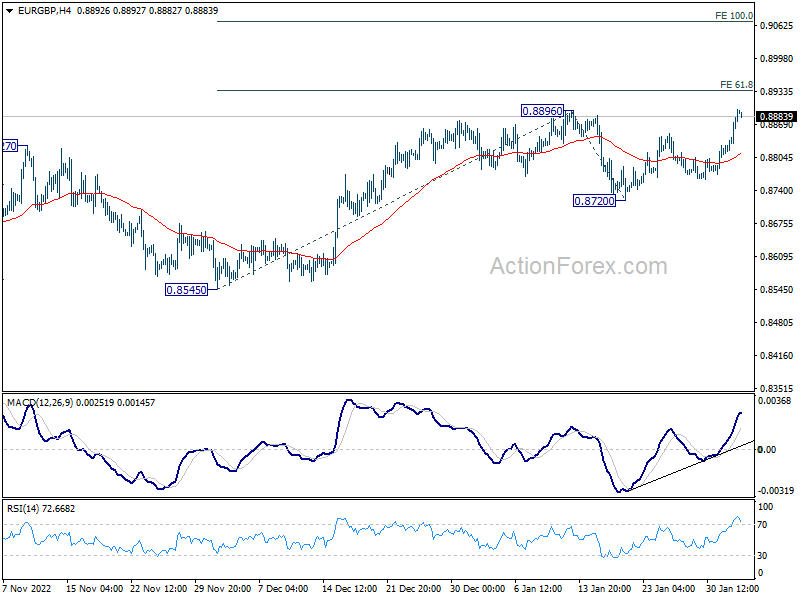
EUR/GBP break through 0.8896 resistance to resume the rise from 0.8545, ahead of the announcements of the two central banks. Further rally is now expected to 61.8% projection of 0.8545 to 0.8896 from 0.8720 at 0.8937. Reaction from there is crucial in determining the underlying momentum. Sustained break should prompt upside acceleration to 100% projection at 0.9071. Rejection by this level will turn near term bias neutral first.
Elsewhere
New Zealand building permits dropped -7.2% mom in December. Australia building permits rose 18.5% mom in December, well above expectation of 1.1% mom. Japan monetary base dropped -3.8% yoy in January, versus expectation of -3.2% yoy. Germany trade surplus narrowed slightly to EUR 10.0B in December.
Looking ahead, Swiss SEO consumer climate will be a feature in the European session. US will release jobless claims, non-farm productivity, and factory orders. Canada will release building permits. But main focuses are of course on BoE and ECB rate decisions.
EUR/USD Daily Outlook
Daily Pivots: (S1) 1.0894; (P) 1.0948; (R1) 1.1043; More…
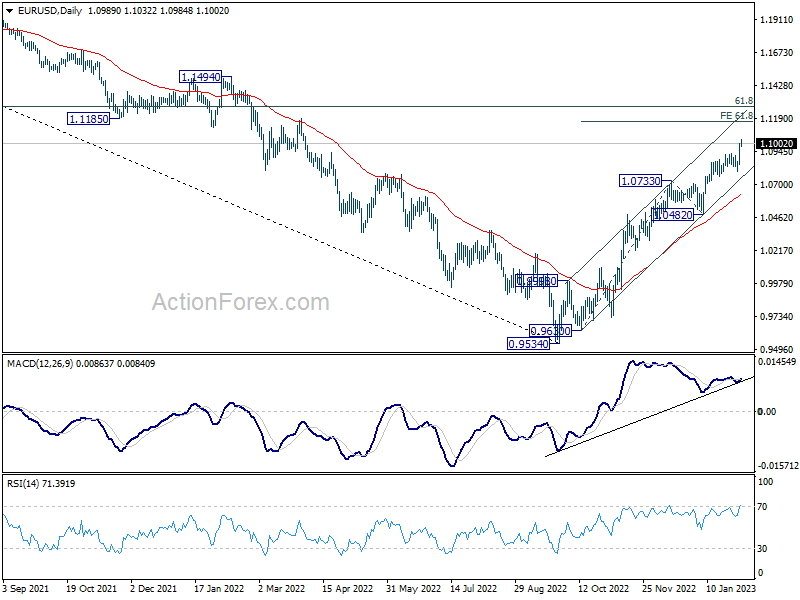
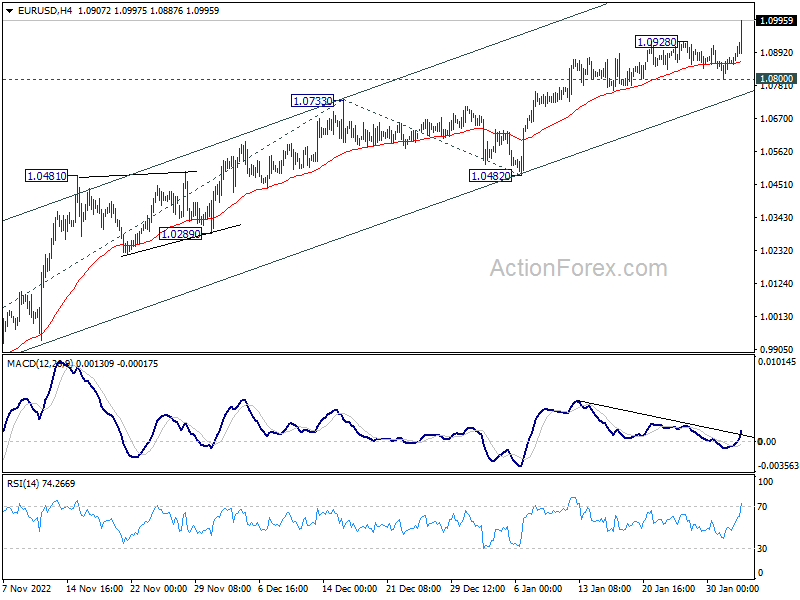
EUR/USD's up trend resumed by breaking through 1.0928 resistance and intraday bias is back on the upside. Current rally from 0.9534 should target 61.8% projection of 0.9630 to 1.0733 from 1.0482 at 1.1164 next. On the downside, break of 1.0800 support is needed to confirm short term topping. Otherwise, outlook will remain bullish in case of retreat.
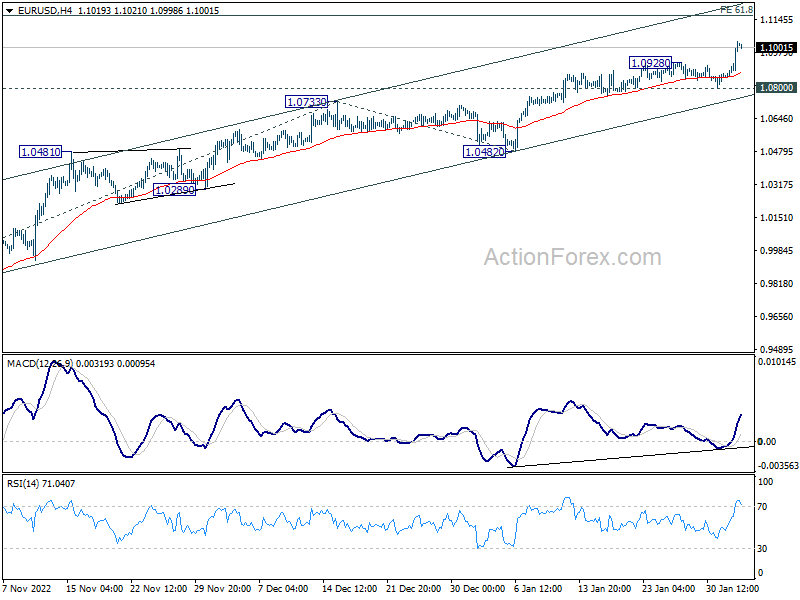
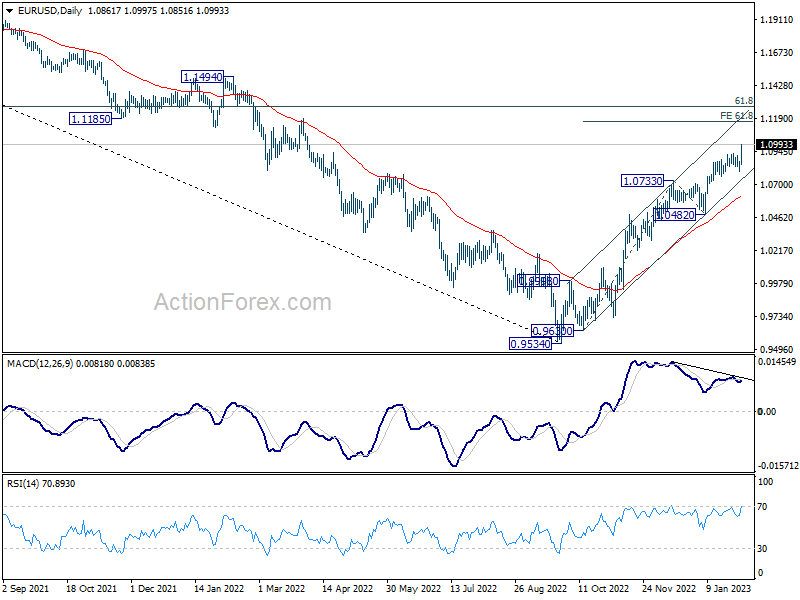
In the bigger picture, current development suggests that the rally from 0.9534 low (2022 low) is a medium term up trend rather than a correction. Further rise is in favor to 61.8% retracement of 1.2348 (2021 high) to 0.9534 at 1.1273 next. This will remain the favored case as long as 1.0482 support holds.
Economic Indicators Update
| GMT | Ccy | Events | Actual | Forecast | Previous | Revised |
|---|---|---|---|---|---|---|
| 21:45 | NZD | Building Permits M/M Dec | -7.20% | 7.00% | 6.70% | |
| 23:50 | JPY | Monetary Base Y/Y Jan | -3.80% | -3.20% | -6.10% | |
| 00:30 | AUD | Building Permits M/M Dec | 18.50% | 1.10% | -9.00% | |
| 07:00 | EUR | Germany Trade Balance (EUR) Dec | 10.0B | 8.8B | 10.8B | 10.9B |
| 08:00 | CHF | SECO Consumer Climate Q1 | -38 | -47 | ||
| 12:00 | GBP | BoE Rate Decision | 4.00% | 3.50% | ||
| 12:00 | GBP | MPC Official Bank Rate Votes | 7--0--2 | 7--0--2 | ||
| 12:30 | USD | Challenger Job Cuts Y/Y Jan | 129.10% | |||
| 13:15 | EUR | ECB Main Refinancing Rate | 3.00% | 2.50% | ||
| 13:30 | USD | Initial Jobless Claims (Jan 27) | 186K | |||
| 13:30 | USD | Nonfarm Productivity Q4 P | 2.50% | 0.80% | ||
| 13:30 | USD | Unit Labor Costs Q4 P | 1.60% | 2.40% | ||
| 13:30 | CAD | Building Permits M/M Dec | 1.50% | 14.10% | ||
| 13:45 | EUR | ECB Press Conference | ||||
| 15:00 | USD | Factory Orders M/M Dec | 2.30% | -1.80% | ||
| 15:30 | USD | Natural Gas Storage | -146B | -91B |
EUR/GBP upside breakout ahead of BoE and ECB, some previews
Two central banks will announce rate decisions today, BoE and then ECB. Currently, the base case is for BoE to hike to bps today to 4.00%, and then another 25bps hike in March, then a pause. Any deviation from that path could trigger much volatility in the Pound. Attention will be on the decision itself, the voting, as well as the new economic projections.
As for ECB, a 50bps hike to 3.00% is widely expect. President Christine Lagarde has been clear that the central bank has to "stay the course". While some policymakers have already indicated the preference for another 50bps in March, that would very much depend on the new economic projections to be released then. So, no matter how firm Lagarde sounds today, there is room for adjustment before the March meeting.
Here are some suggested readings on ECB and BoE:
- ECB Preview: All About Forward Guidance
- Roaring Euro Turns to ECB Rate Decision
- ECB Preview – Set for Another 50bp Rate Hike
- Voting Rotation, Hawkishness and the Next ECB Meeting in Sight
- UK Will Not Avoid Recession Says IMF; What Does this Mean for the Pound?
- BoE Preview: MPC Might Be Split But 50 bp Hike Likely
- Bank of England: One Final 50bps Rate Hike
- Bank of England Preview – Topside Risk to EUR/GBP
EUR/GBP break through 0.8896 resistance to resume the rise from 0.8545, ahead of the announcements of the two central banks. Further rally is now expected to 61.8% projection of 0.8545 to 0.8896 from 0.8720 at 0.8937. Reaction from there is crucial in determining the underlying momentum. Sustained break should prompt upside acceleration to 100% projection at 0.9071. Rejection by this level will turn near term bias neutral first.
NASDAQ completed double bottom, investors responded well to Fed
NASDAQ closed strongly up by 2.00% overnight to close at 11816.31. Fed's 25bps rate hike was well received by investors, with Chair Jerome Powell admitting that “we can now say for the first time that the disinflationary process has started.”
Suggested readings on FOMC:
- An End to the Tightening Cycle is on the FOMC’s Horizon
- FOMC Hikes Rates and Signals Yet More to Come
- FOMC Meeting Recap: Powell Not Hawkish Enough, Traders Price in 50bps of Cuts by EOY
- EUR/USD upside breakout as Fed Powell said disinflationary process has started
- FOMC Hikes Policy Rate by 25 Basis Points, Signals More to Come
NASDAQ's break of 11571.64 resistance completes a double bottom pattern (10088.82, 10207.47). Near term outlook will stay bullish as long as 55 day EMA (now at 11043.84) holds. Next target is 38.2% retracement of 16212.22 to 10088.82 at 12427.95.
It's still a bit early to tell if NASDAQ is in correction to the down trend from 16212.22, or in bullish reversal. Key level lies in 13181.08 cluster resistance, 50% retracement at 13150.52. Reactions from there will reveal which case it is.
Bitcoin Price Climbs Above $24K After Fed Raised Rates by 25bps
Key Highlights
- Bitcoin price started a fresh increase above the $23,000 resistance.
- A key bullish trend line is forming with support near $23,150 on the 4-hours chart.
- Gold price rallied above the $1,950 resistance after the fed raised rates by 25 bps.
- Crude oil price is moving lower below the $80 support.
Bitcoin Price Technical Analysis
Bitcoin price formed a base and started a fresh increase above $23,000 resistance. BTC/USD surpassed key hurdles near $23,500 to move into a positive zone.
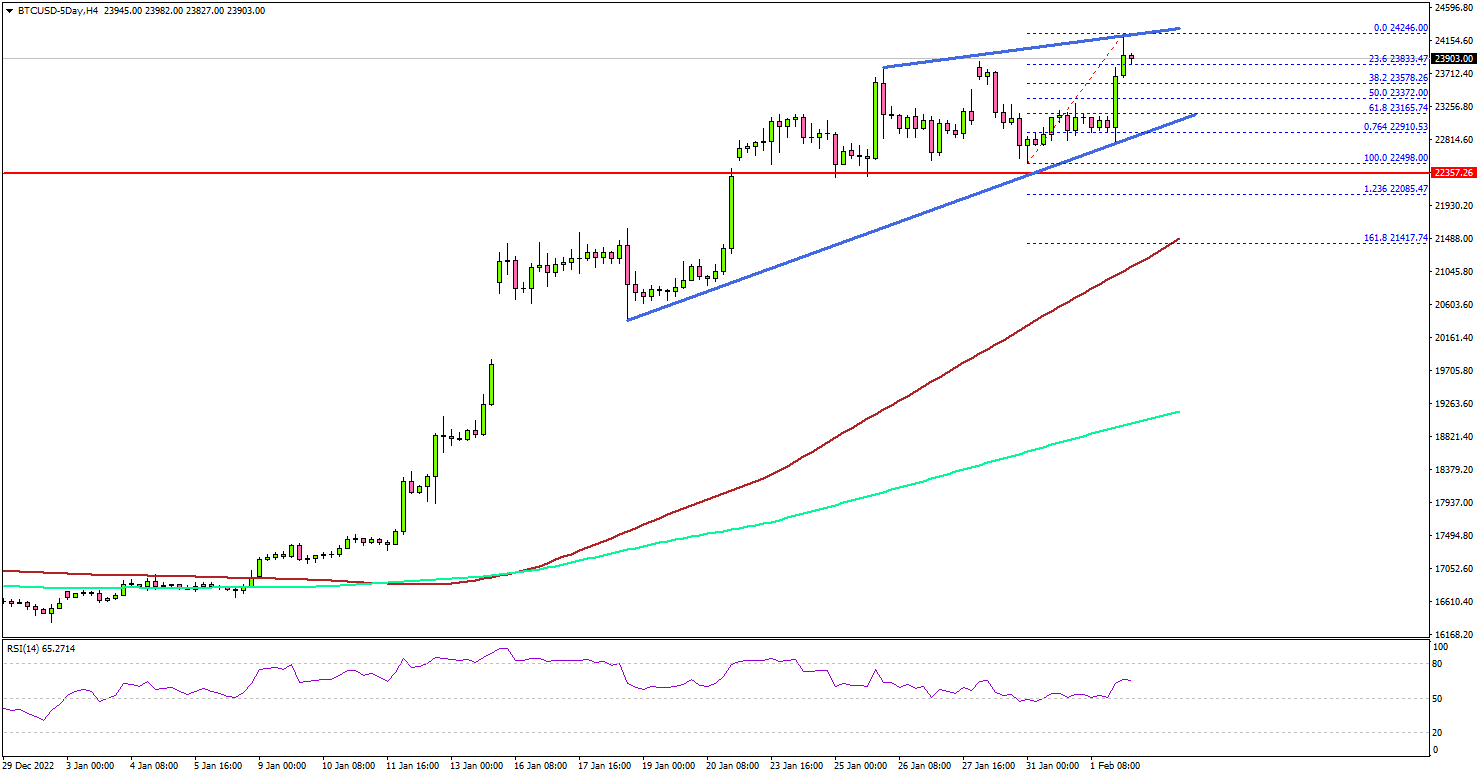
Looking at the 4-hours chart, the price traded above the $23,800 resistance, the 200 simple moving average (green, 4-hours), and the 100 simple moving average (red, 4-hours).
There was also a spike above the $24,000 resistance level after the Federal Reserve raised its benchmark rate by a quarter point. It pumped bitcoin and gold above key hurdles. BTC was able to move further into a positive zone and traded to a new yearly high at $24,246.
It is now showing a lot of positive signs and might rise further above $23,250. The next resistance sits near the $24,500 zone. A close above the $24,500 level may perhaps start another steady increase in the coming sessions.
In the stated case, the price could rise towards the $25,500 level. Any more gains could set the pace for a move towards the $26,000 level.
On the downside, an initial support sits near the $23,650 level. The main breakdown support sits near the $23,000 zone. If there is a downside break and close below $23,000, bitcoin might start another decline in the coming days. In the stated case, it could revisit the $21,500 support or even test $20,000.
Economic Releases
- BoE Interest Rate Decision - Forecast 4%, versus 3.5% previous.
- US Initial Jobless Claims - Forecast 200K, versus 186K previous.
S&P 500 (SPX) Bullish Elliott Wave Sequence Favors Upside
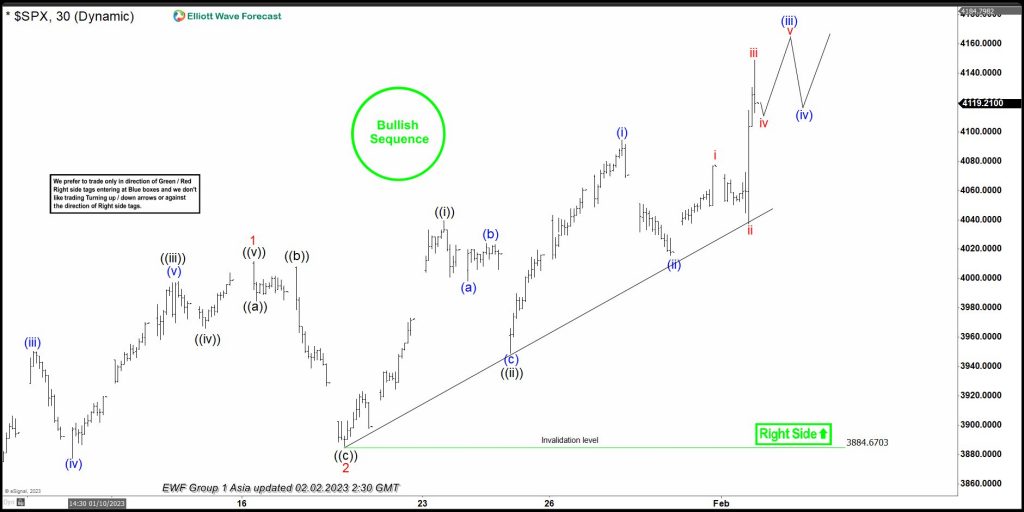
S&P 500 (SPX) showing short term bullish Elliott wave sequence against October-2022 low. It proposed ended wave II correction at 10/13/2022 low of 3528.7 against daily sequence. Above there, it placed (1) at 4087.3 and (2) at 3764.5 low on 12/22/2022. It confirms higher high bullish sequence above (1) high, calling for further strength to continue. It placed wave 1 at 4011.54 high and 2 at 3885.54 low. Within wave 1, it favored ended ((i)) at 3846.65 high and ((ii)) at 3780.78 low. Above there, it placed ((iii)) at 3997.76 high as extended wave. It placed ((iv)) at 3965.95 low as shallow correction. Finally it ended ((v)) at 4011.54 high as wave 1 in (3) sequence and ended wave 2 as 0.5 Fibonacci retracement against wave 1 at 3885.54 low. Above wave 2 low, it confirms higher high sequence as the part of wave 3 of (3).
It placed ((i)) of wave 3 at 4039.31 high and ((ii)) at 3949.06 low as 0.618 Fibonacci retracement of wave ((i)). Currently, it favors higher in ((iii)) of 3. It favored ended (i) of ((iii)) at 4094.21 and (ii) at 4015.55 low as 0.5 Fibonacci retracement of wave (i). It is showing nest structure in wave 3 and expect to more strength to continue, while dips remain above (ii) low. In wave (iii) of ((iii)), it favors pullback in wave iv before final push higher to finish it. It placed wave i at 4077.16 high, ii at 4037.20 low and wave iii of (iii) at 4148.95 high. As long as price remains above (ii) low, it should see more upside as the part of nest within wave 3 and expect further strength. Alternatively, if it breaks below 4015.55 or 3949.06 low, it still can be either in ((ii)) or wave 2 correction and expect upside to continue later against 12/22/2022 low. It is showing bullish sequence and expect to remains supported in 3, 7 or 11 swings pullback to resume higher.
SPX 30-minute Elliott Wave Chart
An End to the Tightening Cycle is on the FOMC’s Horizon
While rates are likely to remain at peak to end-2023 to guard against inflation risks, this FOMC hiking is nearing an end.
At their January meeting, the FOMC returned to its customary pace of tightening following 2022’s extraordinary moves, increasing the fed funds rate by 25bps to a mid-point of 4.625%. Also as anticipated, the Committee held firm to their cautious approach with respect to inflation and financial conditions, making only marginal changes in the decision statement.
On the labour market, job gains continue to be characterised as “robust”. For activity, growth is assessed as “modest”. Together these views suggest the FOMC remains sanguine on the outlook, expecting a slowdown not a contraction or recession.
Two small but significant changes were made to the statement with respect to inflation and the policy outlook, however.
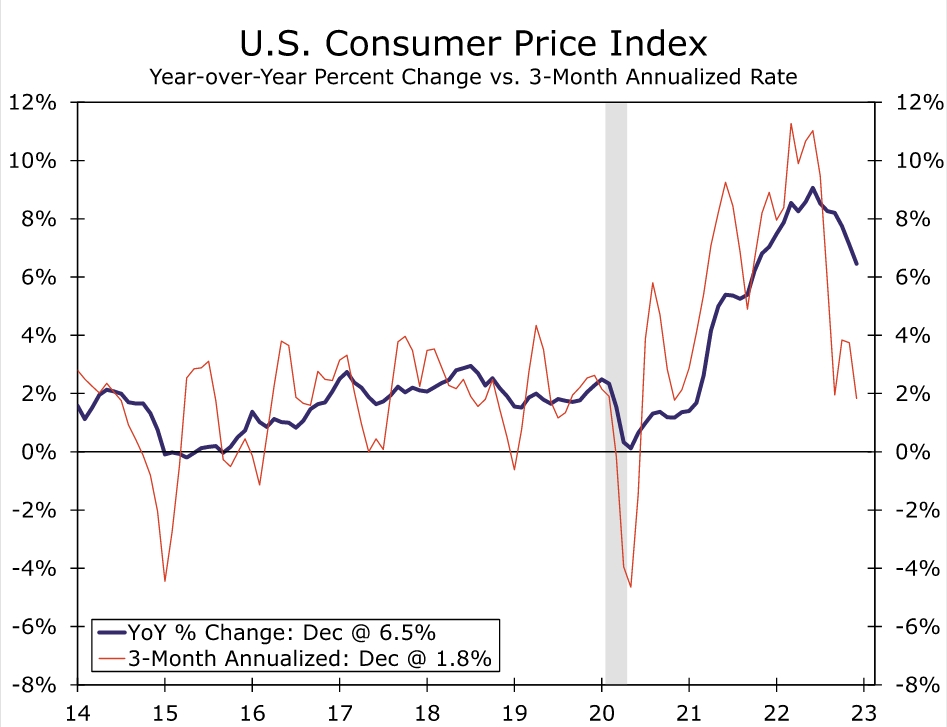
With annual CPI inflation having decelerated from 9%yr to close to 6%yr between June and December 2022, and we might add now with a six-month annualised pace of 2%, inflation was seen by the Committee as having “eased somewhat” while remaining “elevated”.
Interestingly, in the statement, no distinction was made between supply and demand factors or domestic versus global pressures. This could simply be because the Committee remains focused on total inflation, or it may be due to the inflation data from late-2022 signalling a staged but increasingly broad-based deceleration in inflation (more on this below).
The other change of significance is the focus now being on the “extent of future increases” rather than the “pace” of tightening at December. This small adjustment points to an end of the tightening cycle being near, although the continued use of the “Committee anticipates that ongoing increases in the target range will be appropriate” implies that the baseline peak fed funds expectation of the Committee remains 5.1%, as per their December meeting forecasts, 25bps higher than both the market’s and Westpac’s expectation.
Chair Powell’s remarks in Q&A were balanced overall, characterising the labour market as extremely tight while also recognising the material slowing in wage growth, this week confirmed by the December quarter Employment Cost Index. The discussion during Q&A regarding inflation inferred that the Committee believe the disinflation seen to date has been limited to goods; though the downtrend in market measures of rents is clearly pointing to an eventual easing in housing pressures.
On the other hand, Chair Powell remains concerned that services inflation (which he notes is 56% of core PCE) has not eased. While the FOMC’s mandate is headline PCE, services inflation will be the key signal for markets to watch. A slowdown in wage inflation is promising, but the risk is that services inflation, being impacted by a range of variables in addition to wages, holds up for longer than the market is expecting.
The Q&A discussion of the policy outlook was also finely balanced, with Chair Powell signalling the Committee has more to do, but also that financial conditions are now restrictive, with real interest rates positive across the curve. Further, the policy outlook was reportedly discussed in depth at this meeting. The Minutes will provide detail in due course, though note that updates to Committee forecasts will not be made until the March meeting.
Overall, we remain of the view that the FOMC is most likely to end this tightening cycle at the March meeting with one further 25bp hike before going on hold at 4.875% for the remainder of 2023. However, depending on developments in financial conditions and services inflation, they may feel a need to continue the current pace of tightening to the May meeting.
Regardless, the market is likely to remain focused on the timing and scale of the easing cycle to come, particularly with incoming data pointing to a stagnating economy with building downside risks for activity. To conclude, there was some encouragement for the market’s expectation that the easing cycle could come this year, with Chair Powell recognising that, if inflation fell significantly faster than the FOMC currently expect, the case for an earlier easing was credible.
FOMC Hikes Rates and Signals Yet More to Come
Summary
- As universally expected, the FOMC raised its target range for the federal funds rate by 25 bps at the conclusion of its policy meeting today. But the tightening cycle likely is not over yet as the FOMC noted that it "anticipates that ongoing increases in the target range will be appropriate."
- The FOMC said that "inflation has eased somewhat," which Chair Powell reiterated in his post-meeting press conference. But he also noted that the Committee "has more work to do" in terms of monetary tightening to bring inflation back to the FOMC's target of 2% on a sustained basis. Powell also stated that policy will need to be restrictive for some time.
- We look for the FOMC to hike the fed funds target rate by 25 bps each at its next two policy meetings. That said, we do not have a high level of conviction regarding the exact amount of tightening that the Committee will need to deliver. The FOMC is in the fine-tuning stage of its tightening cycle, and future rate hikes will depend on incoming data in coming weeks and months.
- We have a higher degree of conviction around our belief that policy will need to remain restrictive for quite some time to bring inflation back to 2%. We forecast that the FOMC will not begin easing policy until early 2024.
- Stock and bonds rallied after Powell said that the disinflationary process appears to have started without any material weakening in the jobs market. It appears that market are buying into (hoping for?) the "soft landing" scenario.
"We Have More Work To Do"
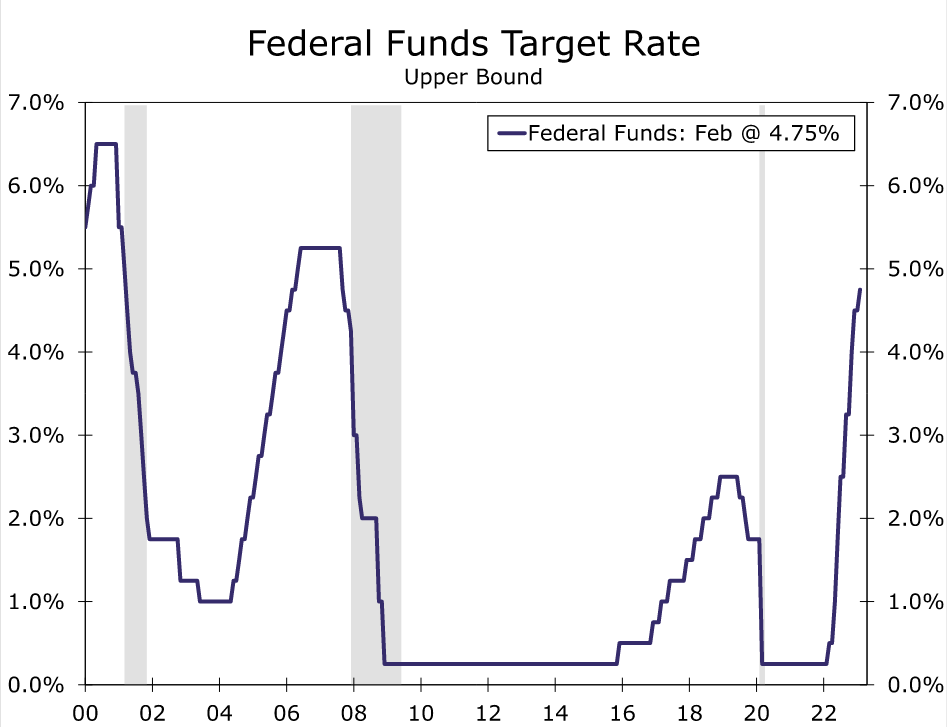
As universally expected, the Federal Open Market Committee (FOMC) unanimously agreed to raise its target range for the federal funds rate by 25 bps at the conclusion of its policy meeting today. The target range is now 4.50%-4.75%, which is 450 bps higher than where it was when the FOMC started its tightening cycle last March (chart).
In announcing today's move, the Committee noted that growth in spending and production appears to have been "modest" recently. Despite "modest" growth, "jobs gains have been robust in recent months, and the unemployment rate has remained low." In short, the labor market remains tight in the Committee's view. The statement noted that "inflation has eased somewhat." The use of the verb "ease" is an acknowledgement of the deceleration in the consumer price index that has occurred in recent months on both a headline and core basis (chart). That said, the Committee chose to qualify "ease" with "somewhat," and the statement continues to state that inflation remains elevated. In short, it would be premature to declare victory over inflation. In his post-meeting press conference, Chair Powell noted that the disinflationary process has started, but he also said that there are some sectors, notably in the broad service sector, where the Fed is not yet seeing signs of price moderation. Indeed, Powell explicitly stated that "we have more work to do."
Policy Will Need To Be Restrictive For Some Time
The policy statement continued to note that "The Committee anticipates that ongoing (emphasis ours) increases in the target range will be appropriate in order to attain a stance of monetary policy that is sufficiently restrictive to return inflation to 2 percent over time." This sentence is a clear indication that further tightening likely lies ahead. In that regard, the FOMC authorized the continued reduction in the size of the Fed's balance sheet via the roll-off of up to $60 billion worth of Treasury securities per month and up to $35 billion worth of mortgage-backed securities. Shrinkage in the size of the Fed's balance sheet acts as another form of monetary tightening.
We look for the FOMC to hike the fed funds rate by 25 bps at each of its next two meetings on March 22 and May 3, which would bring the target range for the fed funds rate to 5.00%-5.25%. That said, we do not have a high level of conviction regarding the exact amount of further tightening that the FOMC will deliver. The Committee is in the fine-tuning stage of its tightening cycle, and the number of remaining rate hikes will depend on incoming economic data in coming weeks and months. We have a higher degree of conviction, however, in our belief that the FOMC will not be quick to ease policy. Committee members appear to be united in their view that inflation remains too high, and that policy will need to be restrictive in order to bring inflation back to the FOMC's target of 2% on a sustained basis. In his press conference, Powell characterized the labor market as "extremely tight," and he stated that policy will need to be "restrictive for some time (emphasis ours)." Although the end of the FOMC's tightening cycle may be pulling into sight, after another rate hike or two, we believe there is a long way to go before the Committee begins to ease policy. In that regard, we do not look for rate cuts to begin until early 2024.
We look for the U.S. economy to slip into a mild recession this year, although we acknowledge that the Fed could potentially still pull off a "soft landing" in which inflation returns to 2% without a significant retrenchment in the labor market. In that regard, stocks and bonds rallied on Powell's comment that the disinflationary process has started without notable weakening in the labor market. It appears that markets are increasingly buying into (hoping for?) the "soft landing" scenario.
EUR/USD upside breakout as Fed Powell said disinflationary process has started
US stocks staged a reversal while EUR/USD broke out to the upside on Fed Chair Jerome Powell's post meeting press conference.
Powell did note that “Inflation is not over, and neither is the Fed’s battle against it.” However, he also mentioned, “we can now say for the first time that the disinflationary process has started."
“It is a good thing that the disinflation that we have seen so far has not come at the expense of the labor market,” he also said.
Without any drastic surprises, Fed seems on track to pause tightening with two more 25bps rate hike.
EUR/USD breaks 1.0928 resistance decisively to resume the up trend from 0.9534. Near term outlook will remain bullish as long as 1.0800 support holds, in case of retreat. Next target is 61.8% projection of 0.9630 to 1.0733 from 1.0482 at 1.1164. The real test will lie in resistance zone between 1.0482 and 61.8% retracement of 1.2348 (2021 high) to 0.9534 at 1.1273. Attention should be paid to topping signal inside this 1.1164/1273 resistance zone.
FOMC Hikes Policy Rate by 25 Basis Points, Signals More to Come
The Federal Reserve Open Market Committee (FOMC) lifted the federal funds rate to the 4.5% to 4.75% range and will continue its balance sheet runoff.
The Fed kept its characterization of growth and the labor market unchanged – growth is modest and job gains have been robust. But, it updated its language on inflation to "Inflation has eased somewhat but remains elevated."
On the future path of policy, it "anticipates that ongoing increases in the target range will be appropriate in order to attain a stance of monetary policy that is sufficiently restrictive to return inflation to 2 percent over time."
All of the members of the FOMC voted in favor of the decision.
Key Implications
The Fed has once again slowed the pace of rate hikes as it attempts to digest the evolution of incoming economic data. With sentiment measures falling and consumer spending starting to slow, momentum points to economic weakness in the months ahead. At the same time, inflation has continued to improve. Given the current pace, core PCE inflation is likely to trend below 3% by the second half of this year.
Recent Fed speeches have shown that members want rates at 5%+ in order to ensure inflation is headed towards the 2% target. We will hear from Chair Powell shortly, but all signs are pointing to another 25 basis-point hike in March. How many more hikes after that is hotly debated. Though we think incoming economic data will slow enough for the Fed to move to the sidelines, it has remained steadfast in its bias towards higher and higher rates.