

Sample Category Title
EUR/USD Daily Outlook
Daily Pivots: (S1) 1.0818; (P) 1.0846; (R1) 1.0891; More…
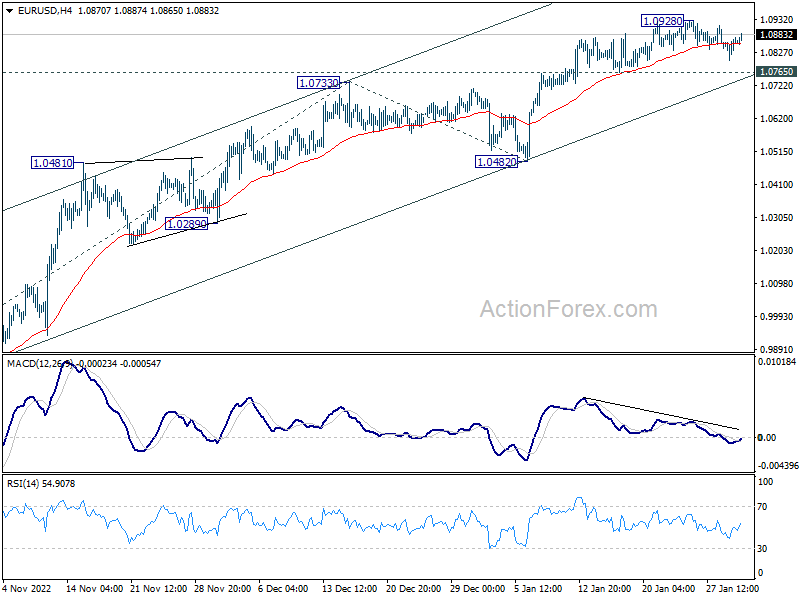
Intraday bias in EUR/USD remains neutral as sideway trading continues in very tight range. With 1.0765 support intact, further rally remains in favor. On the upside, break of 1.0928 will resume larger rise to 61.8% projection of 0.9630 to 1.0733 from 1.0482 at 1.1164 next. On the downside, though, break of 1.0765 support should now confirm short term topping, and turn bias back to the downside for 55 day EMA (now at 1.0601).
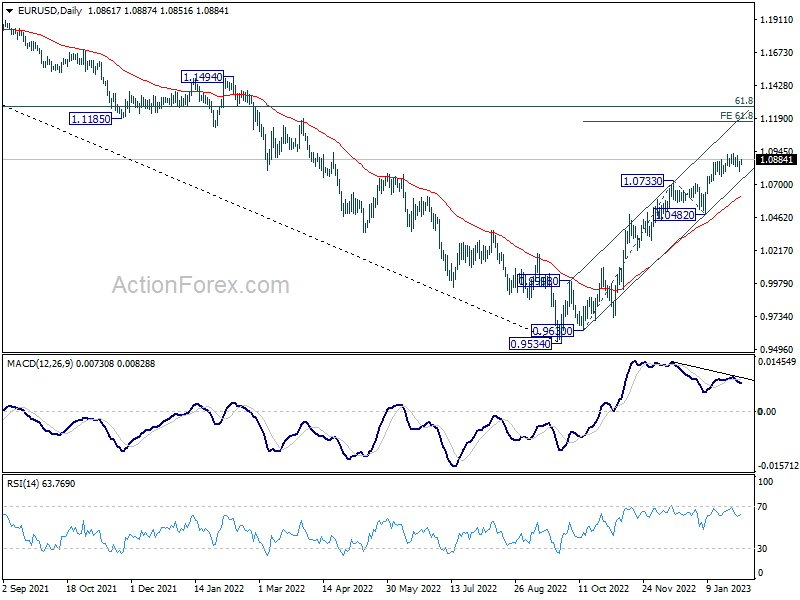
In the bigger picture, current development suggests that the rally from 0.9534 low (2022 low) is a medium term up trend rather than a correction. Further rise is in favor to 61.8% retracement of 1.2348 (2021 high) to 0.9534 at 1.1273 next. This will remain the favored case as long as 1.0482 support holds.
GBP/USD Daily Outlook
Daily Pivots: (S1) 1.2278; (P) 1.2325; (R1) 1.2365; More…
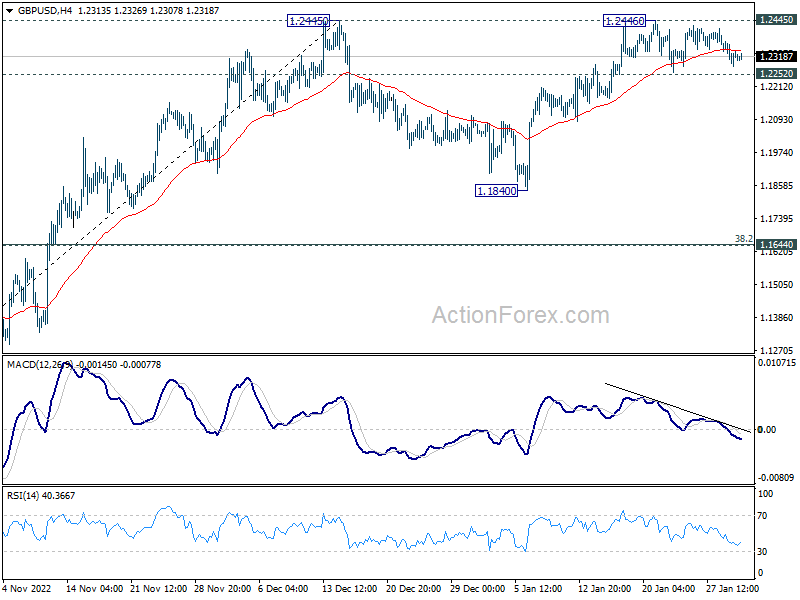
Intraday bias in GBP/USD remains neutral at this point as range trading continues. On the downside, firm break of 1.2252 minor support will turn bias to the downside, and extend the corrective pattern from 1.2445 with another falling leg. On the upside, decisive break of 1.2445 will confirm resumption of whole rise from 1.0351. Next target will be 1.2759 fibonacci level.
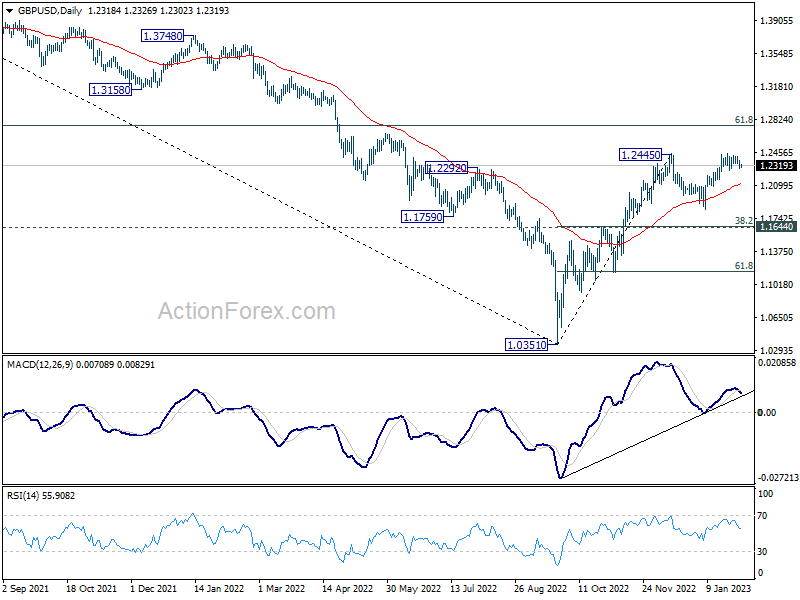
In the bigger picture, rise from 1.0351 medium term bottom is at least correcting whole down trend from 1.4248 (2021 high). Further rise is expected as long as 1.1644 resistance turned support holds. Next target is 61.8% retracement of 1.4248 to 1.0351 at 1.2759. Sustained break there will pave the way back to 1.4248.
USD/JPY Daily Outlook
Daily Pivots: (S1) 129.73; (P) 130.13; (R1) 130.51; More…
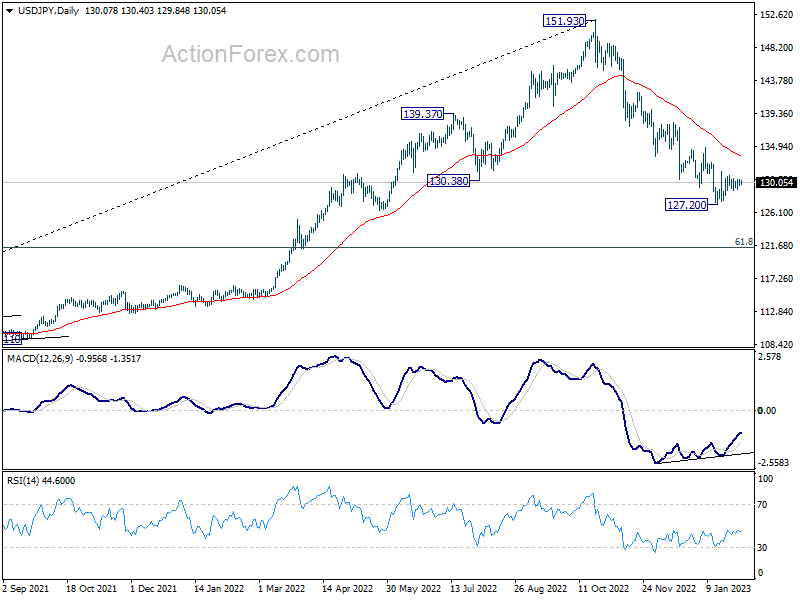
Intraday bias in USD/JPY remains neutral for the moment as range trading continues. On the downside, break of 127.20 will resume the whole decline from 151.93 and target 121.43 fibonacci level. Nevertheless, on the upside, break of 131.56 resistance should confirm short term bottoming, and turn bias back to the upside for stronger rebound to 55 day EMA (now at 133.61) and possibly above.
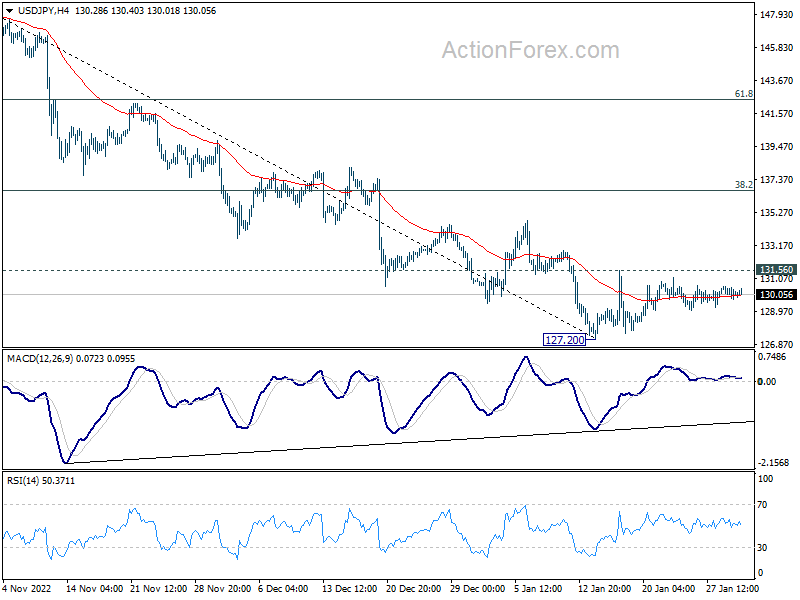
In the bigger picture, the break of 55 week EMA (now at 131.39) raises the chance of medium term bearish reversal, but that’s not confirmed yet. Strong support could be seen around 61.8% retracement of 102.58 to 151.93 at 121.43 and 38.2% retracement of 75.56 to 151.93 at 122.75 to bring rebound. But break of 131.56 resistance is needed to indicate bottoming first. Otherwise further fall will remain in favor.
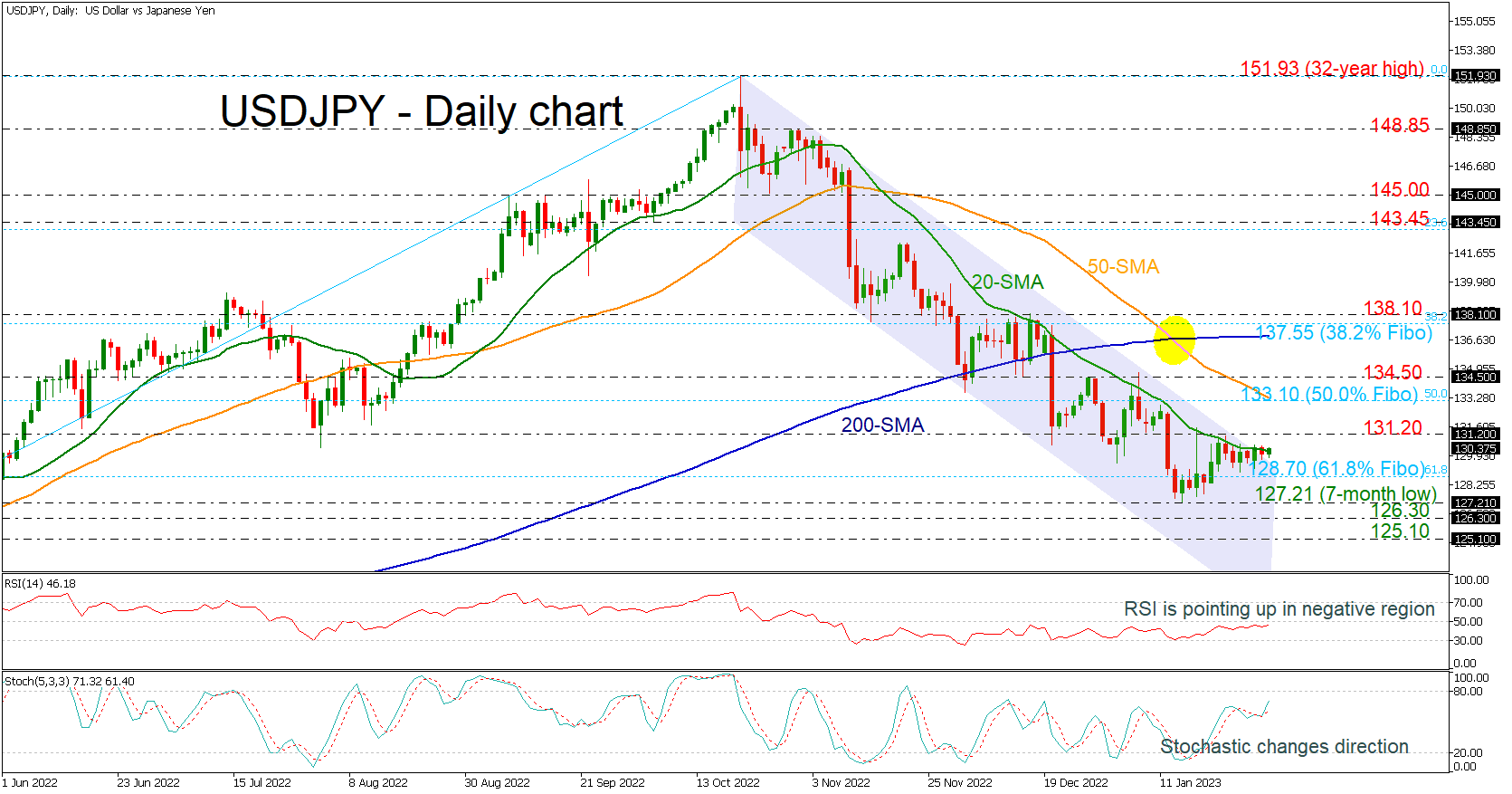
USDJPY Lacks Clear Direction in Near Term; Neutral Bias
USDJPY has been moving sideways over the last week, holding within the 61.8% Fibonacci retracement level of the upward wave from 114.64 to 151.93 at 128.70 and the 131.20 resistance level. The pair exited from the medium-term downward sloping channel but the momentum is too weak to support more gains.
Regarding the technical oscillators, the RSI is pointing marginally up in the negative territory, while the stochastics posted a bullish crossover within its %K and %D lines, approaching the overbought region.
Should the price retreat, the 61.8% Fibonacci at 128.70 which the bears were unable to break this week could provide immediate support. Moving lower, the focus will shift to the seven-month low of 127.24 ahead of the 125.10-126.30 area.
In the alternative scenario, traders would be eagerly looking for a break above 131.20 to increase buying orders. If that’s the case, the rally could last until the 50.0% Fibonacci at 133.10, which overlaps with the 50-day simple moving average (SMA). If bullish forces appear even stronger, the 134.50 mark and the 200-day SMA at 136.85 could be another resistance to keep in mind.
All in all, USDJPY is lacking direction in the short-term timeframe; however, in the bigger outlook the market is still bearish.
FTSE 100 Seeks Support
The FTSE 100 treads water ahead of major central bank decisions. The RSI’s double top in the overbought zone is a sign of overextension and the index needs to consolidate after reclaiming last year’s top at 7670. The confluence of a former resistance and the 30-day moving average makes it an important level to gauge the strength underpinning the rally. An oversold RSI on the hourly chart may attract bargain hunters. 7560 is another support in case of a deeper correction. 7800 is the first hurdle before a rebound could gain traction.
NZD/USD in Corrective Mode
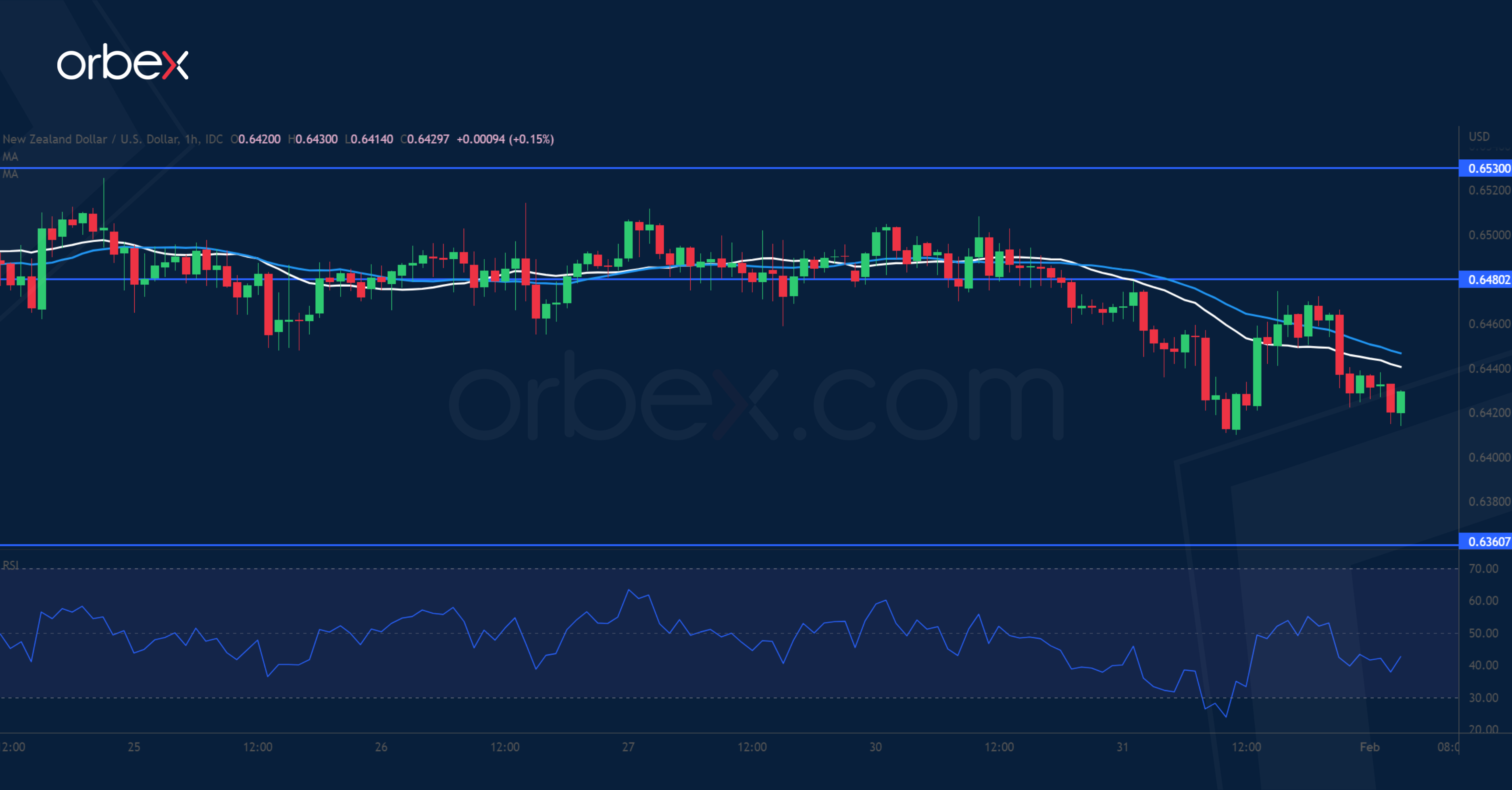
The New Zealand dollar dips as the Q4 unemployment rate disappoints. The pair has been grinding the recent of 0.6530 without success and a break below 0.6440 may prompt some bulls to look for the exit. As the kiwi strives to maintain its lead after clearing 0.6500 on the daily chart, 0.6360 over the 30-day moving average is a key level to expected follow-up interest. The support-turned-resistance at 0.6480 is the first barrier to lift before the uptrend could resume. Otherwise, the gate would be open for a drop below 0.6300.
USD/CAD Gives Up Gains
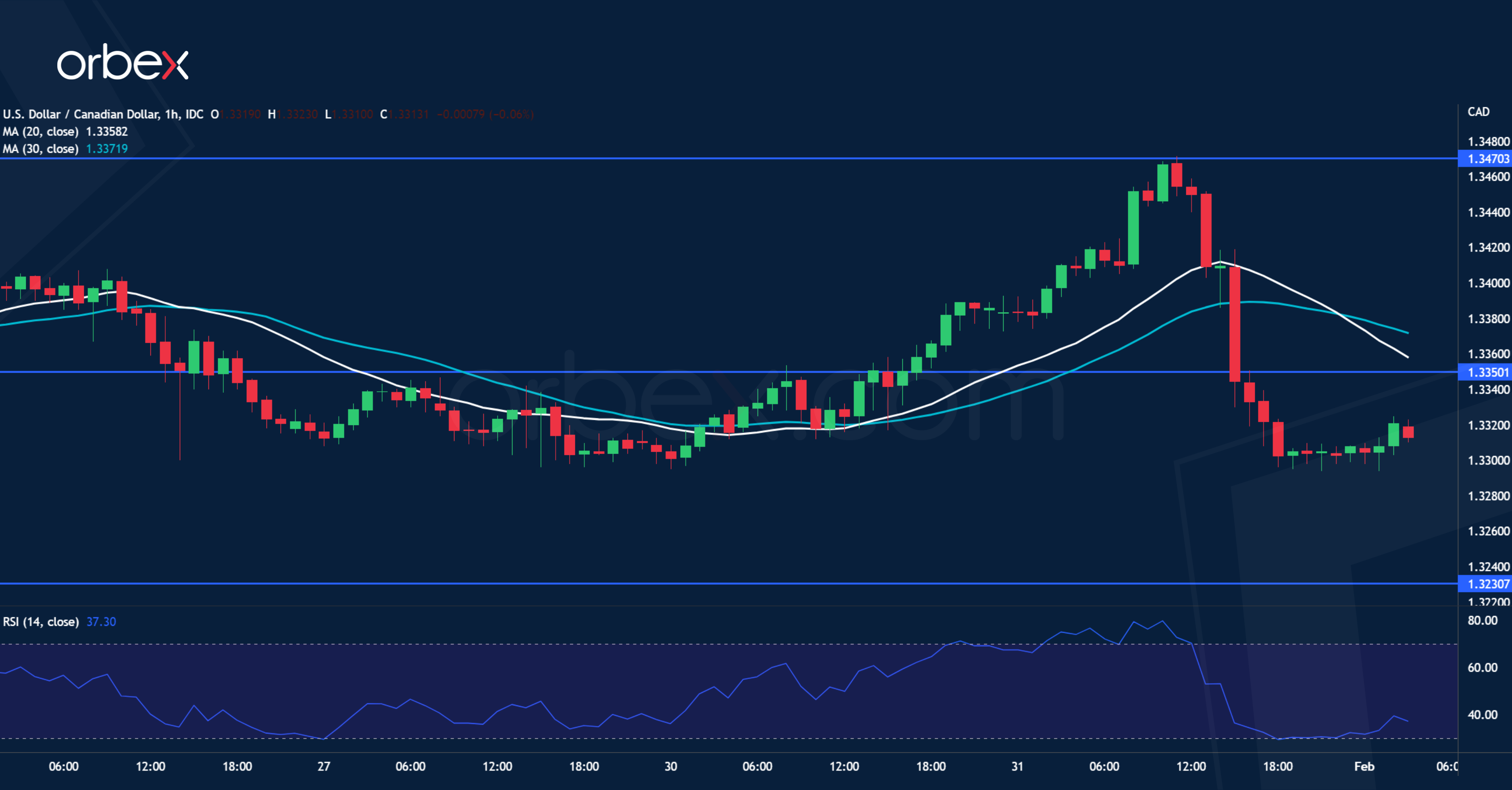
The Canadian dollar recouped losses after November’s GDP beat expectations. On the daily chart, the pair is still in a flag consolidation. A break above the previous resistance of 1.3400 eased some pressure but was not enough to clear the supply zone between 1.3470 and 1.3500. A sharp reversal below 1.3380 then 1.3300 reveals that the bears are still in control of the price action. November’s swing low at 1.3230 is a critical support as the RSI drops into oversold territory. 1.3350 is the immediate resistance.
Fed Expected to Downshift Tightening Pace Again
Markets
The build-up to a Fed decision usually brings lackluster trading. This time around, things might be different. For starters because of the January EMU CPI release. Spanish and Belgian data on Monday triggered a market reaction as headline inflation didn’t or didn’t fell as fast as expected while core readings keep setting all-time highs. French CPI printed in line with forecasts, but delayed German numbers (to next week because of technical reasons) imply more uncertainty than usual around the EMU number. Consensus expects headline CPI rising by 0.1% M/M with the Y/Y-reading down to 8.9% from 9.2%. Core CPI is forecast to moderate from 5.2% Y/Y to 5.1% Y/Y. We believe that risks are tilted to the upside of expectations. In such scenario, bonds will sell off with Bunds underperforming. EUR/USD’s performance is more linked to risk sentiment. The US eco calendar contains ADP employment change and manufacturing ISM. Ever since the Fed first indicated the possibility of downshifting from 75 bps rate hikes to a slower pace (early November 2022), (US) markets have been reacting asymmetric to data releases – picking out every argument in favour of downshifting/ending the tightening cycle all together. In the run-up to tonight, we expect this reaction function to hold. Consensus expects again decent job growth (180k) with the manufacturing ISM sliding somewhat further in contractionary territory (48 from 48.4). Over the past decades, such levels often turned out to be bottom levels in case of growth slowdowns/mild recessions. Only in real crisis years (eg dotcom, GFC, Covid) did the manufacturing ISM drop much deeper.
The Fed is expected to downshift its tightening pace again from 50 bps to 25 bps, bringing the policy rate at 4.5%-4.75%. Several governors argued in favour of doing so, though some stuck to the view to get to a peak level (5-5.25% as per December dots) as fast as possible, allowing for a pause afterwards. This would suggest a 50 bps hike tonight followed by a (conditional) last one in March when new growth/inflation forecasts and dot plot are available. It would probably need to show in the policy statement which for months now says that “the Committee anticipates that ongoing increases (emphasis added) in the target range will be appropriate in order to attain a stance of monetary policy that is sufficiently restrictive to return inflation to 2% over time”. Only dropping this reference while simultaneously delivering only a 25 bps hike could trigger a (bond) rally at the front end of the curve. We don’t believe in that outcome as too many (conflicting) factors remain at play: lower (headline) inflation vs tight labour market & wage pressure, weaker growth dynamics vs looser financial conditions,… . In all other scenarios, we expect the US yield curve to invert further via an underperformance of the front end. This should help the dollar above recent support levels (eg EUR/USD 1.0941) while weighing on risk sentiment as well as the other two scenario’s (50-25-pause) or (25-25-25-pause?) are not discounted in US money markets (peak rate 4.75-5%). Apart from how to get to the peak, we expect Powell to talk markets out of the idea of rate cuts in the second half of the year.
News and views
The British Retail Consortium (BRC) said this morning that UK shop prices in January rose by 0.7% M/M and 8% Y/Y, the fastest pace since at least 2006. The cost of fresh food remains a major contributor (0.7% M/M and 15.7% Y/Y). Broader food prices gained 1.3% M/M and 13.8% Y/Y. The cost of non-food items rose by 0.3% M/M and 5.1%Y/Y. In a comment, BRC Chief Dickinson indicated that price rises might not have peaked yet as retailers still have to cope with the pass through of rising energy bills while facing labour shortages. The data are a final piece of info before the BoE decides on its policy rate tomorrow. A 50 bps rate hike is widely expected.
The New Zealand labour market remains tight. The unemployment rate was 3.4% in December, up from 3.3% in September and holding near its historic low. Actual hours worked increased 3.6% last year as the number of people employed rose 1.3%. At 71.7%, the participation remained at the highest level since 1986. Salaries and wages as measures in the labour cost index rose 4.1% Y/Y in December, the highest levels since the series began in 1992. Average hourly earnings were up 7.2%, the second highest on record. The data were slightly softer than the RBNZ forecast in its November policy report. The NZ central bank raised its policy rate by 75 bps in November and signaled further increases. Markets expect a downshift to 50 bps, with the peak priced near 5.2% (vs RBNZ guidance at 5.5%).
Will Easing Inflation and Slower Wages Get the Fed Closer to Pause?
Weak economic data ran to the rescue of the equity bulls on Tuesday.
The Federal Reserve (Fed) President Jerome Powell will be thrown to the spotlight today, to potentially shoot a couple of doves down to the ground.
But there is always a hope that the falling price and wages inflation will get the Fed to the pivot point.
Weak wages inflation
January ended on a positive note, as the new set of economic data from the US helped investors brushing off the fear of a hawkish Fed.
The employment cost index, which is the Fed’s favourite gauge of wage inflation, slowed more than expected in Q4, to 1% from 1.2% a quarter earlier, compared with the 1.1% penciled in by analysts, and from the 1.4% peak announced for the Q1 of last year.
So, it is happening. US inflation is coming lower, and wages are growing slower – and other economic data, including the PMI indices continue pointing at a slowing economy, but without warning of recession.
In this sense, IMF also revised its growth outlook slightly higher for this year, and the Chinese reopening, along with the resilience of the US spending were the major reasons for the latest optimism.
As a result of weak economic data that helped the Fed doves get overt their Powell fear, the S&P500 rallied almost 1.50%, while Nasdaq jumped more than 1.50%.
What does Powell make of it?
The Fed is expected to raise its interest rates by 25bp today, but unlike Canada, the Fed will certainly not announce the end of the tightening cycle today.
Jerome Powell will certainly sound satisfied about the falling inflation and slowing wages, but he will likely point out that inflation remains high, risks to inflation remain to the upside, and that the job is not done yet.
He will surely push back the expectation of any rate cut this year.
Hawkish accompanying statement could boost the US dollar, and weigh on equities.
On the data front, the ADP report is expected to print a number below 200’000, while the JOLTS job openings will likely remain above 10 mio.
And that’s enough for the Fed to conclude that the jobs market is still too tight to stop tightening its policy.
In the FX
The US dollar failed to consolidate and extend gains as the weaker economic data keeps strengthening the Fed doves’ hands. While Powell could rectify sentiment and give a boost to the greenback today, gains in the dollar may not last long, and the dollar could see a strong top selling for a deeper downside correction toward the 100 mark.
The EURUSD eased as low as 1.08 yesterday, but the pair found buyers on the back of a strong looking GDP data from the Eurozone. The zone grew 0.1% last quarter, versus the 0.1% contraction expected by analysts. The headline figure was good, but the fact that German growth slowed, and the growth surprise was mostly explained by tax avoidance in Ireland still left a metallic taste in investors’ mouths.
Anyway, that will certainly not change the European Central Bank’s (ECB) decision to hike by 50bp this week. Whether a 50bp hike will be enough to send the EURUSD to 1.10 depends on what Jerome Powell will say, however.
Elsewhere, today’s PMI data from China, released by Caixin, were not as rosy as the one compiled by China Federation and released yesterday. The Caixin manufacturing index remained in the contraction zone, and more importantly, the slowdown was faster than the market expectations. Meaning that the Chinese manufacturing contracted more than what analysts expected. But again, give it some time! The period into the Chinese New Year is always a bit depressed in China.
American crude tipped a toe below the 50-DMA yesterday, as the API data revealed another big build in US inventories last week. US inventories grew by more than 6 mio barrels last week. Gasoline inventories rose by almost 3 mio barrels.
The more official EIA data is due today, and the expectation is a 1 mio barrel decline, leaving room for further weakness in oil prices.
Euro Area Inflation Data as an Appetizer Ahead of FOMC Tonight
Market movers today
The main event today will be the FOMC meeting. Anything but a 25bp hike would be a major surprise, and the focus will be on guidance about the terminal rate level. We expect the communication to be on the hawkish side, markets price in cumulative 58bp worth of hikes by next June while we look for three consecutive 25bp hikes, which would take the Fed Funds rate to 5.00-5.25% by May. See our Fed preview (24 January).
Ahead of the FOMC meeting, we also have a range of tier-1 data releases coming up. The preliminary Spanish and French inflation figures supported our call for an upside surprise in the euro area flash HICP, we expect headline to print at 9.6% (from 9.2%) and core at 5.4% (from 5.2%).
The regional Fed manufacturing surveys point towards a small decline in the ISM manufacturing index, but with the PMI recovering and financial conditions easing, we could be near the bottom for most US leading indicators already in Q1. Fed will focus especially on the December JOLTs survey, where the elevated number of job openings has so far pointed towards persistent high wage inflation. The ADP private sector employment report is also due for release.
This morning, we will also get the manufacturing PMIs for Sweden and Norway.
The 60 second overview
Market limbo amid a lot of data: Financial markets traded mostly in a limbo yesterday ahead of the major central bank events this week starting with the FOMC tonight, followed by BoE and ECB tomorrow. Yesterday, French inflation rose to 7.0%, in line with consensus while its GDP recorded +0.1% qoq growth (consensus expected unchanged), German retail sales was weak for December and declined 5.5% mom while the unemployment still fell in Germany (unemployment rate at 5.5%). The euro area economy weathered the shocks of 2022 better than feared, avoiding a GDP contraction in Q4 22 (+0.1% q/q), despite bleak consumer and business sentiment. However, the economy's seeming resilience again stemmed partly from Irish distortions (where GDP rose 3.5% q/q in Q4), while some tailwinds are also a leftover from the past (high order backlog/easing supply bottlenecks). ECB staff projected -0.2% qoq in their December round).
US: The Q4 employment cost was slightly lower than expected at 1.0%, but still on the high side for Fed to feel comfortable. The Chicago PMI was a bit weaker than expected, but still above the November lows. US Conference Board's consumer confidence index dropped to 107.1 (from revised 109.0) driven by weaker expectations, while current situation estimate continued improving. Inflation expectations ticked higher, which is likely linked to the somewhat higher gasoline prices. Interestingly and in contrast to past months' trend, employment indicators point towards improving labour market conditions, which could hint that the Friday NFP has remained at healthy levels.
China: Overnight, we got the private version of manufacturing PMI from Caixin. The release of 49.2 was marginally better than the December version, however it fell short of market expectations at 49.8. Yesterday, NBS PMI's saw a strong frontloaded rebound of activity in both services and manufacturing due to the reopening. Especially the service sector saw a sharp turn higher with service PMI rising from a 41.6 to 54.4 (consensus 52.0) and the expectations index rose to the highest level in 10 years at 64.9.
FI: Intra-euro area spreads were broadly unchanged on the day, except Ireland that saw strong performance, tightening 2.5bp in the 10y point. The Irish GDP is notoriously known for its volatility, but the quarterly growth of 3.5% was surprisingly strong. The solid Irish fundamentals (and relatively low financing needs) is supportive for the Irish bonds.
FX: FX mostly in waiting mode in anticipation of tonight's FOMC. EUR/USD firmly within its trading range, whereas Scandies have seen a slight rebound over the night following yesterday's underperformance. Within CEE, CZK continues to outperform peers whereas HUF and PLN are broadly unchanged.
Credit: Yesterday marked a relatively quiet end to a busy month in EUR credit markets, with only two EUR benchmarks priced (one green senior non-preferred deal from BayernLB and an inaugural sustainability linked bond from Spanish toll-road operator Abertis). Overall, however, January has been very busy this year particularly for FIG issuers, who have raised some EUR64bn in unsecured format compared with EUR28bn in January 2022 according to our figures, while corporate issuance has been somewhat more modest (at EUR40bn vs EUR33bn in January last year). Even so, credit spreads have tightened overall though CDS indices were broadly flat yesterday (iTraxx Main unchanged at 79bp, Xover tighter by 1bp to 414bp).
Nordic macro
In Norway, the quarterly manufacturing survey from SSB indicated that the outlook for the manufacturing sector is deteriorating further into 2023. Hence, we expect that the PMI dropped to 49.5 in January despite some improvement in Euro PMIs and a significant recovery in oil-related industries.