Sample Category Title
Gold Heading for a Correction
Gold is declining for the fourth consecutive session, flirting with the $1900 level and $49 below last Thursday’s peak. Gold’s 2.5% retreat is much more pronounced than the dollar index’s 1% growth over the same period.
The current reversal to the downside is linked to several factors and could be relatively long and deep, although it is unlikely to break the long-term uptrend.
The formal trigger for a wave of dollar buying has now been a pull into defensive assets ahead of a hectic second half of the week, which includes interest rate decisions from the Fed, ECB, and Bank of England, as well as releases on eurozone inflation and US jobs report.
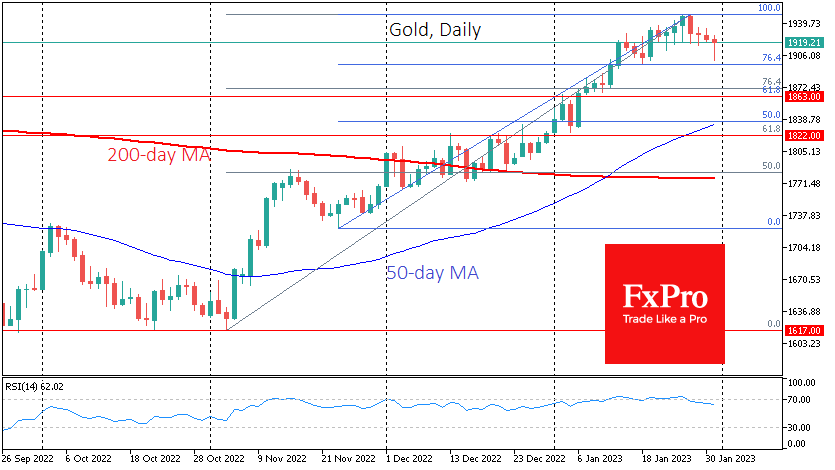
After a rally of more than 20% from the September and November double lows of $1617, a technical correction above $1900 is needed. Accumulated bull fatigue was evident in last week’s relatively deep intraday drawdowns.
In addition, the RSI has been in overbought territory for two weeks on the daily timeframe and returned to neutral territory below 70 last Wednesday, which often signals the start of a correction. At the end of November, gold lost 3.3% on a similar signal before rebounding.
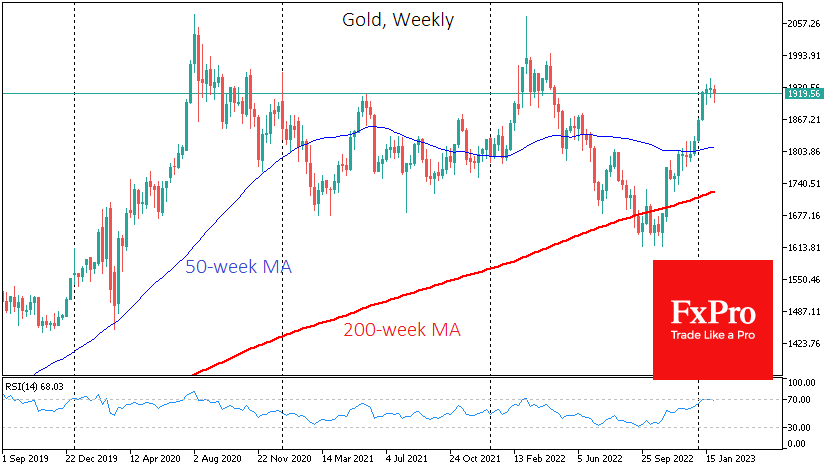
Gold is also overbought on the weekly timeframe, which has almost always led to a sudden reversal or a prolonged stall in this area.
Now it is worth preparing for a deeper correction as the gains of the past two months have been more significant. The Fibonacci patterns suggest a potential retreat to $1862 if we look at the November-January momentum and to $1822 if we look at a full correction of the entire velocity from the November lows.
The 50-week moving average is also targeting the $1820 area. This is a crucial trend indicator where buyers and sellers will battle it out for the long-term trend. However, it is too early to speculate on the outcome of this battle.
A Huge Few Days Aahead
We're seeing plenty of caution in the markets this week which is perhaps not entirely surprising given what lies ahead.
Earnings season isn't going as well as hoped and there are some big names coming up this week that could potentially dampen the mood further. It was always going to be a challenging period given the level of economic uncertainty, not to mention the staggering number of layoffs we're seeing, in the tech space in particular.
Then we have the various central bank announcements, the most notable of which of course is the Fed, which could bring some relief if we hear any softening in the hawkish tone alongside a 25 basis point rate hike. There's now a solid body of evidence that the rate hikes are having a big impact which could warrant ending the tightening cycle very soon.
This will be followed by the ECB and BoE on Thursday, both of which are expected to stay in the 50 basis point camp. The commentary will once again be crucial here though, especially with the latter given the weak forecasts for the economy this year, an updated version of which will be released by the BoE alongside the decision.
And finally, we'll get the latest jobs data from the US, which is expected to show a further slowing of job growth, a slight increase in unemployment, and another month of modest earnings growth. In other words, exactly what the Fed will want to see as it draws the tightening cycle to a close.
Less optimistic
Oil prices are a little lower again on Tuesday, matching the mood elsewhere broadly as investors become less confident in the outlook for the economy. It also comes as the OPEC+ panel is expected to recommend keeping output steady, with the uncertainty around the global economic outlook also likely clouding their forecasts for demand. I'm sure we'll see plenty more shifts in sentiment in the coming weeks which will ensure oil remains very volatile as we move through the first quarter of the year.
Profit-taking ahead of the Fed
We've seen some profit-taking in gold in recent days, with a stronger dollar enabling such a decline. What's interesting is that gold rebounded strongly today around $1,900 and is now relatively flat on the day, which could be viewed as a bullish signal. I expect this will remain very choppy over the next 24 hours or so as we await the latest Fed decision.
Poised for a correction?
The bitcoin rebound may have lost some momentum but it's still managing to hang on to the bulk of the gains from recent weeks. It appears to have found some support around $22,500 with resistance then coming around $24,000. It could be argued that the lack of momentum is a sign of it being poised for a correction but the reality is that may ultimately depend on the Fed, as opposed to anything else.
WTI: Bears Faced Strong Headwinds and Contained by Daily Cloud Base
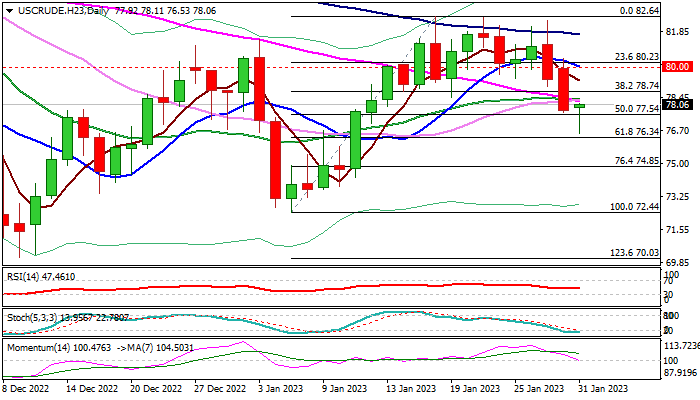
The WTI oil price hit three-week low Tuesday, in extension of sharp fall in past two days (down over 4%) but drop was limited by daily cloud base and Fibo 61.8% of $72.44/$82.64 upleg) where bears faced strong headwinds, causing the price to bounce.
Prospects of stronger dollar on expectations for Fed’s further rate hikes (0.25% raise expected on Wednesday) weighs on oil prices, along with expectations for ECB and BOE 0.5% hikes (meetings are on Thursday), with signals that Russia’s oil exports are going to rise in February, despite tough sanctions imposed on Russia from western economies.
The OPEC+ group is also meeting on Wednesday and analysts expect the cartel will keep its current output policy unchanged.
On the other side, unexpectedly strong acceleration in China’s economic activity in post-Covid restrictions period, boosts hopes for strengthening demand that would partially counter negative impact.
Daily studies show weakening near-term structure on fading bullish momentum and MA’s in bearish setup, though negative signals were partially offset by oversold stochastic and strong bids at the base of thick cloud.
Repeated close above daily Kijun-sen ($77.54) would soften bears and add to signals of basing, however, more work at the upside, such as lift and close above daily Tenkan-sen ($79.57) that would unmask key barriers at $81.91 (daily cloud top) and $81.50/60 zone (recent peaks).
Res: 79.23; 80.00; 80.45; 81.70
Sup: 77.54; 76.25; 74.85; 73.64
Roaring Euro Turns to ECB Rate Decision
The European Central Bank will announce its next policy decision at 13:15 GMT on Thursday. A rate increase of 50bps is already fully priced in, so the euro’s reaction will depend mostly on President Lagarde’s commentary. The economic outlook has improved lately and inflation remains elevated, so a hawkish message that lifts the euro a little might be in store. That said, the bigger picture isn’t so bright.
Rescued by the weather
The Eurozone economy has been surprisingly resilient in recent months. Thanks to a historically warm winter, fears about the energy crisis evolving into a harsh recession have calmed down. Natural gas prices are back to pre-war levels, brightening the outlook around economic activity.
Of course, the region is not out of the woods. Business surveys paint a picture of an economy that is essentially stagnating. It might not be a recession, but the persistent decline in new business orders coupled with the relentless increase in borrowing costs paints a gloomy picture about economic growth moving forward.
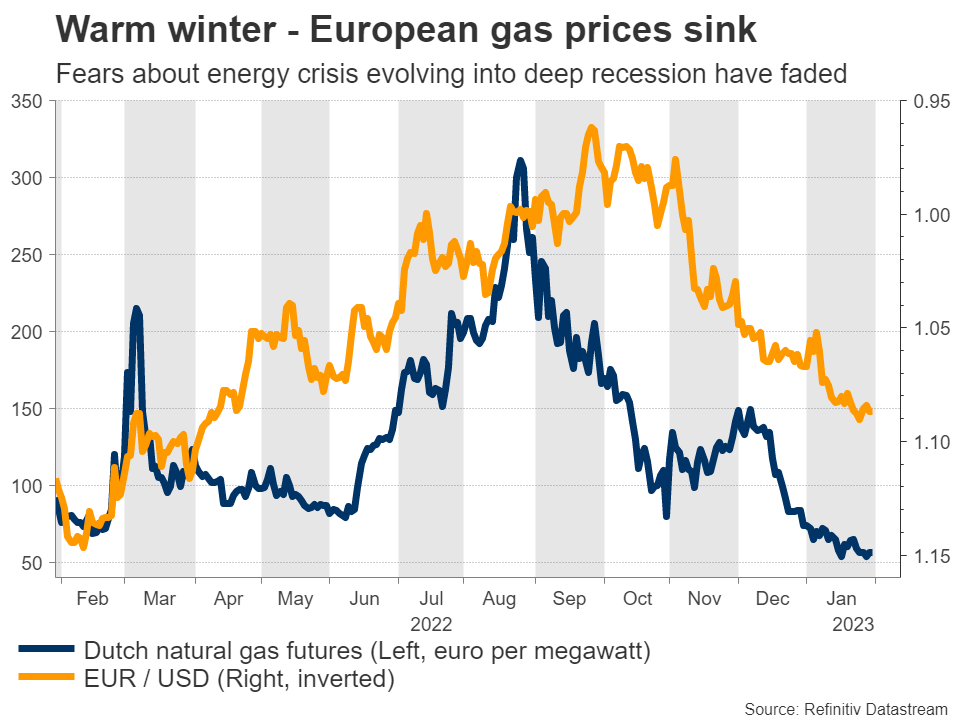
Inflation is still raging, forcing the European Central Bank to keep its foot heavy on the rate increase pedal. The next update on inflation will come on Wednesday, ahead of the ECB decision on Thursday. Even though forecasts suggest the CPI rate declined to 9% in January from 9.2% previously, that is still an unacceptably high level for the central bank.
In fact, there’s a risk of an upside surprise in this inflation report, as surveys showed that businesses raised their selling prices at a slightly faster pace in January, something also reflected in regional numbers for France and Spain that have already been released.
A hawkish twist?
Back in December, President Lagarde stressed the need to move quickly on rates, effectively pre-committing to a 50bps rate increase at this upcoming meeting. Accordingly, markets have fully priced in the rate hike, putting the spotlight mostly on what Lagarde will say during her press conference.
A case can be made that she might strike a hawkish tone. The economic outlook is improving ever so slightly, with GDP growth for Q4 turning positive and China’s economic reopening bolstering confidence. Meanwhile, the recent loosening in financial conditions will be worrisome for ECB officials, as it could prevent inflation from returning to its target in a reasonable timeframe, making them likely to push back.
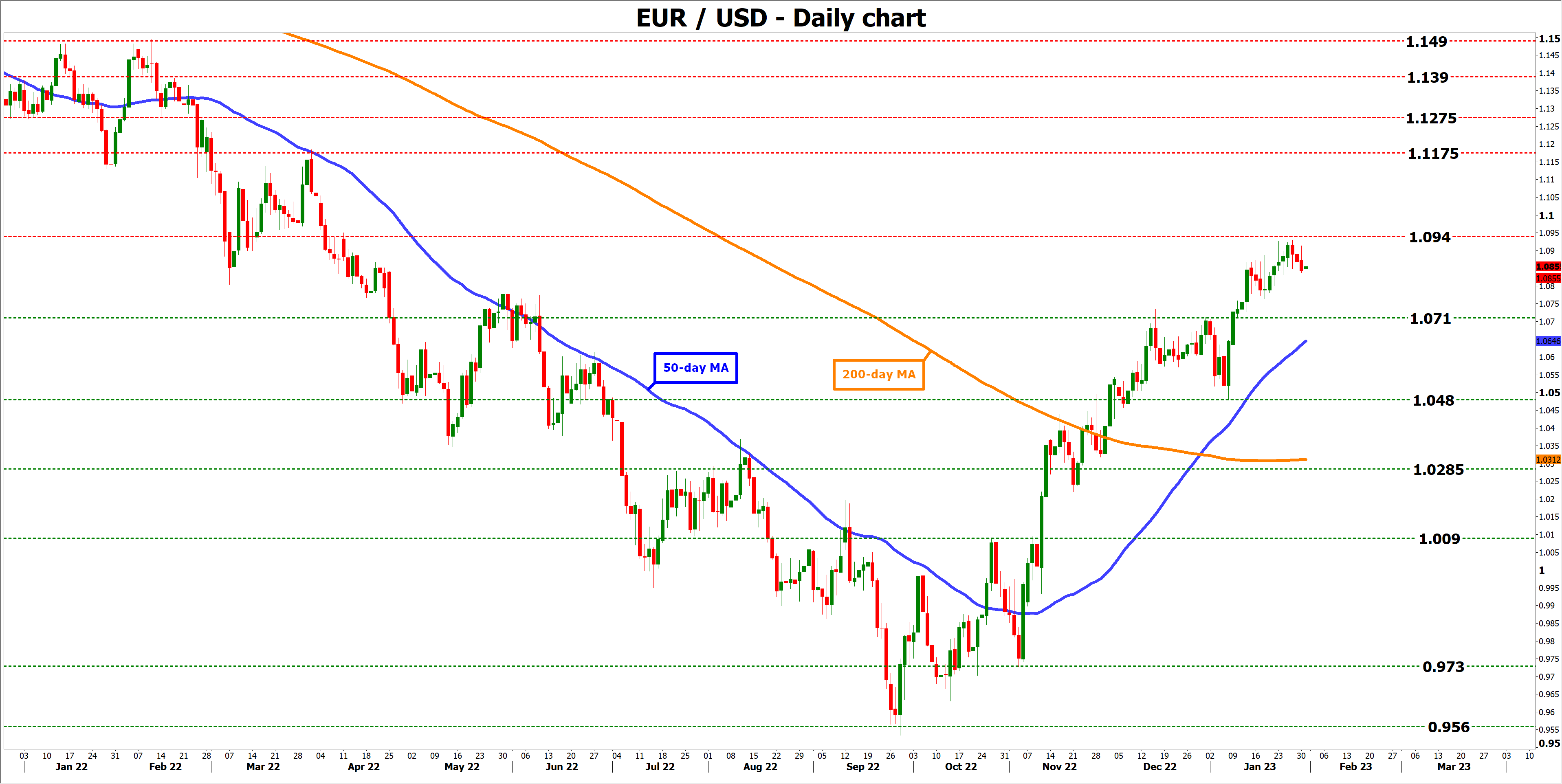
The question for markets is whether Lagarde will telegraph another 50bps move for March, which seems likely considering everything above. If that’s the case, the euro could spike higher, with the first major obstacle for euro/dollar likely to be the recent high near 1.0940.
Euro prospects not so bright
Overall, the euro staged a phenomenal rally in recent months. Much of that was due to favorable weather patterns that helped reduce energy prices and recession risks, but China’s reopening, soaring stock markets, and a softer US dollar also played a big role.
Admittedly, it’s difficult to envision this rally lasting much longer. Even if a recession is avoided, the best-case scenario in Europe is economic stagnation, since there isn’t much to drive growth forward. Higher interest rates will come back to bite eventually, especially economies with high debt burdens such as Italy.
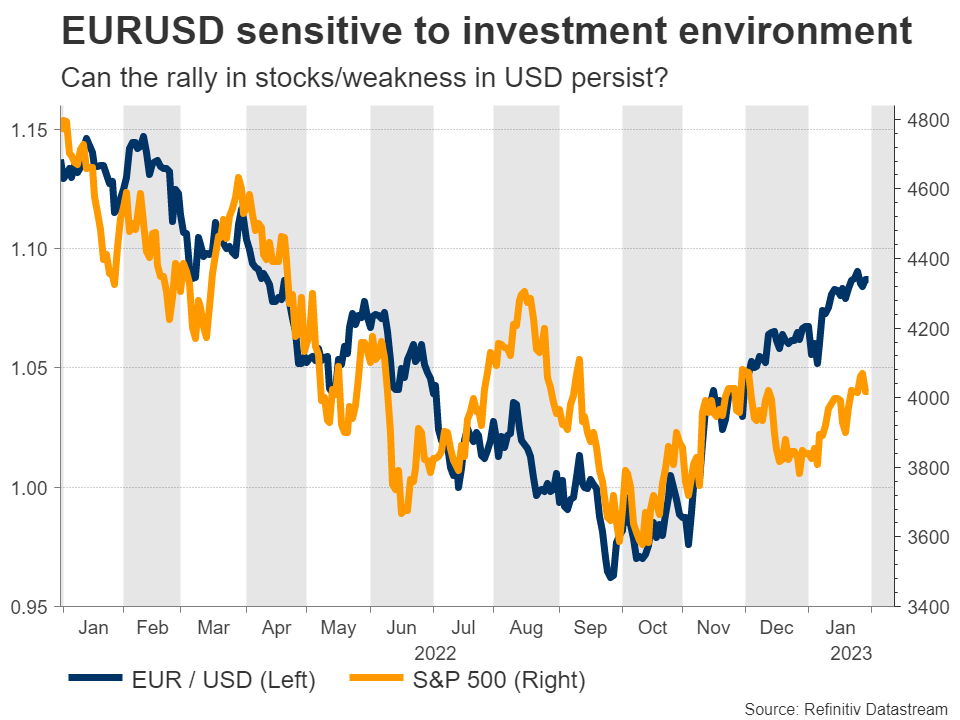
The weakness in the dollar and the euphoria in stocks were instrumental pieces behind the euro’s resurgence, but those were caused partly by a liquidity dump from the US Treasury, which might reverse soon. On a simpler level, a global environment characterized by heightened recession risks favors a softer euro/dollar.
In other words, the risk/reward profile for the euro doesn’t seem attractive anymore in this investment environment. Technically speaking, any retreats in euro/dollar could encounter initial support around the 1.0710 region.
Bank of England: One Final 50bps Rate Hike
The Bank of England will review its monetary policy on Thursday in what might turn out to be a live event as investors eagerly look for signs that rate differentials with the Fed will narrow this year. While a downshift to softer rate hikes is less likely to happen this time, pound traders may seek new tweaks in forward guidance before they drive the pound out of its short-term range. The policy announcement will be out at 12:00 GMT.
A slowdown in tightening might be premature
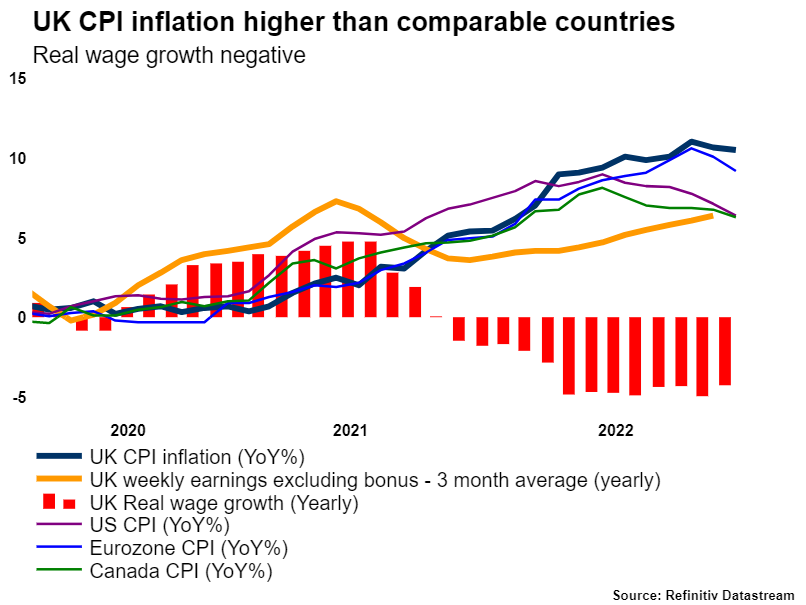
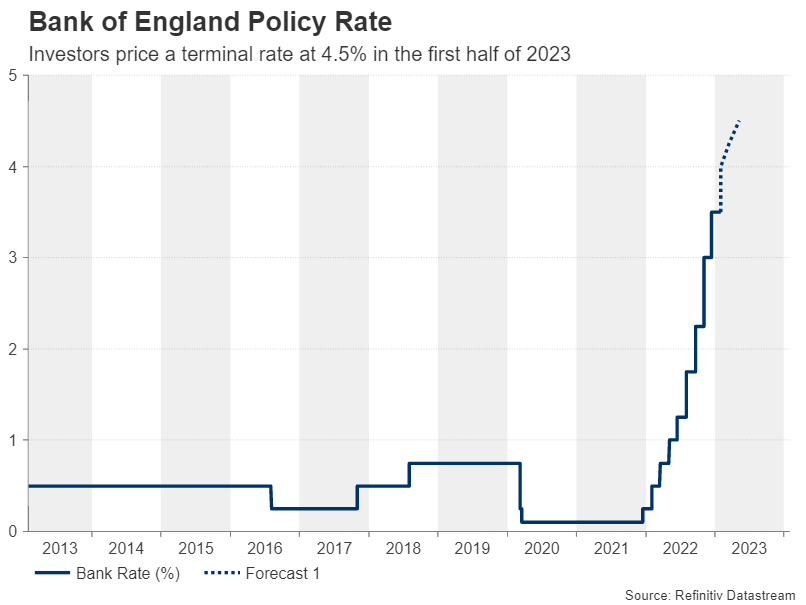
The Bank of England (BoE) has raised its interest rate from nearly zero to 3.5% over the past year, applying a more aggressive hiking strategy during the second semester as the inflation rate jumped to double digits for the first time in almost half a century. Global evidence has somewhat convinced central bankers that inflation is cooling now, with the Bank of Canada signaling a pause at its current interest rate, while the Fed flagged a slowdown to a 25bps rate hike in the forthcoming meeting . The BoE, however, may not follow suit.
The UK headline CPI clocked in at 10.5% y/y in December, down from 10.7% in November and 11.1% in October, but still far above the central bank’s 2.0% target, suggesting that the cost of living is still biting.
What was more concerning was the core measure, which stood stable at 6.3% y/y on the back of high housing and household services prices despite expectations for a soft decline. Hence, assuming that the price stability mandate remains a top priority, there might be little backing within the board for a rate hike less than a half point, especially as the labor market remains resilient and the continuous strikes across several sectors pressure for higher wage growth, which might cause even more inflation. According to the government, the National Living Wage will rise by 9.7% in April, experiencing the largest increase since its introduction in 2016.
Recession is still on the horizon
On the other hand, the doves may reasonably claim that additional bold rate increases can lead the economy to a recession. Even though the positive monthly GDP surprises in October and November seem to have reduced the odds of a technical recession in the fourth quarter, an economic downturn has probably been delayed rather than averted. The first business PMI release for the new year was disappointing, displaying falling activity, export losses and labor shortages, while consumer sentiment further dampened according to a GfK study. Also, a million borrowers are expected to switch from fixed rates to higher floating rates this year, adding more pressure on spending and house valuations.
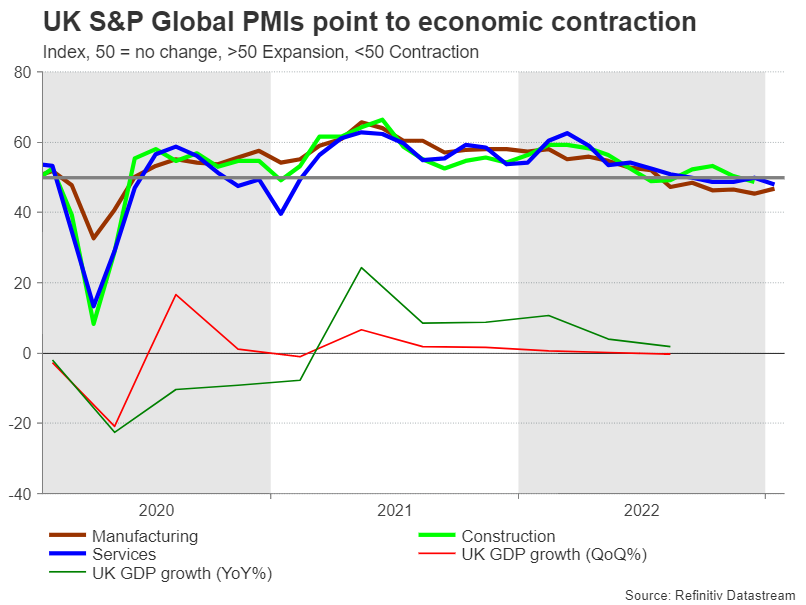
There is speculation that the BoE will keep the recession scenario on the table as the government's budget hit a record deficit recently and Brexit jitters keep weighing. But governor Andrew Bailey may backtrack from his previous gloomy growth projections of the longest recession ever, painting a slightly improved economic picture.
Inflation estimates may fall as well since earlier rises in energy and other goods prices drop out of the annual comparison. It's worthy to note that inflation expectations for the next twelve months eased to 5.7% in December from 6.1% previously.
Voting composition
Any changes in the voting composition may also influence intentions for future rate hikes. During the previous policy meeting, board members Silvana Tenreyro and Swati Dhingra voted to end rate increases, while Catherine Mann backed a larger 0.75 percentage point move. The group of hawks is widely expected to lead the rate hike decision, though it would be interesting to see whether more policymakers will propose softer rate increases or no changes at all amid falling inflation pressures and persistent economic risks. If support for incremental rate hikes drops, the pound could give up some ground.
Rate hike cycle
As for the rate hike cycle, futures markets are reflecting an 80% probability for a 50bps rate hike at the moment, but they signal it will be the last bold increase in a row before the central bank switches to 25bps rate hikes in March and likely pause its tightening phase at a peak rate of 4.5% in May. The BoE governor did not criticize market expectations as he did previously when rate projections were significantly higher at 5.35%.
In any case, the central bank will likely keep all options open, avoiding a strong forward guidance as the year is still young and the impact from previous rate hikes is uncertain.
GBP/USD
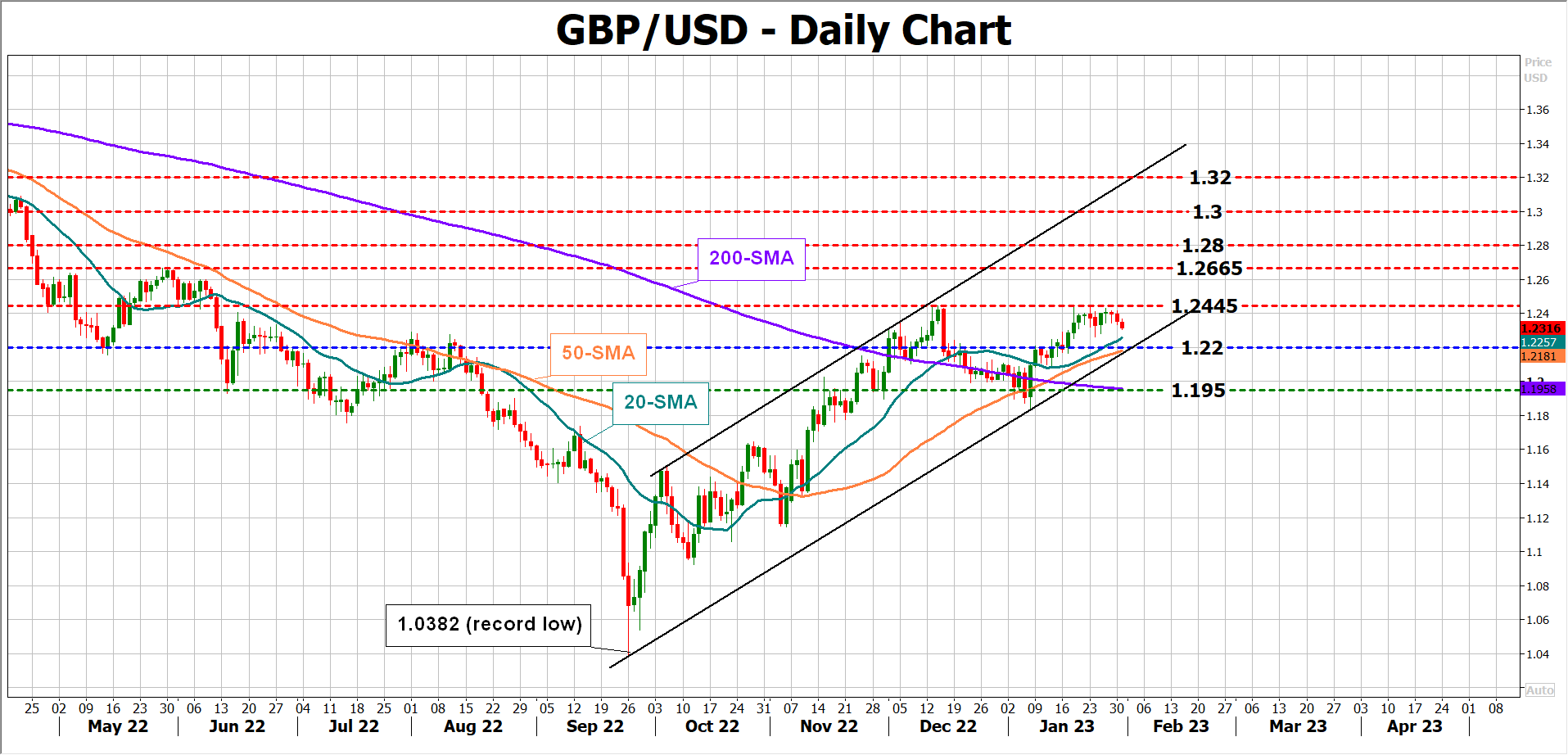
Early signals that the BoE will be slower in reaching its terminal rate than the Fed could lift pound/dollar towards May’s resistance of 1.2665. Even higher, the pair may retest the 1.2800 round level before heading for the 1.3000 number.
Alternatively, a surprisingly smaller 25bps rate hike and calls for a lower terminal rate would feed speculation that the rate gap with the Fed will remain wide. Consequently, pound/dollar could drift lower to test the 1.2200-1.2170 support region. A steeper decline may bring the 200-day simple moving average (SMA) next into view at 1.1950.
US 100 Index Retreats after Penetrating Downtrend Line
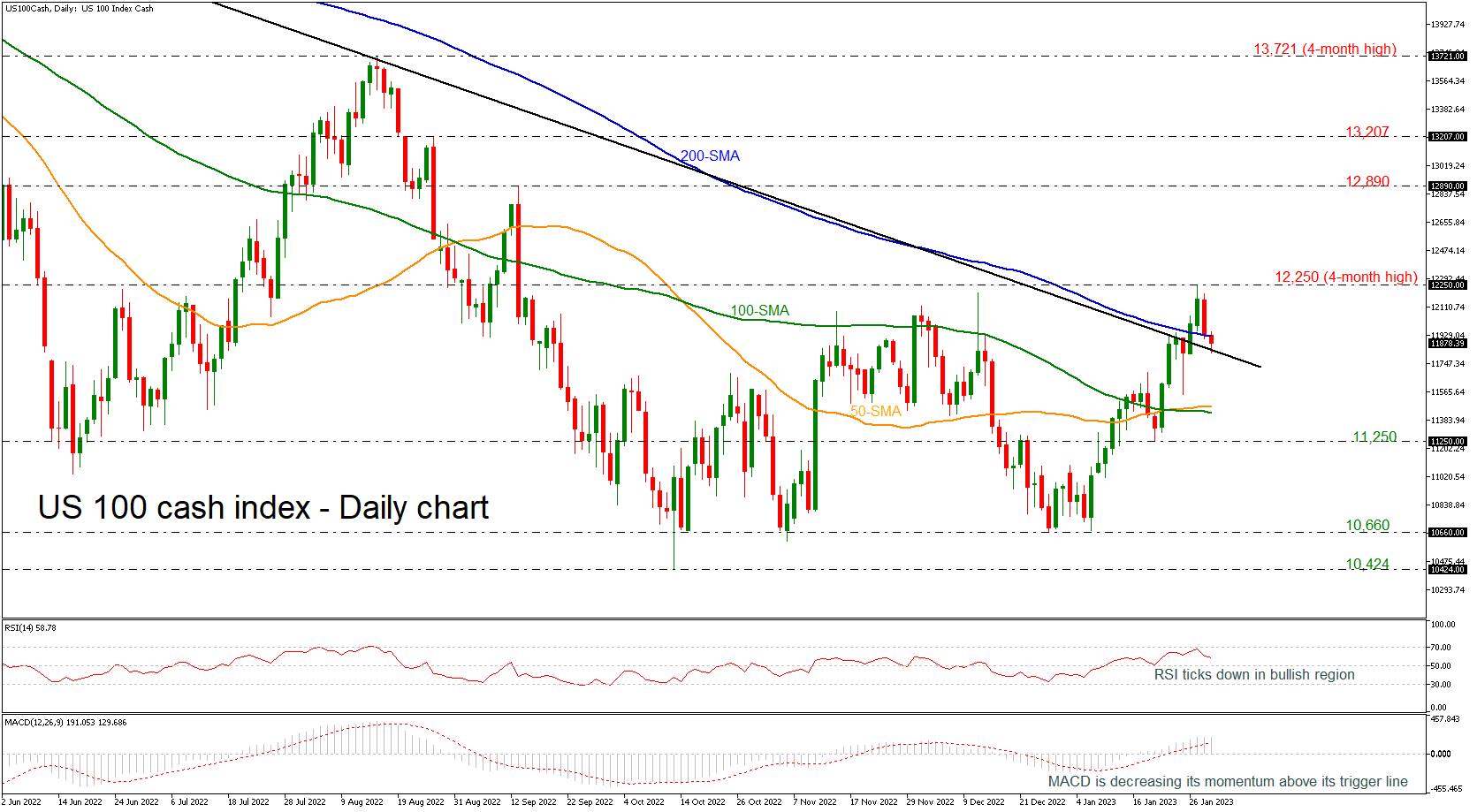
The US 100 cash index reached overbought levels according to the RSI and reversed lower after the price finally jumped above the long-term downtrend line and the 200-day simple moving average (SMA), creating a four-month high at 12,250.
While the aforementioned technical oscillator continues to slow down, mirroring the market’s bearish behavior over the past two days, the indicator is still moving in bullish territory, flagging that a recovery could reemerge in the short term. The MACD is also holding above its red signal line, which supports the bullish view as well, even though it is flattening.
In case the price changes its short-term direction to the upside, the bulls will probably challenge the previous top at 12,250. A break higher could last until 12,890, the high from September 13, ahead of 13,207.
Alternatively, additional declines may drive the price towards the 50- and the 100-day SMAs around 11,452 before the 11,250 support comes into view. Beneath the latter, the 10,660 zone, which rejected the market’s actions recently, could be another level in focus.
Summarizing, the US 100 index maintains a bullish bias in the medium-term picture after the bounce off 10,660 but any moves beneath the downtrend line could confirm the long-term negative mode again.
Canada’s Economy Edges Up in November, Points to Zero Growth in December
The Canadian economy expanded by 0.1% month/month (m/m) in November, matching Statistics Canada's flash estimate. Meanwhile, December's flash estimate showed no change.
November's increase in activity was fairly broad, with output expanding in 14 of the 20 industries. The service-producing sector rose by 0.3%, while the goods-producing sector declined 0.1%.
The gain was led by the transportation and warehousing sector, as the lifting of COVID-19 border restrictions resulted in a boost to air transportation (+4.6%). This passed through to the "accommodation services subsector (+2.5%) which also expanded in November, driven by an increase in traveller accommodation." The finance and insurance sector (+0.5%) also saw a gain on greater trading revenues and higher interest rates.
Once again there was weakness in residential construction (-1.8%). According to StatCan, "all types of residential activity fell in November, with new construction of single detached homes and home alterations and improvement leading the contraction." Retail trade also declined (-0.6%), with weakness seen in "food and beverages stores (-1.8%), building material and garden equipment and supplies dealers (-2.9%), as well as general merchandise stores (-1.6%)."
Key Implications
The Canadian economy continues to show its resilience. With today's print and the flash estimate for December, GDP is likely going to clock in at around 1.6% (quarterly annualized). This is right around Canada's long-term trend pace, though will mark a step down from the 3% trend of the prior three quarters. This deceleration was always in the cards given the historic Bank of Canada tightening cycle. Looking at the industry sector breakdown, we can see that the interest rate sensitive sectors are feeling the brunt of this, especially in the construction and retail sectors.
This report isn’t likely to cause the BoC to have any second thoughts regarding its recent pause. The economy hasn't yet absorbed the impact of past rate hikes. Though we are seeing the beginning of this, there is more to come, with GDP and employment growth set to stall in the coming months. Even though today's growth numbers are holding up well, the BoC can feel comfortable keeping its policy on cruise control a little while longer.
USD/JPY Mid-Day Outlook
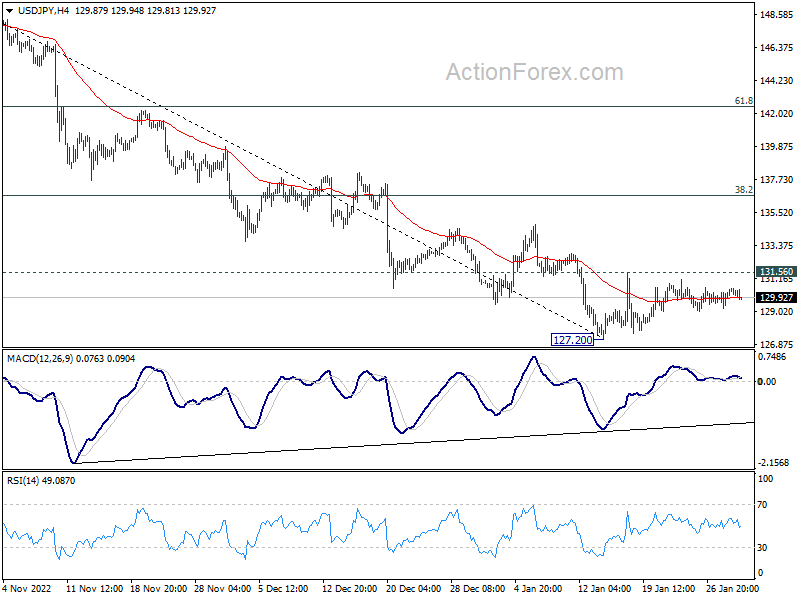
Daily Pivots: (S1) 129.58; (P) 130.08; (R1) 130.94; More…
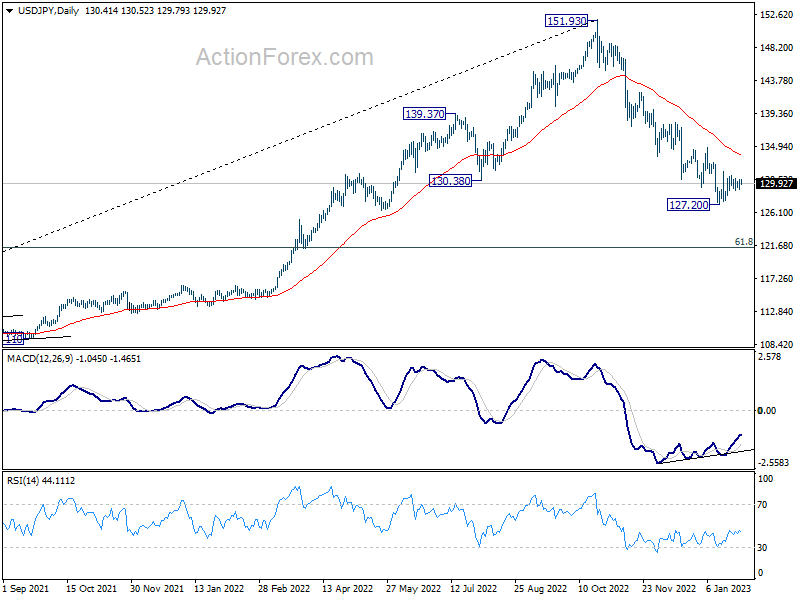
USD/JPY is still struggling in sideway trading and intraday bias remains neutral. On the downside, break of 127.20 will resume the whole decline from 151.93 and target 121.43 fibonacci level. Nevertheless, on the upside, break of 131.56 resistance should confirm short term bottoming, and turn bias back to the upside for stronger rebound to 55 day EMA (now at 133.76) and possibly above.
In the bigger picture, the break of 55 week EMA (now at 131.39) raises the chance of medium term bearish reversal, but that’s not confirmed yet. Strong support could be seen around 61.8% retracement of 102.58 to 151.93 at 121.43 and 38.2% retracement of 75.56 to 151.93 at 122.75 to bring rebound. But break of 131.56 resistance is needed to indicate bottoming first. Otherwise further fall will remain in favor.
USD/CHF Mid-Day Outlook
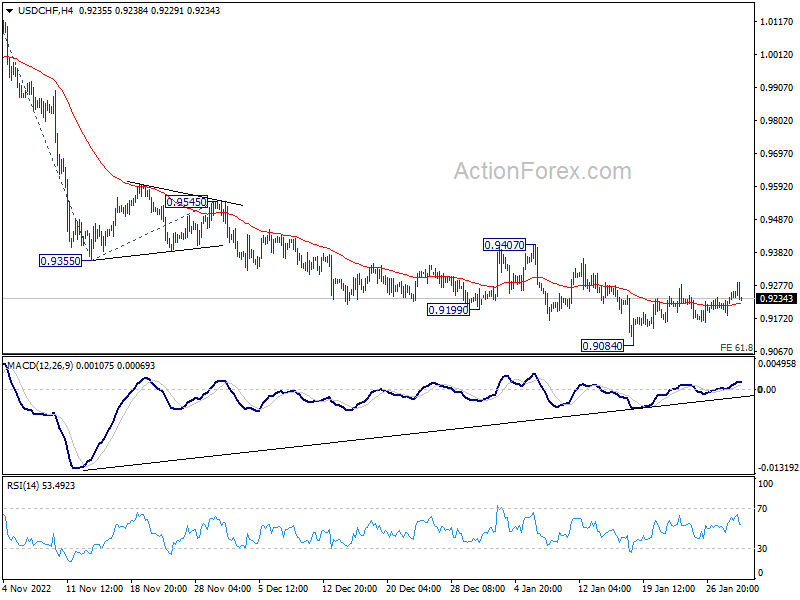
Daily Pivots: (S1) 0.9202; (P) 0.9230; (R1) 0.9277; More…
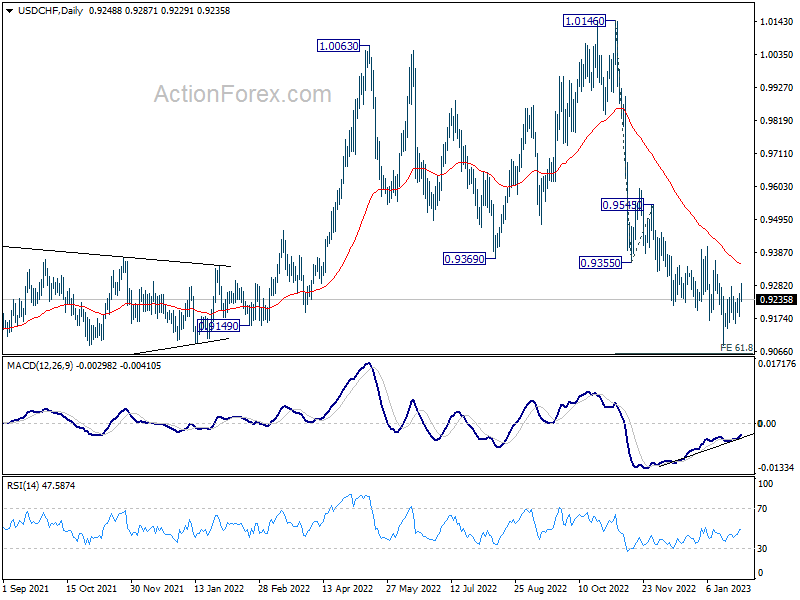
No change in USD/CHF's outlook as it's still gyrating inside established range. Intraday bias remains neutral. Outlook will stay bearish as long as 0.9407 resistance holds. On the downside, sustained break of 61.8% projection of 1.0146 to 0.9355 from 0.9545 at 0.9056 will pave the way to 100% projection at 0.8754, which is close to 0.8756 long term support. Nevertheless, on the upside, break of 0.9407 should confirm short term bottoming and turn bias back to the upside for 0.9545 structural resistance.
In the bigger picture, rise from 0.8756 (2021 low) has completed at 1.0146, well ahead of 1.0342 long term resistance (2016 high). Based on current downside momentum, fall from 1.0146 should be a medium term down trend itself. Next target is a test on 0.8756 low. Strong support should be seen there to bring rebound. Still, further decline will now be expected as long as 0.9407 resistance holds, in any case.
GBP/USD Mid-Day Outlook
Daily Pivots: (S1) 1.2320; (P) 1.2368; (R1) 1.2400; More…
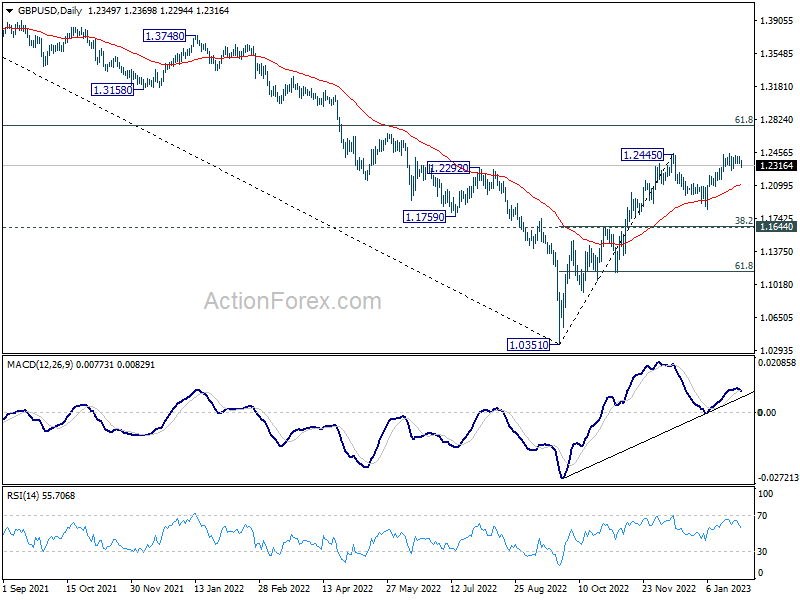
No change in GBP/USD's outlook as it's still struggling in tight range. On the downside, firm break of 1.2252 minor support will turn bias to the downside, and extend the corrective pattern from 1.2445 with another falling leg. On the upside, decisive break of 1.2445 will confirm resumption of whole rise from 1.0351. Next target will be 1.2759 fibonacci level.
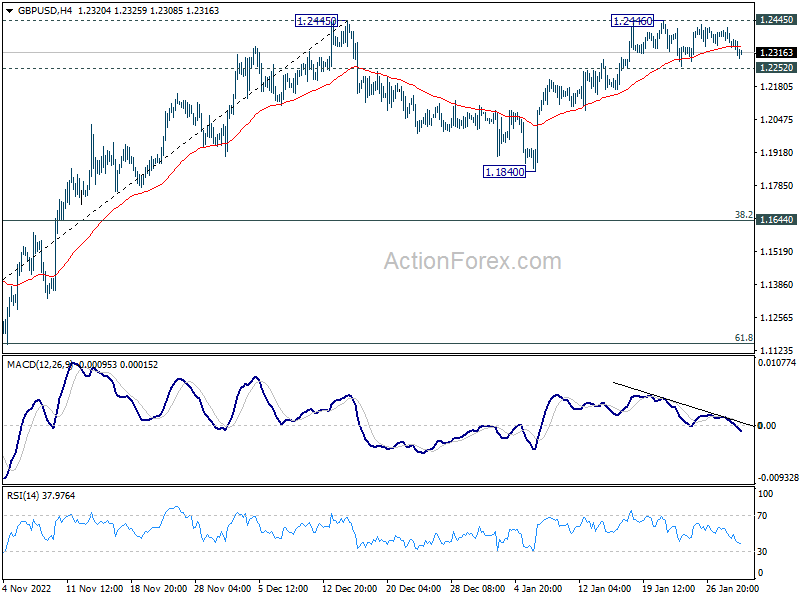
In the bigger picture, rise from 1.0351 medium term bottom is at least correcting whole down trend from 1.4248 (2021 high). Further rise is expected as long as 1.1644 resistance turned support holds. Next target is 61.8% retracement of 1.4248 to 1.0351 at 1.2759. Sustained break there will pave the way back to 1.4248.