Sample Category Title
USD/CHF Mid-Day Outlook
Daily Pivots: (S1) 0.9187; (P) 0.9213; (R1) 0.9238; More…
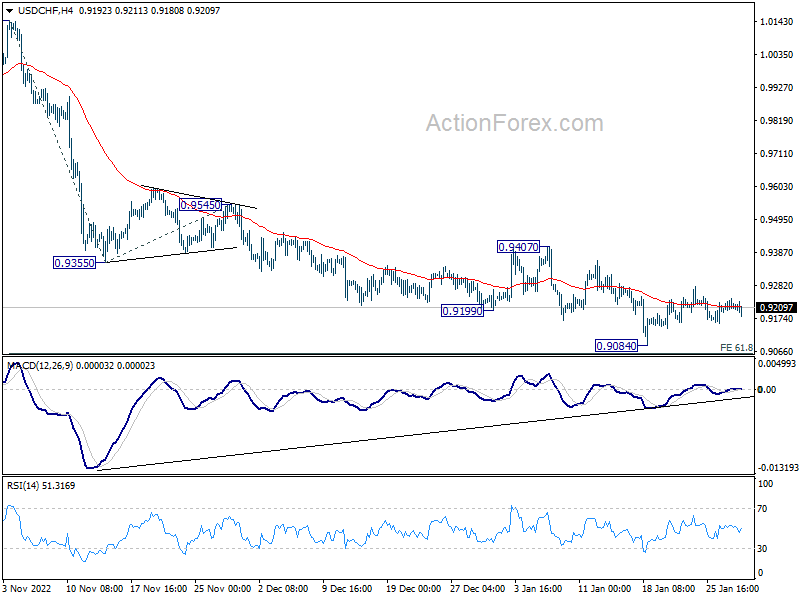
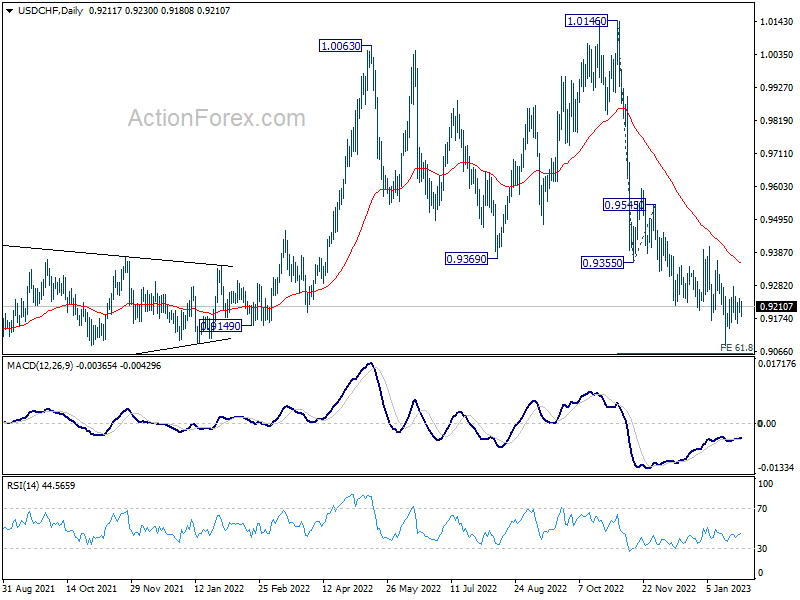
Intraday bias in USD?CHF remains neutral as sideway trading continues above 0.9084. On the downside, sustained break of 61.8% projection of 1.0146 to 0.9355 from 0.9545 at 0.9056 will pave the way to 100% projection at 0.8754, which is close to 0.8756 long term support. Nevertheless, on the upside, break of 0.9407 should confirm short term bottoming and turn bias back to the upside for 0.9545 structural resistance.
In the bigger picture, rise from 0.8756 (2021 low) has completed at 1.0146, well ahead of 1.0342 long term resistance (2016 high). Based on current downside momentum, fall from 1.0146 should be a medium term down trend itself. Next target is a test on 0.8756 low. Strong support should be seen there to bring rebound. Still, further decline will now be expected as long as 0.9407 resistance holds, in any case.
USD/JPY Mid-Day Outlook
Daily Pivots: (S1) 129.48; (P) 129.88; (R1) 130.25; More…
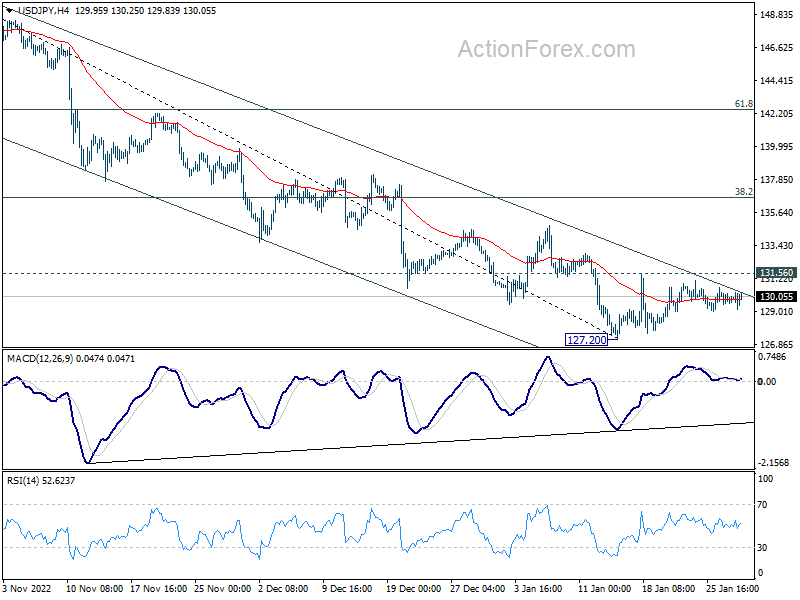
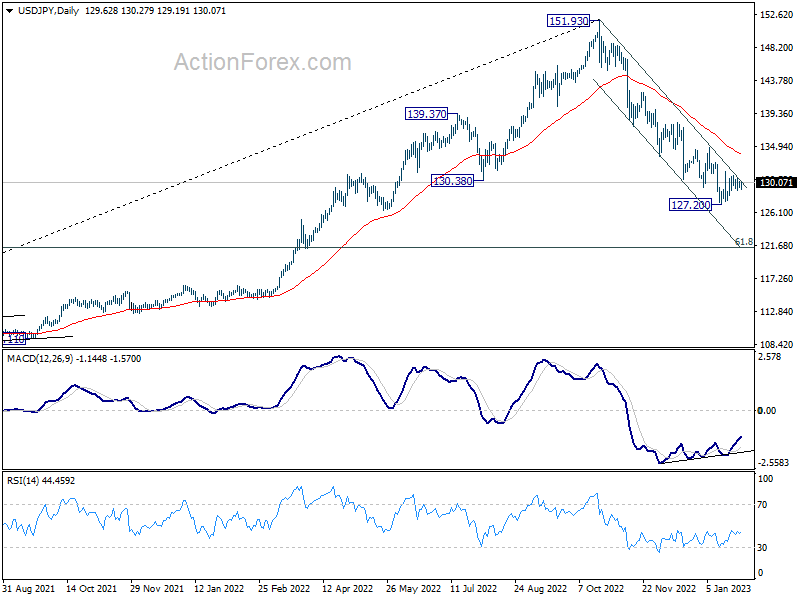
Intraday bias in USD/JPY stays neutral as sideway trading continues above 127.20. On the downside, break of 127.20 will resume the whole decline from 151.93 and target 121.43 fibonacci level. Nevertheless, on the upside, break of 131.56 resistance should confirm short term bottoming, and turn bias back to the upside for stronger rebound to 55 day EMA (now at 134.01).
In the bigger picture, the break of 55 week EMA (now at 131.39) raises the chance of medium term bearish reversal, but that’s not confirmed yet. Strong support could be seen around 61.8% retracement of 102.58 to 151.93 at 121.43 and 38.2% retracement of 75.56 to 151.93 at 122.75 to bring rebound. But break of 131.56 resistance is needed to indicate bottoming first. Otherwise further fall will remain in favor.
GBP/USD Mid-Day Outlook
Daily Pivots: (S1) 1.2354; (P) 1.2387; (R1) 1.2427; More…
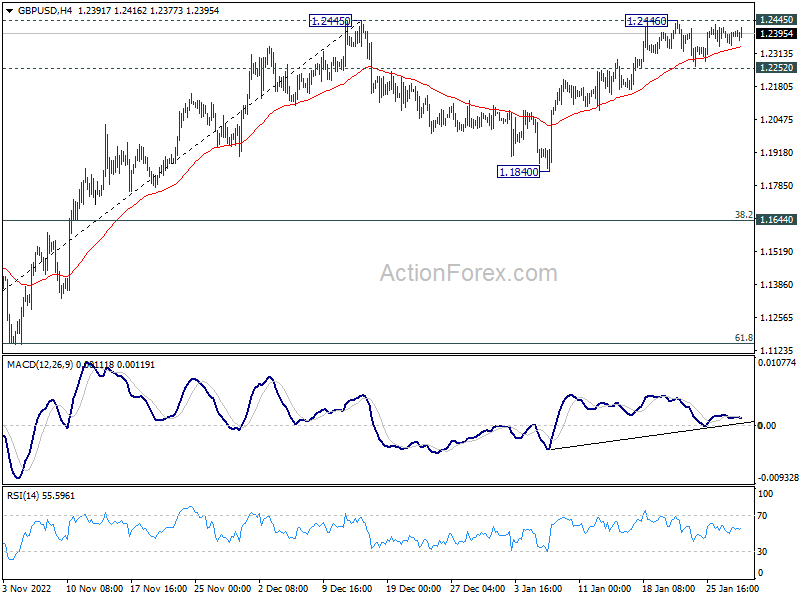
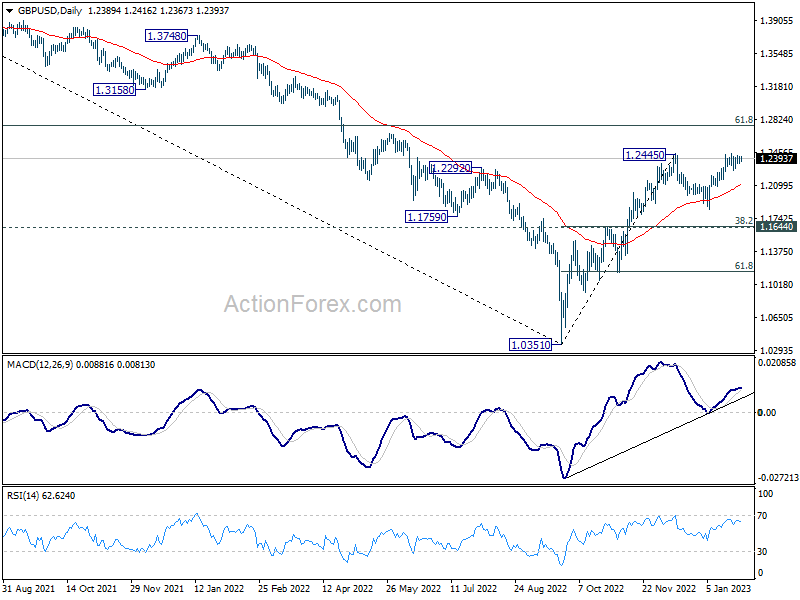
Range trading continues in GBP/USD and intraday bias remains neutral. On the downside, firm break of 1.2252 minor support will turn bias to the downside, and extend the corrective pattern from 1.2445 with another falling leg. On the upside, decisive break of 1.2445 will confirm resumption of whole rise from 1.0351. Next target will be 1.2759 fibonacci level.
In the bigger picture, rise from 1.0351 medium term bottom is at least correcting whole down trend from 1.4248 (2021 high). Further rise is expected as long as 1.1644 resistance turned support holds. Next target is 61.8% retracement of 1.4248 to 1.0351 at 1.2759. Sustained break there will pave the way back to 1.4248.
EUR/USD: Euro Regains Traction Ahead of EU CPI Report, Fed and ECB
The Euro regained traction after two-day pullback and rose on Monday, underpinned by higher than expected Spanish inflation HICP Jan 5.8% vs 4.7% f/c, Dec 5.5% and improving Eurozone economic sentiment (Jan 99.9 vs Dec 97.1, f/c 97.0), as strong figures partially offset negative impact from weak German Q4 GDP.
Markets shift focus to a number of economic events this week, with EU CPI report (inflation is expected to remain elevated) and Fed policy decision (expected 25 basis points hike) due on Wednesday and ECB meeting on Thursday (expected to raise interest rates by 50 basis points).
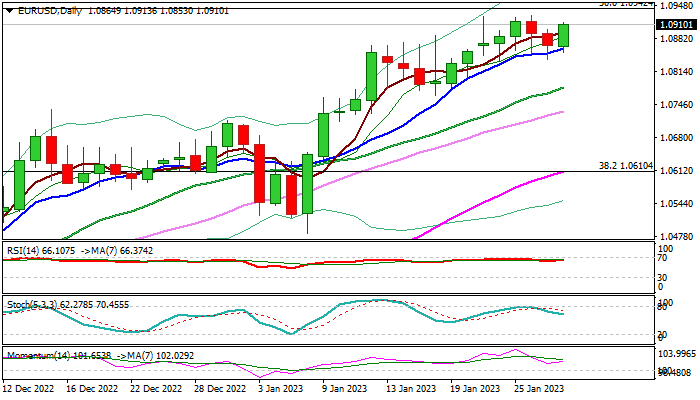
Technical studies are bullish on daily chart and the Euro is on track to end the fourth consecutive month with gains, though bulls need to clear strong barrier at 1.0930 (weekly cloud top) and 1.10 (psychological) to generate stronger signal of bullish continuation.
Immediate bullish bias is expected to remain intact while the action holds above daily Tenkan-sen (1.0847) , but extended dips cannot be ruled out, though expected not to be very harmful for larger bullish structure, while being contained above daily Kijun-sen (1.0706).
Res: 1.0930; 1.1000; 1.1072; 1.1184.
Sup: 1.0847; 1.0782; 1.0766; 1.0706.
EUR/USD Mid-Day Outlook
Daily Pivots: (S1) 1.0838; (P) 1.0869; (R1) 1.0900; More…
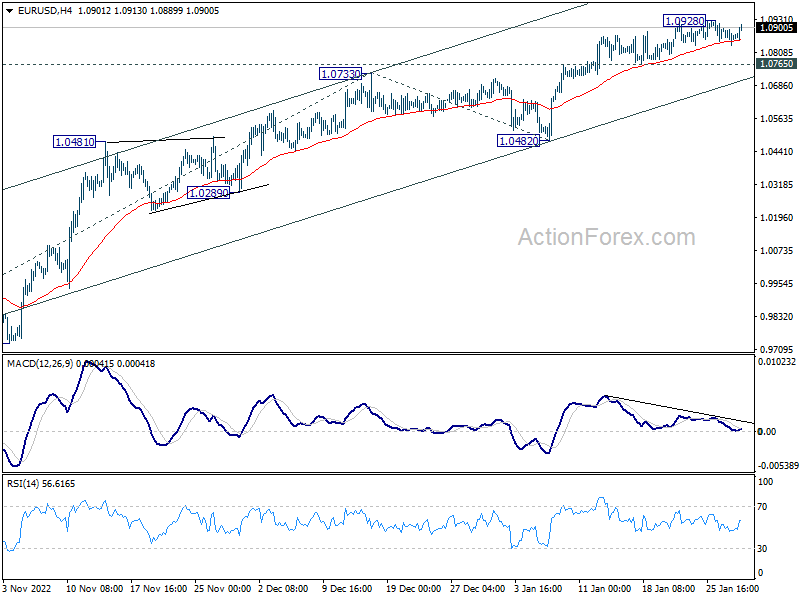
EUR/USD recovers mildly today but stays in range below 1.0928. Intraday bias remains neutral for the moment. With 1.0765 support intact, further rally remains in favor. On the upside, break of 1.0928 will resume larger rise to 61.8% projection of 0.9630 to 1.0733 from 1.0482 at 1.1164 next. On the downside, though, break of 1.0765 support should now confirm short term topping, and turn bias back to the downside for 55 day EMA (now at 1.0601).
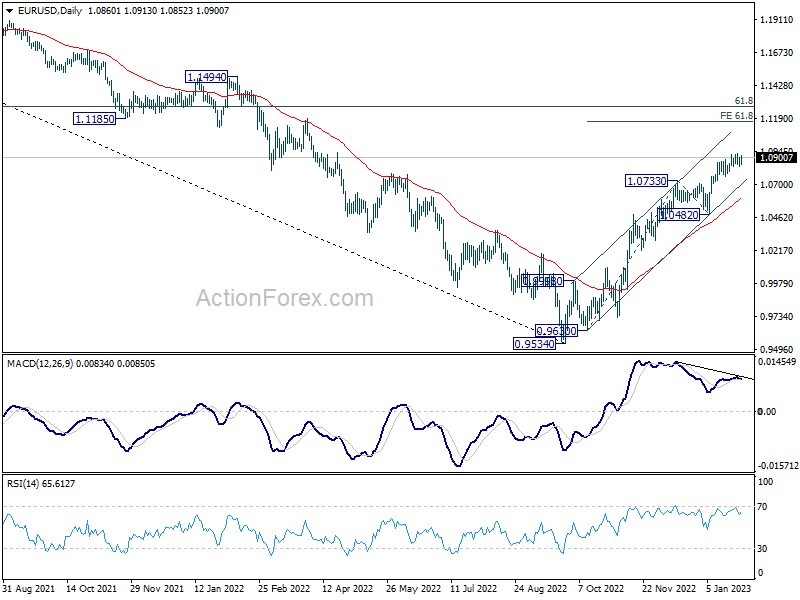
In the bigger picture, current development suggests that the rally from 0.9534 low (2022 low) is a medium term up trend rather than a correction. Further rise is in favor to 61.8% retracement of 1.2348 (2021 high) to 0.9534 at 1.1273 next. This will remain the favored case as long as 1.0482 support holds.
Euro Shrugs Poor German GDP, But Overall Markets Tread Water
Overall, the forex markets are pretty quiet today. Euro rises broadly despite poorer than expected German GDP. Yet, there is no breakout from familiar range. Swiss Franc is tracking Euro closely, followed by Dollar. Australian Dollar is so far the worst performer, without follow through downside momentum. Yen is following and then Canadian. Sterling and Kiwi are mixed for now. Traders are clearly holding their bet ahead of the main events of Fed, BoE and ECB later in the week.
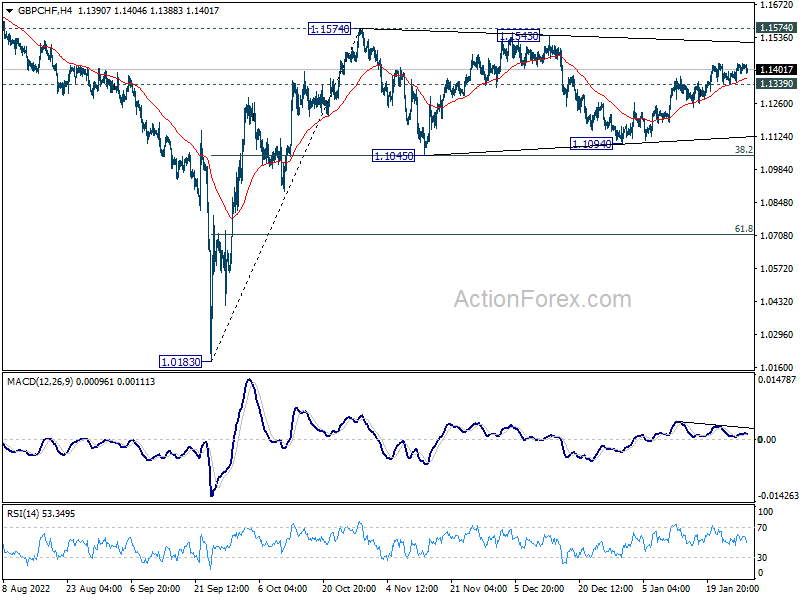
Technically, GBP/CHF continued to lose upside momentum even though rebound from 1.1094 is still trying to extend. Judging from the structure, such rebound is likely the fourth leg of the triangle pattern from 1.1574. That is, there should be another falling leg before larger rise from 1.0183 resumes. Break of 1.1339 minor support will indicate the start of the fifth leg, with opportunity to go long as this envisaged decline completes.
In Europe, at the time of writing, FTSE is up 0.05%. DAX is down -0.58%. CAC is down -0.51%. Germany 10-year yield is up 0.0645 at 2.308. Earlier in Asia, Nikkei rose 0.19%. Hong Kong HSI lost -2.73%. China Shanghai SSE rose 0.14%. Singapore Strait Times dropped -0.47%. Japan 10-year JGB yield dropped -0.0037 to 0.481.
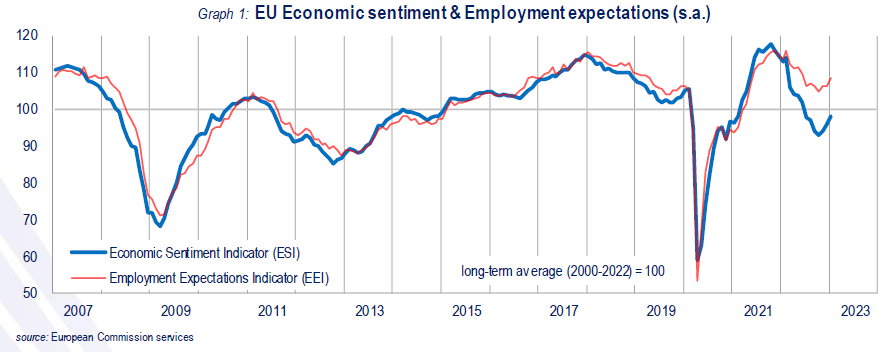
Eurozone economic sentiment rose to 99.9 in Jan, EU up to 98.0
Eurozone Economic Sentiment Indicator rose from 97.1 to 99.9 in January. Employment Expectation Indicator rose from 107.4 to 110.1. Economic Uncertainty Indicator dropped from 27.5 to 26.2. Industry confidence rose from -0.6 to 1.3. Services confidence rose from 7.7 to 10.7. Consumer confidence rose from -22.1 to -20.9. Retail trade confidence rose from -2.7 to -0.8. Construction confidence dropped from 3.6 to 1.3.
EU Economic Sentiment Indicator rose from 95.7 to 98.0. Employment Expectation Indicator rose from 106.2 to 108.5 Economic Uncertainty Indicator dropped from 27.0 to 25.9. Amongst the largest EU economies, the ESI increased markedly in France (+4.4), Spain (+2.7), Germany (+2.5), Italy (+1.7) and, to a lesser extent, the Netherlands (+0.5), while it was unchanged in Poland (±0.0).
Germany GDP contracted -0.2% qoq in Q2, worst than expectations
Germany GDP contracted -0.2% qoq in Q2, worse than expectation of 0.0% qoq. Comparing to the same quarter a year ago, GDP rose 0.5% in price adjusted term, or 1.1% in price and calendar adjusted term. For 2022 as a whole, GDP grew 1.8% (price adjusted), or 1.9% (price and calendar adjusted).
DeStatis said, After the German economy managed to perform well despite difficult conditions in the first three quarters, economic performance slightly decreased in the fourth quarter of 2022.
Swiss KOF jumped to 97.2 in Jan, outlook considerably less gloomy
Swiss KOF Economic Barometer rose from 91.5 to 97.2 in January, well above expectation of 93.3. That's the second month of rise in a row, but the index remains below its medium term average. KOF said, "the outlook for the Swiss economy at the beginning of the year is considerably less gloomy than it was in autumn last year."
KOF also noted: "All bundles of indicators contribute to the improvement. They are developing particularly favourably in manufacturing, hospitality and the services sector. Nevertheless, the indicator bundles for manufacturing and services are below their medium-term average. The indicators for the hospitality sector, on the other hand, jump above the average, so the prospects here are now better than average."
NZ goods exports rose 11% yoy in Dec, imports rose 1.8% yoy
New Zealand goods exports rose 11% yoy or NZD 640m to NZD 6.7B in December. Goods imports rose 1.8% yoy or NZD 125m to NZD 7.2B. Monthly trade deficit narrowed to NZD -475m, comparing to November's NZD -2180m and expectation of NZD -1750m.
The US leads monthly expect rise, up 40% yoy, while exports to all trade partners were up, including China (up NZD 4.2m), Australia (up 17% yoy), EU up (9.8% yoy), and Japan (up 14% yoy).
The US also leads monthly import rise up 80% yoy. Others were mixed with China down -11% yoy, EU up 3.8% yoy, Australia up 7.0% yoy and Japan up 3.4% yoy.
BoJ Kuroda: Inflation trend likely to gradually accelerate, but takes some more time
BoJ Governor Haruhiko Kuroda told the parliament today,
"Japan's trend inflation is likely to gradually accelerate ... but that will take some more time."
"Uncertainty regarding Japan's economy is extremely high. It's therefore important now to support the economy, and create an environment where companies can raise wages," he said.
Separately, a panel of academics and business executives urged BoJ to make the 2% inflation target a long-term goal, to make monetary policy more flexible.
"The way the BOJ conducts monetary policy must be revamped," Yuri Okina, a candidate for the next BOJ deputy governor."By making 2% inflation a long-term goal, the BOJ can make its monetary policy more flexible."
EUR/USD Mid-Day Outlook
Daily Pivots: (S1) 1.0838; (P) 1.0869; (R1) 1.0900; More…
EUR/USD recovers mildly today but stays in range below 1.0928. Intraday bias remains neutral for the moment. With 1.0765 support intact, further rally remains in favor. On the upside, break of 1.0928 will resume larger rise to 61.8% projection of 0.9630 to 1.0733 from 1.0482 at 1.1164 next. On the downside, though, break of 1.0765 support should now confirm short term topping, and turn bias back to the downside for 55 day EMA (now at 1.0601).
In the bigger picture, current development suggests that the rally from 0.9534 low (2022 low) is a medium term up trend rather than a correction. Further rise is in favor to 61.8% retracement of 1.2348 (2021 high) to 0.9534 at 1.1273 next. This will remain the favored case as long as 1.0482 support holds.
Economic Indicators Update
| GMT | Ccy | Events | Actual | Forecast | Previous | Revised |
|---|---|---|---|---|---|---|
| 21:45 | NZD | Trade Balance (NZD) Dec | -475M | -1750M | -1863M | -2180M |
| 08:00 | CHF | KOF Leading Indicator Jan | 97.2 | 93.3 | 92.2 | 91.5 |
| 09:00 | EUR | Germany GDP Q/Q Q4 P | -0.20% | 0.00% | 0.40% | |
| 10:00 | EUR | Eurozone Economic Sentiment Jan | 99.9 | 94.6 | 95.8 | 97.1 |
| 10:00 | EUR | Eurozone Industrial Confidence Jan | 1.3 | -1.7 | -1.5 | -0.6 |
| 10:00 | EUR | Eurozone Services Sentiment Jan | 10.7 | 4.3 | 6.3 | 7.7 |
| 10:00 | EUR | Eurozone Consumer Confidence Jan F | -20.9 | -20.9 | -20.9 |
Euro Starts Week With Gains
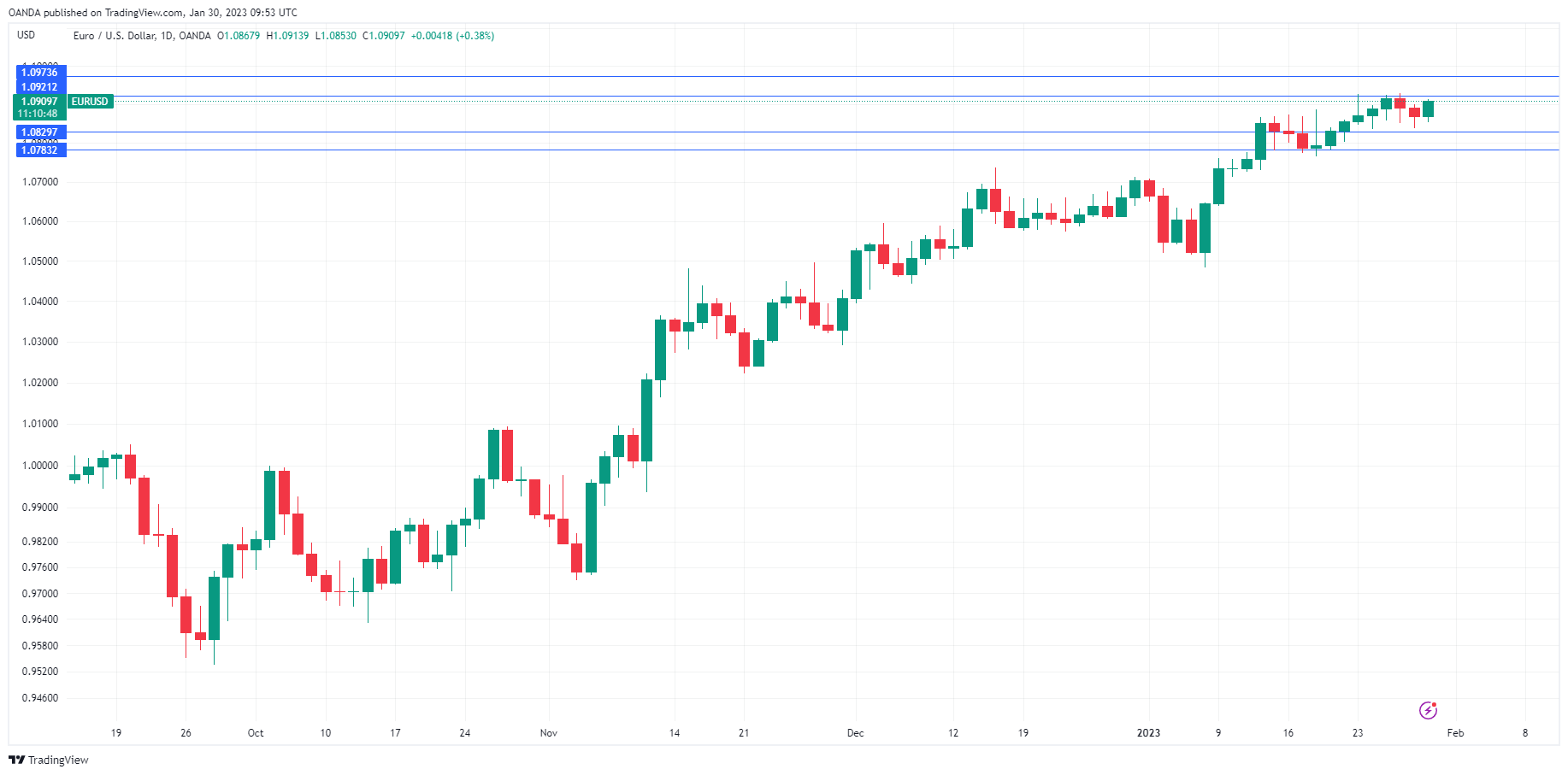
The euro is in positive territory on Monday. EUR/USD is trading at 1.0907 in the European session, up 0.36%.
It was a quiet week for the euro, which continues to hug the 1.09 line. I expect to see stronger volatility this week, as the eurozone releases GDP and inflation data, followed by the ECB rate announcement on Thursday.
German GDP declines in Q4
Germany’s economy posted a rare decline in the fourth quarter. GDP came in at -0.2% q/q, down from 0.4% in Q3 and shy of the forecast of zero. On an annualized basis, GDP slowed to 1.1%, down from the Q3 read of 1.3%, which was also the forecast. The markets are braced for more bad news out of the eurozone on Tuesday. German retail sales for November are expected to drop by 4.3% y/y, after a decline of 5.9% in November. Eurozone GDP is expected to slow to 1.8% y/y in Q4, compared to 2.3% in Q3.
The ECB will be keeping a close eye on this week’s GDP and inflation data, ahead of a key rate decision on Thursday. The central bank has adopted a hawkish stance but is still playing catch-up with inflation, which is currently at 9.2%. The markets are expecting 50-basis points at the upcoming and March rate meetings, but there is uncertainty as to what happens after that. The ECB would love to ease up on rates, but the paramount consideration is curbing high inflation. The cash rate stands at 2.50%, and the markets are forecasting a terminal rate in the range of 3.25%-3.75%, meaning that there is plenty of life left in the current rate-tightening cycle.
EUR/USD Technical
- EUR/USD is testing support at 1.0907. Below, there is support at 1.0837
- 1.0958 and 1.1028 are the next resistance lines
What Awaits the Oil Market in February?
Information is not investment advice
The Backstory
Western countries are trying to find other options for oil and gas supplies after a 10th package of sanctions, which will put more pressure on Russian oil and decrease global oil supply. Italy, for example, is in talks with Libya.
However, the lingering question is "will the reopening of the Chinese economy pool enough demand to alter the decline in the outcome of oil price in February?"
How does this affect the Forex market?
Oil prices usually work as a leading indicator for the US dollar. Rising prices lead to inflation increase, which forces the Fed to become more hawkish. As a result, the greenback strengthens.
On the other hand, lower oil prices cool down inflation, making the Federal Reserve to act more dovish. As a result, the USD declines.
What do the charts have to say?
In light of the fundamental breakdown above, we will draw our conclusions from the outlook of price on the charts using price action.
XBRUSD - D1
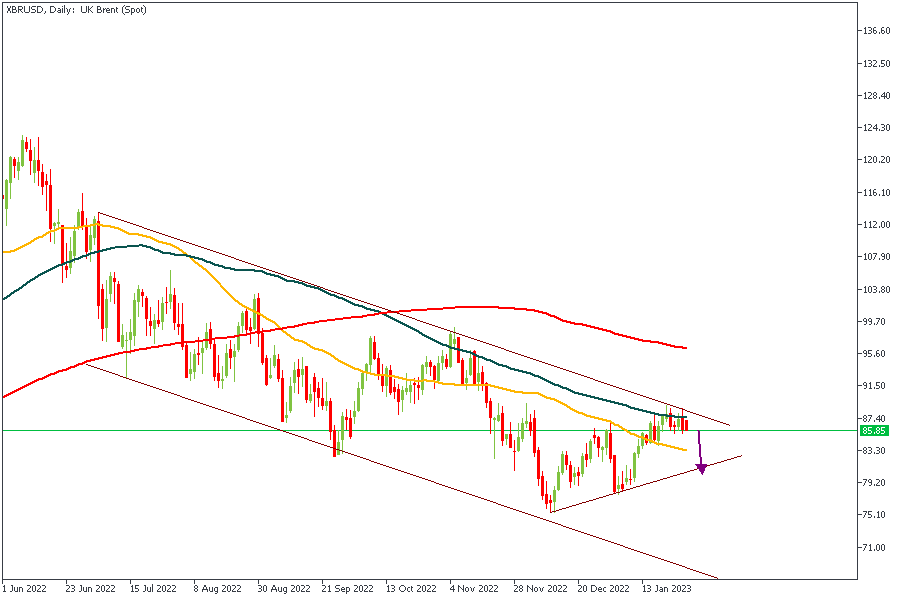
On the daily timeframe, Brent has been steadily bearish since March, 2022, declining by over 33% from the high. At the present, price has created a downward channel and is currently retesting the trendine resistance. The presence of the 100-Day SMA at that level as a confluence simply makes a stronger case for a bearish continuation from that point.
Analysts’ Expectations:
- Direction: Bearish
- Target: $80
- Invalidation: $90
XTIUSD - Daily Timeframe
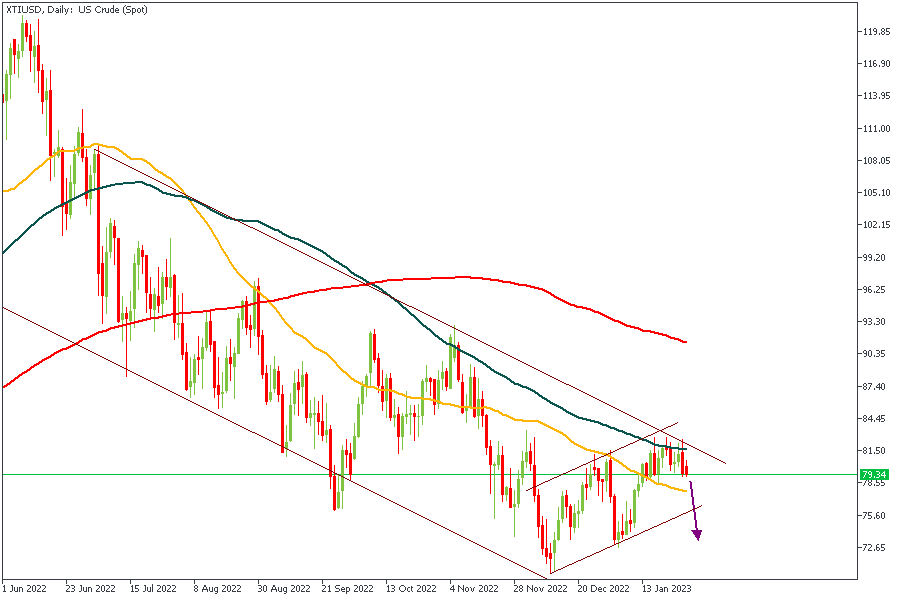
On the daily timeframe, XTIUSD formed a rising channel inside a downward channel. The implication of this is that the point of intersection of trendlines from both channels acts as a strong area of resistance. Considering the presence of the 100-Day SMA as an added confluence, it is only logical to expect lower prices on oil over the next couple of days.
Analysts’ Expectations:
- Direction: Bearish
- Target: $77
- Invalidation: $82
Conclusion
Based on the analyses above, it is safe to expect bearish price action of the oil market.
Important
The trading of CFDs comes at a risk. Thus, to succeed, you have to manage risks properly. To avoid costly mistakes while you look to trade these opportunities, be sure to do your due diligence and manage your risk appropriately.
Cable is Eyeing 1.25 – 1.26 Area: Elliott Wave Intraday Analysis
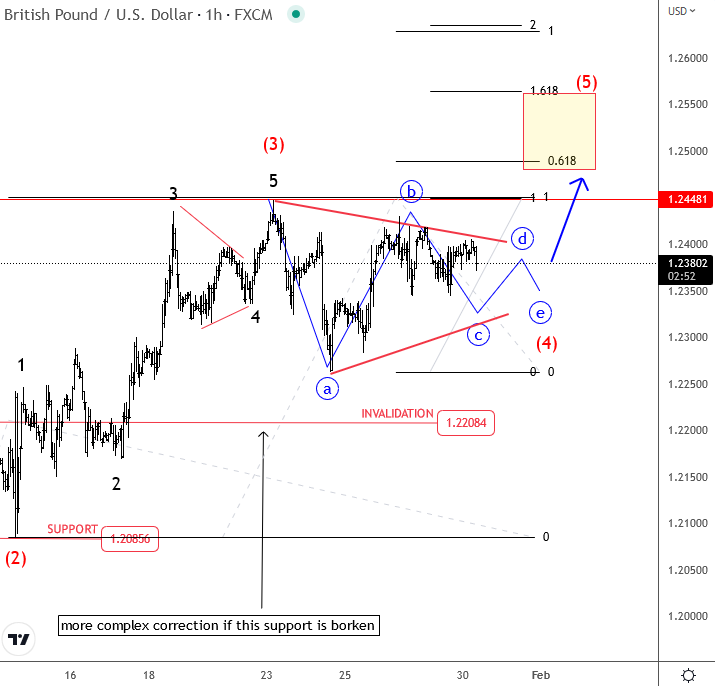
Cable is in an impulsive recovery mode on the intraday basis and seems like it's still pointing higher for wave (5), as current intraday consolidation looks like a bullish triangle pattern in wave (4). So, once a triangle in wave (4) fully unfolds, watch out for a break higher into wave (5) towards 1.25 – 1.26 area before we will see a bigger, deeper and higher degree slow down.
Eurozone economic sentiment rose to 99.9 in Jan, EU up to 98.0
Eurozone Economic Sentiment Indicator rose from 97.1 to 99.9 in January. Employment Expectation Indicator rose from 107.4 to 110.1. Economic Uncertainty Indicator dropped from 27.5 to 26.2. Industry confidence rose from -0.6 to 1.3. Services confidence rose from 7.7 to 10.7. Consumer confidence rose from -22.1 to -20.9. Retail trade confidence rose from -2.7 to -0.8. Construction confidence dropped from 3.6 to 1.3.
EU Economic Sentiment Indicator rose from 95.7 to 98.0. Employment Expectation Indicator rose from 106.2 to 108.5 Economic Uncertainty Indicator dropped from 27.0 to 25.9. Amongst the largest EU economies, the ESI increased markedly in France (+4.4), Spain (+2.7), Germany (+2.5), Italy (+1.7) and, to a lesser extent, the Netherlands (+0.5), while it was unchanged in Poland (±0.0).