

Sample Category Title
AUD/USD Tests Major Supply Area
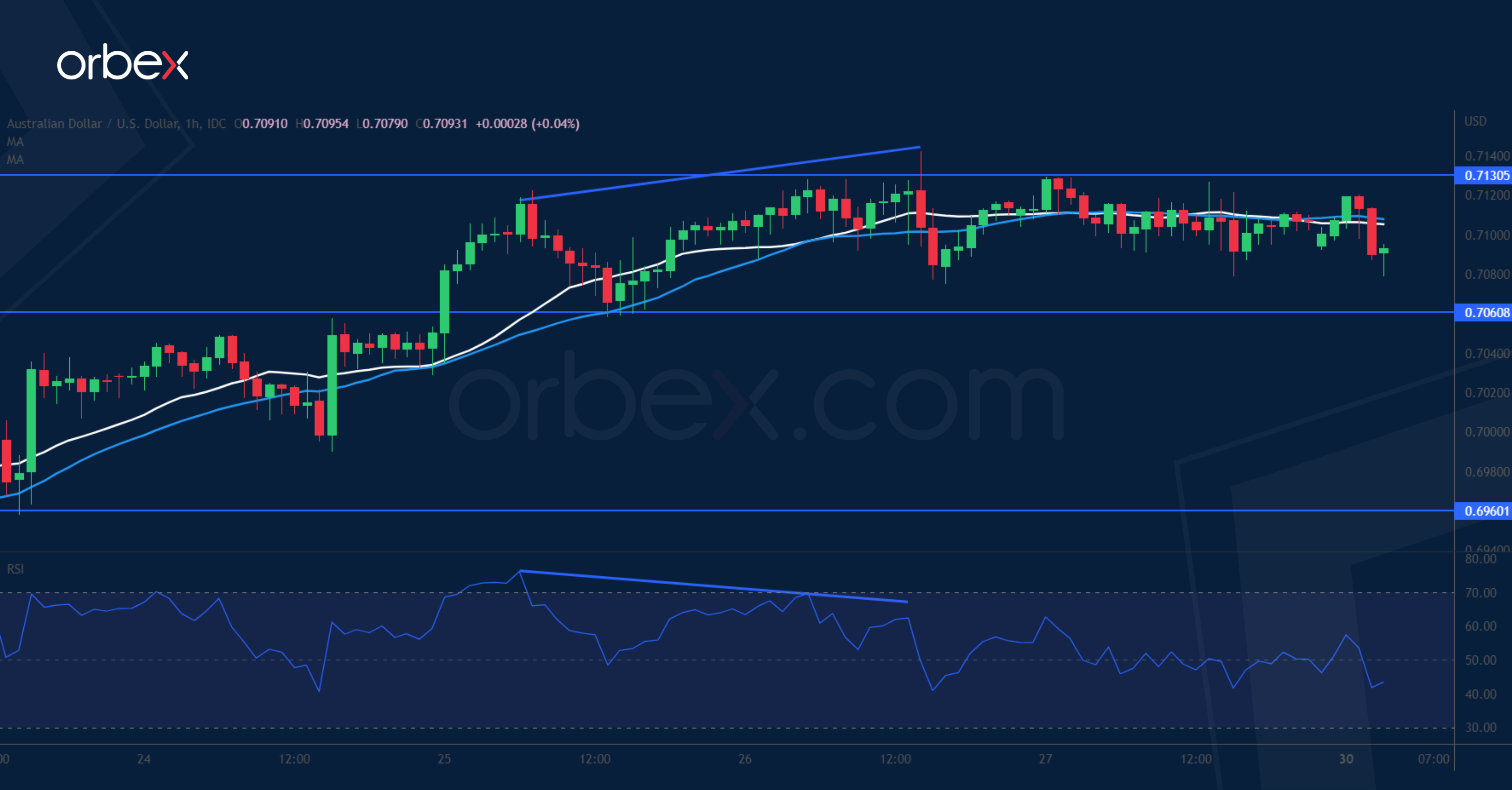
The Australian dollar stays high as traders remain hopeful of a dovish Fed pivot. A tentative break above last August’s high of 0.7130 further fueled the bulls’ enthusiasm and could lay the foundation for an extended reversal to 0.7270. In the short-term, the RSI’s bearish divergence indicates a slowdown in the momentum and could be significant as the price flirts with the supply zone. 0.7060 is the first support and 0.6960 at the base of a bullish breakout and on the 20-day moving average is a key level in case of a deeper correction.
Crucial Week with Fed, BoE and ECB Policy Meetings
Markets
Last Friday’s session was one to rapidly forget about. December US PCE deflators and spending data printed near consensus as could be expected following the Q4 GDP release earlier that week. Final figures from University Michigan consumer confidence showed a downward revision to 1y (3.9% from 4%) and 5-10y (2.9% from 3%) inflation expectations. The data didn’t alter market thinking/repositioning going into this crucial week with Fed, BoE and ECB policy meetings. Daily changes on the US yield curve ranged between +1.9 bps (2-yr) and -1.9 bps (30-yr). German Bund yields added up to 2.8 bps with the belly of the curve underperforming the wings. 10-yr yield spreads vs Germany widened up to 2 bps with Italy underperforming (+4 bps). EUR/USD held within its extremely narrow weekly range (1.084-1.092) with a weekly close of 1.0868. The pair last week failed to take out 1.0942 resistance (50% retracement on 2021-2022 decline). The litmus test will follow this week. EUR/GBP closed the week at 0.8774, coming off intraweek highs around 0.8850. The high 0.88 resistance zone survived earlier this month, but the rationale is the same as for EUR/USD: the real test will follow this week. Main US and European stock markets ended Friday marginally higher with Nasdaq again exception to the rule (+1%).
Chinese markets reopen from Lunar NY holiday’s with relatively small gains (<1%). Core bonds and EUR/USD are going nowhere. The Japanese yen is somewhat stronger (USD/JPY 129.50) after a panel of experts urged the government and central bank to revise their joint policy statement and make an inflation target a longer term goal. One of the members, who’s also on the shortlist to become a deputy BoJ governor in Spring said that the normalization of yield functions and the bond market would likely mean a need to comprehensively rethink monetary policy. The episode once more adds pressure on the BoJ to end its decade-long monetary easing.
Today’s eco calendar contains amongst others Spanish and Belgian inflation numbers. They are a prelude running up to tomorrow’s German and French data and Wednesday’s EMU figures. Consensus expects both headline and core inflation gently moderating, respectively from 9.2% Y/Y to 9% Y/Y and from 5.2% Y/Y to 5.1% Y/Y. Together with tomorrow’s Q4 GDP data (-0.1% Q/Q expected), they provide final input for Thursday’s ECB meeting – though they won’t alter the outcome (+50 bps rate hike). This week’s US eco calendar is well-filled as well with consumer confidence, Chicago PMI, ADP employment change and manufacturing ISM before Wednesday’s FOMC meeting and payrolls and non-manufacturing ISM afterwards. This complex of triggers makes heavy weather for market sailing. Our main view is that core bonds will sell off with German Bunds underperforming US Treasuries. The faith of EUR/USD 1.0942 will depend on whether constructive risk sentiment holds or not.
News and views
Rating agency S&P downgraded both Hungary’s long- and short term foreign and local currency debt ratings from BBB to BBB-. According to S&P: “the downgrade follows a series of economic shocks to Hungary in the context of the Covid-19 pandemic and the Russia-Ukraine conflict, which have impaired the policy flexibility of fiscal and monetary authorities”. S&P expects “fiscal consolidation will be difficult given still-elevated energy costs, a rising interest bill, and a challenging economic outlook”. With respect to the availability of EU funds, the rating agency’s baseline expectation is “that Hungary and the EU will reach an agreement and that no substantial part of EU funds will be cut”. The outlook for the credit rating was put at stable as S&P expects “that Hungary’s economy will avoid a substantial economic downturn over the next two years and weather the indirect effects of the Russia-Ukraine war, despite challenges to fiscal and monetary policy flexibility”. S&P expects 0.3% growth for Hungary this year.
S&P also affirmed Australia’s AAA long term rating. The outlook for is stable. S&P forecasts that the government deficit will be less than 2% between 2023 and 2026. It expects the net general government debt to remain modest at about 30% of GDP over this period. According to S&P, Australia will likely avoid a recession and expand over the next three years, as the unemployment remains low and as it profits from high commodity prices. S&P still expects sound economic growth of 1.5% in the fiscal year ending June 2024 even as monetary tightening kicks in.
Swiss KOF jumped to 97.2 in Jan, outlook considerably less gloomy
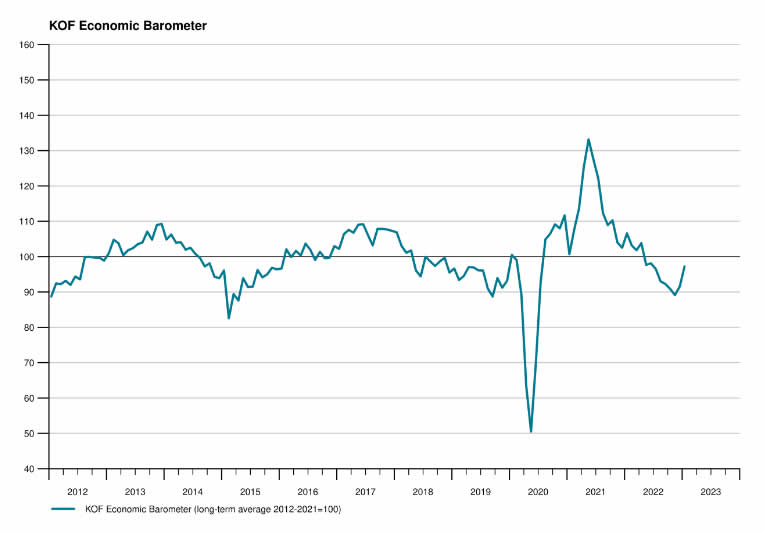
Swiss KOF Economic Barometer rose from 91.5 to 97.2 in January, well above expectation of 93.3. That's the second month of rise in a row, but the index remains below its medium term average. KOF said, "the outlook for the Swiss economy at the beginning of the year is considerably less gloomy than it was in autumn last year."
KOF also noted: "All bundles of indicators contribute to the improvement. They are developing particularly favourably in manufacturing, hospitality and the services sector. Nevertheless, the indicator bundles for manufacturing and services are below their medium-term average. The indicators for the hospitality sector, on the other hand, jump above the average, so the prospects here are now better than average."
USD/CAD Daily Outlook
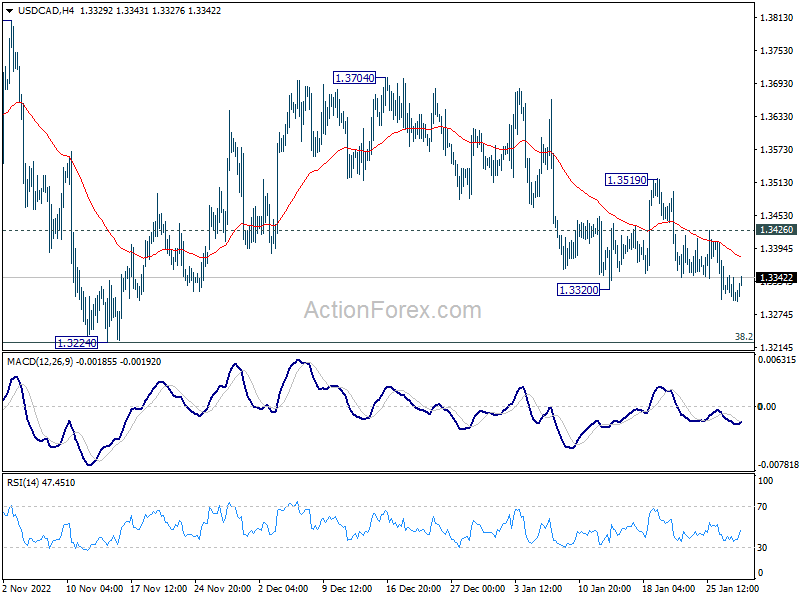
Daily Pivots: (S1) 1.3291; (P) 1.3319; (R1) 1.3338; More…
While deeper decline might be seen in USD/CAD with 1.3426 minor resistance intact, strong support is still expected from 1.3224 key support level to bring rebound. On the upside, above 1.3426 minor resistance will turn intraday bias back to the upside for 1.3519 resistance. However, decisive break of 1.3224 would carry larger bearish implication.
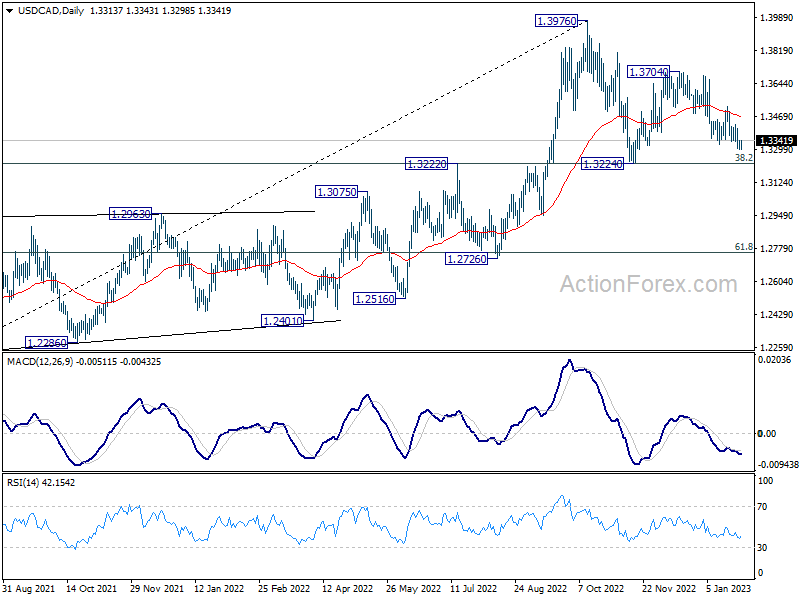
In the bigger picture, as long as 1.3222 cluster support (38.2% retracement of 1.2005 to 1.3976 at 1.3223) holds, larger up trend from 1.2005 (2021 low) is still expected to resume through 1.3976 high at a later stage. However, firm break of 1.3222/3 will indicate that the trend might have reversed. Deeper fall would be seen to next cluster support at 1.2726 (61.8% retracement at 1.2758).
USD/JPY Daily Outlook
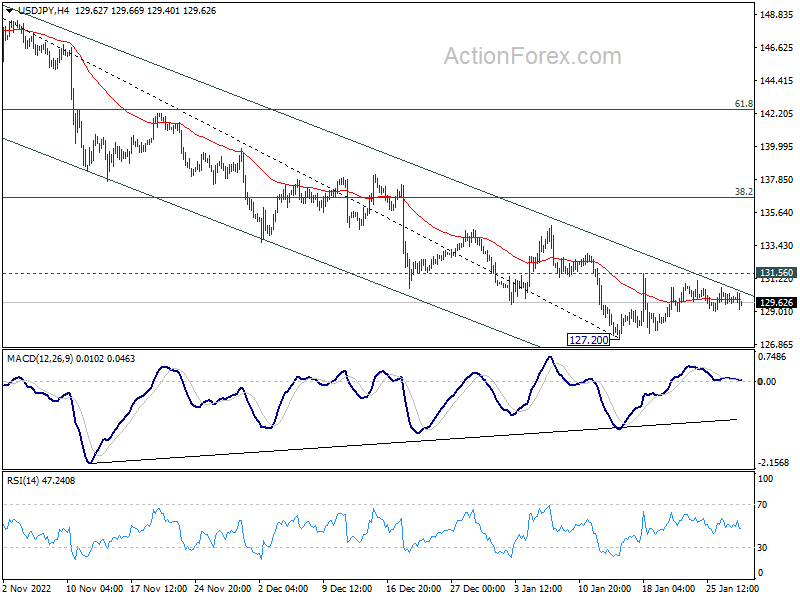
Daily Pivots: (S1) 129.48; (P) 129.88; (R1) 130.25; More…
USD/JPY is staying in range above 127.20 and intraday bias remains neutral. On the downside, break of 127.20 will resume the whole decline from 151.93 and target 121.43 fibonacci level. Nevertheless, on the upside, break of 131.56 resistance should confirm short term bottoming, and turn bias back to the upside for stronger rebound to 55 day EMA (now at 134.01).
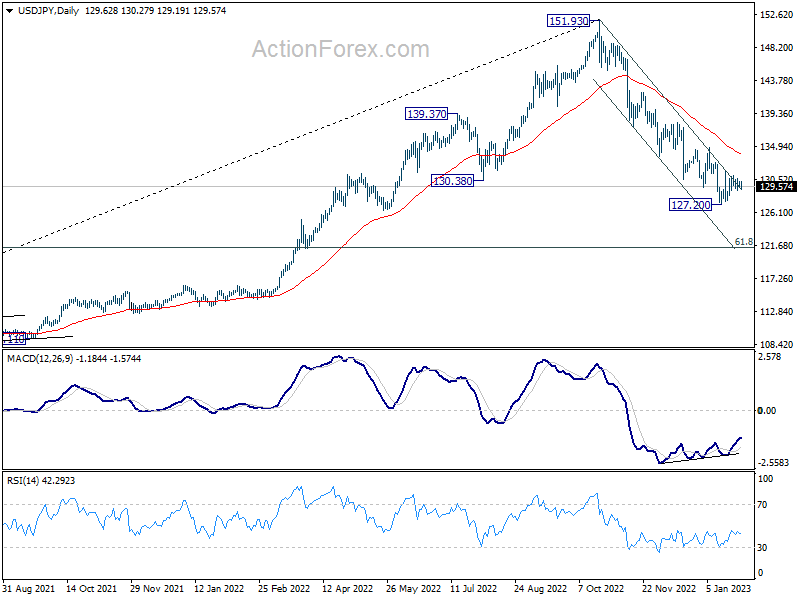
In the bigger picture, the break of 55 week EMA (now at 131.39) raises the chance of medium term bearish reversal, but that’s not confirmed yet. Strong support could be seen around 61.8% retracement of 102.58 to 151.93 at 121.43 and 38.2% retracement of 75.56 to 151.93 at 122.75 to bring rebound. But break of 131.56 resistance is needed to indicate bottoming first. Otherwise further fall will remain in favor.
USD/CHF Daily Outlook
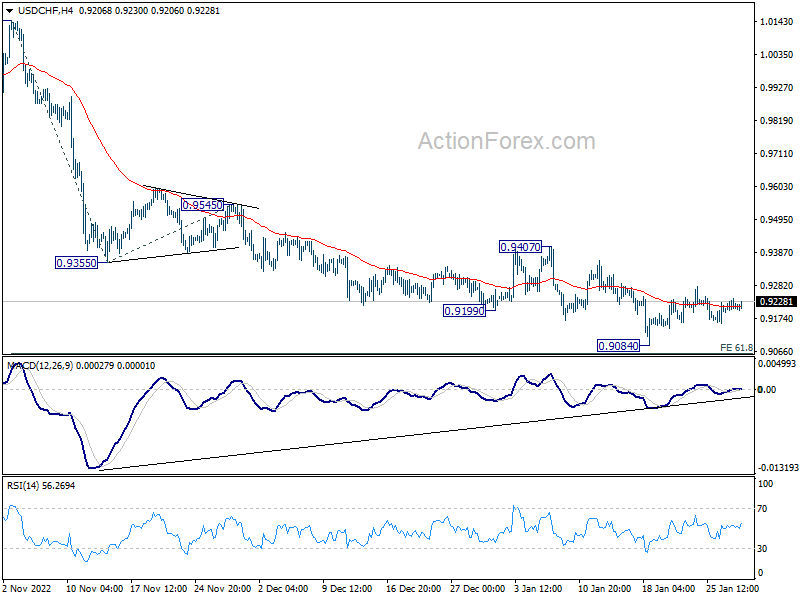
Daily Pivots: (S1) 0.9187; (P) 0.9213; (R1) 0.9238; More…
USD/CHF is still bounded in range above 0.9084 support and intraday bias remains neutral at this point. On the downside, sustained break of 61.8% projection of 1.0146 to 0.9355 from 0.9545 at 0.9056 will pave the way to 100% projection at 0.8754, which is close to 0.8756 long term support. Nevertheless, on the upside, break of 0.9407 should confirm short term bottoming and turn bias back to the upside for 0.9545 structural resistance.
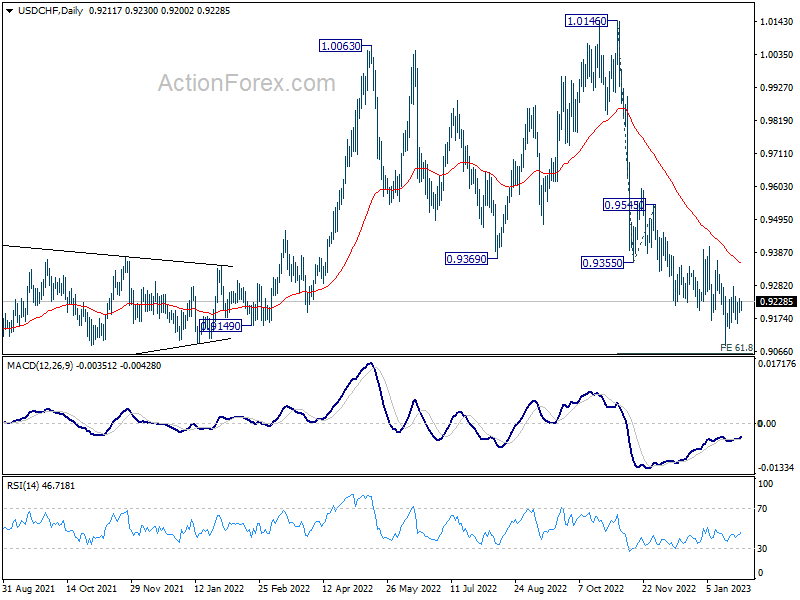
In the bigger picture, rise from 0.8756 (2021 low) has completed at 1.0146, well ahead of 1.0342 long term resistance (2016 high). Based on current downside momentum, fall from 1.0146 should be a medium term down trend itself. Next target is a test on 0.8756 low. Strong support should be seen there to bring rebound. Still, further decline will now be expected as long as 0.9407 resistance holds, in any case.
GBP/USD Daily Outlook
Daily Pivots: (S1) 1.2354; (P) 1.2387; (R1) 1.2427; More…
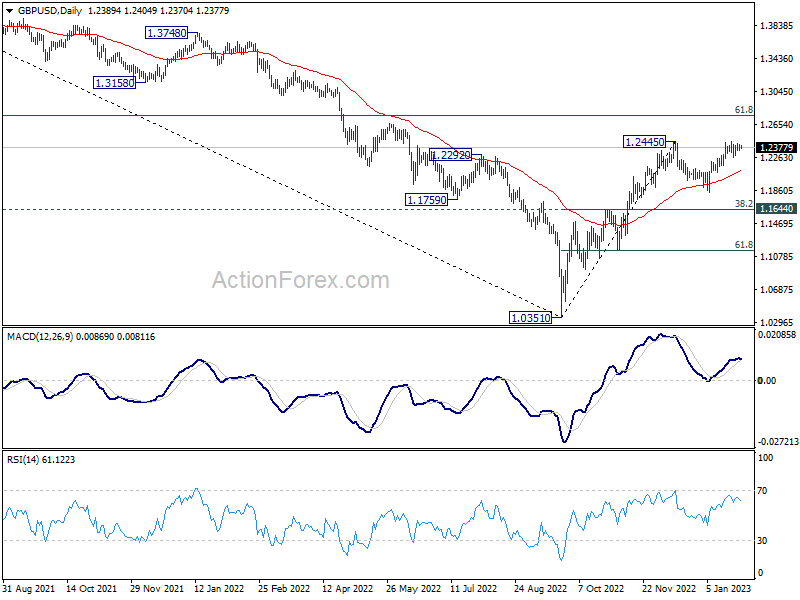
GBP/USD is still bounded in tight range below 1.2445 resistance and intraday bias stays neutral at this point. On the downside, firm break of 1.2252 minor support will turn bias to the downside, and extend the corrective pattern from 1.2445 with another falling leg. On the upside, decisive break of 1.2445 will confirm resumption of whole rise from 1.0351. Next target will be 1.2759 fibonacci level.
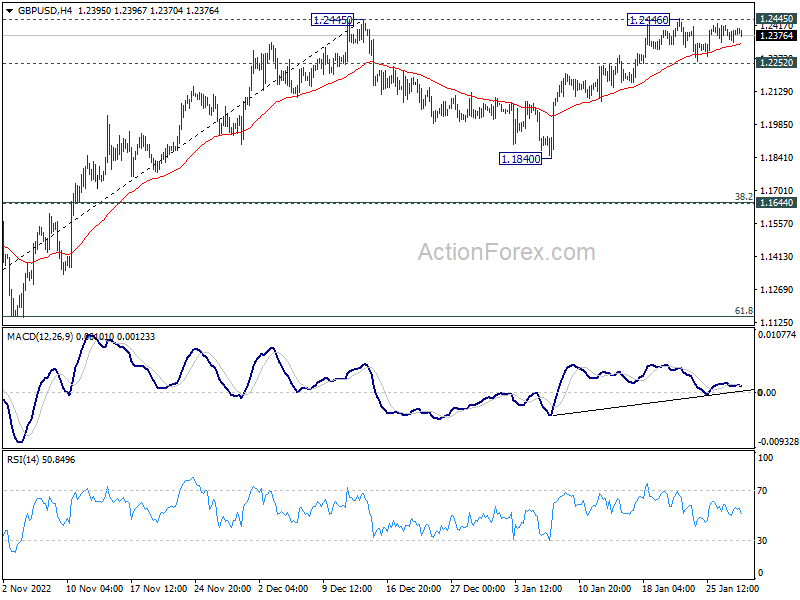
In the bigger picture, rise from 1.0351 medium term bottom is at least correcting whole down trend from 1.4248 (2021 high). Further rise is expected as long as 1.1644 resistance turned support holds. Next target is 61.8% retracement of 1.4248 to 1.0351 at 1.2759. Sustained break there will pave the way back to 1.4248.
EUR/USD Daily Outlook
Daily Pivots: (S1) 1.0838; (P) 1.0869; (R1) 1.0900; More…
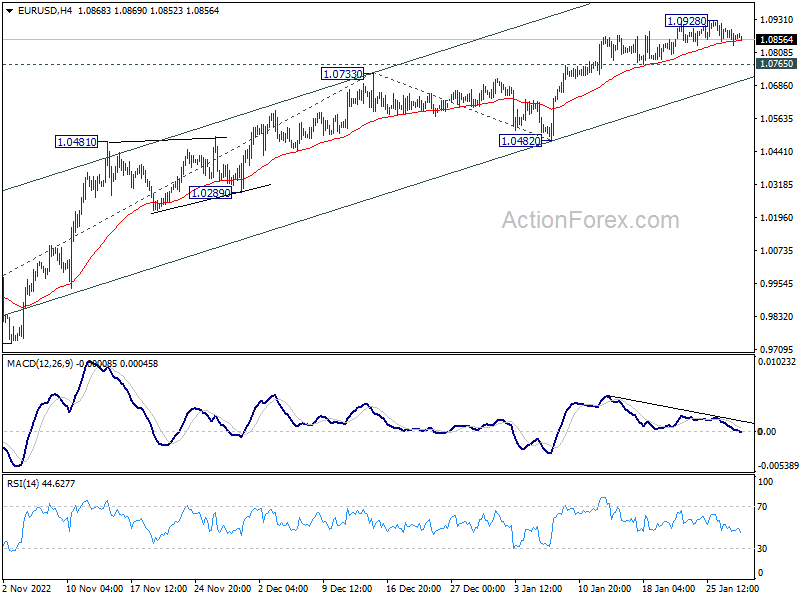
Intraday bias in EUR/USD stays neutral first. With 1.0765 support intact, further rally remains in favor. One the upside, break of 1.0928 will resume larger rise to 61.8% projection of 0.9630 to 1.0733 from 1.0482 at 1.1164 next. On the downside, though, break of 1.0765 support should now confirm short term topping, and turn bias back to the downside for 55 day EMA (now at 1.0601).
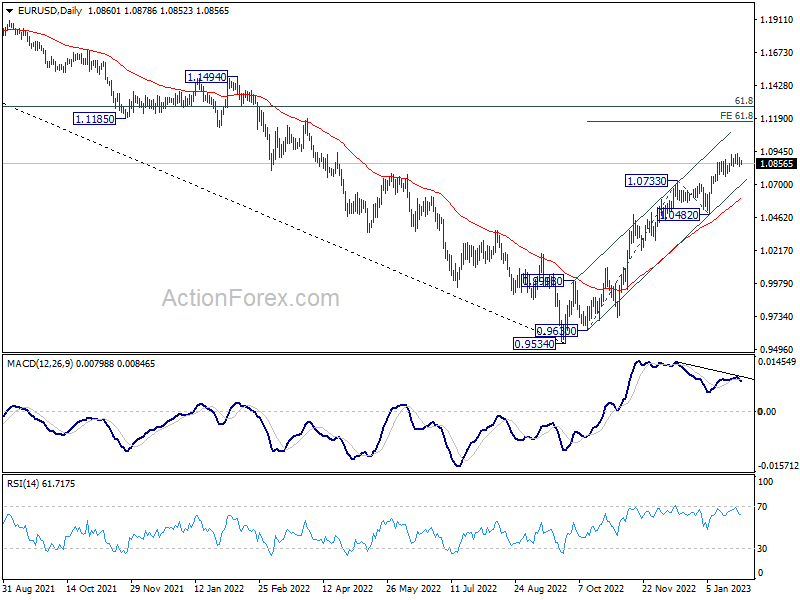
In the bigger picture, current development suggests that the rally from 0.9534 low (2022 low) is a medium term up trend rather than a correction. Further rise is in favor to 61.8% retracement of 1.2348 (2021 high) to 0.9534 at 1.1273 next. This will remain the favored case as long as 1.0482 support holds.
EURUSD Weakens After Jumping Above 1.0900
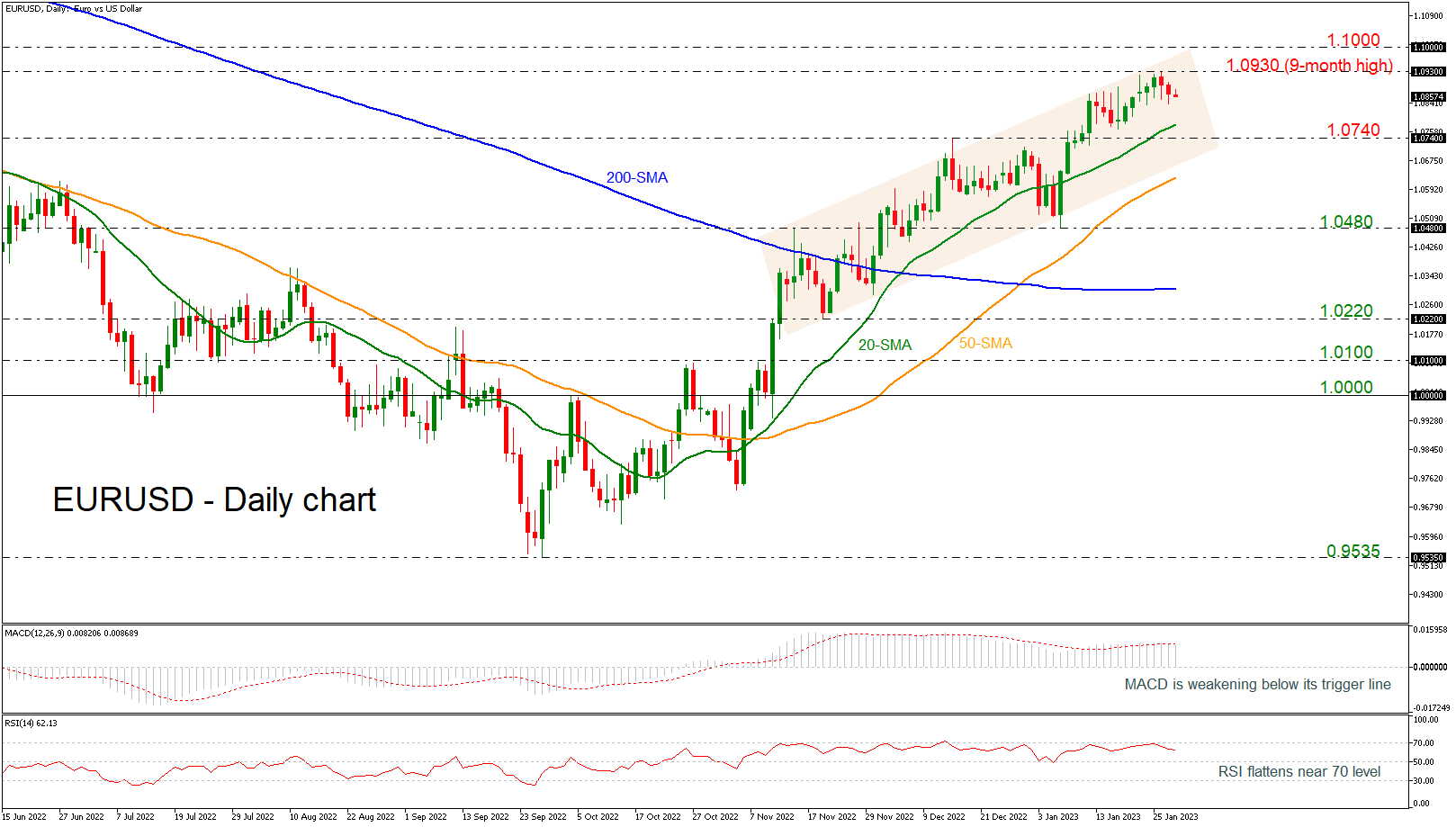
EURUSD is easing from last week’s the nine-month high of 1.0930, remaining within the upward sloping channel and well above the short-term simple moving averages (SMAs).
Technically, the MACD oscillator is falling beneath its trigger line in the bullish region, while the RSI is flattening beneath the 70 level, suggesting the momentum is weakening.
Further losses should see the 20-day SMA at 1.0780 acting as a major support ahead of the 1.0740 support level and the lower boundary of the channel at 1.0680. A drop below the 50-day SMA at 1.0630 would reinforce the bearish structure in the medium term and open the way towards the next key support level of 1.0480, changing the outlook to neutral.
In the event of an upside reversal, the previous peak of 1.0930 could act as a barrier before being able to re-challenge the 1.1000 round number. A break above this level would endorse the bullish structure, meeting the 1.1180 barrier, registered in March 2022.
Summarizing, EURUSD is still in a positive mode and only a decline beneath the channel may switch the view to neutral.
Big Week Ahead
The new week kicked off with Chinese equities jumping into a bull market as traders returned from their Lunar New Year holiday.
The CSI index, which began its positive move back in November, rallied more than 20% since then, and the positive vibes weren’t only on the menu of the Chinese, the S&P500 also freed itself from the 2022 bearish trend and extended rally in the bullish consolidation zone for the second straight day on Friday; there was nothing better to end a week – where the GDP data surprised to the upside - with a spot-on easing in core inflation. The cherry on top was the faster-than-expected contraction in US personal spending in December, while Michigan’s inflation expectations for 5-years remained steady at 2.9%, while analysts were expecting a read around 3%.
Bonds are having the best time
The picture in the bonds market is not less colorful. Global bond markets also had their best January since 1990, and if the equity rally is still on a shaky ground – due to fear that the slowing economy could hit company earnings – the future in bonds looks brighter. It is said that the US pensions are presently sitting on their biggest surplus in about two decades, and in dollar terms that means they have something like $1 trillion to spend to… buy bonds! Such buying will counter the falling demand from the Fed, which shrank its balance sheet by around $500 billion so far. So, the scenario of catastrophe that we were painting for 2023 may be a bit rosier after all.
But it’s too early to tell.
Huge week ahead
In the macro front, the Federal Reserve (Fed), the European Central Bank (ECB) and the Bank of England (BoE) will be announcing their latest policy verdicts, between Wednesday and Thursday.
For the Fed, there is extremely little doubt that this week’s rate hike won’t be anything more than a meagre 25bp hike.
Inflation is headed lower, economy is slowing if you look at the PMI figures, but the slowdown is not dramatic if you look at the GDP numbers. The US jobs market is still tight, however, but as long as inflation is headed lower, the Fed should not be too obsessed with people losing their jobs.
The US 2-year yield is stable since the start of the year between 4 and 4.30%, and the dollar index lost up to more than 3.80% since the January peak.
The depreciation in the US dollar clearly let the world’s other currencies breathe – and note that, that also probably helped convincing investors to return to the markets, as the US dollar seemed no longer on a one-way rally.
The only risk for FX traders this week is Jerome Powell, because he will certainly not declare victory on inflation and remind investors that the rate hikes will continue, though the size of the coming hikes will certainly be small. If that’s the case, we could see a minor rebound in the US dollar across the board, yet the dollar outlook remains bearish for this quarter.
Elsewhere. The ECB is expected to hike by 50bp this month, and Madame Lagarde will certainly remind investors that there will be as much 50bp hikes as ‘little breads’ for the Europeans on the pipeline – as goes a French saying.
Across the Channel, we know that the BoE will hike the interest rates, we don’t know by how much. In one hand, the BoE should continue fighting against inflation – which remains in the double-digit zone in Britain. On the other hand, the economic outlook for Britain is so morose – with country-wide strikes adding salt and pepper to the gloomy picture that Bailey cannot throw a series of 50bp hikes in the middle like Madame Lagarde.
After a nice 5% rally against the US dollar in January, Cable consolidates gains a touch below the 1.24 mark. The risks look tilted to the downside this week with the high possibility of a hawkish Jerome Powell, and the low - but still existent probability of a dovish BoE action. All Cable must do to remain in the bullish trend is to hold support at 1.2225 level, which is the major 38.2% Fibonacci retracement on January rally.
Against the euro, the pound will likely see limited appetite into the 50 and 100-DMAs, as both the economic and the central bank outlook for Europe and UK do support a better valuation for the euro than the contrary.
Elsewhere
The Indian markets are being shaken by the Adani scandal – which will certainly be a great Netflix series next year. The Nifty 50 extended losses to fresh lows since October despite Adani publishing a more-than-400 pages denial of the short seller’s allegation.
In energy, OPEC will meet this week, but the cartel is expected to maintain the production levels unchanged at the current levels.
In earnings, Amazon, Apple, Google, Meta, Exxon, Starbucks and Ford are among big names that are due to announce earnings this week.