Sample Category Title
Weekly Economic & Financial Commentary: Fine-Tuning Fed Set to Hike Rates Next Wednesday
Summary
United States: Headline GDP Growth Overstates the Strength of the Economy
- Real GDP expanded at a 2.9% annualized pace in Q4. While beating expectations, the underlying details were not as encouraging. Moreover, the weakening monthly indicator performances to end the year suggest the decelerating trend will continue in Q1.
- Next week: Consumer Confidence (Tue), ISM Manufacturing (Wed), Employment (Fri)
International: Sentiment in Europe Is Improving, Bank of Canada Calls It Quits
- For most of 2022, we had concerns that the broader European economy could be on the verge of a deep recession. While a warm winter and falling inflation have not completely abated those concerns, they do lead us to believe the European economic downturn will not be as bad as initially expected. Elsewhere, one of the major central banks opted to formally pause rate hikes this week. Following a 25 bps hike to 4.50%, Governor Macklem of the Bank of Canada declared the central bank's tightening cycle is over.
- Next week: Brazilian Central Bank (Wed), Bank of England (Thu), European Central Bank (Thu)
Interest Rate Watch: Fine-Tuning Fed Set to Hike Rates Next Wednesday
- We expect the Federal Open Market Committee (FOMC) to raise the fed funds target range by 25 bps at the conclusion of the FOMC meeting on Feb. 1. Ultimately, this meeting should signal that the Fed's work this hiking cycle is nearer completion but not yet done.
Topic of the Week: Benchmarks and Broomsticks: A Guide to the Upcoming Changes to the Establishment and Household Survey Jobs Data
- Nonfarm payrolls have continued to expand at an impressive pace despite an increasingly challenging environment. But what if the recent strength of payrolls is a mirage? The annual benchmark revisions to payrolls are expected to show more robust hiring through early 2022, but will say little about how job growth has fared subsequently.
Is the U.S. Fed Nearing the End of its Record Hiking Cycle?
The Bank of Canada has delivered what it suggested could be the last hike for its current cycle, raising the overnight rate by 25 basis points to 4.5%. Will the U.S. Fed follow suit next week?
We do expect the size of its rate increase to mirror the BoC’s at 25 basis points. That’s half the size of its December hike and would take the fed funds target range to 4.5% to 4.75%. Price pressures in the U.S. have shown encouraging signs of slowing. Headline CPI growth rates have eased and the breadth of price pressures has narrowed alongside lower gasoline prices, easing global supply chain constraints, and slower economic growth momentum. Manufacturing sales for consumer goods fell by over 3% by late 2022 from peak levels in June. Consumer spending volumes declined two consecutive months over November and December.
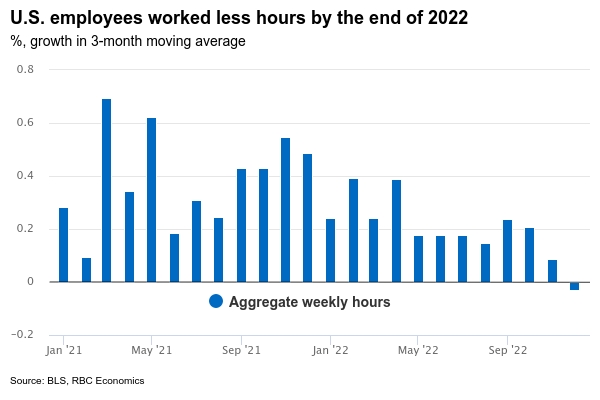
Labour markets are still running hot with the U.S. unemployment rate matching multi-decade lows at 3.5% in December. But, over the last three months, total hours worked declined for the first time since the 2020 pandemic lockdowns—in line with expectations that reduced hours would come before layoffs. Wage growth is still high but has been edging lower. And further softening in labour demand is likely as the impact of 425 basis points of hikes last year (the most aggressive hiking cycle since the 1980s) continues to work its way through the economy. In December, most Federal Open Market Committee participants expected that the fed funds target range would need to be lifted above 5% this year. But we expect a pause in the slightly lower range of 4.75% to 5%—provided ongoing softening in U.S. inflation and growth trends persists.
Week ahead data watch
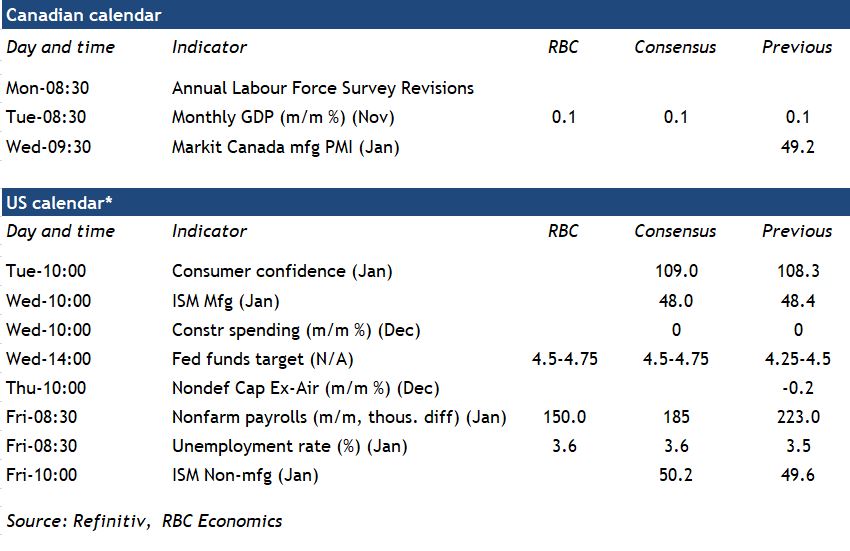
We expect Canadian GDP to tick up 0.1% in November, in line with StatCan’s advance estimate. Construction, retail, mining, quarrying, and oil and gas extraction declines partially offset increases in manufacturing, utilities, wholesale, and finance and insurance. Growth has slowed over the fall and early winter following stronger gains over the summer. We also look for December output to be little changed with hours worked up 0.1% in the month.
U.S. payroll employment likely continued to rise in January, although the 150,000 increase in payrolls we expect would be the smallest gain since a drop in December 2020. The labour market remains tight and layoffs are still very low. But the number of job openings has been edging lower and we look for a tick up in the unemployment rate to 3.6% from 3.5% in December.
Revisions to closely-watched Canadian labour market data will be released next Monday. Re-estimated seasonal factors and implementation of a new classification by occupation are not expected to have a significant impact on annual estimates of employment for 2022, although could change the monthly pattern of growth within the year and recent trends.
Week Ahead – All Eyes on the Fed, ECB, BOE and NFP Report
It doesn’t get any busier than this week. Traders will focus on the FOMC decision, but they should also closely watch mega-cap tech earnings, and the nonfarm payroll report.
The Fed is expected to continue slowing their rate hiking pace with a small 25 basis point rate rise. Disinflation trends are clearly here, but Core PCE suggest price pressures are coming and the labor market refuses to break and could prompt the Fed to remain vigilant with its inflation fight.
The nonfarm payroll report is still expected to show job growth of 175K, even as we hear of multiple reports of layoffs announcements across tech, finance, and real estate. Most of the layoffs will happen throughout the next couple of quarters, so we still could see another better-than-expected jobs number.
Earnings season gets chaotic as Wall Street will get results from Advanced Micro Devices, Alphabet, Amazon, Amgen, Apple, Canadian Pacific Railway, Cigna, ConocoPhillips, Deutsche Bank, Exxon Mobil, Ferrari, Ford Motor, General Motors, Gilead Sciences, GSK, Hershey, Honeywell International, Humana, McDonald’s, McKesson, Merck, Meta Platforms, Novartis, Qualcomm, Samsung SDI, Sanofi, Shell, SoftBank, Sony Group, Starbucks, T-Mobile, Thermo Fisher Scientific, and United Parcel Service
Three events stand out next week, the most obvious being the ECB meeting on Thursday. While the rate decision is what everyone will be waiting for, the flash inflation data on Wednesday and GDP on Tuesday could have some influence on whether the central bank will seek to soften its hawkish message. A 50 basis point hike is mostly priced in but what comes next is less certain at this point.
The Bank of England has a particularly tough decision over the coming months. On the one hand, inflation is above 10% and the economy likely didn’t fall into recession in the second half of last year, to the surprise of many. On the other, inflation has decelerated in the last two months and the November GDP data probably delayed the inevitable rather than making it less likely. The outlook remains bleak, how the BoE navigates is still highly uncertain. And next week brings the monetary policy report containing the latest forecasts from the central bank. The majority of analysts expect them to raise rates by 50bp to 4.00%, while a minority are eyeing a 25bp hike.
Russia
Unemployment on Monday and a couple of PMI reports are the only highlights next week. That aside, focus will remain on events in Ukraine.
South Africa
The whole economy’s PMI is the only highlight next week.
Turkey
Official inflation data is the main release next week but this has become more of a political focus in recent years than an economic one, as the central bank pays very little attention to it. Inflation is expected to slow towards low-50s, potentially making it to the 30s by the end of the year.
Switzerland
A few notable pieces of economic data next week including the leading indicator, retail sales and PMI survey.
China
China markets reopen after the Lunar Year Holiday and traders await to see how much economic activity improved last month after they began rolling back some COVID restrictions. Traders will pay close attention to the official government manufacturing PMI reading which could come close to returning to expansion territory. The services PMI is expected to post a strong rebound from 41.6 to 51.5.
India
The focus will fall on the Indian government’s budget which should focus on deficit reduction. Economic data releases include India’s fiscal deficit, eight infrastructure industries and both manufacturing and services PMIs.
Australia & New Zealand
China’s COVID reopening has supported both Australian and New Zealand dollars significantly. Much attention will go towards China’s PMI data readings. For Australia, the economic calendar contains the December retail sales report that should show spending is cooling, building approvals are expected to rebound, and the NAB business confidence report.
The New Zealand economic calendar contains the fourth quarter employment report, the December building permits, and ANZ consumer confidence.
Japan
The pressure of the sharp depreciation of the yen in the past has eased somewhat and the reopening of China should support the start of a recovery in the Japan economy in the first half of this year. The next BoJ meeting in March will be the last meeting of Governor Haruhiko Kuroda’s term of office. Bank of Japan governor candidate Takatoshi Ito recently said that if the BoJ abandons yield curve control, it will need to conduct a comprehensive review of its policy framework.
Next week will focus on the jobless rate, retail sales, industrial production, housing starts data, and PMI readings.
Singapore
It will be a busy week of data for Singapore. Economic releases include money supply data, unemployment rate, PMI data, and retail sales.
Markets
Energy
Crude prices are poised to finish the week on a strong note as global recession fears are countered by optimism that China’s reopening momentum will continue and over economic data that suggests large parts of the US economy remains strong. The upcoming week has two massive events; the OPEC+ virtual meeting on output and the FOMC decision. The OPEC+ meeting might be easy with a decision to keep output steady as they await what happens with the short-term global demand outlook.
Traders will also pay close attention to earnings from both Exxon and Shell.
Gold
Gold prices are consolidating leading up to the FOMC decision. Next week, the Fed is likely to shift from a 50bp hike pace to just a quarter point rate rise, but still will say that more could come. Gold’s outlook for the rest of the year is turning rather bullish for some investors, but a lot of that hinges inflation steadily falling back below 3.0%.
Cryptos
Cryptos continue to benefit from the broad risk rebound across Wall Street. The Fed is nearing the end of its rate hiking cycle and that has helped all interest rate sensitive assets to start the New Year. The headlines across the crypto space have not all been doom gloom as Moody’s works on a scoring system for stablecoins, Amazon has a NFT initiative, and as some firms successfully raise money. Bitcoin has major resistance at the $24,000 level, so momentum traders will closely watch to see how prices behave post-FOMC decision. Given where inflation stands, the Fed will likely remain hesitant that a pause is imminent and lean more towards staying hawkish. If the Fed follows the lead from the BOC and signals they are almost done with rate rises, Bitcoin could tentatively break past $24,000.
Summary 1/30 – 2/3
Monday, Jan 30, 2023
| GMT | Ccy | Events | Consensus | Previous |
|---|---|---|---|---|
| 21:45 | NZD | Trade Balance (NZD) Dec | -1750M | -1863M |
| 08:00 | CHF | KOF Leading Indicator Jan | 89.1 | 92.2 |
| 09:00 | EUR | Germany GDP Q/Q Q4 P | 0.00% | 0.40% |
| 10:00 | EUR | Eurozone Economic Sentiment Jan | 94.6 | 95.8 |
| 10:00 | EUR | Eurozone Industrial Confidence Jan | -1.7 | -1.5 |
| 10:00 | EUR | Eurozone Services Sentiment Jan | 4.3 | 6.3 |
| 10:00 | EUR | Eurozone Consumer Confidence Jan F | -20.9 | |
| 23:30 | JPY | Unemployment Rate Dec | 2.50% | 2.50% |
| 23:50 | JPY | Industrial Production M/M Dec P | -0.80% | 0.20% |
| 23:50 | JPY | Retail Trade Y/Y Dec | 3.10% | 2.50% |
| GMT | Ccy | Events | |
|---|---|---|---|
| 21:45 | NZD | Trade Balance (NZD) Dec | |
| Forecast: -1750M | Previous: -1863M | ||
| 08:00 | CHF | KOF Leading Indicator Jan | |
| Forecast: 89.1 | Previous: 92.2 | ||
| 09:00 | EUR | Germany GDP Q/Q Q4 P | |
| Forecast: 0.00% | Previous: 0.40% | ||
| 10:00 | EUR | Eurozone Economic Sentiment Jan | |
| Forecast: 94.6 | Previous: 95.8 | ||
| 10:00 | EUR | Eurozone Industrial Confidence Jan | |
| Forecast: -1.7 | Previous: -1.5 | ||
| 10:00 | EUR | Eurozone Services Sentiment Jan | |
| Forecast: 4.3 | Previous: 6.3 | ||
| 10:00 | EUR | Eurozone Consumer Confidence Jan F | |
| Forecast: | Previous: -20.9 | ||
| 23:30 | JPY | Unemployment Rate Dec | |
| Forecast: 2.50% | Previous: 2.50% | ||
| 23:50 | JPY | Industrial Production M/M Dec P | |
| Forecast: -0.80% | Previous: 0.20% | ||
| 23:50 | JPY | Retail Trade Y/Y Dec | |
| Forecast: 3.10% | Previous: 2.50% | ||
Tuesday, Jan 31, 2023
| GMT | Ccy | Events | Consensus | Previous |
|---|---|---|---|---|
| 00:30 | AUD | Private Sector Credit M/M Dec | 0.50% | 0.50% |
| 00:30 | AUD | Retail Sales M/M Dec | -0.30% | 1.40% |
| 01:00 | CNY | Manufacturing PMI Dec | 50.2 | 47.0 |
| 01:00 | CNY | Non-Manufacturing PMI Dec | 51.0 | 41.6 |
| 05:00 | JPY | Consumer Confidence Jan | 30.5 | 30.3 |
| 05:00 | JPY | Housing Starts Y/Y Dec | 0.50% | -1.40% |
| 06:30 | EUR | France Consumer Spending M/M Dec | 0.20% | 0.50% |
| 06:30 | EUR | France GDP Q/Q Q4 P | 0.00% | 0.20% |
| 07:30 | CHF | Real Retail Sales Y/Y Dec | 2.60% | -1.30% |
| 08:55 | EUR | Germany Unemployment Change Dec | 5K | -13K |
| 08:55 | EUR | Germany Unemployment Rate Dec | 5.50% | 5.50% |
| 09:30 | GBP | Mortgage Approvals Dec | 44K | 46K |
| 09:30 | GBP | M4 Money Supply M/M Dec | -0.30% | -1.60% |
| 10:00 | EUR | Italy GDP Q/Q Q4 P | -0.20% | 0.50% |
| 10:00 | EUR | Eurozone GDP Q/Q Q4 P | -0.10% | 0.30% |
| 13:00 | EUR | Germany CPI M/M Jan P | -0.30% | -0.80% |
| 13:00 | EUR | Germany CPI Y/Y Jan P | 8.80% | 8.60% |
| 13:30 | CAD | GDP M/M Nov | 0.20% | 0.10% |
| 13:30 | USD | Employment Cost Index Q4 | 1.20% | 1.20% |
| 14:00 | USD | S&P/CS Composite-20 HPI Y/Y Nov | 6.80% | 8.60% |
| 14:00 | USD | Housing Price Index M/M Nov | -0.40% | 0.00% |
| 14:45 | USD | Chicago PMI Jan | 45.4 | 44.9 |
| 15:00 | USD | Consumer Confidence Jan | 109.2 | 108.3 |
| 21:30 | AUD | AiG Performance of Mfg Index Jan | 44.7 | |
| 21:45 | NZD | Employment Change Q4 | 0.30% | 1.30% |
| 21:45 | NZD | Unemployment Rate Q4 | 3.30% | 3.30% |
| 21:45 | NZD | Labour Cost Index Q/Q Q4 | 1.30% | 1.10% |
| GMT | Ccy | Events | |
|---|---|---|---|
| 00:30 | AUD | Private Sector Credit M/M Dec | |
| Forecast: 0.50% | Previous: 0.50% | ||
| 00:30 | AUD | Retail Sales M/M Dec | |
| Forecast: -0.30% | Previous: 1.40% | ||
| 01:00 | CNY | Manufacturing PMI Dec | |
| Forecast: 50.2 | Previous: 47.0 | ||
| 01:00 | CNY | Non-Manufacturing PMI Dec | |
| Forecast: 51.0 | Previous: 41.6 | ||
| 05:00 | JPY | Consumer Confidence Jan | |
| Forecast: 30.5 | Previous: 30.3 | ||
| 05:00 | JPY | Housing Starts Y/Y Dec | |
| Forecast: 0.50% | Previous: -1.40% | ||
| 06:30 | EUR | France Consumer Spending M/M Dec | |
| Forecast: 0.20% | Previous: 0.50% | ||
| 06:30 | EUR | France GDP Q/Q Q4 P | |
| Forecast: 0.00% | Previous: 0.20% | ||
| 07:30 | CHF | Real Retail Sales Y/Y Dec | |
| Forecast: 2.60% | Previous: -1.30% | ||
| 08:55 | EUR | Germany Unemployment Change Dec | |
| Forecast: 5K | Previous: -13K | ||
| 08:55 | EUR | Germany Unemployment Rate Dec | |
| Forecast: 5.50% | Previous: 5.50% | ||
| 09:30 | GBP | Mortgage Approvals Dec | |
| Forecast: 44K | Previous: 46K | ||
| 09:30 | GBP | M4 Money Supply M/M Dec | |
| Forecast: -0.30% | Previous: -1.60% | ||
| 10:00 | EUR | Italy GDP Q/Q Q4 P | |
| Forecast: -0.20% | Previous: 0.50% | ||
| 10:00 | EUR | Eurozone GDP Q/Q Q4 P | |
| Forecast: -0.10% | Previous: 0.30% | ||
| 13:00 | EUR | Germany CPI M/M Jan P | |
| Forecast: -0.30% | Previous: -0.80% | ||
| 13:00 | EUR | Germany CPI Y/Y Jan P | |
| Forecast: 8.80% | Previous: 8.60% | ||
| 13:30 | CAD | GDP M/M Nov | |
| Forecast: 0.20% | Previous: 0.10% | ||
| 13:30 | USD | Employment Cost Index Q4 | |
| Forecast: 1.20% | Previous: 1.20% | ||
| 14:00 | USD | S&P/CS Composite-20 HPI Y/Y Nov | |
| Forecast: 6.80% | Previous: 8.60% | ||
| 14:00 | USD | Housing Price Index M/M Nov | |
| Forecast: -0.40% | Previous: 0.00% | ||
| 14:45 | USD | Chicago PMI Jan | |
| Forecast: 45.4 | Previous: 44.9 | ||
| 15:00 | USD | Consumer Confidence Jan | |
| Forecast: 109.2 | Previous: 108.3 | ||
| 21:30 | AUD | AiG Performance of Mfg Index Jan | |
| Forecast: | Previous: 44.7 | ||
| 21:45 | NZD | Employment Change Q4 | |
| Forecast: 0.30% | Previous: 1.30% | ||
| 21:45 | NZD | Unemployment Rate Q4 | |
| Forecast: 3.30% | Previous: 3.30% | ||
| 21:45 | NZD | Labour Cost Index Q/Q Q4 | |
| Forecast: 1.30% | Previous: 1.10% | ||
Wednesday, Feb 1, 2023
| GMT | Ccy | Events | Consensus | Previous |
|---|---|---|---|---|
| 00:30 | JPY | Manufacturing PMI Jan F | 48.9 | 48.9 |
| 01:45 | CNY | Caixin Manufacturing PMI Jan | 49.2 | 49 |
| 08:30 | CHF | Manufacturing PMI Jan | 54.3 | 54.1 |
| 08:45 | EUR | Italy Manufacturing PMI Jan | 49.6 | 48.5 |
| 08:50 | EUR | France Manufacturing PMI Jan F | 50.8 | 50.8 |
| 08:55 | EUR | Germany Manufacturing PMI Jan F | 47 | 47 |
| 09:00 | EUR | Eurozone Manufacturing PMI Jan F | 48.8 | 48.8 |
| 09:30 | GBP | Manufacturing PMI Jan F | 46.7 | 46.7 |
| 10:00 | EUR | Eurozone CPI Y/Y Jan P | 9.00% | 9.20% |
| 10:00 | EUR | Eurozone CPI Core Y/Y Jan P | 5.10% | 5.20% |
| 13:15 | USD | ADP Employment Change Jan | 168K | 235K |
| 14:30 | CAD | Manufacturing PMI Jan | 49.2 | |
| 14:45 | USD | Manufacturing PMI Jan F | 46.8 | 46.8 |
| 15:00 | USD | ISM Manufacturing PMI Jan | 48.7 | 48.4 |
| 15:00 | USD | ISM Manufacturing Prices Paid Jan | 41.9 | 39.4 |
| 15:00 | USD | ISM Manufacturing Employment Index Jan | 51.4 | |
| 15:00 | USD | Construction Spending M/M Dec | 0.00% | 0.20% |
| 15:30 | USD | Crude Oil Inventories | 0.5M | |
| 19:00 | USD | Fed Rate Decision | 4.75% | 4.50% |
| 19:30 | USD | FOMC Press Conference | ||
| 21:45 | NZD | Building Permits M/M Dec | 7.00% | |
| 23:50 | JPY | Monetary Base Y/Y Jan | -3.20% | -6.10% |
| GMT | Ccy | Events | |
|---|---|---|---|
| 00:30 | JPY | Manufacturing PMI Jan F | |
| Forecast: 48.9 | Previous: 48.9 | ||
| 01:45 | CNY | Caixin Manufacturing PMI Jan | |
| Forecast: 49.2 | Previous: 49 | ||
| 08:30 | CHF | Manufacturing PMI Jan | |
| Forecast: 54.3 | Previous: 54.1 | ||
| 08:45 | EUR | Italy Manufacturing PMI Jan | |
| Forecast: 49.6 | Previous: 48.5 | ||
| 08:50 | EUR | France Manufacturing PMI Jan F | |
| Forecast: 50.8 | Previous: 50.8 | ||
| 08:55 | EUR | Germany Manufacturing PMI Jan F | |
| Forecast: 47 | Previous: 47 | ||
| 09:00 | EUR | Eurozone Manufacturing PMI Jan F | |
| Forecast: 48.8 | Previous: 48.8 | ||
| 09:30 | GBP | Manufacturing PMI Jan F | |
| Forecast: 46.7 | Previous: 46.7 | ||
| 10:00 | EUR | Eurozone CPI Y/Y Jan P | |
| Forecast: 9.00% | Previous: 9.20% | ||
| 10:00 | EUR | Eurozone CPI Core Y/Y Jan P | |
| Forecast: 5.10% | Previous: 5.20% | ||
| 13:15 | USD | ADP Employment Change Jan | |
| Forecast: 168K | Previous: 235K | ||
| 14:30 | CAD | Manufacturing PMI Jan | |
| Forecast: | Previous: 49.2 | ||
| 14:45 | USD | Manufacturing PMI Jan F | |
| Forecast: 46.8 | Previous: 46.8 | ||
| 15:00 | USD | ISM Manufacturing PMI Jan | |
| Forecast: 48.7 | Previous: 48.4 | ||
| 15:00 | USD | ISM Manufacturing Prices Paid Jan | |
| Forecast: 41.9 | Previous: 39.4 | ||
| 15:00 | USD | ISM Manufacturing Employment Index Jan | |
| Forecast: | Previous: 51.4 | ||
| 15:00 | USD | Construction Spending M/M Dec | |
| Forecast: 0.00% | Previous: 0.20% | ||
| 15:30 | USD | Crude Oil Inventories | |
| Forecast: | Previous: 0.5M | ||
| 19:00 | USD | Fed Rate Decision | |
| Forecast: 4.75% | Previous: 4.50% | ||
| 19:30 | USD | FOMC Press Conference | |
| Forecast: | Previous: | ||
| 21:45 | NZD | Building Permits M/M Dec | |
| Forecast: | Previous: 7.00% | ||
| 23:50 | JPY | Monetary Base Y/Y Jan | |
| Forecast: -3.20% | Previous: -6.10% | ||
Thursday, Feb 2, 2023
| GMT | Ccy | Events | Consensus | Previous |
|---|---|---|---|---|
| 00:30 | AUD | Building Permits M/M Dec | 1.10% | -9.00% |
| 07:00 | EUR | Germany Trade Balance (EUR) Dec | 8.8B | 10.8B |
| 08:00 | CHF | SECO Consumer Climate Q1 | -38 | -47 |
| 12:00 | GBP | BoE Rate Decision | 4.00% | 3.50% |
| 12:00 | GBP | MPC Official Bank Rate Votes | 7--0--2 | 7--0--2 |
| 12:30 | USD | Challenger Job Cuts Y/Y Jan | 129.10% | |
| 13:15 | EUR | ECB Main Refinancing Rate | 3.00% | 2.50% |
| 13:30 | USD | Initial Jobless Claims (Jan 27) | 186K | |
| 13:30 | USD | Nonfarm Productivity Q4 P | 2.50% | 0.80% |
| 13:30 | USD | Unit Labor Costs Q4 P | 1.60% | 2.40% |
| 13:30 | CAD | Building Permits M/M Dec | 1.50% | 14.10% |
| 13:45 | EUR | ECB Press Conference | ||
| 15:00 | USD | Factory Orders M/M Dec | 2.30% | -1.80% |
| 15:30 | USD | Natural Gas Storage | -91B | |
| 21:30 | AUD | AiG Performance of Construction Index Jan | 48.2 |
| GMT | Ccy | Events | |
|---|---|---|---|
| 00:30 | AUD | Building Permits M/M Dec | |
| Forecast: 1.10% | Previous: -9.00% | ||
| 07:00 | EUR | Germany Trade Balance (EUR) Dec | |
| Forecast: 8.8B | Previous: 10.8B | ||
| 08:00 | CHF | SECO Consumer Climate Q1 | |
| Forecast: -38 | Previous: -47 | ||
| 12:00 | GBP | BoE Rate Decision | |
| Forecast: 4.00% | Previous: 3.50% | ||
| 12:00 | GBP | MPC Official Bank Rate Votes | |
| Forecast: 7--0--2 | Previous: 7--0--2 | ||
| 12:30 | USD | Challenger Job Cuts Y/Y Jan | |
| Forecast: | Previous: 129.10% | ||
| 13:15 | EUR | ECB Main Refinancing Rate | |
| Forecast: 3.00% | Previous: 2.50% | ||
| 13:30 | USD | Initial Jobless Claims (Jan 27) | |
| Forecast: | Previous: 186K | ||
| 13:30 | USD | Nonfarm Productivity Q4 P | |
| Forecast: 2.50% | Previous: 0.80% | ||
| 13:30 | USD | Unit Labor Costs Q4 P | |
| Forecast: 1.60% | Previous: 2.40% | ||
| 13:30 | CAD | Building Permits M/M Dec | |
| Forecast: 1.50% | Previous: 14.10% | ||
| 13:45 | EUR | ECB Press Conference | |
| Forecast: | Previous: | ||
| 15:00 | USD | Factory Orders M/M Dec | |
| Forecast: 2.30% | Previous: -1.80% | ||
| 15:30 | USD | Natural Gas Storage | |
| Forecast: | Previous: -91B | ||
| 21:30 | AUD | AiG Performance of Construction Index Jan | |
| Forecast: | Previous: 48.2 | ||
Friday, Feb 3, 2023
| GMT | Ccy | Events | Consensus | Previous |
|---|---|---|---|---|
| 01:45 | CNY | Caixin Services PMI Jan | 51.6 | 48 |
| 07:45 | EUR | France Industrial Output M/M Dec | 0.20% | 2.00% |
| 08:45 | EUR | Italy Services PMI Jan | 50.9 | 49.9 |
| 08:50 | EUR | France Services PMI Jan F | 49.2 | 49.2 |
| 08:55 | EUR | Germany Services PMI Jan F | 50.4 | 50.4 |
| 09:00 | EUR | Eurozone Services PMI Jan F | 50.7 | 50.7 |
| 09:30 | GBP | Services PMI Jan F | 48 | 48 |
| 10:00 | EUR | Eurozone PPI M/M Dec | -1.70% | -0.90% |
| 10:00 | EUR | Eurozone PPI Y/Y Dec | 30.20% | 27.10% |
| 13:30 | USD | Nonfarm Payrolls Jan | 193K | 223K |
| 13:30 | USD | Unemployment Rate Jan | 3.60% | 3.50% |
| 13:30 | USD | Average Hourly Earnings M/M Jan | 0.30% | 0.30% |
| 14:45 | USD | Services PMI Jan F | 46.6 | 46.6 |
| 15:00 | USD | ISM Services PMI Jan | 50.4 | 49.6 |
| GMT | Ccy | Events | |
|---|---|---|---|
| 01:45 | CNY | Caixin Services PMI Jan | |
| Forecast: 51.6 | Previous: 48 | ||
| 07:45 | EUR | France Industrial Output M/M Dec | |
| Forecast: 0.20% | Previous: 2.00% | ||
| 08:45 | EUR | Italy Services PMI Jan | |
| Forecast: 50.9 | Previous: 49.9 | ||
| 08:50 | EUR | France Services PMI Jan F | |
| Forecast: 49.2 | Previous: 49.2 | ||
| 08:55 | EUR | Germany Services PMI Jan F | |
| Forecast: 50.4 | Previous: 50.4 | ||
| 09:00 | EUR | Eurozone Services PMI Jan F | |
| Forecast: 50.7 | Previous: 50.7 | ||
| 09:30 | GBP | Services PMI Jan F | |
| Forecast: 48 | Previous: 48 | ||
| 10:00 | EUR | Eurozone PPI M/M Dec | |
| Forecast: -1.70% | Previous: -0.90% | ||
| 10:00 | EUR | Eurozone PPI Y/Y Dec | |
| Forecast: 30.20% | Previous: 27.10% | ||
| 13:30 | USD | Nonfarm Payrolls Jan | |
| Forecast: 193K | Previous: 223K | ||
| 13:30 | USD | Unemployment Rate Jan | |
| Forecast: 3.60% | Previous: 3.50% | ||
| 13:30 | USD | Average Hourly Earnings M/M Jan | |
| Forecast: 0.30% | Previous: 0.30% | ||
| 14:45 | USD | Services PMI Jan F | |
| Forecast: 46.6 | Previous: 46.6 | ||
| 15:00 | USD | ISM Services PMI Jan | |
| Forecast: 50.4 | Previous: 49.6 | ||
Will the Fed Add a Hawkish Flavor to a Smaller Hike?
With some Fed officials corroborating investors’ view of a quarter point increase, Wednesday’s FOMC gathering will likely be among the highlights of the week. Market participants will be eager to find out whether the consensus of policymakers also agrees with their view on the path of interest rates after the meeting, as this is where opinions between the financial community and the Fed diverge. What will the Fed signal and how may the market respond?
A bone of contention
At their last meeting for 2022, Fed officials raised interest rates by 50bps after four consecutive 75bps hikes. However, despite the smaller increment, they sang a hawkish song, with the gist of the lyrics being that interest rates may rise above 5%, while Fed Chair Powell’s solo part at the press conference intended to push back against pivot expectations.
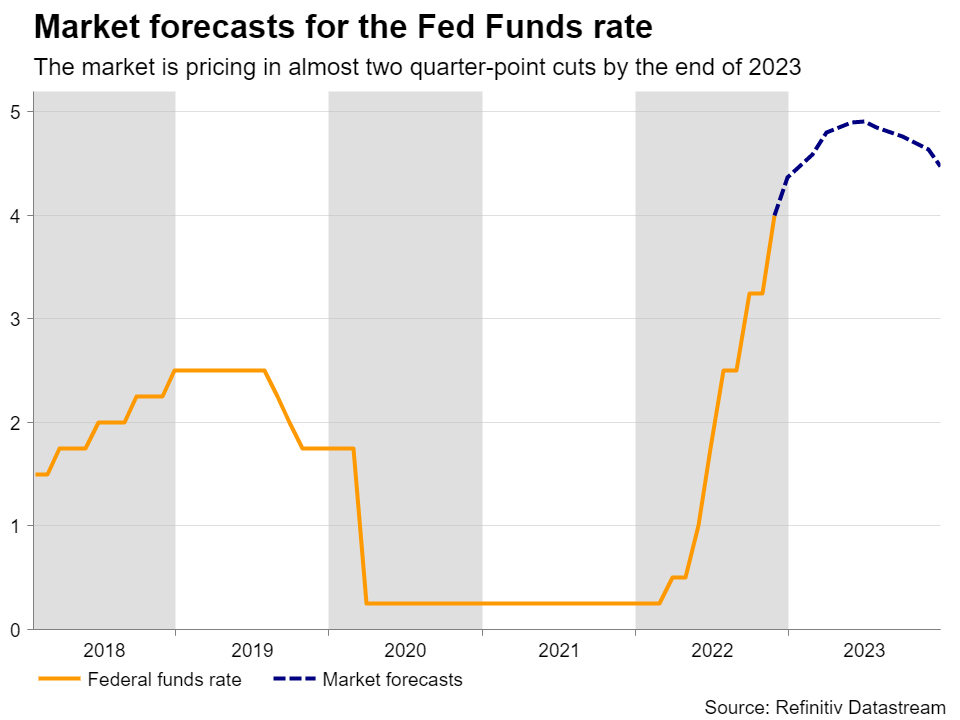
Since then, even if some policymakers admitted that shifting to a lower gear at the upcoming gathering may be appropriate, most of them have been adamantly sticking to their guns that interest rates will probably rise to slightly above 5%, in line with the December “dot plot”, and that they will stay there for a prolonged period thereafter. However, this has been a bone of contention as the market insists that interest rates are likely to rise to the 4.75-5.00% range, and that 50bps worth of rate cuts may be warranted by the end of the year.
Market keeps gaze locked on data
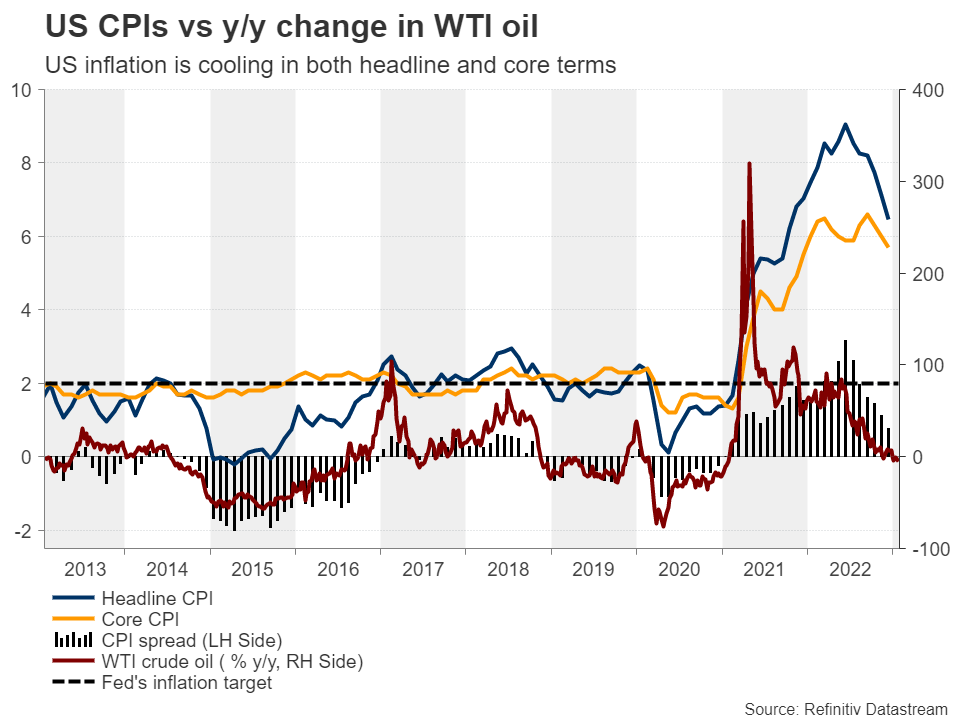
It seems that investors overly rely on economic data rather than the Fed communication, and especially the steady cooling of inflation. In December, the headline CPI slowed for the sixth straight month, with the core rate dropping as well, confirming the view that inflation may be on a sustained downtrend.
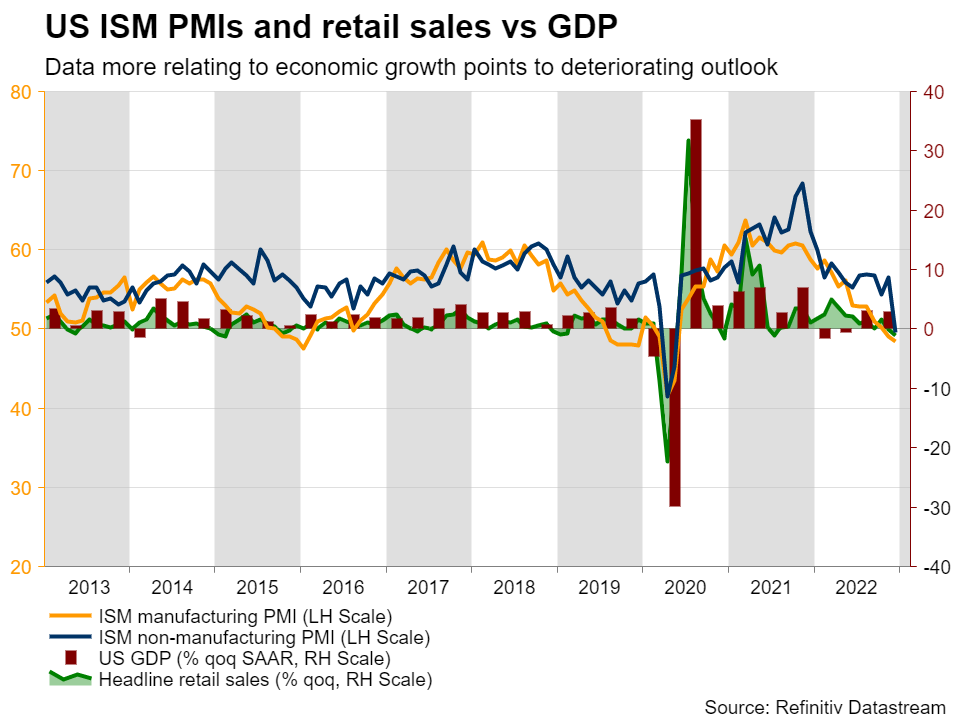
Furthermore, retail sales for December recorded their biggest drop in 12 months, a strong sign of deteriorating consumer demand, which could bring inflation further down in coming months but also adds to recession fears, especially after the ISM non-manufacturing PMI for December fell into contractionary territory for the first time since May 2020. Coming on top of the further contraction in the manufacturing sector, a shrinking service sector (which accounts for around 77.6% of US GDP) is anything but encouraging. Yes, the preliminary S&P Global PMIs for January suggested some improvement but still stayed below the boom-or-bust zone of 50.
On Friday, after the Fed decision, the employment report for December is expected to reveal a slowdown in job gains, but with the unemployment rate staying close to its five-decade low and wages accelerating, it would reflect a still-tight labor market, which may be the only argument in favor of the Fed’s narrative.
Dollar could gain, but not out of the woods yet
Recent history has shown that market participants are willing to sell dollars aggressively when data enhances their pivot view, but they are not buying with the same excitement when economic releases surprise to the upside.
Thus, even if the Fed continues to signal that interest rates are likely to rise above 5%, and even if Fed Chair Powell pours more cold water on rate-cut expectations at the press conference following the decision, the dollar is unlikely to skyrocket. It could rebound somewhat and perhaps extend its gains in the case of a solid NFP report, but with the first sign pointing to deeper economic wounds, investors may re-initiate short positions. That’s why dollar traders may pay even more attention to the ISM non-manufacturing PMI for January which is scheduled to be released on Friday after the NFPs. Another month of contraction could well weigh on the dollar, while a rebound back above 50 as the forecast currently suggests may extend a potential corrective rebound for a while longer.
An overly hawkish ECB on Thursday, confirming expectations of more 50bps rate increments beyond February, could also limit any dollar strength, as euro/dollar is by far the largest component of the index, with a 57.6% weigh.
The technical picture corroborates that view
Should this week’s agenda end up net positive for the US dollar, euro/dollar could pull back and perhaps retest the 1.0715-1.0800 zone as support. Even if it breaks below 1.0715, the pair would still be trading above the uptrend line drawn from the low of September 9, which might keep the door open for a rebound.
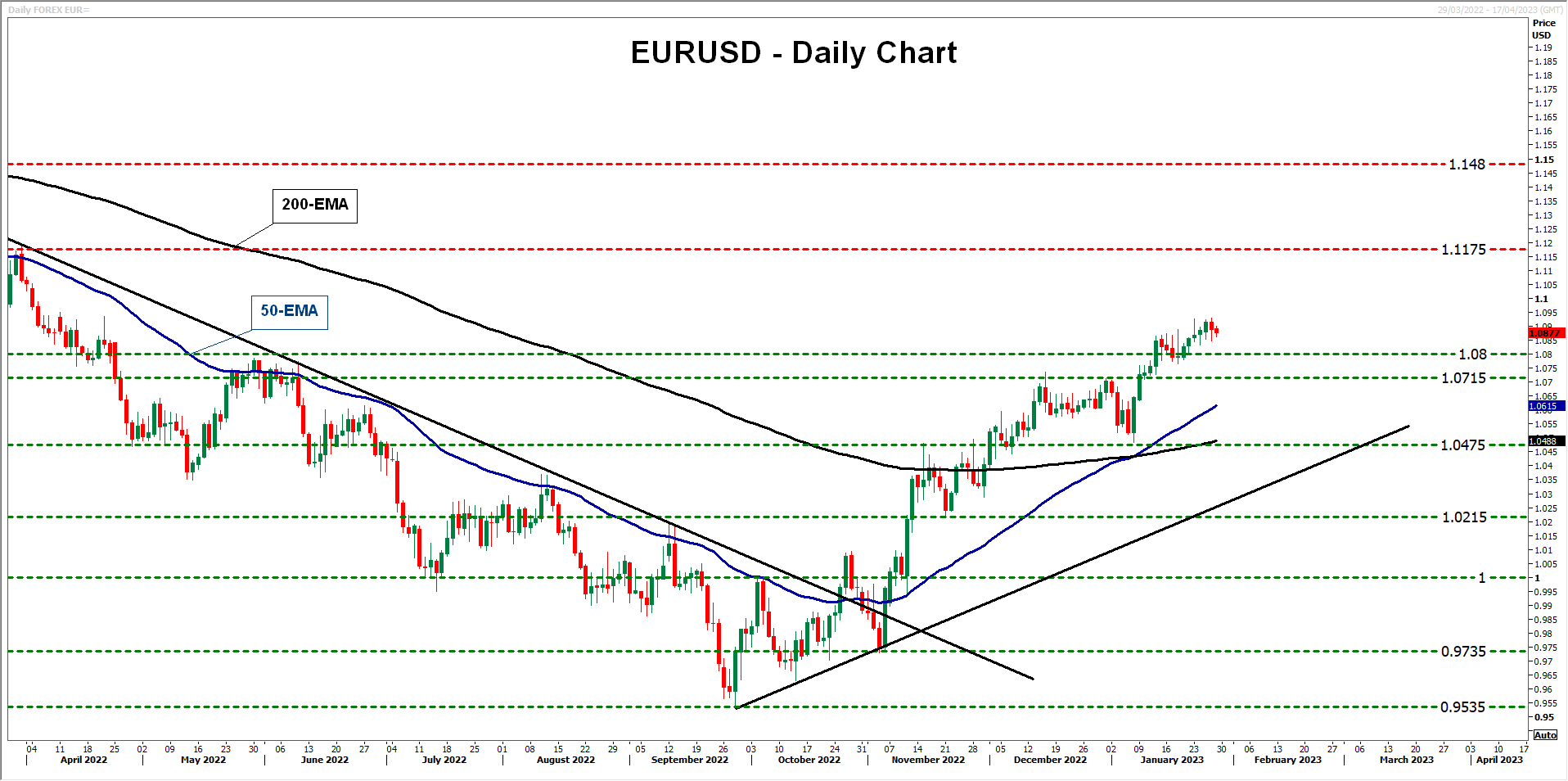
If indeed the bulls regain control in the not-too-distant future and drive the price back above 1.0800, they may push it all the way up to the 1.1175 zone, defined as resistance by the high of March 31. That zone also acted as support between November 2021 and February 2022. For the outlook of euro/dollar to be considered bearish, the bears may need to be strong enough to dive below 1.0215, as this is the move that could solidify a potential dip below the aforementioned uptrend line.
Week Ahead – Fed, ECB, and BoE Rate Decisions on the Menu
A busy week lies ahead, featuring several central bank decisions and a stream of data releases. The Fed is set to raise rates at a slower pace as inflation has started to cool down, putting the emphasis on Powell's commentary. Meanwhile, market pricing suggests the ECB and BoE will roll out bigger rate increases than the Fed, before the week concludes with the latest US employment report.
Dollar awaits Fed update
It's been a difficult few months for the US dollar. The world's reserve currency lost a lot of ground as a persistent slowdown in inflation supported the notion that the Fed is about to end its tightening cycle. A winter 'heat wave' in Europe also played a role, by diminishing fears around the energy crisis and a harsh recession, boosting the euro.
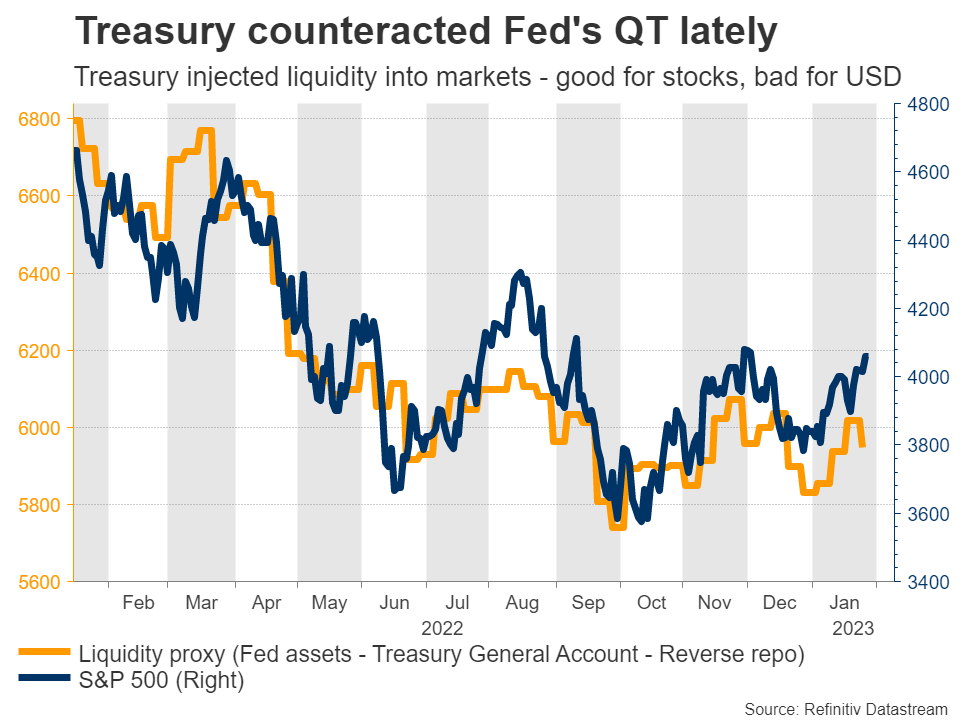
Another problem for the dollar is that the impact of the Fed's quantitative tightening program has been negated by the US Treasury lately. Faced with another debt ceiling standoff, the Treasury has been using its cash buffer at the Fed, essentially injecting liquidity back into the markets. This dynamic enabled the rally in 'meme stocks' and other risky assets, but it is negative for the dollar.
Heading into the Fed decision on Wednesday, Chairman Powell and his colleagues will be faced with some mixed signals on the economy. Inflationary pressures finally seem to be moderating, but that's happening mostly because demand is faltering and economic growth has started to lose steam.
Most importantly, the labor market remains extremely tight. The worry for policymakers is that even if inflation cools, it could come back swinging at any time if the jobs market stays extremely tight. Therefore, the Fed has to remain restrictive until it sees some real damage in employment numbers.
Markets have already fully priced in a 25 basis points rate hike for next week. Since that's basically a done deal, the dollar's reaction will depend mostly on what Chairman Powell says during his press conference. He probably won't be too happy with the dramatic loosening in financial conditions, which have returned to where they were when the Fed started its tightening cycle.
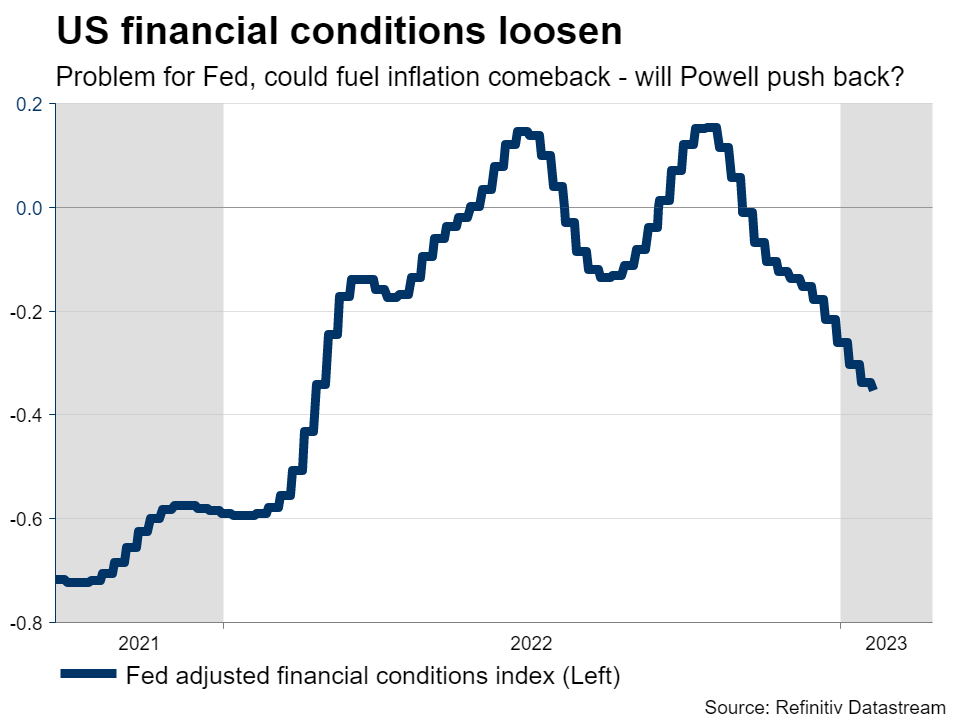
This phenomenon blocks the effective transmission of monetary policy and generates the risk that inflation might come back for a second round, so Powell could push back against it. A firm tone by the Fed chief, reminding investors that the job is not done yet, would likely be beneficial for the dollar.
Still, the Fed makes decisions based on the data, so the employment report on Friday could be even more important. Economists expect another solid report, with nonfarm payrolls forecast at 175k in January. However, business surveys by S&P Global paint an uglier picture, warning that jobs growth almost came to a halt.
Despite these signs that the labor market is cooling, it's probably too early for any real weakness to show up in this dataset, because applications for unemployment benefits remain exceptionally low. There are many anecdotes of mass layoffs, but it hasn't shown up in the hard data yet.
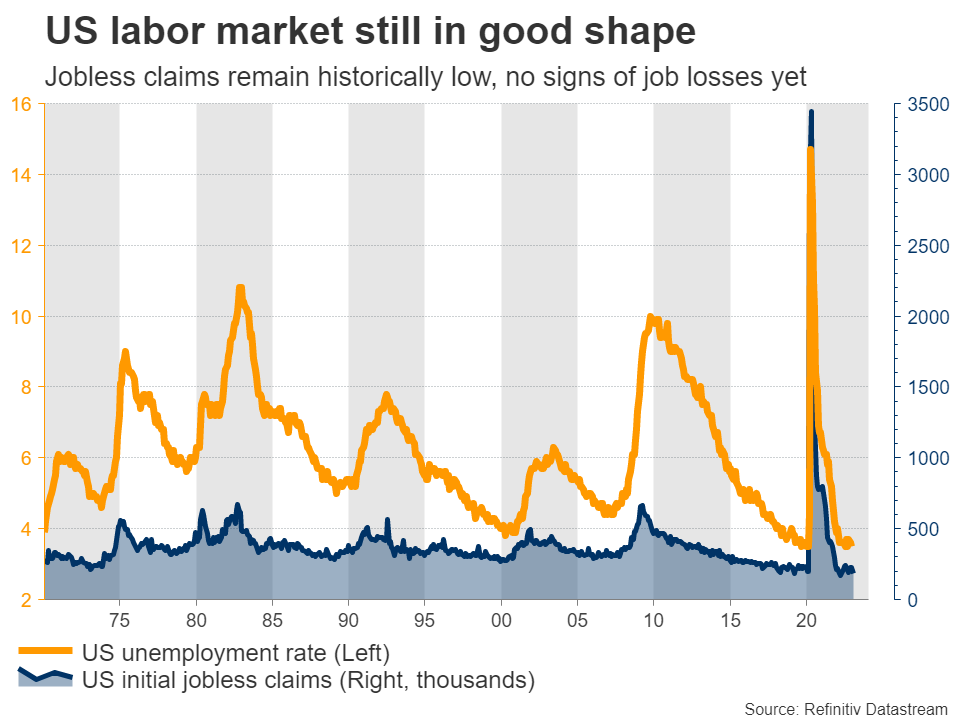
The ISM non-manufacturing survey for January will also be released on Friday, after the jobs numbers, and could be just as important in shaping the economic narrative.
ECB and BoE to forge ahead
Over in Europe, the ball will get rolling on Monday with the first estimate of Germany's GDP for last quarter. The nation's latest inflation stats will follow on Tuesday, alongside the Eurozone-wide GDP print for Q4. Monthly inflation numbers for the Eurozone are out on Wednesday.
Of course, the main event will be the European Central Bank decision on Thursday. Markets have fully priced in a 50bps rate increase, following clear signals from President Lagarde about the need to move rapidly in half-point increments. Hence, similar to the Fed, traders will focus on the press conference.
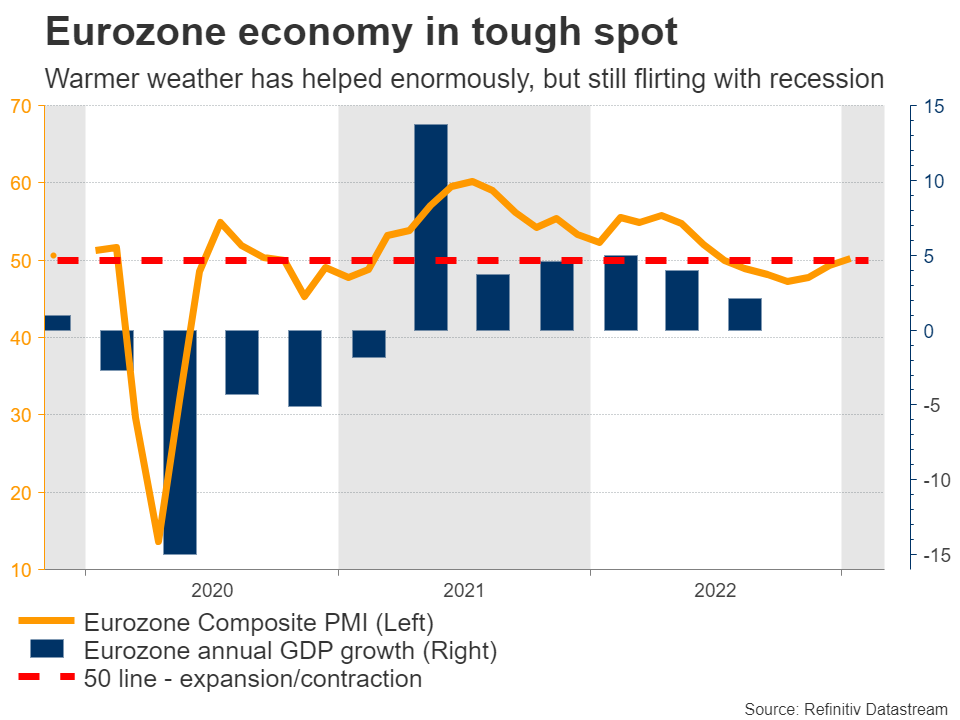
Warmer than usual weather has been a real blessing for the Eurozone economy, and by extension for the euro itself, as it has alleviated some concerns about an energy-driven recession and helped cool inflationary pressures at the same time.
Despite all this, many ECB officials have been talking a big game, stressing the need for forceful action to make sure that high inflation does not become embedded. Accordingly, market pricing suggests the central bank will keep tightening well into the summer.
Turning to the United Kingdom, the economy seems to be in worse shape, complicating matters for the Bank of England that also meets on Thursday. Business surveys suggest recession risks are on the rise, as widespread worker strikes compound the economic damage from the cost of living crisis and higher interest rates.
Inflation is still raging though, essentially forcing the BoE to keep raising rates even as the economy deteriorates. Bearing that in mind, markets are split on how much the central bank will raise rates next week, pricing in a 70% probability for a half-point move and a 30% chance for a smaller, quarter-point increase.
The decision might ultimately depend on what the BoE's updated economic forecasts show about inflation and growth moving forward. It will almost certainly be a split vote, as some officials place more weight on recession concerns and others on inflation risks.
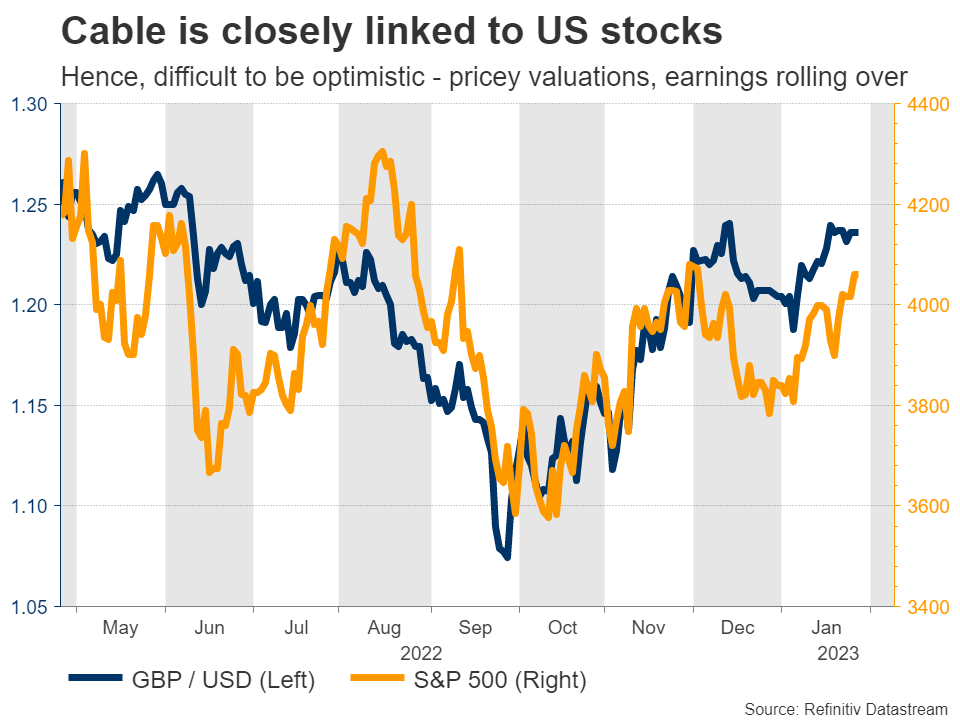
As for the pound, it's difficult to be optimistic. The domestic UK economy is struggling and the British currency has a strong correlation with US stock markets, leaving it vulnerable to a selloff as equity valuations remain expensive and earnings growth has started to crumble.
Key data releases and earnings
On the data front, the show will start with the latest business surveys from China early on Tuesday, which will give investors an update into how the economic reopening is playing out.
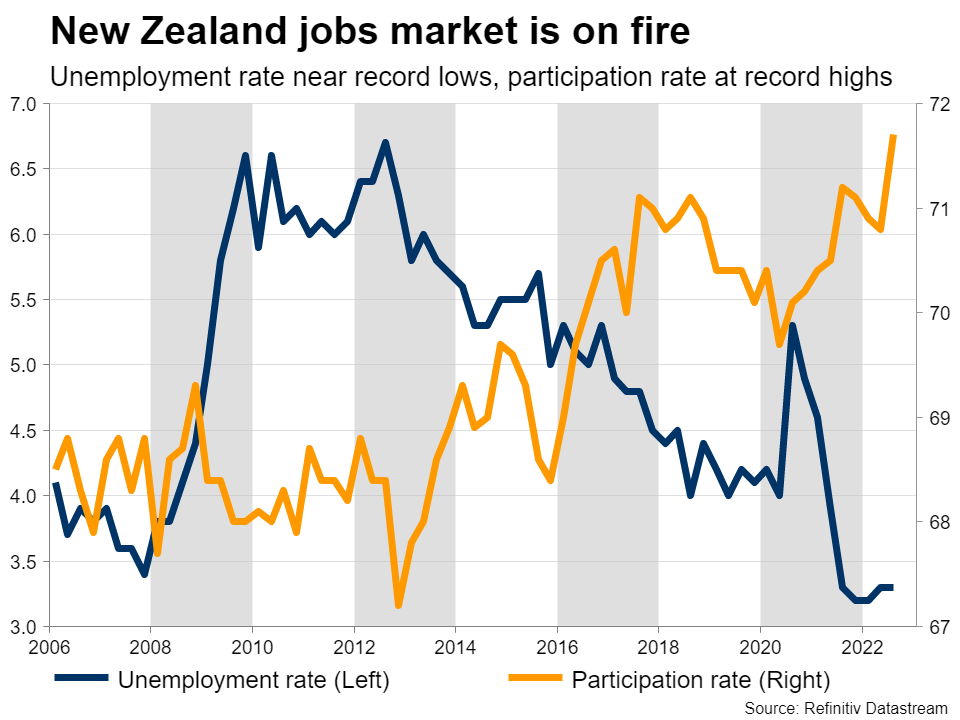
The New Zealand dollar has been a key beneficiary of China's reopening, capitalizing also on speculation that the RBNZ will raise rates above the Fed this cycle, mostly because the nation's jobs market is extremely hot. This elevates the importance of the employment numbers for Q4, which are out on Wednesday.
In Canada, the jobs report for January will be released on Friday, alongside the US data.
Finally, the corporate earnings season will kick into top gear next week with tech juggernauts like Apple, Google, Amazon, Meta, and many other household names releasing their quarterly results.
Bank of England Preview – Topside Risk to EUR/GBP
Bank of England Preview - Topside risk to EUR/GBP
- We expect the Bank of England (BoE) to hike the Bank Rate by 50bp.
- We pencil in an additional 25bp hike in March, now expecting the Policy Rate to peak at 4.25% in March 2023.
- Dovish communication from BoE should send EUR/GBP higher during the day.
BoE call. We expect the Bank of England (BoE) to hike the Bank Rate (Policy Rate) by 50bp on 2 February bringing it to 4.00%. Markets are currently pricing 45bp for the meeting next week. Importantly, we consider it a closer call between 50bp and 25bp than what markets are pricing and the distribution of analyst expectations would suggest. That said, we believe the latest data releases support a continued forceful response by the BoE which favours a slightly more aggressive 50bp hike compared to the 25bp alternative.
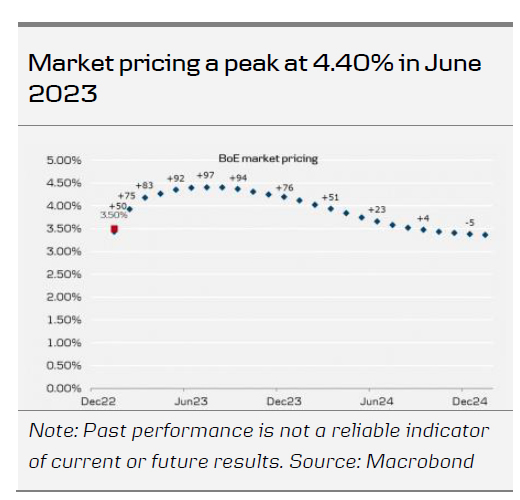
Since the last meeting in December, data has shown further persistent inflationary pressures as well as a more resilient UK economy. Wage growth has surprised to the upside reaching 6.41% in November, whereas the BoE in their November projections estimated wage growth at 5.75% for Q4. Likewise, core CPI remained unchanged at elevated levels, headline inflation fell less than expected and GDP growth came in stronger than expected. As highlighted in the December minutes, the BoE is particularly concerned about the tightness of the labour market and the pass-through to domestic prices and wages. This is an important reason why we think a majority of the MPC will vote for a 50bp February hike. Likewise, we expect the central bank's updated projections to show a relative improved economic outlook as market pricing for policy input has come significantly down since the last meeting (from peak 5.25% to peak 4.40%) which supports our case for 50bp.
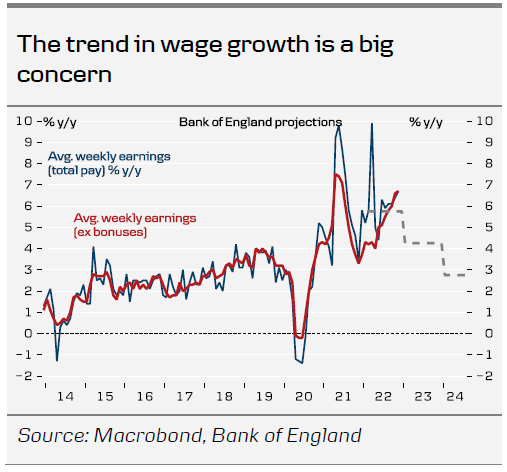
Additionally, we extend our current forecast to include a final hike of 25bp in March this year, forecasting a peak in the Bank Rate at 4.25%. This is still fewer hikes than priced in markets (currently 90bp until June 2023). We expect BoE to return to its more dovish stance as recession risks should start to be more pronounced as the growth outlook continues to become weaker. We do, however, not expect cuts to materialise before 2024.
Growth outlook. The UK economy might avoid negative GDP growth in Q4 2022 due to stronger than expected growth during October and November, while data gives weak signals for December. This, however, does not mean that the UK economy will avoid a recession, but merely that it will come later than originally pencilled in. Inflation continues to be substantially above target and despite a seeming peak in October last year, core inflation remains resilient. This is also reflected in retail sales figures, which took a hit during December. While the labour market remains tight, unfilled vacancies have continued to come lower and survey indicators as PMI's are showing the first signs of easing.
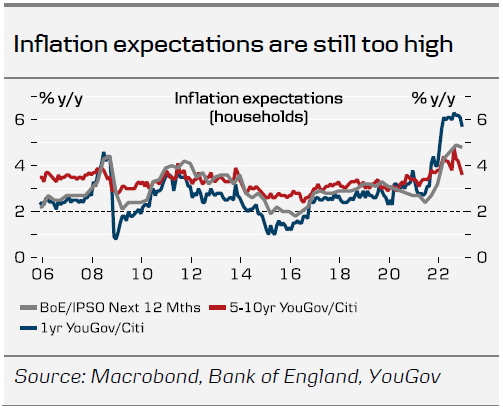
FX. In our base case of a dovish 50bp hike, we expect EUR/GBP to move slightly lower upon announcement, but reverse higher on the back of a dovish statement and press conference. In its statement we expect the BoE to highlight the dire state of the UK economy lending support to our call that market pricing is too aggressive currently pricing a peak in the Bank Rate at 4.40% by June 2023. Combined with the expectation of a hawkish 50bp hike by the ECB later in the afternoon, we expect EUR/GBP to move higher during the afternoon, ending the day ca. ½ figure higher than the opening levels
USD/JPY Mid-Day Outlook
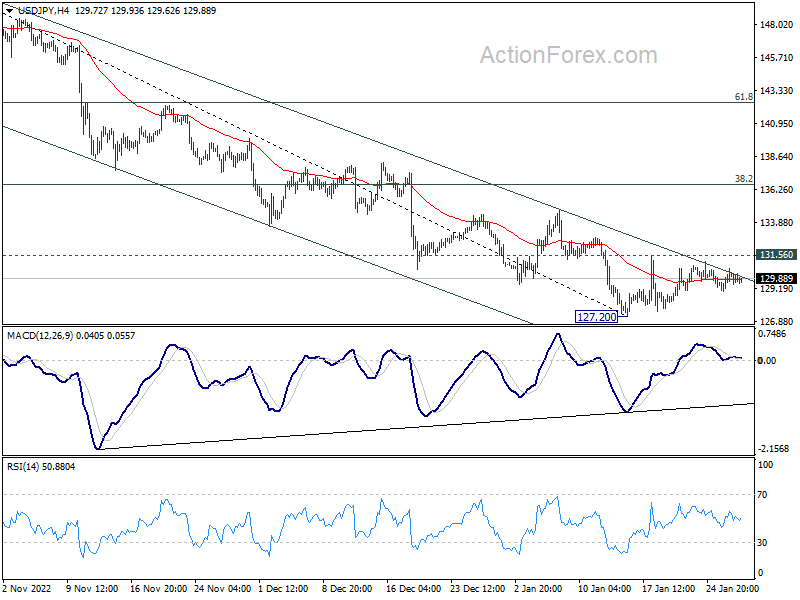
Daily Pivots: (S1) 129.30; (P) 129.96; (R1) 130.89; More...
Intraday bias in USD/JPY stays neutral as range trading is still in progress. On the downside, break of 127.20 will resume the whole decline from 151.93 and target 121.43 fibonacci level. Nevertheless, on the upside, break of 131.56 should confirm short term bottoming, and turn bias back to the upside for stronger rebound to 55 day EMA (now at 134.02).
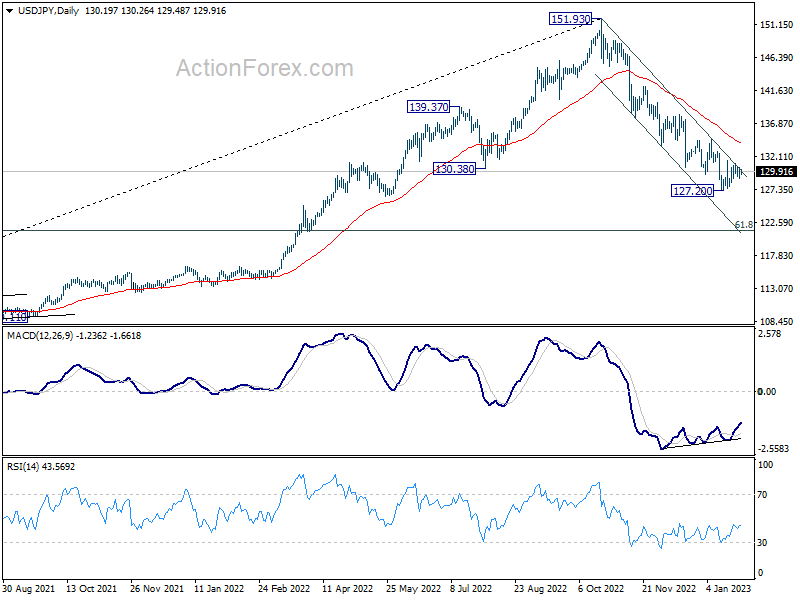
In the bigger picture, the break of 55 week EMA (now at 131.47) raises the chance of medium term bearish reversal, but that's not confirmed yet. Strong support could be seen around 61.8% retracement of 102.58 to 151.93 at 121.43 and 38.2% retracement of 75.56 to 151.93 at 122.75 to bring rebound. But break of 131.56 resistance is needed to indicate bottoming first. Otherwise further fall will remain in favor.
USD/CHF Mid-Day Outlook
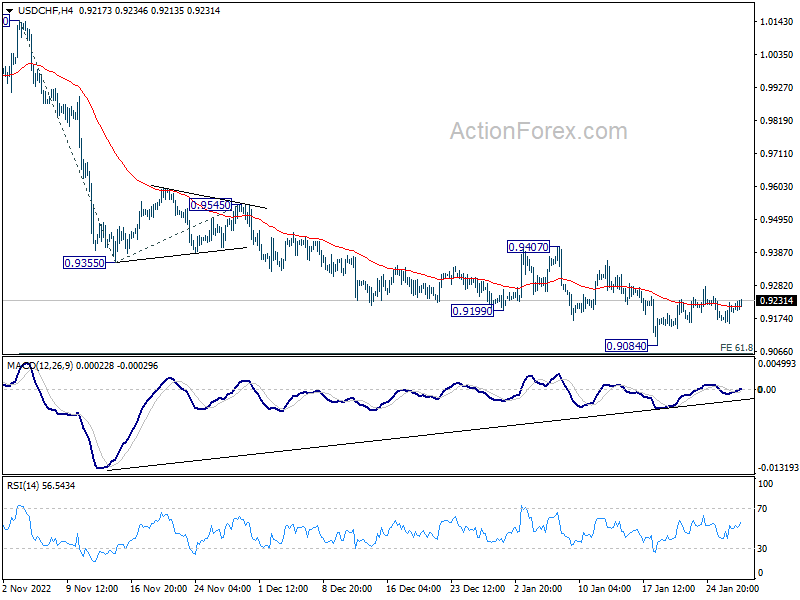
Daily Pivots: (S1) 0.9167; (P) 0.9196; (R1) 0.9233; More...
Intraday bias in USD/CHF stays neutral for the moment. On the downside, sustained break of 61.8% projection of 1.0146 to 0.9355 from 0.9545 at 0.9056 will pave the way to 100% projection at 0.8754, which is close to 0.8756 long term support. Nevertheless, on the upside, break of 0.9407 should confirm short term bottoming and turn bias back to the upside.
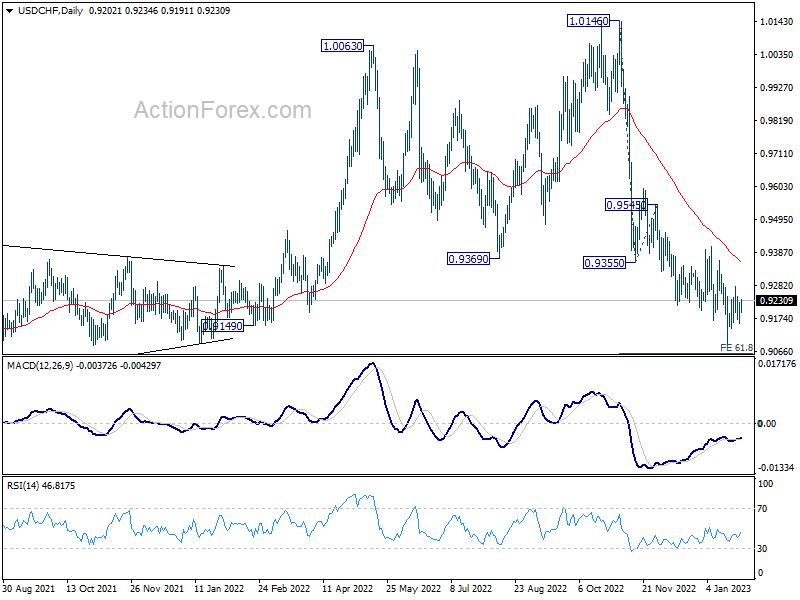
In the bigger picture, rise from 0.8756 (2021 low) has completed at 1.0146, well ahead of 1.0342 long term resistance (2016 high). Based on current downside momentum, fall from 1.0146 should be a medium term down trend itself. Next target is a test on 0.8756 low. Strong support should be seen there to bring rebound. Still, further decline will now be expected as long as 0.9407 resistance holds, in any case.
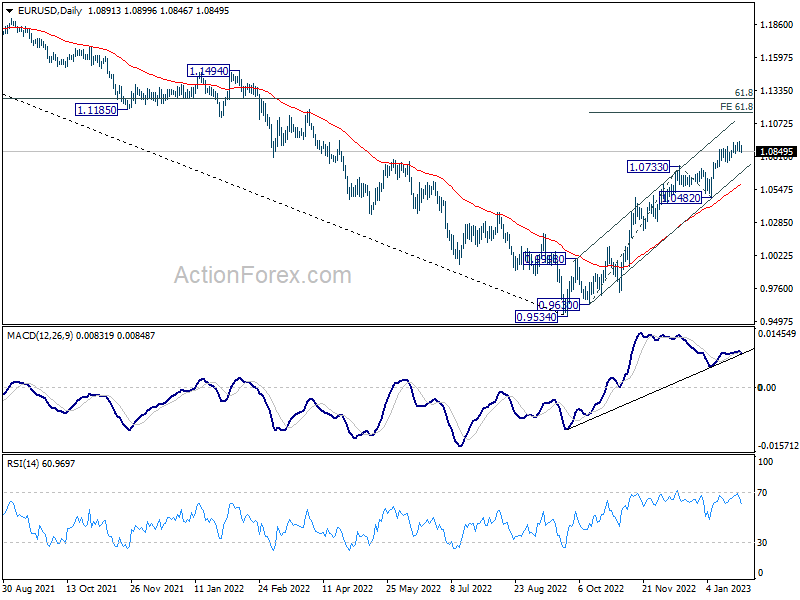
EUR/USD Mid-Day Outlook
Daily Pivots: (S1) 1.0852; (P) 1.0891; (R1) 1.0931; More...
Further rise is still expected in EUR/USD with 1.0765 support intact. Above 1.0928 will resume larger rise to 61.8% projection of 0.9630 to 1.0733 from 1.0482 at 1.1164 next. On the downside, though, break of 1.0765 support should now confirm short term topping, and turn bias back to the downside for 55 day EMA (now at 1.0591).
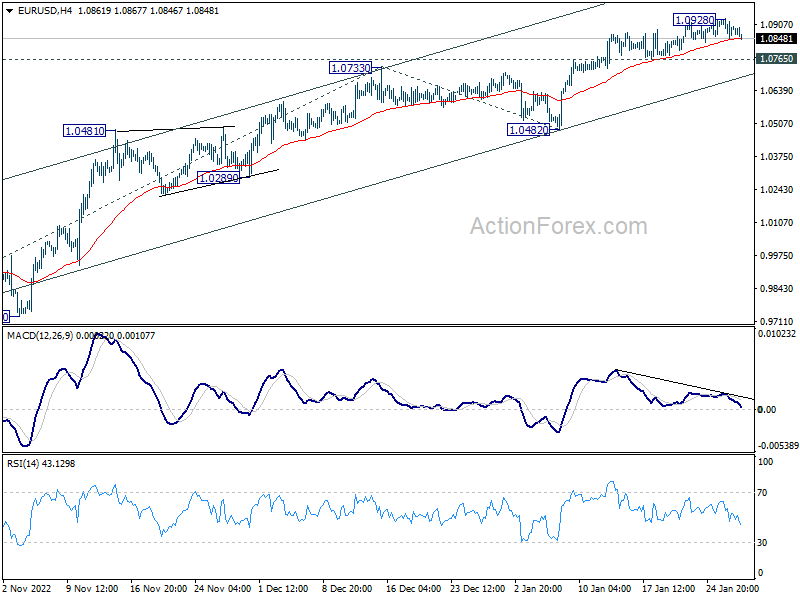
In the bigger picture, current development suggests that the rally from 0.9534 low (2022 low) is a medium term up trend rather than a correction. Further rise is in favor to 61.8% retracement of 1.2348 (2021 high) to 0.9534 at 1.1273 next. This will remain the favored case as long as 1.0482 support holds.