Sample Category Title
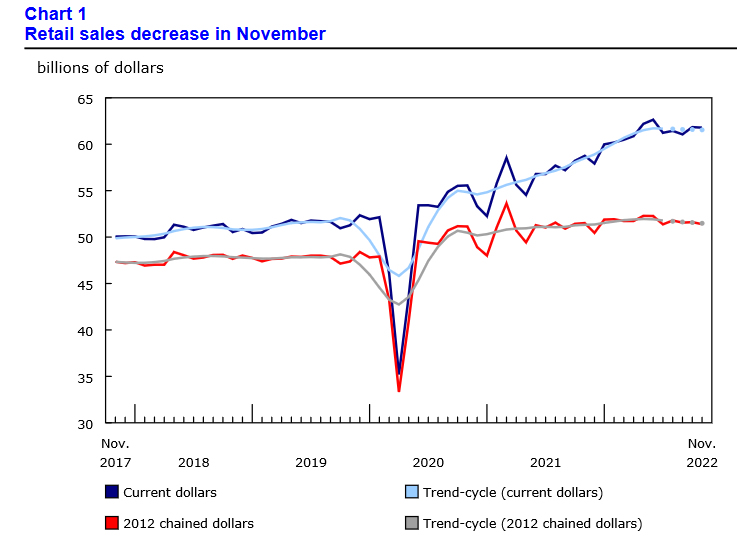
Canada retail sales down -0.1% mom in Nov
Canada retail sales decreased -0.1% mom to CAD 61.8B in November, better than expectation of -0.5% mom. Core retail sales, excluding gasoline stations and motor vehicle and parts dealers, decreased -1.1% mom, largest decline in 11 months.
Sales declines in 6 of 11 subsectors, representing 47.4% of retail trade. The decrease was led by lower sales at food and beverage stores (-1.6%) and building material and garden equipment and supplies dealers (-3.8%).
Advance estimate indicates that sales rose 0.5% mom in December.
It’s Going to be a Bumpy Ride
It's been another eventful week and one that serves to remind us that while there may be more sources of optimism this year, compared with last, it's going to be a very bumpy ride.
There's no doubt that there's been plenty more cause for optimism so far this year, especially compared with what we became accustomed to in 2022. The US could achieve the soft landing that many have doubted is possible, China could bounce back strongly from the dropping of Covid restrictions and the euro area may avoid a recession.
That's not a bad shift in expectations at all. But just as quickly as they turned more favourable, they could switch again. Economic data from the US this week has been far less promising. Rather than focus on disinflation and the labour market, it's been other economic indicators and earnings that have taken the spotlight and it hasn't been great.
What's more, it seems we're seeing more regular warnings of imminent layoffs, the latest coming from Alphabet which plans to cut 12,000 staff globally. For so long companies have been reluctant to lay staff off following the post-pandemic re-hiring struggles but the tide appears to be turning and it could accelerate from here, at which point the economic data may become much more downbeat.
UK retail sales slump again
It's been a busy week for UK economic data and many may be just as confused about the outlook as they were before. Data has previously indicated that the country may have managed to avoid a recession in the fourth quarter but at the same time, retail sales strongly suggest that households are feeling the strain which begs the question, did the World Cup just delay the inevitable?
Meanwhile, labour market figures remain strong, so much so that wages are continuing to accelerate higher while still failing to keep up with inflation. While that explains why households are spending less, it doesn't alleviate fears within the BoE that getting inflation sustainably back to 2% could necessitate inflicting more pain on households. An unenviable dilemma, but policymakers are in agreement that inflation must take priority. And when that is still above 10%, it's clear that means the rate hikes will keep coming.
Speed bumps ahead
Oil prices have been choppy this week after climbing back towards their late December/early January peaks. It would appear the rally is running short of momentum amid a week of less promising data from the US and a downturn in market sentiment, more broadly. That's to be expected. After all, it's not like we were going to go from the doom and gloom of 2022 into relentless optimism just like that. It's going to be a bumpy ride this year and this week has simply been the first speed bump of many. With so many other factors also influencing the oil price, I expect volatility is going nowhere.
Gold not far from record highs
Another rally on Thursday saw gold surpass last week's peak but already it's running into resistance and trading slightly lower on the day. While not the end of the world, it's clear that momentum is fading which, following a strong rally since November, could suggest a correction is possible. The environment remains favourable for gold but a correction could be healthy considering it's now rallied almost 20% from its early November lows and sits a little over 6% from all-time highs.
Volatility is back
It's been a very choppy week for bitcoin after the cryptocurrency surged back to life, buoyed by a much-improved risk environment. A period of relative calm in the crypto space has allowed for such a rebound, time clearly being a great healer and all that. Still, as we've seen in crypto, the volatility works both ways and what we've seen this past week suggests there's plenty more to come.
Gold Has Altitude Sickness, But the Climb is Not Over
Gold has made an impressive rally in the last 11 weeks, adding 19.9% to its lows at the start of November and hitting highs since last April at $1937 this morning. While maintaining a bullish outlook on gold, we focus on short-term overbought and a high chance of correction before a new leg up.
Late last year, gold turned upwards after getting methodical support on declines under the 200-week moving average, correcting half of the gains from the lows of 2018 to the 2020 and 2022 peaks.
Fundamentally, gold was pulled down by an appreciating dollar and a tightening of US monetary policy, which made US bond purchases more attractive than holding non-coupon-earning gold. A slowdown in rate hikes halted the rise in medium-term bond yields, allowing gold to shine again.
A 20% rally from the lows will allow us to name it a new bull market for gold, suggesting further gains. We saw similar situations in late 2002 and 2008 and the second half of 2018. This historical proximity sets up a further multi-year rally in gold with a renewal of historical highs above 2630 – 161.8% of initial climbing from 2018 to 2020.
But often, the market needs short-term corrections to get fuel for gains, allowing it to lock in profits and join the movement on a pullback. And such a pullback seems to be imminent.
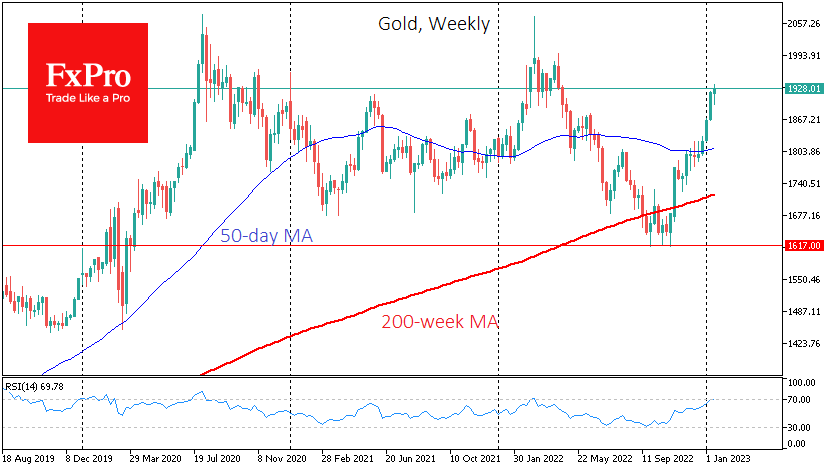
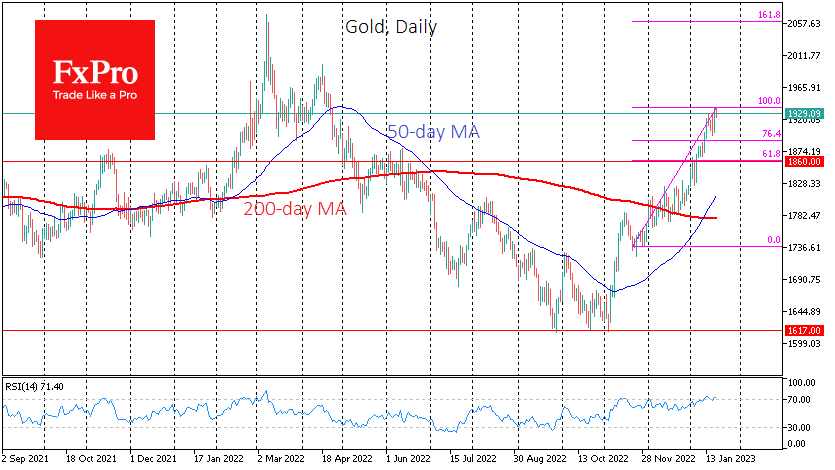
During the four weeks since December 19, the amplitude of the move-up was also increasing. But this movement lost momentum this week. Despite the new price high, the RSI on the daily chart has stalled just on the verge of an overbought area. We had seen something similar at the beginning of the rally, when the powerful momentum of early November wore off by the middle of the month, taking the gold back from $1785 to $1735 – perfectly within the Fibonacci retracement pattern.
A repeat of this pattern from the highs set earlier this morning ($1937) would suggest a return to the $1860 area. This is also where the local tops of June are concentrated, which adds to the importance of support. The gold could be there by the end of the month and return to the upside as early as February.
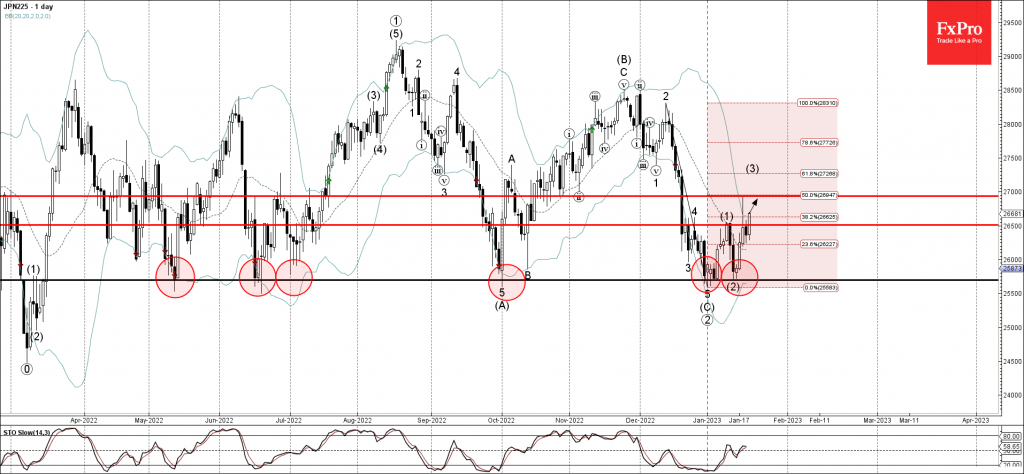
Nikkei 225 Wave Analysis
- Nikkei 225 broke resistance level 26500.00
- Likely to rise to resistance level 27000.00
Nikkei 225 index continues to rise after the earlier breakout of the resistance level 26500.00 (which stopped the previous waves 4 and (1)).
The breakout of the resistance level 26500.00 coincided with the breakout of the 38.2% Fibonacci correction of the previous downward impulse from December.
Nikkei 225 index can be expected to rise further toward the next resistance level 27000.00 (former monthly low from November).
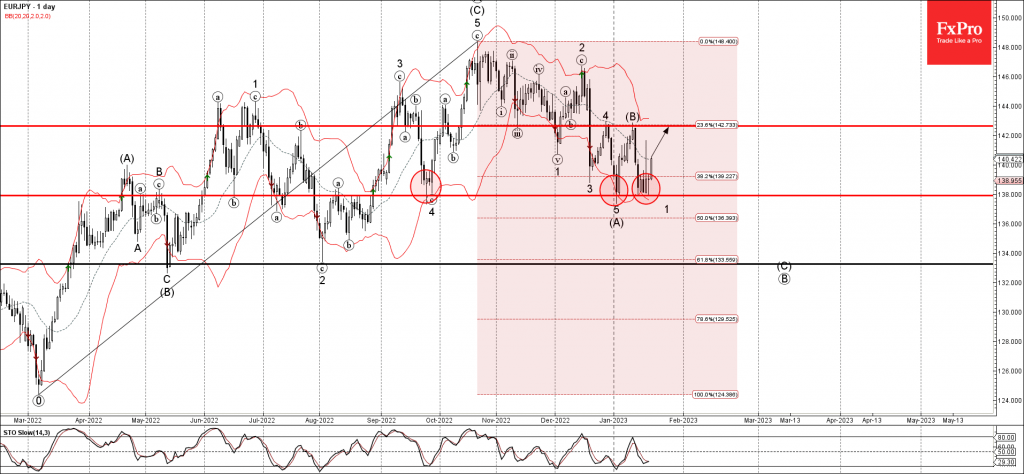
EURJPY Wave Analysis
- EURJPY reversed from support level 137.90
- Likely to rise to resistance level 142.60
EURJPY recently reversed up from the support level 137.90 (former monthly low from September), intersecting with the lower daily Bollinger Band.
The upward reversal from the support level 137.90 created the second consecutive Japanese candlesticks reversal pattern Piercing Line.
EURJPY can be expected to rise further toward the next resistance level 142.60 (which stopped the previous waves 4 and (B)).
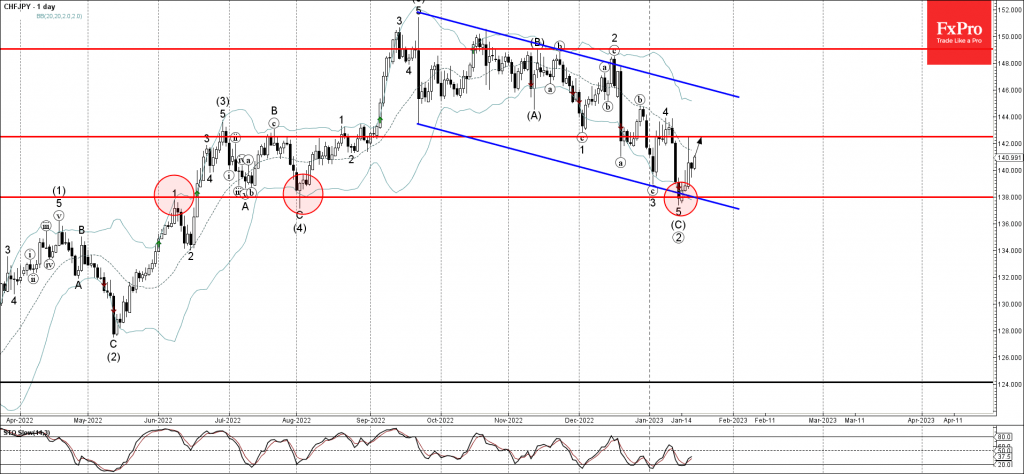
CHFJPY Wave Analysis
- CHFJPY reversed from support level 138.00
- Likely to rise to resistance level 142.50
CHFJPY recently reversed up from the key support level 138.00 (which has been revering the price from June), intersecting with the lower daily Bollinger Band and the support trendline of the daily down channel from September.
The upward reversal from the support level 138.00 started the active primary impulse wave ③.
CHFJPY can be expected to rise further toward the next resistance level 142.50 (previous minor reversal high).
BoJ Kuroda defends extremely accommodative monetary policy
BoJ Governor Haruhiko Kuroda defended this week decision to maintain by the -0.1% interest rate and the 0.5% 10-year JGB yield cap.
"We expect, probably from February this year, inflation rates start to decline and fiscal year 2023 as a whole, inflation rate will be less than 2%. So, we decided to maintain the current extremely accommodative monetary policy for the time being," he said.
"Our hope is that wages start to rise and that could make 2% inflation target to be met in a stable and sustainable manner, but we have to wait for some time," he added.
Asked whether he had any regrets during reign, he said, "All in all, the government's policy, coupled with the BoJ's extremely accommodative policy, have been successful in changing Japan's economic structure and growth prospects".
"But our 2% inflation target has not been achieved in a sustainable, stable manner," he said. "That is the only regret I have".
ECB Lagarde: Stay the course is my mantra for monetary-policy purposes
ECB President Christine Lagarde said, "We have to also stay that course of resilience that we observed in 2022. Stay the course is my mantra for monetary-policy purposes."
"I hope that in 2023 fiscal policy will not work in a counter-cyclical way to monetary policy," she said. "We don't need to be pushed to do more than is necessary."
Lagarde also noted that China's reopening "will have inflationary pressure on many of us, simply because the level of energy that was consumed by China last year was certainly less than what they will consume this year, the amount of LNG that [they] will be buying from the rest of the world will be higher than what we have seen and there is not so much spare capacity in terms of oil and gas."
"So there will be constraints, there will be more inflationary pressure coming out of that added demand," she added.
SNB Jordan: Focus on price stability absolutely essential
SNB Chairman Thomas Jordan said,"inflation is far too high. It is negative not only for the functioning of the economy, it is very negative especially for lower income classes."
"The population doesn't like inflation, so ... the focus on price stability for central banks is absolutely essential."
Businesses "don't hesitate any more to increase their prices," the said. "That is different to two or three years ago, and that is also a signal it is not that easy to bring inflation back to 2%."
"Once inflation is high, the pressure coming from wages is here and it is proof it will not be that easy everywhere to bring inflation down quickly," he said.
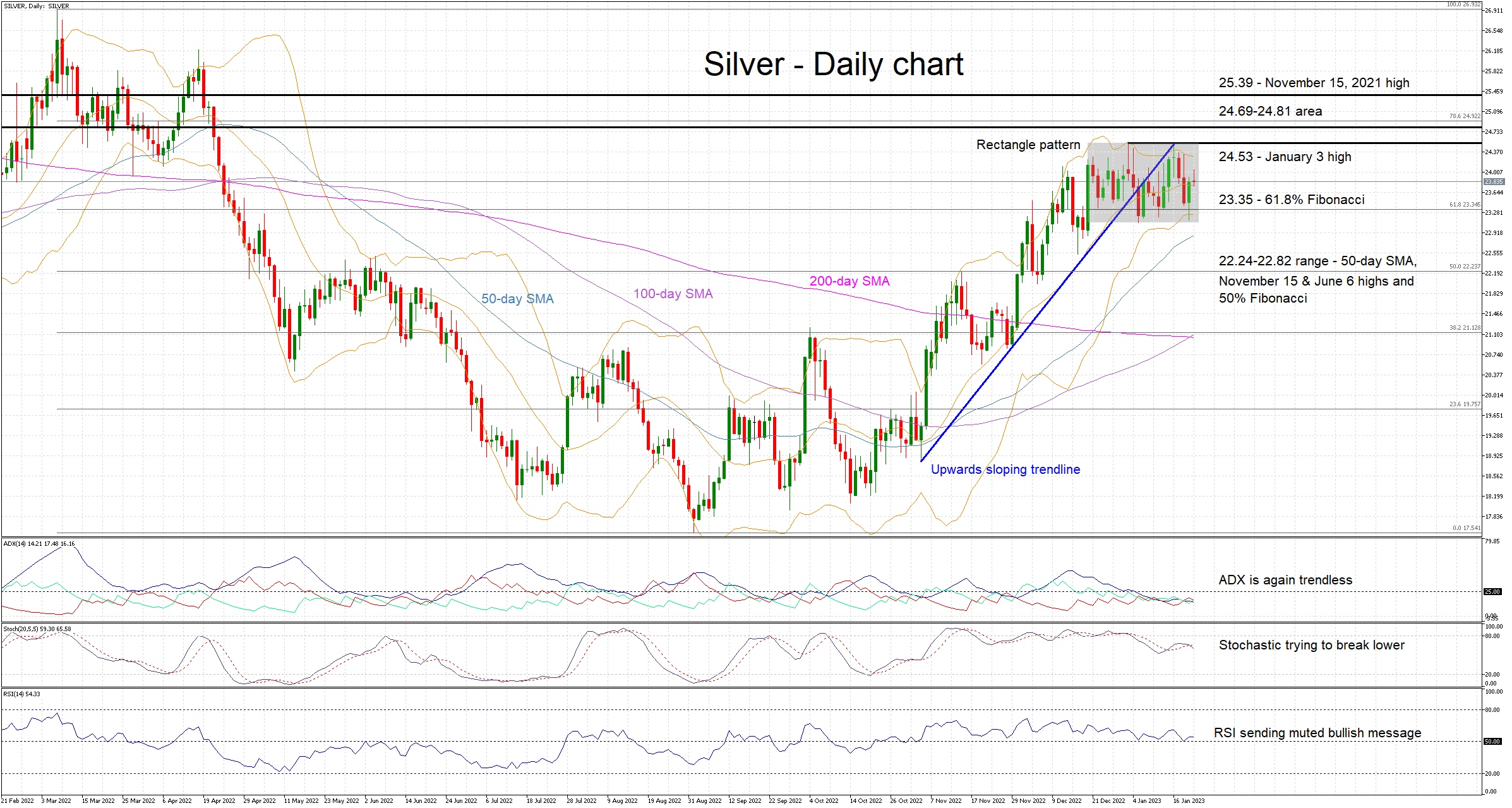
Silver Continues to Trade in a Range; Will There Be First-Mover Advantage?
Silver continues to trade within the 23-25 well-observed range, contrary to gold’s fiery performance. This balance between buyers and sellers is reflected in the momentum indicators as both the Average Directional Movement Index (ADX) and RSI are mostly pointing to a trendless market. The stochastic oscillator is trying to stir the pot, but it needs a more decisive move to help draw meaningful conclusions.
In range-trading periods, the focus turns to "secondary" signals. In more detail, the convergence of the 100- and 200-day simple moving averages (SMAs) and the narrower Bollinger bands potentially point to an imminent move. The direction is unknown, but the rectangle pattern could offer some clues. This type of pattern favours upward breakouts, but it also experiences a high percentage of failed breakouts.
Should the bulls feel more confident, their initial target could come at the January 3 high of 24.53. The 24.69-24.81 area could then trouble the bulls, ahead of the November 15, 2021 high of 25.39.
On the other hand, the bears could face an initial obstacle at the 61.8% Fibonacci retracement of March 8 – September 1 downtrend of 23.35. Upon successfully breaking this level, they could be faced with the busier 22.24-22.82 area, crowded by the 50-day SMA, the November 15 and June 6 highs, and the 50% Fibonacci retracement.
To conclude, the present calm in the market points to an imminent “storm” with evidence slightly favouring the bulls at this juncture.