

Sample Category Title
EUR/AUD Weekly Outlook
EUR/AUD recovered to 1.5749 last week but retreated from there. Initial bias is turned neutral this week first. Corrective pattern from 1.5976 could still extend with another fall. But strong support could be seen from 38.2% retracement of 1.4281 to 1.5976 at 1.5329 to bring rebound. On the upside, above 1.5749 will resume the rise from 1.5376 for retesting 1.5976 high.
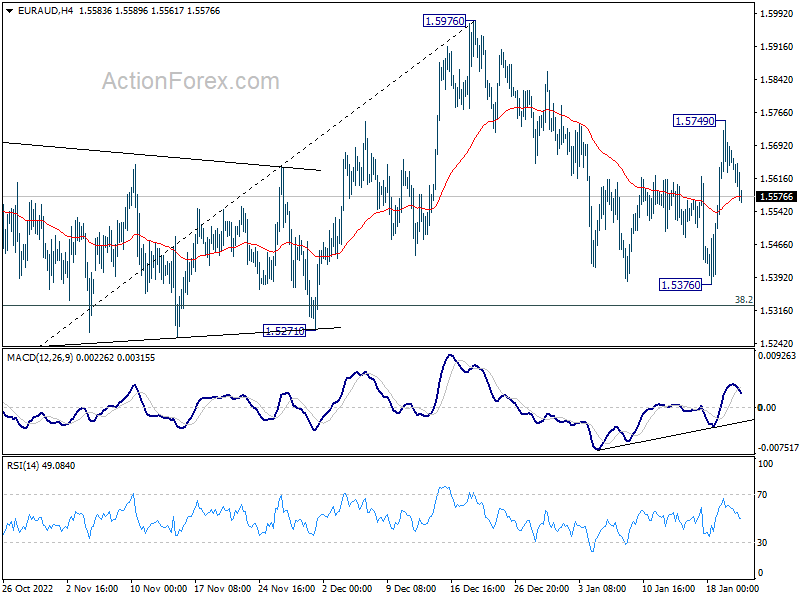
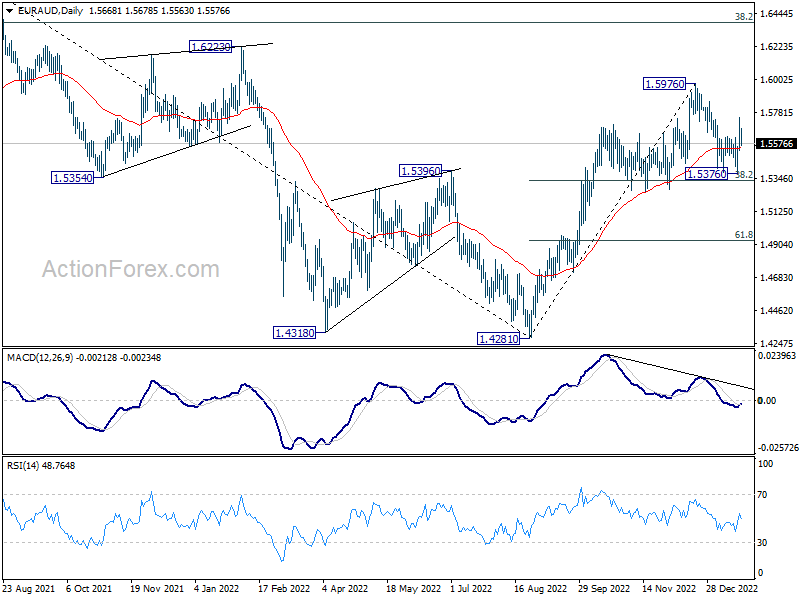
In the bigger picture, it's still early to confirm if rise from 1.4281 represents bullish trend reversal. But as long as 1.5271 support holds, such rally is in favor to continue. Break of 1.5976 will target 1.6434 key resistance next. On the other hand, firm break of 1.5271 will retain medium term bearishness instead.
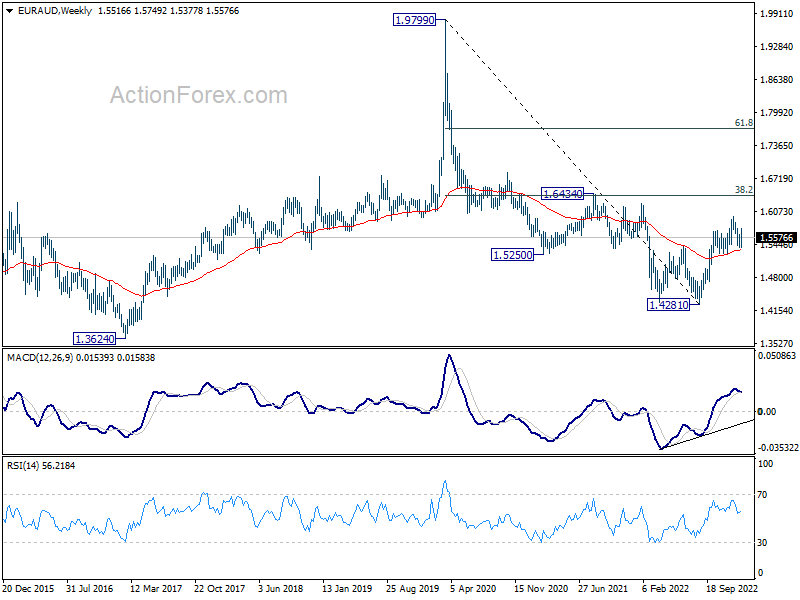
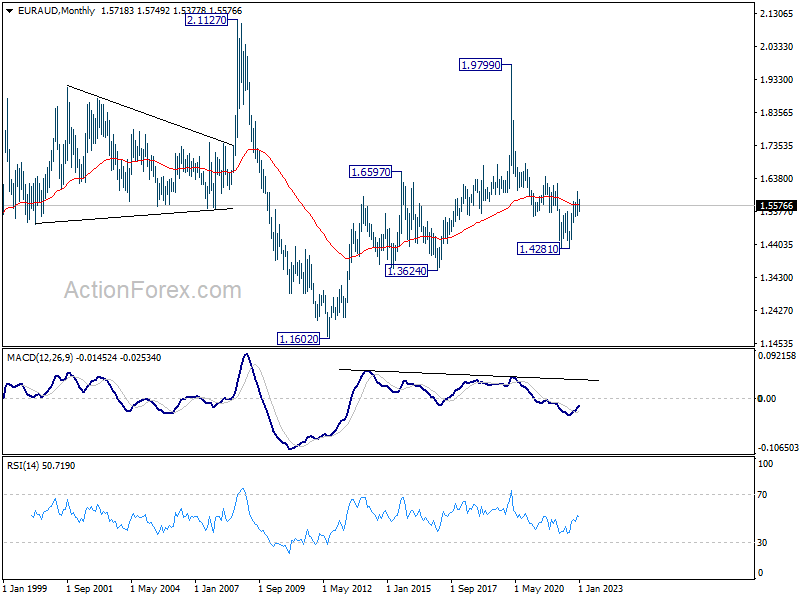
In the longer term picture, focus stays on 55 month EMA (now at 1.5595). Sustained trading above there will raise the chance of bullish trend reversal, and at least bring further rally to 1.6434 cluster resistance, 38.2% retracement of 1.9799 (2020 high) to 1.4281 at 1.6389. However, rejection by 55 month EMA will suggest that down trend from 1.9799 is still in progress for another low below 1.4281.
EUR/CHF Weekly Outlook
EUR/CHF's sharp retreat last week might have completed at 0.9873 already, after drawing support from 55 day EMA. Initial bias is mildly on the upside this week for retesting 1.0095 resistance. On the downside, though, break of 0.9917 minor support will turn bias back to the downside to resume the correction to 38.2% retracement of 0.9407 to 1.0095 at 0.9832.
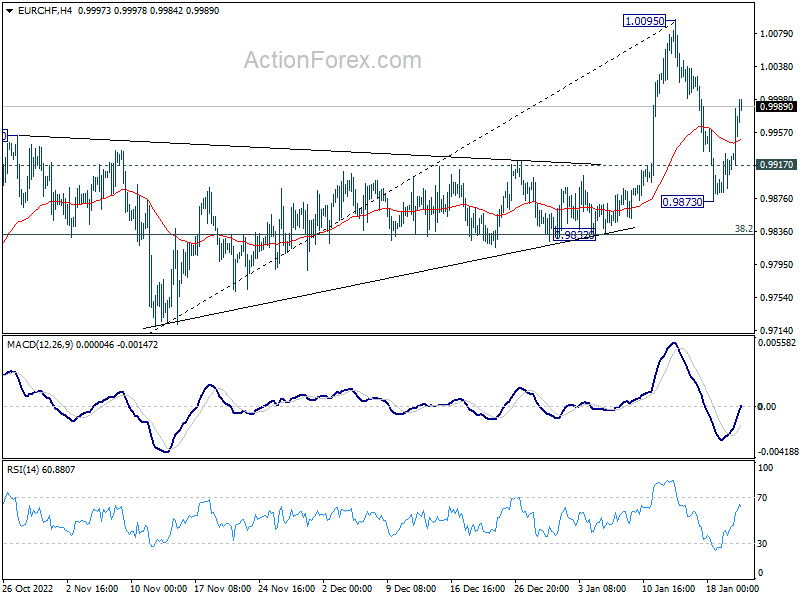
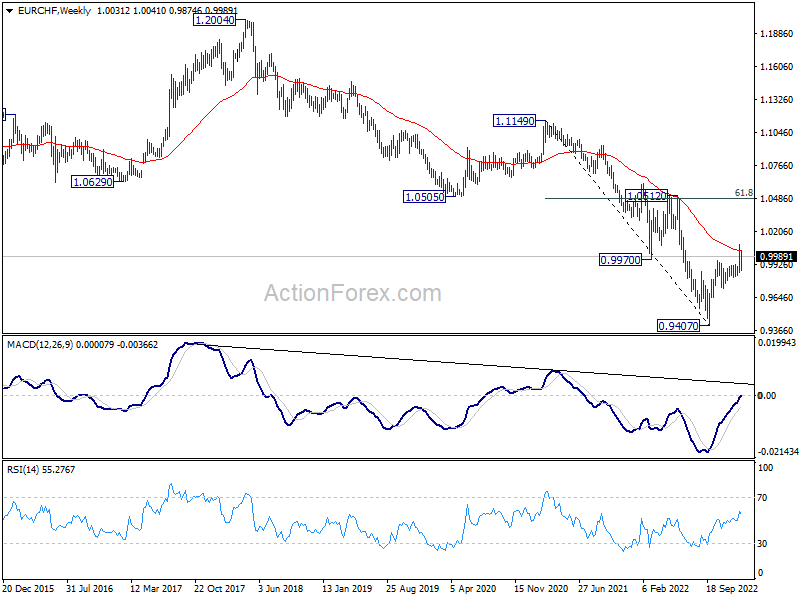
In the bigger picture, the initial rejection by 55 week EMA (now at 1.0039) mixed up the outlook. On the upside, sustained trading above 55 week EMA will raise the chance of bullish trend reversal. Rise form 0.9407 should then target 1.0505 cluster resistance (2020 low at 1.0505, 61.8% retracement of 1.1149 to 0.9407 at 1.1484). However, firm break of 0.9832 support will revive medium term bearishness and bring retest of 0.9407 low instead.
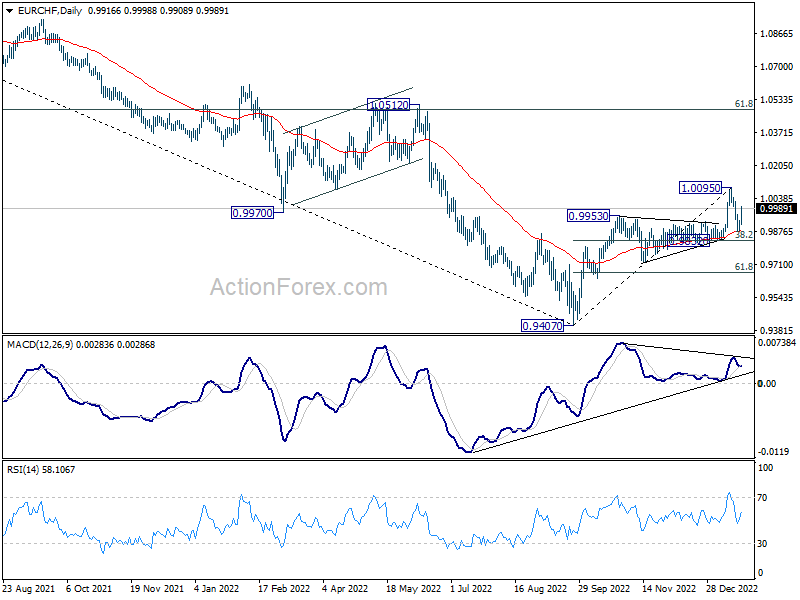
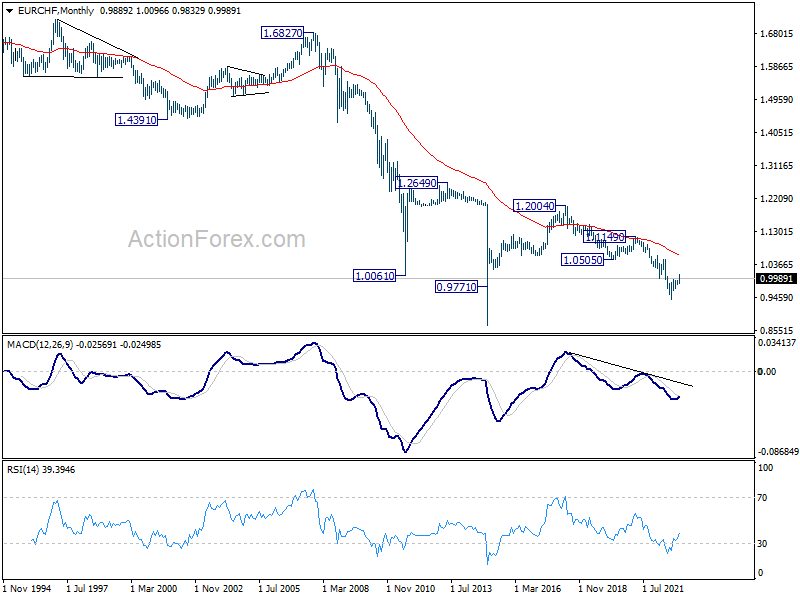
In the long term picture, it's still way to early too call for bullish trend reversal with upside capped well below 55 month EMA and 1.0505 support turned resistance (2020 low).
Yen Down, Nikkei Up, Yield Curve Distortion Improved
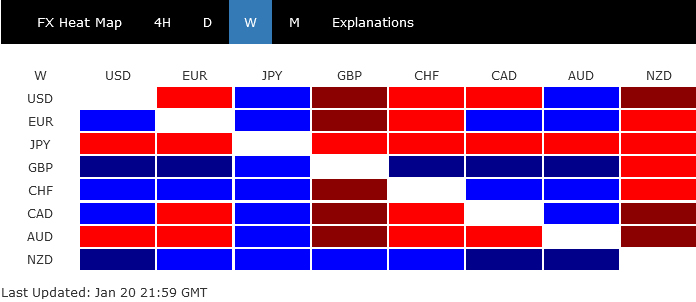
BoJ and Davos were the major focuses of last week. Much volatility was seen in Nikkei, JGB yields, and Yen. As dusts settled, the Japanese currencies ended as the worst performer, but closed inside prior week's range. Australian Dollar was the next weakest after poor job data. Dollar was the third, after many Fed officials indicated their support for a 25bps hike in February.
New Zealand Dollar ended the strongest despite Prime Minister Jacinda Ardern's surprised resignation. Sterling and Swiss Franc followed. But it should noted that Euro did stage a strong rebound against European peers after ECB President Christine Lagarde pledged to "stay the course", countering rumors of a slower rate hike.
A look at JGB yield, Nikkei, and NZD/JPY after BoJ drama
Despite all the speculations, BoJ eventually decided to keep monetary policy unchanged last week, maintaining short term interest rate at -0.10% and the 10-year yield cap at 0.50%. Governor Haruhiko Kuroda reiterated the pledge to maintain extremely accommodative monetary for the time being. Much volatility was seen in JGB yields, Nikkei and Yen. However, as BoJ won't meet again until March 8, speculations on policy move should cool for a while.
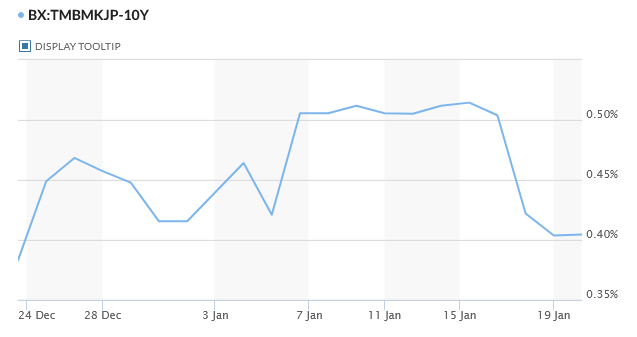
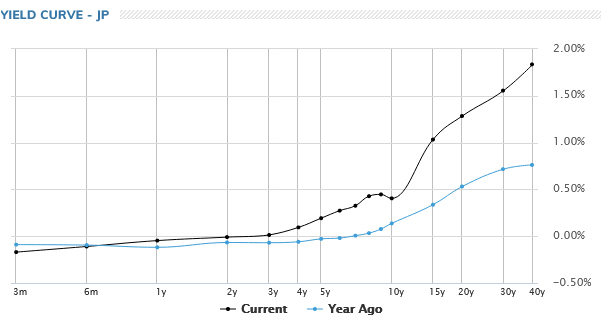
10-year JGB yield closed lower at 0.404 after hitting as high as 0.585.
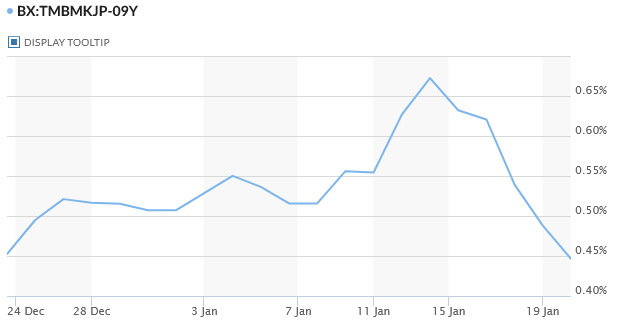
The move in 9-year JGB yield was more drastic, hitting as high as 0.700 before eventually closing at 0.488...
and 8-year yield which surged to 0.674 before closing at 0.473.
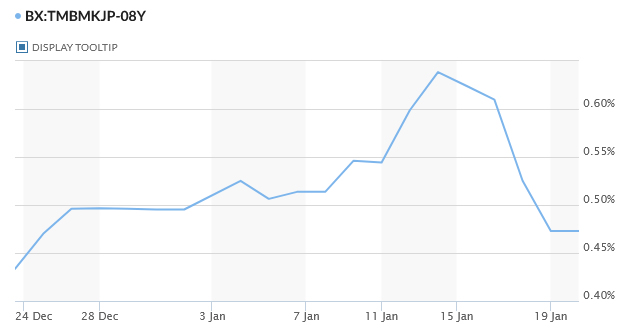
Yield curve remains "distorted" with a dip at 10-year, but the distortion became much less serious.
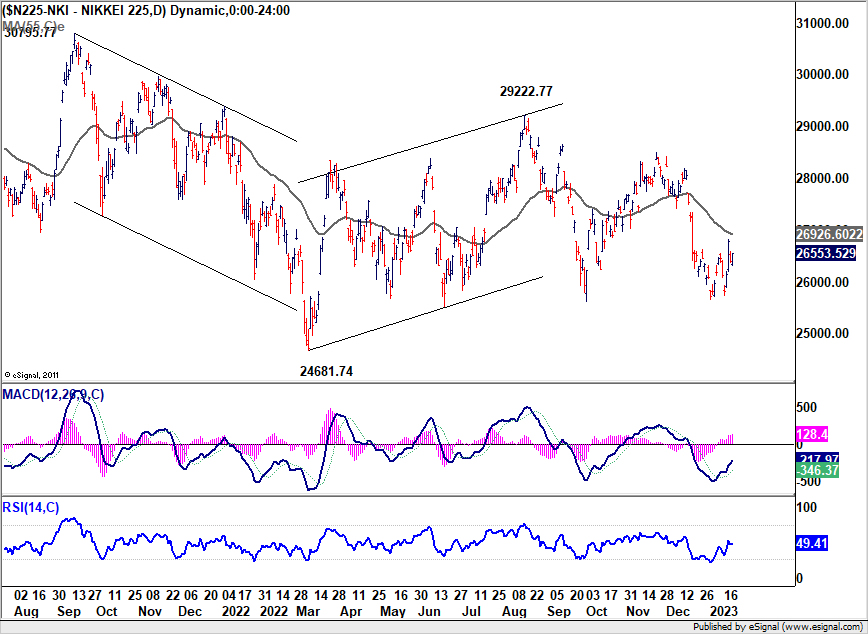
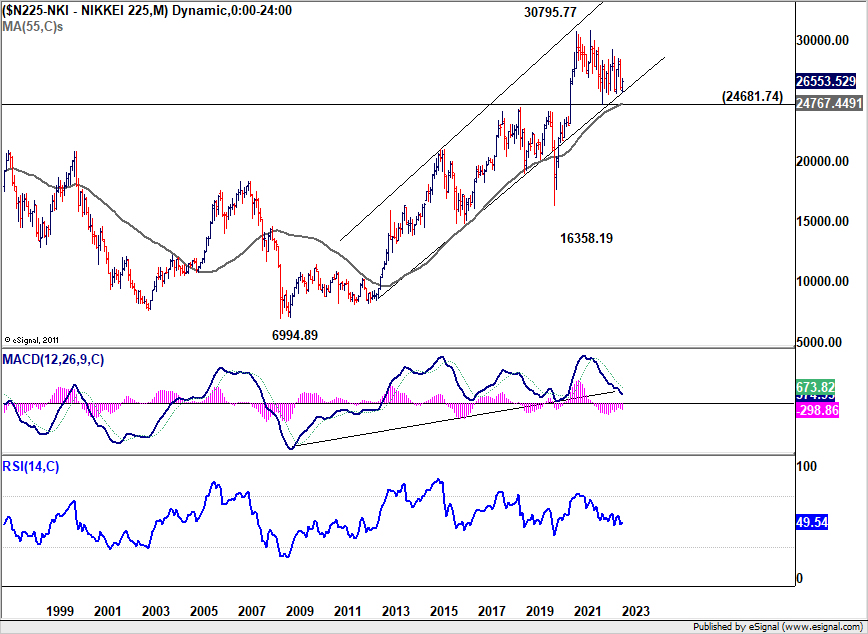
Nikkei had a wild ride, hitting 25748.10, the rebounded to 26816.68, then closed the week at 26553.52. For the near term, risk is still mildly on the downside as long as the index stays below the falling 55 day EMA (now at 26926.60), i.e. around 27k handle. A break through 25661.89 support cannot be ruled out. But even in case of a fall, strong support should be seen around 24681.74 to contain downside. The level is close to 55 month EMA, which stands at 24767.44.
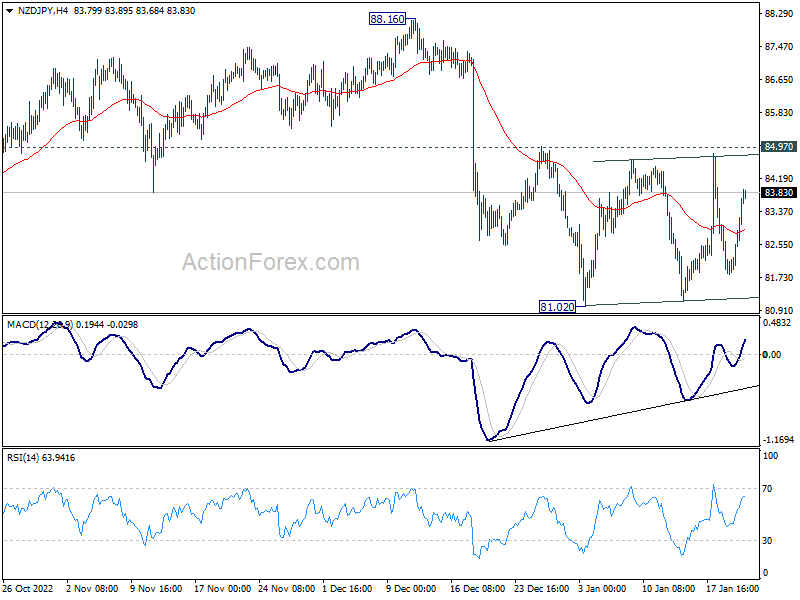
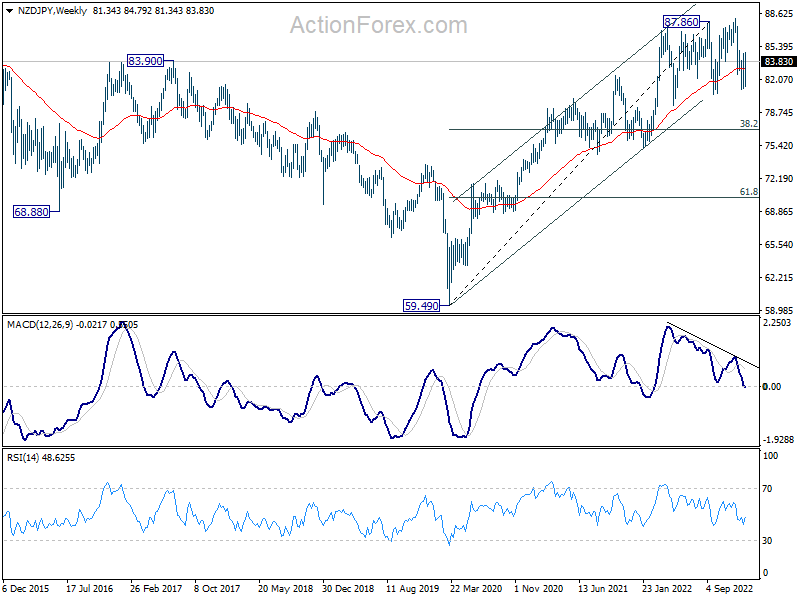
While Yen was sold off towards the end of the week, all Yen crosses just closed inside prior week's range. The 2.64% gain in the top mover NZD/JPY might look huge. It's indeed just a leg inside a near term sideway pattern. For the near term, risk will stay on the downside as long as 84.97 resistance holds. Break of 81.02 will extend the corrective pattern from 87.86 (with fall from 88.16 as the third leg) towards 38.2% retracement of 59.49 (2020 low) to 87.86 at 77.02. But break of 84.97 will bring stronger rebound back to 87.86/88.16 resistance zone.
Risk sentiment mixed but Bitcoin hints underlying appetite?
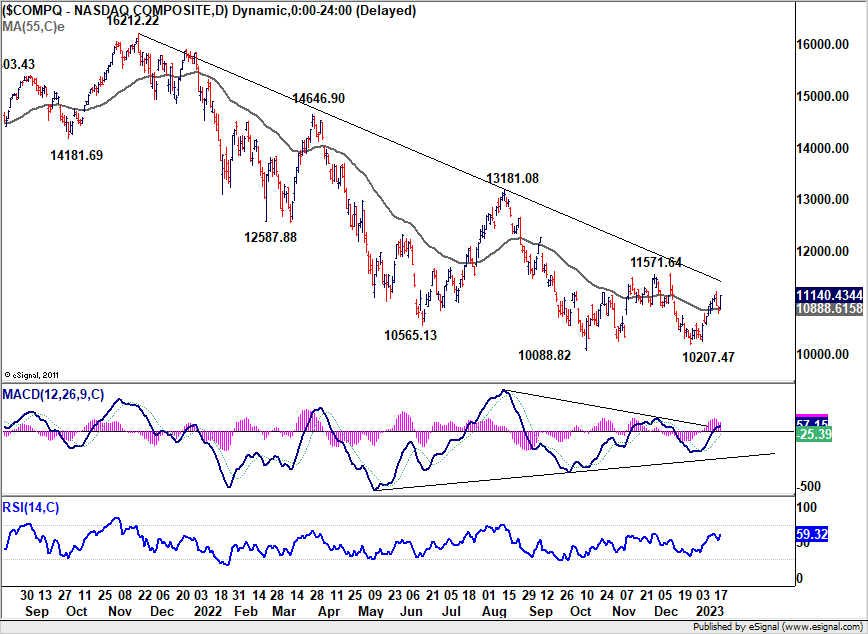
In the US, sentiment was mixed with DOW finished lower by -2.7% for the week, and S&P 500 lost -0.66%. But NASDAQ bucked the trend and gained 0.55%. As for NASDAQ the support from 55 day EMA is a positive sign. Near term focus is back on 11571.64 resistance. Firm break there will indicate at least a stronger rebound back to 13181.08 resistance, with prospect of bullish reversal.
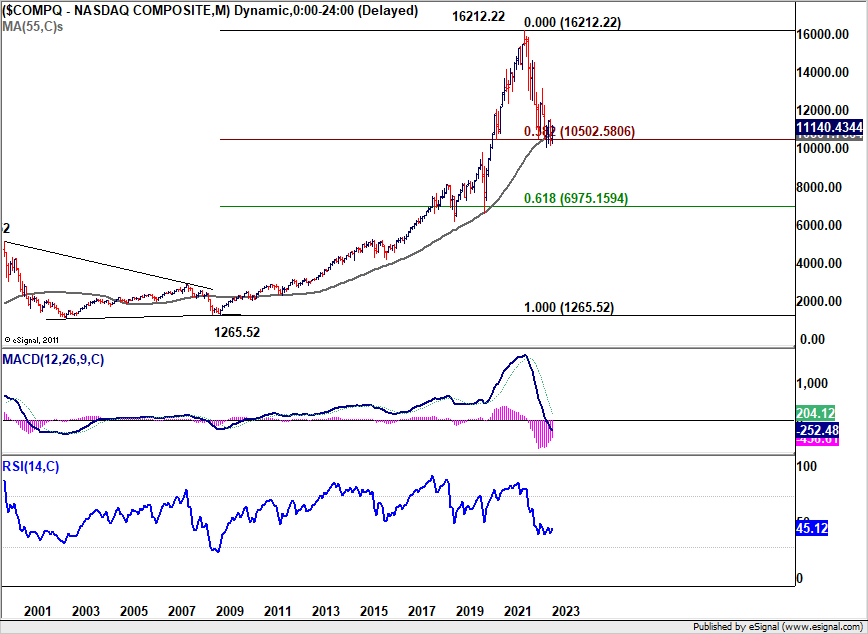
Meanwhile, even though the reversal might still be delayed. It's looking increasing likely that correction from 16212.22 will finish at around current level at 10k handle, with 55 month EMA at 10801.78 and 38.2% retracement of 1265.52 to 16212.22 at 10502.58.
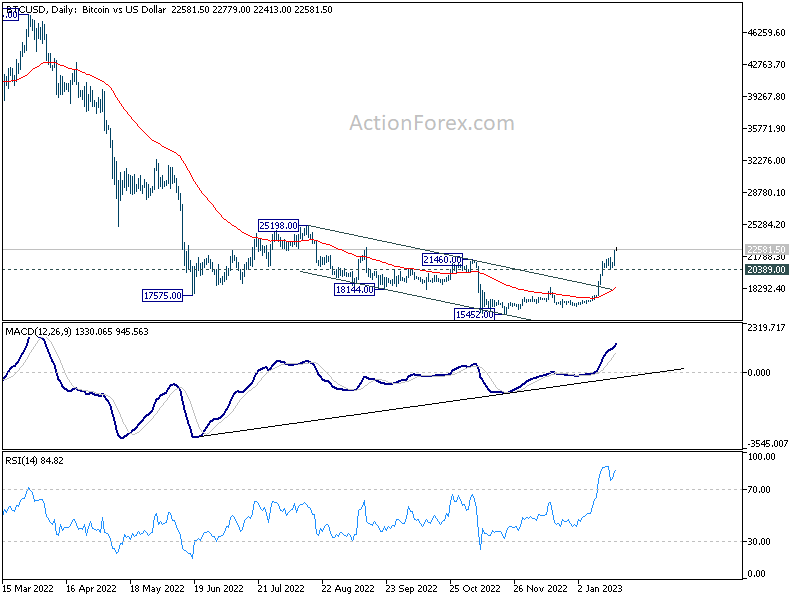
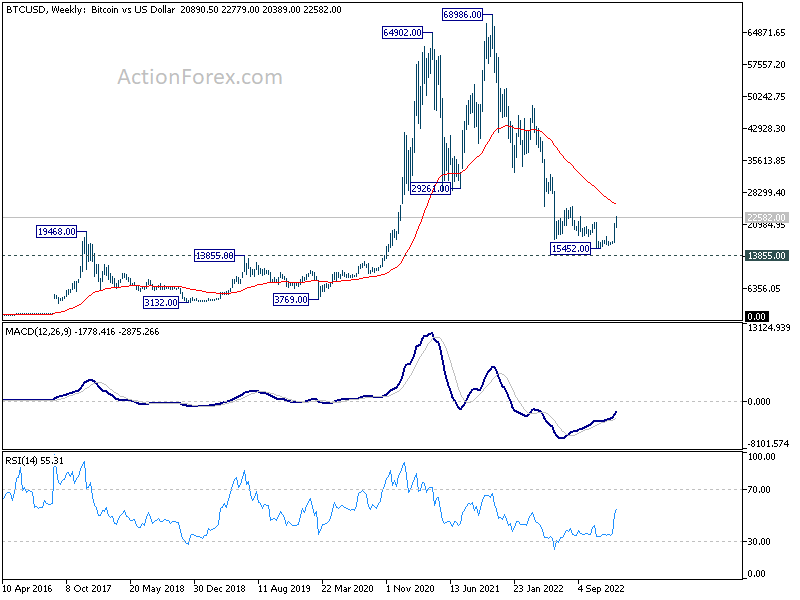
While, again, overall sentiment was mixed, the bullish development in Bitcoin argues that there might be some risk appetite building up underneath. The strong break of 21468 resistance should confirm medium term bottoming at 15452 on bullish convergence condition in daily and week MACD.
It's still early to call for a large scale up trend. But further rally is now expected as long as 20389 support holds. Bitcoin would target 25198 resistance, or even further to 55 week EMA (now at 25730). Reactions from there will reveal the underlying buying momentum.
But anyways, rise in Bitcoin could happen in tandem with NASDAQ, which takes overall markets higher.
Dollar index extending the fall from 114.77
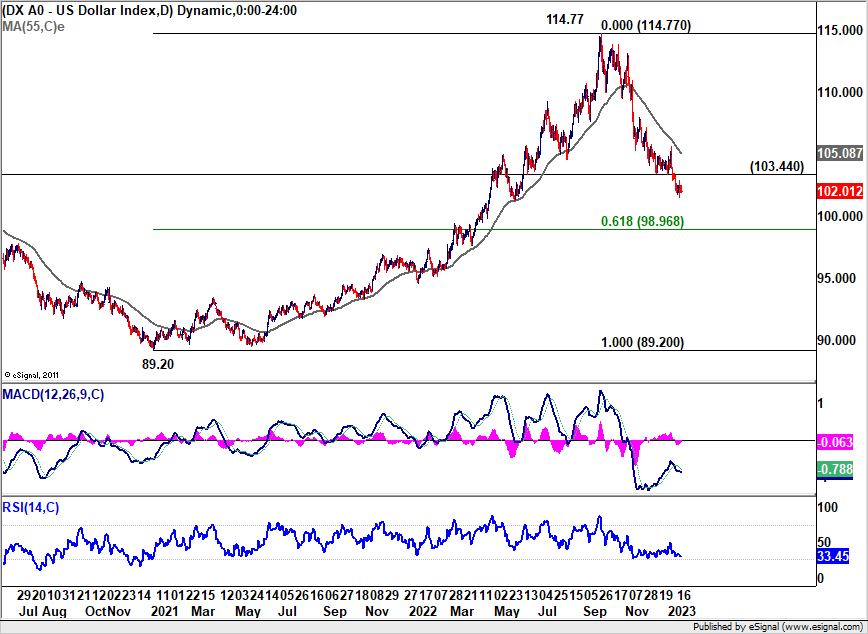
Dollar index's fall from 114.77 has somewhat slowed slightly, but there is no sign of bottoming yet. USD/JPY's mild recovery doesn't warrant a strong rebound yet. At the same time, EUR/USD's up trend is still on the risk track. Additionally, risk on sentiment could continue cap any upside in DXY.
For the near term, further decline is expected as long as 103.44 support turned resistance holds. Fall from 114.77 could extend to 61.8% retracement of 89.20 to 114.77 at 98.96 before getting enough support. Nevertheless, break of 103.44 should at least trigger an attempt towards 55 day EMA (now at 105.08).
USD/JPY Weekly Outlook
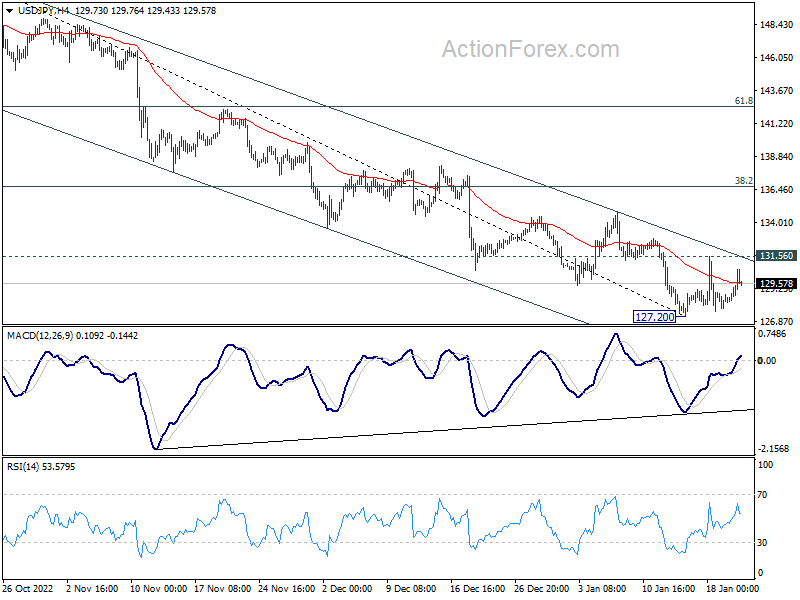
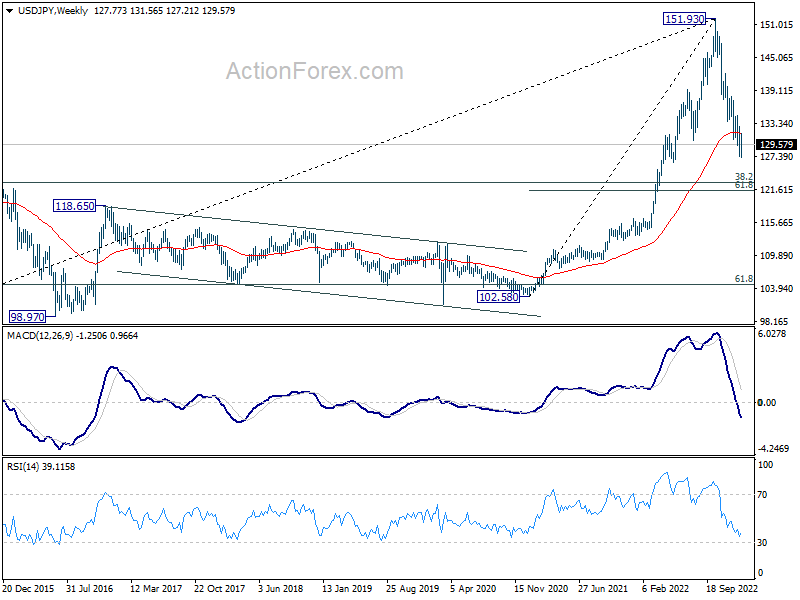
USD/JPY edged lower to 127.20 last week but turned sideway since then. Initial bias stays neutral this week first. There is no clear sign of bottoming yet, and another fall remains mildly in favor. Break of 127.20 will resume the whole decline from 151.93 and target 121.43 fibonacci level. Nevertheless, break of 131.56 should confirm short term bottoming, and turn bias back to the upside for stronger rebound.
In the bigger picture, the break of 55 week EMA (now at 131.52) raises the chance of medium term bearish reversal, but that's not confirmed yet. Strong support could be seen around 61.8% retracement of 102.58 to 151.93 at 121.43 and 38.2% retracement of 75.56 to 151.93 at 122.75 to bring rebound. But break of 131.56 resistance is needed to indicate bottoming first. Otherwise further fall will remain in favor.
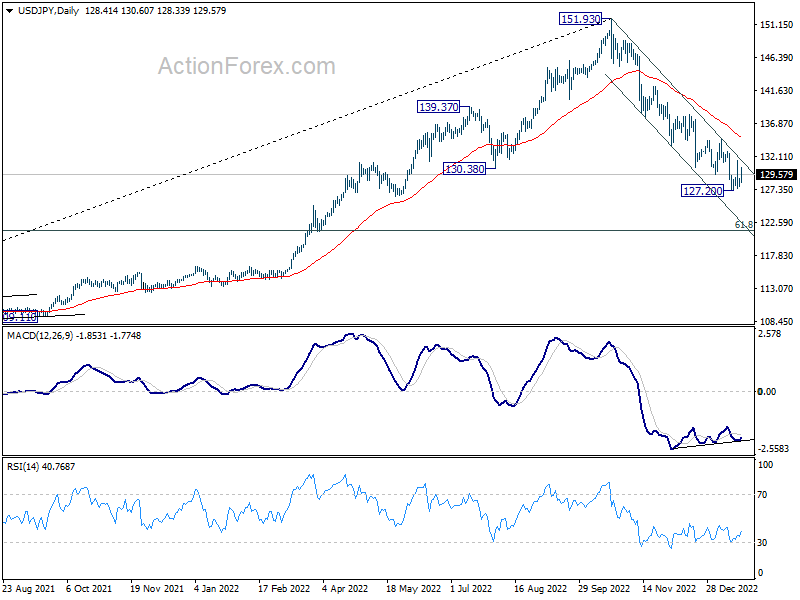
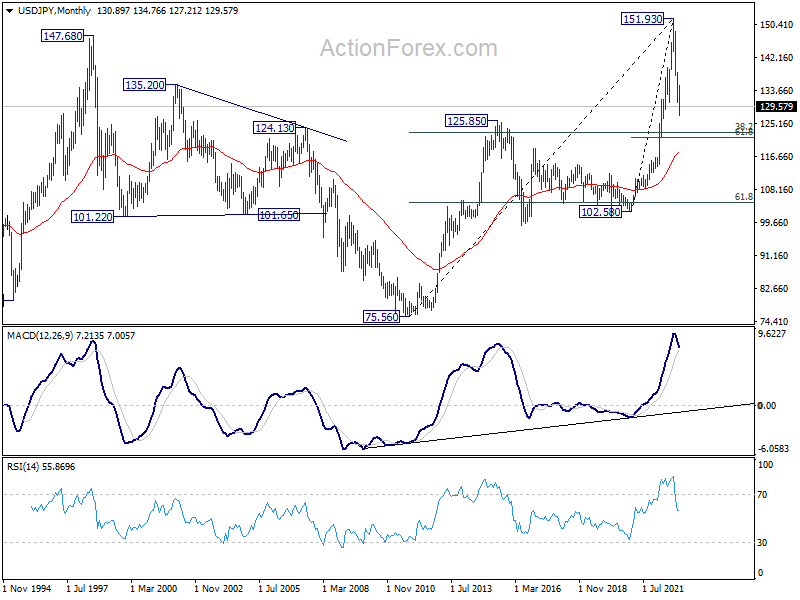
In the long term picture, 151.93 looks increasingly likely a major top. But it's too early to call for long term bearish reversal at this point. Rebound from around 38.2% retracement of 75.56 to 151.93 at 122.75 will keep the case open for price action from 151.93 to be just a corrective pattern.
Summary 1/23 – 1/27
Monday, Jan 23, 2023
| GMT | Ccy | Events | Consensus | Previous |
|---|---|---|---|---|
| 23:50 | JPY | BoJ Minutes | ||
| 13:30 | CAD | New Housing Price Index M/M Dec | -0.20% | |
| 15:00 | EUR | Eurozone Consumer Confidence Jan P | -20 | -22 |
| 22:00 | AUD | Manufacturing PMI Jan P | 50.2 | |
| 22:00 | AUD | Services PMI Jan P | 47.3 |
| GMT | Ccy | Events | |
|---|---|---|---|
| 23:50 | JPY | BoJ Minutes | |
| Forecast: | Previous: | ||
| 13:30 | CAD | New Housing Price Index M/M Dec | |
| Forecast: | Previous: -0.20% | ||
| 15:00 | EUR | Eurozone Consumer Confidence Jan P | |
| Forecast: -20 | Previous: -22 | ||
| 22:00 | AUD | Manufacturing PMI Jan P | |
| Forecast: | Previous: 50.2 | ||
| 22:00 | AUD | Services PMI Jan P | |
| Forecast: | Previous: 47.3 | ||
Tuesday, Jan 24, 2023
| GMT | Ccy | Events | Consensus | Previous |
|---|---|---|---|---|
| 00:30 | AUD | NAB Business Conditions Dec | 20 | |
| 00:30 | AUD | NAB Business Confidence Dec | -4 | |
| 00:30 | JPY | Manufacturing PMI Jan P | 49.4 | 48.9 |
| 07:00 | EUR | Germany Gfk Consumer Confidence Feb | -33 | -37.8 |
| 07:00 | CHF | Trade Balance (CHF) Dec | 3.23B | 2.31B |
| 07:00 | GBP | Public Sector Net Borrowing (GBP) Dec | 20.3B | 21.2B |
| 08:15 | EUR | France Manufacturing PMI Jan P | 49.6 | 49.2 |
| 08:15 | EUR | France Services PMI Jan P | 49.7 | 49.5 |
| 08:30 | EUR | Germany Manufacturing PMI Jan P | 47.5 | 47.1 |
| 08:30 | EUR | Germany Services PMI Jan P | 49.6 | 49.2 |
| 09:00 | EUR | Eurozone Manufacturing PMI Jan P | 48.1 | 47.8 |
| 09:00 | EUR | Eurozone Services PMI Jan P | 49.4 | 49.8 |
| 09:30 | GBP | Manufacturing PMI Jan P | 45.4 | 45.3 |
| 09:30 | GBP | Services PMI Jan P | 46.7 | 49.9 |
| 14:45 | USD | Manufacturing PMI Jan P | 46.1 | 46.2 |
| 14:45 | USD | Services PMI Jan P | 44.5 | 44.7 |
| 21:45 | NZD | CPI Q/Q Q4 | 1.50% | 2.20% |
| 21:45 | NZD | CPI Y/Y Q4 | 7.20% | |
| 23:30 | AUD | Westpac Leading Index M/M Dec | -0.10% |
| GMT | Ccy | Events | |
|---|---|---|---|
| 00:30 | AUD | NAB Business Conditions Dec | |
| Forecast: | Previous: 20 | ||
| 00:30 | AUD | NAB Business Confidence Dec | |
| Forecast: | Previous: -4 | ||
| 00:30 | JPY | Manufacturing PMI Jan P | |
| Forecast: 49.4 | Previous: 48.9 | ||
| 07:00 | EUR | Germany Gfk Consumer Confidence Feb | |
| Forecast: -33 | Previous: -37.8 | ||
| 07:00 | CHF | Trade Balance (CHF) Dec | |
| Forecast: 3.23B | Previous: 2.31B | ||
| 07:00 | GBP | Public Sector Net Borrowing (GBP) Dec | |
| Forecast: 20.3B | Previous: 21.2B | ||
| 08:15 | EUR | France Manufacturing PMI Jan P | |
| Forecast: 49.6 | Previous: 49.2 | ||
| 08:15 | EUR | France Services PMI Jan P | |
| Forecast: 49.7 | Previous: 49.5 | ||
| 08:30 | EUR | Germany Manufacturing PMI Jan P | |
| Forecast: 47.5 | Previous: 47.1 | ||
| 08:30 | EUR | Germany Services PMI Jan P | |
| Forecast: 49.6 | Previous: 49.2 | ||
| 09:00 | EUR | Eurozone Manufacturing PMI Jan P | |
| Forecast: 48.1 | Previous: 47.8 | ||
| 09:00 | EUR | Eurozone Services PMI Jan P | |
| Forecast: 49.4 | Previous: 49.8 | ||
| 09:30 | GBP | Manufacturing PMI Jan P | |
| Forecast: 45.4 | Previous: 45.3 | ||
| 09:30 | GBP | Services PMI Jan P | |
| Forecast: 46.7 | Previous: 49.9 | ||
| 14:45 | USD | Manufacturing PMI Jan P | |
| Forecast: 46.1 | Previous: 46.2 | ||
| 14:45 | USD | Services PMI Jan P | |
| Forecast: 44.5 | Previous: 44.7 | ||
| 21:45 | NZD | CPI Q/Q Q4 | |
| Forecast: 1.50% | Previous: 2.20% | ||
| 21:45 | NZD | CPI Y/Y Q4 | |
| Forecast: | Previous: 7.20% | ||
| 23:30 | AUD | Westpac Leading Index M/M Dec | |
| Forecast: | Previous: -0.10% | ||
Wednesday, Jan 25, 2023
| GMT | Ccy | Events | Consensus | Previous |
|---|---|---|---|---|
| 00:30 | AUD | CPI Q/Q Q4 | 1.70% | 1.80% |
| 00:30 | AUD | CPI Y/Y Q4 | 7.20% | 7.30% |
| 00:30 | AUD | RBA Trimmed Mean CPI Q/Q Q4 | 1.60% | 1.80% |
| 00:30 | AUD | RBA Trimmed Mean CPI Y/Y Q4 | 6.10% | |
| 07:00 | GBP | PPI Input M/M Dec | 0.90% | 0.60% |
| 07:00 | GBP | PPI Input Y/Y Dec | 19.20% | 19.20% |
| 07:00 | GBP | PPI Output M/M Dec | 0.70% | 0.30% |
| 07:00 | GBP | PPI Output Y/Y Dec | 13.90% | 14.80% |
| 07:00 | GBP | PPI Core Output M/M Dec | 1.10% | 0.50% |
| 07:00 | GBP | PPI Core Output Y/Y Dec | 13.90% | 13.30% |
| 09:00 | CHF | Credit Suisse Economic Expectations Jan | -42.8 | |
| 09:00 | EUR | Germany IFO Business Climate Jan | 90.5 | 88.6 |
| 09:00 | EUR | Germany IFO Current Assessment Jan | 94.4 | |
| 09:00 | EUR | Germany IFO Expectations Jan | 83.2 | |
| 15:00 | CAD | BoC Rate Decision | 4.50% | 4.25% |
| 15:30 | USD | Crude Oil Inventories | 8.4M | |
| 16:00 | CAD | BoC Press Conference | ||
| 23:50 | JPY | BoJ Summary of Opinions | ||
| 23:50 | JPY | Corporate Service Price Index Y/Y Dec | 1.70% |
| GMT | Ccy | Events | |
|---|---|---|---|
| 00:30 | AUD | CPI Q/Q Q4 | |
| Forecast: 1.70% | Previous: 1.80% | ||
| 00:30 | AUD | CPI Y/Y Q4 | |
| Forecast: 7.20% | Previous: 7.30% | ||
| 00:30 | AUD | RBA Trimmed Mean CPI Q/Q Q4 | |
| Forecast: 1.60% | Previous: 1.80% | ||
| 00:30 | AUD | RBA Trimmed Mean CPI Y/Y Q4 | |
| Forecast: | Previous: 6.10% | ||
| 07:00 | GBP | PPI Input M/M Dec | |
| Forecast: 0.90% | Previous: 0.60% | ||
| 07:00 | GBP | PPI Input Y/Y Dec | |
| Forecast: 19.20% | Previous: 19.20% | ||
| 07:00 | GBP | PPI Output M/M Dec | |
| Forecast: 0.70% | Previous: 0.30% | ||
| 07:00 | GBP | PPI Output Y/Y Dec | |
| Forecast: 13.90% | Previous: 14.80% | ||
| 07:00 | GBP | PPI Core Output M/M Dec | |
| Forecast: 1.10% | Previous: 0.50% | ||
| 07:00 | GBP | PPI Core Output Y/Y Dec | |
| Forecast: 13.90% | Previous: 13.30% | ||
| 09:00 | CHF | Credit Suisse Economic Expectations Jan | |
| Forecast: | Previous: -42.8 | ||
| 09:00 | EUR | Germany IFO Business Climate Jan | |
| Forecast: 90.5 | Previous: 88.6 | ||
| 09:00 | EUR | Germany IFO Current Assessment Jan | |
| Forecast: | Previous: 94.4 | ||
| 09:00 | EUR | Germany IFO Expectations Jan | |
| Forecast: | Previous: 83.2 | ||
| 15:00 | CAD | BoC Rate Decision | |
| Forecast: 4.50% | Previous: 4.25% | ||
| 15:30 | USD | Crude Oil Inventories | |
| Forecast: | Previous: 8.4M | ||
| 16:00 | CAD | BoC Press Conference | |
| Forecast: | Previous: | ||
| 23:50 | JPY | BoJ Summary of Opinions | |
| Forecast: | Previous: | ||
| 23:50 | JPY | Corporate Service Price Index Y/Y Dec | |
| Forecast: | Previous: 1.70% | ||
Thursday, Jan 26, 2023
| GMT | Ccy | Events | Consensus | Previous |
|---|---|---|---|---|
| 13:30 | USD | Initial Jobless Claims (Jan 20) | 211K | 190K |
| 13:30 | USD | GDP Annualized Q4 P | 2.80% | 3.20% |
| 13:30 | USD | GDP Price Index Q4 P | 6.20% | 4.40% |
| 13:30 | USD | Goods Trade Balance (USD) Dec P | -88.8B | -83.3B |
| 13:30 | USD | Wholesale Inventories Dec P | 1% | |
| 13:30 | USD | Durable Goods Orders Dec | 2.50% | -2.10% |
| 13:30 | USD | Durable Goods Orders ex Trans Dec | 0.00% | 0.20% |
| 15:00 | USD | New Home Sales Dec | 615K | 640K |
| 15:30 | USD | Natural Gas Storage | -82B | |
| 23:30 | JPY | Tokyo CPI Core Y/Y Jan | 4.20% | 4.00% |
| GMT | Ccy | Events | |
|---|---|---|---|
| 13:30 | USD | Initial Jobless Claims (Jan 20) | |
| Forecast: 211K | Previous: 190K | ||
| 13:30 | USD | GDP Annualized Q4 P | |
| Forecast: 2.80% | Previous: 3.20% | ||
| 13:30 | USD | GDP Price Index Q4 P | |
| Forecast: 6.20% | Previous: 4.40% | ||
| 13:30 | USD | Goods Trade Balance (USD) Dec P | |
| Forecast: -88.8B | Previous: -83.3B | ||
| 13:30 | USD | Wholesale Inventories Dec P | |
| Forecast: | Previous: 1% | ||
| 13:30 | USD | Durable Goods Orders Dec | |
| Forecast: 2.50% | Previous: -2.10% | ||
| 13:30 | USD | Durable Goods Orders ex Trans Dec | |
| Forecast: 0.00% | Previous: 0.20% | ||
| 15:00 | USD | New Home Sales Dec | |
| Forecast: 615K | Previous: 640K | ||
| 15:30 | USD | Natural Gas Storage | |
| Forecast: | Previous: -82B | ||
| 23:30 | JPY | Tokyo CPI Core Y/Y Jan | |
| Forecast: 4.20% | Previous: 4.00% | ||
Friday, Jan 27, 2023
| GMT | Ccy | Events | Consensus | Previous |
|---|---|---|---|---|
| 00:00 | NZD | ANZ Business Confidence Jan | -70.2 | |
| 00:30 | AUD | Import Price Index Q/Q Q4 | 1.60% | 3.00% |
| 00:30 | AUD | PPI Q/Q Q4 | 1.90% | 1.90% |
| 00:30 | AUD | PPI Y/Y Q4 | 6.30% | 6.40% |
| 09:00 | EUR | Eurozone M3 Money Supply Y/Y Dec | 4.60% | 4.80% |
| 13:30 | USD | Personal Spending Dec | -0.10% | 0.10% |
| 13:30 | USD | Personal Income M/M Dec | 0.20% | 0.40% |
| 13:30 | USD | PCE Price Index M/M Dec | 0.10% | |
| 13:30 | USD | PCE Price Index Y/Y Dec | 5.50% | |
| 13:30 | USD | Core PCE Price Index M/M Dec | 0.30% | 0.20% |
| 13:30 | USD | Core PCE Price Index Y/Y Dec | 4.70% | |
| 15:00 | USD | Pending Home Sales M/M Dec | -1.00% | -4.00% |
| 15:00 | USD | Pending Home Sales Y/Y Dec | -37.80% | |
| 15:00 | USD | Michigan Consumer Sentiment Index Jan F | 64.6 | 64.6 |
| GMT | Ccy | Events | |
|---|---|---|---|
| 00:00 | NZD | ANZ Business Confidence Jan | |
| Forecast: | Previous: -70.2 | ||
| 00:30 | AUD | Import Price Index Q/Q Q4 | |
| Forecast: 1.60% | Previous: 3.00% | ||
| 00:30 | AUD | PPI Q/Q Q4 | |
| Forecast: 1.90% | Previous: 1.90% | ||
| 00:30 | AUD | PPI Y/Y Q4 | |
| Forecast: 6.30% | Previous: 6.40% | ||
| 09:00 | EUR | Eurozone M3 Money Supply Y/Y Dec | |
| Forecast: 4.60% | Previous: 4.80% | ||
| 13:30 | USD | Personal Spending Dec | |
| Forecast: -0.10% | Previous: 0.10% | ||
| 13:30 | USD | Personal Income M/M Dec | |
| Forecast: 0.20% | Previous: 0.40% | ||
| 13:30 | USD | PCE Price Index M/M Dec | |
| Forecast: | Previous: 0.10% | ||
| 13:30 | USD | PCE Price Index Y/Y Dec | |
| Forecast: | Previous: 5.50% | ||
| 13:30 | USD | Core PCE Price Index M/M Dec | |
| Forecast: 0.30% | Previous: 0.20% | ||
| 13:30 | USD | Core PCE Price Index Y/Y Dec | |
| Forecast: | Previous: 4.70% | ||
| 15:00 | USD | Pending Home Sales M/M Dec | |
| Forecast: -1.00% | Previous: -4.00% | ||
| 15:00 | USD | Pending Home Sales Y/Y Dec | |
| Forecast: | Previous: -37.80% | ||
| 15:00 | USD | Michigan Consumer Sentiment Index Jan F | |
| Forecast: 64.6 | Previous: 64.6 | ||
Weekly Economic & Financial Commentary: The Pain Is Spreading
Summary
United States: The Pain Is Spreading
- The housing sector has borne the brunt of the Fed's efforts to slow the economy, and this week's data showed the industry continues to reel. But pain is now clearly spreading beyond housing with grim reports on retail sales and manufacturing activity this week.
- Next week: Leading Economic Index (Mon), Q4 GDP (Thurs), Personal Income & Spending (Fri)
International: Bank of Japan Maintains Accommodative Monetary Policy for Now
- At a widely anticipated Bank of Japan (BoJ) monetary policy meeting, the central bank pushed back against expectations for a further policy adjustment, maintaining its accommodative monetary policy stance for now. In particular, the BoJ maintained a zero percent target for 10-year Japanese government bond yields, with an unchanged tolerance band of plus or minus 50 bps around that target. Elsewhere, Chinese activity was firmer than expected late last year, as Q4 GDP was flat quarter-over-quarter, and December retail sales and industrial output also surprised to the upside.
- Next week: Eurozone PMIs (Tue.), Australia CPI (Wed.), Bank of Canada Policy Announcement (Wed.)
Credit Market Insights: Corporate Bond Yields in a Debt Ceiling Showdown
- The mounting debt ceiling showdown in 2023 will be an event for credit markets to watch closely. In the period around the 2011 debt ceiling standoff, the absolute level of investment grade corporate bond yields remained almost entirely unchanged. However, the plunge in Treasury yields translated into a widening of spreads on investment grade corporate bonds.
Topic of the Week: The Fed's Reach Extends Beyond the Housing Market
- Qualitative accounts from the January Beige Book support our view that the economy is not currently in recession, but the effects of monetary tightening are beginning to materialize in the broader economy. The survey also suggests that population growth acts as a hedge against economic declines.
The Weekly Bottom Line: Bad News is Bad News
U.S. Highlights
- Markets finished the week lower on weaker economic data and rising political risks.
- December retail sales registered the biggest monthly decline in 2022, finishing the fourth quarter flat. Housing starts were down less than expected, driven by the volatile multifamily component. Existing home sales continued to soften.
- This week’s Fed speakers demonstrated a varying degree of hawkishness on the pace of upcoming rate hikes. Yet, markets are all but priced-in a 25-basis point increase..
Canadian Highlights
- Inflation pulled back this week, cooling to 6.3% year-on-year (y/y) in December, from 6.8% in November. The pullback was helped by a 13.1% decline in gasoline prices.
- Near-term trends in core goods and services inflation show that inflation is expected to continue to decelerate in the coming months.
- Consumer demand is responding to rate hikes, as housing sales continue to sputter and spending continues to shift from goods to services.
U.S. - Bad News is Bad News
The week started with a holiday, but that didn’t stop markets from feeling the blues of the most depressing period in the Northern Hemisphere. At the time of writing, equities are down almost 2% on the week. On the political front, concerns about the government’s ability to pay its debts resurfaced as the Treasury Department was forced to begin taking ‘extraordinary measures’ in order to keep paying the government’s bills. By suspending certain additional investments, the Treasury buys Congress more time – likely until June - to negotiate a resolution on how to increase the debt ceiling. With the deadline still several months out, investors’ focus was squarely on the economic data. Unfortunately, there was little to cheer about.
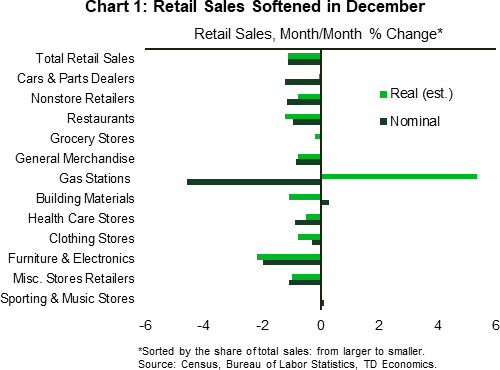
Retail sales came in weaker than expected – falling 1.1% m/m - and marking the second consecutive month of declines. Most major categories were weak in both nominal and inflation adjusted terms. The only group that showed stronger demand was sales at gas stations, where real sales rose five percentage points on a sizeable drop in gas prices (Chart 1). The message is clear: consumers are becoming increasingly more cautious in allocating their income and pandemic savings. Moreover, judging by sales at restaurant and bars, demand for services might also be nearing an inflection point. The soft reading on retail sales led us to adjust our expectations for Q4 consumer spending down to a still robust 2.7% (previously 3.3%).
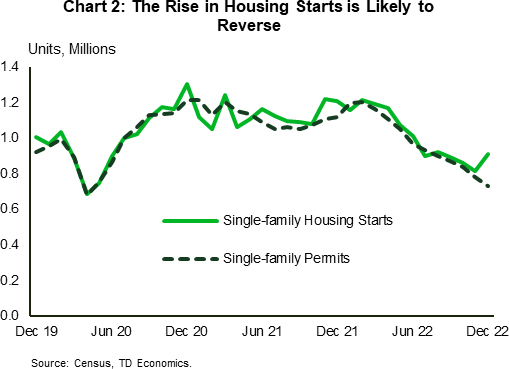
Housing activity also ended 2022 on a soft note. Residential construction declined for the fourth consecutive month, but by less than expected in December. The decline was attributed to a 19% drop in the multi-family segment. In contrast, starts in the single-family, rose for the first time in four months, but are likely to decelerate further in the months ahead as permits continue to trend lower (Chart 2).
On that note, existing home sales also continued to soften, falling 1.5% m/m December and 17.8% for the year. Despite the sharp decline in sales, prices have only fallen by 1.5%. However, the sharp increase in inventory since August suggests more meaningful downward pressure lies ahead.
Increasingly bold signs of cooling economic activity are welcome news for the Fed on its mission to bring down inflation. That said, this week’s Fed speakers had varying degrees of hawkishness on the pace of upcoming rate hikes. Of those who have the voting rights on the Federal Open Market Committee, James Bullard sounded most hawkish by expressing his preference to “err on the tighter side to get the disinflationary process to take hold”. e
In contrast, Fed’s Lorie Logan and Patrick Harker voiced their support for a 25-basis point hike, while Vice Chair Lael Brainard, without explicitly backing a softer pace, emphasized the possibility of a soft lending - easing in the labor market and reduction in inflation without a significant loss of employment. Markets side with this view, having priced-in a quarter-of-a percent hike on February 1st with a 97% probability. Compare it to exactly one month ago, when only 70% of market participants (including yours truly) expected a downshift. Seemingly, investors express more certainty about an economic slowdown ahead.
Canada – Inflation Continues to Slow as Higher Rates Bite
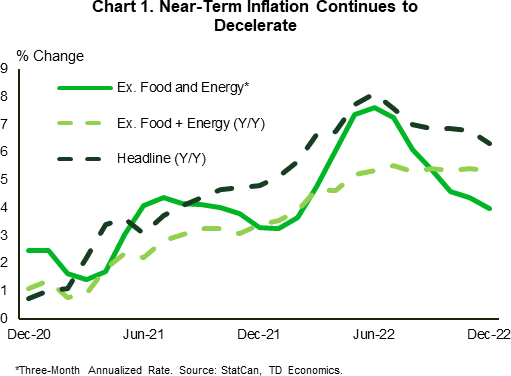
With the Bank of Canada (BoC) interest rate announcement next week, all eyes were on December's Consumer Price Index (CPI) report. The headline reading decelerated to 6.3% year-on-year (y/y), from 6.8% in November. The top-line figure was helped lower by a 13.1% month-on-month fall in gasoline prices, but even stripping out the effects of food and energy prices, inflation decelerated slightly to 5.3% y/y. The Bank of Canada's core inflation measures also edged down in December.
Despite inflation continuing to register well above the 1-3% target range, the data featured positive developments. In fact, focusing on more recent trends shows that the three-month annualized pace for CPI ex-food and energy slowed substantially, falling to 4.0% from a peak of 7.6% in June (Chart 1). With near-term price gains slowing, this means the annual (y/y) prints will slowly continue to ease – ultimately falling below 3.0% later this year. So, while falling energy prices took the edge off inflation in December, now it is core goods and services price gains that need to cool further to bring inflation back to the BoC's target.
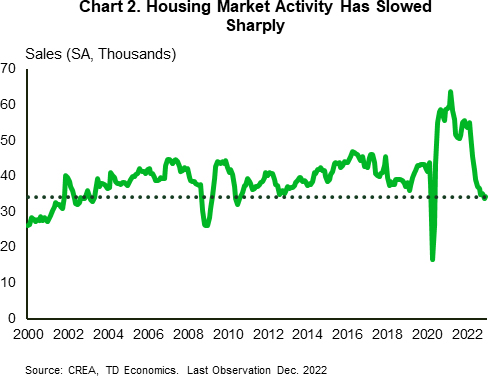
The improved inflation outlook has come with a cost. December housing sales were down 36.4% y/y, lingering at levels last consistently seen in 2003 (Chart 2). Yet, construction activity has remained resilient through the initial slowdown. Although housing starts declined 5% m/m, at 248.6k, they are still well above pre-pandemic norms. This strength is unlikely to persist as higher interest rates sap demand in the housing sector. Our forecast remains that new construction activity should continue to moderate through 2023 and 2024, falling to roughly 200k units by the fourth quarter of 2024.
Beyond housing, consumers continue to adjust their spending patterns – shifting from goods to services expenditures. Friday's retail sales data showed a 0.1% m/m pullback in November's retail activity (-0.4% in real terms) highlighting the sputtering appetite for goods purchases. A silver lining is that December's preliminary estimates suggest a 0.5% bounce-back to close out the year. The recovery in December is in line with our estimates using TD's internal data. A key finding in our report is that much of the consumer spending growth is being powered by services expenditures, rather than the goods purchases that dominated consumer outlays through the pandemic recovery. Rising interest rates impacting interest rate sensitive goods purchases more than services highlights the transmission mechanism the BoC is relying on to cool demand.
The BoC has some crosscurrents to weigh as it considers its next interest rate move. Inflation has slowed as aggregate demand has weakened amid a barrage of rate hikes, but it remains above target. The Bank doesn't want to back off until they are confident inflation is coming back down. The recent resiliency of consumers could test the Bank's plans, but we expect the BoC will raise rates one more time before pausing to evaluate whether enough has been done to ensure inflation will return to its target band.
Bank of Canada Likely to Make One Last Rate Hike—Then Take a Breather
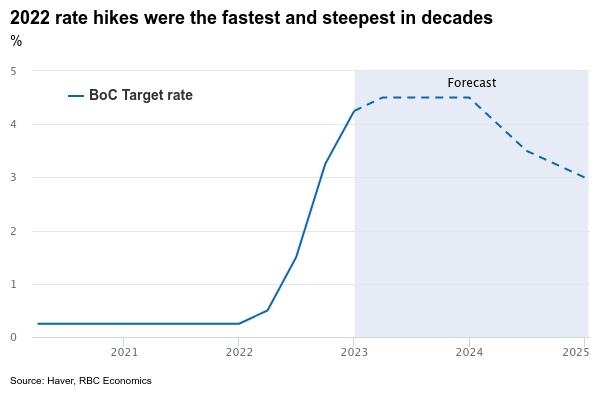
The Canada’s central bank is expected to slow the pace of interest rate hikes at next week’s policy decision. And odds are that the 25 basis point increase we anticipate (down from the 50 basis point increase in December) could be the last of this hiking cycle.
Though broader inflation trends are still running above the Bank of Canada’s 1% to 3% target range, they’ve already shown clear signs of losing steam. And the lagged impact of the 400 basis points of BoC rate increases in 2022—the most aggressive hiking cycle in decades—is still filtering through to household and business borrowing costs. We expect household debt servicing costs to rise to record levels by mid-2023. Housing markets have already softened significantly. And consumer demand is likely to contract as Canadians feel the pinch of higher debt-servicing costs and prices. Our own RBC cardholder data shows restaurant spending declined in December, suggesting discretionary spending may be starting to flag.
Labour markets continue to defy this trend. An unexpected surge in employment in December and a decline in the unemployment rate to a near record low of 5% is the main reason we expect the BoC to follow through with one final rate hike. Still, interest rates are likely high enough now that labour markets will soften in 2023.
Week ahead data watch
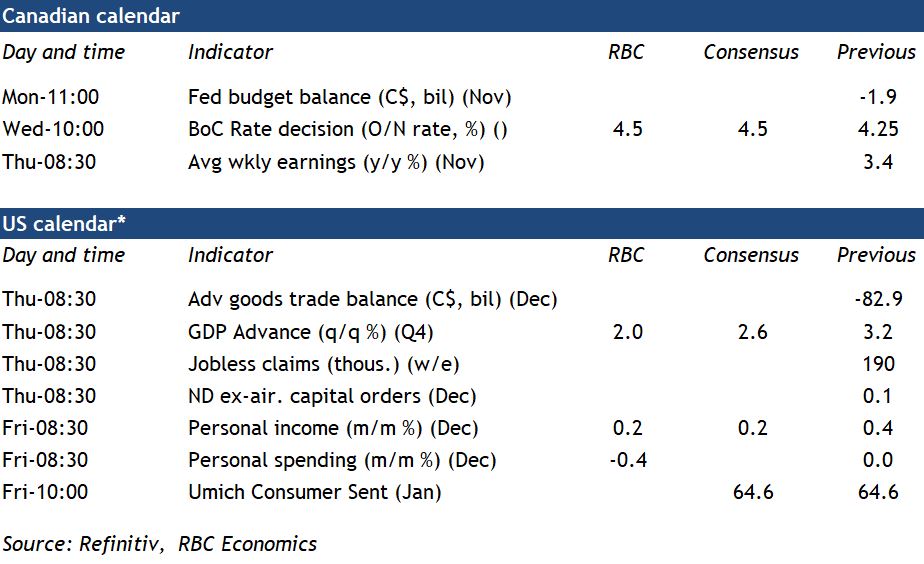
Q4 U.S. GDP growth likely slowed in Q3 (we expect a 2.0% annualized increase) due to a wider net trade deficit and weak residential investment offsetting stronger consumer spending growth.
Personal spending in the U.S. is likely declined by 0.4% in December, following the weak 1.1% drop in retail sales already reported. We expect a 0.2% increase in December personal incomes, with a 0.3% increase in average hourly earnings partially offset by a 0.1% dip in hours worked.
The Canadian SEPH data will be watched closely for signs that labour market tightness could be easing. Earlier data from the monthly Labour Force Survey already flagged lower unemployment over November and December but the number of job vacancies from the SEPH data has been edging lower in recent months.(1.8%).
Week Ahead – Earnings Season a Highlight
It will be a busy week filled with the first look at Q4 GDP, corporate earnings, and US debt ceiling gridlock. There is a lot of risk on the table and a key focal point for many will be the modest growth we will see alongside a plethora of data points that are signalling recession warnings. Traders will want to see if the contraction manufacturing and service PMI readings we saw in December show any improvement this month.
Wall Street is also fixating on what will happen with debt ceiling talks. Special measures are being used and that should stave off default until June 5th, but flare-ups will most likely happen along the way.
Earnings season shifts away from the banks and now focuses on broader parts of the economy. Key earnings include results from Tesla, Chevron, the airlines, Lockheed Martin, Visa, American Express, 3m Abbott Labs, JNJ, GE, IBM, and Colgate-Palmolive.
The flash PMIs early in the week will be of keen interest as investors continue to assess how much trouble the economy is in. A relatively mild winter to date has boosted the bloc’s economic prospects as gas prices have fallen considerably. This isn’t expected to be reflected in the PMIs though, with the prospect of much higher interest rates and a tougher global economic environment continuing to weigh. It will be interesting to see if there is any improvement as a result of this and China’s growth prospects.
Regardless, markets expect the ECB to hike by another 150 basis points over the coming meetings and officials have been keen to ensure investors don’t become complacent on that. I expect more commentary along those lines next week.
UK
While the PMIs would typically be the standout release next week, investors may have more of an eye on the PPI inflation data for signs of inflationary pressures subsiding. The CPI data in December declined for a second month but remains far too high, above 10%. We’ll need to see much greater signs of those pressures abating before the Bank of England can become more comfortable.
Russia
The only economic release of note is the PPI data. That aside, the focus will remain on the war in Ukraine.
The SARB is expected to raise interest rates by another 50 basis points on Thursday, taking the repo rate to 7.5%, although they could opt for only 25. Inflation has been heading in the right direction since peaking in the summer and could be back within the 3-6% target range before long. Investors will be looking for signs on whether the tightening cycle is now at or near an end.
Turkey
The CBRT left the repo rate unchanged at 9% in January after opting to pause the easing cycle late last year. The quarterly inflation report may offer insight into whether rates will fall again and when but that aside, I’m not sure it will contain much of note given the logic adopted to justify cutting interest rates over the last couple of years.
Switzerland
Trade data is the only notable release next week.
China
This Saturday is Chinese New Year’s Eve, followed by the Spring Festival. The New Year atmosphere which generally extends until at least the end of January may further stimulate domestic consumption and investment in China. The billions of trips made during the Chinese New Year could bring the second wave of Covid-19 to largely unaffected rural areas and smaller cities. Given that the general population will have a higher level of immunity, the economic impact of a second outbreak should be less in areas that have already withstood the main wave of evacuations.
India
No major data or central bank appearances are expected.
Australia & New Zealand
China’s full reopening since the beginning of January this year and its renewed focus on ‘economic development’ will benefit economic growth in Australia and New Zealand. The largest potential upside from reopening itself sits within the services sector given China is the largest consumer of Australian tourism and education exports.
Australia recently released its CPI for November at an annual rate of 7.3%, in line with expectations but higher than the previous value of 6.9%, indicating that Australia’s inflation level may still not have peaked.
The RBA’s CPI for December will be released on Thursday, as well as its revised CPI average quarterly rate for the fourth quarter. New Zealand’s CPI for the fourth quarter will offer clues on whether sustainable disinflation is underway.
Japan
The Bank of Japan monetary policy decision saw them defer any major decisions until at least Governor Kuroda’s last meeting in March, barring any surprises in the interim. Following that, the summary of opinions on Wednesday could be of interest, as will the December minutes, released Monday. Despite being outdated now, it will provide perspective on the decision to unexpectedly tweak its yield curve control band.
Next week also focuses on the Japan PMI readings, leading index, and Tokyo’s CPI.
Singapore
The release of the December inflation will be followed closely. MAS sees core inflation averaging 3.5%–4.5% this year.
Economic Calendar
Saturday, Jan. 21
Economic Events
- US Treasury Secretary Janet Yellen visits Senegal, Zambia, and South Africa
Sunday, Jan. 22
Economic Events
- Germany Chancellor Scholz and French President Macron hold a joint news conference after a Franco-German cabinet meeting in Paris
- Italian PM Meloni visits Algiers
Monday, Jan. 23
Economic Data/Events
- US Conference Board leading index
- Euro area consumer confidence
- EU foreign ministers meeting in Brussels
- Russian Foreign Minister Lavrov is expected to travel to South Africa’s Pandor
- ECB’s Panetta speaks in the European Parliament
- ECB President Lagarde makes a speech at the Deutsche Boerse annual reception
- Bank of Japan releases minutes of its December meeting
Tuesday, Jan. 24
Economic Data/Events
- US flash PMIs; Richmond Fed Manufacturing
- Australia Judo Bank PMI, business confidence
- Chile PPI
- European flash PMIs: Eurozone, Germany, UK, and France
- Japan PMIs, department store sales
- Mexico international reserves, bi-weekly CPI
- New Zealand performance services index
- Thailand trade
- South Africa leading indicator
- ECB’s Knot speaks at the Future of the Financial Sector conference in Frankfurt
- German Foreign Minister Baerbock addresses the Council of Europe in Strasbourg
- SNB’s Vice Chairman Schlegel speaks in Zurich
- Earnings from Danaher, General Electric, Intuitive Surgical, Johnson & Johnson, Lockheed Martin, Microsoft, Raytheon Technologies, Texas Instruments, 3M, Union Pacific, and Verizon
Wednesday, Jan. 25
Economic Data/Events
- US MBA mortgage applications, Philadelphia Fed non-manufacturing activity
- Australia CPI, leading index
- Canada rate decision: Expected to raise rates by 25bps to 4.50%
- Germany IFO business climate
- Japan leading index
- Mexico economic activity IGAE
- New Zealand CPI, credit card spending
- Russia PPI, weekly CPI
- Singapore CPI
- Thailand rate decision: Expected to raise rates by 25bps to 1.50%
- The Republican National Committee winter meeting is held
- Nordic economic outlook published by Finland’s Nordea Bank
- Germany’s Economy Ministry publishes its annual report with updated forecasts
- BOJ announces the outright purchase amount of government securities
- Earnings from Abbott Laboratories, ASML Holding, AT&T, Boeing, IBM, and Tesla
Thursday, Jan. 26
Economic Data/Events
- US Q4 GDP, new home sales, initial jobless claims, goods trade balance, US durable goods, wholesale inventories, retail inventories
- Canada CFIB business barometer
- Japan PPI services, machine tool orders
- Mexico unemployment rate
- Russia gold, forex reserves
- Singapore industrial production
- South Africa rate decision: Expected to raise rates by 50bps to 7.50%
- New Zealand releases financial statements for the five months to Nov. 30
- BOJ releases summary of opinions from January meeting
- Earnings from American Airlines, Blackstone, Comcast, Intel, LVMH Moet Hennessy Louis Vuitton, Mastercard, SAP, Southwest Airlines, and Visa
Friday, Jan. 27
Economic Data/Events
- US personal income/spending, University of Michigan consumer sentiment, pending home sales
- Australia PPI, export/import price index
- Japan Tokyo CPI
- Mexico trade balance
- New Zealand business confidence
- Singapore home prices
- South Korea business survey
- Thailand foreign reserves, forward contracts
- Spain GDP
- Earnings from American Express, Chevron, and HCA Healthcare
Sovereign Rating Updates
- Denmark (Fitch)
- Greece (Fitch)
- Hungary (S&P)
- Netherlands (Moody’s)
- Portugal (DBRS)
Eurozone Data Take Centre Stage as Debate in ECB Ranks Hots Up
For the past year the euro area has been touted for a severe recession during 2023. Up to now, data have failed to follow suit as they enjoy a period of better-than-expected prints. This situation could reflect the extreme pessimism among professional forecasters going into 2023, but it is evidently unsettling the market and causing a wave of upward revisions in the EURUSD projections. Having said that, next week’s economic releases would be the first real test on the current shape of the euro area economies.
ECB meeting nears, the two sides look for evidence in support of their arguments
With the ECB meeting less than two weeks away, the debate among its members is hotting up ahead of the usual blackout period. President Lagarde at the December ECB meeting essentially announced a series of 50 bps rate moves for the foreseeable future, in exchange for a more aggressive quantitative tightening playbook from March 2023. But recent data, particularly the inflation rates appearing to be in a downward sloping trend, cautiously point to a brighter future than most anticipated a few months ago. This situation has reignited the disagreement between hawks and doves about the ECB’s next moves, thus elevating further the importance of next week’s data.
Could the PMIs climb above 50 again?
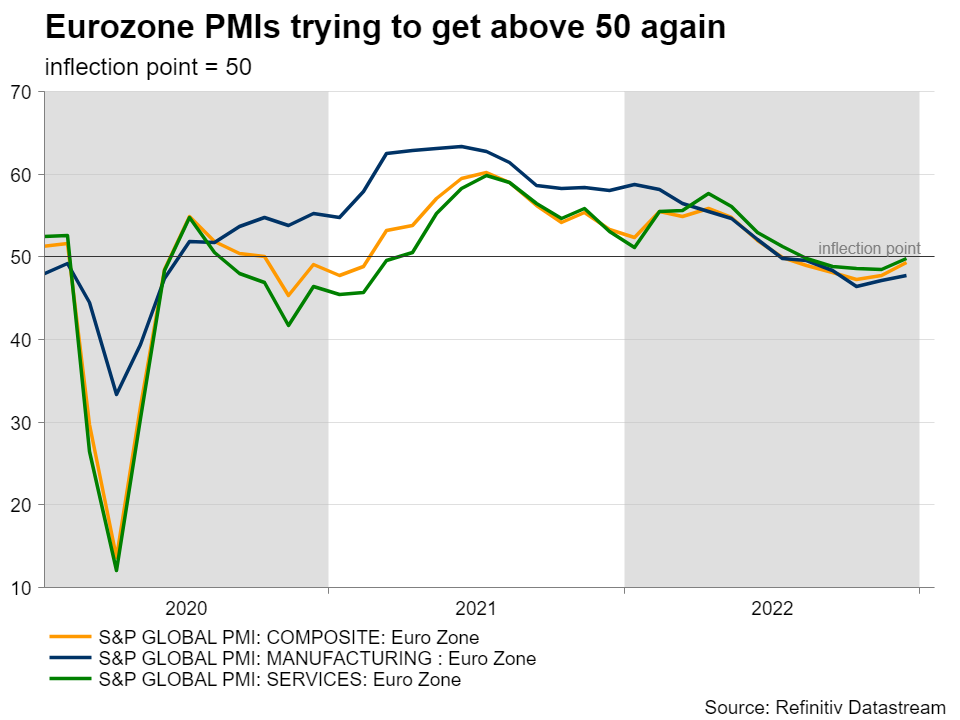
Following the impressive rebound in the Economic Sentiment component of the ZEW survey for both Eurozone and Germany, next week we get the preliminary S&P Global Manufacturing and Services PMIs for the eurozone, Germany and France. Set to be released on Tuesday, the Reuters poll is revealing an expected improvement across the board, with the eurozone Services indicator seen climbing above 50. The PMIs have been on a downward trend since the first half of 2021, but they did not reach a level signaling a potentially acute recession ahead. An upside surprise on Tuesday could further support the recent optimism surrounding the euro area economies, especially if the indicators managed to climb above the 50-inflection point. On the other hand, a negative print could imply that the recent optimistic view is potentially unjustified and thus could cause a more substantial market reaction.
IFO set to continue its recovery
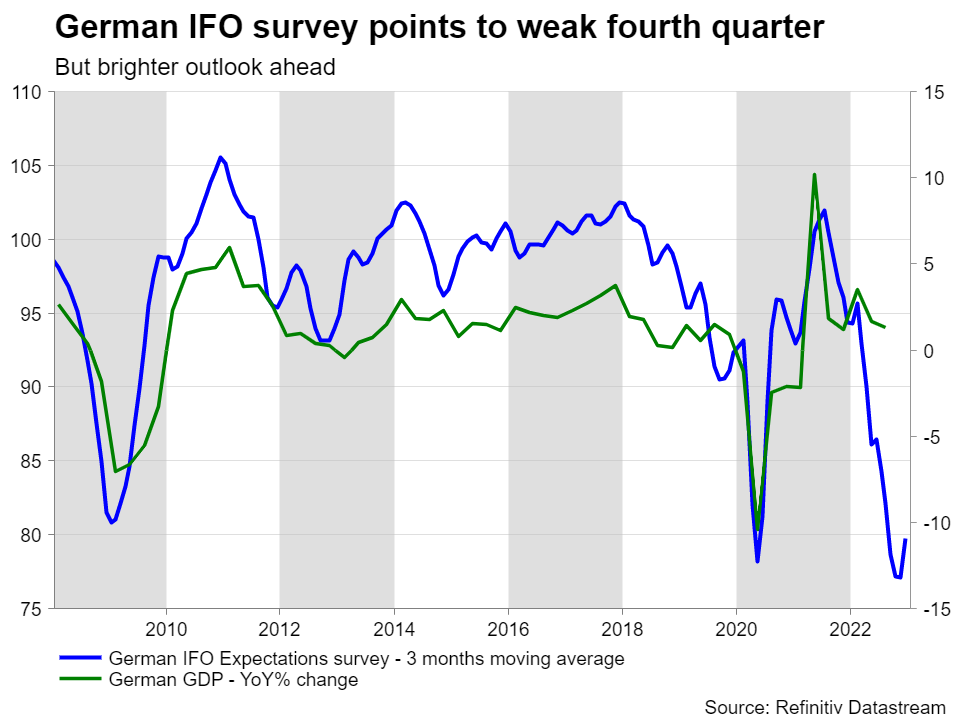
A day later, on Wednesday, we get the January print of the IFO survey, potentially the most closely-watched leading indicator for the German GDP. The dip in the Expectations component during 2022 was shocking on the back of the geopolitical events and the associated inflation surge. On January 30 we will find out the exact damage done with the publication of the preliminary GDP for the fourth quarter of 2022. Looking ahead and based on other German surveys, it looks increasingly likely that the IFO survey recovery could have legs and therefore further support the recent optimism priced in the market.
A quick look on consumer confidence – electricity prices
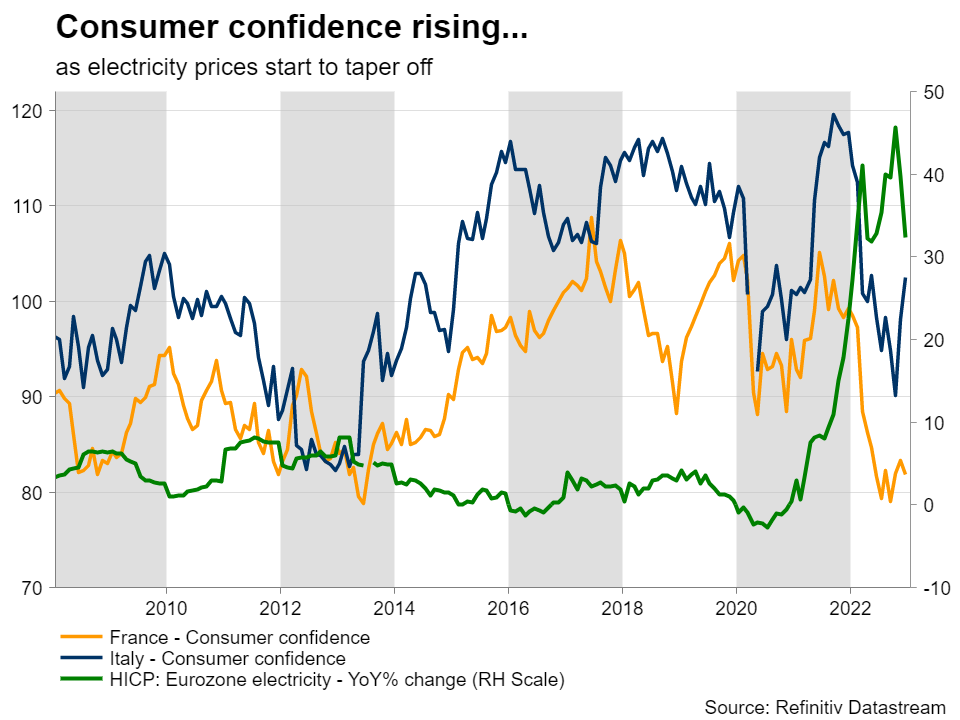
Finally, on Thursday we get two usually overlooked indicators. The French and Italian Consumer Confidence surveys do not possess the market-moving ability of the other indicators. However, they appear to be confirming the current “improved outlook” story for the euro area, albeit from very low levels. The sky-rocketing energy prices have managed to dent consumer appetite to levels unseen since the 2012-13 period. Another improvement at Thursday’s numbers would make the economic outlook less dim from the consumers’ perspective even though inflation remains close to record levels.
DAX 40 enjoys first correction following strong start of 2023.
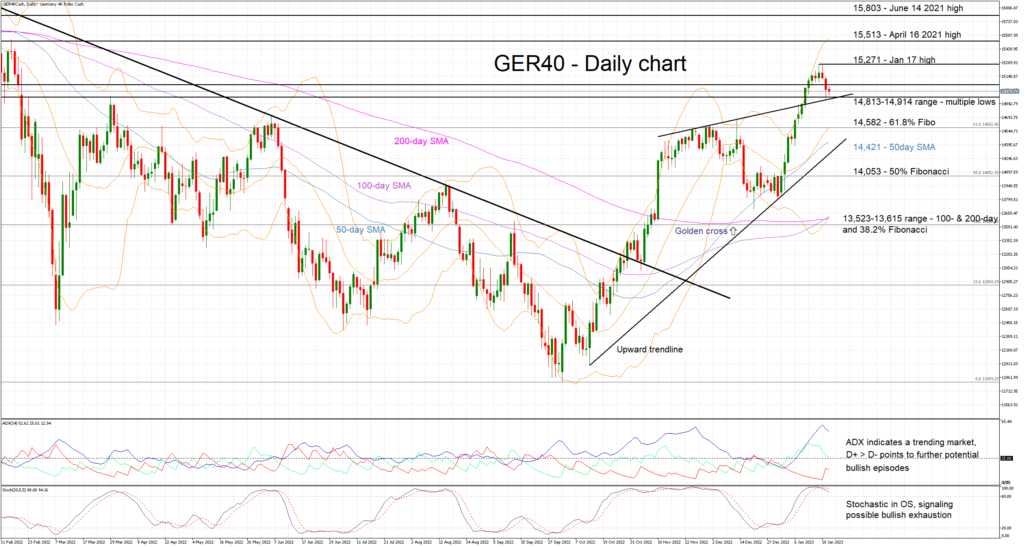
In synchronization with other stock indices, DAX 40 has enjoyed a very strong start in the new year, trading to the highest level since February. It is actually recording the strong start since January 2015 when it closed 9.1% higher on a monthly basis. Having said that, the overall technical picture is less bullish than the recent price move implies. The momentum indicators are revealing signs of exhaustion after the 1,500 points jump from the December 20 low. A close below the 14,813-14,914 range could potentially tip the balance in favour of the bears.
Week Ahead – BoC May Hike One Final Time; Will Flash PMIs Spread Gloom or Optimism?
As 2023 gets underway, so do the central bank meetings and the Bank of Canada will be the next after the BoJ to announce its first policy decision of the year. Meanwhile, investors will be nervously awaiting the first PMI readings of 2023 next week as they juggle to reach a consensus about the recessionary risks. In the United States, there will additionally be the advance GDP estimates for the final quarter of 2022, as well as PCE inflation data. The latest CPI numbers will be at the forefront too in Australia and New Zealand.
BoC to ponder one last rate hike
After having spent much of the last year front loading rate hikes, many central banks are now nearing the end of their tightening cycle and this theme is likely to dominate at least the first half of 2023. The Bank of Canada could take the lead in pausing rate hikes when it meets on Wednesday, but in all probability, it will raise its overnight rate by 25 basis points to 4.50% in one final tightening round.
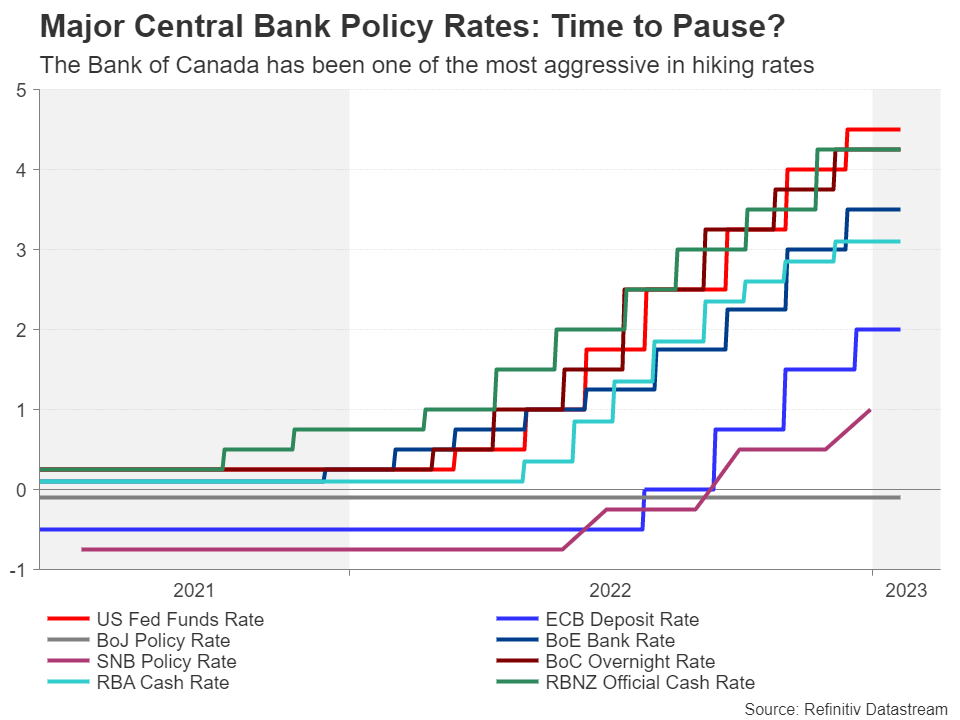
Inflation in Canada peaked back in June but then stubbornly hovered slightly below 7%. There was better news from the December data as the retreat in CPI gathered pace, sliding to 6.3% y/y. However, underlying measures of inflation haven’t budged much in the last few months. What’s more, employment surged in December, making a pause appear somewhat questionable.
Markets have assigned about a 60% probability of a 25-bps rate rise, with the remaining bets placed on no change. This gives the Canadian dollar some scope for gains should the BoC lift rates in line with expectations. However, if the Bank maintains the same language as last time that it “will be considering whether the policy interest rate needs to rise further”, the loonie is more likely to slip after the decision.
US data could be a mixed bag for the dollar
Just south of the border, the Fed is far from done with rate hikes and investors are getting more and more jittery about an impending recession. Inflation in America is well and truly on the way down, but so is pretty much everything else as cracks are appearing across the economy. The hot labour market is fast becoming the sole bright spot. But with payrolls being a lagging indicator, markets are increasingly out of lockstep with the Fed as they are not convinced it will be able to stick to its rate hike path where the terminal rate is somewhere above 5%.
The US dollar has been a big casualty of this divergence and next week’s releases could potentially stir even more confusion. Data on durable goods orders and the initial estimate of Q4 GDP are expected to be upbeat, with the former seen rising by 2.5% m/m in December and the latter by an annualized 2.8% q/q. Both are due on Thursday.
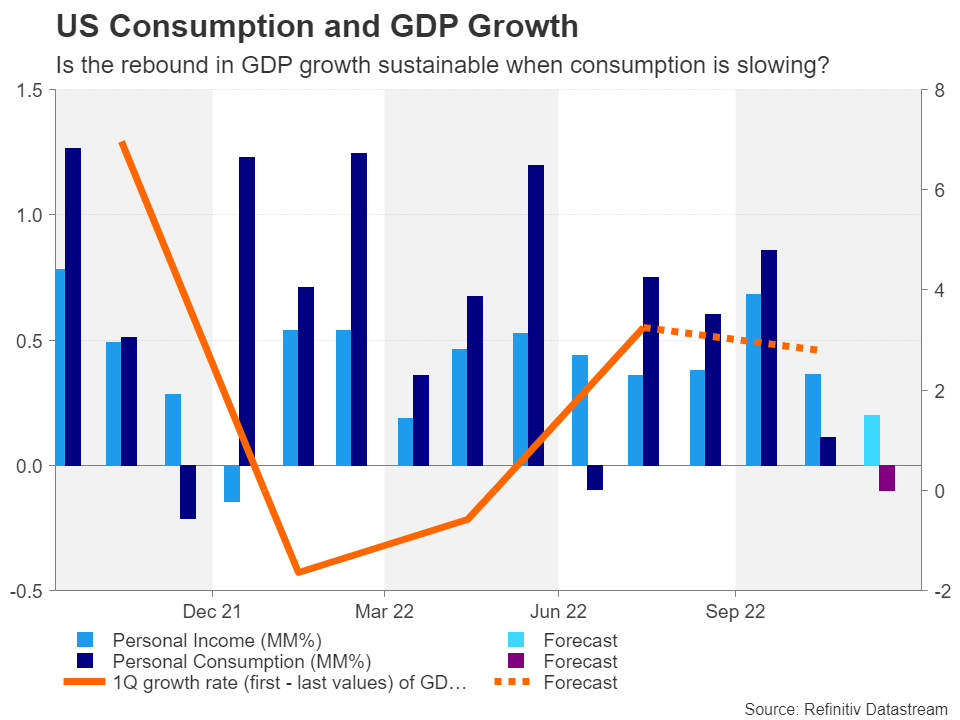
However, the flash S&P Global PMI readings out on Tuesday could point to another contraction in business activity in the early parts of January, while Friday’s personal income and spending numbers for December could be soft again. More importantly, the core PCE price index – the Fed’s preferred inflation gauge – could make further progress towards the 2% target.
There could be support for the dollar if the US indicators overall aren’t as dire as some of the more recent ones, such as the ISM non-manufacturing PMI and retail sales. But for Wall Street, traders might shrug off the data and focus on the Q4 earnings season as tech favourites Microsoft and Tesla will be among the many reporting their latest financial results.
Not as bad as feared for the euro area
In Europe, the flash PMIs will be taking a more prominent role when released on Tuesday. Although the PMI numbers since the summer have been mostly knocking the euro down, lately, the picture from the surveys has been improving and this could be repeated in January. The manufacturing PMI is forecast to edge up from 47.8 to 48.5, while the services sector is expected to return to growth, with the PMI increasing to 50.2 from 49.8.
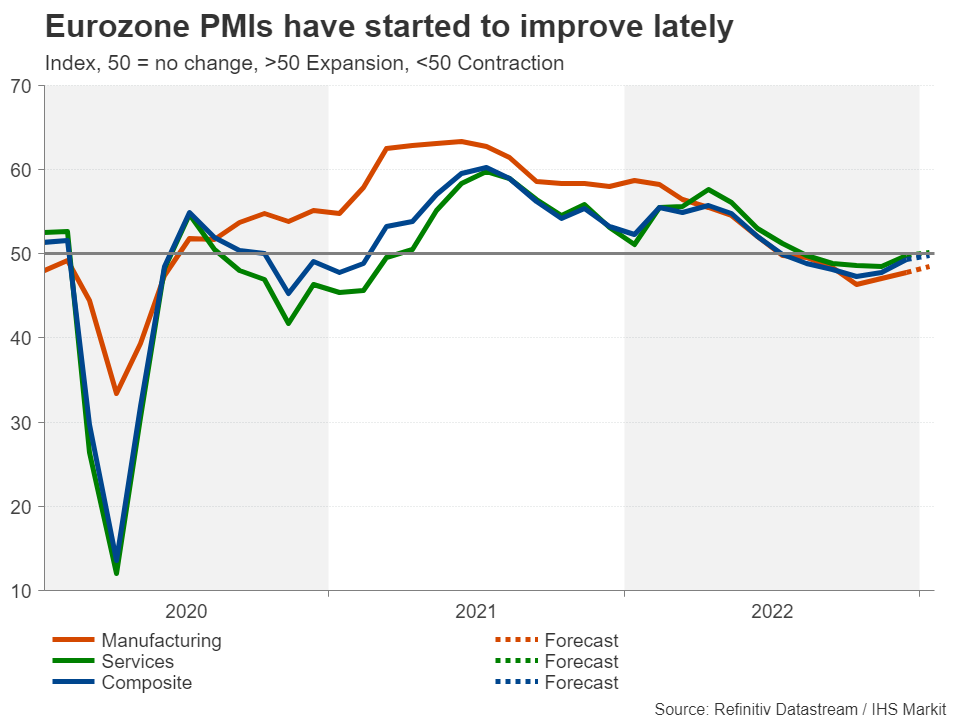
The current shift in the economic backdrops on either side of the Atlantic whereby there are growing signs that any recession in Europe will be a mild one but that the much-hoped soft landing in the US might not be possible after all has been a game changer for the euro.
The single currency is trying to establish a foothold above the $1.08 level and its prospects for 2023 look promising as the European Central Bank has reiterated its pledge for several more 50-bps rate hikes in the coming meetings.
If the PMIs provide further evidence that the worst is over for the continent from last year’s energy crisis, the euro’s uptrend could have further to go.
Sterling eyes new highs with UK PMIs
It could be said that the United Kingdom is in a very similar boat as the Eurozone but not quite. The odds of the British economy dodging a recession are somewhat lower and even if some of the gloom around the UK and sterling has been overdone, Brexit and the political chaos have seriously dented the outlook for the country.
Still, with the dollar on the backfoot, further positive surprises in UK data could help the pound surpass its December peak of $1.2445.
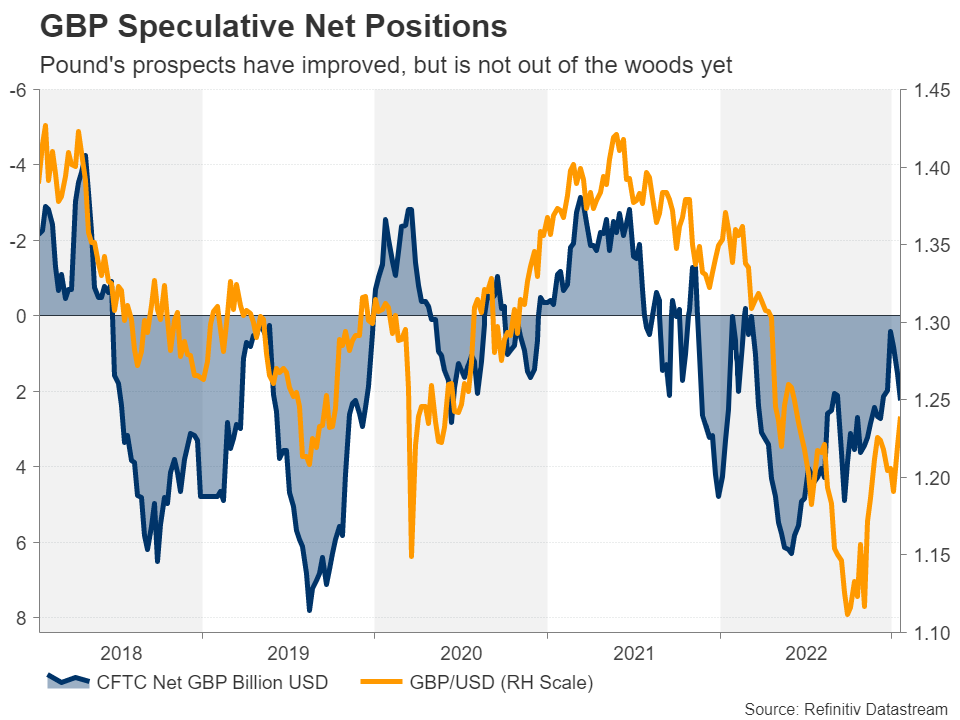
The flash January PMIs are due on Tuesday and investors will be looking out for an uptick in both the services and manufacturing prints. On Thursday, the producer price index for December might also attract some attention.
Aussie and kiwi on inflation watch
The coming week will be relatively quieter in Asia as Chinese markets will be closed for the Lunar New Year celebrations. But for the antipodean currencies, there should be plenty of excitement from the incoming CPI data.
Both Australia and New Zealand will publish quarterly readings on the consumer price index on Wednesday. The Reserve Bank of Australia’s fight against inflation suffered a setback recently after the annual CPI rate crept back up to 7.3% in November. If there is a further deterioration in December and for the fourth quarter as a whole, investors are likely to increase their bets of a 25-bps rate rise at the February meeting from the current odds showing it’s a coin toss between a hike and keeping rates unchanged.
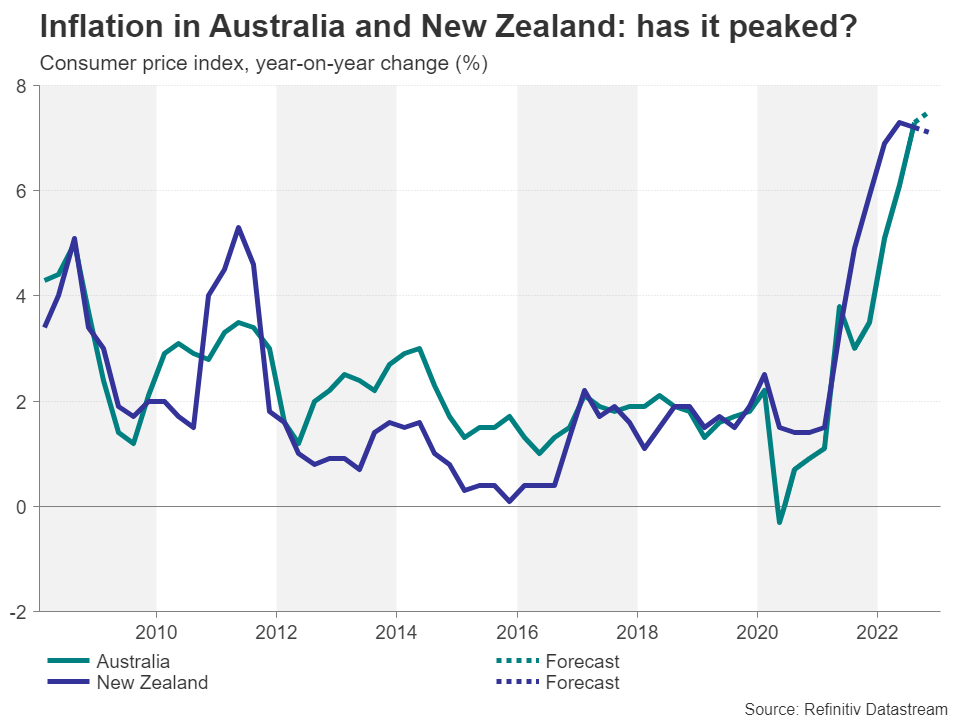
The aussie will also be keeping an eye on the flash PMIs and business confidence figures on Tuesday.
As for the kiwi, it’s likely to benefit more substantially from stronger-than-expected CPI prints as investors have priced in about a 25% chance of a bigger 75-bps rate increase by the Reserve Bank of New Zealand at its February gathering. The RBNZ’s cash rate is seen peaking well above 5% and at the current level of 4.25%, the bank could be hiking long after its peers have paused, so any upside surprises are likely to boost the local dollar.