

Sample Category Title
Weekly Focus – Risk Sentiment on the Back Foot
Weak US economic data brought a setback to the soft landing narrative and start-of-the-year risk rally. US retail sales fell by more than expected (-1.1% m/m) in December, while industrial production declined 0.7% m/m, supporting the view that the US economy is losing further momentum. Risk sentiment soured and yield curves flattened from the long end, despite comments from Fed officials that stressed more rate hikes are needed.
In contrast, the euro optimism got another boost after German ZEW expectations showed a larger than expected rebound in January, turning positive for the first time since Russia's invasion of Ukraine. The German economy has been holding up better than feared and leading indicators suggest that the European recession could actually be milder and shorter than we have previously anticipated. That said, until the energy crisis is truly resolved, Germany is unlikely to return as the euro area's economic powerhouse anytime soon.
An 'ECB sources' news story further added to the European fixed income rally, reporting that policymakers are starting to consider a slower pace of rate hikes than President Lagarde indicated in December. While the 50bp hike she signalled for February remains likely, the prospect of a smaller 25bp increase at the following meeting in March is gaining support according to officials. Implied ECB peak rate pricing edged down to 3.3%, but we stick to our call of 50bp hikes in both February and March and only expect ECB to slow the hiking pace to 25bp in May amid still high core inflation pressures.
Bank of Japan kept monetary policy unchanged at its meeting this week. The market had speculated another hike of the cap over 10Y yields could come and was left disappointed, which triggered a rally in USD/JPY above 131. We stick to our view that a policy rate hike to 0% and another hike in the yield curve control target awaits in Q2 23.
The Chinese economy performed better than expected in Q4 22 (0.0% q/q versus our and consensus expectations of a decline of -1.0% q/q), leaving annual growth for 2022 at 2.9%. Data also suggests that Q1 23 could be stronger than expected, as Covid cases have already peaked in the big cities and we now look for an even more frontloaded recovery starting already in early Q1 (see China growth update - More frontloaded recovery, 18 January). That said, longer term the Chinese economy faces some of the same challenges as most western economies, with the population declining in 2022 for the first time in 60 years.
UK inflation eased 0.2pp to 10.5% in December, but with core inflation remaining unchanged at 6.3% and wage growth edging even higher (+0.2pp to 6.4% in November), pressure is rising for Bank of England to deliver another 25bp rate hike not only in February, but also in March.
The macro highlight next week will be the January PMI figures on Tuesday. It will be interesting to see whether the rebound in euro area leading indicators extends into Q1 23. In the US, we expect PMIs still to paint a weak overall picture, as it seems the economy clearly lost steam in December and we look 2.8% q/q AR in the Q4 22 GDP figures released on Thursday.
Is The Crypto Market Ready to Recover?
Recently, on the 16th of January, 2023, Thailand Securities Exchange Commission issued fresh rules in its continued efforts to protect investors' assets and build confidence in the crypto space. It comes right after Bitcoin surged above $20k. However, is this enough to kickstart a full recovery for crypto coins?
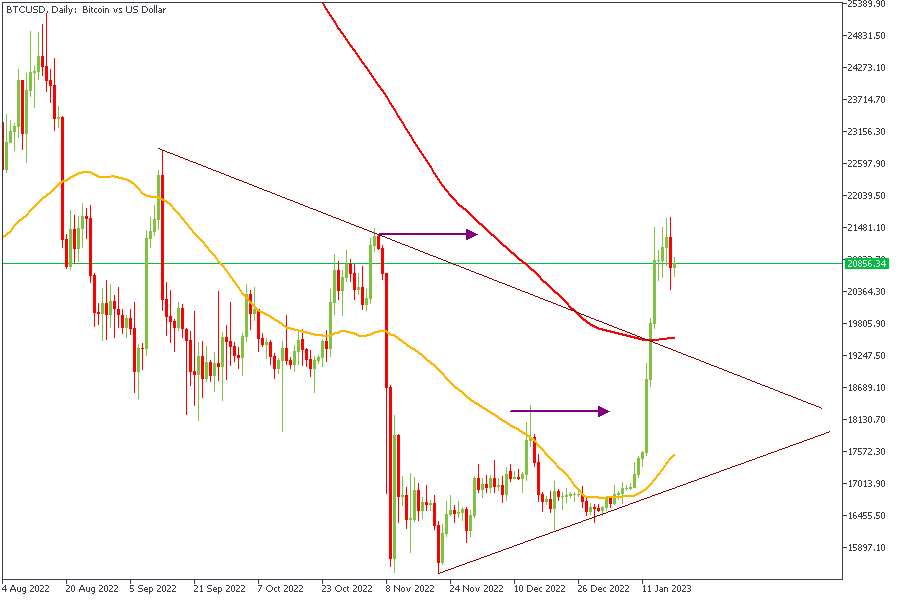
BTCUSD, Daily timeframe
We see a breakout of the wedge and the 200-Moving Average. The breakout also came with a double break of structure, as seen from the two horizontal arrows. Will the rally continue? I expect a slight retracement toward the 50-Moving Average before the possible recovery of the bullish momentum.
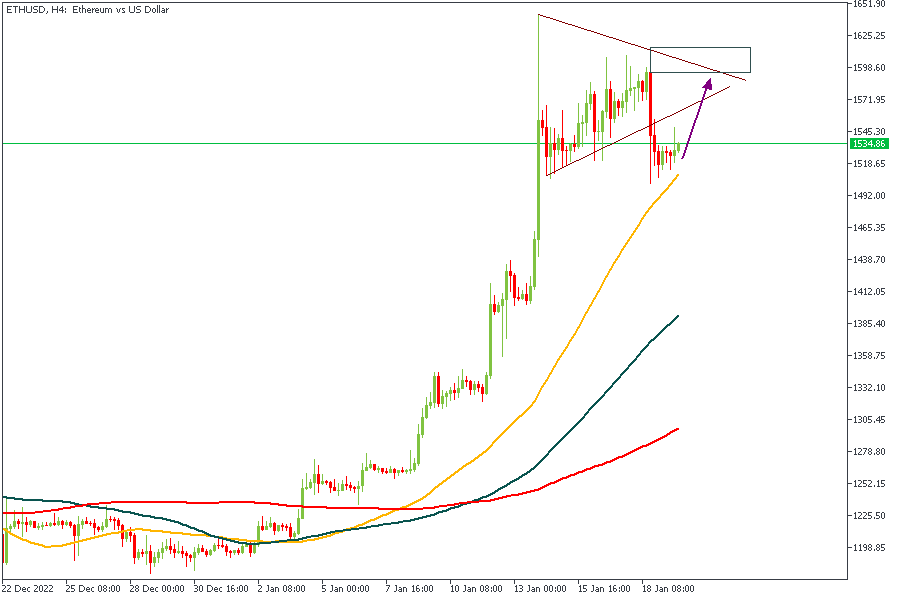
ETHUSD, H4 timeframe
Ethereum, on the other hand, has recently had a bearish break out of a wedge while still trading above the bullish Moving Average array. However, the constraint with this is the bearish break of structure from the breakout. In my opinion, the bearish movement will continue until a reliable demand zone is found. It should happen close to the 100-Period Moving Average.
Conclusion
The trading of CFDs comes at a risk. Thus, to succeed, you have to manage risks properly. To avoid costly mistakes while you look to trade these opportunities, be sure to do your due diligence and manage your risk appropriately. You can access more of such trade ideas and prompt market updates on the telegram channel.
What Lies Ahead for Gold?
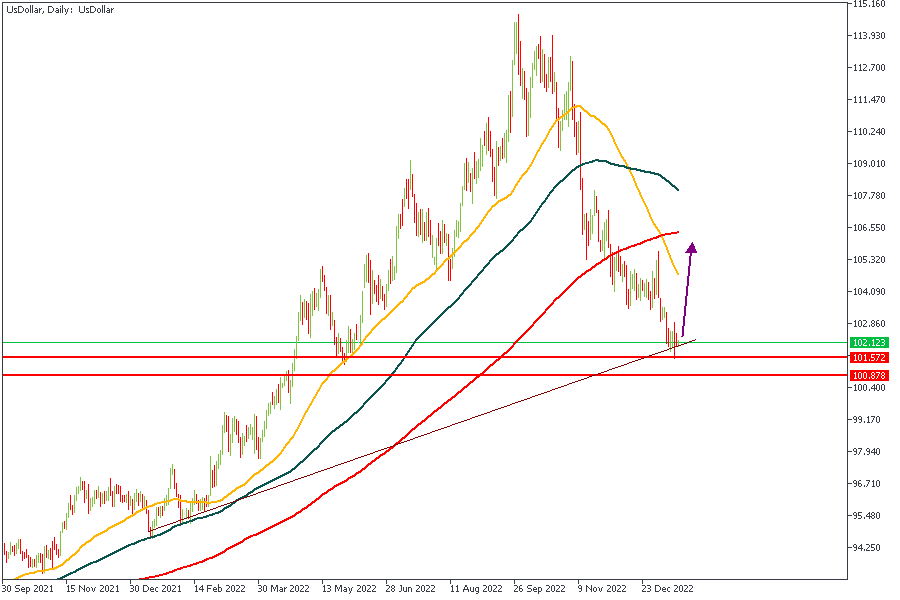
The US Dollar is currently trading around a pivot zone on the Daily timeframe, which supports the price. Considering the confluence of the pivot zone, demand zone, and trendline support, we can expect a bullish reaction from the current area. A bullish Dollar often implies a bearish outcome on XAUUSD.
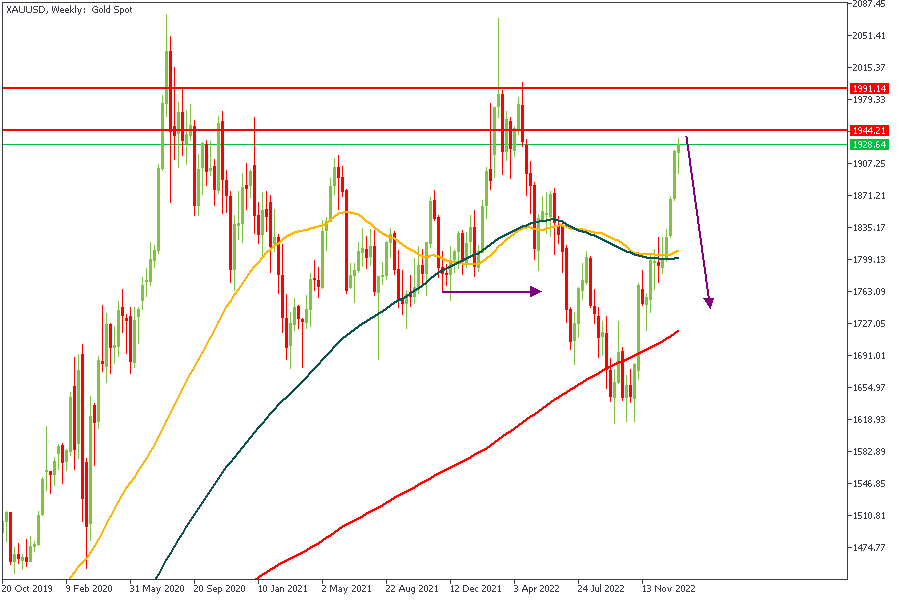
GOLD Weekly Timeframe
On the weekly timeframe, XAUUSD is currently trading within the vicinity of a supply zone. We can also notice that there's been a recent break of structure downwards, as well as a supply zone. These confluences lend credence to our initial bearish outlook. However, we have to prove it by looking at the Daily timeframe.
GOLD Daily Timeframe
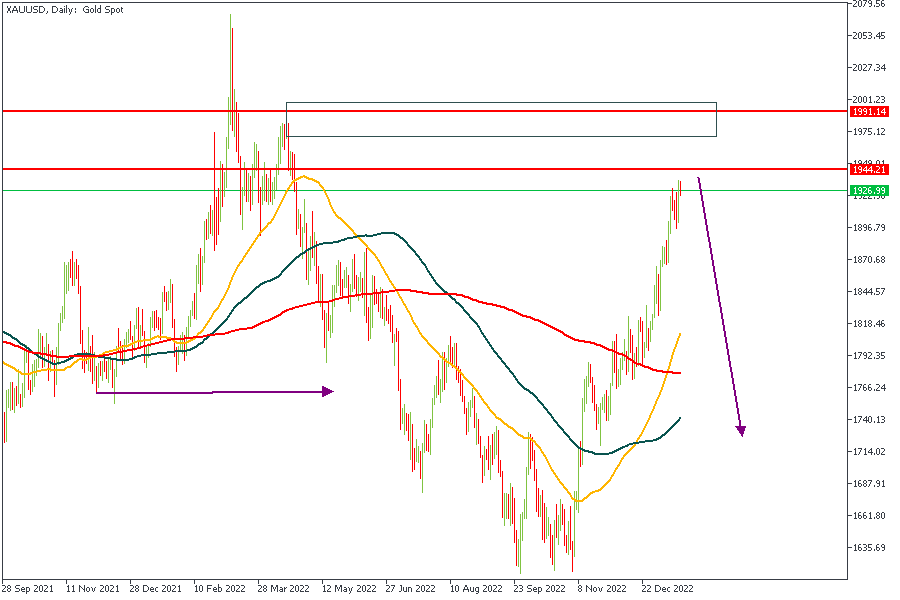
From the Daily timeframe perspective, everything aligns perfectly too. Thus, I suggest traders await the price reaction to the supply zone. With a solid rejection at that zone, the price will reverse toward the 50-Moving Average around 1844.
CONCLUSION
The trading of CFDs comes at a risk. Thus, to succeed, you have to manage risks properly. To avoid costly mistakes while you look to trade these opportunities, be sure to do your due diligence and manage your risk appropriately. You can access more of such trade ideas and prompt market updates on the telegram channel.
GBP/USD: Is a New Bearish Trend Starting?
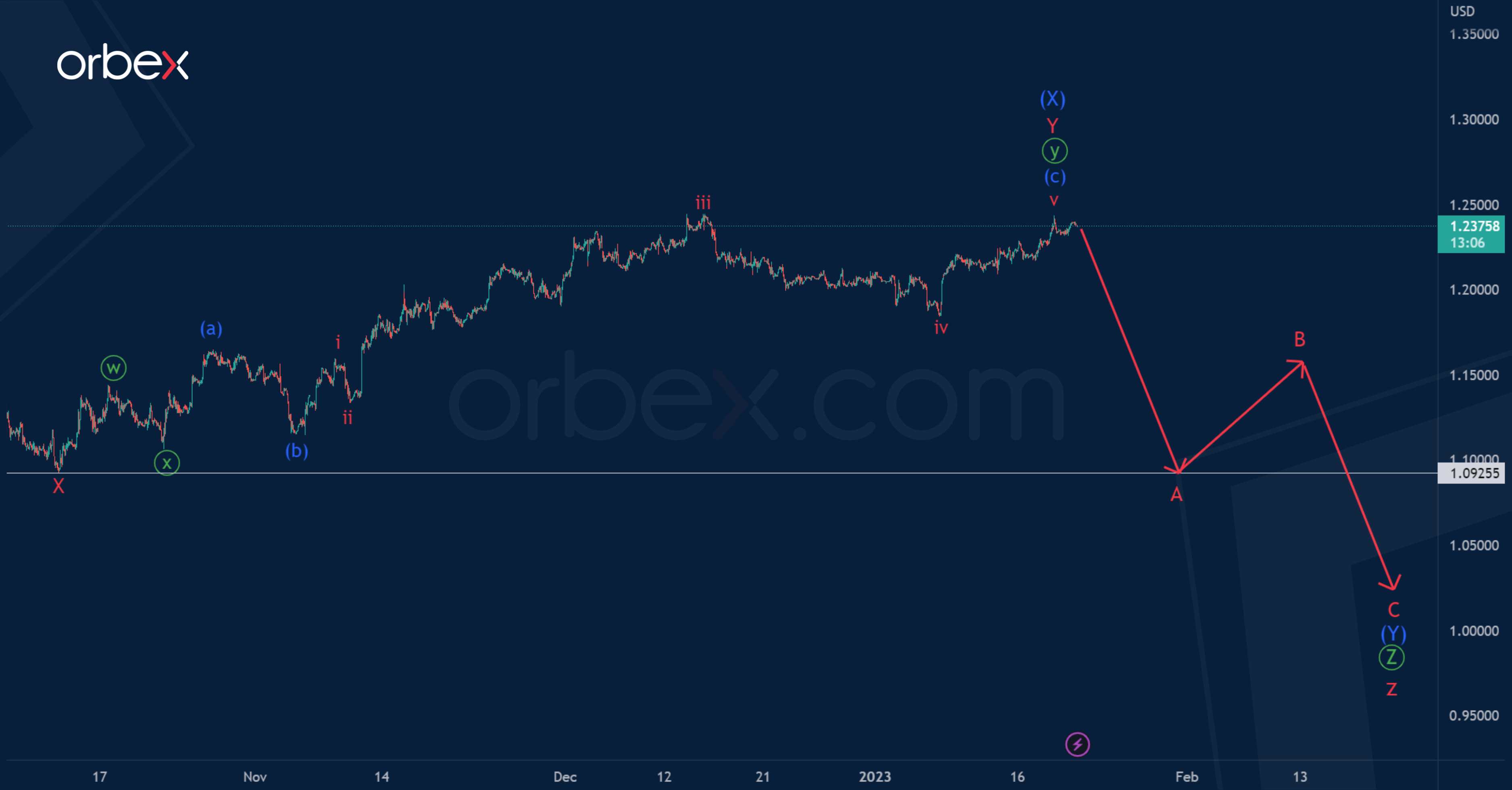
GBPUSD may lead to the formation of a global corrective trend – a triple zigzag w-x-y-x-z, in which the market builds the final actionary wave z of the cycle degree.
The wave z most likely takes the form of a primary triple zigzag, in which we see the development of the primary wave. It may take the double zigzag pattern (W)-(X)-(Y).
The formation of the intervening wave (X) has recently ended. There is a high probability that the last sub-wave (Y) will take the form of a zigzag A-B-C.
The end of the first impulse wave A is expected at a minimum of 1.095.
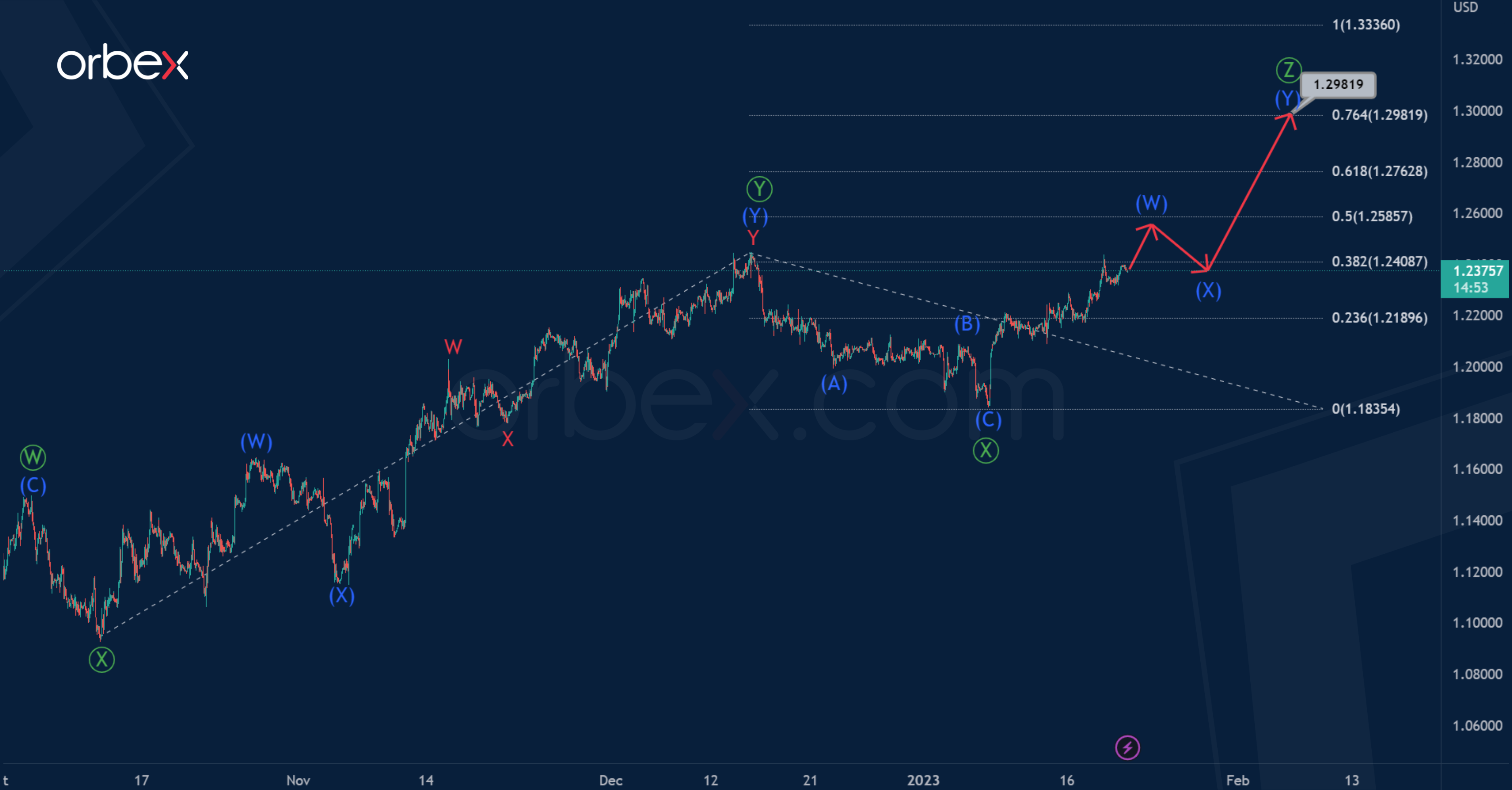
Alternatively, it is assumed that the cycle wave z could have been fully completed. Thus, we see that since the end of September, bulls have started to move the price up in a new trend.
Perhaps we are seeing the development of a primary triple zigzag, where the first four parts are already formed.
In the last section of the chart, the final actionary wave is formed. Most likely, it will be at 76.4% of wave and will end near 1.298.
Canada: Retail Sales Edged Lower in November but Poised to Increase in December
Retail sales edged lower by 0.1% month-on-month (m/m) in November, a better outturn than Statistics Canada's advance estimate for a 0.5% drop. Adjusting for the impact of inflation, the volume of sales was down 0.4% on the month.
Statistics Canada's advance estimate for December indicates a 0.5% m/m gain. Our internal card spending data also points to higher spending in December.
November was a good month for gas stations and car dealerships. Receipts at gasoline stations increased by 2.2% m/m, entirely on account of more driving and higher sales volumes (+3.7% m/m) since gas prices actually fell by 3.6% in that month. Sales of motor vehicle and parts rose by 1.4%, led by higher sales at new car dealerships (+1.2%).
Core sales, which exclude autos and gasoline, were much weaker than the headline, falling by 1.1% in November.
- Lower sales at food and beverage stores (-1.6%) as well as at building materials and garden equipment stores (-3.8%) led the decline. Performance was also soft at another housing-related category – furniture and home furnishings (-0.2%). Sales declined at sporting goods, hobby and book stores (-1.5%), general merchandise stores (-0.8%) and miscellaneous retailers (-2.0%).
- Electronics and appliance stores (+0.9%), personal and health stores (+0.5%) and clothing & accessories stores (+0.3%) were the only categories bucking the weak trend in November.
- E-commerce sales were down 2.7% m/m, marking the third consecutive monthly drop, and were 3.5% lower than a year ago.
Key Implications
Outside of spending more on gas and new cars, consumers took a breather from shopping in November, perhaps waiting for discounts and building up some financial cushion ahead of a spending-heavy December. Indeed, Statistics Canada flash estimate suggests that retail sales have rebounded in December. This is in line with our internal debit and credit card aggregate spending data, which also points to an increase in consumer spending in December. A sizeable drop in gasoline prices last month could have given consumers a much-needed break, leaving more cash to spend on gifts.
Even as consumers appear to have kept on spending through December, they will likely need to tighten their belts this year. As we note in our latest forecast, we expect that as 2023 unfolds, consumer spending will likely edged lower in the second half of the year amid escalating debt servicing costs, which will take a bite out of discretionary spending.
EUR/USD Mid-Day Outlook
Daily Pivots: (S1) 1.0796; (P) 1.0818; (R1) 1.0853; More...
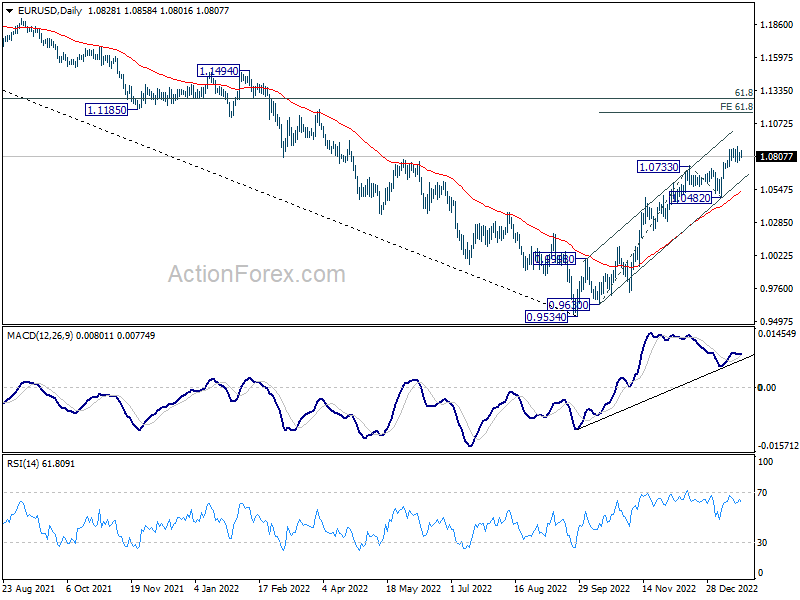
Intraday bias in EUR/USD remains neutral, as consolidation continues below 1.0886. Overall outlook will remain bullish as long as 1.0482 support holds. Break of 1.0886 will resume rally from 0.9534 to 61.8% projection of 0.9630 to 1.0733 from 1.0482 at 1.1164 next.
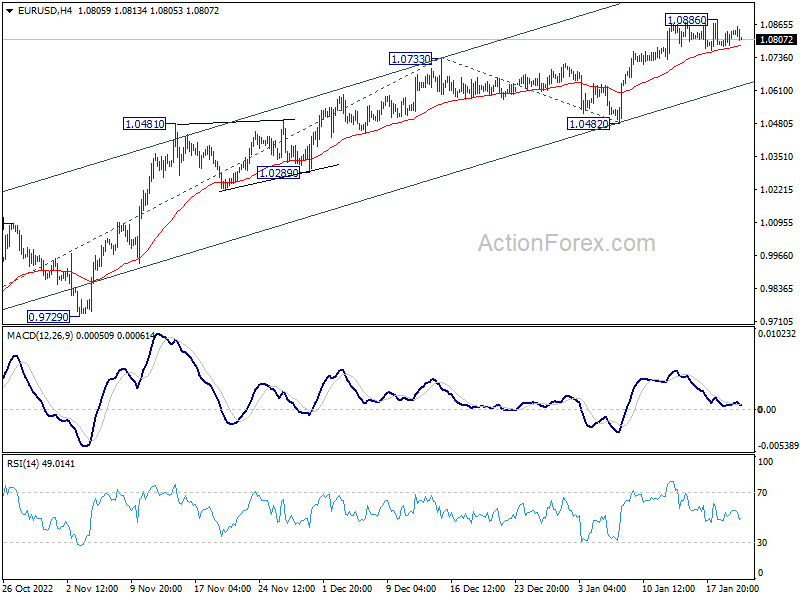
In the bigger picture, current development suggests that the rally from 0.9534 low (2022 low) is a medium term up trend rather than a correction. Further rally is in favor to 61.8% retracement of 1.2348 (2021 high) to 0.9534 at 1.1273 next. This will remain the favored case as long as 1.0482 support holds.
GBP/USD Mid-Day Outlook
Daily Pivots: (S1) 1.2337; (P) 1.2368; (R1) 1.2422; More...
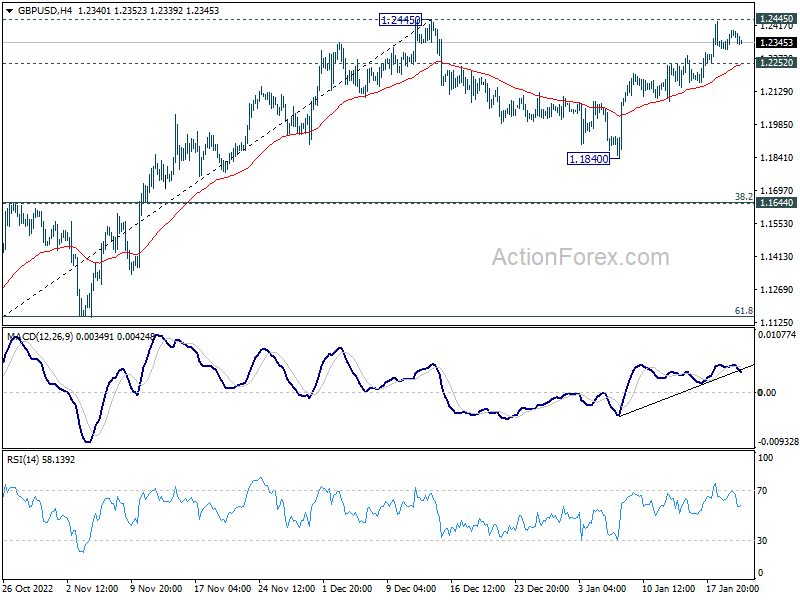
Intraday bias in GBP/USD stays neutral at this point. On the upside, decisive break of 1.2445 will confirm resumption of whole rise from 1.0351. Next target will be 1.2759 fibonacci level. On the downside, break of 1.2252 minor support will turn bias to the downside, and extend the corrective pattern from 1.2445 with another falling leg.
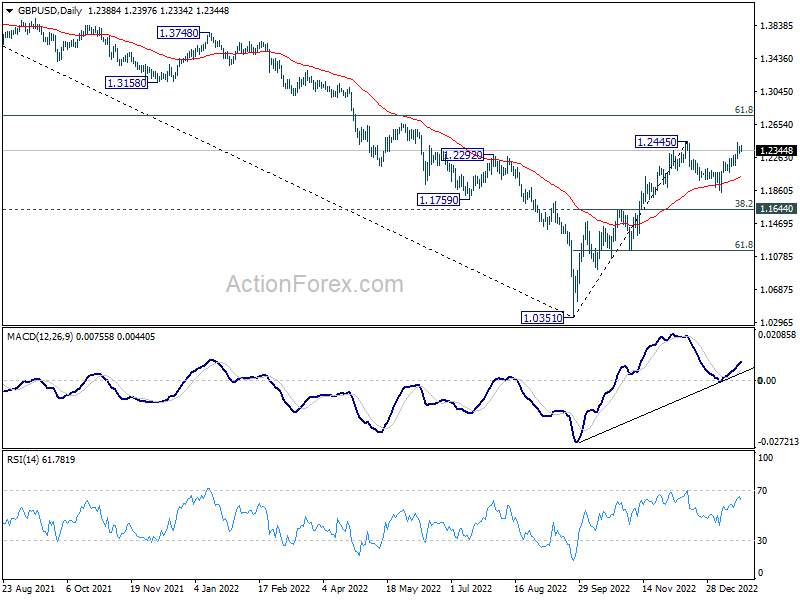
In the bigger picture, rise from 1.0351 medium term bottom is at least correcting whole down trend from 1.4248 (2021 high). Further rise is expected as long as 1.1644 resistance turned support holds. Next target is 61.8% retracement of 1.4248 to 1.0351 at 1.2759. Sustained break there will pave the way back to 1.4248.
USD/CHF Mid-Day Outlook
Daily Pivots: (S1) 0.9142; (P) 0.9166; (R1) 0.9184; More...
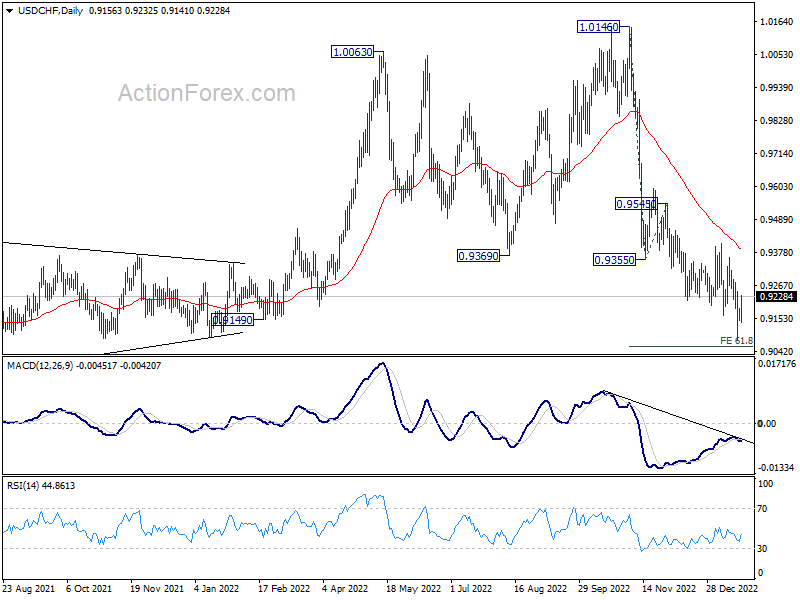
Intraday bias in USD/CHF remains neutral at this point. Outlook remains bearish as long as 0.9407 resistance holds. Sustained break of 61.8% projection of 1.0146 to 0.9355 from 0.9545 at 0.9056 will pave the way to 100% projection at 0.8754, which is close to 0.8756 long term support. Nevertheless, on the upside, break of 0.9407 should confirm short term bottoming and turn bias back to the upside.
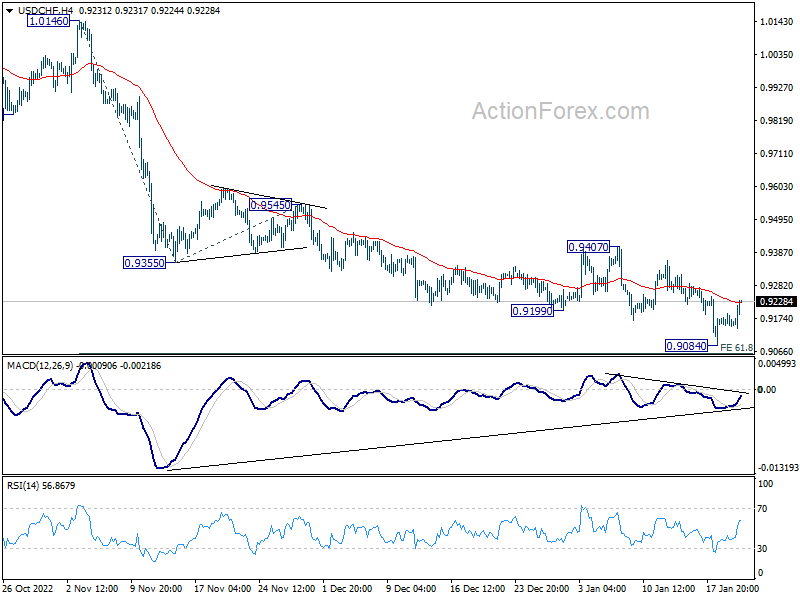
In the bigger picture, rise from 0.8756 (2021 low) has completed at 1.0146, well ahead of 1.0342 long term resistance (2016 high). Based on current downside momentum, fall from 1.0146 should be a medium term down trend itself. Next target is a test on 0.8756 low. Strong support should be seen there to bring rebound. Still, further decline will now be expected as long as 0.9407 resistance holds, in any case.
USD/JPY Mid-Day Outlook
Daily Pivots: (S1) 127.13; (P) 129.35; (R1) 131.14; More...
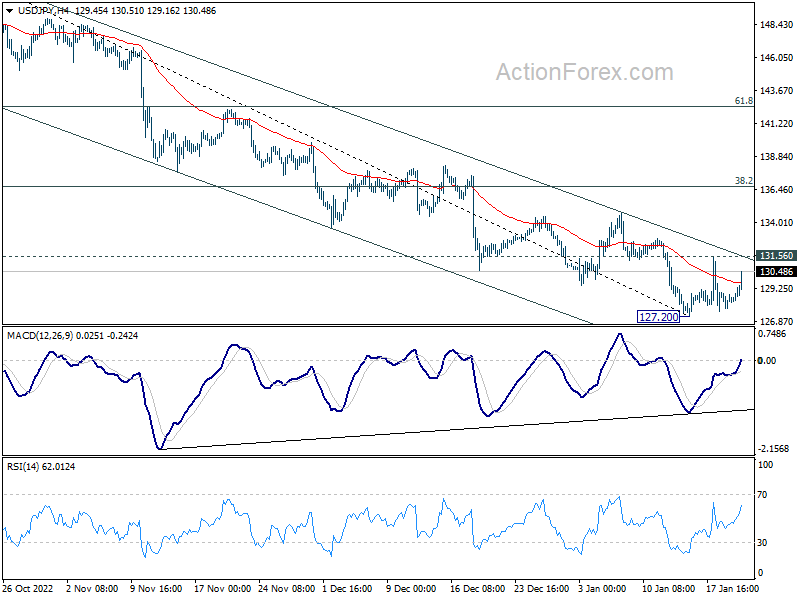
USD/JPY is still bounded in established range despite today's strong recovery. Intraday bias remains neutral first. On the upside, break of 131.56 minor resistance should confirm short term bottoming at 127.20. Intraday bias will be back on the up for stronger rebound to 38.2% retracement of 151.93 to 127.20 at 136.64. On the downside, though, firm break of 127.20 will resume larger fall from 151.93 to 121.43 fibonacci level next.
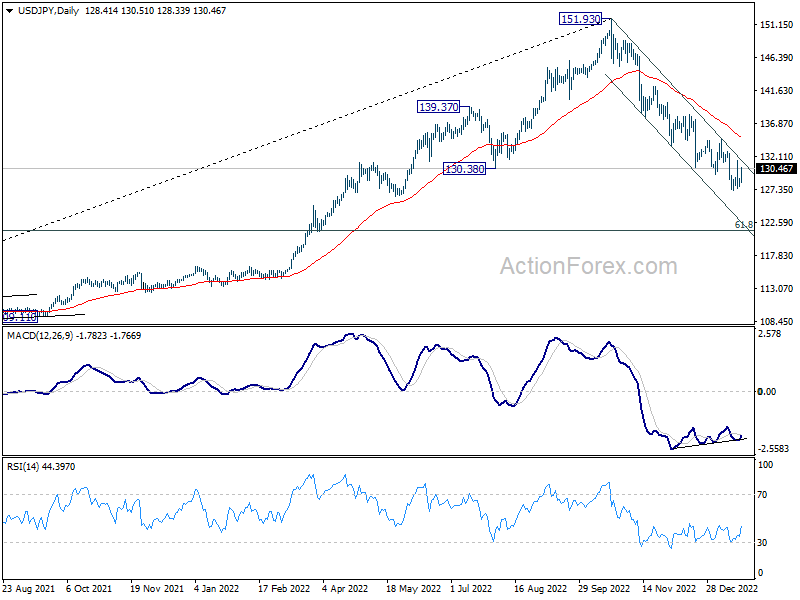
In the bigger picture, the firm break of 55 week EMA (now at 131.59) raises the chance of medium term bearish reversal, but that's not confirmed yet. Strong support could be seen around 61.8% retracement of 102.58 to 151.93 at 121.43 and 38.2% retracement of 75.56 to 151.93 at 122.75 to bring rebound. But break of 134.76 resistance is needed to indicate bottoming first. Otherwise further fall will remain in favor.
Yen Decline Continues after Dovish BoJ Kuroda
Yen's weakness continues into US session after BoJ Governor Haruhiko Kuroda repeated his dovish stance. Swiss Franc is also trading notably lower, reversing some of this week's gains. Aussie, Kiwi are extending recovery but there is no clear upside momentum. For the week, Sterling is still the strongest, followed by Swiss Franc while Yen is the worst, followed by Aussie.
In Europe, at the time of writing, FTSE is up 0.17%. DAX is up 0.41%. CAC i up 0.56%. Germany 10-year yield is up 0.0735 at 2.138. Earlier in Asia, Nikkei rose 0.56%. Hong Kong HSI rose 1.82%. China Shanghai SSE rose 0.76%. Singapore Strait Times rose 0.54%. Japan 10-year JGB yield rose 0.0008 to 0.404.
Canada retail sales down -0.1% mom in Nov
Canada retail sales decreased -0.1% mom to CAD 61.8B in November, better than expectation of -0.5% mom. Core retail sales, excluding gasoline stations and motor vehicle and parts dealers, decreased -1.1% mom, largest decline in 11 months.
Sales declines in 6 of 11 subsectors, representing 47.4% of retail trade. The decrease was led by lower sales at food and beverage stores (-1.6%) and building material and garden equipment and supplies dealers (-3.8%).
Advance estimate indicates that sales rose 0.5% mom in December.
ECB Lagarde: Stay the course is my mantra for monetary-policy purposes
ECB President Christine Lagarde said, "We have to also stay that course of resilience that we observed in 2022. Stay the course' is my mantra for monetary-policy purposes."
"I hope that in 2023 fiscal policy will not work in a counter-cyclical way to monetary policy," she said. "We don't need to be pushed to do more than is necessary."
Lagarde also noted that China's reopening "will have inflationary pressure on many of us, simply because the level of energy that was consumed by China last year was certainly less than what they will consume this year, the amount of LNG that [they] will be buying from the rest of the world will be higher than what we have seen and there is not so much spare capacity in terms of oil and gas."
"So there will be constraints, there will be more inflationary pressure coming out of that added demand," she added.
SNB Jordan: Focus on price stability absolutely essential
SNB Chairman Thomas Jordan said,"inflation is far too high. It is negative not only for the functioning of the economy, it is very negative especially for lower income classes."
"The population doesn't like inflation, so ... the focus on price stability for central banks is absolutely essential."
Businesses "don't hesitate any more to increase their prices," the said. "That is different to two or three years ago, and that is also a signal it is not that easy to bring inflation back to 2%."
"Once inflation is high, the pressure coming from wages is here and it is proof it will not be that easy everywhere to bring inflation down quickly," he said.
UK retail sales volume down -1.0% mom in Dec, value down -1.2% mom
UK retail sales volume declined -1.0% mom in December, much worse than expectation of 0.4% mom. Ex-fuel sales dropped -1.1% mom, below expectation of 0.4% mom. Sales value decreased -1.2% mom while ex-fuel sales value declined -1.0% mom.
Between 2021 and 2022, retail sales volume fell by -3.0%, "as the lifting of restrictions on hospitality led to a return to eating out, and rising prices and the cost of living affected sales volumes."
BoJ Kuroda defends extremely accommodative monetary policy
BoJ Governor Haruhiko Kuroda defended this week decision to maintain by the -0.1% interest rate and the 0.5% 10-year JGB yield cap.
"We expect, probably from February this year, inflation rates start to decline and fiscal year 2023 as a whole, inflation rate will be less than 2%. So, we decided to maintain the current extremely accommodative monetary policy for the time being," he said.
"Our hope is that wages start to rise and that could make 2% inflation target to be met in a stable and sustainable manner, but we have to wait for some time," he added.
Asked whether he had any regrets during reign, he said, "All in all, the government's policy, coupled with the BoJ's extremely accommodative policy, have been successful in changing Japan's economic structure and growth prospects".
"But our 2% inflation target has not been achieved in a sustainable, stable manner," he said. "That is the only regret I have".
Japan CPI core rose to 4% yoy in Dec, highest since 1981
Japan CPI core (all items ex-fresh food) accelerated from 3.7% yoy to 4.0% yoy in December, matched expectations. That's also the highest level in four decades since 1981. CPI core-core (all items ex-food and energy) also accelerated from 2.8% yoy to 3.0% yoy, hitting the highest level since 1991. Headline inflation rose from 3.8% yoy to 4.0% yoy.
Food prices jumped 7.4% while energy prices rose 15.2%. "The impact on CPI from higher energy prices was large in 2022 but contributions from food prices are now bigger," a government official said.
NZ BusinessNZ manufacturing unchanged at 47.2, further slippage expected in Q1
New Zealand BusinessNZ Performance of Manufacturing Index was unchanged at 47.2 in December. Looking at some details, production ticked up from 49.5 to 49.7. Employment rose from 46.9 to 48.8. New orders rose from 42.2 to 46.1. Finished stocks dropped from 55.5 to 50.1. Deliveries dropped from 49.6 to 48.4.
BNZ Senior Economist, Doug Steel stated that the latest PMI result "broadly fits with the clear decline we already expect for manufacturing GDP in Q4 with further slippage expected in Q1".
USD/JPY Mid-Day Outlook
Daily Pivots: (S1) 127.13; (P) 129.35; (R1) 131.14; More...
USD/JPY is still bounded in established range despite today's strong recovery. Intraday bias remains neutral first. On the upside, break of 131.56 minor resistance should confirm short term bottoming at 127.20. Intraday bias will be back on the up for stronger rebound to 38.2% retracement of 151.93 to 127.20 at 136.64. On the downside, though, firm break of 127.20 will resume larger fall from 151.93 to 121.43 fibonacci level next.
In the bigger picture, the firm break of 55 week EMA (now at 131.59) raises the chance of medium term bearish reversal, but that's not confirmed yet. Strong support could be seen around 61.8% retracement of 102.58 to 151.93 at 121.43 and 38.2% retracement of 75.56 to 151.93 at 122.75 to bring rebound. But break of 134.76 resistance is needed to indicate bottoming first. Otherwise further fall will remain in favor.
Economic Indicators Update
| GMT | Ccy | Events | Actual | Forecast | Previous | Revised |
|---|---|---|---|---|---|---|
| 21:30 | NZD | Business NZ PMI Dec | 47.2 | 47.4 | 47.2 | |
| 23:30 | JPY | National CPI Y/Y Dec | 4.00% | 4.40% | 3.80% | |
| 23:30 | JPY | National CPI Core Y/Y Dec | 4.00% | 4.00% | 3.70% | |
| 23:30 | JPY | National CPI Core-Core Y/Y Dec | 3.00% | 2.90% | 2.80% | |
| 00:01 | GBP | GfK Consumer Confidence Jan | -45 | -41 | -42 | |
| 07:00 | GBP | Retail Sales M/M Dec | -1% | 0.40% | -0.40% | -0.50% |
| 07:00 | GBP | Retail Sales Y/Y Dec | -5.80% | -4.20% | -5.90% | -5.70% |
| 07:00 | GBP | Retail Sales ex-Fuel M/M Dec | -1.10% | 0.40% | -0.30% | |
| 07:00 | GBP | Retail Sales ex-Fuel Y/Y Dec | -6.10% | -4.40% | -5.90% | -5.60% |
| 07:00 | EUR | Germany PPI M/M Dec | -0.40% | -1.20% | -3.90% | |
| 07:00 | EUR | Germany PPI Y/Y Dec | 21.60% | 20.80% | 28.20% | |
| 13:30 | CAD | Retail Sales M/M Nov | -0.10% | -0.50% | 1.40% | 1.30% |
| 13:30 | CAD | Retail Sales ex Autos M/M Nov | -0.60% | -0.90% | 1.70% | 1.60% |
| 15:00 | USD | Existing Home Sales M/M Dec | 3.95M | 4.09M |