

Sample Category Title
GBP/USD: Headwinds May Delay Continuation of Larger Uptrend
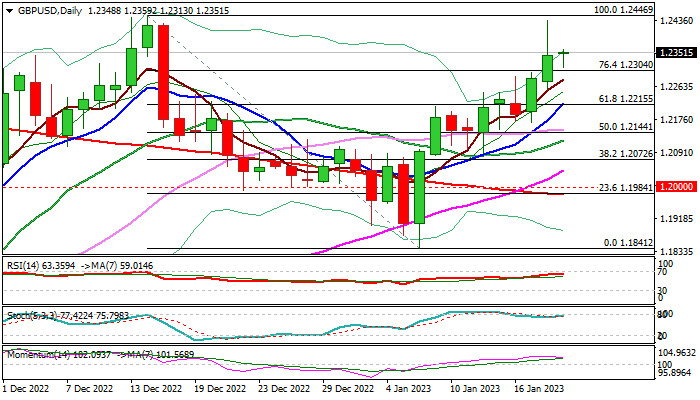
Cable keeps firm tone on Thursday, but holding within about 70-pips range, with little impact from today’s better than expected US data.
Sterling was inflated on Wednesday by UK inflation data which showed persisting inflationary pressures and weak US retail sales, hitting the one-month high on probe above 1.2400 barrier and almost fully retracing 1.2446/1.1841 pullback.
Structure on daily remains bullish and underpins the action for continuation of larger uptrend from Sep 26 low (1.0348), which was paused rally for correction in past few months, though bulls may struggle to break higher, due to headwinds from key barriers at 1.2446/55 (former top of Dec14/base of falling weekly cloud.
Prolonged consolidation could be likely near-term scenario, with bullish bias to remain intact while the price holds above rising daily Tenkan-sen (1.2259).
Res: 1.2446; 1.2455; 1.2500; 1.2589.
Sup: 1.2313; 1.2255; 1.2215; 1.2151.
Fed Collins: More measured rate adjustments better in the current phase
Boston Fed President Susan Collins said, "I anticipate the need for further rate increases, likely to just above 5%, and then holding rates at that level for some time."
But she also added, "more measured rate adjustments in the current phase will better enable us to address the competing risks monetary policy now faces – the risk that our actions may be insufficient to restore price stability, versus the risk that our actions may cause unnecessary losses in real activity and employment."
USD/JPY Mid-Day Outlook
Daily Pivots: (S1) 127.13; (P) 129.35; (R1) 131.14; More...
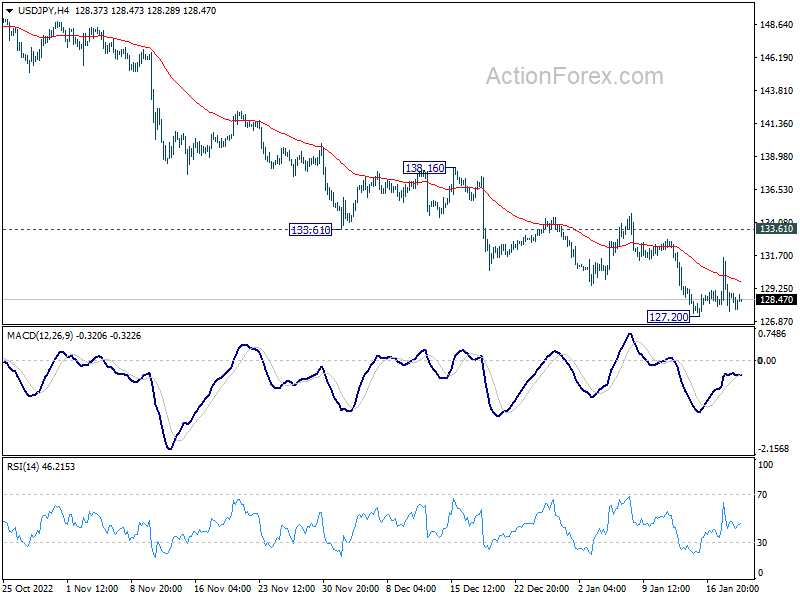
Intraday bias in USD/JPY remains neutral at this point. Outlook remains bearish with 133.61 support turned resistance intact. Break of 127.20 will resume larger fall from 151.93 to 121.43 fibonacci level next. On the upside, though, firm break of 133.61 will indicate short term bottoming and bring stronger rebound.
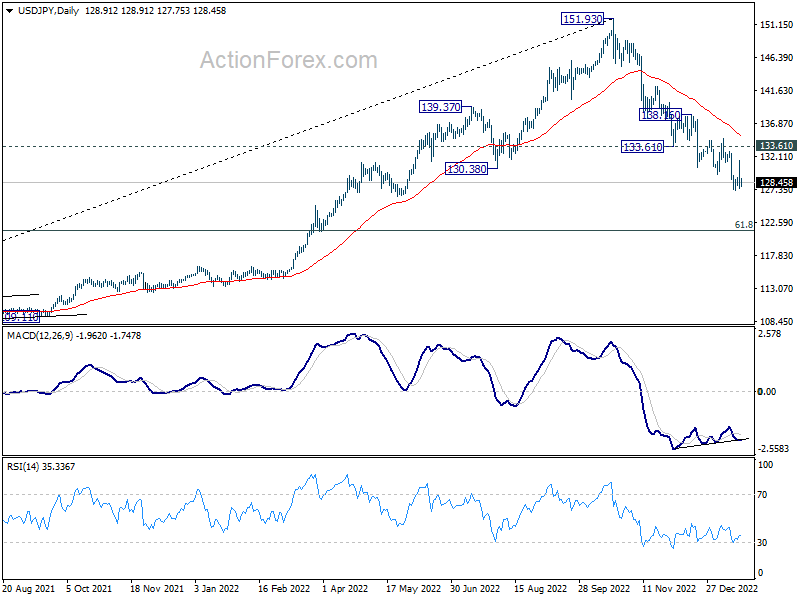
In the bigger picture, the firm break of 55 week EMA (now at 131.59) raises the chance of medium term bearish reversal, but that's not confirmed yet. Strong support could be seen around 61.8% retracement of 102.58 to 151.93 at 121.43 and 38.2% retracement of 38.2% retracement of 75.56 to 151.93 at 122.75 to bring rebound. But break of 134.76 resistance is needed to indicate bottoming first. Otherwise further fall will remain in favor.
USD/CHF Mid-Day Outlook
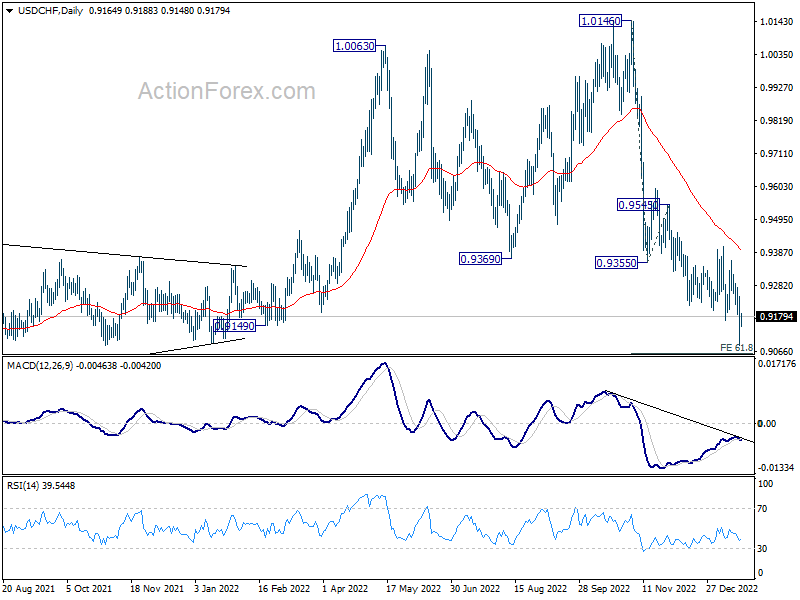
Daily Pivots: (S1) 0.9086; (P) 0.9166; (R1) 0.9246; More...
Intraday bias in USD/CHF stays on the downside for 61.8% projection of 1.0146 to 0.9355 from 0.9545 at 0.9056. Sustained break there will pave the way to 100% projection at 0.8754, which is close to 0.8756 long term support. On the upside, above 0.9199 minor resistance will turn intraday bias neutral first, before staging another decline.
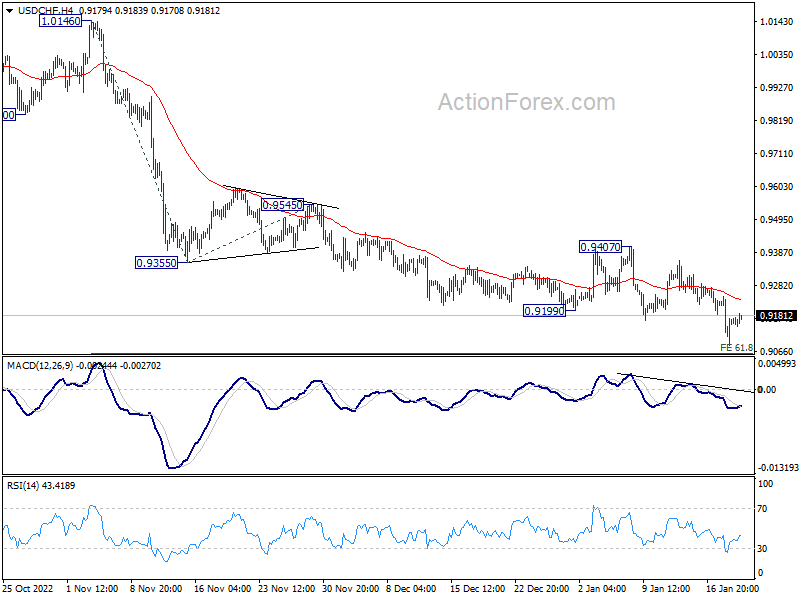
In the bigger picture, rise from 0.8756 (2021 low) has completed at 1.0146, well ahead of 1.0342 long term resistance (2016 high). Based on current downside momentum, fall from 1.0146 should be a medium term down trend itself. Next target is a test on 0.8756 low. Strong support should be seen there to bring rebound. Still, further decline will now be expected as long as 0.9407 resistance holds, in any case.
GBP/USD Mid-Day Outlook
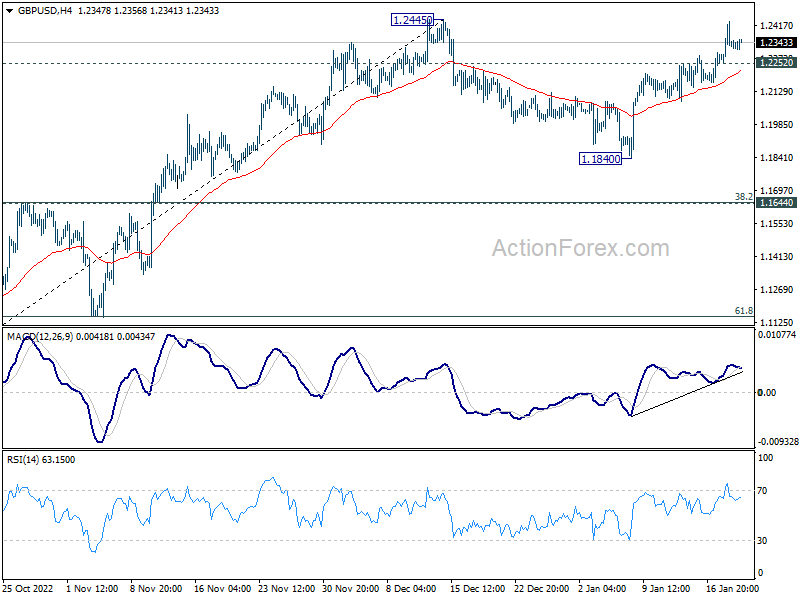
Daily Pivots: (S1) 1.2255; (P) 1.2345; (R1) 1.2436; More...
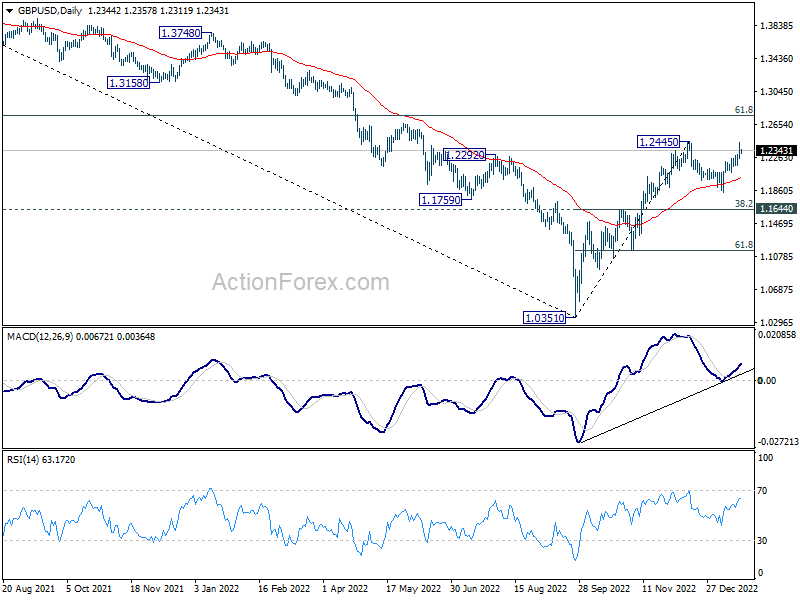
Intraday bias in GBP/USD remains on the upside for the moment. Decisive break of 1.2445 resistance will confirm resumption of whole rise from 1.0351. Next target will be 1.2759 fibonacci level. On the downside, break of 1.2252 minor support will turn bias to the downside, the extend the corrective pattern from 1.2445 with another falling leg.
In the bigger picture, rise from 1.0351 medium term bottom is at least correcting whole down trend from 1.4248 (2021 high). Further rise is expected as long as 1.1644 resistance turned support holds. Next target is 61.8% retracement of 1.4248 to 1.0351 at 1.2759. Sustained break there will pave the way back to 1.4248.
EUR/USD Mid-Day Outlook
Daily Pivots: (S1) 1.0745; (P) 1.0816; (R1) 1.0866; More...
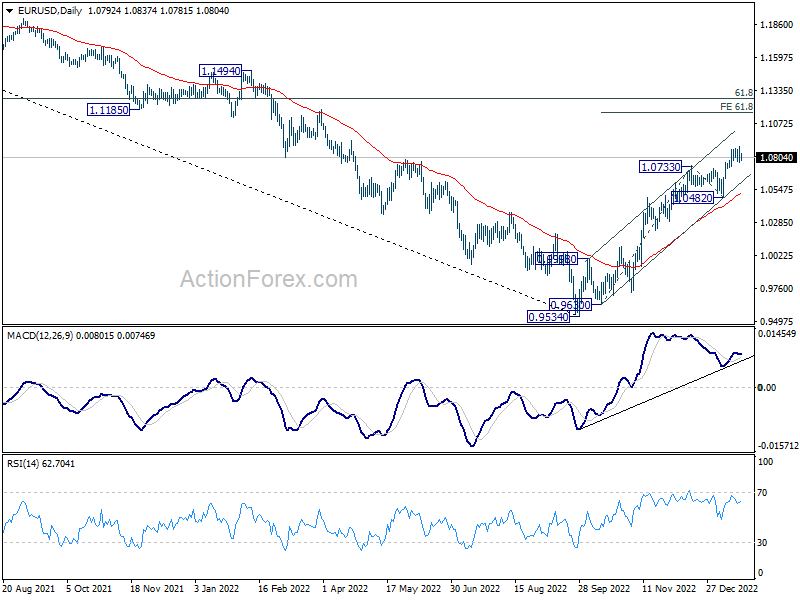
EUR/USD is still bounded in consolidation from below 1.0886 and intraday bias stays neutral. Overall outlook will remain bullish as long as 1.0482 support holds. Break of 1.0886 will resume rally from 0.9534 to 61.8% projection of 0.9630 to 1.0733 from 1.0482 at 1.1164 next.
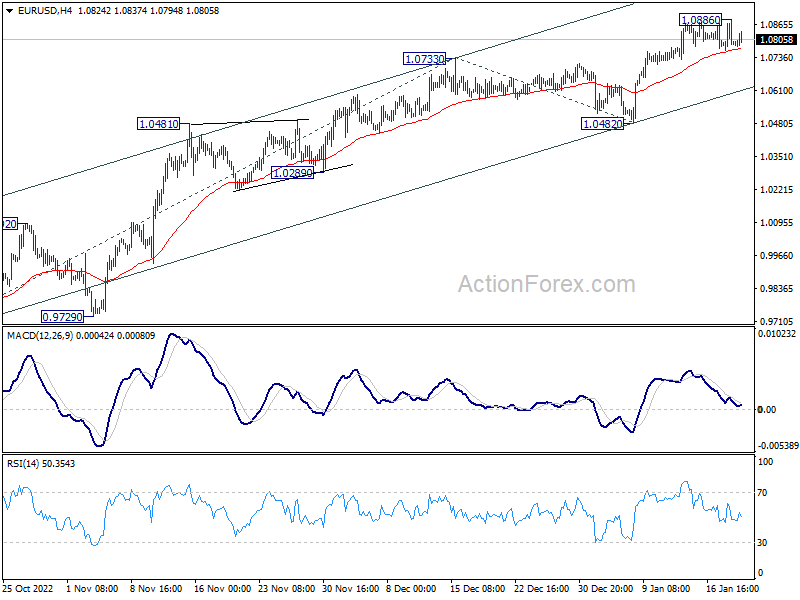
In the bigger picture, current development suggests that the rally from 0.9534 low (2022 low) is a medium term up trend rather than a correction. Further rally is in favor to 61.8% retracement of 1.2348 (2021 high) to 0.9534 at 1.1273 next. This will remain the favored case as long as 1.0482 support holds.
Euro Supported by Hawkish ECB, Commodity Currencies Down
Euro is lifted slightly by hawkish comments from ECB officials, as well as the meeting accounts. But overall, it's risk-on sentiment that matters more for now, supporting Yen and Dollar too. Commodity currencies are so far the worst performers, with Aussie also weighed down by poor job data. Sterling and Swiss Franc are currently mixed.
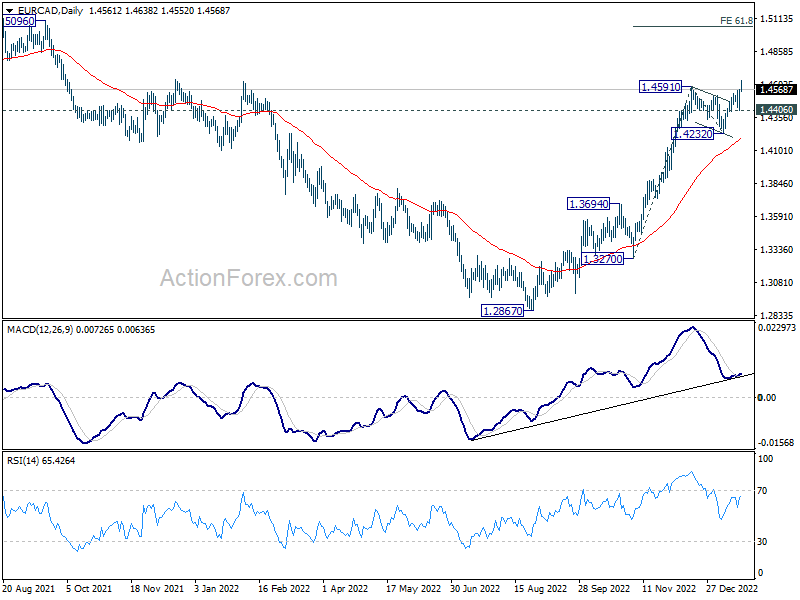
Technically, EUR/CAD finally breaks through 1.4591 resistance to resume larger up trend from 1.2867. Further rally is now expected as long as 1.4406 support holds. Next target is 61.8% projection of 1.3270 to 1.4591 from 1.4232 at 1.5048. Let's see if USD/CAD could also pick up momentum towards 1.3704 resistance.
In Europe, at the time of writing, FTSE is down -1.20%. DAX is down -1.69%. CAC is down -1.81%. Germany 10-year yield is up 0.063 at 2.088. Earlier in Asia, Nikkei dropped -1.44%. Hong Kong HSI dropped -0.12%. China Shanghai SSE rose 0.49%. Singapore Strait Times dropped -0.41%. Japan 10-year JGB yield dropped -0.0184 to 0.404.
US initial jobless claims dropped to 190k
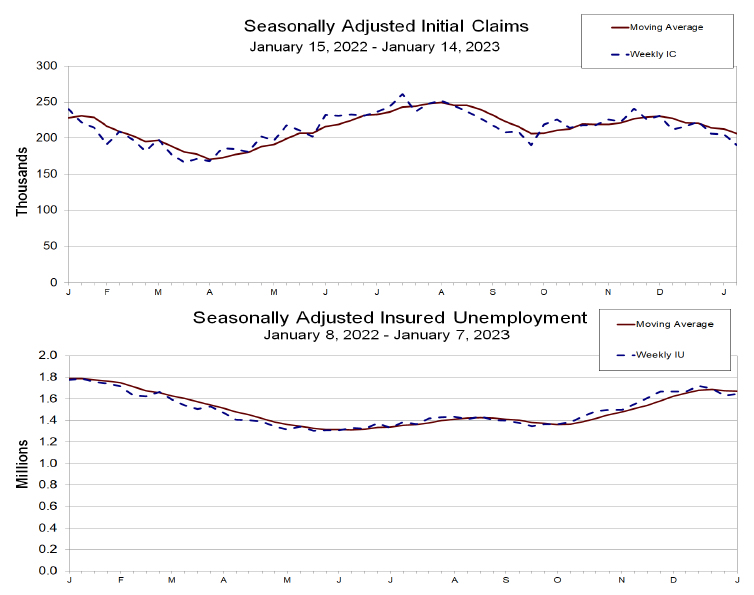
US initial jobless claims dropped -15k to 190k in the week ending January 14, better than expectation of 212k. Four-week moving average of initial claims decreased 6.5k to 206k.
Continuing claims rose 17k to 1647k in the week ending January 7. Four-week moving average of continuing claims declined 5.5k to 1673k.
Also from the US, Philly Fed survey improved from -13.7 to -8.9 in January.
BoE Bailey: We don't target a particular peak interest rate
BoE Governor Andrew Bailey said two months of decline in headline inflation is "the beginning of a sign that a corner has been turned." He said: "What we think is the most likely outcome is that it will fall quite rapidly this year, probably starting in the late spring and that has a lot to do with energy pricing.
On the outlook for the base rate, he said: "We don't target a particular peak". Market curve was out of line back in November, because of UK risk premium in there following the events of September and October
"If you go back to the height of that period, the peak of what the market thought we were going to get to was over 6%, but the time we did our forecast in November it was 5.2%, it is now down to 4.5%. Now I am not endorsing 4.5%, but what you may have noticed in December is that we did not include the comment that we made in November about the market being in our view rather out of line," he said.
ECB accounts: Less frontloaded but steadier approach consistent with persistent inflation process
In the accounts of ECB's December meeting, it's noted that a "large number" of members "initially" expressed preference for a 75bps hike. But some of them expressed their willingness to agree on a 50bps if the majority were to support Chief Economist Philip Lane's proposal.
That is, to rate interest rates by 50bps and to communicate that interest rates would "still have to rise significantly at a steady pace to reach levels that were sufficiently restrictive". Meanwhile, 50bps hikes was "judged to constitute an appropriate pace".
Also, "a less frontloaded but steadier approach to bringing interest rates to restrictive levels could be seen as consistent with the more persistent nature of the inflation process and continued elevated uncertainty...
Nevertheless, some member still held the view that "the proposed adjustment of the monetary policy stance was insufficient – even taking into account the combination of a 50 basis point interest rate hike with the announcement of a reduction in APP reinvestments."
ECB Lagarde: Inflation is way too high, we should stay the course
ECB President Christine Lagarde said in Davos today, "Inflation by all accounts, whichever way you look at it, is way too high."
"There is determination at the ECB to bring (inflation) back in a timely manner and we should stay the course until we have been in restrictive territory for long enough to bring it down," Lagarde added.
"The job market in Europe has never been as vibrant as it is now. The unemployment number is at rock bottom compared with what we've had in the last 20 years. And the participation rate which matters as well, is also very, very high level and that is pretty much homogeneous throughout the euro area," she said.
"The news has been much more positive over the past few weeks," she said. "It will not be a brilliant year (in 2023), but a lot better than feared".
ECB Knot: Don't assume that it's a one-shot 50; it's more than that
ECB Governing Council member Klaas Knot told CNBC today, "Our president has already announced that most of the ground that we have to cover we will cover at a constant pace of multiple 50 basis-point hikes"
"So we will continue that at a steady pace. Based on the information that we have available today, that predicates another 50-basis-point rate hike at our next meeting, and possibly at the one after that, and possibly thereafter, but everything will also be determined by the review of data. So don't assume that it's a one-shot 50; it's more than that," he added.
Referring to recent market speculations that ECB will slow down rate hikes in March, Knot said, "The sort of market developments that I've seen over the last two weeks or so, are not entirely welcome... I don't think that they are compatible, actually, with a timely return of inflation towards 2%."
"Core inflation shows no signs of abating," Knot said. "I would first need to see different dynamics in core inflation before I could start thinking about a more equal balance of risk."
Japan exports up 11.5% yoy in Dec, imports up 20.6% yoy
In December, Japan exports rose 11.5% yoy to JPY 8787B, marking the slowest growth rate in 2022. Exports to China fell -6.2% yoy in value and down -24% yoy in volume. Imports rose 20.6% yoy to JPY 10236B, led by oil, coal and liquefied natural gas.
Trade deficit came to JPY -1.45T, extending the run of deficits to 17 months. For the whole of 2022, trade balance came in at JPY -19.97T deficit, the second straight annual shortfall, and the largest since 1979.
In seasonally adjusted term, exports dropped -3.5% mom to JPY 8352B. Imports dropped -3.4% mom to JPY 10076B. Trade deficit narrowed slightly to JPY -1.72T, larger than expectation of JPY -1.63T.
Australia employment down -14.6k in Dec, unemployment rate unchanged at 3.5%
Australia employment declined -14.6k in December, much worse than expectation of 21.2k growth. Full-time jobs rose 17.6k while part-time jobs fell -32.2k. Unemployment rate was unchanged at 3.5%. Participation rate dropped -0.2% to 66.6%. Monthly hours worked dropped -0.5%.
Lauren Ford, head of labour statistics at the ABS, said: "The falls in employment and hours worked in December followed strong growth through 2022, with an annual employment growth rate of 3.4 per cent and hours worked increasing by 3.2 per cent.
"The strong employment growth through 2022, along with high participation and low unemployment, continues to reflect a tight labour market.
"In December, we saw the number of people working reduced hours due to illness increasing by 86,000 to 606,000, which is over 50 per cent higher than we would usually see at this time of the year."
EUR/USD Mid-Day Outlook
Daily Pivots: (S1) 1.0745; (P) 1.0816; (R1) 1.0866; More...
EUR/USD is still bounded in consolidation from below 1.0886 and intraday bias stays neutral. Overall outlook will remain bullish as long as 1.0482 support holds. Break of 1.0886 will resume rally from 0.9534 to 61.8% projection of 0.9630 to 1.0733 from 1.0482 at 1.1164 next.
In the bigger picture, current development suggests that the rally from 0.9534 low (2022 low) is a medium term up trend rather than a correction. Further rally is in favor to 61.8% retracement of 1.2348 (2021 high) to 0.9534 at 1.1273 next. This will remain the favored case as long as 1.0482 support holds.
Economic Indicators Update
| GMT | Ccy | Events | Actual | Forecast | Previous | Revised |
|---|---|---|---|---|---|---|
| 23:50 | JPY | Trade Balance (JPY) Dec | -1.72T | -1.63T | -1.73T | -1.78T |
| 00:01 | GBP | RICS Housing Price Balance Dec | -42% | -30% | -25% | -26% |
| 00:30 | AUD | Employment Change Dec | -14.6K | 21.2K | 64.0K | 58.3K |
| 00:30 | AUD | Unemployment Rate Dec | 3.50% | 3.40% | 3.40% | 3.50% |
| 07:30 | CHF | Producer and Import Prices M/M Dec | -0.70% | -0.40% | -0.50% | |
| 07:30 | CHF | Producer and Import Prices Y/Y Dec | 3.20% | 3.10% | 3.80% | |
| 09:00 | EUR | Eurozone Current Account (EUR) Nov | 13.6B | -11.6B | -0.4B | |
| 12:30 | EUR | ECB Meeting Accounts | ||||
| 13:30 | CAD | Wholesale Sales M/M Nov | 0.50% | 2.00% | 2.10% | 1.90% |
| 13:30 | USD | Initial Jobless Claims (Jan 13) | 190K | 212K | 205K | |
| 13:30 | USD | Building Permits Dec | 1.33M | 1.37M | 1.34M | 1.351M |
| 13:30 | USD | Housing Starts Dec | 1.382M | 1.36M | 1.43M | 1.401M |
| 13:30 | USD | Philadelphia Fed Manufacturing Survey Jan | -8.9 | -11.2 | -13.8 | -13.7 |
| 15:30 | USD | Natural Gas Storage | -76B | 11B | ||
| 16:00 | USD | Crude Oil Inventories | -2.1M | 19.0M |
US initial jobless claims dropped to 190k
US initial jobless claims dropped -15k to 190k in the week ending January 14, better than expectation of 212k. Four-week moving average of initial claims decreased 6.5k to 206k.
Continuing claims rose 17k to 1647k in the week ending January 7. Four-week moving average of continuing claims declined 5.5k to 1673k.
Will Retail Sales Weigh on British Pound?
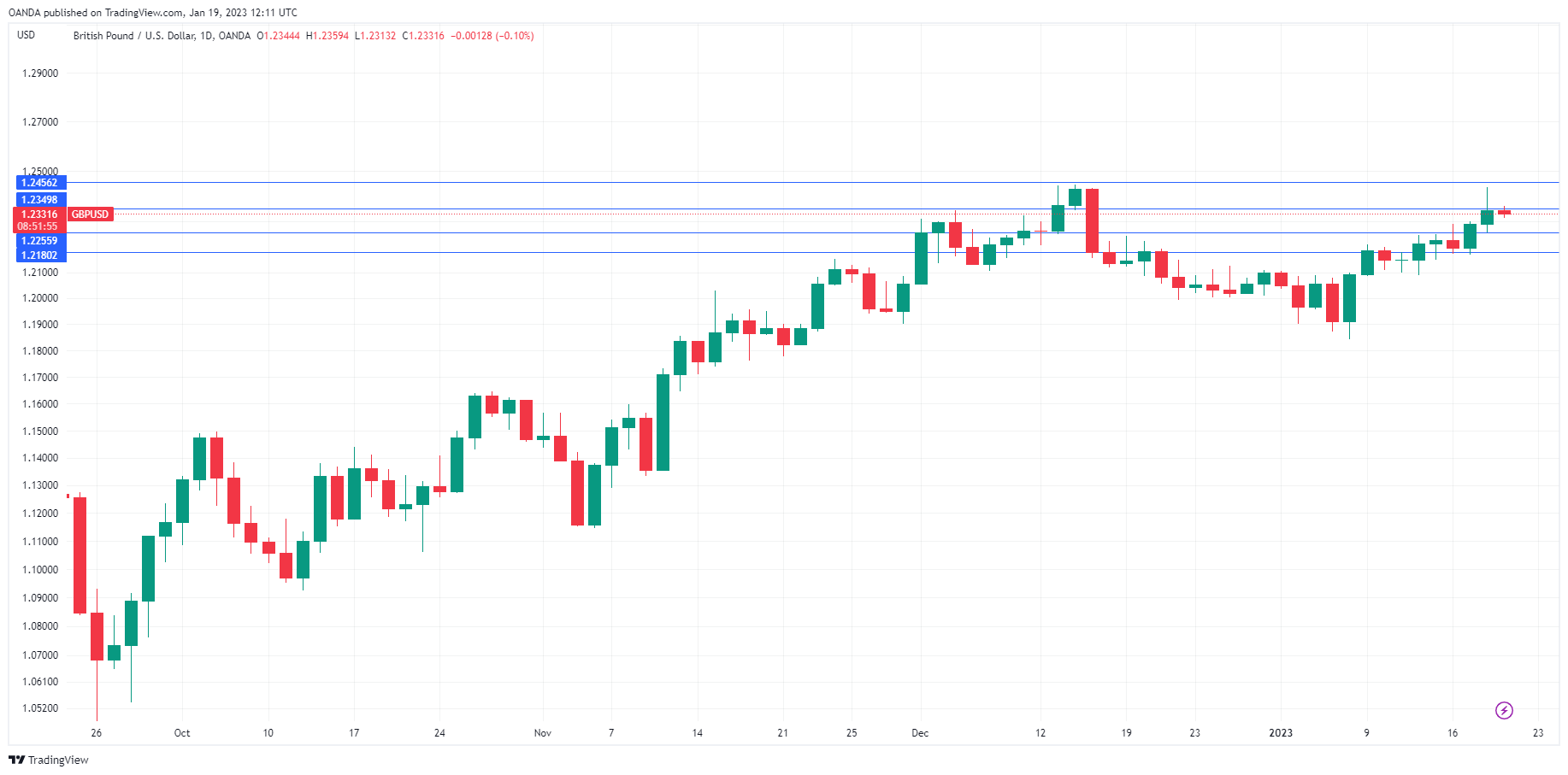
The British pound is almost unchanged on Thursday, trading at 1.2342 in the European session.
Markets brace for another decline in retail sales
All eyes will be on the UK’s December retail sales, which will be released on Friday. The UK consumer has been holding tight to the purse strings, which is bad news for an economy that has tipped into recession. Headline retail sales is expected to decline by -4.1%, after a -5.9% read in November, and the core rate is projected at -4.4%, following -5.9% in November. A weak release will put pressure on the pound, which has looked sharp this week with gains of 1.07%. Consumer confidence has been in deep-freeze, which is not a surprise given the cost-of-living crisis that continues to squeeze consumers. GfK Consumer Sentiment is expected at -40, little changed from the previous reading of -42 points.
UK inflation dropped for a second straight month in December, falling from 10.7% to 10.5%. This is a welcome trend, but double-digit inflation is nothing to cheer about. As well, core inflation, which is a more accurate gauge, remained steady at 6.3%. The Bank of England has the unenviable task of having to continue to raise rates in order to curb inflation, despite the weak economy. The BoE holds its next meeting on February 2nd and the markets have priced in a second-straight 50-bp increase, which would bring the cash rate to 4.0%. Unless inflation takes a dramatic plunge, we can expect further rate hikes after the February meeting.
The US dollar seems to lose ground whenever the US releases soft data, as we have seen this week. The Empire State Manufacturing Index sank to -32.9, while headline and core retail sales both fell by -1.1%. PPI came in at -0.5%. All three releases were weaker than the November readings and missed the forecasts, indicating that cracks are appearing across the US economy, which is feeling the bite of the Fed’s aggressive tightening.
The Fed continues to insist that high rates are here to stay for a while, but the markets are clinging to the belief that weak data will force the Fed to end the current rate cycle after a 25-bp increase in February and even cut rates late in the year. I expect this pattern to continue and for the US dollar to lose ground if economic releases continue to miss their forecasts.
GBP/USD Technical
- 1.2352 is a weak resistance line, followed by 1.2455
- There is support at 1.2255 and 1.2179
Central Bank Warnings
It's been a solid start to the year for equity markets but that optimism appears to be fading as policymakers queued up in Davos to push back against market interest rate expectations.
Let's be clear on this, the markets have a much better record over the last 18 months of anticipating shifts in interest rates than central banks so to some degree these warnings will fall on deaf ears. But then, they come at a time when stocks have had a good run so perhaps it's a case of any excuse to lock in some profits.
Lagarde's warnings falling on deaf ears?
ECB President Christine Lagarde was among those to warn about overly optimistic market expectations, insisting that she would "advise market participants to revise their positions". It's hard to take the advice too seriously considering how late to the party the ECB was. While every situation was different, to have seen the experience of most other central banks and think "that won't happen to us" before diving into an aggressive catch-up tightening cycle doesn't leave you with much credibility.
CBRT holds for now
Of course, compared with the CBRT the ECB looks like it's doing a stellar job. While the latter was late to acknowledge that the house was on fire, the former decided the throw fuel on it and see what happens. After another series of rate cuts, the CBRT recently decided it was time to pause again and assess the damage. Official data recently showed inflation is falling but from extraordinarily high levels. I'm sure we'll see further cuts at some point in the future but it would seem today was not the time. Although at this stage I have no idea exactly what they're looking for and how they're coming to the conclusions they are.
Oil eases around prior highs
It would appear the profit-taking we're seeing elsewhere is weighing on oil as well, with Brent and WTI off around half a percentage point after reversing off their highs yesterday. The reversal occurred slightly above the late December and early January peaks so it's perhaps a natural profit-taking zone, especially occurring around a broader risk reversal.
Gold eyeing a correction?
Gold is pushing higher again today but the broader rally appears to have stalled. That may not come as a big surprise, occurring in a zone between $1,880 and $1,920 where we've seen plenty of support and resistance in recent years. It had plenty of momentum going into these levels but that has now faded which could signal a potential correction.