Sample Category Title
EURCAD Wave Analysis
- EURCAD reversed from key resistance level 1.4585
- Likely to fall to support level 1.4400
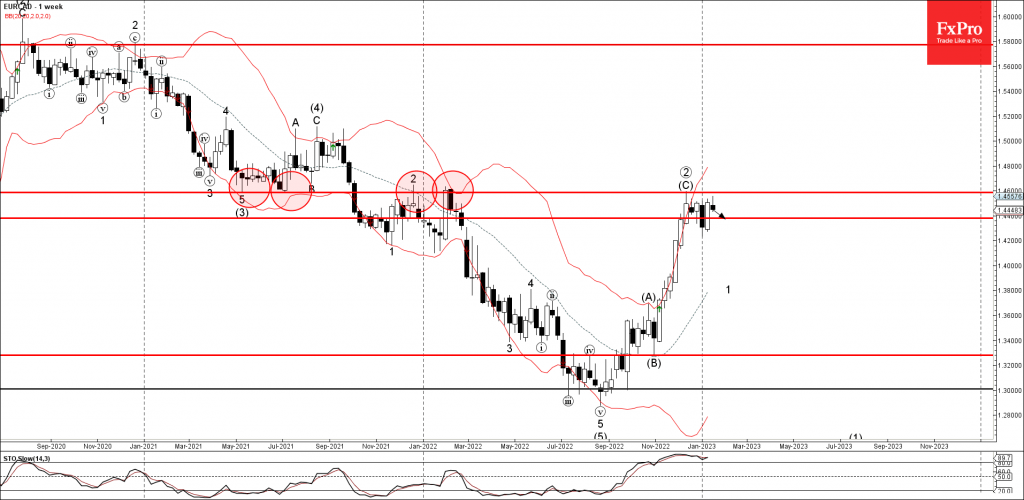
EURCAD recently reversed down from the key resistance level 1.4585 (which has been repeatedly reversing the pair from the end of 2021 as can be seen below).
The downward reversal from the resistance level 1.4585 continues the active weekly downtrend from the start of 2020.
Given the overbought reading on both the daily and the weekly Stochastic indicators, EURCAD can be expected to fall further toward the next support level 1.4400.
An Improving Outlook for the Eurozone Economy and Currency
Summary
- Recent developments hint at some improvement in the outlook for what will still be a challenging 2023 for the Eurozone economy. A sharp drop in energy prices is driving a slowdown in headline inflation. Against this backdrop, real household incomes and consumer spending could be more resilient than previously expected and, indeed, Eurozone PMI surveys have already improved in recent months.
- Many Eurozone governments have also announced fiscal measures to shield European households and businesses from higher energy prices, suggesting fiscal policy could be modestly expansionary this year. Together, lower inflation and fiscal stimulus mean the risks are tilted towards a smaller 2023 Eurozone GDP decline than our current forecast for a 0.6% contraction.
- Meanwhile, Eurozone policymakers have made it clear that inflation remains much too high, and remain concerned at the persistence of core inflation pressures. The European Central Bank's policy outlook has turned notably more hawkish since December (we now forecast a policy rate peak of 3.25%), at a time when the Fed's policy monetary policy outlook has started to shift in a less hawkish direction.
- From a currency perspective, a more resilient Eurozone economy and more hawkish European Central Bank clearly offers a more supportive mix for the euro. With respect to our base case forecast, it is quite possible that some of the weakness we had anticipated in the EUR/USD exchange rate in early 2023 may in fact not eventuate. In addition, the risks to our Q1-2024 target for the EUR/USD exchange rate of $1.13 are clearly tilted to the upside.
Eurozone Growth Outlook Becoming Somewhat Less Dim
The momentum of the Eurozone's economic expansion slowed as 2022 progressed and, given historically elevated energy prices, rapid inflation and rising interest rates, we have long believed the region would fall into recession, beginning around the turn of this year. To be sure, we still expect the Eurozone economy to experience contraction. That said, recent developments hint at some improvement in the outlook for what will still be a challenging 2023.
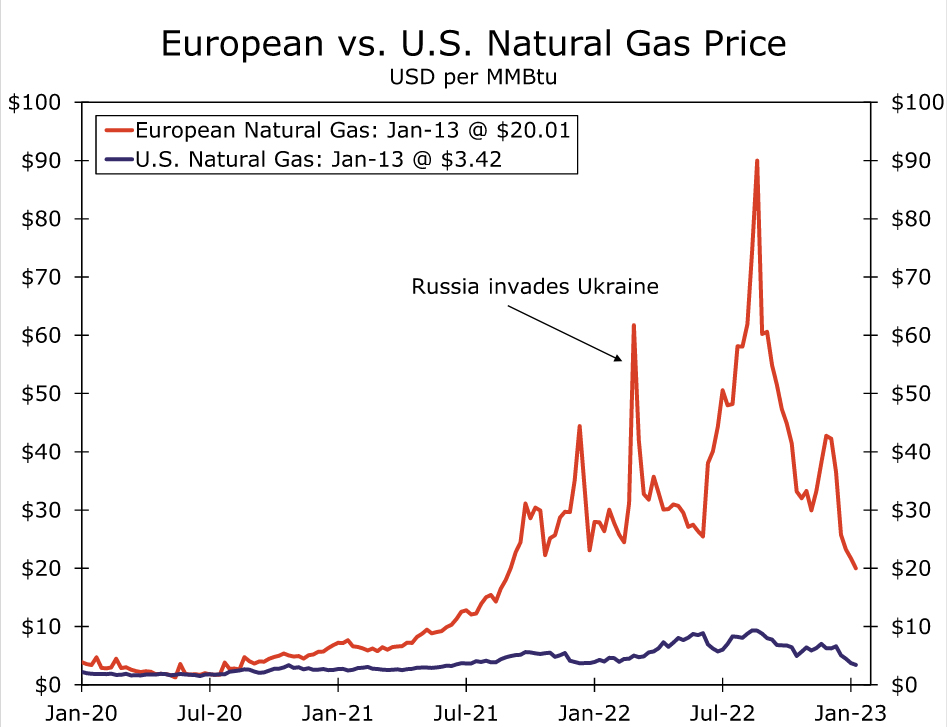
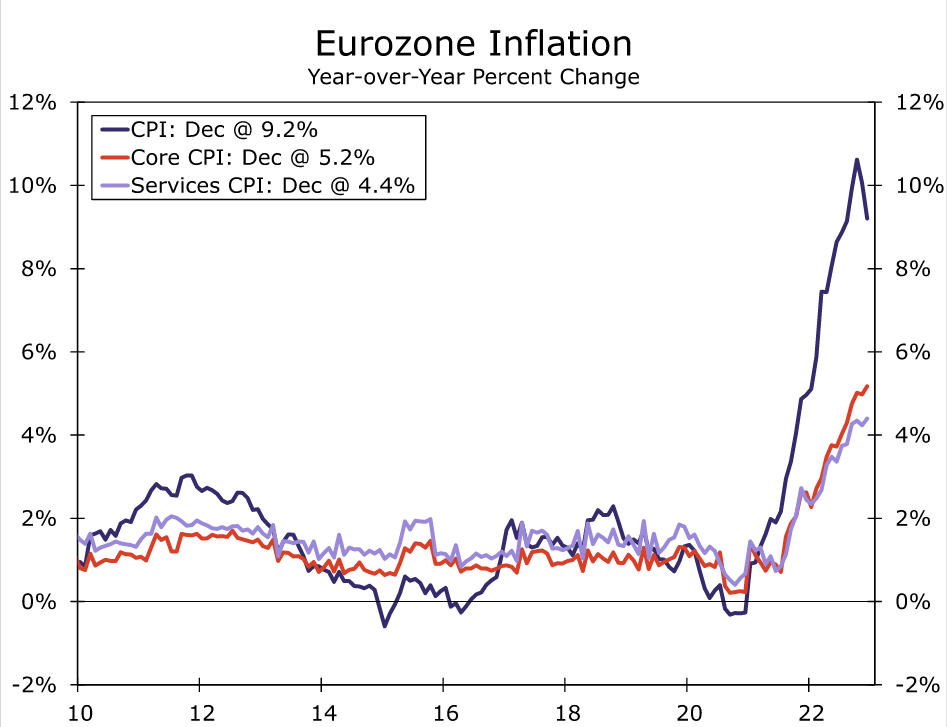
Most importantly, a sharp fall in energy prices offers potential relief for households, and could help the consumer sector to remain more resilient than previously forecast. European natural gas prices are down more than 75% from their August 2022 peak, while Brent crude prices have also fallen almost 35% from their March 2022 peak. To be sure, there remains some concern about a renewed rise in energy prices given the disruption of supply from Russia. By Q3-2022, the European Union sourced 15% of its natural gas imports from Russia (down from 39% for all of 2021), while the European Union sourced 14% of its oil imports from Russia (down from 25% for 2021). But for now at least, falling energy prices also offer the prospect of significant inflation relief for Eurozone households, a trend that is already underway. In December, the Eurozone headline CPI slowed to 9.2% year-over-year, down from a peak of 10.6% in October. Importantly however, there has not yet been any easing in broader underlying prices pressures, with core CPI inflation quickening further to 5.2% year-over-year in December.
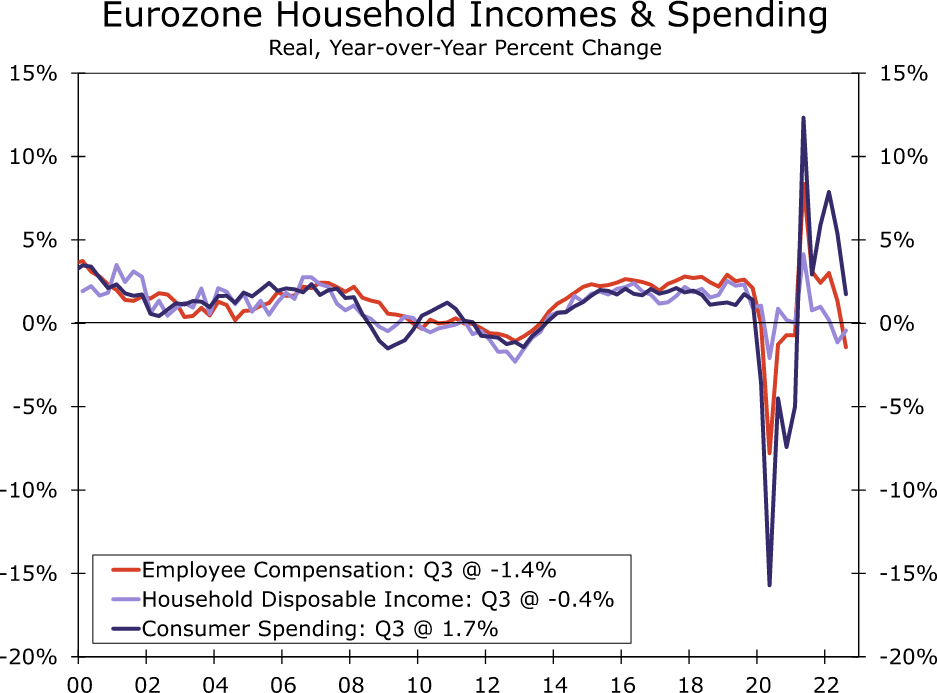
That said, the slowing in headline inflation is potentially very significant for the consumer spending outlook. Although Eurozone household disposable incomes have risen in nominal terms for seven quarters in a row, they have not kept up with the pace of inflation, meaning that adjusting for price increases, real income growth turned negative around the middle of 2022. Still, there are already hints in the latest available data that the drag on Eurozone real incomes may be waning. Based on preliminary figures from Eurostat, we estimate that Eurozone real household disposable income fell 0.4% year-over-year in Q3-2022, less than the 1.1% decline seen in Q2. While Q4 might be too early to see further inflation relief (average Eurozone inflation was actually higher in Q4 than Q3), it is possible that growth in real incomes could turn less negative, or even positive, by early 2023. The preliminary Eurostat figures also indicate the Eurozone household saving rate fell only slightly to 13.2% in Q3-2022, and is broadly in line with levels that prevailed prior to the pandemic. Overall, considering trends in real incomes and household savings, consumer spending may prove to be more resilient in 2023 than previously anticipated.
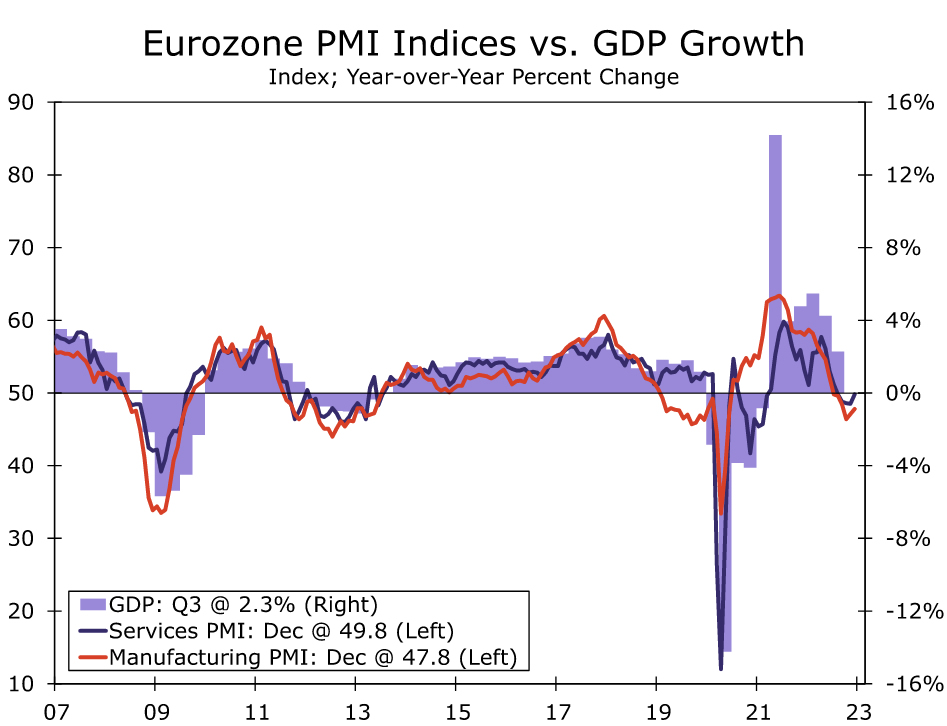
These improving (or at least less negative) economic prospects are also reflected in recent confidence surveys, as Eurozone PMI indices have gained in recent months. Notably, the services PMI rose to 49.8 in December from its recent low of 48.5 in November. The manufacturing PMI also rose to 47.8 in December, from its recent low of 46.4 in October. Those readings are historically consistent with a contracting Eurozone economy, though at the same time consistent with only a moderate contraction. For now, we maintain our forecast for Eurozone GDP to contract by a 0.6% for calendar year 2023, but taking into account developments in inflation, activity data and confidence surveys, we believe the outlook is potentially moving in the direction of a smaller 2023 GDP decline.
The Push and Pull of Eurozone Fiscal Policy
Much has also been made of Europe's fiscal policy response to the region's energy crisis, and measures that have been put in place to shield European households and businesses from higher energy prices. In late November 2022, Bruegel (a Brussels based economic think-tank) offered estimates for the European Union (of which Eurozone countries comprise the dominant majority) of funds that have been earmarked or allocated by governments to address the energy crisis between September 2021 and November 2022. These measures, among other things, include reduced energy taxation, retail price regulations, transfers to vulnerable groups, and business support. Those funds amounted to €600B, of which €264B has been allocated by Germany alone. To put those numbers in context, that equates to around 3.9% of European Union GDP and 7.0% of German GDP, respectively. In isolation, the estimates suggest European fiscal policy could be somewhat supportive of economic activity.
Recent estimates of the broader fiscal position also indicate the fiscal policy stance could be modestly supportive of economic activity in 2023. In the European Central Bank's (ECB) staff macroeconomic projections for December 2022, the ECB also sees total fiscal stimulus for the Eurozone related to the energy crisis and war in Ukraine at around 2% of GDP for 2022-23, with some of that fiscal stimulus projected to continue having a budget impact in 2024. Keeping in mind the energy related stimulus measures will be partly offset by withdrawal of previous COVID related fiscal support, the ECB projects the structural budget balance to narrow from 3.4% of GDP in 2021 to 3.0% in 2022, before widening to 3.3% of GDP in 2023. That is, the fiscal stance is seen tightening modestly in 2022, before loosening modestly in 2022. Overall, its appears the Eurozone fiscal policy stance should be mildly supportive of economic activity in 2023, reinforcing the outlook for Eurozone 2023 GDP to move in the direction of a smaller decline.
Eurozone Monetary Policy Turning More Hawkish
In addition to the outlook for Eurozone economic activity, ECB policymakers have made it clear over the past several weeks that their flight against inflation is far from over, and that Eurozone inflation remains much too high for comfort. The fact that core inflation pressures have not shown any lessening across the Eurozone is another reason we believe ECB policymakers are hesitant to let up on their inflation fight at this point. At its December announcement, the ECB raised its Deposit rate 50 basis points to 2.00%, and perhaps more importantly said that “interest rates will still have to rise significantly at a steady pace to reach levels that are sufficiently restrictive to ensure a timely return of inflation to the 2% medium-term target.” ECB President Lagarde also said we should expect the ECB to raise rates at a 50 basis point pace for a period of time, and that the ECB needs to do more on interest rates than what was implied by market pricing at the time.
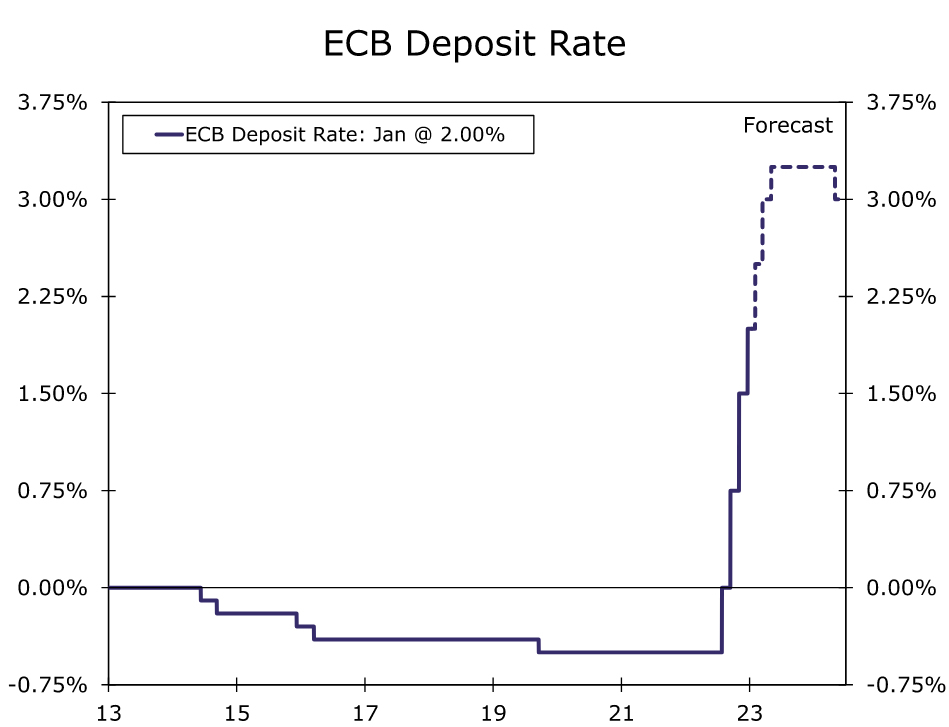
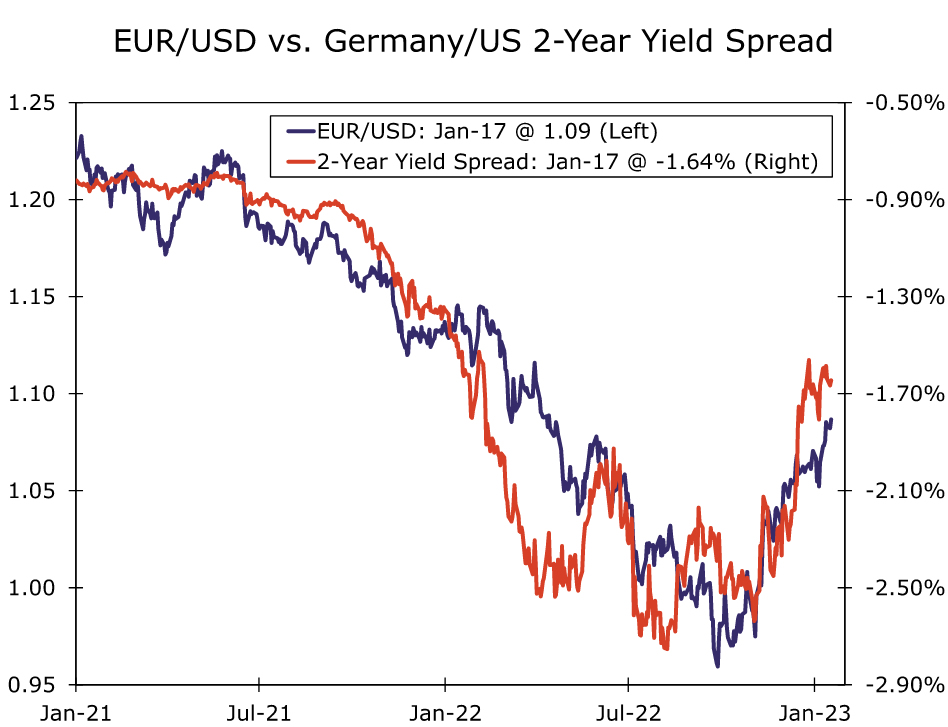
In response, we raised our forecast for the ECB's peak policy rate during the current cycle to 3.25%, and ECB policymaker comments in subsequent weeks have generally continued to highlight the need for steady and sustained rate increases. In contrast, with U.S. inflation slowing and based on evolving hints from some Fed policymakers, we now expect the Fed to raise rates by an even smaller 25 basis points at its early February meeting. Indeed, from current levels we expect a further 125 basis points of ECB rate hikes compared to just a further 75 basis points of rate hikes from the Fed. In effect, the ECB is turning more hawkish at a time when the Fed is starting to turn less hawkish. These dynamics have led to a meaningful narrowing in the large negative yield gap that previously existed between the Eurozone and the U.S. The two-year government yield spread between Germany and the U.S. has narrowed to -159 basis points, from as wide as -264 basis points as recently as early November.
From a currency perspective, a more resilient (albeit still subdued) Eurozone economic outlook and a more hawkish European Central Bank monetary policy outlook clearly offers a more supportive mix for the euro exchange rate against the U.S. dollar. With respect to our base case forecast, it is quite possible that some of the weakness we had anticipated in the EUR/USD exchange rate in early 2023 may in fact not materialize. In addition, the risks to our Q1-2024 target for the EUR/USD exchange rate of $1.13 are clearly tilted to the upside. In the context of recent developments, our outlook for the euro versus the U.S. dollar is shifting appreciably in the direction of a more constructive medium-term trend.
Euro tumbles on report that ECB considering smaller hike in Mar
Euro tumbles broadly after Bloomberg reported, quoting unnamed source, that ECB is pondering slower rate hike after 50bps in February. It noted that "the prospect of a smaller 25-point increase at the following meeting in March is gaining support".
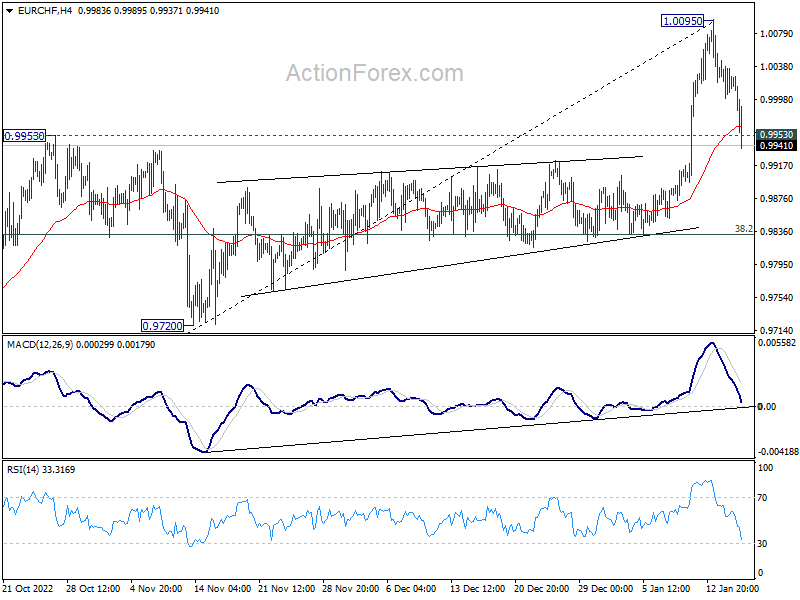
EUR/CHF's break of 0.9953 resistance turned support now raising the chance of at least a deeper correction. For now, 38.2% retracement of 0.9407 to 1.0095 at 0.9832. Reaction from there would reveal whether EUR/CHF could defend its near term bullishness.
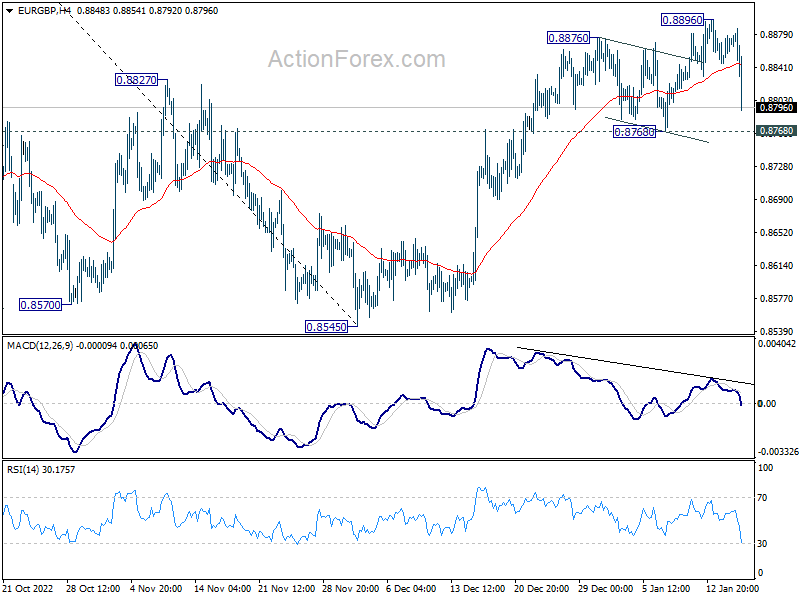
Meanwhile, EUR/GBP is heading back to 0.8768 support. Reaction from there will also reveal whether rebound from 0.8545 has completed at 0.8896 already.
UK Earnings Rise Alongside Employment Drop
The UK market is showing further signs of a reversal in the labour market towards a fall in employment, but the increased pace of wage growth is keeping a close eye on the Bank of England’s actions and comments.
Jobless claims rose by 19.7K in December after climbing by 16.1K a month earlier, a logical development after a smooth stop to the decline earlier last year.
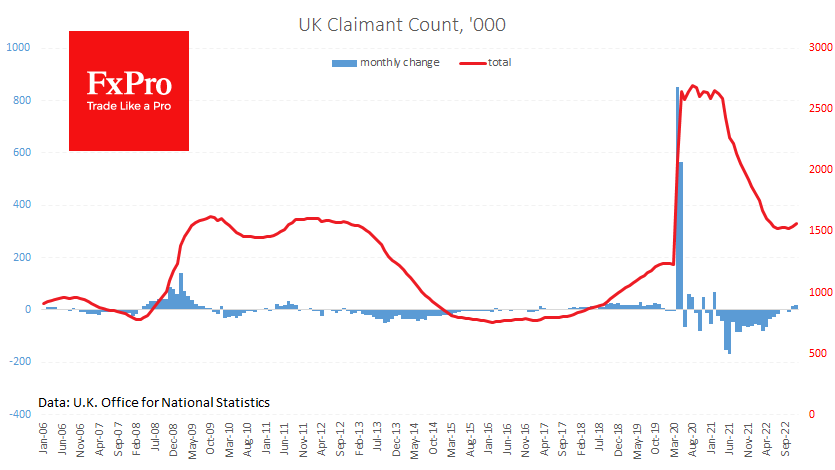
The unemployment rate remained at 3.7%. Here there is a 0.2 percentage point increase from the August lows, but these levels remain very low by historical standards. Unfortunately for policymakers, the low unemployment rate reflects a shrinking active workforce, which has forced the government to launch a programme of tax incentives for those back to work in the ages over 50.
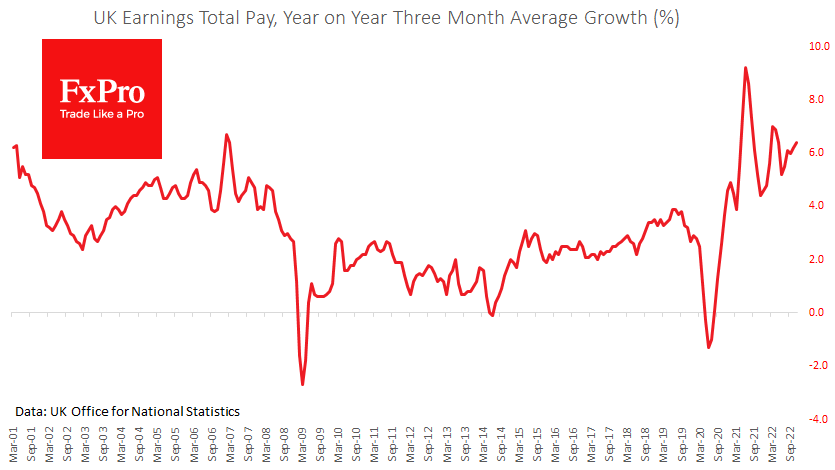
In theory, this should increase supply and curb wage growth, which now looks like the most dangerous part of the inflationary spiral. Wages in the last three months to November were 6.4% higher than in the same period a year earlier. This is below current inflation. However, this high rate of wage growth risks is the most significant factor in anchoring inflation expectations and overall inflationary pressure.
A fresh set of inflation data is published tomorrow morning, where a sharp fall in prices is not forecast on average. The combination of high consumer inflation and rising wages could force the Bank of England to push the economy harder into recession to suppress consumption and bring price growth under control, which would be positive for the pound.
EUR/USD: Bulls Hold Grip But Overbought Conditions Warn of Prolonged Consolidation
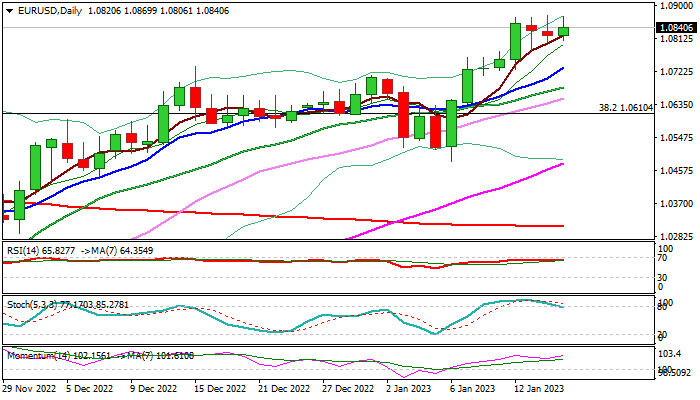
The Euro regained traction on Tuesday but remains within a consolidation range, signaling that larger bulls remain in play, as the pair is in steep rally for the fourth consecutive month and the action is underpinned by last week’s large bullish candle.
Near-term action received boost from upbeat German/EU ZEW economic sentiment data, drop in German inflation and weaker dollar.
Technical studies are in full bullish setup on daily chart, though overbought conditions warn of stronger headwinds on approach to targets at 1.0930 (weekly cloud top) and 1.0942 (50% retracement of 1.2349/0.9535 downtrend).
A healthy correction should be contained by converged daily Tenkan/Kijun-sen (1.0678) to offer better buying opportunities attack at 1.0930;42 targets, violation of which would expose psychological 1.10 level and 100WMA (1.1094) in extension.
Caution on dip below weekly cloud base/weekly Tenkan-sen (1.0548) which would weaken near-term structure and allow for deeper pullback.
Res: 1.0874; 1.0900; 1.0942; 1.1000.
Sup: 1.0780; 1.0732; 1.0678; 1.0610.
Canadian Dollar Shrugs as CPI Declines
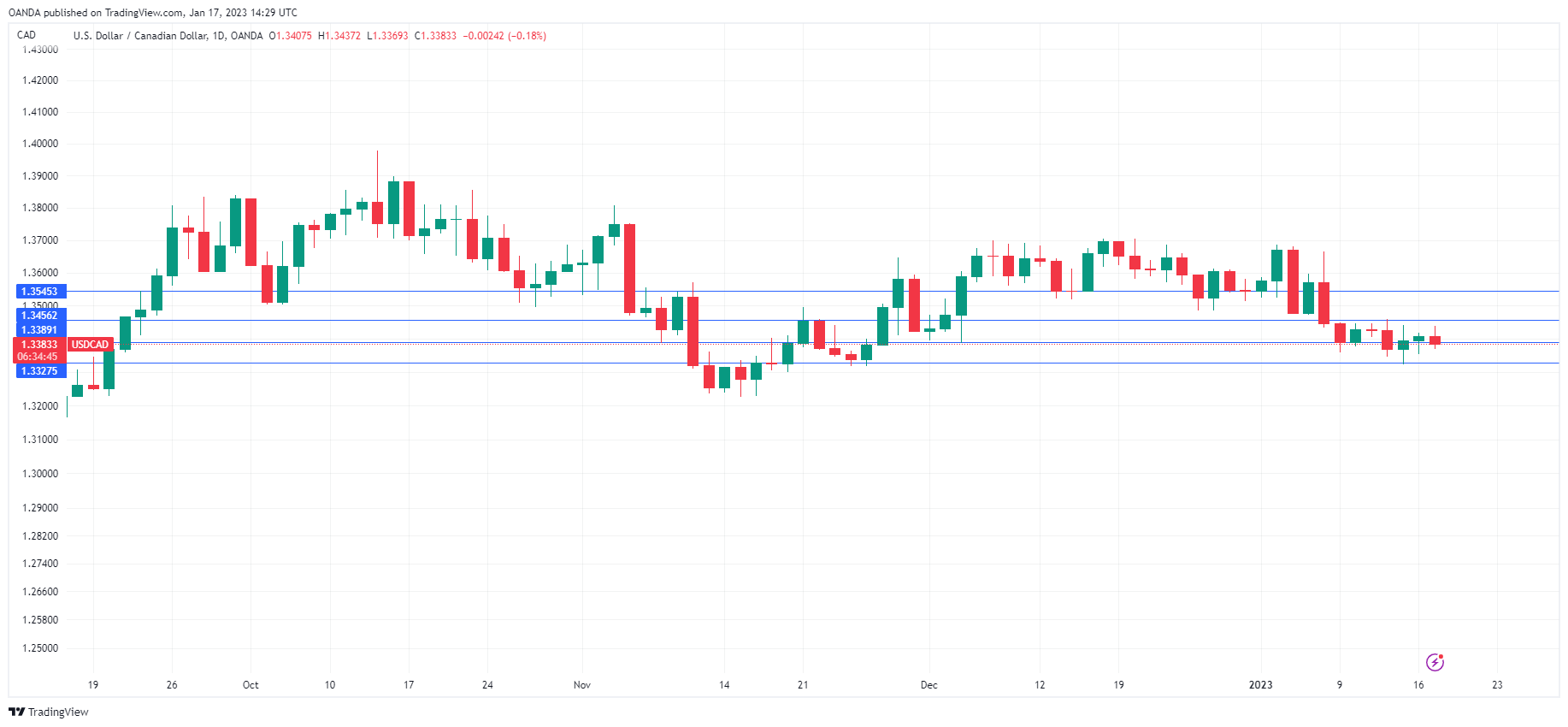
It has been a quiet day in the currency markets, and the Canadian dollar has followed suit. In the North American session, USD/CAD is trading at 1.3386, down 0.15%.
Canada’s inflation heads lower
Inflation in Canada slowed to 6.3% y/y in December, down from 6.8% a month earlier and matching the consensus. On monthly basis, the decline was noticeable at -0.6%, compared to 0.0% in November and the forecast of -0.1%. Core CPI fell to 5.4% y/y, down from 5.8% in November and below the forecast of 6.1%. The driver of the drop in inflation was a sharp decline in gasoline prices. Food prices, however, remain high and rose by 11% in December, a slight improvement over the November read of 11.4%. The Canadian dollar shrugged off the drop in inflation and remains close to the 1.34 round-figure mark.
The drop in inflation suggests that the Bank of Canada’s aggressive rate cycle is having the desired effect, although inflation remains much higher than the BoC’s target of 2%. The BoC holds its rate meeting next week, and the markets have priced in a 25- basis point hike, which would bring the cash rate to 4.50%. If inflation continues to downtrend, the expected hike next week could signal the end of the current rate-tightening cycle.
The BoC has said that future hikes would be determined by economic data, and there are signs of economic strength despite the rate hikes. GDP is expected to rise 1.2% y/y in Q4 and job growth sparkled in December, with over 100,000 new jobs. The markets are expecting a 25-bp hike next week, but it’s uncertain what the central bank has planned after that. The markets will be looking for clues about future rate policy from the rate statement and BoC Governor Macklem post-meeting comments.
USD/CAD Technical
- USD/CAD is testing support at 1.3389. Below, there is support at 1.3328
- 1.3455 and 1.3546 are the next resistance lines
Sunset Market Commentary
Markets
US markets reopened after the long weekend (Martin Luther King Day), but didn’t provide any new directional narratives for global trading. Core US and European yields this morning tried to build on a tentative bottoming out process. Still, the feeling was/is that any sustained rise in yields remains difficult for now. Early in US dealings, the US Empire manufacturing survey tumbled sharply from -11.2 to -32.9, the lowest level since May 2022 and confirming recent evidence on a slowdown in the sector. The report blocked the upward momentum in yields. In a steepening trend, the US 2y yield is ceding 2 bps. Yields at longer maturities still trade modestly positive (30y; +3bps), but off the intraday peak. Regarding US data later this week, retail sales (release tomorrow) take center stage. A soft figure from the spending side of the economy, if it were to materialize (-0.9% M/M is expected for headline sales), might revive recent dovish markets dynamics like after softer inflation data. After trading in green earlier, German yields are also easing 1/2 bps across the curve, with Bunds slightly underperforming swaps. 10y intra-EMU spreads vs Germany over the previous days also showed tentative signs of bottoming (Greece today + 9 bps, Italy +2 bps). Greece today launched a €3.5 bn 10-y bond at MS +165 bps. The February TTF Dutch y gas contract this morning touched a new correction low near €51.4/Mwh, but rebounded intraday (currently €58). Oil extends its gradual uptrend (brent $85.5/b). Equities show lackluster dynamics, at best. European indices are little changed (EuroStoxx 50 +0.2%) even as German ZEW investor confidence improved sharply with the expectations component jumping from -23.3 to 16.9. US indices open with a modest loss (0.25%) as earning from the US banking majors (Goldman, Morgan Stanley) failed to convince investors.
Sterling gained modestly on FX markets as the short-term interest rate differentials with the US and EMU rose after decent UK labour data this morning, with a faster-than-expected rise in wages (6.4% Y/Y) catching eye. EUR/GBP dropped from the 0.8890/70 resistance area to touch an intraday low near 0.8835. However, further gains were blocked (currently 0.885), probably as investors await the UK December inflation data tomorrow. The dollar initially traded sideways, but again lost momentum after the very poor Empire manufacturing release. The DXY index struggles not to return below the 102 handle. EUR/USD (1.086) nears recent peak levels around 1.087. USD/JPY trades little changed near 128.5. In this cross rate, the focus now turns to the yen-side of the story with investors looking out for more tweaks in policy as the BOJ concludes its policy meeting tomorrow morning.
News Headlines
OPEC’s top official, Secretary-General Al-Ghais, turned cautiously optimistic on the outlook for the global economy. In an interview with Bloomberg in Davos he said that a potential slowdown in advanced economies is still the biggest concern but that it is being countered by accelerating growth in Asia. He referred to China’s reopening, which also helps oil demand to recover. To avoid a glut, OPEC cut back production significantly last year. But Al-Ghais said it was premature to say if this needs to be reversed already, even as potential supply losses from sanctions-hit Russia loom. The oil cartel holds a monitoring meeting on February 1. Oil prices inch higher today with the Brent reference adding 1.5% to $85.75/b currently.
Canadian headline inflation eased a bit more than expected in December. Price growth decelerated from 6.8% to 6.3% (-0.6% m/m) vs 6.4% expected. Underlying inflation also eased but only because the November reading was revised upwards. At 5 or 5.3% (depending on the gauge), it remains well above the Bank of Canada’s 2% target. The BoC lifted policy rates by 50 bps to 4.25% at the most recent meeting in December. Further increases were not a given with inflation still too high and tight labour markets on the one hand but moderating consumption and declining housing activity on the other. Next week’s policy meeting comes with updated forecasts and could set the stage for a pause in the cycle after delivering a final 25 bps rate hike. Such a scenario is not yet fully discounted by markets (+/- 75%). Canadian swap yields erased previous losses after the CPI release to trade 3 bps+ higher. The Canadian dollar barely budges. USD/CAD is testing the 1.34 big figure.
Canada: Another Welcome Cooling in Inflation in December
Consumer price inflation continued to come off the boil in December, up 6.3% versus a year ago (y/y), from 6.8% in November.
The decline in energy prices gathered speed in December, as prices at the pump fell 13.1% month-on-month (m/m). Gasoline prices are now only 3% higher than a year ago.
Food inflation also cooled slightly in December, with grocery costs up 11% y/y, versus 11.4% in November.
In a sign that consumer demand is cooling and supply chains are less constrained, durable goods prices decelerated for the third consecutive month in December to 4.7% y/y from 5.3% y/y in November. Prices for household appliances saw the largest decline on record (-4.1% m/m).
Underlying inflation pressures also lost some steam, with CPI ex-food and energy up 5.3% y/y, down from 5.4% in November. All three of the BoC's core inflation measures moved in a positive direction in December. But most importantly, CPI-trim was 5.3% y/y (5.4% in Nov.) and CPI-median was 5% y/y (5.1% in Nov.).
The improvement in core inflation was helped by shelter inflation decelerating to 7% y/y from 7.2% y/y in November. Inflation for homeowners' replacement continued to come down to 4.7% y/y in December from 5.8% y/y in November thanks to a slowing resale market. Although mortgage interest costs remained a key source of upward pressure, up 18% y/y versus 14.5% in November.
Key Implications
December's CPI report showed that Canadian inflation continues to come off the boil, but at 6.3% remained well above the Bank of Canada's 1-3% target. As outlined in our last Quarterly Economic Forecast, we expect the cooling process to continue, but it will require consumer spending to effectively grind to a halt. Core inflation pressures are decelerating more slowly than headline, but are roughly consistent with our December forecast.
This is the last inflation reading the Bank of Canada will get before its rate decision on January 25th. Despite signs from the consumer and business surveys that Canadians are tightening their belts as they brace for recession, the battle against inflation has not turned enough for the BoC to declare victory. As outlined in our last Dollars & Sense, we expect the Bank will make one last quarter point hike next week, and then pause to assess the cumulative impact of a year of dramatic tightening on the economy.
EUR/USD Mid-Day Outlook
Daily Pivots: (S1) 1.0791; (P) 1.0833; (R1) 1.0863; More...
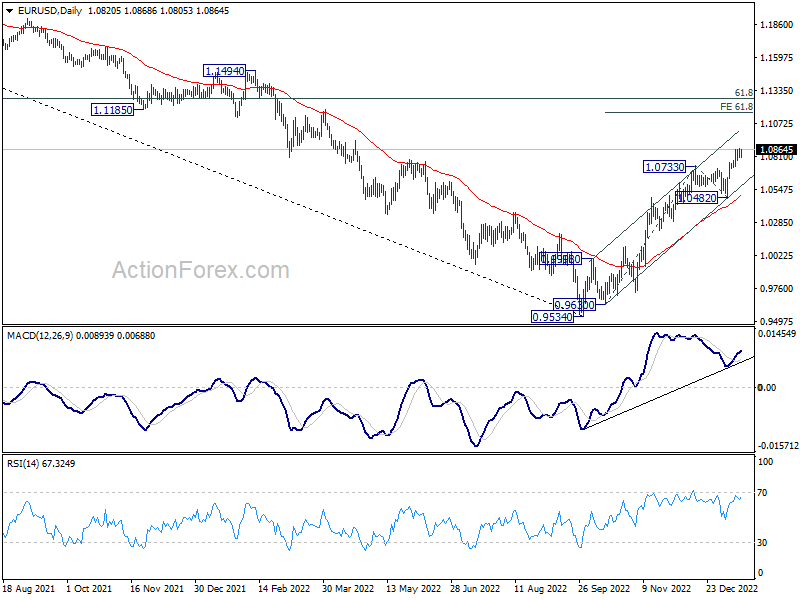
Intraday bias in EUR/USD stays neutral first. Further rally is expected as long as 1.0482 support holds. On the upside, break of 1.0873 will resume larger rally from 0.9534 to 61.8% projection of 0.9630 to 1.0733 from 1.0482 at 1.1164 next.
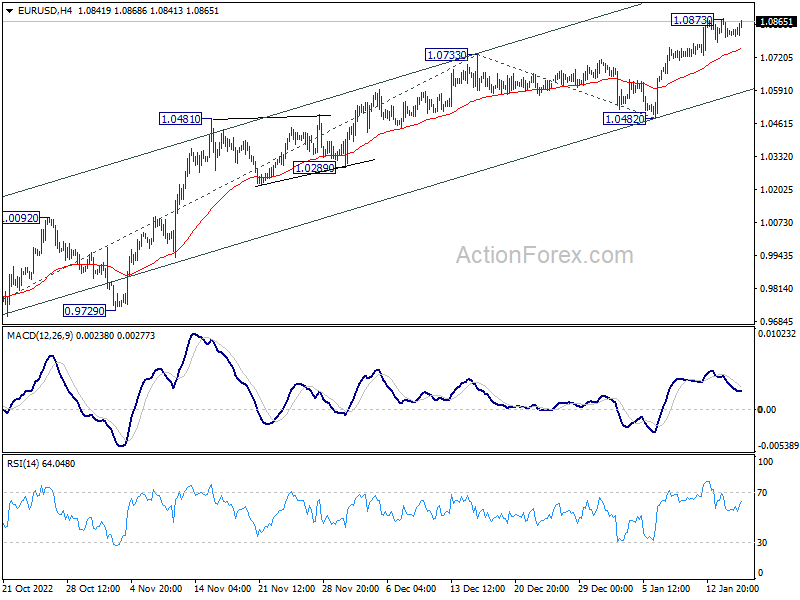
In the bigger picture, current development suggests that the rally from 0.9534 low (2022 low) is a medium term up trend rather than a correction. Further rally is in favor to 61.8% retracement of 1.2348 (2021 high) to 0.9534 at 1.1273 next. This will remain the favored case as long as 1.0482 support holds.