Sample Category Title
USD/CHF Mid-Day Outlook
Daily Pivots: (S1) 0.9225; (P) 0.9257; (R1) 0.9295; More...
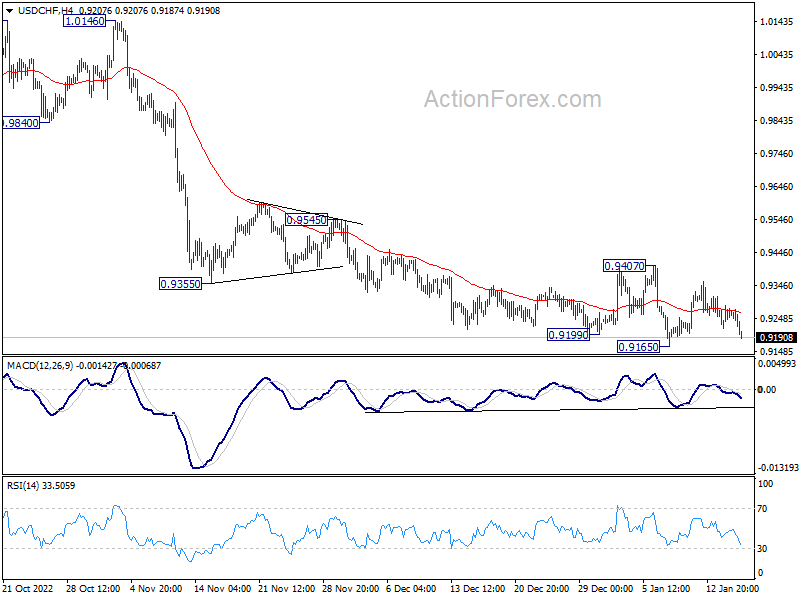
Intraday bias in USD/CHF remains neutral for the moment. Outlook stays bearish as long as 0.9407 resistance holds. Break of 0.9165 will resume whole fall from 1.0146. However, firm break of 0.9407 will turn bias back to the upside for stronger rebound.
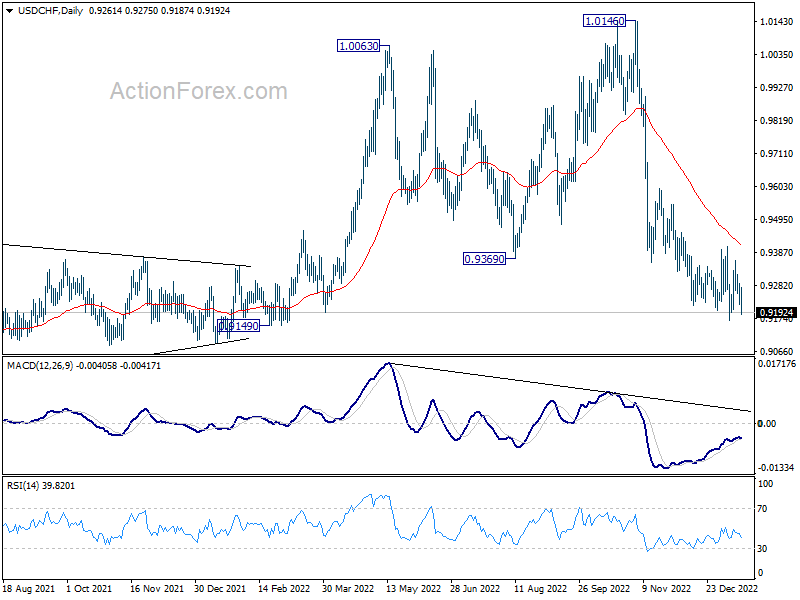
In the bigger picture, rise from 0.8756 (2021 low) has completed at 1.0146, well ahead of 1.0342 long term resistance (2016 high). Based on current downside momentum, fall from 1.0146 should be a medium term down trend itself. Next target is a test on 0.8756 low. Strong support should be seen there to bring rebound. Still, further decline will now be expected as long as 0.9407 resistance holds, in any case.
USD/JPY Mid-Day Outlook
Daily Pivots: (S1) 127.54; (P) 128.21; (R1) 129.18; More...
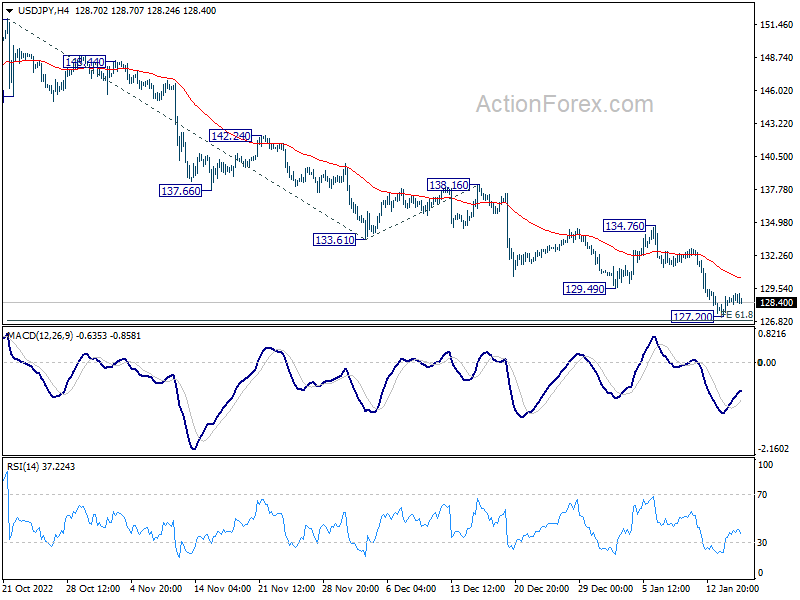
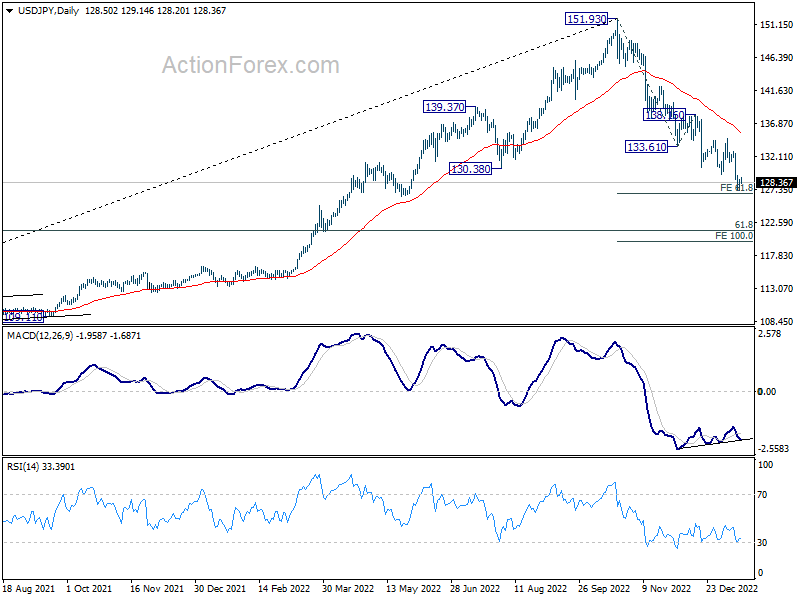
USD/JPY is still extending the consolidation from 127.20 and intraday bias remains neutral. Further decline will remains in favor as long as 134.76 resistance holds. Break of 127.20 will resume the fall from 151.93 to 121.43 fibonacci level next. Nevertheless, firm break of 134.76 will confirm short term bottoming and turn bias back to the upside.
In the bigger picture, the firm break of 55 week EMA (now at 131.59) raises the chance of medium term bearish reversal, but that's not confirmed yet. Strong support could be seen around 61.8% retracement of 102.58 to 151.93 at 121.43 and 38.2% retracement of 38.2% retracement of 75.56 to 151.93 at 122.75 to bring rebound. But break of 134.76 resistance is needed to indicate bottoming first. Otherwise further fall will remain in favor.
GBP/USD Mid-Day Outlook
Daily Pivots: (S1) 1.2150; (P) 1.2219; (R1) 1.2267; More...
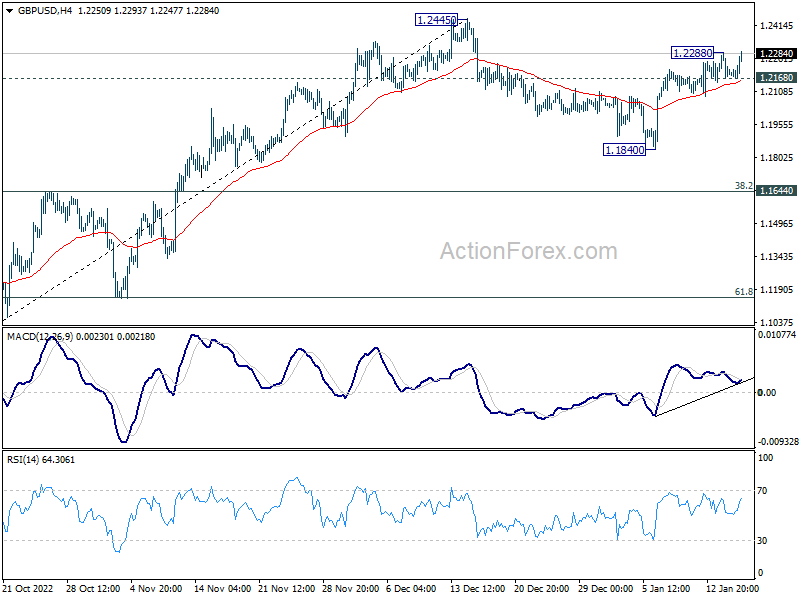
GBP/USD's rise from 1.1840 resumed by breaking 1.2288 temporary top. Intraday bias is back on the upside for retesting 1.2445. Decisive break there will resume whole rally from 1.0351 to 1.2759 fibonacci level. On the downside, break of 1.2168 minor support will turn intraday bias neutral again.
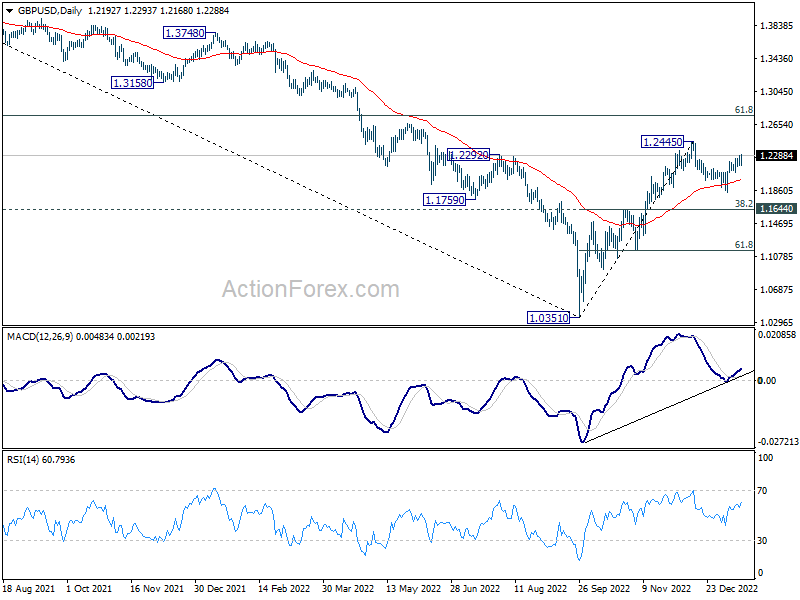
In the bigger picture, rise from 1.0351 medium term bottom is at least correcting whole down trend from 1.4248 (2021 high). Further rise is expected as long as 1.1644 resistance turned support holds. Next target is 61.8% retracement of 1.4248 to 1.0351 at 1.2759. Sustained break there will pave the way back to 1.4248.
European Majors Gain on Solid Data, Yen Consolidates ahead of BoJ
European majors are trading generally higher today, with help from strong improvement in Germany economic sentiment as well as solid UK job data. Commodity currencies are turning softer, with Canadian Dollar shrugging off CPI data. Dollar is mixed despite sharp decline in New York State manufacturing data. Yen is so far the weakest for today, continuing to digest recent gains, awaiting tomorrow's BoJ policy decision, which could bomb the market with surprises.
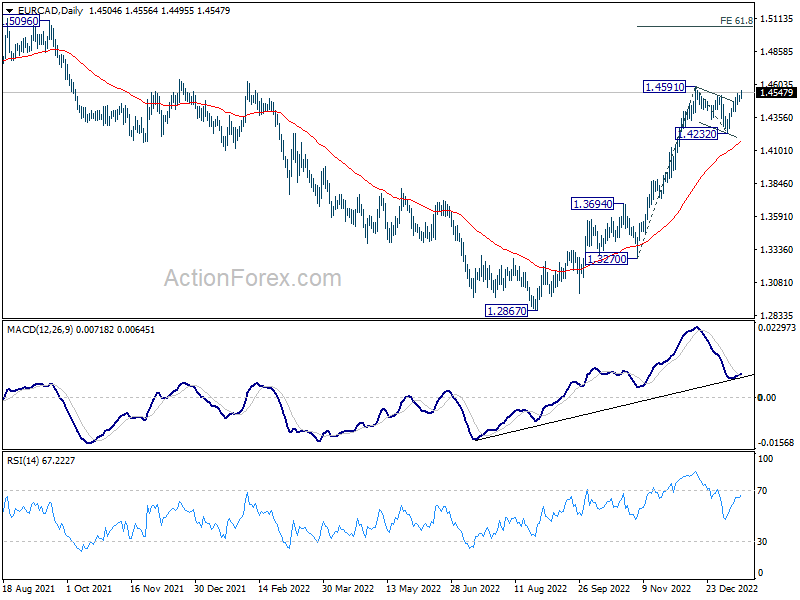
Technically, following up on GBP/CAD, breach of 1.6433 minor resistance argues that pull back from 1.6846 might have completed at 1.6099 already. Further rise should be seen to retest 1.6846 high. Firm break there will resume larger rally from 1.4069. At the same time, EUR/CAD might even lead the way by breaking through 1.4591 resistance. In that case, rise from 1.2867 should be resuming for 61.8% projection of 1.3270 to 1.4591 from 1.4232 at 1.5048.
In Europe, at the time of writing, FTSE is down -0.14%. DAX is down -0.04%. CAC is up 0.09%. Germany 10-year yield is down -0.0088 at 2.167. Earlier in Asia, Nikkei rose 1.23%. Hong Kong HSI dropped -0.78%. China Shanghai SSE dropped -0.10%. Singapore Strait Times dropped -0.09%. Japan 10-year JGB yield dropped -0.0105 to 0.504.
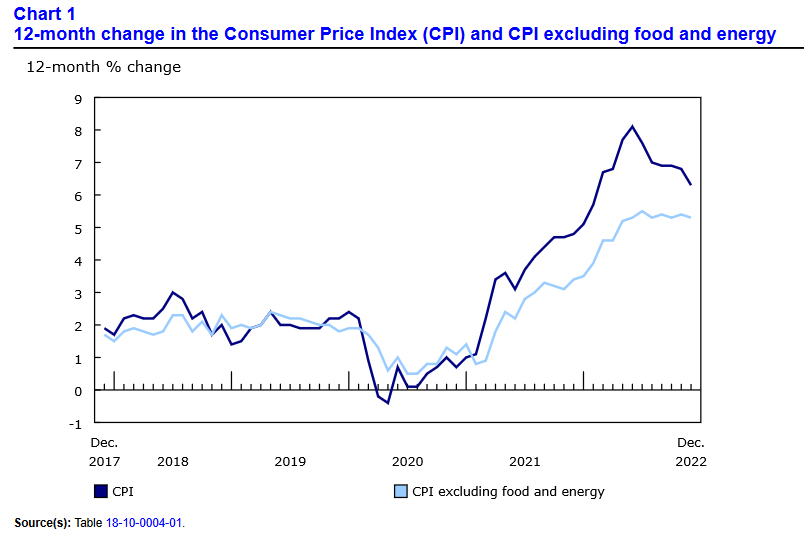
Canada CPI slowed to 6.3% yoy, core down to 5.3% yoy
Canada CPI slowed from 6.8% yoy to 6.3% yoy in December, matched expectations. Excluding food and energy, CPI Core slowed from 5.4% yoy to 5.3% yoy.
CPI median dropped from 5.1% yoy to 5.0% yoy, above expectation of 4.9% yoy. CPI trimmed dropped from 5.4% yoy to 5.3% yoy, above expectation of 5.2% yoy. CPI common dropped from 6.8% yoy to 6.6% yoy, matched expectations.
On a monthly basis, CPI dropped -0.6% mom, largest monthly decline since April 2020. The fall was mostly driven by gasoline prices, which also posted their largest monthly decline since April 2020.
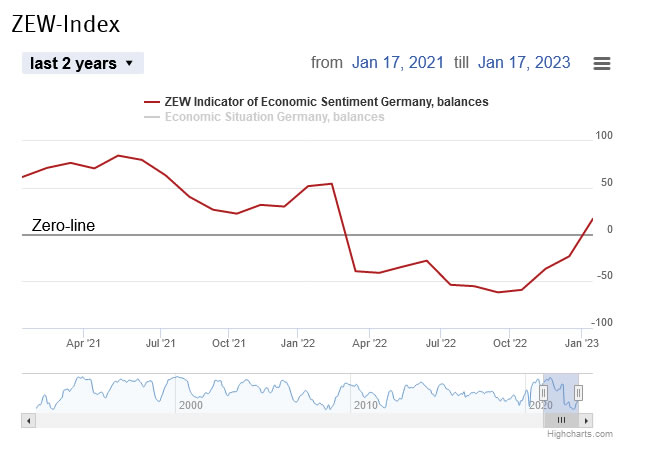
Germany ZEW jumped to 16.9, positive again after a year
Germany ZEW Economic Sentiment jumped sharply from -23.3 to 16.9 in January, well above expectation of -15.5. That's also the first positive reading in a year since February 2022. Current Situation improved from -61.4 to -58.6, below expectation of -57.0.
Eurozone ZEW Economic Sentiment surged from-23.6 to 16.7, well above expectation of -14.3. Current Situation rose 2.6 pts to -54.8.
ZEW President Professor Achim Wambach said: "The ZEW Indicator of Economic Sentiment signals a positive outlook again in January. For the first time since February 2022, the month in which the war in Ukraine began, the indicator points to a noticeable improvement in the economic situation over the next six months.
"The more favourable situation on the energy markets and the German government's energy price caps have contributed to this in particular. In addition, export conditions for the German economy are improving due to China's lifting of Covid-restrictions.
"Accordingly, the earnings expectations of the export-oriented and energy-intensive sectors have gone up significantly. The prospect that the inflation rate will continue to fall has brightened expectations for the consumer-related sectors."
ECB Lane: Interest rates have to be higher under vast majority of scenarios
ECB Chief Economist Philip Lane said in an FT interview published today, "we're not yet at the level of interest rates needed to bring inflation back to 2 per cent in a timely manner", and "it still requires work".
Under the "vast majority" of the scenarios, "interest rates do have to be higher than they are now". "Risks are not yet two-sided, and under a wide range of scenarios, it's still safe to bring interest rates above where they are now," he said.
"The question is how do you get from mid-threes at the end of 2023 to the 2% target in a timely manner," Lane said. "That's where interest rate policy is going to be important... to make sure that the last kilometer of returning to target is delivered."
Lane also noted, the self-reinforcing low inflation environment in Eurozone was gotten rid of as a "byproduct" of the inflation shock. He added, "the chronic low-inflation equilibrium we had before the pandemic will return."
ECB Centeno: The economy surprises quarter after quarter
ECB Governing Council member Mario Centeno said, at a panel at the World Economic Forum, the a recession is not a foregone conclusion.
The Eurozone economy "has been surprising us quarter after quarter," he said. "The fourth quarter in Europe will be most likely still positive. Maybe we'll be surprised also in the first half of the year."
Meanwhile, Centeno pledged that ECB will continue to fight inflation.
UK payrolled employment rose 28k in Dec, unemployment rate unchanged at 3.7% in Nov
In December, UK payrolled employment rose 28k or 0.1% mom to 29.9m. That's a rise of 2.3% yoy or 676k over the 12-month period. ONS also noted that the number employees were rising in line with pre-pandemic trends. Median monthly pay rose 7.7% yoy to GBP 2194. Claimant count rose 19.7k.
In the three months November, unemployment rate was at 3.7%, 0.2% points higher than the previous three-month period, but 0.3% below pre-pandemic levels. Employment rate was unchanged at 75.6%. Economic inactivity rate was down -0.1% to 21.5%. Both average earnings including bonus and excluding bonus rose 6.4% 3moy.
China GDP growth slowed to 2.9% yoy in Q4, but beat expectations
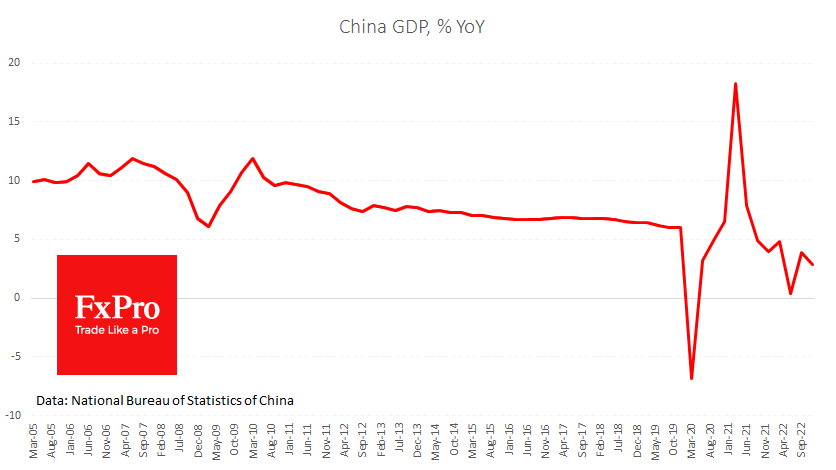
China's GDP growth slowed to 2.9% yoy in Q4, down from Q3's 3.9% yoy but beat expectation of 1.8% yoy. For 2022 as a whole, GDP grew 3.0%, sharply lower than 2021's 8.4%, but was better than 2020's 2.2%. That's still the second worst on record nonetheless.
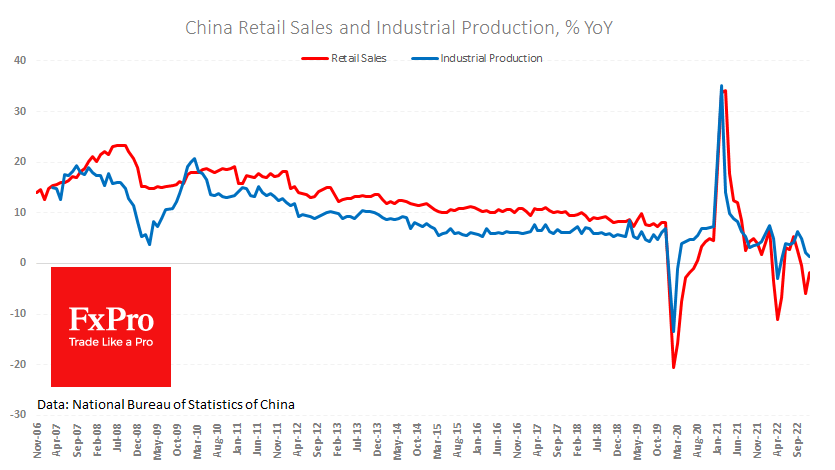
In December, industrial production rose 1.3% yoy, above expectation of 0.3% yoy. Retail sales declined -1.8% yoy, much better than expectation of -9.5% yoy. Fixed asset investment grew 5.1% ytd yoy, above expectation of 5.1%.
"The foundation of domestic economic recovery is not solid as the international situation is still complicated and severe while the domestic triple pressure of demand contraction, supply shock and weakening expectations is still looming," NBS said in a release.
Also released, China's population decreased by -850k in 2022, the first contraction in more than six decades. Birthrate was at 6.77 births per 1000 people, sharply down from 2021's 7.52 births, and marked the lowest level on record. Death rate rose from 7.18 to 7.37 per 1000 people, highest since 1976.
NZ NZIER business sentiment hit record low
New Zealand NZIER Quarterly Survey of Business Opinion showed, in Q4 on a seasonally adjusted basis, a net 73% of businesses expect general economic conditions to deteriorate over the coming months. That's the worst level in the survey's history.
A net 13% of businesses reported a decline in their own activity over the past quarter, worst since Q2 2020 during the full impact of the first pandemic lockdown. A net 33% expected decline in activity in the coming quarter.
"Firms have also reduced investment plans substantially, particularly when it comes to investment in buildings," NZIER said. Retail businesses were feeling "very downbeat", it found.
Australia Westpac consumer sentiment rose 5% in Jan
Australia Westpac Consumer Sentiment rose 5.0% mom to 84.3 in January, the largest monthly gain since April 2021. It's also the second straight month of improvement, with combined rise of 8.1%. Current Conditions index rose 2.8% mom while Expectations Index rose 6.3% mom. Unemployment Expectations also improved 8.4% mom.
Westpac said: "One likely explanation for the lift in confidence is that January was the first month since April last year that did not see an increase in the RBA cash rate. While that was because there was no RBA Board meeting in the month rather than an explicit decision by the Bank to leave rates unchanged, the break in the tightening cycle looks to have provided some relief."
Regarding RBA rate decision, Westpac expects another 25bps hike on February. It also expects clear message from RBA that the February increase will not be the last in the tightening cycle, because of a lift in annual inflation, strong retail sales growth and ongoing tight labor market.
GBP/USD Mid-Day Outlook
Daily Pivots: (S1) 1.2150; (P) 1.2219; (R1) 1.2267; More...
GBP/USD's rise from 1.1840 resumed by breaking 1.2288 temporary top. Intraday bias is back on the upside for retesting 1.2445. Decisive break there will resume whole rally from 1.0351 to 1.2759 fibonacci level. On the downside, break of 1.2168 minor support will turn intraday bias neutral again.
In the bigger picture, rise from 1.0351 medium term bottom is at least correcting whole down trend from 1.4248 (2021 high). Further rise is expected as long as 1.1644 resistance turned support holds. Next target is 61.8% retracement of 1.4248 to 1.0351 at 1.2759. Sustained break there will pave the way back to 1.4248.
Economic Indicators Update
| GMT | Ccy | Events | Actual | Forecast | Previous | Revised |
|---|---|---|---|---|---|---|
| 21:00 | NZD | NZIER Business Confidence Q4 | -70 | -42 | ||
| 23:30 | AUD | Westpac Consumer Confidence Jan | 5.00% | 3.00% | ||
| 02:00 | CNY | GDP Y/Y Q4 | 2.90% | 1.80% | 3.90% | |
| 02:00 | CNY | Industrial Production Y/Y Dec | 1.30% | 0.30% | 2.20% | |
| 02:00 | CNY | Retail Sales Y/Y Dec | -1.80% | -9.50% | -5.90% | |
| 02:00 | CNY | Fixed Asset Investment YTD Y/Y Dec | 5.10% | 5.00% | 5.30% | |
| 04:30 | JPY | Tertiary Industry Index M/M Nov | -0.20% | 0.20% | 0.20% | 0.50% |
| 07:00 | GBP | Claimant Count Change Dec | 19.7K | 19.8K | 30.5K | |
| 07:00 | GBP | ILO Unemployment Rate (3M) Nov | 3.70% | 3.70% | 3.70% | |
| 07:00 | GBP | Average Earnings Including Bonus 3M/Y Nov | 6.40% | 6.10% | 6.10% | |
| 07:00 | GBP | Average Earnings Excluding Bonus 3M/Y Nov | 6.40% | 6.30% | 6.10% | |
| 07:00 | EUR | Germany CPI M/M Dec F | -0.80% | -0.80% | -0.80% | |
| 07:00 | EUR | Germany CPI Y/Y Dec F | 8.60% | 8.60% | 8.60% | |
| 10:00 | EUR | Germany ZEW Economic Sentiment Jan | 16.9 | -15.5 | -23.3 | |
| 10:00 | EUR | Germany ZEW Current Situation Jan | -58.6 | -57 | -61.4 | |
| 10:00 | EUR | Eurozone ZEW Economic Sentiment Jan | 16.7 | -14.3 | -23.6 | |
| 13:15 | CAD | Housing Starts Y/Y Dec | 249K | 265K | 264K | 263K |
| 13:30 | CAD | CPI M/M Dec | -0.60% | -0.60% | 0.10% | |
| 13:30 | CAD | CPI Y/Y Dec | 6.30% | 6.30% | 6.80% | |
| 13:30 | CAD | CPI Median Y/Y Dec | 5.00% | 4.90% | 5.00% | 5.10% |
| 13:30 | CAD | CPI Trimmed Y/Y Dec | 5.30% | 5.20% | 5.30% | 5.40% |
| 13:30 | CAD | CPI Common Y/Y Dec | 6.60% | 6.60% | 6.70% | 6.80% |
| 13:30 | USD | Empire State Manufacturing Index Jan | -32.9 | -8.2 | -11.2 |
China Smashed Expectations for the Economy, But that Hasn’t Stopped the Yuan’s Correction
An extensive package of statistics from China showed a much better economy than the average analysts had expected. But this set of economic surprises failed to affect the renminbi, which is falling for a second day, having lost 1.4% in the meantime.
China’s economy grew by 3% last year (2.7% was expected). GDP was virtually unchanged for the fourth quarter, although a decline of 0.8% was expected, which is a considerable difference between expectation and fact.
The high-frequency data for retail trade and industrial production also exceeded expectations. The industrial production index in December was 1.3% higher than a year earlier. Since the start of the year, production has risen by 3.6%. Retail sales last month were 1.8% lower than a year earlier but were expected to fall by 9.5% y/y.
The unemployment rate fell from 5.7% to 5.5%, contrary to analysts’ forecasts that it would remain unchanged.
Often such a divergence triggers an impulse to buy currencies on the back of capital inflows into domestic assets. But this time, the markets have quietly digested the difference, developing a second day of a technical rebound in the renminbi after the 9% rally from the beginning of November to the peak at the end of last week.
So far, the movement of the last two days has resembled a “buy the rumour, sell the news” style technical bounce, as investors ramped up their investments in the yuan late last year, betting on a turnaround to greater openness.
And this bet is working on several fronts across a broad spectrum of activity, from abandoning the 0-covid policy to easing for the technology sector. On top of that, we are seeing a softening of rhetoric from trade representatives and a pumping of liquidity into the financial system. Simply put, China has comprehensively taken up economic growth stimulus to regain some of the appeal for investors that it has been losing in several waves since 2018.
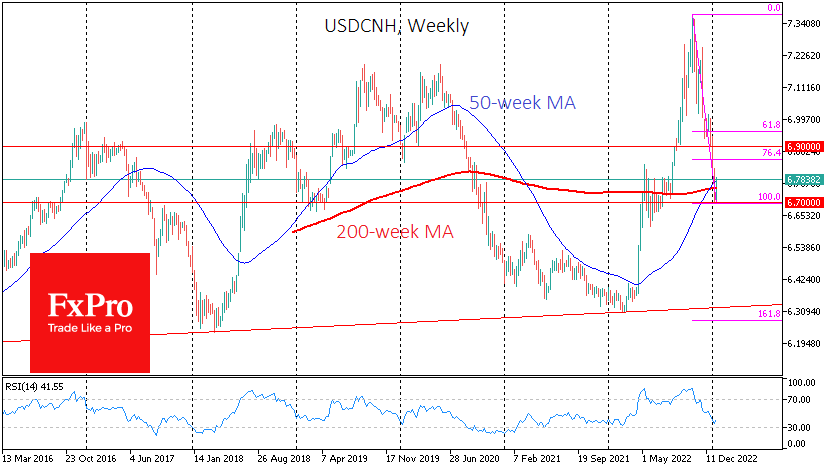
The USDCNH exchange rate is consolidating near the 50- and 200-week averages after collapsing from 7.35 to 6.71 in just over two months. The exchange rate reduced near these same levels from May to August 2022 and found support in early 2019. Therefore, another potentially prolonged stop here is a probable scenario.
A market shakeout could lift USDCNH to 6.86-6.90 before we see a new reversal to the downside. At the same time, this would remove the short-term overbought yuan on FX and provide some impetus to the economy through exports.
If China supports the economy and opens up to investors in the coming weeks, capital inflows into the renminbi could continue. In that case, the USDCNH could return to 6.25-6.35, where multi-year lows and the 161.8% Fibonacci level from the last rally of the Chinese currency are concentrated.
EUR/USD Drifting, Eurozone Inflation Next
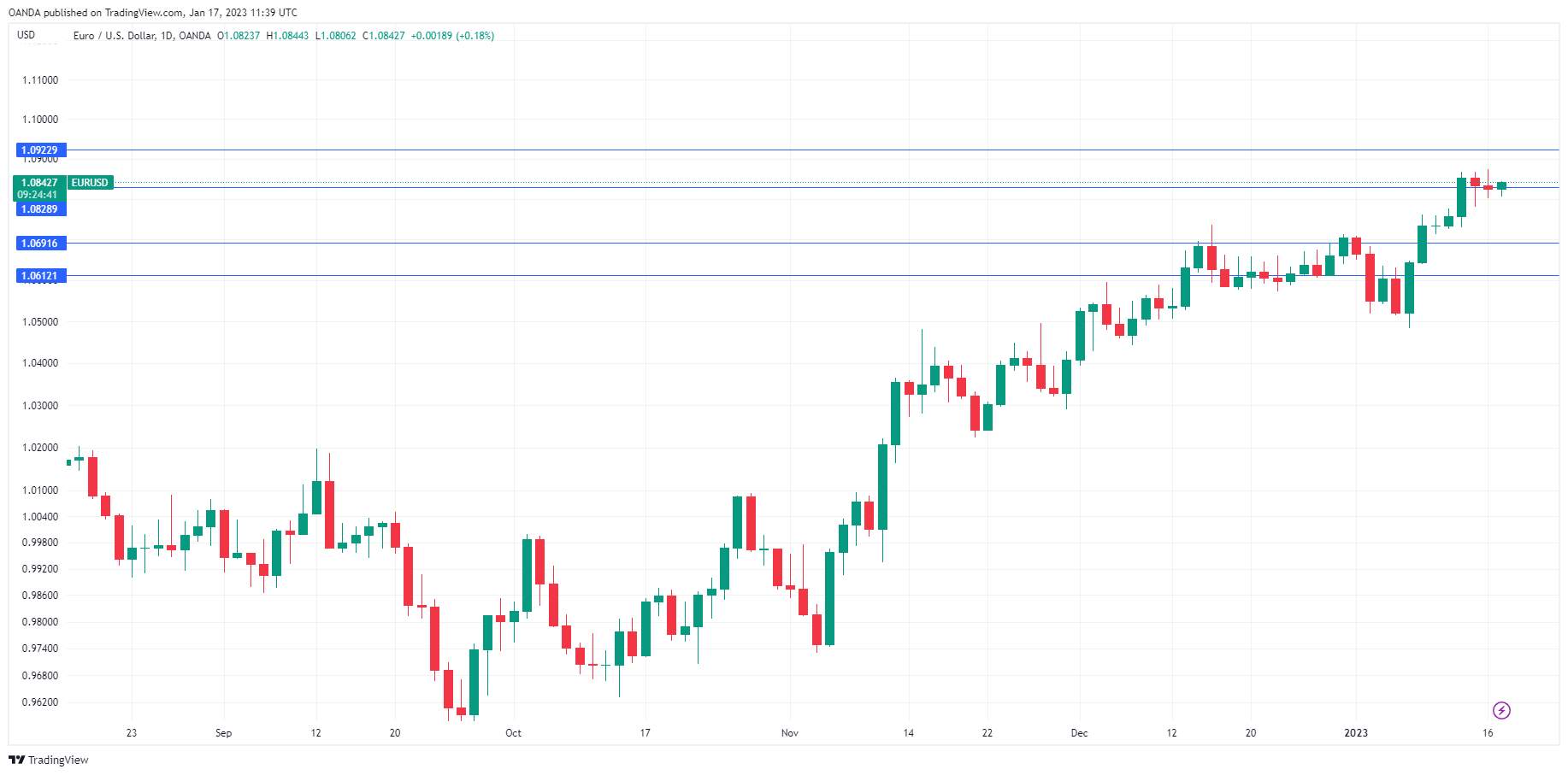
The euro continues to drift this week and is trading close to the 1.0820 line. This follows last week’s sharp gains of 1.8%.
German inflation falls – will eurozone follow suit?
German Final CPI came in at -0.8% m/m in December, matching the forecast and unchanged from November. The annual average in 2022 was 7.9%, compared with just 3.1% in 2021. No big surprise here – inflation soared in 2022, driven mainly by the extreme rise in energy and food prices due to the war in Ukraine. Inflation climbed to 10.4% y/y in October but has been falling and dropped to 8.6% in December. The downtrend is expected to continue into 2023, as energy prices have fallen and the government has introduced relief measures such as fuel discounts.
This sets the stage for the Eurozone inflation release on Wednesday. Inflation has been falling, but the forecast has inflation remaining steady in December: 9.2% for headline inflation and 5.2% for the core rate. The economic outlook for the bloc has also improved. Last week, Goldman Sachs revised upwards its 2023 GDP forecast for the eurozone from -0.1% to a small gain of 0.6%. The sunnier outlook has lifted confidence numbers. Germany’s ZEW Economic Sentiment improved to 16.9 in January, up from -23.3 in December and above the consensus of -15.5 points. The eurozone release had similar numbers, pointing to stronger confidence.
The ECB is no doubt pleased to see stronger data but is unlikely to change its hawkish stance, which includes further rate hikes in the coming months. Inflation may have peaked, but it remains much higher than the ECB’s target of 2%, and the central bank will not pivot until inflation has dropped further, even if that means a recession in the eurozone. Like other central banks, the ECB wants to avoid, at all costs, inflation expectations becoming unanchored, which would complicate its efforts to reduce inflation.
EUR/USD Technical
- EUR/USD is testing resistance at 1.0829. Above, there is resistance at 1.0921
- 1.0691 and 1.0612 are supporting support
Canada CPI slowed to 6.3% yoy, core down to 5.3% yoy
Canada CPI slowed from 6.8% yoy to 6.3% yoy in December, matched expectations. Excluding food and energy, CPI Core slowed from 5.4% yoy to 5.3% yoy.
CPI median dropped from 5.1% yoy to 5.0% yoy, above expectation of 4.9% yoy. CPI trimmed dropped from 5.4% yoy to 5.3% yoy, above expectation of 5.2% yoy. CPI common dropped from 6.8% yoy to 6.6% yoy, matched expectations.
On a monthly basis, CPI dropped -0.6% mom, largest monthly decline since April 2020. The fall was mostly driven by gasoline prices, which also posted their largest monthly decline since April 2020.
USD/JPY – Calm Before the Storm?
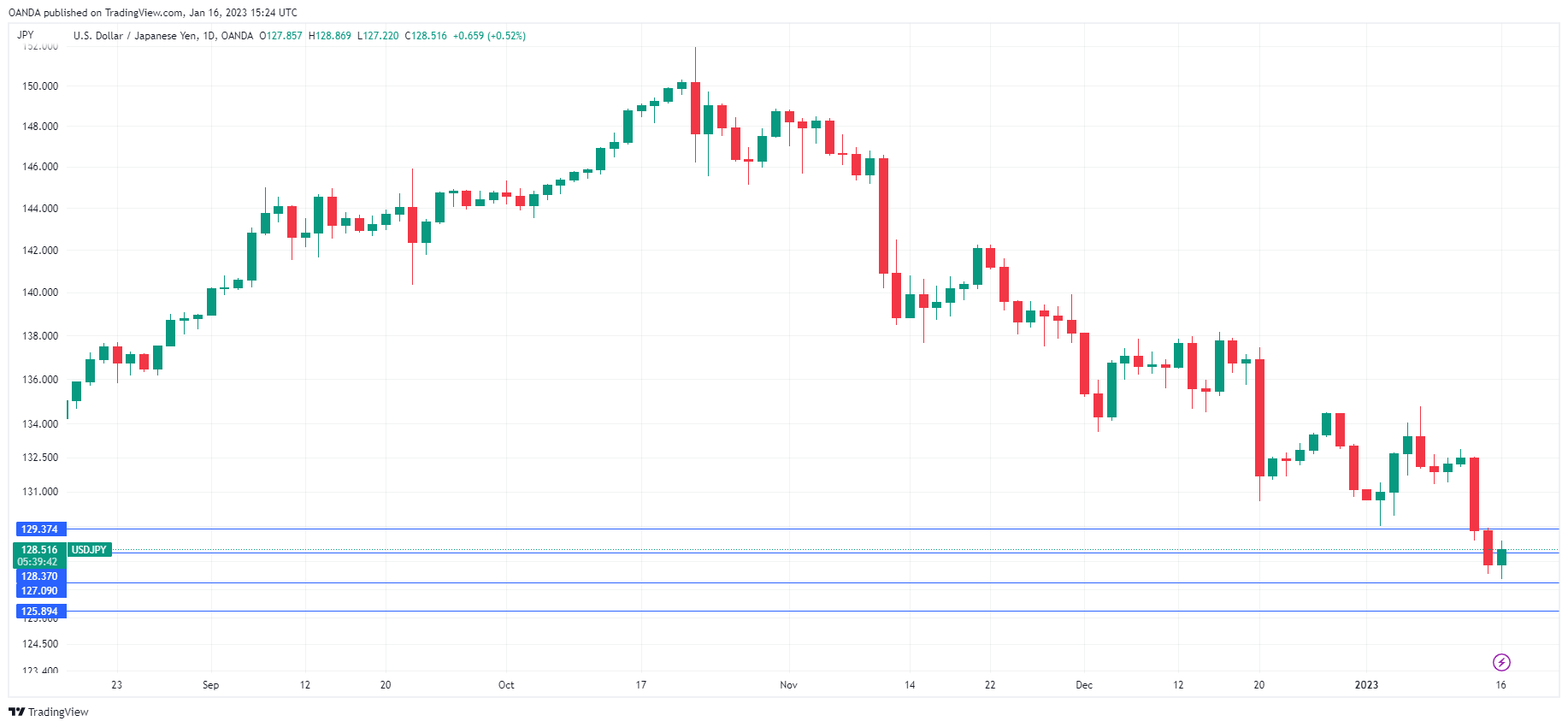
The Japanese yen is in calm waters on Tuesday, as the Bank of Japan’s two-day meeting starts today. In the European session, USD/JPY is trading at 128.76, up 0.18%.
Markets eye BOJ meeting
The markets are keeping a close eye on the BOJ meeting. The central bank shocked the markets at the December meeting with a policy tweak that widened the bank around 10-year JBs to 0.50%, up from 0.25%. The speculation that the BOJ could follow through with additional moves at this meeting has pushed USD/JPY back below the 130 level. On Monday, USD/JPY touched 127.21, its lowest level since May.
It seems likely that further moves are coming from the BOJ, but it’s unclear whether the BOJ will announce the changes on Wednesday or will wait until the new BOJ Governor takes over in April. Unlike the Fed, the BOJ appears to have no interest in telegraphing its plans and is keeping mum, which is making this meeting that much more dramatic. I expect to see some volatility from USD/JPY on Wednesday – if the BOJ does make any policy tweaks, the yen will likely continue to improve. Conversely, if the BOJ maintains the status quo, traders will be disappointed at the lack of action and the yen would likely lose ground.
The BOJ has spent over six trillion yen ($86 billion) since Friday to defend its new 0.50% cap on 10 JGB, as sellers continue to flood the bond market. The central bank could widen the band to 0.75% or make a radical change and discard its yield curve control altogether. Let’s not forget that the BOJ is expected to increase its inflation forecast at the meeting, which would mark a step closer to normalization and would be bullish for the yen.
USD/JPY Technical
- There is resistance at 129.40 and 130.82
- 128.40 and 127.54 are providing support
EURUSD Renewed Its Highs
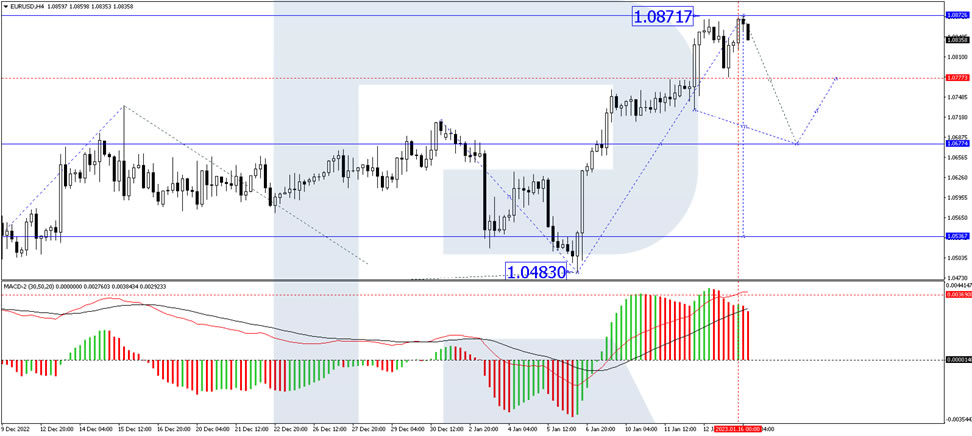
EUR/USD starts this new week of January in a strong position. It is mainly fluctuating near 1.0855, which is very close to five-month highs. After the market got at hand some facts about a slow-down of the US inflation, dollar got under fierce attacks. This time, investors abandoned the "but on rumors, sell on facts" strategy and went on getting rid of the USD.
Market participants suppose that some positive signals from the background will let the Fed launch the final phase of the tight monetary policy.
Investors estimate the increase in the interest rate, expected by the market in February, as 25 base points. This is forecast by almost 92% of the poll participants.
On H4, EUR/USD has completed a wave of growth to 1.0871. Today the market is forming an impulse of decline to 1.0777. Practically, a consolidation range is likely to develop at these levels. With an escape downwards, a wave of decline should continue to 1.0677. Technically, this scenario is confirmed by the MACD: its signal line is at the highs, getting ready for a decline to zero.
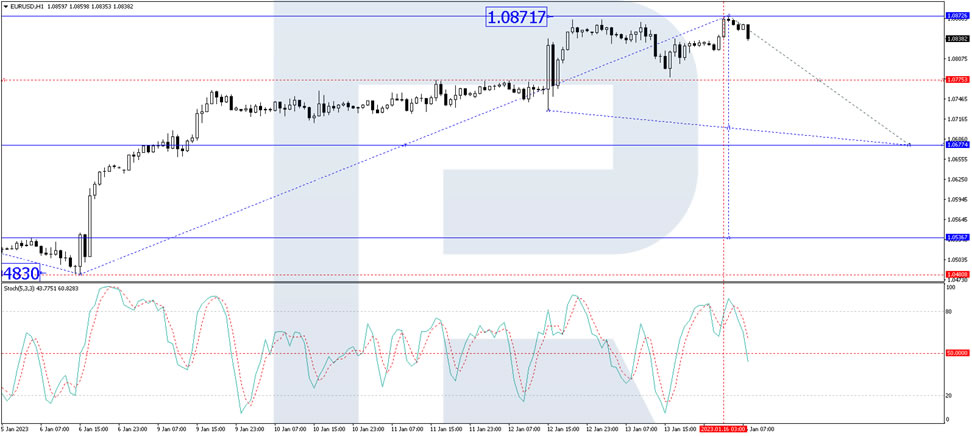
On H1, the pair has formed a structure of a wave of growth to 1.0872. Today the market is developing the first wave of decline to 1.0775. After this level is reached, a link of correction to 1.0808 is not excluded, followed by a decline to 1.0677. Technically, this scenario is confirmed by the Stochastic oscillator. Its signal line is above 80. A decline to 50 is expected. With a breakaway downwards here, a pathway for 20 will open.
Germany ZEW jumped to 16.9, positive again after a year
Germany ZEW Economic Sentiment jumped sharply from -23.3 to 16.9 in January, well above expectation of -15.5. That's also the first positive reading in a year since February 2022. Current Situation improved from -61.4 to -58.6, below expectation of -57.0.
Eurozone ZEW Economic Sentiment surged from-23.6 to 16.7, well above expectation of -14.3. Current Situation rose 2.6 pts to -54.8.
ZEW President Professor Achim Wambach said: "The ZEW Indicator of Economic Sentiment signals a positive outlook again in January. For the first time since February 2022, the month in which the war in Ukraine began, the indicator points to a noticeable improvement in the economic situation over the next six months.
"The more favourable situation on the energy markets and the German government's energy price caps have contributed to this in particular. In addition, export conditions for the German economy are improving due to China's lifting of Covid-restrictions.
"Accordingly, the earnings expectations of the export-oriented and energy-intensive sectors have gone up significantly. The prospect that the inflation rate will continue to fall has brightened expectations for the consumer-related sectors."