Sample Category Title
ECB de Cos: We plan to continue increasing interest rates significantly in the next meetings
ECB Governing Council member Pablo Hernandez De Cos said yesterday, "we plan to continue increasing interest rates significantly in the next meetings." Also, tightening will continue "until reaching sufficiently restrictive levels to ensure that the inflation returns to the 2% target over the medium term."
"Keeping interest rates at tight levels will reduce inflation by dampening demand and will also protect against the risk of a persistent upward shift in inflation expectations", he explained.
De Cos also noted that Since last meeting, markets have raised the expected terminal rate by 30bps to 3.4%. However, market rates incorporated a positive premium, and "the market's genuine expectation of what the maximum level of the deposit facility rate would be is somewhat below that figure."
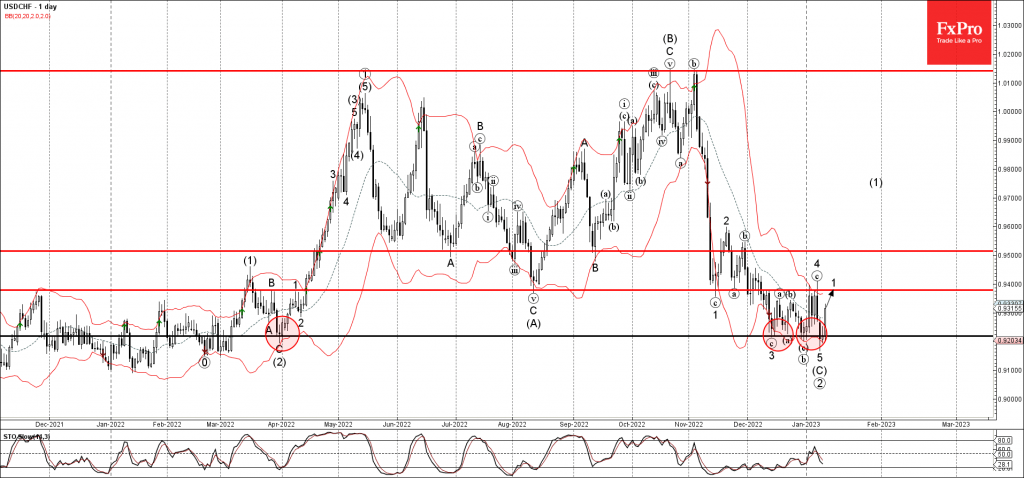
USDCHF Wave Analysis
- USDCHF rising inside impulse wave 1
- Likely to reach resistance level 0.9400
USDCHF continues to rise inside the active impulse wave 1, which previously started from the powerful support level 0.9220 (which has been reversing the price from the end of March) – strengthened by the lower daily Bollinger Band.
The upward reversal from the support level 0.9220 created the daily Japanese candlesticks reversal pattern Morning Star.
USDCHF can be expected to rise further toward the next resistance level 0.9400 (forecast price for the completion of the active impulse wave 1).
EURGBP Tries to Clear the 0.8870 Resistance
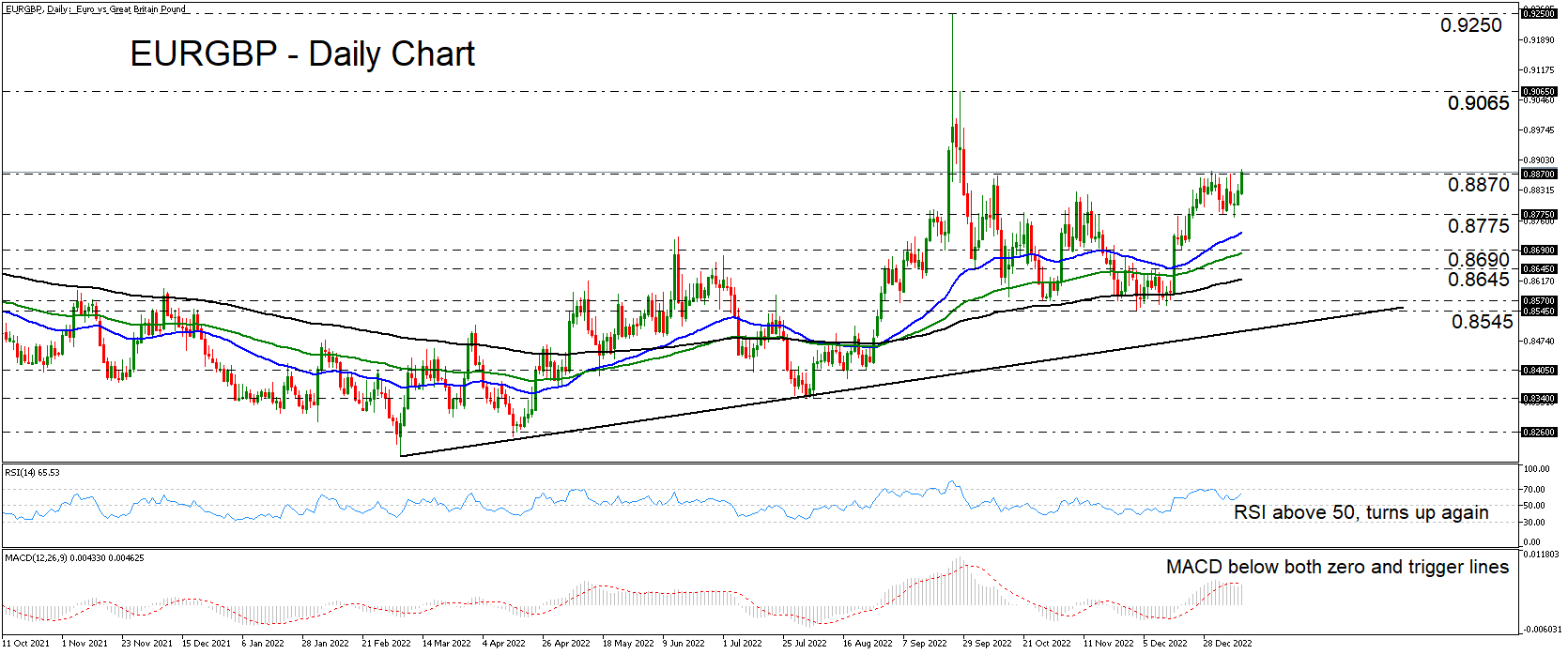
EURGBP rebounded this week, after it found support near the 0.8775 barrier, marked by the low of January 4. Currently, the bulls are trying to emerge above the key resistance zone of 0.8870, the break of which could carry larger bullish implications. In the bigger picture, the pair is trading above all three of the plotted moving averages and well above the uptrend line drawn from the low of March 7, technical signs of a positive medium-term outlook.
The RSI, already above 50, has turned up again, while the MACD, although below its trigger line, is lying well above zero and shows signs it could cross back above its trigger line soon. Both indicators detect upside momentum and corroborate the case for some further near-term advances.
A clear and decisive break above 0.8870 would confirm a higher high and may set the stage for extensions all the way up to the peak of September 28 at 0.9065. If the bulls are not willing to abandon the action there, they may decide to continue climbing higher, perhaps aiming for the high of September 26 at 0.9250.
On the downside, a break below 0.8775 could signal the beginning of a decent correction, perhaps towards the 0.8690 or 0.8645 territory. However, as long as EURGBP trades above the uptrend line drawn from the low of March 7, the bigger picture might still be positive. The move signaling that the bears have stolen the bulls’ swords may be a clear dip below the crossroads of that uptrend line and the 0.8545 barrier, marked by the low of December 1.
To sum up, EURGBP is trading well above a medium-term uptrend line and is now trying to emerge above 0.8870. A decisive move higher would confirm a higher high and may see scope for larger bullish extensions.
Bitcoin Keeps Bullish Bias But Daily Cloud Limits the Action for Now
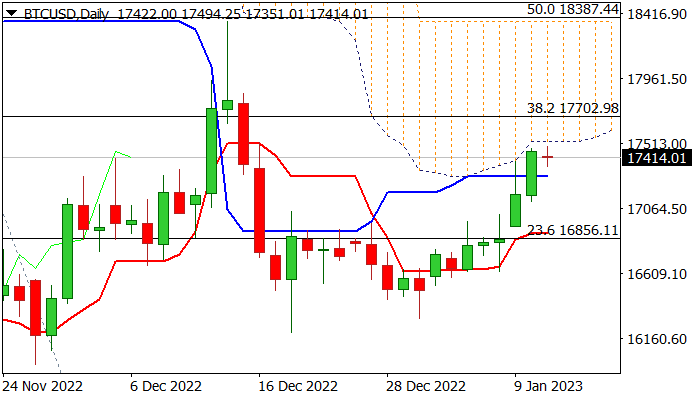
Bitcoin is trading in a quiet mode on Wednesday, after rally in past two days faced headwinds from the base of thick daily cloud (1752), reinforced by Fibo 61.8% of 1863/1620 bear-leg.
Overbought conditions on daily chart also contribute to current conditions, although near-term bias remains with bulls, as positive momentum is still strong and DMA’s (10/20/30) are in bullish configuration.
Bullish scenario requires firm penetration into daily cloud which would bring in focus next key barrier at 1836 (cloud top / Dec 14 high / 50% retracement of 2128/1548 fall) and signal bullish continuation of recovery from 2022 low (1548).
Repeated failure under daily cloud would increase downside risk, but near-term structure should keep positive stance above rising 10DMA (1689) which today formed a bullish cross with 20DMA).
Res: 1752; 1770; 1810; 1838
Sup: 1714; 1689; 1630; 1620
ECB Rehn: Policy rates will still have to rise significantly
ECB Governing Council member Olli Rehn said, "Policy rates will still have to rise significantly... This means significant rate hikes at this winter's remaining meetings."
Though he also admitted that it's a fair argument that it takes time to reverse the a decade of stimulus.
"With the benefit of hindsight, there may be some truth in this argument, at least from the standpoint that we could thus have created more policy space to react if the euro zone economy falls into recession," Rehn said.
Sunset Market Commentary
Markets
We didn’t find a specific driver, but UK Gilts are significantly outperforming German Bunds and US Treasuries today. Yesterday’s prediction by the Centre for Economics and Business Research did gain more attention in media. It suggested that falling natural gas prices may shave £13bn off the UK Treasury’s spending. UK yields cede 5.1 bps (2-yr) to 15.5 bps (30-yr). Changes on the German curve range between -2.5 bps (2-yr) and -7.9 bps (30-yr) while US yields drop up to 5.2 bps (30-yr). 10-yr yield spreads vs Germany drop 4 to 5 bps with Italy (-7 bps) and Greece (-10 bps) outperforming. We face difficulties in understanding the market rationale these days. Overall risk sentiment remains positive, contributed to less pessimistic economic outlooks and the Chinese economic reopening. Main European stock markets add another 1% today with global commodity prices rising 1% and more (energy) as well. It’s hard to interpret the core bond moves in this context, which seem to be zooming in on declining (headline) inflation. If anything, we think that more economic resilience will longer support economic demand and thus keep inflation relatively higher, allowing central banks to keep monetary policy more restrictive than in case of bad economic weather. An easing of global financial conditions (lower rates, higher stocks, weaker dollar, smaller credit spreads) also suggests that central banks might have to err on the hawkish side of expectations. For those reasons (and others), we advise against buying into the core bond rally while acknowledging their momentum.
Sterling loses out against other majors because of the loss of yield support. EUR/GBP is currently testing the 0.8867/77 resistance. The probability of a break increases, paving the way to the 0.90+ area. GBP/USD falls back from 1.2175 towards 1.21. The euro and the dollar kept each other more or less in balance though the equilibrium is extremely delicate. FI and FX markets are positioning for another US CPI inflation decline tomorrow. At EUR/USD 1.0765, the pair remains within the resistance area between 1.0735/47/61/87. ECB and Fed speeches and the empty eco calendar helped sustaining this subtle balance. The US Treasury continues its mid-month refinancing operation tonight with a $40bn 10-yr Note auction. Yesterday’s $40bn 3-yr sale met with stellar demand. On Thursday, the Treasury concludes with a $18bn 30-yr Bond.
News Headlines
Czech inflation was slightly softer than expected in December. Prices stabilized on a M/M basis, resulting in a decline in the Y/Y rate to 15.8%, down from 16.2%. According to the Czech statistical office average inflation over 2022 was 15.1%. However, on a monthly basis, there was quite a big divergence within different price categories of the consumer basket. Prices for transport declined 3.1% M/M with fuels and lubricants for domestic transport declining 10.5% M/M. Prices of alcoholic beverages and tobacco also declined 1.3% M/M. On the other hand, prices of housing, water, electricity and gas rose 0.4% M/M. Prices in recreation and culture also gained 0.9% M/M. In aggregate prices of good eased 0.2% M/M. Services went up by 0.3% M/M. The Czech national bank in its December policy statement indicated inflation to soften in the October/December period due to the methodology for including the electricity savings tariff. Still the CNB expected inflation to reach a cycle peak toward the 20% area in January. The Czech 2-y swap yield eased 8 bps today. The krone slightly underperformed the region with EUR/CZK rebounding north of 24 (24.02).
Hungary posted a budget deficit of HUF 1287bn in December, bringing the full-year deficit to HUF 4753bn. The finance ministry also reconfirmed the target for this year’s budget deficit at 3.9% of GDP. PM Orban already last month indicated that the deficit would be 3.9% rather than the 3.5% indicated earlier. As moderation in fiscal spending is important to ease inflationary pressure. A higher deficit doesn’t help to improve the risk context the MNB considers to be needed to remove exceptional policy measures. The forint weakens slightly today, returning the EUIR/HUF 400 barrier.
All Eyes on the Inflation Report
Investors remain in an upbeat mood going into tomorrow's US inflation report, buoyed still by the December jobs report and the prospect of the economy being less squeezed by interest rates.
Fed Chair Jerome Powell may have refrained from commenting on the monetary policy outlook on Tuesday but the chances are, he wouldn't have said anything investors would have liked even if he had addressed it. It's been clear from other commentaries that policymakers are sticking to the hawkish script.
Another good inflation number tomorrow could change that as the trend has already been very encouraging and the jobs data that appeared to throw a spanner in the works last month has since been revised out. From an investor perspective, it would take something pretty terrible tomorrow - the inverse of what we were treated to on Friday - to really rock the boat.
Buoyed by economic optimism
That optimism appears to be feeding through to the oil market, with Brent and WTI both up more than 2% on the day. It will be interesting to see if they can hold onto those gains considering how they've failed to do so over the last four days. Another failure to do so would make this recovery rally look very weak.
Perhaps that will also hang on the inflation data tomorrow, with another softer reading paving the way for fewer hikes and even cuts later in the year. That would be supportive of the economy and therefore demand, potentially boosting oil prices.
$2,000 in sight?
Gold looks to have entered into a holding pattern ahead of the inflation data after rallying strongly once more in the aftermath of the jobs report. The yellow metal has started the year really strongly, buoyed by lower yields and favourable data, and the CPI numbers tomorrow could be supportive on both of these fronts.
There is significant resistance above at the moment, between $1,880 and $1,920 but if it can overcome this on the back of the CPI data, it could gather further momentum with $2,000 then not far away. An underwhelming report could reinforce that resistance and even trigger a correction.
Building confidence
Bitcoin is missing out on today's risk rally but traders will be relieved by how the last couple of days have gone. It's back above $17,000 and suddenly the mid-December peak doesn't look too far away. Friendly newsflow and a solid CPI number tomorrow could help it gain some momentum from here but I remain sceptical about how much upside can be achieved in an otherwise hostile environment.
Will UK Growth Data Spoil the Pound’s Bounce Back?
Britain’s economy has been on the receiving end of some of the more pessimistic forecasts around for 2023 and Friday’s data dump, due at 07:00 GMT, isn’t anticipated to lift any of the gloom. The monthly output indicators will likely show that the economy went back into contraction in November, even as the Bank of England is expected to hike interest rates by another 50 basis points at its next meeting in February. A poor set of data could scupper the pound’s chances of a meaningful rebound as it struggles to get its three-month old uptrend back on track.
From crisis to crisis
It's been a tough year for UK assets as, fresh out of the pandemic, the country was hit by the energy crisis, spurred by the war in Ukraine. This was then followed by political turmoil where investors lost count of the residents moving in and out of numbers 10 and 11 Downing Street. Whilst it is easy to dismiss the happenings at Westminster over the summer and autumn as nothing more than political drama, the damage inflicted to investor confidence towards the UK economy may outlast the effects of the energy crisis.
Thanks to a relatively mild winter season, worries about a severe energy crunch have not materialized and are not likely to either, at least not this winter. But the UK’s troubles don’t end there as public sector discontent over pay has led to a series of strike actions across the country, with the government being blamed for refusing to negotiate new pay deals. The affected sectors range from transport to the civil service to hospitals.
Grim forecasts
The disruptions are bound to cause a significant dent in GDP output in December, meaning that if the forecasts of negative growth in November turn out to be correct, the UK will almost certainly record two consecutive quarters of contraction, placing it in a technical recession.
For November, the projections are pretty grim. Both services and industrial output are expected to have shrunk over the month, by 0.1% and 0.3%, respectively. Overall output is anticipated to have fallen by 0.2%, reversing some of the 0.5% bounce enjoyed in October.
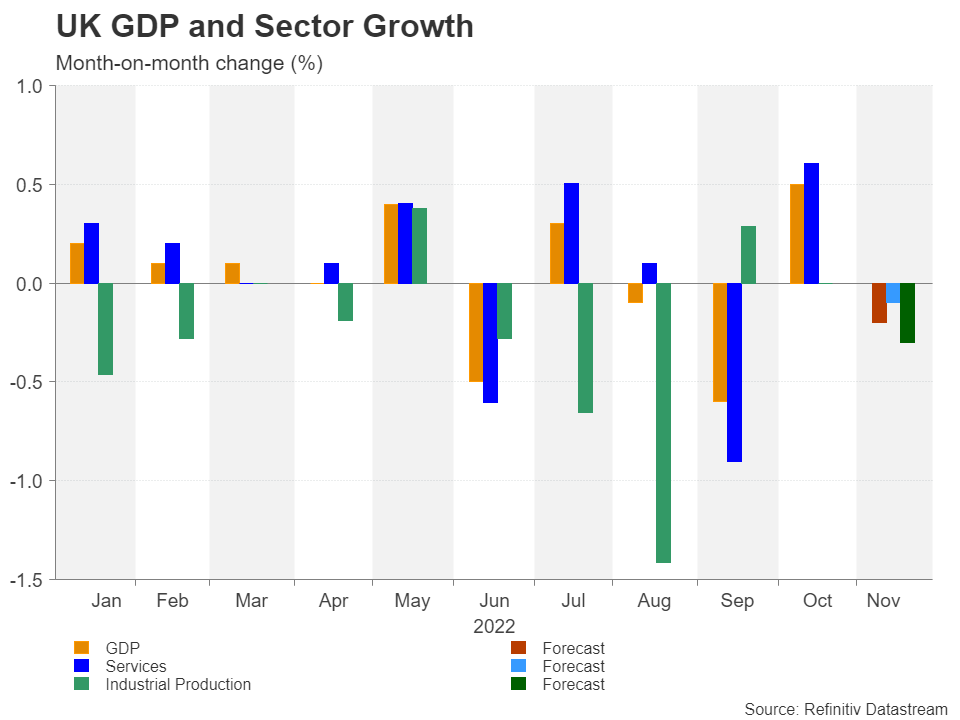
Confidence in the UK is at a low
Some small upside surprises cannot be ruled out in November’s data, but given that GDP has barely grown in the last 12 months, whether there’s still a chance that the UK can avoid a technical recession is unlikely to change the view that the economy has stagnated. The lack of business and economic leadership from the government is a major source of worry for investors, not to mention the increasing tax burden. Thus, when you take out the weakening US dollar out of the equation for cable, the pound doesn’t have much going for it at the moment.
The cost-of-living crisis seems to be hurting UK consumers more than those in other advanced economies. Brexit has had some part to play in this as certain import prices rose after leaving the single market, labour shortages have worsened and exports to the EU have taken a hit. But perhaps the biggest concern is the bleak prospect for consumer spending in 2023. Consumption is the most important engine of economic growth in Britain and as long as households are being squeezed by high inflation and falling real wages, a recovery doesn’t seem imminent.
Squeeze on households could continue well into 2023
In fact, things could get worse in the coming months as rising interest rates push up mortgage costs further and many households currently on fixed mortgages are set to see their installments jump when their fixed-rate loans come up for renewal.
On the plus side, the Bank of England appears to more than recognise the risks that higher rates pose to households with rising mortgages. But at the same time, policymakers might have their hands tied from the tight labour market.
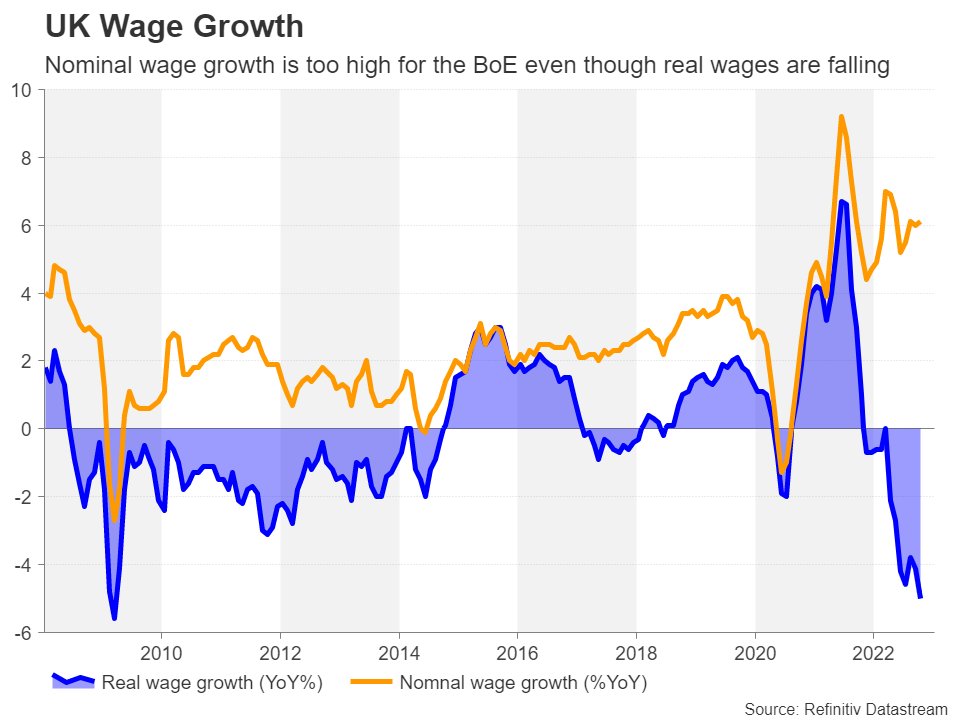
The UK’s labour pool has shrunk in the aftermath of Brexit and the pandemic and unless the government relaxes immigration rules, worker shortages in specific sectors could persist even as the jobless rate ticks higher. The Bank’s chief economist, Huw Pill, warned on Monday that wage pressures and supply-chain problems could make it more difficult for inflation to drop to 2% despite the substantial retreat in energy prices.
Can cable extend its uptrend?
Nevertheless, in the short term, traders might still find cable an attractive buy as long as the dollar stays on the backfoot and there are some positives in the November stats. Having just cleared the obstacles set by the moving averages, the bulls are likely to set their sights on the $1.2445 resistance where the uptrend stalled in mid-December in such a scenario.
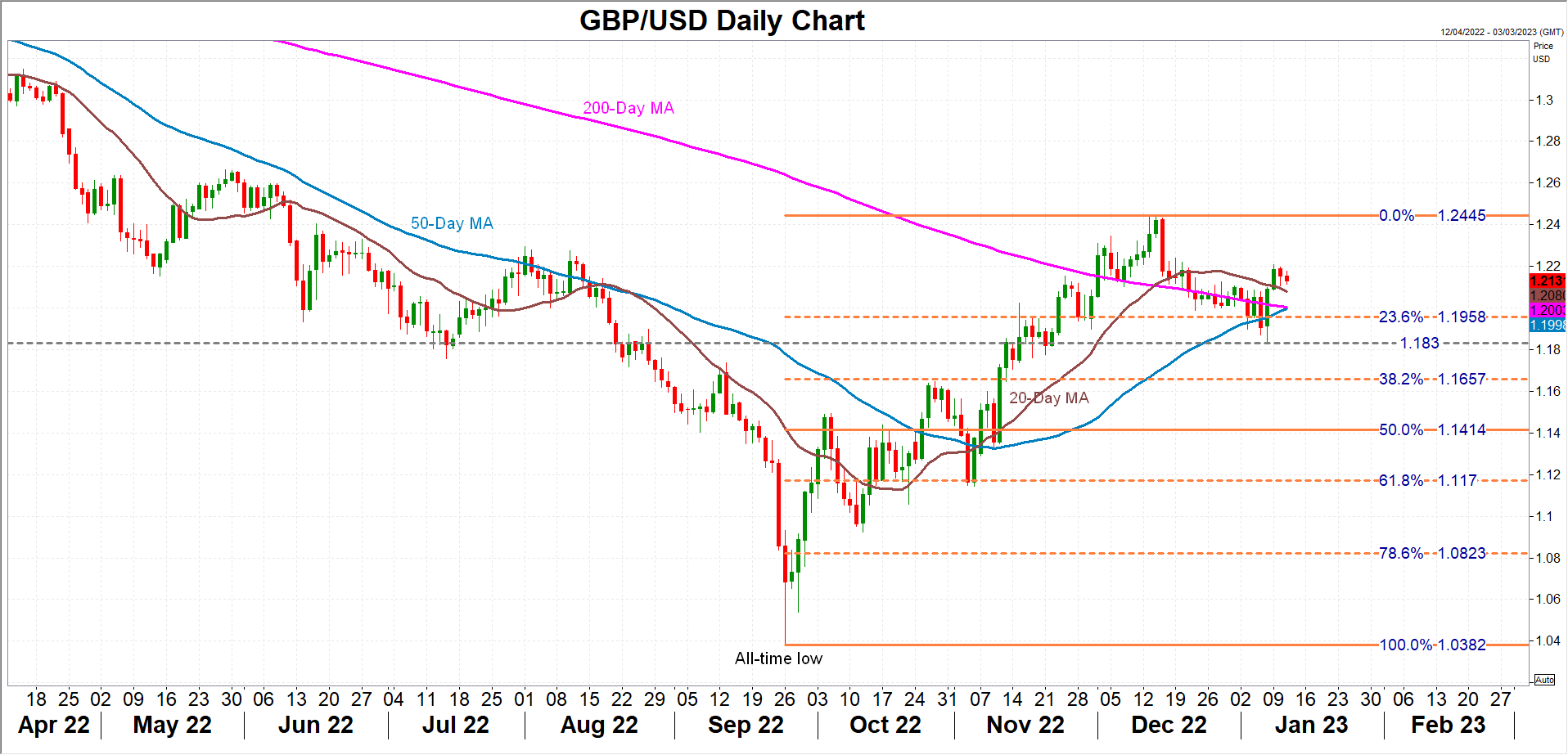
However, if Friday’s data disappoint, amplifying concerns about the UK’s economic prospects, the pound could revisit its recent low of $1.1830. If breached, the 38.2% Fibonacci retracement of the September-December upleg could be the next major support at $1.1657.
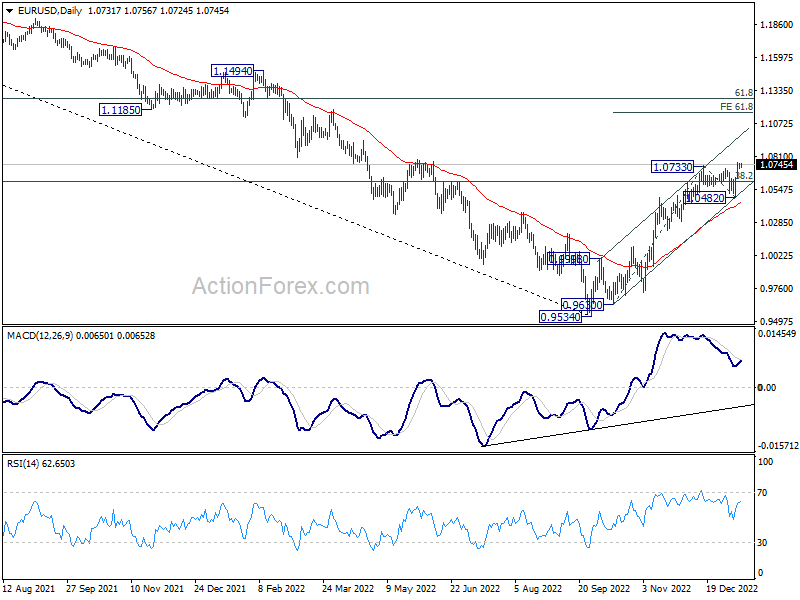
EUR/USD Mid-Day Outlook
Daily Pivots: (S1) 1.0712; (P) 1.0736; (R1) 1.0759; More...
For now, intraday bias in EUR/USD stays mildly on the upside with 1.0659 minor support intact. Current rally from 0.9534 would target 61.8% projection of 0.9630 to 1.0733 from 1.0482 at 1.1164. On the downside, below 1.0659 minor support will turn intraday bias neutral again first. But near term outlook will stay bullish as long as 1.0482 support holds, in case of retreat.
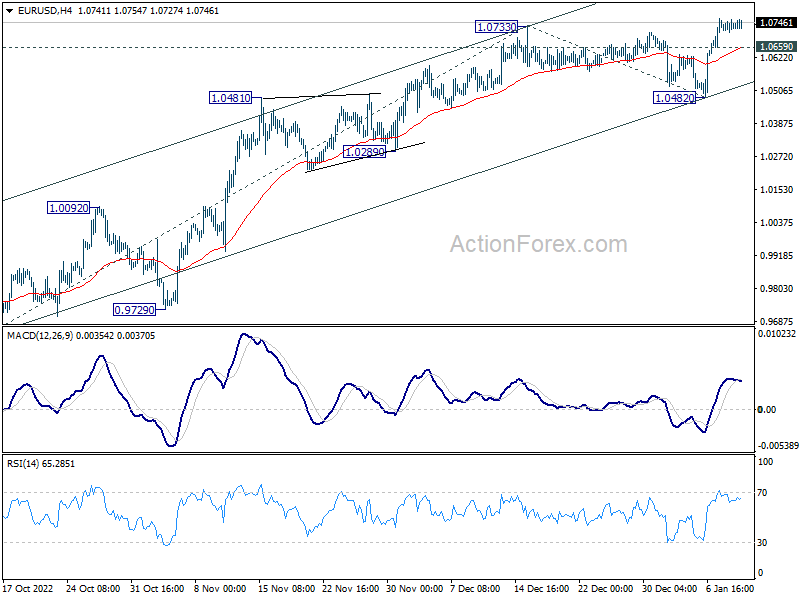
In the bigger picture, focus stays on 38.2% retracement of 1.2348 (2021 high) to 0.9534 at 1.0609. Rejection by 1.0609 will suggest that price actions from 0.9534 medium term bottom are developing into a corrective pattern. Thus, medium bearishness is retained for another fall through 0.9534 at a later stage. However, sustained break of 1.0609 will raise the chance of trend reversal and target 61.8% retracement at 1.1273.