

Sample Category Title
USDJPY Ticks Marginally Up, But Momentum is Weak
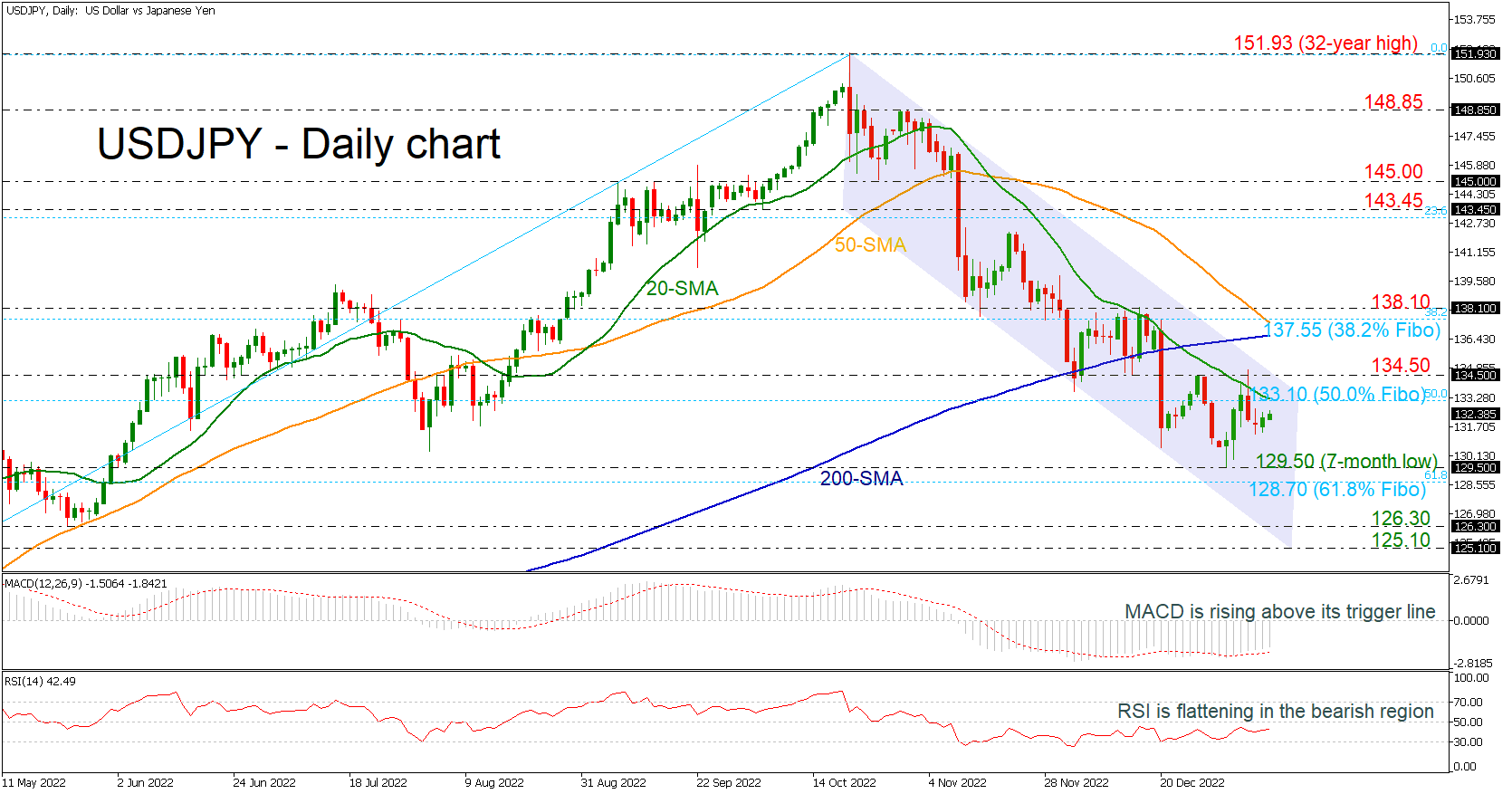
USDJPY is moving slightly higher within the medium-term downward sloping channel, but the momentum is weak to continue the bullish structure above the 50.0% Fibonacci retracement level of the upward wave from 114.64 to 151.93 at 133.10.
The MACD is rising somewhat above its trigger line in the bearish area; however, the RSI is flattening in the negative territory. Also, the 50- and the 200-day simple moving averages (SMAs) are approaching each other suggesting a death cross in the next sessions.
Should the buying interest remain, and the pair surpasses the immediate 50.0% Fibonacci at 133.10, which overlaps with the 20-day SMA then the bulls may manage to challenge the 134.50 barrier ahead of the 200-day SMA at 136.60, penetrating the descending channel to the upside. Above this line, the 38.2% Fibonacci at 137.55, which lies near the 50-day SMA may halt the positive actions as well.
On the other hand, a move lower could meet the seven-month trough of 129.50 before testing the crucial 61.8% Fibonacci of 128.70, which will be a significant step for a longer-term bearish structure. Beneath that, the 126.30 bottom, registered in May 2022 could come next.
All in all, USDJPY is bearish and only a move above the 200- and the 50-day SMAs may switch the outlook to bullish.
EUR/USD: Euro Keeps Bullish Stance But US CPI Data Likely to Define Near-Term Direction
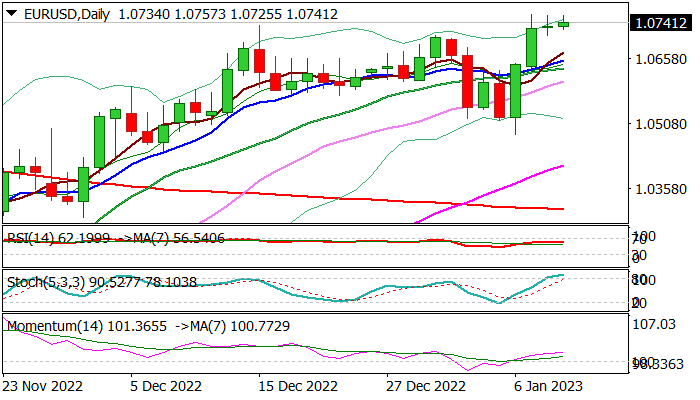
The Euro keeps bullish bias in early Wednesday and regains traction after bulls took a breather (Tuesday’s Doji).
Full reversal of January’s pullback (1.0705/1.0483) generates initial signal of continuation of larger uptrend from 2022 low (0.9535).
Bullish daily studies add to positive picture, though overbought conditions warn of prolonged consolidation, as traders slowed pace, awaiting Thursday’s release of US December inflation report, which is expected to provide fresh direction signal.
Lack of economic releases from Europe today, would also add to quieter mode.
US inflation is expected to drop to 6.5% in Dec from 7.1% in Nov, with further easing in price pressures to signal that Fed’s measures in strong policy tightening started to impact high inflation that would open way for further easing of Fed’s stance on monetary policy and deflate dollar, while the single currency would benefit in such scenario.
Conversely, hotter than expected US CPI number would keep the Fed alerted of further and probably more aggressive tightening, which would bring the Euro under pressure.
Bulls eye initial resistance at 1.0786 (May 30 high) violation of which would expose pivotal Fibo barrier at 1.0901 (50% retracement of 1.2266 / 0.9535).
On the downside, converged daily Tenkan-sen and Kijun-sen (1.0622/02 respectively) offer solid support which should contain dips to keep bulls intact, while break here would weaken near-term structure and risk deeper pullback towards key support at 1.0483 (Jan 6 trough).
Res: 1.0760; 1.0786; 1.0814; 1.0901.
Sup: 1.0712; 1.0622; 1.0602; 1.0483.
ECB Villeroy: France should avoid hard landing
ECB Governing Council member Francois Villeroy de Galhau told Radio Classiqu, "activity in France is showing a better than expected resistance," and a hard landing should be avoided. He expects inflation in France to peak in H1 2023, then falls back to 4% towards the end of the year.
Villeroy also said that ECB should aim to reach terminal interest rate by summer, and emphasized the need to be pragmatic about the pace of tightening.
AUD/USD: The Market May Collapse to a Minimum of 0.617
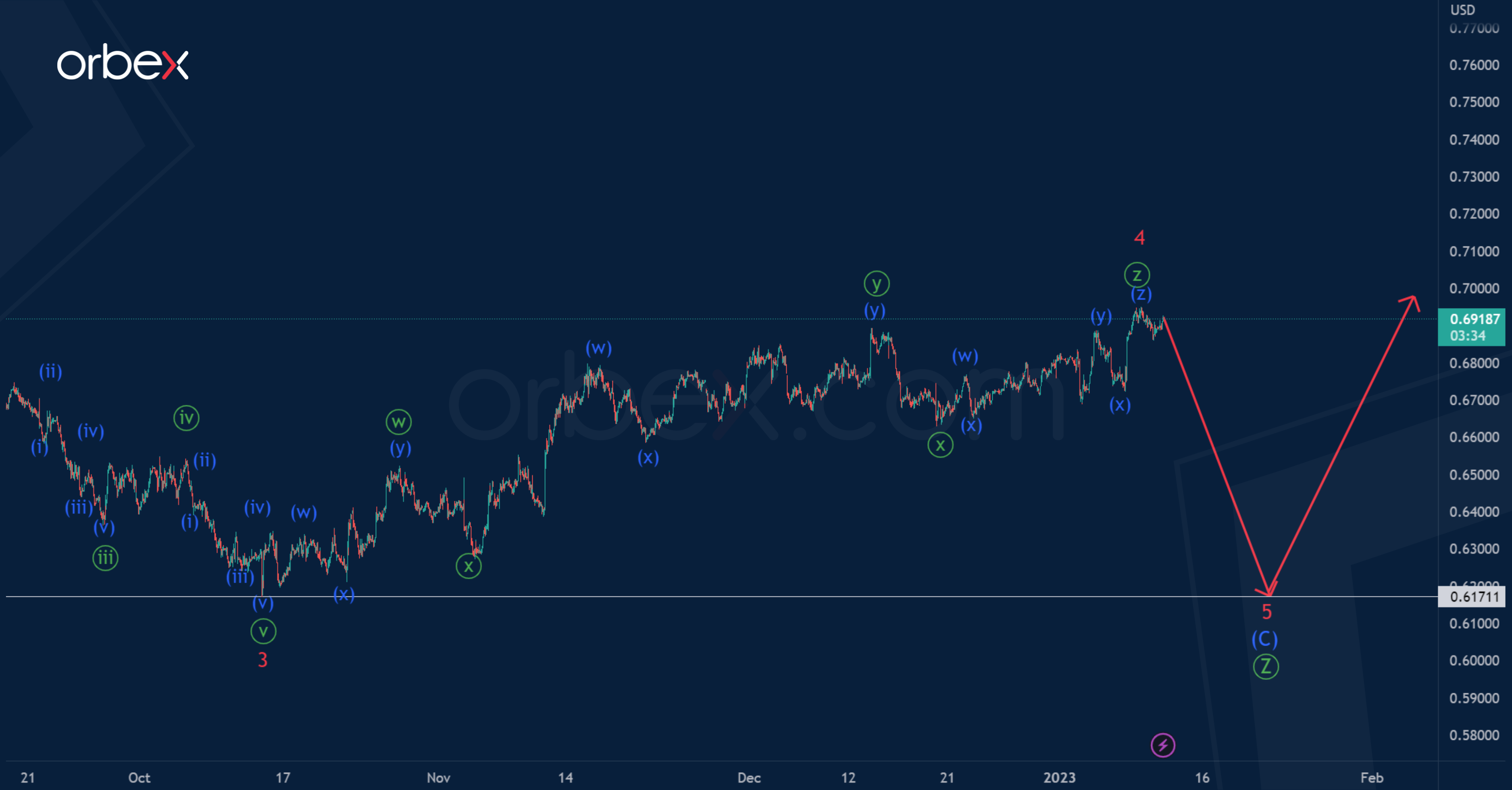
Most likely, the AUDUSD currency will form a bearish triple zigzag Ⓦ-Ⓧ-Ⓨ-Ⓧ-Ⓩ in the long term, where the primary wave Ⓩ is a simple zigzag (A)-(B)-(C).
At the moment, an impulse wave (C) is being formed, which consists of minor sub-waves 1-2-3-4-5.
Perhaps the development of the minor corrective wave 4 in the form of a minute triple zigzag has been completed. Thus, the market may continue to move down in the impulse wave 5.
The currency is expected to decline to the previous low of 0.617, marked by the impulse 3.
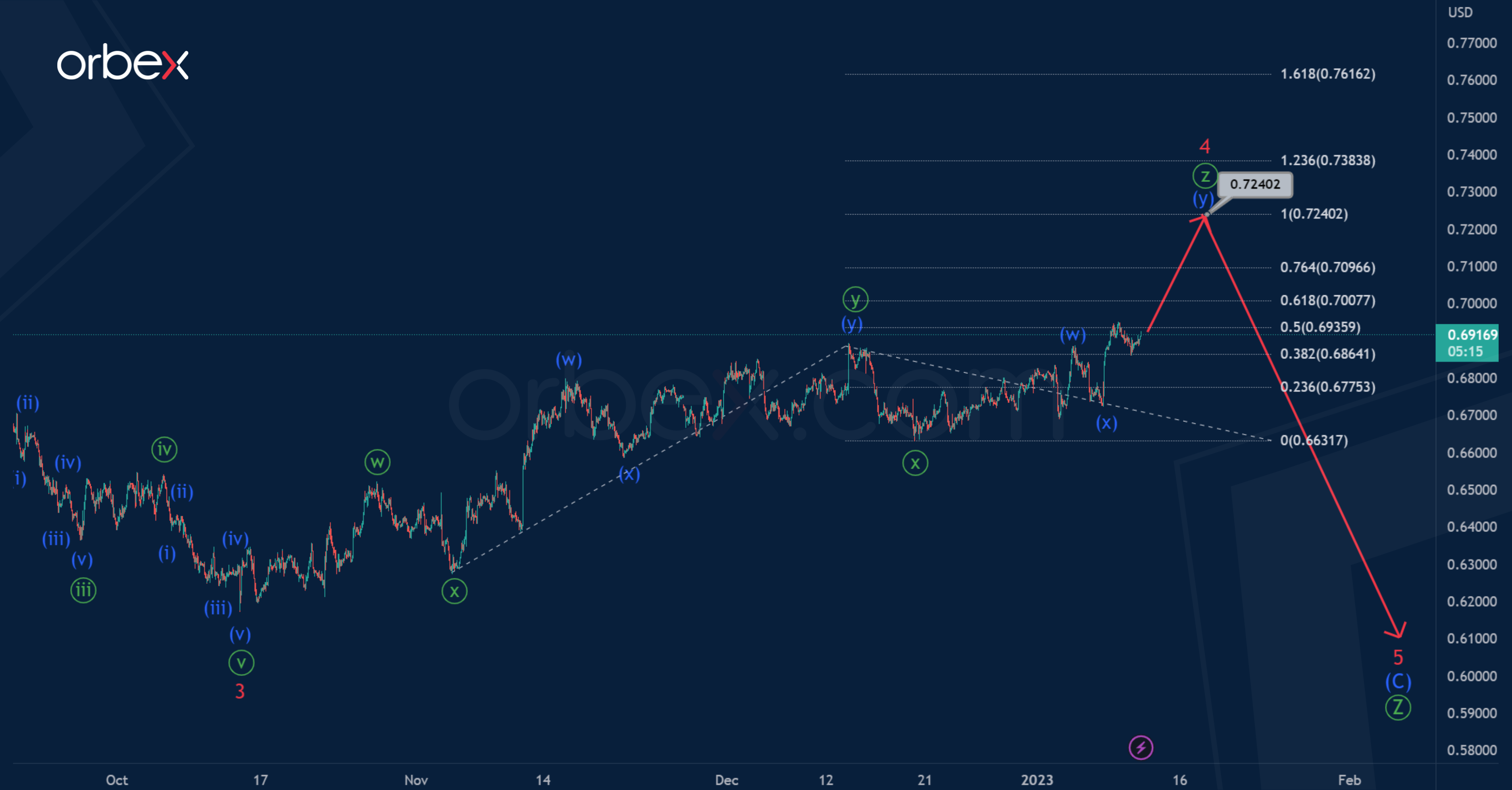
Alternatively, the corrective wave 4 continues its development.
Bulls could build only four parts of correction 4, that is, we can see fully formed sub-waves ⓦ-ⓧ-ⓨ-ⓧ, and the sub-wave ⓩ is still being built.
In the near future, the market may grow to 0.724. At that level, actionary sub-waves ⓨ and ⓩ will be equal.
An approximate scheme of possible future movement is shown on the chart.
S&P 500 Attempts to Rebound
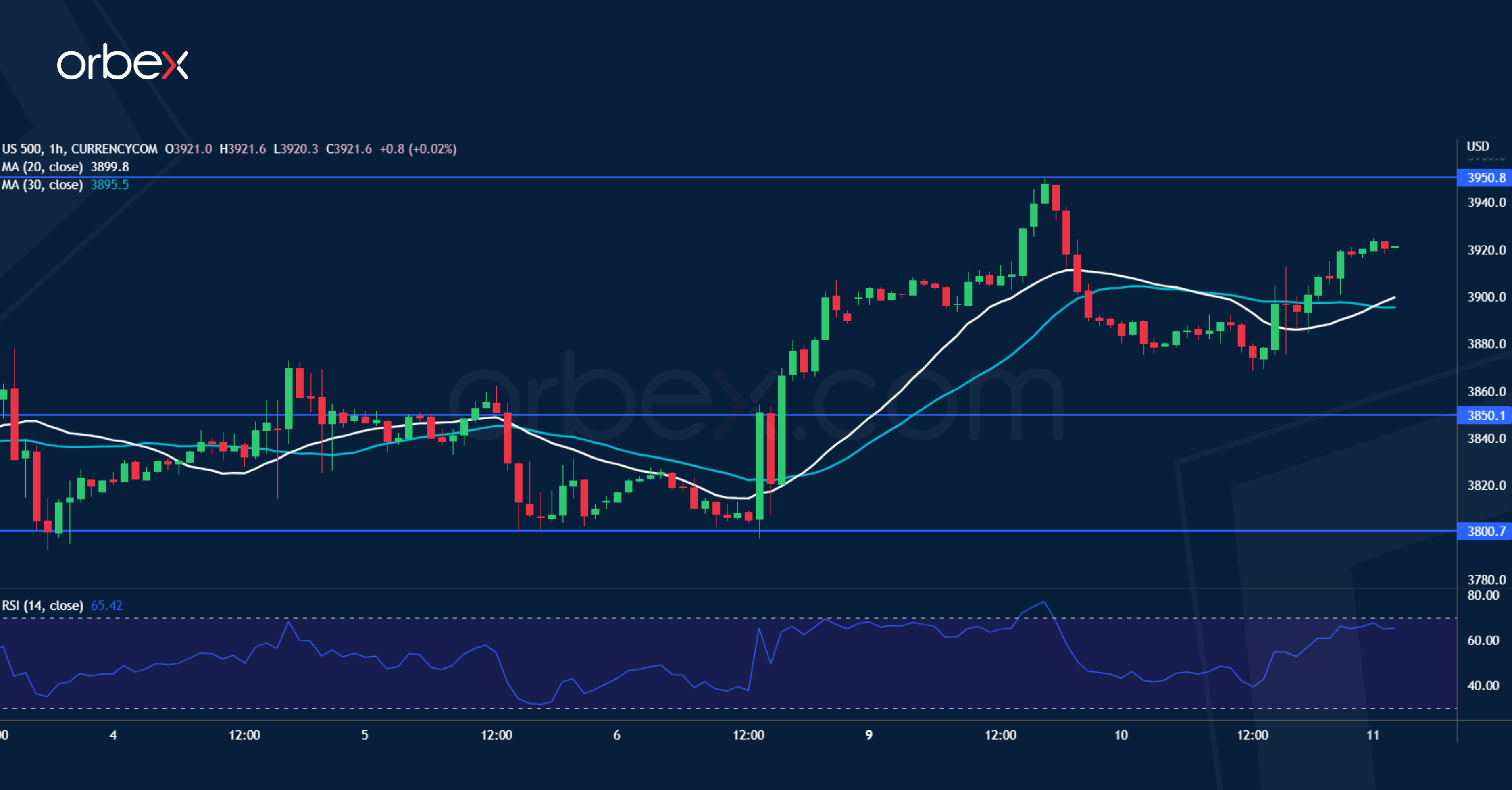
The S&P 500 rallied after Fed Chair Powell avoided appearing hawkish in his latest remarks. The rally hit a bump in the former demand zone (3950) from December. Selling by previously trapped bulls weighs on the near term price action. If renewed buying could overpower this resistance, the index may progress towards 4050 which is just a springboard to the recent peak at 4120. In the meantime, the upper band (3850) of the previous consolidation range is the closest support, and 3800 a critical level to keep the recovery bias intact.
AUD/USD Breaks Resistance
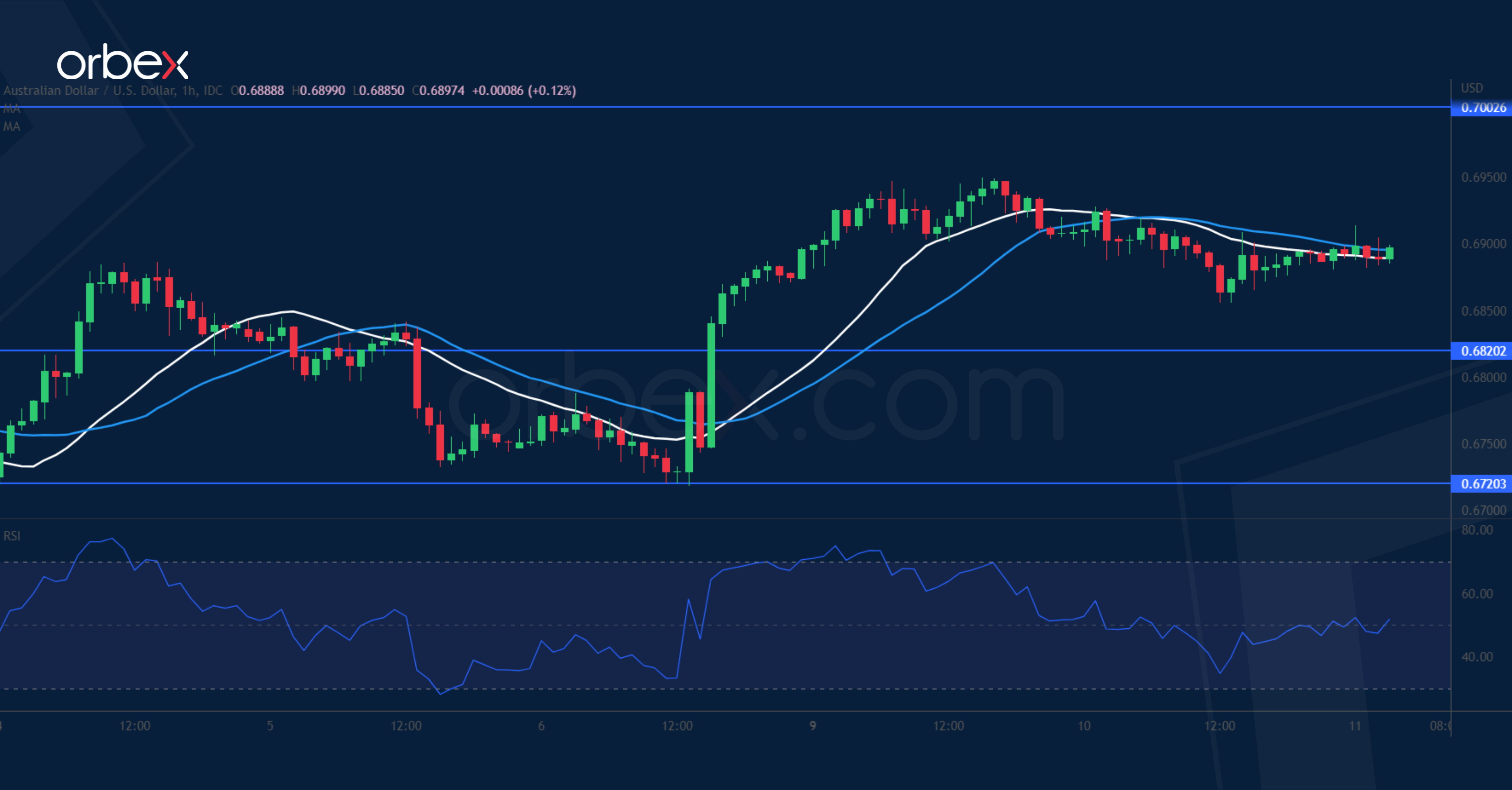
The Australian dollar strengthened over better-than-expected retail sales in November. On the daily chart, the price has been grinding along the 30-day average (0.6720). A close above the double top (0.6890) is a sign that the bulls are strongly committed. The psychological level of 0.7000 coincides with the origin of a late August high, making it a key hurdle before the aussie could extend higher. On the downside, 0.6820 is the immediate support and 0.6720 the bulls’ second line of defence in case of hesitation.
GBP/USD Seeks Support
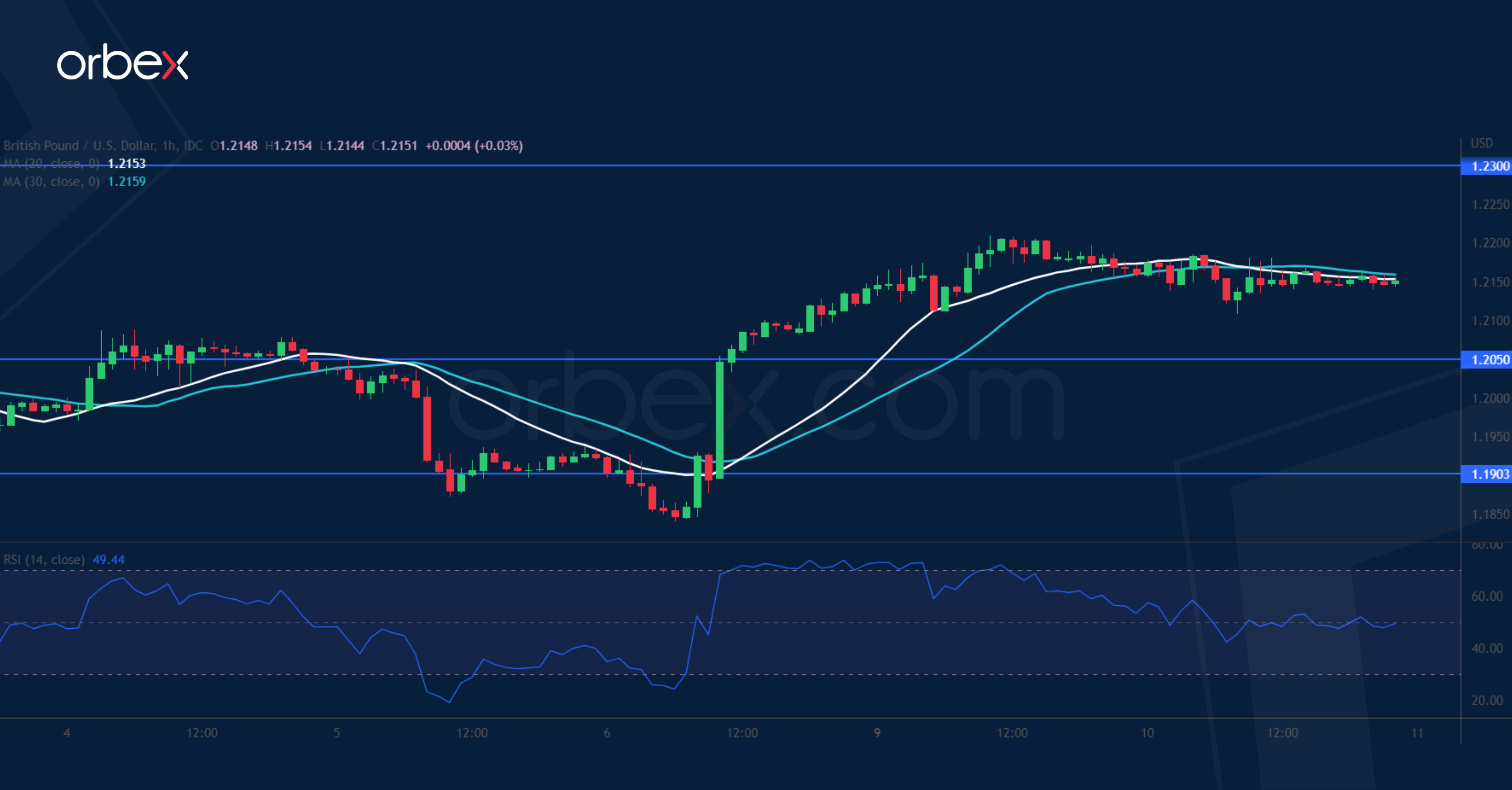
The high beta pound edges higher on improved market sentiment. A surge above 1.2080 has prompted short-term sellers to cover their positions. This could be the signal the bulls have been waiting for after the pair drifted lower in search of support. As the RSI returns to the neutrality area, the supply-turned-demand zone around 1.2050 is the first level to expect follow-up bids. 1.1900 is a critical support in case of a deeper pullback. On the upside, a close above 1.2300 could pave the way for a bullish reversal in the medium-term.
The Test is Ongoing With Dollar Unable to Really Fight Back
Markets
Global core bonds on Monday already showed a loss of momentum following Friday’s post-ISM surge and effectively lost some ground yesterday. Especially in the US, they remain well above Friday’s opening levels though. The start of the US Treasury’s mid-month refinancing operation helps explain some weakness. They eventually kicked off with a well-received $40bn 3-yr Note auction. The real test follows tonight and tomorrow with 10-yr Note and 30-yr Bond auctions. Washington Fed-based Bowman joined the chorus of Fed governors calling for more policy rate increases (a lot more work to do) and vowing to keep rates at their peak for some time. Markets keep fighting the Fed when it comes to this view. US yields recovered 3.3 bps (3-yr) to 9.5 bps (30-yr) on a daily basis. From the ECB camp, governing council member Centeno joined in by arguing that there’s no alternative to raising rates as inflation is still too high despite two straight months of moderation. German yields gained 3.9 bps (2-yr) to 7.8 bps (10-yr) on the day. 10-yr yield spreads vs Germany narrowed by around 2 bps with Belgium (-3 bps), Italy (-4 bps) and Greece (-9 bps) outperforming. Latvia, Italy and Belgium successfully launched new syndicated benchmarks, following Slovenia, Austria, Ireland and Portugal in the first trading week of the year. The Kingdom of Belgium raised €7bn with a new 10y bond (OLO 97 3% June2033). The order book was above €51bn, allowing the debt agency to print at MS +10 bps compared to early guidance of MS +12 bps. The debt agency with this one deal completed over 15% of this year’s OLO funding need (€45bn). Two more syndicated benchmarks and regular monthly OLO auctions should help to raise the remainder of the amount.
Trading in FX majors was extremely muted yesterday. The trade-weighted dollar held just north of the 103 cycle low with EUR/USD moving in an extremely narrow corridor between roughly 1.0720 and 1.0750. The 1.0736 to 1.0806 area provides strong resistance. The test is ongoing with the dollar unable to really fight back. Tomorrow’s US December CPI print will be decisive and suggests more wait-and-see today. Sterling has difficulties to get away from the 0.88-area. Resistance stands at 0.8867/77. Today’s eco calendar is again irrelevant. Apart from above-mentioned supply, speeches by an avalanche of ECB speakers will be interesting, but probably without market impact.
News Headlines
Australian November retail sales and CPI printed stronger than expected this morning. Monthly sales jumped a solid 1.4% M/M from an upwardly revised 0.4% in October (initially -0.2%). Solid growth rates for household goods (2.1%), apparel (6.4%) and sales at department stores (5.4%) suggest that consumer demand is holding up well even as the Reserve Bank of Australia raised its policy rate by a cumulative 300 bps since May last year. November CPI rebounded to 7.4% Y/Y, after easing to 6.9% Y/Y the previous month, with housing (+9.6%), food and non-alcoholic beverages (+9.4%), transport (+9%), furniture, household equipment and services (+8.4%) the biggest contributors. In a monthly perspective, there was an unusually high rise (4.3%) in prices of holiday travel and accommodation. The core trimmed mean measure also rose further to 5.6%, the highest since 2018. The data suggest that the RBA should continue its hiking cycle with an additional 25 bps step at the early February meeting, which currently isn’t fully discounted by markets. The Aussie dollar extends recent gains against the dollar to trade at AUD/USD 0.6915.
Brazilian inflation rose 0.62% M/M in December, bringing the Y/Y measure at 5.79% from 5.9% in November. The decline was slightly more moderate than expected with inflation still above the central bank target of 3.5% with a tolerance band to 5%. Brazilian Y/Y inflation peaked at 12.13% Y/Y in April. The Brazilian central bank (BCB) raised the policy rate to 13.75%. The new government’s stimulative fiscal policy is one of the factors that could slow the disinflationary process. The Brazilian real yesterday rebounded further to USD/BRL 5.20 as higher inflation might force the BCB to keep interest rates higher for longer than expected until now.
AUD/USD: Bullish Impulse, Now Fifth Wave Approaching Resistance at 0.7
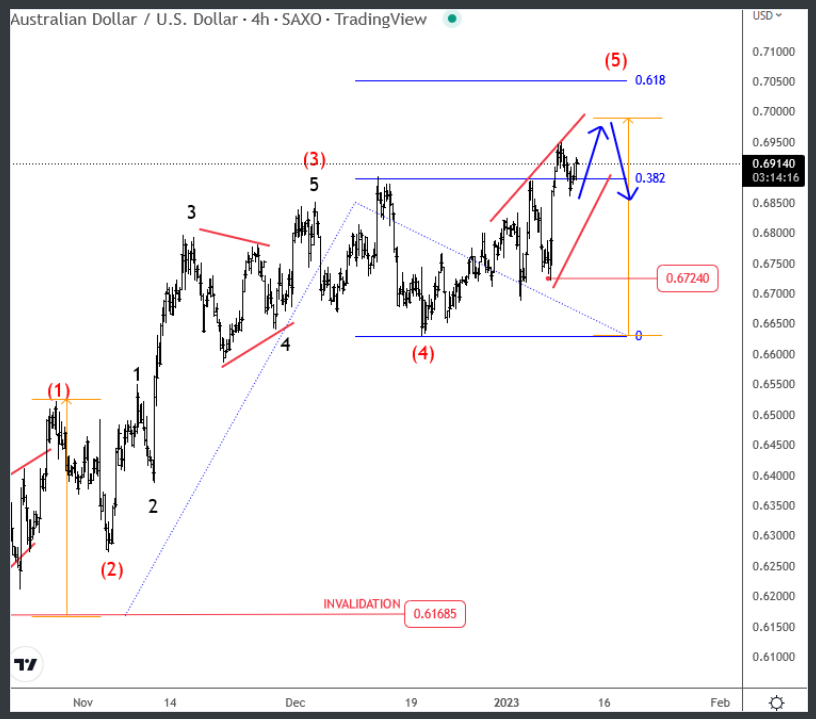
Aussie is breaking to a new high after a few weeks of a slow price action in 200 pip range which we saw it as a correction, but we thought it will be a deeper one. However, we have to go with the trend now, after a recent break to a new high, meaning correction is completed and the fifth wave in play. The upward projection is at 0.7 psychological level, but there is room even for 0.7050/0.71 while the price is above 0.67240. However, keep in mind that after every five waves correction follows, so if USD will get strong after US CPI report this week (if the numbers will be bad), and if stocks would drop then, Aussie can easily towards lower supports.
Investors Keep Their Rosy Glasses Pn
US equities first struggled to find direction, as the Federal Reserve (Fed) Chair Jerome Powell kept mum on monetary policy in Stockholm yesterday, worried about the World Bank’s morose growth projections, but then turned north on hope that a softer US inflation print tomorrow could boost the Fed doves and enhance appetite in US equities.
The S&P500 found support at the 100-DMA and closed the session above the 50-DMA, while Nasdaq advanced 0.88%. We could see some more optimism into tomorrow’s CPI print in the US.
Gold benefits from softer US yields, and softer dollar on expectation that a softer inflation could soften the Fed’s policy stance. So, a softer inflation could indeed send the price of an ounce above $1900 to the end of the week.
Stop fighting the Fed
What’s happening right now is absurd. The market is fighting back the Fed. The Fed says ‘we will hike the rates above 5%’, and investors reply ‘we don’t believe you; we think that you will NOT raise the rates above 5%!’
As a result, the financial conditions in the US are now neutral, while inflation, though easing, remains more than three times higher than the Fed’s 2% target. This means that the Fed will continue hiking rates even if it means slower economic growth.
World Bank forecasts aren’t cheery
The World Bank predicts a global growth of about 1.7% this year, about half the pace it predicted last summer. It would also be the third worst year in three decades after 2009 and 2020 slowdowns.
The US is expected to grow by only 0.5%, the Eurozone should not grow nor contract, while growth in China will be around 4.3% according to their latest forecasts for 2023.
Although the slowing economic growth softens the rate expectations – and boost equities, a weaker global economy should weigh on corporate profits and should not let the rally run too far.
Have you gone out of your mind, Goldman?
Then you have Goldman Sachs, which predicts that the Eurozone will finally not enter into recession… after all.
The bank said yesterday that the European GDP should grow by around 0.6%, versus a 0.1% contraction predicter earlier. And oh, they also see inflation easing faster than expected to around 3.25% by the end of this year.
Why? Because the boost from Chinese post-Covid reopening, and the sharp fall in natural gas prices thanks to the Weather Gods which prevented the continent from cold weather so far should help tempering slow down. ¨
… then unicorns will invade Europe and we will all leave happily ever after.
ECB remains determined to hike rates
European Central Bank (ECB) officials stand behind their hawkish view despite the latest softening in inflation. ECB’s Schnabel said at her speech yesterday that the ECB will have to raise the rates much further because ‘inflation will not subside by itself’.
The EURUSD tested the 1.0760 resistance again yesterday, forming a triple top since mid-December. The positive pressure is the fruit of the divergence between softening Fed expectations and hawkish ECB bets.
Strong Australian inflation revives RBA hawks
In Australia, inflation advanced more than expected to 7.3% in Q4 fueling the expectation that the Reserve Bank of Australia (RBA) could opt for another 25bp hike in its February meeting. The AUDUSD is ready for fighting the 0.70 offers, if, of course, tomorrow’s inflation read in the US doesn’t reveal a bad surprise.
Crude under pressure
In energy, crude oil is dragging its feet below the $75 this morning and will likely remain under pressure as yesterday’s API data showed that the US oil inventories rose by a little less than 15 mio barrels last week as the refining activity returned to normal following weather-related shutdowns. I still believe that price pullbacks could be interesting dip-buying opportunities as there are many supportive factors, including the Chinese reopening, and the globally tight supply.