

Sample Category Title
China Caixin PMI composite improved to 48.3, continuing contraction
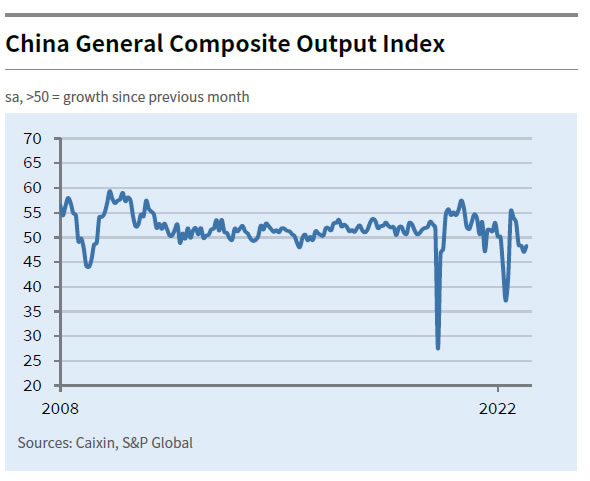
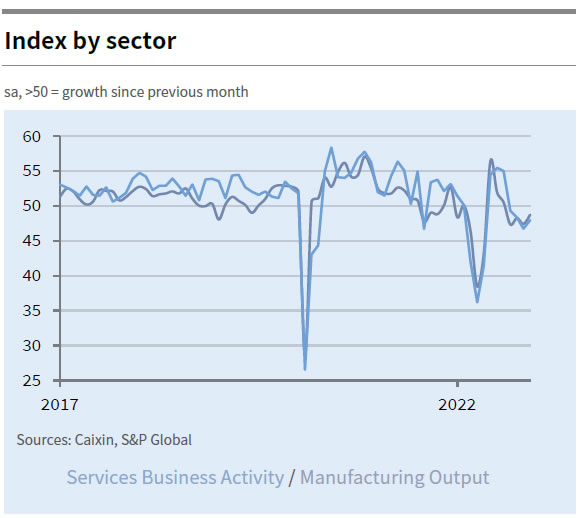
China Caixin PMI Services rose from 46.7 to 48.0 in December, above expectation of 47.5. PMI Composite rose from 47.0 to 48.3, pointing to contraction in business activity for the fourth straight month.
Wang Zhe, Senior Economist at Caixin Insight Group said: "Both manufacturing and services sectors' supply and demand contracted due to the pandemic, with manufacturing demand taking a harder hit than in November. Overseas demand was weak, employment remained sluggish, but inflationary pressure was modest, and optimism among businesses significantly improved.
"Covid outbreaks rapidly spread across China in November, causing a number of macroeconomic indicators to fall sharply. On Dec. 7, China announced 10 new measures to further optimize Covid containment. In the short term, infections are expected to explode, which will disrupt production and everyday life. How to effectively coordinate Covid controls with economic and social development has once again become a crucial question."
FOMC Minutes: Anticipate ongoing rate hikes appropriate
In the minutes of the December FOMC meeting, the participants agreed that inflation was "unacceptably high". They "concurred" that inflation data showed "welcome reductions in the monthly pace of price increases", but "stressed that it would take substantially more evidence of progress to be confident that inflation was on a sustained downward path."
Also, participants noted that risk to inflation outlook remained "tilted to the upside", with possibility of "more persistent than anticipate" price pressures. Meanwhile, risks to economic activity outlook were "weighted to the downside".
Participants continued to anticipate that "ongoing increases in the target range for the federal funds rate would be appropriate". "No participant" anticipated that it's appropriate to start lowering rates in 2023. They generally observed that a "restrictive policy stance would need to be maintained" for some time. Also, "several participants commented that historical experience cautioned against prematurely loosening monetary policy."
(FED) Minutes of the Federal Open Market Committee
December 13–14, 2022
A joint meeting of the Federal Open Market Committee and the Board of Governors of the Federal Reserve System was held in the offices of the Board of Governors on Tuesday, December 13, 2022, at 10:00 a.m. and continued on Wednesday, December 14, 2022, at 9:00 a.m.1
Attendance
Jerome H. Powell, Chair
John C. Williams, Vice Chair
Michael S. Barr
Michelle W. Bowman
Lael Brainard
James Bullard
Susan M. Collins
Lisa D. Cook
Esther L. George
Philip N. Jefferson
Loretta J. Mester
Christopher J. Waller
Charles L. Evans, Patrick Harker, Neel Kashkari, Lorie K. Logan, and Helen E. Mucciolo, Alternate Members of the Committee
Thomas I. Barkin, Raphael W. Bostic, and Mary C. Daly, Presidents of the Federal Reserve Banks of Richmond, Atlanta, and San Francisco, respectively
James A. Clouse, Secretary
Matthew M. Luecke, Deputy Secretary
Brian J. Bonis, Assistant Secretary
Michelle A. Smith, Assistant Secretary
Mark E. Van Der Weide, General Counsel
Richard Ostrander, Deputy General Counsel
Trevor A. Reeve, Economist
Stacey Tevlin, Economist
Beth Anne Wilson, Economist
Shaghil Ahmed, Carlos Garriga, Joseph W. Gruber, and William Wascher, Associate Economists
Patricia Zobel, Manager pro tem, System Open Market Account
Jose Acosta, Senior Communications Analyst, Division of Information Technology, Board
David Altig, Executive Vice President, Federal Reserve Bank of Atlanta
Roc Armenter, Vice President, Federal Reserve Bank of Philadelphia
Kartik B. Athreya, Executive Vice President, Federal Reserve Bank of Richmond
Penelope A. Beattie, Section Chief, Office of the Secretary, Board
Daniel O. Beltran, Deputy Associate Director, Division of International Finance, Board
Ellen J. Bromagen, First Vice President, Federal Reserve Bank of Chicago
Jennifer J. Burns, Deputy Director, Division of Supervision and Regulation, Board
Mark A. Carlson, Adviser, Division of Monetary Affairs, Board
Todd E. Clark, Senior Vice President, Federal Reserve Bank of Cleveland
Stephanie E. Curcuru, Deputy Director, Division of International Finance, Board
Navtej S. Dhillon, Special Adviser to the Board, Division of Board Members, Board
Burcu Duygan-Bump, Special Adviser to the Board, Division of Board Members, Board
Rochelle M. Edge, Deputy Director, Division of Monetary Affairs, Board
Matthew J. Eichner,2 Director, Division of Reserve Bank Operations and Payment Systems, Board
Eric M. Engen, Senior Associate Director, Division of Research and Statistics, Board
Eric C. Engstrom, Associate Director, Division of Monetary Affairs, Board
Jon Faust, Senior Special Adviser to the Chair, Division of Board Members, Board
Glenn Follette, Associate Director, Division of Research and Statistics, Board
Joshua Gallin, Senior Special Adviser to the Chair, Division of Board Members, Board
Jonathan E. Goldberg, Principal Economist, Division of Monetary Affairs, Board
Erik A. Heitfield, Deputy Associate Director, Division of Research and Statistics, Board
Valerie S. Hinojosa, Section Chief, Division of Monetary Affairs, Board
Jane E. Ihrig, Special Adviser to the Board, Division of Board Members, Board
Benjamin K. Johannsen, Section Chief, Division of Monetary Affairs, Board
Michael T. Kiley, Deputy Director, Division of Financial Stability, Board
Don H. Kim, Senior Adviser, Division of Monetary Affairs, Board
Elizabeth K. Kiser, Associate Director, Division of Research and Statistics, Board
Sylvain Leduc, Executive Vice President, Federal Reserve Bank of San Francisco
Andreas Lehnert, Director, Division of Financial Stability, Board
Paul Lengermann, Assistant Director, Division of Research and Statistics, Board
Eric LeSueur,2 Policy and Market Monitoring Advisor, Federal Reserve Bank of New York
Kurt F. Lewis, Special Adviser to the Board, Division of Board Members, Board
Laura Lipscomb, Special Adviser to the Board, Division of Board Members, Board
David López-Salido, Senior Associate Director, Division of Monetary Affairs, Board
Jonathan P. McCarthy, Economic Research Advisor, Federal Reserve Bank of New York
Ann E. Misback, Secretary, Office of the Secretary, Board
Raven Molloy, Deputy Associate Director, Division of Research and Statistics, Board
Norman J. Morin, Deputy Associate Director, Division of Research and Statistics, Board
Michelle M. Neal, Head of Markets, Federal Reserve Bank of New York
Giovanni Nicolò, Senior Economist, Division of Monetary Affairs, Board
Anna Nordstrom, Capital Markets Trading Head, Federal Reserve Bank of New York
Marcelo Ochoa,3 Principal Economist, Division of Monetary Affairs, Board
Giovanni Olivei, Senior Vice President, Federal Reserve Bank of Boston
Anna Paulson, Executive Vice President, Federal Reserve Bank of Chicago
Andrea Raffo, Senior Vice President, Federal Reserve Bank of Minneapolis
Linda Robertson, Assistant to the Board, Division of Board Members, Board
Achilles Sangster II, Senior Information Manager, Division of Monetary Affairs, Board
Anthony Sarver, Senior Financial Institution and Policy Analyst, Division of Monetary Affairs, Board
John W. Schindler,4 Senior Associate Director, Division of Financial Stability, Board
Samuel Schulhofer-Wohl, Senior Vice President, Federal Reserve Bank of Dallas
Seth Searls,2 Policy and Market Monitoring Associate Director, Federal Reserve Bank of New York
Nitish Ranjan Sinha, Special Adviser to the Board, Division of Board Members, Board
Clara Vega, Special Adviser to the Board, Division of Board Members, Board
Annette Vissing-Jørgensen, Senior Adviser, Division of Monetary Affairs, Board
Jeffrey D. Walker,2 Associate Director, Division of Reserve Bank Operations and Payment Systems, Board
Min Wei, Senior Associate Director, Division of Monetary Affairs, Board
Paul R. Wood, Special Adviser to the Board, Division of Board Members, Board
Rebecca Zarutskie, Special Adviser to the Board, Division of Board Members, Board
Selection of Committee Officer
By unanimous vote, the Committee selected Richard Ostrander to serve as deputy general counsel, effective December 13, 2022, until the first regularly scheduled meeting of the Committee in 2023.
Developments in Financial Markets and Open Market Operations
The manager pro tem turned first to a discussion of developments in financial markets. Following several months of tightening, financial conditions eased over the period as investor concerns about global risks edged lower and incoming data showed nascent signs of a moderation in inflationary pressures. Central bank communications signaling a slower pace of policy rate increases appeared to contribute to improved sentiment. Measures of implied volatility across financial markets declined somewhat from the elevated levels observed in October. Consistent with the decline in volatility, model-based measures suggested that a drop in term premiums accounted for much of the decline in Treasury yields over the period. Equity markets moved higher. However, equity market contacts noted risks to growth ahead, and earnings expectations for coming quarters had been marked down. In foreign exchange markets, moderating concerns about the potential for highly elevated U.S. interest rates spurred a depreciation in the foreign exchange value of the dollar. In other market developments, the manager pro tem noted the failure of a prominent crypto-asset exchange. While the spillovers from this situation had been significant among other crypto lenders and exchanges, the collapse was not seen as posing broader market risks to the financial system.
Regarding the outlook for inflation in the United States, inflation compensation implied by Treasury Inflation Protected Securities declined over the period, responding to lower-than-expected consumer price index (CPI) data and a sizable drop in oil prices. However, the Desk survey-based measures of inflation expectations were little changed from the prior survey, suggesting that falling inflation risk premiums may have contributed to the moves. Both market- and survey-based measures continued to point to expectations for a moderation of inflation over the coming year.
Regarding the outlook for monetary policy, both market- and Desk survey-based measures indicated expectations for the Committee to maintain elevated policy rates through 2023. In the December survey, the median respondent's modal expectation for the path of the federal funds rate in 2023 shifted higher by 25 basis points relative to the November survey. The survey-based estimate of the expected policy path in 2024 continued to suggest a decline in the target range for the federal funds rate over 2024, little changed from the path anticipated in the November survey. In contrast, the market-implied path of the federal funds rate in 2024 shifted down by as much as 3/4 percentage point over the period, likely reflecting declining risk premiums.
The manager pro tem turned next to a discussion of operations and money markets and assessed that balance sheet runoff was proceeding smoothly. Repurchase agreement (repo) rates firmed modestly relative to the overnight reverse repurchase agreement (ON RRP) facility rate over the period with balance sheet reduction reportedly contributing, in part, to an increase in the demand for financing of Treasury securities. ON RRP balances declined, on net, as money market funds shifted investments out of the ON RRP facility, reportedly in favor of higher rates available in repo markets.
In recent months, banks continued to increase their use of wholesale funding. In addition, survey information suggested that banks expected to move deposit rates modestly higher relative to the target range in coming months. Over time, greater competition among banks for funding could contribute to drawdowns in the ON RRP facility. Staff indicated that they would continue to monitor money market conditions closely as balance sheet reduction proceeds.
Looking ahead to year end, market participants anticipated limited pressures. The manager pro tem noted that if transitory pressures emerged in money markets, the Federal Reserve's backstop facilities are available to support effective policy implementation and smooth market functioning.
By unanimous vote, the Committee ratified the Desk's domestic transactions over the intermeeting period. There were no intervention operations in foreign currencies for the System's account during the intermeeting period.
Staff Review of the Economic Situation
The information available at the time of the December 13–14 meeting suggested that U.S. real gross domestic product (GDP) was increasing at a modest pace in the fourth quarter of 2022 after expanding strongly in the third quarter. Labor market conditions eased somewhat over October and November but remained quite tight. Consumer price inflation—as measured by the 12-month percent change in the price index for personal consumption expenditures (PCE)—stepped down in October but continued to be elevated.
Total nonfarm payroll employment posted solid gains in October and November that were slower than the average monthly pace seen over the earlier part of the year. The unemployment rate moved up 0.2 percentage point to 3.7 percent in October and remained at that rate in November. On balance, the unemployment rate for African Americans edged down over those two months, while the unemployment rate for Hispanics increased slightly; the unemployment rates for both groups remained above the national measure. Both the labor force participation rate and the employment-to-population ratio declined a little over the past two months. The private-sector job openings rate, as measured by the Job Openings and Labor Turnover Survey, moved back down in October but remained high.
Nominal wage growth continued to be elevated and remained above the pace judged to be consistent with the FOMC's 2 percent inflation objective. Average hourly earnings rose 5.1 percent over the 12 months ending in November, close to the pace recorded in the employment cost index of hourly compensation in the private sector over the 12 months ending in September. Compensation per hour (CPH) in the business sector rose 4.0 percent over the four quarters ending in the third quarter, but the reported increase likely understated the true pace of increase in CPH, as the lower second-quarter employment data from the Quarterly Census of Employment and Wages had not yet been incorporated in the CPH measure.
Consumer price inflation remained elevated but had eased in recent months. Total PCE price inflation was 6.0 percent over the 12 months ending in October, 0.3 percentage point below the September figure. Core PCE price inflation, which excludes changes in consumer energy prices and many consumer food prices, was 5.0 percent over the 12 months ending in October, down 0.2 percentage point from its September reading. The trimmed mean measure of 12-month PCE price inflation constructed by the Federal Reserve Bank of Dallas remained at 4.7 percent in October. In November, the 12-month change in the CPI stepped down to 7.1 percent and core CPI inflation dropped to 6.0 percent. The CPI, along with data from the producer price index, pointed to a further slowing in PCE price inflation in November. A preliminary estimate of the staff's common inflation expectations index, which combines information from many indicators of inflation expectations and inflation compensation, edged down in the fourth quarter but continued to be above pre-pandemic levels.
After expanding at a moderate pace in the third quarter, real PCE growth appeared to have picked up in the fourth quarter. In contrast, residential investment looked to be contracting sharply further, and growth in business fixed investment seemed to be slowing markedly, with tepid gains in equipment and intangibles spending and continued declines in nonresidential structures investment. Manufacturing production increased only modestly in October, and the available data pointed to a decline in November. A decrease in factory output would be consistent with recent readings from national and regional manufacturing surveys, which showed declining new orders and a drawdown in order backlogs.
After narrowing in the third quarter, the nominal U.S. international trade deficit widened in October. Real goods exports fell, led by declines in exports of industrial supplies and consumer goods. Real goods imports rose, driven by increases in imports of industrial supplies, which more than offset declines in imports of capital goods and consumer goods. Exports of services rose, in part as travel exports continued to recover, while imports of services were little changed.
Foreign economic activity grew at a moderate pace in the third quarter, but more recent data pointed to weakening growth, weighed down by the economic fallout of Russia's war against Ukraine and a COVID-19-related slowdown in China. High inflation continued to contribute to a decline in real disposable incomes, which, together with disruptions to energy supplies, depressed economic activity, especially in Europe. In China, authorities began to ease social restrictions even as COVID cases surged, raising the prospect of significant disruptions to economic activity in the near term, but also a faster reopening. Weaker global demand and high interest rates also weighed on activity in emerging market economies. Despite tentative signs of easing in foreign headline inflation, core inflationary pressures remained elevated in many countries. In response to high inflation, many central banks further tightened monetary policy, albeit at a slower pace in some cases.
Staff Review of the Financial Situation
Over the intermeeting period, Treasury yields and measures of inflation compensation declined, on net, and the implied path of the federal funds rate in 2023 ended modestly lower. Stock market indexes rose, on balance, likely reflecting reduced concerns about the inflation outlook, and market volatility declined notably. Borrowing costs declined, on net, over the intermeeting period. Credit flows moderated a bit in recent months, and the credit quality of businesses and most households remained solid.
The expected path of the federal funds rate implied by a straight read of financial market quotes ended the intermeeting period lower, largely reflecting data releases that pointed to a larger-than-expected moderation in inflation. Medium-to-longer-term nominal Treasury yields declined substantially over the intermeeting period, driven primarily by lower-than-expected inflation data releases, which appeared to prompt a substantial reduction in investors' concerns about the possibility that inflation would remain high for a long period. In line with those developments, inflation compensation measures based on inflation swaps declined notably, especially for shorter maturities.
Broad stock price indexes increased, likely reflecting reduced concerns about the inflation outlook and the associated implications for the future path of policy. On net, the one-month option-implied volatility on the S&P 500—the VIX—decreased notably and was around the middle of its range since mid-2020. In line with reduced investor concerns about the inflation outlook, spreads of interest rates on corporate debt, mortgage-backed securities, and municipal bonds to comparable-duration Treasury yields all narrowed over the intermeeting period.
Conditions in short-term funding markets remained stable over the intermeeting period, with the November increase in the target range for the federal funds rate and the associated increases in the Federal Reserve's administered rates passing through quickly to overnight money market rates. In secured markets, repo rates were below the ON RRP offering rate less frequently than in the previous intermeeting period. Daily take-up in the ON RRP facility declined modestly, consistent with the recent firming in overnight repo rates. Net yields on money market funds rose further over the intermeeting period, mostly passing through the increase in administered rates, while bank deposit rates increased only slightly in October and November.
Foreign financial conditions broadly eased over the intermeeting period, largely driven by lower-than-expected U.S. inflation data. The foreign exchange value of the dollar depreciated against most foreign currencies, particularly against those of advanced foreign economies, in part reflecting a narrowing of near-term yield differentials between the United States and other advanced economies. Investors reacted positively to news of an easing of COVID restrictions in China, which drove risky asset prices significantly higher despite near-term challenges associated with the health policy shift. Emerging market fund outflows moderated and turned to inflows later in the intermeeting period. Option-implied volatility measures for exchange rates and benchmark foreign yields declined but remained elevated by historical norms amid a high degree of uncertainty around global inflation and the prospects for a reopening of the Chinese economy.
In domestic credit markets, changes in borrowing costs were mixed during the intermeeting period but remained above levels observed at the end of the previous tightening cycle. Yields for corporate bonds declined, while borrowing costs for leveraged loans remained at an elevated level. Bank interest rates for commercial and industrial (C&I) loans continued to trend up in the third quarter. Municipal bond yields also decreased across rating categories. Residential mortgage rates fell, on net, after the November FOMC meeting. In contrast, interest rates in credit card offers continued to increase, reflecting the higher prime rate that was quickly passed through. Interest rates on auto loans also rose steadily through November.
Credit continued to be generally available to businesses and households, but high borrowing costs appeared to weigh on financing volumes in many markets. Issuance of investment-grade corporate bonds rebounded somewhat in late October and November from earlier subdued levels, while speculative-grade issuance remained soft. New launches of leveraged loans picked up in November, particularly for higher-rated firms.
Business loan originations continued to expand in October and November but at a slower pace than observed in previous months. C&I loans continued to grow in October and November but decelerated relative to the third-quarter pace, moderating the robust rate of growth observed earlier this year. Nonetheless, the volume of C&I lending remained solid overall. Commercial real estate (CRE) loans outstanding at commercial banks continued to increase in October and November, but the recent pace was somewhat lower than in previous months. In addition, banks increased CRE originations to multifamily and industrial properties relative to office properties, reflecting caution in the context of rising office vacancies. Moreover, commercial mortgage-backed securities (CMBS) issuance softened somewhat in October amid elevated financing costs and tighter underwriting standards. Credit availability to small businesses appeared to have tightened further this fall, with the share of small firms reporting that it was more difficult to obtain credit than three months earlier trending up through November.
Credit was readily available in the residential mortgage market for high-credit-score borrowers who met standard conforming loan criteria. Credit availability for households with lower credit scores was considerably tighter at levels comparable with what prevailed before the pandemic. The number of home purchases and refinance mortgage rate locks edged lower at subdued levels despite recent declines in mortgage interest rates. In contrast, home equity lines of credit (HELOCs) grew notably in recent months, on net, potentially reflecting homeowners using HELOCs as a preferred way of extracting home equity in the presence of high mortgage rates. Consumer credit remained available for most consumers through September, with auto loans and credit card debt growing at a robust pace. Bank credit data also indicate that the expansion in credit card balances continued in October before slowing in early November.
The credit quality of nonfinancial corporations remained solid. The volume of speculative-grade corporate bond downgrades slightly exceeded upgrades in October and November, while for investment-grade corporate bonds, the volume of upgrades turned positive, on net, in November. Leveraged loans experienced net downgrades in October, but the pace of net downgrades slowed substantially in recent weeks. Default rates on corporate bonds and leveraged loans remained at very low levels. However, measures of expected default probabilities for corporate bonds and leveraged loans had increased from their levels at the beginning of the year in recent months. Overall, the credit quality of municipalities remained robust amid strong revenues at state and local governments. The credit quality of businesses that borrow from banks remained sound on balance. Delinquencies on C&I loans stayed flat, and those on small businesses loans continued to edge up, but delinquencies remained low relative to historical levels. In addition, the credit quality of non-agency CMBS loan borrowers deteriorated slightly, with average delinquency rates ticking up in September and October, driven by the office and retail sectors.
The credit quality of most households remained solid overall. Delinquencies on conventional mortgages continued to trend down through October, while those on Federal Housing Administration mortgages ticked up a bit from low levels. In contrast, delinquency rates for credit cards and auto loans continued to rise over the third quarter. While delinquency rates on credit cards remained low relative to their historical range, those on auto loans surpassed their pre-pandemic peak.
Staff Economic Outlook
The forecast for U.S. economic activity prepared by the staff for the December FOMC meeting was not as weak as the November projection. Recent data suggested that real GDP growth in the second half of 2022 was stronger than previously expected, but economic growth was still forecast to slow markedly in 2023 from its second-half pace. Broad financial conditions were projected to be somewhat less restrictive than previously assumed, as the effects of a higher path for equity values and a lower path for the dollar more than offset a higher medium-term trajectory for interest rates. Nevertheless, the forecast for U.S. real GDP growth through 2025 remained subdued. The staff slightly lowered its outlook for potential output, reflecting a lower expected trend in labor force participation. Moreover, the staff assumed a slower pace of decline in the natural rate of unemployment over the near term in response to recent estimates suggesting that job-matching efficiency was not improving as fast as previously anticipated. With all these changes, output was expected to move below the staff's estimate of potential near the end of 2024—a year later than in the previous forecast—and to remain below potential in 2025. Likewise, the unemployment rate was expected to move above the staff's estimate of its natural rate near the end of 2024 and remain above it in 2025.
On a four-quarter change basis, total PCE price inflation was expected to be 5.5 percent in 2022, while core inflation was expected to be 4.7 percent, both lower than in the November projection. With the effects of supply–demand imbalances in goods markets expected to unwind further and labor and product markets projected to become less tight, the staff continued to forecast that inflation would decline markedly over the next two years. Core goods inflation was anticipated to slow further, housing services inflation was expected to peak in 2023 and then move down, while core non-housing services inflation was forecast to move down as wage growth eased. In 2025, both total and core PCE price inflation were expected to be near 2 percent.
With inflation still elevated, the staff continued to view the risks to the inflation projection as skewed to the upside. Moreover, the sluggish growth in real private domestic spending expected over the next year, a subdued global economic outlook, and persistently tight financial conditions were seen as tilting the risks to the downside around the baseline projection for real economic activity, and the staff still viewed the possibility of a recession sometime over the next year as a plausible alternative to the baseline.
Participants' Views on Current Conditions and the Economic Outlook
In conjunction with this FOMC meeting, participants submitted their projections of the most likely outcomes for real GDP growth, the unemployment rate, and inflation for each year from 2022 through 2025 and over the longer run, based on their individual assessments of appropriate monetary policy, including the path of the federal funds rate. The longer-run projections represented each participant's assessment of the rate to which each variable would be expected to converge, over time, under appropriate monetary policy and in the absence of further shocks to the economy. A Summary of Economic Projections was released to the public following the conclusion of the meeting.
In their discussion of current economic conditions, participants noted that recent indicators pointed to modest growth of spending and production. Nonetheless, job gains had been robust in recent months, and the unemployment rate had remained low. Inflation remained elevated, reflecting supply and demand imbalances related to the pandemic, higher food and energy prices, and broader price pressures. Participants recognized that Russia's war against Ukraine was causing tremendous human and economic hardship. The war and related events were contributing to upward pressure on inflation and were weighing on global economic activity. Against this background, participants continued to be highly attentive to inflation risks.
Participants observed that the growth of economic activity had slowed significantly in 2022 from the previous year's robust pace, partly in response to the Committee's policy actions. The effects of those actions were especially notable in interest-sensitive sectors, particularly housing. Participants remarked that, although real GDP appeared to have rebounded moderately in the second half of 2022 after declining somewhat in the first half, economic activity appeared likely to expand in 2023 at a pace well below its trend growth rate. With inflation remaining unacceptably high, participants expected that a sustained period of below-trend real GDP growth would be needed to bring aggregate supply and aggregate demand into better balance and thereby reduce inflationary pressures.
In their discussion of the household sector, participants noted that growth in consumer spending in September and October had been stronger than they had previously expected, likely supported by a strong labor market and households running down excess savings accumulated during the pandemic. A couple of participants remarked that excess savings likely would continue to support consumption spending for a while. A couple of other participants, however, commented that excess savings, particularly among low-income households, appeared to be lower and declining more rapidly than previously thought or that the savings, the majority of which appeared to be held by higher-income households, might continue to be largely unspent. Several participants remarked that budgets were stretched for low-to-moderate-income households and that many consumers were shifting their spending to less expensive alternatives. They also observed that many households were increasingly using credit to finance spending. Overall, participants assessed that there was considerable uncertainty around the consumer spending outlook. Participants commented that higher mortgage interest rates had notably restrained housing activity and that they expected housing activity to remain weak. A couple of participants remarked on anecdotes or concerns from builder contacts about contract cancellations by purchasers no longer able to qualify for loans at higher interest rates.
With regard to the business sector, participants noted that growth in investment spending appeared modest and was being restrained by high borrowing costs and an outlook for slow growth of final demand, although views on investment prospects varied across businesses and Districts. Based on discussions with District contacts as well as a survey of firms' chief financial officers, some participants commented that while businesses were generally optimistic about their own prospects, they expressed increasing concern about the general economic outlook for 2023. Participants noted signs of continued easing in supply bottlenecks, with a couple citing District contacts' reports of declines in shipping costs and delivery times. Even so, participants remarked that the improvements in supply chains had not been uniform and supply shortages remained for some types of goods. Participants also discussed the developments in energy and agricultural sectors. Several participants commented that they saw diminished risks of severe disruption from the European Union's embargo and the Group of Seven's price cap on Russian oil exports. A couple of participants noted that high costs for inputs like diesel, feed, and fertilizer were creating challenges for the agricultural sector.
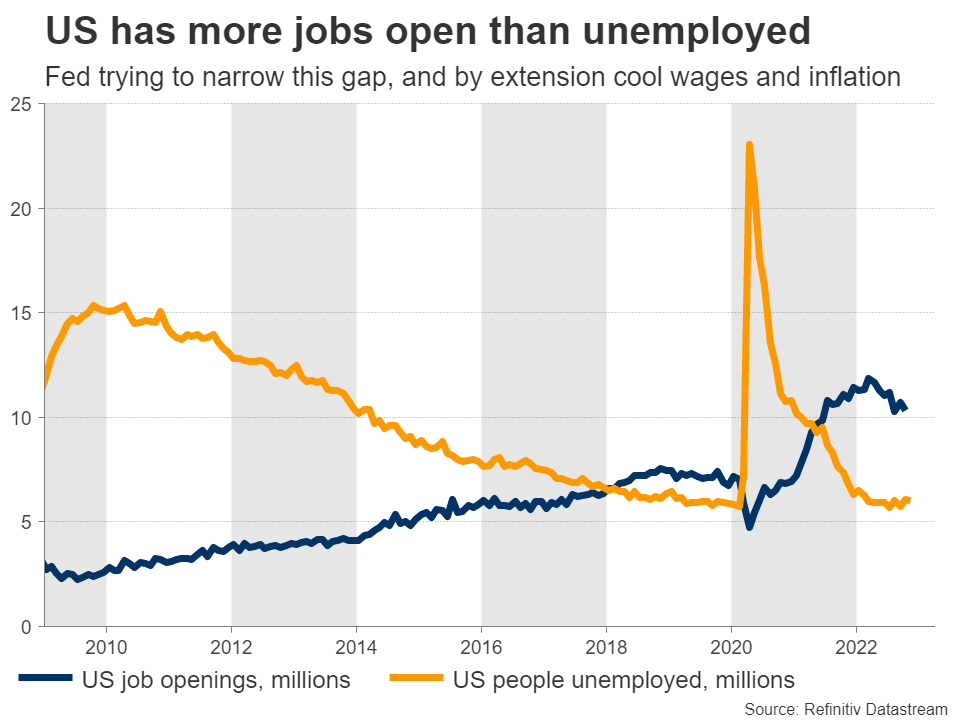
Participants observed that the labor market had remained very tight, with the unemployment rate near a historically low level, robust payroll gains, a high level of job vacancies, and elevated nominal wage growth. Several participants commented that there were tentative signs of labor market imbalances improving, including declines in job openings and quits over the second half of 2022 as well as reports from District contacts that they were seeing more qualified job applicants for open positions than earlier in the year. Some participants pointed out that payroll gains had remained robust even as they slowed in recent months. Nevertheless, they noted that some other measures of employment—such as those based on the Bureau of Labor Statistics' household survey and the Quarterly Census of Employment and Wages—suggested that job growth in 2022 may have been weaker than indicated by payroll employment. Participants generally concluded that there remained a large imbalance between labor supply and labor demand, as indicated by the still-large number of job openings and elevated nominal wage growth. Participants commented that labor demand had remained strong to date despite the slowdown in economic growth, with a few remarking that some business contacts reported that they would be keen to retain workers even in the face of slowing demand for output because of their recent experiences of labor shortages and hiring challenges. With the labor force participation rate little changed since the beginning of 2022, some participants commented that labor supply appeared to be constrained by structural factors such as early retirements, reduced availability or increased cost of childcare, more costly transportation, and reduced immigration. Under an appropriately restrictive path of monetary policy, participants expected labor market supply and demand to come into better balance over time, easing upward pressures on nominal wages and prices. In the context of achieving the Committee's broad-based and inclusive maximum-employment goal, a number of participants commented that as the labor market moved into better balance, the unemployment rate for some demographic groups—particularly African Americans and Hispanics—would likely increase by more than the national average.
With inflation still well above the Committee's longer-run goal of 2 percent, participants agreed that inflation was unacceptably high. Participants concurred that the inflation data received for October and November showed welcome reductions in the monthly pace of price increases, but they stressed that it would take substantially more evidence of progress to be confident that inflation was on a sustained downward path. Participants noted that core goods prices declined in the October and November CPI data, consistent with easing supply bottlenecks. Some participants also noted that, by some measures, firms' markups were still elevated and that a continued subdued expansion in aggregate demand would likely be needed to reduce remaining upward pressure on inflation. Regarding housing services inflation, many participants observed that measures of rent based on new leases were indicating a deceleration, which would be reflected in the measures of shelter inflation with some lag. Participants noted that, in the latest inflation data, the pace of increase for prices of core services excluding shelter—which represents the largest component of core PCE price inflation—was high. They also remarked that this component of inflation has tended to be closely linked to nominal wage growth and therefore would likely remain persistently elevated if the labor market remained very tight. Consequently, while there were few signs of adverse wage-price dynamics at present, they assessed that bringing down this component of inflation to mandate-consistent levels would require some softening in the growth of labor demand to bring the labor market back into better balance.
Participants observed that measures from surveys of households and businesses as well as from financial markets generally indicated that longer-term inflation expectations remained well anchored, while short-term inflation expectations had come down. However, participants stressed that the Committee's ongoing monetary policy tightening to achieve a stance that will be sufficiently restrictive to return inflation to 2 percent is essential for ensuring that longer-term expectations remain well anchored. Several participants commented that the longer inflation remained well above the 2 percent goal, the greater the risk that longer-term inflation expectations could become unanchored. Such a development, if it materialized, would make it much more costly to bring inflation down to achieve the Committee's statutory objectives of maximum employment and price stability.
Participants noted that since the November meeting, financial conditions had eased, with the market-implied path for the federal funds rate beyond 2023 and longer-term yields coming down noticeably. A few participants remarked that the current configuration of nominal yields, with longer-term yields lower than shorter-term yields, had historically preceded recessions and hence bore watching. However, a couple of them also noted that the current inversion of the yield curve could reflect, in part, that investors expect the nominal policy rate to decline because of a fall in inflation over time.
Participants generally noted that the uncertainty associated with their economic outlooks was high and that the risks to the inflation outlook remained tilted to the upside. Participants cited the possibility that price pressures could prove to be more persistent than anticipated, due to, for example, the labor market staying tight for longer than anticipated. Participants saw a number of uncertainties surrounding the outlook for inflation stemming from factors abroad, such as China's relaxation of its zero-COVID policies, Russia's continuing war against Ukraine, and effects of synchronous policy firming by major central banks. A number of participants judged that the risks to the outlook for economic activity were weighted to the downside. They noted that sources of such risks included the potential for more persistent inflation inducing more restrictive policy responses, the prospect of unexpected negative shocks tipping the economy into a recession in an environment of subdued growth, and the possibility of households' and businesses' concerns about the outlook restraining their spending sufficiently to reduce aggregate output.
In their consideration of appropriate monetary policy actions at this meeting, participants concurred that the Committee had made significant progress over the past year in moving toward a sufficiently restrictive stance of monetary policy. Even so, participants agreed that inflation remained well above the Committee's longer-run goal of 2 percent, while the labor market remained very tight, contributing to upward pressures on wages and prices. Against this backdrop, all participants agreed that it was appropriate to raise the target range for the federal funds rate 50 basis points at this meeting and to continue the process of reducing the Federal Reserve's securities holdings, as described in the Plans for Reducing the Size of the Federal Reserve's Balance Sheet that the Committee issued in May. Participants observed that a slowing in the pace of rate increases at this meeting would better allow the Committee to assess the economy's progress toward the Committee's goals of maximum employment and price stability, as monetary policy approached a stance that was sufficiently restrictive to achieve these goals.
In discussing the policy outlook, participants continued to anticipate that ongoing increases in the target range for the federal funds rate would be appropriate to achieve the Committee's objectives. In determining the pace of future increases in the target range, participants judged that it would be appropriate to take into account the cumulative tightening of monetary policy, the lags with which monetary policy affects economic activity and inflation, and economic and financial developments. With inflation staying persistently above the Committee's 2 percent goal and the labor market remaining very tight, all participants had raised their assessment of the appropriate path of the federal funds rate relative to their assessment at the time of the September meeting. No participants anticipated that it would be appropriate to begin reducing the federal funds rate target in 2023. Participants generally observed that a restrictive policy stance would need to be maintained until the incoming data provided confidence that inflation was on a sustained downward path to 2 percent, which was likely to take some time. In view of the persistent and unacceptably high level of inflation, several participants commented that historical experience cautioned against prematurely loosening monetary policy.
In light of the heightened uncertainty regarding the outlooks for both inflation and real economic activity, most participants emphasized the need to retain flexibility and optionality when moving policy to a more restrictive stance. Participants generally noted that the Committee's future decisions regarding policy would continue to be informed by the incoming data and their implications for the outlook for economic activity and inflation, and that the Committee would continue to make decisions meeting by meeting.
Participants reaffirmed their strong commitment to returning inflation to the Committee's 2 percent objective. A number of participants emphasized that it would be important to clearly communicate that a slowing in the pace of rate increases was not an indication of any weakening of the Committee's resolve to achieve its price-stability goal or a judgment that inflation was already on a persistent downward path. Participants noted that, because monetary policy worked importantly through financial markets, an unwarranted easing in financial conditions, especially if driven by a misperception by the public of the Committee's reaction function, would complicate the Committee's effort to restore price stability. Several participants commented that the medians of participants' assessments for the appropriate path of the federal funds rate in the Summary of Economic Projections, which tracked notably above market-based measures of policy rate expectations, underscored the Committee's strong commitment to returning inflation to its 2 percent goal.
Participants discussed a number of risk-management considerations related to the conduct of monetary policy. Many participants highlighted that the Committee needed to continue to balance two risks. One risk was that an insufficiently restrictive monetary policy could cause inflation to remain above the Committee's target for longer than anticipated, leading to unanchored inflation expectations and eroding the purchasing power of households, especially for those already facing difficulty making ends meet. The other risk was that the lagged cumulative effect of policy tightening could end up being more restrictive than is necessary to bring down inflation to 2 percent and lead to an unnecessary reduction in economic activity, potentially placing the largest burdens on the most vulnerable groups of the population. Participants generally indicated that upside risks to the inflation outlook remained a key factor shaping the outlook for policy. A couple of participants noted that risks to the inflation outlook were becoming more balanced. Participants generally observed that maintaining a restrictive policy stance for a sustained period until inflation is clearly on a path toward 2 percent is appropriate from a risk-management perspective.
Committee Policy Action
In their discussion of monetary policy for this meeting, members agreed that recent indicators pointed to modest growth in spending and production. Members also concurred that job gains had been robust in recent months, and the unemployment rate had remained low. Members agreed that inflation had remained elevated, reflecting supply and demand imbalances related to the pandemic, higher food and energy prices, and broader price pressures.
Members observed that Russia's war against Ukraine was causing tremendous human and economic hardship. They also agreed that the war and related events were contributing to upward pressure on inflation and were weighing on global economic activity. Members concurred that they remained highly attentive to inflation risks.
Members agreed that the Committee seeks to achieve maximum employment and inflation at the rate of 2 percent over the longer run. In support of these goals, members agreed to raise the target range for the federal funds rate to 4-1/4 to 4-1/2 percent. Members anticipated that ongoing increases in the target range would be appropriate in order to attain a stance of monetary policy that is sufficiently restrictive to return inflation to 2 percent over time. Members agreed that, in determining the pace of future increases in the target range, they would take into account the cumulative tightening of monetary policy, the lags with which monetary policy affects economic activity and inflation, and economic and financial developments. In addition, members agreed that they would continue reducing the Federal Reserve's holdings of Treasury securities and agency debt and agency mortgage-backed securities, as described in the Plans for Reducing the Size of the Federal Reserve's Balance Sheet that were issued in May. All members affirmed that the Committee is strongly committed to returning inflation to its 2 percent objective.
Members agreed that, in assessing the appropriate stance of monetary policy, they would continue to monitor the implications of incoming information for the economic outlook. They would be prepared to adjust the stance of monetary policy as appropriate if risks emerge that could impede the attainment of the Committee's goals. Members agreed that their assessments will take into account a wide range of information, including readings on public health, labor market conditions, inflation pressures and inflation expectations, and financial and international developments.
At the conclusion of the discussion, the Committee voted to authorize and direct the Federal Reserve Bank of New York, until instructed otherwise, to execute transactions in the SOMA in accordance with the following domestic policy directive, for release at 2:00 p.m.:
"Effective December 15, 2022, the Federal Open Market Committee directs the Desk to:
- Undertake open market operations as necessary to maintain the federal funds rate in a target range of 4-1/4 to 4-1/2 percent.
- Conduct overnight repurchase agreement operations with a minimum bid rate of 4.5 percent and with an aggregate operation limit of $500 billion; the aggregate operation limit can be temporarily increased at the discretion of the Chair.
- Conduct overnight reverse repurchase agreement operations at an offering rate of 4.3 percent and with a per-counterparty limit of $160 billion per day; the per-counterparty limit can be temporarily increased at the discretion of the Chair.
- Roll over at auction the amount of principal payments from the Federal Reserve's holdings of Treasury securities maturing in each calendar month that exceeds a cap of $60 billion per month. Redeem Treasury coupon securities up to this monthly cap and Treasury bills to the extent that coupon principal payments are less than the monthly cap.
- Reinvest into agency mortgage-backed securities (MBS) the amount of principal payments from the Federal Reserve's holdings of agency debt and agency MBS received in each calendar month that exceeds a cap of $35 billion per month.
- Allow modest deviations from stated amounts for reinvestments, if needed for operational reasons.
- Engage in dollar roll and coupon swap transactions as necessary to facilitate settlement of the Federal Reserve's agency MBS transactions."
The vote also encompassed approval of the statement below for release at 2:00 p.m.:
"Recent indicators point to modest growth in spending and production. Job gains have been robust in recent months, and the unemployment rate has remained low. Inflation remains elevated, reflecting supply and demand imbalances related to the pandemic, higher food and energy prices, and broader price pressures.
Russia's war against Ukraine is causing tremendous human and economic hardship. The war and related events are contributing to upward pressure on inflation and are weighing on global economic activity. The Committee is highly attentive to inflation risks.
The Committee seeks to achieve maximum employment and inflation at the rate of 2 percent over the longer run. In support of these goals, the Committee decided to raise the target range for the federal funds rate to 4-1/4 to 4-1/2 percent. The Committee anticipates that ongoing increases in the target range will be appropriate in order to attain a stance of monetary policy that is sufficiently restrictive to return inflation to 2 percent over time. In determining the pace of future increases in the target range, the Committee will take into account the cumulative tightening of monetary policy, the lags with which monetary policy affects economic activity and inflation, and economic and financial developments. In addition, the Committee will continue reducing its holdings of Treasury securities and agency debt and agency mortgage-backed securities, as described in the Plans for Reducing the Size of the Federal Reserve's Balance Sheet that were issued in May. The Committee is strongly committed to returning inflation to its 2 percent objective.
In assessing the appropriate stance of monetary policy, the Committee will continue to monitor the implications of incoming information for the economic outlook. The Committee would be prepared to adjust the stance of monetary policy as appropriate if risks emerge that could impede the attainment of the Committee's goals. The Committee's assessments will take into account a wide range of information, including readings on public health, labor market conditions, inflation pressures and inflation expectations, and financial and international developments."
Voting for this action: Jerome H. Powell, John C. Williams, Michael S. Barr, Michelle W. Bowman, Lael Brainard, James Bullard, Susan M. Collins, Lisa D. Cook, Esther L. George, Philip N. Jefferson, Loretta J. Mester, and Christopher J. Waller.
Voting against this action: None.
To support the Committee's decision to raise the target range for the federal funds rate, the Board of Governors of the Federal Reserve System voted unanimously to raise the interest rate paid on reserve balances to 4.4 percent, effective December 15, 2022. The Board of Governors of the Federal Reserve System voted unanimously to approve a 1/2 percentage point increase in the primary credit rate to 4.5 percent, effective December 15, 2022.5
It was agreed that the next meeting of the Committee would be held on Tuesday–Wednesday, January 31–February 1, 2023. The meeting adjourned at 10:35 a.m. on December 14, 2022.
Notation Vote
By notation vote completed on November 22, 2022, the Committee unanimously approved the minutes of the Committee meeting held on November 1–2, 2022.
_______________________
James A. Clouse
Secretary
1. The Federal Open Market Committee is referenced as the "FOMC" and the "Committee" in these minutes; the Board of Governors of the Federal Reserve System is referenced as the "Board" in these minutes. Return to text
2. Attended through the discussion of developments in financial markets and open market operations. Return to text
3. Attended Tuesday's session only. Return to text
4. Attended opening remarks for Tuesday's session only. Return to text
5. In taking this action, the Board approved requests to establish that rate submitted by the Boards of Directors of the Federal Reserve Banks of Boston, New York, Philadelphia, Cleveland, Richmond, Atlanta, Chicago, St. Louis, Minneapolis, Kansas City, Dallas, and San Francisco. Return to text
Gold Price Could Extend Gains To $1,900, Here’s Why
Key Highlights
- Gold price started a fresh increase above the $1,825 resistance.
- A connecting bullish trend line is forming with support near $1,835 on the 4-hours chart.
- EUR/USD might attempt a fresh increase above the 1.0700 zone.
- The US ADP employment could change 150K in Dec 2022, up from 127K.
Gold Price Technical Analysis
Gold price formed a base above the $1,780 level against the US Dollar. The price started a steady increase above the $1,800 and $1,810 levels.
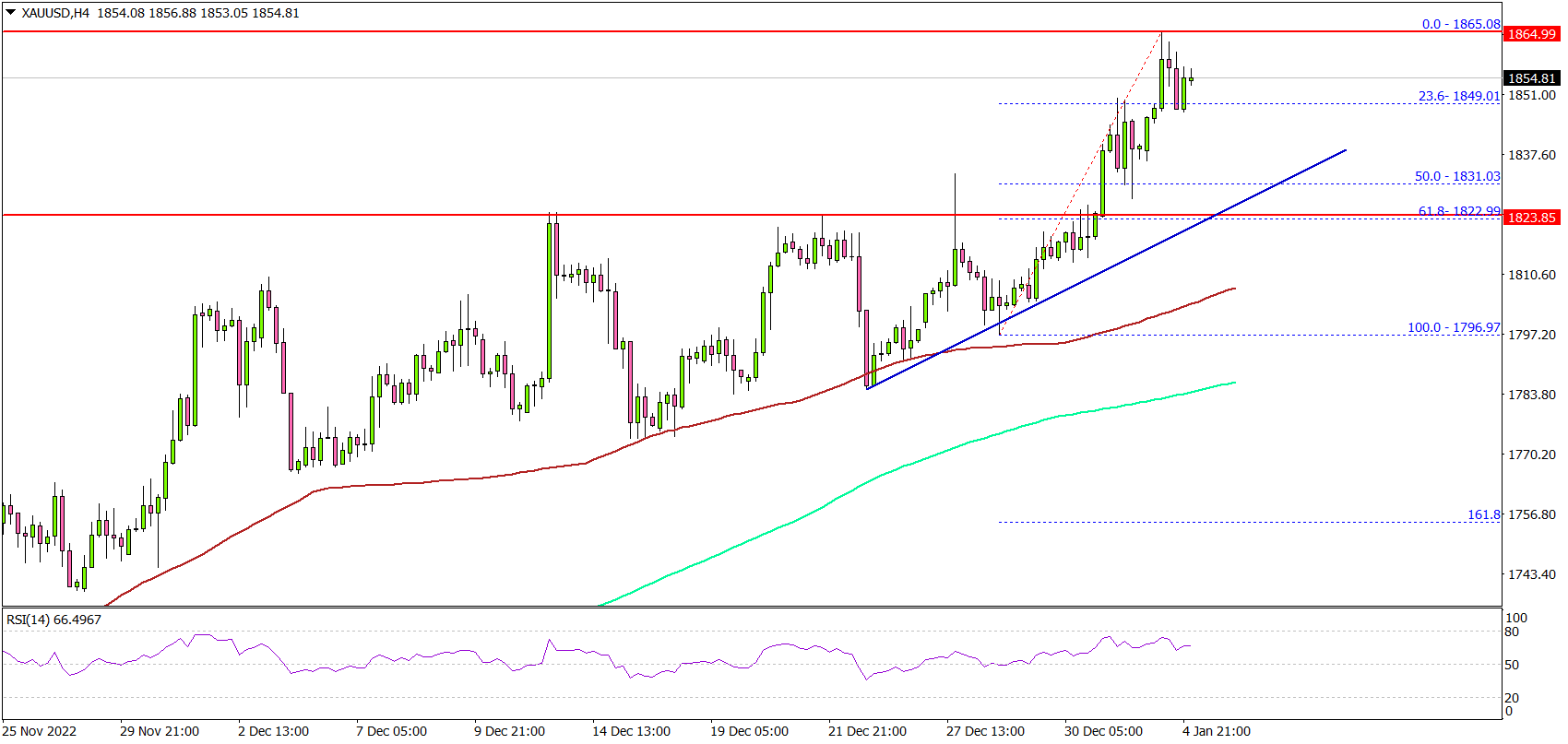
The 4-hours chart of XAU/USD indicates that the price gained pace above the $1,820 resistance zone. The price even moved above the $1,850 level and settled well above the 100 simple moving average (red, 4-hours) plus the 200 simple moving average (green, 4-hours).
The price tested the $1,865 and started a consolidation phase. On the upside, the price might face sellers near the $1,872 level.
The next major resistance is near the $1,880 level. Any more gains might send the price towards the $1,900 resistance level, above which gold price might revisit the $1,920 resistance.
On the downside, an initial support is near the $1,840 level. There is also a connecting bullish trend line forming with support near $1,835 on the same chart.
The next major support is near the $1,822 level. The main support is near $1,800, below which gold price might struggle to stay above the $1,780 zone.
Looking at EUR/USD, the pair could attempt a fresh increase if it clears the 1.0700 resistance zone in the coming sessions.
Economic Releases to Watch Today
- US Initial Jobless Claims - Forecast 225K, versus 225K previous.
- US ADP Employment Change for Dec 2022 - Forecast 150K, versus 127K previous.
Fed Minutes Showed Continued Commitment to High Policy Rates Through 2023
The minutes from the December 13-14, 2022 Federal Open Market Committee (FOMC) meeting showed that the Fed remains committed to bringing inflation back to target.
On the progression of the economy, the Committee members noted that "recent indicators pointed to modest growth of spending and production. Nonetheless, job gains had been robust in recent months, and the unemployment rate had remained low. Inflation remained elevated, reflecting supply and demand imbalances related to the pandemic, higher food and energy prices, and broader price pressures."
Committee members anticipated that "ongoing increases in the target range for the federal funds rate would be appropriate to achieve the Committee’s objectives." No participants believed that it would be appropriate to move from a restrictive position in 2023.
Participants recognized the risks of their policy actions by stating that "the lagged cumulative effect of policy tightening could end up being more restrictive than is necessary to bring down inflation to 2 percent and lead to an unnecessary reduction in economic activity".
Key Implications
Today's release reaffirms that the Fed isn't done hiking and that member's expect rates to remain at elevated levels through this year. Even with the Fed's past actions, more progress must be made before it can confirm that inflation is on a sustainable downward trajectory. Indeed, while recent inflation prints have signaled a modest deceleration, inflation remains well above the Fed's 2% target.
With economic activity expected to slow markedly in 2023, recession fears continue to capture headlines. These fears continue to be reflected in the spread between the U.S. 10-year and 2-year Treasury yields, which remains in negative territory. Looking forward, we expect the Fed will continue to raise rates, reaching a peak of 5%, before pausing to monitor the impact on economic activity and inflation over the remainder of 2023.
USDJPY Wave Analysis
- USDJPY reversed from support area
- Likely to rise to resistance level 135.00
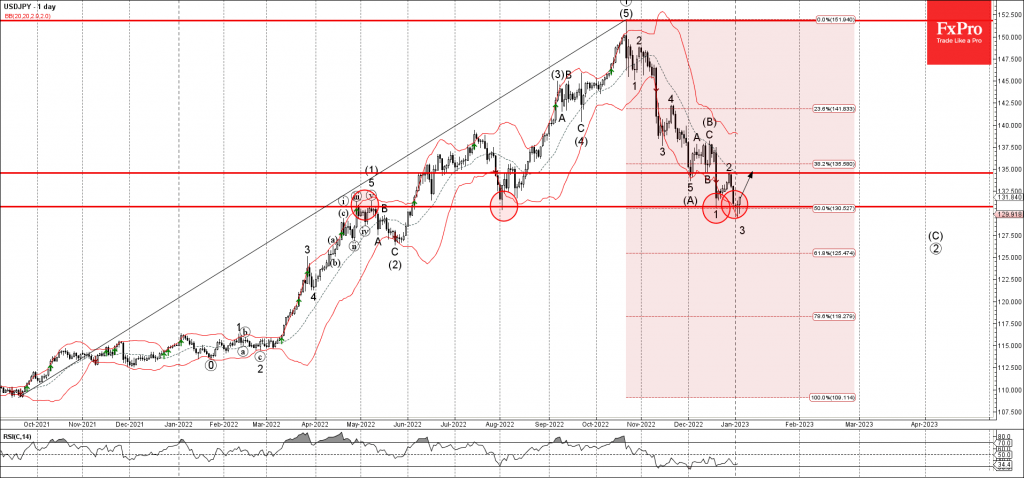
USDJPY currency pair today reversed up from the support area located between the major long-term support level 130.75 (which has been reversing the price from May) and the lower daily Bollinger Band.
This support area was further strengthened by intersecting 50% Fibonacci correction of the previous extended weekly uptrend from the end of 2021.
Given the clear daily uptrend, USDJPY can be expected to rise further toward the next resistance level 135.00 (top of the previous minor correction 2).
Brent Crude Oil Wave Analysis
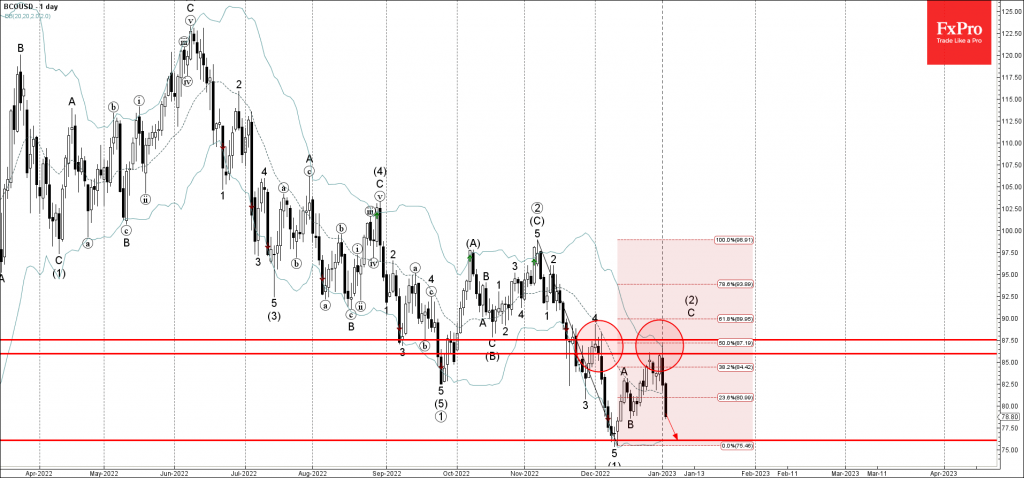
- Brent crude oil reversed from resistance area
- Likely to fall to support level 76.10
Brent crude oil under the bearish pressure after the price reversed down with the daily Bearish Engulfing from the resistance area located between the key resistance levels 87.5 and 85.00.
This resistance area was further strengthened by the upper daily Bollinger Band and by the 50% Fibonacci correction of the previous sharp intermediate downward impulse wave 1 from the start of November.
Given the clear daily downtrend, Brent crude oil can be expected to fall further toward the next support level 76.10 (which stopped the earlier impulse wave at the start of December).
Chinese Coal Rumors Boost AUD
The AUDUSD caught a bit of a bid yesterday on rumors that China might lift its ban on coal imports from Australia. This could have an important impact on the Australian currency. But, it could also not end up becoming effective, since this rumor has gone around before. Given the situation, it's good to know what the potential impact would be, so traders can be prepared for either eventuality.
The facts
China is, of course, Australia's largest trading partner, and used to be the largest buyer of Australian coal. China has a high demand for coal, as well. Both for manufacturing steel as well as for producing electricity.
But, in order to understand the situation, it's important to remember that not all coal is the same. Coal used for making steel - coking coal - is rarer and more expensive. Also, Australia has a lot of it. It can be used for producing electricity, but thermal coal can't be used for making steel. Thermal coal is a lot more abundant around the world, and Australia also produces it. But so does China.
The worsening and improving situation
China unofficially banned the import of coal from Australia back in 2020, after Australia took a hard stance on covid. The Australian government under Morrison even demanded investigations into the origin of the virus, pointing the finger at Chinese authorities. Since then, China has imported hardly any thermal or coking coal. Before the ban went into effect, China imported over $9.0B in coal per year.
There is a new government in Canberra, and Albanese has made it a priority to repair relations with Beijing. At the end of last year, he held a telephone conversation with Xi, following a visit by Australia's foreign minister to China in a bid to improve relations. It's thought that China could start lifting some of the ban on coal as part of a thawing of relations between the two countries.
The other factors to keep in mind
This isn't the first time the rumor has gone around. Back in July, there were press reports that China was looking to reverse the unofficial ban. Naturally, that didn't happen in the months since. The difference this time around is that the rumor comes in the aftermath of high-level talks between the two countries.
The other factor is that China is facing energy challenges. The country is looking to make its energy matrix a lot more green, and phase out coal. Particularly considering that China produces brown coal, which can be used to generate electricity, but is much more polluting than the thermal coal sourced from Australia. Already last year, China was facing energy restrictions due to a combination of factors, such as environmental restrictions, a drought, and high costs of alternative fuels such as petroleum because of the war in Ukraine.
As China reopens from covid and demand for both energy and steel would be expected to ramp up in the coming months, it's logical to think China would be looking to secure coal supplies. The increase in trade could mean more demand for Australian dollars, supporting the currency. After all, coal represented a little under 10% of the total ore exports of Australia to China.
Nonfarm Payrolls to Set the Tone for US Dollar in New Year
Trading in the new year will fire up with the latest US employment data on Friday. Forecasts point to another solid jobs report, although business surveys warn that the labor market has started to lose steam. As for the dollar, calls about its demise and a bearish trend reversal still seem premature.
Dollar wins 2022 - what about 2023?
The US dollar rally lost some steam in the final stages of 2022, but nevertheless, the reserve currency still came out as the big winner of the year. It was a story of interest rate differentials as the Fed raised rates faster than other central banks, safe-haven flows, and an absence of any attractive alternatives.
Looking into 2023, the question is whether the dollar will remain the 'alpha' in the FX complex or whether a bearish reversal is on the cards. There's a case to be made that it might be a year of two halves, with dollar strength persisting early in the year, only to reverse later on.
The logic is that America is in better shape than most other economies, partly because its vast energy production helped shield it from the global power crisis, and partly because higher interest rates take longer to impact US economic activity. Most US mortgages are on fixed rates, so it takes some time before higher rates can slow the economy, as most homeowners are not directly affected.
In contrast, other economies such as the Eurozone, United Kingdom, Australia, and Canada have many of their mortgages at variable rates that reset each year. This means the harmful effects of higher rates in these economies will show up much faster, setting the stage for a period where America outperforms mostly because of policy transmission lags.
Nonfarm payrolls expected solid
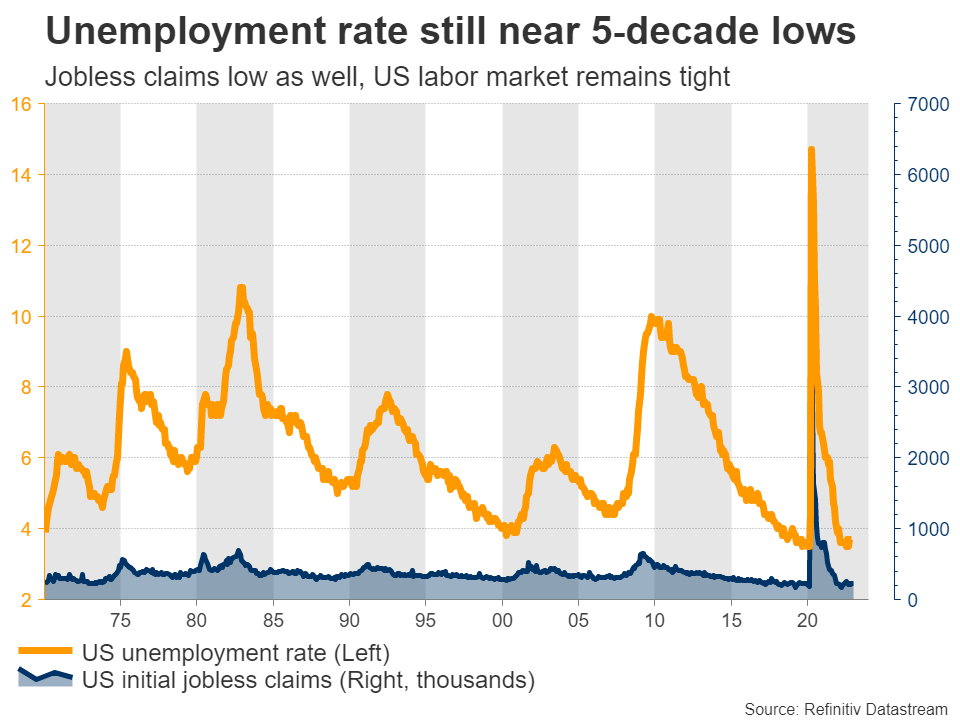
This is also why the US labor market has not shown any signs of damage from higher rates yet. Economists expect another solid employment report for December, with nonfarm payrolls anticipated at 200k and the unemployment rate seen unchanged at 3.7%. The only dark spot is wage growth. Average hourly earnings are projected to have slowed to 5.0% in yearly terms, from 5.1% in November.
As for any risks, the number of people filing for unemployment benefits remained low during the month, so this dataset won't reflect any real job losses. That said, business surveys from S&P Global noted that employment levels barely rose and job creation almost crawled to a halt, which suggests weakness is slowly creeping in. In other words, the jobs market is losing steam, but it's probably too early for that to show up.
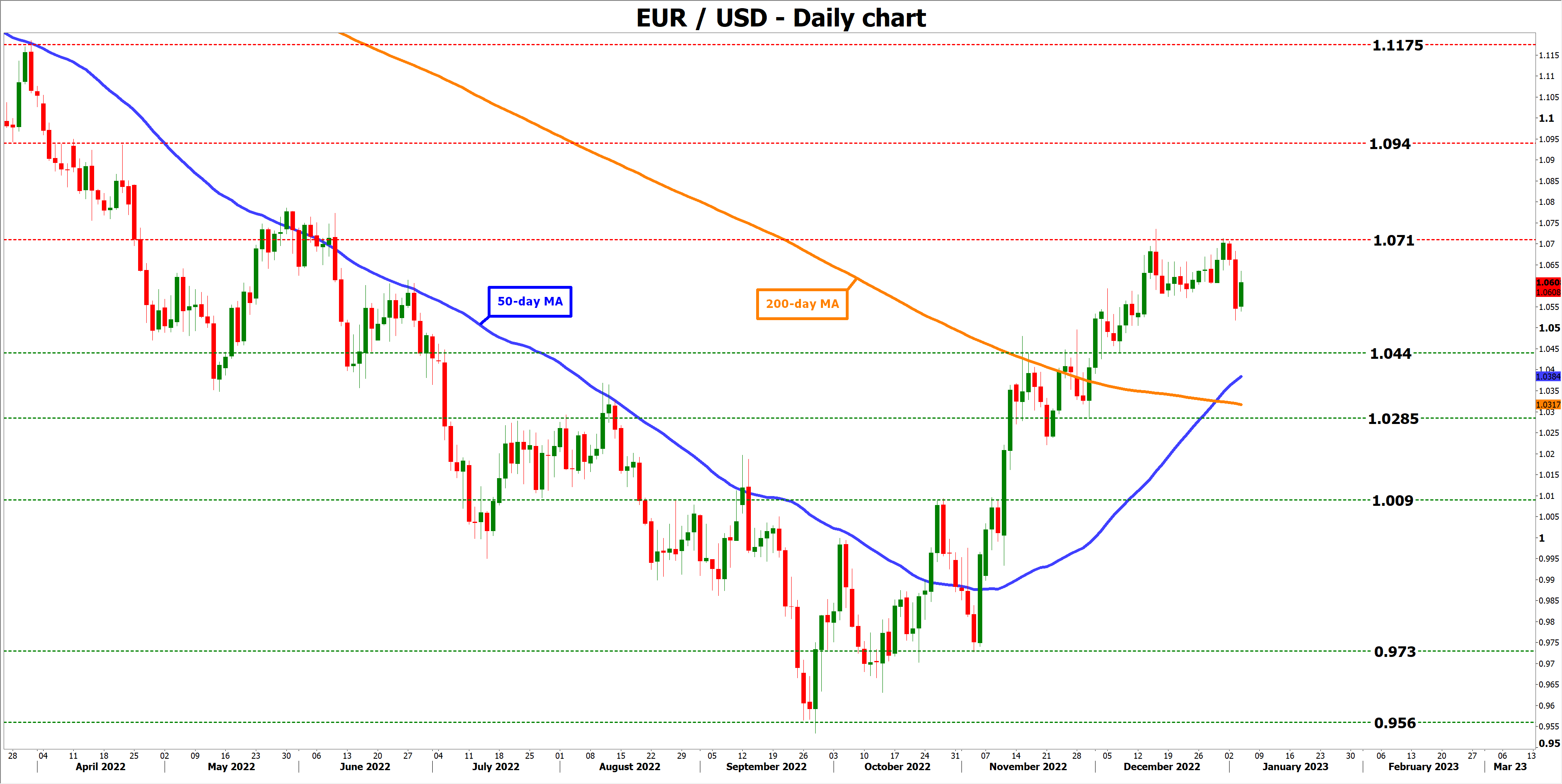
Market pricing currently suggests the Fed will slow down the pace of its rate increases next month. In case of a strong jobs report though, traders might have second thoughts about that, helping to boost the dollar. Taking a technical look at euro/dollar, initial support to any declines may be found near the 1.0440 zone.
On the flipside, a surprisingly soft report could propel the pair higher, with the first obstacle to the upside likely to be the recent high around 1.0710.
Note that the ISM non-manufacturing survey will also be released shortly after the jobs report.
Dollar down, but not out
All told, calls for a bearish trend reversal in the dollar still seem premature. Even though the Fed is approaching the end of its tightening cycle, it might keep rates high for a longer period than other central banks will, because of the aforementioned policy lags.
On a simpler level, America is stronger than most economies. Business surveys suggest recession risks are greater in the Eurozone and United Kingdom, China is dealing with the painful deleveraging of its property sector, while nations like Canada and Australia have housing markets that are vulnerable in a higher rate environment.
Historically speaking, the dollar tends to depreciate when the global economy is booming and capital leaves the United States, searching for higher returns abroad. That's not the case today, hence why it is still too early to envision a sustained downtrend in the reserve currency.